




Abstract
This article examines police strip-searching practices in the UK. Drawing on newly acquired Freedom of Information data, publicly available testimonies, thematic analysis of official literature and media reports, and first-hand experience, we advance three arguments. First, strip-searching is used systematically, not exceptionally, and targets young people and people of colour, especially Black young men and boys. Second, strip-searching in practice is demonstrably excessive when measured against its stated rationales of ‘crime’ detection and ‘caring’ for detainees; we unpick the circular logics through which it is legitimized in official and public discourse. Third, drawing on Sharpe's notion of the abject, we argue that strip-searching, as a form of normalized sexual violence folded into the rubric of ‘care’, is part of a project of abjectification that aims to exclude the individuals and groups it targets from social and political subjecthood.
Introduction
This is a sexual assault … It will never happen to Edward that's living in Sussex. […] It happens to us. (Ellis, strip-search survivor, quoted in Archer and Mureithi, 2022)
While resistance has cast a spotlight on the practice, and on broader contexts of institutional racism, misogyny and sexual violence in British policing (Chakelian, 2021; Elliott-Cooper, 2021), there has been little scholarly attention to its scale, targeting, impact and function. Just one UK-based peer-reviewed study exists, focusing on a single police station in Kilburn (Newburn et al., 2004). By comparison, the harms of stop and search (a practice comparable to US stop and frisk) are more widely discussed (Elliott-Cooper, 2016; Flacks, 2020; Shiner and Delsol, 2015). That literature is relevant since many strip-searches take place as part of stop and search operations, and its theorizations of institutional racism inform our analysis.
Elsewhere, more has been written. In the Australian context, for example, Grewcock and Sentas (2021: 204) describe strip-searches as ‘visible assertions of police power’, arguing that they are ‘inherently invasive and easily deployed by police as a mechanism for intimidation and abuse’. In the United States, Davis (2003: 81) considers their use in prisons as a form of sexual assault designed to terrorize incarcerated people. While there are important specificities to the histories of racial and sexual violence in these settler colonial contexts (Razack, 2020; Richter-Montpetit, 2014), as we will argue, strip-searching operates in British policing in a comparable manner: as a mechanism of intimidation and abuse that serves both visibly and invisibly to other, and suppress resistance by, targeted groups.
Aims and argument
This article is intended as a contribution to zemiology: the study of social harm (Canning and Tombs, 2021). Zemiologists explore how harms are (re)produced in ways that the concept of ‘crime’ cannot account for and may serve to conceal (Hillyard and Tombs, 2007, 2017). While there has been some focus on state-enacted harms and specifically those produced by border control (Canning, 2018; Soliman, 2021), there is surprisingly little zemiological work investigating harms of policing. By incorporating the state-inflicted harms of policing into our zemiological analysis, we respond to Parmar (2017) and Phillips et al.'s (2020) call to bring questions of race into the centre of British criminology.
The harms of strip-searching are not incidental or exceptional to the operations of policing and carceral institutions. Rather, they are functional insofar as these institutions exist to enforce oppressively hierarchical (gendered, racialized, classed and ableist) social ‘orders’ (Chowdhury, 2021; Elliott-Cooper, 2021; Neocleous, 2014; Thompson, 2021; Woodman, 2021). 1 We argue that strip-searching is a form of normalized sexual violence folded into the rubric of ‘care’, which is part of a project of abjectification (a concept we explain below) directed against groups who are stigmatized and dispossessed within these orders.
This account has consequences for how to address the harms of strip-searching. It reveals the problems with existing policies and standard reform proposals, pointing to a need for radical curtailments of police powers amid—and as a prerequisite for—broader social transformations. While our analysis focuses on police forces, future research could consider its application to other carceral settings including prisons, immigration detention, psychiatric spaces and the ‘care’ system.
Key concepts: Abjectification and sexual violence
To abjectify means to expel a person or group ‘from the realm of the human’ (Sharpe, 2016: 14). By abjectification we understand a process of exclusion from social and political subjecthood that aims: to mark its targets as violable, both individually and collectively; to strip them of their capacity to resist; and to undermine solidarity with and among policed subjects. The impacts of strip-searching, on this account, are not just on individuals but on communities, collective identities and social structures. We draw on a notion of the abject as provoking visceral reactions of disidentification such as horror, contempt or disgust, without invoking a specifically psychoanalytic account (Kristeva, 1982; cf. Tyler, 2009).
Abjectifying processes are material and ideological. They use concrete technologies of control—handcuffs, leg restraints, police vans and cell floors, the muscles and fingers of officers—to threaten and inflict bodily forms of violence. Simultaneously, they operate through discourse. Laws and policies, police-speak in the form of official rationalizations and unofficial banter, public discussions and media representations of strip-searching and its targets—all are sites where the project of abjectification is enacted. We are concerned with how the material and ideological aspects of abjectification interact, and how they can be disrupted.
The claim that strip-searching amounts to ‘state-sanctioned sexual assault’ emerges from testimonies of those affected (4Front, 2022). It is not that strip-searching is always experienced as sexual violence; the perspectives of policed subjects will be diverse and complex. However, while the level of physical force can significantly affect how an encounter is experienced, the line between threatening and enacting sexual violence is often unclear. As feminist analyses of gendered violence emphasize, if you comply with a sexual demand or ‘invitation’ to avoid implicitly threatened violence then what is happening is already coercive (Duff, 2018; MacKinnon, 1989). We argue that the picture of strip-searching that emerges clearly from the data makes sense only once we recognize its power as (threatened or enacted) sexual violence to humiliate, discipline and demean—in short, to abjectify—its targets.
Methodology and structure
The article employs a mixed methods approach. In collaboration with the non-governmental organization (NGO) Release, we have collated and analysed FOI data on the extent and targeting of the practice. FOI requests, sent to all police forces in England and Wales, asked for the numbers of strip-searches carried out in a year period from 2018–2019, broken down by age, gender and ethnicity. We asked for similar statistics for 2016 to 2021, although fewer forces responded to this request.
We have undertaken a thematic analysis of media articles and grey literature on strip-searching that underpins our claims about official and public discourses on the issue. We analysed articles from three primary media outlets by searching for ‘strip search’ in the title and removing irrelevant items (e.g. where they related to non-UK events, strip-searching by non-police bodies and ‘digital strip-searching’). This process left us with 51 articles from the BBC, 16 from The Guardian and 22 from the Daily Mail. The articles collected span from 2013 to June 2023. We also analysed legal and grey literature including the Police and Criminal Evidence Act 1984 (PACE) and its guidelines, the College of Policing's guidelines, statements by police forces and complaints bodies (Independent Police Complaints Commission (IPCC)/Independent Office for Police Conduct (IOPC)), and NGO reports. We coded the articles thematically based on how strip-searches (in specific cases and generally) were either problematized or justified in a process informed by Braun and Clarke's (2022) work. We extract from this analysis key tropes and argumentative strategies that feature in the justificatory discourse around strip-searching, and subject these to ideology critique (Finlayson, 2016; Geuss, 2008: 50–55).
We also engage with publicly available testimonies of people who have been strip-searched to access on-the-ground realities concealed by official figures and narratives. These testimonies are drawn from research published by 4Front (2022). Their website states, ‘The following testimony has been gathered from children in a safe and sensitive way by specialist youth and community workers who have long-term, trusted, supportive and therapeutic relationships with them’ (4Front, 2022). We are informed by Koshka's first-hand experiences of being strip-searched and of the police complaints and civil legal processes that oversee the practice. Eight years after Koshka was forcibly stripped at Stoke Newington police station, she received an apology for ‘sexist, derogatory and unacceptable language used’ during the incident, although not for the strip-search itself (Duff, 2022).
We begin by setting out the legal frameworks that (purport to) govern strip-searching and present FOI data indicating the extent and targeting of the practice. Next, in the ‘Circular logics of legitimation’ section, we observe that strip-searching tends to be rationalized in official and public discourses on the grounds that it is necessary (a) to detect ‘crime’, and/or (b) to ‘care’ for people in custody. This section argues that these rationales fail to justify and account for the realities of the practice, and unpicks the circular logics upon which these justificatory discourses rest. In the section entitled ‘Resisting abjectification,’ we theorize strip-searching as part of an abjectifying project that is functional to the enforcement of hierarchical ‘orders’ and consider how that project is and can be resisted.
Throughout, we focus on gender and race because sexual violence is always gendered, and our data demonstrate the racialized nature of strip-searching practices. Their simultaneously classed character is equally significant, but harder to glean from records. Likewise, figures are not recorded for the incidence of strip-searching against Gypsy, Roma and Traveller (GRT), LGBTQ*, disabled and neurodivergent communities. The institutional ableism evident in the police's use of mental health discourse to legitimize strip-searches requires careful treatment that is beyond the scope of this article, but would need to be part of a fuller analysis (Rowe et al., 2022).
Strip-searching on paper and in practice
On paper
Section 1 of PACE provides the most used powers to strip-search during a stop and search and s32 authorizes searches in police custody. The police are granted further powers to strip-search under s43 Terrorism Act 2000 and s23 Misuse of Drugs Act 1973. PACE's associated Codes of Practice provide guidance as to how the police should treat those subjected to strip-searches.
Under PACE Code A, police strip-searches take two forms. First, a ‘More Thorough Search’ (MTS, or partial strip-search) is a strip-search in which more than the outer layer of clothing is required to be removed. Under PACE Code A paragraph 3.6, this must be done out of public view and can be conducted in a police vehicle. A second form of search is one that ‘Exposes Intimate Parts of the body’ (also known as an EIP, or full strip-search). PACE Code A paragraph 3.7 states that an EIP search must be done out of public view in a police station but not in a police vehicle. Despite the terminology centring on mere exposure, EIP searches can and do involve touch and force being applied. 2 In addition, under s55 of PACE a police officer at inspector level can authorize an ‘intimate search’, defined as ‘a search consisting of the physical examination of a person's body orifices other than the mouth’. According to Code C, ‘Strip-searches shall not be routinely carried out if there is no reason to consider that articles are concealed.’ The search should be done by a person of the same sex and except in ‘cases of urgency’ there should be at least two people present.
Strip-searching of children by police is lawful with some added conditions. For children under 18, an appropriate adult should be present unless the child has specifically requested that one is not present, or the police officer deems it too urgent. Until challenged by judicial review in 2013, children aged 17 were treated as adults when in custody. 3
In practice
Despite policy documents downplaying its routine nature, 4 the FOI data we obtained suggest that strip-searching is a standard policing tactic across England and Wales. Our figures will in some cases be underestimates. Strip-searches are not reported systematically in police ‘use of force’ statistics, and the Home Office began attempting to compile data only in October 2022 (Home Office, 2022) . The decentralized responsibility to gather and publish data and respond to FOI requests (Kingston et al., 2019) means there is a lack of uniformity and transparency in how data are compiled across forces; consequently, they are sometimes not directly comparable. Some large forces such as Merseyside Police and Greater Manchester Police are not accounted for because they have refused to provide data on strip-searching, citing reasons of cost and the time it takes to extract data from records.
Furthermore, some practices of stripping people in custody (such as when clothing itself is regarded as the unsafe item) would be legally considered a search but not necessarily recorded as such. 5 There are strip orders that may not be recorded under strip-search figures—for example, it is unclear if and how Child Q's strip-search on school premises would have been recorded. Records may not distinguish between degrees of strip-searching (the removal of shoes, for example, may be recorded as a strip-search in some cases), nor where the authorization for a strip-search was granted but the search not carried out. Finally, searches conducted in custody are recorded on separate systems from those conducted as part of stop and search operations, further obfuscating the scale of the practice. Nonetheless, our figures indicate something of its extent and who it targets.
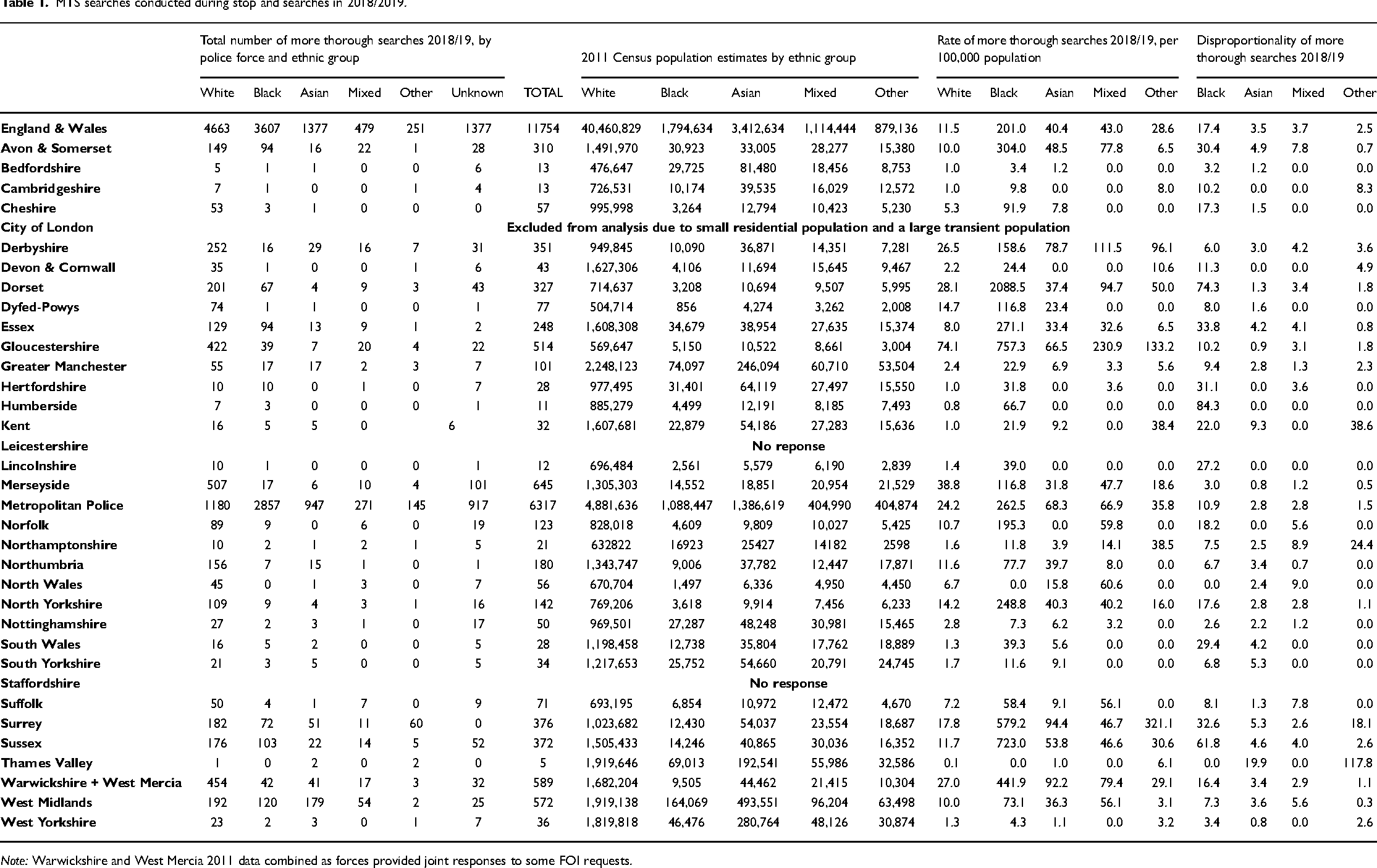
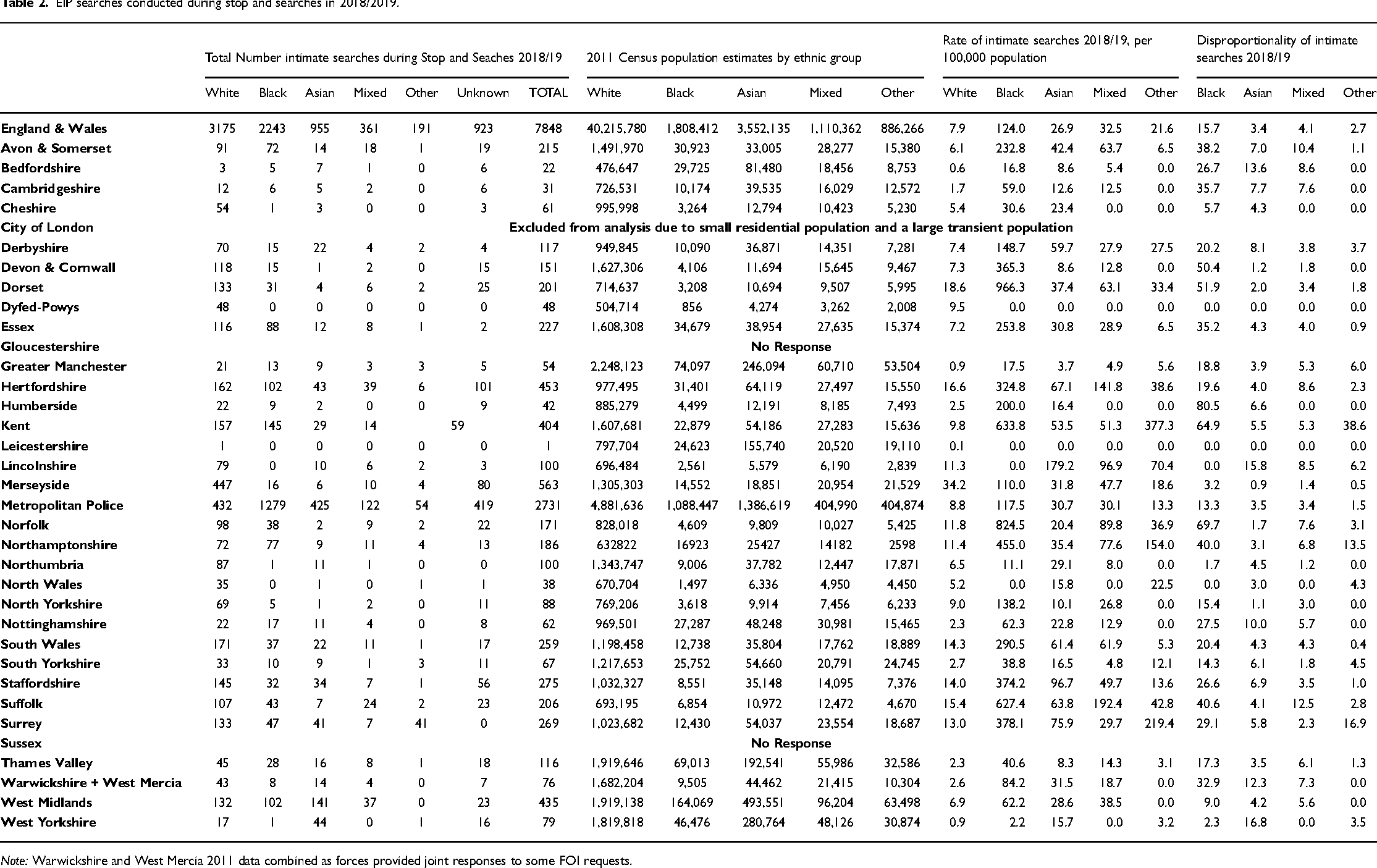
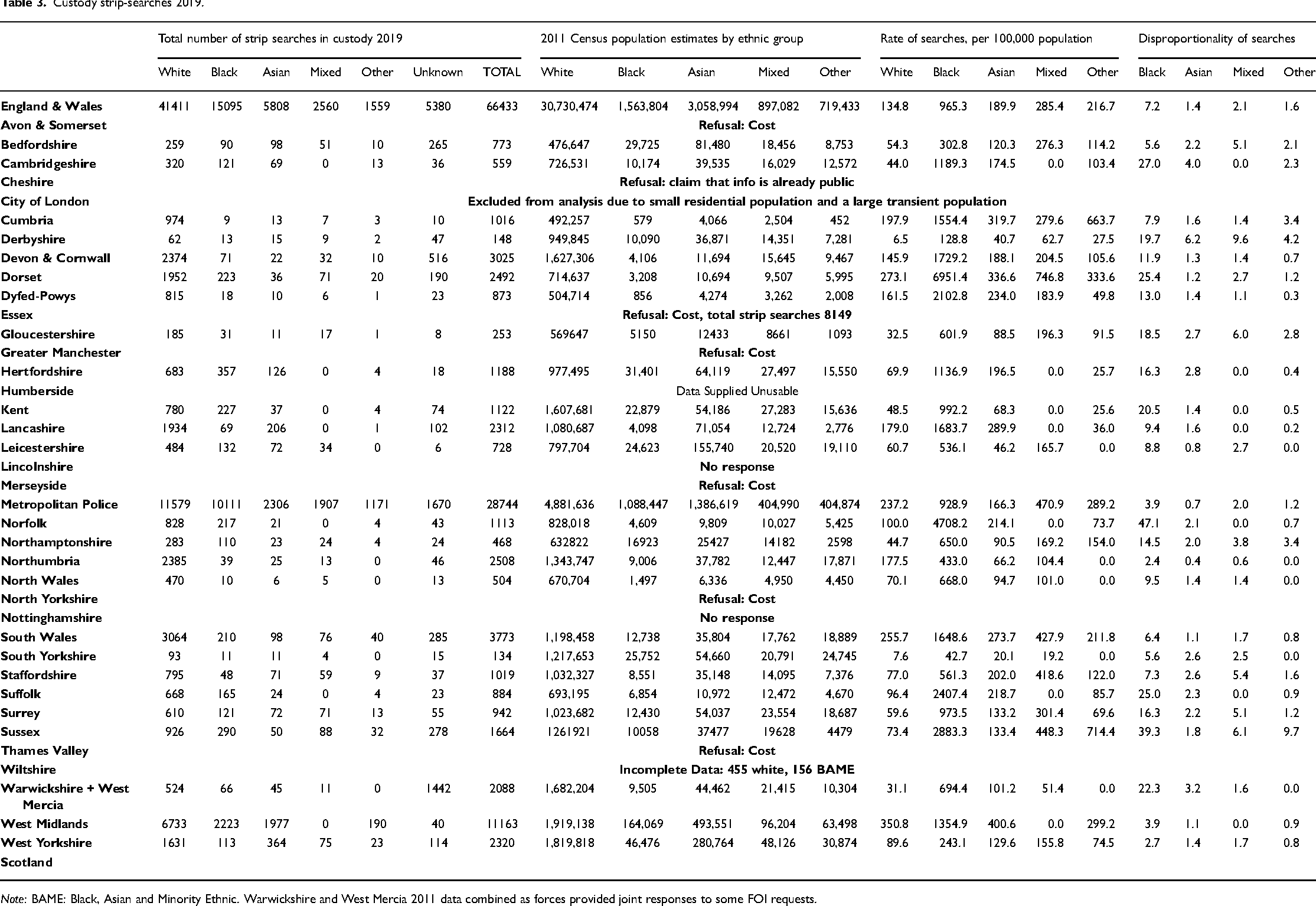
Tables 1, 2 and 3 provide the results of FOI data collection conducted by the authors and the NGO Release. They identify the numbers of MTS and EIP searches conducted during stop and searches (Tables 1 and 2) and numbers of strip-searches conducted in custody (Table 3). These tables also record the numbers of strip-searches by ethnicity with an estimated rate of disproportionality for each area. The rate of strip-searches is calculated by dividing the number of strip-searches conducted on people of each ethnic group by that group's population as ascertained by recent census data. The disproportionality measure is arrived at by dividing the rate of searches conducted on Black, Asian, Mixed and Other groups respectively by the rate of searches conducted on white people. In England and Wales, there were 11,754 MTS searches that occurred during stop and searches in the one year period spanning 2018/2019. Seventy-five per cent (n = 8777) of these were recorded as searches for drugs. In the same period, 7848 EIP searches were carried out with 90% (n = 7057) recorded as conducted to search for drugs.
MTS searches conducted during stop and searches in 2018/2019.
Note: Warwickshire and West Mercia 2011 data combined as forces provided joint responses to some FOI requests.
EIP searches conducted during stop and searches in 2018/2019.
Note: Warwickshire and West Mercia 2011 data combined as forces provided joint responses to some FOI requests.
Custody strip-searches 2019.
Note: BAME: Black, Asian and Minority Ethnic. Warwickshire and West Mercia 2011 data combined as forces provided joint responses to some FOI requests.
Using 2011 regional census data, we can see that Black people are 17.4 times more likely to be subject to an MTS than white people. The figure is 15.7 times for EIP searches. Black people are 13.3 times more likely to be subject to an EIP search by the Metropolitan Police. This year is not exceptional: 54% of all stop and search strip-searches conducted between 2018 and 2021 (n = 44,528) by the Metropolitan Police were conducted on Black people. Separate FOI data gathered by the authors show that West Midlands police force—which covers Birmingham, Coventry, Wolverhampton and the Black Country—reported 2444 strip-searches during stop and searches in the six years from 2016 to 2021. The racial bias is stark: 595 (24.3%) are conducted on white British people, 951 (38.9%) on Asian people and 510 (20.8%) on Black people. Compare this with the demographic data for this area: 70% white, 6% Black and 18% Asian.
There were at least 66,433 strip-searches conducted in custody in 2019. In England and Wales, Black people are 7.2 times more likely to be subject to a strip-search in custody than white people. Again, there is significant racial disproportionality in London but in areas such as Cambridgeshire, Dorset, Norfolk and Suffolk the rate is even worse, with Black people over 20 times more likely to be searched. The disproportionality in these figures is not explained by racial bias in the arrest rate. White people have an arrest rate of 9 per 1000 people, Black people have an arrest rate of 29 (UK Government, 2022). So Black people are 29/9 = 3.22 times more likely to be arrested, but about 7.2 times more likely to be strip-searched in custody.
In both settings, the majority of people strip-searched are young men. Women and girls make up 7.2% of those stripped during a stop and search. Across the 18 forces that we have data for, under 17-year-olds account for 10% of MTS searches. Looking at the Metropolitan Police data for custody searches, younger men were again those predominantly subject to strip-searching. In 2019, 56.4% (n = 16,945) of people strip-searched by the Metropolitan Police were under 30, including 1632 children. Reported data show that ‘of 5,279 children searched in the past three years, 3,939 (75%) were from ethnically diverse backgrounds’ (Venables, 2022). While women and girls are strip-searched less often, racial disproportionality is observable when they are. The NGO Liberty found that ‘Black female children are 2.7 times more likely than their white counterparts to be subjected by the Metropolitan Police to the most invasive [EIP] form of strip search’, based on figures from 2017 to 2022 (Gidda and Thomas, 2023).
In the stop and search context, where the primary ‘justification’ recorded is suspicion of drugs, 61% of MTS searches and 57% of EIP searches result in nothing being found. We do not have data for a national figure of in-custody strip-searches but in 2019 for West Midlands police, 7.9% of strip-searches resulted in ‘an item’ being found (n = 11,401).
The data provided here give a sense of how frequently strip-searches are conducted and who the targeted populations are. More research is necessary to establish firmer numbers, but it is worth highlighting here the patchy response rates from police forces to FOI requests, and the inconsistency and incompleteness of their data. These problems in recording and reporting could plausibly be regarded as ‘functional incompetence’: a failure (or refusal) to adhere to basic professional standards of transparency, which operates to allow institutions to avoid challenge (see Ahmed, 2021).
Circular logics of legitimation
Our media analysis indicates that, over the past five years, reported police statements have rarely attempted explicitly to justify the practice of strip-searching. Rather, they comment on a specific incident, such as the strip-search of ‘Child Q’ referenced earlier, without drawing the legitimacy of broader policies into discussion. This media strategy differs from the more forthright approach evident in earlier communications. In 2014, for example, the Metropolitan Police responded to news coverage about searches of children by reiterating what they took to be the value of the practice: ‘Strip-searching is a vital power in police custody, not only to identify and seize evidence, but also to ensure the safety and security of all detainees and staff’ (BBC News, 2014).
When incidents and policies are justified by the police and in public discourse, this tends to be by appeal to the following rationales:
The ‘crime detection’ rationale: strip-searching is necessary for the detection of crime because it uncovers ‘forbidden items’ such as restricted substances or weapons, and evidence such as stolen goods. The ‘care’ rationale: strip-searching is necessary to fulfil a duty of care towards detained persons by reducing the risk of them harming themselves (or others) while in custody.
These are sometimes framed in terms of ‘what if?’ scenarios that position strip-searching as the lesser of two evils. Counterfactual scenarios—or ‘foils’—standardly cited as the greater evils that strip-searching avoids include: more deaths in custody; more extensive use of restraint and supervision; and unchecked ‘criminality’ that places more vulnerable people at risk.
Such claims, with minor variations, are routinely deployed to legitimize the practice and its scope and targeting (where these are acknowledged). For instance, in response to protests over their treatment of Child Q, a Metropolitan Police spokesperson stated: While some may question whether any child should be subject to a MTIP [More Thorough Search where Intimate Parts are exposed, more standardly referred to as an ‘EIP’] or strip-search, there are occasions when it is very necessary to prevent harm to children who may be exploited by gangs, County Lines and drug dealers. […] Used appropriately, stop and search powers [including strip-search powers] save lives and are an important tactic to keep Londoners safe, helping us identify criminality and take drugs and dangerous weapons off the streets.
We see these rationales replicated across official and unofficial discourses. A concern often raised on police Twitter is that, as one commentator puts it, ‘if under 18s are never allowed to be strip searched, imagine the sky high increase in their exploitation by predatory adults. It would be awful’ (Kempster, 2022). Similarly, a counterfactual logic is deployed by Police Foundation researcher Gavin Hales (2022) when he positions the high rates of strip-searching by the Metropolitan Police as indicators of a ‘risk-averse approach to young detainees in particular’, highlighting the possible ‘catastrophic consequences’ of failures to strip-search that ‘weigh heavily on the shoulders of Custody Sergeants’.
Crime detection and care are also invoked to justify strip-searching in individual cases. In a disciplinary hearing for the custody sergeant who ordered Koshka's strip-search, the officer was exonerated on the grounds that he ‘was unable to ascertain from Dr. Duff whether she suffered from any mental illness, other vulnerability or whether she was on drugs’ (Gayle, 2018). The rationale given in the custody record does not mention mental health concerns, but states: ‘REFUSES TO tell Police her IDENTITY .. [sic] DP [Detained Person] may have weapons or other items concealed […] DP BEING OBSTRUCTIVE FOR REASONS UNKNOWN.’
In the following sub-sections, we identify multiple circular logics at work in these rationales. First (‘Analytical atomism’), they justify strip-searching in response to, or in order to avoid, harms that the police themselves are implicated in producing. Second (‘Bureaucratic bad faith and banter’), they trade on the assumption that if something is ‘normal’ in policing then it must be fine, using policing's routinization of violence to justify itself. Third (‘Abjectifying projections’), they draw on racist and patriarchal imaginaries to portray strip-searching's targets as already abject, then use the humiliation of the procedure to ‘prove’ this. Any resistance someone offers is taken to cement their status as a dangerous element in need of violent control, while compliance is presented as a marker of the harmlessness of the practice.
Analytical atomism
Very often criminal gangs exploit young people to transport drugs concealed in intimate body cavities … It is important that these searches get done to safeguard young people who may be getting exploited. In respect of the strip-search policy, our approach has always been based on minimising the risk to detainees as their safety is our main priority.
These approaches fail to question the conditions and decisions that brought people into custody. They do not ask whether the mental health crisis supposedly ‘justifying’ the search might have been prevented or mitigated by access to secure housing and health care. The context of state and, more broadly, societal abandonment in which criminalization often occurs (Hudson, 2021; Wacquant, 2009) is treated as given. The role of violently enforced inequality and social marginalization in the production of trauma and mental illness is ignored (Various, 2021). In this way, strip-searching functions as another site in which a ‘neo-liberal humanitarian morality’ (Sözer, 2020: 2168) mobilizes vulnerability in order to legitimize limited and (either immediately or ultimately) harmful forms of ‘assistance’ (Aliverti, 2020).
Likewise, the ‘need’ to strip someone to search for concealed substances only arises in a context where there is a policing imperative to uncover certain substances, and a motive for people to conceal them (or exploit children to carry them). These are not imperatives we have to accept. Far from justifying the practice, pointing to the routine strip-searching of children as a ‘necessary’ consequence of the criminalization of drugs rather adds to the wealth of evidence that criminalization exacerbates drug-related harms (Koram, 2019; Shiner et al., 2018). Given the connections between economic disadvantage, drug-related harms and mental health outcomes, a realistic approach to harm reduction would address the criminalization of poverty by removing punitive sanctions for rough sleeping, begging, loitering, shoplifting and so on (National Harm Reduction Coalition, 2020; Various, 2021).
Arguments for the practice therefore replicate the ‘analytical atomism’ that Neu (2017) criticizes in liberal discourses that legitimate sweatshops, torture and war. This atomism legitimizes the status quo by framing the available ‘foils’ in ways that obscure the complicity of liberal states and corporate actors in producing the very evils—extreme poverty, non-state terrorism—that are then invoked as warranting a violent response. Defenders of sweatshops, for instance, present us with ‘rational choice’ scenarios between (A) scavenging on trash dumps to survive and (B) the ‘lesser evil’ of suffering hyper-exploitation and sexual harassment in a sweatshop. In these presentations, ‘it is assumed that there is no connection between those who are scavenging on the trash dumps and those who grant them the opportunity to work in a sweatshop instead’ (Neu, 2017: 17). Viewed in abstraction from the global operations of racial capitalism and (neo-)colonial extraction, and with no attention to the struggles of those who survive and resist them (Kumar, 2020), it appears common-sensical that simply removing the option of lesser-evil B does not improve anyone's situation. Sweatshops emerge as justified.
Analogously, defences of strip-searching do not deal with the role of police in creating the harms they are then called upon to address. Instead, they assume that ‘identifying criminality’ (Venables, 2022) is automatically a good thing, as though ‘crime’ and harm were equivalent; when presenting the risks of failing to strip-search, they also tend to assume that if someone is in police custody, that is where they should be (BBC News, 2011). These moves obscure the political nature of criminalization (Elliott-Cooper, 2021: 86-110; Duff, 2017; Woodman, 2018) and the role of police activity itself in the creation of ‘crime’ and social harm (Hudson, 2021).
There may be a limited number of circumstances where strip-searching someone is less harmful than alternatives available within policing's existing imperatives. However, even leaving aside what proportion of actual strip-searches satisfy this criterion, pointing to such cases cannot justify the practice. A decontextualised preoccupation with these (real or imagined) incidents diverts attention from the urgent need to transform the oppressive conditions that systematically generate and naturalize scenarios where ‘state-sanctioned sexual assault’ can appear the least bad option.
Bureaucratic bad faith and banter
Imagine being 14, 15, 16. You’re in a room with grown men, four strangers, grown men telling you take off your clothes, bend over and squat. They’re watching you. They’re watching you—and the funny thing is they are bantering, they’re laughing about it. It would take seconds to pull a razor blade from underwear, and slit a throat. I prevented a 15 year old girl from doing just that, by requiring a strip search. Life saved. Alternative? Hours, even days, of handcuffs behind the back. Barbaric.
Public-facing statements from the police emphasize the ‘respect, dignity and empathy’ (Venables, 2022) with which searches should be carried out. Characteristically of this discourse, the defence filed by the Metropolitan Police to Koshka's civil claim states: ‘The claimant was strip searched in an appropriate and lawful manner […] it is further denied that any officer made threatening [or] otherwise inappropriate comments.’ CCTV from her detention shows the custody sergeant instructing his team to ‘treat her like a terrorist’ and officers mocking the smell of her underwear (Gayle, 2022). Across official records more broadly, euphemism and missing data abound. Many police forces will provide strip-search figures only for the 20-and-under or 19-and-under age brackets, making it difficult to ascertain the number carried out on legal minors. The squeamishness that afflicts legalistic definitions of searches leaves outsiders to piece together for themselves what ‘contact’ with any ‘body orifice other than the mouth’ might feel like. Bureaucratic descriptors disappear violent realities.
Media discussions often home in on apparently exceptional details of specific cases. In doing so, they render ‘normal’ strip-searches as unproblematic. Over two-thirds (69%) of our media sample focused on strip-searching of children, for example. Although this focus is understandable, the rhetorical effect of locating the problem primarily in its use on children can be to legitimize and erase the harms of strip-searching adults (see Viterbo, 2022). This reporting further exceptionalizes harm by treating protocols (like the notification of parents or the presence of an ‘appropriate adult’) as ciphers for harmlessness. The absence of an appropriate adult is mentioned in 55 of the 89 articles in our sample. The question whether being examined naked in front of either yet another stranger or (formerly) trusted adult is necessarily less traumatic for a young person is never asked. 6 Where media discussions do question ‘standard’ police practice, rather than just cases where it has apparently not been followed, they often conclude with uncritical allusions to reforms such as ‘more and better’ training and new processes of authorization by senior police officers. In so doing, they reassure audiences that harm can be prevented while strip-searching continues.
The on-the-ground discursive environment in which strip-searching is situated—the world in which you are ‘tak[en] up for a strippy’ and officers debate whether you’re ‘rank’ after cutting off your clothes (Archer and Mureithi, 2022; Gayle, 2022)—gives the lie to the pious language of official communications. At the same time, the knowing cheekiness of slang terms and sexualized banter (BBC London, 2022) can perform similar ideological—and perhaps psychological—work to its more elevated counterparts by making sexual violence feel reassuringly routine.
During Koshka's search, one officer grabbed her breasts and another stuck her hand between Koshka's legs, ostensibly to ‘see if [she had] any more’ piercings. Investigating the incident, the police's Directorate of Professional Standards (DPS, 2016: 8) concluded: ‘PC [X] explained that […] neither she, nor any officer, touched you at all during the strip-search procedure. Should this have occurred, she would have challenged such behaviour and reported it to a supervisor.’ Officers insisting that it would be ‘wholly inappropriate’ to do things that they have in fact done (and could not have failed to notice themselves doing) is, in a sense, just straightforward lying. That officers’ false statements are unquestioningly accepted by the official mechanisms of accountability (officers ‘explain’ rather than ‘claim’, according to the DPS), bears out Reiner's (2015: xii) observation that guidelines may do more to shape the police's recording of incidents than to constrain their conduct.
The salient point here is the mismatch between the self-image of hard-nosed realism that strip-searching's defenders project, and the sanitization of reality that their defences depend upon. The attitudes of officers and the DPS, as revealed by these statements, exhibit an awareness of the violence that is necessary to the practice, alongside an awareness of the necessity of obscuring that violence. This suggests that they are cognizant the violence would be unacceptable (to a non-police audience, or perhaps even to themselves) if straightforwardly presented and recorded.
The bureaucratic euphemism of public-facing statements is contradicted by the unsavoury banter that surrounds strip-searching in practice. Yet they serve a similar end. Both make what is happening feel normal, feel routine. Within the lexicon of policing legitimization, presenting something as routine and normal means presenting it as unproblematic. ‘In incidents similar to this, it is common practice to cut clothing away in order to carry out an effective a [sic] search’, noted the DPS (2016: 21) as justification for Koshka's treatment. This is at odds with the impression given elsewhere in the report that officers touching her ‘at all during the strip-search procedure’ would be grounds for whistleblowing. Crucially, it only operates as a justification at all on the assumption that ‘common practice’ is the benchmark of correctness—that if it is normal it must be fine. The normalization of violence serves as its own justification.
Abjectifying projections
The spectacular inscription of violent subjugation marks the boundaries between ‘us’ and ‘them’, ranks bodies within the larger social order, […] as the very performance of violent bodily domination provides the visual ‘proof’ for ‘their’ social difference and hence differential status.
Take the suggestion that strip-searching, when all goes smoothly, is not especially or worryingly harmful. This view is contradicted by survivor testimony, which indicates that strip-searching in and of itself has harmful effects: ‘Showing your private parts to the people that you’ve never met before… it feels degrading and it feels like it's just a very really nasty feeling to be honest about how you feel inside’ (Strip-search survivor, quoted in 4Front, 2022). It is unlikely that the people who claim strip-searching is unproblematic when conducted ‘properly’ would regard themselves as cared for rather than violated if they were ordered, on pain of physical force, to strip naked in front of armed strangers. To maintain their position, therefore, they must imagine that the people the police do this to do not have the same level of sensitivity, the same dignity to lose. This helps explain why the cases recognized as harmful tend to be those where the police have done it to the ‘wrong kind’ of person. Some of the public sympathy in Koshka's case was filtered through her possession of social markers (‘professor of philosophy’, ‘Cambridge graduate’) that seemed to set her apart from policing's usual targets (Knight, 2022; see also BBC News, 2022).
When a search does not go smoothly—that is, when the violence it involves becomes more visible—police tend to blame the person targeted: they were non-compliant; they posed a threat to officers; they would not ‘be reasonable’. ‘You continuously struggled, failing to comply with the commands given. This resulted in your clothing being cut off in order to affect [sic] the strip-search’, wrote the DPS in Koshka's case; ‘officers tried to place you in a paper suit to preserve your dignity, however due to your resistance the upper half of the suit was torn’ (DPS, 2016: 12). The double-bind, of course, is that your compliance makes the search ‘consensual’ and your non-compliance means you brought it on yourself (Duff, 2018). The abjectifying ideologies that continually position the targets of strip-searching as either unharmed by the experience or, in the words of the police's legal defence in Koshka's case, ‘the author of [their] own misfortune’.
Throughout British imperial history, the control of subject populations has relied on tropes of uncivilized and shameless nudity and of ‘a dangerous masculinity […] committed to violence, sexual depravity and greed’ (Elliott-Cooper, 2021: 62, 98). Against this backdrop, such harm-erasing and victim-blaming moves are readily accepted in relation to marginalized groups.
What is more, the sexualized violence of strip-searching itself can serve to make people abject, expelling them from the realm of shared social meaning. Within a patriarchal imaginary, subjection to such violence is productive of a socially demeaned or ‘ruined’ figure (Brison, 2003). Intimate violation is coded as a feminizing process that reduces the social standing of victims of all genders. It compromises masculine subjecthood by revealing a ‘failure’ to enforce the boundaries of the self's sovereign territory. It marks the already feminized as ‘damaged goods’ by visibly negating the respectability-defining condition of being owned by one or more men with the power and inclination to ‘protect’ them from sexual contact outside prescribed property categories (the patriarchal definition of rape) (Card, 1991).
Abjectifying projections are therefore not mere misrepresentations. Their physical infliction through strip-searching practices can create realities—traumatized communities, criminal records, desperate behaviour or acts of resistance—which, in turn, are used to justify further violence. The practice of producing abject figures through sexual violence ‘proves’ its own legitimizing ideology.
In summary, claims that strip-searching prevents harm do not stand up when the harmful impacts of policing are themselves factored in. Strip-searching, then, does not work as it purports to. That is not to say it does not work at all. In the next section, we argue that it performs important—even essential—functions within the existing system.
Resisting abjectification
And afterwards […] I just felt a lot less human, if that makes sense. […] I feel like I kind of have been stripped of my dignity, which is kind of a bit cliché, but I mean, quite literally.
Producing compliance with contested orders
I got strip-searched three times in one night. The first time was enough. The second time was ‘whoa what are you lot doing?’ and the third time I gave up. What can I do? I couldn’t do nothing, so I gave up. Things like that can change a person's mind, you know. From a little kid.
‘[T]he police often use the sanction of a strip-search to enforce the person's compliance’, observes Iain Gould, a lawyer specializing in police litigation. He describes it as ‘a low-level form of torture, deliberately implemented in many cases, not to safeguard a detainee's welfare, but to break their spirit’ (Kotecha, 2022). This analysis is echoed by a survivor of strip-searching by Greater Manchester Police whose case was publicized in July 2023. After making complaints that the force had failed to properly investigate sexual abuse against her sister, she was arrested on allegations of blackmail and subjected to a strip-search. She describes this as a tactic of intimidation: ‘Power, it was all power, police on a power trip… to shut me up, make me scared; it's to show we’re boss, not you’ (Farrell, 2023). Contrary to the language of care that cloaks their activities, it is precisely because police recognize the strip-search as ‘a very physical act of degradation and humiliation’ (Gould, quoted in Kotecha, 2022) that they make use of it in this way.
The targeting of young people sets up the ritual humiliation of the ‘strippy’ as a classed and racialized rite of passage. Consequently, it operates not only to produce compliance with officers’ demands on particular occasions, but to generate ongoing compliance with policing's vision of social order, through the construction of ‘always violable’ (Alexandre, 2012: 47) populations. Feminist analysis shows that sexual violence—and gendered violence more broadly—is not exceptional, monstrous and necessarily disruptive of order. Often it is normalized and order-producing; it keeps people in line (Davis et al., 2022; Duff, 2018). Familiarly, what counts as ‘orderly’ is skewed towards the experience of richer, whiter, more neurotypical and gender- and sexuality-conforming subjects. The forces of ‘order’ serve to maintain stratified and crisis-prone social conditions in which members of oppressed and marginalized groups may experience chronic insecurity: lack of safe housing and health care, vulnerability to violence from intimate partners, dangerous working conditions connected with migration status (Rossdale, 2015; Smith and Mac, 2018; Smith and Marmo, 2014). The enforcement of ‘order’ may itself be a site of subjection to arbitrary violence for such groups (Seigel, 2018).
On the flip side, the ‘need’ for routinized sexual violence to ‘break detainees’ spirits’ speaks to the challenge these spirits pose to police power in the first place. It reveals the contested and unstable nature of the ‘order’ this power enforces. ‘Yes, the violence of the police is often latent or withheld, but it is functional precisely because it is suspended’, explains Seigel (2018: 9): ‘It often need not be made manifest, because people fear it and grant it legitimacy.’ Refusing to grant it legitimacy can make police violence manifest; this is the work of resistance.
Dominating and dividing communities
Because police are allowed to do stuff like that. They are allowed—in my opinion—to sexually assault people at will. If they say they can smell cannabis in there, or they can smell cannabis on you—they can take you for a strippy. There's nothing that can stop that.
Republican political theorists 7 have highlighted how the arbitrariness of punitive treatment can result in collective domination. They show how awareness of being potentially subject to arbitrary harmful intervention can produce ‘a bundle of psychological effects’ even before or in the absence of actual intervention (Lazar, 2019: 682). For example, it can produce anxiety, uncertainty and an adaptation known as ‘toadying’, where you learn to anticipate the demands of the person or institution dominating you and comply in advance to avoid punishment (again, the production of ‘consent’ seen from a more critical angle) (Lazar, 2019: 689–690). This relationship of domination pre-exists and extends beyond the individual dominating act.
Likewise, Fanon (2004) analyses the ‘atmosphere of violence’ produced by colonial domination, which affects not just those individuals directly brutalized but a whole population. He describes the ‘divide and rule’ function of this atmosphere. Subjection to day-to-day humiliation at the hands of colonial authorities does not automatically produce unity in the face of oppression. The overwhelming frustration and trauma it generates may find expression in conflict among colonized subjects that further devastates already scarred communities. The resulting harms are then invoked—in the circular logic with which we are by now familiar—to legitimize intensified violence.
Seeing your friends, family and peers subjected to arbitrary sexual violence by police can operate as a constant reminder that you are not part of the body politic whose safety counts as ‘order’ (Wall, 2022). Alternatively, you may receive the message that your membership of the great British public is conditional upon your sharply distinguishing yourself from those friends, family, peers—disavowing your fellow oppressed and joining in the victim-blaming. The dominating function of strip-searching in breaking down solidarity with and among the collective targets of policing therefore demands further study.
Conclusions
The transformative promise of zemiology can only be fulfilled through attention to how the harms it identifies function to maintain broader dominating ‘orders’. Addressing the harms of strip-searching requires analysis of the conditions in which institutionalized racial and sexual violence can appear a justified response to the endemic crises of care and control these orders entail. This approach reframes the question standardly posed when confronting troubling forms of policing, namely, whether they are excessive ('police brutality') or essential ('just doing their jobs'). We have shown that the answer can be, and in the case of strip-searching often is, both. Defenders of existing practice claim police need broad and discretionary strip-search powers to do their jobs—that is, to carry out the institutional imperatives of policing. Insofar as this is plausible, we have argued, it does not vindicate strip-searching; rather, policing itself is brought into question by recognizing the violence it necessitates.
Reform proposals that focus on the attitudes and identities of individual officers, or on training, vetting and recruitment procedures (HMICFRS, 2022; Walcott, 2021), miss the deeper dynamics of abjectification at work in strip-search policy and practice. Our efforts would be better directed at curtailing the powers that police systematically deploy against marginalized and dissenting subjects with abjectifying consequences. The ‘need’ to find drugs, stolen goods, or nationality documents does not, under any circumstances, justify sexually assaulting children or adults; our analysis establishes the need to build and support campaigns demanding these powers, in particular, be removed immediately. Doing so will be most effective within a broader programme of decriminalization, investment in non-punitive forms of care, and building up of social infrastructure to address the cycles of poverty and inequality-related harm in which police strip-searching so destructively participates. What it means to ‘remove’ a power in practice is complex, given the inefficacy of legal guidelines for constraining police behaviour (Grewcock and Sentas, 2021; Reiner, 2015; see also Loick, 2021). Attention must therefore be directed to the role of resistance by, and solidarity with, policed subjects—including community self-defence and bystander intervention skill-building—as mechanisms of public oversight and accountability at the point of policing.
Footnotes
Acknowledgements
The authors would like to thank the editor of Theoretical Criminology and the anonymous reviewers for their constructive feedback on the article. We’d also like to acknowledge the generous thoughts of Adam Ferner, Lorna Finlayson, Matthew Hall, Rosa Maryon, Chris Rossdale and Joey Whitfield, who read earlier drafts. The article would not have been possible without the research input and collaboration of Release, an NGO working to transform the UK's harmful drug policies. Koshka would like to thank her lawyers, the reception team at Bindmans LLP, and her sister, Miriam, for their invaluable support.
Declaration of conflicting interests
The authors declared no potential conflicts of interest with respect to the research, authorship and/or publication of this article.
Funding
The authors received no financial support for the research, authorship and/or publication of this article.

Notes
Correction (April 2024):
Article updated to correct the affiliation of Koshka Duff and reference Skinner (1998) has been added to the reference list.