




Abstract
This article illustrates how US Border Patrol agents and Dutch Military and Border Police officers explain racialized border control outcomes, through colourblind ideologies. These ideologies—legalism, criminalization and securitization—function as euphemisms that allow border agents to downplay the importance of immigrants’ race/ethnicity in their decision making and behaviour. Yet, underlying these colourblind ideologies are racialized immigration laws and social constructions that continue to produce group-based inequalities in who is questioned, arrested, detained and removed by border guards. We call for cross-national comparisons of how race/ethnicity is both manifested and concealed in border control. We also suggest the existence of supranational racial frames that protect the status quo in western immigration policies and practices.
Introduction
Race in the USA and its multiple analogous concepts in Europe (e.g. ethnicity, culture, nationality) are the basis for exclusionary and criminalizing policies that narrow the mobility and belonging of groups deemed undesirable in the Global North (Bosworth et al., 2018). Despite its omnipresence and power, race/ethnicity is often concealed under colourblind ideologies that convey racial meaning in more culturally acceptable ways (Hellgren and Bereményi, 2022). The colourblind ideologies that dominate American and European immigration discourse have distinct origins. In the USA, a country founded on racial difference, the turn towards colourblindness came in the Civil Rights era when explicit racism was replaced by a more covert, ‘New Racism’ (Bonilla-Silva, 2006). By contrast, in Europe, colourblindness constitutes a more fundamental ‘racial denial’ that has long characterized the continent but grew particularly salient after the atrocities of the Second World War (Goldberg, 2006). Colourblindness—whether it is a relatively recent shift or a more enduring model—is pernicious because it constrains our ability to recognize racism, thus thwarting collective responses against it. Studying colourblind ideologies, their impact and function across national contexts is important if we are to contend with the growing racial inequalities of a globalized world (Beaman and Petts, 2020).
To understand colourblindness across national contexts, we examine how Dutch and American border agents justify racialized border control outcomes in their respective countries. The USA and the Netherlands are western liberal democracies that differ on governmental structures, immigration histories, approaches to social policy and their conceptualization of race. Despite these differences, Dutch and American border controls produce similarly racialized outcomes and agents justify these unequal outcomes with similar ideologies. Through qualitative fieldwork, we distil three ideologies—legalism, criminalization and securitization—that agents use to explain racialized border outcomes as the product of something else. When agents appeal to legalism, they attribute their decisions to laws, policies and guidelines, negating that immigrant stereotypes inform their behaviour—this is the most strictly colourblind ideology we identify. While the criminalization and securitization logics also deny racial/ethnic discrimination, these logics more readily betray the racial constructions that undergird agents’ assumptions. When agents adopt a logic of criminalization, they inadvertently reveal racialized constructions about immigrant deviance, while the securitization logic reveals an amorphous sense of danger linked to Muslim Middle Easterners specifically.
Literature review
Race and migration
Our starting point for this analysis is that bordering regimes are inherently racialized. Whether they be deployed in the name of sovereignty, security or rule of law, bordering practices ‘construct “Europe” and “the West” as normatively white spaces, under threat from racialized Others within and without’ (Baker, 2021: 124). In North America, governments build walls, both physical and virtual, to exclude various groups racialized as intruders and threats to the nation-state (Heyman, 2008; Pratt and Thompson, 2008). In the Africa–EU borderlands, Africans are marked as undesirable outsiders (Carlotti, 2021; Gross-Wyrtzen and El Yacoubi, 2022; Martinez, 2022), allowing White migrants who are out of status to evade border controls (Gazzotti, 2021). In the West more generally, immigration risk assessments are pregnant with racialized, gendered and nationalist vestiges of colonialism and imperialism (Brambilla, 2014; Muñiz, 2022; Stachowitsch and Sachseder, 2019; Walters, 2002). Throughout the world, bordering is a racialized practice highlighting that the race–migration nexus is fundamental to broader questions of power, state violence and geo-political inequalities (de Noronha, 2019; Erel et al., 2016).
When states engage in immigration control, they create classificatory schemes that distinguish between desirable and undesirable migrants, often along racial lines (FitzGerald and Cook-Martin, 2014; Ngai, 2014). The classificatory systems that sort between good and bad migrants have become less explicitly racist as the acceptability of overt discrimination has fallen out of social favour in the Global North. Instead, immigration narratives racialize in indirect ways (Bhatia, 2020), by framing groups as ‘immigration cheats’, ‘fraudulent asylum seeker’ or ‘bogus [international] students’ (Lousley, 2020: 211). Coded language is why one is pressed to find evidence of de jure racial discrimination in western immigration policies, even though de facto racialization persists via bureaucratic selection (Garner, 2007).
Nevertheless, bureaucrats seldom understand their work in racial terms. Scholars have offered terms like techno-bureaucratic race-making (León and Gómez-Cervantes, 2023), bureaucratic dissociation (Gordon, 2022), legal endogeneity (Obasogie, 2020) and racialized organizations (Ray, 2019) to highlight how race is produced and reproduced through ostensibly neutral bureaucratic processes. These frameworks grapple with the paradoxical qualities of race—its concealed omnipresence—and show that bureaucrats need not be explicitly or consciously racist to produce racialized outcomes (Armenta, 2017). Yet, their focus is on bureaucratic or legal dynamics and not on the relationships between national myths about race/ethnicity and bureaucratic race making. This is where the colourblind framework can help us understand race/ethnicity in a more macro and comparative way.
Colourblindness in the United States and the Netherlands
Colourblind racism produces and maintains racial inequalities through seemingly deracialized logics and practices (Bonilla-Silva, 2006). In the USA, this ‘New Racism’ gained prominence in the post-Civil Rights era when the outright racist language that dominated American discourse and policies towards minorities was rebranded. Today racial inequalities are explained through liberal principles and are justified as natural. The purported biological inferiority of non-Whites has been replaced with culturally deficit explanations, and the existence of racial discrimination is minimized and denied altogether (Bonilla-Silva, 2015). These colourblind strategies maintain racial disparities, while adhering to a normative climate that negates the existence of discrimination. In the end, colourblind ideologies breed ignorance and constrain opposition to discrimination (Beaman and Petts, 2020).
Explicitly racialized notions of inferiority guided US immigration law making from the country's earliest days. From the Chinese Exclusion Act of 1882, which shunned Chinese laborers, to the 1924 Johnson-Reed Immigration Act, which excluded Southern and Eastern Europeans through quotas, to programmes like Operation Wetback in 1954, which deported Mexican immigrants and citizens alike, race had been at the centre of US immigration politics and law. The Immigration Act of 1965 sought to correct the USA's history of racist immigration law making, by among other things, abolishing the national quotas established decades earlier. This act ushered in the colourblind era in American immigration policy (Douglas et al., 2015).
In the colourblind era, racial meaning is conveyed through euphemisms instead of outright racist language. For instance, debates about Proposition 187 in California, which is widely recognized as an anti-Latinx policy, repackaged historic tropes about immigrants as unassimilable and criminal into narratives about the importance of law, English and taxes (Jacobson, 2008). More recently, participants in the online forum of anti-immigrant organizations use legality as a proxy for race (Bloch, 2014). Even right-wing political organizations whose goals are explicitly racialized, like the National Association for the Advancement of White People (Brooks et al., 2017) or vigilante border groups (Griffith, 2022) use colourblind ideologies to achieve legitimacy. In sum, colourblind ideologies have permeated US immigration law and discourse.
The rise of colourblind discourse has not produced deracialized immigration outcomes. In the USA, ‘illegality’ is a racialized construct that refers to Latinx people (Menjivar, 2021) and the immigration system functions as a racial project that produces and reinforces ideas about Latinx inferiority and criminality (Aranda and Vaquera, 2015; Armenta and Vega, 2017). The terms, ‘criminal aliens’ and ‘illegals’ function as signifiers that refer to this group (Douglas et al., 2015) and the agencies charged with border control and deportation arrest and remove Latinos at a disproportionate rate (Golash-Boza and Hondagneu-Sotelo, 2013). Upwards of 90% of people arrested by the Border Patrol are Latinos and more recently, Central Americans. Eighty-nine per cent of US immigration detainees are from Mexico, Honduras, Guatemala and El Salvador; 90% of deportations conducted by Immigration and Customs Enforcement are of people from these four countries (Menjivar, 2021). These statistics remind us that US immigration law, while purportedly colourblind, has race at its core (Johnson, 2022).
While colourblindness in the USA is a recent phenomenon, this ideology has long thrived in Europe (Goldberg, 2006: Hellgren and Bereményi, 2022; Lentin, 2016, 2020). Race in the Netherlands, like in other European countries, comes in the form of multiculturalism, ethnicity and culture (Ghorashi, 2023; Lentin, 2014; Rodríguez-García, 2022). In political discourse and policies for instance, so-called minority problems have been linked to the resistance of minority groups to embrace, accept and live by Dutch culture and values (Siebers, 2010). Wekker (2016) observes a forcefulness and even aggression in the Dutch's refusal to acknowledge race or racial discrimination. The Dutch colourblind ideology condemns resistance to racism by labelling it as racist, baseless or misguided (Essed and Nimako, 2006). The construction of the Dutch self-image as charitable and open, and thus non-racist, makes it very difficult to accept the notion of racism as part of Dutch culture (Ghorashi, 2023). This coincides with the strong tendency in Dutch judicial approaches to view racial discrimination more as an act of single officials instead of the outcome of solidified historical and legal structures (Atrey, 2021; Salomon, 2022).
The foundations of Dutch immigration laws and policies can be directly traced to the country's colonial past (Buettner, 2016). After the Second World War, people from the former colonies—Surinam and the Dutch Antilles—started to migrate to the Netherlands (Rose, 2022), which sparked efforts to curb the movement of black and brown bodies. Their mobility was not addressed in openly racist terms but framed as problematic as they would be ‘resistant to Dutch culture’ (Essed, 1991; van Dijk, 1992). Whereas this colourblind logic of immigration and Dutch culture affects all immigrants of colour (and those who are perceived as ‘not really white’, see, for example, Anderson, 2013), this logic has been particularly strong in response to Muslim migrants, or migrants arriving from countries associated with the Muslim faith (De Koning, 2020). As illustrated by the rise and success of openly Islamophobic or anti-migration political parties, multiculturalism and the notion of national culture have in practice become an acceptable political site to negotiate race in national politics in seemingly race-neutral terms (Entzinger, 2006).
The increasingly exclusionary and repressive discourse on migration in the Netherlands has also translated into a more restrictive ‘crimmigration’ regime including a close monitoring of the country's borderlands (Van der Woude, 2020). Migrants, especially irregular migrants, and asylum-seekers from the Global South have become increasingly stigmatized as cultural, security and economic threats in the Netherlands. Although civil society and scholars have called attention to the discriminatory workings of the Dutch migration control apparatus, there is no ‘hard’ information available on the overrepresentation of certain ethnic or racial groups in border policing or immigration control statistics, due to the statistical blindness to ethnic diversity in the Netherlands. As Escafré-Dublet and Simon (2011) observe, although the resistance to producing ethnic statistics is historically understandable considering the Second World War, it also contributes to the false idea that Europe, and in this case the Netherlands, is a colourblind space.
Methods
Data description and analysis
Our analysis is based on two studies of border control in the United States and the Schengen area in Europe. The US data consist of semi-structured interviews with 60 United States Border Patrol (USBP) agents who worked in the Arizona–Mexico–California border region between 2014 and 2015. The sample is mostly male, mostly Latina/o and 40% of respondents had at least 10 years of work experience when Vega interviewed them. USBP agents work between ports of entry, although their jurisdiction extends to 100 air miles of the nearest land border. The American Civil Liberties Union (2023) estimates that approximately two-thirds of the US population resides within the USBP's jurisdictional area, reminding us that these agents have wide latitude to police within the country's interior through checkpoint operations, as well as collaborations with local and state police. The Border Patrol interviews were part of a larger study that Vega conducted on the culture of US immigration agents.
The Dutch portion of our data comes from a study conducted between 2013–2015 (see Van der Woude et al., 2016). In this article, we make use of over 800 hours of structured observations of the stops and ID checks conducted by Dutch Military and Border Police (MBP) officers in the borderlands with Belgium and Germany. Following the 1995 Schengen Agreement, these borderland countries can perform so-called ‘spot checks’ in a 20 to 30 km area around the geographical borders (also see Van der Woude, 2020). The agents observed and interviewed were mostly white, male and between 20–35, with few exceptions. The focus of the observations and informal interviews was to map the various factors that influenced officers’ decisions to stop and check a vehicle. The observations and informal interviews were documented in fieldnotes and observation forms. The research team also conducted 12 focus groups with between 6–12 participants at a time. The topic of ethnic profiling was explicitly mentioned and questioned during these focus groups.
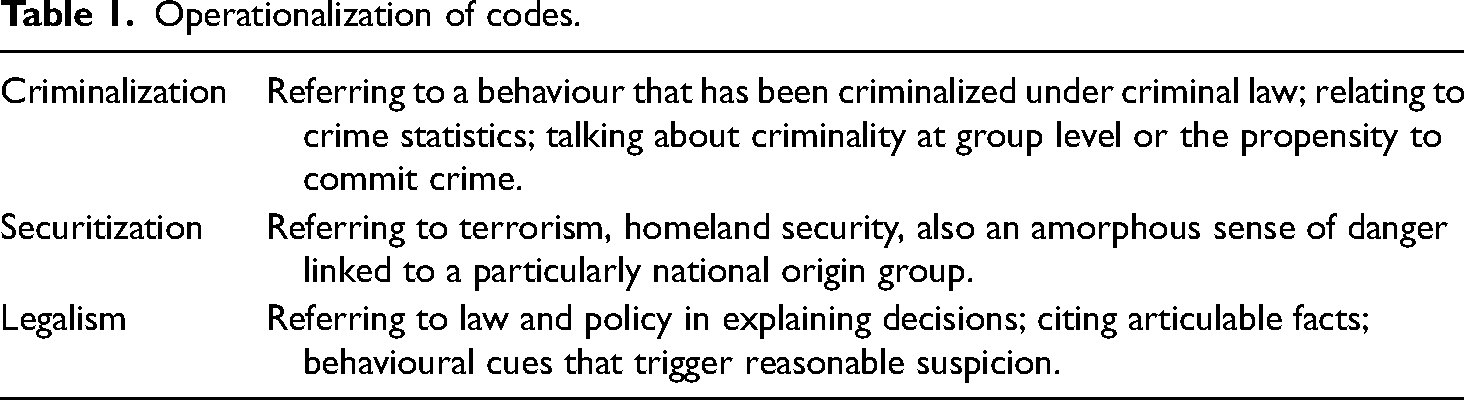
Our data analysis strategy consisted of the ‘flexible coding’ approach by Detering and Waters (2021). First, we identified excerpts where respondents were discussing race or proxies for race; we ‘indexed’ these data accordingly. In the US case, we identified excerpts where agents were discussing race implicitly, as well as excerpts that directly addressed ‘race’, ‘racism’, ‘racist’ and ‘racial profiling’. These terms did not work for the Dutch case due to the historically rooted ‘racial denial’ that obfuscates race in that context. We thus looked for ‘ethnicity’, ‘nationality’, ‘culture’ and ‘ethnic profiling’. Then we applied more narrow, analytic codes to the indexed data based on the logic of our respondents’ deliberations. We identified three logics that our respondents used to explain racialized border control outcomes: securitization, criminalization and legalism (see Table 1 for operationalizations). These logics fit under the broader category of colourblind racism, which Bonilla-Silva (2006) defines as an ideology that explains racial inequalities as the product of non-racial dynamics.
Operationalization of codes.
Findings
Legalism: An emphasis on guidelines
Dutch and American border agents explain that their work is racially neutral and based on legal guidelines. The USBP has long been the primary instrument of racialized social control against Mexicans/Latinx people, especially in the Southwest (Lytle-Hernandez, 2010). Yet, agents deny the existence of racial profiling, arguing that any decision to stop vehicles for inspection is based on ‘articulable facts’. When Vega asked a USBP agent why Hispanic/Latinx people are disproportionately stopped by his agency, he emphasizes legalism through the language of ‘articulable facts’: Someone's race or ethnicity doesn’t make them a criminal … I don’t pull anyone over just because they’re Hispanic. I pull them over because they’re in this area that's known to circumvent the checkpoint. They’re driving stiff …, looking over, looking back in the mirror, swerving in the lanes the minute they saw my vehicle. Well, just because he happens to be Hispanic doesn’t mean anything. Because you could get an Armenian who's as White as I am doing the same thing and any Border Patrol Agent would stop him.
The Supreme Court has sanctioned the overt reliance on race in immigration law. In the United States v. Brignoni-Ponce (422 U.S. 873), the Court decided that Mexican appearance can be a factor in establishing reasonable suspicion of an immigration violation, when used in conjunction with other ‘articulable facts’ (Chacón and Coutin, 2018). The Customs and Border Protection's (CBP) non-discrimination statement reflects the possibility of using race/ethnicity as a factor in its work, as it states that CBP policy is to ‘prohibit the consideration of race or ethnicity in law enforcement, investigation, and screening activities, in all but the most exceptional circumstances’ (Department of Homeland Security, 2013, emphasis added).
Despite legal loopholes allowing agents to use race/ethnicity to establish reasonable suspicion, agents are trained to justify their stops by appealing to race-neutral factors. One agent told Vega that agents can make stops ‘as long as you are able to articulate your facts for the stop … what we need … for an immigration stop is reasonable suspicion’. Border Patrol agents do not need probable cause, which imposes a higher legal requirement, only reasonable suspicion is required to make a roving patrol stop. This is how the agency trains its agents. Border Patrol training material acquired by the American Civil Liberties Union, lists 21 ‘articulable facts’ that agents can use to establish reasonable suspicion for a stop. These factors include agents’ knowledge of normal traffic patterns and information about illegal activity (drugs and trafficking) in the area, proximity to the border, the driver's behaviour, the vehicle's appearance and the number and appearance of people in the vehicle.
Legal and bureaucratic terms, like ‘articulable facts’ effectively provide cover for racially discriminatory practices. As Mary Romero (2008: 30) notes, the Border Patrol uses an ‘amorphous designation “Mexicanness” as a basis of reasonable suspicion or probable cause’ in its work. Observations of Border Patrol checkpoint operations in Arivaca, Arizona showed that Latino-occupied vehicles were over 26 times more likely to be stopped and be required to show identification than other vehicles (Murdza and Ewing, 2021). Racial profiling by border agents has been documented on the northern border too, where 84% of Border Patrol arrests in New York were of people categorized as having ‘black or medium complexion’ (Murdza and Ewing, 2021). In the now infamous ‘Chandler Roundup’ in 1997, a Border Patrol operation that targeted a predominantly Mexican neighbourhood in Arizona, local media acquired pre-filled ‘Record of Deportable Alien’ documents that designated ‘Mexico’ for country of citizenship and ‘BLK’ for hair colour, ‘BRN’ for eye colour, and ‘MED’ for skin tone (Romero, 2006). One analysis found that agents conduct racially patterned stops, mostly of Hispanic men driving trucks in Texas, while justifying the stop based on a driver's behaviour appearing stoic and nervous (Armendariz, 2012). There is ample evidence that Border Patrol agents have wide latitude to make racially motivated stops under legal cover.
While most Border Patrol agents negate racial profiling, some are aware that immigration law creates a loophole for their use of race in roving patrols. One agent told Vega, ‘In Arizona, the Border Patrol can do a lot more than we can here in California. In Arizona, you can arrest someone for looking Hispanic. We can’t do that here. We can’t stereotype in California.’ The Border Patrol agents featured in this study are implementers of federal immigration law. However, there is variation in how they interpret their mandate at the local level. The agent quoted above suggests that state-level political context matters to how federal agents use race/ethnicity in their work.
Dutch MBP officers have the legal power to stop cars in the intra-Schengen borderlands based on European and Dutch regulations and legislation governing border movement. Under this combined framework, officers can check people's immigration status to combat irregular migration. Besides checking for ‘illegal migration’ as border officers put it, officers also have a limited mandate to search for human smuggling and identity fraud, as these phenomena are perceived to be connected to irregular migration.
To select someone for a stop and check, officers have a great amount of discretion. The legal framework only states that the checks ‘are based on general police information and experience regarding possible threats to public security and aim, in particular, to combat cross-border crime’ (article 23a section ii Schengen Borders Code 2016). In asking how they decided which car to pull over, many officers directly referred to their legal mandate and, in explaining why they considered someone's perceived race or perceived ethnicity an important factor, they would highlight the fact that the main aim of these ‘article 23’ checks as conducted in the Netherlands, was to combat irregular migration. During one of the observations, van der Woude discusses discrimination and ethnic profiling with one of the officers. In explaining that the idea they are discriminating against people of colour is a widely shared misconception, the officer acknowledges that it is indeed not easy to decide which vehicle to stop and continues: But we are obviously standing here and doing our work under the mandate of the Immigration Act and with the goal to find illegal aliens. This makes that these indicators [ethnicity and nationality] as well as someone's skin colour are important factors to take into consideration in deciding who to pull over and who not.
This response was widely shared among his colleagues. When discussion between the researcher(s) and one or more officers got to the topic of how someone's perceived race played a role in their practice, most of the officers would ‘hide’ behind the law. A white male officer talked about why he pulled over the last car that they searched—a car with two Dutch Moroccan guys in it and not a previous car with an elderly grey-haired white couple in it. Both of the Dutch Moroccan men were able to show valid documents/identification and could continue their way without a problem. The officer seemed to directly interpret the question as a form of critique, and shifted into a legalistic explanation, ‘We are here to fight illegal migration, after all. This does not mean that we are discriminating [against certain people or groups].’ He continues his explanation by adding that they were just focusing on someone falling within their ‘target group’ of people who might try to enter the country without the right papers: ‘I am just going to say it as it is, but that is exactly why we will be more prone to select negros (in Dutch: ‘neger’) than grey-haired women.’
The ‘grey-haired women’ reference was about the elderly couple that had just passed without being selected for additional inspection. Although the officer did not state it as such, by using the word ‘negro’, which would only apply to dark-skinned people, the whiteness of the ‘grey-haired women’ is implied. These examples illustrate how colourblindness is deeply ingrained in Dutch society and in how border officials do and talk about their work. The last example is interesting in the light of the creation of the myth of colourblindness in the Netherlands through a denial—or neglect—of its colonial past (Ghorashi, 2023; Rose, 2022). The word ‘neger’ is a colonially construed term that—together with the word moriaan or ‘More’—would be used to refer to the native people of the colonies of the Netherlands. Whereas the word ‘negro’ in English is pejorative, the word ‘neger’ in Dutch has only recently been problematized as such. The use of the term—and its direct reference to thus turning the state's ‘suspicious gaze’ to people of colour (Borrelli et al., 2022)—in the context of this vignette was not problematized at all; quite the contrary, it was justified by the legal mandate and official task of the MBP: combating irregular migration.
Furthermore, the examples also illustrate an awareness among border agents of non-discrimination (legislation) and the fact that discriminating against people based on their perceived race or ethnicity is against the law. Yet, at the same time, the fact that they might look at these indicators to decide who to stop and ask for identification, was presented as non-discriminatory and legitimized through their legal mandate and thus seemed to neutralize the problematic nature of their decision-making rationale. This creation of the illusion of colourblindness by ‘hiding’ behind the law more in general in the Netherlands has also been flagged by the UN Special Rapporteur on contemporary forms of racism, racial discrimination, xenophobia and related intolerance in her 2020 report about the Netherlands. She observes a paradoxical ‘legal logic’ through which colourblindness is implied and notes that whereas Dutch legislation and regulations are clear about the prohibition of discriminatory action, these rules are not often complied with by the government and government actors (UN Special Rapporteur, 2020).
Criminalization: Morally undeserving crimmigrants
While some agents justify racialized border enforcement by appealing to legalistic logics, others employ the logic of criminalization to this same end. Immigrant criminalization is a moral process that separates the worthy from the wrongdoer (Barker, 2017). The logic of criminalization is distinguishable from the legalism frame because instead of emphasizing their authority, agents seek to discredit immigrants to justify their work.
When Border Patrol agents use criminalizing rhetoric, they are seeking to legitimize their exclusionary practices by attacking immigrants’ moral character (Vega, 2018). For instance, the following Border Patrol agent argues that his organization's reputation as a ‘discrimination force’ that focuses on Mexicans is incorrect. Instead, he argues that the Border Patrol is keeping the USA safe from outsiders with bad intentions: If you don’t have that presence there, would you rather have these people coming into your homes, killing your family, raping your children, so on and so forth? Or would you rather have some sort of a force there on the border trying to … keep it out? I think most people would agree, yeah, I don’t want my family killed. I don’t want my children raped or their heads cut off … So yeah … Put whoever you have to out there.
This agent goes on to explain that people ask him ‘Are you racist against Mexicans?’ to which he responds that he is ‘racist against everybody. If something is crossing illegally, I’m going to get it … I don’t care who you are.’ Notably, this agent begins justifying racialized border enforcement outcomes through criminalizing rhetoric that is part and parcel of the US immigration debate on undocumented migration. Specifically, the idea that Latino men are prone to crime, violence and sexual predation is central to the Latino threat narrative (Chavez, 2013) and evident in agents’ logics. However, when this agent says he is ‘racist against everyone’, he is appealing to a colourblind ideology that negates racial distinctions and instead turns on behaviour.
We can see the overlap between the criminalization and legalism logics in the Dutch case also. Although the MBP is performing the border checks based on a legal mandate that is founded in immigration law, they are also equipped with limited crime control powers to address instances of human smuggling and identity fraud (Van der Woude and Brouwer, 2017). Nevertheless, most of the officers framed the scope of their job predominantly through the lens of crime instead of migration and referred to themselves as policemen instead of immigration officers.
Prior to patrols, ‘facts’ about the overrepresentation of certain migrant groups in certain forms of crime were shared during briefings. These ‘facts’ were created by the organization's own intelligence unit and based on a combination of data made available by European organizations such as FRONTEX and Europol and ‘information’ gathered by the MBP itself. Despite the statistical ‘colourblindness’ in official (police and migration) data, the latter source of data was fraught with racialized ‘law and order’ tropes (Hodges and Cipponeri, 2021). The following vignette illustrates how, more in general, officers would construe and discuss the connection between migration and crime: After having chased a German Mercedes on the highway, we sat down to have dinner with the officers who performed the chase. In the car that was stopped were three men and a little boy of about 10 years old. Everything turned out to be okay. The officers explained that they had stopped the car because the men in the front of the car looked like ‘legit crooks’ whereas the man in the back of the car according to them looked more like a businessman. This combination and the fact that the ‘businessman’ was sitting next to the little boy also made the whole situation feel ‘off’. The officers added that this was especially the case since they all looked like Albanians. They explained that, based on information that was shared by their intelligence unit, it was known the Albanian Mafia had outgrown the Italian Mafia and that they were constantly trying to expand into Western Europe. They continued by saying that Albanians were known to be ruthless and to be involved in human trafficking, drugs or money laundering. One of the officers said that it was just ‘a dirty people’.
This vignette exemplifies what Brouwer et al. (2018) described as the multiple ‘crimmigrant stereotypes’ that are guiding the actions of the Dutch MBP in the European borderlands. Although often lacking any foundation in empirical research, these crimmigrant stereotypes are presented as ‘facts’ and therefore as a justification for racialized choices. During the fieldwork, these often stated, ‘facts’ about the overrepresentation of certain groups in (cross-border) crime, were not questioned and can therefore be seen as an important part of a colourblind ideology that actively steers away from reflecting on the racialized outcomes of decision-making processes and the self-fulfilling prophecy of ‘factual’ and ‘real’ crime statistics. Besides this, as others have illustrated (Hodges and Cipponeri, 2021; Lousley, 2020), the impact of narratives and logics of law and order, punishability and crime not only allows for migration to be framed as unwanted; it also inverts racial vulnerability so that migrants are seen as threats rather than victims of state-centred violence.
The vignette furthermore also illustrates that, as mentioned earlier, although the legacies of colonialism and nationalism continue to imprint the privilege of whiteness onto the map of Europe, it is not just the mobility of non-white immigrants that is being racialized: it is also the mobility of immigrants from Central and Eastern Europe who are ostensibly white but who are not seen as ‘core’ Europeans and are seen to represent ‘a contingent and degraded form of whiteness’ (Anderson, 2013: 45). The criminalization and legalistic logic are closely connected in the Dutch case now that, legally, MBP officers are partially allowed to act as ‘crime fighters’ due to the previously mentioned ambiguous legal framework within which they are operating (Calavita, 1998; Edelman, 1992). As observed by Obasogie (2020), it is precisely this ambiguous and thus endogenous (Edelman, 2006) nature of the law that creates the possibility for law enforcement agents to operate in a seemingly neutral yet highly unjust and illegitimate way.
Securitization: An amorphous terrorist threat to the state
While immigration control has long been framed as a threat to the nation in the United States, immigration control since 9/11 has become part of the global War on Terror. The securitization logic is about border agents drawing on the discourse of threat, homeland security and terrorism to justify racialized border control outcomes.
Border Patrol agents consistently explain that the major threat at the border is terrorism. That terrorism is a top concern for agents is unsurprising since they work for the Department of Homeland Security, a cabinet-level agency created in the wake of the 9/11 attacks to combine the country's security efforts into one agency. What is notable, however, are the racialized distinctions that agents make in the context of their anti-terrorism mission. This is how an agent from Arizona responded when Vega asked him to identify the threat that USBP agents are protecting against: ‘The major threat? … I would have to say terrorists trying to come through … last year, we’ve had a lot of groups that weren’t Mexican that were trying to come in through here.’ The distinction between Mexicans and others hints at the racialized constructions that undergird how agents think about the people they are charged with regulating. The same agent continues, explaining that the Border Patrol has seen an increase in non-Mexicans specifically: So, you’re talking about Indians, Hindus from India. People from Bulgaria. Eastern nations like that where who knows what they’ve done in their countries. We take their fingerprints here. And whatever they’ve done here will come up. And if they’ve done something huge internationally, it’ll come up. But outside of that, you don’t know who these people are.
These group-based distinctions reflect two racialized constructions at once. First, we can see that Mexicans are the default group in agents’ work narratives—a reality reflected in agents’ use of the acronym OTM to refer to arrests of ‘other than Mexicans’. Not only are Mexicans the default work target, their racialization as criminals (at worst) and economic migrants (at best) is more defined in agents’ work conceptions. In contrast, non-Latin American groups are racialized as enigmatic and therefore, potentially more dangerous than Mexicans. When the agent says ‘you don’t know who these people are’, he is being literal in referring to a lack of information about foreigners’ identity and their potential criminal record. However, he is also making a conceptual distinction between the readily available racialized constructions of Mexicans and other Latin Americans and more ambiguous categorization of other migrants.
An exception to the amorphous racialization of OTM is immigrants from the Middle East who serve as the archetypal terrorist threat that agents see themselves guarding against. The way agents spoke about terrorism revealed the racialized constructions that motivate their work. This agent's reference to traditional Arab headdress and clothing shows that the working assumption among agents is that terrorists are Middle Eastern: ‘Very rarely do you see a guy in this little towel and his garb and everything, oh my God, it's a terrorist. They’re usually trying to play the role of a South American country so they can blend in.’ What is more, this agent is highlighting the lay theory that Middle Eastern terrorists might enter the USA by blending in with Mexican migrants based on phenotypic similarity between Latinx and Middle Eastern people. In explaining how difficult it is to assess border crossers’ identities or nationalities, one agent from Arizona explained to Vega that: ‘Skin colour doesn’t say where you’re from … you have a lot of Middle Eastern people that look just the same as the South and Central Americans or the Mexicans for that matter.’
This fear of missing the ‘real terrorist’ within a group of Latinx migrants was repeatedly mentioned by Border Patrol agents and reflects what Rivera (2014) calls the ‘brown threat’. This concept captures how Latinx and Middle Eastern Muslims are both constructed as dangerous to the American homeland but for distinct reasons. Latinx immigrants represent a threat to the social and economic well-being of the country, while Muslims are framed as anti-American terrorist threats who hate western ways (Selod, 2018). While Border Patrol agents often use 9/11 to emphasize the danger of terrorism, Islamophobia has long been a part of US institutions and the War on Terror only exacerbated long-standing racialization of Muslims (Selod, 2018). In the end, both groups—Latinos and Muslim Middle Easterners—are constructed as ‘undesirable minorities’ and ‘interchangeable Brown Threats in the post-9/11 American imagination’ (Selod, 2018: 45)—a fact that is reflected in Border Patrol agents’ logics. The USBP's history of racialized immigration policing cannot be erased by rebranding the agency as a terrorist prevention organization. Immigration policing, and border enforcement specifically, has always been intimately tied to nation-building, racism, xenophobia and construction of the other (Bigo, 2002; Bosworth et al., 2018; Parmar, 2020).
The securitization logic, in the context of the Dutch MBP, is a bit harder to pinpoint than the previously discussed logics. This can be explained by the fact that there is a general notion, not just among our respondents and the MBP as an organization, but also more in general within Dutch society, that the overall framework within which they operate is one of national security. The respondents would confirm this repeatedly by distinguishing themselves from the National Police. Whereas the latter were responsible for the ‘safety on the streets’, the Dutch MBP were responsible for the ‘security of the state’. The location of their actions, in the borderlands of the Netherlands, was often mentioned to underline the importance of this deeply felt responsibility: Even though it [crime control] is not the focal point of our activities, we will stop and arrest him [a car with a possible suspicious person in it], we can legally do that, and it contributes to the security of the state. Because otherwise no one else will act in these borderlands.
Officers would see and position themselves as a ‘first line of defence’ against a broad variety of dangerous and criminal ‘others’. Even though Islamophobia is very prevalent in political and public discourse all throughout Europe and in the Netherlands (De Koning, 2020) the ‘fear of terrorism’ as the clearest illustration of the securitization logic hardly appeared explicitly in the data. What, on the other hand, is very clear in the data is an overall suspicion towards north African young men, especially Moroccan-looking men. Even if they were crossing the border in a car with a Dutch licence plate and thus most likely were Dutch nationals, Moroccan-looking men were stopped and checked. Yet, when asking why a particular car and person that would fit that category were stopped, a criminalization logic linked to a ‘crimmigrant stereotype’ was used to explain the decision. The following vignette illustrates this: A car was pulled over because it fit the so-called ‘human trafficking profile’, which meant that there were two men in the front and two women in the back. The car, a BMW, itself also added to the suspicion of the officer. The driver said that they were going to Amsterdam to party. One of the women, who was questioned outside of the car, confirmed the story. The driver, who turned out to be Spanish, looked North African. The other man in the car had an Arabic name. His ID card showed him wearing a thick beard, which he did not have at the moment of the stop. This was a reason for the officers to run his ID card for possible links with terrorist activities. The officers explained their actions by saying how important it is to look for a ‘criminal appearance’ but had a hard time further specifying what that was. They mentioned clothing, posture and the way a person looked at them.
The initial reason to pull over the car was a possible criminal act, human trafficking, but there was a shift towards the securitization logic while the check was conducted.
Discussion/Conclusion
We examine how Dutch and American border agents use colourblind ideologies to justify racialized border control outcomes. Despite country-level differences in migration histories, as well as distinct relationships to the concept of race, border agents cohere around three colourblind ideologies: legalism, criminalization and securitization. We argue that these logics capture what colourblind ideology looks like at the implementation stage of border control. The categories through which border agents carry out their work are themselves linked to shared stereotypes about specific groups, identified through physical markers and nationalities (Flores and Schachter, 2018). That is, from a border agent's perspective, their job is to look for people who lack permission to enter a particular territory, and/or who pose a security or criminal risk. But when they think about legality, security and criminality, they are relying on ‘perceptual shorthands’ based on stereotypes and attributions about race, gender, ethnicity and social class (Van der Leun and Van der Woude, 2011).
Just as we call for increased comparative research on colourblind ideologies in immigration practice, we also acknowledge that explicitly racist discourse is resurging. A look at how political elites in the USA and Europe describe immigrants and immigration is evidence that the cultural parameters of acceptability around race/racism are expanding in both contexts. In the United States, Donald Trump announced his candidacy for president in 2016 by calling Mexicans ‘rapists’ and ‘criminals’ and made anti-Latino sentiments a centrepiece of his eventual presidency. The explicitly racial language that pervaded the Trump presidency was not unique to him, but rather signals what Heuman and Gonzalez (2018) mark as a ‘new essentialism of racial logics’, which is a hybrid between the overt racism of old, with the covert racism of the colourblind era.
The shift towards right-wing, nationalist parties is perhaps even more pronounced in Europe. The so-called 2015 European refugee ‘crisis’ has caused far-right politics to gain momentum throughout Europe and refugees to be dubbed a threat to the project of nationalism. In 2017 the European Network Against Racism (ENAR, 2017) observed increased support for far-right parties and groups and the resultant legitimation of racialized anti-migrant discourses and policies. It is important to monitor if these cultural changes will be reflected in legal doctrine, or whether laws will continue to be ‘colourblind’, even as the legislative process is explicitly racial. For instance, in the Netherlands, a recent Court of Appeal ruling stated that the MBP can no longer use race or ethnicity as a selection criterion in their border checks. Since agents can still use nationality as a proxy for race, the ruling's impact remains unclear.
Racial ideologies, whether colourblind or explicit, are built into security logics because border agents are charged with preserving sovereignty and thus, global inequality (Chubin and Ramirez, 2021). Our study of border agents’ colourblind ideologies demonstrates that even when countries, like the United States and the Netherlands use deracialized logics, they continue to assert control over the racial/ethnic composition of their populace. However, colourblind ideologies endow them with a certain level of plausible deniability for doing so. This work highlights the need for more comparative research on how colourblind ideologies shape the so-called practice logics' (Loftus, 2015: 115) of border agents working in distinct national contexts. Through this research, we can broaden our view of how race/ethnicity—and the discursive absence or reinvention of it—shapes immigration processes in a globalized world.
Footnotes
Declaration of conflicting interests
The author(s) declared no potential conflicts of interest with respect to the research, authorship and/or publication of this article.
Funding
The author(s) disclosed receipt of the following financial support for the research, authorship and/or publication of this article: the Dutch portion of the data collection was partially funded by a research grant distributed by the Directorate for Migration Policy of the Dutch Ministry of Justice and Security.

Author biographies
Irene I Vega is Assistant Professor of Sociology at the University of California, Irvine.
Maartje van der Woude is Professor of Law and Society at Leiden University and holds her chair at the Van Vollenhoven Institute for Law, Governance and Society.