




Abstract
In this article, we examine detainee experiences of dignity in police detention through the lens of materiality. To do this, we draw on sociological and anthropological literature on the ‘material turn’ and its application to criminal justice settings, and a mixed-methods study of police custody in England and Wales. First, we conceptualise different dimensions of materiality in police custody. Second, we show how some forms of materiality, in conjunction with staff–detainee relationships, shape detainee dignity rooted in equal worth, privacy and autonomy. Third, we examine how the intertwining of the social and material in police custody opens up new possibilities for theorising police work. The materiality of police work is active, not just symbolic. Alongside social relations, it shapes citizen experiences of the police, including of ‘hard’ and ‘soft’ forms of policing, and by implication, pain and injustice. Materiality therefore provides a further way of theorising the production of social order inside and outside police detention.
Introduction
Here we examine the ‘humility of things’ (Miller, 1987) in police custody. We explore how things mould detainee dignity rooted in autonomy, equal worth and privacy. We also open up the debate about materiality and its relevance to police studies. Criminal justice scholars – interested in the police, rather than prisons – are late to the materiality ‘party’ and some ‘catching-up’ is needed. To help, we draw on a 40-year debate among anthropologists, archaeologists, sociologists and organisational studies theorists about the divide between social relations and materiality. 1 Those at the forefront of this ‘material turn’ argue for a co-constitutive relationship (Woodward, 2020; Hicks, 2010; Miller, 2010; Orlikowski, 2007; Latour, 2005). ‘[T]he social and the material are … inextricably related — there is no social that is not also material, and no material that is not also social’ (Orlikowski, 2007: 1437). Meaning emerges through the interplay of both.
Police custody is where 546,170 English and Welsh citizens are detained each year (Home Office, 2022), pending a police investigation and the disposal of their case. It is thus an important institutional setting for police work and entrance to the criminal process. Detainees are increasingly held in large out-of-town purpose-built custody blocks (Skinns et al., 2017b), which feel clinical, yet spaceship-like, with pale coloured walls, and staff sitting on elevated bridge areas attending to detainees standing below them, albeit that custody blocks vary in the precise nature of these material conditions.
Police custody is also a site of pain for those who enter, in which detainee vulnerabilities and resulting inequalities may emerge or increase as a result of their detention and the power exercised over them by the police (Dehaghani, 2021; Skinns, 2019; Welsh et al., 2021; Pemberton, 2008). Although it is not formally intended as punishment, it can be experienced as such, as a critical part of the ‘penal painscape’ (Skinns and Wooff, 2020; Harkin, 2015). Police custody is also a site of (racialised) injustice, in which due process rights may be overlooked (Welsh et al., 2021), or people, especially those from minoritised groups, may be subject to the use of lethal force (Williams et al., 2023; Welsh et al., 2021; Angiolini, 2017; Athwal and Bourne, 2015; Razack, 2013; Pemberton, 2008). Therefore, we theorise how the material and the social impact detainee experiences, while also acknowledging that this socio-materiality arises in painful and dehumanising circumstances.
The article has three specific aims. First, we conceptualise the main material features of police custody. Second, using observational and interview data collected in Phase 2 of the ‘good’ police custody study, we examine the potentially active role played by some of these features – technology such as CCTV, objects and soundscapes – in shaping detainee dignity. The third aim of the article is to broaden the discussion of materiality from police custody to police work more generally, where it has received limited debate. We therefore hope to make a significant contribution in this regard. We argue that, alongside social relations, materiality plays a key role in shaping citizen experiences of the police and provides a further way of theorising ‘soft’ and ‘hard’ forms of policing and thus the production of social order inside and outside police detention. Materiality, as we argue, is implicated in detainee experiences of power in police custody and, by implication, pain and injustice.
In what follows, we examine the material turn, particularly as it applies to criminal justice scholarship, followed by the methodology. We then use the empirical data to conceptualise materiality in police custody and to examine the actant-like qualities of these material conditions on detainee experiences of dignity rooted in equal worth, privacy and autonomy. In the discussion, we re-engage with literature on the material turn, examining the implications of the empirical findings for the relationship between materiality and social relations, the meaning of ‘good’ police custody; the power of things; and the relevance of the ‘material turn’ to theorising police work.
The material turn
The concept of materiality – which in simple terms refers to ‘the properties and capacities of things’ and their particular effects on people and other things (Woodward, 2020: 17) – has existed in some form or another in the social sciences since the 19th century (Hicks, 2010; Miller, 2010). For the purposes of this article, we refer to things, stuff, objects, but also materiality. These terms convey the importance of looking at the processes and practices that accompany an object, paying attention to the way people and things interact and the effects they have on each other (Woodward, 2020). We also include sound as a particular form of materiality (Stifin, 2017), recognising that sound, but also its counterpart, silence, can ‘act’, not just ‘be’, much like many of the more solid, stable and discrete objects that have typically been the focus of the ‘material turn’ of the past four decades (Stifin, 2017).
Until the late 20th century, there was a tendency to prioritise social relations over things in explaining the social world (Hicks, 2010; Miller, 2010). The ‘material turn’ challenged this, noting the actant-like quality of things, their enmeshing with people and their co-constituting of the social world. Drawing on Hegel, for example, Miller (1987/2010) points to the dialectical relationship between subjects and objects, in a bid to overcome the subject/object divide. Subjects become externalised in objects, with these objects then becoming re-appropriated by the self, as part of a continual and dynamic process of ‘becoming’ (Miller, 1987). For Actor Network Theory scholar, Latour (2005), the relationality of people and things is crucial; things cannot be separated from the enactment of micro-level social ties. Objects are interwoven with social ties, with social action ‘zig-zagging’ from one to the other (Latour, 2005). As such, objects not just people are potential actants, which impact experiences and the meanings ascribed to them. The empirical evidence presented later in this article similarly demonstrates the interwoven nature of social relations and things in police custody settings.
The material turn in criminology emerged to a greater extent in prison than police studies. In prison studies, a key focus has been on the impact of food and drink, 2 clothing and soundscapes on prisoners’ feelings of personal power relative to the prison institution. All three are relevant to the empirical analysis and given the prison-like qualities of police custody (Skinns and Wooff, 2020). The majority of studies of food in prison examine ‘negotiations of relationships and power … between inmates and correctional officers’ (Smoyer, 2019: 5). For example, commissary snacks help prisoners to regain control (Chatterjee and Chatterjee, 2018), while unpalatable food, if delivered without care or concern, can diminish it (Smoyer and Lopes, 2017). In addition, acquiring, sharing, cooking and consuming food, sometimes in illicit or semi-illicit ways, can be a way of resisting institutional power and asserting agency (Gibson-Light, 2018; de Graaf and Kilty, 2016; Smoyer, 2016; Smoyer and Blankenship, 2014; Ugelvik, 2011). Clothing similarly functions to exert power, conformity and humiliation over inmates, whilst also providing opportunities for subversion and resistance. Prison-issue clothing strips prisoners of their identities and turns their bodies into ‘property of the state’ (Smiley and Middlemass, 2016), but this can also be resisted by prisoners: for example, with designer footwear or low-slung underwear-revealing jeans (Smiley and Middlemass, 2016; Ash, 2010; Jewkes, 2002).
Soundscapes – ‘which refer to the sounds heard and made’, but also the objects and technologies that mediate them – are similarly influential of prisoner experiences of agency and their power to resist the prison institution (Hemsworth, 2016: 92). They can resist the oppressive silence of their confinement and ‘rekindle a flame of dignity’, through spontaneous group singing or through individualised stomping, shouting, crying and banging (Hemsworth, 2016). Yet, unwanted sounds may be difficult to stop and impossible to ‘unhear’, even if they are embarrassing or distressing (e.g. the sounds of other prisoners defecating, shouting, self-harming or perhaps dying), and undermine prisoners’ sense of personal power. While Hemsworth (2016) emphasises the materiality of sound, others have focused more on its sensory dimensions, 3 albeit that they reach similar conclusions. Sensorial accounts show prisons to be noisy places, in which sound foregrounds prison life (Herrity, 2020), sometimes in unwanted and disturbing ways (Rice, 2016), including when prisoners attend court via audiovisual links (McKay, 2020, 2018, 2016). Yet, sound is also used, individually and collectively, by prisoners and activists for the purposes of ‘acoustical agency’ (Russell and Carlton, 2020; Rice, 2016).
In the analysis that follows and to avoid conflating them, we emphasise the material rather than the sensory dimensions of sound in police custody. This materiality encompasses the aurality of sound (arising from vibrations in the ear drum), but also the material mediums through which sound is transported to the ear drum. Similarly, we also focus on the material not the sensory in relation to objects like food and technology used in police custody. Although we acknowledge the importance of sensorial experiences of police custody – for example, experiences of food and drink depend heavily on smell, taste and touch – examination of this is beyond the scope of this article.
In police scholarship, few explicitly consider materiality, even when it may be relevant to understanding police–citizen relationships, which are the focus of this article. The literature on body-worn cameras exemplifies this (see Lum et al., 2019 for a review). A few do engage directly with materiality, in particular, the materiality of firearms, but in relation to police–private sector not police–citizen interactions (Diphoorn, 2020), or desistance from gun-related crime (Goldsmith et al., 2021). One study that does link materiality to police–citizen relations is Linnemann and Turner (2022), but in public order not police custody settings. So-called ‘3D policemen’ produce order horizontally, but also vertically, using ‘volumetric’ police tactics/technology, such as drug sniffer dogs, ‘shotspotter’ microphones, which triangulate and detect the location of gunfire, and tear gas (Linnemann and Turner, 2022). A further and more relevant exception can be found in Wooff (2020), who acknowledges the power of the police cell in managing risk, the emotions and resistance of detainees. He notes that police cells are far from passive, rather they are harnessed by staff to manage detainee experiences of ‘emotion, risk and resistance’ (Wooff, 2020). This provides a point of departure for the current article, although we also develop it further by: considering a wider range of material conditions than the cell; using a broader range of data collected in England and Wales rather than only in Scotland; and examining detainee experiences of dignity and of police power.
Detainee dignity, as we have noted elsewhere (Skinns et al., 2020), is a core feature of ‘good’ police custody, making it of central importance when thinking about its relationship with materiality. We pay particular attention to the following dimensions of dignity:
Equal worth, which refers to respect for the intrinsic and immutable sense of the equal worth of human beings and encapsulated in detainees’ desire to be ‘treated like a human being’ (Skinns et al., 2020; Henry, 2011; Irwin, 1986). Autonomy, which refers to the fundamental need to respect people's free will and their capacity to make autonomous choices (Henry, 2011). Despite the apparent contradiction, an obvious arena in which such autonomous choices are evident is detainees exercising their rights and entitlements, for example. Privacy, which refers to the need to limit intrusions to detainees’ bodily integrity, such as during strip searches, or to the observation of detainees in the cells, particularly when they may be naked or using the toilet. This privacy, however, must be balanced against the need to minimise risk and harm to detainees and to staff.
These dimensions of dignity need also to be recognised as relational and contingent (Gibson-Light, 2020). They can depend on: staff perceptions of detainees’ moral worth, as ‘the dross’ or not (Choongh, 1997); racialised and gendered stereotypes (Razack, 2013; Skinns, 2011); or their cooperation with the police.
Dignity is also another way of orienting this article to considerations of power, given the role of dignity – as a dimension of procedural justice – in encouraging perceptions of police legitimacy and citizen cooperation with the police (Worden and Mclean, 2017; Tyler et al., 2015; Donner et al., 2015). Of particular interest is the way that this form of ‘soft’ policing, based on persuasion, functions alongside harder forms of policing based on inducement or coercion (Skinns, 2019; Skinns et al., 2017b; Innes, 2005; Nye, 2004). For example, elsewhere, we have documented some of the soft styles of policing exhibited in police custody – including treating detainees as fellow human beings – and how these co-exist alongside coercion and inducement, and are aimed at encouraging cooperation and compliance (Skinns et al., 2017b). There are, however, downsides to dignity, which include its hollow, ideological qualities. This soft form of power, in which staff need only to appear to treat detainees with dignity, may be used to ‘hoodwink’ detainees into cooperating with the police and, in some cases, accepting unfair outcomes (Skinns, 2011; MacCoun, 2005). Others have also noted the contingent nature of soft policing in police custody, in which procedurally just actions, such as showing dignity and respect to detainees, are predicated on detainees first showing politeness, respect and cooperation to staff, thereby turning procedurally just actions, including dignified treatment, into ‘a reward to the compliant’ (Savigar-Shaw et al., 2022). This underscores the disempowered status of detainees in police custody and within these micro-dynamics of soft and hard power, in which dignity is a ‘gift’ that the police (appear to) give and detainees receive, if they are compliant, and, without which, hard power based on inducement and coercion may be used instead. What remains unknown, however, is the way that materiality functions in this context, in particular how it shapes these micro-level power dynamics inside police custody. We argue that materiality, in conjunction with staff–detainee relations, supports both ‘soft’ and ‘hard’ styles of policing, as well as being implicated in pain and injustice.
Methodology
This article draws on the ‘Good’ Police Custody Study (GPCS). This Economic and Social Research Council-funded national research study in England and Wales ran from 2013 to 2018 and rigorously examined the meaning of ‘good’ police custody. Mixed-methods data were collected in three phases, the second and third of which are pertinent to this article. In Phase 2, data were collected between March 2014 and May 2015, in four custody areas in four forces, drawing on the principles of appreciative inquiry (Skinns et al., 2021), and focusing on themes of risk, culture(s), power, fairness, justice, emotions and relationships, cost, governance and accountability. These four custody areas were given the pseudonyms Mill City, Stone Street, Combiville and Newtown and were selected as illustrative of different types of custody facilities, (public, private or hybrid) identified in Phase 1 (see Skinns et al., 2017b). 4
In each site, researchers spent 3–4 weeks undertaking participant observation and then interviewing 10–15 staff, largely police officers, detention officers, other criminal justice practitioners, and 10–15 detainees including a mixture of men and women, those from different age groups, ethnic backgrounds and first-timers/those who had been in custody before. Once formal permission had been granted, staff were emailed about the research and asked to indicate if they did not wish to be observed. It was more difficult, however, to secure consent from staff/detainees passing through custody. The police turned down offers to put up posters in the custody block when we were observing and, instead, we had to be proactive in explaining openly and honestly about the research and in wearing university cards to indicate our identity and that we did not work for the police. Staff and detainees were approached to participate in interviews in custody, with staff interviews taking place in custody and detainee interviews taking place in public places following release. To minimise the risk of harm to either detainees or the research team, police gatekeepers assisted in identifying potential detainees to interview. They were approached in custody by the research team, who shared an information sheet with them, requested their initial consent and asked for their contact details so that the research team could contact them on release. 5 Once these interviews were arranged and before their interview began, information about the research was provided again to detainees and their final consent requested. In total, the research team spent 532 hours observing and conducted 97 interviews (47 with staff and 50 with detainees).
The field notes and transcripts from the Phase 2 data were analysed thematically, picking out 11 broad themes and a number of sub-themes. Based on this analysis, two separate closed-question questionnaires were constructed and administered to nearly 800 detainees and custody staff, in Phase 3 of the research in 2016–2017.
This article primarily draws on the Phase 2 data. After finding highly significant relationships in the Phase 3 data between measures of material conditions and of staff and detainee experiences, we revisited the Phase 2 data in search of explanations for these findings, framed also by growing knowledge of materiality. Given that an interest in the theorisation of materiality came after data collection was completed, the GPCS did not explicitly employ ‘material methods’ (Woodward, 2020). However, the participant observation allowed the researchers to watch where things were and what people did with them. Armed with preliminary Phase 3 findings and knowledge of materiality, we re-examined the Phase 2 data, which had been coded according to the following themes: conditions of custody; material objects such as blankets, food and drink, reading materials, toilet paper and CCTV; any data pertaining to different types of dignity (equality, autonomy, decency and privacy); and data relating to detainees’ emotional responses to police custody. When re-examining these Phase 2 data, we focused more than in previous analysis on how detainee experiences were shaped by materiality. The theorisation of materiality in police custody has therefore been an iterative process, as has the data analysis that has supported this. This theorisation has involved inductive and deductive elements, with preliminary theories first emerging from the quantitative data, although existing theories were then used at the analysis and writing stage to better interpret the data and refine preliminary theoretical ideas.
Conceptualising material conditions in police detention
In the Phase 3 data, we found five main material features of police detention (Table 1). First, the physical environment, including lightness and brightness. In some custody blocks, natural light had been built into the cells and main charge area. It also referred to the décor, cleanliness and efforts to maintain the custody block on a short- and long-term basis.
Material conditions in the Phase 2 research sites
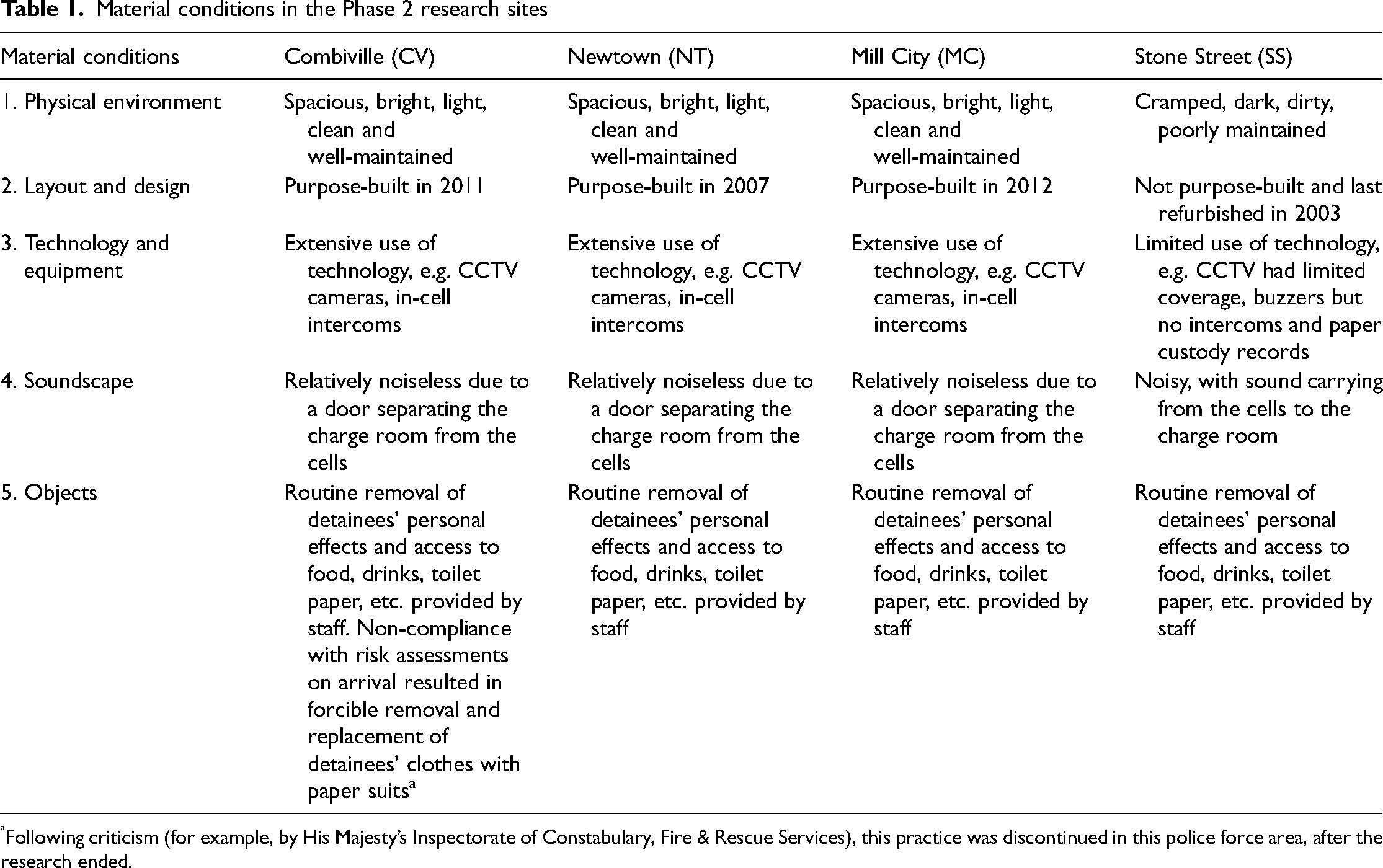
Following criticism (for example, by His Majesty’s Inspectorate of Constabulary, Fire & Rescue Services), this practice was discontinued in this police force area, after the research ended.
Second, the design and layout. This included whether custody was linear or circular, whether spacious or not, and the location of different facilities (showers, medical rooms, rest rooms for staff, kitchen, waiting areas, etc.). It also refers to lines of sight, the elevation of the booking-in desk, 6 and the separation of young suspects from adults and men from women, or simply from each other via ‘privacy screens’ at the booking-in desk.
Third, technology and equipment, including: widespread CCTV coverage in the charge room, corridors and cells; life-signs technology, which checks for heart and breathing rates of detainees in the cells; panic buttons; in-cell buzzers/intercoms; and, forensic and interview recording technology. There was also various equipment used to subdue and control detainees, including handcuffs, spit hoods, limb restraints, rip-proof or police- issue clothing and Tasers. Most police forces have also invested in IT systems, enabling tick-box approaches to assessing risk and logging required information on detainees’ custody records.
Fourth, the cleanliness and soundscapes of police custody mean that it involves not just ‘dirty work’ (Ashforth and Kreiner, 1999; Hughes, 1951), but also ‘dirty conditions’, particularly where custody blocks were in a state of disrepair. Staff also dealt with detainees who were bleeding, vomiting, urinating or defecating. As for the soundscape, police custody could be noisy: buzzers and the telephone constantly rang; detainees shouted, screamed and banged; staff also raised their voices or stomped up and down the custody block, with jangling keys. Doors also constantly banged open and shut.
Fifth, objects, such as detainees’ personal effects (e.g. bags, wallets, watches, mobile phones, jewellery, hair bobbles and spectacles) were routinely removed through (strip) searches, sometimes by force. Removal of such personal effects distressed detainees contributing to a ‘degradation’ or ‘mortification of the self’ (Goffman, 1961; Sykes, 1958). These ‘process’ degradations were inherent to detainees’ induction into custody (Irwin, 1986), and readied detainees for the police custody regime (Skinns and Wooff, 2020). They were therefore also part of a power struggle between staff and detainees, as has been noted in prisons (Smiley and Middlemass, 2016).
These material conditions varied across the four Phase 2 sites. CV, NT and MC were fairly new and purpose-built to be spacious and to ensure natural light for staff and detainees in the cells and at the charge desk. 7 This lightness was also achieved through colour schemes (e.g. white, pale blues and greens), although this this also created a clinical, hospital-like feeling. CCTV, capturing images and sound, operated in the majority of cells, and at the booking-in desk and corridors. Key facilities were logically located. For example, medical rooms and breath-analysis machines were near to the charge desk so that they were easily accessible for detainees and also for staff, should their colleagues need support when using these facilities with detainees. The blocks also had soundproofed doors, which separated the main charge room from the cells and prevented noise from the cells carrying to staff working at the booking-in desk. In CV, MC and NT, ‘privacy screens’ – high walls – were also erected between booking-in desks so that detainees could be simultaneously booked-in, without seeing each other, although they could still hear each other.
By contrast, SS – since replaced – was old and not purpose-built, as evidenced by the breath-analysis machine being up a flight of stairs, making it unsafe particularly for intoxicated detainees. SS was also dingy dirty (e.g. with mould on the walls) and described as a ‘shithole’ (SS_PO_18.6.14) and not conducive to feeling ‘uplifted or valued’ (SS_CS2).
The actant-like qualities of materiality in police custody?
Having conceptualised the material features of police custody, we now consider the way in which some of these impact detainee experiences. We examine the links between technology, soundscapes and objects, and dignity rooted in equal worth, privacy and autonomy, which were the key themes/interactions we found when re-analysing the Phase 2 data.
Equal worth
Staff conveyed equal worth primarily by providing food and drink, as well as sometimes clean clothes and showers, particularly where detainees were regarded as deserving of such support.
8
For detainees arrested on immigration grounds and found in lorries after a lengthy journey from mainland Europe, [t]hey come in dirty … the one thing we want to do is just sort them out first … have a shower … put some clean clothes on, settle yourself down, eat that food, … have a cup of coffee, and put your head down. (CV_CS1)
Staff thus believed that detainees were, on the whole, grateful to receive these items, because they provided a sense of having something in the sparse confines of the cell (Skinns et al., 2020). This also gives a sense of the relational, but also contingent nature of dignity for those in confinement (Savigar-Shaw et al., 2022; Gibson-Light, 2020; Razack, 2013; Skinns, 2011). The moral status and the cooperative behaviour of those arrested on immigration grounds was, in this case, enough to warrant clean clothes, accompanied by the possibility of feeling to be of equal worth.
Food and drink, was one of the simplest acknowledgements of the equal worth of detainees, as all human beings need to eat and drink. For example, one detainee said, [e]ven though I am still locked up and I’ve still done my badness. They are not degrading me because of that … They are still looking at me [as if] I am still a person. I still need to be fed. I still need to drink. They still ask me do I want anything. (CV_DET1)
Similarly, a detention officer (SS_DO4) noted the simple act of giving someone a cup of tea, saying, ‘a cup of tea is always a fantastic one “come on mate, let's make you a cup of tea”’. He described using it to acknowledge a detainee's pain and suffering, having recently lost his father, which was adding to his audible distress in the cells. However, there were limits to this, given, for example, that detainees were only ever given drinks in small polystyrene cups, unlike the ceramic mugs used by staff, which indicated their ‘same but different’ status, contingent upon their arrest and detention and the police's more powerful position as a result.
As SS_DO4's comments show, it was also the conversation that accompanied the cup of tea that elevated the detainee's sense of being valued. The cup of tea provided an opportunity for dialogue and for staff to convey compassion and equal worth, with staff adjusting their actions according to who they considered deserving of such support. This suggests an intertwining of social relations and materiality, in the way that scholars, such as Woodward (2020), Hicks (2010), Miller (2010), Orlikowski (2007) and Latour (2005) suggest. Experiences of dignity came about from and through the cup of tea, although were also contingent on detainees’ moral status and cooperative behaviour, and underpinned by asymmetries of power (Savigar-Shaw et al., 2022; Skinns, 2011).
Privacy
The all-encompassing nature of CCTV in all corners of the custody suite and cell areas, facilitated by the sophistication of the audiovisual and recording technology, shaped detainee privacy. Although detainees recognised its mutual benefits – in preventing harm or mistreatment and as an accountability tool for detainees, and as a means to cover staff's backs and reduce the risk of false allegations of improper conduct – they primarily saw in-cell CCTV as invading their privacy. For example, CV_DET5, said, ‘I’d rather take a hiding than have that poxy thing [the CCTV camera] watch me all night’. It was thus the inescapability of the cameras that rendered them problematic, both day and night, but also wherever detainees were in their cell, as CV DET5 explained: ‘[T]here's no privacy in there … It's just that square room isn’t it. It's just horrible. You can’t put your head nowhere without it being seen. It's horrible’.
Being watched and having their privacy invaded all the time affected detainees’ mood, making it hard to feel comfortable. For those with mental health conditions it added to their sense of paranoia, while other detainees worried about staff laughing at their behaviour on camera. The possibility of being watched while using the toilet also impacted detainee behaviour. They delayed using the toilet because of concerns about being watched, even when they were ill with urinary tract infections. Others did not want to defecate for the same reason. It was, therefore, not so much that the possibility of the all-seeing eye of the cameras had a disciplining effect in inducing compliance with the rules (Foucault, 1977); rather, detainees acted to assert their autonomy by maintaining their dignity and their need for privacy when engaging in the personal act of using the toilet.
Detainee privacy, or rather a lack of it, was also rooted in failures by staff to explain when CCTV was not used; namely, to observe detainees while using the toilet as the area around the toilet was pixilated on CCTV monitors. That is, social relations not just the cameras informed detainee behaviour, illustrating once again the ‘mangling’ of the social and the material (Orlikowski, 2007). However, this also illustrates the relational effect of materiality, in which materiality cannot be separated from the enactment of social relations (Latour, 2005). The presence of CCTV cameras and the provision of insufficient information by staff about how those cameras were used, combined to affect detainee behaviour, sometimes with uncomfortable consequences, which may have added to the pains of police detention associated with a loss of control and autonomy (Skinns and Wooff, 2020).
Autonomy
The noisiness of the custody block further eroded autonomy and increased feelings of helplessness and stress, and therefore the pains of police detention (Skinns and Wooff, 2020). If other detainees were noisy, there was nothing detainees could do, no matter if this upset or aggravated them, or prevented them from sleeping. It was simply endured. Even if detainees were to ask others making the noise to stop, it would be to no avail and was therefore futile: Let's face it, you can’t go to sleep in the cells because you’ve got either side knocking, screaming, banging and that goes on all night … it's unbearable because … they’re screaming, it's all echoing and they’re shouting … they’re arguing with other people in other cells. Someone's singing their heart out while someone's trying to tell them to shut the f**k up, saying they’re going to kill them when they get out … a part of it is quite funny, but the other part of it's like, shut the f**k up (NT_DET4).
Noise and the limitations it imposed on detainee autonomy were also affected by relationships with staff. Staff were unlikely to move detainees to a quieter cell. As NT_DET11 said, I’ve complained before when people's been banging and shouting next door constantly and I’ve said … ‘why don’t you move me then?’ …‘No, where do you think you are at? You can’t just be moved’.
Staff therefore appeared to discourage any bargaining over cells for fear that it might erode the image of the police as in charge (Wooff and Skinns, 2020; Skinns, 2011, 2019; Kendall, 2018; Skinns et al., 2017a; Choongh, 1997). Here we see again the entangling of the social with the material. Detainee dignity was informed by the soundscapes they encountered, but also by the negotiations they engaged in with other detainees or with staff, or rather the lack of them, and by the image of the police that custody staff sought to maintain in such negotiations, if they took place at all. In other words, the materiality of the soundscape mediated the meanings detainees ascribed to their experiences and to their sense of dignity, increasing their feelings of helplessness and a loss of autonomy, and this was reinforced by the futility of engaging in negotiations with staff or other detainees and their general sense of powerlessness.
Detainee experiences of autonomy were also shaped by food and drink. As found in prisons (Smoyer, 2019), food and drink added to or diminished detainees’ sense of power and agency in relation to staff and also their sense of dignity rooted in autonomy. Not giving in to requests for food and drink, especially when the request came outside what some staff saw as prescribed mealtimes and which were therefore disruptive of custody routines, or being slow to respond to these requests, were used to show contempt for detainees and their needs. These actions could also be degrading (Irwin, 1986: 94-5) and reinforced the sense that the police were in charge: I do everything I can to make sure they are dealt with as per the rules … I don’t like people that come in and say ‘can I have something to eat I’ve not eaten for 10 h?’ Well, that's not my problem is it? I think they should be fed at breakfast time, lunch time and a reasonable time in the evening and if they come in at 2 in the morning they can have breakfast at 7 (SS_CS3).
Decisions about whether to provide food were also shaped by staff perceptions of the behaviour of detainees. Some staff would only agree to requests from detainees when they were seen to ‘toe the line’, for example by not being too demanding and by not ‘kicking off’. If detainees were seen as polite, quiet and compliant, then this would be rewarded. As this detention officer said, detainees know that ‘if they’re alright with us, they can have a good time down here … they know their stay can be far more pleasant … magazines, pencils, crosswords, all stuff like that’ (SS_DO2). By contrast, MC_CS5 said, if they [detainees] are demanding stuff off you and treating you like … shit, really, show no respect or manners whatsoever and shouting abuse and saying I want a drink, you’re not going to give them a drink are you? … they have got to know who's in charge and its us.
The way that food and drink were provided corresponds with Savigar-Shaw et al.'s (2022) findings about procedurally just actions by the police – in this case, the giving of food and drink – ‘being a gift to the compliant’. It also highlights the relational and contingent nature of dignity discussed above. In this case, dignity rooted in autonomy, depended on cooperative and compliant behaviour.
Ultimately, food and drink facilitated tussles over power in the staff–detainee relationship, in which asymmetries of power meant that detainees were the likely loser. This served to underscore detainees’ already limited sense of autonomy. This also illustrates the socio-material nature of objects such as food and drink, with staff–detainee relationships and the objects themselves mutually moulding detainee experiences of autonomy but also feelings of equal worth, as described earlier.
Discussion
In summary, the material features of police custody include the physical environment (e.g. lightness and brightness), the design and layout, the soundscape, technology and equipment, and objects (e.g. food, drink, toilet paper, personal effects, clothing), some of which actively shaped detainee dignity. Objects such as food and drink conveyed the shared humanity of staff and detainees, and thus their equal worth. The inescapability of in-cell CCTV left detainees devoid of privacy, including while using the toilet. The noisiness of custody, over which detainees had limited control, eroded their autonomy, as did limited access to food and drink. These became vehicles for tussles over power in the staff–detainee relationship and in which detainees were the inevitable loser. These findings have four sets of implications.
First, materiality impacts detainee dignity, but only alongside staff–detainee relationships, particularly staff perceptions of detainees’ moral status (e.g. as dross or not) and the cooperativeness of their behaviour. Dignity is therefore contingent, as well as impacted by the material (Savigar-Shaw et al., 2022; Gibson-Light, 2020). For ‘the deserving’, cups of tea were accompanied by kind words intended to improve detainees’ sense that they were a person of value. In-cell CCTV cameras invaded detainee privacy, but this was also because of failures to communicate when these cameras were not used. Noise undermined autonomy, but only because staff did not act on requests by detainees to move cells, particularly if they demanded this ‘too much’. Similarly, autonomy was shaped not just by food and drink, but also by staff–detainee relationships, including whether staff saw detainees as sufficiently compliant.
In other words, the material and the social were inextricably intertwined. Although it was hard to tease out the ‘dialectical’ (Miller, 1987) from the ‘relational’ (Latour, 2005), things did act on detainee experiences of dignity in iterative and dynamic ways. Experiences of dignity arose through things (e.g. the act of providing a hot drink), but things like hot drinks also prompted further actions (e.g. well-meaning conversation) and meanings were then ascribed by detainees as these micro-level interactions unfolded (e.g. about their value and sense of being treated like a human being). The term, socio-material, which Orlikowski (2007) uses to convey the blending of the social and the material, therefore offers an accurate depiction of detainee experiences of dignity in police custody.
Second, moving materiality to the foreground of the analysis adds to understandings of ‘good’ police custody. In Phase 3, we found that a key measure of ‘good’ police custody, equal worth, was predicted by two features of materiality: when detainees felt they ‘had something’ in terms of access to material goods that met their basic needs (e.g. food, drink, reading and writing materials or limited personal possessions) and when they perceived the material conditions more favourably (e.g. whether the custody block felt not underground and well-maintained) (Skinns et al., 2020). From a socio-material perspective and the empirical analysis presented here, the predictive value of these aspects of materiality are explained by their active role in shaping detainee experiences, in conjunction with staff–detainee relationships. Objects and material conditions did more than symbolise the equal valuing of detainees by staff, as was initially thought to be the case. Rather they had actant-like qualities critical to detainee experiences of dignity.
The emphasis on socio-materiality also reveals hitherto underexplored aspects of ‘good’ police custody and police–citizen relations therein. If we regard detainee dignity as critical to notions of ‘good’ police custody, which is something we have argued to be the case (Skinns et al., 2020), and if materiality moulds detainee experiences of dignity, in the way this article has set out, then material conditions must also be seen as central to notions of ‘good’ police custody. However, it is not the case that ‘good’ material conditions amount to dignity, as His Majesty’s Inspectorate of Constabulary, Fire & Rescue Services inspection reports and European jurisprudence imply when they describe poor material conditions as undignified (Skinns et al., 2020). Rather, ‘good’ material conditions are a precursor to dignity. These ‘good’ material conditions actively shape detainee dignity and should therefore be seen as the basis for ‘good’ police custody practices, which might include, for example, ending restrictions on providing food only at specified mealtimes.
Third, this piece also demonstrates how materiality is implicated in detainee experiences of power in police custody and, by implication pain and injustice. Owing to the vastly unequal relationship between citizens and the state in criminal justice settings (Welsh et al., 2021), prison studies scholars have been quicker to recognise this power of things. As discussed at the outset, objects such as food and drink, are implicated in tussles over power between confinees and criminal justice actors. Food and drink and other aspects of materiality cannot be treated, therefore, in a benign fashion in police custody, given the disempowered status of detainees therein. Materiality serves to support hard and soft forms of policing. On the one hand, materiality supports ‘hard’ forms of policing and some of the pains of police detention and injustice that may stem from this. For example, when physical conditions are poor or when staff deny detainees food or drinks outside prescribed mealtimes, this may coerce or induce detainee cooperation and convince them that they are being punished. On the other hand, materiality supports ‘soft’ policing. Cooperation may be encouraged not coerced, for example, where clean clothes are provided to maintain the dignity of a detainee wearing soiled clothes or where hot drinks are provided to show that staff care about detainees’ wellbeing. That said, dignity-supporting stuff may appear soft, but in fact have coercive ends, enabling better domination of detainees but through subtler and less coercive means. For instance, a cup of tea and kind words might be enough to ‘sugar coat’ and thus ‘hoodwink’ detainees into cooperating with necessary police procedures (Skinns, 2011; MacCoun, 2005). Staff in the current research were all too aware of these soft and hard forms of policing and their relationship with stuff and used them accordingly to manage detainee behaviour and secure their preferred outcomes. As such, social relations and materiality intertwine in ways which enable staff to produce and reproduce social order and manage problem groups inside police custody, but outside it too, given the inevitable vulnerabilities and inequalities experienced by detainees (Skinns, 2019; Pemberton, 2008), which become reinforced through their arrest and detention and the ‘soft’ and ‘hard’ power of things in custody.
Suggesting that materiality supports ‘soft’ and ‘hard’ forms of policing and the maintenance of social order is an important contribution of this piece, because the existing literature has hitherto focused primarily on the significance of social relations to these different styles of policing in police custody (Savigar-Shaw et al., 2022; Skinns, 2019; Skinns et al., 2017b). In immigration detention, the focus has similarly been on the social not the material to the governance of ‘problem groups’. Armenta's (2017) notion of ‘compassionate repression’, for example, focuses on politeness, empathy, kindness, respectfulness and humour, which are used by immigration officials in the US to make practices of social control more agreeable and palatable, while also normalising and legitimising them to staff and to those being detained. Moreover, it is reasonable to conclude that the ‘soft’ and ‘hard’ power of things noted here, in relation to police custody, are also useful for understanding other police settings, where citizens, the police and things routinely interact (e.g. situations where the police use body-worn cameras).
In conclusion, the findings presented in this article confirm what others have noted too, that materiality is hard to ignore, including in police custody, especially when combined with the intricacies of staff–detainee relationships. Socio-materiality represents an important lens through which to explore police procedures, practices and staff–citizen interactions, including as a route to understanding the operation of ‘soft’ and ‘hard’ police work. To see the objects of police work as only symbolic or representational is too limiting. Instead, police scholars should consider the properties of things, but also the processes and practices that accompany them, paying attention to the way in which people and things interact and the effects they have on each other, something that has been limited in the existing police studies literature. The symbiotic relationship between the material and social should therefore be recognised and indeed further elucidated and mapped out in future police research, which is the fourth and final set of implications of this piece.
By employing material methods (Woodward, 2020), future work might further explore the differential meanings of things from the perspectives of the police and citizens, and their effects. It should also systematically map out the relationship between different features of materiality and dignity, as well as examine the relative value of different theoretical accounts for understanding the role of materiality in police–citizen encounters, drawing on sociology, anthropology, but also geography, which was largely put to one side for the purposes of the current article. In this regard, thinking about the three-dimensional or volumetric nature of police custody might yield some interesting avenues for future research (Linnemann and Turner, 2022), including law, language, policy, but also sound, atmosphere and three-dimensional tools of coercion and surveillance.
Further consideration is also needed of the material aspects of ‘soft’ power, beyond the links between materiality and dignified treatment explored here. Woodward and Bruzzone (2015), for example, note the ‘haptic’ nature of touch, in which the police touch citizens without touching or coerce without bruising. While standing in a queue to be searched by the police, citizens anticipatorily display police use of force logics when they splay their legs and raise their arms without being asked. It is likely that detainees may display similar behaviours when waiting to be searched at the charge desk, as might citizens during street-based encounters with the police. A further aspect of this is to examine how collectively the social and the material function to support ‘soft’ and ‘hard’ policing in a range of settings; in other words, examining how materiality not just social relations functions to secure cooperation and compliance from citizens during their interactions with the police inside and outside police custody. Hopefully, this article provides a starting point that will enable police scholars to catch up and to take the material turn in new directions in criminal justice scholarship and beyond.
Footnotes
Acknowledgements
We would like thank Amy Sprawson for her role in collecting and coding some of the data on which this article draws. Thanks also to SJ Cooper-Knock, Tessa Diphoorn, Sarah Neal and Mike Rowe for reading earlier versions of this article, as well as to attendees at the Oxford All Souls Lecture on 23 January 2020, where the first author presented an earlier version of this article.
Declaration of conflicting interests
The author(s) declared no potential conflicts of interest with respect to the research, authorship, and/or publication of this article.
Funding
The author(s) disclosed receipt of the following financial support for the research, authorship, and/or publication of this article: This work was supported by the Economic and Social Research Council [Grant number ES/J023434/1].
