




Abstract
Multi-agency partnerships and intelligence-led policing are among the proactive policing strategies used to manage and prevent crime outside the criminal justice process. Drawing on narrative criminology, this article studies the co-constitution of concrete proactive policing methods and the populations and crimes that they are directed at. Further, the article illuminates the variety of distinct approaches that are understood in the studied policing context as ‘preventive’, a term found to be applicable to any police strategy or method that does not involve investigation and is not aimed at building a criminal case for prosecution. Whereas crime prevention effects are considered desirable and achievable, at least in theory, the internal organisational aim to prevent prosecution exerts an influence on how crimes as well as the crime prevention mandate are made sense of and rendered actionable.
Introduction
Prosecution is an expensive and time-consuming way to address crime. As such, it has been utilised by police and regulatory agencies as a ‘last resort’: after pre-trial alternatives have failed to provide a solution, in exceptional cases of instrumental or expressive import (Hawkins, 2002), or when other causes of attrition have not stopped the case from proceeding through the criminal justice system (Korsell, 2015). Coupled with, for example, public spending cuts and waning faith in the criminal justice state's capacity to provide security, alternative proactive strategies have been established to manage and prevent crime outside, or at the early stages of, the criminal justice process (Garland, 2001; Weisburd and Braga, 2019). These strategies include preventive partnerships wherein state agencies and/or private actors share the responsibilities and workload of crime control (Crawford, 1999; O’Neill and Loftus, 2013), as well as data-driven decision-making frameworks. Among such frameworks, intelligence-led policing (ILP) is a prominent applied model. It proffers to make policing more cost-efficient by predicting risky people and places accurately and early, thus facilitating targeted preventive policing (Fyfe et al., 2018; Ratcliffe, 2016; Tilley, 2008).
Policing's preventive aims are not novel in and of themselves. Comprehensive aims to prevent and avert threats to the welfare of the community were shared by nascent police institutions in the Anglo-American (Dubber, 2005), as well as Nordic contexts (Ellefsen, 2021). However, the growing ideological and practical salience of the proactive paradigm (Hartmann, 2018; Hestehave, 2021; Husabø, 2013; Weisburd et al., 2019) warrants empirical attention to understand how a loadbearing ideal of crime prevention is understood and made actionable in policing. These are pressing issues, particularly as ILP tends to neglect how police organisations have interests, aims and perspectives that affect what becomes known and actionable to them (Vestby, 2018).
ILP presupposes a ‘machine-like’, formal rational relationship between police knowledge and policing as targeted interventions against crime and disorder (Sheptycki, 2017). This understanding largely ignores the co-constitutive dynamic between how such problems are interpreted by the police, and the availability and perceived usefulness of particular police courses of action. Several researchers have studied how decision-makers across police, security and regulatory agencies render their work meaningful and actionable by selecting which events to target for interventions, and how. Examples include studies of how customs officials prioritise types of contraband that can be efficiently processed (Runhovde, 2017), how detectives transform criminal cases with reference to organisational structures and according to their own needs for making their work predictable (Ericson, 1981), the co-production of risk-oriented knowledge by intelligence professionals and decision-makers (Gundhus and Jansen, 2020), and how moral classifications and organisational interests serve as part of the basis for ordering prosecution decisions (Hawkins, 2002).
The contemporary impetus toward more self-directed and future-oriented policing necessitates studies of how prevention is explicated, operationalised and made sense of (Weick et al., 2005) by practitioners and decision-makers. This article asks: How is the concept of ‘prevention’ made sense of by policing agencies as they attempt to connect plausible accounts of problems to available courses of action? Which interventions are explicitly understood as ‘preventive’ by practitioners, and how are these articulated with reference to different target populations?
The empirical basis for this article is a Norwegian multi-agency policing initiative against ‘work-related crime’ (WRC), in which some businesses are considered ‘good’ and suitable to include in a responsibilisation strategy, and others are judged to be better incentivised through disruptive policing strategies (cf. Garland, 2001). Yet both modes of policing are argued with reference to similar preventive ideals. WRC encompasses profit-motivated offences connected to the labour market and has been conceptualised as an inter-sectorial issue for which the police, along with the tax, welfare and labour authorities, are responsible (Jahnsen and Rykkja, 2020). Criminal investigation is to be prioritised only for the most serious offences (Departementene, 2021; Riksadvokaten, 2021), and pluralistic, multi-agency alternatives to the prosecutorial route have been established in the form of, for example, disruptive task forces and preventive partnerships between police and local business communities. Police and other agencies are thus required to draw meaningful distinctions between sufficiently licit businesses, that could be included in preventive partnerships, and the fly-by-night or downright criminal businesses against which more punitive disruptive methods are considered appropriate.
The article draws on a theoretical framework of sensemaking theory and narrative criminology, and produces an analysis that is centred on how the policing agencies render the multifaceted anti-WRC mandate actionable in their local organisational context, creating order and predictability, while also catering to act proactively and produce crime prevention. To discuss the research questions posed above, this article examines the narrative understanding and legitimation of prevention vis-à-vis reactive crime control and the narrative co-construction of morally good or bad businesses with preventive policing strategies.
Proactive policing and crime prevention
Because crime has increasingly come to be understood in terms of future risk rather than wrongs committed in the past (Schuilenburg, 2017; Zedner, 2007), self-directed and preventive policing strategies that aim to affect the future (Maguire, 2000; McCulloch and Wilson, 2016) have grown more relevant compared with post hoc and emergency responses. ‘Proactive policing’, according to Weisburd et al. (2019: 2), comprises strategies that aim for ‘the prevention or reduction of crime and disorder’ and that include ‘an emphasis on prevention, mobilizing resources based on police initiative, and targeting the broader underlying forces at work that may be driving crime and disorder.’ Compared with the standard model of policing in which there is ‘an emphasis on reacting to particular crime events after they have occurred and mobilizing resources based on requests coming from outside the police’ (Weisburd et al., 2019: 2), proactive policing gives police agencies wide berth to define their own remit and objectives (Hestehave, 2021).
Ashworth and Zedner (2014: 5) define crime prevention as ‘the significant reduction of (potentially) harmful behaviour, or the reduction of (potentially) harmful behaviour to a tolerable level’. How to achieve a reduction in harmful behaviour has been sought out and theorised in many ways. Routine activity theory has been an influential perspective in the practice of crime analysis. Its concept of the crime triangle (wherein motivated offenders intersect with an attractive target in the absence of guardians; Felson and Boba, 2010) directs preventive action; for example, toward reducing opportunities and increasing the costs of crime through focused deterrence (Rowe and Søgaard, 2019) or regulation (Eck, 2017), rather than toward bolstering potential offenders’ motivation to comply with the law (Hough et al., 2017), or identifying social welfarist solutions to crime that is seen to have been generated by socio-economic deprivation and inequality (Egge and Gundhus, 2012; Garland, 2001). At the core of this article, thus, is the empirical exploration of how police interpret and make actionable their work as a ‘preventive endeavour’ (Ashworth and Zedner, 2014) in light of organisational and policy ambitions to manage crime and disorder outside formal criminal procedures (cf. Weisburd et al., 2019).
ILP offers, in theory and practice, a salient example of a proactive strategy, and emphasises strategic agenda-setting and resource allocation based on crime analysis (Fyfe et al., 2018; Ratcliffe, 2016). The ideals and practices of proactive policing have been articulated in the national context of this study as well, most clearly through the Norwegian Police Directorate's implementation of a national model for ILP in 2014 (Vestby, 2018), and its naming crime prevention as its foremost strategy going forward: ‘The police will work to be one step ahead of crime and unwanted incidents, and to promote a safe society!’ (Politidirektoratet, 2020: 2; author's translation).
Police power, risk and classification
Although proactive innovations such as problem-oriented and intelligence-led policing emerged during the last decades of the 20th century, police-directed and future-oriented social control and public administration are not new (Dubber and Valverde, 2006; Weisburd et al., 2019). Police as a mode of governance, not a force or organisation, predates even Peel's oft-cited preventive patrolman (Loader, 2016). The term dates to the 18th century in the Anglo-American tradition and already existed in the Danish–Norwegian language by the early 1500s (Dubber, 2005; Ellefsen, 2021). In both contexts, the word refers to the wide-ranging ‘power of the state to govern the persons and things within its dominion as a household’ (Dubber, 2005: 159), or ‘the regulatory power to take coercive measures to ensure the safety and the welfare of “the community”’ (Dubber and Valverde, 2006: 2). Police denotes a wide-ranging discretionary and preventive mode of governance aimed at protecting the present and future welfare and safety of a designated community. Unlike law as mode of governance, police seeks to prevent undesired outcomes in the future rather than to punish specific acts committed in the past (which are within the purview of the individualistic and rights-based system of law). Modern proactive policing seeks to prevent through strategic, knowledge-based interventions into populations and territories rather than to redress through justice measures (Weisburd et al., 2019). This approach to policing thus falls within the original sense of a police governance tradition: ‘Police is the power to prevent the need for law’ (Dubber, 2005: 163).
Whereas crime traditionally has been regarded as a wrong to be addressed post hoc, it is increasingly perceived as a risk of future losses. These potential losses might be averted through action in the present (Zedner, 2007). Hudson argued that we have witnessed a ‘shift from “justice” to “risk” as the primary organizing principle of criminal justice’ (2012: 146). Within the tradition of critical risk studies, risk is understood as a constructed entity that brings into existence the very effects it anticipates (McCulloch and Wilson, 2016; Mythen, 2014), and which can be studied as a governance tool with associated strategies and methods for acting on ‘uncertain futures’ in the present (Amoore, 2013). The article explores the types of populations that ‘are brought into being and made amenable to governing within the politics of possibility’ (Amoore, 2013: 6) when policing agencies connect particular preventive strategies with what they consider to be appropriate target businesses.
To classify subjects and objects according to their perceived riskiness becomes paramount to security. At the core of police-as-governance is the act of classifying these either as resources for, or as threats to, the safety of the protected social order, to be able to ‘treat each object according to its classification’ (Dubber, 2005: 180). This separation into resources and threats resonates with Hudson's distinction between ‘those (potential victims) who deserve rights and those (potential offenders) who don’t’ (Hudson, 2003: x). Classification is essential to develop and use differentiated proactive strategies within the remit of police power.
Classification is fundamental to policing and is a prerequisite for choosing a course of action (Dubber, 2005; Lundgaard, 2021). Drawing on narrative criminology and sense-making theory, this article studies prevention as a first-order concept (Van Maanen, 1979) through its narrative articulation, meaning how it is used and understood in the field under study. Narratives exist at individual as well as aggregate scales (Presser, 2009) and enable us to impose order and coherence by reducing complexity. When explanations of phenomena resonate and appear plausible, they may act as heuristic devices for determining appropriate action (Weick et al., 2005). Stories can also impose moral order, assigning purity and blameworthiness (Ugelvik, 2016). For instance, Tognato (2015) found two different public stories of tax evasion in Italy, one connecting it to a symbolic centre of society, and the other, depicting it as a specialised matter. A story that dramatised a subject provoked a moral response, whereas one that downplayed it elicited a technical one (Garland, 2001; Tognato, 2015). Recent research that has considered narrative constructions of WRC has either portrayed it as a near-existential threat posed by transnational organised crime and requiring action, or as a type of economic crime resulting from normal market dynamics within the framework of the welfare state (Vestby, 2022). Through organisational narratives – meaning ‘shared interpretive patterns’ (Vaara et al., 2016), practices and ideas are given meaning, are lauded or rejected, and become connected to particular populations, crimes and police roles. The narrative articulations of prevention as well as policing strategies, and the classes of businesses that are considered suitable targets for them, are studied here as situated articulations of circumstances and as reflective of participants’ ongoing efforts to connect plausible explanations to appropriate courses of action (Weick et al., 2005).
Context and methods
This study has been carried out in the context of a national Norwegian initiative against WRC. Based on an inter-ministerial strategy that has been updated and reaffirmed biannually since 2015, the initiative is in its fourth iteration (Departementene, 2021). The definition of WRC has remained largely unchanged: Work-related crime comprises actions that violate Norwegian laws on pay and working conditions, social security, and taxation, often committed in an organised manner, which exploits workers, or which distorts fair market competition and undermines the structural underpinnings of society. (Departementene, 2021: 6; author's translation)
The term intends to capture a range of profit-motivated offences that fall under the ambit of different jurisdictions. Labour exploitation, tax evasion, human trafficking and fraud relating to bankruptcies, credit and welfare benefits are common expressions of WRC (NTAES, 2020). Interorganisational coordination is considered essential to develop flexible and effective forms of control that rely on methods other than criminal investigation and prosecution (Departementene, 2021), although prosecution remains an option for the most serious cases (Riksadvokaten, 2021). Within the police organisation, units specialising in economic and environmental crime, organised crime and migration are often tasked with WRC enforcement. Each police district has one police–business liaison who sits in the districts’ crime prevention units. The government has established a secondary inter-agency structure that includes a strategic intelligence analysis unit and regional inter-agency task forces (Departementene, 2021; Jahnsen and Rykkja, 2020).
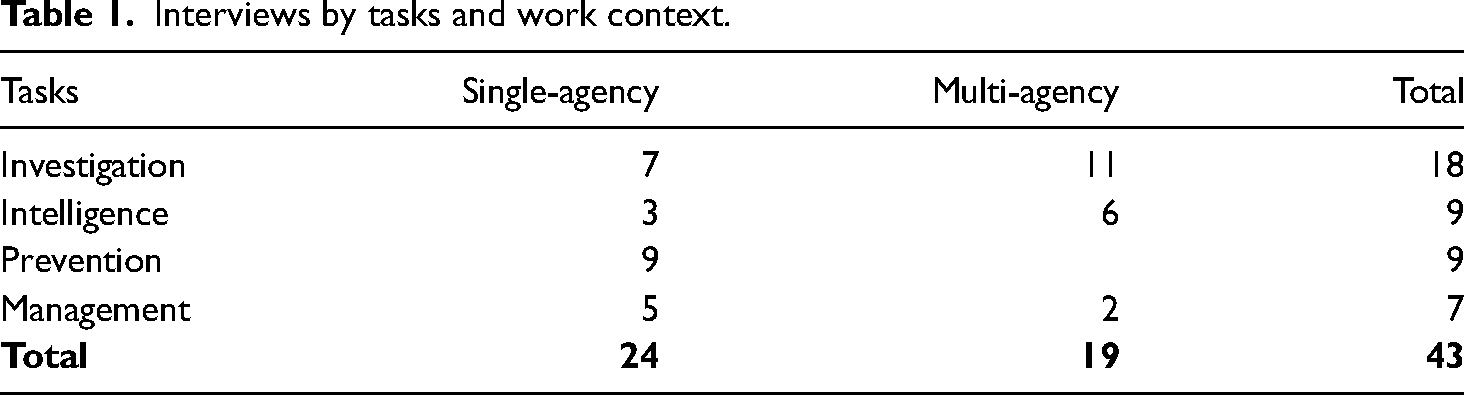
This article's data set comprises semi-structured interviews, publicly available policy documents and strategic intelligence analyses. 1 During 2015–2020, I conducted 43 interviews 2 with professionals, including managers, employed in units tasked with criminal intelligence gathering and analysis, investigation and crime prevention. Six of these were interviews with professionals performing similar tasks in three other agencies that are integral to the anti-WRC initiative: the Labour and Welfare Administration, the Labour Inspection Authority, and The Tax Administration. Table 1 shows how many interviews were conducted with participants who had their day-to-day work embedded in a multi- versus single-agency setting, and their primary tasks. A purposive sampling strategy (Guest et al., 2006) was used where participants were invited based on professional experience with the empirical phenomena (WRC, ILP, partnerships) that concern this study, and to represent functionally and geographically diverse sites. Although not members of the police force, the non-police participants were embedded alongside police offers in inter-agency collaborative work and, as such, were highly relevant sources to understand the policing context under study.
Interviews by tasks and work context.
The multi-sited research design aimed to capture as much variety in interpretations of WRC and crime control strategies as I could, tracing them as ‘cultural phenomena across and within multiple sites of activity’ (Marcus, 1995: 3). I analysed policy documents and strategic analyses using a thematic analysis strategy, and the interview materials using Tjora's stepwise deductive–inductive method (henceforth SDI) (2018). The purpose of the latter is to ensure an inductively based analysis, wherein later theorisation and categorisation (i.e. the narratives presented in the Findings section) can be traced back to the first-order coded materials. Each SDI code is a summary of what was said (when coding interview data), rather than a term for what was talked about. To give an example, two codes from the inductive first cycle of SDI coding were ‘working with the police is cool’ and ‘police lend credibility to collaborations’. These aim to summarise rather than categorise an interview statement. Later, these codes were categorised as ‘incentives to collaborate’ – an abstracted term for what I considered the statements to be about in the context of my research. This process helped ‘stave off’ deductive theoretical themes during the initial coding cycle. This was useful because I had analysed 22 of the included interviews previously, using a theoretically deductive thematic analysis (Bjelland and Vestby, 2017).
Regarding my positionality, I turn to Brown's (1996) typology of four distinct researcher positions in police studies, which ranges from inside insiders (in-house research conducted by police employees for the police organisation) to outside outsiders (e.g. university academics who study police). My position as an academic criminologist employed by the police college, but funded by the Norwegian Research Council, is best captured by the category inside outsider: a ‘qualified civilian researcher’ (Davies, 2016: 156) ‘with “official” access or rights […] to be treated as being on the same side as the institution they are researching’ (Westmarland, 2015: 165). Being an employee at the college places me as a researcher in a familiar context to participants that are mostly, although not exclusively, police officers, and may elicit a degree of trust that has benefited me in negotiations over formal research access as well as informal networking.
Findings
This section explains the narrative co-constitution of victims and offenders through an analysis of two proactive police models for anti-WRC efforts. The first is essentially ‘the organised crime policing concept’, which is taken here to represent a risk-control approach whose ‘primary intent is […] containment, not change […]’ (Clear and Cadora quoted in Hudson, 2003: 50) of suspect persons and enterprises. The second involves a liaison model that requires representatives from the police to foster preventive partnerships with others, such as members of the business community. The proactive paradigm can include both ‘soft’ and more coercive police models. Those involved in anti-WRC efforts make sense of and justify the two approaches described here with reference to their crime prevention effects. These justifications appear and recur in the data as comparisons between proactive, preventive crime control with criminal investigation, and prosecution. This section thus begins with a brief outline of the narrative construction of economic crime policing as the reactive and law-centred counterpart to other forms of proactive and/or operative police work. It then offers descriptions of the narrative justifications for the police–business liaison and organised crime policing concepts.
Economic crime investigation as the epitome of reactive policing
Registered crime is suffocating us. (036) We drop case files [due to capacity], more than we actually make strategic choices about which cases to investigate. (037)
Further, those interviewed recognise that other serious crimes take priority over economic crimes and that investigations cost a great deal in terms of both money and time. Arguing for the value of investigation despite the absence of quick results, an investigator from a specialist economic crime unit put it like this: Everyone understands that sexual abuse and homicide cases require rapid responses from the police and have to take priority over our [economic crime] cases. But someone has to deal with what I call ‘long crime’ as well, [m]eaning forms of crime that are persistent, practically ambient. That is where we come in. […] Investigations take a long time, are resource intensive and sometimes the cases are too complicated for us to be able to do anything. We don’t often get quick results, but we can get good signal cases. And that's where a unit like ours comes in, dealing with ‘long crime’ is our job. (049)
Quick results are more likely in the case of operative police interventions that occur close to the real-time occurrence of crimes. An investigator at a national special unit for economic crime stated with reference to the operative ideal, We lack – we’re not operative in that sense, we don’t visit building sites, we don’t do surveillance and that sort of thing. But we’re quite good at tracing large sums of money and can be quite effective in taking down central actors (048)
An officer with experience in both organised crime and economic crime policing characterised the specialised economic crime teams as being too oriented toward the law, in contrast to the operative ideal of the police: They are too juridical! They have too many lawyers and are too preoccupied with the law. They’re not operative enough, and they use operative police methods too rarely. They need to learn from the OC [organised crime] policing units. (036)
Economic crime investigation epitomises reactive policing and functions narratively to negatively define proactivity. It is thus an important backdrop for the two narratives about models that rely on police power, not law.
The police–business liaison: Serving and sharing responsibility with bona fide businesses
As part of a major structural reform of the Norwegian police in 2017, a ‘police–business liaison’
3
position was established in each police district and assigned an explicit preventive scope within the organisation. The directive for the standardised position states, The liaison shall work to prevent and reduce work-related crime and crime which targets businesses. The function shall foster good local collaborations between the police, businesses, security authorities and other actors in civil society. This will contribute to proactive and targeted actions undertaken by businesses and other private actors, as well as to knowledge-based crime-fighting by police.
The liaison is the police district's main contact point for businesses outside the penal track, and shall act as an advisor and forward inquiries to the proper authority. (Politidirektoratet, 2017: 90; author's translation)
Organisationally, the liaison sits within the department for crime prevention. Per the directive, the liaison should play an advisory role vis-à-vis the business community and work outside the penal track. One liaison, in describing the advisory function, emphasised its intentional separation from any penal or coercive measures that police might take: If there's a problem, if businesses are uncertain if they’re on the right track or whether they’ve done something wrong, they can come to me and we’ll talk about it and not necessarily have it become a reported case. It's been important to our police district that there's a low threshold for businesses to reach out. This is also to build trust in the business community. (030)
The police–business liaison position is designed to face a business community whose features remain implied in this model. Here, the business community is cast as valuable to society and at risk of victimisation from WRC and other forms of misconduct against the private sector. Prominent in the narrative is the assumption of businesses’ innocence, or at the very least an assumption of their good intentions; businesses may overstep the mark but they are well-meaning and corrigible through the advice and aid of the police. The business community as an arena for, or perpetrator of, these forms of crime goes largely unmentioned: The liaison has a unique preventive role in the sense that they can be a team player for a business community that mostly is interested in combating crime. Work-related crime. (038)
To be included in the implicitly bounded business community is, according to the liaison model, to be classified as a proper business, a societal resource worthy of protection and a legal entity whose rights should not be infringed upon by either criminals or public authorities (Dubber, 2005; Hudson, 2003). One liaison, reflecting on appropriate methods to use against bona fide businesses as opposed to their less serious counterparts, stated, Serious businesses should be left in peace. We can advise and guide them, but we have to catch the fly-by-night businesses using the [police operative] WRC task force. One could imagine that we could get rid of those businesses using preventive methods, but we would need to challenge each other more on that […] (029)
In the liaison model, the liaison acts as an information broker, drawing on the intelligence capabilities of the police organisation to distribute information to the business community and enable it to act in a prudent and knowledge-based manner (Ericson and Haggerty, 1997). We [liaisons] are going to be proactive, aware of current trends in crime, and be able to say something about any type of crime that may threaten the business community. (030)
In providing businesses with information, police assign responsibility to them to protect their own interests and values and enable them to protect themselves against future harm and loss. Whenever we see a trend in WRC that requires us to do something, it is my role to provide information – either publicly or in meetings with businesses. We can raise a warning finger as well and say ‘Beware!’ (038)
The liaison model for crime prevention is articulated as non-coercive and respectful of the autonomy and privacy of the implicitly bona fide business community. The target audience for the liaison model is defined as the business community, against which there is no need for coercive measures. Here, concern over the cost associated with false positives is articulated as limitations on the acceptable methods the police should use and even on the roles the police should embody. Whereas the liaison model fits within a proactive policing paradigm, this particular approach involving the police and business community is explicitly concerned with the rights of the target population – the business community.
The OC policing concept: Dynamism, pragmatism, effectiveness
Whereas the police–business liaison model is codified in the police organisation's formal directives, ‘the organised crime [OC] policing concept’ is not a formalised model in this sense. The term is used by participants in this study and designates a set of flexible, operative, pragmatic and frequently disruptive and person-oriented police methods. These often derive from police organised crime units, which have frequently spearheaded innovative crime control approaches. One participant summarised the spirit of the OC policing concept as follows: Our intention is to have a maximal impact on criminals. My experience is that the organised crime policing concept is to ally with everyone who is willing and able play on your team. Against the wicked [laughs]. There are other factors at play in economic crime investigation teams where you don’t have the same … dynamism. (046)
Whereas economic crime generally may be understood as constituting predictable offences given competitive markets, organised crime has more often been considered a threat posed by an external Other (Franko, 2020; Vestby, 2022; Woodiwiss and Hobbs, 2009). This understanding is reflected in OC policing's legitimisation of anticipatory, disruptive action as well as proactive investigation against the ‘usual suspects’ (Hestehave, 2021). The following statement indicates the person-oriented, rather than crime-oriented, direction of this policing concept: We aimed to go after the criminal person, rather than getting him for every exact thing he had done. (001)
Economic crime investigations (like criminal investigations generally) take place within reactive and rule-based conditions; by contrast, OC policing is a locus for innovation in disruptive modes of crime control (Kirby and Snow, 2016; Lomell, 2018; Tilley, 2016). In the Nordic context as well, there has been noted a ‘redirection of prevention into disruption’ (Hestehave, 2021: 59. For example, ‘pulling levers’ 4 approaches that originated in the United States are in common use in Europe, including the Nordic countries (Bjelland and Vestby, 2017; Jahnsen, 2018; Rowe and Søgaard, 2019). Disruptive measures used to stop criminal acts from being carried out require both knowledge and discovery (Bjørgo, 2016). Disruption has been linked to the application of ILP, the result, in part, of its status as an effective alternative to criminal investigation and prosecution (Lomell, 2018). Intelligence provides information and a framework for systematic application of disruption, which offers an alternative to prosecution or a reliance on less coercive or punitive forms of crime prevention (Innes and Sheptycki, 2004).
Inter-agency collaboration and the strategic exchange of expertise and legal tools are mainstays of a dynamic OC policing model. In this way, all ‘good’ forces unite against criminals, with the precise constellation of contributors varying depending on the situation. Coordination among police, tax, labour, and welfare authorities in the context of reactive investigations is common, as are persistent, large and small interventions and penalties by a variety of governmental agencies aiming to demoralise individuals and discourage them from associating with organised crime groups (Bjelland and Vestby, 2017; Jahnsen, 2018). The anti-WRC initiative is fundamentally defined as an arena for innovation to achieve effective collaborative control practices (Departementene, 2021). Regional inter-agency WRC task forces conduct inspections to uncover irregularities and disrupt by, among other things, hitting suspect businesses with sanctions against workers based on their immigration status, withholding liquor licences, or seizing tools and materials necessary to conduct business. Police officers involved in anti-WRC work have said that sometimes they hoped such inspections would not result in criminal investigations ‘as these cases would most likely pile up at the section for economic crime in the police’ (Jahnsen and Rykkja, 2020: 14). One officer interviewed for this study responded to a question about how a team is formed from among the agencies participating in a regional effort to conduct a specific intervention: Officer: Typically, the immigration unit is present and they have plans for the whole year, where they’re going to be at. They’re going here and there to have inspections. Then the Labour Inspection Authority perks up and wants to join, maybe the local tax collection office as well. Officials from the municipality and these inspectors think it's a lot of fun to come along. The Labour and Welfare Administration people sometimes join as well. So yes, we agree on who should come, but there's no formal directive that it should be this way or the other. That gets assessed on a case-by-case basis depending on the tip we’ve received. (037)
This officer describes the assembly of the team as a pragmatic and opportunistic allocation of resources, in line with what Sklansky (2012: 157) terms ad hoc instrumentalism: the use of ‘legal rules and legal procedures as interchangeable tools, to be brought to bear pragmatically and instrumentally on an ad hoc basis’. Not only is criminal law harnessed in the name of prevention (Lomell, 2012), but all applicable legal jurisdictions – tax law, employment and environmental protection legislation and immigration law, among others – are implicated in the holistic anti-WRC framework (Bjelland and Vestby, 2017; Jahnsen and Rykkja, 2020). The goal is frequently to strike a particular person or circle of associates by preventing – through disruption – expected future crimes. An investigator in an OC unit described an inter-agency disruption technique used to bring business owners into compliance with the law: We go to those who haven’t submitted their turnover statements at home and knock on their door. The tax authority, the police, and the Labour and Inspection Authority, and we tell them it's against the law to not submit the statement. To just get it done. Fix it. Most of them do. Ninety per cent do it after our visit, or they close down their business. (035)
The OC policing narrative assumes that these disruptive tactics, individually, stop ongoing crimes and that, on aggregate, they alter the offenders’ cost–benefit analysis and thus, to some extent deter and lead to desistance (Jahnsen, 2018). This assumption of prevention, and the acknowledgement that some may doubt this deterrent effect and see disruptive methods as trivial, are evident in the comment of one study participant: There are different opinions about how disruption tactics work. Some people think it's trivial, to seize a scaffolding [e.g. from a house-painting business]. That it means nothing. You’ve expelled a worker from a building site and they’re back two days later. In and of itself it is very trivial. The OC approach, though, is that down the line these actions will have an effect. Whether that is the case is another matter, but without that knowledge in the other agencies, they’ll only see the trivial. (046)
Discussion
Responsibilisation and disruptive police strategies have both been prevalent logics of crime control innovations over past decades (Garland, 2001; Weisburd and Braga, 2019). Whereas crime prevention practices have sometimes been conceptualised as non-punitive, scholars argue that, within a new preventive paradigm, prevention tends to be conceptualised as the disruption of specific acts committed by specific persons, and to place criminal law enforcement at its core (Ashworth and Zedner, 2014; Hestehave, 2021; Lomell, 2012, 2018). The two police methods described in this article – collaboration between the police and the business community, and the disruptive, organised crime approach – represent, respectively, these two understandings of how policing may succeed in its ‘preventive endeavour’ (Ashworth and Zedner, 2014): making ‘good’ businesses into capable guardians and obstructing morally ‘bad’ businesses (cf. Hawkins, 2002; cf. Felson and Boba, 2010).
The narrative legitimacy of both these models rests on claims that they prevent crime, are police-initiated, and build on the initiatives of police and collaborating agencies to mobilise resources to achieve crime control (Weisburd et al., 2019). Although both frameworks share a vocabulary of crime prevention, they differ greatly in their substantive practices, including coercion and the extent to which they are perceived as useful in dealing with different groups of victims or offenders. The organisational narratives about both the liaison model and the OC policing concept articulate particular instances of governance within the logic of police power. The two strategies share key traits that set them apart from traditional post hoc governance through law. One point of resemblance is the commitment to flexibility, pragmatism, and discretionary judgement based on the accumulated knowledge of either the police alone or the police as part of an inter-agency constellation. Both models aim to prevent harm to a designated community, first, by bolstering resilience and responsibility among bona fide businesses and thus making them more capable of protecting their own interests, and second, by forcing a halt in suspected criminal activity and having ‘a maximal impact on criminals’.
Neither approach is rule-bound or procedural, and both are defined in opposition to reactive crime control. The narrative construction of these strategies shows that a cross-cutting aim is to prevent prosecution. The prosecutorial mode is considered expensive, time-consuming, and not up to handling the threats currently facing the welfare state and the licit economy (Innes and Sheptycki, 2004; Vestby, 2022). Although the reactive deployment of officers in response to external calls for service is literally termed ‘the standard model of policing’, the police – both as current institutional arrangement and as mode of governance – have always been temporally oriented to the future (Dubber, 2005; Ellefsen, 2021). Undoubtedly, a strong tendency exists within the police and governing structures today toward temporal and autonomous proactivity, risk aversion, and security management. However, attention to the concept of police power is essential because it is within this understanding that police have the room to adapt and develop new methods. It is also here, outside the prosecutorial mode, that police exercise the most autonomy, in their discretionary matching of suitable methods to target populations.
The two organisational narratives about proactive police methods conjure up different target populations for the different interventions. I have termed the target population in the narrative understanding of the police–business liaison model the constituents. This population is an imagined business community consisting of licit, well-meaning entrepreneurs who require information to protect themselves and guidance in those instances when they wonder if they have overstepped the law. Unless the police strongly suspect wrongdoing, they should leave the business community alone. The narrative about the OC policing concept, however, conjures up a population of suspects. These are criminal Others against whom all good forces should join together to impede them, with the aim of excluding them from at least their current arena of activity.
The features of these imagined target populations are closely intertwined with the narrative descriptions and the methods themselves. If business owners are well-meaning but mistaken, it makes sense to guide them rather than interfere in their businesses. And it makes sense to force an incorrigible offender to desist. The classifications ‘constituents’ and ‘suspects’ that are implied in these narratives coincide with Dubber's argument that police (as governance) categorises people and things as either resources for, or threats to, the community. Rather than punish (which, in any case, falls outside the purview of police), police seek to assist the community by taking action based on these classifications (Dubber, 2005).
To be recognised as a bona fide business is to be classified as a resource for the community, as a decent employer, taxpayer, provider of goods and services whose activities provide economic and social benefit. Businesses classified as such are thus treated as constituents – as members of a population whose opinion of the police matters, whose business dealings should not be interrupted unnecessarily, who can be guided and informed at the discretion of the police and who can thus be given responsibility for preventing crime within their businesses themselves (cf. Garland, 2001). Opposed to them are businesses perceived to be illegitimate or downright criminal and thus as threats to community values such as worker safety and dignity; they are tax cheats, fraudulent actors in transactions with customers, and threats to the fundamental integrity and well-being of the economy and the state. Deployed against them are crime prevention methods that rely on criminal intelligence work, such as mapping and surveillance, which help determine which sites to target for inspections and (other) disruptions, such as the seizing of equipment or the expulsion of workers.
These responses to the two different sets of actors can be characterised, respectively, as risk management and risk control (Clear and Cadora cited in Hudson, 2003: 50). A key distinction between these two approaches is their relationship to the risk of false positives and false negatives. The risk-management strategy seeks to balance the risk of assigning either false-negative or false-positive status to offenders, which corresponds with the police–business liaison model, wherein an important goal is to facilitate crime prevention but to otherwise leave businesses alone as much as possible. The risk-control strategy involves methods that ‘have as their purpose to take power over situations of risk in an offender's life such that the offender may not engage in crimes. Their primary intent is thus containment, not change.’ (Hudson, 2003: 50) This approach represents a lower tolerance for false negatives; the threshold for perceived risk is low in comparison with that of the risk-management approach, which takes into consideration the risk of false positives. At core, these are issues of whether the two narratively imagined populations which fall within the remit of police power are seen as insiders, resources, and people with rights (to privacy and due process, for example), or whether they are viewed as outsiders whose interests are a (potential) threat to the welfare of the community (Hudson, 2003). Insofar as narratives act as sense-making devices to prepare for action (Presser, 2016; Weick et al., 2005), the way enterprises are categorised may be consequential.
Empirical reality is more complex than the narratively imagined ideal types described in this article. For instance, in the Findings section of this article, which discusses the OC policing concept, a participant related her experience bringing the Tax Authority and the Labour and Inspection Authority to join her in visiting the homes of business owners who had failed to submit their turnover statements. Such a failure is itself an offence and is considered an indicator of potential non-compliance with other regulations. Although the home visits constituted a disruptive action – halting an unlawful act (Bjørgo, 2016) – it is not unequivocally exclusionary. They can be read as invitations to comply with acceptable business practice; business owners were made aware that they are being watched and given a chance to change their behaviour. Although not coercive in the way some disruptive tactics are (such as seizing tools or expelling workers from a building site), the home visits were a show of force that exposes the paternalism of police as a mode of governance (Dubber, 2005). It may be a surprise to learn that this practice developed at the same time that Norway's national police organisation, as a result of several reforms over past two decades, had their mandate gradually pared down to only ‘core tasks’ in crime control and emergency preparedness (Gundhus et al., 2022). However, this conjunction is not puzzling if one understands police as a mode of governance and recognises that law as a mode of governance has ceded some legitimacy as the pivotal ideological site of crime control to pragmatic and instrumentalist interventions within the domain of police power. Such an understanding makes it possible to gain a fuller appreciation of the flexible nature of the police's manifest institutional arrangements: [T]o say that anything falls outside police purview is to get policing wrong in principle. The reason why police do so much extraneous stuff
5
is that police power is fundamentally malleable, open in both theory and practice. […] It can be anything, and so is whatever its age requires. (Seigel, 2018: 7–8)
Thus, I consider the proactive policing paradigm to be a particular articulation of police power in our time rather than to represent a substantive shift in either the temporal orientation or the degree of autonomy of policing. Police power has always been both discretionary and prospective. The police force has long been a stablemate of prevention. The emphasis on flexible and pragmatic policing to manage risk and achieve control rather than on the criminal justice process may, however, represent a more significant change. Awarding the police primacy in managing crime through prevention de-emphasises their role as gatekeepers to the criminal justice system. It also hides the variation in practices that are lumped together as ‘prevention’.
Concluding remarks
Proactive policing caters to the needs of knowledge-hungry, risk-oriented criminal justice and security organisations that frequently operate under conditions of austerity (Brodeur, 2010; Dahl et al., 2021; Sanders et al., 2015). To prevent prosecution represents a fundamental goal of the police both as mode of governance and as institutional arrangement. Investigation, prosecution, and sentencing are not panaceas against injustice, and preventing victimisation is intuitively superior to having the responsibility for it allocated post hoc, if at all. However, it is still necessary to explore empirically how the discretionary power of the police to prevent crime is expressed with respect to different populations and types of crimes. My findings suggest that proactive, preventive police methods are made sense of as reasonable and relevant depending on judgements about the moral category of business one must or may deal with, which range from decent partners to the business equivalents of ‘police property’ against whom the use of police powers is more easily justified (cf. Lee, 1981). Despite being future-oriented, proactive police strategies stand in a recursive relationship to reactive policing, implemented to affect an uncertain future based on historical observations (Amoore, 2013; see Weisburd et al., 2019: 3).
The two strategies discussed here are not adequately captured by an inclusionary/exclusionary dichotomy. Rather, what emerges from the police–business liaison and the disruptive OC policing approaches are, respectively, paternalistic and ‘gloves-off’ (Dubber, 2005; Hudson, 2003) modes of crime control. Formal criminal justice procedures are more transparent than policing and other forms of opaque security governance (Zedner, 2003). The flexible, creative and frequently partnered approaches to handling WRC align closely with the remit of police as a mode of governance separate from the strictures of law – the power of the state to govern the people and things within it as a household to achieve a desired order, the good police (Dubber, 2005; Ellefsen, 2021). Under this mode of governance, the term prevention can be understood in relation to coercive and disruptive, as well as traditional ‘soft’ prevention, strategies. The narrative refutation of prosecution as a viable option in the anti-WRC initiative may express the preventive ambition of police in its classical articulation, but also, and in a more quotidian way, express material organisational incentives to avoid expensive processes of investigation and prosecution.
Footnotes
Acknowledgements
I sincerely thank Professor Helene Oppen Ingebrigtsen Gundhus and Professor Heidi Mork Lomell for their valuable comments on several drafts of this article.
Declaration of conflicting interests
The author(s) disclosed receipt of the following financial support for the research, authorship, and/or publication of this article: The author(s) declared no potential conflicts of interest with respect to the research, authorship, and/or publication of this article.
Funding
The author(s) disclosed receipt of the following financial support for the research, authorship, and/or publication of this article: This study was funded by The Research Council of Norway (NFR 238170/F60).

Notes
Author biography
Annette Vestby has worked as a doctoral researcher who was jointly affiliated with the Norwegian Police University College and the University of Oslo. She currently holds a position as senior adviser at Statistics Norway.