




Abstract
Notwithstanding claims about the emergence of ‘crimmigration’ systems, immigration law and criminal law entail two different sets of instruments for authorities to control foreign nationals. Drawing on an analysis of removal orders for foreign offenders in Finland, this article demonstrates that significant administrative powers in immigration enforcement are employed largely autonomously from the criminal justice system. Immigration law enables the police and immigration officials to issue removal orders based on fines or penal orders for (suspected) minor offences, without obtaining criminal convictions. In addition to disproportionate administrative sanctions for foreign nationals, removal orders involve a preventive rationale targeting future risks for the society based on the assumed continuation of criminal activities. While criminal courts adjudicate all severe offences, punitive application of immigration law enables authorities to bypass criminal justice procedures and safeguards, resulting in a distinct, administrative punitive system for visiting third-country nationals.
Introduction
‘The best criterion by which to decide whether someone has been forced outside the pale of law is to ask if he would benefit by committing a crime’, Hannah Arendt (1973: 286) famously wrote in The Origins of Totalitarianism. According to Arendt, by committing a crime, even a stateless person can gain recognition from the state and be treated without discrimination during criminal procedures: ‘Only as an offender against the law he can get a protection from it’ (Arendt, 1973: 286). Criminal law is assumed to be universal in democratic societies, stipulating due process to define the guilt or innocence of the accused. However, foreign nationals are situated at the intersections of universal and exclusionary norms (Bosniak, 2006), even within the criminal justice system; thus, immigration enforcement measures can exclude foreign offenders from criminal procedures. Instead of receiving equal treatment and legal protection, foreign nationals without a permanent residence status, in particular, can face excessive and multiple administrative immigration sanctions for minor offences that would result in either a notification or fine for permanent residents—or non-prosecution. Whereas administrative immigration sanctions for foreign nationals can take place outside the pale of criminal law, the criminal justice system is nevertheless applied to everyone charged of severe offences, potentially resulting in imprisonment.
In addition to empirical research on lived experiences of deportable foreign nationals (e.g. Bosworth, 2014; Di Molfetta and Brouwer, 2020; Hasselberg, 2016), coercive measures imposed on foreign offenders and other unwanted non-citizens have been subject to increasing theoretical discussion in criminology. Despite earlier work on the criminalization of immigration law (e.g. Miller, 2003), the common reference point has become Stumpf (2006) article ‘The crimmigration crisis’. Drawing on legal and policy analyses on immigration enforcement reforms in the United States, Stumpf highlighted the convergence of criminal law and immigration law, pointing to the overlap in their substance, similarities in enforcement practices and procedural parallels. While acknowledging the distinctions between immigration and criminal law measures (including limited constitutional protection and broad powers to detain non-citizens), Stumpf (2006: 367) suggested the merger of the two formerly distinct laws into ‘crimmigration law’: ‘Immigration law today is clothed with so many attributes of criminal law that the line between them has grown indistinct.’ Notwithstanding attention to the duality of coercive systems concerning foreign offenders (Brandariz, 2022; Franko, 2020), many scholars in Europe have highlighted the impact of criminal law measures on border controls and immigration enforcement in the framework of border criminology (e.g. Aliverti, 2012; Barker, 2018; Bosworth, 2017). For example, Barker (2018: 6) argued: ‘Affluent and democratic societies have come to rely increasingly on the tools and methods of criminal justice to manage, regulate, and ultimately punish unwanted migration.’ However, other scholars have raised questions about the extent of crimmigration policies in Europe, as the incarceration of foreign offenders as well as detention and deportation rates have either not changed dramatically, or have even declined (Brandariz, 2021; see also Ambrosini, 2016). Moreover, empirical research on immigration detention orders (Campesi and Fabini, 2020; Könönen, 2022a) and internal bordering practices (Moffette, 2020; van der Woude and van der Leun, 2017) in Europe has demonstrated the primacy of the flexible administrative measures provided by immigration law in the governance of mobile populations. As Moffette and Pratt (2020: 16–17) have pointed out, preoccupation with the convergence of criminal and immigration law systems can result in oversimplifications and hide from view the different institutions, legal instruments and administrative practices involved in immigration enforcement (also Chacón, 2016: 763).
In order to better understand the relation between immigration law and criminal law in immigration enforcement, and to interrogate the extent of crimmigration practices, there is a need for empirically grounded analysis of law in action in administrative removal practices. As Van der Woude et al. (2017: 4) have noted, the discussion of crimmigration in Europe has mainly addressed ‘securitization at the level of political and policy discourses’ and focused on ‘criminalization rather than on crime and concrete attempts to deal with it’. In addition to the lack of empirical research on administrative decision-making practices in removal procedures, the different legal definitions of ‘deportation’ in national immigration legislation further complicates comparative discussion. Despite being frequently used in a general sense to refer to removals of non-citizens, ‘deportation’ brackets a host of different reasons for expulsion from rejected asylum or residence permit applications to immigration violations and deportable offences. It can be applied to foreign nationals with distinct legal statuses from permanent residents to temporary visitors, with different legal protections for EU citizens and third-country nationals. While removal policies are ultimately contingent on administrative decision making and enforcement practices, immigration laws produce deportable ‘criminal aliens’ through different legal criteria that depend on legal status and criminal sanctions. Therefore, immigration law interacts with criminal law in different ways in immigration enforcement: not all foreign prisoners are deported after criminal sentences, whereas other foreign offenders can be removed without any criminal convictions. As a result, both foreigner (immigration law) and crime (criminal law) encompass different legal implications for punishment.
In this article, I examine the relation between criminal law and immigration law in removals of foreign offenders by drawing on 196 removal orders issued for Russian and Gambian citizens who represent the two main groups of third-country nationals removed from Finland for (suspected) criminal offences. In Finland, deportation orders (karkotuspäätös) are a distinct legal category from removal orders (käännytyspäätös). While the former concern only registered legal residents and involve a higher threshold and legal protection against removal, the latter accompany negative residence permit or asylum decisions. They may also be issued for visiting foreign nationals, suspected of criminal activity. This article contributes to debates about crimmigration by drawing attention to actual removal practices and to the relevance of foreign nationals’ legal status for criminal procedures. Instead of the convergence of criminal and immigration law, the analysis demonstrates the primacy of immigration law in the removals of (suspected) foreign offenders. In addition to the low threshold for their removals ultimately based on the assumed continuation of criminal activities, this article offers concrete examples of punitive application of immigration law for foreign nationals and the preventive rationale of immigration enforcement measures. Accordingly, this article argues for the need to pay closer attention to the distinction between immigration and criminal law measures and to the differential inclusion of foreign offenders in the criminal justice system, in order to better understand the dynamics of immigration enforcement practices.
Policing foreign offenders through immigration law
Crimmigration and border criminology scholars have emphasized the impact of the criminal justice system on the development of coercive immigration enforcement practices drawing largely on the theoretical framework originating from analysis of the distinct legal system in the federal government of the United States (Brandariz, 2022; van der Woude et al., 2017). However, and notwithstanding the recent facilitation of removals of foreign offenders and the expansion of enforcement capacities, ‘immigration law and criminal law procedures have remained more autonomous and separated’ in Europe than is usually acknowledged (Brandariz, 2022: 290). Unlike the United States and the United Kingdom, where deportations are meant automatically to follow prison sentences of more than one year, in many European countries deportations remain a separate discretionary measure based on immigration law (e.g. Brioschi, 2020). Although accounts of the criminalization of migration also often cover coercive and preventive measures targeting irregular migrants beyond criminal law (e.g. Mitsilegas, 2015), to be precise, criminal sanctions for immigration violations remain one of the only criminalized immigration-related acts. 1 Indeed, criminal law measures have been largely secondary in immigration enforcement, as immigration violations mainly result in a criminal punishment when the primary administrative sanction of removal cannot be enforced (Aliverti, 2012). Likewise, it is worth recalling that immigration detention has a long history as an administrative measure (e.g. Wilsher, 2014), despite its resemblance with the coercive criminal law measures. In addition to Anglo-Saxon bias, the emphasis on criminal justice measures in the crimmigration and border criminology discussions involves a risk of what Velloso (2013) has called ‘criminocentric dogmatism’. Accordingly, the tendency to label the punitive use of non-criminal-based normative systems as criminalization acts as an epistemological obstacle to perceiving and examining administrative-based punitive systems, such as immigration law (Velloso, 2013: 171; also Moffette and Pratt, 2020).
Immigration law and criminal law provide two distinct instruments to control mobile populations and enforce social order (see Brandariz, 2022; Franko, 2020; Moffette, 2020; van der Woude and van der Leun, 2017). In addition to constituting crime and criminals ‘by selecting when and against whom to apply coercion’ (Aliverti, 2020: 9), the police also make decisions whether to invoke criminal law or immigration law (or both) for foreign offenders, consequently either processing the case following criminal procedures or deciding to ‘change tracks’ and select administrative deportation procedures based on immigration law (Franko, 2020: 94). Drawing on Sklansky (2012) concept of ‘ad hoc instrumentalism’—that is, the selection of the most effective and appropriate tools from the available set of interchangeable legal procedures—Brandariz (2022) has identified ‘crimmigration instrumentalism’ as the increasingly systematic adaptation of immigration enforcement measures over criminal law procedures in Europe. For example, Campesi and Fabini (2020) have demonstrated how immigration law provides the police with a flexible administrative instrument to control and detain ‘dangerous’ mobile populations in Italy. Likewise, Moffette (2020: 270) has drawn attention to ‘jurisdictional games’—when authorities use different laws, including public order regulations—in policing migrants in Barcelona, concluding that ‘it is not the convergence but the distinction between different types of laws that allows a multiplicity of actors to deploy laws as flexible sets of tactics in the everyday governance of urban life’ (see also van der Woude and van der Leun, 2017). The police can employ immigration law for punitive and preventive purposes in a flexible manner when criminal law would not enable coercive measures or only allow pecuniary penalties.
Several scholars have highlighted the relevance of membership in the criminal justice system and its consequent implications for foreign offenders, who often face ‘double punishment’ when removal follows prison sentences ( Franko Aas, 2014; Stumpf, 2006; Zedner, 2013). In this vein, Franko Aas (2014) refers to exclusionary practices targeting non-members in criminal justice as ‘bordered penality’: ‘The absence of formal citizenship status also crucially affects the procedural and substantive standards of justice afforded to non-members’ (Franko Aas, 2014: 521). Likewise, Fekete and Webber (2010) have argued that automatic deportation after a prison sentence, harsher sentences and resections to citizenship and permanent residence constitute a separate criminal justice system for foreign nationals. This underlining binary conception of members and non-members risks idealizing the criminal justice system, as if membership would guarantee equal treatment, despite extensive evidence of differential law enforcement practices and criminal adjudications based on racialized practices and perceptions of certain risk groups (Armenta, 2017; Fassin, 2013; Parmar, 2020). More importantly for the analysis of removal measures, such debates overlook the fact that immigration controls do not operate on the binary terms of inclusion and exclusion (e.g. Balibar, 2002) but themselves produce differential inclusion in the sphere of rights (e.g. Könönen, 2018). The multiplication of legal statuses for foreign nationals—including the distinctions between EU citizens and third-country nationals, and diverse temporary and permanent immigration categories among the latter—has generated different criteria for removals with direct implications for criminal procedures (i.e. whether the same offence results only in normal penal sanctions or it initiates the removal process). While insecurity or ‘liminal legality’ also characterize the position of many legal permanent residents (Chacón, 2016), instrumentalized laws and procedures for foreign offenders are contingent on the legal status and severity of offences. In short, despite the absence of formal membership status, some foreign nationals are legally more foreign than others.
Although immigration enforcement shares similar coercive measures with criminal justice (Barker, 2018; Bosworth, 2017; Stumpf, 2006) that are often experienced as punitive, their logic and aims differ due to the different legal constraints and temporal horizons. While the criminal justice system includes preventive rationales alongside its primary post-crime orientation in sanctioning acts committed in the past, the pre-crime logic characterized by ‘the temporal perspective to anticipate and forestall that which has not yet occurred and may never do’ (Zedner, 2007: 262) prevails in immigration enforcement. In other words, coercive measures such as immigration detention and removals operate in the security framework and aim to prevent potential disorders for society based on estimations of probable actions in the future (see Campesi, 2020; Gundhus and Jansen, 2020). Likewise, entry bans accompanying removal orders aim to prevent unwanted mobility back to Europe by rendering targeted individuals immediately deportable if they are apprehended while returning during the sanctioned period (Könönen, 2022b). Even if ultimately authorized due to their foreignness (or non-belonging), removal orders for foreign offenders entail a conception of ‘criminal aliens’ who pose a threat to social order irrespective of criminal convictions. In this way, the control of foreign offenders through administrative measures resembles the historical idea of sanctioning ‘dangerous individuals’ based on their assumed ‘behavioural potentialities’, instead of ‘the actual violations of an actual law’ (Foucault, 2000: 57). Compared with the criminal justice system, immigration law provides significant powers for the police to employ preventive measures to enforce social order—or eradicate disorder—which has been the main aim of the police in modern societies (Neocleous, 2021).
Data and methods
In Finland, the police have historically possessed significant powers in immigration enforcement and continue to be the main actor in the removal and detention system. In addition to enforcing removals, conducting immigration checks and operating immigration detention, the police can issue removal orders for visiting third-country nationals based on criminal offences or immigration violations under certain, limited circumstances: provided that they have not been residing in Finland for more than three months and that their accompanying entry ban does not exceed two years. In other cases, the Finnish Immigration Service (hereafter Migri, following the commonly used abbreviation) makes removal orders based on proposals by the police or border authorities. The overall share of removal orders based on criminal offences remains difficult to estimate due to varying categorizations in official statistics. Recently, for example, Migri has issued around 100 deportation orders each year for registered foreign residents due to criminal offences. They have also issued 650 removal orders for other reasons, including criminal offences, irregular residency and other immigration violations. Around half of these removal orders concerned EU citizens. Additionally, each year, the police make a few hundred removal orders. Of these crime-related removals, the share of Gambians is particularly high relative to their population size in Finland, while that of Russians is relatively very low. Like the Russians visiting Finland with Schengen visas, most Gambians arrive in Finland legally with residence permits obtained in Spain or Italy (see Könönen, 2022b).
This article is based on 196 crime-related removal orders for Gambian and Russian citizens that were obtained from Migri and the police. 2 The decisions obtained from Migri were extracted from their electronic database, whereas the police departments collected the decisions from their own paper archives. Because most removal orders for Gambians were issued by the Helsinki police department and for Russians by the South-East Finland police department, the decisions were requested from these respectively. A majority were from 2018 and 2019, although the data from Migri included older decisions. Almost all the Gambians in the analysed files were young men suspected of selling marijuana. By contrast, the Russians represented a more heterogeneous group in terms of their gender and age as well as their offences: around half of their removal orders were related to smuggling cigarettes from Russia, whereas the rest mainly concerned property offences and traffic violations. Despite the lack of geographically and temporally equivalent data—and the fact that the same removal grounds involved different criminal cases, as it turned out—the removal orders provided an opportunity to examine actual removal practices and the relation between immigration and criminal law in immigration enforcement.
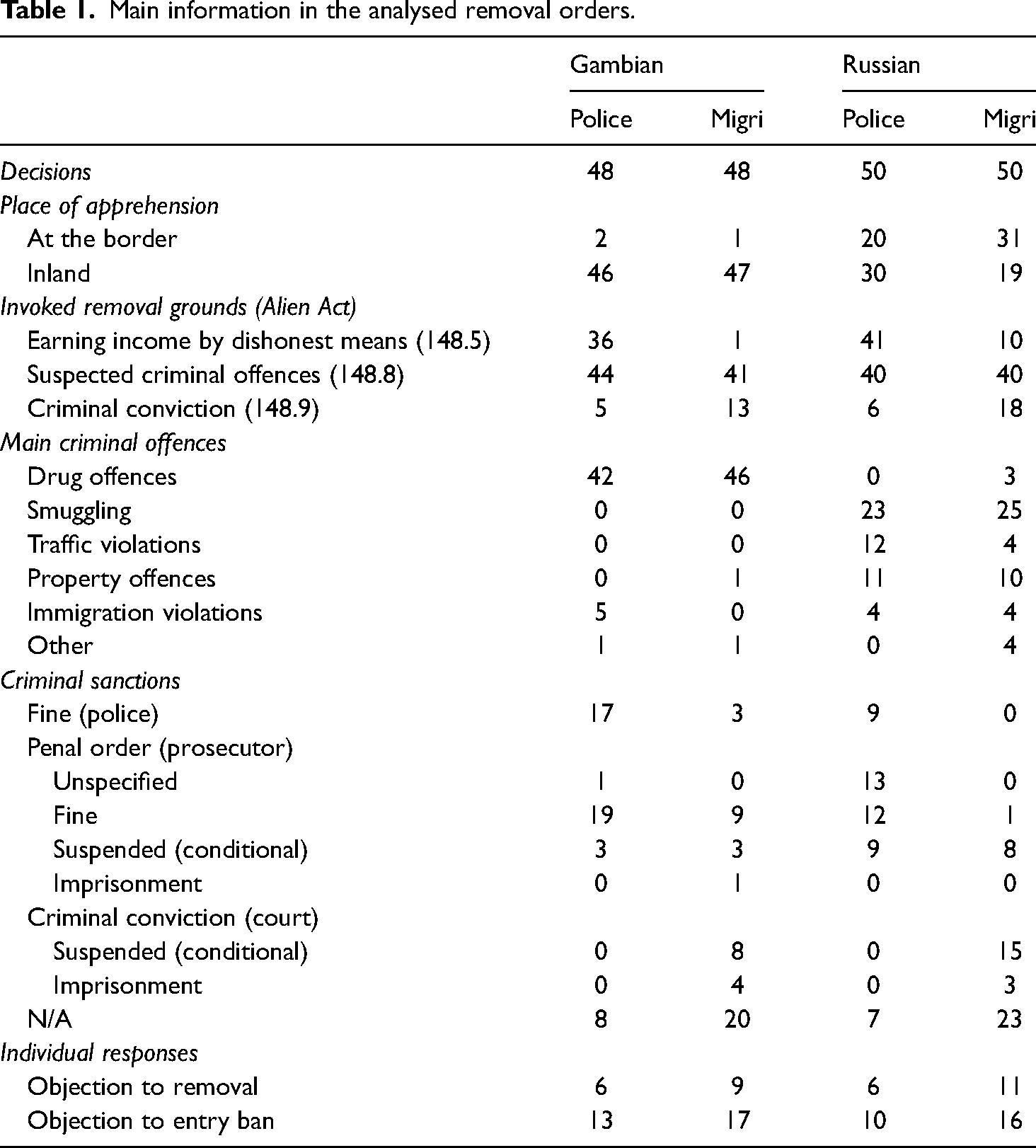
Table 1 summarizes the main information from the data analysis, which focused on the applied legal grounds, criminal offences, criminal sanctions and argumentation for removal orders. 3 Overall, the removal orders consisted mainly of short paragraphs covering the person's criminal offences, and their lack of social ties and an address in Finland. They included little information on the specific individuals, their duration of residence or their criminal records. The format of removal orders differed somewhat between the two authorities. Migri quoted the applied sections verbatim from the immigration law, whereas the police ticked boxes for the applied sections in their own format. In the conclusions, Migri repeated the legal sections for the removal. The police usually just concluded that foreign nationals would be removed and subject to an entry ban due to endangering public order and security or because of their repeated offences. Based on theoretically informed data analysis, the following sections will focus on the production of removable ‘criminal aliens’, punitive application of immigration law and the preventive rationale of immigration enforcement.
Main information in the analysed removal orders.
Producing removable ‘criminal aliens’
The Finnish Alien Act (301/2004) leaves considerable discretion for the authorities to issue removal orders, as it does not specify deportable offences or stipulate automatic removal for criminal offences. Whereas deportation orders for foreign nationals who have acquired a residence permit require criminal conviction of an offence ‘punishable by a maximum term of imprisonment of at least one year’ or convictions of repeated offences (Sec. 149.2), 4 removal orders can be issued on the basis of one or more rather speculative grounds concerning criminal activities or noncompliant behaviour (Sec. 148) 5 and the subsequent failing to meet the conditions of entry by endangering public order and security (Sec. 11.5). Most of the removal orders in my dataset invoked Section 148.8 concerning potential future offences (‘on the basis of an earlier sentence of imprisonment, or on other reasonable grounds, there is reason to suspect that he/she may commit an offence that is punishable by imprisonment in Finland, or there is reason to suspect that he/she may commit repeated offences’). The police often applied this together with Section 148.5 (‘there are reasonable grounds to suspect that he/she may earn income through dishonest means’) for supposed drug selling and smuggling offences. Only a minority invoked Section 148.9 (‘he/she was sentenced for an offence during his/her stay in Finland’), including convictions from previous years. Owing to the speculative formulations like reasonable grounds to suspect that a foreign national may commit offences, even minor suspected activities can result in a removal order without criminal convictions. ‘Punishable by imprisonment’ is likewise a hypothetical precondition, because the Finnish Criminal Code includes an option of imprisonment as the maximum punishment for most minor offences; for example, offences of drug use, endangering traffic safety and drunk driving are punishable by a fine or imprisonment of up to six months.
Notwithstanding the assumed connection between irregular migration and crime, most removal orders concerned legally arrived third-country nationals who were not removable without a separate decision. While the legal production of deportable aliens through tight legal criteria for entry and residency (De Genova, 2002) is commonly discussed in migration research, it is administrative practices in the application of immigration law that produce deportable criminal aliens. In addition to ‘proactive policing’ targeting foreign nationals in traffic controls, immigration checks or crime control (Armenta, 2017), the police can actively use the opportunity to issue removal orders for foreign nationals suspected of minor offences (see Franko, 2020). In the documents I analysed, even a single drug use offence, shoplifting or deception worth a couple of euros resulted in a removal order. Almost all the Gambian cases related to drug offences in the Helsinki region: the police usually invoked charges for purported drug selling based on possession of a few or a dozen grams of marijuana, although a few individuals received fines for drug use offences only. Notwithstanding some smuggling cases of considerable amounts of marijuana, Migri decisions likewise concerned relatively minor drug offences, often connected with immigration violations. In addition to five police decisions solely based on violations of entry bans, at least 25 other removal orders for Gambians involved immigration violations alongside drug offences. By contrast, most Russians had been just visiting Finland and were caught either inland in traffic and crime controls or directly during arrival at the eastern border. Around half of the Russian cases (N = 48) concerned smuggling of cigarettes and consequent tax evasion; their crimes range from dozens up to hundreds of cigarette cartons hidden in the structure of their vehicle. Other charges against Russians mainly included property offences and traffic violations. While the former ranged from shoplifting of groceries and consumer goods worth tens or hundreds of euros to attempted burglaries and stolen cars, the latter included speeding, driving under the influence and endangering traffic safety, sometimes involving also drug use offences. Finally, eight of the 100 removal orders for Russians concerning immigration violations covered unauthorized employment, overstaying the 90-day limit and counterfeiting visa stamps. While some Russians were charged with more than one offence and a few convicted of severe offences, overall a majority of cases represented minor subsistence-based criminal activities.
What was notable in the data was that most of the removal decisions were based on police reports and fines or penal orders by the prosecutor, instead of on the people's criminal convictions. The police may order fines for minor offences, such as traffic violations, shoplifting and drug offences, with a maximum number of 20-day fines, provided that the offender gives consent for this procedure. 6 In the case of rebuttal or more substantial penalties, the police transfer the case to the prosecutor to issue penal orders, which the district court adjudicates within a few months. For example, the standard penalty for minor drug offences concerning less than 10 grams of marijuana was a 10-day fine, accounting for 60 euros for penurious persons, whereas penal orders by the prosecutor for smuggling of cigarettes ranged from 60–100-day fines up to short, suspended sentences. Even if processing removal orders concerning more serious offences, only 30 Migri decisions mentioned criminal convictions, of which just seven involved prison sentences; almost half the Migri files did not include any information on criminal sanctions or penal orders. As the collection of fines is practically impossible from penurious persons (although the police confiscate assets claimed to be acquired through ‘criminal gain’, when possible), removal and the entry ban become the main punitive measure in response to minor offences in most cases.
Removal orders and the length of accompanying entry bans are also subject to overall assessment (Sec. 146). Consequently, the authorities are meant to take into account non-citizens’ residence time and social ties in Finland, as well as the severity of their offence and the damage it causes to public or private security. According to the responses from foreign nationals—though not systematically recorded—most did not oppose the removal and entry ban, which might reflect their absence of social ties in Finland or the inevitability of the outcome. Most Russians had been just visiting Finland or were caught at the border, although some had relatives or family members in the country, and even a second house. Although Gambians usually had been residing in Finland for some weeks—a few had stayed irregularly for up to three years—they often expressed their hopes for a quick removal to Spain or Italy. However, many Gambian men (16 of the 96) reported having a girlfriend in Finland; three additionally claimed their girlfriend was pregnant. Such matters, however, appeared to have little effect on the immigration decision, since the authorities took into consideration only information on family relations or cohabitation listed in the official population registers. Consequently, the decisions included a standard sentence: ‘The person does not have a permanent address, job or family ties in Finland within the meaning of the Alien Act.’ Nevertheless, a few people received removal orders and entry bans despite demonstrable family ties. Despite varying situations, the authorities concluded with a statement that they have considered all relevant factors and ‘there do not exist any factors with more weight’ counterbalancing the removal, thereby demonstrating perfunctory reasoning in the removal orders.
Punitive application of immigration law
Although removal was trigged by (suspected) criminal offences and consequent criminal sanctions or penal orders, criminal law appeared to be largely irrelevant to the cases I examined. Indeed, only 21 of the 196 decisions included references to the Criminal Code, all of which were made by the North-East police department. 7 Instead, the authorities relied on immigration law to expel these foreign nationals. Such administrative powers are a normal part of criminal investigation; by default, the police investigate suspected foreign offenders’ conditions of entry and residency. For permanent foreign residents, minor offences result only in fines, yet these same offences can initiate the removal process for foreign nationals without a residence permit. However, criminal procedures also reflect the severity of the offence. In practice, criminal courts adjudicate all charges for offences that can result in a sentence of at least two years’ imprisonment, which is the precondition for pre-trial police custody as well as the threshold for an unconditional sentence; in Finland, criminal sentences under two years are issued as conditional (suspended) sentences for a first-time offender, if there are no aggravating circumstances. 8 In other words, in addition to citizens (see Zedner, 2013), criminal justice exists for foreign legal residents as well as including those charged with severe offences, even if they are removed after serving their criminal sentences (in Finland, this is subject to a separate decision issued based on immigration law).
In many cases, immigration enforcement measures replace criminal justice processes for visiting third-country nationals by excluding them from criminal adjudication. In my analysis, the authorities considered foreign offenders to be guilty based on police reports, displaying a presumption of guilt that contrasted sharply to the presumption of innocence inherent to criminal law. While guilt was obvious for those apprehended for driving under the influence or smuggling cigarettes—several Russians also confessed to previous imports—charges for drug offences were less clear cut; in particular, removal orders provided only vague circumstantial evidence for the purported selling purpose, mainly possession of one-gram ‘selling packages’. Although their responses were not systematically recorded in the analysed data, at least some of the Gambians either rejected the charges altogether or denied the selling charge, stating that they had bought marijuana for personal use. The police seemed to consider Gambian men as particularly likely to be involved in the drug business, reflecting familiar racialized practices of crime control and guilt by association. While Russians were often charged with more serious offences, the police also issued removal orders based on shoplifting or single traffic violations. Migri sometimes used phrases such as ‘the systematic nature and frequency of criminal activity’, ‘disregard towards laws and regulations’ or that the person ‘had entered the country to commit crimes’. However, the same arguments were invoked for minor property offences as well, or when the previous offence was committed a long time ago. The application of standard formulations such as these thus appeared to represent administrative ‘legitimation work’ (Coutin et al., 2002) to justify removal orders, rather than concrete evidence (see also Borelli and Lindberg, 2020).
While criminal adjudication always involves some inconsistencies regarding proportionality and application of the penalty scale based on the Criminal Code, punitive application of immigration law results in excessive and disproportionate sanctions for minor (suspected) offences. In the removals of foreign offenders, only the length of the entry ban is tied to the severity of the offence(s) based on an administrative scale made by Migri. Owing to their residence permit in another EU member state, most Gambians received only a national entry ban to Finland, whereas the removal orders for Russians included a Schengen entry ban as well as the annulment of the existing visa. Here, too, however, practices varied, as for example, seven Russians in possession of residence permits or with family members living in other EU member states received only a national entry ban to Finland. So, too, the police usually issued the maximum period of a two-year ban, although sometimes they settled on one year for single drug use offences; six Russians charged with unauthorized employment or minor property offences received a removal order without an entry ban. Migri processed removal orders for more severe offences, resulting in entry bans that usually ranged from two to five years; however, eight Gambians and nine Russians received entry bans ‘until further notice’ due to their criminal convictions, including suspended sentences. Indeed, entry bans issued by Migri often seemed disproportionately harsh; for example, one Russian citizen received a four-year entry ban due to ‘the systematic nature and frequency of criminal activity’ based on a ‘theft’ accounting for a hundred euros and another unsubstantiated offence that had taken place more than a year earlier. The fact that some foreign nationals did oppose their entry ban, even if they accepted being removed, or considered the length of the ban to be excessive, indicates the significance of these sanctions for their future mobility and for their ability to maintain family or other social relations (Könönen, 2022b).
Significant administrative sanctions such as these, for minor offences, undermine fundamental criminal justice principles, including the presumption of innocence, the burden of proof for charged offences, the right to defence and the proportionality of criminal sanctions. Matters are compounded by the fact that removals can also be implemented even if foreign nationals deny charges and appeal the decision, unless the administrative court issues an implementation ban. Rapid decision making, in otherwise slow immigration bureaucracy, indicates the priority of removing foreign offenders. Most removal orders were issued in the days following the suspected offence, sometimes even on the same day. According to the Migri files, Gambians were removed to their residence countries of Italy or Spain within a week, while Russians were often returned to the other side of the border on the same day. In contrast to the speedy administrative decision making, criminal hearings at the district court were often organized a few months after removals. While, in theory, the defendants can return to criminal trial, the court can adjudicate the case without their presence. Thus, and despite the fact that foreign nationals do commit offences and many did admit to their charges, the administrative removal process involves significant risks of excessive or even unfounded criminal and immigration sanctions.
Preventive policing of dangerous mobile populations
In addition to the low threshold for removals without criminal convictions, crime-related removal orders deviate from normal criminal justice practices in one more fashion: they constitute anticipatory penalties targeting the continuation of criminal activities. Indeed, removal orders are explicitly based on ‘reasonable grounds’ to suspect that foreign nationals may commit (or repeat) offences in the future, and, as such, involve a conception of pre-crime (Zedner, 2007). Removal orders for crime prevention are in accordance with the Alien Act, yet the decisions lacked detail on what were the ‘reasonable grounds to assume’ that foreign nationals would commit repeated offences or offences punishable by imprisonment. While committing several offences in a short period or new crimes after returning to Finland despite an entry ban may indicate a person is continuing in their criminal activities, most analysed decisions were based on a single, minor offence. Instead of criminal justice adjudicating committed past acts, removal orders (together with entry bans) as preventive measures connect crime prevention and border control with the enforcement of public order and security (see Gundhus and Jansen, 2020). In particular, the police regularly invoked a threat to public order and security as the reason to deny the period for voluntary departure (often together with criminal offences) and as conclusive justification for removal measures. Ultimately, ‘reasonable grounds to assume’ that foreign nationals will commit repeated offences entails a prejudiced conception of a ‘criminal alien’ as someone with tendencies to engage in criminal activities and who consequently needs to be subjected to preventive measures.
In addition to a racialized and gendered preconception of foreign men as a particular risk group and social danger (see Ahmed, 2000), preventive immigration enforcement measures also involve a class-based dimension in that they predominantly target mobile poor people. A few police decisions explicitly mentioned the person's limited financial resources or a lack of return ticket, whereas all removal orders invoked circumstantial factors, such as a lack of permanent accommodation and registered address and recognized social ties in the country. Above all, most (suspected) offences resulting in a removal order—property offences, drug selling and smuggling of cigarettes—represent subsistence-based criminality or crimes of survival (De Giorgi, 2017). Visiting third-country nationals face a ‘differential opportunity structure’ (van der Leun, 2003: 63–64) because the Schengen visa or a residence permit in another EU member state do not entitle them to work legally elsewhere; a few removal orders involved unauthorized employment in Finland. Many West Africans move from Southern Europe to Northern European countries to look for more favourable opportunities, with the help of informal support networks providing accommodation; for many, intimate relationships provide the best opportunity for regularization (Könönen, 2022b). In addition to shopping and tourism, significant price and income differences across borders create opportunities for informal border economies; removal orders concerned also several elderly Russians living near the border who acted as intermediaries, transporting cigarettes to third parties for a moderate remuneration. That said, a few decisions based on traffic violations also concerned middle-class Russians who came for shopping or to visit relatives; one Russian citizen even received a two-year ban for driving under the influence, despite owning property in Finland.
Immigration law provides a flexible instrument for the police to control supposedly dangerous mobile populations outside the criminal justice system (Campesi and Fabini, 2020). While the police can only issue fines or transfer a case to the prosecutor for more substantial penal orders based on criminal law, immigration law enables them to issue removal orders and entry bans, as well as to decide on immigration detention as a preventive administrative measure. While explicitly mentioned only in some of the decisions I analysed, immigration detention is a routine part of the removal process: around half of the detention orders have been related to crime prevention and the enforcement of removals of foreign offenders in Finland (Könönen, 2022a). Like the removal grounds connected to crime prevention, the Finnish Alien Act stipulates as one specific legal ground for immigration detention that ‘the alien has committed or is suspected of having committed an offence and the detention is necessary to secure the preparations for or the enforcement of a decision on removal from the country’ (Sec. 121.3). Under these circumstances, and in contrast to pre-trial criminal detention that requires charges for severe offences, the police may detain foreign nationals suspected of minor offences under the immigration law until removal. Consequently, immigration detention provides a convenient administrative instrument to facilitate removals and to prevent criminal offences and other unwanted conduct regarded as a risk for public order and security. As the police have powers to order detention and issue removal orders and entry bans, the whole process—from suspected offences to enforced removals—can take place without judicial supervision in Finland due to the quick enforcement practices. 9
Conclusions
The Finnish Alien Act enables the police and immigration officials to issue removal orders based on fines or penal orders for (suspected) offences, without criminal convictions. As a result, the threshold for removals is low, as even minor suspected drug or property offences resulted in a removal order and entry ban without information about prior crimes. While different migration trajectories and criminal charges among Russians and Gambians complicate estimations of the extent of racialized and gendered practices in crime and immigration controls, the harsh policies for minor drug offences for Gambians, in particular, reveal excessive and discriminatory practices. Instead of providing evidence of the propensity for repeated future offences, the authorities applied standard formulations regarding putative lack of social and family ties and an absence of funds to justify the removal orders, indicating a conception of dangerous mobile individuals who acquire income through dishonest means and commit criminal offences. The removal order narratives were largely characterized by foregone conclusions: a foreign national charged with an offence is not only guilty without a criminal hearing but is regarded as a recidivist by default, being inherently likely to commit new offences and endanger public order and security. Overall, this administrative removal process for visiting third-country nationals took place largely autonomously from the criminal justice system, as the authorities relied on coercive measures stipulated in immigration law to target and remove ‘criminal aliens’ as a preventive action.
The findings of this research demonstrate the primacy of immigration law measures in policing foreign offenders. Notwithstanding their resemblances and similarities, immigration law and criminal law provide separate instruments for the authorities to control mobile populations (see also Franko, 2020; Moffette, 2020). While the crimmigration and border criminology literature often refers to the criminalization of immigration violations or to the over-representation of foreign nationals in prisons as examples of the punitive turn in immigration policies, ‘the criminalization dimension of the crimmigration turn is not the centre of gravity of recent shifts’ in Europe (Brandariz, 2022: 290). Migration and deportation scholarship tend to be dominated by theoretical frameworks and concepts developed in Anglo-Saxon countries, yet their analytical usefulness may be limited in Europe—not to speak of other continents—due to different historical and institutional frameworks, migration patterns, racialized and other social hierarchies, immigration enforcement practices and varying national crime control and penal policies. Crimmigration practices also matter ‘more for certain categories of migrants’ and more in certain circumstances than others (Ambrosini, 2016: 154). In addition to different disciplinary frameworks, limited attention to the details of immigration law and administrative practices in immigration enforcement may have contributed to the overemphasis on criminal law measures. Owing to broad discretionary powers among enforcing authorities, empirical research on the police and other security agencies (e.g. Armenta, 2017; Moffette, 2020) and administrative decision-making practices (e.g. Campesi and Fabini, 2020) are valuable for understanding the operationalization of different laws in immigration enforcement and the formation of crimmigration practices from the bottom.
Considering the preference for coercive immigration law measures to criminal justice procedures among the authorities, it may be more precise to speak of punitive application of immigration law, rather than of crimmigration or the criminalization of migration. In addition to identifying deportable foreign offenders or unauthorized residents (see Armenta, 2017), the police in Finland also actively produce deportable ‘criminal aliens’ by making removal proposals or even issuing removal orders themselves based on immigration law. Preoccupation with the merger of immigration and criminal law obscures the role of the different institutions and legal instruments employed in policing mobile populations (Moffette and Pratt, 2020), as well as the different legal criteria for removing foreign nationals depending on their legal status. Instead of the binary division between citizens and non-citizens, the multiplication of legal statuses with different removal grounds entails the differential inclusion of foreign offenders in criminal justice. Whereas all charges for serious offences potentially resulting in imprisonment are subject to criminal adjudication, punitive application of immigration law enables bypassing of criminal procedures and safeguards for visiting third-country nationals suspected or charged of minor offences. Consequently, removal and entry bans based on immigration law represent an excess of punishment and indicate a disentanglement between crime and punishment compared with the proportionality principle in criminal justice. In addition to undermining the legal protection of foreign nationals, punitive application of immigration law results in derogations from the criminal justice system and the separation of powers that constitute fundamental legal principles in democratic societies. Immigration enforcement measures differ significantly from those of the criminal justice system due to broad administrative powers and their preventive rationality. In this regard, they represent equally, if not more so, a long history of coercive and preventive practices targeting mobile and marginalized populations (e.g. Foucault, 2015), as well as the broad police powers to enforce the social order through different legal or administrative instruments (Neocleous, 2021).
In Finland, as in many other countries, harsher punishments for ‘criminal aliens’ are regularly propagated by anti-immigration and conservative parties. Contrary to popular assumptions, removals of foreign offenders often are based on fairly minor offences, which, if committed by citizens would result only in fines or non-prosecution. Ultimately, administrative and preventive immigration law sanctions (removal, entry ban, detention) are based on the foreignness of the offender, because these measures cannot be imposed on citizens. Although care must be taken to avoid exaggeration, the treatment of foreign offenders evokes Arendt (1973: 290) warning of the wider consequences for society caused by the inability to treat ‘stateless people as legal persons’ and the temptation to rule foreign nationals ‘with an omnipotent police’ after the Second World War. Nevertheless, the removal practices discussed in this article demonstrate significant administrative police powers in immigration enforcement and a separate punitive system for foreign offenders, who are not treated as legal persons entitled to the due process in the criminal justice system.
Footnotes
Acknowledgements
The author would like to thank the anonymous reviewers, editors of the journal, José A Brandariz and Lea Sitkin for their valuable comments on the manuscript.
Declaration of conflicting interests
The author declared no potential conflicts of interest with respect to the research, authorship and/or publication of this article.
Funding
The author(s) disclosed receipt of the following financial support for the research, authorship, and/or publication of this article: This work was supported by the Academy of Finland under grant 323149.

Notes
Author biography
Jukka Könönen works at the Institute of Criminology and Legal Policy at the University of Helsinki. His research has focused on immigration controls, migrant labour, irregular migration, the European border regime, and immigration enforcement. He has conducted long-term research on the immigration detention and deportation system in Finland, including a recent project on crime-related removals.