




Abstract
Mass incarceration is a phenomenon that emerged in the USA in the 1970s. Since then, this pattern of imprisonment has taken shape in all other continents. Nowadays, many ‘core countries’ have been able to neutralize it and, in some cases, even reverse it. This, however, is not the case in Latin America. In this region, the increase of imprisonment rates has remained intense even in times of economic growth, in contrast to the main theories on punishment developed in the Global North. Drawing on primary and secondary data, I analyse the Brazilian case and indicate three necessary steps to understand contemporary imprisonment in the country. This article is structured in three main sections. I argue first that Brazilian criminologists have asked the wrong question: rather than asking why we have high imprisonment rates now, we should first understand why we had imprisonment rates comparable to Nordic countries up to the 1980s. I then argue we should stop uncritically reproducing northern theories and understand the local conditions of possibility for mass incarceration in times of social inclusion. I finally claim we should change the focus on the players: rather than pointing out to the Executive and Legislative dimensions, we ought to better understand internal struggles in the criminal justice system, considering in particular the pivotal role of judges in the Brazilian mass incarceration.
Keywords
Introduction
For decades now, scholars in the ‘punishment and society’ field have researched mass incarceration from many different perspectives. This includes, for example, accounts based on the ascendancy of late-modernity, neoliberalism, post-Fordism, actuarial justice and variations of political economy. If there is any common element among them, it is their western-centric approach. Dominant criminological knowledge has essentially been centred on the experiences of core countries (Agozino, 2003; Carrington et al., 2016; Cunneen, 2011), even when comparative studies are considered (Brangan, 2020; Dal Santo, 2021). Realities in global peripheries have been overlooked, and their role is at best limited to be sources of data or examples of the diffusion of North American crime control strategies, such as sentencing guidelines and zero-tolerance policing (e.g. Pavarini, 2002; Wacquant, 2014).
Peripheral realities are not only overlooked by northern criminologists, though. Theory importation is a common trend in knowledge production (Castro, 1987; Olmo, 1981; Varsavsky, 1969; see also Sozzo, 2001). Criminologists from the Global South often apply a northern lens to analyse their own region. This is illustrated by the fact that the neoliberal penalty thesis and the penal populism argument are the dominant perspectives applied to make sense of mass incarceration in Brazil. 1 However, their application to the Brazilian reality is problematic and very limited (Dal Santo, 2020a, 2020b; Sozzo, 2016a). This scenario suggests that even scholars from the Global South may look at their countries and ‘read it from the centre’ (Connell, 2007: 44–46).
In this article, I show why scholars have failed to understand the rise of mass incarceration in Brazil and its reproduction in times of economic growth and inclusion. In so doing, I indicate three pivotal steps to understand contemporary punishment in Brazil. I highlight elements, conditions, trends, and actions that tend to be ignored in northern literature and overlooked by Global South scholars too. In the first section, I argue we have posed the wrong question: before asking why we currently have one of the highest rates of imprisonment worldwide, we should ask why we did have low imprisonment rates until 1990. In the second step, I claim we have misread recent elements of political economy, focusing too much on economic indicators while not paying enough attention to state-building processes. In the third, I argue that when agency is considered, scholars tend to overestimate the role played by politicians and underestimate the efforts of judges to reproduce mass incarceration.
Changing the question: Why Nordic imprisonment rates in a peripheral setting?
My first claim is that criminologists trying to understand mass incarceration in Brazil have been asking the wrong question. The first step to comprehend why Brazilian imprisonment rates (i.e. the number of prisoners per 100,000 inhabitants) are currently so high is to understand why these rates used to be so low, in a comparative perspective, up to 1990. In 1981, the imprisonment rate in the country was 41 (IBGE, 1981). 2 This rate only passed 60 in 1988, when it reached 61, remaining stable until 1990 (IBGE, 1988, 1993).
Despite being an extremely unequal country, with high levels of poverty and exploitation, Brazil had imprisonment rates compared to Nordic countries until a recent past, as Sozzo (2016b) first noticed: in 1980 and 1990, imprisonment rates in Norway were 44 and 56, respectively; in Denmark, 63 and 67; in Sweden, 55 and 58. 3 Understanding historical conditions and determinations is a necessary process if one wants to ‘grasp matters at the root’ (Marx, 1844/1972: 137). In opposition to what most scholars have suggested, the historical conditions for mass incarceration to grow are not merely given by the ascendency of neoliberalism. Below, I touch upon elements from political economy (colonialism, slavery, late urbanization) and institutional (patterns of detention and imprisonment) perspectives. This can reorient us to understand recent changes in patterns of punishment in Brazil.
Domestic punishment: A colonial heritage?
Throughout its history, Brazilian society has been marked by domestic punishment and ‘private’ conflict resolution (Batista, 2000). To understand it, one must go back to colonial times. The colonial period in Brazil (1500–1815) is broadly characterized by indigenous genocide, slavery, expropriation and exploitation. The supposed ‘civilizing process’ in Brazilian lands began with the insertion of Portuguese people into indigenous civilizations mostly through Jesuits and their theological knowledge and power (Prado, 1945/1981: 25). The indigenous people who were considered devil representations were brutally decimated. When left alive, they were oppressed through brutal processes of forced labour (Dussel, 1977). The indigenous genocide enforced by colonizers is what made possible the process of ‘primitive accumulation’ (Marx, 1867/2003: 959–1014), and a wide exploitation of the then-new and rich land and its native peoples. The so-called ‘civilizing process’ was nothing but a project of economic expansion achieved through extremely violent means.
Slavery is another key feature of colonial times. Portuguese colonial domination over Brazil had its economy based on rural activities, not least sugar plantation. From 1549, African people were trafficked to Brazil, where they were kept as slaves up to the 19th century. Colonial society was then composed by two groups: on the one hand, senhores de engenho (plantation owners or planters); on the other, slaves and ‘quasi-free’ rural workers (Prado, 1945/1981: 28–29). The structure and social relations that configured this stratified society hugely affected patterns of punishment and social control needed for the reproduction of that hierarchical social order.
Until Brazilian independence in 1822, punitive practices and social control were fundamentally domestic, being enforced privately within the engenhos (plantations). Masters punished their slaves as they wished, with no official control over those practices (Zaffaroni and Batista, 2015: 414). The reproduction of this pattern of punitive practices was made easier by the lack of any minimal bureaucratic structure (Zaffaroni and Batista, 2015: 419). The relations between the then-Kingdom of Portugal and the planters in Colonial Brazil were limited to some administrative and political level, including the payment of some taxes. Prado (1945/1981: 30) argued that Kingdom officials used to: close[d] their eyes to all sorts of abuses that they did not have the power to repress or punish. They intervened with the settlers at best as their allies in the […] oppression of the lower population. They gave [the settlers] carte blanche to act as they best understood.
Despite the Brazilian formal independence (and its transition to a ‘liberal regime’) in 1822, punitive practices basically remained stable. The process of legal codification that started in 1824 did not significantly affect concrete relations of dominance: slavery persisted under liberal legislation. To meet planters’ interests, their autonomy to punish their slaves was preserved (Dieter, 2012: 621), confirming the tight relations between political and economic powers. The liberal idealism incorporated into Brazilian legislation was limited to cover the relations between planters and the State, but not their relations with subalterns.
The consolidation of ‘senhorial power’ 4 and the maintenance of slavery as the main mode of production reinforce one of the main assertions from the political economy of punishment perspective. Rusche and Kirchheimer (1939/2003: 5) once claimed that every system of production finds its specific pattern of punishment in terms of productive relations. Patterns of punishment tend to adapt to the material needs for the dominant social order and relationships to be reproduced. In the 19th century, prisons were becoming the main form of punishment in core countries (Melossi and Pavarini, 1977; Rusche and Kichheimer, 1939/2003). In that region, the Industrial Revolution had already reshaped their modes of production and, consequently, social relations. This made social order demand other forms of discipline, subjugation and control. Workhouses and, afterwards, prisons were useful for that purpose. In Brazil, where slavery remained, domestic punitive practices were maintained, so masters applied them against their slaves, producing other sort of domination and discipline.
As time passed, political, legal and economic changes resulted in a broader context towards the weakening of slavery labour power, a larger liberation of enslaved people and the beginning of a centralization of punitive practices into a public power. Thus, the enforcement of punitive practices varied according to the status possessed by people: whether slaves or free subjects. However, the important issue here is the predominance of domestic, and not public, forms of punishment through most of the Brazilian history, where slavery lasted until 1888.
Late urbanization
Another key step to comprehend low imprisonment rates in Brazil is to consider the country's late urbanization. The urban population became larger than the rural one only in the 1970s in Brazil (IBGE, 2006). This clearly affected patterns of punishment in the country. Although the predominance of rural population favoured the maintenance of a ‘domestic punishment’, patterns of punishment started to move away from the previous practices enforced in the slavery society.
To understand the evolution of punishment in rural areas, one needs to grasp the changes observed in the social order throughout time. Over the 19th century, exportation of coffee represented the main economic activity in Brazil. In addition to being a costly and time-consuming cultivation, this activity demanded large rural properties and many workers in a period of decreasing slavery labour force. This situation made room for the rise of free, but dispossessed individuals (‘squatters’). Franco (1969/1997: 99–100) argues that to this group of people, small unproductive pieces of land used to be ceded by landowners. This, however, did not represent any sort of loss to landowners. On the contrary, a new sort of relationship of dependency and cordiality between landowners and squatters started to emerge.
Evidently, landowners somehow benefitted from these relations. For these ‘squatters’ were dependent on powerful landowners with nothing to give them in return, they were often used as landowners’ ‘instruments for any and all purposes, including those of offence and death’ (Franco, 1969/1997: 153). These men fulfilled an alternative function to policing and judicial systems, exercising the private defence of powerful landowners’ interests, as private militias (Huggins, 1985). They were established in allotments bordering the large rural properties, where they could carry out activities of surveillance. Therefore, domestic punitive practices remained prevalent in rural society.
The embryonic process of State centralization from the second half of the 19th century did not affect the concentration of power held by landowners. From there on, a minimum politico-administrative structuration and bureaucratization of the State started to take shape. Yet, a punitive power delegation from the State to elite lords was explicit even in official documents. Franco (1969/1997: 153–162) mentions cases in which landowners detained aggregates in their private properties, but not a single juridical consequence followed from this—as state apparatuses were controlled by groups of powerful landowners and their families. In the few cases of conflicts that ended up reaching the criminal justice, private power would still prevail. In practice, local politicians and powerful landowners used to have control, or a great influence, over the list of jurors (Leal, 2012: 198–199). The exercise of this power tended to result in criminal justice decisions directly or indirectly influenced by those local politicians and powerful landowners. Overall, justice administration and operation, when in practice, were always in accordance with landowners’ interests.
So far, social control, dominance and subjugation were not achieved through public criminal justice. Personal dominance and relations of dependency were key features of 19th-century Brazil, being more effective mechanisms of control and order production. Domestic punitive practices still corresponded to the main form of punishment able to guarantee the material conditions for the reproduction of social order.
With an increasing rural exodus, other sorts of control and punishment were used more often. It is true that previous means of social control and conflict resolution remained in use. Homicide, for example, was still widely accepted and employed. On the one hand, until the 1970s, homicides were still a common means of private conflict resolution, especially related to family conflicts and honour-related issues (Fausto, 1984). On the other hand, homicides as means of crime control, social cleansing and territorial control were not only used by private militias (previously squatters, then justiceiros or vigilantes, bankrolled by local merchants), but also by policemen (in death squads), especially in the suburbs from the 1960s (Manso, 2012). However, this migration to more urban zones may explain the increase in incarceration rates in specific periods and the change in prison status as a mechanism of punishment and control in Brazil. As per Figure 1, prison gained a greater relevance only from the 1950s. Not coincidently, this period represents a significant change in the Brazilian political economy, notably the intensification of industrialization and urbanization (Marini, 2000: 84–87).
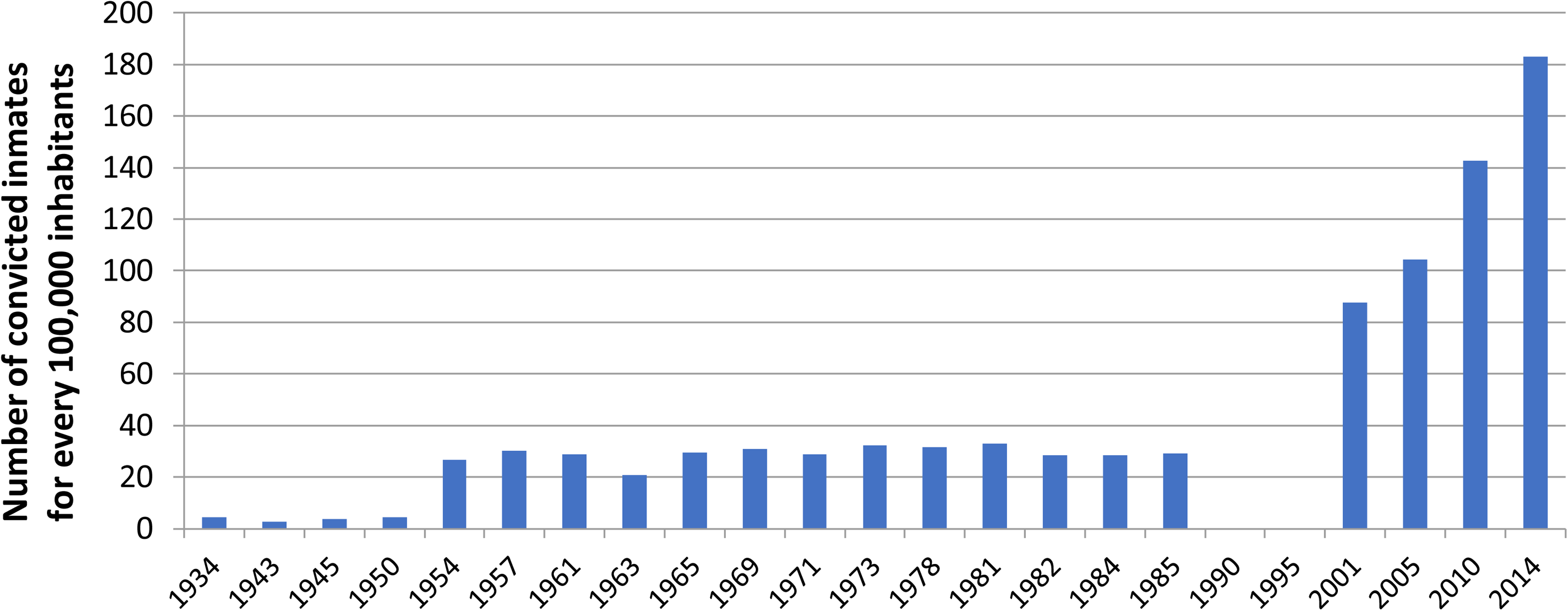
Convict-only incarceration rate (1934–2014).
This graph also shows some stability in the pattern of incarceration between the 1950s and the 1980s. The number of convicted prisoners grows as much as the Brazilian population does. However, Figure 2 shows a significant change in incarceration trends.
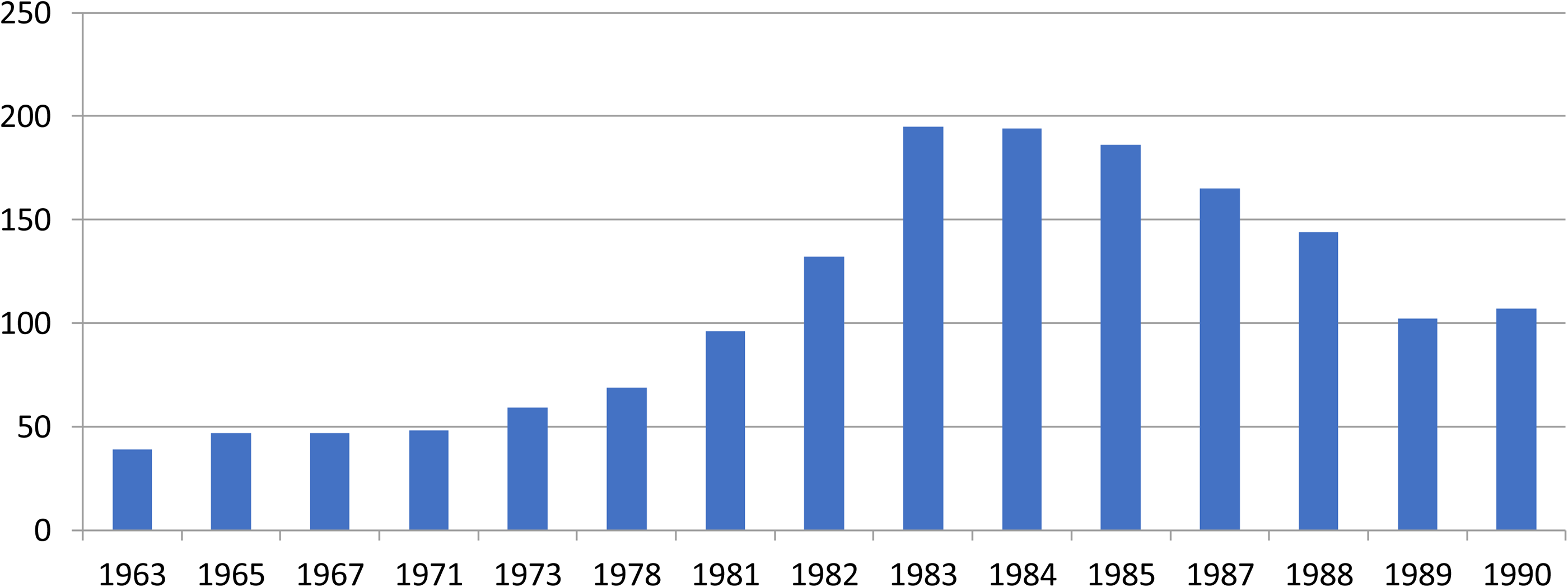
Number of annual arrests for every 100,000 inhabitants.
There was a subtle increase in the proportional number of arrests made annually from the 1970s. In the first half of the 1980s, this increase is intensified. Nonetheless, this sharp increase did not impact any representative change in the number of convicted people imprisoned in the end of the year. The reason for that is the topic of the following sub-section.
Detention, not imprisonment: Different patterns of incarceration
The third element responsible for keeping the ‘official picture’ of imprisonment rates low in Brazil until 1990 is the historical predominant use of (unregulated police) detention over imprisonment. The former means custody for a short period, being mostly a product of police action and often unrelated to crimes. The latter is of relatively mid- or long duration, mostly resulting from a sentence passed by judges after a criminal behaviour. Though the origins of detention date back to the 19th century, this is a key element to understand the boom towards mass incarceration in the 1990s.
This pattern of incarceration also relates to other issues highlighted so far—slavery, domestic punishment, urbanization and the preservation of a dominant social order. In the minds of the Brazilian ruling class throughout the 19th century, the increasing liberation of enslaved Black people represented an imminent risk to the exploitative social order from which the elites benefitted. Black people were responsible for an increasing ‘white fear’ (Azevedo, 1987). Many scholars (e.g. Flauzina, 2006; Koerner, 2006) argue that the activities of the Empire of Brazil (1822–1889) were focused on controlling enslaved and formerly enslaved people, to prevent a revolt from Black people. Zaffaroni and Batista (2015: 428) argue this period is responsible for the ‘roots of police authoritarianism and Brazilian vigilantism’.
In response to the liberation of enslaved people, several mechanisms aimed at controlling them—and maintaining relations of dominance—were set up. Some behaviours were criminalized in a clear attempt to criminalize former slaves. A good illustration is the criminalization, in 1890, of capoeira, a combination of martial art, music and dance, played originally by enslaved African people in Brazil. In parallel, vague mechanisms to increase judges’ and the police discretion were established. Take the power initially given to judges, in 1832, and then expanded to police chiefs, in 1841, of enforcing detention for up to 30 days of people suspected to be planning to commit crime (Zaffaroni and Batista, 2015: 424). The old senhorial power was giving place to the police empowerment (Duarte, 1988: 210). Urban police were becoming the new overseer, who then worked for the State—which, in turn, was ruled by the old landowners.
Although this pattern of detention persisted for over a century (19th and 20th), the alleged reasons for its enforcement varied over time. In the context of enslaved people's liberation and urban migration, Black and Brown people used to be detained by the police under the suspicion of being slaves on the run (Koerner, 2006: 219). In 1840, offences against the vague figure of ‘public order’ were the reason for about 65% of all arrests in Rio de Janeiro (Flauzina, 2006: 58). A similar reality was observed in Pernambuco between the late 19th and early 20th century (Huggins, 1985: 84–85). Between 1892 and 1916, over 80% of arrests made in São Paulo were based on misdemeanours or were detention for investigation (Fausto, 1984: 33). In São Paulo, misdemeanours were mainly drunkenness and disorder (Fausto, 1984: 37), whereas in Rio de Janeiro, vagrancy was the main category, and capoeira had a significantly higher representation (IBGE, 1927: 377). A key difference between those cities is that the Black population was significantly higher in Rio de Janeiro, whereas (white) immigrants, who had just arrived to compose a then-emerging working class, were the majority in São Paulo.
These detentions and the police vigilantism were mainly focused on controlling and producing public order by controlling risky people. They were not aimed at containing criminality, neither in ‘reforming’ criminals. Available data from late 19th- and early 20th-century São Paulo illustrates well the nature and pattern of these detentions. According to Fausto (1984: 31), 3466 people were in custody in São Paulo in 1893, but only 329 police inquiries were filed. In 1905, 11,036 people were in custody and 794 police inquiries were filed. This large disproportion between arrests and police inquiries was similar in Rio de Janeiro (Bretas, 1997). Data from Recife House of Detention from 1860 to 1922 show that ‘50% of the referrals to [that prison] left within three days of arrival; two-thirds were released within two weeks’ (Huggins, 1985: 79). Hence the centrality of short-period detentions not dependent upon any judicial activity.
This trend helps us to understand the use of prisons before mass incarceration. Previously, I showed an increase in the number of arrests made from the 1970s to the mid-1980s. Yet, this did not affect considerably the size of the prison population. Arrests based on vagrancy, and administrative and ‘for investigation’ arrests were among the most frequent categories of arrests made during those years (IBGE, 1976, 1986), when Brazil lived under a military dictatorship. In the 1970s, it is claimed that arrests ‘for investigation’ amounted to 95% of all arrests made in the country (Teixeira, 2012: 24). What followed these arrests were mere ‘detentions’—arrested people would only remain in custody for a few days or hours. This, thus, is not an actual imprisonment, but a mere detention.
The end of military dictatorship means (in theory) the end of those arbitrary detentions. Administrative and ‘for investigation’ arrests are expressively forbidden by the post-dictatorship Constitution of 1988. All arrests are now ‘judicialized’: they demand an immediate 5 legal manifestation by judges, who either release the arrested person or transform a flagrant in a pre-trial detention—this when the arrest is not determined by a conviction or an arrest warrant issued by a judge. This also represents a new ‘temporality’ of incarceration in Brazil. The old pattern of detention, a key feature of police vigilantism, started to give place to imprisonment only from the late 1980s. It does not follow that police vigilantism was overcome. However, while the power to control (and arrest) used to be mostly exclusively exercised by the police, it now demands a legal activity. 6 The larger importance of judges in contemporary Brazilian imprisonment is revisited in the last section. For now, it is important to understand that the old pattern of unregulated police detention, the prevalence of domestic punishment and the late urbanization are three vital elements to understand why Brazilian imprisonment rates were relatively low—compared to those of Nordic countries—in a poor and unequal country.
At this point, it should be clear that imprisonment rates do not entirely correspond to penal harshness. The former is merely a fraction of the latter. If Brazilian and Nordic imprisonment rates were similar until 1990, their penal harshness was not. Private conflict resolution and unregulated police detention show this. When these previous masked and hidden punishments started to take shape as official state punishment, imprisonment rates rocketed. 7 The comparison between Brazilian and Nordic imprisonment rates therefore should not be seen as an attempt to equate their penal harshness, but as a metaphor that helps us identify what could be initially seen as an anomaly of the Brazilian penal system.
Changing the lens: Mass incarceration in times of economic growth and inclusion
As per northern criminological literature, there has been a trend of correlation between economy and punishment. The higher the rates of inequality, poverty and unemployment, the higher the imprisonment rates (e.g. Beckett and Western, 2001; Downes and Hansen, 2006; Wilkinson and Pickett, 2009). Incarceration in Latin America has followed a different trend in the 21st century (Iturralde, 2019; Sozzo, 2021). I here argue the second step to understand contemporary Brazilian punishment (and punishment in other peripheral regions) is to change the lens. The consideration of structural issues in this context must go beyond the traditional link between inequality and incarceration, or the contemporary alleged correlation between neoliberalism and mass incarceration. It must also consider wider state-building processes, which in turn directly affect the state institutional capacity to punish.
Economic growth and inclusion
In the 21st century, Brazil had undergone a period of economic growth and inclusion, which included reduction of poverty, inequality and unemployment (Pochmann, 2012; Sader, 2013). However, before that, the Brazilian transition to democracy in the late 1980s was marked by the adoption of neoliberal economic policies (Antunes, 2006; Pochmann, 2012). This trend remained until 2002, when Luiz Inácio Lula da Silva, the Workers’ Party candidate for Brazil's presidency, was elected. The Workers’ Party stayed in power until 2016, when Dilma Rousseff was impeached. This period of the Workers’ Party government in Brazil is referred to in different terms, such as ‘post-neoliberalism’ (e.g. Sader, 2013) and ‘social-liberalism’ (e.g. Antunes, 2013). Nonetheless, economic indicators clearly portray a considerable improvement in Brazilian socio-economic reality.
The first indicator to represent this context is the variation in unemployment levels. Unemployment rates plummeted, decreasing from 13% in June 2003 to nearly 4% in December 2013 and /2014 (IPEA, 2016). Whether unemployment rates alone are not enough to represent the broader condition—including living standards and levels of exploitation—of working classes (Giorgi, 2002; Melossi, 1993), this huge decrease is extremely relevant, especially when considered in parallel with other elements.
The decrease of inequality was also remarkable. The GINI index declined from 59.4 to 52.6 in a 10-year period (2002–2012), reinforcing the idea of a considerable socio-economic improvement in Brazil—the lower this indicator, the lower the inequality is. It is essential to consider that this large reduction of inequality was not only a consequence of a national economy growth. During the military dictatorship, Brazil also underwent a process of economic growth (Pochmann, 2012). However, that process only favoured the local bourgeoisie, which got richer, whereas the poor got poorer and more exploited. That economic growth resulted in increasing inequality. Diversely, during this latest period of economic growth, social inequality was reduced, this being not only a consequence of unemployment decrease, but also owing to the increase of public expenditures on social policies and public policies of income distribution (Barbosa, 2013; Brazil, 2016).
Under the Workers’ Party government, public expenditure on social policies broadly speaking was increased in absolute and proportional terms. This means the increase in public expenditure on areas such as education, culture, health, housing, social assistance and cash transfer programmes was also a product of political choices and public expenditure internal rearrangements. The representation of public investment in education and culture grew from 1.7% to 2.7% of the Brazilian gross domestic product (GDP) between 2002 and 2015 (Brazil, 2016: 15). In the same period, public investment in social assistance increased from 0.47% to 1.54%. In absolute numbers, this corresponds to an increase of nearly six times, from R$15,900,000,000.00 to R$91,300,000,000.00 (Brazil, 2016: 15). As a result, public expenditure on social assistance had finally exceeded the investment in public security, which accounted for 1.47% of the GDP in 2002, but 1.38% in 2015 (FBSP, 2016).
This whole context would lead us to expect a shift in Brazilian imprisonment rates. Since the 1990s, the period attributed to the ‘neoliberal rise’ in Brazil, imprisonment rates have acutely risen. As per most of the northern literature on punishment and society, this political reorientation resulting in a significant socio-economic improvement should have affected punishment trends. However, not only did the rates of imprisonment not decrease, but instead, the high intensity of growth continued over the period. This is shown in Figure 3, which portrays an increase in incarceration rates by 124.60% in the neoliberal period (1990–2002), followed by a further increase by 123.40% in the social-liberal period (2002–2014).
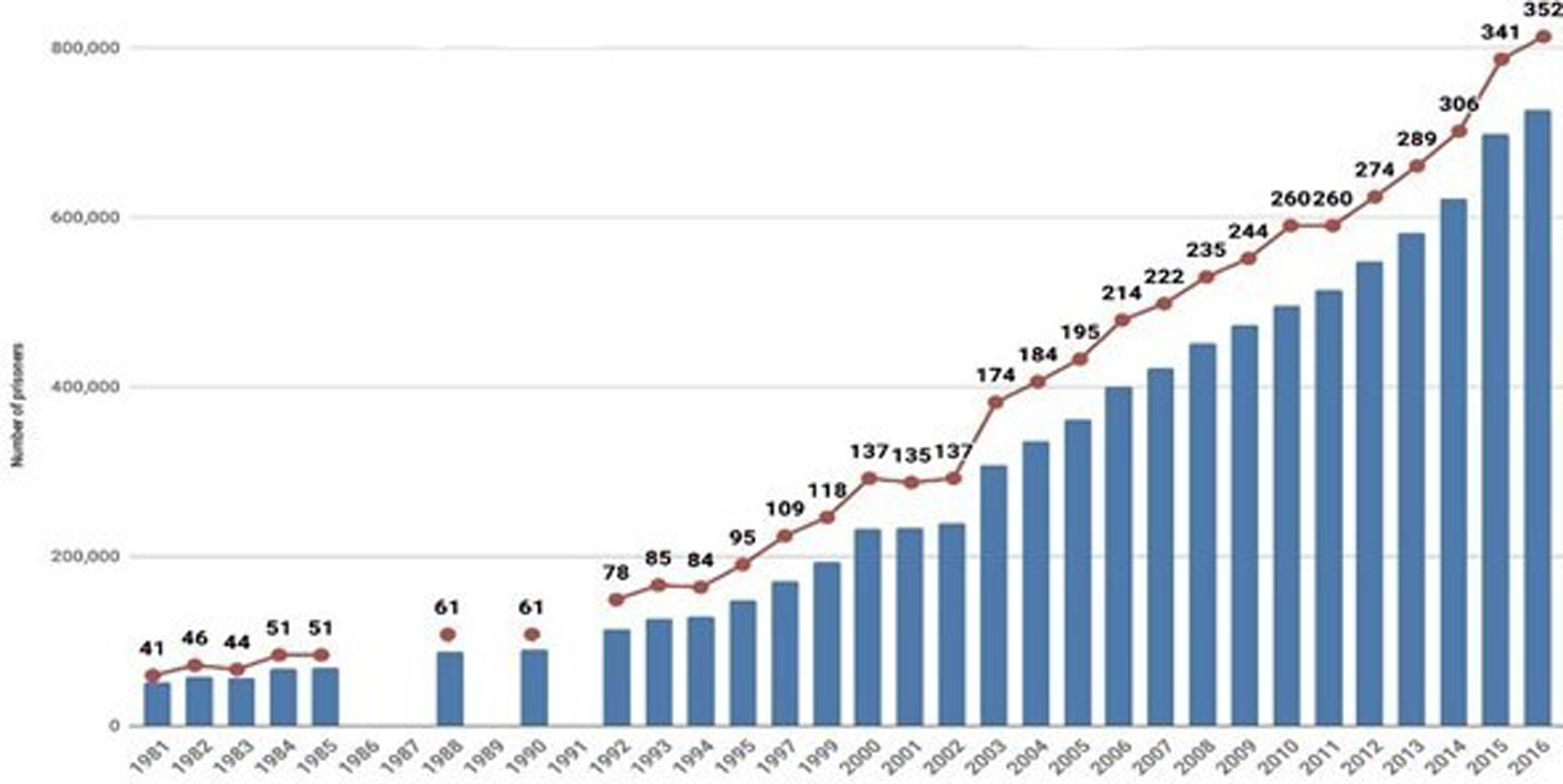
Imprisonment rates and prison population (1981–2016).
It does not follow from this that politico-economic elements do not influence trends of punishment in Brazil as they do in the Global North. It does mean, though, that economic indicators such as GINI, GDP, Human Development Index (HDI) and unemployment rates do not account for the whole picture. In the previous section, I have shown the importance of some historical politico-economic factors that are often neglected by northern literature but are crucial to understand contemporary punishment in global peripheries. To comprehend the reproduction of mass incarceration in times of economic growth and inclusion in Brazil, one also needs to consider broader state-building processes that preceded that period.
State-building and institutional capacity to punish
The penal system apparatus enlargement during military dictatorship in Brazil is a clear condition of possibility for mass incarceration to be reproduced in times of social inclusion. As argued above, the urban migration resulted in a transition from domestic to state punishment. The police apparatus became more relevant in the production and reproduction of social relations. The development of a new social order demanded that transition. As also stated above, the period when urban population became larger than the rural one was in the 1970s. Therefore, it would be expected that the Brazilian penal apparatus would be somehow enlarged in that period.
The penal system was not merely enlarged but became the key mechanism of social control during the dictatorial state (1964–1985). Despite not being the crudest among the South American dictatorships in terms of killings (Pereira, 2008), Brazilian dictatorship was the one that lasted longer in the region. The use of force and arbitrariness permeated society in all its domains. Suppression of political mandates, persecution of workers’ and peasants’ leaders, closure of unions, censorship, torture, illegal arrests, forced disappearances and killing of political dissidents are some features that constituted real state terrorism (Godoy, 2014). This just highlights the key status possessed by the penal system as a mechanism of governance and control.
The evolution in the ratio of public security personnel 8 per every 100,000 inhabitants illustrates well this enlargement of the penal system during the military dictatorship. As shown in Figure 4, this ratio was 23.28 in 1946. In the following years, it increased only subtly—23.98 in 1949 and 25.89 in 1953. The ratio then rose more significantly to 47.5 in 1958, but remained relatively stable until before the dictatorship, reaching 51.85 in 1963. In 1968, in the first years of the military dictatorship, this ratio soared to 88.5, increasing over 70% in five years. Only three years later, it more than doubled, totalling 184. These numbers give us a clear dimension of the relevance of military dictatorship in expanding the penal system and, consequently, its institutional capacity to control and punish.
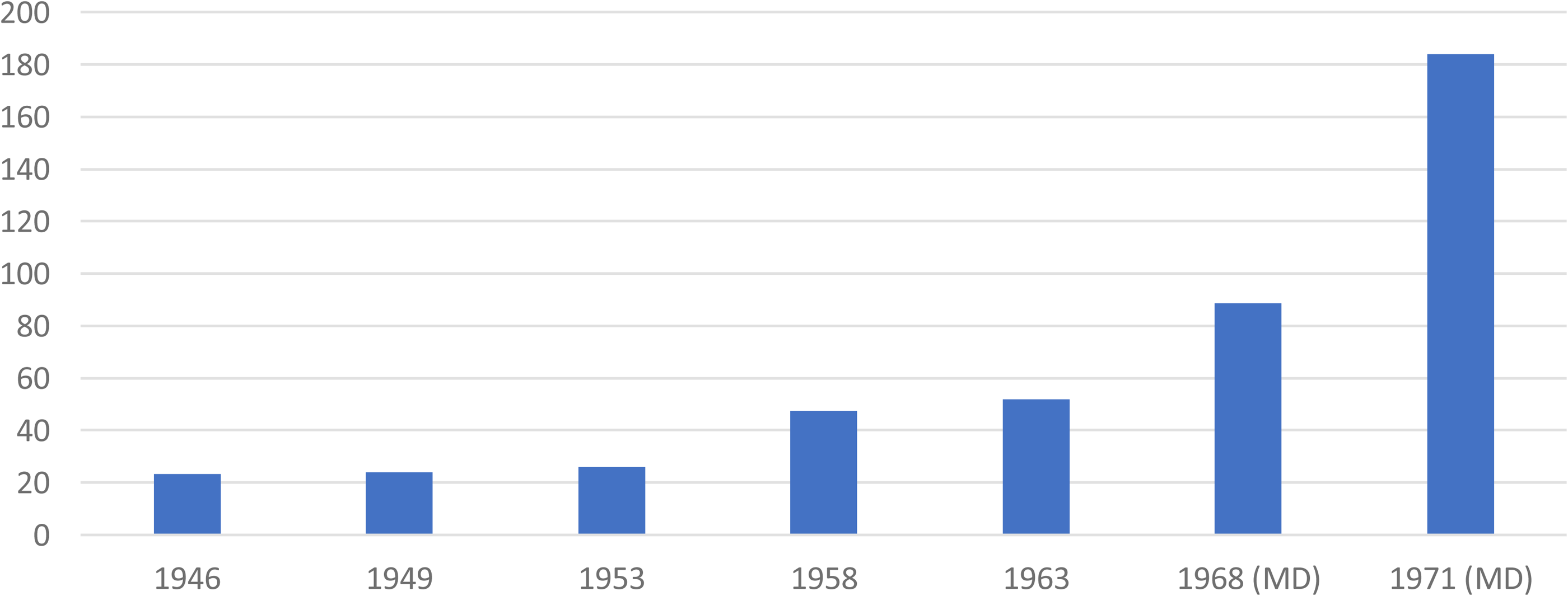
Ratio of public security personnel per 100,000 inhabitants.
The process of re-democratization did not dismantle this punitive infrastructure. Rather than dismantling the ‘penal state’, it further expanded it and endeavoured to make it more humanitarian, following a human rights legal framework (Marques, 2017; Salla, 2007). Fonseca (2018) originally drew attention to the penal system apparatus expansion and its impact in the Brazilian mass incarceration. However, he claims this was a process that took place after the transition to democracy, indicating some sort of stability in the number of policemen in relation to the whole population throughout the 20th century. Above, I have shown something different: the ratio of public security personnel rocketed throughout the military dictatorship, although not producing a consequent increase in incarceration rates. In any case, Fonseca (2018) rightly depicts a further, wider process of expansion in the criminal justice after the transition to democracy, from the military police personnel to judges and clerks, prosecutors and its assistants. Whether this promised to tackle delayed judicial provision, the now expanded criminal justice system has an expanded capacity to process more and more cases too. Another post-dictatorial policy aimed at humanizing the criminal justice has been the construction of prisons, arguably to fight prison overcrowding and promote human dignity in Brazilian prisons (Marques, 2017). The now expanded prison system has not been able to tackle prison overcrowding in the long term, although it has worked to house more and more prisoners (Dal Santo, 2022). Both trends—expanding and humanizing—also relate back to the transition from detention to imprisonment. By following a human rights orientation, the post-dictatorship Constitution abolished the usual practices of arbitrary arrests for investigation and administrative detentions, so the old pattern of police unregulated detentions—that used to last days—are gone. However, police arbitrariness has basically been ratified by the Judiciary through the systematic use of pre-trial detentions—which last months, if not years. In the end, many penal policies put in practice after the transition to democracy ended up promoting a rise in imprisonment rates.
Changing the players: Judges’ predominance over politicians?
So far, we have paid more attention to structural and institutional elements. However, we must acknowledge that ‘conditions change, but they do not have the power to change. Only things and materials and people have “powers”’ (Bhaskar, 1975/2008: 68). This highlights the importance of human agency. We, human beings, reproduce and transform social structures that, in turn, constitute the social world. And in so doing, it should be clear that people ‘make their own history, but they do not make it as they please; they do not make it under self-selected circumstances, but under circumstances existing already, given and transmitted from the past’ (Marx, 1852/1972: 10). I have discussed above the ‘circumstances existing already’ that made possible the reproduction of mass incarceration in times of economic growth and inclusion. I now turn my attention to those whose daily actions directly shape imprisonment rates.
Several scholars have emphasized human agency, contestation and struggles in a context of middle-range accounts (Barker, 2009; Loader and Sparks, 2004). There are indeed some researchers who highlight an important role of human agency in the Brazilian mass incarceration too. However, they have mostly followed another northern theoretical trend, pointing to politicians as the most important players in a supposed adherence to penal populism. I here argue the third step to understand contemporary Brazilian imprisonment is moving the focus from the Executive and Legislative onto the Judiciary. 9 This change of focus is justified by at least two main factors. First, throughout the 20th century, penal policies and changes in legislation were not entirely repressive (Campos, 2010; Cifali, 2016; Ferreira et al., 2018); they have in fact embraced considerable policies towards decarceration. Second, the role of judges within the Brazilian criminal justice is considerably wider than in countries such as the USA and the UK. I further develop these and other points below.
Policies towards decarceration
Brazilian scholars have almost entirely focused their attention on the effects produced by two pieces of legislation introduced after the transition to democracy: the Heinous Crimes Law (n. 8072/1990) and the Drug Law (n. 11,343/2006). Both laws have indeed promoted a significant increase in imprisonment rates. The former, introduced in 1990, prohibited the concession of provisional release, bail, pardon, probation and parole for some crimes, in addition to increasing their minimum and maximum sentence length. The latter increased the minimum sentence length for drug trafficking from three to five years. The common understanding is that both laws are symbols of a ‘tough-on-crime’ approach allegedly taken in both periods in post-dictatorial Brazil—the neoliberal and the social-liberal.
Despite concretely affecting imprisonment rates, it is inaccurate to consider them as perfect representations of Brazilian penal policies since its re-democratization. Changes in penal legislation have not been entirely punitive. After analysing all projects of amendments and introduction of new penal laws from 1989 to 2006, Campos (2010) concludes that more punitive law projects moved faster in the national congress when compared with those aimed at expanding rights. Nonetheless, Campos claims legislative changes in penal law during that period are better framed as ambivalent, for laws that expanded and harshened punishment co-existed with others that decriminalized conducts and expanded defendants’ and prisoners’ rights. Another important element is that most punitive laws are essentially symbolic, not having significant concrete effects. Therefore, although the claims that politicians played a key role in mass incarceration are not wrong, they do not give us the full picture (nor the right reasons).
Little attention has been paid to Executive pardons, for example. Yet, this has been an important mechanism intentionally used to decrease prison population in some countries, such as Italy (Santorso, 2015) and France (Lévy, 2007). In post-dictatorial Brazil, they have been increasingly more inclusive. In 1994, when Itamar Franco was the president, the presidential pardon in generic terms was granted to those sentenced to up to six years’ imprisonment who had served at least a third of their prison sentence (Decree n. 1242/1994). These were broadly the same terms in pardons granted by the succedent president, Fernando Henrique Cardoso (FHC) (1995–1988 and 1989–2002). However, FHC slightly expanded the groups of pardon recipients. By the end of the second presidential term of Lula da Silva, the following president, pardons were expanded to those sentenced to up to eight years’ imprisonment who had served at least a third of their prison sentence (Decree n. 7420/2010). Lula da Silva was also the first president to expressively grant pardon to people with mental health issues sentenced to internment in hospital, and to people convicted for minor cases of drug trafficking. No significant changes in pardons granted by Dilma Rousseff were made. Michel Temer, who succeeded Dilma Rousseff after the 2016 Coup d’État in Brazil—sometimes referred as impeachment—was the first president to comprise pregnant women in his first pardon granted (Decree n. 8940/2016), later further expanding it to other groups of women (Decree n. 9370/2018). Overall, the evolution of pardons in Brazil 10 illustrates political decisions aimed at reducing the prison population, moving away from the penal populism paradigm.
In addition to Executive efforts towards decarceration, there have been some changes in penal legislation that should have reduced incarceration. The Law on Precautionary Measures (Law n. 12,403/2011) provided judges with several alternatives to pre-trial detention, such as the electronic anklet monitoring, the periodic appearance in court to inform and justify activities, the prohibition of leaving home at night and weekends, and the prohibition to frequent certain places. Latin American countries have historically suffered from the endemic use of pre-trial detention as the very punishment (Zaffaroni, 1989). The possibility of enforcing precautionary measures other than pre-trial detention could have helped tackle this issue. In 2010, the year before this law was enacted, pre-trial prisoners amounted to 33% of the prison population in Brazil; five years after the law, this percentage rose to 40% (MJ, 2017: 14). As in other countries, this movement ended up only ‘widening the net’ (Cohen, 1979: 346–350).
Other changes in penal legislation illustrate attempts to reduce imprisonment in the country. The Law n. 12,736/2012, introduced in 2012, is another case that has faced resistance in practice. As per the Brazilian Law, there are three sorts of ‘prison type’: closed, semi-open and open. Overall, prisoners are expected to get their prison type ‘progressed’, moving on to the following type. In theory, after serving a sixth (for ordinary crimes) or two-fifths (for heinous crimes) of their sentence, they get a prison type progression. In fact, however, it takes much longer than a sixth or two-fifths for inmates to have their prison type progressed. This is because there is no automatic progression. ‘Penal supervision’ is not managed by parole or probation boards in Brazil; it is a judicialized process, being controlled by judges. As a reply to long delays in judges’ concessions on penal progression requirements, and in a context of long-lasting pre-trial detentions, this Law established that when sentencing, judges must consider the time spent as pre-trial detention to determine the adequate initial prison type. Before this Law, judges did not analyse this circumstance, which means thousands of people sentenced to serve time in a closed prison could have been already serving time in a semi-open, or even open, prison. However, judges have ignored or refused to follow this legal determination. This is what I found when analysing over 200 sentences of robbery judged by São Paulo Criminal Court between 2014 and 2020. In 74.1% of the cases, judges did not consider the time served as pre-trial detention before determining the prison type. In nearly half of all sentences the judge simply ignored the law, not even mentioning it. In 26.3% of all sentences the judge expressly denied considering it, arguing the law is unconstitutional.
Since Brazilian return to democracy, there have been political choices whose outcome was expanding imprisonment. However, this is far from being a single-sided, intentional trend. In all the three circumstances analysed above, politicians promoted concrete actions that created conditions for incarceration rates to decrease. Yet this has not happened. It seems changes towards decarceration have faced some resistance that have prevented them from happening—or from transiting from the reality of the books to the actual reality. The following sub-section helps us in solving this puzzle.
Judges in the front line: Internal resistances
Judges are clearly important players within the criminal justice. I mentioned earlier that judges in Brazil have a larger role when compared with their pairs in countries such as the USA and the UK. Unlike the latter countries (Ashworth and Roberts, 2012: 879), guilty pleas are extremely uncommon in Brazil and plea bargain can only take place in minor offence-related cases to which imprisonment is not a possible punishment. The most important difference, though, may well be that judges have had their discretionary power considerably reduced in the Global North (e.g. Tonry and Frase, 2001), whereas they have not only had their discretion power increased in Brazil, but have also become more important players politically, socially and economically (e.g. Almeida, 2010; Mascaro, 2018; Zaffalon, 2017). The northern context may explain why judges and sentencing have not attracted great interest from scholars researching mass incarceration in that region. Yet even in the Global North, their relative importance has already been highlighted (Mauer, 2001; Simon, 2014).
At this point and given the favourable social and political climate, Brazil could have at least reduced the intense level of growth of its mass incarceration. However, judges assumed a role of resistance against decarceration, promoting its very opposite. There has been some relevant research on their role in this process. Most of them are based on sentencing drug-trafficking (Semer, 2019). In summary, their main findings are that judges are overly punitive and do not necessarily follow the law strictly. Generic and abstract justifications are enough to, for example, determine a tougher prison type, transform arrests in the act into pre-trial detention and increase sentence lengths. As Semer (2019: 311) states, the Brazilian penal system is marked by a ‘liberal legislation and authoritarian practices’.
I have also been looking at judges and their key role in reproducing mass incarceration. Rather than researching drug-related offences, I have focused on robbery, which was the most represented crime in the Brazilian prison population in 2019, totalling 31.9% (MJ, 2019). My empirical research is still in progress. I can, however, highlight an aspect that demands less legal and normative contextualization but still supports my main claim on the pivotal role of judges in mass incarceration: the outcome of COVID-19 in sentencing. As I have analysed sentences imposed in the period between 2011 and 2020, cases from the period that comprises COVID are just a small minority (n = 54). Yet it is relevant to observe that the effects of COVID on sentencing and on prison population are opposite in Brazil when compared with other countries (Penal Reform, 2021). Rather than releasing prisoners and decreasing punishment levels, Brazilian judges have increased it, passing longer sentences. Judges did not consider COVID when justifying pre-trial detentions in any case I have analysed, whereas COVID has justified the release of hundreds of thousands of prisoners around the world. Sentence length was increased in over 30% of the cases I have analysed for the crime was committed in times of ‘public calamity’, while judges have prioritized alternative sentencing in other countries. This may well indicate how distant Brazilian judges are from the ‘platonic guardians’ (Loader, 2006) or liberal professionals they used to be in the majority of so-called western democracies (Tonry and Frase, 2001).
Though some researchers have been successful in generating relevant data and in identifying that judges have been overly punitive, Brazilian mass incarceration scholars have not yet achieved success in understanding how judges have assumed this stance and why they have played this role. One must also consider the complexity of this context, especially before the federative organization of Brazil. Some guidelines towards decarceration were also set from the National Council of Justice, a constitutional-administrative body of the Brazilian Judiciary. Broadly speaking, judges have not entirely followed those guidelines, sometimes even expressly opposing them. 11 Overcoming the generic answer provided by the ‘penal populism’ paradigm, identifying the real dynamics that have most influenced judges’ decision-making process, and outlining the mechanisms through which this overly punitive demeanour has been reproduced are vitally important to understand Brazilian contemporary mass incarceration.
Conclusion
In this article, I have indicated three pivotal steps to understand contemporary punishment in Brazil. I have claimed that, before asking why imprisonment rates are currently so high, we should understand why they were so low until 1990, when mass incarceration was already a practice in some regions. I have highlighted three reasons for that. From a political economy viewpoint, domestic punitive practices were fundamental to reproduce social order in a colonial, slaveholding society, and they remained relevant in the subsequent postcolonial and post-abolition but rural society. While society was becoming more urban, the previous ‘senhorial power’ was giving place to police vigilantism. From an institutional perspective, it is crucial to consider that ‘police vigilantism’ has impacted patterns of incarceration. In Brazil, when prison started to gain some relevance, it was being used more as an instrument of control. Unregulated police detention following arrests for investigation or administrative detention was the standard. As a result, people used to be kept in custody for short periods—days or hours. This pattern of incarceration was responsible for keeping imprisonment rates relatively low.
I have claimed that the second step to understand contemporary punishment in Brazil is changing the lens when analysing more recent politico-economic trends. As per most northern literature on punishment and society, levels of poverty, inequality, and unemployment seriously impact imprisonment rates. The worse the economic indicators, the higher the levels of punishment. However, Brazilian mass incarceration was even boosted in ‘times of economic growth and inclusion’. Therefore, we should not focus only on those economic indicators, but also on broader changes that took place in the Brazilian state in a recent past. Not only did Brazil become more urban by the end of the 20th century, but the military dictatorship between 1964 and 1985 massively expanded the state penal apparatus, giving it a real centrality as a mechanism of governance and control. On the one hand, the pattern of incarceration at the time (unregulated detention) did not promote a dramatic rise in imprisonment rates. On the other, it created the conditions of possibility for mass incarceration to flourish. The Brazilian state massively expanded its institutional capacity to punish. Rather than dismantling this, the Brazilian transition to democracy legitimized and further expanded that structure, ‘attempting’ to make it ‘more humane’ and bringing it under a human rights framework. The previous police vigilantism and arbitrariness began to be controlled (actually, ratified) by judges.
Finally, the third step to understand Brazilian mass incarceration is moving the focus from political to legal actors, and judges in particular. When human agency is taken into consideration by the Brazilian scholarship, it is often focusing on how politicians have supposedly embraced penal populism and increased imprisonment rates by introducing more punitive legislation. This analysis ignores that there have also been significant changes in penal legislation and other political choices aimed at reducing incarceration. These changes failed to transit from the reality of the books to the actual reality. Judges, I claim, are the players in the frontline of mass incarceration in Brazil, resisting from within the criminal justice system attempts towards decarceration and further reproducing an intense growth of mass incarceration.
Footnotes
Acknowledgements
Parts of this article were presented at the international conferences ‘Punishment in Global Peripheries’, Oxford, in June 2021; ‘Exploring Incarceration Trends between Europe and Latin America’, Turin, in February 2022; at one of the informal seminars of the Oxford Socio-Legal Studies Discussion Group, in February 2022; and at two panels of the Law and Society Association Global Meeting, Lisbon, July 2022. I am thankful to Máximo Sozzo, José Brandariz, Dario Melossi and Caio Machado for the invitation to present my ideas on those occasions, and to all participants for their comments and questions. I am also thankful to Ian Loader, Máximo Sozzo and three anonymous reviewers for their helpful comments on earlier drafts of this article.
Declaration of conflicting interests
The author declared no potential conflicts of interest with respect to the research, authorship and/or publication of this article.
Funding
The author received no financial support for the research, authorship and/or publication of this article.
