




Abstract
This article extends the study of carceral expansion—currently encompassing criminal, civil, and immigration enforcement—by examining the role of military (and, within that, extraterritorial) incarceration. Drawing on the case of military incarceration of civilians in Israel/Palestine, which since 1967 has accounted for between one-third and one-half of the entire prisoner population, it demonstrates the consolidation of a single carceral apparatus that normalizes military detention and incorporates non-citizens detained in extraterritorial locations. Involving both institutional and spatial dimensions, the article illuminates how the boundaries of the carceral state are relatively independent of formal sovereign borders, legal categories, and institutional arrangements, identifying the military as a carceral state agency. The study thus suggests a framework for an integrated study that accounts for the actual scope of the carceral state and its paradoxical modes of exclusionary inclusion.
Keywords
Introduction
The global growth in incarceration and confinement, as well as the mass incarceration boom in the United States, has led many scholars to examine the expansion and overreach of the carceral state. This exploration has taken two main directions. The first looks inward into carceral mechanisms in the belly of the state, such as administrative and civil sanctions (Beckett and Murakawa, 2012; Stumpf, 2006), as well as hospitalization and institutionalization related to disability (Ben-Moshe, 2013; Harcourt, 2006). The second looks outward into criminalization and incarceration around the borders of the state, relating mainly to the regulation of migrants and asylum seekers (Aas and Bosworth, 2013; Krasmann, 2007). Both directions attempt a broader definition of the institutional mechanisms that comprise the carceral state, and both have expanded the purview of criminological research to include civil, mental health, immigration, and border control authorities. In this article, I add a third direction to this endeavor by examining the role of military (and, within that, extraterritorial) incarceration. Like prior studies, this perspective involves both an institutional and a spatial dimension. However, the current analysis transcends the formal borders of the state, identifying the military as a carceral state agency and the boundaries of the carceral state separately from those of the sovereign state. I demonstrate my argument using the case of military incarceration of civilians in Israel.
I argue that we should look at the entire carceral apparatus of the state as a single analytical unit that I call “the one carceral state,” which currently comprises predominantly criminal, immigration, and military incarceration. 1 Conceptualizing the carceral state as a single entity comprising multiple institutional configurations enables us to overcome the institutional fragmentation underlying concepts such as “the shadow carceral state” (Beckett and Murakawa, 2012) and to grasp its full scope. This requires a comprehensive approach that extends beyond sovereign borders, legal categories, and institutional arrangements, as do the state and its carceral practices.
In the carceral system of Israel, since 1967, between one-third and one-half of prisoners have been arrested, detained, sentenced, or imprisoned by its military forces (Korn, 2003b). Israel is undoubtedly an extreme case, exercising protracted military control over millions of Palestinians in the Occupied Palestinian Territories (OPT), a non-sovereign territory where a non-citizen population is governed by military rule. However, this has brought about the normalization of military involvement in incarceration. Although the occupation created a bifurcated carceral system in which military incarceration was framed as a temporary exception to the state carceral system, this article describes the fluidity between the two systems and their subsequent consolidation under the civilian carceral system, which makes Israel a perfect case study for studying the possible roles of the military in the carceral state, applicable beyond military occupation.
Over the course of its history, Israel has presented several territorial and organizational configurations of civilian–military relations in the carceral apparatus, which I describe in three periods: internal military regime (1948–1966), occupation (1967–2005), and the one carceral state (since 2006). The first period represents internal proliferation, whereas the last two periods demonstrate two iterations of outward carceral expansion. Between 1948 and 1966, Israel operated a single carceral system and a dual system of civilian and military courts, all within sovereign borders. Civilians sentenced in both military and civilian courts were imprisoned by the country's sole civilian prison service. Following the occupations of 1967, Israel established a parallel network of military prisons and courts in the OPT, and thus, a dual carceral system. However, this system was fluid: military and civilian prisons operated in the OPT and inside Israel, and Palestinian prisoners sentenced by the military were assigned to either. Most dramatically, in the third period, since 2006, without making any change to its sovereign status or that of the OPT, the carceral system was consolidated when Israel transferred almost all prisons and Palestinian prisoners from the OPT into Israel. Following a reorganization process, the Israeli Prison Service (IPS) was rebranded a “national prison authority,” and all prison and detention facilities were transferred from the military to the civilian IPS, which now imprisons all sentenced prisoners, whether they were arrested and sentenced by the military or not, either within or outside the state. Both periods—of fragmentation and unification—demonstrate how the military and civilian justice systems can work in tandem, in multiple ways, with the military playing a primary carceral role to the point of arresting and sentencing half of the prisoner population. In the transition to the last period, Israel has normalized military incarceration by transforming it from a hybrid military–civilian operation into an integral part of the civilian carceral system.
The 2006 consolidation of a single prison system embodies a contradiction between the carceral state and the sovereign state. Although the sovereign state maintains formal borders that exclude the OPT and the population of Palestinians as extraterritorial and subject to a separate military regime, it empowers the carceral state to include these territories and populations. It thus reveals new correlations between the mechanisms of sovereignty (law and borders) and those of governmentality (administrative agencies and prisons) (Foucault, 2007). 2 Whereas studies of border criminologies tend to conceive the criminalization of border control mechanisms as aiming to strengthen state sovereignty by excluding the outside from the inside, I examine the extension of governmentality beyond the state (Hussain, 2007; Khalili, 2012) in ways that contradict or diffuse sovereignty, yet do not undermine it, and the paradoxical inclusion (Miller and Stuart, 2017; Rosenberg Rubins, 2022) of incarcerated non-citizen individuals that it entails. I term this latter phenomenon “exclusionary inclusion.”
Israel is not a complete outlier.The parallel growth of immigration and military detention is emblematic of the “paradigm of suspicion” in a globalized world, conflating anxieties over crime, immigration, and terrorism, associated with mobility (Shamir, 2005; Stumpf, 2006) as well as being inherent to emboldened authoritarian regimes. Such regimes continually employ military courts and military detention to suppress political opposition and resistance internally (for example: Hamzawy, 2017; International Commission of Jurists, 2019). Many powerful democracies that have seen a rise in their internal carceral mechanisms are also engaging in military incarceration beyond their borders. The military operates as a carceral institution in relation to enemy combatants and terrorism suspects in external confinement operations—liminal sites that are under complete state control—and involves other state authorities and professionals in this function (Brown, 2009). Traditional doctrines of extraterritorial military detention relate to wartime and prisoners of war; but, since the end of the Second World War, and more so since the 9/11 attacks, non-battlefield detention and imprisonment of civilians have become increasingly important (Abu Sitta and Rempel, 2014; Hajjar, 2006; Hakimi, 2008). Although this is not solely a post-9/11 phenomenon (Khalili, 2012) and has relied on practices of criminal incarceration (Forman, 2009; Simon, 2007), as the distinction between peacetime and wartime loses its relevance and most conflicts involve non-state actors over protracted periods, I believe that the normalization of military incarceration is likely to become more pervasive. As the United States continues to detain and prosecute foreign prisoners in Guantánamo Bay (Hajjar, 2022) and Pakistan has been extending the jurisdiction of military courts over civilians accused of terrorism since 2015 (International Commission of Jurists, 2019), the Israeli case is part of a wider range of military-carceral apparatuses. Moreover, integrating the study of military detention into the larger field of carceral studies can contribute to the integrated study of immigration detention, crimmigration, and mass incarceration, which currently preoccupy many countries and researchers.
With the staggering statistic of between one-third and one-half of all prisoners in Israeli prisons originating in military detention and courts, and given the country's relatively stable criminal justice system, one might think Israeli criminologists would be vigorously scrutinizing the role of the military in carceral institutions. However, this is hardly the case. Just like criminological research in other countries, Israeli criminology exceptionalizes and neglects military law and incarceration. The methodological blind-spots of the field are therefore a generalized phenomenon.
To address this lacuna, I make the “one carceral state” visible by looking at the state through its mechanisms of governmentality, rather than through the lens of sovereignty—focusing on the prisons, in and of themselves, rather than through the prism of the law. Although the law creates boundaries between sub-fields such as immigration, military, criminal, and administrative law, a capacious study of the carceral state should transcend these theoretical boundaries and prioritize the practices of incarceration over the labels that legal theory assigns to them, to uncover the multiple state strategies of carceral control and population management. The spatial boundaries of the carceral state can differ from those of the sovereign state, whereas its organizational boundaries should be understood more holistically. The consolidation of a single carceral apparatus was implemented on the administrative level, without changes in the law or in state borders. The picture that emerges is that the sovereign state (borders and law) and the administrative–carceral state (detention and prisons) can operate quite independently of one another. Nonetheless, as the Israeli case demonstrates, they can still work in tandem, in multiple ways, with the military playing a primary carceral role to the point of arresting and sentencing half of the prisoner population. This reality further shows, through the state-orchestrated movement of prisons and prisoners across Israel's borders, how incarceration not only blocks movement but facilitates the unfree movement of prisoners across borders—and not only in rendition operations meant to strip prisoners of rights, but also in ways that can, paradoxically, enhance some legal protections.
To trace the boundaries of the carceral state, I undertake a combined analysis of bureaucratic and legal documents. These include military legislative orders and Israeli Prison Service (IPS) regulations, annual reports of the IPS, military and IPS statistics on prisoners, and documents of the Israeli legislature (the Knesset). 3 I also rely on decisions of the Israeli Supreme Court in cases challenging military detention operations in the OPT and in Israel, detailing bureaucratic action based on the briefs of non-governmental organizations (NGOs) and government agencies.
The first section of this article, What are the boundaries of the carceral state?, provides the theoretical background. The second section, Military incarceration in Israel/Palestine, outlines the forms of military incarceration in Israel/Palestine and describes the changing relations between its geographical and organizational aspects in three periods: internal military regime (1948–1966); occupation (1967–2005); and what I label “the one carceral state” (2006–present). The third section, The scope of the carceral state and exclusionary inclusion, adds immigration detention to the analysis and examines the entire scope of the carceral state and effects on the non-citizen prisoner population through analyzing statistics, classifications, modes of inclusion, exclusion, and contestation. The Conclusion offers insights for a future research agenda on the interrelations of civil, immigration, and military incarceration beyond the case of Israel/Palestine.
What are the boundaries of the carceral state?
David Garland (1990: 16–17) observed that, in modern society, punishment “is in fact a complex set of interlinked processes and institutions, rather than a uniform object or event.” He argued that “[t]o understand ‘punishment’ at a particular time […] one has to explore its many dynamics and forces and build up a complex picture of the circuits of meaning and action within which it currently functions.” However, focusing on legal punishment, the underlying assumption of most scholarly research is that the law imposes punishment exclusively through criminal law and the criminal justice system. From this perspective, the military is considered to be one of the “total institutions”—one that practices punishment in internal, disciplinary proceedings (Garland, 1990; Goffman, 1961) but does not participate in the larger project of the carceral state.
The conceptualization of “crimmigration” sought to challenge and expand the perceived boundaries of the carceral state beyond criminal law and into immigration law (Bosworth, 2008; João Guia et al., 2013; Simon, 1998; Stumpf, 2006). Scholars point to the growing phenomena of immigration detention and the criminalization of immigration-related violations, arguing that criminal law has expanded beyond its traditional realm. Importantly, crimmigration studies have also stressed the connections between immigration and national security policy after the terrorist attacks of 9/11, implicating immigrants as potential threats in terms of both crime and terrorism and turning security into one of the drivers and powerful imaginaries of crimmigration policies. Still, the concept of security has not entered the criminological research field as much as immigration ultimately did, and the “police, courts, probation services and prisons [are] not thought of as agents of security” (Zedner, 2003: 163).
In The Shadow Carceral State, Beckett and Murakawa (2012) moved to include other areas of law as manifestations of the expansion of carceral strategies, such as administrative (including immigration) and civil law as well as the “institutional annexation” of sites and actors beyond the traditional boundaries of the criminal justice system. These authors stressed the limitations that defining these institutions as “not criminal” places on theorizing them as part of the carceral state, despite their inflicting punitive sanctions. Similarly, Ben-Moshe (2013) argues for a conceptualization of incarceration that includes institutionalization in diverse enclosed settings, including institutions for the intellectually disabled and psychiatric hospitals. The notion of the shadow carceral state thus opens the ostensible territory of the carceral state to include carceral practices beyond their legal definition as “criminal.” It highlights the vital, yet peripheral, role of “shadow” practices: more diffused forms of penal control beyond incarceration proper, such as probation, parole, surveillance, monetary sanctions, and coerced institutionalization.
Another strand of literature that pushed the boundaries of the carceral state identified the expansion of incarceration and confinement in the context of globalization and the global “war on terror” (Aas, 2011; Shamir, 2005; Simon, 1998; Zedner, 2010). Globalization has not only expanded movement and circulation, but has also, paradoxically, created a new regime of confinement and surveillance of a global population whose movement has been framed as dangerous, and a network of global governance institutions that are invested in this regime. These developments, embodied in the aforementioned paradigm of suspicion “that conflates the perceived threats of crime, immigration, and terrorism” (Shamir, 2005: 200) were bolstered in the aftermath of 9/11 and subsequent international terrorism attacks. Scholars exploring connections between the “war on crime” and the “war on terror” have shown how detention and torture techniques supposedly justified by the war on terror were not as exceptional as claimed by their proponents but, rather, were deeply entrenched in US domestic crime policies (Brown, 2005; Forman, 2009; Simon, 2007).
Yet, even as the United States was detaining tens of thousands of people in extraterritorial prisons such as Bagram, Abu Ghraib, and Guantánamo Bay, and, to a lesser extent, prosecuting “enemy aliens” in military commissions (Hajjar, 2006, 2022), while other countries also practiced mass detention of aliens (for example, Bosworth, 2008) and were complicit in international renditions (Nino, 2007), these carceral regimes largely escaped the attention of scholars dealing with the material practices of the carceral state (Zedner, 2003) and mass incarceration (Garland, 2001). Moran et al. (2019), for example, studied the military prison complex—the relationship between carceral and military institutions as different but analogous, interrelated, and mutually reinforcing. The phenomenon I discuss here, however, differs from the notions of the shadow carceral state and the military prison complex, because it points to the military acting directly as a carceral institution in its own right, forming part of the core amalgam of institutions comprising the carceral state, rather than located on its periphery. This blind-spot seems particularly paradoxical, given that metaphors of war have long been used to frame mass-scale law-and-order and antiterrorism campaigns (Simon, 2007). A notable exception is Alina Korn's (2003b) seminal study, on which the current research builds, finding that the rates of incarceration in Israel have been mostly affected by the Israeli–Palestinian conflict. Immediately following the 1967 occupations, the overall rates of incarceration grew significantly and at any given time up to 2000, Palestinian civilians arrested extraterritorially by the military accounted for between one-third and one-half of the entire (civilian plus military) IPS prisoner population. 4
Legal categories dominate the study of military incarceration. Military justice literature treats the field as being concerned with trials of members of the military forces and enemy combatants, giving military justice relating to civilians very little attention (Duxbury and Groves, 2016; Liivoja, 2014)—even though, from the perspective of the carceral state, it is no less significant. 5 During wartime, prisoners of war are combatants who have been apprehended by enemy forces and are held without charge for the duration of the conflict or until a prisoners’ exchange is negotiated. Military trials resulting in prison sentences are applicable only for violations of the international laws of war defined as war crimes. Another form of military incarceration in wartime is internment, also referred to as administrative detention: preventive detention of enemy combatants (including civilians accused of terrorism) without charge, renewable periodically. Military prosecutions of civilians are also applicable upon declaration of martial law and under occupation; in both cases, a civilian population is placed under military rule and military law replaces civilian law. Although the use of martial law decreased following the Second World War as its extra-legal character was delegitimized, a third type of military-enforced penal regime developed in colonial contexts, under the framework of emergency powers that are also applicable during peacetime (Ben-Natan, 2021; Donohue, 2001; Neocleous, 2007). This kind of regime, in which civilians are prosecuted and sentenced by military courts during times of internal unrest, is often normalized beyond the periods of rebellion and hostility that initially justify them.
Military imprisonment challenges the unitary conception of sovereignty, which defines the boundaries of the carceral state through sovereign borders and the ideal of a centralized legal system, because it extends state powers beyond sovereign borders and employs judicial institutions outside the judiciary branch, using mechanisms of governmentality (Foucault, 2007). Historically, military imprisonment was used by empires, in and in-between colonial domains, as part of the fragmented imperial sovereignty (Ben-Natan, 2021; Khalili, 2012; Stoler, 2018). In a post-imperial world where the state is the only acknowledged form of sovereignty, the use of military incarceration outside wartime remains largely unacknowledged in the literature. Law, borders, and the relatively small scale of military incarceration, compared with its criminal counterpart, have also been main impediments to achieving an integral study of military imprisonment (along with the traditional academic divide between wartime and peacetime and the lack of criminological expertise in wartime and military detention).
But because criminological research tends to adopt the state-centric notion of law and the framework of the centralized legal system, it obscures forms of punishment that are produced by decentralized bodies. Mainstream Israeli criminological literature has relied on the seemingly unitary state legal system to narrow its unit of analysis to the prisoners sentenced by civilian courts, although Palestinian prisoners were included in the carceral system. In one representative study (Shavitt, 1998), the fact that most Palestinian prisoners are tried by military courts has been used to exclude this sizeable population—40% of the total—from the purview of research (see also Besinger, 1984; Fishman and Rattner, 1997: 14; Lernau, 2016). 6 The same study describes policies such as education, rehabilitation, and parole as generally applicable, when, in fact, they apply to only 60% of prisoners. In recent years, more researchers have studied the treatment of the Palestinian prisoner population, the vast majority of whom are classified as “security prisoners” by the IPS (Baker and Matar, 2011; Dagan, 2022; Samuel, 2022; Viterbo, 2018). However, no research, to date, has asked how they have become included in the state carceral system in such large numbers or aimed to redefine what we understand as “the carceral system.” The following sections attempt this task.
Military incarceration in Israel/Palestine
Throughout Israeli history, the military has played a predominant role in incarceration. Given the vast extent of this role, the question of scale is no impediment to study in this case. The role of the Israeli military underwent major transformations over the three aforementioned periods. The first of these, the internal military regime, commenced in 1948 when Israel was established following the termination of the British Mandate over Palestine. The United Nations devised a partition plan that would establish both a Jewish and a Palestinian–Arab state. After winning a war against Arab and Palestinian forces, Israel was the only state established in the former mandate territory, and the partition has never been realized. Approximately 160,000 Palestinians remained in the Jewish state as citizens, whereas the great majority (c. 700,000) were deported or fled to neighboring countries. Israel adopted the legal system of the British Mandate in which emergency law created a dual criminal system. Indeed, to this day, civilian criminal law and courts coexist alongside emergency laws that can potentially authorize military courts to prosecute civilians for security offenses (Ben-Natan, 2021; Mehozay, 2016). Throughout the first period, until 1966, emergency law was used to enforce the military regime over the Palestinian citizenry (Ballas, 2021). However, Israel established a single prison authority.
In 1966, the military regime was terminated, only to be followed by the second phase—occupation—in 1967. Israel occupied the extensive territories of the West Bank and the Gaza Strip and established a military government of occupation therein. Under the Oslo Accords of 1993, Israel and the Palestinian Liberation Organization agreed on a framework that was intended to bring about a two-state solution. As interim steps, Israel withdrew from major Palestinian cities and the Palestinian Authority was established to govern those territories. But further negotiations for a permanent solution failed in 2000 and have never resumed. In 2005, although Israel unilaterally withdrew its forces from inside the Gaza Strip (“disengagement”), it continued to control the area from the outside, effectively imposing a protracted siege. The West Bank is still formally held under military occupation.
During the first period (the internal military regime), the military was deployed to prosecute Palestinian citizens who had violated the military regime's rules which primarily pertained to 1) restrictions on movement, access to land, and political organization, and 2) the arrest, prosecution, and deportation of Palestinian non-citizens breaching state borders as “infiltrators” and “saboteurs” (Ballas, 2021; Berda, 2020; Korn, 2000, 2003a). Although Palestinians were prosecuted in military courts, all prisoners were held in IPS facilities. Most cases involved rather petty offenses and did not carry prison sentences. The cases that did entail incarceration contributed to the disproportionate representation of Palestinian citizens in prisons (Korn, 2003b). After the termination of the military regime in 1966, the military continued to prosecute Palestinian citizens for security-related offenses in a special military court until 2000, albeit in relatively small numbers (Ben-Natan, 2021).
Following the 1967 occupation, a military government was declared in the OPT. Since 1967, an estimated 800,000+ Palestinians from the West Bank and Gaza have been detained—approximately 20% of the population and 40% of the male population (Khalidi 2014; Meari, 2014). The two forms of incarceration that the military uses to this day are prosecutions in military courts, which resemble criminal proceedings, and administrative detention without charge ordered by the military, which is subject to judicial review by the same military courts.
On the formal–legal level, Israel refrained from annexing the OPT and kept their status as “occupied territories” under international law—an external, separate, non-sovereign territory held “temporarily” under military control. The OPT thus came to be governed by a military government that was (and is), de jure, separate from the Israeli legal system. This arrangement abides by a general scheme outlined in the Fourth Geneva Convention of 1949: the occupying power may operate military courts and imprison civilians from the occupied population, but it must do so within the occupied territory. 7 Because of this de jure separation between the military government of the occupation and the civilian government of the state, the military formally took over the management of prison facilities in the OPT. 8
However, the carceral system has not, de facto, mirrored this split. Very early on, Israeli authorities permitted the military and civilian carceral systems to cooperate. The IPS assumed control over some existing prisons in the West Bank and Gaza, while the military was responsible for other detention and prison facilities in the OPT and inside Israel. 9 Within a short time, the prisons in the OPT were overcrowded. In response, the government passed Emergency Regulations in July 1967 (which have been extended by law ever since), authorizing detention and imprisonment orders issued by the OPT system to be implemented inside Israel, thereby allowing the transfer of prisoners and detainees into Israel. 10 Many Palestinian prisoners were transferred to existing and new prisons inside Israel, with more prisons being opened there to house the rapidly growing incarcerated population (Korn, 2003b). Hence, although, in legal terms, the offenses were categorized under the military law of occupation, the carceral system operated fluidly regardless of legal categories, and in violation of international law, leaving the location and imprisoning agency to the discretion of administrative authorities. 11
This hybrid carceral system was extremely dynamic: the size of the prisoner population was highly changeable, because Israel conducted mass arrests each time hostilities mounted (first intifada, 1987; second intifada, 2000 and multiple Israeli military operations), and numbers dropped as prisoner releases were secured as part of the Oslo Accords and subsequent agreements as reoccurring “gestures” or “confidence-building” measures (Sebba, 2011). Because of the formal status of the occupation as temporary, and the peace negotiations during 1991–2000 over a political two-state solution, the military-carceral system also was regarded as temporary and was expected to close upon resolution of the conflict and Israel's (full or partial) withdrawal from the occupied territories.
The ultimate failure of negotiations and the second intifada in 2000 marked a political paradigm shift and the beginning of the transition to the third and current phase. In their aftermath, the Israeli government abandoned any attempt, genuine or performative, of conflict resolution, and shifted to conflict management instead. The abandonment of negotiations halted the collective release of prisoners and transformed the Israeli vision of the military-carceral system as a temporary measure. 12 The government's forecast turned from shrinking the number of prisoners to increasing numbers that were not expected to drop in the foreseeable future. 13 Yet more prisons were built inside Israel, expanding existing prisons into large compounds comprising several facilities. 14 After the 2005 disengagement, the Israeli-run prison in Gaza was abandoned, and the detainees that Israel had captured in ongoing incursions to Gaza were imprisoned inside Israel. From the perspective of carceral authorities, the management of Palestinian prisoners became an integral part of their role. 15
In 2006, the phase I term “the one carceral state” began. This does not mean that the occupation has ended; rather, occupation has ceased to be the paradigm of incarceration and has been replaced by the one-state paradigm (Lustick, 2019). Between 2005 and 2006, all military prison facilities (together, holding a total of approximately 4500 prisoners) were transferred to the IPS. 16 The IPS was rebranded the National Prison Authority, and the Israeli military ceased to be responsible for incarcerating Palestinians, thereby turning military incarceration into an internal “homeland security” issue. 17 To manage the additional organizational and budgetary burden, the military has been assigning soldiers to perform their compulsory military service as guards in IPS prisons housing Palestinian prisoners (Seidman, 2014). 18 Although the military continues to arrest, prosecute, and sentence Palestinians in the West Bank, only two detention facilities (Ofer and Salem) are located adjacent to the two military courts, near the imaginary borderline between Israel and the West Bank.
In sum, military incarceration in Israel has never operated completely separate from civilian incarceration. Since 1948, civilians arrested and sentenced by the military have been incarcerated by the IPS. Ever since 1967, Palestinians arrested in the OPT have been incarcerated by the IPS and by the military, inside and outside Israel, owing to fluid organizational boundaries that allowed for the movement of prisoners between territories and organizations. By 2006, the military-carceral system of the OPT had been dismantled, and the civilian IPS had absorbed all Palestinian prisoners into Israel. The minor exceptions of Ofer and Salem are but technical outposts of the IPS carceral system, both located on the borderline.
The reasons for this transformation are mainly political and external to the carceral system, but also internal, and although a full discussion of them extend beyond the scope of this article, I provide a general outline. 19 As noted above, since 2000 the Israeli Government has transitioned from a paradigm of conflict resolution that envisioned a two-state solution to the Israeli–Palestinian conflict that would end the occupation, into a conflict management paradigm that governs the entire territory of Israel/Palestine as a single, albeit unequal, political system (Azoulay and Ophir, 2012; Lustick, 2019; Yiftachel, 2012). Once the scope of military incarceration came to be perceived as permanent, managerial efficiency and core professional capacities became important. Transferring the responsibility of incarceration to the IPS relieved military personnel for other security missions. 20 Long-term investments in the construction of prisons were made only inside Israel, mostly adjacent to existing facilities. The transfer of prisoners into Israel was in violation of international law, but the Israeli Supreme Court had already legalized it after the first intifada. 21 Moreover, after the second intifada the Israeli Supreme Court raised the bar of human rights obligations toward Palestinian civilians under military detention. 22 These latter rulings have been affected by the political paradigm, described by the Court as the realization that “Israel will continue to hold significant numbers of security detainees.” 23 The reorganization allowed for better management of large-scale military incarceration along with higher standards of imprisonment conditions. Ultimately, in 2010 the Supreme Court legalized the transfer of prisoners in Israel more generally, citing the long-term outlook of security imprisonment and improved conditions as the primary justifications. 24 In all these aspects, Israel has abandoned paradigms of international law and limits on the powers of the sovereign state, prioritizing governmental–managerial considerations instead.
The changing relationships between the sovereign state and the carceral state over these three periods are presented in Table 1.
Changing relationships between the sovereign and carceral states in Israel, 1948–present.
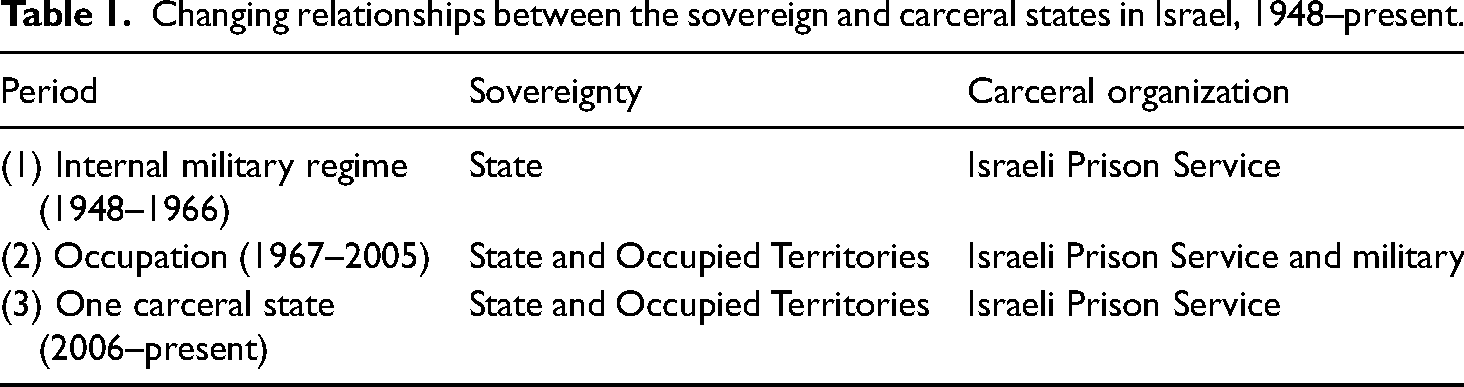
In both the second and the third periods, the carceral state extends beyond the criminal carceral system and the sovereign state, maintaining fluidity between carceral state agencies that is unrelated to legal categories. Each represents a different configuration of the carceral state: fragmented or unified. Were this only the case in the occupation period, the Israeli experience could be understood as exceptional; however, the “one carceral state” demonstrates how military incarceration can be integrated into any centralized carceral system under a single state paradigm, which makes the argument more broadly applicable.
The transition between the second and third periods demonstrates the extent to which the carceral state is decoupled from the sovereign state: the non-sovereign status of the OPT remained the same, as did the law governing the IPS and the legal categories of military and civilian offenses, while the military system has been completely dismantled and the prisoner population internalized. The one carceral state represents an incongruence between the fragmented sovereign state, maintaining formal adherence to international law and politics, and the unified carceral state that operates according to internal human rights standards and managerial and logics.
The scope of the carceral state and exclusionary inclusion
The decoupling of the carceral from the sovereign state means that carceral power is used beyond its traditional functions to control and confine populations beyond territory and political membership. This results in an unintended inclusion of these populations and in the subsequent reconfiguration of carceral mechanisms, producing “exclusionary inclusion.”
How does this affect the scope of the carceral state and the treatment of prisoners? First, a comprehensive account of the carceral state should include all carceral agencies, including military and immigration detention, confinement of court-martialed soldiers, and possibly other institutions as well; in what follows I address immigration detention specifically. 25 Second, the inclusiveness of the carceral state should be reflected in statistics and accounted for when assessing questions of scope such as mass incarceration, overcrowding, and de-carceration. Third, the carceral state includes larger populations of non-citizens whose access to rights and resources may be inferior to those of citizens but who may also benefit from “carceral citizenship.” Seeking to limit this inclusion, some of the boundaries that the carceral state transcends are, in fact, internalized and transformed into administrative categories of prisoners afforded different types of treatment. I briefly demonstrate these implications for the Israeli case and more broadly.
Immigration detention
Immigration detention is also integrated into the one carceral state. Palestinians have been militarily detained—in smaller numbers—for immigration charges in addition to security charges. In the military regime period (1948–1966), military incarceration applied mostly to Palestinian citizens (under military rule), but also to smaller numbers of non-citizen “infiltrators” (Korn, 2003a). Since 1967, when the population of Palestinian non-citizens accounted for the lion's share of military detainees, some of those have also been arrested on immigration charges. As occupied non-citizens, Palestinians from the OPT are subject to a set of military movement-regulations and immigration laws (Ajzenstadt and Barak, 2008; Berda, 2017), criminalizing them for illegal entry to Israel. As with security charges, in the occupation period Palestinians imprisoned for illegal entry were held either by the military or the IPS, although in the one carceral state, they have all been transferred to the IPS. 26
Other immigrant populations have also been detained by Israeli civilian authorities. This population grew significantly from 2006, when Israel faced an influx of African asylum seekers and increasingly used immigration detention (Rosenberg Rubins, 2019). Although Israel operates the Population, Immigration and Border Authority, which in some other countries would also manage immigration detention, it is the IPS that has been entrusted with immigration detention facilities. 27 The IPS thus manages both non-citizen populations of immigration and military detainees.
Analyzing statistics
In a bifurcated and fluid carceral system, either in terms of organization or territory, measuring and analyzing the prisoner population raises a host of issues (Harcourt, 2006; Jahnsen and Slettvåg, 2018). The assumption of a single carceral system and an overlap between the sovereign and the carceral state, lead to a reliance on the statistics of the central prison system. However, such statistics replicate organizational divisions, which are arbitrary and fluid, and distort national statistics (Korn, 2003b), obscuring the full scope of the carceral state. In Israel, the one carceral state period changed this situation: since 2006, IPS statistics largely represent the total number of prisoners. However, that was not the case before that, and nor is it so in other countries that maintain a fragmented or fluid carceral system.
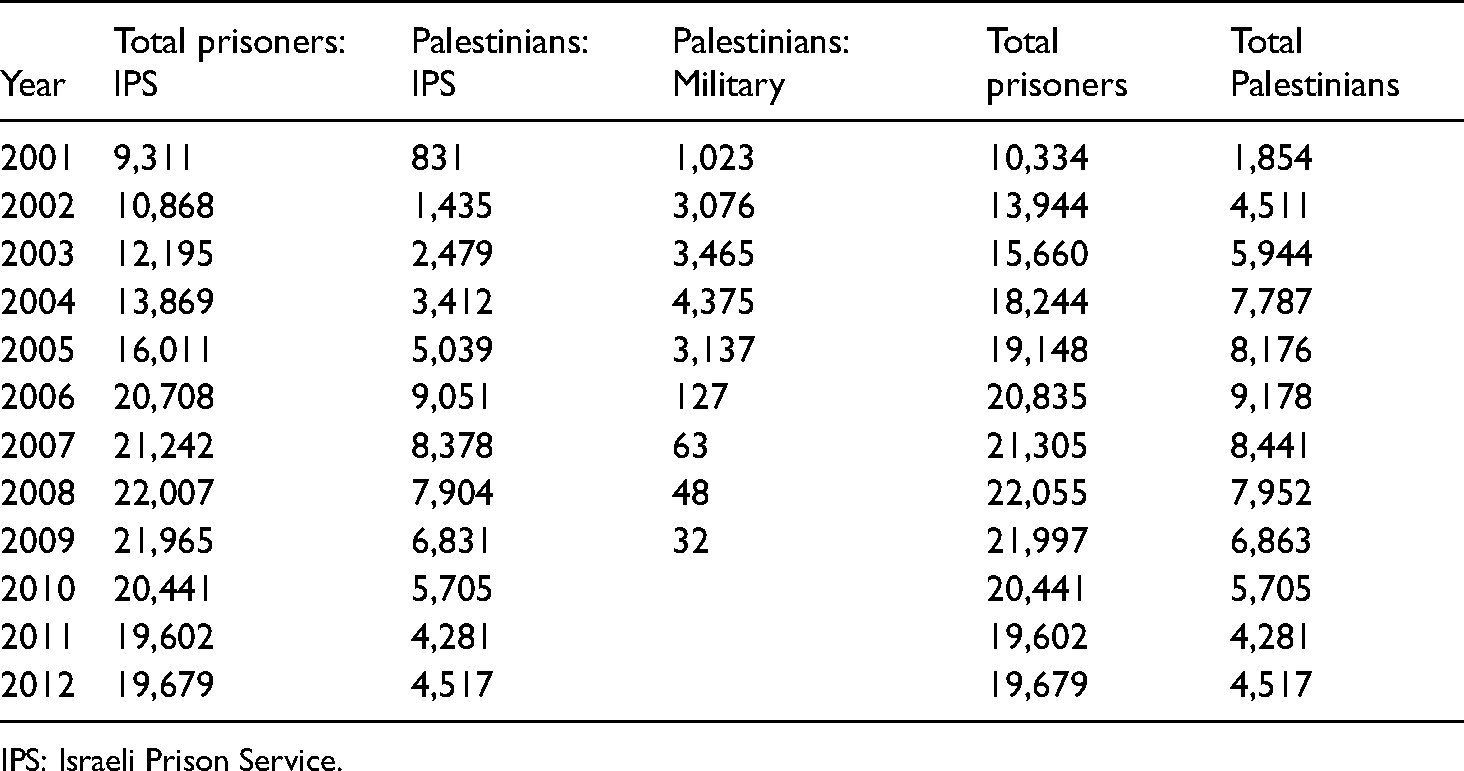
To demonstrate this and fully account for the prisoner population before and after the consolidation of the carceral system, I integrated data on prisoners in the IPS and in military custody between 2001 and 2012, presented in Appendix 1. 28 Up to 2005, IPS statistics did not represent the actual number of prisoners. For example, in 2004 the total IPS population was 13,869, but the military was incarcerating 4,375 Palestinian prisoners, which raises the total number by more than 30%, to 18,244. Between 2005 and 2006, when nearly all prisoners were transferred to the IPS, the number of IPS prisoners spiked from 16,011 to 20,708; at the same time the number of prisoners held by the military fell from 3,137 to 127, and by 2009 to just 32. 29
False assumptions on the scope of the carceral state affect various types of databases. For example, World Prison Brief (WPB) relies on official national figures generated by the IPS. According to WPB, Israel's prisoner population grew by 50% (around 7,000 prisoners) between 2004 and 2006, from 13,605 to 20,628. 30 However, these numbers represent a growth in the population of the IPS and not of the Israeli carceral state, because they ignore prisoners held by the military (some of them inside Israeli territory). According to the comprehensive statistics I gathered, the total number of prisoners in 2004 was 18,244 (and not 13,605), rising to 20,825 in 2006, an increase of around 2,500 prisoners (not 7,000). The rest of the growth—4,500—is due to the transfer of prisoners from the military to the IPS.
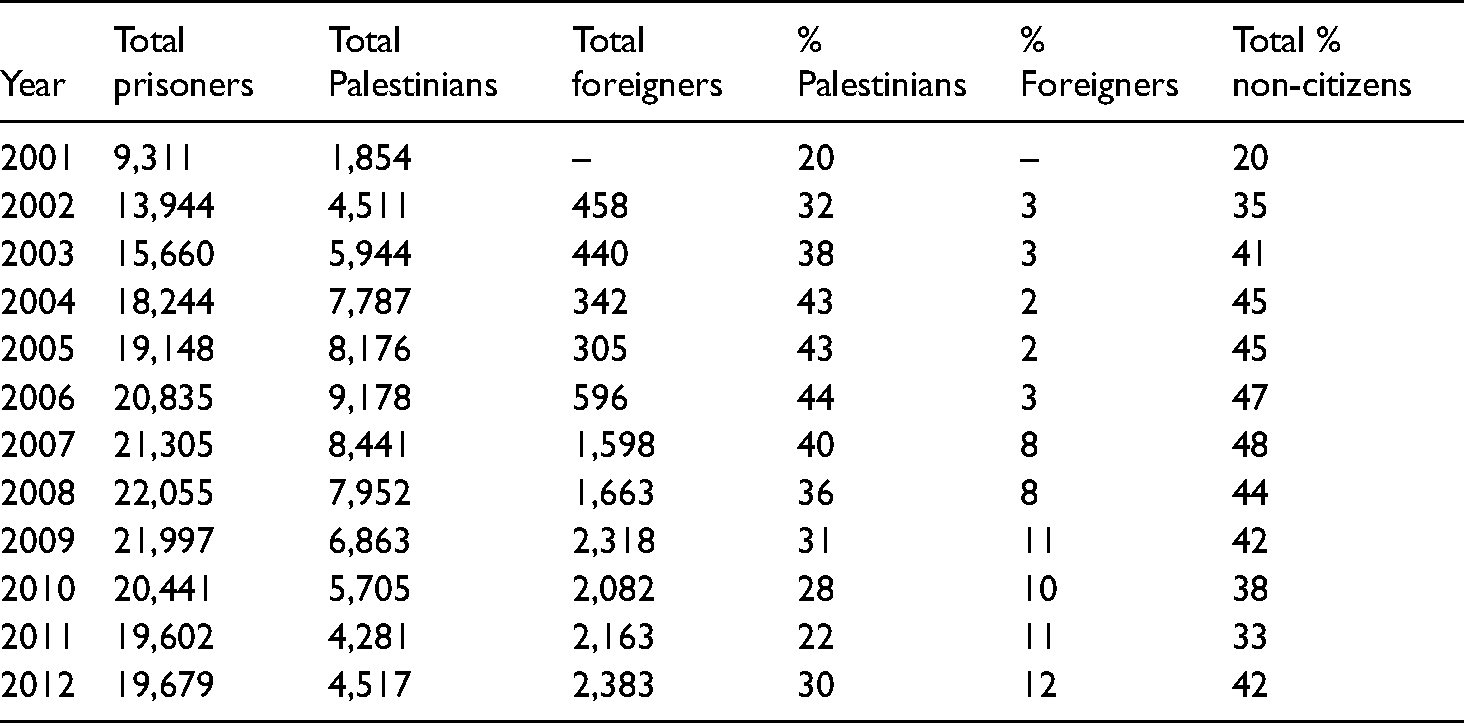
The inclusion of additional prisoner groups also affects assessment of the rates of incarceration and mass incarceration. The WPB documents Israel's rate of incarceration as 208 per 100,000 inhabitants in 2004, rising to 302 per 100,000 in 2006. Again, the 2004 number did not reflect the entire carceral state, whereas the addition of military incarceration in 2006 places incarceration rates in Israel among the highest for developed countries. 31 In 2006, Palestinian prisoners accounted for 44% of the total prisoner population, making military incarceration the decisive factor that drives Israeli rates onto a mass scale.
Starting in 2007, the numbers of immigration detainees became more significant, as presented in Appendix 2. 32 Whereas these numbers had amounted to a few hundred until 2006, in 2007 they grew by 200%, reaching 1,598—that is, 8% of the total prisoner population. The year 2009 presents another spike to 2,318 prisoners, or 11% of the total population, a figure that remained relatively steady until 2012. The growth in the total number of prisoners was thus affected by the rising proportion of both groups. The combined percentage of non-citizen prisoners was 47% in 2006; although absolute numbers and percentages of Palestinians have dropped moderately since then, the rise in immigration detention kept the total percentages of non-citizen prisoners fluctuating at around 40% for the period studied, until 2012.
Internalizing classifications
Unification of the carceral state does not mean, however, that it acts according to a single carceral logic, especially when those included are non-citizens. These populations occupy a liminal and precarious position in relation to membership in the polity (Aas, 2014; Stumpf, 2006). The treatment of “others” highlights aspects of “enemy penology” (Krasmann, 2007; Zedner, 2013), which are common or analogous to enemy aliens and immigrants across carceral systems. In the one carceral state, administrative classifications replace sovereign distinctions based on borders and formal status. These classifications seek to limit or otherwise change the rights regime afforded to these prisoners and enhance the independence of the carceral system in administratively changing such classifications, while allowing the sovereign state to appear to be upholding by law its obligations to equal protection and human rights. I sketch only some of these implications here.
The administrative classifications of “security prisoners” and “foreign prisoners” reflect the internalization of military and immigration incarceration. The vast majority of Palestinian prisoners are classified as “security prisoners” by the IPS. 33 Notably, this classification also includes the few Palestinian Israeli citizens convicted of security offenses, undermining their equal citizenship status (Baker and Matar, 2011). The security classification was created by the IPS in 1958 to apply stricter security measures to Arab prisoners convicted of infiltration and security offenses (Shavitt, 1998: 277). However, it became increasingly significant after 2000 as more and more prisoners were included within it, and detailed IPS regulations were issued in 2000 and 2002, providing that security prisoners should be kept in separate wings, setting restrictive rules regarding their living conditions and visitation rights, excluding them from academic education, rehabilitation programs, furloughs, and phone calls that are available for criminal prisoners, and permitting the force feeding of prisoners on hunger strike. 34 A growing body of studies identifies policies specific to “security prisoners” regarding education, parole, separation of juvenile prisoners, and hunger strikes (Baker and Matar, 2011; Dagan, 2022; Samuel, 2022; Viterbo, 2018).
Since 2002, the IPS has included a category of “foreigners” that relates to civilian immigration detainees in its formal statistics. 35 Special rules pertaining to immigration detention have been legislated, regulated, implemented, and contested in the Israeli Supreme Court, establishing different policies such as open detention facilities and limited periods of detention, policies that are not unique to Israel (Rosenberg Rubins, 2022). Hence, although the IPS is exclusively responsible for the incarceration of all prisoners, specific categories within it produce differentiated conditions for groups on non-citizen prisoners.
Carceral citizenship and exclusionary inclusion
The inclusion of a large non-citizen population within the state carceral system would also transform the understanding of “carceral citizenship.” Miller and Stuart (2017) argued that carceral institutions govern simultaneously through coercion and care. The state provides a set of conditions and rights that is unique to prisoners, alongside prison's deprivations. Incarceration thus creates an alternative legal reality that distinguishes prisoners from other citizens, placing them under an alternate legality.
Carceral citizenship is an unintended and paradoxical consequence of the one carceral state; however, its distinctiveness becomes more radical in the case of non-citizens, who prior to their imprisonment were not entitled to any rights under state law. 36 In the case of Israel, Palestinian non-citizens are, in fact, involuntarily brought into state territory and included under state law and the IPS system, which rarely formally distinguishes between citizens and non-citizens, and thus become entitled to many rights that were intended to apply to citizens. Immigrants and asylum seekers enter the state voluntarily, and paradoxically become eligible to “citizen rights” when they are criminally charged or detained (Rosenberg Rubins, 2022).
Carceral citizenship, in this case, amounts to “exclusionary inclusion” in the political community—inclusion under the law, which comes at the great cost of being incarcerated and thus deprived of liberty, privacy, family, among many other deprivations (compare Ophir et al., 2009, discussing inclusive exclusion of Palestinians). 37 The inclusive aspects of state law, regulations, and institutions include, for example, Palestinian prisoners becoming eligible to prisoners’ rights and parole; they can initiate inmate litigation to challenge imprisonment conditions and policies and claim such rights; and their living conditions are monitored by institutions such as the Office of the Public Defender and Knesset committees.
As mentioned above, state authorities have sought to curtail the rights earned by non-citizen prisoners through a variety of new legal and administrative measure and classifications, which prisoners are able to challenge through inmate litigation and access to Israeli human rights NGOs. A powerful example of this push–pull dynamic is the petition of the Association for Civil Rights in Israel against prison overcrowding, resulting in a 2017 Supreme Court decision ordering the state to reduce prison overcrowding. 38 The decision did not distinguish between categories of prisoners; however, in subsequent motions to overturn or delay its implementation, the state argued that public safety demands that security prisoners should not be released. The state thus relied on the high rates of security prisoners as impeding de-carceration. 39 This case and volumes of inmate litigation initiated by non-citizen prisoners and NGOs acting on their behalf demonstrate how the content of carceral citizenship is constantly being negotiated between alien carceral citizens and the state.
Conclusion
Studies dealing with crimmigration, disability-related confinment, and the shadow carceral state have paved the way toward conceptualizing the expansion of the carceral system beyond what has traditionally been viewed as the criminal justice system. Perceiving the single carceral state in Israel/Palestine, as I propose here, demonstrates the multiple directions that this expansion can take—territorially, organizationally, and population-wise—and the scale of its impact, primarily on non-citizen populations. The boundaries of the carceral state are both internal and external. The external boundaries transform the relations between sovereignty and governmentality, showing how the carceral state forms its own boundaries that are not limited by sovereign borders, reaching populations beyond the state. Internally, in such a capacious carceral state, fragmentation along internal boundaries marks the different logics of managing populations in liminal positions that potentially create distinct carceral regimes. Both the unity and the fragmentation of the carceral state are important to acknowledge, because the unifying ideas of state sovereignty and the rule of law are in constant tension with the divisive mechanisms of citizenship, immigration, risk, and security.
The shift to a single carceral system in Israel/Palestine was implemented through bureaucracy rather than through law in the shadowy areas of the administrative state and prison buildings. Hence, the sovereign state obfuscates the true scope of the carceral state, which has thus far successfully remained under the radar of researchers. The “one carceral state” of Israel is unique in its integration of extraterritorial military detention and imprisonment into the state prison system. However, it is important not to overstate the meaning of this institutional consolidation. Even in the previous phases that have more equivalents in other countries, the internal boundaries of military and civilian imprisonment were, in fact, porous and fluid, and the carceral system was already functioning as a single, hybrid system. Framing the carceral system as one matrix provides a common ground from which to analyze different carceral practices.
Each carceral system presents different degrees of formal and informal integration of military, immigration, juvenile, mental health, and other carceral institutions. For example, although the US kept a separate system of extraterritorial detention, the Supreme Court in the Boumediene case acknowledged the constitutional right of habeas corpus to detainees in Guantánamo Bay and allowed them access to US courts—but these protections were not extended to other extraterritorial prisons such as Bagram. 40 Elsewhere, the UK was made accountable for its treatment of military detainees in Iraq through international human rights mechanisms. 41 Both of these examples represent degrees of integration and the development of new forms of carceral citizenship.
Beyond the specificity of its local context, then, I argue that the Israeli case serves as a window through which to discern the totality of the carceral state and how it can undetectably transcend state borders, organizational fragmentation, and legal categories. Potentially, the carceral state may further extend outward, for example to leaders imprisoned by the international criminal court. Both military and immigration detention imprison entire populations of non-citizens who are rarely counted in the total prisoner population. Including them in the study of the carceral state would teach us a great deal about carceral regimes and citizenship regimes and how these are negotiated. Such a holistic approach would provide a thicker understanding of the “circuits of meanings and action” (Garland, 1990: 17) —an understanding that would trace the actual contours and operations of the carceral state.
Footnotes
Acknowledgment
I wish to thank Ian Lustick, Amal Jamal, Anand Yang, Lena Salaymeh, Nir Gazit, Netanel Dagan, Lisa Hajjar, Katherine Beckett, Jamie Mayerfeld, Stephen Meyers, Magda Boutros, and Noga Rotem, for their ideas, comments and thoughts. I am grateful to Shirley Le Penne and Dana Boulus for their excellent research assistance and contributions.
Declaration of conflicting interests
The author(s) declared no potential conflicts of interest with respect to the research, authorship, and/or publication of this article.
Funding
The author(s) disclosed receipt of the following financial support for the research, authorship, and/or publication of this article: This work was supported by a Distinguished Scholar Grant from the Harry Frank Guggenheim Foundation.

Notes
Author biography
Appendix 1: Civilian and military incarceration,2001–2012
| Year | Total prisoners: IPS | Palestinians: IPS | Palestinians: Military | Total prisoners | Total Palestinians |
|---|---|---|---|---|---|
| 2001 | 9,311 | 831 | 1,023 | 10,334 | 1,854 |
| 2002 | 10,868 | 1,435 | 3,076 | 13,944 | 4,511 |
| 2003 | 12,195 | 2,479 | 3,465 | 15,660 | 5,944 |
| 2004 | 13,869 | 3,412 | 4,375 | 18,244 | 7,787 |
| 2005 | 16,011 | 5,039 | 3,137 | 19,148 | 8,176 |
| 2006 | 20,708 | 9,051 | 127 | 20,835 | 9,178 |
| 2007 | 21,242 | 8,378 | 63 | 21,305 | 8,441 |
| 2008 | 22,007 | 7,904 | 48 | 22,055 | 7,952 |
| 2009 | 21,965 | 6,831 | 32 | 21,997 | 6,863 |
| 2010 | 20,441 | 5,705 | 20,441 | 5,705 | |
| 2011 | 19,602 | 4,281 | 19,602 | 4,281 | |
| 2012 | 19,679 | 4,517 | 19,679 | 4,517 |
IPS: Israeli Prison Service.
Appendix 2: Non-citizen prisoners in Israeli prisons,2001–2012
| Year | Total prisoners | Total Palestinians | Total foreigners | % Palestinians | % Foreigners | Total % non-citizens |
|---|---|---|---|---|---|---|
| 2001 | 9,311 | 1,854 | – | 20 | – | 20 |
| 2002 | 13,944 | 4,511 | 458 | 32 | 3 | 35 |
| 2003 | 15,660 | 5,944 | 440 | 38 | 3 | 41 |
| 2004 | 18,244 | 7,787 | 342 | 43 | 2 | 45 |
| 2005 | 19,148 | 8,176 | 305 | 43 | 2 | 45 |
| 2006 | 20,835 | 9,178 | 596 | 44 | 3 | 47 |
| 2007 | 21,305 | 8,441 | 1,598 | 40 | 8 | 48 |
| 2008 | 22,055 | 7,952 | 1,663 | 36 | 8 | 44 |
| 2009 | 21,997 | 6,863 | 2,318 | 31 | 11 | 42 |
| 2010 | 20,441 | 5,705 | 2,082 | 28 | 10 | 38 |
| 2011 | 19,602 | 4,281 | 2,163 | 22 | 11 | 33 |
| 2012 | 19,679 | 4,517 | 2,383 | 30 | 12 | 42 |