




Abstract
Between 1984 and 2016, Philadelphia prosecutors seized over US$86 million dollars, most of it in the form of cash taken from Black and Latinx Philadelphians. These seizures of dirty money were realized through civil forfeiture, which has the unique capacity to enrich municipal law enforcement agencies while dispossessing alleged participants in the drug trade. As a civil intervention into the illicit narcotics trade, cash forfeiture is characteristic of the carceral state's increasing use of non-criminal sanctions. In this essay I argue that Philadelphia police and prosecutors mobilize cash forfeiture to assert social control over the interfaces between licit and illicit economies in Philadelphia's poorest and most racially segregated neighborhoods. Drawing from historical accounts of the racial capitalist state's disciplinary oversight of the monetary system, I show how cash forfeiture operates through a racializing framework of socio-moral remediation that reproduces the harms associated with longstanding financial inequality in these neighborhoods.
Keywords
Between 1984 and 2016, Philadelphia prosecutors seized over US$86 million dollars, most of it cash taken from Black and Latinx Philadelphians. This program produced such high revenue for the District Attorney's Office (DAO) and Philadelphia Police Department (PPD) despite its reliance on strikingly petty individual seizures: from a median seizure of just US$183 between 2011 and 2016, the DAO amassed nearly US$15 million. 1 These seizures of ostensibly dirty money were realized through civil asset forfeiture—a legal form, prosecutorial policy, and police tactic—that has the unique capacity to enrich municipal law enforcement agencies while simultaneously dispossessing alleged participants in the drug trade. Unlike criminal sanctions, civil forfeiture assigns liability to property—meaning that property can be seized even if its owner is not convicted of a crime (Vallas et al., 2016). Philadelphia law enforcement officials defend cash forfeiture by claiming that seized assets have the capacity to cause harm (Williams, 2015). 2 Interrogating rather than taking for granted this contention, I show how cash forfeiture operates through a racializing framework of socio-moral remediation that reproduces the harms associated with racialized financial inequality.
As a quasi-criminal and yet civil intervention into the illicit narcotics trade, cash forfeiture is characteristic of the “legal hybridity” that Beckett and Murakawa (2012) argue characterizes the “shadow carceral state” (see also Beckett and Herbert, 2008; Kohler-Hausmann, 2013; Lynch, 2012). Policymakers embraced legal hybridity in part to overcome the limits placed on carceral power following the invalidation of vagrancy laws and status-based crimes during the due process revolution of the 1960s and 1970s (Goluboff, 2016). Faced with diminished authority to assert social control over urban space through criminal jurisprudence, law enforcement officials mobilized new civil and administrative sanctions (Freiberg and O’Malley, 1984). The most striking of these strategies—the proliferation of legal financial obligations (LFOs) throughout the criminal justice system—targeted the extant vulnerabilities of marginalized populations to social and economic harm. By disproportionately burdening the poor with legal debt they are often unable to pay, LFOs “create and sustain inequality” in the USA, as Alexes Harris argues. They also “shift criminal justice costs directly onto defendants”, thereby blurring the “line between punishment and fiscal management” in an era characterized by persistent austerity politics (Harris, 2016: 11, 14, 151; see also Fernandes et al., 2019; Martin et al., 2018; O’Malley, 2009).
While cash forfeiture is not technically a LFO—it is the confiscation of money already possessed by an individual, rather than an obligation to pay money that she may or may not possess in the future—it poses similar consequences. Police and prosecutors use forfeiture to assert social control over the interfaces between licit and illicit economies in Philadelphia's poorest and most racially segregated neighborhoods, compounding the city's longstanding inequalities. They have also used forfeiture to shore up their own budgets. During the early years of cash forfeiture—a period that coincided with a municipal fiscal crisis—Police Commissioner Willie Williams appropriated over US$800,000 in forfeiture funds for police overtime during what he anticipated would be a “long, hot summer” (Miller, 1989). Between 2002 and 2006, the revenue generated by forfeiture comprised at least 10% of the DAO's annual budget (City of Philadelphia, 2002–2006; Office of Attorney General, 1984–2016). Forfeiture, more than LFOs, thus demonstrates how the “survival and expansion” of law enforcement institutions has often become, in Jackie Wang's (2018: 21–22) words, “bound up with their capacity to use the police power and the court system to loot residents”.
To describe cash forfeiture as looting is not an understatement. While forfeiture revenue has typically represented a small fraction of the city's overall law enforcement budget, the US$86 million seized by the PPD and forfeited by the DAO represent a significant transfer of wealth from the city's poor neighborhoods to its narcotics policing apparatus. In this article, I draw from extensive public records research to theorize the relationship between cash forfeiture and Philadelphia's enduring structures of financial inequality and exclusion. 3 The core of this research is a sample of cash forfeiture case records for the years 2011 to 2016 that I accessed via a right-to-know request to the Administrative Office of Pennsylvania Courts (AOPC). The raw data I received from the AOPC was voluminous and yet limited—it consisted of basic docket information for tens of thousands of cases—so I compiled a random sample for which I retrieved case histories from Philadelphia's Juanita Stout Criminal Justice Center. Most case histories are quite thin, containing just police property receipts, the DAO's forfeiture petitions, and default forfeiture orders. Yet each case history includes the amount of cash seized and the location where it was seized, crucial data points for charting the spatialized harm wrought by the practice. A minority of the cases I pulled contained more fine-grained accounts of the circumstances surrounding individual seizures. I discuss several of these cases below as I analyze how the practice intersects with financial inequality. 4
Both financial inequality and cash forfeiture in Philadelphia are organized geographically, mirroring the city's longstanding patterns of racial segregation. Seizures concentrate within a small set of neighborhoods in North Philadelphia, an area of the city that features a confined and immiserated Black and Latinx population (see Figure 1). While the seizure of cash is clearly related to the underlying racial logics of policing, I argue that it is also shaped by the racialized geography of financial inequality. Cash becomes dirty money in neighborhoods shaped by long histories of racially discriminatory mortgage lending and cut off from mainstream financial institutions today.
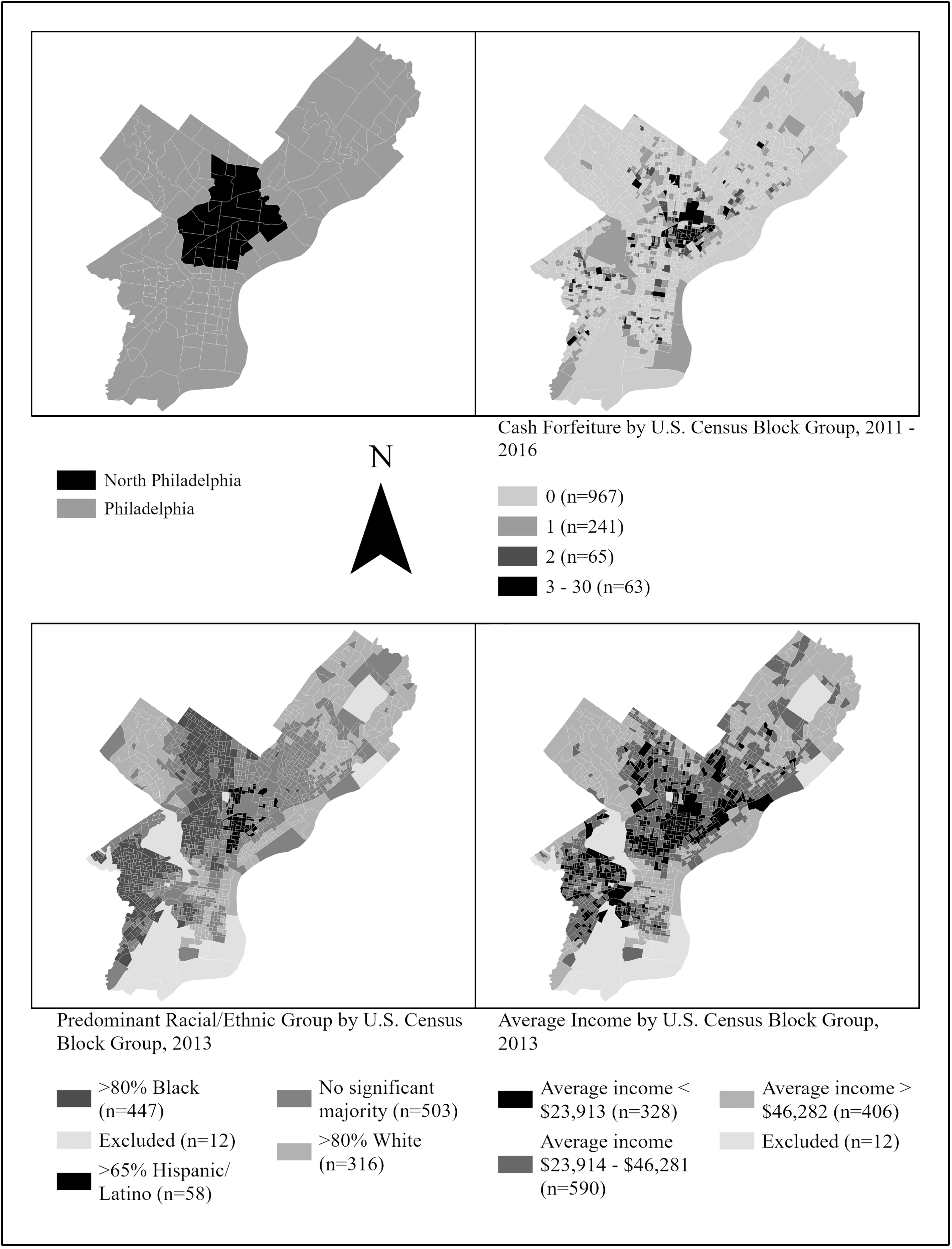
Cash forfeiture, race, ethnicity, and poverty in Philadelphia.
The policing of dirty money in Philadelphia is consistent with a long history of the state's direct and often disciplinary oversight of the monetary system. Reviewing anthropological scholarship on dirty money, Gustav Peebles (2012: 1231, 1235) argues that communities have long mobilized state power to target dirty money. They do so to condemn the alleged “anti-social retention or acquisition of surplus money”. By invoking “money's metonymical attachments to the community at large”, they cleanse dirty money and renew the community's socio-moral values.
Yet it is not just dirty money that is targeted by state power. While we tend to think of money as an economic rather than political technology, historians have shown how money is constituted by state power. In her history of money's historical development in England, Christine Desan (2015: 1) frames the production of money as a “governance project” that determines the distribution of wealth. She argues that monetary relations are “activated by legal rules, driven by institutions, [and] implemented by practices that change the way people relate” (2015: 11) and distribute “power in particular ways” (2005: 8). The upshot of the state's role in monetary relations is that any individual's possession of money is subject to legal and political adjudication. The adjudication of access to money, as Desan argues, was a central component of the governance strategies that emerged alongside the development of what Cedric Robinson terms “racial capitalism” in both England and the USA (Desan, 2015; Robinson, 2000: 1, 11). The widespread seizure of cash in North Philadelphia was shaped by this centuries-long history of the state's role in mediating access to money. The dirty money targeted by Philadelphia police and prosecutors is a key criterion in what Michael Ralph (2015: 8) calls the “forensic profile”, a contemporary “governance project” (Desan, 2015: 1) that he defines as a “composite history concerned with whether [an entity] enjoys favorable standing—whether it has transgressed shared protocols”. As the “scientific apparatus that we use to calibrate social standing” and grant “access to resources”, the forensic profile is instrumental to myriad spheres of contemporary governance—including both consumer banking and the criminal justice system (Ralph, 2015: 8, 37–38). Dirty money was born at the intersection of these two engines of contemporary racial inequality.
In the remainder of this essay, I examine cash forfeiture in Philadelphia to show how dirty money has emerged as a racial marker of civic exclusion that police and prosecutors use to enforce the spatialized boundary between licit and illicit economies. In the first section I trace the race-making power of dirty money to collective vulnerabilities to financial inequality. While the possession of cash within the racially segregated neighborhoods of North Philadelphia is the product of spatialized financial inequality, it forensically signifies a dangerous proximity to narcotics markets and thereby racially marks its possessor as having transgressed the boundaries between licit and illicit economies. In the second section I undertake a qualitative analysis of cash forfeiture records to illuminate how dirty money is produced as a marker of stigmatized vulnerability to both financial inequality and illicit economies. I conclude by theorizing the contemporary policing of dirty money in Philadelphia in relation to the intertwined history of money and punishment within capitalist societies. I argue that dirty money represents a new “stratigraphy” of cash (Desan, 2015), or a locus of racial differentiation that operates through the civic exclusion of those living cash lives in neighborhoods socially and spatially disconnected from the wage form and formal financial services.
Racialized vulnerability to financial inequality
In 2014 Philadelphia narcotics officers ambushed Nassir Geiger as he drove home. Geiger, a Black resident of Northeast Philadelphia and a city sanitation worker, had just cashed his US$580 paycheck before heading to a nearby McDonald's restaurant, where a co-worker leaned into his window to say hello. After construing that friendly interaction as a drug transaction, the officers moved in with guns drawn and proceeded to search Geiger's vehicle. They did not find drugs but they did charge him with possession of paraphernalia after they discovered empty Ziploc bags. They also took his US$580. Geiger's criminal charge was dismissed, but he never recovered his cash—it was forfeited by default (Marin and Briggs, 2017).
Geiger's experience highlights how cash forfeiture in Philadelphia intersects with the city's history of racialized inequalities in employment and access to mainstream financial services. The North Philadelphia neighborhoods where cash forfeitures cluster have inherited a long history of financial inequality characterized by stark disparities in access to consumer financial services (Smith et al., 2008) and ongoing racial inequalities in mortgage financing (Glantz and Martinez, 2018) linked to racial redlining during the early 20th century (Hillier, 2005). As in many similar neighborhoods throughout the USA, banks insured by the Federal Deposit Insurance Commission (FDIC) are few and far between in these neighborhoods. Quantitative researchers on financial inequality refer to this absence of formal financial institutions as a “spatial void”, which is filled by Alternative Financial Service Providers (AFSP) like pawnshops and check-cashing outlets—the kinds of institutions that unbanked Philadelphians use to turn paychecks into cash (Smith et al., 2008). While FDIC-insured banks offer an array of services that include electronic deposit accounts and mobile banking, AFSPs deal exclusively in cash and have a well-earned reputation for predatory practices and excessive fees. AFSPs thus represent a costly burden for poor populations (Ernst et al., 2018; Valenti, 2014). A 2008 study of these dynamics in Philadelphia found that neighborhoods with significantly higher access to AFSPs had a median income US$10,000 less than the city's overall median income and featured much higher proportions of nonwhite people, especially Latinx residents (Smith et al., 2008). These spatialized inequalities are evident in the North Philadelphia neighborhoods where forfeitures concentrate (see Figure 2).
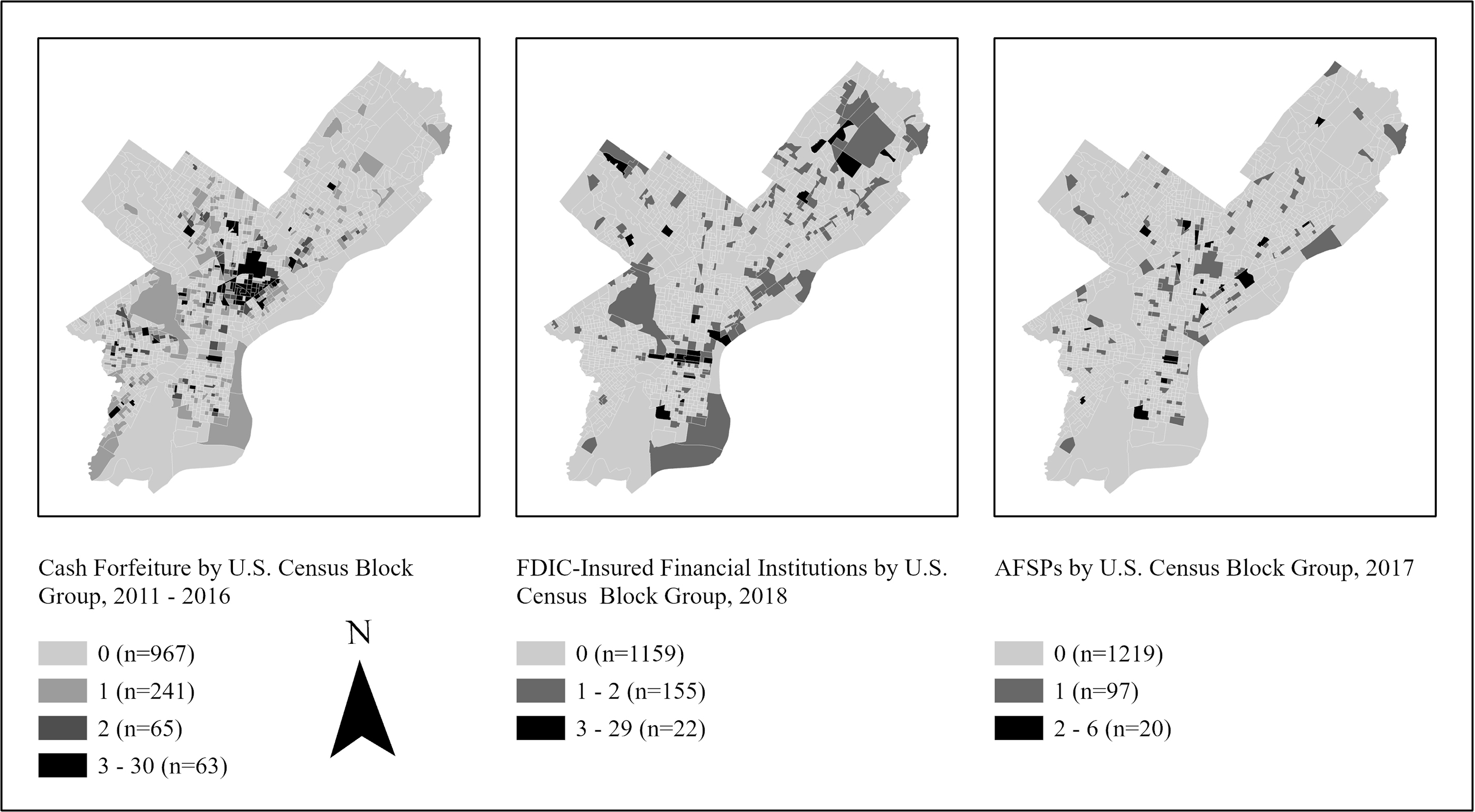
The geography of cash forfeiture and financial inequality in Philadelphia.
The dearth of both FDIC-insured banks and formal employment opportunities in North Philadelphia transforms the social form of cash within the confines of these neighborhoods. Cash becomes dirty money, a racial marker of civic exclusion and a mechanism for the public expropriation of illicit wages and profits. To be clear, my argument is not that police or prosecutors themselves consciously work to transform cash into dirty money, nor to ascribe the possession of dirty money to certain predetermined racial groups. Rather, dirty money operates both structurally and spatially. It marks the boundary between licit and illicit economies, tripping up those who transgress that boundary regardless of how police officers and prosecutors visually interpret their racial or ethnic status. It is dirty money that marks its possessors, rather than the possessor who marks the cash. To make this argument, I build on Murakawa and Beckett's (2010: 721) critique of claims that racism in the criminal justice system “exists only with proof of racial ‘intent’ and racial ‘causation’”. Pointing to the growth of the criminal justice system in “race-laden ways that diffuse ‘intent’ and complicate ‘causation’”, Murakawa and Beckett (2010: 721) call on scholars to attend to how racism operates in criminal justice practices in “systemic, interactive, and serpentine ways”. Instead of looking for racist intent among the police officers and prosecutors who seize cash from Philadelphians, I ask how the transformation of cash into dirty money both depends upon and exacerbates the conditions of racialized financial inequality in which officers work. Dirty money racially marks the possessors of cash via their proximity to financial inequality and illicit economies, irrespective of whether they are interpreted as nonwhite and regardless of the race or ethnicity of police officers and prosecutors.
My approach entails asking not only how cash forfeiture reflects racial disparities, but also how it makes race anew. As Stuart Schrader (2019: 39) argues, “in relation to policing, race is understood as cause, when it should be understood as effect”. Drawing from Ruth Wilson Gilmore’s (2007: 247) understanding of race as the institutionalized “production and exploitation of group-differentiated vulnerability to premature death”, Schrader (2019: 40) suggests that such vulnerability “does not begin with the group”. Instead, “the group begins, extends, and coalesces” through the institutional production of vulnerability, such that “previous vulnerability is a heuristic of future vulnerability”. This historic process—the production of race via policing, which I am here framing as the production and exploitation of a collective and spatialized vulnerability to financial inequality and illicit economies—coheres into discrete social forms such as dirty money. Cash becomes dirty money through the contemporary inheritance of historic forms of racialized financial inequality, on the one hand, and the deployment of police to manage the social distribution of vulnerability to this extant inequality, on the other hand. Dirty money thus comes to racially mark the spatial and structural boundary between clean and dirty spheres of economic activity, a boundary that divides not only licit and illicit employment but also mainstream and peripheral banking. This unconscious relationship between narcotics policing and racialized financial inequality is evident in the geographic articulation between cash forfeiture and predatory financial services: both forfeitures and AFSPs concentrate in the spatial gaps between FDIC-insured banks (see Figure 2).
Rather than take either the drug dealer or dirty money as self-evident social categories, I interrogate the process through which cash is legally framed as an ill-gotten gain. Dirty money does not simply exist in the world, waiting to be seized by police officers. To the contrary, it is constituted by the law itself. As Yngvesson and Coutin (2006: 178) argue, legal fictions like dirty money link “the ‘as if’ world of law to an allegedly exterior or prior world (the natural? the social? the real?) on which law acts and from which law derives truth”. This relationship between the “prior world” and law constitutes the prior as “being of a different order than law”, and yet constructs this order within the limits of being a “legally cognizable event”. Legal fictions are essentially interpretive frameworks for making sense of a complex, external world that is thereby cast as formally immanent to the law itself. In the next section I analyze how the legal fiction of dirty money is produced through the documentary trail created by police and prosecutors. This process reveals how the social and economic circumstances shaping the possession of cash in North Philadelphia are made “legally cognizable” through the civil forfeiture framework.
The production of dirty money
The transformation of cash into dirty money begins during a police encounter, typically the result of an investigation into alleged narcotics dealing. It is during these encounters that the actual seizure of cash occurs. To substantiate a seizure, officers must complete a property receipt (much like a police report substantiates an arrest). These documents initiate a legal process separate from criminal proceedings that begins when DAO paralegals use them to produce formulaic civil forfeiture petitions, which allege the property is forfeitable under Pennsylvania law. Prosecutors file these petitions with the Court of Common Pleas of Philadelphia County, thus formally asking the court to issue a forfeiture order that finally transfers ownership of seized cash to the Commonwealth of Pennsylvania (Rulli, 2017; see Figure 3).
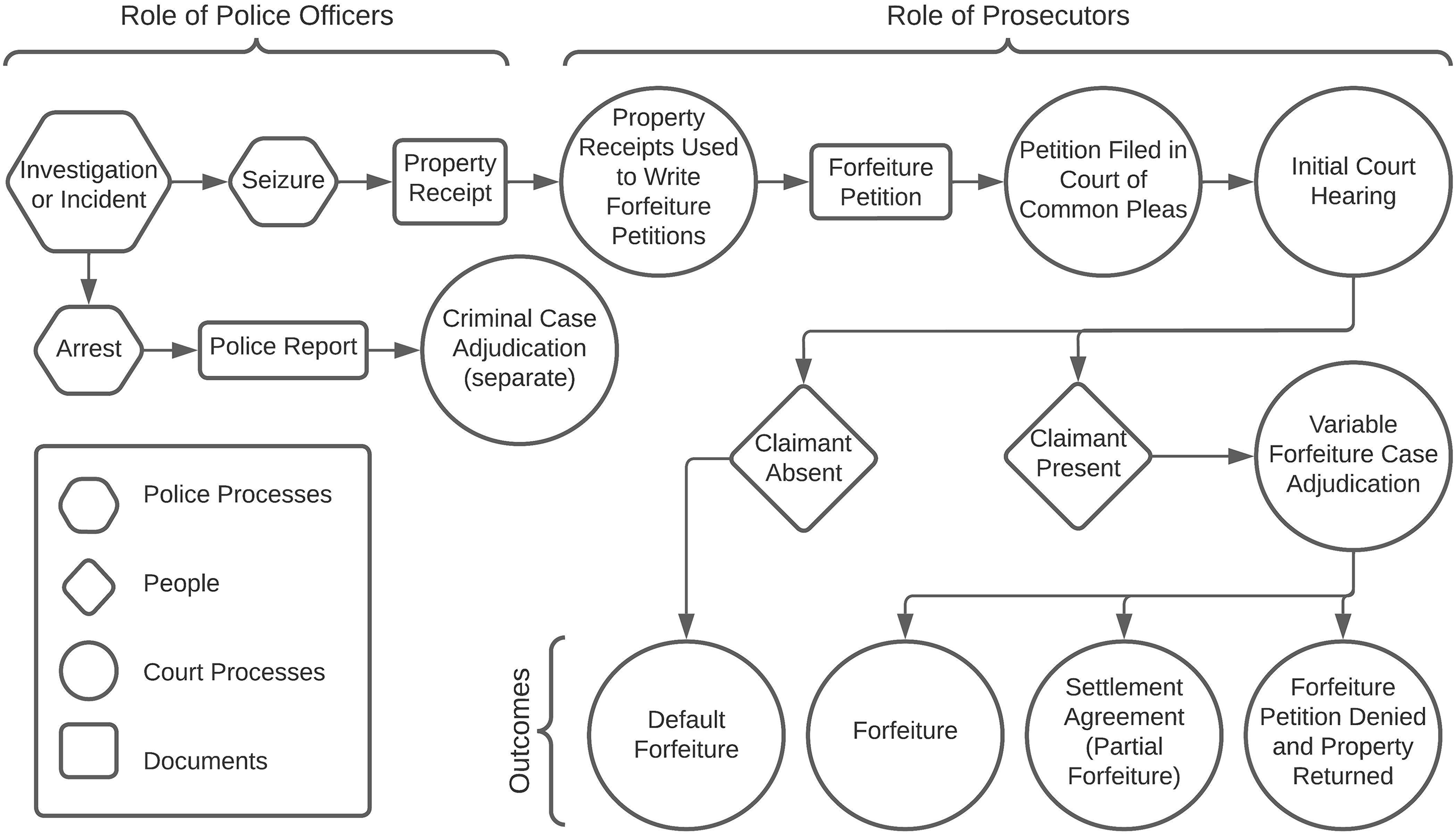
The civil forfeiture legal process.
Prosecutors must also file a proof of notice with the court, attesting that they have notified any known owners of the seized cash about the forfeiture proceedings against it. In practice, however, notice often fails to reach the original possessor of seized cash. The American Civil Liberties Union (ACLU) found that the DAO failed to provide proper notice of pending forfeitures in 34% of cases between 2011 and 2013, despite their legal obligation to do so (Kelly, 2015: 6). With the filing of the forfeiture petition and the proof of notice, the previous possessor of cash is transformed into a “claimant”—not the subject of the legal proceedings against her cash, but a third party to the case who must affirmatively demonstrate both her claim to the cash and prove that she did not possess it in violation of narcotics law. This distinction is significant. As indirect parties to these civil cases, claimants are unable to avail themselves of the procedural protections afforded to criminal defendants—including the right to legal counsel. Initial court hearings take place approximately 30 days after prosecutors file forfeiture petitions (Rulli, 2017). For most cash forfeiture claimants, these hearings represent the beginning and end of their cases: according to the ACLU, “approximately 87% of … cases ended when the property owner failed to appear for their first court date”. Claimants are often unaware of how to retrieve their seized cash, due both to their lack of legal representation and the inefficacy of the DAO's efforts to provide notice (Kelly, 2015: 5–6). Without a claimant asserting an ownership claim over the cash, the court awards a default judgment to the DAO that grants forfeiture of the property. The rare claimants who do show up for these initial hearings may pursue a range of legal strategies to compel the return of their cash, including settling with the DAO for a full or partial return or asserting statutory or constitutional defenses with the aid of legal representation (Rulli, 2017; see Figure 3).
While forfeiture orders finalize the seizure of cash, dirty money is constituted first and foremost by the property receipt. Arresting officers collect cash at the scene of an arrest, count it, and record both the total amount and a breakdown of the denominations on a receipt. These receipts document the seizure of cash as “evidence” supporting the underlying criminal charges. They therefore serve two distinct legal functions. First, they are formal evidence of the criminal allegations brought against the person who possessed the cash. Cash transformed into drug money becomes an evidentiary support for the criminal charges brought against the suspect. Second, and conversely, these receipts attest that the property for which they are issued has itself been tainted by the alleged offense. In the receipt pictured in Figure 4, US$53 denominated in two US$20 bills, one US$5 bill, and eight US$1 bills was “recovered” by an officer during the arrest of an 18-year-old Black youth for “narcotics violations” (AOPC). The property receipt invokes a criminal charge as the reason for the seizure of cash, yet it also registers the cash as evidence for the charge that tainted it in the first place (cash is obviously not the only evidence of a narcotics violation, but it is often key to establishing violations beyond simple possession). The evidentiary trail represented by the property receipt is thus tautological—a violation of narcotics law taints the cash even as this dirty money substantiates the officer's claim that narcotics law was indeed violated. The US$53 in cash is not only evidence of this young man's transgression of the law, but also evidence that this cash itself was sullied by virtue of being in his pockets at the time and place of the alleged transgression. His money takes on a legal life of its own, separate from the course of criminal allegations against his person.
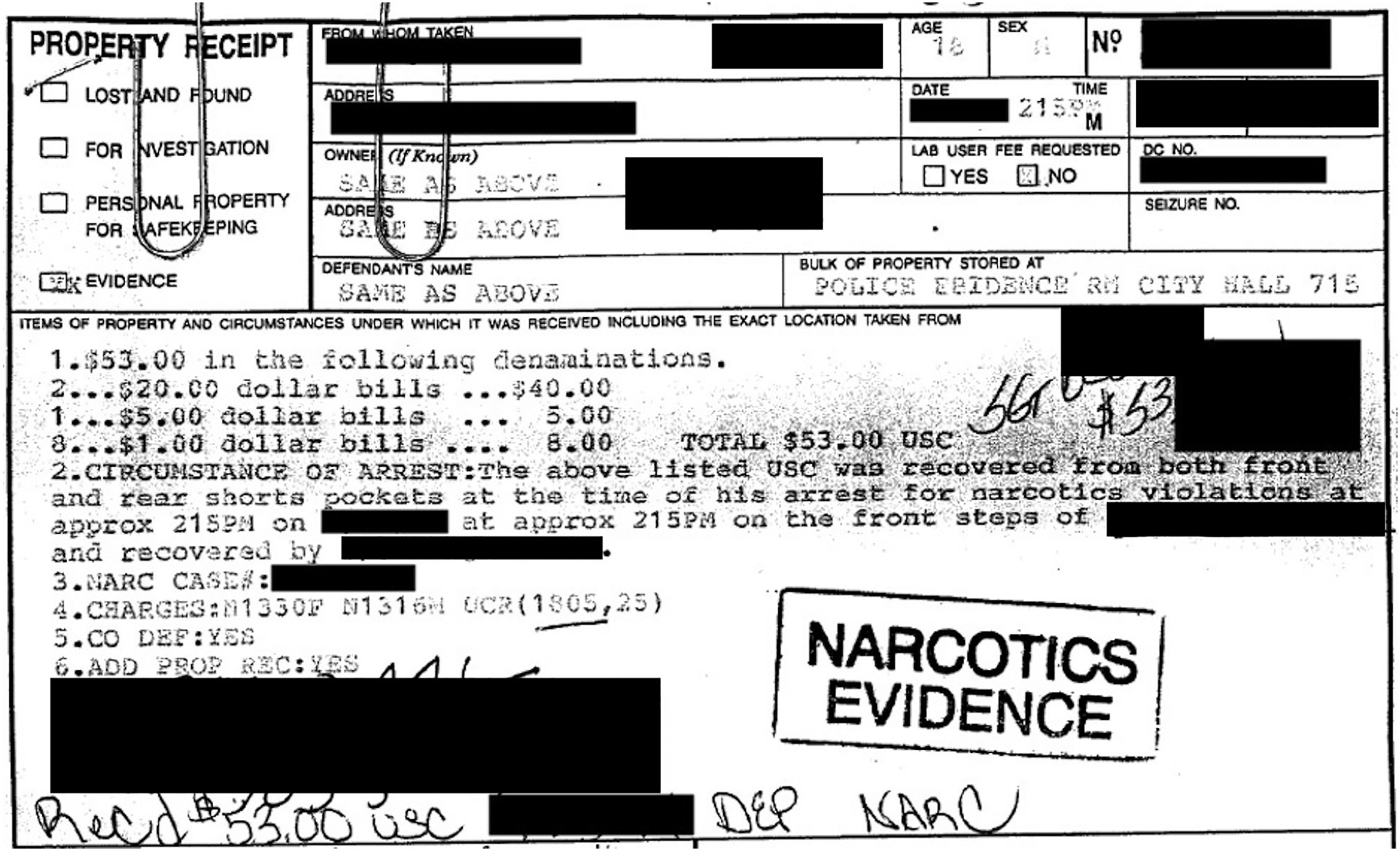
Sample property receipt for cash forfeiture.
The property receipt is thus a “forensic” document that legally reconstructs the relationship between person and property, casting the latter as dirty money (Ralph, 2015). Although it purports to reflect an external reality in which this young man participated in an illicit economy to acquire his modest wealth, the receipt produces the legal fiction of dirty money as a means for retroactively interpreting and reconstructing the social situation in which the police intervened. That situation, of course, was marked by preexisting forms of collective vulnerability to racialized financial inequality. Yet the interpretive frame of dirty money obscures these conditions, instead translating them into the punitive language of civil forfeiture. Cash comes to embody illicit social potential; it is an object of moral contagion. As former narcotics officer Kevin Bethel put it to me, “the money was the bloodline for these drug operations” (Interview by the author, 2018). Dirty money is the blood sustaining illicit narcotics businesses. Police and prosecutors aim to staunch the flow of blood into these dangerous social bodies, which threaten a vulnerable body politic. They do so through the civic exclusion of individuals constructed as drug dealers and the seizure of their livelihoods.
The specific circumstances of individual cash seizures further illuminate the production of dirty money. In March 2015, narcotics detectives seized US$545 during the execution of a search warrant at a Northeast Philadelphia home. While the property receipt indicated that money had been seized from a Black man charged with narcotics offenses, a different possessor of the cash hired private counsel to contest the seizure. In her answer to the DAO's forfeiture petition, she recalled that when that man was arrested at the house next door she was “raising her two children” at home. Detectives knocked on her door to serve a search warrant and then “opened [her] closed purse, and removed $545”. Her cash was seized due to her social proximity to the drug trade; the absence of specific criminal allegations against her did not keep it from becoming dirty money. Once narcotics officers record cash on a property receipt, they have effectively completed this transformation. Dirty money then endures through the legal process due to the vaunted status of police testimony in the eyes of most prosecutors and judges (Warren, 2018). Claimants are burdened to prove otherwise. They can only do so by establishing a connection to legitimate spheres of employment or formal financial institutions, thereby contesting their vulnerability to financial inequality—a condition of vulnerability implied by the transformation of their cash into dirty money. This woman managed to secure the return of her US$545 by providing paystubs from her job as a security guard, thus demonstrating her relative resilience to racialized financial inequality and illicit economies (AOPC).
Forfeiture claimants who cannot demonstrate legible connections to waged work and the formal financial system are less successful in retrieving the cash taken from them. After narcotics detectives seized US$2000 in cash from the South Philadelphia home of Kevin and Carla Johnson as part of a broader narcotics investigation during the summer of 2012, the DAO moved to forfeit the money. Carla had saved the money from her pension checks, while Kevin sometimes used marijuana to calm arthritic pain that he endured “after decades of manual labor as a dockworker”. Unable to afford an attorney, the Johnsons had no choice but to let the case end in a default forfeiture (Kelly, 2015: 7). The forfeiture stemmed not only from their alleged proximity to the illicit narcotics trade, but also from their disconnection from the formal financial system. Dirty money here functions as an interpretive frame that informs how the state manages spheres of social reproduction that are unmediated by these financial institutions. Within this context the possession of a large sum of cash marks individuals as beyond the boundaries of the licit economy, justifying the seizure of their cash as dirty money.
Personal financial status also shapes cash seizures originated by street-level narcotics interdiction officers, who frequently target young Black and Latinx men. If these young men attempt to contest a cash forfeiture in court, they must answer prosecutors’ questions about their employment and banking statuses. These questions can be nearly impossible to answer, even for those who have managed to obtain legal representation. As defense attorney Gerald Stein explained to me: [My defendants often] can’t show where the money came from. They’re all living a cash life. I say, “you have a job?” They say, “no, I don’t have a job”. I say, “what are you doing for money?” They say, “my girlfriend”. Or, “my mom is giving me money” … [if] the interrogatories say give us your tax returns—nobody has tax returns. (Interview by the author, 2018)
These stories reveal forfeiture as a dragnet that ensnares even the most peripheral participants in the illicit narcotics economy, not to mention those simply living in incriminating proximity to the trade. Police officers have also cast this net explicitly to ensnare the most vulnerable drug users. In April 2014, narcotics detectives initiated a “reverse drug sting operation” targeting a woman alleged to be a drug user. Typical sting operations are initiated by undercover detectives posing as drug users, who use this cover to purchase drugs from suspected dealers. Reverse stings turn that scenario on its head. In these operations an undercover officer poses as a drug dealer to sell a small quantity of fake narcotics to a suspected user. Once the suspect furnishes cash—in this case a mere US$50 for drugs that did not actually exist, what detectives called “six packets of look a like substance (Heroin)”—the officer confiscates the money and arrests the suspect (AOPC). Reverse stings thus rely on a rubric of suspicion oriented toward the money itself. Cash here is made dirty even in the absence of criminalized narcotics. Instead, it is sullied by the alleged intention of drug users to spend it in an illicit economy. While reverse stings are not widely used, they nonetheless reveal the logic of forfeiture: to discipline those who transgress the racialized boundaries between licit and illicit economic spheres by closing economic circuits that spill across this divide.
Cash forfeiture takes place at this boundary between licit and illicit economies—a boundary that also divides the social worlds inhabited by police officers and the social realities of neighborhoods deeply impacted by racialized financial inequality. Police officers are eligible to be members of the Police and Fire Federal Credit Union, a FDIC-insured financial institution that offers interest-bearing savings accounts, electronic deposit services, and other financial products (Police and Fire Federal Credit Union, N.D.). They therefore have access to formal financial services and non-cash means of payment. This colors their orientation to individuals who lack occupational or geographic access to such FDIC-insured services, amplifying the general suspicion that underlies predatory policing. People who are excluded from formal financial institutions understand this risk. As one forfeiture claimant remarked outside of a forfeiture courtroom, “find a black guy, let him walk around the neighborhood with some money, he’ll be stopped”. This claimant had had US$776 seized from him for drug charges that had since been dismissed. His arrest occurred immediately after he had cashed his US$2500 paycheck (Thompson, 2012). Much like Nassir Geiger, he became vulnerable to the charge of carrying dirty money after using services offered by a check-cashing outlet to convert wages earned within the sphere of clean capital into cash that could be forensically interpreted by police as dirty money. The experience of these two men is consistent with the collective experiences of thousands of other Black and Latinx men in Philadelphia. The cash they carry marks them as beyond the bounds of the state's promises to protect property or to safeguard their livelihoods and savings. Instead, they find that the possession of cash in North Philadelphia signifies their likelihood of transgressing the lines between the illicit narcotics trade and the broader urban economy, placing them in the crosshairs of a policing apparatus charged with regulating this boundary.
Dirty money and the new “stratigraphy” of cash
The process through which cash becomes dirty money reproduces race as a boundary between licit and illicit spheres of economic intercourse. This process begins with the discretion exercised by police officers to evaluate a suspect's relation to the urban economy. Alleged participation in illicit economies taints cash, but so does a suspect's apparent disconnection from waged employment or from the formal financial system. For instance, the PPD's directives on when officers may seize cash specify that both “a lack of credible explanation as to the source or purpose” of cash and “lack of employment” can justify a cash seizure (Philadelphia Police Department, 2023). Thus, while the seizure of dirty money can be understood as a racializing process, it operates through police and prosecutorial interpretations of the specific social and economic circumstances in which police encounters take place—circumstances that are themselves racialized. Cash becomes suspicious where it conveys a collective vulnerability to racial inequality, personal financial precarity, and the economic attraction of illicit economies, while the transformation of cash into dirty money buttresses and reproduces these unequal conditions. It does so in relation to clean money—such as electronic deposit accounts or personal credit—that reinforce accumulated social and economic privileges organized by race and class, as well as by age, gender and sexuality, and national origin. The socially differentiating power of dirty money lies in these distinctions between cash-based and non-cash means of payment. Dirty money operates as a marker of civic exclusion, a vector for disciplinary police interventions, and a system of unconscious racial classification.
The phenomenon of dirty money is part and parcel of the capitalist state's broader prerogative to provide institutional, rule-bound parameters to an economic technology often mistakenly conceived—and experienced—as proper to the private sphere and thus insulated from public administration. To the contrary, as Christine Desan (2015: 328) argues, modern money was born with the creation of the Bank of England during the late 17th-century political upheaval of the Glorious Revolution, an episode that reveals “the fingerprints of public authority … all over the new medium”. This history reveals how money has long served to discipline and differentiate populations by leveraging their reliance on it to access means of survival in capitalist society (Desan, 2015). As Karl Marx argues in the Grundrisse (1993), possession of money confers abstract and universal social power. It is a claim to the goods and services—the social wealth—produced by society. Yet money is also a concrete means of purchase—a “sensuous, external object”—that does not “presuppose an individual relation to its owner” (1993: 222). It does not confer a particular power over society, such as a political title. The universal social power money represents can therefore “be mechanically seized, and lost in the same manner” (1993: 222). If a person loses a US$20 bill, or if that money is taken, they no longer possess the social power it embodies. However, that value, or social power, is immediately available to the person who has taken possession of it (Marx, 1993: 115–238; see also Pietz, 1993).
This contradictory, “twofold” character of money was central to how those controlling the levers of “public authority” could use it as disciplinary leverage over the poor. After the founding of the Bank of England, the credit it offered floundered due to the devaluation of its fractional reserve of coin from pervasive clipping and counterfeiting. These crimes against the currency were framed by John Locke as crimes against “publick Faith” in the state. He appointed Isaac Newton “Warden of the Mint” and charged him with shoring up faith in the state and its coin, while simultaneously withdrawing the devalued coin from circulation to be reminted at par (Wennerlind, 2011: 123–125, 131, 138). Locke and Newton deployed “public authority” to great effect, instilling a new degree of monetary discipline in the English people. As Desan (2015: 366) argues, the “hardships from the Great Recoinage … fell disproportionately on the poor and middling”, in part because it “targeted only silver coin as opposed to the gold guineas held by” the wealthy. The iron fist of public authority disciplined a population that increasingly relied on sovereign coin for daily survival.
This episode exemplifies what Desan (2015: 191–192) calls the “social stratigraphy of coin”, or the way that money itself has “helped to stratify the social world, layering it according to how easily the coin of the realm serviced it and what forms of credit that coin induced”. The concept of “stratigraphy” comes from geology, where it is used to analyze the relative positions of differentiated geological strata. The stratigraphy of money rests upon the social and political determination of its differentiated layers. For example, in late medieval England, coin's high purchasing power, lack of fractional denominations, and frequent shortage meant the poor often had to depend on predatory credit in lieu of access to cash to settle their transactions. As Desan (2015: 205) argues, “the selectivity of money … sort[s] people”; and as Carl Wennerlind shows, the “stratigraphy of coin” can also be deadly. Under Newton, England finally put a long-standing penalty of death for clipping and counterfeiting into routine use, executing 42 people between 1696 and 1698 (Wennerlind, 2011: 152). As Wennerlind (2011: 5) argues, the “power[s] to tax, fight, punish, and colonize” were of a piece with the constitutional effort to create money. Or, as Peter Linebaugh (2006: 50) puts it as he reflects on John Locke's vocal support of the Bank of England, “the movement of ideas is from property to law, from law to death, and from death to the public good”. Limits on group-differentiated survival capacities were figured as essential to the stability of the economy and therefore well within the public interest.
What does this history of money in England have to do with contemporary cash forfeiture in Philadelphia? And what does it reveal about the race-making power of dirty money? The answer hinges on understanding that the history of capitalism was always deeply intertwined with the history of race. As Cedric Robinson (2000: 2, 9–10) argues, “antagonistic differences” internal to Europe were extended “into the larger tapestry of the modern world's political and economic relations” with the development of global capitalism—always and everywhere “racial capitalism”. In the USA, the management of public authority over money and banking has been crucial to the historical development of racial capitalism. As Michael O’Malley (2012: 80) observes, “historians of money and banking tend to ignore slavery and race altogether”, even though the public administration of race has run parallel to the public administration of money. Before the Civil War, he argues, the USA literally “banked on slavery” (2012: 7). In lieu of a central bank, the “commoditized racial difference” of enslaved people “enabled Americans to use an astonishingly chaotic variety of money forms” (2012: 7, 44–45). Here too money embodied society's political superstructure, advancing a “stratigraphy” that sorted people along racial lines. Public authority forged both whiteness and blackness in the USA in part through the crucible of money, elevating the former as a public entitlement to private survival—a kind of property in itself—and the latter as a vulnerability to privation (Harris, 1993).
The process by which cash becomes dirty money operates through a new stratigraphy for the 21st century. The contradiction between the capacity of money to distill abstract social power and its accidental connection with any specific person is key to understanding this new stratigraphy. While this contradiction continues to characterize cash, there are now myriad forms of money that are characterized by their particularity to specific individuals. Depository accounts and personal credit lines feature claims to monetary value legally attached to specific persons or entities. Of course, this is not an entirely novel development. As Desan noted of the stratigraphy of cash during the English financial revolution, it was precisely the poor's reliance on small quantities of impersonal coin that made them vulnerable to economic predation. The gulf between coin or cash and depository money is thus a crucial vector along which money “sort[s] people” (2015: 205). While both types of money equally confer social power, they are subject to distinct adjudicatory processes and they thus become imbued with different social and moral valences. In North Philadelphia, cash is often adjudicated as dirty money, sorting its possessors by deeming them unfit to wield the social power it confers.
The ongoing development of depository accounts and digital financial infrastructures reflects another historical trajectory bearing down upon the present and originating in the same 17th-century moment that gave birth to modern money and banking. Observing John Locke's argument that “human identity cannot be grounded other than on personal terms, that is, forensically”, Michael Ralph argues that Locke's thinking on selfhood, property, and governance operates through the notion of the accountable individual (Stephen Palmíe cited in Ralph, 2015: 37, emphasis in original). Our biographical coherence and our relation to the polity are “grounded, for Locke, in the fact of liability” (2015: 37). This “crucial tether between accountability and accounting”—for Locke, our personal accountability comes into play through our “‘embodied capacity’ to generate wealth” and property—“defined governance in the seventeenth-century Atlantic world” (2015: 38). Ralph (2015: 8) argues that the metaphysics of selfhood and accountability in Locke's thought cohered into “forensic profile[s]” that have become central to contemporary governance. The paradigmatic example of this science is the contemporary credit profile, a mechanism typically attached to personalized financial services that is used to adjudicate personal liability and access to wealth. Yet individuals whose personal identities—and cash—are not mediated by these infrastructures are no less liable. To the contrary, their forensic profiles suggest a lack of accountability—as Gustav Peebles (2012: 1231, emphasis added) puts it, they engage in the “anti-social retention or acquisition” of money—and thus an unfitness for access to wealth. In the parlance of narcotics police, their cash is always already ill-gotten.
What is novel about the cash forfeiture era in Philadelphia—what sets it apart from the larger historical development of monetary forms attached to personal forensic profiles—is how technological advances have widened the gulf between cash and depository money. For example, in 2011 The New York Times reported that the production of US$5 bills had reached its lowest level in three decades. The reporter concluded that “cash is in decline”, even as he noted that cash—and especially US dollars—remains popular (Appelbaum, 2011). Yet in everyday experience the persistence of cash stands in stark contrast to the proliferation of electronic depository accounts and digital means of payment. As Bill Maurer (2015: 9) observes: The combination of credit and debit cards, the Internet, and personal and later mobile computing changed how many people … spend their money and altered the experience of payment into an increasingly digital affair. But not everywhere, not always, and not for everyone. Many lack access to bank accounts, either because bank branches do not exist in their community, will not accept low-value deposits, require identity documents people simply don’t have, or actively or passively dissuade poor clients from stepping foot inside.
Conclusion
While the new stratigraphy of cash was made possible by the historical relationship between the capitalist state and money, its emergence during the waning decades of the 20th century and opening decades of the 21st century reflects the ongoing withdrawal of waged work from the racialized poor. Protracted economic downturn (Brenner, 2006), capital flight (for these dynamics in Philadelphia, see Adams et al., 2008; McKee, 2008), and public service retrenchment (Phillips-Fein, 2017) have devastated postindustrial urban economies like that of Philadelphia and swelled the ranks of what Ruth Wilson Gilmore (2007) calls a racialized “surplus population”. These historic processes have produced what James Ferguson (1999), borrowing from Julia Kristeva (1982), theorizes as an “abjected” or disconnected condition among populations increasingly cut off from waged work. I suggest that as the residents of North Philadelphia have become increasingly disconnected from the wage form, they have found securing the means of survival to be increasingly difficult. Shut out from formal financial services, they are also marooned in an increasingly stratified cash economy. These conditions have conspired to cast suspicion on cash, which increasingly signals to law enforcement authorities the abjected condition of racialized surplus populations. Disconnected from the licit economy, they are criminalized for their vulnerability to illicit economies.
Dirty money thus becomes an object of police, who target cash among those who work informally, illicitly, precariously, or not at all. Like all money, dirty money represents abstract social wealth and universal social power. Yet it exists in a world of technologies that represent wealth in more particular modalities. These “forensic” technologies—electronic depository services and digital payment platforms—attach value to specific legal identities, but cash remains mute about its social antecedents. It offers no intrinsic account of its social circulation and is therefore always potentially an ill-gotten gain or an embodiment of illicit social potential. The line within cash economies between social reproduction and the reproduction of crime is therefore rendered ever-blurrier, as cash forfeiture in Philadelphia makes clear. The consequence is a new stratigraphy of cash, enforced by narcotics police and legal interventions like civil forfeiture. As police and prosecutors patrol a landscape characterized by racialized financial inequality and illicit narcotics markets, they distill the vulnerability of poor Black and Latinx residents into the socio-moral threat posed by dirty money. Cash transforms into a racialized marker of civic exclusion, thereby inscribing race anew onto those who possess it.
Footnotes
Declaration of conflicting interests
The author declared no potential conflicts of interest with respect to the research, authorship, and/or publication of this article.
Funding
The author received no financial support for the research, authorship, and/or publication of this article.
