




Abstract
More than 75 million people were killed in wars, dictatorships and civil conflicts in the 20th century alone. To date, states and international organizations have been regarded as the reliable entities for addressing these atrocities. However, these agencies are often perpetrators (or bystanders) that even deny their crimes. Based on a southern criminology approach, the article examines whether challenging atrocities becomes more feasible if organizations led by the victim-survivors themselves take precedence over established state-based or international entities. The key hypothesis is that the degree of effective resistance is directly related to the degree of victims’ involvement in the process. Moreover, this article will go beyond the state of the art (based on victim participation) by advocating a victim-driven model, where victims’ networks play a leading role that is independent from the state and international organizations.
More than 75 million people have been killed in wars, dictatorships and civil conflicts in the 20th century alone (Morrison, 2013), and the death toll keeps on dramatically increasing even today (Myanmar, Syria, Ethiopia, Afghanistan, Ukraine). When we also take into consideration historical injustices (Cunneen, 2016) as well as everyday institutional violence, environmental destruction and organized corruption, it becomes clear that crimes and harms committed by states, corporations and international organizations far outweigh those by individuals (Barak, 1990; Michalowski, 2011). Based on these observations, state crime criminology has successfully called attention to the fact that powerful actors and particularly the state, the agency charged with protecting its people, are often the ones perpetrating atrocities (Cohen, 2001).
However, how these crimes are resisted is still under-researched (Stanley and McCulloch, 2013). Considering this knowledge gap and focusing on a specific set of state crimes, largely regarded as the most egregious, so-called ‘atrocity crimes’ (Karstedt, 2009), inclusive of state extrajudicial killings, torture and enforced disappearance, this article will address a pending and pressing question: who is the social actor that can more effectively organize and exercise resistance?
Searching for answers, this study will look beyond the northern echo chambers (Carrington et al., 2018) and, building upon the analysis of different Global South examples, will examine whether challenging state crimes becomes more feasible if organizations led by the victim-survivors themselves take precedence over established state-based or international entities. The key hypothesis is that the degree of effective resistance is directly related to the degree of victims’ involvement in the process. Moreover, this article will go beyond the state of the art (based on the passage from victims’ instrumentalization to victim participation) by advocating a victim-driven model, where victims’ networks play a leading role that is independent from the state and international organizations.
In this vein, the article will include references to a broad range of case studies located in the Global South to analyse the different degrees of victims’ involvement and, in the last section, it will particularly focus on Argentina, where I conducted fieldwork from 2017 to 2020,
1
arguing that it can be considered as a victim-driven case study. Notably, during the 1970s, Argentina was immersed in Operation Condor, a network of dictatorships in South America orchestrated with support from the United States to eliminate left-wing movements amid Cold War geopolitics. The Argentinean dictatorship lasted from 1976 to 1983 and included the unlawful imprisonment of victims in 340 clandestine detention centres spread across the country, in which unprecedented forms of torture were inflicted. The military implemented an operation consisting of ‘forced disappearances’, a euphemism that glossed over a situation wherein 30,000 people were kidnapped, tortured and murdered, with their whereabouts never disclosed. Another criminal innovation by the military included an operation to abduct and unlawfully adopt under a false identity at least 500 children from pregnant women or young mothers who were kidnapped as part of the ‘forced disappearances’ operation. Since then, victims’ organizations have engaged in leading public policy: they were not just a group of relevant individuals who were heard and considered in an official process but they provoked national and international recognition of these crimes, even under the dictatorship. When democracy returned, they raised their voices against impunity, conducted fact-finding procedures that became the core evidence of later investigations and led a cultural shift to avoid recurrence (Vegh Weis, 2017). As Méndez (1997: 58, emphases added) highlights: ‘in Argentina, the inherent force of the idea of accountability has resulted in magnificent efforts by civil society to document past violations and to rescue the memory of the victims from oblivion’. Sikkink (2008: 2–3, emphasis added) reinforces: other countries experienced repression as great as or greater than that in Argentina and did not put forth the same vibrant response from both civil society and governmental actors […] In Argentina, social movements not only took advantage of existing opportunity structures but also helped create them at both the domestic and the international levels.
Following this analysis, section one will explore the literature on state crime criminology and resistance, including the limitations of top–down resistance to atrocities and the potential of a bottom–up approach. Section two will focus on victims’ organizations as a privileged actor to foster bottom–up resistance strategies against atrocities. Section three will analyse the existing paradigm of victims’ resistance and how it has evolved from cases marked by victims’ instrumentalization to cases involving victims’ participation or a victim-centred approach. This section will point out how, despite the progress made within this paradigm shift, victim-centredness still entails philosophical, structural and practical shortcomings. Section four argues for a ‘victim-driven approach’, based on the leadership and independent agenda of survivors’ groups, as a new model to confront atrocity crimes from the bottom up and focuses on the Argentinean case study as a possible example for this new model.
State crime criminology and resistance ‘from above’ and ‘from below’
Despite the severity of atrocities, mainstream criminology has mostly turned a blind eye to these crimes and, instead, continues to focus on individuals committing street offences—for example, robbery, burglary, drug dealing or homicide (see Hagan, 2010 for an exception). Seeking to overcome this literature gap, a specific subfield of criminology—particularly embraced by critical scholars—known as state crime criminology was born in the 1980s.
In the Global North, it was the late William J Chambliss who, in his 1988 American Society of Criminology presidential address, focused upon state crimes—a novel choice for such addresses (Chambliss, 1995). Further contributions pointed out the need to broaden the scope of state crime to include not only violations of domestic law but also breaches of international law (Kauzlarich et al., 2001); not only civil and political human rights violations, but also economic, social and cultural ones (Stanley, 2008); state agents acting by commission but also by omission (Faust and Kauzlarich, 2008); an intersectional perspective that considers gender, sexual orientation, region, class and religion about both state agents and victims (Collins, 2015); and even the study of deviances not necessarily incorporated in the law (Green and Ward, 2004).
When confronting the question about how to stop and resist this broad range of violence, states and international organizations have been globally regarded as the reliable entities to pursue this task. This widespread norm is present because domestic criminal law as well as international criminal law (the normative global framework that addresses atrocities and their aftermath) consider these agencies to be the bodies responsible for dealing with international crimes and for fostering transitions, while individuals and groups are only marginally considered (De Greiff, 2020).
However, state crime criminologists have argued that states and international organizations are often perpetrators or bystanders who take no action even after receiving credible reports of ongoing or imminent (preventable) atrocities (Cohen, 2001; Friedrichs, 2009). Moreover, these agencies might even be hiding international crimes through ‘techniques of neutralization’ (Sykes and Matza, 1957), ‘states of denial’ (Cohen, 2001), othering and techniques of obfuscation (Jamieson and McEvoy, 2005).
Concerning the state, this contradiction gives rise to ‘the fundamental paradox that historically [this agency] has been the perpetrator of the largest-scale crimes and the principal protector against crime victimisation’ (Friedrichs, 2009: 12). In Gready's (2019: 19) words ‘the state is Janus-faced, both the main protector of human rights as the primary duty bearer, and the main violator’. Indeed, Morrison charges that the Holocaust is not incorporated in criminology exactly because this field of study still finds in the nation-state the definer of foundational concerns, while it is usually the perpetrator. In other words, ‘the Nazis were the state’ (Morrison, 2009: 64).
In terms of international organizations, even when well minded, they are often constrained by institutional regulations not aligned with the critical societal changes needed to stop and prevent atrocities and by the agenda of funding countries and/or those with seats on the UN Security Council. For these reasons, international entities rarely engage in resistance while the crimes are occurring besides the provision of basic humanitarian aid and mostly take part in the first phase of the post-atrocity process, leaving the country with lingering issues and undermining the chance of sustainable transformation.
Analysing these structural flaws in resistance ‘from above’ (by states and international organizations), some state crime criminologists call to explore ‘the ways individuals and movements challenge, oppose, and even prevent and stop state crimes’ (Stanley and McCulloch, 2013: 4392). This view often focuses on civil society, broadly understood as the arena of uncoerced collective action around shared interests, purposes and values (Loden, 2007) and as ‘a realm of associations that are independent of the state and not primarily commercial in their aims’ (Green and Ward, 2019: 1). From this perspective, opposition to governments’ and international organizations’ states of denial and lack of engagement with transformative processes ‘can, in general, only be mounted by movements of resistance’ (Lasslett, 2012: 126). The understanding is that unpromising top–down processes can be augmented by grassroots work; that is, interventions made by civil society groups as ‘the most potent force in exposing, defining and countering crimes perpetrated by states’ (Green and Ward, 2019: 1). In this vein and drawing on Gramsci, MacManus considers that civil society can challenge the ideological hegemonic atmosphere that may provide support or impunity for the perpetrators (2014: 200–201). Such is the relevance of civil society engagement to stop state crime that Grewcock (2012: 112) argues that ‘without an explicit engagement with civil society and a social audience prepared to condemn particular state behaviours as deviant, sociological conceptions of state crime are rendered virtually meaningless’.
Looking for concrete case studies, Green and Ward (2019) conducted extensive fieldwork in eight countries and developed their theoretical framework by identifying different strategies and characteristics of civil society confronting state crimes worldwide. Also, Collins (2018) shed light on the role of gender pointed out to different examples in which, within the larger space of civil society, women have confronted state-perpetrated violence in general and gender violence in particular. Additionally, Kasm and Alexander (2018) focused on civil society engagement with digital resistance, including the role of whistle blowers to access secret information gathered by the state, gathering digital documentation of the ongoing crimes and deploying the internet to organize resistance itself (i.e. communication to organize a protest).
In turn, transitional justice scholars have also explored resistance strategies, the role of civil society and even the relevance of the Global South. Particularly, Gready (2019: 5) pays attention to the ‘new civil society’, which refers to those that explicitly reject the mainstream and donor-driven non-governmental organizations (NGOs) and their ways of working, and that is mostly ‘evolving southward’, ‘meaning that it is the Global South and its activisms that provide us with privileged insights into “world-historical processes” and as such “prefigure the future”’.
Building upon this crucial research, the emerging question is about the limits of civil society. Is it possible to expect a long-term thorough engagement from civil society organizations composed of professional, ad honorem activists and ‘institutional saviours’ (Mutua, 2001) who are also often traversed by biased perceptions in terms of gender, race, ethnicity and class, or by contextual social movement attached to a specific event and momentum? If not, is it possible to identify, within forces ‘from below’, other social actors personally traversed by the crimes with a stronger inclination to resistance regardless of institutional and contextual constraints?
Digging into resistance ‘from below’: Building upon a southern perspective to identify victims as privileged resistance actors within the broader civil society
Beyond the contributions of critical northern scholars, one can see that in 1981—eight years before Chambliss's famous presidential address—a network of southern criminologists had already written the Maracaibo Manifesto, identifying the state as the perpetrator of massive crimes and the legitimizing role of the law in obscuring such misdeeds; while the particularities of this dynamic in the South were also identified (De Castro and Codino, 2013: 271–274). Moreover, this network had previously already theorized atrocities occurring in the repressive regimes of the 1960s to the 1980s in Latin America (Del Olmo, 1984). Prominent southern scholars pointed out as early as in 1988 that ‘the highest number of deaths in Latin America is caused by state agencies’ and that there was an ‘urgent need to approach them from a criminological perspective [that] shall include the study of the social dimension of human rights’ (Zaffaroni, 1988: 4). For decades, they have also argued for the inclusion of the underlying causes of the atrocities, such as external debt burdens, crimes of omission and the impunity of the powerful (Del Olmo, 1990; Feierstein, 2015; Zaffaroni, 2010).
Particularly, southern scholars have called attention since the 1980s to the role of victims as privileged actors of social change (Bergalli, 1986–1987) and highlighted that victims have become prominent protagonists in successful post-atrocity programmes (Méndez, 1997). Moreover, De Greiff (2015) asserted that if victims had not been at the forefront in these cases, little progress would have been made towards truth, justice and reparations. On this basis, it is possible to argue that even when (I)NGOs, educational centres and religious and social groups are relevant to civil society, certain actors have been particularly affected by atrocities and might be able to display an even stronger commitment to resistance. In this vein, victim-survivors, acting in engagement with civil society, might be this promising actor.
As a fact, victims are usually disregarded or even revictimized within the criminal justice system (Rothe and Kauzlarich, 2014) and generally described as powerless—even by critical scholars (Kauzlarich et al., 2001)—and as unable to act in ‘self-defense against the state or the culture in question … as hordes of nameless, despairing, and dispirited masses. To the extent they have a face, it is desolate and pitiful’ (Mutua, 2001: 220). However, the reality may be otherwise: a still-to-be developed victimology of state crime (Matthews, 2021) and, more specifically, a victimology of genocide (Eski, 2021) built upon the experience and literature from the Global South can shed light on the fact that victim-survivors may also be in the best position to fully develop their claims. As they have been drastically affected by the experienced crimes, victims may have a stronger attachment to the seeking of truth, justice, reparations, guarantees of non-repetition and memory, understood as part of their own identity. Moreover, from a process perspective, is it even feasible to embrace more structural challenges to prevent the repetition of atrocities (e.g. the overturning of antisemitism and otherness) without those suffering them?
As those most affected by atrocities, victims tend to be biographically committed; that is, committed by virtue of personal experience, to the enforcement of the rule of law. Victims are the ones who have suffered most directly and have been greatly affected by the human rights violations; their lives have been traversed by state crime and they have little to lose except their claims to a criminal justice system and—more broadly—to a state that will probably not move forward if they do not demand it or even enact the changes themselves. Victims are not performing a job or participating in a hobby. Victims will be forever affected by the suffering, and so that forms a strong basis to sustain the struggle, while the same cannot be said about categories such as ‘civil society’ or ‘experts’, which are more inclined to vary their levels of engagement in line with the specific moment, but that face serious challenges in sustaining the struggle over a long period. Furthermore, victims’ individual motivations and personal expertise relevant to human rights make them stand out in the field in terms of both commitment and perspective. Moreover, their personal commitment to broader justice will rarely be subordinated to ulterior goals. What can be more important than being in a concentration camp or losing a family member?
In short, because victim-survivors often have ‘nothing left to lose’, they can become ‘ferocious fighters and tenacious enemies’ (White, 2009: 55). Indeed, it is the profound emotional impact of experiencing and witnessing violence that often drives victims towards political activism (Green and Ward, 2019). Furthermore, in contrast to perpetrators, who will ‘try to keep a low profile, retreat into particular groups supporting their perspective, and will generally be more interested in a policy of forgetting, if not forgiving. Perpetrators are ‘naturally’ silent’ (Karstedt, 2009: 28), victims can hardly escape memory. Moreover, they often have uniquely relevant information about the truth of what happened, know exactly what kind of reparations are needed to rebuild their lives and are usually intimately interested in guaranteeing justice. Because of their encounters with certain aspects of state agencies and society, victims also tend to have an astute understanding of the institutional and cultural changes necessary to avoid the repetition of state crimes.
Following such reasoning, victims have been called ‘incidental activists’ because their activist involvement is not related to a pre-existing ideological commitment but is rather due to their direct experience of social injustice (McWilliams, 1995). As Estela de Carlotto, the current president of Abuelas de Plaza de Mayo (i.e. the Argentinean victims’ organization that looks for the abducted children of those who were forcibly disappeared) shared with the author in an interview in 2017: [during the dictatorship] we were the unifying force in the demonstrations … We were looking for our grandchildren and that was a strong motivation … We found six abducted grandchildren while the Juntas were still in power … That was inspiring and we never stop.
Indeed, the difference between the most committed expert or governmental staff and victims is that the latter are less likely to forget or give up (Kaiser, 2005). This becomes clear in the Argentinean case, where—despite large periods of governmental neglect—there was never silence, largely because of the activism of the human rights movement (MENA, 2010). The victims’ ‘persistent and informed presence made possible the transformation of apparently innocuous and irrelevant developments into opportunities’ (Smulovitz, 2008: n.p.). And even when those opportunities were not out there, they developed ‘initiatives that by-passed political and bureaucratic obstacles and that kept the treatment of the past as a persistent and unsolved claim of the political agenda’ (Smulovitz, 2008: n.p.). Victims have been ‘memorial candles’, to use a phrase from the Shoah vocabulary, or ‘memory entrepreneurs’, in the words of Jelin (2003) and they make up the most committed actors to continually pursuing truth and justice, while reminding society of the crimes suffered. As one of the victims-survivors—the former political prisoner and later Nobel Peace Awardee, Adolfo Pérez Esquivel (2001: 98)—affirms, ‘victims were a fundamental pillar in the construction of these spaces of freedom, cultural resistance and the fight against human rights violations’.
Victims’ resistance: From instrumentalization to a victim-centred approach
Despite the centrality of victim-survivors, practical experience demonstrates that most victims are not considered by domestic or international powerholders while crimes are occurring or in their aftermath. Instead, victims are often instrumentalized; that is, used for rhetorical capital but not meaningfully involved in the decision-making process. This means that powerholders tend to praise victims’ involvement but, in practice, end up instrumentalizing them with the aim of gaining legitimacy.
To confront top–down instrumentalization by governments, international organizations and entrepreneurs, the victim-centred or victim-participation approach was developed, particularly within the transitional justice literature, from the 1990s onwards (Bonacker and Safferling, 2013). Victim-centredness rejects instrumentalization and promotes processes or mechanisms in which victims can be heard and considered. An awareness of the centrality of victim-survivors and their needs vitalizes this approach (Robins, 2011). In this vein, Orentlicher (2007) highlights the central importance of promoting the broad participation of victims and other citizens in designing and implementing transitional-justice programmes for combating impunity. Meanwhile, Nickson and Braithwaite (2014: 458) state that ‘when survivors are given participation rights alongside other survivors, they can be helped to transcend their loss by seeing the greater suffering of others’. Lundy and McGovern (2008) also argue that participation is aimed at achieving longer-term sustainability by shifting away from the top–down ‘one-size-fits-all’ model to allow voices from below to be heard and heeded.
International organizations, including the United Nations (UN), have also started to support the centrality of the victims or participatory approach. The 2010 UN Guidance Note of the Secretary-General on the United Nations Approach to Transitional Justice includes among its guiding principles the will ‘to ensure the centrality of victims in the design and implementation of transitional justice processes and mechanisms’. The UN Human Rights Council (2012) also affirmed the importance of a victim-centred approach in all transitional-justice activities. Following the same logic, the former special rapporteur on this matter, Pablo de Greiff (2012), elaborated on this approach in his first annual report calling for the ‘meaningful participation’ of victims, victims’ organizations and civil society in truth-seeking, prosecutions, reparations and legislative reforms.
However, is this enough? The victim-centred approach, I argue, reaffirms the conventional wisdom that the success of survivors’ involvement is measured by their being ‘guests’ in public policies ‘hosted’ by other stakeholders (governments, local or international organizations). This means that the role of victims is limited to their being participants in initiatives steered by others, instead of conceiving the victims as taking centre stage. In other words, the victim-centred model still ‘speaks to’ the states or international powerholders, who shall, if willing and capable, allow for victims’ participation (of the same victims they have traditionally instrumentalized). In this vein, the relevant literature refers to the ‘benefits’ that victims can enjoy by participating in the process, therein exposing how tricky this very word is. Here, ‘benefit’ does not refer to an active actor claiming a right that the state must guarantee, but to mere ‘beneficiaries’; that is, passive individuals who are given a ‘benefit’, a ‘favour’, a ‘grace’, a ‘plus’ or something in excess of regular considerations, which—unlike rights—can be discretionally removed. Overall, victims remain as passive recipients, a target of a process that is being conducted somewhere else by other parties who may look after them. Now, what are the problems that emerge with victims being participants in processes hosted by others? At least five challenges can be identified.
First, as the state or the intervening international organization determines the form of the victims’ ‘participation’, they may end up approaching only those whom they regard as entitled to that consideration; that is, powerholders end up determining who is recognized as a victim. This means that although the discourse on participation is universalizing—that is, it includes all who suffered gross human rights violations—the state or international organization selects and appoints as victims only a part of the entire affected population. For example, the much-vaunted South African Truth and Reconciliation Commission classified victims according to the gravity of the human rights violation and created a database with coded victims’ statements to assess who would be recognized as a victim and would accordingly be allowed to participate in the commission hearings (Stan and Nedelsky, 2013b). The coding specifically targeted those victims already explicitly engaged in reconciliation, while others remained unheard (Hamber and Wilson, 2003). Also, the testimonies that did not project a sense of an ‘innocent victim’ were marginalized and perceived as incoherent (Krog et al., 2009).
Second, the relevant literature shows that, in practice, most victim-centred processes labelled as such are rarely truly victim-centred (Lawther and Moffett, 2017). As Van Boven (2013: 18) states, there is a ‘gap between, on the one hand, standards and aspirations and, on the other hand, the realities of leaving victims without redress and remedies’. For example, in Peru, the process was presented as focused on the victims but, in reality, it evolved as a case of instrumentalization. This was especially clear because the intervention was understood solely in terms of providing victim testimonies. Victims did indeed participate in the transitional-justice process, giving their testimony in their local language, Quichua, which was translated into Spanish; however, there were no translations the other way round. This means that victims were called upon to provide testimony, yet afterwards they knew nothing about the outcomes of their contribution. Moreover, the Peruvian government and court's staff looked down upon the victims and delayed psychological support to them during exhumations. These features were noted by the UN rapporteur Shaheed (2013: para. 97), who stated that: ‘[a]ll too frequently, once their testimonies have been gathered, victims receive no feedback on decisions taken and are left within their victim status, rather than being empowered through actively participating’. In a similar vein, in Colombia, even though the process is presented as focused on the victims, women in particular denounced the fact that they were not given opportunities to voice their views and felt that the process was ultimately futile (ICTJ, 2014). The case of Nepal also provides evidence of a process supposedly centred on the victims but actually conducted by the elites, who neglected survivors from rural areas who ended up being marginalized in the transitional process, just as they have always been marginalized in Nepalese social and political life (Robins and Bhandari, 2012).
Notably, this distance between aspirations and practices might take place by reducing victims’ involvement in ‘reconciliation and healing’ without a real role in the decision making or follow-up processes (Fassin and Rechtman, 2009). This approach, I argue, raises some problematic issues as it involves the risk of reducing attention to the perpetrated crimes and the necessary social changes needed to avoid repetition, while shifting the focus to a primarily psychological and individual-centred project. Furthermore, the victims can end up being the actors on whom the burden of forgiving and reconciling lies for the sake of the process. This was indeed the tone of the ‘revealing is healing’ framing of the South African commission, while the slogan ‘The Truth Heals’ was printed on posters lobbying for the Rwandan Gacaca tribunals (Buckley-Zistel and Stanley, 2012). In these cases, the announced therapeutic benefit appeared not only as a magic solution but also as resulting from the work of forgiving (including abandoning accountability aspirations) and reconciling, with the further humiliation of confronting perpetrators who refused to accept responsibility, and who might even refuse to humbly ask for forgiveness. As a result, in the South African and Rwandan cases, many victims reported feelings of impotence, anger, fear and shame (Cuevas et al., 2002; Stan and Nedelsky, 2013a).
Third, the participation or victim-centred approach perpetuates the victims’ submissive role in relation to the political leadership of the moment, which may not be committed to fully advancing the process. In this regard, the victim-centred approach is particularly sensible when there are no leaders committed to challenging prior or ongoing human rights violations and confronting the perpetrators, or when the government itself is made up of individuals who were involved in the prior human rights violations themselves. As James (2012: 204) points out, there are ‘concerns about how a victim-centred approach functions in a sociopolitical context dominated by the institutional perpetrators and individual beneficiaries of the injustices’. In such cases, dismissing the victims’ voices completely, threatening them, or cherry-picking suitable survivors while disregarding those who want to deepen the process ‘may yet leave untouched the routines and relationships that change-oriented strategies also need to contest’ (James, 2012: 204). This can be seen in the Kenyan case, where a Task Force appointed to investigate the human rights violations that occurred during post-election violence in 2007 concluded while those accused remained as the political leaders of the country (Vegh Weis, 2020).
Fourth, even when the later governments and international organizations involved in the transition might have been willing to work towards meaningful participation by the victims, this may not be an attainable ideal in the first place. This is because the countries and regions that are undergoing transitional processes after massive crimes are particularly vulnerable to political change and socio-economic instability. For example, the UN-initiated Commission for Reception, Truth and Reconciliation in East Timor originally had a broad mandate to follow victims’ claims of ‘no reconciliation without justice’. However, after independence, the East Timor administration formed an alliance with the Indonesian government and together created the Commission of Truth and Friendship, which was mandated to seek the ‘conclusive truth’ and final reconciliation without further accountability. Victims’ demands for criminal investigations, the recovery of those who were forcibly disappeared and the addressing of the underlying economic inequalities have been dismissed by the new government (Kent, 2011).
Fifth, and finally, even in an ideal case of participation, in which everything goes well and the state or international organizations consistently focus the process on victims who are truly heard, the victim-centred approach might be too narrow because the extent of victims’ involvement is still decided by the powerholders. For example, in Sierra Leone victims were not satisfied with the international tribunal, but the international legal experts ignored this fact and praised the tribunal on behalf of the victims. Transitional-justice entrepreneurs have such power that they can even affect victims’ self-perceptions. Indeed, victims in Northern Ireland have completed relevant grassroots work, but because others presented the process publicly, the victims’ work appears to have been viewed as something that ‘belongs’ to others—chiefly to lawyers, policymakers and state officials (McEvoy and McGregor, 2008). Overall, will victims aware of their power and pushing for more radical transformation beyond the boundaries of liberal democracy be admitted even by the most welcoming powerholder?
In short, via the victim-centred or participation approach, victims remain in a submissive role because powerholders are the ones defining who is a victim and who is not; participation is usually limited to healing mechanisms or consultations disconnected from decision making and follow-up capacities; participation is dependent on those in power and will rarely occur if the government is not committed to the transitional-justice process or has even been involved in the committed crimes; even welcoming and committed governments might well be unstable and victims’ participation will be dependent and uncertain; and, finally, even committed and stable governments will rarely invite victims to participate if the victims push for radical change. With this in mind, a systematic discussion of what constitutes real victims’ agency and involvement in resistance is still missing (Grewcock, 2012).
Going beyond the victim-centred model: Towards a victim-driven approach
If victims are expected to be at the centre of the process, but experience reveals that the participation or victim-centred approach has not been enough to ensure them a consistent autonomous role, should we then aim for an even more intense degree of involvement from victims; that is, a victim-driven approach? This paradigm shift reveals that the victim-centred or victim-participation approach, once considered the cutting edge of victim involvement, might indeed be only a stepping-stone on the path to real transformational and sustainable atrocity justice. As Arnstein (1969: 216) clarifies: There is a critical difference between going through the empty ritual of participation and having the real power needed to affect the outcome of the process … participation without redistribution of power is an empty and frustrating process for the powerless … It maintains the status quo.
Before delving into its meaning, the key point to clarify is that the victim-driven approach does not constitute a moral, political or legal obligation, but rather a right that victims can choose to exercise. According to international law, only the state has the legal responsibility to ensure that crimes are stopped and that further actions are taken. This means that the duty to ensure truth, justice, reparations and guarantees of non-repetition belongs exclusively to the state and, eventually, to transitional-justice entrepreneurs. Victims, in turn, have the right to choose to embrace this leading position if they are willing to do so. It is legally and morally understandable that victims may choose, instead, to stay at home and mourn in the private sphere. So-called ‘reluctant victims’ might even refuse to engage in the resistance processes (Lykes and Van der Merwe, 2017). Once the fact that victim-driven approach is a right (rather than an obligation) has been clarified, five components of the model can be proposed, which I will now consider in turn.
The first component is that the victim-driven approach is displayed by the victims themselves. Scholarly and grassroots discussions are yet to agree, terminologically speaking, on notions of ‘victim’ and ‘survivor’. Some understand the latter as involving more agency and even suggest innovative concepts such as ‘change agents’. This article preserves the notion of ‘victim’ because it is the one adopted by international law (United Nations (UN), 1985), which has the benefit of being grounded in a minimum-achieved level of global agreement. Furthermore, the term victim appears more comprehensive as it normatively includes the murdered and the survivors (direct victims), and those linked to them by kinship (indirect victims). Moreover, the notion of ‘victim’ can also include the following generations who still bear the material and post-traumatic consequences of the atrocities (Assmann, 2021), as it is the case with those children abducted during the Argentinean dictatorship and even their own children, or entire communities who continue to be marginalized decades after, such as the activists living in shantytowns who were particularly targeted by the Argentinean dictatorship.
In this vein, victimhood establishes a common ground and a shared identity that unifies survivors and relatives across generations. Survivors have been in prisons, clandestine centres or extermination camps, while both survivors and relatives have lost people and belongings—usually a relative or peers—that made them experience a similar grief, which, in turn, allowed them to connect. Therefore, all these forms of victimhood are not only bound by a political commitment that can be contingent, changeable and even opportunistic; they are also bound by lifelong and visceral love ties based on loss. ‘Philia’ refers to the rejection of the calculating spirit: the place where interest is suspended in the narrow sense of the term; that is, the search for the equivalent in exchanges (Pita, 2010: 128). People might change their political affiliations more than once in a lifetime, but they would rarely stop caring for those to whom they are attached by family ties and love.
Second, while many victims confront their pain in solitude, or fight on an individual basis, the victim-driven approach refers to victims with a similar experience of pain, who collectively organize themselves. In Argentina, most victims started by individually appealing to any possible institutional opportunity (e.g. going to the police station, or to churches, hospitals, etc.), but they rapidly acknowledged the futility of this path and found out that combining efforts might bring better results. They quickly and viscerally intuited that collective action might be a more efficient strategy in order to call for action and gain support for their cause. This became clear in the publication from Familiares (1979), an Argentinean victims’ organizations composed of relatives and friends of the forcibly disappeared and political prisoners. The publication states: ‘Our effort contributes to the recovery of our beloved ones. … Crying must be transformed into work. Come to the sub-commissions.’
Therefore, the victim-driven approach consists of those who organize themselves in a collective, with a common agenda consciously or spontaneously oriented towards confronting international crimes and enforcing transitional justice, while also engaging civil society and international networks. As stated by Hebe de Bonafini, leader of Asociación Madres de Plaza de Mayo, a network that gathers the mothers of the forcibly disappeared: ‘If a woman who lost her child forty years ago and comes today to present a demand and pretends to use the [Madres] handkerchief, I say no, she is not a Mother, she is a woman who lost her child’ (Asociación Madres de Plaza de Mayo, 2019). Of course, this is fluid and, as she confirmed during our interview in 2019, throughout the 40 years of Argentinean victims’ struggle, many who first confronted their pain in isolation later joined the collective struggle, and vice versa.
The collective character of the struggle in the Argentinean case becomes clear in the fact that, as found out during the fieldwork, there are no great books or museums or street names honouring the individual victims who devoted their lives to confronting the dictatorship and to building democracy. There are no substantial biographies of these individual victims either. Instead, one can easily appreciate while taking part in demonstrations and in the everyday life of the country how the symbols of the collective victims’ organizations (the organization name, the white handkerchief, the logos) are replicated in pins, flags, t-shirts and other popular artistic expressions and how the story of the organizations (rather than the story of the individual victims) is widely researched and published worldwide.
Third, the victim-driven approach does not refer to an isolated collective of victims. Instead, it is attached to an engagement with local and international civil society both at the institutional level and on ‘the streets’; that is, in the grassroots struggles, protests and mobilizations. This aspect responds to those concerned with victims becoming the sole legitimate actor in the human rights arena. Instead, the victim-driven approach understands that dialogue and cooperation between different social actors is an organic element that allows for the sustainability, legitimation, impact and strength of the process. The categories of ‘victims’ and ‘civil society’ are, in this regard, necessarily complementary. Civil society embraces the victims’ fight as their own (in the form of a pin, a flag or an ideal) and victims rely on broader civil society organizations to back up and strengthen their struggle (particularly in demonstrations). It might even be problematic to conceive of victims as isolated figures, as the only legitimate representatives of the transitional process, or as more transparent and legitimate than those who get involved for political but non-personal reasons (Jelin, 2008). Instead, the conducted interviews expose how the case of Argentina reveals that the success of the victims’ movement is inseparable from its capacity to make alliances with other social actors (from the unemployed to artists’ networks) and to mobilize an important part of civil society in critical dates such as the anniversary of the dictatorship as well as to embrace social, economic and cultural struggles that go beyond the strict challenge of forced disappearances, children’s abductions and extrajudicial killings. In this regard, fieldwork allowed me to accompany members of the victims’ organizations to demonstrations, assemblies and events organized by social groups working on different topics such as environmental rights, human trafficking or police brutality.
In this vein, demonstrations against impunity or that remind people of the crimes of the dictatorship are a strong tool because they are led by the victims, but, as I was able to appreciate via participant observation, they also count on the committed participation of a variety of stakeholders, including workers’ and students’ unions, community-based organizations, religious organizations, artists, political parties and individuals committed to the struggle. A kind of ‘we’ as portrayers of the human rights value has been developed, and both victims and supporters of civil society, even from other generations, now share the commitment as peers who do not only represent the past in a memorialization process but who engage in true dialogue and peer engagement. I often saw young people asking the Abuelas and Madres for a ‘selfie’, or wearing their symbols on pins, t-shirts and backpacks. In this regard, a victim-driven approach is necessarily understood as encompassing the broad range of victims working in cooperation with civil society, while also ensuring a gender and racial or ethnic perspective. This is especially relevant in places where victims ‘may be traumatised, lack relevant skills or capacity, have little access to power, resources and so forth [and, therefore] need help and support from those [among civil society] with skills or resources’ (McEvoy and McConnachie, 2013: 499).
Fourth, even when engagement with civil society and the potential of coalitions and campaigns with other organizations is crucial, the victim-driven approach also defends an independent and creative agenda or programme led by the victims. In this regard, while some critical scholars and practitioners sincerely concerned about victims recommend lower transitional justice expectations to avoid disappointment among survivors (Schneider and Esparza, 2015), the victim-driven approach leaves it up to the victims themselves to decide which hopes to raise and how to deal with them. It is the victims’ agenda that will determine which goals are desirable, how to achieve them and to what degree expectations should be raised. In the case of Argentina, the victims’ agenda is always in expansion connecting the historical demands for ‘truth, memory and justice’ in relation to the crimes of the dictatorship with more current demands for economic justice, as I was able to appreciate in their public appearances.
The independent agenda, as intrinsically attached to the victim-driven approach, is especially crucial when the state or international organizations are willing to support the victims’ struggle but threaten to co-opt their agenda. In this vein, victims may feasibly occupy places in the government or international organizations (in what can be defined as ‘porosity’) but without undermining the durability of their institutions and their independent goals. To do so, the victim-driven approach includes preserving a critical perspective on the role of the other players and giving voice to criticism when necessary. This became particularly clear during the presidencies of Nestor and Cristina Kirchner (2003–2015) in Argentina, as both embraced the work of the victims’ organizations, who, in turn, supported the government but were also ready to raise critiques (e.g. when Cesar Milani, who was suspected of perpetrating human rights violations during the dictatorship, was appointed commander in chief of the army) (CELS, 2017).
A victim-driven model also entails the fact that victims themselves remain the ones who speak up in demonstrations, through their own communication channels, and in the media and in social media (rather than being ‘represented’ by experts). In this vein, a victim-driven approach can be identified when the victims are the ones who are sought when something arises and an ‘authoritative voice’ is needed, in contrast to cases where lawyers and ‘experts’ are the ones who are called upon (Vegh Weis, 2020). The symbols and framings are also key: the handkerchief of the Madres and Abuelas is the direct image associated with the transitional-justice process in Argentina, while their framing (‘memory, truth and justice’) defines the scope and goals of the process, as it can be appreciated when participating in demonstrations and public appearances.
Fifth, and finally, the victim-driven approach involves setting its limits within the human rights and rule-of-law frameworks. These boundaries allow the constraining of victims who want revenge or who demand extreme punitive measures with the risk of causing a spiral of more human rights violations. In this regard, the victim-driven approach engages with the rule of law and uses all the legal tools available to obtain truth, justice, reparations and guarantees of non-repetition, while also accepting normative limits, including possible acquittals of recognized perpetrators when evidence is not sufficient. In the Argentinean case, most victims’ organizations are happy to comply with this boundary, even when it involves respecting government administrations that do not back up their struggle. As Carlotto (2017: 2) affirms: ‘We do not have a political party, we have a human rights policy. That means that, whoever wins, if elections are legal, we must follow the historical rhythm of the casts, whether we like it or not.’ In the different interviews I conducted, victims followed the same lead and proudly highlighted how they embrace justice and not revenge.
Human rights and the rule of law also impose a limit on victims’ agendas that support blanket amnesties or any other considerations contrary to the international human rights law framework. For instance, the victim-driven approach with the rule of law as a boundary would place a limitation on victims’ wishes in cases such as Uganda where it was argued that the victimized Acholi community was pushing for a blanket amnesty under the 2000 Amnesty Act (Little, 2007). Such limitations also applied in the case of Uruguay, where the population backed amnesties in two circumstances that were overturned by the Inter-American Court of Human Rights. Moreover, the human rights and rule-of-law frameworks do not necessarily present a limitation and can even serve to strengthen the struggle. This is because the language of rights can open up new avenues and possibilities of political expression for some of those who have been traditionally marginalized in public discussions (Kent, 2011: 454).
In Argentina, the victims went even further and were able to use the rule of law not only to have a voice but also to use institutional tools and even loopholes within the existing legislation to achieve real outcomes in their fight for truth, justice, reparations and guarantees of non-repetition, even when it did not seem possible. To mention but one example, victims relied on international law and the ‘right to truth’ to create the strategy of the so-called ‘truth trials’ that allowed for the gathering of evidence and the dissemination of the truth of what happened with the forcibly disappeared, even amid amnesty laws. This, in turn, legitimized the movement before society and the international community, and it also broadened the existing legal strategies for confronting impunity. Finally, the rule of law is also crucial because, as said in the first lines of this section, it makes it clear that the obligation to confront international crimes belongs to the state, while the victim-driven approach is a right that victims might exercise if they find it possible and desirable to do so.
Overall, considering the described levels of victim involvement in negative and positive resistance, the following classification (see Figure 1) is proposed based on degrees understood as a continuum in which case studies might fit in-between categories:
Victim-driven—the highest degree of involvement. It includes those cases in which victims have their own independent organizations with an autonomous agenda and strategies to confront the crimes (negative resistance), while they have also become political actors with decision-making capacities, who design, push forward and implement the pillars of the transition (positive resistance). Victim-centred—this refers to cases in which the victims’ role is restricted to partaking in an agenda designed and managed by the state or international organizations when confronting past crimes and their aftermath. Victim instrumentalization—this applies where there is no real participation and victims are only rhetorically invoked by powerholders. It marks the lowest degree of involvement.
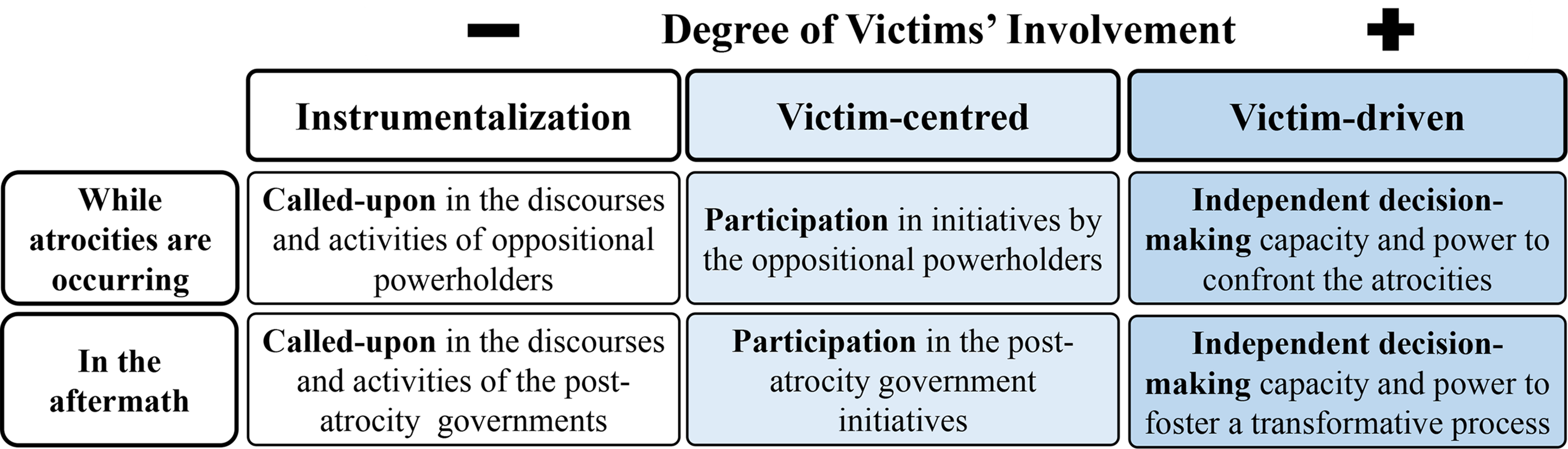
Degrees of victims’ involvement (continuum).
Brief conclusions
Following the urgent need to stop atrocity crimes, this article put together the existing literature on state crime criminology in connection with transitional justice, victimology and social movement literature from a southern lens to inquire about the social actors that can more effectively lead the resistance. After pointing out how this literature has systematically denounced the limitations of top–down mechanisms, the article built upon southern literature and the analysis of cases in the Global South to explore the potential role of civil society and, within it, of victims-survivors.
Notably, even though victim-centredness is today the state-of-the-art model, the article highlighted the limits of this model and proposes a paradigm shift that reveals how this model is indeed only a stepping-stone on the path to atrocity confrontation and sustainable justice. In this vein, the proposed victim-driven approach goes beyond the received wisdom about victim participation (in the state or international organization-run processes) and conceptualizes a higher level of involvement.
Focusing on the Argentinean case, this article exposed how the victim-driven approach understands that survivors have the right to be familiar with the possibilities of the process as well as be aware of the eventual challenges, thus embracing the agency to experience both positive and negative outcomes while still being able to make informed decisions. The victim-driven approach portrays victims with their organization, collective goals and a work plan independent from powerholders (independent of the government, NGOs and other international organizations). The victim-driven approach relies on overcoming personal grief through a bottom–up collective strategy. Moreover, this model refers to victims’ organizations’ ability to speak for themselves through their institutional channels (social media, newsletters), and the chance to express themselves before the media, broader society and the government and not necessarily through intermediaries such as lawyers. A victim-driven approach also necessitates that victims are not only heard and considered by powerholders but that they create and bring about their initiatives or push the government to implement them, even against the odds. This involves seeking national and international acknowledgement of human rights violations and taking advantage of existing legal and institutional structures as well as helping create them on both the domestic and the international levels (e.g. strategic litigation, legislative innovations, new international bodies).
Furthermore, the victim-driven approach might also be a feasible path to work towards the resolution of historical problems that perpetuate disempowerment and stigmatization such as ethnic confrontations, by conceiving victims as part of the same struggle for rights enforcement. The suggested approach might also encompass victims as moral role models and public figures in society, enhancing wider civil support and transgenerational legacies. Under the victim-driven approach, the voice of the victims is identified by civil society and by the international community, their symbols are widely recognized and the name of the organization does not require further introductions.
Overall, based on a southern lens, the article seeks to contribute to development of a victimology of state crime, by digging into the ‘who’ (actors) and the ‘how’ (dynamics and processes) within the organization and exercise of effective resistance. The hypothesis is that the degree of victim involvement might be related to effective resistance, and that victim-driven is the highest level of involvement, going beyond the standard model of participation, and opening the path to the much-needed transformative bottom–up social change against atrocities.
Footnotes
Acknowledgements
I thank the reviewers for their valuable comments that allowed me to strengthen the arguments and improve the structure of the article.
Funding
The author received no financial support for the research, authorship and/or publication of this article.
