




Abstract
The prevailing definitions of organized crime and methodological approaches to studying it derive mainly from the Global North. However, an emergent body of literature suggests that organized crime in the Global South differs from organized crime in the Global North. Focusing on the case of Mexico, I argue that mainstream criminological theories’ inability to explain significant aspects of organized crime in that country stems from their underspecified scope. Mainstream theories analyse organized crime as a phenomenon that transpires in societies characterized by high levels of internal peace, rule of law and strong public institutions. In Mexico, a country that fails to adhere to these conditions, organized crime manifestations defy prevailing theoretical assumptions.
Assessing the limits of mainstream organized crime theories
In 2018, while collecting data on organized crime violence in Mexico, I met Hector, a former officer in Mexico's now defunct Federal Police.
1
During our first exchange, he recalled that, early in his career, his superiors had assigned him to a special task force that was established to disrupt criminal organizations in certain communities. In Hector's estimation, the advantage of this unit was that it did not need to comply with la burocracia (the red tape). ‘We kicked down doors, arrested people, and seized guns, drugs, money. If we got a lead, we acted on it. We had support from judges who issued the required search warrants after the arrests’ (Int-3). Eventually, Hector's operations rattled the ‘wrong’ people. In an ensuing conversation, he recounted the calamitous end of his law-enforcement career (Int-3):
2
I was leaving the office, when a man claiming to represent a local criminal organization offered me a suitcase filled with dollars. He specified that, unless I wanted to die, I had no choice but to accept it. So, I did what I viewed as the best solution. I took the bag, distributed the cash amongst my teammates, and told them nothing would change. We would not collaborate with thugs. A few weeks later, my partner and I arrested the son of the local crime boss. Immediately after the arrest, our supervisor told us that our detainee's mother (the crime boss) wanted to meet with us to negotiate her son's release. He instructed us to go to the meeting place and arrest her. When we arrived, a group of armed men surrounded us, released our prisoner, and nos levantaron (kidnapped us). For three days, they kept us hostage, naked and blindfolded in a room where they tortured us. I thought they were going to kill us. However, on the third day, they informed us that we were under arrest, charged with leading a gang of kidnappers. I then realized that those who had captured us were police officers on the criminal organization's payroll. My boss had set my partner and me up after I refused to cooperate with it.
Hector's story is emblematic of how mainstream theories and research methods in criminology appear to be ill-equipped for interpreting the data I collected in Mexico. Prevailing theories of organized crime commonly depict law-enforcement institutions as entities that are, generally speaking, separated from and antagonistic towards criminal organizations (Abadinsky, 2012; Reuter, 1983; Von Lampe, 2015). Of course, researchers do recognize the existence of some degree of unlawful overlap between criminal organizations and police institutions in most societies (Lupsha, 1996). However, criminologists assume, as a rule, that law-enforcement agencies operate against criminal organizations (Paoli, 2002; Varese, 2010; Von Lampe, 2015). One methodological implication of this doxa is that law-enforcement narratives on organized crime are inherently biased, by virtue of the fact that police officers perceive criminal organizations solely from the ‘outside’ and because their antagonism towards them colours their opinions (Kenney, 2007).
However, the data I collected suggest that Mexico's criminal organizations and police agencies are so intertwined that it is impossible to distinguish them from each other. Unfortunately, mainstream criminological models provide scant indication of how to interpret information collected from such complex settings. In a country where police collusion with criminal organizations is the rule, should researchers construe police officers’ narratives as those of biased ‘outsiders’?
As my research progressed, I discerned other aspects of organized crime in Mexico that eluded criminological paradigms. For instance, some criminal organizations in Mexico have evolved into large, enduring entities with both formal hierarchies and a well-defined division of labour. While prominent scholars have long recognized both the existence and viability of criminal entities with such organizational characteristics, their conditions of emergence remain undertheorized. Generally speaking, organized crime scholars view such criminal entities as exceptions within a criminal universe consisting of largely poorly organized, small and fleeting enterprises (Reuter, 1983; Smith, 1975; Varese, 2010).
Similarly, researchers concur that criminal organizations differ from other violent non-state organizations by virtue of being non-ideological and primarily profit-driven (Abadinsky, 2012; Kalyvas, 2015; Varese, 2010). Nonetheless, evidence from Mexico suggests that political and ideological elements are pivotal to the country's criminal organizations. Finally, predominant narratives on organized crime violence in Mexico largely depict it as a ‘drug war’ (Duran Martinez, 2018; Grillo, 2012; Rios, 2015). However, there are substantial data indicating that organized crime violence in Mexico is more complex than a struggle over the allocation of drug-smuggling routes.
My contention is that mainstream criminological theories’ inability to explain key aspects of Mexican organized crime does not derive from the specificity of the Mexican case. Rather, these inadequacies stem from mainstream organized crime theories’ underspecified scope. Or, phrased otherwise, this inability to explain facets of organized crime in Mexico does not mean that Mexico is simply an outlier. Rather, it underscores that these models are developed primarily by western scholars in order to explain organized crime in their communities (Hosford et al., 2021), that is, societies characterized by ‘a high level of internal peace, within what is assumed to be a stable nation-state system’ (Carrington et al., 2016: 3).
In Mexico, a country that does not meet these scope conditions, organized crime manifestations sometimes defy mainstream theoretical predictions. Paradoxically, from a global standpoint, Mexico epitomizes the socio-political and economic destruction that organized crime—combined with deleterious anti-crime policies—can engender within a country. In this respect, organized crime in Mexico can thus be said to constitute a significant case for theories of organized crime.
More broadly, organized crime in the Global South (i.e. in the communities ‘that have been negatively impacted by contemporary capitalist globalization’) ranks among the world's most formidable obstacles to human security, democratic governance and economic development (Mahler, 2017: 1). From this standpoint, it is ill-advised to approach it as an outlier when it displays characteristics that diverge from prevailing manifestations of organized crime in the Global North, where most research on organized crime is produced (Hosford et al., 2021). My aim is not to reject traditional organized crime theories. Rather, I wish to make a case for their refinement and adaptation to different contexts. More specifically, I seek to contextualize Global North theories and, in so doing, contribute to an agenda for future studies of organized crime in the Global South that is less uncritically accepting of the Global North literature.
My views of organized crime in Mexico stem primarily from the data I collected between 2018 and 2021. I draw on conversations with 56 Mexican officials (police officers, military personnel, intelligence agents, prosecutors and security advisers) involved in anti-organized crime initiatives, journalists and scholars of organized crime (see Appendix A). I supplement these narratives with governmental reports, academic and journalistic publications on organized crime in Mexico. I assess these data vis-a-vis mainstream organized crime theories to explain why they are ill-equipped for elucidating Mexico's organized crime manifestations.
The main body of this article considers Mexico in light of the Global North literature. The conclusion returns to the discussion of representativeness as well as the broader applicability of the findings. This analytical exercise required synthetizing a large and heterogeneous body of literature. Based on this, I was cognizant about not presuming that my analysis seamlessly encapsulates all organized crime theories from both the Global North and South. Rather, my assessments merely reflect my interpretation of academic debates on this topic. Other researchers may thus produce different, equally valuable assessments via their respective readings of organized crime literature.
This evaluation is relevant to criminologists for three reasons. First, it shows that organized crime researchers in Mexico must begin by reassessing the generalizability of organized crime theories. Undoubtedly, some influential organized crime theories developed in the Global North are expedient for explaining organized crime in Mexico. However, uncritically importing theories devised to explain organized crime in the USA or Western Europe to the Mexican context is detrimental to scientific knowledge's advancement. At best, the uncritical application of prevailing theories neglects relevant aspects of organized crime in Mexico, and, at worst, reinforces misconceptions about the phenomenon.
Second, Mexico's case may contribute to refining theories of organized crime. In Mexico, aspects of organized crime that prominent theories either disregard or misinterpret are more noticeable than elsewhere. However, their higher visibility in Mexico does not mean that they are non-existent or extraneous elsewhere. For example, while ideologico-political factors may play a more conspicuous role in shaping criminal organizations’ behaviour in Mexico than in the USA, this does not mean that such factors are irrelevant to organized crime studies in US communities. Rather, it is to say that they may play a relevant—albeit less perceptible—role, which researchers can easily overlook.
Finally, this article contributes to ongoing debates on the relevance of southern criminology. In recent decades, social scientists have discussed the need to decolonize scientific knowledge. A growing number of scholars contend that criminology can only progress by democratizing knowledge creation (Carrington et al., 2016; Moosavi, 2019). They encourage an end to the misconception that theories developed in the Global North are more robust, objective and generalizable than theories developed elsewhere. Concurrently, they call for an appreciation of historically marginalized communities’ cultural, political and socio-economic specificities as well as a greater recognition of the scientific knowledge emerging from these communities (Agozino, 2010).
Conversely, some scholars worry that construing the Global South's realities and ideas as fundamentally other to those of the Global North may contribute to their exoticization (Scott et al., 2018). I contend that examining aspects of organized crime in Mexico that criminological theories from the Global North cannot explain may contribute to these theories’ refinement. I will also demonstrate that numerous organized crime theories from the Global North are vital for developing robust explanations of organized crime in Mexico and elsewhere in the Global South.
The following sections examine four aspects of organized crime theories in the Global North that can be refined to produce more robust explanations of organized crime in Mexico. The first section examines theories that explain organized crime groups’ organizational features. The second section analyses debates on the role of ideological and political grievances in explaining criminal organizations’ behaviour. The third section discusses the characterization of Mexico's organized crime violence as a ‘drug war’. The fourth section assesses the suitability of mainstream research methods for investigating organized crime in Mexico. The concluding observations provide suggestions as to how the Mexican case can help improve future research on organized crime.
How large, enduring, formally organized criminal organizations emerge
A prominent idea in organized crime studies is that illegality engenders significant operational constraints on criminal organizations, which serve to prevent them from evolving into large, enduring, formal organizations (Albini, 1971; Anderson, 1979; Reuter, 1983). That is to say, illegality forces most criminal organizations to remain small, ephemeral and poorly organized. However, there is evidence to suggest that—both in Mexico and elsewhere—some criminal organizations grow into sizeable, long-lasting, formally organized bodies (Correa, 2017; Paoli, 2008). How have researchers explained the emergence of these types of criminal entities?
The notion that illegality forces most criminal organizations to remain small, fleeting and rudimentary began as a critical reaction to the ideas put forward by the sociologist Donald Cressey (1969) in Theft of the Nation: The Structure and Operations of Organized Crime in America. Cressey argued that a confederation of criminal organizations, known as La Cosa Nostra, coordinated the operations of crime syndicates across the USA. Cressey claimed that each syndicate maintained a ‘hierarchical structure of different levels of authority and a division of labour between specialized tasks’ (Von Lampe, 2015: 40).
While criminologists consider Cressey to be the precursor of organized crime studies, his thesis has received so much criticism that he has also been dubbed the ‘main foe’ of organized crime scholars (Varese, 2010: 40). Cressey's critics pointed out that criminal organizations are rarely able to attain the sophistication he described because illegality forces them to operate ‘without and against the state’ (Paoli, 2002: 64). In other words, unlike lawful entities, criminal organizations cannot rely on state-based mechanisms (i.e. laws, courts and law-enforcement institutions) to safeguard property and civil rights. Similarly, criminal organizations cannot expect lawmakers to establish and enforce rules to regulate competition. Moreover, criminal organizations must continually grapple with the state's efforts to eradicate them.
In theory, this dual (i.e. without and against) hindrance produces operational barriers that prevent criminal organizations from consolidating, diversifying and expanding their operational capabilities. Operating without the state generates trust, cooperation and coordination problems that generate manifold difficulties for criminal organizations, namely ‘problems of asymmetric information, imperfect monitoring and opportunistic behaviour’ (Varese, 2010: 41). Moreover, without the state's support, criminal organizations must ‘fend for themselves’, that is, protect their interests, by hiding from unscrupulous competitors and purchasing private protection (Gambetta, 1993). Alongside this, operating against the state forces criminal organizations to devote significant resources to concealing their activities from public authorities.
The notion that illegality significantly fetters most criminal organizations’ development remains relevant in criminological debates, and, in fact, has informed some researchers’ views on organized crime in Mexico. For instance, Zavala (2018) argues that autonomous, enduring, structurally complex criminal organizations do not dominate Mexico's underworld. From his standpoint, Mexican political elites have historically overemphasized criminal organizations’ size and organizational capabilities to justify prohibitionist policies. Similarly, Astorga (2005) posits that even the best organized criminal entities in Mexico are more akin to loose webs of independent entrepreneurs as opposed to well-established hierarchies.
However, scholars, journalists, government officials and criminals have provided compelling evidence that some criminal organizations in Mexico and elsewhere are formal, enduring and formally structured associations comprising several thousand full-time employees. A stark demonstration of this organizational sophistication occurred in Mexico on 17 October 2019, when approximately 800 heavily armed, well-coordinated individuals besieged Culiacán (a city with one million residents) to prevent one person's arrest (Linthicum and Sanchez, 2019).
Similarly, one of the police officers I interviewed (Int-32) described how: [The criminal organization known as] Los Zetas operated like a bureaucracy. I was once assigned to spy on one of the group's cells. Every other week the man in charge of the group's human resources showed up at the same spot. Dozens of men and women formed a queue. The guy took out a list, called those in the line one by one, and paid their quincenas (fortnightly wages).
In light of this evidence, scholars have revised their prior assumptions about the consequences of illegality for criminals’ capacity to organize. Some researchers now treat the premise that criminal organizations operate against the state as a continuum (Gootenberg, 2008; Paoli et al., 2009; Reuter and Trautmann, 2009). At one end of this spectrum, de jure prohibition fails to influence the state's commitment and ability to combat criminal organizations (Farer, 1999). At the other, it produces effective governmental policies that drastically undermine criminal organizations’ ability to function (Varese, 2018).
In Mexico, some segments of the country's law-enforcement apparatus do indeed attempt to thwart criminal organizations. However, the human and financial resources at their disposal are often significantly lower than those of their counterparts in high-income countries. Simultaneously, the human and economic resources that some criminal organizations can amass are more substantial than those of their counterparts in countries with more effective law-enforcement institutions. Moreover, the capacity of criminal organizations in Mexico to corrupt and intimidate public officials stifles the effectiveness of anti-organized crime initiatives (Kenny et al., 2012). These factors engender a context in which operating against the state does not significantly hinder criminal organizations’ organizational capabilities.
Recent studies also demonstrate that the relationship between illegality and criminal organizations’ need to operate ‘without the state’ fluctuates (Reuter and Paoli, 2020; Sergi and Lavorgna, 2016). At one end, certain countries engage in nationwide ‘state-sponsored protection rackets’, that is, informal institutions through which the state actively safeguards criminal organizations in exchange for a share of their profits (Snyder and Duran Martinez, 2009). In these spaces, criminal organizations benefit from many of the same state safeguards that legal organizations enjoy. At the other end, state institutions take effective measures that systematically block criminal organizations’ access to public goods and services (Varese, 2018). In Mexico, although nationwide collusion between criminal organizations and state institutions does not exist, criminals regularly purchase provisional assistance from governmental officials to grant them access to public goods and services (Serrano, 2022).
Despite these important revisions to earlier theoretical premises, the reasons why some criminal organizations evolve into large, resilient, formally structured entities while others remain small, ephemeral and poorly organized remain undertheorized. Evidence suggests that analysing the gaps between de jure and de facto illegality is critical for explaining these variations. While these rifts often appear more pronounced in the Global South compared with the Global North, the causal pathways that promote the development of different forms of criminal structures often remain unclear.
For instance, law-enforcement action appears crucial for thwarting the development of formally organized criminal structures. However, some police initiatives, such as militarized crackdowns on organized crime, can promote the emergence of, paramilitary criminal organizations (Calderon et al., 2015). Similarly, although access to public goods and services appears to be conducive to the development of resilient, formally organized criminal groups, different criminal organizations that operate within the same space (and grapple with the same governmental institutions) often display markedly divergent organizational facets (Cockayne, 2016). Moreover, some criminal organizations are capable of evolving into lasting, sophisticated entities without necessarily relying on corrupt state guarantors (Reuter and Paoli, 2020). Consequently, future studies can contribute to theory development by unearthing how patterns in the relationships between illegality and criminal groups’ organizational characteristics vary both across and within socio-political contexts in the Global North and Global South.
The role of ideology in organized crime
Some leading political scientists object to comparing insurgent groups with criminal organizations (Gutiérrez, 2004; Kalyvas, 2015). Similarly, some prominent criminologists eschew drawing analogies between criminal organizations and other types of violent-non state organizations (Abadinsky, 2012; Van Duyne, 1996). In their estimation, conflating criminal organizations with politically or ideologically driven movements muddies the waters of conceptual clarity. For instance, Stathis Kalyvas (2015), an influential civil war scholar, repeatedly critiques researchers who claim that criminal organizations and insurgent groups sometimes converge into nearly identical entities (Makarenko, 2004). However, admirable attempts to preserve analytical constructs from conceptual overstretching occasionally reveal the limitations of Global North theories. In Mexico and elsewhere in the Global South, scholarly debates have sometimes overlooked the significance of ideologico-political elements in ensuring the viability of specific criminal organizations. Mainstream organized crime studies would benefit from a more flexible perspective that recognizes how genuine ideological motivations can influence the behaviour of criminal organizations and their members. Such a perspective need not necessarily view criminal and ideological motivations as converging phenomena (i.e. as becoming the same), but rather would entail acknowledging that both kinds of motivations can entwine and influence one another. Below, I suggest how researchers can engage with this challenge.
According to Schedler (2013), some of Mexico's criminal organizations increasingly resemble insurgent groups. The reasons for this are three-fold. First, some Mexican criminal organizations employ thousands of ‘professionals of violence’ (i.e. former soldiers or police officers) in militias equipped with modern military equipment. Second, Mexican criminal organizations routinely use these paramilitary units against both the Mexican government and military personnel to advance their interests. Third, since 2006, criminal organizations in Mexico have killed more than 150,000 individuals, which makes them deadlier than most contemporary insurgent groups (Beittel, 2019). Based upon this, Schedler (2013) argues that Mexico is undergoing a form of civil war.
Kalyvas (2015: 1520) rebutted this characterization, arguing that it is wrong to compare criminal organizations in Mexico to insurgent groups on the grounds that: They lack an ideological profile and an explicit political agenda. They do not seek to take over the government. [In fact, they do not even] attempt to disguise their profit-oriented motivations behind a political discourse. Those accustomed to seeing political conflict and revolution in a positive light […] abhor the use of [the term insurgent] to describe psychotic, cold-blooded killers motivated by profit alone.
Debates on organized crime in Mexico would surely benefit if researchers could agree that the country is not experiencing a civil war, while, simultaneously, acknowledging that political grievances and ideological elements do play a pivotal role in Mexican organized crime. Recognizing these factors’ relevance is essential for examining the following questions: what causes individuals to join and remain in criminal organizations? Why are some Mexican criminal organizations so effective at recruiting members? Why do some criminal organizations in Mexico appear to enjoy strong popular support?
For instance, political scientists have shown that people ordinarily do not join insurgencies for ideological reasons, but rather out of personal concerns, such as, for example, fear or revenge (Linebaugh and Rediker, 2013). Similarly, analysts of organized crime in Mexico have noted that ‘greed’ (i.e. the quest for financial profit) is not always the determining factor for joining criminal organizations. Rather, motives like social pressure, fear of victimization or the search for empowerment often occupy a central role in the narratives of those who join criminal organizations. In some Mexican communities, those who refuse to collaborate with criminal organizations quite literally risk their lives as well as those of their relatives (Garcia, 2017). Consequently, depicting all members of criminal organizations as profit-driven, unhinged individuals is unjustified.
Moreover, criminal organizations in Mexico and elsewhere often justify their actions via discourses that contain significant political and ideological elements. One recent example of this is the organization known as La Familia Michoacana. Between 2006 and 2013, this group vindicated its violence through a unique discourse that blended evangelical, left-wing, populist and regionalist elements (Grayson, 2010a; Lemus, 2015). It is reasonable to infer that La Familia Michoacana's discourse did not emerge randomly and that the group would not have cultivated it if it had deemed it irrelevant.
While some analysts regarded La Familia Michoacana's reproduction of ideological discourses as little more than a ‘marketing’ strategy (Canales, 2013), residents in the communities where the group emerged often supported its actions and described them in terms that evoked Hobsbawm's (2000) social bandits (see Finnegan, 2010). Understanding La Familia Michoacana's usage of political and ideological ideas is therefore vital for explaining why the organization thrived in the rural, marginalized indigenous communities of Western Mexico, whereas other criminal organizations foundered. Similarly, studying La Familia Michoacana's usage of ideological discourses may explain, in part, both how it developed its social capital and which anti-crime initiatives might have worked better in communities where the group enjoyed widespread popular support.
Scholars have contributed towards understanding how criminal entrepreneurs draw upon political-ideological narratives to both bolster the social basis of their support (Farer, 1999; Gootenberg, 2008) and influence governmental policies (Cockayne, 2016). These researchers are also cognizant that such narratives often represent more than a simple means through which to attain criminal ends. In some instances, genuine ideological motivations intertwine with criminal interests to shape the behaviour of criminal organizations (Pansters, 2018). Undoubtedly, future debates on organized crime would benefit from systematically considering these complex realities. As Ruggiero (2015) notes, criminological debates have much to gain from embracing a more thorough approach to the interrelations between crime, ideology and power.
Finally, ideology and profit need not be mutually exclusive. Indeed, the ruthless pursuit of financial wealth can, in itself, be ideologically motivated. As Andreas (1999: 125) stated, ‘in a highly competitive global marketplace dominated by multinational corporations from the industrialized world, criminal organisations stand out as […] the quintessential expression of the kind of private-sector entrepreneurialism celebrated by neoliberal economic orthodoxy’.
Although Mexico's criminal organizations lack a neoliberal agenda, Mexico's economic liberalization and the government's aggressive promotion of neoliberal policies and values may have influenced organized criminals’ worldviews. For instance, Garcia Reyes (2018) shows that former members of criminal organizations draw upon neoliberal discourses to explain their involvement in these groups. Future studies may analyse the extent to which Mexico's promotion of neoliberalism contributed to societal strain and deviant adaptations, such as, for example, enrolment in criminal organizations.
Organized crime violence in Mexico as a ‘drug war’
The predominant characterization of organized crime violence in Mexico as a drug war derives, in part, from a Global North viewpoint. Undoubtedly, Mexico's organized crime violence is intimately related to the illegal drug trade. However, its causes and mechanisms are significantly more complex and diverse than the drug epithet suggests. Essentializing Mexico's organized crime violence solely as a drug issue imposes a reductionist analytical prism that restricts scholars’ ability to explain the phenomenon. Fortunately, ever-more studies are problematizing this perspective.
First, it is essential to reiterate that illegal drugs and organized crime violence are closely intertwined in Mexico. Historians of Mexico's organized crime concur that the country's prohibitionist policies, which date back to the early 20th century, significantly contributed to the highly profitable illegal drugs industry (Enciso, 2015; Smith and Pansters, 2018; Valdes, 2013). Most importantly, researchers concur that the enormous demand for illicit drugs in the USA and Europe has fuelled the global narcotics market. A reduction in the global demand for illegal drugs would almost certainly decrease the magnitude of organized crime violence in Mexico and elsewhere.
That said, the illegality of narcotics in itself is an insufficient (and sometimes an unnecessary) explanation for organized crime violence in Mexico. It is more instructive to view illicit drug trade as akin to a compounding variable that exacerbates causal processes that would most likely unfold—albeit with less devastating outcomes—in its absence. Nonetheless, dominant representations of organized crime in Mexico often depict drug illegality as the raison d’etre for organized crime violence, to the point where the prefix ‘narco’ has become inseparable from debates on the subject.
There are manifold reasons why the drug war designation is so pervasive. First, Mexican elites have a long tradition of blaming the USA for Mexico's social, political and economic woes. The USA is certainly not blameless in this regard. Researchers have demonstrated the deleterious effects of its drug, gun and foreign policies on organized crime violence in Latin America (Enciso, 2015; Ezquivel, 2013; Perez Ricart, 2018; Perez Esparza et al., 2020). However, Mexican officials who wish to divert attention from their own failures to address the endemic corruption, social and economic inequality have also promoted the view that US and European drug demand is the underlying cause of criminal violence in Mexico (Grayson, 2010b).
Second, Global North scholars are more likely to secure employment, research funding and publicity if they present their research as relevant for tackling salient problems in their communities. Since illicit drugs constitute the most visible and harmful aspect of Mexican organized crime in the USA and Europe, researchers in these regions are incentivized to focus on it.
Finally, as they did with the term ‘cartel’, Mexico's gangsters have embraced the narco epithet and now proudly trace their lineage back to the country's earliest drug smugglers (Astorga, 1995; Osorno, 2020). Criminal organizations’ emphasis on the drug-related aspects of their operations is not a simple matter of optics. Being a ‘narco’ in Mexico—as opposed to being a kidnapper or extortionist—has historically carried more positive connotations. A narco is not an ‘evil’ criminal, but rather a noble, brave and ingenious peasant who overcomes poverty by flouting the rules of an oppressive system imposed by the gringos (Astorga, 1995). Criminal organizations divert attention from their not-so-honourable activities by perpetuating this myth.
In short, the drug war terminology is deeply entrenched in depictions of Mexico's organized crime. However, viewing organized crime violence in Mexico exclusively through the drug prism reduces a multifaceted phenomenon to only one of its (admittedly relevant) dimensions. Moreover, fixating on the drug dimension of Mexico's organized crime violence leads analysts to overlook other significant factors. For instance, in my discussions with a former official in Mexico's intelligence agency (Int-27), he noted: For Los Zetas, participation in illicit drug markets gradually became supplementary to territorial control. By controlling land and its residents, Los Zetas aimed to reap profits by imposing taxes or taking over all sorts of legal and illegal enterprises. Violence by Los Zetas was more than violence over drugs and their distribution. Its purpose was to establish and enforce the group's illegal order in the territories it controlled.
At the macro-level, researchers have increasingly focused on the relationship between organized crime and the Mexican state. Political scientists readily recognize that Mexico's transition to a democracy in the 21st century brought about the collapse of informal institutions through which the Mexican government regulated criminal enterprises (Snyder and Duran Martinez, 2009). More recent studies have focused on the relationships between organized crime and the state in post-authoritarian Mexico. For instance, Bailey (2014) analyses how organized crime impacts upon Mexico's democratic institutions, while Trejo and Ley (2020) examine organized crime violence against politicians. Recently, other scholars have examined Mexico's organized crime violence through recourse to a state-making approach. Pansters (2018: 315) argues that non-state entities in Mexico have historically ‘exercised de facto sovereignty and governance, creating zones of limited statehood governed by coalitions of state and non-state actors driven by criminal and political interests’.
At the meso-level, researchers have recently shifted their focus onto the impact of specific policies on organized crime violence and the types of control that different criminal organizations exert in the territories in which they operate. Scholars have studied the impact of gun policies (Perez Esparza et al., 2020), military crackdowns (Espinosa and Rubin, 2015) and kingpin strategies (Calderon et al., 2015) on violence levels. Other researchers have analysed how criminal organizations use violence to force changes in governmental policy (Lessing, 2015) and impose their extra-legal order (Blattman et al., 2021; Chinchilla, 2018). Studies on governance by Mexico's criminal organizations take recourse to earlier Global North literature on illegal governance (Gambetta, 1993; Paoli, 2008; Skarbek, 2011) to demonstrate that Mexican criminal organizations are complex entities that pursue multifaceted objectives.
Finally, recent micro-level analyses have endeavoured to unearth the underlying individual and organizational causal mechanisms for Mexico's organized crime violence. For instance, Garcia Reyes (2018) shows that criminals’ views towards poverty and masculinity are integral to understanding their violence. More recently, Pereda (2021) analysed how organizational processes shape criminal organizations’ everyday violence.
In summary, the drug war concept is often inadequate for explaining organized crime violence in Mexico, and scholars who employ it uncritically risk essentializing a multifaceted phenomenon. Fortunately, as scholarly knowledge on organized crime in Mexico expands, its intricacies have become increasingly acknowledged.
Research designs for studies on organized crime in Mexico
Defining organized crime concepts, operationalizing them, collecting and analysing data entails significant methodological challenges, which vary depending on the context. In Mexico, researchers face methodological problems that often differ from those that scholars in the Global North typically encounter. Paradoxically, despite these differences, leading scholars continue to judge the methodological robustness of studies on Mexico's organized crime through a Global North prism, which is problematic for reasons I examine below.
The main challenge in studying organized crime is the phenomenon's inscrutability. There is hitherto no consensus on the defining characteristics of organized crime or criminal organizations. This scholarly discord has led researchers like Von Lampe (2015: 14) to (ironically) conclude that ‘organised crime is what people so label’. One implication of this definitional ambiguity is that researchers disagree over which criteria should be employed to operationalize organized crime.
Even if social scientists agreed upon what precisely constitutes organized crime and how best to operationalize it, they would often be unable to collect extensive and reliable data that adhere to such criteria, owing to organized crime's inherent secretiveness. Criminal organizations constantly conceal evidence of their existence and operations. They avoid producing hard data (e.g. ledgers), and even when they do, they usually hide or destroy them. Moreover, criminal organizations rarely allow scholars to scrutinize their inner workings. Indeed, even those who have managed to study criminal organizations ‘from within’ have rarely observed how they plan and execute illegal activities (see Ianni and Reuss-Ianni, 1972).
Researchers have partially surmounted these methodological challenges. Some scholars have relied on witness depositions to explain criminal organizations’ actions (Catino, 2015; Paoli, 2008). Others have drawn from indictments, verdicts and criminal investigation dossiers (Gambetta, 1993; Sergi and Lavorgna, 2016). Some studies have used transcripts of wiretapped conversations between criminals (Campana and Varese, 2013). Finally, some researchers have relied on participant observation to obtain insider knowledge of criminal organizations (Ianni and Reuss-Ianni, 1972).
While these methodological approaches have enabled scholars to gain invaluable knowledge of organized crime, those who have utilized them have readily acknowledged their limitations. Studies based on official data are likely to introduce biases by describing people and events from a law-enforcement perspective (Kenney, 2007). Testimonies of criminals who turned state's evidence may also be biased, insofar as informants are incentivized to omit, downplay or exaggerate facts. Finally, ethnographies and interviews with criminals require access to these individuals and, as such, are rife with ethical dilemmas (Contreras, 2019). Overall, scholars widely concur that organized crime is an elusive field that forces them to ‘piece together coherent scientific narratives by analysing sketchy empirical records’ (Kenney, 2007: 18).
One of the principal challenges associated with researching organized crime in Mexico and elsewhere in the Global South is that these aforementioned methodological challenges are often more pronounced than in the Global North. For example, official data on organized crime in Mexico are typically scant and fragmentary. I requested copies of verdicts in various criminal cases when conducting my field research, but the Mexican courts systematically rejected my requests. I appealed their decisions, and ultimately Mexico's Institute for Transparency and Access to Information (the country's authority in freedom of information matters) ruled in my favour. However, the transcripts I received were redacted to the point of being incomprehensible.
Similarly, while Mexico's law-enforcement, intelligence and military institutions collect extensive data on the country's criminal organizations, they ordinarily designate them as classified and rebuff researchers’ efforts to examine them. Moreover, owing to Mexican detectives’ tendency to fabricate evidence as well as torture and intimidate suspects, the reliability of criminal investigation dossiers is low compared with similar documents in places where these practices are rare (see Aquino et al., 2019). Finally, in a context characterized by pervasive organized crime (and state) violence, interviews with individuals involved in organized crime pose significant risks for both researchers and respondents. For researchers, venturing into territories where criminal organizations wield a quasi-monopoly over violence poses a threat to their safety. Moreover, spaces that researchers in the Global North would generally view as reasonably safe, such as prisons, are not necessarily so in Mexico.
Aside from the risks to their (and their relatives’) safety that researchers must navigate, collecting data on organized crime in Mexico can also jeopardize the participants. At the very least, interviewees may risk penalties (e.g. losing their jobs) for talking to outsiders about a sensitive subject. Some of the police officers I interviewed expressed concern about the potential consequences of their participation. In turn, individuals who are privy to organized crime secrets may endanger researchers by sharing these secrets.
Recognizing that research on organized crime in Mexico is methodologically challenging does not require lowering scholarly standards. Rather, it calls for greater methodological ingenuity. One way of doing so is to employ data collection methods that are tailored to Mexico's socio-political reality. For example, religious institutions in Mexico play a significant role in assisting members of criminal organizations who wish to renounce crime. Some scholars have relied on intermediaries like religious institutions and non-government organizations (NGOs) to secure safe access to street-level criminals (Garcia Reyes, 2018).
Another way of overcoming the challenges associated with researching organized crime in Mexico is to revise traditional operationalizations of key concepts. Researchers must recognize that criminal organizations are not self-contained groups, but rather are nebulous entities that can span across organizations and socio-economic milieus. Criminal organizations in Mexico are not confined to rural settings or marginalized urban neighbourhoods. Indeed, one of the most harmful aspects of criminal organizations in Mexico is their profound intertwinement with mainstream society and their capacity to infiltrate legitimate industries and public institutions. Consequently, researchers may find informants with valuable ‘insider’ knowledge of criminal organizations’ workings outside of settings typically associated with criminal activity.
My conversations with Mexican police officers corroborated that the relationship between law-enforcement agents and organized crime is different in Mexico than in most high-income countries. First, endemic corruption in Mexico has engendered a context in which entire police agencies operate as branches of criminal organizations (Jaramillo, 2019). According to one senior law-enforcement officer I interviewed, at least half of Mexico's police forces provide services to criminal organizations (Int-46).
Undoubtedly, not all police officers collaborate with criminal organizations; however, even those who do not routinely interact with those who do. One Federal Police officer I interviewed noted, ‘I know some of my colleagues were taking the jobs [criminal organizations offered], but there is not much I could do about it’ (Int-30). Frequently, lower-ranking officers receive orders to do their corrupt superiors’ bidding and will take the fall if caught.
Concurrently, disaffected police and military personnel who join criminal organizations as full-time employees have exacerbated this convergence between police and organized crime (Ernst, 2018). As a former official in Mexico's secret intelligence agency stated: ‘Criminal organizations’ recruits often think, talk, and behave as soldiers or police officers because they used to be soldiers or police officers’ (Int-27). Continual exchanges between Mexico's criminal organizations and law-enforcement institutions have contributed to an amalgamation of both these milieus. This entanglement accords Mexican police officers a privileged position from which to understand the country's organized crime phenomenon. This position does not result from their investigative work, but rather stems from their experience of working in an environment that is intertwined with criminal organizations.
Conclusion
I have argued that both mainstream assumptions about organized crime's characteristics and the prevailing methodological approaches for studying it are sometimes inadequate for researching organized crime in Mexico. These inadequacies stem from the Global North prism that has traditionally informed mainstream organized crime studies. I also recommended specific revisions to mainstream theories and research methodologies based on my own research of organized crime in Mexico. Table 1 summarizes the proposed reassessments to extant scholarly approaches that I examined in each section.
Proposed revisions to organized crime theories.
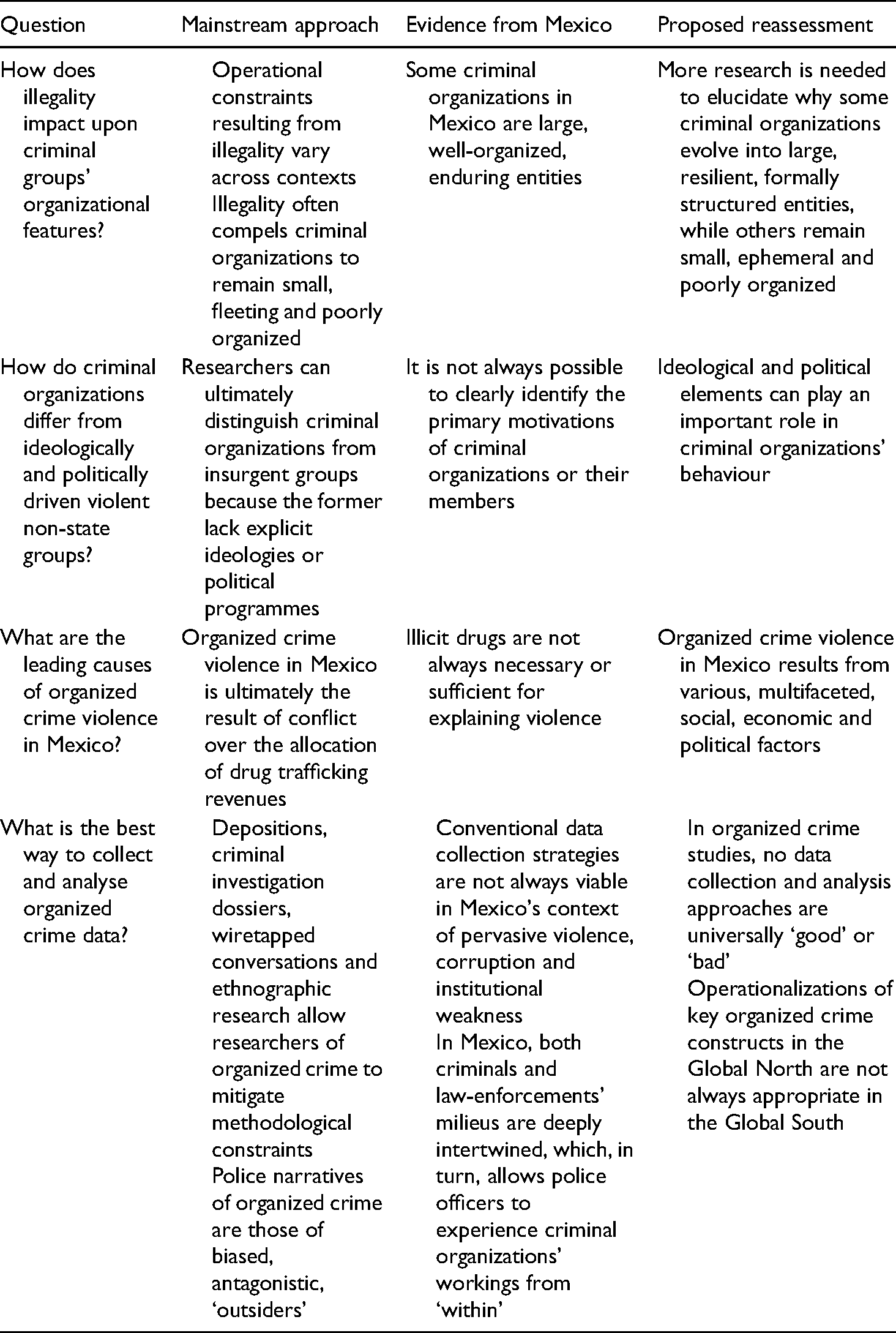
First, I suggested that more comparative research is needed to explain the relationship between illegality and the emergence of large, enduring, formally structured criminal organizations. Second, I proposed a more flexible approach to examining the role of ideology in shaping the behaviour of criminal organizations. Third, I argued that adopting a more critical stance to the conceptualization of Mexico's organized crime violence as a drug war would generate more fruitful academic debates on the subject. Finally, I posited that studying organized crime in Mexico requires a partial re-evaluation of conventional methodological approaches to researching organized crime.
What is the broader applicability of my claims? While I focused exclusively on my experience of researching organized crime in Mexico, my suggestions are also relevant beyond the Mexican context. Undeniably, organized crime in Mexico has distinctive facets that distinguish it from organized crime elsewhere. Indeed, even within the Global South, the level of criminal violence in Mexico is exceptionally high. Moreover, Mexico's criminal organizations appear to be wealthier and better equipped than their counterparts in most other countries.
However, organized crime in Mexico also shares relevant features with organized crime elsewhere, especially in the Global South and Global South ‘enclaves’ within the North. In this respect, my suggestions are sufficiently broad to apply to a wide range of socio-political and economic contexts. In other words, the veracity of my claims extends beyond places that closely resemble Mexico.
For instance, fine-grained analyses of the relationship between illegality and criminal organizations’ structural characteristics are essential for explaining the emergence of large, well-organized entities in the Global South, such as Brazil's Primeiro Comando da Capital (Nunes Dias and Darke, 2016), and some groups in the Global North, such as the Yamaguchi-Gumi in post-occupation Japan (Kaplan and Dubro, 2012).
Similarly, my claim that it is sometimes impossible to explain criminal organizations’ behaviour without due consideration of their ideological facets applies to some criminal organizations in both the Global South and Global North. Outside of Mexico, political and ideological elements influence the behaviour of criminal organizations like the Albanian Mafia (Makarenko, 2004) or the Aryan Brotherhood (Sanders, 2019).
Avoiding oversimplified interpretations of organized crime phenomena is also essential irrespective of the context. Global North scholars often mislabel organized crime violence in Mexico as a ‘drug war’. However, this oversimplification of complex phenomena is not exclusive to Mexico. For instance, in the 21st century, Global North researchers often mislabelled violence by the Revolutionary Armed Forces of Colombia as a clash over control of cocaine production, while disregarding its political dimensions (Gutiérrez, 2004).
Finally, organized crime scholarship would benefit from developing a more flexible approach to what constitutes a robust research design. Methodological approaches for studying organized crime are not universally good or bad. Rather, the robustness of a research design should also be appraised on the basis of how well it adapts to the context under examination. For instance, in his studies of organized crime in Europe, Von Lampe (2015) demonstrated that vital information about the workings of the underworld can often be found in the social microcosm of organized crime, that is, amid those who are not directly involved in unlawful activities.
In summary, organized crime studies would benefit from both reassessing the limited scope of Global North paradigms and challenging certain theoretical assumptions and methodological approaches that are ill-suited for elucidating organized crime phenomena.