




Abstract
Most of the previous studies on vigilante violence suggest that people employ vigilante violence instrumentally to compensate for a lack of state monopoly on violence and the state's illegitimacy in controlling crime. This study, however, highlights the significance of emotions—most notably anger—in explaining approval of vigilante violence. A cross-sectional study was conducted at six Pakistani universities with a sample of 500 students recruited through online surveys. The results of the regression models show that police legitimacy and trait anger independently predict approval of vigilante violence both directly and indirectly via righteous anger. Thus, the findings suggest that people who are easily angered and who perceive the police as corrupt and procedurally unjust feel righteous anger and are likely to approve of vigilante violence.
Introduction
In recent decades, scholars have been investigating vigilante violence, defined as “taking the law into one's own hands” (Rosenbaum and Sederberg, 1974: 542). Vigilante violence might begin with slapping and punching and escalate to more intense extralegal punishment of the offender (Adinkrah, 2005; Bateson, 2021). A predominant research tradition relates acts of vigilante violence to the weakness, absence or illegitimacy of the state or police in the eyes of the public (Haas et al., 2012; Jackson et al., 2013; Nivette, 2016; Tankebe, 2009). According to this approach, when people perceive the state/police as illegitimate or lacking the capacity to control crime, they create an alternate, self-help response to exert social control (Black, 1983; Senechal de la Roche, 1996). However, another theoretical approach posits anger itself as a factor in explaining support for vigilante violence (Asif and Weenink, 2022; Silke, 2001). Empirical evidence supporting this hypothesis is limited (García-Ponce et al., 2019). Anger has been largely ignored as an explanatory factor, particularly in relation to approval of vigilante violence. Therefore, this study seeks to extend the research on approval of vigilante violence by considering how such approval (namely, of the beating and/or lynching of alleged offenders) relates to anger. Anger is categorized into trait anger (a general disposition of experiencing anger) and righteous anger (a moral anger that stems from violation of core moral values), which will be illustrated further below. This study examines three relationships. First, this article examines the effect of police legitimacy on the approval of vigilante violence. Second, it examines whether righteous anger mediates the effect of police legitimacy on the approval of vigilante violence. Third, it examines whether righteous anger mediates the effect of trait anger on the approval of vigilante violence.
The study was conducted at six public-sector Pakistani universities. The rationale for choosing Pakistani university students was as follows. Tankebe and Asif’s (2016) findings from three neighborhoods in Lahore suggested widespread support for vigilante violence in Pakistan. According to their work, approximately 71% of the sampled heads of household believed that taking the law into one's own hands to punish a perceived offender is appropriate if the public perceives the police as unable to control crime, and 60% of those sampled would not condemn the killing of violent robbers by the public. By engaging in vigilante violence, people choose to forgo the use of formal legal procedures for dispute resolution. In democratic societies, these procedures are founded on the principle of the rule of law—the idea that suspects are innocent until proven otherwise by a lawfully constituted authority. Support for vigilante violence is therefore an important indicator of people's commitment to due process, the rule of law and human rights. University students are prospective elites. Some will go on to occupy key positions in society. Furthermore, their attitudes toward vigilante violence can offer insight into their current commitment to the rule of law. Moreover, vigilante acts sometimes involve university students. For example, on 13 April 2017, a group of students at Abdul Wali Khan University Mardan lynched a fellow student on campus after accusing him of posting blasphemous (derogatory remarks about religion) content on social media. There is, therefore, merit in focusing on this particular group. Thus, online surveys were administered to a total of 500 respondents. This study contributes to the existing literature on approval of vigilante violence by exploring whether police legitimacy and trait anger independently and directly predict approval of vigilante violence or whether their effects are mediated by righteous anger. The following section further elaborates on the historical and sociolegal context of vigilante violence in Pakistan.
Vigilante violence in Pakistan: A contextual overview
Vigilante violence is not specific to Pakistan; present or past acts of vigilante violence can be identified across most countries (Adinkrah, 2005; Baker, 2002; Brundage, 1993; Senechal de la Roche, 2001; Smith, 2004). Now, three main factors are presented that ostensibly contribute to public approval of vigilante violence in Pakistan; namely, the historical construction of society, religious competition and outpourings of anger, and weak police legitimacy.
Violence as a legacy of armed struggle against the state for independence
After the subcontinent was occupied in 1858, the British introduced new administrative laws to control the masses and maintain dominance and hegemony over the colonized state (Imam, 2011; Kumar and Verma, 2009). Several times, the people of the subcontinent collectively attempted to revolt against the occupation (e.g. in the Moplah rebellion and the Jallianwala Bagh massacre), but the state violently crushed their movements (Kumar and Verma, 2009: 76). On these occasions, police forces controlled civil movements and showed their loyalty to the British (Arnold, 2017). These incidents suggest that the interests of the state and the masses were opposed and that the two entities were unlikely to rely on or trust each other. The people presumably felt hatred and anger toward the state. Later, an organized independence struggle was launched by indigenous political parties demanding freedom from the British Raj. During this struggle, the state's monopoly on violence and its legitimacy were repeatedly challenged. The struggle continued until the end of the British occupation and independence of Pakistan and India in 1947. As a result, a culture of vigilante violence plausibly became embedded in the Pakistani social system, with norms of collective violence continuing to haunt society at large as a legacy of the experience of armed struggle (Steenkamp, 2005, 2011). These historical developments suggest that citizens may have increased the likelihood of supporting vigilante violence as a type of self-help instead of relying on law enforcement institutions to resolve interpersonal disputes and conflicts.
Religious competition and outpourings of anger
Before the partition, the subcontinent was home to a mixture of several communities. After some religio-ethnic riots, the British initially introduced laws related to religious affairs; for example, Laws 295 (Defilement of places of worship), 296 (Disturbance of a religious assembly) and 298 (Utterances to offend religious feeling), in 1860 to keep the peace and maintain a tight hold on the masses (Center for Research and Security Studies, 2014: 9). Then, in 1927, Law 295A was notably promulgated by the British government in the wake of two well-known incidents that greatly impacted modern Pakistani society, namely, the publication of derogatory remarks about the Prophet of Islam in the second edition of the book Rangeela Rasool and in a periodical titled “Risala-e-Vartman”, offending the Muslim community. Consequently, Ilm Din, a young Muslim man, killed the publisher—Mahashay Rajpal—on 6 April 1929. Din was honored as a ghazi (holy warrior) among Muslims for restoring the honor of the Prophet by sacrificing his own life, while Rajpal was revered as a shaheed among Hindus (Center for Research and Security Studies, 2014: 17–19). This outcome demonstrates how vigilantes can be celebrated as heroes or defenders.
After the partition of India, a Muslim-majority state came into being, and the menace of religioethnic riots ostensibly disappeared. However, the use of violence as a means of resolving religious disputes was not entirely eliminated. Following the Ilm Din case, later incidents occurred that imitated his actions in contemporary Pakistan. First, on 4 January 2011, Mumtaz Qadri killed the governor of Punjab Province, Salman Taseer, based on allegations that he had uttered blasphemous remarks. Second, on 29 July 2020, a young man named Khalid Khan killed an alleged offender named Tahir Naseem (a US citizen) in a courtroom during a trial in which Naseem was accused of making blasphemous remarks. These incidents suggest that vigilante violence continues to be inflicted on perceived offenders, whether Muslim or non-Muslim, as an emotional reaction to (perceived) crimes. According to the Center for Research and Security Studies (2014) and Hashim (2020), since 1990, approximately 52–77 alleged blasphemers have been killed by angry vigilantes. This indicates that people may be emotionally attached to religion and that whenever they construe encroachment on their religious values, they vent their anger by punishing the alleged offenders themselves.
Police legitimacy in Pakistan
Pakistan inherited its current policing system from its former British rulers. After independence, not only were the British rulers replaced by an elitist bureaucracy, but the large gap between the general population and police continued (Imam, 2011). Thus, today's Pakistani police are unable to serve and protect the rights of common citizens (Abbas, 2009; Imam, 2011). As a consequence, people fear and avoid police because they do not expect fair outcomes in dealing with them (Bashir, 2011; Perito and Parvez, 2014). Sometimes, people even avoid reporting crimes to police (Hussain, 2010). Several attempts have been made to reform the police structure, but none of the constituted committees succeeded in their task (Imam, 2011; Naz et al., 2014; Suddle, 2002) until the Police Act of 2002, which replaced the Colonial Police Act of 1861 (Abbas, 2009). Two of the most striking issues that police face to this day are pervasive corruption and perceptions of weak legitimacy (Jackson et al., 2014; Malik and Qureshi, 2021). According to a recent study (Jackson et al., 2014), 86% of respondents believed that police are ineffective at controlling violent crimes, 65% had either bribed or promised to bribe a police officer to overlook unlawful behavior, and 78% had witnessed somebody bribing or promising to bribe a police officer to overlook unlawful behavior. Pakistan ranks 124th out of 180 countries (with 1 indicating the least corrupt and 180 the most corrupt) on the Corruption Perceptions Index (Transparency International, 2021). Indeed, the police are one of the most corrupt institutions in Pakistan (Gallup Pakistan, 2011; Transparency International, 2013). Tankebe and Asif (2016) conducted a survey in Lahore in which approximately 75% of the respondents stated that handing over a suspected criminal to police is pointless because police will not bring the offender to justice. Thus, these factors explained above make Pakistan a suitable context for studying public approval of vigilante violence.
Vigilante violence and approaches to studying approval of vigilante violence
Vigilante violence has been defined in prior studies as an organized and premeditated act of violence (Abrahams, 2003; Johnston, 1996; Senechal de la Roche, 1996). Some researchers have argued that it could also be a spontaneous action (Adinkrah, 2005; Asif and Weenink, 2022). It is usually considered a reaction to a perceived/actual act of crime or offense of encroachment on a societal norm (Bateson, 2021; Johnston, 1996). Many relate such behavior to weak, absent or ineffective state performance (Haas et al., 2012; Nivette, 2016; Tankebe, 2009); under such conditions, vigilante violence serves as a form of self-help (Black, 1983; Tankebe, 2009). It can be enacted by either a group of people (Abrahams, 2003; Baker, 2002) or a single vigilante (Johnston, 1996). Vigilantes can be private or ordinary citizens (Johnston, 1996), political actors (Rosenbaum and Sederberg, 1974), off-duty state actors (Huggins, 1991), or on-duty police officers who hand over suspects to active vigilantes and watch the subsequent violence as bystanders (Brundage, 1993; Wright, 1996). The goal of vigilante violence is usually social control (Black, 1983; Senechal de la Roche, 1996), regime or crime control (Rosenbaum and Sederberg, 1974), the enforcement of social norms (Baker, 2002; Kloos, 2014), the preservation of social stability (Sederberg, 1978) or the maintenance of “law and order on behalf of … communities, often by resorting to violence” (Abrahams, 2003: 26). Vigilante violence is not exclusively related to any particular society but is a global phenomenon (Pratten and Sen, 2007). This section summarizes various forms, dimensions and motivating factors of vigilante violence as well as its ultimate goals. Two distinct research methodologies, namely, quantitative and qualitative historical have been employed to explain public support for vigilante violence. The quantitative studies explain why people support vigilante violence, while the qualitative historical studies mainly concentrate on the action patterns during actual lynching incidents that occurred in the South of the United States (Brundage, 1993, 1997; Patterson, 1999; Young, 2005). The studies show that lynchings of black victims were enacted as public ritualistic spectacles by white mobs based on accusations of having raped or physically assaulted white victims (Hill, 2010; Wood, 2018). The present study mainly focuses on factors to explain attitudes of why people approve of vigilante violence. Therefore, this study will elaborate on following two approaches instead.
The first is police legitimacy, which is a predominant factor in studies of vigilante violence (Jackson et al., 2013; Nivette, 2016; Tankebe, 2009). In one influential work, Tyler (1990) operationalized legitimacy as people's general sense of obligation to obey the law and support legal authorities (i.e. police and courts). Applying Tyler's conceptualization of legitimacy in a study based in London, Jackson et al. (2013) identified a correlation between police legitimacy and the use of private violence. They found that people who lacked a sense of moral obligation to obey police were willing to use violence to settle disputes. However, Bottoms and Tankebe (2012) contested the operationalization of the construct in their earlier work, disputing the use of the Tylerian components (felt obligation and support for authorities) of legitimacy as outcome variables rather than as constitutive elements of legitimacy. They built their argument upon Beetham’s (1991) conceptualization of legitimacy to offer an alternate conceptualization of police legitimacy. According to these authors, legitimacy is an ongoing dialog between those who hold power and their audience; furthermore, legitimacy is a multidimensional concept that encompasses lawfulness, procedural fairness and effectiveness. The first element of their model is police lawfulness, which relates to whether people believe that police officers are working under the rule of law or breaching legal boundaries. The second element is procedural fairness, which is related to the extent to which people think that police behave respectfully and fairly toward citizens and that people receive fair outcomes in their dealings with police. The third and last element is police effectiveness, which relates to whether the public believes that police are effective in reducing neighborhood crimes. Some studies have empirically supported this multidimensional approach to police legitimacy (Tankebe, 2013; Tankebe et al., 2016). The current study is also interested in this conceptualization of police legitimacy because of its multidimensionality and broad operationalization.
Many prior studies on vigilante violence have suggested that perceptions of police (il)legitimacy or the underperformance of any of its components predict public support for vigilante violence (see Adzimah-Alade et al., 2020; Haas et al., 2014; Nivette, 2016; Tankebe, 2009; Tankebe and Asif, 2016). This relationship implies that when people perceive the police as illegitimate or underperforming in constitutive components of legitimacy such as lawfulness (corruption), effectiveness or fairness, they may support vigilante violence against an alleged offender. In addition, some studies in procedural justice have suggested a mediating role of anger between the perception of procedural injustice and subsequent noncompliant behavior (see Barkworth and Murphy, 2015; Murphy and Tyler, 2008). This implies that when people generally feel angry following treatment by police or government officials, it may affect their compliance behavior. Applying these findings to vigilante violence, this article proposes that people who perceive the police as illegitimate will feel righteous anger (described below) and will subsequently approve of vigilante violence. Following the above literature review, the current study will draw two hypotheses regarding whether perceptions of police legitimacy or any of its three components have a direct effect on approval of vigilante violence or are mediated by righteous anger. Thus, the following hypotheses are posited:
H1: Perceptions of police (il)legitimacy have a direct effect on approval of vigilante violence. H2: Righteous anger mediates the effects of perceptions of police (il)legitimacy on approval of vigilante violence.
A second theoretical explanation for vigilante violence is anger. Silke (2001) argued that anger is the most common emotional reaction to crimes and leads to support for vigilante violence. Recently, Asif and Weenink (2022) theorized an explicit link between righteous anger and vigilante violence. They argue that righteous anger is an emotional reaction that stems from the violation of moral imperatives. Moral imperatives are operationalized as core values that constitute the social identity of a group. These authors posited that when group members see any encroachment on their moral imperatives, they feel righteous anger, which they then transform into vigilante violence to restore the integrity of their moral imperatives. There is empirical evidence that anger supports vigilante violence. García-Ponce et al. (2019) conducted three observational and experimental studies in Mexico and found that anger was an emotional reaction to violence and exacerbates the likelihood of support for vigilante violence regardless of the state's ability to respond to such crimes. In addition to this work on vigilante violence, Agnew's general strain theory of crime and delinquency also proposes that when individuals are blocked from achieving important goals and/or are presented with negatively valued stimuli or a loss of positively valued stimuli, they feel anger, which is likely to result in crime when they lack adequate coping mechanisms (Agnew, 1992). In other words, this theory suggests that when people feel unfairly stressed (i.e. by violating their moral imperatives through acts such as blasphemy, child abuse, rape, murder or theft), this might elicit feelings of anger, which is conducive to crime. However, this theory does not suggest that the anger induced by various forms of strain automatically leads to violence. Moreover, some empirical evidence shows that anger drives support for retaliatory punitive retribution. Johnson's (2009) findings from the USA have revealed that people who are angry about crimes are more likely to espouse punitive attitudes. Likewise, many other empirical studies also suggest anger as a significant predictor of the desire for punitive retribution (see, for example, Carlsmith et al., 2002; Darley et al., 2000; Tyler and Boeckmann, 1997). These studies indicate that anger is conceptually relevant for approval of vigilante violence. However, they have explored social psychological insights to explicitly determine whether anger acts as a mediator or a moderator.
Psychologist Spielberger (1988) identifies two types of anger: trait anger and state anger. Trait anger is a general disposition of experiencing anger that does not vary across situations; rather, it remains a stable personality characteristic. State anger, on the other hand, refers to a momentary state of feeling angry that might vary across situations. This state–trait theory of anger has been empirically tested, and it has been validated that people with high trait anger feel more frequent and intense state anger (see Deffenbacher et al., 1996; Quinn et al., 2014). This also implies that trait anger is a moderator, while state anger is a mediator. Building on this psychological contribution, the current study explores whether both types of anger are relevant in explaining public approval of vigilante violence. However, there is a distinction made between trait anger and righteous anger. The vigilante rituals theory (explained above) delineates righteous anger, which is deemed akin to state anger. The reason for the inclusion of righteous anger instead of state anger is conceptual. For instance, first, righteous anger is a group feeling that is collectively shared among group members, while state anger is a momentary state of feelings for an individual. Second, righteous anger is felt to be morally justified and supported by the group members whose moral imperatives have been encroached upon. State anger is the feeling only of an individual and may not have similar support from a moral community. The current study is about public support for vigilante violence as a collective action against an alleged offender. This makes righteous anger a more appropriate focus. It is conceptualized as mediating the relationship between trait anger and approval of vigilante violence. Thus, the following hypothesis is presented: H3: Righteous anger mediates the effects of trait anger on approval of vigilante violence.
The entire discussion is summarized in Figure 1.
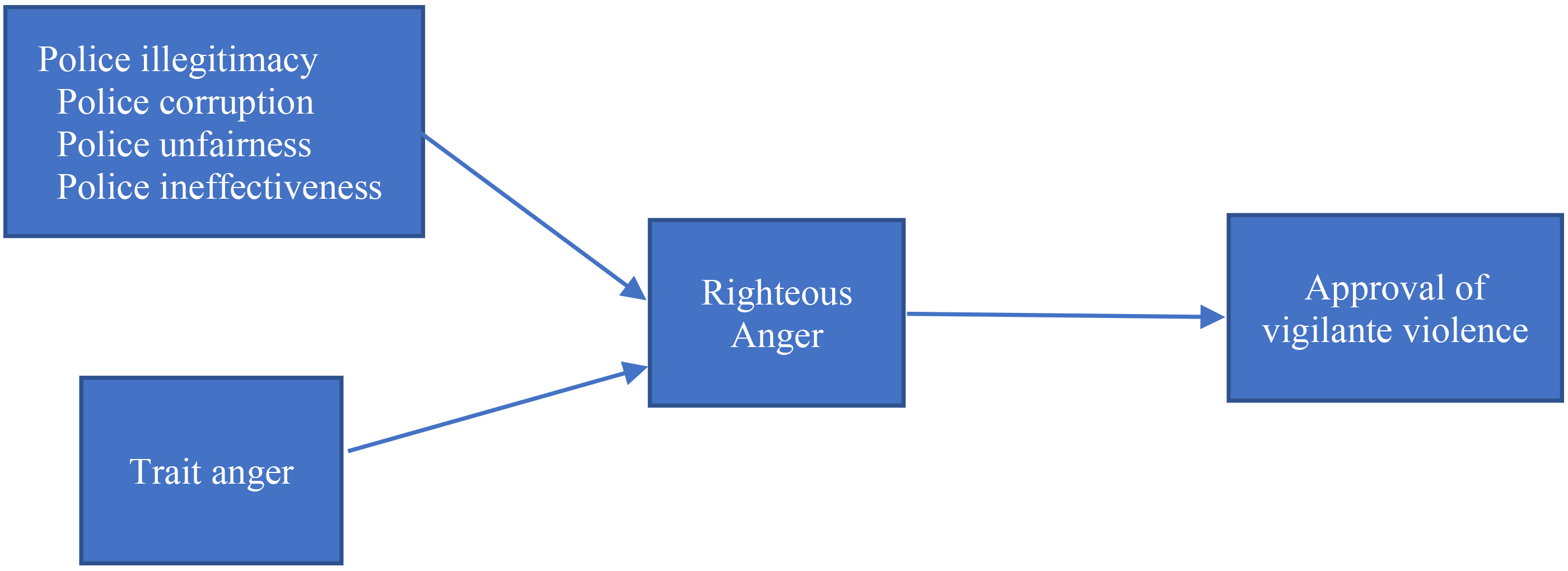
Mediation role of righteous anger. Source: Adapted from Asif and Weenink (2022).
Method
Data and participants
This survey was administered at six public-sector universities in Pakistan. Two universities each were selected from three clusters: Punjab, Khabar Pakhtunkhwa and Islamabad (the capital of Pakistan). All these clusters are mainstream and major public-sector universities that attract diverse student populations from various social strata, communities and ethnicities. Because of COVID-19 and the related lockdown in Pakistan, the original strategy of physical survey distribution was changed, and an online survey form was created. The universities’ administrations were contacted for permission to administer the surveys. After the study objectives were shared with students enrolled at the included universities, an e-link to the survey questionnaire was shared with them, along with an informed consent form, via their email accounts, WhatsApp groups and Facebook groups; it was ensured that no student completed the survey more than once. Initially, the survey targeted 200 respondents from each of the three clusters, for an expected total of 600 responses. However, because of the lockdown, students remained at home, and the researchers subsequently realized that in some areas, students had internet access problems. Therefore, the study ultimately relied upon the total number of responses obtained instead of the targeted 200 responses from each cluster. Finally, a total sample size of 500 was recorded. Later, to determine whether the sample was sufficiently large, a post hoc power analysis was performed with G*Power software based on the values
Results of the principal component analysis on the scaled items.
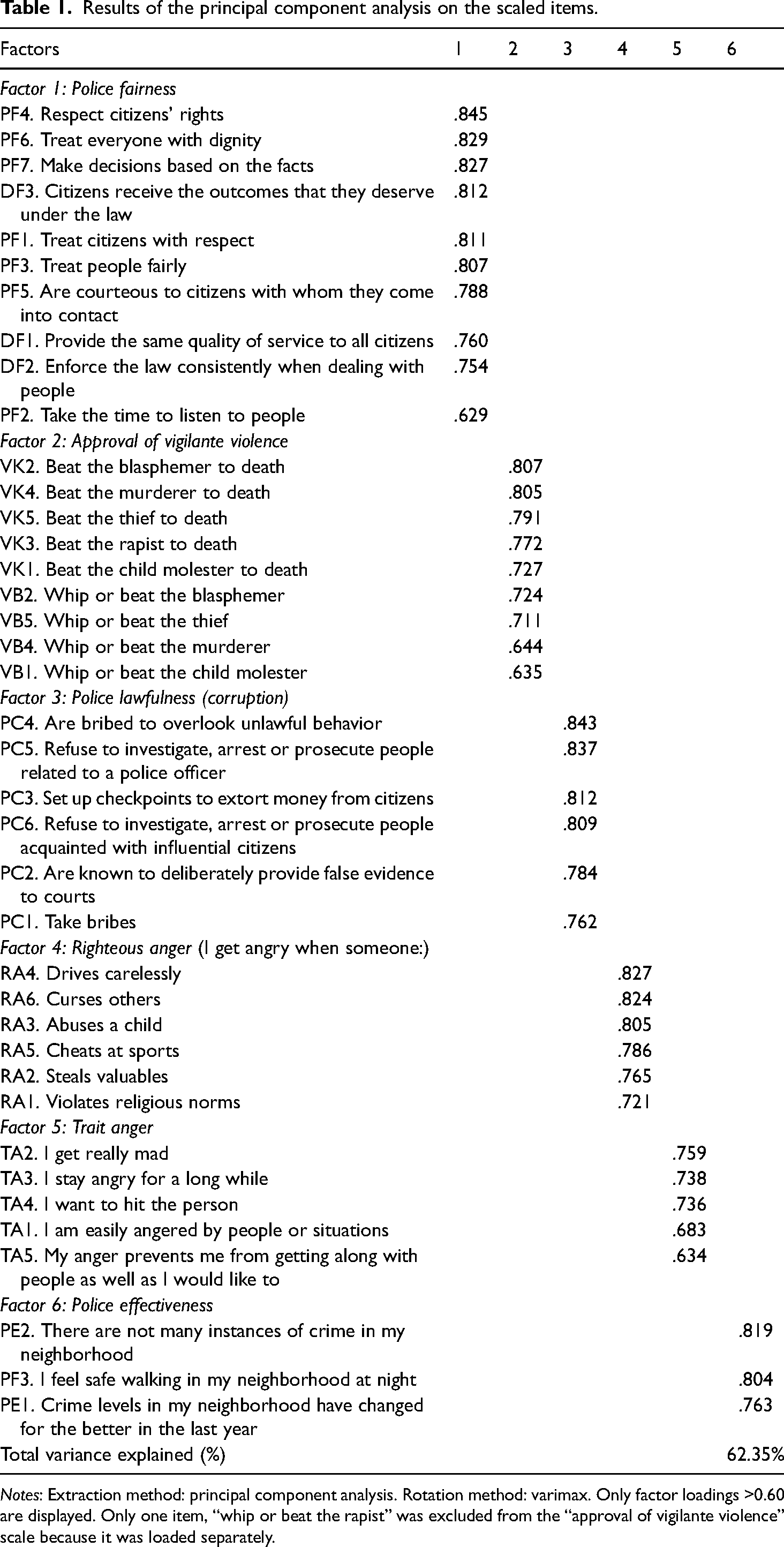
Notes: Extraction method: principal component analysis. Rotation method: varimax. Only factor loadings >0.60 are displayed. Only one item, “whip or beat the rapist” was excluded from the “approval of vigilante violence” scale because it was loaded separately.
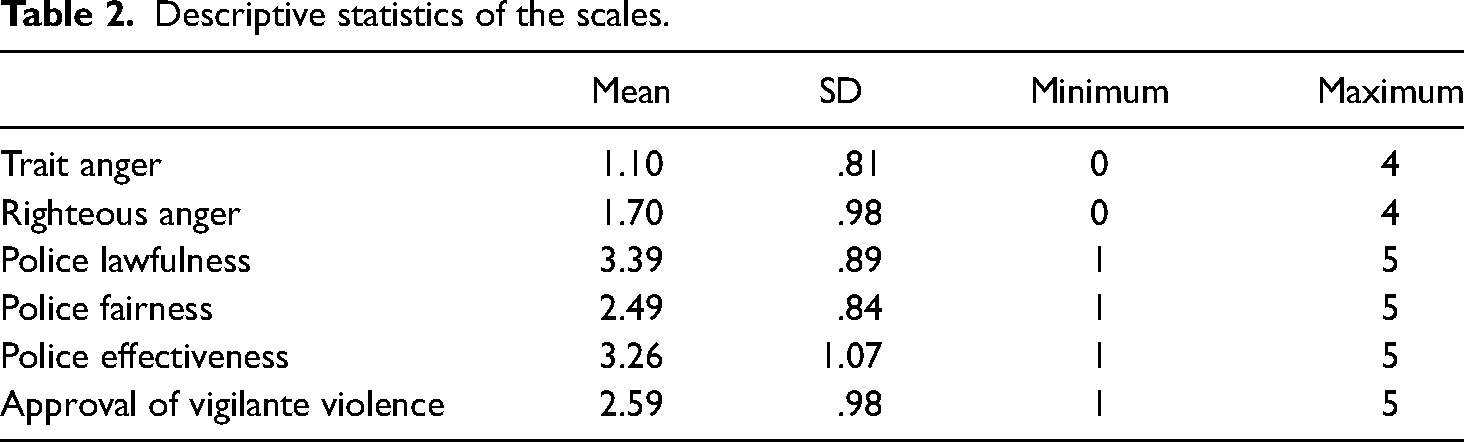
Descriptive statistics of the scales.
The sample was 44.8% male and 55.2% female; 70.2% of respondents were aged 18–23 years, and 29.8% were aged 24 or above. Regarding educational attainment, 61% were undergraduate students, and 39% were postgraduate students. In regard to residential areas, 41% lived in rural or smaller towns, and 59% were from cities. Finally, 69% reported a Punjabi ethnic background, while 31% reported a Pashtun ethnic background.
Measures
Principal component analysis was conducted to construct scales. The result of the Kaiser–Meyer–Olkin measure of sample adequacy was 0.883, and Bartlett's test of sphericity was also found to be statistically significant, with X2(780) = 12,208, p < .001. This means that the data were sufficient in scope for dimension reduction. The results of the principal component analysis are displayed in Table 1.
Dependent variable
The main dependent variable in this study was approval of vigilante violence. This variable was initially split into two forms of punishment: vigilante beating and vigilante lynching. However, the principal component analysis merged items from both subscales and measured them as a combined scale of approval of vigilante violence. This scale was measured in relation to five criminal offenses: rape, child abuse, theft, blasphemy and murder. These offenses are all categorized as crimes that are illegal and punishable by law in Pakistan (Mahmood, 2020). This choice of crimes was based on research showing that vigilante violence has most often been publicly condoned across cultures in response to these five criminal offenses (see Adinkrah, 2005; Adzimah-Alade et al., 2020; Brundage, 1993; Senechal de la Roche, 1996, 2001). According to Hill (2010: 36), approximately 50% of all allegations that led to lynching in the USA were related to rape and murder. Adzimah-Alade et al. (2020) analyzed 172 media reports from 2000–2018 in Ghana and found that theft and robbery were the main reasons (117/172) for which offenders were attacked and lynched by vigilantes. Likewise, the Center for Research and Security Studies (2014) and Hashim (2020) have reported that since 1990, approximately 52–77 people have been killed extrajudicially in Pakistan by vigilantes owing to reports of the offenders making blasphemous statements. Thus, the researcher created vignette scenarios regarding such offenses (for precedents on the use of situation-based vignettes regarding such offenses, see Haas et al., 2012, 2014; Nivette, 2016). The statement in each vignette was repeated five times separately for each offender. For example, the vignette targeting approval of vigilante beatings was written as follows: “Suppose that a group of neighbors caught an offender committing a crime. To what extent would you approve or disapprove if they beat the person?” Similarly, the sample vignette targeting approval of vigilante lynching was as follows: “Suppose that a group of neighbors caught an offender committing a crime. To what extent would you approve or disapprove if they lynched the person?” The response items are displayed in Table 1. Both subscales were measured using a five-point Likert scale ranging from 1 (strongly disapprove) to 5 (strongly approve). A higher combined score of these scales indicated higher approval of vigilante violence (Cronbach's α = 0.90).
Independent variables
Police fairness
The scale items were adapted from Sunshine and Tyler (2003) and Tankebe et al. (2016). This scale was also measured in two distinct subscales: procedural fairness and distributive fairness. However, similar to the previous scale, the principal component analysis merged items from both subscales and measured them as a combined scale of police fairness. The items of the scale are given in Table 1 and were measured using a five-point Likert scale ranging from 1 (strongly disagree) to 5 (strongly agree). A higher score on this scale indicated a higher perceived level of police fairness (Cronbach's α = 0.93).
Police lawfulness
Police lawfulness was measured in terms of police corruption, and the scale items were drawn from Akinlabi and Murphy (2018) and Tankebe (2010). The items are given in Table 1 and were measured using a five-point Likert scale ranging from 1 (strongly disagree) to 5 (strongly agree). A higher score on this scale indicated a higher level of perceived police unlawfulness (Cronbach's α = 0.90).
Police effectiveness
Police effectiveness 1 was measured in terms of feelings of neighborhood safety and crime control. This is consistent with extant studies both of police legitimacy, public confidence in the police and of vigilantism (Tankebe, 2009; Tankebe and Asif, 2016). The items were drawn from Sunshine and Tyler (2003) and are given in Table 1. They were measured using a five-point Likert scale ranging from 1 (strongly disagree) to 5 (strongly agree). A higher score on this scale indicated a greater level of perceived police effectiveness (Cronbach's α = 0.83).
Trait anger
This scale was adapted from Hawthorne et al. (2006). The scale items are given in Table 1 and were measured using a five-point Likert scale ranging from 0 (not at all) to 4 (very much). A higher score on this scale indicated a higher level of trait anger (Cronbach's α = 0.78).
Righteous anger
The researcher constructed this scale. The items are given in Table 1 and were measured using a five-point Likert scale ranging from 0 (not at all) to 4 (very much). A higher score on this scale indicated a higher level of righteous anger (Cronbach's α = 0.89).
Findings (importance of anger)
The first key objective of the study was to examine whether police legitimacy affects approval of vigilante violence directly or whether it is mediated by righteous anger. Second, the effect of trait anger on approval of vigilante violence is mediated by righteous anger. In the following, a bivariate correlation matrix is presented to assess potential multicollinearity and then display the results of hierarchal regression models showing how righteous anger mediates a relationship between the constructs.
Bivariate correlation matrix
Table 3, from top to bottom, shows that first, trait anger and righteous anger correlate with each other (r = 0.36, p < 0.01) and with approval of vigilante violence (r = 0.21, p < 0.001, and r = 0.20, p < 0.001, respectively). This means that people who have anger as a personality trait are likely to feel higher righteous anger and are more inclined toward approval of vigilante violence than those lacking this trait. Likewise, people who experience righteous anger upon seeing their moral imperatives violated are also likely to approve of vigilante violence. Second, righteous anger and police lawfulness correlate with each other (r = 0.15, p < 0.001), and like righteous anger, perceived police lawfulness explains individuals’ approval of vigilante violence (r = 0.19, p < 0.001). That is, participants who believe that the police are corrupt and unlawful are likely to feel righteous anger and approve of vigilante violence. Third, police lawfulness and police fairness both correlate with police effectiveness (r = 0.32, p < 0.001 and r = 0.36, p < 0.001, respectively), while police effectiveness correlates with approval of vigilante violence (r = 0.10, p < 0.05). That means participants who perceive the police as lawful and procedurally just and fair believe that the police are effective in controlling neighborhood crimes; such participants therefore disapprove of vigilante violence. In conclusion, trait anger, righteous anger and police lawfulness are relatively stronger predictors of approval of vigilante violence than other factors are. However, none of the correlations among the predictors themselves (police lawfulness, police fairness, police effectiveness, trait anger and righteous anger) or between the predictors and dependent variable (approval of vigilante violence) are multicollinear. All the correlation values are below 0.8, and all the variance inflation factor (VIF) values are below 10 (for threshold values, see Field, 2013). Notably, trait anger and righteous anger correlate with each other, but trait anger does not correlate with any components of police legitimacy. However, righteous anger does correlate with police lawfulness. This indicates that righteous anger might mediate a relationship among trait anger and police lawfulness and approval of vigilante violence. In the following, this relationship is examined more explicitly.
Correlation matrix for the study variables.
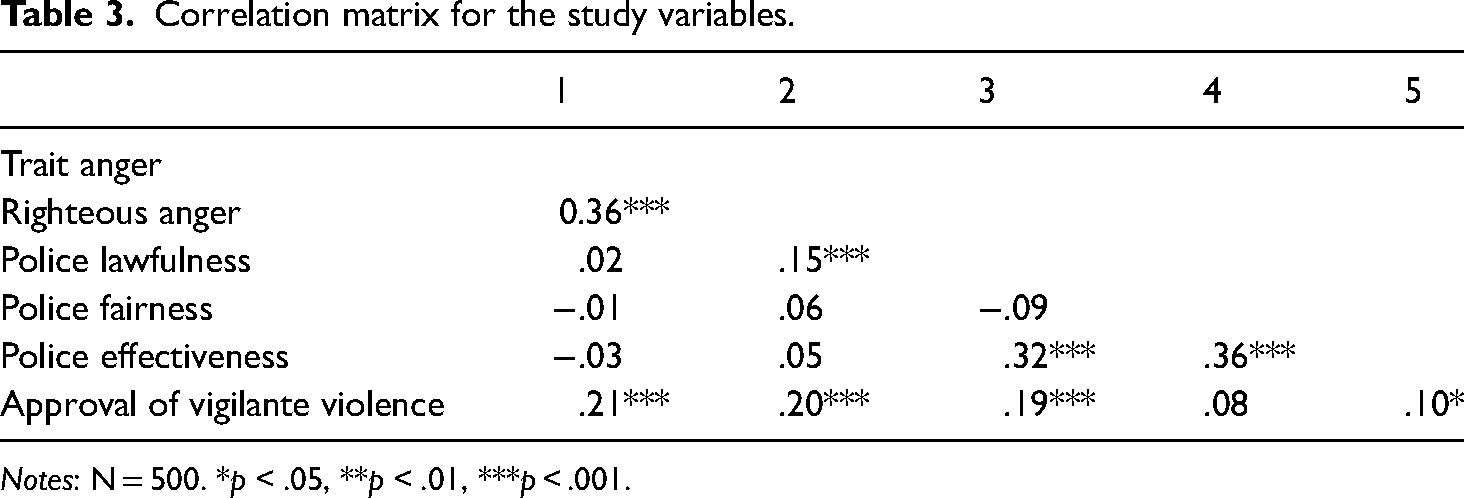
Notes: N = 500. *p < .05, **p < .01, ***p < .001.
Hierarchical regression analysis
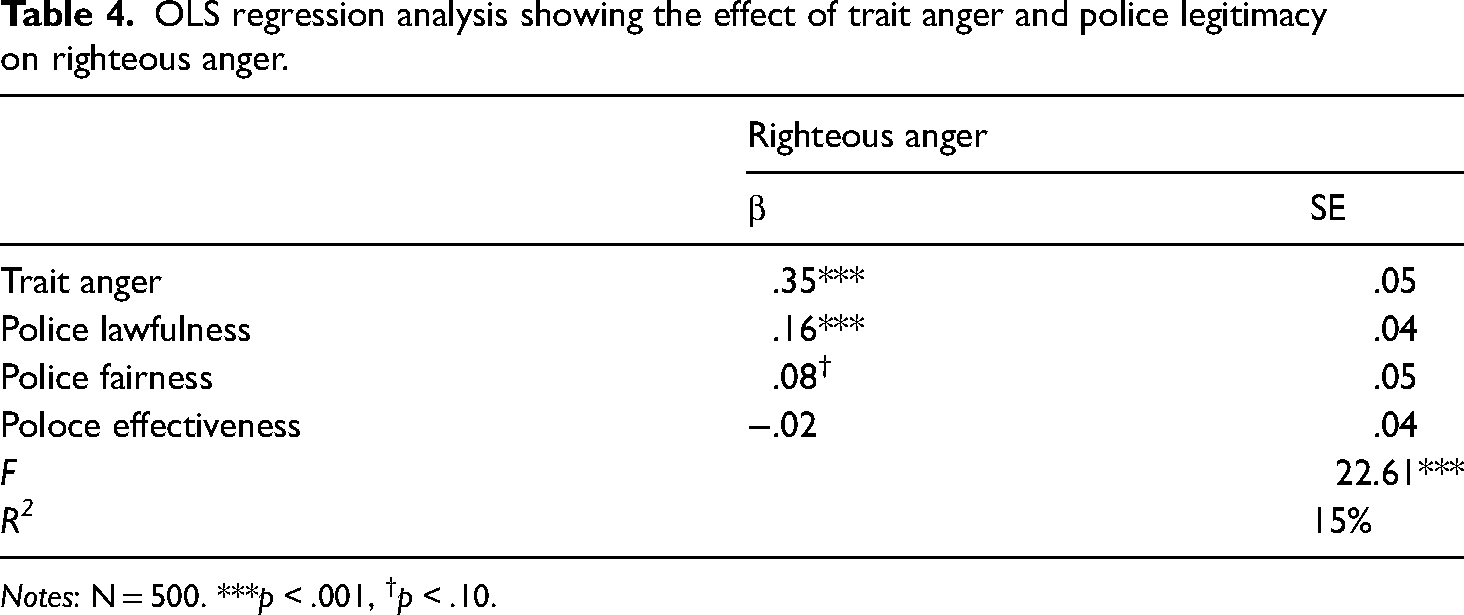
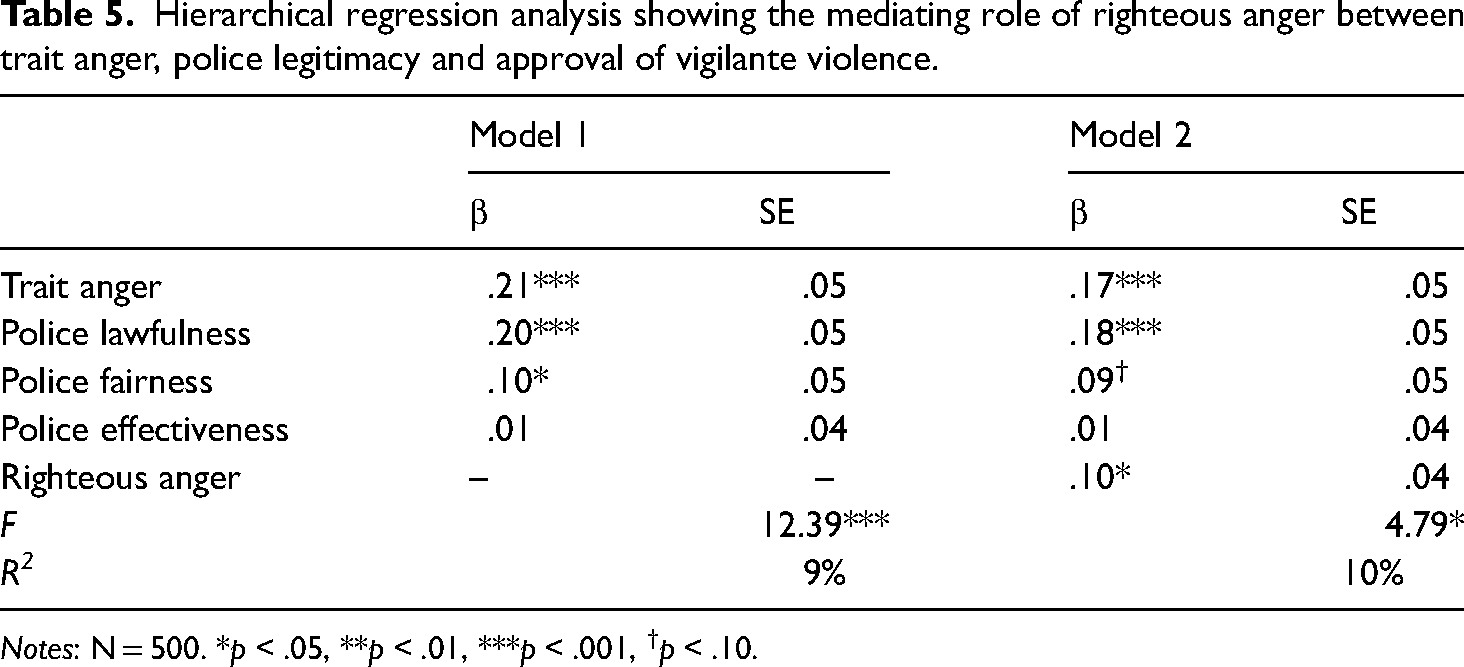
The aim of employing hierarchical regression analysis is to assess whether righteous anger mediates a relationship among trait anger, police legitimacy and approval of vigilante violence. Here, two tables are presented. First, OLS regression Table 4 shows how independent variables (police legitimacy and trait anger) affect the mediator (righteous anger). Then, Table 5 of the hierarchical regression shows how righteous anger mediates the effect of police legitimacy and trait anger on approval of vigilante violence. This analysis technique was employed following earlier studies that suggested that anger mediates a relationship between procedural injustice and noncompliant behavior (see Barkworth and Murphy, 2015; Murphy and Tyler, 2008).
OLS regression analysis showing the effect of trait anger and police legitimacy on righteous anger.
Notes: N = 500. ***p < .001, †p < .10.
Hierarchical regression analysis showing the mediating role of righteous anger between trait anger, police legitimacy and approval of vigilante violence.
Notes: N = 500. *p < .05, **p < .01, ***p < .001, †p < .10.
Before getting started, the criteria for mediation to occur are described. According to Baron and Kenny (1986), for mediation, four conditions should be met: (1) the independent variable should affect the mediator; (2) the independent variable should affect the dependent variable; (3) the mediator should affect the dependent variable; and (4) the last condition determines whether mediation is partial or perfect. For partial mediation, the direct effect between the independent and dependent variables is consistently both direct and indirect, while for perfect mediation, the direct effect should no longer be significant.
Table 4 shows the first condition of mediation in which independent variables (i.e. trait anger and police legitimacy) affect the mediator (i.e. righteous anger). This indicates that trait anger and police lawfulness have significant effects on righteous anger (β = 0.35, p < .001 and β = 0.16, p < .001, respectively). Moreover, police fairness shows a weak association with righteous anger (β = 0.08, p < .10). However, police effectiveness does not have a discernible effect on righteous anger. Table 4 explains 15% of the variation in righteous anger.
With regard to the second condition, Table 5 shows that in model 1, the independent variables of trait anger, police lawfulness and police fairness have significant effects on the dependent variable (i.e. approval of vigilante violence) (β = 0.21, p < .001, β = 0.20, p < .001 and β = 0.10, p < .05, respectively). For the third condition, Table 5 shows in model 2 that the mediator (i.e. righteous anger), affects the dependent variable (i.e. approval of vigilante violence) (β = 0.10, p < .05).
For the last condition, the direct effect of the independent variables (i.e. trait anger) (β = 0.17, p < .001) and police lawfulness (β = 0.18, p < .001) on the dependent variable (i.e. approval of vigilante violence), do not cease to be perfectly nonsignificant. However, the strength of the direct flow of trait anger slightly attenuates from (β = 0.21, p < .001) to (β = 0.17, p < .001), and that of police lawfulness attenuates from (β = 0.20, p < .001) to (β = 0.18, p < .001). Moreover, the direct flow of police fairness returns to the earlier weak association (β = 0.09, p < .10). Thus, this shows overall that trait anger, police lawfulness and police fairness are predictors of approval of vigilante violence and their effect flows directly and indirectly through righteous anger, which mediates a partial relationship between them. Table 5 explains 10% of the variation in approval of vigilante violence. These findings generally imply that people who perceive the police as corrupt and procedurally unfair are likely to approve of vigilante violence directly, and moreover, when they perceive the police as corrupt and procedurally unfair, they might have feelings of righteous anger that they later translate into approval of vigilante violence. Likewise, people who are easily angered are likely to approve of vigilante violence directly; they may also feel more righteous anger and are likely to approve of vigilante violence. Police effectiveness is not associated with approval of vigilante violence in either model, as shown in Table 4. This suggests that participants do not completely rely on the police for safety and crime control in their neighborhoods; rather, they partly depend on themselves to protect their neighborhoods. Perhaps such feelings stem from the perceived ineffective or lacking performance of the police. People alternatively perceive vigilante violence as more effective and just in controlling crimes and in dealing with such offenders (for such findings, see the role of the Bakassi Boys in Nigeria, Baker, 2002; Smith, 2004). Thus, the findings of Tables 3 to 5 are consistent with each other, partially support H1 and H2 and fully support H3.
Discussion and conclusion
The current study examined the following three research hypotheses: (1) whether police legitimacy affects approval of vigilante violence; (2) whether the effect of police legitimacy on approval of vigilante violence is mediated by righteous anger; and (3) whether the effect of trait anger on approval of vigilante violence is mediated by righteous anger. Individual explanations of the three key findings of the study are now presented. First, the study's findings are consistent with those of prior studies that police legitimacy, assessed in terms of police lawfulness (corruption), affects approval of vigilante violence (e.g. Nivette, 2016; Tankebe and Asif, 2016). These studies have suggested that when people perceive the police as corrupt and unlawful, they are likely to support vigilante violence. Police corruption is the most significant predictor of police legitimacy in the context of Pakistan (Jackson et al., 2014; Malik and Qureshi, 2021). Based on the current study and the findings of prior studies, corruption is an overarching issue linked to police (il)legitimacy and subsequent public approval of vigilante violence in Pakistan. Moreover, the findings related to police fairness also concur with Jackson et al.’s (2013) findings from London and Tankebe and Asif’s (2016) findings from Lahore, in which procedural fairness predicted support for vigilante violence. This suggests that when people perceive the police as unfair and procedurally unjust, they approve of vigilante violence against offenders. Last, and unexpectedly, the study found that police effectiveness does not predict approval of vigilante violence. This finding replicates the findings of earlier studies, that is, one from Ghana (Tankebe, 2009) and another from Pakistan (Tankebe and Asif, 2016), but it contradicts Nivette’s (2016) findings from Latin American countries and Adzimah-Alade et al.’s (2020) results from Ghana, which indicated that institutional ineffectiveness explained support for vigilante violence. In the current study, police effectiveness was measured in relation to neighborhood safety and crime control. Given the evidence of pervasive support for vigilante violence in Pakistan (Tankebe and Asif, 2016), it seems that people deem it partly their prerogative to ensure safety and crime control in their neighborhood. They probably believe that they can exert social control and uphold the law in their neighborhoods better than police do. This finding also suggests that police may deal with such offenders lawfully and might devise legal punishment accordingly. However, this does not suit vigilantes, who want such offenders to be dealt with more harshly and violently. This seems compatible with other findings from the same context of Pakistan, where vigilantes punish such offenders violently and sometimes mutilate their bodies after they have been lynched (Asif et al., 2021). Therefore, such people seek to rectify moral wrongdoing through such punitive punishments (Carlsmith et al., 2002; Tyler and Boeckmann, 1997).
Second, the current study found that righteous anger partially mediates a relationship between police legitimacy and approval of vigilante violence. This finding supports those of earlier studies that suggested that the effect of procedural injustice on noncompliant behavior is mediated by anger (Barkworth and Murphy, 2015; Murphy and Tyler, 2008). However, the study extends the research on police legitimacy and approval of vigilante violence, suggesting that when people perceive the police as corrupt and unfair in dispensing justice, they feel righteous anger, which affects their approval of vigilante violence. Thus, this study explores a microsociological process in which perceptions of police corruption and unfairness are channeled through feelings of righteous anger and lead to approval of vigilante violence. This seems to correspond with vigilante rituals theory (Asif and Weenink, 2022), which suggests that the violation of moral imperatives arouses righteous anger, which is then translated into support for vigilante violence in contexts lacking police legitimacy. Similarly, this seems to echo Agnew's (1992) general strain theory of crime, showing that when people perceive the police as blocking their goals of attaining social control, unjustly and not punishing offenders sufficiently, they feel righteous anger that results in approval of vigilante violence.
Third, this study found that righteous anger partially mediates a relationship between trait anger and approval of vigilante violence. This implies that people who are easily angered feel more righteous anger, which leads to approval of vigilante violence. This finding partially corroborates vigilante rituals theory (Asif and Weenink, 2022), in which researchers have correctly posited righteous anger as an explanatory factor for approval of vigilante violence but overlooked trait anger. Moreover, this finding is partially consistent with psychological studies that suggested that people with trait anger feel more frequent and intense state anger (righteous anger, herein) than others (Deffenbacher et al., 1996; Quinn et al., 2014). However, this study found that trait anger flows directly into approval of vigilante violence. This means that people with trait anger are easily angered and are more inclined to approve vigilante violence than others.
Last, the synthesized findings of the study thus suggest that anger aroused by violation of moral imperatives is an important factor that not only predicts approval of vigilante violence independently in the form of trait anger but also mediates a relationship between police legitimacy and approval of vigilante violence in the form of righteous anger. It is now evident that violation of moral imperatives and anger in general is important in explaining approval of vigilante violence. This is consistent with prior studies on support for vigilante violence that have suggested that such anger is a significant predictor of support for punitive retribution (Carlsmith et al., 2002; Darley et al., 2000; García-Ponce et al., 2019; Johnson, 2009; Tyler and Boeckmann, 1997). The findings of the study suggest that people in Pakistan who are easily angered or who perceive the police to be lacking legitimacy feel righteous anger and approve of vigilante violence against (alleged) offenders. This outcome is linked to the broader debate on whether support for vigilante violence as self-help to attain social control unfolds only under macroconditions of state weakness and/or its absence and on whether emotions are also relevant (for macro–micro explanations, see Black, 1983; Collins, 2008). This study thus concludes that people do not approve of vigilante violence instrumentally only to compensate for a lack of state monopoly on violence and/or state illegitimacy but that emotions—notably anger—are also significant in explaining public approval of vigilante violence as a form of self-help to attain social control. Therefore, future studies should consider both trait anger and righteous anger from another theoretical perspective to explain approval of vigilante violence.
Limitations and future studies
First, this study cannot be generalized to the entire population because the survey was administered to university students only. Therefore, it is suggested that future investigators study approval of vigilante violence by focusing on the general population and obtaining cross-country samples to verify the extent to which trait anger and righteous anger play roles in explaining this social problem in other societies. Second, further research is needed to explore whether only emotions of anger lead to approval of vigilante violence or whether other emotions, such as fear, stress, anxiety, tension or feelings of exclusion or deprivation, may also do so. Third, the coefficients of the predictor variables, including police fairness, police lawfulness, trait anger and righteous anger, were not particularly large, only moderate, and the variance explained in the survey data findings was somewhat small. Follow-up studies can evaluate whether these predictors perform differently in different contexts. Despite these limitations, this study nevertheless makes a significant contribution to research by discovering the role of anger (trait anger and righteous anger) besides police legitimacy in explaining approval of vigilante violence.
Footnotes
Acknowledgments
I am very grateful to the anonymous reviewers and editors at Theoretical Criminology for their constructive comments. Also, I want to thank Don Weenink, Justice Tankebe, Peter Mascini, Matthew light and Muhammad Siddique Akbar for their useful comments on the previous drafts of this article.
Declaration of conflicting interests
The author declared no potential conflicts of interest with respect to the research, authorship and/or publication of this article.
Funding
The author disclosed receipt of the following financial support for the research, authorship and/or publication of this article: This work was funded by a scientific grant awarded to Muhammad Asif by FDP of Bahauddin Zakariya University, Multan, Pakistan.
