




Abstract
This article examines expulsions in and around the Spanish enclaves of Ceuta and Melilla and in informal settlements in former black townships in South Africa. These violent bordering processes expose the violent injustices that constitute the boundaries of lawful (liberal) law, and the violence that sovereigns use to secure territories. Drawing on Walter Benjamin we make three main theoretical arguments. First, that the bordering processes in our case studies are instances of law (and State) preserving violence. Second, that absence and responsibilization are central techniques for invisibilizing the role of violence in preserving law, and that abdication of jurisdiction is key to the exercise of state sovereignty. Third, that when the State preserves itself through sharing its monopoly over violence the fictitious distinction between law and violence collapses. We use the term ‘borderline lawful violence’ to highlight the precarious nature of the boundary between lawful and unlawful violence.
Keywords
Introduction
The colonial world is a world divided into compartments. It is probably unnecessary to recall the existence of native quarters and European quarters, of schools for natives and schools for Europeans; in the same way we need not recall Apartheid in South Africa. Yet, if we examine closely this system of compartments, we will at least be able to reveal the lines of force it implies. This approach to the colonial world, its ordering and its geographical layout will allow us to make out the lines on which a decolonized society will be reorganized. The colonial world is a world cut in two (Fanon, 1990: 29).
This article looks to the north and south of the African continent. Our focus is on the expulsive violence that arises out of, and is interwoven with, bordering processes in and around the Spanish enclaves of Ceuta and Melilla (on the southern border of Spain) and in informal settlements in Cape Town (South Africa). We chose these case studies because each exemplifies how bordering plays out symbolically and literally, internally and externally, between nations and within nations, between Europe and Africa, black and white, rich and poor. Morocco is a border country in the sense that it is literally at the edge of Africa. Our focus, however, is on the contested enclaves of Ceuta and Melilla, which belong to Spain but are physically situated in Morocco. As such, they illustrate the multiple dynamics of bordering in two contained, relatively small spaces. South Africa, on the other hand, is quite distant from Europe, situated on the southern side of the continent. Cape Town is almost (but not quite) at the southernmost tip of Africa. Thus, part of the reason we chose these two case studies is precisely because of their polar opposite geographical locations. Because Morocco is geographically close to Europe, the physical border between it and Spain exemplifies the symbolic border between the white ‘global North’ and black ‘global South’. South Africa is physically far from Europe, and as the most unequal country in the world, exemplifies the borders created by inequality and histories of racial segregation.
In Ceuta and Melilla we focus on externalized bordering, analysing the violence deployed to enforce the border between two countries (Spain and Morocco). In the case of South Africa, we analyse violent forms of internal bordering, within and between local communities. Both case studies demonstrate the ways in which unlawful (or borderline lawful) violence is used to secure territories and assert sovereignty by expelling unwanted persons. We use the term borderline lawful in two ways: first, to refer to situations where the legality (or otherwise) of a violent action is not initially clear (and hence open to dispute). Second, we use it to refer to instances or contexts when an initially lawful form (or infrastructure) of violence collapses into unlawful violence—for example when a lawfully constituted neighbourhood watch punishes, or when a border guard exceeds the amount of force reasonably necessary to perform a lawful action. Whereas ‘lawful violence’ is violence that is within the law, for example the use of force to effect an arrest (by a police officer or a citizen), or to defend oneself against an attack (self-defence), unlawful violence is violence that is outside of the law and is generally criminalized. Both state and non-state actors can enact unlawful violence, for example when exceeding the bounds of what is considered ‘reasonable’ violence to effect an otherwise lawful purpose (such as an arrest). While in theory the border between lawful and unlawful violence is clear, in practice it is blurred and porous—hence the term ‘borderline lawful’.
Borrowing from critical geographers (Kyed, 2020; Parker et al., 2009; Van Houtum, 2010) we use the term ‘bordering’ as a verb to imply the process of struggle that goes into constructing a border. We analyse three different types of borders: the physical or geographical division between two countries (delineated by a fence, a wall, a checkpoint, etc.); the legal-jurisdictional boundary between lawful and unlawful violence; and the social boundaries within a territory (between rich and poor, white and black, ‘criminal’ and ‘moral’, etc.). 1 Since bordering takes place on multiple scales, ‘the border’ is not a static line on a map, but a ‘series of practices’ (Parker et al., 2009: 586). Borders exclude and invisibilize realities on the ‘other side’, and hide the unequal power relations that underpin their construction—what de Sousa Santos (2007) refers to as drawing ‘abyssal lines’. This article focuses on the racialized violence that is integral to processes of bordering between the ‘global North’ and ‘global South’, between Europe and Africa, Spain and Morocco, white and black neighbourhoods, ‘law abiding’ and ‘criminal’, and so on. These violent bordering processes, which occur in contexts of inequality and are targeted at poor black ‘outsiders’, include internal displacements, destruction of settlements, banishments, curfews, shack evictions, demolitions, violent pushbacks 2 and other forms of unlawful (or borderline lawful) violence that contribute to the creation of literal and symbolic outsiders (Parker et al., 2009; Van Houtum, 2010). They are tacitly tolerated by a range of actors because they occur in marginalized spaces: out of sight of affluent white urban centres in South Africa and/or away from the spectacle of the physical border (and hence beyond European territory).
Although our article is empirically informed, it is more of a conceptual piece aimed at opening up lines of inquiry into the relationships between territoriality, sovereignty, violence and race. We have drawn on and synthesized insights from several related past and ongoing projects. Our data consist of newspaper articles, reports from international and national human rights organizations, documents produced by the Spanish and South African governments, by Spanish, Moroccan and South African non-governmental organizations, court judgments from Spain, Europe and South Africa, and ethnographic fieldwork that the First Author has conducted in former black townships in Cape Town since 2012 in connection with her research on vigilantism, popular justice and local forms of community-based crime prevention. The Second Author is currently conducting a three-year research project on inter alia immigration detention practices in Spain. This enabled us to approach the bordering practices on the southern border of Spain in the context of the Spanish government’s general approach to the government of unwanted mobility. In the Ceuta and Melilla case study we analyse expulsive bordering practices deployed against black sub-Saharan Africans who attempt, or are suspected of attempting, to illegally enter the Spanish enclaves. 3 In the case of South Africa we analyse the expulsive bordering practices that play out between and within communities inside the country. We deliberately chose two geographically distinct case studies in order to gain insight into how bordering operates in multiple ways, but the article is not intended to be a comparative article per se. By bringing together various literatures—critical legal theory, border criminology, legal geography and postcolonial—we aim to contribute to existing work on the relationships between law and violence, and between sovereignty and violence, and to the literature that looks to the ‘global South’ not only as an exotic exception but as central to theory building—where the ‘exception’ is in fact the norm (Carrington et al., 2016; Comaroff and Comaroff, 2006; Mbembe, 1992). Although our cases are intended to be illustrative and not exhaustive our findings suggest that unlawful (and borderline lawful) expulsive violence, aimed at racialized others, is central to securing the sovereignty of the liberal State, both internally and externally.
Drawing on Walter Benjamin (1996) we make three main theoretical arguments. First, that the violent bordering processes deployed against poor black Africans in the name of ‘security’ are examples of ‘law preserving’ violence, inasmuch as it is through violence (or force) that law preserves itself. 4 Since Benjamin used the word ‘law’ interchangeably with the State we therefore also argue (following Benjamin) that violence is central to preserving state sovereignty.
Our second argument, inspired by Valverde (2015), is that absence and responsibilization are central techniques for invisibilizing the role of violence in preserving law (and the State). Techniques of ‘absence’ both constitute specific spaces as marginal as well as marginalizing the forms of violence (lawful and unlawful) that play out within them. Thus, for example, when the South African police and/or the Spanish Guardia Civil tolerate (even implicitly) the infliction of unlawful violence on ‘criminals’ or potential ‘fence climbers’ by state and/or non-state actors they are abdicating (rather than claiming) jurisdiction and contributing to the legitimation of unlawful forms of violence. In this sense the law (or the State) takes certain violent practices under the ‘protection of its power’ (Benjamin, 1996: 242), by temporarily abdicating its jurisdiction to act against these practices. This abdication is key to the exercise of the State’s sovereignty. Thus, ironically, it is through tolerating unlawful violence (which on the face of it threatens the Weberian State’s claim to the monopoly of the legitimate use of violence) that law (i.e. the State) is able to preserve itself.
Third, we argue that the State’s sharing of its theoretical monopoly over lawful violence results in the collapse of the distinction between law and violence, and an unstable (precarious and shifting) boundary between lawful and unlawful violence. Not only is the law preserved through violence (because it ultimately relies on violence to enforce itself), as Benjamin argues, but it sometimes enacts this violence (preserving itself, and the State) by tolerating unlawful violence (i.e. by not enforcing itself)—hence, through its absence. Thus, unlawful violence both preserves and challenges state sovereignty. This contradiction is obvious in our case studies, where the violent bordering practices of ‘non-state’ actors combine with lawful, unlawful (and borderline lawful) state violence to ‘secure’ contested and unstable spaces, territories and communities.
We start by discussing how racist spatiotemporal restrictions play a major role in the discourse and practices of securitization in our case studies, and how historic and current acts of eviction constitute and maintain racialized spaces, territories and communities.
Racialized bordering and marginal spaces
The expulsive violence analysed in this article is first and foremost rooted in the injustice that characterizes inequality. It is most obvious in marginalized physical spaces. Just as South Africa’s chronic poor are severely inhibited in their mobility and access to rich unofficially white areas (because of private security, high transport costs, etc.), so too are poor and racialized (mainly black) people from sub-Saharan Africa prohibited from entering ‘Fortress Europe’. Thus, spaces of marginality are not merely ‘static’ entities but are ‘recursively related to social relations’ (Blomley, 2003: 123)—produced through colonial histories and/or racial capitalism.
The fences around Ceuta and Melilla not only separate Spain and Morocco but also, on a supranational scale, separate ‘Fortress Europe’ from the African continent. As such they exemplify the divisions between the global North and global South, with race-based social and physical segregation in Morocco and in the Spanish-Moroccan borderlands having a long historical pedigree (Ferrer-Gallardo, 2008). Similarly, the effects of prior evictions and violent forms of spatial regulation that were central to the process by which race became spatialized and space racialized are still experienced by poor black South Africans in the ‘new’ and formally democratic South Africa. While liberal legal theory might describe certain acts of violence (such as vigilante, unlawful police or border guard violence) as ‘marginal’ (or ‘abnormal’ in the sense of not being the norm) and/or occurring on the ‘margins’, viewed from another (more local) vantage point (or at a different scale), this illegal violence is quite central. In this sense liberal law, and its unlawful (violent) underside, play out in different registers and on different scales, depending on previous (and extant) processes of spatialization. Like space, marginality is also scaled and constructed (de Sousa Santos, 1987; Valverde, 2015). While a resident in an informal settlement in South Africa may feel marginalized by the State, the space in which she lives is not on the margins of her own existence. It is central to it. Thus, like ‘territory’ and ‘community’, space is constituted by social relations that function to both include and exclude (Parker et al., 2009; Sylvestre et al., 2020; Van Houtum, 2010). As such, the spaces of our case studies are neither ‘topographical surfaces’ (Sylvestre et al., 2020: 27), nor ‘bounded and homogenous units’: they are invested with materiality and meaning (Comaroff and Comaroff, 2006). In this section we argue that violent bordering practices play a central role in constituting this meaning.
From the 1920s, South Africa’s housing policy focused on demolishing ‘native slumyards’ (Maylam, 1990: 60) and forcibly relocating residents to racially segregated ‘locations’ (Smit, 2016: 37). The white minority National Party government, which gained power in 1948, poured enormous resources into continuing this process of racist bordering. It constructed black townships on urban peripheries and bantustans (‘homelands’) in impoverished rural areas. Enabled by a raft of legislation, it forcibly relocated black Africans to the newly created townships and bantustans, and criminalized their movement in white spaces (Maylam, 1990; Smit, 2016). From the mid-1980s, as grand apartheid began to be formally dismantled in South Africa, there was an influx of people from the former homelands to urban areas. Thanks to the current era of ‘precarious work’ (Hunter and Posel, 2012: 287) and a massive drop in employment in rural areas, this influx has, together with a limited supply of formal housing, resulted in a significant increase in illegal land occupations in or near former black townships.
The transition to formal democracy did not result in a cessation of the expulsions on which the colonial city was built (Razack, 2014) and in the post-1994 era violent removals of shacks and shackdwellers, by the local state and/or private companies acting on behalf of the State, have increased (Chance, 2018). Poor black people still experience significant mobility restrictions, even though bordering no longer occurs on explicitly racial grounds (as was the case in terms of apartheid legislation). Residents in former black townships are economically and politically trapped in their immediate spaces and disconnected from previously ‘whites only’ neighbourhoods (Pillay, 2008). This is strikingly apparent in the photographs shown here. The first is a graphic, bird’s eye view of inequality (Figure 1). On the left-hand side is Masiphumelele, in the southern part of Cape Town, where residents live in tiny houses and shacks. On the right-hand side is the affluent (mostly white) suburb of Lake Michelle, where residents live in luxury homes, alongside a tranquil lake. The area in between is the buffer zone, fortified by an electric fence on the Lake Michelle side (Silber, 2019). The second photograph is of shacks in the ‘Wetlands’ after heavy winter rains (Figure 2). 5
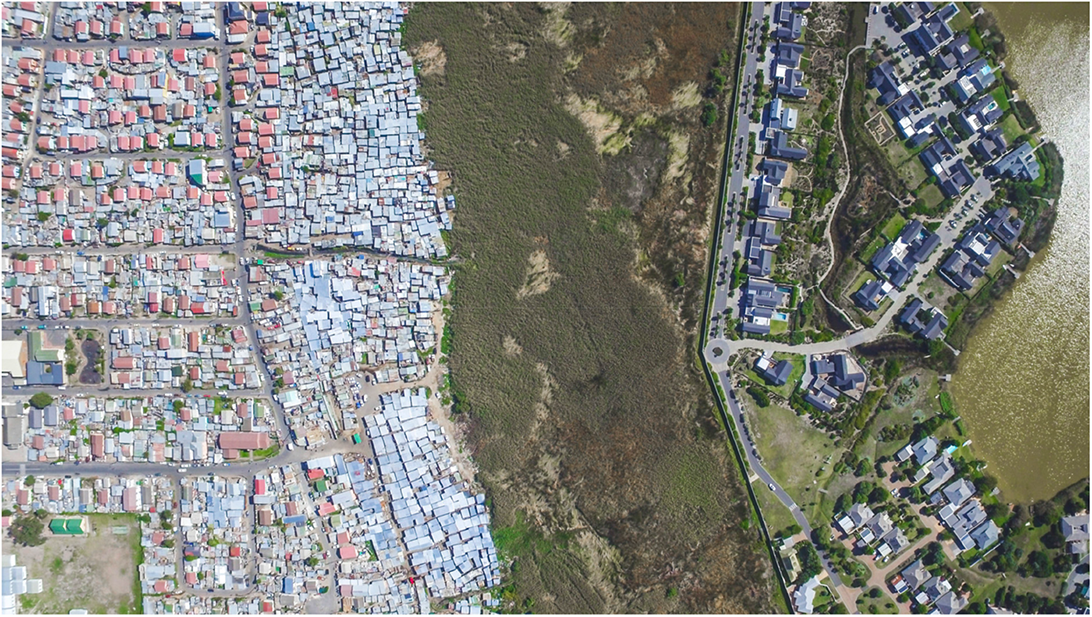
Photograph by Johnny Miller.
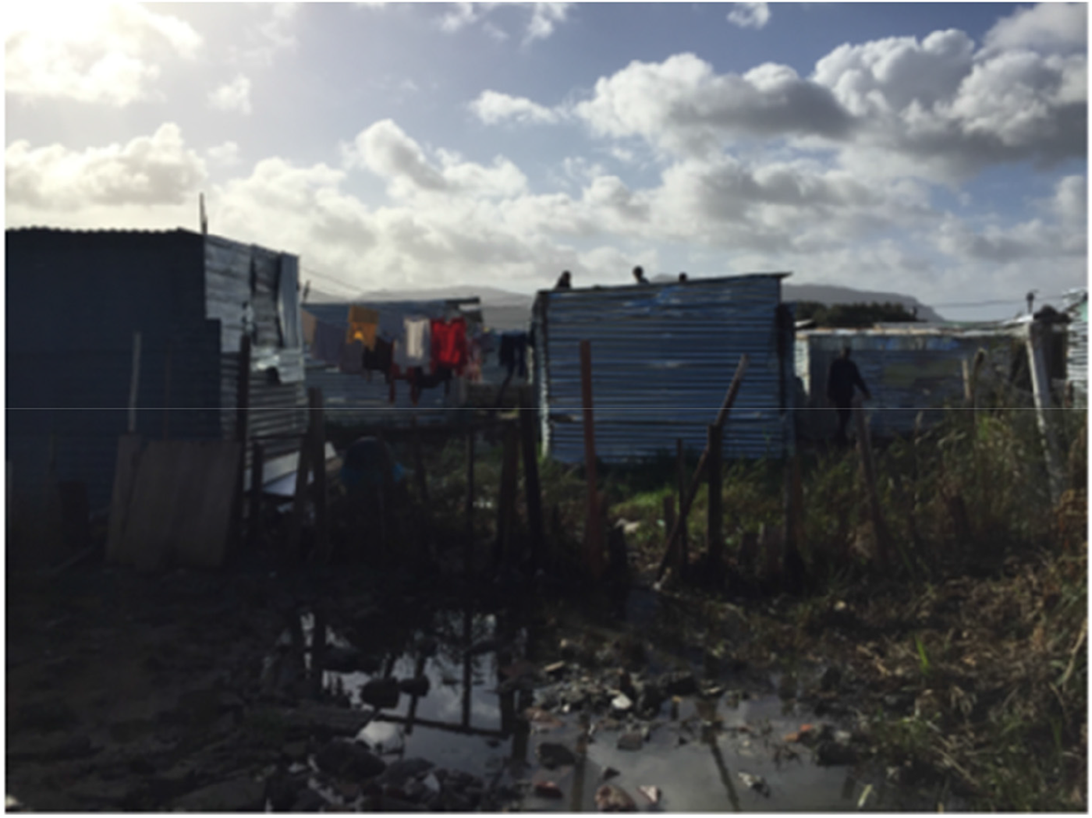
Photograph by the First Author.
Although geographically on the continent of Africa, Melilla has been in Spanish hands since 1497 and, Ceuta, since 1668. Since the end of the Spanish colonization of Morocco in 1956 the ‘ownership’ of these two enclaves has been disputed. When Spain became a member of the European Union (EU) in 1986, the Spanish-Moroccan border acquired new significance, as the external border of a supranational entity (Ferrer-Gallardo, 2008). Thus, the fences around these two enclaves, respectively 8.2 and 12 kilometres long, symbolize a complex combination of territorial disputes, economic negotiations and geopolitical interests (Ferrer-Gallardo, 2008). The EU began to deploy huge resources to police the border in response to the increasing arrivals of sub-Saharan Africans, particularly after the coming into force of the Schengen Agreement in 1995. As can be seen in Figure 3, these include extensive fortifications of the physical borders between the enclaves and Morocco. Steel and barbed wire fences, surveillance towers, 100 24-hour surveillance cameras, microphones, motion sensors, high-intensity floodlights, high pressure water hoses and a network of twisted steel cables were constructed in the post-1990s period (Barbero, 2012). In 2019, the Spanish government started to replace the razor wire in the fences with a new ‘reversed comb’ (peine invertido) structure and also added an additional three metres to the height of the fences in terms of a shift to ‘security with humanity’ (Ministry of Internal Affairs, cited in Desalambre/Efe, 2019). At the same time, however, after receiving 140 million euros from the EU in support of its ‘fight’ against ‘irregular migration’ (Moreno, 2019), the Moroccan government erected new razor wire fences on its side. Although the Spanish government argued that both processes were independent of each other, their combined effect was cruel, to say the least. This is a clear example of border externalization, in terms of which the most violent and ‘inhumane’ mechanisms for preventing international mobility are displaced to third countries, and rendered invisible at the scale of ‘civilized’ global North (Davitti, 2019; Mountz and Loyd, 2014).
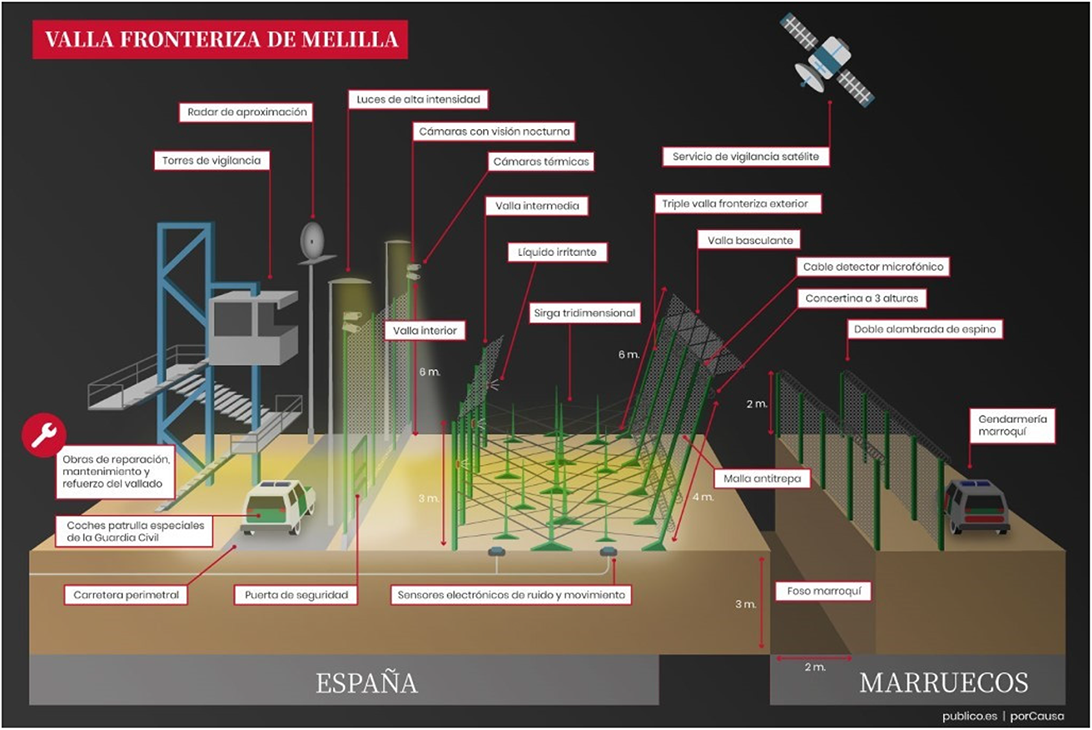
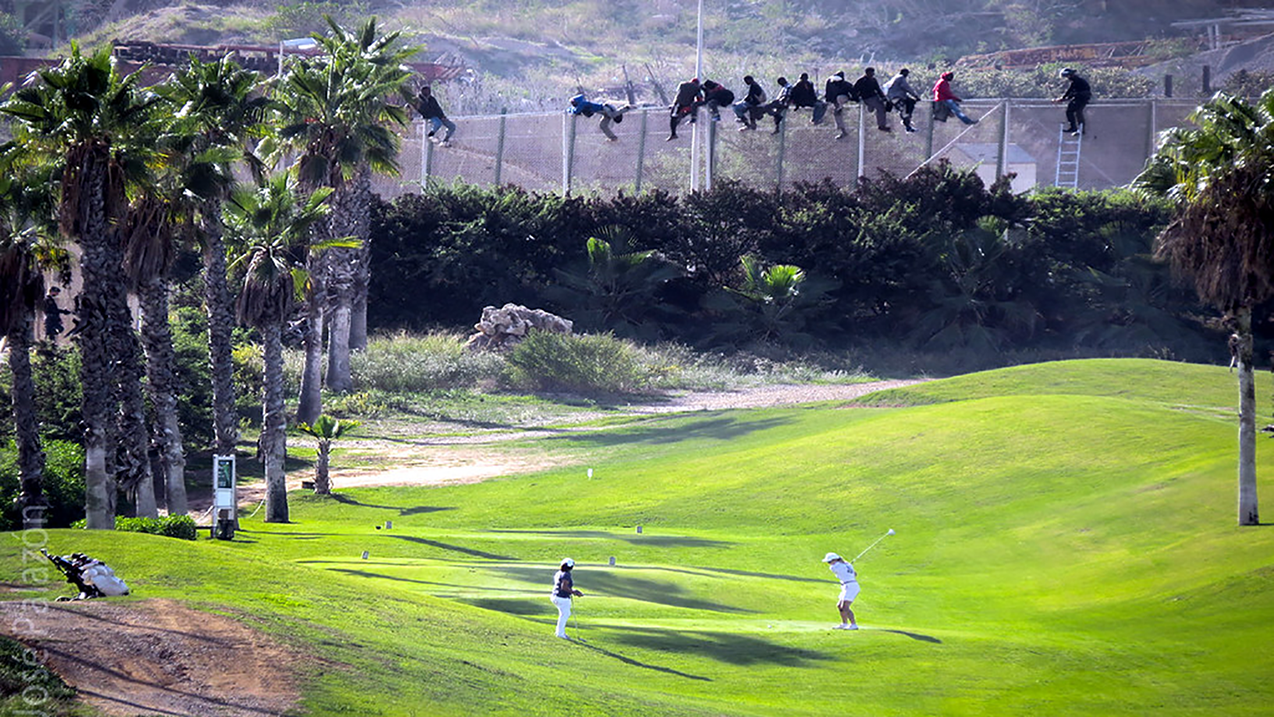
Migrants on the fence in Melilla, at the border between Spain and Morocco. (Author: JOSÉ PALAZÓN - AFP) licensed under CC BY-NC-SA 2.0.
Punitive ‘spatial tactics’ 6
Bordering practices in Ceuta and Melilla, under the apartheid state, and in ‘post’-apartheid South Africa, restrict mobility on the grounds of race and class. They are deeply connected to structural inequalities and must be examined in the context of colonial, apartheid and postcolonial state violence. In both case studies sub-Saharan black Africans are subject to extensive mobility restrictions on the basis of the ‘security risk’ that they pose. Black Africans in particular are ‘pre-known as risk failures’ (Mitchell, 2009: 244) and thus, in terms of a new form of ‘sovereign spatial power’ (Mitchell, 2009: 242) whole populations are banished because of their ‘future risk’ (Mitchell, 2009: 242). Thus, in Ceuta and Melilla onerous and prohibitively expensive visa requirements restrict lawful entry to a select, and ‘whitened’ few, with punitive expulsions and violence meted out against racialized outsiders. In South Africa chronically poor black males are pre-constituted as risky criminal figures in both ‘white’ neighbourhoods and within former black townships. Thanks to governmental projects that deploy mobility restriction technologies and to technologies deployed by private property owners, in support of security (Murray, 2020) they are severely inhibited in their mobility, subject to forced removals, by whoever is wielding the sovereign power to exercise violence at the time.
South Africa
Technologies such as curfews; banishments (some more successful than others); evictions (via padlocking the doors to shacks and/or demolitions); violent expulsions conducted by crowds of people; corporal punishment; retrieval of stolen property via the use of violence; bashing down and/or burning the shacks of suspected criminals; and lethal instances of collective violence (where suspected criminals are beaten and/or burnt to death) are but some of the ‘banal’ ways in which non-state actors in former black townships and informal settlements deploy violence to deal with crime. This brings into view ‘multiple and contested sovereignties’ or what Valverde (2015: 50) refers to as a ‘mash-up’ of ‘multi-scalar’ knowledge forms, relations of power and technologies of violence.
This violence occupies a ‘twilight’ (Lund, 2006: 686) or borderline zone because those who use it act in a state-like fashion, and draw on symbols of ‘stateness’ (Lund, 2006: 686). It is precarious (unstable) in the sense that what starts out as a banishment or shack eviction may collapse into more serious (sometimes) lethal violence. For example, decisions by a street committee 7 to evict or expel someone have the potential to collapse into deadly violence when the crowd (or certain individuals in the crowd) go beyond the decision and no longer obey the initial orders of the committee (Cooper-Knock, 2018; Super, 2016, 2017). Similarly, initially lawful practices—such as neighbourhood watch crime prevention patrols, have resulted in unlawful violence (including expulsions) being meted out on those who question the authority of the patrollers, are not recognized as residents in the area and/or violate the informal curfews imposed by local actors (sometimes in conjunction with the police) that prohibit people from being on the street after 9 p.m. (Cooper-Knock and Super, 2022; Super, 2016).
In certain instances, the police watch (or even assist) residents to evict (and thereby punish) suspected criminals (Super, 2021). They have also referred crime victims to vigilante associations to obtain evidence for potential court cases (Sv Hena & Another, 2006; see also Buur, 2005; Super, 2016). Explicit acknowledgement of violence (via arrests of vigilantes, press releases by government officials, etc.) only rarely occurs, and day-to-day violence by non-state actors in pursuit of crime prevention and punishment is mostly ignored by the State. Even in spectacular cases of collective violence successful prosecutions are rare.
Unlawful or borderline lawful punitive violence is, of course, not only inflicted by ‘non-state’ actors, nor only in former black townships. 8 Apart from police violence and police vigilantism (Huggins, 1991; Viewfinder, 2021) the local State (and its agents) mete out unlawful and overtly expulsive violence when acting against so-called ‘land invaders’—extremely poor people who have unauthorizedly erected shacks and (sometimes) brick and mortar houses on vacant state (or privately) owned land. Violent evictions, in terms of which homes are demolished by bulldozers and/or bashed down by private security companies (subcontracted by the State) are carried out under the banner of promoting the ‘rule of law’ and being against ‘lawlessness’. It is common for excessively punitive violence to be used in the course of demolitions and evictions (Cruywagen, 2020; Draper, 2020; Draper et al., 2020; Gedye, 2020; New Frame, 2020). These have been described as ‘brutal’ (Majvu, 2020): police have been known to open fire at close range with rubber bullets, while bulldozers are at work, and to inflict multiple physical injuries including from live ammunition, pellet guns and pangas (Draper et al., 2020). It is also common for building material to be ‘deliberately destroy(ed)’ and furniture to be burnt after a shack is demolished, thus adding an extra layer of unlawful violence that goes well beyond the claimed (albeit dubious and borderline) legality of evictions (Draper et al., 2020). In one instance, the head of an anti-land invasion unit was so angry after residents secured an interdict against the municipality’s illegal evictions that he went to the settlement and fired off a round of bullets hitting one resident in the hip (Draper et al., 2020). In another (subsequently ruled unlawful by the Cape High court), 9 an occupant was forced out of his shack while naked and beaten in front of a large crowd while his shack was demolished. Thus, in their ‘countless exercises of discretion’ (Wolcher, 1996: 51) the police, 10 essentially, make and preserve their own laws (Benjamin, 1996: 243). This results in slippage between law and violence, and between lawful and unlawful violence.
Southern border of Spain
The bordering techniques, such as surveillance technology, naval patrols, razor wires and various forms of corporeal violence, deployed in the service of securitizing the southern border of Spain are also examples of law (State) preserving violence. Here, where the global North and global South confront one another in a ‘very concrete and abrasive way, and where gradients of wealth and poverty, citizenship and non-citizenship, appear especially sharply’ (Walters, 2010: 146), this violence is no longer spectral but obvious. Both the Spanish and Moroccan states engage in expulsive pushback strategies and mete out corporal punishments against those who attempt to access Melilla and Ceuta. The Guardia Civil have summarily removed successful fence jumpers who made it as far as Melilla, handed them to Moroccan border patrols who then beat them, sometimes in full view of the Guardia Civil (Human Rights Watch, 2014: 3). These pushbacks are borderline processes, whose legality is disputed and sometimes tested in the courts. In one case, where the European Court of Human Rights 11 initially ruled in favour of two applicants who attempted to climb over the fences around Melilla, the decision was reversed by the Grand Chamber and the Guardia Civil’s violence ruled lawful (ACCEM, 2020; Forensic Architecture, 2020).
Apart from this quotidian ‘everyday’ violence, spectacular violence occasionally plays out around the ‘fence of Death and Shame’ (Barbero, 2012: 752). On the night of 23 June 2005, more than 200 migrants attempted to use handmade ladders to climb the two sets of three-metre-high fences between Morocco and Melilla. The Guardia Civil successfully used rubber bullets to disperse them and most were eventually returned to the Moroccan border—without any official deportation procedures (SOS Racismo, 2007). More recently, in February 2014, when approximately 90 of the 200 immigrants who were trying to reach Ceuta, tried to swim across to the Spanish side from Tarajal beach, at least 14 drowned, one disappeared and the Guardia Civil returned 23 to Moroccan authorities without following any formal procedures. During the incident the Spaniards deployed rubber bullets, and detonated rounds of teargas and smoke canisters, to prevent the swimmers from reaching the mainland. Although human rights organizations instituted legal action, arguing that the excessive force deployed by the Spanish border guards caused the drownings, after several appeals the Guardia Civil was acquitted of the charges (ECCHR, 2020).
The Moroccan police have frequently raided and dismantled migrant camps in the forests near the Ceuta and Melilla fences, forcibly dumped thousands of people at the Moroccan–Algerian border and displaced others to southern Morocco—without following any legal procedures (Barbero, 2012: 751). These violent practices of displacement, ‘abandonment’ (Gross-Wyrtzen, 2020: 890) and ‘dispossession’ (Gazzotti and Hagan, 2021) play both retributive and deterrent roles, functions that are central to the exercise of the State’s sovereign power to punish. However, unlike the lawful violence provided for in formal penal codes, this law (State) preserving violence, enacted in the service of preventing black sub-Saharan Africans from reaching the EU (Gross-Wyrtzen, 2020: 892) is an obscured, spatially and temporally fluid, exercise of state sovereignty. It both produces and results in ‘border externalisation’, a strategy that gained traction in 2005 when the EU adopted a ‘global approach to migration’ (GAM) policy to address migration ‘in partnership with third countries’ (European Council, 2005). The result is that violence at the physical border is now complemented by violence further downstream of the fences. To give some examples: Immigration Law 02–03 authorizes the Moroccan government to ban undocumented people from staying in certain areas or cities, resulting in the Moroccan police enforcing transportation of black Africans back south. Additionally, checkpoints en route from southern to northern Morocco are aimed at preventing sub-Saharan black Africans from reaching the southern border. Thus, race has become a ‘central logic of border enforcement and migration management’ in Morocco (Gross-Wyrtzen and Gazzotti, 2021: 836), and ‘irregular migration’ (Andersson, 2014: 140) has become increasingly ‘racialized’. ‘Blackness’ is now ‘a sign of illegality’ (Andersson, 2014: 140; see also Gross-Wyrtzen and Gazzotti, 2021; Natter, 2014).
These iatrogenic feedback loops of expulsion, abandonment and criminalization constitute a type of ‘containment through mobility’ (Tazzioli, 2018), which not only renders it virtually impossible for black Africans to apply for legal asylum but is also framed around an underlying ‘imperial politics of controlling (certain) people on the move’ (Casas and Cobarrubias, 2019: 187). We argue that containment through mobility is a classic example of law (state) preserving violence, with the sovereignty of the Spanish state maintained via punitive violence meted out in Moroccan territory. In enforcing its own sovereignty and lawful (albeit unjust) right to refuse entry to certain categories of (racialized) immigrants, the Spanish state relies on (or tacitly tolerates) unlawful (or borderline lawful) violence by the Moroccan police against black sub-Saharan Africans. As Bosworth (2008: 201) argues, ‘non citizens … call into question “the limits of the sovereign state”’ and, we would add to this that the bordering processes that construct and deconstruct these ‘limits’ result in a perpetually collapsing boundary between lawful and unlawful law (state) preserving violence.
Law, violence and ‘games of jurisdiction’ 12
As discussed above, one of the results of ‘outsourcing’ the border is that it is enforced and policed both earlier (in time) and further away (in space) from the physical fence. Violent bordering practices thus occur in the ‘absence’ of the Spanish state, inasmuch as they take place beyond the fences, within a different sovereign territory, and on a multi-scalar level (Casas-Cortés et al., 2016). This demonstrates the increasingly ‘transnational [and geographically flexible] nature of sovereign power’ (Mountz and Hiemstra, 2012: 468) and renders the meaning of terms such as the border, sovereignty, territory and state, ‘ambiguous and malleable’ (Mountz and Hiemstra, 2012: 468). Furthermore, the unlawful (or borderline lawful) violence (whether inflicted by the Spanish state or further downstream, on a different scale, by the Moroccan state) ultimately serves to fortify Spain’s border with Morocco, and in this sense ‘preserves’ the Spanish state (and its immigration laws).
This cooperation between countries of ‘origin, transit, and destination’ responsibilizes non-EU countries (in our case Morocco) for preventing irregularized migrants from reaching the EU’s borders (Casas-Cortés et al., 2010: 77). It is coupled with funding, provided for in bi- or multi-lateral agreements between African and EU states. Thus, the quid pro quo for Spanish (and/or EU) support for ‘development’ projects is to render non-EU countries responsible for carrying out violent bordering processes aimed at maintaining European borders (or the Spanish state’s sovereignty). 13
When the Moroccan government expels black sub-Saharan Africans to its northern or southern borders, and metes out unlawful violence for both preventative and retributive purposes, Spain is able to avoid legal responsibility for the oftentimes flagrant human rights abuses (Human Rights Watch, 2014), precisely because they occur away from the spectacle of the fence, in Moroccan territory. Yet, when the Moroccan police mete out violence against ‘clandestine travellers’ (Andersson, 2014) they are acting as agents (but not in the legal sense of the term) of the Spanish state (Landau, 2019; Macklin, 2021). These ‘borderline legal infrastructures’, 14 which combine with physical infrastructures such as roadblocks and ‘spaces of confinement’ (Davitti, 2019: 1176), enable the Spanish state to avoid its international law obligations (Davitti, 2019: 1176). It is precisely because the Spanish state abdicates, rather than claims, jurisdiction that the exercise of unlawful violence in support of its sovereignty is less visible in marginalized and/or economically precarious spaces. Here the protections provided by official law, together with the State, are visibly absent. We return to this point shortly.
In informal settlements in South Africa, where the State is most often visible through its absence to provide security (in the broadest socio-economic sense of the term), poor residents are responsibilized for their own safety. The South African state both absents itself from marginalized neighbourhoods and simultaneously calls for ‘communities’ to be involved in crime control and crime prevention. Historically, because apartheid police focused on securing white neighbourhoods against black people, residents of former black townships have long been responsible for their own policing (Brewer, 1994; Fourchard, 2011). Thus, low-level vigilante activities while officially illegal were, and still are, tacitly tolerated by both state and local actors. Informal patrols and neighbourhood watch groups (in both historically white and black neighbourhoods) have been actively encouraged by the post-apartheid South African state. The National Development Plan 2030 promotes an active citizenry to build ‘community participation in community safety’ (Lawrence, in O’Regan and Pikoli, 2014: 150) and the Department of Community Safety’s ‘whole of society approach’ attempts to make ‘safety everyone’s responsibility’ (Lawrence, in O’Regan and Pikoli, 2014: 150), to ‘mobilise communities against crime’ and to encourage ‘community safety structures’ (Department of Community Safety, 2010: 21.1.1: 34–35). Given that the technologies to displace potential threats available to neighbourhood watch members in affluent South African suburbs are not available in poorer areas it is not surprising that neighbourhood watches and informal patrols resort to coercive tactics to force potential criminals to leave an area (Bénit-Gbaffou, 2008; Super, 2016). Thus, here too, the State abdicates its jurisdiction, through responsibilizing inchoate ‘communities’ for certain types of policing without providing logistical support, and/or necessary resources. As such, responsibilization and absence promote (and implicitly condone) unlawful (and borderline lawful) violence by those who are ‘preventing’ crime.
We are not arguing that expulsive violence in the service of crime prevention does not occur in the more well-off formerly white areas, but that the affluent have better ways of masking their violence, by for example contracting out to security companies to perform expulsive work (Murray, 2020). Informal settlement residents regard the police and courts as incapable of delivering justice, hence the recourse to violence and demands for the State to punish more harshly are coupled with the rejection of official (liberal) justice—because it does not solve the very real problems of structural violence associated with inequality and centuries of racial repression (Goldstein, 2003; Super, 2021). Indeed, liberal ‘justice’ is itself a form of violence because, as noted by Derrida (1992) and others, it ‘both hides and reflects’ economic and political interests (Wolcher, 1996: 45). Resultantly, the protections that liberal law promises, via concepts such as human rights and individual freedoms, are also unevenly implemented. In South Africa’s marginalized spaces—where the clash between liberal values and punitive community attitudes is patently obvious—non-state violence contributes to the construction and maintenance of ‘moral communities’ (Buur and Jensen, 2004: 144), by separating ‘criminals’ from ‘non-criminals’. As a social bordering process, it contributes to both state and alternative orders. However, even as it is simultaneously being subverted, the State’s order still looms large. Here, the police do not simply consist of policemen in uniform [but] are present or represented everywhere that there is force of law … The police aren’t just the police … They are present, sometimes invisible but always effective, wherever there is preservation of the social order. (Derrida, 1992: 44, emphasis added)
Similarly, where bordering processes in support of Spanish sovereignty take place inside Morocco this complicates the idea of state sovereignty, rendering it ‘shifting and fluid’ (Davitti, 2019: 1176). When the Moroccan state uses unlawful violence to expel potential border crossers or to prevent them from reaching areas that are close to the border zones this is ostensibly not the Spanish state acting, and in this sense it is ‘non-state’. On the other hand, as we argue, the Spanish state is complicit in the unlawful violence taking place on Moroccan soil and/or, the Moroccan state is acting as an ‘agent’ of the Spanish state and the EU. Additionally, when the Spanish government claims that violence in the space adjacent to the Spanish side of the fences, and in the grey zone between Spain and Morocco (sometimes called ‘no-man’s’ land), is inflicted by Moroccan military forces, or when it refuses to recognize the rights of migrants and asylum seekers who are on, or have recently climbed over, the fences (which are on Spanish territory), it is ‘abdicating its jurisdiction’ (Valverde, 2021: 26) and permitting violence to take place in the legal space of this abdication. So too, when the Guardia Civil engage in pushbacks or the Moroccan military forces deploy violence in Spanish territory, the Spanish government temporarily (and willingly) abdicates jurisdiction over its own space (Moffette and Pratt, 2020) and shares its monopoly over violence.
In informal settlements in South Africa, where the historical overlaps between revolutionary justice, popular justice and vigilantism (Super, 2016) combine to constitute a contested assemblage of precarious sovereignties (specifically insofar as the right to police and punish is concerned) the State quite obviously does not exercise a monopoly over legitimate violence—since the right to exercise violence and to mete out punishment is also claimed by ‘non-state’ actors. In these circumstances, where ‘justice’ (both in the Derridean and narrow (legalistic) sense of the term) is a distant concept, with township deaths mostly ignored by the larger polity (Gillespie, 2015), the porous boundaries between lawful and unlawful violence, between the State and other sovereigns, and between legitimacy and illegitimacy, are plain to see. Furthermore, the fact that violence is lawful on one scale does not necessarily render it legitimate on another, and vice versa (Hansen and Stepputat, 2005). When viewed from a more local perspective protection against the abusive exercise of sovereign power assumes different, more flexible and unstable forms, than those provided for in national constitutions and international human rights laws (Valverde, 2008). Thus, at this scale, and in this space, where the boundary between lawful and unlawful violence collapses, the safeguards provided by liberal law (i.e. human rights) are obviously precarious. The technologies for maintaining the ‘moral community’ within this ambiguous periphery are also precarious, shifting between unlawful and lawful violence, often collapsing in on each other. In this sense they become borderline. When vigilantes act violently towards suspected criminals the South African state is complicit (Cooper-Knock, 2018; Super, 2017), or at least tolerant, unless and until its own sovereignty is explicitly challenged. Thus, like the Spanish state, the South African state also abdicates its jurisdiction to enforce the law—when it tacitly tolerates and hence legitimates punitive (and precarious) forms of local justice, and when it contracts, and colludes with, private security companies to demolish shacks in the service of expelling (and punishing) so-called ‘land invaders’. Like the Spanish state, it is selective in the power that it exercises, or the sovereignty that it claims. In both of our case studies, where the Spanish and South African states share their monopoly over violence, the boundary between law and violence collapses in on itself and law’s injustice is plain to see. Sovereignty too is revealed to be porous, obscured, fluid and fragile.
Conclusion
This article has analysed bordering processes within informal settlements, between affluent areas and poor former black townships, between Spain and Morocco, and between Europe and Africa. We have argued, more generally, that bordering produces (and reproduces) marginality based on race and class and simultaneously makes, unmakes and lays claim to territories, spaces and communities. It does this both symbolically and literally. Whether in the service of preventing undocumented migrants from entering Europe via Ceuta and Melilla, or preventing crime in, and/or land occupations of, informal settlements in South Africa, the outcome of these forms of ‘securitization’ is the further marginalization of poor black Africans. Thus, racist mobility restriction is interwoven with, and arises out of, multi-scalar forms of inequality, and the scalar nature of the ‘protections’ provided by liberal law are plain to see.
Although our article has focused on two specific case studies our argument is broadly applicable to other contexts. First, violent mobility restrictions are used against the racialized poor in most countries (in fact we are hard pressed to think of anywhere where they are not used); second, the fact that these coercive tactics appear to manifest more frequently in postcolonial contexts is only because legal pluralism and expulsion were central tactics of colonial rule and hence resulted in more obvious forms of ‘necropolitics’ (Mbembe, 1992); and third, technologies of state violence are always implemented in a scalar way: the greater the inequality, the more scales there are, and the less chance there is of legal challenges to the situation. After all, as Eslava (2019: 27) writes: ‘law has been instrumental in the construction of our lopsided present’.
The dehumanization of racialized bodies via expulsive spatial tactics is less visible when it takes place in marginalized places, which are themselves the product of centuries of colonial, apartheid, post-colonial and post-apartheid violent processes of territorialization. Here, in these spaces, unlawful (or borderline lawful) violence is enabled or centralized because it occurs away from the physical border, away from affluent, urban ‘white’ areas, and because it is targeted at poor black bodies. It is here that law’s violence, rather than its protection, comes to the fore. We have also argued that the terms ‘border’ and ‘margins’ are relative, scaled and dependent on where one is situated. Although a state-centric view of liberal law views ‘non-state’ or unlawful violence as marginal, and hides its own violence, when viewed at a different scale, it becomes obvious that violence (both state and non-state) is central to liberal sovereignty and its ‘rule of law’. Violence at the physical borders of states, and internal (social and/or socio-economic) bordering within states, renders visible the contradictions of the liberal State project, specifically the myth that it is non-violent and has shifted to greater humanization. Here, where the boundaries between lawful and unlawful violence are increasingly blurred, the ‘immanent connections’ (Benjamin, 1996: 242) between law and violence come into sharp focus—violence no longer has an ‘all pervasive ghostly presence’ (Benjamin, 1996: 243) but assumes a visceral reality.
As anthropologists have noted, sovereign power is not exercised by the State alone. Instead, it has to be established and re-established, claimed and re-claimed, from above and below. This renders it contested, multiple, precarious and unstable (Hansen and Stepputat, 2005; Orock, 2014). Similarly, the border that is symbolic of a state’s sovereignty over its territory is also porous and permeable. We have argued that the bordering processes in our case studies are instances of law preserving violence, and as such are central to state sovereignty. To quote from Benjamin (1996: 239): ‘law has an interest in a monopoly of violence’ and this violence does not ‘strive to protect any given just and legal ends but law itself’ (1996: 239). Second, we argued that the State (which is ‘law in its greatest force’ (Derrida, 1992: 34)) often deploys its violence via technologies of absence and responsibilization, through the abdication, rather than the claim of jurisdiction. In this way the liberal State, which claims to be non-violent and humanitarian, conceals the violence that is central to its not always realized claim of sovereignty, and simultaneously produces further marginality. These techniques of absence and responsibilization have fundamentally shifted the scale of ‘the border’—in our case studies, and elsewhere. Third, we have argued that it is precisely because the State preserves itself through sharing its monopoly over violence that the fictitious distinction between law and violence collapses. This transferring of the power over life and death, and the power to exercise violence, to both citizen-subjects, and to other states, renders the very concept of state sovereignty inchoate, incomplete, precarious and constantly shifting. Our case studies demonstrate not only how law (or the State) is preserved through violence, but also the precarity of the boundary between lawful and unlawful violence. We have used the term ‘borderline violence’ to highlight this precarity, arguing that the unlawful or borderline lawful violence wielded by both state and non-state actors is central to the preservation of the State. However, when unlawful violence becomes state (or law) preserving a contradiction arises, because this very violence is, on the face of it, also inimical to the theoretical monopoly that the State has over (lawful) violence. In this sense, the liberal State’s sharing of its supposed monopoly over violence both reinforces and threatens its sovereignty, and also threatens law itself. Thus, the precarious boundary between law and violence collapses.
Footnotes
Acknowledgements
We would like to thank the members of the Sociolegal Writing Group at the University of Toronto, specifically Martha Balaguera Cuervo, Catherine Evans, Anna Korteweg, Beatrice Jauregui, Filiz Kahraman, Sida Liu, Chris Smith and Zach Richter for their helpful comments. Thanks also to Mariana Valverde for her brilliant theoretical insights, to the editors of this Special Issue and to the anonymous reviewers who pushed us to refine our arguments. All errors are our own.
Funding
The authors disclosed receipt of the following financial support for the research, authorship and/or publication of this article: this research has received funding from a Canadian government SSHRC Insight Development Grant fund No. 505131, and from the European Union’s Horizon 2020 research and innovation programme under the Marie Skłodowska-Curie grant agreement No. 796197. Any dissemination of results reflects only the authors’ view.
