




Abstract
Recent penal policy developments in many jurisdictions suggest an increasing role for voluntary organizations. Voluntary organizations have long worked alongside penal institutions, but the multifaceted ways their programmes affect (ex-)offenders remain insufficiently understood. This article addresses the implications of voluntary organizations’ work with (ex-)offenders, using original empirical data. It adds nuance to netwidening theory, reframing the effects of voluntary organizations’ work as inclusionary and exclusionary. Exclusionary effects sometimes have inclusionary aspects, and inclusionary effects are constrained by a controlling carceral net. We propose the novel concept of inclusionary control. This is not an alibi for punishment but enables rich analysis of the effects of voluntary organizations’ work, and raises possibilities for change in penal practice.
Introduction
Penal voluntary organizations are now more significant than ever, yet, so far, remain poorly understood. Sitting between the state and the market (Considine, 2003) these organizations engage with (ex-)offenders through varied formal and informal mechanisms. They have a social benefit mandate. 1
Voluntary organizations have been implicated alongside private companies in recent public social welfare service marketization (Considine, 2003; Salamon, 2015), although competitive service delivery contracts are only one means through which they govern (ex-)offenders (Kaufman, 2015). Their marketized involvement in punishment occurs around the world (see Tomczak, 2017). 2 Even the traditionally strong Nordic welfare states increasingly utilize voluntary and private bodies in social service delivery (Helminen, 2016).
The distinctive place of penal voluntary organizations, alongside but separated from statutory penal institutions (albeit to varying degrees), justifies distinctive theorization of their work. This theorization has broader implications for netwidening theory and penal practice, enabling a nuanced agenda by illustrating how inclusionary outcomes can occur in exclusionary contexts and highlighting potential mechanisms of inclusion. These findings have value for both penal abolitionists and reformers.
Voluntary sector programmes are context specific and this article primarily applies to the penal and policy contexts and cultures of England and Wales. English and Welsh voluntary organizations have a history of penal philanthropic involvement (Ignatieff, 1978; McWilliams, 1983), have featured in marketized penal policy rhetoric since 1991 and are (at least) discursively implicated in the decentralizing Transforming rehabilitation policy agenda (Ministry of Justice, 2013), adopting Payment by Results (PbR) contractor payments. 3 However, this analysis is relevant internationally, with consideration of contextual variations. 4
Although the voluntary sector is broadly under-researched (Considine, 2003), there is a particular dearth of penal voluntary sector research compared to, for example, housing and social care (Armstrong, 2002; Corcoran, 2011; Goddard, 2012). Given the sector’s prominence in penal policy (Ministry of Justice, 2010, 2013), 5 ‘long and rich history’ (Mills et al., 2012: 392) 6 and significance in punishment, 7 it is peculiar that it is not better understood.
Our limited understanding of how voluntary organizations affect (ex-)offenders is particularly problematic. A burgeoning English and Welsh literature stresses that marketization threatens voluntary organizations’ ‘special contribution’ to service users (Maguire, 2012: 490; see also Mythen et al., 2013). However, the ‘richly positive imagery’ evoked by voluntary action is not substantiated by evidence (Armstrong, 2002: 351). Commentary about effects ranges from claims that voluntary groups: build social capital (Lewis et al., 2007); diffuse control, governance and penology; and justify intensified interventions into the lives and psyches of (ex-)offenders based on their structural needs (Hannah-Moffat, 2005; Quirouette et al., 2016). Although we consider how voluntary organizations may contribute to (ex-)offenders, we do not endorse imprisonment and community sentences. Similarly we do not negate the pains of such punishments, nor legitimize political choices to cut public services and de-responsibilize the state for structural inequalities and social problems (Goddard, 2012). Rather, this article seeks to improve understanding.
The penal voluntary sector
The voluntary sector is diverse and notoriously difficult to define. It contains a ‘bewildering variety of organisational forms, activities, motivations and ideologies’ (Kendall and Knapp, 1995: 66), that overlap with public, private and informal welfare provision (Alcock and Scott, 2007). 8
The penal voluntary sector comprises specialist charitable and voluntary agencies working principally 9 with prisoners, (ex-)offenders, their families and victims in prison, community and policy advocacy programmes (Tomczak, 2017). Organizations within the sector may have more differences than similarities (Kaufman, 2015). Differences between penal voluntary organizations include: functions; target participants; income ranges; funding sources (statutory, non-statutory, earned income, donations); organizational size; aims; principles; volunteer and paid staff proportions; (ex-)offender employment; relationship(s) with statutory agencies. 10 This heterogeneity is likely to influence the effects of penal voluntary organizations’ work, which we now explore.
Effects
It is often presumed that ‘something in the quality of being “non-profit” […] improves upon […] “state” institutions’, with voluntary sector programmes considered ‘inherently less punitive and more rehabilitative’ than statutory programmes (Armstrong, 2002: 346). Some indicate that voluntary organizations support positive effects, which we group as inclusionary, that is, providing objective or subjective improvements in the situation of (ex-)offenders (Labonte, 2004; Lareau and Horvat, 1999; Rose, 2000). Inclusion can range from satisfying basic individual needs (e.g. housing, job skills, employment opportunities, education and learning), through to social connections, supportive and accepting relationships, civic participation and policy advocacy (Caidi and Allard, 2005; Winnick and Bodkin, 2008). Inclusion can have economic, cultural, religious and political aspects (Caidi and Allard, 2005), can operate at a variety of scales and is likely to be positively associated with desistance from crime (Andrews and Bonta, 1998). However, ‘the stigma of imprisonment is possibly the greatest barrier to inclusion in civic society’ (Behan and O’Donnell, 2008: 331; see also Uggen et al., 2006). We also acknowledge (ex-)offenders’ general structural disadvantage and voluntary organizations’ limited capacity (or willingness) to reduce structural inequalities (Hannah-Moffat, 2005).
Other scholarship finds exclusionary, negative and controlling effects, arguing that apparently ‘benevolent’ reforms extend penal control and exclusion, shore up coercive carceral regimes and hinder (ex-)offender (re)integration (e.g. Cox, 2013; Foucault, 1977; Garland, 1985). We adopt the terminology ‘exclusionary’ broadly, to indicate objective or subjective deteriorations in the situation of (ex-)offenders (Labonte, 2004; Lareau and Horvat, 1999; Rose, 2000). Like inclusion, exclusion can have economic, cultural and political aspects (Caidi and Allard, 2005) and can operate from the individual to the structural scale (Winnick and Bodkin, 2008). Indicators of exclusion include problems with education, employment, finances, housing, relationships, health, safety, stigma and discrimination (Nilsson, 2003; Uggen et al., 2006). ‘Supportive’ work may thus mean that exclusionary penal institutions and practices remain, their remit extends, intervention intensifies and the net of carceral power and control widens; justified by powerful charity, voluntarism and welfare labels (Armstrong, 2002; Cohen, 1985). Within this, so-called ‘positive reforms’ may improve conditions, making the system more acceptable and tolerable while shoring it up (Mathiesen, 1974).
Voluntary organizations are often involved without a direct mandate in surveillance and conditioning work (Quirouette et al., 2016). Marketization of voluntary organizations’ service delivery can extend punitive penal policies focused on assessing and managing the risk some (ex-)offenders pose (Garland, 2001; Mythen et al., 2013). North American research indicates that voluntary organizations can extend the state’s regulatory net, ‘netting more people into the formal criminal justice realm for more reasons, by connecting less formal institutions of control with more formal ones’ (Armstrong, 2002: 354). In so doing, these organizations reproduce state institutions and shape ‘citizens’ as defined by state or market interests (Kaufman, 2015).
However, it is insufficient to consider controlling or more positive outcomes in isolation (O’Malley, 1999). Although neither a consistent nor uncomplicated good, voluntary organizations can display distinctive and potentially inclusionary person-centred, non-authoritarian and non-judgemental working styles (Maguire, 2012; Tomczak, 2017). Voluntary sector staff are often contrasted with statutory penal staff, who are necessarily ‘more focussed on punishment, controlling offenders and managing risk’ (Mills et al., 2012: 394). Those within voluntary organizations tend to have more time to spend with (ex-)offenders than statutory staff and can have some separation from more coercive aspects of punishment (Mills et al., 2012).
Theory enabling accounts of the breadth, complexity and nuances of voluntary organizations’ activities is required (Goddard, 2012). Yet it should be applied with care, particularly amid unevenly marketized contexts where statutory funding relationships and marketization discourses affect some voluntary sector projects (Tomczak, 2014). As Armstrong (2002: 365) warns, we should not mimic ‘nihilistic net-widening literature’ by too easily concluding that, ‘nonprofits and community providers simply […] reproduce state-operated forms of control’. In Goddard’s (2012: 359) words, ‘non-State community governance is more open to variation and possibilities than critical commentators would predict’. 11 For Maurutto and Hannah-Moffat (2016: 185), ‘the multifaceted ways in which women’s organizations are advancing the rights of women have often been obscured in scholarship on the voluntary sector, particularly in the field of criminal justice’. Finally Kaufman (2015: 549) points out we should reconsider arguments that voluntary organizations have limited ability to shape the citizenship of criminalized people, because they ‘receive ex-prisoners into existing communities in ways that vary across providers’ religious and political orientations and corresponding funding sources’.
However, voluntary programmes still take place alongside, albeit in varying degrees of partnership with, exclusionary criminal justice institutions. We disagree that there is a ‘dichotomy of inclusion and exclusion’ (Rose, 2000: 324). Rather than sharp contrasts, we found mixing of exclusionary and inclusionary forces. This mixing is encapsulated to some extent by Mathiesen’s (1974) principle of ‘voluntariness’, the test of whether penal reforms ‘genuinely’ escape the reach and effects of the coercive prison system. While valuable, this principle awkwardly assumes that the operations of power can be suspended, neglecting the ways in which political and social subjects are always products of power and constituted within a field of power relations (Brown and Hogg, 1985). As power resides in a host of specific and detailed practices, we select particular voluntary sector practices here to sharpen debates about the effects of voluntary organizations’ work and present possibilities for social change.
Our analysis considers top–down extensions of state control over target populations through ‘a staff of experts, scientists, and administrators’ (Garland, 1985: 152–155), while examining how volunteer and paid voluntary organization staff can work with criminalized people alongside exclusionary criminal justice institutions. Without denying the risk of voluntary organizations acting as agents of statutory control and exclusion, we add nuance to netwidening theory by reframing the effects of voluntary organizations’ work as exclusionary and inclusionary, albeit constrained by the carceral net. This overcomes some of the limitations of Mathiesen’s positive/negative distinction, for which it is not always clear whether reforms should be classified as shoring up penal power and making it more tolerable, or breaking penal power down (Brown and Hogg, 1985). Our account presents practical possibilities: demonstrating how power can work through disciplinary strategies and non-statutory governmental agents, while retaining capacity to recognize when and how objective or subjective improvements in the situation of (ex-)offenders can occur, yet maintaining awareness that any such improvements occur within a net of carceral control.
The sample
This analysis combines data from two research projects examining penal voluntary organizations in England and Wales at a similar time. Study 1 included 11 semi-structured interviews with voluntary sector practitioners, carried out on a confidential, individual basis in 2012. All organizations provided supplementary support services for prisoners, probationers or families, and were principally funded by charitable trusts and foundations. None were involved in ‘Payment by Results’ (PbR) or competitive contracting, but one held a statutory contract and another received statutory grant funding. Charities in study 1 included a women’s centre in the north of England, a charity providing support through ‘pen pals’ for prisoners throughout the UK and Eire and a housing/resettlement support service for released prisoners in London. Study 2 examined nine Circles of Support and Accountability projects (CoSA), based across England and Wales. Semi-structured interviews were undertaken with 30 (ex-)sex offenders (Core Members), 20 volunteers and 20 stakeholders 12 in 2013–2014 (Thompson and Thomas, 2017).
CoSA aim to ‘minimise alienation, support reintegration and so prevent sexual reoffending’ (Circles UK, 2015: 3). Core Members are typically recently released from custody and subject to supervision on licence. CoSA consist of the Core Member and four–six trained local volunteers who support and monitor the Core Member for 12–18 months, managed by a co-ordinator (Circles UK, 2015). CoSA take varying forms and have varying institutional arrangements, degrees of formality and statutory embeddedness; but were generally funded by local probation trusts or charitable foundations at the time of the research.
The theme of ‘effects’, that is, how voluntary organizations’ work affects (ex-)offenders, emerged independently during thematic analysis and coding in both projects. Relevant coded data were then combined and reanalysed using ethnographic content analysis (Altheide, 1987), distilling themes from the data and revising these themes as new understandings emerged. This analysis is not representative of the heterogeneous sector. Furthermore, the effects of individual programmes are context dependent (Meek et al., 2013). They are always mediated by the organization’s principles and practices, the practitioners involved, the relationships formed between individual participants and practitioners, and the specific funding conditions and institutional cultures alongside which they are delivered.
Nonetheless, these complementary bodies of original data allow us to offer a useful and rare analysis of diverse voluntary organizations by illustrating shared and diverging effects across different organizational relationships, programmes and service user groups. Considered together, they are more analytically rewarding: providing a stronger data set; combining multiple observers and participants; and a wider set of case studies. All organizations sampled broadly accepted the existence of criminal justice institutions and did not explicitly reject the practices of imprisonment and supervision. The study 2 data are more specialist, as the direct service users are all (ex-)sex offenders, but participants ((ex-)offenders, volunteers and statutory staff) vary more than study 1 (voluntary sector practitioners). However, study 1 draws on diverse voluntary organizations. Furthermore, CoSA indirectly provide services to communities where their (ex-)offenders live, and link with prisons, police and probation. Some study 1 organizations also indirectly provided services to communities, prisons, police and probation. Table 1 illustrates the characteristics of study 1 organizations, with CoSA included for comparison purposes.
Characteristics of sampled voluntary organizations.
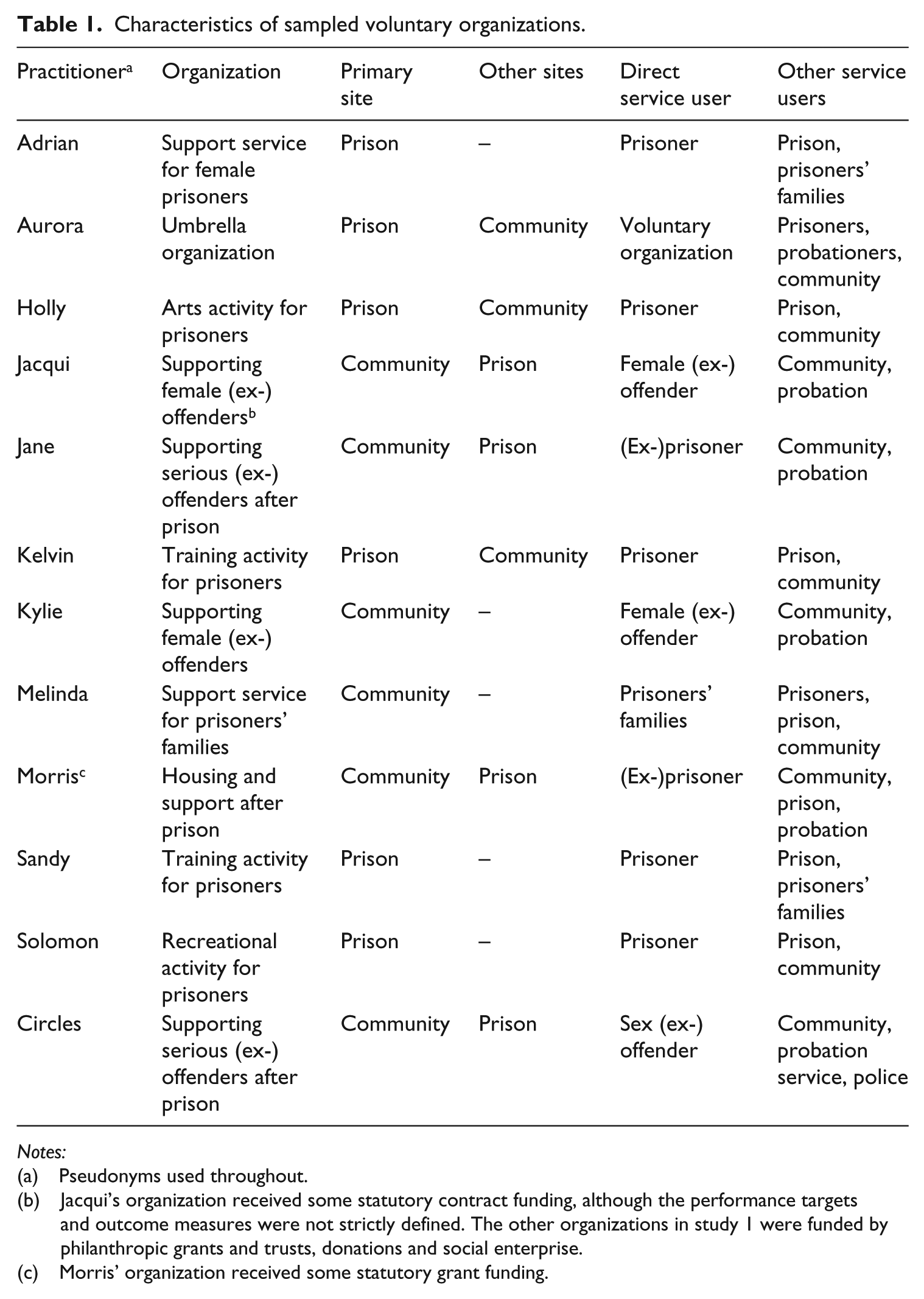
Notes:
(a) Pseudonyms used throughout.
(b) Jacqui’s organization received some statutory contract funding, although the performance targets and outcome measures were not strictly defined. The other organizations in study 1 were funded by philanthropic grants and trusts, donations and social enterprise.
(c) Morris’ organization received some statutory grant funding.
Like Kaufman (2015), we found funding did not determine variations in the work of effects of the organizations. While funding, and marketized and governmental political discourses are likely to affect working practices (e.g. by foregrounding the priorities of statutory agencies), we could not correlate more inclusionary outcomes with particular funding sources or organizational characteristics. We found exclusion in work funded by philanthropic trusts and foundations, and inclusion in projects receiving statutory contract funding, although we did not sample any organizations in tightly structured or PbR contract relationships with statutory organizations. Such relationships may offer diminished flexibility and space for (ex-)offenders to explore their own needs, desires and potential. Nevertheless, CoSA generally have formalized ongoing relationships with police and probation, but our data indicate how powerful and life-saving connections formed even within this tightly controlled framework that connects statutory criminal justice institutions to community organizations and settings. Future research could explore whether specific characteristics (e.g. tightly defined contract relationships; voluntary organizations’ varying objectives and priorities; service user race, gender and ethnicity), can correlate with (without assuming they determine) more and less inclusionary effects. 13
More than control
Netwidening, control and exclusion must feature when discussing penal voluntary organizations. However, our data indicated that voluntary organizations can offer what we term inclusionary control, that is, providing objective or subjective advantages to (ex-)offenders in their life trajectories, while accepting and working within or alongside the carceral net. 14 The programmes we resetrol and attempts at behaviour modification, but these were significantly less dominant than in statutory services (this should, however, not be assumed across voluntary sector programmes). Supervision, risk management and their controlling and exclusionary implications, were often present to some degree in voluntary organizations’ working practices, but did not form the principal function of any organizations sampled. Our organizations all accepted the legitimacy of punishment and the basic rationalities of risk management and information sharing. Yet, despite working alongside the carceral net, their practices had not become ritualistic and were distinguished from statutory agencies by (ex-)offenders and practitioners. The danger of voluntary organizations becoming bound up in punitive objectives is enduring, but scholarship uncovering distinctive voluntary sector qualities plays some role in challenging this.
Although the operation of power cannot be entirely suspended, our least complicated example of ‘voluntariness’ (Mathiesen, 1974) came from voluntary organizations that offered choices to (ex-)offenders and accepted their individual circumstances. These groups included them in programmes and relationships as they were, rather than as they ‘should’ be. Such acceptance could be particularly valuable for those coping with criminal stigma. The following four quotations demonstrate the existence and significance of ‘voluntariness’, when the ‘helpers’ do not dictate the conditions (Foucault, 1977). Ex-offender Christopher (study 2) explained that he did not feel forced or compelled to do things by his Circle: ‘None of the time was it you must do this or you must do that. It always over a cup of tea and a biscuit. […] It was a big help that way’ (emphases in original).
Project Manager Kylie (study 1) demonstrated her charity’s distinctive work supporting employment. ‘Employability’ is a state-endorsed goal amid criminal justice and welfare, and organizations who ‘fit’ state-endorsed goals often enjoy easier access to criminal justice institutions and funding. However, Kylie explained their focus on taking people as individuals and exploring what they want to do. While some conditioning will occur and power dynamics are always present, this person-centred, flexible and responsive approach is significant: Perceptions of what we do (are) […] you’re gonna have a bank of employers that you can say ‘Ok, right, you can go there and do that job.’ Every client that we see has different issues, is at different stages, has different restrictions. […] We have to take everybody on an individual basis and look at what they want to do. So, the majority […], their priority is to try to get into voluntary work or education, to improve their skills or even give them skills that they’ve not had before […]. It’s small steps towards, you know, achieving their goals.
In a similar vein, Director Sandy’s charity (study 1) offered prisoners an elective qualification opportunity. Whether ‘free’ decisions can be made in prison is questionable, but choices and a relative lack of coercion can hold particular value therein: They can get qualifications as well, they can get a qualification in audio or video production because two of us are teachers, so we can deliver that, if they want to do it, we don’t make them do it. So the choice is there. (Emphasis in original)
Director Morris’ Christian housing charity (study 1) respected the beliefs of a Muslim (ex-)offender and engendered that respect among other residents, enabling the man to be safely housed: That person was a Muslim […] we had a Christian ethos and we respected his faith, which is not the case in some secular places, he would have been bullied, you know with a beard he would have been called Osama Bin Laden and all of that kind of thing, and had in a previous life. He was terrified of secular hostels. So he really appreciated us and responded. (Emphases in original)
Considerations of risk, accountability and control were more dominant in study 2 than study 1. CoSA are enabled to conduct their sensitive work by paying attention to these rationalities, but they were at least present alongside support and inclusion, and CoSA’s organizational culture was differentiated from the police or probation. Susie, a Coordinator (study 2), explained that holding (ex-)offenders accountable for their behaviour is important, but is not CoSA’s sole purpose: ‘The police have a very different culture, it’s about catching people doing things wrong and Circles isn’t there for that.’ Similarly, participants in study 1 explained that their organizations did consider security and risk (and accepted the ‘obvious’ rationality of doing so), but less predominantly than statutory services. This is distinctive, as it challenges the idea that neoliberalism as a programme of government ‘shifts the general burden of risk management away from the state […] in partnership with non state forms of expertise and governance’ (Pratt, 1997: 133). Project Manager Jacqui (study 1) considered risk after women’s well-being: It can be easy to lose sight of that woman in the prison sentence […] Things like […] their risk of reoffending, their risk of serious harm, all those sort of things, you have to take those into consideration when you’re working with a group of women who have the potential to be really risky, but I think it’s fair to say we always work from the position that women’s well-being, I guess, takes priority. (Emphases in original)
Director Adrian (study 1) considered security after the needs of individual women: If you’re a prison officer, your key role is always security […] so when they’re working with the women they’re primarily defined by the fact that they’re offenders, and then anything else will be secondary. […] All charities provide that, it is a different role, it’s seeing them first as a woman […] rather than as an offender. […] We approach them as a woman that needs our support. (Emphases in original)
Director Morris (study 1) considered risk after transforming people’s lives: I know where I’m going—to reduce the prison population by transforming people’s lives—oh, and by the way, you have to do it with an assessment of risk, because of public safety. […] They come at it from the other way […] Police and probation are trained that public safety is paramount, so anything that might be risky is frowned on.
Voluntary organizations’ consideration of inclusionary factors such as well-being and individual needs exists in a delicate balance with considerations of security and risk, and the need to challenge structural inequalities. Nevertheless, the foregrounding of the individuals rather than their offending or risk factors was highlighted as a distinctive quality of voluntary sector practice, forming a basis for inclusionary supportive work (which we develop below). Further research could usefully explore how voluntary organizations interpret, communicate and respond to risks and needs (Hannah-Moffat, 2005) and longitudinal ‘outcome’ research would be valuable.
(Ex-)offenders in study 2 also described how they received valuable support and signals of acceptance and belonging, perhaps for the first time in their lives. These interactions, they made clear, were more than the exercise of power and control, and represented valued social connections. (Ex-)offender Bill (study 2) described his appreciation of consistency and non-judgemental interactions: The fact that people actually want to spend time and talk to you is one of the things, I mean it sounds […] just a simple thing, that they turn up to have a coffee […] and that they do it week in, week out, and being talked to as an actual person as opposed to a label.
(Ex-)offender Bruce (study 2) closely echoed Bill’s appreciation: It’s knowing that there’s somebody out there […] having somebody that you can turn to, just for airing […]. You’re not kicked out into the cold and said get on with your life. […] You know you’re gonna come across problems, but having someone there […] that you can talk to without being judged helps again with your own confidence.
Ex-offender Alan (study 2) compared his Circle to family members and valued his relationships with them: ‘I felt welcome, you know they were like brothers, sisters, or parents to me, and I thought “I don’t want to say bye to these people”.’
Both studies indicated that voluntary organizations’ support could form a perceived and actual mode of inclusion. (Ex-)offender Alan (study 2) felt it contributed to him remaining in the community, rather than being excluded and re-imprisoned: They are there on hand you know, and I can call them at midnight […] if I need to. The support is always there […] it’s important and imperative that I have that support, and I would stray off for possible recall without it.
Alan’s view was echoed by Project Manager Jacqui in study 1, who explained the supportive effects of praise and their extensive efforts to keep clients out of prison. Such efforts could lead to inclusion (in society rather than prison, in housing, in a family) and stimulate engagement with services, which is particularly valuable as (ex-)offenders often struggle to engage: If you say to somebody ‘I think you’ve done really well’, it might be the first time that somebody’s ever said that. For me to actually ring them when I said I was gonna ring them is for them a huge kind of landmark on the road to trusting services. If nothing else, if you need to go to their house and make them get up and drive them to probation, it means they’re not gonna get recalled. […] You have to be prepared to do that. The last thing that you want is for that woman to go back to prison. They’ll lose their accommodation, they’ll lose their contact with their children, and all of that negative stuff that goes along with recall.
Voluntary organizations’ work could even enable (ex-)offenders to remain included in life itself. (Ex-)offender Troy (study 2) described how having support from a volunteer helped him come through a period of feeling suicidal: The first Christmas I was out, I contemplated suicide (pause) I actually looked at the aerial cable on the TV and the water pipes […] I started fashioning a noose […] I got that close […]. On the Boxing Day after I thought about topping myself I got in touch with one of [the volunteers] and we spoke about it. It brought me round, it pulled me out of it and I will never be able to thank that woman enough!
Co-ordinator Angela (study 2) also described how the availability of phone support from a volunteer prevented a Core Member’s suicide attempt: The phone is very helpful, knowing that there is a phone line that they could speak to someone at a time of distress. There was a former member that called [volunteer] from the edge of a bridge […] saying he wanted to finish it. Bless her the volunteer talked him off the bridge.
Statutory staff can also be supportive and empathetic, but voluntary sector staff in study 1 illustrated distinctive non-judgemental and enabling conceptualizations of (ex-)offenders. They described clients as: ‘amazing women, who have faced so much and still keep going’ (Jacqui, Project Manager, emphases in recording); ‘normal people who have made a mistake in their lives’ (Kelvin, Project Manager); and ‘people with goodness inside them’ (Solomon, Charity Director). Such conceptualizations are likely enabled by the distinctive place of voluntary organizations, with some practical and psychological separation from the more coercive and punitive aspects of criminal justice. Project worker Holly (study 1) explained how their role was separated from judging offending behaviour and sentencing: ‘You know, it’s not for us to make judgement about what they’ve done or […] you know, sentencing and all the rest of it.’ Director Adrian (study 1) detailed charitable practitioners’ relative distance from sanctioning and disciplinary work
15
(Tomczak and Albertson, 2016): Lots of [Prison Officers] are very good and provide lots of support to the women, but […] in prison it’s just a thing, if you kick off on the landing, the same Officer who may have been being really supportive earlier, their job is to take your privileges away and to lock you up and […] drag you off somewhere if you’re really kicking off.
Accepting people as they are, providing opportunities to explore and exercise personal choices (even if these choices are constrained and involve some degree of conditioning) and respecting individual difference appear to be key aspects of inclusionary voluntary sector programmes, even when they are delivered alongside a controlling carceral framework and set of power relations. Nevertheless, voluntary organizations’ exclusionary and punitive potential can always prevail.
Expanding control and exclusion
Notwithstanding the important inclusionary work we found, it is important also to acknowledge and analyse the punitive and exclusionary implications of voluntary organizations’ work. Our data indicated that voluntary organizations can reproduce and expand statutory penal control and exclusion. Participants in both studies illustrated how voluntary organizations can enhance (ex-)offender monitoring (Foucault, 1977: 126), which could lead to exclusion, for example, from housing and being at liberty in the community. Director Morris’ voluntary organization (study 1) supported and housed prisoners after release, conditional upon drug testing. A positive result from drug testing would exclude (ex-)offenders from the programme and be shared with Offender Managers, so could catalyse breach and further exclusion and punishment: We test on entry, if they are positive for Class A drugs we refuse entry, because that means they have taken drugs between prison and us, so they’re not going to be ready. For cannabis, we’re more flexible, ’cause that’s in the system for longer. We say: ‘we will take you in but if you’re positive in 28 days’ time, we will evict you’. […] We’ll say to the Offender Manager: ‘this person turned up positive’.
Project Manager Jane (study 1) also described gaining privileged access to information about a service user and relaying it to probation, resulting in recall: There’s a whole chunk of monitoring that goes on as well, I’m going to talk to someone after you on a video link who’s been recalled to our local prison, but that was because we’d got some information and I think we stopped something happening to be honest. It was actually me who rang up the Probation Officer, because I had concerns, and then they got the Police in.
Several statutory criminal justice practitioners also viewed CoSA as enhancing monitoring of (ex-)offenders, who were often already subject to strict licence conditions, by being their ‘eyes and ears’: We are looking to utilize [CoSA] as another set of eyes and ears really. (Charlie, stakeholder, study 2) As far as I was concerned it was just another group of people as eyes and ears. The more people that I can speak to who are finding things out—not because I don’t trust [(ex-)offender], but the more information I have, the better. (Frankie, stakeholder, study 2) [CoSA is] not just that support and reintegration but the extra eyes and ears, that you can’t buy. (Casey, stakeholder, study 2)
Voluntary organizations may gain privileged information through apparently informal interactions in community locations, lubricated by the apparent separation between voluntary and statutory agencies, and voluntary organizations’ relatively frequent interactions with probationers. Voluntary organizations may not always share knowledge that they gain and create about (ex-)offenders (Foucault, 1977) with statutory agencies (Goddard, 2012). But, both studies illustrated how voluntary organizations’ work can extend the statutory criminal justice system’s exclusionary reach.
Practitioners in study 1 invested in building supportive relationships and rapport with probationer service users, which they differentiated from relationships that statutory criminal justice staff could build (in terms of location, separation from punishment and frequency of contact). Nevertheless, these ostensibly informal interactions could lead to formal exclusionary outcomes. For Project Manager Jane (who triggered the recall above, study 1), interactions with (ex-)offenders occurred in community settings such as cafes: ‘I really am spending a lot of my time, I joke actually, I spend a lot of my time sitting in cafes with [serious] offenders having coffee, assessing them, getting relationships going’ (emphasis in recording). Project Manager Kylie’s organization (study 1) emphasized its separation from statutory agencies to service users, which was well received: We try to tell them that we’re not the system, you know, we’re not the police, we’re not probation, we’re not prison, we’re a charity that wants to help them. […] We are independent, away from that […] and they do seem to respond to that.
Project Manager Jacqui (study 1) said she had significantly more contact time with (ex-)offenders than probation officers or psychiatrists: Probation officers have the most ridiculous caseloads. They have really high numbers of people. […] We tend to see the women a lot. Erm, you know, if a woman […] sees her psychiatrist once every six months, and we see them every week. (Emphases in recording)
Relationships, rapport and frequent contact can also support inclusion, but these are not uncomplicated benefits. Apparently ‘safe’ or therapeutic places may be, or become, significantly more punitive, disciplinary or directive than they appear. The exclusionary potential of non-punitive interactions with voluntary organizations may not always be evident. Project Manager Kylie (study 1) attempted to highlight this: ‘we try to tell them that […] we will have to feed back if there’s any issues, to the Offender Manager’, and CoSA selection factors theoretically include preparedness to accept close liaison between volunteers and statutory agencies (Circles UK, 2015). In practice there were different degrees of awareness of this in CoSA. Stephen clearly understood information sharing, but Norman felt ‘betrayed’ after experiencing it: Everything that happens in [CoSA] is put back to Probation. So every conversation that we’ve had in Circles, Probation and [Coordinator] know about. So there are no secrets. (Stephen, (ex-)offender, study 2) I feel betrayed because when I tell them something innocent like that there is no need to tell [the police], and it’s, I feel a bit down next time I see ’em. (Norman, (ex-)offender, study 2)
Countering claims about the distinctive contribution (Maguire, 2012; Mills et al., 2011) voluntary organizations are often presumed to make (in contrast to public or private sector engagement), Kylie and Morris from study 1 indicated that voluntary sector programmes are not always useful, and participants did not always engage with or benefit from the programmes:
16
We’re dealing with a very difficult client group […] women ex-offenders who’ve got issues. And they’ll drop off for whatever reasons. (Kylie, Project Manager, study 1) They will go AWOL. Most likely if they are in arrears or arrested but not exclusively so. (Morris, Charity Director, study 1)
Recognizing the potential for programmes to do very little for participants is important for tempering overblown accounts of effects, but also has exclusionary potential if, for example, failure to engage with support services is reported to Offender Managers and interpreted as increasing the individual’s risk of reoffending. Programmes intended to be supportive, which simply fail to suit or engage (ex-)offenders, could thus become mechanisms of exclusion.
This section has illustrated some exclusionary mechanisms of voluntary organizations’ work. Their effects vary on a case-by-case basis. Organizational principles and institutional priorities contribute, but specific local and individual contexts also have enduring importance. Volunteer Jade (study 2) explained that she personally judged Core Members and conceptualized work with them differently, even while operating within the same organizational structure and funding arrangements. Jade prioritized learning with one (ex-)offender, and surveillance with another: The guy I am working with at the moment, he is a very lonely and isolated guy. He doesn’t have any friends and has no network so doesn’t speak to anyone, and me meeting him every week […] I do it for him because it gives him a chance to learn skills again […] But my second Core Member that was definitely for the community, I was like ‘WOW! This guy definitely needs making sure we know where he is.’ So yeah every person is different.
In the same vein, Chairwoman Aurora (study 1) explained how the voluntary sector’s distinctive person-centred approach was permanently at risk of being captured by controlling, punitive and exclusionary foci. Aurora indicated that voluntary organizations could challenge this by asserting their principles and objectives, but illustrated the ever delicate balance between inclusionary and exclusionary outcomes against the backdrop of risk and punishment: Instead of seeing people as offenders, which the criminal justice system too often does […] Instead of sort of seeing everything through the lens of offending, which is always through the lens of risk and, and the lens of need, so you define people as being risky and needy […] is looking at is, you know, what are people’s strengths? And I think that is where the voluntary sector, if it doesn’t get completely captured by the criminal justice system, if it doesn’t let itself just be part of […] an offender-based experience […] So viewing offenders as people with potential, absolutely. […] But you have to be very careful not to be captured by the system! (Emphasis in original)
However, our data suggested that voluntary organizations could create supportive, potentially inclusionary places within the net of carceral control, which statutory staff could never achieve. Study 2 indicated that the support and sense of belonging provided by voluntary organizations could be sustained through emergent breaches in conditions or reoffending.
17
While voluntary organizations’ information sharing triggered exclusion, for example, recalls to prison, that was not all they contributed. Core Member Alan (study 2) explained how he remained included within and supported by his CoSA volunteers despite his recall, which ‘overwhelmed’ him. He did not expect this, and felt it was beyond what a statutory agency could offer: They come to prison and they said what you come back here for?! But they did it in a nice manner and they were concerned, you could see it on their faces […] They were absolutely gutted when I was recalled and I didn’t think I would ever see them again […]. When I came out the welcome was second to none […] I thought perhaps it was my gate money and me clothes and I wouldn’t go back there, but they were corresponding with me (pause) which I didn’t really expect and I was overwhelmed.
18
Our data have illustrated that voluntary organizations seem to offer (ex-)offenders distinctive mechanisms of inclusion, despite remaining nested within a context of penal control. Voluntary organizations can offer support that can keep people alive. This support, based on acceptance and non-judgemental relationships, can lead to outcomes for (ex-)offenders which include: feeling better; feeling more confident; avoiding recall to prison or being recalled less frequently; engaging with services; learning skills; and being connected to people who can help solve problems. These are inherently valuable mechanisms of inclusion, which could all also ultimately contribute towards desistance and ‘the pursuit of a positive life’ (Maruna, 2007: 652). Although voluntary organizations can provide distinctive mechanisms of inclusion and mechanisms of desistance from crime, they generally work within contexts which always retain exclusionary potential.
Conclusion: Theorizing inclusionary control
This article has addressed the empirical and theoretical gap relating to the effects of voluntary organizations’ work. It can be hard to discern whether voluntary sector programmes are including or excluding (ex-)offenders, or shoring up or breaking down penal power. Our concept of inclusionary control encapsulates the mixing of exclusionary and inclusionary forces that is often found in practice.
One could judge many penal voluntary organizations to be ‘incorrectly’ focusing on service delivery for individuals and plugging the gaps left, for example, by statutory cuts, while legitimizing structural inequalities and problematic penal institutions (Hannah-Moffat, 2005). It is valid and important to question what proportion of penal voluntary organizations deliver services under (problematic) conditions set by penal and statutory institutions, and what proportion of the sector engages with broader struggles for social change, for example, by undertaking lobbying work (Carlton, 2016).
Nevertheless, even if following an anti-carceral agenda which reduces prison numbers, we still require ‘support’ services because there are real people needing immediate resources (Carlton, 2016; Shaylor and Meiners, 2013). We have highlighted inclusionary practices in our analysis: offering choices; individual development opportunities (based on what individuals need and want); meeting human needs, for example, housing; foregrounding the individual not their perceived risk; and signalling acceptance and belonging. These practices may enable individuals to escape the reach and effects of the penal system. Operating in accordance with such principles, alongside or within penal institutions, is to adopt a set of practices that make penal institutions less brutalizing and destructive (Liebling, 2004).
Without denying the dangers of the expanding carceral net, its forms and attributes vary. The degree of ‘voluntariness’ and the flexibility of opportunities offered by third sector programmes differ. However, voluntary organizations’ support can change the substance of the carceral net. Compassionate behaviour from statutory staff can make the net gentler (Liebling, 2004), while voluntary organizations may temporarily make it gentler still. Gentler nets can prevent suicide, improve experiences of punishment and present different possibilities. They can have more or easier routes out, through which (ex-)offenders can gradually progress or be guided, becoming more included, suffering less harm and perhaps ultimately even managing to escape the net entirely.
But, structural inequalities and the problems of penality must not be forgotten and distinctive inclusionary qualities of voluntary organizations should not be assumed. The gentler inclusionary net that has more routes out of its grasp can quickly revert to a harsh, tight, deep, exclusionary carceral net. An optional support programme can quickly become a surveillant, exclusionary extension of punishment, as our analysis demonstrated. These punitive transformations could be particularly pertinent where statutory contract funding creates working conditions that lead to goal distortion of voluntary organizations and mission capture by punitive, exclusionary foci.
A significantly expanded empirical evidence base could test this suggestion by examining the characteristics and qualities of the carceral net as it operates and is experienced by different people in different voluntary and statutory sector projects. Penal voluntary organizations’ work is always likely to involve some, albeit variable, degree of power and carceral control, but the nature and extent of this control varies. Establishing how and under which conditions inclusionary outcomes can prevail within controlling contexts is a useful project for penal reform.
Footnotes
Funding
The author(s) disclosed receipt of the following financial support for the research, authorship, and/or publication of this article: The Leverhulme Trust ECF-2015-615, University of Leeds School of Law, University of Manchester School of Law Scholarship and Wates Foundation.