




Abstract
Sensory differences are well documented in autistic individuals. However, early sensory experiences have not been fully explored, particularly from the perspective of autistic people. We sought to understand early sensory experiences in autism from the perspective of autistic adults (some of whom also had autistic children) and caregivers of autistic children (some of whom also had a personal autism diagnosis). Using a qualitative descriptive design, aligned with a constructivist paradigm, focus groups were conducted with 3 autistic adults and 12 caregivers of autistic children. Data were analysed with reflexive thematic analysis. Five themes were generated accounting for early sensory experiences in autism: (1) Acknowledging the uniqueness of sensory preferences, (2) Negative impacts of different sensory experiences, (3) Feeling different and the pursuit of belonging, (4) Controlling sensory experiences to support daily function, and finally (5) Overcoming the challenges of the sensory world. The findings highlight the specific sensory needs of autistic children in early childhood and the adaptability of caregivers. This information can help young autistic people and caregivers advocate the importance of recognising the uniqueness of each autistic child’s sensory preferences when seeking support.
Lay Abstract
Sensory behaviours in early childhood can impact how autistic children experience and engage in the world. There is a lot of research about sensory differences in autistic children; however, there is very little known about experiences in early childhood. We asked 3 autistic adults and 12 caregivers of autistic children about their/their child’s experiences of sensory behaviours in early childhood. In our sample, autistic adults and caregivers of autistic children shared similar experiences about the challenges they/their children face related to sensory experiences in early childhood and how they overcame these. The findings can influence how researchers and service providers view sensory preferences in early childhood by understanding that everyone’s preferences are unique, and the importance of advocating for what works for each autistic person.
Introduction
Sensory differences are common, impacting 69%–95% of autistic people (Baranek et al., 2006; Kirby et al., 2022; Tomcheck & Dunn, 2007). These sensory differences are diagnostically relevant and are often categorised into three types based on how an individual responds to a sensory input: hyper-responsivity, hypo-responsivity and seeking. Hyper-responsivity is described as responding more than expected to an input, often in a manner reflecting distress (e.g. covering the ears in response to an innocuous humming sound), whereas hypo-responsivity is not responding, or responding less than would be expected, to a stimulus (e.g. not being upset following injury). Finally, seeking refers to an individual seeking more sensory stimulation in the way they engage with a stimulus (e.g. looking closely as they spin the wheels on a toy car). Autistic presentation is heterogeneous, including for sensory differences (e.g. Uljarevic et al., 2017), which can occur across the sensory modalities (e.g. tactile, auditory, visual; Jussila et al., 2020; Tomcheck & Dunn, 2007).
Understanding autistic sensory differences has been a focus of research for over a decade as these differences can have profound positive and negative impacts on the lives of autistic individuals. For example, hyper-responsivity is associated with heightened anxiety (e.g. Carpenter et al., 2018), and sensory seeking has been found to impact mental health (MacLennan et al., 2022). More broadly, these sensory differences can lead to difficulties in adaptive behaviour, emotion regulation and social interactions. Indeed, sensory reactivity appears not to be static but can be modulated by factors such as mood (MacLennan et al., 2022). Often challenges are experienced in the home, school and community (e.g. Daly et al., 2022; E. Jones et al., 2020; Kirby et al., 2022), particularly in environments designed without sensory accessibility in mind (MacLennan et al., 2023). However, there are also accounts of autistic individuals enjoying their sensory differences, such as the sounds they produce for themselves (R. Jones et al., 2003). Likewise, repetitive behaviours (i.e. ‘stimming’) have also been described as enjoyable and soothing (e.g. Kapp et al., 2019).
Despite the diagnostic recognition of sensory features in autism in 2013 (American Psychiatric Association, 2013), our understanding of their developmental trajectory and underlying mechanisms remains limited. Schaaf et al. (2024) highlight the need to investigate the onset and progression of sensory features in early childhood to identify critical periods for supports. Existing childhood research largely relies on quantitative methodologies, which, while valuable, often fail to capture the heterogeneity and subjectivity inherent in sensory experiences. Taels et al. (2023) note from the work of philosopher De Jaegher (2013) that the field should focus on how the sensory world is experienced by autistic people, rather than on theories attempting to explain the nature of autistic sensory differences (e.g. Weak Central Coherence theory, Happe & Frith, 2006; Happé, 1996; Enhanced Perceptual Functioning theory, Mottron & Burack, 2001). The importance of lived experience accounts in autism has come to the fore in recent years, and as critical autism experts (Gillespie-Lynch et al., 2017), autistic people have provided insights never possible with quantitative methodology. Predominantly in adults and older children, these accounts have provided insights into the experience of sensory differences in autism. Qualitative studies of autistic sensory experience in adults have revealed a complex interplay between physical, emotional, relational and social dimensions of sensory experience (Sibeoni et al., 2022). Importantly, the sensory experiences of autistic individuals are sometimes described as integral to sense of self (e.g. R. Jones et al., 2003). In their recent meta-synthesis of the qualitative literature, Sibeoni et al. (2022) found that the autistic sensory experience is holistic and inseparable from the environment. This aligns with a phenomenological enquiry published in the same year, where Murray and colleagues (2023) use the term ‘sensorium’ to describe the totality of their subjective sensory experience, encompassing both physical and interpersonal experiences. Therefore, while specific, single-modality investigations can provide valuable insights, they fall short of the real-world sensory experience described by autistic individuals and the fullness of sensory experience cannot be understood divorced from the environment.
These rich, qualitative accounts are missing for key developmental periods such as early childhood. Through Sibeoni et al.’s systematic searching, only one qualitative study of sensory experience focused on childhood, but not early childhood (Mean age = 7 years; Kirby et al., 2015). While there is some work attempting to map sensory behaviours in young autistic children through retrospective video coding (e.g. Baranek, 1999; Unwin et al., 2023), how these sensory differences are experienced in early life, and their impact, remain unclear. This is understandable as by their nature, these early sensory behaviours often occur in pre-verbal children. Yet there are two sources of insight which have remained ‘untapped’ on the topic of the experience of early sensory differences, and these are caregivers and autistic people themselves.
Therefore, this study aimed to understand early sensory experiences in autism from the perspective of autistic adults and caregivers of autistic children. The following research questions guided this project:
How did autistic adults experience sensory behaviours in their early childhood?
How do caregivers of autistic children understand their child(ren)’s experience of sensory behaviours in early childhood?
Methods
Study design
The consolidated criteria for reporting qualitative research (COREQ) guided study reporting (Tong et al., 2007). This qualitative descriptive study was part of a larger project using focus groups with autistic people to develop the Sensory Observation Autism Rating (SOAR) scale (Unwin et al., 2023). Qualitative descriptive methodology was employed within a constructivist paradigm, to explore sensory experiences in autism from the perspective of autistic adults and caregivers of autistic children. This approach was suitable for capturing the rich, subjective nature of participant experiences (Bradshaw et al., 2017; Doyle et al., 2020). Through the constructivist lens, we recognise that knowledge is co-constructed through participant experiences and researcher interpretation (Denzin & Lincoln, 2005, 2011).
Participants
Participants were eligible for this study if they had (autistic adult group), or a child in their care has (caregiver group), an autism diagnosis. Informed consent was provided by eligible participants willing to participate. Convenience sampling was employed in this study. As described in Unwin et al. (2023), participants were invited into focus groups through social media and the Olga Tennison Autism Research Centre (OTARC) participant registry. Study advertising asked autistic people or caregivers of autistic people if they were willing to share their/their child’s sensory experiences. Interested individuals contacted the chief investigator (K.L.U.) who explained more about the study using the participant’s preferred communication method (e.g. phone or email) and were reviewed for eligibility. Before this phone call/email conversation, participants were provided with the study information statement and consent form to review and ask any questions they had. Following this, if they wanted to participate, they were provided with an online consent form and demographics questionnaire link via RedCAP (The REDCap Consortium, 2023). All participants in this study provided informed consent and completed the demographics questionnaire. Prior to the study, there were no pre-existing relationships between participants and the research team. In this study, there was a greater focus on diversity of participants rather than sample size. However, Braun and Clarke (2013) suggest that 10–20 participants are sufficient for a medium-sized project. Therefore, 10–20 stakeholders from different backgrounds were sought. No participants withdrew/dropped out from the study.
Focus group procedure
All focus groups were facilitated by a female autism researcher with 10 years’ experience in the field and moderated by a research assistant. One focus group was held with autistic adults and two focus groups were held with caregivers of autistic children (Table 1). However, a number of the caregivers also had their own autism diagnosis meaning that 43% of the overall sample were autistic. All participants identified their ethnic background as Australian, but further demographic details were not collected to protect the anonymity of participants due to the smallness of the focus groups.
Participant characteristics.

Data generation
All data were collected within 1 week via semi-structured focus groups (60–90 min) held via Zoom. Focus groups were conducted over Zoom to increase participant comfort, allowing them to participate from their own space. It was also the most practical option as Covid-19 precautions were still in place. Participants were asked open questions about sensory behaviours that they, or their child, experienced in early childhood (under 3 years), and later childhood to understand differences developmentally (Appendix 1). To ensure consistency in terminology, and understanding of the sensory nomenclature, definitions were provided for each sensory modality. Focus groups were recorded, and audio was transcribed verbatim by an external third party with research transcription expertise (https://www.pacifictranscription.com.au/). Inspection of the transcripts indicated that data sufficiency (Braun & Clarke, 2021b; Fossey et al., 2002; LaDonna et al., 2021; Nelson, 2017) had been achieved. Transcripts were not returned to participants, and this error could not be remedied due to the time that had elapsed. In lieu of this, an external autistic consultant reviewed the manuscripts for alignment with the broader autistic experience. No amendments were suggested, and no repeat focus groups or interviews were conducted. Field notes were taken during the focus groups for consideration during analysis.
Data analysis
The second author (K.P-R.) conducted inductive data analysis using procedures consistent with Braun & Clarke’s (2021) process, using NVivo software (NVivo, 2012, QSR International Pty Ltd, Doncaster, Australia). Before analysis began, participant names were changed to pseudonyms to maintain anonymity. As 58% of the caregiver sample also had their own formal autism diagnosis, and 33% of the autistic adult sample also had an autistic child, a decision was made to analyse the data as one group. Authors were guided by the following recursive phases: (1) data familiarisation and writing familiarisation notes, (2) systematic data coding, (3) generating initial themes from coded and collated data, (4) generating and reviewing themes and (5) refining, defining and naming themes. Further details about processes completed and the coding tree are available by contacting the lead author.
The chief investigator (K.L.U.) provided ongoing review of the analysis process in consultation with K.P-R. Ongoing meetings were held to discuss how well the generated codes accounted for the data, distinction between the codes and clarity of relationships between the codes and theme structure. A reflexive diary and audit trail was utilised throughout data analysis to document methodological decisions, daily procedures and analytical insights.
The focus group transcripts were analysed in their entirety, despite later questions being about later sensory experiences (see Appendix 1 Interview Schedule section 3). This was because participants discussed early experiences even in response to these questions about later sensory experiences.
Trustworthiness
Lincoln and Guba’s (1985) criteria were used to ensure trustworthiness. Credibility was met through prolonged data engagement and peer debriefing. Consultation with autistic people occurred prior to publication, as discussed below. Detailed descriptions of research methods, philosophical standpoint, participant characteristics and study context enhance transferability and dependability. An audit trail and reflexive diary documented study stages and ensured confirmability of findings. In addition, K.P-R. and K.L.U. practised reflexivity in consultation meetings to examine personal biases and experiences.
Community involvement
The research topic, focus group design and questions were designed in collaboration with autistic people and caregivers of autistic people. Consultants reviewed and refined the initial draft of the focus group questions (Appendix 1). Following completion of the data collection, the findings were then reviewed by two autistic consultants. Specifically, one autistic researcher reviewed transcripts of all focus groups and took brief notes outlining some of the major contents of the transcript. They then compared these notes to the coding scheme and draft themes, offering feedback regarding any nuances from the focus groups they felt could be missing, as well as regarding the hierarchical organisation of codes, sub-themes and themes. This feedback was then integrated into the Discussion. The second autistic consultant reviewed both the content and the wording of the Results.
Results
The shared experiences of participants led to the development of five themes: (1) Acknowledging the uniqueness of sensory preferences, (2) Negative impacts of different sensory experiences, (3) Feeling different and the pursuit of belonging, (4) Controlling sensory experiences to support daily function and finally (5) Overcoming the challenges of the sensory world (Figure 1).
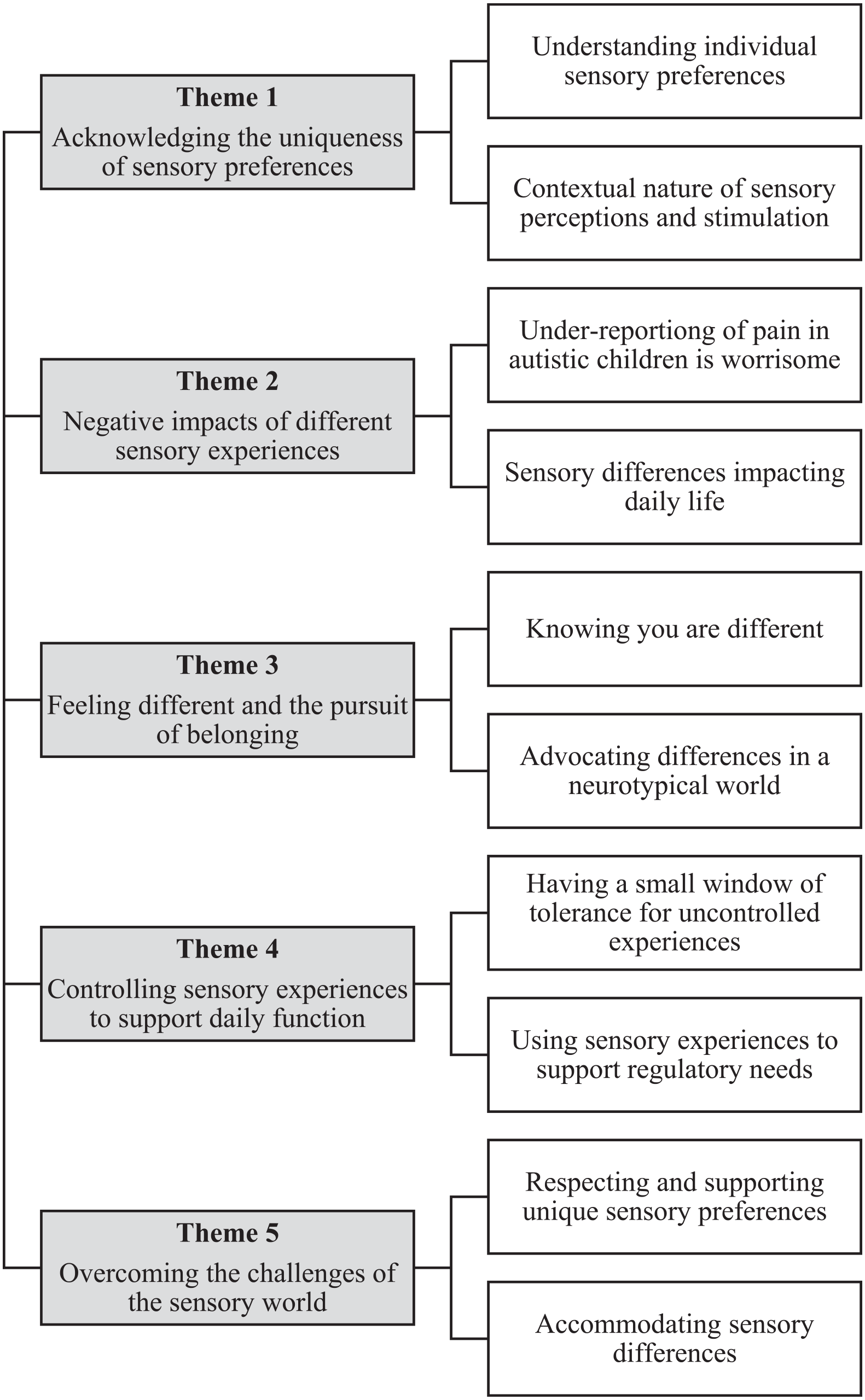
Thematic map of findings with themes in grey and sub-themes beside each theme in white.
Theme 1: acknowledging the uniqueness of sensory preferences
Theme 1 epitomises the uniqueness of sensory preferences in autistic children. Participants described how each child has unique preferences that vary with contextual and personal interest, which others need to understand. Theme 1 has two sub-themes: understanding individual sensory preferences and contextual nature of sensory perceptions and stimulation.
Understanding individual sensory preferences
This sub-theme highlights caregivers’ journey in understanding their autistic child’s unique sensory preferences, often recognising that these preferences might differ from those of their peers. As one participant described,
I remember having to sit down – this is going to NDIS – sat down with someone of the same intelligence. Okay, what does your child do in a normal day and then compared to, ah, so this is what a typical child does, this is what mine does. Oh my god. (Aisling; caregiver)
Despite some variation, participants emphasised that understanding their child’s sensory preferences became a positive experience. Learning about different sensory systems enabled caregivers to understand and contextualise their child’s early behaviours. One participant described, ‘it took me years to find out about the vestibular system and proprioceptor systems, how that was impacting him. And then once I did, I was like oh, yes, [laughs] it’s like that’s the problem’ (Orla; caregiver). Caregivers often recalled specific moments when they could attribute meaning to their child’s early behaviours due to sensory preferences, for example,
somewhere between one and two, I clicked that he would wake screaming at quarter to six on a Tuesday morning and it was always around that same time. Then finally one morning I’d gone in to settle him and it’s like oh, it’s [laughs] the garbage truck . . . (Dayanara; caregiver)
While caregivers attributed some meaning to their child’s behaviours, they noted that those outside of the child’s immediate circle often found it challenging ‘it’s probably to do with her sensory profile but I can’t actually accurately explain from Mary’s perspective why it was that she went ahead and shoved stuff up her nose and in her ears’ (Sneha; caregiver).
Contextual nature of sensory perceptions and stimulation
Caregivers and autistic adults both discussed how sensory preferences could be contextual. As one participant explained, ‘it’s funny because he likes to go and watch motor sports so he can – he loves the loud sound of cars, but a baby crying is very powerful, painful’ (Thea; autistic adult).
Within this sub-theme, participants consistently identified that the changing preferences could be challenging because ‘it’s very much what’s a problem some days is then not a problem other days’ (Orla; caregiver). Although caregivers in particular faced challenges in this sub-theme, they also discussed adapting to these challenges so even though ‘every day it was a different item of clothing. We had to work through the process of trying to figure it all out’ (Frankie; caregiver).
Theme 2: negative impacts of different sensory experiences
In Theme 2, participants describe the negative impacts of sensory experiences. Negative impacts of different sensory experiences consists of two sub-themes: (1) under-reporting of pain in autistic children is worrisome and (2) sensory differences impacting daily life.
Under-reporting of pain in autistic children is worrisome
Despite learning to understand their child’s sensory preferences, as described in Theme 1, caregivers considered their child’s perception of pain, or ‘that sort of pain awareness receptivity’ (Aisling; caregiver) to be a factor in their under-reporting. As one caregiver described, ‘I’m not 100 per cent sure on whether he’s not feeling, or whether – I think he’s got a different view of what level of pain is acceptable and should be reported’ (Dayanara; caregiver). When presenting their children for medical care, caregivers discussed how medical professionals described their child’s pain threshold, with one participant recalling
they checked her ears and they said, if that was you or me we would be screaming in pain it was so badly infected. But she’s there playing happily with the doctor. Yes, she had a fever but, you know. The doctor just looked at me. (Aisling; caregiver)
These differing perceptions of pain sometimes led to negative experiences for autistic children, resulting in minor injuries, or serious medical events. One caregiver described how their child might ‘kick something until he’s bleeding, or be very, very ill and he’s going along like there’s nothing wrong’ (Orla; caregiver). In more serious cases, participants discussed how they spent ‘an entire day and half a night in the [emergency] waiting room, until finally [their child] started passing out . . . and then we go off to surgery’ (Dayanara; caregiver). Psychological impacts of under-reporting of pain for caregivers were also identified in this sub-theme, in which participants highlighted how their ‘worst nightmare would be if she had a ruptured appendix because she wouldn’t know’ (Sneha; caregiver).
Sensory differences impacting daily life
While Theme 1 explores the positive outcomes of identifying personal sensory differences, caregivers and autistic participants equally shared negative experiences related to sensory differences in childhood. Many identified that their, or their child’s, nervous systems could become overloaded by sensory information, leading to physiological and/or psychological responses. Furthermore, participants described how these physiological responses manifested as difficulties engaging or complete certain tasks. One participant conceptualised,
It’s like becoming aware of your own mortality in a way, I suppose . . . if there’s all too many different sounds or – not even the volume but too many sounds and I’m trying to process a conversation or something, all my senses become overloaded much more quickly than any other sense. (Ana; autistic adult)
Unique sensory preferences were recognised as triggers for varied bodily responses, often manifested through involuntary physiological actions. One caregiver described how their child’s ‘torso tenses up really tight, so you see that kind of manifests as he’s very clumsy. He’s really – finds any sort of physical activity really exhausting’ (Orla; caregiver). External sensations were commonly reported as challenging: ‘the minute you touched her to actually wash her or wipe her with a flannel, she would instantly recoil and jump as if she was being electric shocked’ (Frankie; caregiver).
In exploring the negative impacts of sensory differences, one participant reflected that the challenge lies not in sensitivity to a specific stimulus, but in the rapid pace in which they must process and respond to sensory information:
It’s just the sheer input. It’s almost like I see you, I have to register you, then I move on. I see you, I register you and I have to move on. But when there’s so much of it, it’s all happening way too fast. (Roberta; caregiver)
Participants found that completing daily tasks could also be challenging because of their sensory differences:
I struggle with brushing my teeth, so does my son. We have a really strong gag reflex and I just have to put my toothbrush, even just at the front of my mouth and I’m gagging. Sometimes I actually do vomit as well. It is horrible. (Thea; autistic adult)
Other daily tasks, such as forming and maintaining friendships, were also identified as a negative impact of sensory differences. One participant described how they ‘really wanted to like peanut butter because kids eat peanut butter sandwiches but the feeling of it in my mouth would make me want to gag and it still does’ (Ana; autistic adult), highlighting the negative social impacts they experienced due to sensory differences.
Theme 3: feeling different and the pursuit of belonging
The third theme further explores the negative impacts of sensory differences in early childhood, while also highlighting how participants overcame these challenges. Feeling different and the pursuit of belonging addresses the social impacts, with participants describing feeling different from others and advocating these differences. This theme includes two sub-themes: (1) knowing you are different and (2) advocating differences in a typical world.
Knowing you are different
Knowing you are different explores how participants felt they, or their autistic children, were different to their peers. The perception of feeling different often led to negative and complex feelings for participants, sometimes resulting in feelings of isolation. As one autistic participant described,
When I was little, I knew I was different and I thought I was actually the only person who felt this difference. I didn’t know anyone else who was like me and I sometimes struggled to identify whether that meant I was special or whether that meant I was actually broken. (Thea; autistic adult)
Caregivers of autistic children also experienced negative social impacts due to sensory differences. Participants expressed discomfort regarding how others might perceive their child for using specific objects, such as fluffy blanket, to support their sensory needs. One caregiver reported ‘to think that he would be mocked and teased if he actually took this blanket with him and was seen to have it’ (Dayanara; caregiver). However, as one participant noted, not all communities share the same social boundaries. A child’s preferences that may be considered inappropriate in Western society could be seen as acceptable in other cultures, creating a sense of belonging. For example, one caregiver described their child’s tactile preference for eating with their fingers but ‘when he was in Singapore he was in heaven, because in Singapore the people do eat straight out of the bowl’ (Sage; caregiver).
Advocating differences in a typical world
In their pursuit of belonging, participants described various mechanisms for advocating for their sensory differences, both individually and at the community level. However, they found advocacy to be a daunting task that could sometimes reinforce the negativity associated with sensory differences:
If I could self-advocate without coming across as demanding or precious and ask for certain concessions, I might consider it but I just find it too hard to navigate that with people I don’t feel safe around because I don’t know them. (Thea; autistic adult)
Contrastingly, one participant described finding solidarity with other autistic individuals as a way to overcome feelings of being different
because we have to adapt to being in a neurotypical world . . . we’re quite good at thinking outside the box, I think. While I might not have the same sensory sensitivities as someone else, where there is a commonality, we can learn from each other and I love that. (Ana; autistic adult)
Theme 4: controlling sensory experiences to support daily function
Theme 4 marks the beginning of participants’ journey in managing sensory experiences to address the difficulties identifies in the previous three themes. Theme 4 emphasises the importance of controlling sensory experiences to support mental well-being and daily participation. Theme 4 comprises two sub-themes: (1) having a small window of tolerance for uncontrolled experience and (2) using sensory experiences to support regulatory needs.
Having a small window of tolerance for uncontrolled experiences
The first sub-theme describes participants’ experience of having a small tolerance for sensory stimulation that is beyond their control. Both autistic adults and caregivers of autistic children shared feelings of a ‘complete lack of control over your environment. I guess we feel like that a lot because we can’t really control a lot of things about our environment, but you don’t really dwell on that, do you?’ (Ana; autistic adult). This sense of lacking control was a common concern among participants, often leading to quick escalations in meltdowns:
They lose control, not a choice. It’s like a switch is flipped and they go from I’m getting worried, getting worried to just no conscious control over – they’re just full of fear and – or whatever emotion, depending on what the meltdown is connected to and what’s led to that point. (Mariam; caregiver)
Caregivers described various ways their child attempts to regain control, often through obsessive behaviours aimed at understanding when the over-stimulation might cease. As one participant shared,
So if he can hear the phone ringing at the other end of the house, or buzzing or something like that, it drives him up the wall and his response to that is who is it? What is it? Who is it? What and just really intense [repetitive], just more and more intense questions, until he can understand oh, it’s the phone or it’s the garbage truck. So for him it wouldn’t be a meltdown over the garbage truck, but it would just be that escalating anxiety and needing to talk about it constantly, until at some point he starts to understand what it is. (Orla; caregiver)
Each child’s tolerance was different, and participants reflected on how
it can be things they were tolerating stop being able to be tolerated. They’ve got a certain amount of control and it’s almost like they’ve got lots of different areas that they’re sensitive in all of them and if it was just one they could handle it. (Mariam; caregiver)
Participants attributed these behaviours to reducing the anxiety associated with sensory overload, describing how they provide a sense of predictability and comfort in overwhelming situations ‘it’s to do with that level of where their anxiety’s at and maybe the days their anxiety is lower, they can handle the things more’ (Mariam; caregiver).
Using sensory experiences to support regulatory needs
The second sub-theme explores how participants utilise their sensory preferences to regain control and support their regulatory needs in over-stimulating environments. Participants emphasised the calming effect that establishing a sense of control can have. Regaining control was important for participants and their children to feel regulated, as one participant described: ‘as long as he’s controlling it and as long as he’s expecting it, he’s okay with it’ (Dayanara; caregiver). When discussing auditory stimulation, one caregiver reflected on how a medical professional had described this phenomenon:
We had a psychologist explain to us that often it was about control. When the noise was coming from outside they couldn’t control it. When they were making the noise, or bringing the clock in or something, they had control over it and that was – control is calming. (Mariam; caregiver)
To enable regulation through controlled stimuli, participants reported using a range of tactile, olfactory and oral sensory experiences to alleviate their, or their child’s, anxieties. For oral preferences, one participant described, ‘I think mouthing and chewing on things is a really important thing to help with anxiety . . . I think him having that helps him manage his anxiety’ (Thea; autistic adult). These control-seeking behaviours were sometimes pervasive during times of dysregulation, such as when feeling highly anxious. Sneha (caregiver) reported, ‘So even she was a bit distressed and she was in grade two, which is seven or eight, thumb sucking was a go-to for comfort’. For participants who were autistic adults, oral sensory preferences served as a regulation strategy that facilitated graded participation in specific tasks or activities, such as studying:
I used to always chew chewing gum in my first lecture of the morning before putting it away in a tissue or whatever to throw out later. I’d always sit on the end of the row or whatever and gradually I’d work my way in over time. (Shiloh; autistic adult)
Theme 5: overcoming the challenges of the sensory world
The final theme draws together the previous themes by highlighting the different ways participants discussed overcoming the challenges of sensory differences in early childhood, to adapt to predominantly non-autistic environments. While this theme offers insight into the strategies that caregivers and autistic people develop and implement, participants also described how these strategies were essential to foster a sense of safety for them, or their child, in environments that typically did not accommodate their specific needs. The final theme has two sub-themes: (1) respecting and supporting unique sensory preferences and (2) overcoming the challenges of the sensory world.
Respecting and supporting unique sensory preferences
In this sub-theme, participants, particularly caregivers, shared various ways they help their child feel safe in over-stimulating environments. Participants expressed a shared belief that respecting and honouring a child’s sensory preferences is fundamental to supporting their engagement in allistic environments. As one participant described, ‘these days we have to eat on melamine plates, because the sound of cutlery on crockery is painful to her’ (Lani; caregiver). At times, these adjustments were seen to be disruptive to a caregiver’s daily activities: ‘if we were having eggs I would have to cook his meal separately and he would eat in another room. He couldn’t be in the room and that, that lasted for a very, very long time’ (Dayanara; caregiver). Overall, however, participants emphasised the importance of finding appropriate accommodations by recognising and supporting one’s strengths ‘importantly, with these sensory strengths and challenges that we have, if we receive the right accommodations, it really helps us with what we call out spoon theory, our spoons. So, our level of energies’ (Thea; autistic adult).
Accommodating sensory differences
In this sub-theme, participants discussed developing adaptations to sensory differences, building on their understanding of unique preferences from Theme 1. Caregivers and autistic adults reflected on the unique ways they, their child or family members accommodated specific preferences. One participant described,
She’s in Grade 6 now, so she’s amazing and she’s figured out what works for her and she just owns it, like I’m going to do it this way because this is how I need it and don’t get in my way. (Frankie; caregiver)
Self-determination was common among participants when describing the accommodations, which appeared to be driven by the motivation to experience the pleasurable sensation they were seeking. As one participant reflected on their early childhood,
I can remember that to help me avoid getting that brain freeze, I worked out that if I wrapped it [ice] in a hanky, I could crunch it, take it out of my mouth – this is when I was quite young – and then get the temperature of my mouth back to a normal temperature and then crunch away again. (Thea; autistic adult)
Conversely, participants also discussed strategies that enabled them or their autistic child to remove or reduce challenging sensory experiences, oftentimes to enhance their sense of safety, or recover from sensory overload. One participant shared, ‘I had an OT who did a joint session at someone’s place and it was getting too much for [my son] and he went in a cupboard under the stairs. So it’s that sensory deprivation; right, let’s recover’ (Aisling; caregiver). The final sub-theme encapsulates the innovative ways that caregivers and autistic children create opportunities for de-sensitisation:
I ended up making friends with the garbage man and going out and sort of – I’d get up at 5:30 and we’d play out in the street until he came, so that [laughs] we could – so that I was, you know, like what you do with a dog, with positive reinforcement. (Dayanara; caregiver)
Discussion
This study provides the first, rich insights into early sensory experiences in autism through five themes: (1) Acknowledging the uniqueness of sensory preferences, (2) Negative impacts of different sensory experiences, (3) Feeling different and the pursuit of belonging, (4) Controlling sensory experiences to support daily function and (5) Overcoming the challenges of the sensory world.
Previous research predominantly on adults has highlighted the importance of considering the autistic sensory experience holistically (Sibeoni et al., 2022), as a ‘sensorium’ (Murray et al., 2023), and we find evidence of the same in young autistic children. Our study points to the complex nature of sensory differences, even at an early age. Specifically, we found that early sensory experiences vary across contexts (Theme 1), have implications for interpersonal relationships (Theme 3) and result in physiological impacts (Theme 2). The topic of environment apparently underpinned many of these accounts, frequently being implied, even if it was not explicitly discussed to form its own theme. This again lends support for Sibeoni’s interpretation of previous qualitative literature on sensory difference in autism that sensory experience cannot be separated from the environment. Together, this alignment with recent accounts of sensory difference in autism, and our contribution that these are relevant in early development, suggests validity of these models across the life span (i.e. Murray et al., 2023; Sibeoni et al., 2022). Therefore, our research constitutes an important contribution to the literature by providing a sensorium account of early sensory experiences in autism. We echo the call by Sibeoni et al. (2022) and Murray et al. (2023), to both researchers and clinicians, to consider the full sensorium of autistic sensory experience, even in young children.
Both autistic adults and caregivers described innovative ways that they overcame the challenges of the sensory world for themselves or their child(ren; Theme 5). This theme tells the story of a community prevailing over the difficulties imposed on them by allistic environments. This theme was linked to Theme 1, ‘Acknowledging the uniqueness of sensory preferences’, making it clear that the uniqueness of sensory preferences dictated the uniqueness/tailoring of accommodations. Studies have consistently found that caregivers use numerous strategies to support their child(ren)’s engagement (Bernheimer & Weisner, 2007; Pfeiffer et al., 2017), including strategies to specifically support their child(ren)’s sensory differences, irrespective of diagnosis (Little et al., 2022). While we did not compare caregivers of autistic children with caregivers of non-autistic children, we found consistent evidence of the caregivers’ drive to understand their child(ren)’s unique sensory profiles, supporting them in equally unique ways. This further aligns with Little et al.’s (2022) finding that caregivers used support strategies in response to their child(ren)’s specific sensory needs, not just their overall sensory preferences. It was noteworthy that the autistic adults in our sample also understood and met their own unique needs in innovative ways. In contrast to autistic stereotypes, the flexibility of our autistic participants was evident, aligning with emerging literature (e.g. Idriss, 2021). Indeed, we also found evidence of autistic interdependence and considering the needs of others as well as their own, which again, is starting to be acknowledged in the wider literature (e.g. Gray et al., 2023). It was clear that the caregivers and autistic adults were experts in understanding and meeting their/their child’s needs and, in doing so, considered the needs of others and exercised great flexibility. We hope that this evidence goes some way to challenging autism stereotypes which are pervasive in the field.
An important consideration when discussing individualised autistic sensory needs (Theme 1) and overcoming challenges of the sensory world (Theme 5) is the environment. Within the social model of disability (e.g. Hogan, 2019), the onus is on society to adapt the environment to support the needs of autistic people, rather than relying on autistic people to be flexible and interdependent, and caregivers to be active supporters and advocators, as we see in our data. However, while the United Nations (2022) called for the inclusivity of public spaces by 2030, and standards bodies such as the British Standards Institution have produced design standards to support neurodiverse people (British Standards Institute, 2022), there is limited evidence to underpin these initiatives (see Manning et al., 2023). Until there is rigorous, ecological research investigating how everyday spaces impact autistic individuals, and the mechanisms of negative effect have been established from these, we will continue to fall short as a society in removing barriers for autistic people. However, neurodiversity-focused design or environmental considerations are only part of a complex picture of autistic sensory experience with MacLennan et al. (2023) demonstrating that neurotypicals’ unsupportive, judgemental and/or simply misunderstanding attitude towards sensory needs is highly problematic, constituting a large barrier to engagement in public spaces. Participants in our study, both autistic adults and caregivers, echoed this, describing feeling concerned about being judged for accommodating their/their child(ren)’s sensory needs, with an autistic adult worrying that they would come across as ‘demanding or precious’ in asking for accommodations (Theme 3). More public education regarding diverse sensory experiences is necessary, with the goal of making society and engagement feel safer for neurodivergent people.
While our findings align with those of Murray et al. (2023) and Sibeoni et al. (2022; and by extension the wider autism qualitative sensory literature), we contend that true consideration of the sensorium must also encompass socio-cultural factors. Sociologist David Howes (2021) describes ‘. . . the experience of the environment, and of the other persons and things which inhabit that environment, is produced by the particular mode of distinguishing, valuing and combining the senses in the culture . . .’. That is, we need to consider how socio-cultural factors may have played a role in either sensory experiences themselves or autistic and non-autistic people’s conceptualisation of those experiences. For example, while the social model of disability is increasingly accepted, the participants in our study still apparently needed to push against the often-prevailing medical model in society, making necessary the sentiments represented in a sub-theme of Theme 5 ‘Accommodating sensory differences’. Arguably, this sub-theme could be a function of the allistic environment our society has created, rather than autistic experience itself. However, our findings and the wider literature also highlight biological/physiological bases of sensory experience. For example, our sub-theme under Theme 2 ‘Sensory differences impacting daily life’ was all about recognising sensations and their impact on daily life, an idea which also emerged in Taels et al. (2023), and has a biological basis. Indeed, our fourth theme, ‘Controlling sensory experiences to support daily function’, also relates more to basic physiological function (e.g. Lawson et al., 2017; Pellicano & Burr, 2012), than culture, and again this aligns with the wider literature on the importance of control (MacLennan et al., 2023; Robertson & Simmons, 2015; Unwin et al., 2021). This suggests that our findings represent the ‘sensorium’ – from basic biological to socio-cultural sensory experience. However, this interpretation also highlights a large gap in the literature: lack of studies of autistic experience in other societies and cultures. Without these insights, it is likely that our understanding of autistic sensory experience will remain ‘blinkered’.
Limitations
We recognise that while the focus of this work was on early sensory behaviours, issues such as recall bias and the autistic adults describing their current experiences, as well as those in early childhood, may have impacted the findings. However, hearing the voices of autistic people and their caregivers is always valuable, even if, at times, it deviates from the central topic under investigation. In fact, this is the benefit of qualitative investigation. We are confident that we have presented data which represents early childhood experiences, alongside some experiences from later in life. However, our findings should be considered alongside studies which directly measure sensory differences in early childhood (e.g. Unwin et al., 2023).
The autistic adults in this study were all female, and while some caregivers reported on their autistic sons, the male experience of sensory differences in early childhood was largely missing. Lai et al. (2010) reported that autistic females experience more sensory differences than autistic males. However, in their meta-analysis, Ben-Sasson et al. (2019) found that gender was not a significant moderator of sensory differences. Ben-Sasson et al. (2019) do note that males were overrepresented in the 55 studies (n = 4606) they examined, and this could have impacted results. Therefore, while we cannot be sure if gender impacts sensory experience, it is clear that the quantitative literature overrepresents the sensory experiences of males, and therefore, perhaps our study provides a useful balance by presenting a predominantly female perspective. As a field, gender differences in sensory experience would be a fruitful enquiry as it may impact how sensory differences are measured and supported across genders.
Clinical implications
Too often, particularly in autism clinical services, social differences are the sole focus for practitioners. However, as with Kirby et al. (2015), we have highlighted that sensory differences can be experienced at, and impact, early development. Participant insights from our study offer specific areas of focus for clinicians to consider when working with young autistic children. We provide these tentatively as the sample size and study design limit generalisability.
Our data suggested that sensory differences are individual and contextually impacted (Theme 1), and this aligns with the broader literature (e.g. Uljarevic et al., 2017). Therefore, the individuality of these differences, along with the context they present in, should be explored and respected, even during early development. In addition, under-reporting pain (Theme 2a) has potentially severe implications for the autistic child (e.g. serious illnesses remaining untreated), as well as for health and medical practitioners (e.g. misdiagnosis). This propensity for under-reporting pain should be considered when taking firsthand accounts. Indeed, health and medical professionals should also use combined (e.g. proxy report) and autism-specific assessment methods to get the most accurate information possible.
Finally, it was clear from the focus groups that caregivers were masters of accommodations for their children, and this is reflected in the title of the article: ‘We’re quite good at thinking outside the box’. We recommend that clinicians consult caregivers about current accommodations which they employ and work closely to devise a plan for future supports. However, the voice of the child should not be excluded in these conversations, as our data also indicated that at times children unknowingly implemented various accommodations to meet their own sensory needs.
Conclusion
In this first study into the experience of early sensory differences in autism, autistic adults and caregivers of autistic children highlighted the importance of acknowledging the uniqueness of sensory preferences (Theme 1), as well as coming up with innovative adaptations to overcome the challenges of the sensory world (Theme 5). This was important as sensory differences had negative impacts (Theme 2), leading to feelings being different and seeking a sense of belonging (Theme 3). While adaptations such as controlling sensory experiences (Theme 4) were beneficial in overcoming the challenges of the sensory world (Theme 5), it was clear that more needs to be done as a field to understand and support the full sensorium of sensory difference.
Footnotes
Appendix 1
Focus group schedule.
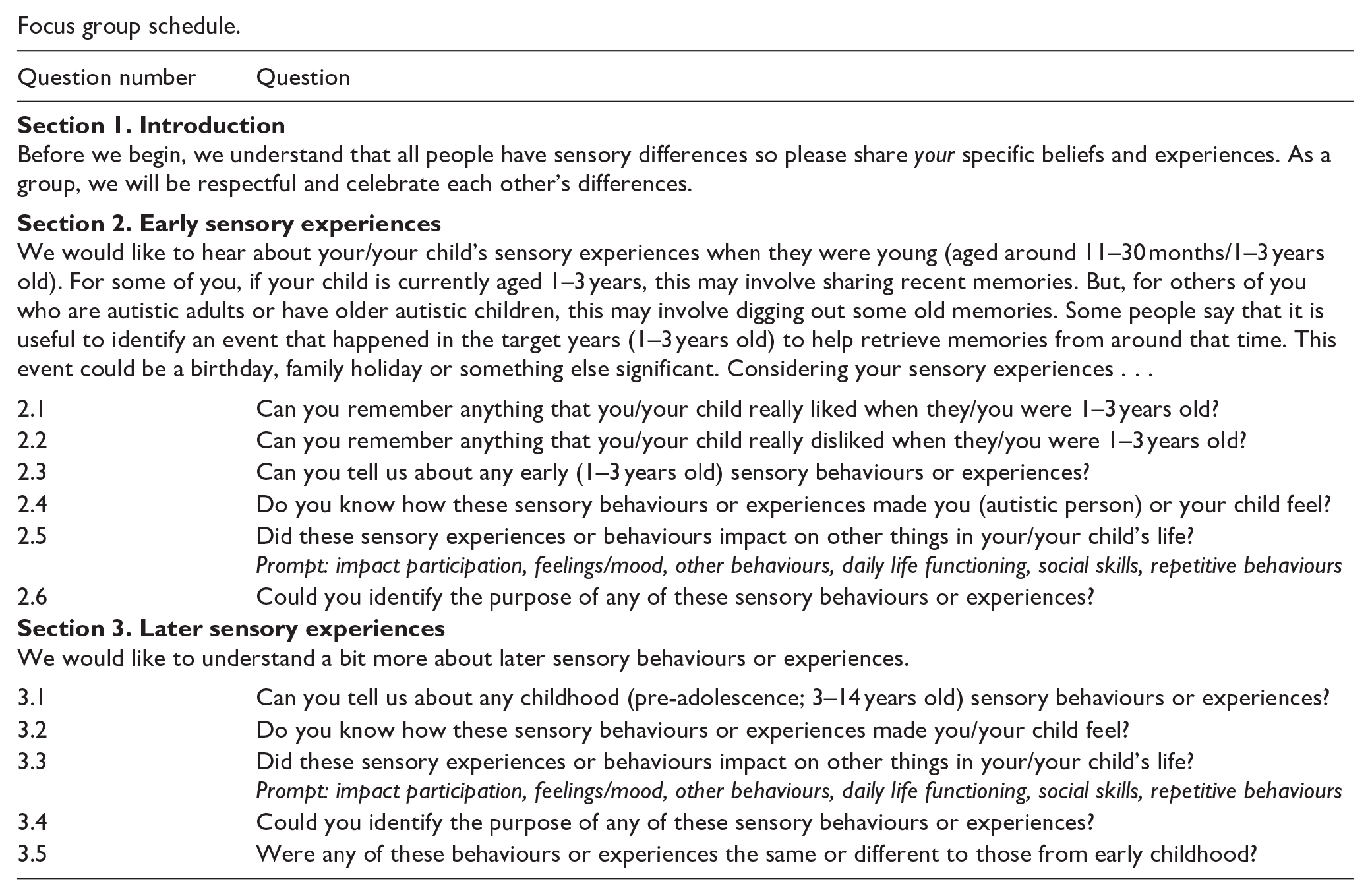
| Question number | Question |
|---|---|
Before we begin, we understand that all people have sensory differences so please share your specific beliefs and experiences. As a group, we will be respectful and celebrate each other’s differences. |
|
We would like to hear about your/your child’s sensory experiences when they were young (aged around 11–30 months/1–3 years old). For some of you, if your child is currently aged 1–3 years, this may involve sharing recent memories. But, for others of you who are autistic adults or have older autistic children, this may involve digging out some old memories. Some people say that it is useful to identify an event that happened in the target years (1–3 years old) to help retrieve memories from around that time. This event could be a birthday, family holiday or something else significant. Considering your sensory experiences . . . |
|
| 2.1 | Can you remember anything that you/your child really liked when they/you were 1–3 years old? |
| 2.2 | Can you remember anything that you/your child really disliked when they/you were 1–3 years old? |
| 2.3 | Can you tell us about any early (1–3 years old) sensory behaviours or experiences? |
| 2.4 | Do you know how these sensory behaviours or experiences made you (autistic person) or your child feel? |
| 2.5 | Did these sensory experiences or behaviours impact on other things in your/your child’s life? Prompt: impact participation, feelings/mood, other behaviours, daily life functioning, social skills, repetitive behaviours |
| 2.6 | Could you identify the purpose of any of these sensory behaviours or experiences? |
We would like to understand a bit more about later sensory behaviours or experiences. |
|
| 3.1 | Can you tell us about any childhood (pre-adolescence; 3–14 years old) sensory behaviours or experiences? |
| 3.2 | Do you know how these sensory behaviours or experiences made you/your child feel? |
| 3.3 | Did these sensory experiences or behaviours impact on other things in your/your child’s life? Prompt: impact participation, feelings/mood, other behaviours, daily life functioning, social skills, repetitive behaviours |
| 3.4 | Could you identify the purpose of any of these sensory behaviours or experiences? |
| 3.5 | Were any of these behaviours or experiences the same or different to those from early childhood? |
Acknowledgements
We are indebted to the autistic/autism community members who contributed to this research by participating in the focus groups and reviewing elements of the project. We are also grateful to Marguerite Hawke for reviewing a draft of the manuscript.
Author Contributions
Declaration of conflicting interests
The author(s) declared no potential conflicts of interest with respect to the research, authorship and/or publication of this article.
Funding
The author(s) received no financial support for the research, authorship and/or publication of this article.
Ethical considerations
Ethical approval was received from the La Trobe University Human Research Ethics Committee (HEC21035), and all participants provided written informed consent.
