




Abstract
When partners coordinate their movement in time and space to reach a goal, they perform joint action, an important part of every interaction. Joint action involves motor abilities and socio-cognitive skills like theory of mind. Autistic children’s lower joint motor coordination (joint action) abilities as well as their motor functioning and theory of mind difficulties may interfere with efficient peer interaction. However, the shared contribution of motor and theory of mind to partners’ joint action was not yet explored. This study investigated those contributors (motor and theory of mind) along with group and age differences in 84 autistic children ages 6–16 years and 64 non-autistic children matched by age, sex, and IQ across three age-groups: early-childhood, preadolescence, and adolescence. Basic and advanced theory of mind skills and most motor tasks were higher among adolescents versus early-childhood. However, the autistic group consistently underperformed the non-autistic group in basic and advanced theory of mind levels and in all gross- and fine-motor tasks across all age-groups, revealing unique motor development characteristics in autism. A significant joint full mediation effect emerged for motor and theory of mind skills on joint action performance in both study groups. Understanding that motor and theory of mind skills together underlie joint action opens up a new channel of intervention to facilitate peer interaction.
Lay abstract
When two or more people move together in a coordinated way at the same time and in the same place, they perform “joint action,” which is an important part of everyday social interaction. Joint action involves the activation of both motor skills and the social-cognitive understanding of others’ thoughts, feelings, and desires—their ability to hold “Theory of Mind.” Motor functioning and Theory of Mind may be challenging for autistic individuals. We wanted to investigate how motor skills and the ability to understand others’ minds develop in autistic and non-autistic children and adolescents and to explore how these skills contribute to joint action performance. We compared 84 autistic children with 64 non-autistic children matched by age, sex, and IQ. Among these 6- to 16-year-olds, we examined three age-groups: early-childhood, preadolescence, and adolescence. We found that older participants, both in the autistic and non-autistic groups, showed better abilities than younger participants in basic and advanced Theory of Mind skills and in most motor tasks. However, non-autistic children outperformed autistic children in Theory of Mind (at basic and advanced levels) and also in all gross-motor and fine-motor tasks, across all age-groups. The autistic group’s motor patterns were characterized by greater variability in tasks’ rated difficulty levels compared to their non-autistic peers, who showed more intact, uniform patterns. Both motor and Theory of Mind skills were found to significantly impact joint action performance in both study groups. These findings are important for understanding joint action’s underlying mechanisms and for refining social intervention programs for autistic individuals.
Keywords
Motor development enables children to explore their environment and socially engage in it (Payne & Isaacs, 2020). Development of socio-cognitive abilities like theory of mind (ToM) during early-childhood also contributes to children’s social engagement by allowing them to understand and interpret others’ mental states (Baron-Cohen et al., 2013; Chiu et al., 2023; Lincoln et al., 2021). Social peer interaction regularly involves “joint action” (JA), a socio-motor ability where partners coordinate their movements in time and space (e.g. exchanging objects or toys, playing tag, walking side-by-side), either by mirroring (e.g. pat-a-cake game) or complementing (e.g. kick-and-catch game) each other’s actions to reach a shared goal (Noy et al., 2011; Sebanz et al., 2006). Despite its central role in synchronizing social interactions and its reliance on both motor and socio-cognitive abilities (Zampella et al., 2020), JA’s underlying mechanisms remain underexplored.
Aiming to narrow this gap, the current study explored the joint contribution of motor and ToM skills to JA performance with a peer partner while comparing autistic children with their non-autistic peers. Autistic youngsters show well-documented challenges in social-communicational and socio-motor behaviors (American Psychiatric Association, 2022; Bar Yehuda & Bauminger-Zviely, 2024). Autism spectrum disorder (ASD) is a diagnosis characterized by atypical social-communicational behavior, specifically during social interaction, alongside sensory regulation difficulties and repetitive behaviors (Diagnostic and Statistical Manual of Mental Disorders (5th ed., text rev.; DSM-V-TR, American Psychiatric Association, 2022)). Although the DSM-V-TR formal autism diagnostic criteria do not include motor functioning, recent studies have indicated a higher prevalence of motor difficulties in the autistic population (Bhat, 2020; Reynolds et al., 2022), up to 22.2 times greater risk compared to typically developing (TD) counterparts (Bhat, 2021). Some evidence indicates a different acquisition order for some ToM skills among autistic children compared to non-autistic children (Peterson & Wellman, 2019). Delay in ToM abilities’ development was also reported in both autistic children and adults compared to non-autistic individuals (Gao et al., 2023; Pedreño et al., 2017; Rosello et al., 2020). Thus, social interventionists seeking to design effective intervention models to improve autistic children’s peer interaction would benefit from empirical exploration of the role that ToM and motor abilities play in JA performance in both study groups, across three developmental age-groups (early-childhood, preadolescence, adolescence).
Motor development in typical development and autism
Fundamental motor skills gradually develop from infancy onward and can be divided into: (a) gross-motor activities involving large muscles (arms, legs, torso) and (b) fine-motor activities involving smaller hand muscles (e.g. manual dexterity, reaching, gripping; Payne & Isaacs, 2020). During TD infancy and toddlerhood, gross-motor milestones include walking at 9–17 months and running at 18–24 months, followed by jumping and hopping. By age 3, children begin to gallop, slide, and skip (Payne & Isaacs, 2020). Fine-motor skills emerge around 3 months as infants adapt their grip to hold objects. Eye-hand coordination skills (e.g. handwriting and drawing) typically develop between ages 3 and 7 years.
Motor difficulties manifest early in autism, around 1.5–2 years (Reynolds et al., 2022; Zhou et al., 2022), in both fine- and gross-motor domains (Liu et al., 2021), across different cognitive levels (Kaur et al., 2018). Autistic children often show delay in achieving motor milestones (e.g. object grasping, walking, running, and jumping; Liu, 2012), which is linked to social-cognition difficulties (Leonard & Hill, 2014). Motor difficulties persist at older ages (Bhat, 2020; Cho et al., 2022), impacting balance and movement quality (Freitag et al., 2007).
ToM and autism
ToM is a social-cognitive mechanism that enables representation and understanding of mental states, emotions, and expectations in oneself and others, along with the prediction and evaluation of others’ actions and intentions based on their behavior (Baron-Cohen et al., 2013). The ToM developmental trajectory includes three main sequential stages (Mundy & Newell, 2007). At the early stage (during the second year of life continuing to the third), children show the earliest ToM competencies like shared attention, social referencing, and recognizing facial expressions. At the basic stage (4–5 years), children establish perception of first-order false beliefs, understanding that others have different thoughts about real-life events. They can predict others’ thoughts and actions, understand pretense, and grasp that seeing leads to knowing. At the advanced stage (6–8 years), children can take second-order perspective, understanding what people are thinking or feeling about others’ thoughts and feelings, and judging complex social situations (Hutchins et al., 2012).
While Frith’s (2012) review described up to 5 years’ delay in ToM development among autistic children compared with TD peers, Peterson and Wellman (2019) reported autistic children’s different developmental sequence. Their comprehension of first-order false beliefs after emotional concealment suggests the former’s greater challenge for autistic individuals (Kimhi, 2014).
Rosello et al. (2020) identified two distinct subgroups among autistic children (aged 7–11 years, IQ > 80) based on their performance on explicit ToM tests (e.g. identifying intentions from social stories or images) and on the Theory of Mind Inventory (TOMI; Hutchins et al., 2012) neutral social-situation items. Such ToM skill variations were not observed in TD peers. The high-ToM subgroup outperformed their low-ToM peers in understanding beliefs, intentions, and feelings on explicit tests, achieving ToM levels similar to TD peers. However, they lagged behind TD children across all ToM levels in neutral social situations (TOMI). The low-ToM subgroup scored significantly lower than TD peers on all measures. This variability highlights persistent gaps in ToM skills between autistic and non-autistic individuals, continuing into adolescence and adulthood.
Although Frith (2012) argued that cognitive compensation may not bridge children’s functional ToM gaps in everyday social situations, other studies showed that some autistic children (IQ > 70) present more intact ToM, mainly in knowledge rather than its application in neutral social situations (Rosello et al., 2020; Scheeren et al., 2013), often linked to lower ASD traits, better pragmatics, and daily living skills. Given social interactions’ involvement in socio-motor interactions like JA, ToM challenges may hinder autistic children’s social engagement.
JA in typical development and autism
JA takes place when two or more individuals change their environment by synchronizing their motor behavior in time and space (Sebanz et al., 2006). Motor synchronization, which is essential for JA, can either arise spontaneously (e.g. synchronized side-by-side walking; conversational gestures) or be directed toward shared intentional goals (e.g. joint dancing, music-making; Cheng et al., 2020). JA typically emerges during children’s first year of life (Brownell, 2011) and reaches adult-like levels by age 8 (Satta et al., 2017). Its performance requires shared attention, predicting partners’ intentions, and coordinating movements with others (Sebanz et al., 2006). JA is facilitated by the construction of shared motor and mental representations (Vesper et al., 2017) and partners’ fluent exchange of sensory and motor signals (Pezzulo et al., 2019), both activated through ToM abilities (Humphreys & Bedford, 2011). Given JA’s key role in social interactive activities (e.g. team sports, conversations), it correlates with better social functioning (e.g. prosocial behaviors; Reddish et al., 2014), cooperation (Jackson et al., 2018), and sense of social belonging (Hove & Risen, 2009). Daily social interactions require motor coordination with peers, potentially challenging autistic children who face communication and social difficulties in school.
Beyond the performance gaps between autistic and TD peers in motor synchronization (Kaur et al., 2018; McNaughton & Redcay, 2020), recent JA research found age-related improvement in both autistic (IQ > 70) and TD youngsters ages 6–16 years (Bar Yehuda & Bauminger-Zviely, 2024). Both groups showed better motor coordination with a computer than with a human partner, likely due to fewer social-cognitive demands like mentalizing and interpreting intentions, although autistic children demonstrated less coordination with both partners. Similar performance gaps between autistic and TD children (ages 6–12) also emerged during a table-carrying maze task with peers (Trevisan et al., 2021), although this gap disappeared with adult partners, emphasizing adults’ role as mediators in JA for autistic children.
These findings matter because JA performance in social interaction requires both successful activation of fundamental motor capabilities (Sebanz et al., 2006), like movement coordination (Brownell, 2011) and action planning (Meyer et al., 2016), and also socio-cognitive abilities like mental representation and interpretation of others’ intentions via ToM skills (Hutchins et al., 2012). This complex interplay of factors highlights the importance of exploring both motor abilities and socio-cognitive skills as mechanisms supporting autistic and non-autistic youngsters’ joint coordination of movements during social interactions across development, potentially leading to increased social participation with peers.
Current study objectives
Overall, differences between autistic and non-autistic children’s activation of motor (Kaur et al., 2018; Zhou et al., 2022) and ToM skills (Alkire et al., 2023; Pedreño et al., 2017) are well documented. However, these differences were usually examined in only one or two age-groups. To deepen the developmental perspective, the current study first aimed to trace previously under-investigated motor and socio-cognitive (ToM) skills while examining three age-groups—early-childhood, preadolescence, and adolescence—in the autistic versus non-autistic groups. We also examined links between age and both motor and ToM performance in each study group, complementing our cross-sectional comparison of the three age-groups with continuous examination of age-related variability in these potential JA contributors.
Within-group differences in motor functioning were also examined to uncover specific areas of strength and difficulty. We predicted better motor functioning in non-autistic and older participants, but due to scarce prior research, each group’s hierarchical motor profile (from easiest to hardest motor ability) was hard to speculate. Considering the variability in ToM development within autistic populations (e.g. Kimhi, 2014; Rosello et al., 2020) and the consistent empirical gap in ToM emergence with age between autistic and TD age-mates (Peterson & Wellman, 2019), we hypothesized that the non-autistic group would outperform the autistic group in overall ToM skills. Given our study participants’ ages (6–16 years) and the suggested 5-year gap between autistic and TD individuals in ToM skills (Frith, 2012), we hypothesized that no age-group differences would be observed at early ToM levels, which begin to emerge around age 2 (Hutchins et al., 2012). In contrast, for basic and more advanced levels of ToM, we hypothesized that non-autistic individuals would demonstrate more advanced abilities than autistic peers within each age-group.
Despite JA’s importance for peer interaction, studies have not yet sufficiently examined underlying mechanisms contributing to its formation. Thus, the current study’s second aim was to explore motor and ToM skills’ joint contribution to JA performance with a peer partner. We predicted a mediation model, assuming that the link between the dependent variable (JA) and independent variable (Group) would be better explained by indirect mechanisms that mediate this link and contribute to its more comprehensive understanding. Based on the theory that JA is built upon motor and socio-cognitive processes (Cheng et al., 2020; Sebanz et al., 2006), we assumed that motor and ToM mechanisms would show a joint positive mediating effect on autistic and non-autistic children’s JA performance (Vesper et al., 2017) and that their joint mediating contribution would shed light on JA’s constitution. To be noted, examination of JA capabilities for group differences (autistic vs non-autistic) and age differences (early-childhood, preadolescence, and adolescence) was beyond the scope of the current paper on predictors of JA and was fully reported for this sample in Bar Yehuda and Bauminger-Zviely (2024).
Method
Participants
Participants for this study included 148 mothers and their autistic (n = 84, 14 girls) and non-autistic (n = 64, 16 girls) children. The autistic and non-autistic study groups were divided into three developmental periods well accepted in the literature (Balasundaram & Avulakunta, 2023): early-childhood (6.0–8.5 years), preadolescence (8.6–12.0 years), and adolescence (12.1–16.0 years). Autistic participants scored over 70 on the Wechsler (2010) IQ test (Wechsler Intelligence Scale for Children-(Hebrew Version) [WISC-IV-HEB]) and within the ASD range on the Autism Diagnosis Observation Schedule–Second Edition (ADOS-2; Lord et al., 2012). The autism group was matched to the non-autistic group on chronological age, sex, and IQ scores. For the non-autistic group, IQ was evaluated via the Vocabulary and Matrices WISC-IV-HEB subtests, which reliably reflect cognitive ability (e.g. Trevisan et al., 2021). Mothers in the two study groups were matched by education status and chronological age. Table 1 presents the participants’ characteristics.
Participant characteristics.
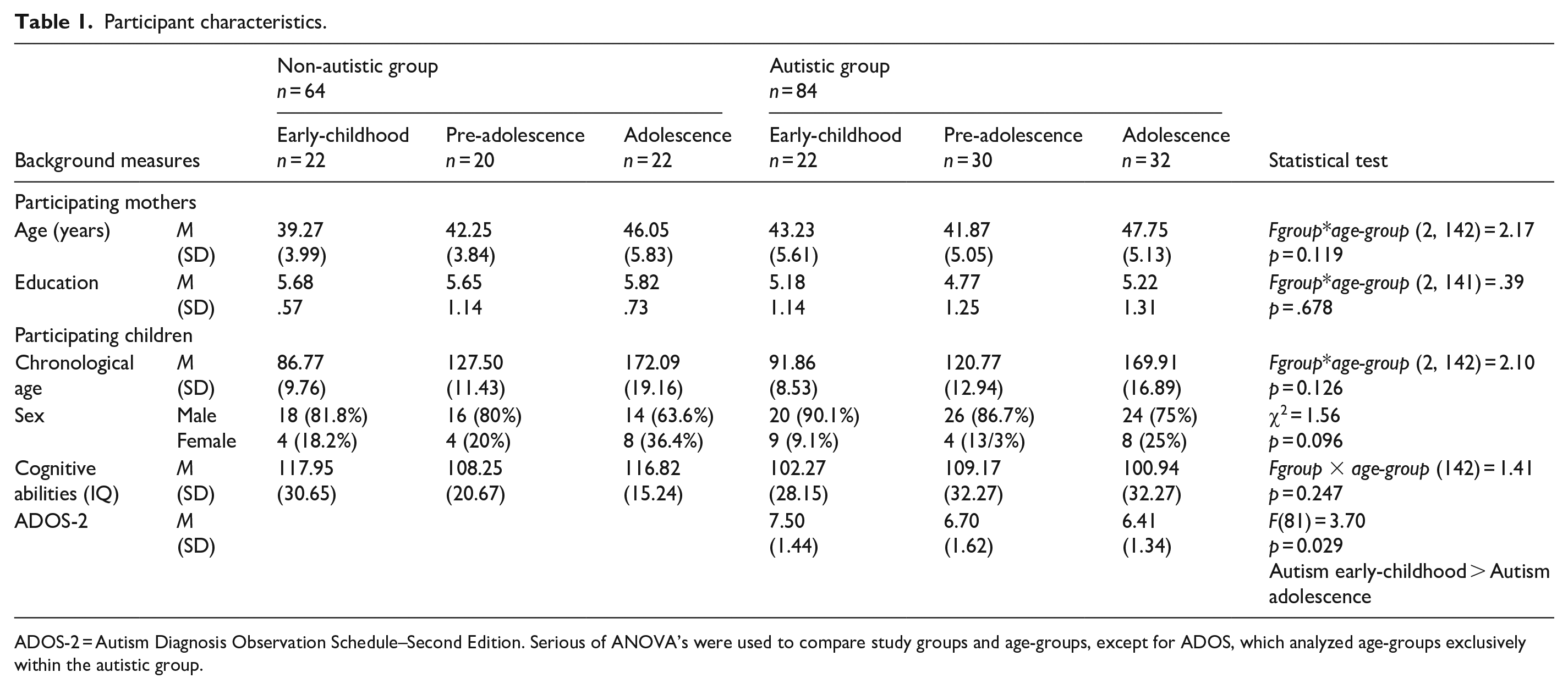
ADOS-2 = Autism Diagnosis Observation Schedule–Second Edition. Serious of ANOVA’s were used to compare study groups and age-groups, except for ADOS, which analyzed age-groups exclusively within the autistic group.
Measures
Observed individual motor abilities
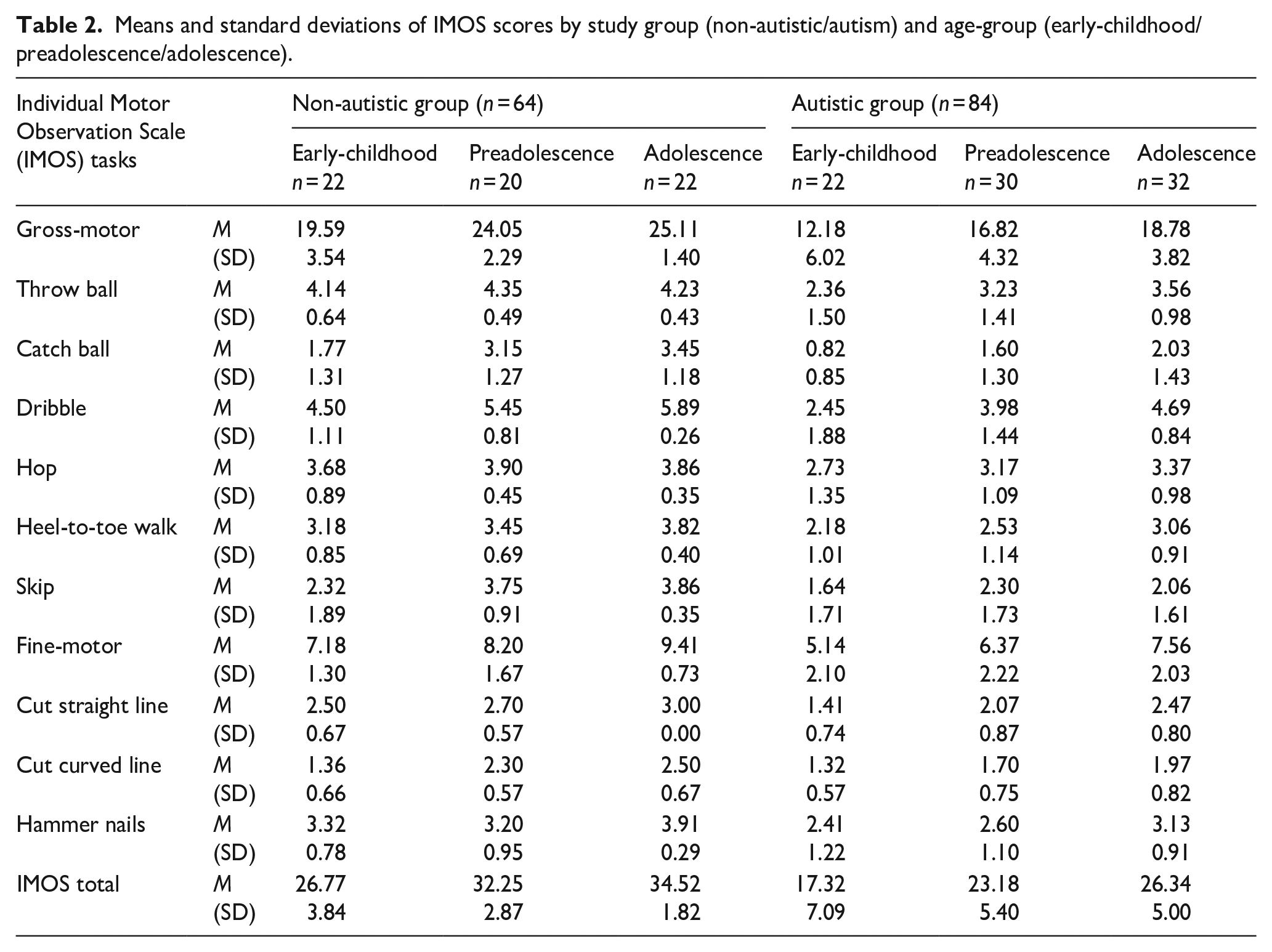
Each participant’s fine- and gross-motor abilities were measured using the Individual Motor Observation Scale (IMOS; Bauminger-Zviely et al., 2017). It includes six gross-motor tasks (dribbling ball, throwing ball against wall, catching ball, skipping, hopping on one leg, heel-to-toe walking across marked lines on floor) and three fine-motor tasks (cutting straight line, cutting curved line, and hammering nails on corkboard). The IMOS and its coding scale (Bauminger-Zviely et al., 2017) were developed in consultation with movement and occupational therapy professionals, based on motor developmental milestones and movement scales (e.g. Hattie & Edwards, 1987; Henderson et al., 1992; Payne & Isaacs, 2020), and were found to successfully reflect TD and ASD youngsters’ motor ability (e.g. Estrugo et al., 2023).
The IMOS coded measures of motor proficiency (task failure = 0, task completion after demonstration = 1, task completion following instructions without demonstration = 2) and motor quality for various appearance and accuracy components like movement differentiation and proper scissor grip (see Estrugo et al., 2023 for further coding details). Inter-rater agreement between two coders (autism experts) for 25% of the videotapes was 94.14 and 93.03 for the fine- and gross-motor observations, respectively. We also used the total IMOS score due to its high correlations with fine-motor (r = 0.75, p = 0.001) and gross-motor (r = 0.98, p = 0.001) components (Cronbach’s α = 0.86).
Mother-rated ToM skills
ToM skills were evaluated using the TOMI parents’ questionnaire (Hutchins et al., 2012), which was found to discriminate between autistic and TD individuals and to significantly correlate with other teacher and parent questionnaires assessing social communication abilities like the Social Responsiveness Scale and Vineland Adaptive Behavior Scales (Greenslade & Coggins, 2016; Hutchins et al., 2012). The 60-item TOMI scale is divided into three developmental levels: 14 “early” items (e.g. “My child is able to show me things”); 23 “basic” items (e.g. “My child understands that to know what is in an unmarked box, you have to see or hear about what is in that box”); and 23 “advanced” items (e.g. “If it were raining and I said sarcastically, ‘Gee, looks like a really nice day outside,’ my child would understand that I didn’t actually think it was a nice day”). Mothers rated items on a 0–20 ruler ranging from “definitely not” to “definitely,” where higher scores indicated better ToM skill attainment. The TOMI’s early, basic, advanced, and total (composite) raw scores were used due to their capacity to reflect the child’s ToM developmental level. The current internal reliabilities were Cronbach’s α = 0.98 for early, α = 0.92 for basic, and α = 0.93 for advanced developmental level. We also used the current TOMI composite score due to its significant moderate to high correlations with its subscales (r = 0.49 for early, r = 0.97 for basic, and r = 0.98 for advanced, p = 0.000).
Observed JA abilities
Each participant’s JA abilities were evaluated by observing the performance of four dyadic motor coordination tasks requiring prediction of a peer partner’s movements (Bar Yehuda & Bauminger-Zviely, 2024). To measure participants’ JA performance, percentages of “coordinated movement” were calculated based on the duration or frequency of that participant’s movement in relation to the partner’s movement for each of the four tasks. In the first of two mirroring tasks, face-to-face partners were asked to imitate each other’s hand and body movements. The coordinated movement (JA) percentage was calculated as the ratio of the participant’s duration (in milliseconds) of co-occurring movements (performed simultaneously with the partner) in a congruent direction (side-side, forward-forward, up-up, down-down), to the participant’s total movement duration. For the second mirroring task, walking together side by side, the coordinated movement (JA) percentage was calculated as the ratio of both participants’ shared co-occurring steps (performed simultaneously) using congruent (right-right, left-left) and incongruent (right-left) feet, to the total steps (right/left) taken by each participant.
In the first of two complementing tasks, partners standing opposite one another were asked to complement their body movements when crossing an imaginary narrow corridor. The coordinated movement (JA) percentage was calculated as the ratio of the participant’s duration (in milliseconds) of attuned, complementary co-occurring body positioning movements while walking from one end to the other, to the total duration of body positioning movements performed by the participant. For the second complementing task, playing an imaginary kick-and-catch soccer game, the coordinated movement (JA) percentage was calculated as the ratio of the participant’s number of consecutive kick-and-catch movements performed in complement (center-center, right-left, left-right direction) with the partner, to the total number of kick-and-catch movements executed by the participant.
Each 30-s task was performed twice to permit participants’ exchange of leader and follower roles. Dyads were matched by study group (autistic/non-autistic), age (gap of < 12 months), and cognitive ability (gap of < 15 IQ points, reflecting one SD). Participants’ task performance was videotaped from three angles simultaneously (right, left, center) and analyzed with frame-by-frame precision (in milliseconds) via INTERACT micro-analysis social behavior observation coding software. This enabled micro-analytical coding in video surveillance of each partner’s specific behaviors (Adamson et al., 2019; Güntner et al., 2020).
Two coders (special education and autism specialists) each separately coded the JA performance of 35 dyads (47% of all observations) including both groups (autistic/non-autistic). Inter-rater reliabilities (kappa) reached 0.92 for hand and body, 0.85 for walking, 0.82 for corridor, and 0.73 for soccer. Remaining observations were divided between both raters for coding. We used the total mean JA score due to its significant positive correlations with all four JA task scores (r = 0.75 for hand and body, r = 0.76 for walking, r = 0.65 for corridor, r = 0.62 for soccer; p = 0.000).
Procedure
This study was part of a larger project examining socio-communicational and motor links in autistic and non-autistic children and adolescents. After receiving approval from the university faculty’s ethics committee, 212 children and adolescents (ASD = 128, non-autistic = 84) were initially recruited via advertising study objectives to parents, colleagues, and social media. Of the initial participant pool, 64 were excluded from the current study because of IQ under 70 (n = 30 with ASD) or partners’ age gap over 12 months (n = 14 with ASD, n = 20 non-autistic). Our research team conducted two sessions at our autism research laboratory. The first session assessed ASD diagnosis (for the autistic group) and cognitive abilities (for both groups), and mothers completed the TOMI questionnaire. The second session assessed JA tasks during peer interactions and the IMOS, in counterbalanced order.
Data analyses
All analyses used IBM SPSS Statistics 25 with the significance level set at <0.05. Group (autistic/non-autistic) and age (early-childhood/preadolescence/adolescence) differences in motor abilities and in ToM skills were computed by a series of multivariate and univariate analyses of variance (MANOVAs, follow-up ANOVAs). One-way ANOVAs were also conducted for the IMOS total score and TOMI composite score. In addition, to better understand variability associated with age in ToM and motor skills, we also examined these variables’ correlations with age. To explore hierarchical motor profiles for each group (autistic/non-autistic), we (1) converted all IMOS subscale scores to a percentage scale, due to differences between motoric tasks’ scoring scales and (2) compared IMOS components’ scores using repeated-measure ANOVA for each group. Post hoc pairwise comparisons used Bonferroni’s correction.
As a preliminary test for our mediation model, Pearson’s correlations were examined among the IMOS total, JA total, and TOMI composite scores. These total scores were chosen to reduce data load, based on their aforementioned significant moderate-to-high correlations with their components. To further understand how individual motor abilities and ToM skills may contribute to JA performance, we employed SPSS PROCESS mediation model 4 (Hayes, 2022). This procedure allows examination of possible mediation effects (indirect effects) of motor abilities and ToM skills, as parallel mediators between group and JA, and it explores their joint contribution. Mediation analysis used bias-corrected bootstrapping procedure (5000 resamples) with 95% confidence interval (CI).
To be noted, although no a priori power calculation was performed, the sample size was the result of maximum efforts made by the research group to collect such intensive observational data (on JA and the IMOS for motor functioning) during the COVID-19 pandemic period, including very rigorous between- and within-data matching procedures.
Data availability statement
The data sets generated and/or analyzed during the current study are not publicly available due to the need to maintain the anonymity of participants and the confidentiality of the data. However, the numeric data sets as SPSS syntax and experimental codes for IMOS and JA are available on Open Science Framework at the following link: https://osf.io/sfbjn/. The TOMI coding procedure should be requested from its authors.
Community involvement statement
Our research team is comprised of community providers who are special education experts and agency leaders working with autistic children, their families, and their communities. Their roles include school vice-principal (first author), supervisor of autism special educators (second author), family consultant in community agency (third author), and educational consultant leading professional training and field intervention (last author). All co-authors were involved in all aspects of the study.
Results
Group differences in motor abilities
As seen in Tables 2 and 3, a significant main effect of group (autism vs non-autistic) emerged across the IMOS gross- and fine-motor general categories and all subcategories, demonstrating better performance in the non-autistic group than the autism group. Likewise, a significant main effect of age (early-childhood, preadolescence, adolescence) emerged, showing that the oldest group (adolescents) significantly outperformed the youngest group (early-childhood) for all IMOS general categories and subcategories except hopping.
Means and standard deviations of IMOS scores by study group (non-autistic/autism) and age-group (early-childhood/preadolescence/adolescence).
Univariate and multivariate F-values and
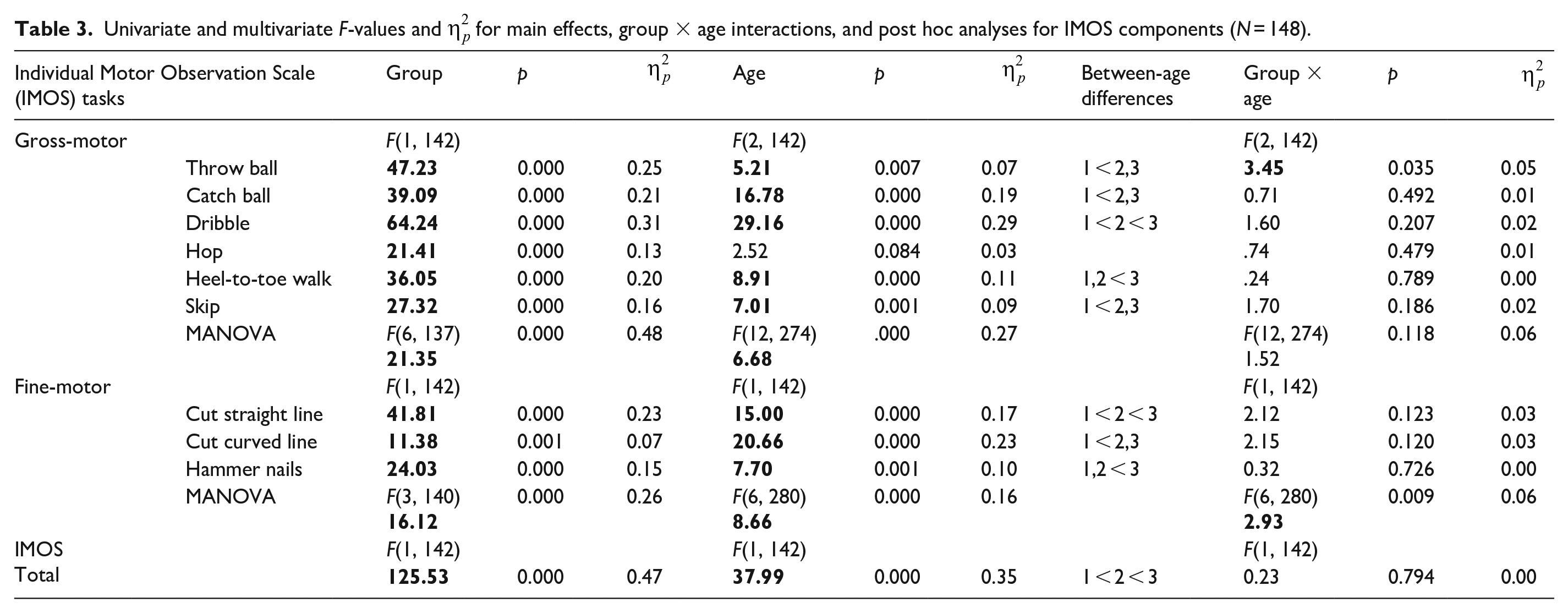
As seen in Table 3, the MANOVA for group-by-age interaction on gross-motor functioning did not reach significance; however, the ANOVA for ball throwing did show a significant interaction. Post hoc analysis with Bonferroni’s adjustment revealed that, only in the autism group, adolescents and preadolescents outperformed those in early-childhood. In contrast, the MANOVA for group-by-age interaction on fine-motor functioning was significant; however, the follow-up ANOVAs for its subcategories did not reach significance (see Table 3). In examining these incongruent findings, the standard deviation for the non-autistic adolescent group’s straight-line cutting equaled 0, which may have led to the significant MANOVA. After removing the straight-line variable from a subsequent MANOVA for fine-motor functioning, the group-by-age interaction was non-significant, F(4, 282) = 1.605, p = 0.173,
To obtain a more sensitive study group comparison with relation to age period, we furthered our analysis using ANOVA to examine differences in the motor abilities total percentage score between all six subgroups (autistic and non-autistic study groups at three ages). The ANOVA was significant, F(5, 142) = 38.86, p = 0.000,
Within-group hierarchical profile of motor abilities
Repeated-measure ANOVAs for each study group (autism/non-autistic) yielded significant within-group differences for the IMOS categories: F(8, 139) = 16.53, p = 0.000,
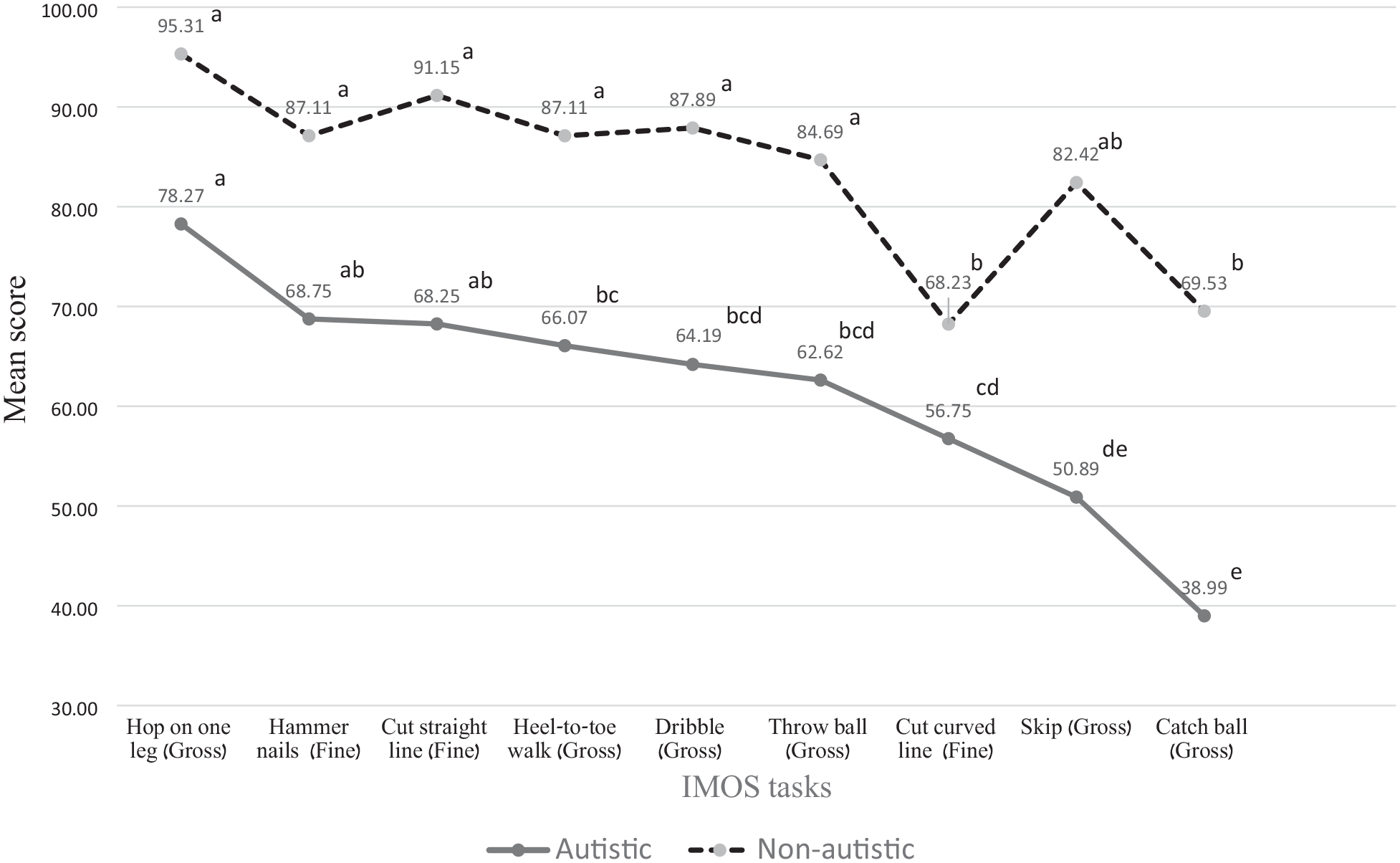
Within-group hierarchical profile of difficulty on IMOS motor tasks.
Group differences in ToM skills
As seen in Table 4, a significant main effect of group (autism vs non-autistic) emerged for all TOMI subscales (early, basic, advanced) demonstrating better performance in the non-autistic group than the autistic group, similarly to the motor results. Also, a significant main effect of age emerged for the basic and advanced ToM skills (but not for early skills), indicating that the oldest group (adolescence) surpassed the youngest group (early-childhood) on basic TOMI skills, while both older groups performed better than the youngest group on advanced ToM skills. As seen on the table, the group-by-age interaction did not reach significance. Likewise, the ANOVA conducted on the TOMI composite score showed that the non-autistic group outperformed the autistic group, F(1, 142) = 190.51, p = 0.000,
Means and standard deviations of TOMI scores by study group (non-autistic/autistic) and age-group (early-childhood/preadolescence/adolescence), with univariate and multivariate F-values and
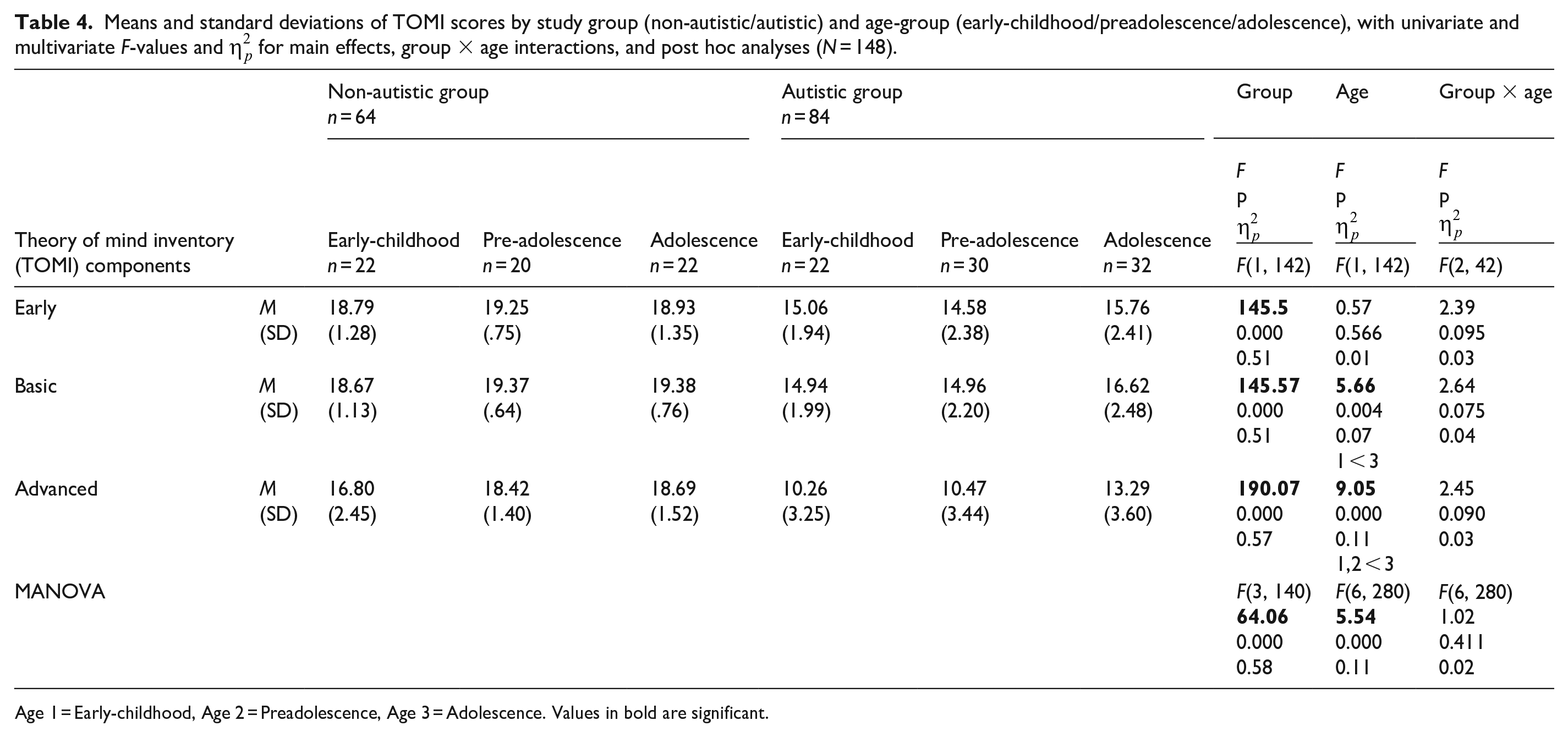
Age 1 = Early-childhood, Age 2 = Preadolescence, Age 3 = Adolescence. Values in bold are significant.
Links between motor abilities, ToM skills and age
As seen in Table 5, in both groups (autistic/non-autistic), participants’ age demonstrated significant positive correlations with the IMOS total score and most of its subcategories. Exceptions were ball throwing for the non-autistic group, skipping for the autistic group, and hopping for both groups. Moreover, in both groups, participants’ age demonstrated significant positive correlations with the TOMI composite score and subcategories, except for the early subcategory that showed no significant correlation in the non-autistic group and borderline significance for the autistic group. A Fisher’s Z-test examined differences between the correlations in the two groups, with results indicating non-significant group differences in the correlations between most of our measures, except for the IMOS skipping task and IMOS total score, where differences in correlations were significant between study groups (see Table 5).
Pearson’s correlation results for TOMI and IMOS scores with age.
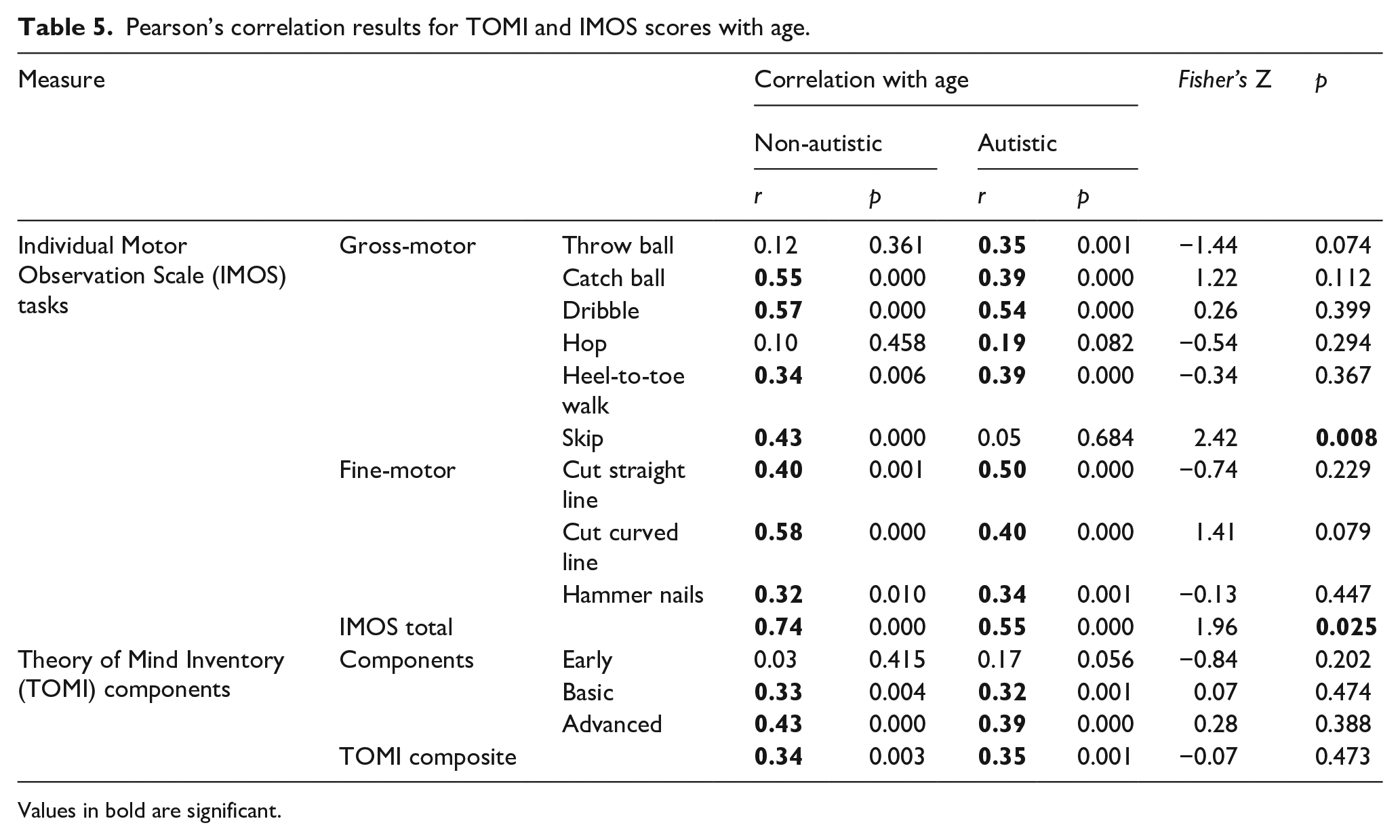
Values in bold are significant.
Links between motor abilities, ToM skills, and JA abilities
In both study groups, JA abilities demonstrated significant positive correlations with the IMOS total score (non-autistic: r = 0.39, p = 0.001; autistic: r = 0.37, p = 0.001) and with the TOMI composite score (non-autistic: r = 0.30, p = 0.007; autistic: r = 0.28, p = 0.005). These results indicated that higher motor and ToM skills were linked with better JA abilities in both study groups. Examining differences between correlations, Fisher’s Z analysis was non-significant.
The contribution of motor and ToM abilities to JA
Our mediation analysis using SPSS PROCESS macro model 4 (Hayes, 2022) revealed a significant indirect effect of group (autism/non-autistic) on the total JA score through the IMOS total score (see a1 × b1 effect at the top of Figure 2), as well as a significant indirect effect of group on the total JA score through the TOMI composite score (see a2 × b2 effect at the bottom of figure). The indirect total effect of the model was also found significant (−16.95, 95% CI = [−23.75, −10.89]). Furthermore, the direct effect of group on the JA total, in the presence of the mediators (IMOS total and TOMI composite), was found to be non-significant (see center of Figure 2). Hence, motor abilities and ToM skills showed a full mediating effect on JA abilities. In combination, group (autism/ non-autistic), ToM skills, and motor abilities accounted for 35% of the variance in JA abilities, R2 = 0.347, F(3, 144) = 25.57, p = 0.000.
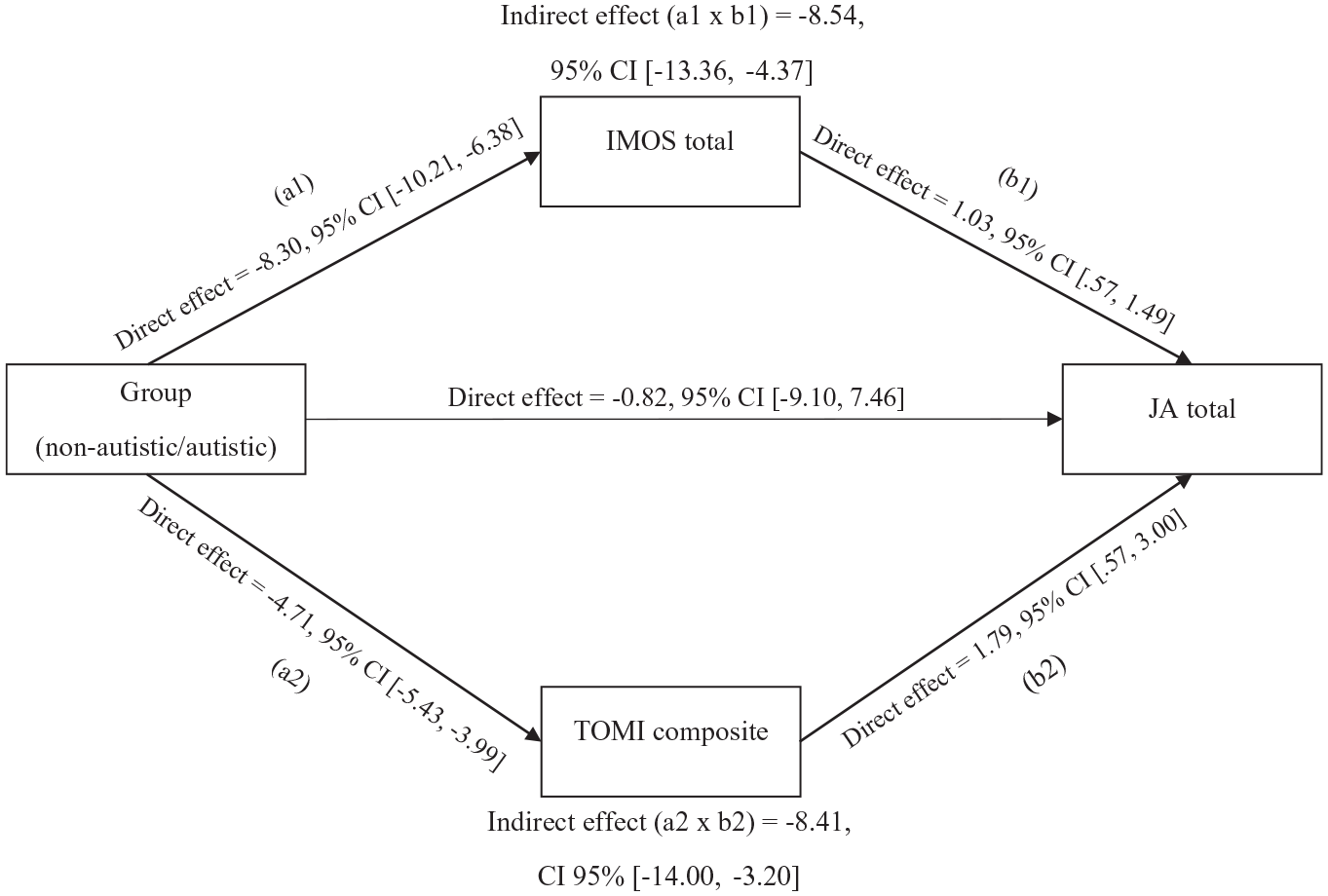
Direct and indirect effects of group (non-autistic/autistic), motor abilities (IMOS), and ToM (TOMI) on joint action (JA) abilities.
Discussion
The current study was novel in two ways. First, our empirical outcomes across three age-groups provided unique information on autistic and non-autistic children’s unfolding motor and ToM abilities. Second, findings from our mediation model furnished a novel perspective on a set of motor and socio-cognitive mechanisms that may explain peer partners’ socio-motor (JA) synchronization during non-autistic and autistic dyads’ interactions.
Age differences in motor and ToM abilities
Overall, our findings for group and age differences in motor abilities coincided with prior literature (Bhat, 2020; Licari et al., 2020). Namely, as hypothesized, the current non-autistic youngsters showed more adaptive fine-and gross-motor abilities than their autistic counterparts. More specifically, autistic adolescents differed significantly from their non-autistic age-mates, performing similarly to the younger non-autistic early-childhood group. Also, adolescents in each study group outperformed those in early-childhood on most motor tasks.
Interestingly, two noteworthy exceptions emerged in the context of gross-motor tasks. First, in the hopping task, no significant differences emerged across the three age-groups, nor did it significantly correlate with age. Furthermore, examination of mean hopping scores suggests that children from both study groups (autism/non-autistic) completed this skill’s development at an early age, considering it relatively easy. This aligns with developmental milestone research showing that TD children typically master hopping ability by age 3 years, 5 months (Sugden et al., 2013).
The second exceptional finding pertained to the ball-throwing task. The non-autistic group consistently demonstrated high motor abilities across all three age-groups, a finding consistent with the literature indicating that TD boys master this task by the age of 63 months (Seefeldt & Haubenstricker, 1982). Conversely, within the autism group, both adolescents and preadolescents outperformed the youngest group in ball throwing. This difference may stem from the complexity of this three-phase movement task (preparation, execution, and follow-through) involving an object and encompassing trunk rotation and a forward step with the contralateral leg. This assumption is further supported by the finding of a significant positive correlation between age and this motor task in the autistic group.
Among the autism group’s heterogeneous fine-motor profile, the curved-line cutting task appeared most challenging (rated cd), requiring participants to trace a twisting line and move the scissors, whereas straight-line cutting and nail hammering involve tracing straight lines. To succeed in manipulating objects, one must focus one’s gaze on certain landmarks to support movements’ planning and execute eye-hand coordination (Johansson et al., 2001). Perhaps tracing curved lines requires more landmarks than straight ones, thus increasing task difficulty.
Looking at the gross-motor tasks, the autism group appeared to reach greater maturity (rated a and bc) for two tasks that did not require object manipulation (hopping and heel-to-toe walking) compared to tasks involving a ball (rated cd through e). This finding suggests that the autism group’s motor profile may be affected by the increasing need for eye-hand coordination when manipulating objects, which has been shown to pose a challenge for this group (e.g. Crippa et al., 2013). In addition, difficulty may arise when motor tasks require integration of more abilities or skills. For example, both ball catching and throwing are intricate motor tasks, requiring sensory-perceptual information to achieve a movement goal. However, catching was significantly harder than throwing for the autism group, possibly because of the extra demand for synchronization of timing with the approaching ball (Sugden et al., 2013). Likewise, although skipping does not require object manipulation, it may pose an added challenge for autistic individuals compared to hopping or heel-to-toe walking, due to its complex nature involving the integration of movements like stepping forward, hopping on the same leg, and creating an uneven rhythm with alternating leading legs (Payne & Isaacs, 2020). The examination of age-group differences for skipping yielded an overall significant effect showing an advantage of the two older groups over the early-childhood group, beyond the study group. However, due to this ability’s non-significant correlations with age in the autistic group, it can be concluded that development in skipping over age occurs only in the non-autistic group.
Overall, more complex motor planning, eye-hand coordination, and integration of movement patterns appeared to pose more pronounced difficulty for autistic children and adolescents. These findings coincide with recent research suggesting that autistic adults present a different motor profile than TD adults (ages 18–65 years, IQ > 85), manifesting in slower movements, reduced walking speed and finger tapping frequency, and difficulties in balance control (Cho et al., 2022). Continued future exploration of these findings across a broader age range and with a wider motoric assessment can help more clearly characterize the motor profile of autistic youngsters.
Our findings regarding ToM skills’ comparison between study groups (autism/non-autistic) and the three age-groups, and the positive correlation of TOMI basic and advanced scores with age, indicated that both groups showed improvements in their basic and advanced ToM abilities with age. However, despite improvements in ToM skills in autism with age, they still lag behind their non-autistic peers. These findings substantiate prior research (e.g. Alkire et al., 2023; Pedreño et al., 2017).
The contribution of motor and ToM abilities to JA performance
Together, motor and ToM abilities significantly contributed to JA performance beyond the individual child’s diagnostic affiliation, explaining 35% of the variance in JA synchronization. This presents a novel theoretical and therapeutic model that sheds some light on the mechanisms behind social-motor interaction and on the combined role-played by ToM and motor skills. The theoretical definition of JA suggests the need for motor abilities and cognitive skills to understand partners’ intentions (Sebanz et al., 2006). Our model helps elucidate the relationships among these three abilities by empirically pinpointing personal motor abilities and ToM skills as jointly contributing to better coordination abilities during JA peer interactive tasks.
The importance of JA abilities is in their contribution to children’s social participation in many social interactive activities with their peers. Abilities for coordinating our body movements in relation to our partner’s body movements—either through complementing actions such as in soccer or ball throwing and catching, or through mirroring actions as in side-by-side walking or many children’s social games like “Simon says”—are indeed important building blocks in our capacity to communicate effectively. As demonstrated by our mediation model, the ability to implement ToM processes—predict and perceive our partner’s movement signals to respond appropriately through our motor system—forms one important basis of JA. This system of relationships holds important consequences for individuals’ ability to adequately participate in movement coordination activities (Pezzulo et al., 2019) and thereby to develop adequate peer interaction skills (Bowsher-Murray et al., 2022). Prior literature highlighted the frequency of JA as an everyday social interaction (Sebanz et al., 2006) as well as its social benefits (Hove & Risen, 2009; Jackson et al., 2018; Reddish et al., 2014) and its ability to enhance social connectivity and facilitate more effective communication exchanges (Cross et al., 2019).
For autistic children, when peer interaction is a major challenge contributing to social isolation and loneliness, facilitating their JA abilities by strengthening their ToM and motor skills can be an effective way to increase their level of social participation and peer interaction, thereby impacting their communication with classmates. This is particularly needed considering autistic children’s challenges in motor (Bhat, 2020, 2021; Reynolds et al., 2022) and ToM domains (Pedreño et al., 2017; Schwartz Offek & Segal, 2022) in comparison to non-autistic peers. Improving motor skills and ToM abilities can enhance the execution of JA performance, expand the understanding and expression of social cues during conversations (Zampella et al., 2020), foster greater involvement in social activities like team sports, and positively influence autistic children’s social participation throughout their school years (Seippel & Bergesen Dalen, 2024).
Study limitations and implications
Our study has several limitations. Although the sample is quite large, its division into three age-groups may have somewhat reduced our ability to obtain some significant developmental outcomes. The loss of statistical power due to sample size also precluded the incorporation of age as contributing to the model examining the effect of motor and ToM skills on JA abilities. It would be interesting to explore the effects of age on this mediation model to provide a developmental perspective. Thus, findings should be replicated with larger samples.
Moreover, the current study population included only participants with average IQ and did not address sex differences, suggesting important areas for further exploration in future research. Finally, our cross-sectional examination of age-group differences yielded significant novel developmental information as discussed, but developmental trajectories for ToM and motor skills cannot be extracted from this cross-sectional examination and require exploration using longitudinal data.
The outcomes of our study carry both novel theoretical and therapeutic implications. We strengthened understanding of motor and ToM differences between TD and autistic youngsters by presenting evidence that these gaps persist across a broad age-group continuum. Furthermore, our findings suggest that autistic youngsters may exhibit distinct characteristics in motor abilities that differ from those of non-autistic peers. These findings require more in-depth examination in an effort to clearly characterize the diversity characterizing the motor developmental trajectory of autistic children and adolescents. Clearer understanding of these youngsters’ motor development trajectory can assist professionals in refining motor promotion plans for this population. In addition, we offer a novel model that empirically demonstrates the influence of motor and ToM skills on socio-motor abilities. This underscores the significance of integrating training for these skills in future intervention programs aimed at enhancing peer interaction in autistic children and adolescents.
Footnotes
Acknowledgements
This article is based on the first author’s MA dissertation under the guidance of the last author. Special thanks are extended to research team members Eynat Karin for coordinating the study and Inbal Shemesh and Bina Stern for their dedicated co-coding. The authors express their appreciation to Dr Gabi Liberman and Amir Hefetz for their valuable statistical guidance and to Dee B. Ankonina for her editorial contribution. Finally, the authors express their gratitude to the children and their mothers who participated in the study.
Author contributions
R.P.N.: Conceptualization; Data curation; Formal analysis; Investigation; Methodology; Validation; Writing—original draft; Writing—review & editing. Y.E.: Data curation; Formal analysis; Methodology; Validation; Writing—review & editing. S.B.Y.: Data curation; Investigation; Methodology; Writing—review & editing. N.B.-Z.: Conceptualization; Formal analysis; Funding acquisition; Resources; Software; Supervision; Validation; Writing—review & editing.
Funding
The author(s) disclosed receipt of the following financial support for the research, authorship, and/or publication of this article: This research was supported by the Israel Science Foundation (ISF).
