




Abstract
Autistic youth experience higher rates of peer victimization than their non-autistic peers. While there is some evidence that friendships may protect against the negative mental health effects of peer victimization in the general population, these protective effects have not been examined in autistic youth. The current study explored whether satisfaction with friendship support is associated with depressive symptoms among autistic youth, and whether satisfaction with friendship support buffers against the negative effects of peer victimization on mental health. Autistic youth (N = 224) between the ages of 15 and 25 years (M = 18.68 years) completed questionnaires measuring frequency of peer victimization, satisfaction with friendship support, and depressive symptoms. Satisfaction with friendship support was not associated with depressive symptoms; however, the effect of peer victimization on depressive symptoms was attenuated for youth who were more satisfied with their friendship support compared to youth who were less satisfied with their friendship support. The results of the current study therefore highlight the potential for promoting mental health of autistic youth through reducing peer victimization and increasing satisfaction with peer relationships.
Lay Abstract
Autistic youth are more likely to be bullied than youth who are not on the autism spectrum. Youth in the general population who are bullied experience poor mental health, but those who are satisfied with their friendships may be protected from these negative outcomes. No studies have looked at how friendships affect the mental health of autistic youth who are bullied by their peers. Autistic youth completed questionnaires that asked them to report how frequently they were bullied, whether they were satisfied with the support they received from friends, and depressive symptoms they experienced. Depressive symptoms did not differ between youth who were more satisfied and youth who were less satisfied with their friendship support. However, among youth who were frequently bullied, depressive symptoms were lower for those who were more satisfied with their friendship support compared to those who were less satisfied with their friendship support. This study shows that interventions are needed to support the mental health of autistic youth by decreasing bullying by peers and increasing positive peer relationships.
Introduction
Healthy friendships are associated with positive mental health for both autistic and non-autistic youth (e.g. Alsarrani et al., 2022). For example, among autistic adolescents and adults, studies have found that greater friendship quantity and quality are associated with less loneliness and fewer depressive symptoms (Mazurek, 2014; O’Connor et al., 2022). In addition, friendships may protect autistic and non-autistic youth from the poor mental health outcomes associated with negative social experiences. Several studies of adolescents in the general population have found that having more friends (e.g. Palomares Ruiz et al., 2019) and higher friendship quality (e.g. Cuadros & Berger, 2016) attenuate the negative effects of peer victimization on depressive symptoms (Schacter et al., 2021). However, to our knowledge, no studies have examined whether friendships protect autistic youth against the negative effects of peer victimization. Given growing evidence of the negative impacts of peer victimization on the lives of autistic youth (e.g. Chou et al., 2020; Maïano et al., 2016), there is an urgent need to understand if the protective effects of friendship that have been found in non-autistic samples hold for autistic youth.
The current study addressed this gap by investigating whether satisfaction with friendship support attenuated the association between peer victimization and depressive symptoms. We chose to focus on reported satisfaction with support from friends, given emerging research that autistic youth’s feelings about their friendship needs—specifically whether the amount of time they spend with friends meets their needs—may be more impactful to their mental health than the amount of time they spend with friends (Adams et al., 2024). Thus, the current study examined whether satisfaction with friendship support had a main effect on depressive symptoms, and whether friendship support had a moderating effect on the association between peer victimization and depressive symptoms.
Methods
Participants and procedures
The current sample consisted of 224 autistic youth without an intellectual disability between the ages of 15 and 25 years (M = 18.68, SD = 2.58) who participated in a larger study focused on mental health among autistic transition-age youth (see Table 1 for demographic characteristics). Youth were the primary respondents, and a parent of each youth also participated in the study (88% mothers). While 241 youth/parent dyads participated in data collection for the larger study, 17 youth did not complete key measures needed for the current study and were not included in the analyses.
Demographic and behavioral characteristics of the sample.

Participants were recruited from research match registries hosted by the Simons Simplex Collection (SSC; Fischbach & Lord, 2010) and the Simons Foundation Powering Autism Research for Knowledge (SPARK; Feliciano et al., 2018), as well as from clinical research registries and databases at the authors’ institutions. For the larger study, eligibility criteria included youth: (1) being 15 to 25 years of age at the time of study recruitment; (2) having an existing autism diagnosis; (3) having a historic intelligence quotient (IQ) or parent-report IQ of 70 or above; and (4) being able to self-report and consent independently (assent for youth under 18 years).
Families that met the inclusion criteria for the study were identified using information collected during initial registration for the SSC and SPARK registries and from clinical research registries and databases in which families had agreed to be contacted for future research opportunities. Study information was shared with eligible families via email, and if families expressed interest in participating, they were contacted via telephone or video call by project staff. To confirm that youth were able to self-report, the study team verbally administered a short series of questions that assessed their language proficiency (Bishop et al., 2017). Eligible participants and their parents provided consent (assent for youth under 18 years) to the study during this phone/video call, after which youth and parents completed the study protocol using remote survey and interview platforms. The Institutional Review Boards at the authors’ institutions and a community advisory committee from SPARK approved all study procedures.
Measures
Peer victimization
Youth completed the Revised Schwartz Peer Victimization Scale (Schwartz et al., 2002), an 18-item questionnaire containing descriptions of various types of peer victimization. Participants indicated how often they experienced each type of victimization using a 7-point scale ranging from 1 = Never happens to me to 7 = Happens to me almost every day. Ratings were averaged across all the items to produce a mean victimization score, with higher scores indicating more frequent victimization. This measure has been used in studies with autistic individuals with good psychometric properties (Adams et al., 2014). An alpha of 0.93 was found for the current sample.
Satisfaction with friendship support
Participants were asked to rate their satisfaction with the support they received from friends via an item from the World Health Organization Quality of Life Scale (The WHOQOL Group, 1998). When completing the questionnaire, youth were asked the following question: “How satisfied are you with the support you get from your friends?” Response options included 1 = Very dissatisfied, 2 = Dissatisfied, 3 = Neither satisfied nor dissatisfied, 4 = Satisfied, and 5 = Very satisfied. Few participants selected Very dissatisfied (n = 3), Dissatisfied (n = 15), and Neither satisfied nor dissatisfied (n = 45). Responses were therefore dichotomized into Less satisfied (score of 1–3; n = 63) and More satisfied (score of 4–5; n = 161).
Depressive symptoms
Youth completed the Beck Depression Inventory-II (BDI-II; Beck et al., 1996), a 21-item questionnaire that measures the presence and severity of symptoms of depression. Ratings were summed across all the items to produce a total score, with higher scores indicating greater depressive symptoms. Research has shown that the BDI-II is a valid measure of depressive symptoms in autistic samples (Williams et al., 2021). An alpha of 0.92 was found for the current sample.
Demographic and behavioral characteristics
Self-reports of age and gender (man, woman, non-binary/other) were completed by the youth. For 77 youth, IQ scores from standardized cognitive assessments were available from the datasets of their respective research registries. The remaining youth (n = 141) were administered the Peabody Picture Vocabulary Test-5 (PPVT-5; Dunn, 2018) when possible during the online interview, and the total standard score on the PPVT was used as an estimate of cognitive ability (Krasileva et al., 2017).
Analysis
Linear regression analyses were conducted to examine whether satisfaction with friendship support was associated with depressive symptoms, and whether satisfaction with friendship support moderated the association between peer victimization and depressive symptoms. A separate regression model was conducted to answer each research aim, with depressive symptoms as the outcome measure. Age, IQ, and gender (man as reference category; see Table 2) were entered as control variables. To test the main effect of satisfaction with friendship support on depressive symptoms, friendship support was entered as a predictor into the first model. The change in adjusted R2 was examined before and after adding friendship support to the model to determine whether adding friendship support improved model fit. To test whether satisfaction with friendship support moderated the association between peer victimization and depressive symptoms, the main effect of peer victimization and the interaction between peer victimization and friendship support were added as predictors to the previous model. The change in adjusted R2 was examined before and after adding the interaction between peer victimization and friendship support to the model to determine whether adding the interaction improved model fit.
Estimates of predictors of depressive symptoms in regression models.

Of the 224 youth who completed the outcome measures needed for the current analysis, 6 participants (2.7%) were missing IQ information and were not administered the PPVT-5; the mean IQ of the sample (101) was imputed for the six missing IQ cases. The linear regression analyses were implemented using R version 4.1.0. The conditional effects of peer victimization on depressive symptoms across levels of friendship satisfaction were calculated using PROCESS version 4.0.
Results
Estimates from the two linear regression models are presented in Table 2. In Model 1, the association between satisfaction with friendship support and depressive symptoms was not statistically significant (Δ adjusted R2 = 0.005, p = ns). Meanwhile, in Model 2, there was a statistically significant interaction between satisfaction with friendship support and peer victimization (Δ adjusted R2 = 0.03, p = 0.003). As seen in Figure 1, the strength of the association between peer victimization and depressive symptoms was attenuated for youth who were more satisfied with their friendship support, b = 2.35, 95% CI (0.85, 3.85), p = 0.002, compared to youth who were less satisfied with their friendship support, b = 6.64, 95% CI (4.215, 9.13), p < 0.001.
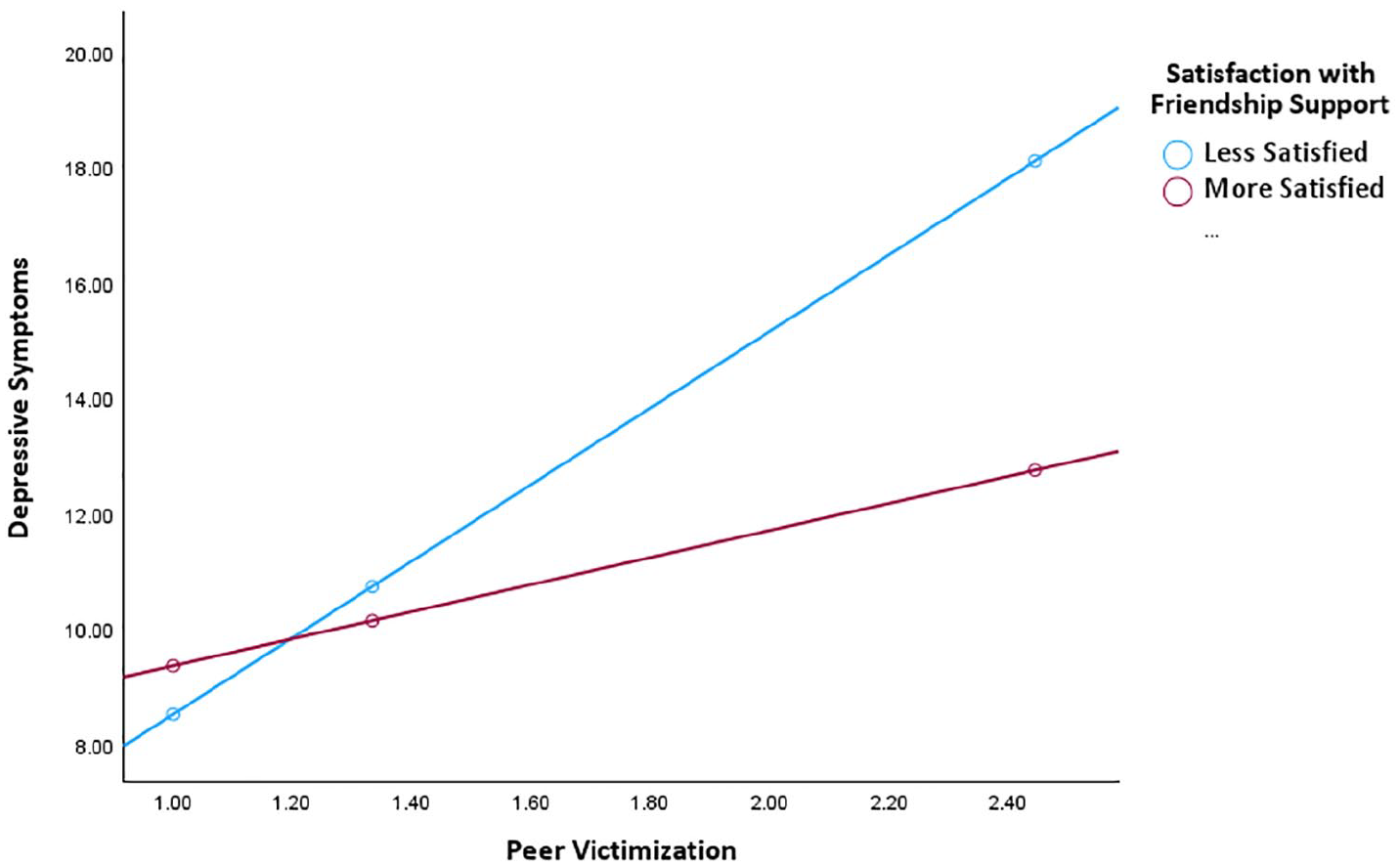
Moderation results depicting the effects of peer victimization on depressive symptoms across levels of satisfaction with friendship support.
Discussion
While friendships have been shown to protect youth in the general population from the negative mental health outcomes associated with peer victimization (Schacter et al., 2021), this is the first study to examine whether this pattern holds for autistic youth. Autistic youth are more likely than their non-autistic peers to experience peer victimization, which is associated with psychological distress (e.g. Chou et al., 2020); therefore, it is critical to understand positive social experiences that may protect the mental health of these youth. In the current study, the main effect of satisfaction with friendship support on depressive symptoms was not statistically significant. However, greater satisfaction with friendship support was associated with fewer depressive symptoms among youth who were frequently victimized by their peers (see Figure 1).
The protective effects of friendship satisfaction observed in this study seem to align with the stress-buffering hypothesis (Cohen & Wills, 1985), which states that the negative effects of stress on mental health are weaker among individuals with high levels of support (Cranford, 2004). While some studies in the general population have also found perceived friendship support to have protective mental health effects (e.g. Cuadros & Berger, 2016), other studies have not replicated these findings (e.g. La Greca & Harrison, 2005). It is important to note that these prior studies have focused on the amount of friendship support rather than the extent to which friendship support meets the needs of the individual (Schacter et al., 2021). As with non-autistic youth, the social needs of autistic individuals vary widely; the current study as well as others (e.g. Adams et al., 2024) suggest that autistic youth’s satisfaction with their friendships is particularly impactful to their mental health. Specifically, autistic youth who are more satisfied with their friendship support seem to be protected from the negative mental health effects associated with peer victimization.
The current study makes a significant contribution to the literature by pointing to a new factor (i.e. satisfaction with friendship support) that may be protective against the negative effects of peer victimization for autistic youth. However, there were some limitations worth noting. Since few participants reported being very dissatisfied, dissatisfied, or neither satisfied nor dissatisfied with their friendship support, we were unable to examine the full range of responses on satisfaction and understand their impact on youth’s mental health. Furthermore, while the friendship satisfaction item on the WHOQOL-BREF has high face validity, single-item measures lack precision and sensitivity. The current findings should therefore be interpreted with caution until they can be replicated using more psychometrically sound measures of friendship satisfaction. In addition, the current sample was recruited from existing research registries and had limited diversity in terms of family socioeconomic status and race/ethnicity. Youth with minoritized racial/ethnic identities and those from low socioeconomic status households are at heighted risk of depression (e.g. Goodman et al., 2003; Hargrove et al., 2020); therefore, the protective effects of friendship satisfaction may be heightened in these groups. Future studies are needed to examine the protective effects of friendships among autistic youth with other minoritized identities. Finally, the autistic youth in the current study all had IQ scores above 70 and were able to report on their friendships, peer victimization experiences, and mental health; these findings may not be generalizable to autistic youth who have intellectual disability or are otherwise unable to self-report.
This study demonstrates the association between peer victimization and depressive symptoms among autistic youth, and highlights the protective effects of friendship support on the mental health of autistic youth who are victimized by their peers. It is important that interventions designed to ameliorate depression among autistic youth focus on reducing peer victimization and facilitating healthy, supportive friendships. Rather than solely focusing on the development of more friendships, interventions should further aim to understand how each individual perceives the meaning of friendships and how they can feel supported by their friends.
Footnotes
Author Contributions
Declaration of conflicting interests
The author(s) declared no potential conflicts of interest with respect to the research, authorship, and/or publication of this article.
Funding
The author(s) disclosed receipt of the following financial support for the research, authorship, and/or publication of this article: This project was supported by the U.S. Department of Defense under grant number W81XWH-20-1-0475 (PI: Bishop, Taylor) and by the FAR Fund (PI: Taylor) with core support from the National Institute of Child Health and Human Development (P50 HD103537, PI: Neul) and the National Center for Advancing Translational Sciences (UL1 TR000445).
