




Abstract
In non-autistic populations, social motor synchrony during interactions is linked to increased interpersonal rapport – a friendly connection marked by mutual understanding and ease of communication. Previous research indicates autistic individuals show lower social motor synchrony in interactions with both autistic and non-autistic partners. However, it is unclear if this affects rapport, as synchrony’s role in social communication may differ for autistic individuals. The study had three aims: to replicate and extend previous findings of reduced social motor synchrony in dyads with at least one autistic person; second, to examine the relationship between synchrony and rapport in autistic (n = 12), non-autistic (n = 17), and mixed dyads (n = 14); and third, to investigate reliance on motor synchrony for achieving rapport among autistic and non-autistic participants. We found no evidence that dyads with at least one autistic person have less social motor synchrony than dyads without an autistic person. However, we found that social motor synchrony positively affects rapport more in non-autistic dyads than in autistic dyads. Participant-level analysis indicated that non-autistic individuals require higher social motor synchrony levels to achieve high rapport levels than autistic individuals. These results suggest that non-autistic individuals may emphasise movement synchrony as a key component of successful social interaction.
Lay abstract
During social interactions, people often mirror each other’s movements and gestures, a process called synchrony. This synchrony helps foster a sense of connection, understanding, and ease in communication. While research suggests that autistic people may show less synchrony in their movements compared to non-autistic people, the implications of this difference for building rapport remain unclear. Specifically, it is unknown whether synchrony plays a similar role in rapport-building for autistic individuals as it does for non-autistic individuals, particularly in interactions with autistic versus non-autistic partners. This study had three goals to investigate whether synchrony is lower in conversations involving at least one autistic person; to explore the relationship between synchrony and rapport; and to compare how much autistic and non-autistic people rely on synchrony to feel connected. The findings suggest that while synchrony positively influences rapport more strongly in non-autistic interactions, autistic individuals may rely less on synchrony for rapport. These results highlight differences in how social connection is built, offering deeper insight into social interactions for autistic and non-autistic people.
Keywords
Introduction
In recent years, research on autistic social behaviour has shifted from examining individual performance on social cognition measures to investigating interactions between autistic and non-autistic individuals (Davis & Crompton, 2021). This shift is due in part to the increased recognition of the Double Empathy Problem (DEP; Milton, 2012; Milton et al., 2022), a theory that challenges the notion that autistic people’s social skills are the sole cause of communication difficulties between autistic and non-autistic individuals. Rather than an inherent impairment, this theory suggests that social difficulties experienced by autistic individuals arise from mutual challenges in understanding and relating across neurological differences.
Researchers have examined empirical support for the DEP by contrasting the interactional dynamics of autistic, non-autistic, and mixed-neurotype (one autistic and one non-autistic) pairs. Findings reveal that same-neurotype pairings experience stronger self-rated and observer-rated rapport compared to mixed-neurotype pairings (Crompton et al., 2020c). In addition, matched-neurotype pairs share information more accurately (Crompton et al., 2020b) and are more likely to share personal information (Morrison et al., 2020).
Interestingly, autistic individuals often prefer to socialise with other autistic individuals, despite perceiving them as more awkward and less attractive than non-autistic individuals (Chen et al., 2021; DeBrabander et al., 2019; Morrison et al., 2020). This preference may be attributed to the difficulty autistic people experience in being understood by non-autistic individuals regarding mental states and facial expressions (Sheppard et al., 2016). Conversely, non-autistic individuals find it more challenging to comprehend the mental states conveyed by the movements of autistic individuals compared to other non-autistic individuals (Edey et al., 2016). However, autistic individuals do not exhibit significant impairment in interpreting the mental states of other autistic individuals compared to neurotypical individuals.
Qualitative reports align with these findings, as autistic individuals have reported feeling accepted and understood within autistic social circles, and often judged, misunderstood, and pressured to mask their traits when interacting with non-autistic people (Crompton et al., 2020a). Two recent reviews include a wealth of qualitative data indicating that friendships between autistic people may provide opportunities for comfortable communication and in many cases may be preferable to non-autistic interactions (Black et al., 2024; Watts et al., 2024). While the pattern of same-neurotype preference in interactions is consistent across studies, further research is needed to explore the underlying mechanisms responsible for these effects.
To date, much of the research on autistic social interaction concentrates on high-level social cognitive processes, including the perception of social cues such as facial expression and tone (Golan et al., 2007; Wallace et al., 2008), theory of mind (Gernsbacher & Yergeau, 2019), and perspective-taking (Pearson et al., 2013). However, an emerging area of interest is social motor synchrony (SMS), which involves the coordination of physical movements in timing, intensity, or rhythm between individuals during interactions (Fitzpatrick et al., 2017a, 2017b). SMS has been established as an important factor for successful and comfortable social exchanges in non-autistic individuals and is linked to positive social outcomes such as rapport, connection, and empathy (Bernieri & Rosenthal, 1991; Dotov et al., 2021; Lakens & Stel, 2011; Miles et al., 2009; Mogan et al., 2017; Paxton & Dale, 2017; Shockley et al., 2007; Tunçgenç et al., 2015). However, autistic individuals often display atypical movement patterns, particularly in kinematic profiles, with movements such as arm motions being jerkier compared to non-autistic individuals (Cook, 2016; Cook et al., 2013; Edey et al., 2016; Glazebrook et al., 2006; Keating, 2023; Lewis et al., 2024). These differences in movement patterns can significantly influence the effectiveness of SMS and subsequently impact the quality of social interactions.
Research on SMS in autistic people is still in its infancy. A recent meta-analysis found 16 experimental studies comparing synchronous behaviours between autistic and non-autistic pairs, reporting overall lower SMS in autistic pairs (Carnevali et al., 2024). Another review identified 29 studies examining this phenomenon, which generally suggest that autistic individuals tend to exhibit reduced SMS (Glass & Yuill, 2023). However, there is evidence that results may depend on the neurotype of the conversational partner. A recent study by McNaughton et al. (2024) found that synchronised smiling in dyads predicted enjoyment of interactions among pairs of autistic children and pairs of non-autistic children. In contrast, this effect was reversed in mixed-neurotype pairs (i.e. one autistic and one non-autistic participant), where synchronised smiling decreased the desire to converse. In addition, Glass and Yuill (2023) note that most existing research implements non-naturalistic tasks that do not accurately reflect real-world scenarios where SMS occurs. Moreover, these studies often have limited sample sizes, predominantly recruiting children (Glass and Yuill, 2023). Examining SMS using ecologically valid methodologies, for example, in unstructured conversations, and comparing mixed and matched-neurotype dyads has the potential to enhance our understanding of interpersonal dynamics within and between autistic and non-autistic people (Glass & Yuill, 2024).
To date, only one study has investigated SMS in autistic adults using conversational tasks. Across five conversation activities, dyads containing at least one autistic person showed overall lower SMS compared to non-autistic dyads (Georgescu et al., 2020). What remains unclear is whether this reduced SMS impacts the ease and enjoyment dyadic partners experience during an interaction. While the correlation between SMS and rapport is well-established in non-autistic populations (Mayo & Gordon, 2020; Mogan et al., 2017), whether this pattern extends to autistic people is unclear. It is possible that autistic people may have overall lower SMS but still have high enjoyment of the interaction. Indeed, Rifai et al. (2022) found that mixed-neurotype dyads showed lower levels of mutual gaze and backchanneling compared to non-autistic dyads, corresponding to lower ratings of rapport. However, autistic dyads also had low levels of these behavioural markers of interactive engagement, and yet their rapport ratings were high and uncorrelated. This indicates that backchanneling and mutual gaze are associated with subjectively successful interactions for non-autistic, but not autistic, people. The use of non-verbal modes of communication as indicators of rapport may differ between autistic and non-autistic individuals.
Understanding the differences that emerge during dynamic conversations between autistic and non-autistic individuals is important. When non-autistic people interact with autistic people, they often form swift and negative judgments and impressions about them (DeBrabander et al., 2019; Morrison et al., 2020; Sasson et al., 2017; Sasson & Morrison, 2019). These negative judgments are unrelated to the content of what autistic people say and are instead related to non-verbal behaviours or movements during an interaction (Grossman, 2015; Sasson et al., 2017). Some studies have examined individual non-verbal behaviours during social interactions. For example, autistic adults typically use more interactive and single-handed gestures, which can be difficult for non-autistic people to understand but may be clearer to other autistic individuals or their close contacts (de Marchena et al., 2019). Examining the synchronisation of social interactions, along with how participants perceive those interactions, can provide valuable insights into the mechanisms that contribute to ‘successful’ social interactions, both for autistic and non-autistic individuals.
In this study, we examine SMS in conversational interactions between autistic, non-autistic, and mixed dyads including one autistic and one non-autistic person. In addition, we examine whether SMS predicts the subjective experiences of rapport reported by participants immediately following the interaction.
Method
This study was conducted using a Registered Report format, with analyses registered with the journal and undergoing peer review before being performed. The Stage 1 Registered Report can be found at (https://osf.io/eudmp/), which includes full details of the data structure, analysis pipeline, power analysis, proposed analyses for each hypothesis, and an interpretive plan, alongside pre-defined thresholds for creating composite indices, and significance levels for multiple comparisons. In addition, the data and analysis scripts for the Stage 2 report can also be accessed at the same link.
Sample characteristics
Ethics and recruitment
Ethical approval was granted by the University of Edinburgh’s Medical Research Ethics Committee, University of Nottingham, School of Psychology Ethics Committee, and the University of Texas at Dallas’s Institutional Review Board. Participants were recruited through community networks, social media, local autism organisations, and participant databases across three University sites. All participants provided written informed consent before participating and were reimbursed for their time (£30/$40).
Participants
The dataset consisted of videos of 110 participants (59 autistic), paired into dyads across three neurotype conditions: autistic–autistic pairs, non-autistic–non-autistic pairs, and mixed pairs (one autistic and one non-autistic individual; see Table 1). Participants first completed an online survey via Qualtrics to collect demographic and clinical information for eligibility screening, which included being over 18 years old, fluent in English, and having normal or corrected vision and hearing. Participants were ineligible if they had a diagnosis of social anxiety. We excluded 44 participants (22 dyads) due to low video quality (see Supplemental Materials S1), and an additional one dyad (two participants) was excluded as an outlier because its SMS value exceeded the threshold of 3.29 when converted to a z-score based on the sample’s median and MAD (Thériault et al., 2024; 0.12.4). The final dataset comprised 86 participants; 38 were autistic (Mage = 26.61, SDage = 10.78), consisting of both clinically diagnosed (n = 25) and self-identified autistic adults (n = 13). The remaining 48 participants were non-autistic (Mage = 25.65, SDage = 10.54).
Dyad characteristics by gender, age, and IQ.

Note. This table presents the demographic characteristics of the dyads, including their age, RAADS-14, and IQ scores. F: female; M: male; NB: non-binary; RAADS: Ritvo Autism and Asperger’s Diagnostic Scale.
All participants completed the two-subtest version of the Wechsler Abbreviated Scale of Intelligence (WASI-II; Wechsler, 2011) to assess IQ (see Table 1). Furthermore, participants who self-identified as autistic without a clinical diagnosis completed the Ritvo Autism and Asperger’s Diagnostic Scale-Revised (RAADS-R; Ritvo et al., 2011) and were included if they scored above 72, indicating a self-rating above the diagnostic threshold (Andersen et al., 2011). Furthermore, all participants completed the Ritvo Autism and Asperger’s Diagnostic Scale 14-item Screen (RAADS-14; Eriksson et al., 2013), and non-autistic participants were excluded if they scored above 14, suggesting high levels of autistic traits.
Design
Experimental design
Our study utilised a between-subjects design to explore the effects of dyad composition on SMS. The primary independent variable is the neurotype of the dyad: autistic, non-autistic, and mixed groups. In addition to dyad neurotype, we also consider the diagnostic status of participants – whether they are autistic or non-autistic. This allows us to assess how SMS varies across different dyad configurations and within the interaction dynamics of individuals based on their diagnostic status.
Procedure
Recording the paired interactions
Participants took part in an in-person session and completed a 5-minute unstructured interaction task. Two participants, who had never met before, were seated in a room with two chairs positioned at an angle between 45° and 90°. This arrangement facilitated conversation and allowed for eye contact and other non-verbal communication. The interactions were recorded using Panasonic cameras (models HC-W580, HC-V785, and HC-V270) mounted on tripods.
Participants were instructed to have a conversation with each other. If participants were informed about their partner’s diagnostic status, they were told, ‘You will be chatting with one other person, and they are [autistic / not autistic]’, and if they were uninformed, no additional information was provided. The researcher provided verbal suggestions for the interaction, such as ‘You could talk about something you did last weekend or plans for next weekend’. These prompts were given at the session’s start and not provided during the interaction itself. Thereafter, the researcher left the room. After the 5-minute period had passed, the researcher returned and escorted the participants to separate rooms where they completed a self-rated rapport (see Supplemental Material S2).
Measures
Participants rated their feelings of rapport on a 100-point visual analogue scale (VAS) for five dimensions (ease, enjoyment, success, friendliness, and awkwardness), for example, ‘How much did you enjoy interacting with this person?’. These measures were previously used in mixed and matched autistic and non-autistic dyadic studies (Crompton et al., 2020b, 2020c; Rifai et al., 2022, see Supplemental Materials S2). The awkwardness item was reverse scored. On the VAS, 0 indicates a difficult or uncomfortable conversation (low rapport), while scores close to 100 reflect a pleasant and comfortable interaction (high rapport). The five items were summed as the final variable rapport.
To evaluate the internal consistency of the rapport scale, a Cronbach’s alpha reliability analysis was computed using the psych package (Revelle, 2023; 2.4.6.26) on the five items, resulting in an alpha of .88, which surpassed the acceptable threshold (α = .70; Santos, 1999).
Motion energy analysis
Motion energy analysis (MEA; Ramseyer, 2020; Ramseyer & Tschacher, 2011) was used to quantify synchronicity between participants. The MEA software converts video frames to greyscale. It computes the absolute differences between consecutive frames to quantify motion intensity (see Supplemental Material S8 and S9 for figures of total movement and Lead). The software also allows for the selection of specific regions of interest (ROIs) for tracking (see Figure 1). The ROI encompassed the participant’s entire visible area without separating body parts (e.g. head, body, arms), as arm movements often entered the headspace (Georgescu et al., 2020). Time-series data for the ROI was pre-processed, analysed, smoothed for noise reduction, and standardised for participant differences using the rMEA package (Kleinbub & Ramseyer, 2021; 1.2.2; Tschacher et al., 2018). Windowed cross-lagged correlations quantified synchrony between dyads over time, using parameters guided by previous research (Georgescu et al., 2020; Kleinbub & Ramseyer, 2021). The final SMS value is an absolute Fischer’s Z-transformed cross-correlation value averaged over the entire 5-minute interaction, ranging from 0 to 1. Finally, we examined pseudo synchrony, which is synchrony by coincidence (Ramseyer & Tschacher, 2010). For a full description of the procedure see Supplemental Material S3.
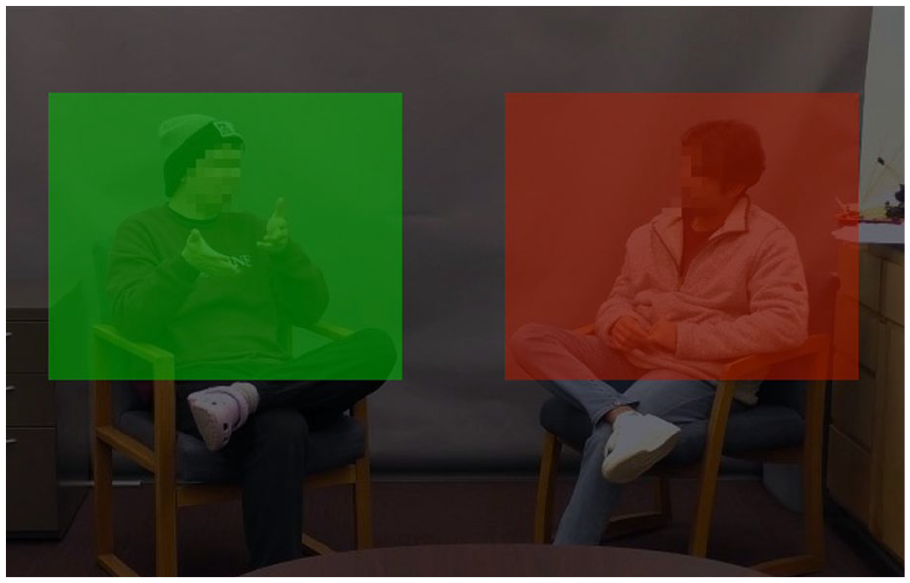
Screenshot of the ROI in the MEA software.
Data transformations
We calculated a synchrony-to-rapport ratio to explore the relationship between SMS and self-rated rapport. Rapport scores were Z-transformed, and the SMS value was divided by the Z-transformed rapport score to obtain the ratio using the datawizard package (Patil et al., 2022; 0.13.0). However, non-linear transformations can impact data distribution, particularly when dealing with small values in the denominator. Thus, this was mitigated by adding a small constant to both the numerator and denominator, as suggested by Winship and Radbill (1994). The ratio was therefore calculated using the formula: Ratio = (SMS + 1)/(Rapport + 1).
A higher ratio indicated that participants, despite reporting low rapport, exhibited relatively high synchrony in their body movements. Conversely, a lower ratio implied that participants reported strong rapport but exhibited relatively low synchrony in their behaviours, indicating either an overestimation of rapport or a lack of behavioural coordination that is not fully recognised by the participants themselves.
Analyses and hypotheses
All analyses were conducted in R version 4.3.2 (R Core Team, 2023). Statistical assumptions (e.g. normality, homoscedasticity) were tested, and R² and model comparisons were computed using the performance package (Lüdecke et al., 2021; 0.12.4). Linear mixed-effect models (LMM) were carried out using the packages lme4 (Bates et al., 2015; 1.1.35.5) and lmerTest for p values and degrees of freedom (Kuznetsova et al., 2017; 3.1-3). Bayesian models and t-tests used the brms (Bürkner, 2017; 2.22.0) and Bayesfactor (Morey & Rouder, 2012; 0.15.0). Post hoc comparisons were carried out with the emmeans package (Lenth, 2024; 1.1-35.5) for frequentist analyses. Effect sizes were computed using the effectsize package (Ben-Shachar et al., 2020; 0.8.9).
Results
We first tested whether SMS data reflected genuine synchrony versus pseudosynchrony (i.e. accidental synchrony of movement; Ramseyer & Tschacher, 2010). SMS values for each dyad were compared to a surrogate sample generated by shuffling motion data to create non-interacting pairs. As expected, correlations for shuffled pairs were low, serving as a baseline for genuine synchrony. Effect sizes (Cohen’s d) were 0.39 for autistic dyads, 0.21 for non-autistic dyads, and 0.59 for mixed dyads, indicating small to strong effects against pseudosynchrony.
To examine whether SMS was significantly higher in non-autistic dyads compared to dyads including at least one autistic participant (H1), a one-way analysis of variance (ANOVA) was conducted. The main effect of neurotype was not statistically significant (F(2, 40) = 0.09, p = .91, η² = .005, 95% confidence interval (CI) [0.00, 1.00]; see Figure 2). Two-tailed post hoc comparisons of the marginal means for SMS were as follows: non-autistic (M = 0.16, SE = 0.01, 95% CI [0.14, 0.17], Cohen’s d = 0.01), mixed (M = 0.16, SE = 0.01, 95% CI [0.14, 0.16], Cohen’s d = 0.15), and autistic (M = 0.16, SE = 0.01, 95% CI [0.15, 0.17], Cohen’s d = 0.13). All pairwise comparisons were non-significant (p > .05). Adding awareness of the partner’s diagnosis as a predictor did not change the results (see Supplemental Material S4).
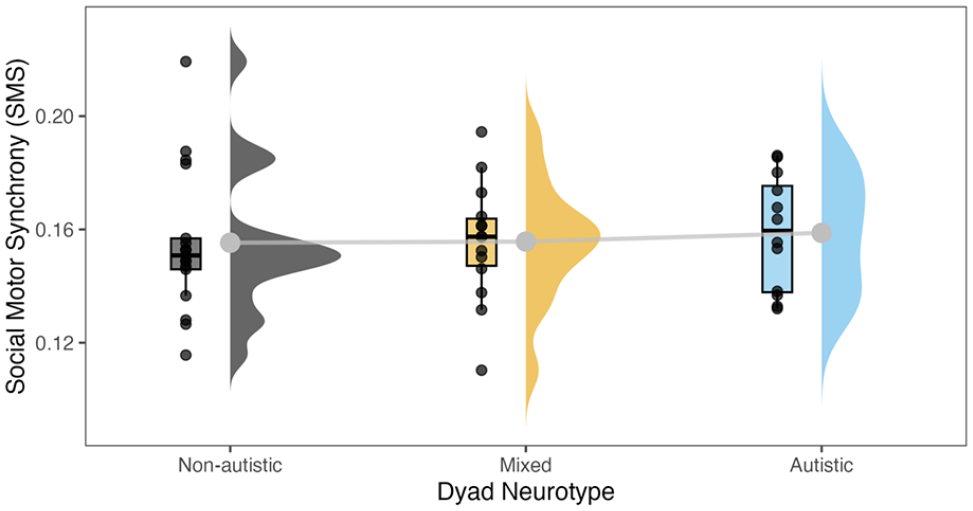
Distribution of SMS scores by dyad neurotype (non-autistic, mixed, and autistic).
A Bayesian one-way ANOVA was conducted for H1 (see Supplemental Material S6 for diagnostics), comparing each group to non-autistic dyads (β = 0.16, SE = 0.01, 95% credible interval (CrI) [0.15, 0.17]). Mixed (β diff = −0.01, SE = 0.01, 95% CrI [−0.03, 0.00]) and autistic (β diff = −0.01, SE = 0.01, 95% CrI [−0.03, 0.01]) showed a small difference compared to the non-autistic dyads. The results suggest probable decreases in SMS for mixed (91%) and autistic (84%) dyads relative to non-autistic dyads, but credible intervals include zero, indicating uncertainty and potential lack of effect. Finally, a two-tailed test compared autistic and mixed dyads revealing minimal difference (β diff = 0.00, SE = 0.01, 95% CrI [−0.02, 0.02]), with the Savage-Dickey ratio (BF10 = 0.33) providing anecdotal evidence for the null hypothesis (75% likelihood), indicating weak support for the absence of a significant difference between the groups.
To examine the interaction between SMS and neurotype on rapport (H2), an LMM was conducted (Rapport ~ SMS: Neurotype + (1| dyad ID)). The model explained a substantial portion of the variance (conditional R² = .37; marginal R² = .07), but the interaction between SMS and neurotype did not significantly predict rapport for any neurotype group: non-autistic (β = 5.42, SE = 5.63, CI [−5.32 16.17], t(39) = 0.96, p = .34; Cohen’s d = 0.21), mixed (β = 4.18, SE = 5.69, CI [−6.68 15.04], t(39) = 0.74, p = .47; d = 0.16), and autistic dyads (β = 1.29, SE = 5.62, CI [−9.44 12.01], t(39) = 0.23, p = .82; Cohen’s d = 0.05). Across all three neurotypes, the slopes did not differ from the intercept (β = −0.60; see Figure 3). Planned two-tailed pairwise comparisons were conducted to assess whether the slopes differed between the three groups (H2). The difference in slopes between non-autistic and mixed dyads was not statistically significant (Mdiff = 1.24, SE = 1.84, t(39) = 0.675, p = .50, CI [−2.48, 4.96]), nor was the difference between mixed and autistic dyads (Mdiff = 2.90, SE = 1.99, t(39) = 1.457, p = .153, CI [−1.12, 6.92]). However, a significant difference emerged between non-autistic and autistic dyads (Mdiff = 4.14, SE = 1.90, t(39) = 2.176, p = .036, CI [0.29, 7.98]). We repeated the analysis, this time including whether participants were aware of their partner’s diagnostic status as a third predictor; the results remained unchanged (see Supplemental Material S5 for details).
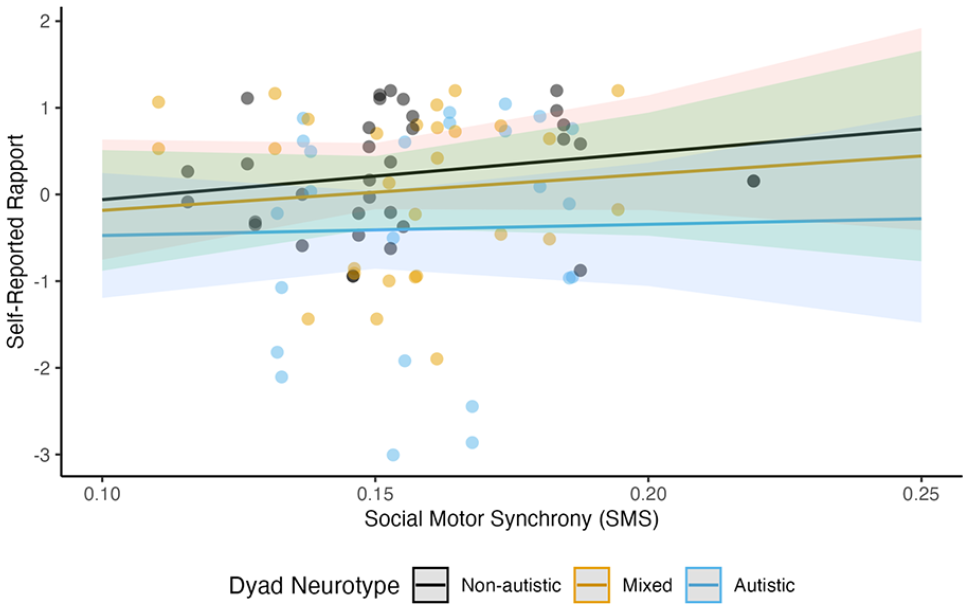
Relationship between SMS and Rapport across different neurotypes.
As planned, follow-up analyses included an analogous Bayesian LMM. We compared an intercept-only model with a fixed-effects model (SMS-neurotype interaction), the fixed-effects model performed better with strong evidence favouring the fixed over the intercept-only model (BF10 = 11.06). Furthermore, the fixed-effects model explains more variance (higher R²), showing better predictive accuracy (lower RMSE), and receiving stronger support based on WAIC and LOO.
Within the model (see Supplemental Material S7 for diagnostics), SMS positively predicted rapport for the non-autistic dyads (β = 0.37, 95% CI [−0.31, 1.16]) with 88.05% probability of being positive (>0) and for the mixed (β = 0.31, 95% CI [−0.45, 1.26]), there was 81.05% probability of being positive (>0). For the autistic dyads (β = −0.09, 95% CI [−1.17, 0.64]), the converse was true, with a 53.60% probability of being negative (<0)). Across all three dyad types, the credible intervals were wide and included zero, reflecting uncertainty regarding the direction of these effects. Rapport scores were descriptively highest for non-autistic dyads (M = 0.24, SD = 0.67), followed by mixed dyads (M = 0.06, SD = 0.94), and lowest for autistic dyads (M = −0.42, SD = 1.32).
In our two-tailed comparison of slopes (H2), the non-autistic dyads showed a stronger positive relationship between SMS and rapport compared to autistic dyads, though the evidence is anecdotal (β diff = 0.46, SE = 0.57, 95% CrI [−0.59, 1.70], BF10 = 1.19, posterior probability (PP) = 0.54). Similarly, Bayesian analysis indicated anecdotal evidence for a difference between non-autistic and mixed dyads (β diff = 0.07, SE = 0.52, 95% CrI [−1.02, 1.10], BF10 = 0.85, PP = 0.46). Finally, there was also weak evidence for a difference between mixed and autistic dyads (β diff = 0.40, SE = 0.59, 95% CrI [−0.67, 1.73], BF10 = 1.15, PP = 0.53). Across all comparisons, posterior probabilities near 0.50 indicate minimal support for hypothesised differences in slopes. The data provide weak evidence for SMS-rapport relationships across dyad types. Frequentist analyses suggest the relationship is strongest in non-autistic dyads, followed by mixed dyads, and weakest in autistic dyads. Bayesian findings align in direction but offer minimal evidence for these hypothesised differences.
The final hypothesis (H3) tested whether there were differences in the ratio of SMS to rapport between autistic and non-autistic participants. A one-tailed independent samples t-test was conducted to compare the mean ratio scores between non-autistic and autistic participants. The non-autistic group (M = 0.73, SD = 0.18) had significantly higher ratio scores than the autistic group (M = 0.65, SD = .21; t(84) = 2.04, p = .022, 95% one-sided CI [0.02, ∞], Cohens d = 0.45, 95% CI [0.08, ∞]). In addition, a Bayesian independent samples t-test resulted in a BF10 = 1.38, which provides anecdotal evidence in favour of the alternative hypothesis over the null hypothesis. Overall, the analyses indicate that non-autistic participants require a higher level of SMS to achieve a high level of rapport compared with autistic participants (Figure 4).
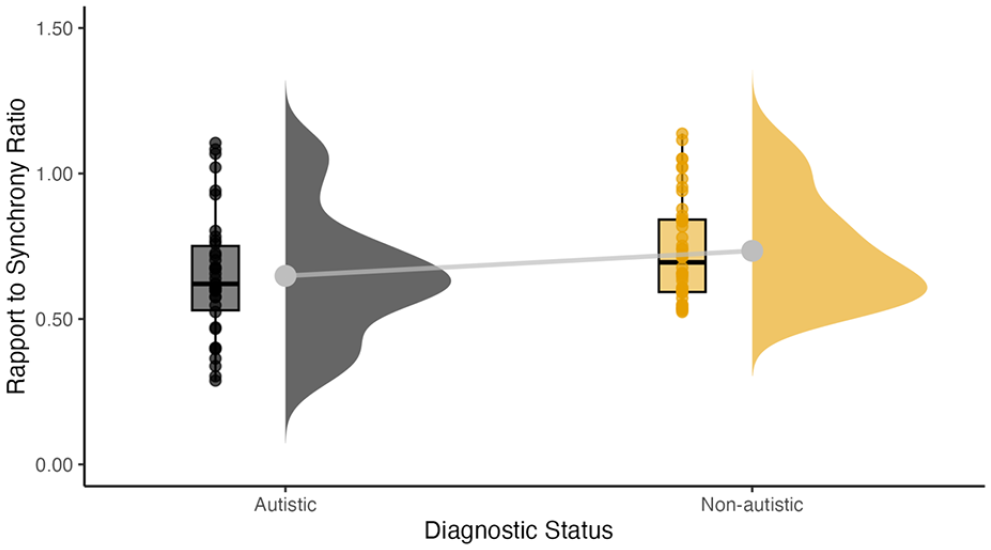
Distribution of Rapport to synchrony ratios by diagnostic status.
Discussion
SMS is widely recognised as a key factor in fostering rapport during social interactions among neurotypical individuals (Mogan et al., 2017). However, the role of SMS in fostering rapport among autistic adults remains underexplored, particularly in naturalistic settings (Glass & Yuill, 2023). This study examined SMS in natural conversations between autistic, non-autistic, and mixed-neurotype dyads, investigating whether SMS is reduced in dyads with autistic individuals and whether SMS predicts self-reported rapport.
Contrary to our first hypothesis (H1), the frequentist and Bayesian analyses did not reveal significant differences in SMS between the three dyad types. This lack of significant findings was unexpected, as previous research demonstrated, with a medium effect size, differences between non-autistic dyads and those with one autistic person (Georgescu et al., 2020). Counteractive factors, such as methodological differences between the studies, may explain the discrepancy (Anvari et al., 2023). Georgescu et al. (2020) used multiple structured tasks such as role-playing and debates, each lasting for 5 minutes, likely fostering SMS by providing shared goals (Glass & Yuill, 2024) and repeated exposure, indicating cumulative effects (Götz et al., 2024). In contrast, our study featured a single, unstructured 5-minute conversation, which might not have provided sufficient time for participants to become comfortable with each other and for rapport to build cumulatively. Prior research has utilised longer interactions – up to 20 minutes – which allow more opportunity for rapport development (Vacharkulksemsuk & Fredrickson, 2012). Incorporating an ice-breaker activity or extending the conversation duration in our study might have facilitated a more natural flow and stronger rapport between participants. These methodological differences may have minimised our ability to detect an effect. This interpretation is supported by evidence that longer or more structured interactions offer greater opportunities for SMS to develop, potentially amplifying neurotype-related differences – a factor particularly relevant for machine-learning approaches that use SMS as a diagnostic marker (Koehler et al., 2024; Koehler et al., 2022).
Second, we examined whether SMS predicted rapport in non-autistic and mixed dyads. We predicted differences across dyad types, with a stronger relationship between rapport and SMS in non-autistic dyads. Our results offered partial support for this hypothesis. The frequentist analysis indicated a stronger link between SMS and rapport in non-autistic compared to mixed and autistic dyads, but no difference was detected between the autistic and mixed dyads. Bayesian analysis also provided moderate evidence suggesting a more pronounced SMS-rapport relationship in non-autistic dyads than in both autistic and mixed dyads. These findings are consistent with existing literature that highlights the role of SMS in fostering rapport and social connection among neurotypical individuals (Mogan et al., 2017). This suggests that SMS contributes more significantly to rapport-building in non-autistic and mixed dyads, whereas autistic dyads may rely less on synchrony cues during social interactions.
Although the relationship strength between SMS and rapport varied across groups, no dyad type – autistic, mixed, or non-autistic – showed a significant overall link between synchrony and rapport. While slopes differed, no group consistently demonstrated that higher SMS directly increased rapport. This suggests that SMS alone may not predict rapport strongly or that its influence was diminished for reasons similar to those in H1. However, the observed patterns hint that SMS influences rapport differently: non-autistic dyads might rely more on synchrony, and autistic dyads less so. It is possible that autistic dyads rely more on different cues like the content of verbal communication or shared interests (Morrison et al., 2020). Qualitative data also indicate that autistic people may simply be more tolerant of variations in people’s behaviour and communication (content and style) provided that shared values, such as honesty, are met (Sutherland et al., 2024).
Finally, we transitioned from dyadic-level analysis to individual-level analysis to examine the relationship between synchrony and rapport in autistic and non-autistic participants (H3), predicting that non-autistic participants would have a higher ratio score than non-autistic participants. This hypothesis was confirmed, indicating that SMS influenced non-autistic participants’ rapport scores. This finding suggests that non-autistic individuals may be more sensitive to social synchrony when developing rapport, whereas autistic individuals might rely less on synchrony cues in social interactions.
Our results can be understood through the lens of the DEP (Milton, 2012), which suggests that communication challenges between autistic and non-autistic people arise from mutual differences in communication and understanding rather than deficits in one group. Non-autistic people may rely on SMS to build rapport, while autistic people may prioritise other aspects of the interaction (Jaswal & Akhtar, 2019; Morrison et al., 2020). The weaker SMS-rapport link in autistic dyads and the intermediate findings in mixed dyads highlight how different communication styles require mutual adaptation. In mixed interactions, mismatched expectations – where non-autistic individuals may be more influenced by SMS and autistic individuals focus on other aspects – underscore the need for adaptation rather than solely relying on SMS to achieve rapport. This may be challenging since SMS with another person is unlikely to be under conscious control – non-autistic people experiencing a lack of SMS may be unaware of why they are not getting along with an autistic person and thus unable to correct their perception to be more inclusive. These findings suggest that while SMS can contribute to rapport among non-autistic individuals, it is important to recognise and value other ways of building rapport, especially in cross-neurotype interactions. These findings emphasise that understanding the varied ways autistic and non-autistic people build rapport is crucial for fostering effective communication, particularly in cross-neurotype interactions.
An important consideration arising from our study is whether SMS truly matters in the development of rapport. If autistic people can establish rapport effectively while relying less on SMS, then the emphasis on reduced SMS as contributing to social challenges in autism may be overstated (Carnevali et al., 2024; Glass & Yuill, 2023; Mogan et al., 2017). Our findings indicate that rapport remains strong within autistic dyads in the absence of relatively high synchrony. This aligns with Heasman and Gillespie’s (2019) study, which found that a lack of verbal coordination between autistic individuals did not impact rapport, suggesting that our findings may extend this insight to non-verbal communications as well. Therefore, rather than focusing on the reduction of SMS, it may be more beneficial to explore how varying reliance on synchrony affects interactions. Acknowledging that rapport can be achieved through multiple pathways highlights the importance of understanding and adapting to different communication preferences rather than fixating on synchrony as a universal mechanism for successful social connection.
This work also exemplifies the methodological rigour advocated by Livingston et al. (2024), including preregistration and the adoption of advanced analytical techniques. These approaches not only ensure greater transparency and replicability in autism research but also reflect the broader shift in the field towards open science practices (Poole et al., 2024). By addressing these methodological challenges, our study contributes to the growing body of work refining DEP theory and offers practical avenues for future empirical research.
While our study provides valuable insights into the role of SMS in dyadic interactions, some limitations must be acknowledged (Kinnaird et al., 2019). Autistic people may underestimate their rapport with others due to poor self-perception and an underestimation of their social competence and skills (DeBrabander et al., 2021; Hull et al., 2017; Jamison & Schuttler, 2015) due to the stigma around autistic communication (Bauminger et al., 2004; Botha et al., 2022). Future studies could incorporate complementary measures, such as third-party assessments, to provide a more comprehensive understanding of rapport, with the caveat that these may be affected by a neuronormative lens.
In addition, the presence of video cameras may have influenced our findings. Previous research shows that simply knowing one is being recorded can reduce certain social behaviours (Noah et al., 2018a) as individuals shift from focusing on internal experiences to an external self-awareness when observed (Noah et al., 2018b). In this study, this external focus could explain the low levels of SMS overall. Participants might have become more self-conscious, leading to less engagement in the unconscious, spontaneous movements that typically drive synchrony. Future research should investigate how video cameras impact social behaviour, particularly in autistic people, as little research exists on this topic.
Conclusion
This study challenges the assumption that autistic individuals inherently exhibit less SMS, demonstrating that the manifestation of synchrony in social interactions is influenced by a range of factors, including neurotype, interaction context, and rapport-building strategies. For non-autistic people, synchrony appears to be a crucial component of social rapport, whereas autistic people may rely more on alternative forms of communication. Recognising these differences is vital for fostering inclusive social environments and developing services and supports that respect diverse social experiences.
Deviations from protocol
Since submitting our Stage 1 registered report, we made three deviations. In Data Transformations, we initially planned to use absolute z-scores for rapport to align with the SMS measure. However, this misrepresented low rapport as high rapport, so we retained the original z-scores for mixed models. We also added a Bayesian ANOVA for consistency with our other analyses, though hypothesis confirmation remained based on the planned frequentist ANOVA. The Bayesian LMM initially used a Gaussian family, but poor posterior predictive cheques led us to switch to a skew_normal() family, which better fit the data (BF10 = 3340). This prompted a reassessment of priors due to scaling differences.
In the Stage 1 Bayesian LMM analysis, we incorrectly stated that both specific and default priors would be used; only the informative priors described in the manuscript and R script were applied. In addition, in Hypothesis 3, we mistakenly predicted higher ratios for autistic participants. Based on our logic – that SMS is less critical for achieving high rapport for autistic individuals – the correct expectation was for non-autistic participants to have higher ratios. We revised the prediction wording to align with the correct interpretation.
Supplemental Material
sj-docx-1-aut-10.1177_13623613251319585 – Supplemental material for Social motor synchrony and interactive rapport in autistic, non-autistic, and mixed-neurotype dyads
Supplemental material, sj-docx-1-aut-10.1177_13623613251319585 for Social motor synchrony and interactive rapport in autistic, non-autistic, and mixed-neurotype dyads by Themis N Efthimiou, Charlotte EH Wilks, Sarah Foster, Michelle Dodd, Noah J Sasson, Danielle Ropar, Martin Lages, Sue Fletcher-Watson and Catherine J Crompton in Autism
Footnotes
Declaration of conflicting interests
The author(s) declared no potential conflicts of interest with respect to the research, authorship, and/or publication of this article.
Funding
The author(s) disclosed receipt of the following financial support for the research, authorship, and/or publication of this article: This work was funded by the Templeton World Charity Foundation (grant number TWCF-2020-20442) which was awarded to Catherine J Crompton, Noah Sasson, Danielle Ropar, and Sue Fletcher-Watson.

Supplemental material
Supplemental material for this article is available online.
References
Supplementary Material
Please find the following supplemental material available below.
For Open Access articles published under a Creative Commons License, all supplemental material carries the same license as the article it is associated with.
For non-Open Access articles published, all supplemental material carries a non-exclusive license, and permission requests for re-use of supplemental material or any part of supplemental material shall be sent directly to the copyright owner as specified in the copyright notice associated with the article.
