




Abstract
As many autistic individuals report mentalizing difficulties into adulthood, the current pre-registered study investigated potential differences in belief reasoning and/or visual perspective taking between autistic and non-autistic adults. The Seeing-Believing task was administered to 121 gender-balanced participants online (57 with a self- reported diagnosis of an autism spectrum condition and 64 without), as well as Raven’s Progressive Matrices (on which the groups did not significantly differ) and the Autism Spectrum Quotient. Non-autistic adults replicated previous findings with this task, revealing slower responses to belief-reasoning than to perspective-taking trials. Autistic adults did not show significantly slower or more error-prone performance during perspective taking and/or belief reasoning. In fact, the autistic group committed significantly fewer mistakes, including fewer altercentric intrusions. The main group difference in response times was a steeper increase with increasing angular disparity between self and other in the autistic group. We discuss our findings in terms of differences in self-other control, but emphasise that our findings cannot be explained in terms of simplistic deficit-based notions of autism and suggest that autistic adults might favour slightly different strategies when judging another’s perspective or belief.
Lay abstract
Many autistic individuals report difficulties in social situations, where they are required to think about what goes on in others’ minds. These states of the mind can include how others perceive the world around them, their beliefs, or their desires. While research has shown that autistic children could be delayed in developing their full capacity in this regard, less is known about how adults process others’ experiences and beliefs. Here we used a novel task and asked adults to participate online. Participants self-reported whether they had been diagnosed with autism or not and we split them into two groups depending on their response. We also asked participants to fill in a self-report questionnaire about social preferences and habits and we also asked them to conduct a test of their nonverbal reasoning ability. Importantly, the autistic and the non-autistic groups did not differ in their nonverbal reasoning abilities, and on our task, we observed that the autistic group committed fewer mistakes than the non-autistic group. Autistic participants were particularly fast and made fewer mistakes on those responses that overlapped with their own view and belief of reality. In conclusion, our findings do not support a simple view of autism in terms of deficits in either social or more general thinking abilities. Instead, autistic adults might favour slightly different ways of thinking about other’s experiences and beliefs that is more firmly linked to their own experience and knowledge.
Introduction
A crucial developmental stepping-stone in our understanding that others’ experiences may differ from our own is the emergence of visuospatial perspective taking – the mental process of seeing the world through another’s eyes. So far, this capacity has been studied separately from other mentalizing abilities, such as belief reasoning. The latter requires the representation of others’ beliefs about reality rather than their actual experiences and might therefore require a higher level of complexity. Recently, by developing a novel integrated paradigm, the ‘Seeing-Believing task’, we delineated perspective taking from belief reasoning. Reasoning about others’ beliefs was consistently associated with higher costs, even when those beliefs were true and therefore matched their visual perspective (Green et al., 2023). In the present study, we aimed to extend these new insights into the segregation of mentalizing sub-processes in autism which may provide more nuanced insights into the cognitive phenotype of autism.
Mentalizing
Mentalizing refers to the ability to impute mental states to others (see Quesque et al., 2024). The so-called Theory of Mind Hypothesis of autism suggests that differences in social interaction and communication in autism arise specifically from variations in certain aspects of the mentalizing capacity (e.g. Rajendran & Mitchell, 2007). According to the revised lexicon by Quesque et al. (2024, Figure 1), we rename this hypothesis as the ‘mentalizing hypothesis’ (MH) in the current study. The more specific subprocess of ToM within mentalising is commonly measured in terms of belief reasoning (BR), which can be broadly divided into true- (TB; the observer and task protagonist’s mental representations match) and false-belief reasoning (FB; the observer and protagonist’s mental representations diverge, e.g. the Sally-Anne task; Baron-Cohen et al., 1985). Subsequent research suggests that typically developing children tend to pass FB tasks between ages 4–5 years (see Wellman et al., 2001 for review), while autistic children typically start to pass them later (Baron-Cohen et al., 2001; Charman & Baron-Cohen, 1995). Although at later ages, many autistic children pass BR tasks, evidencing mentalizing capacity.
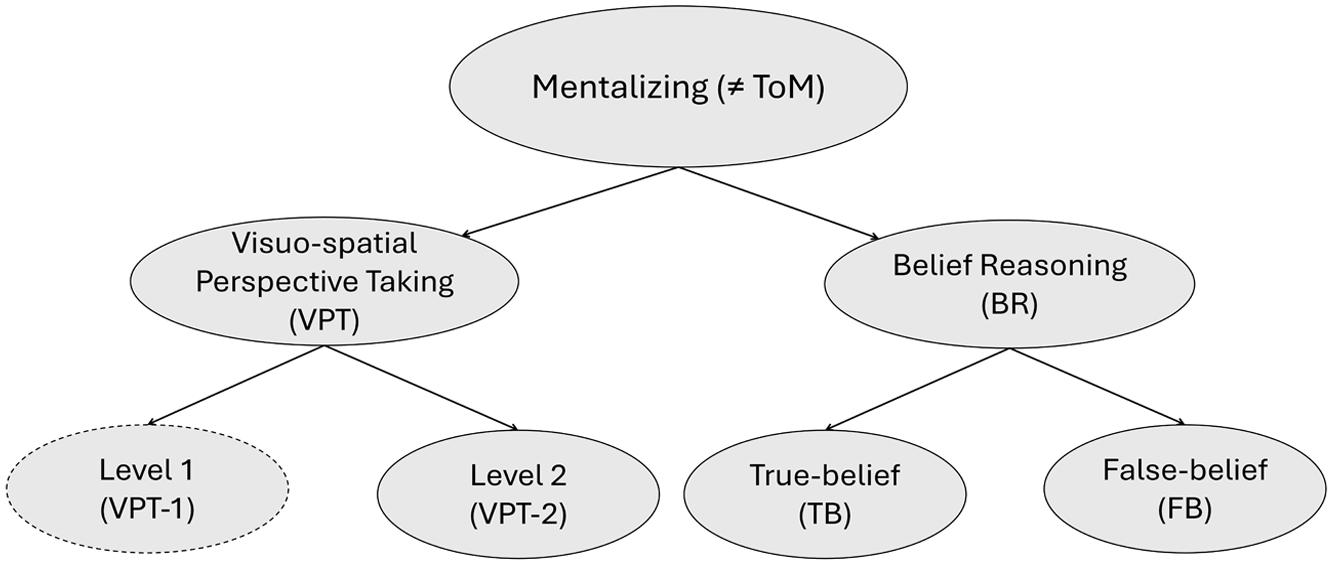
Summary of mentalizing concepts, aligned with Quesque et al.’s (2024) proposal of a common lexicon. The authors propose that the use of Theory of Mind (ToM) as an equivalent term to general Mentalizing should be avoided. Instead, ToM should be regarded as a specific way of mentalizing that uses ‘folk psychology and heuristics’ to attribute mental states to others (p. 2). VPT-1, in dashed circle, was not studied in this investigation; processes on the same line are not assumed to be of equal difficulty.
However, many autistic adults report mentalizing difficulties (Bylemans et al., 2023; Costa-Cordella et al., 2023; Spek et al., 2010) despite being able to pass experimental tests of this capacity – measures of both first-order (inferring a person’s mental state) and second-order BR (inferring a mental state about a mental state; Kaland et al., 2002; Tager-Flusberg et al., 2000). In fact, a recent review by Yeung et al. (2023) indicates that the most frequently employed mentalizing tasks might be too simplistic and therefore exhibit ceiling effects in the adult population, potentially explaining a lack of significant performance differences between autistic and non-autistic participants. Advanced tasks have been developed to capture more accurately the demands of everyday social interactions. Using the Faux Pas task as an example (Baron-Cohen et al., 1999),’ participants are presented with short vignettes describing social situations and asked to explain characters’ behaviour by inferring their mental states. Using advanced mentalizing tasks (see also Strange Stories by Happé, 1994), some studies reported that autistic adults scored less than non-autistic adults (Happé, 1994; Zalla et al., 2009), whereas many other studies report no such differences (for a review of null findings, see Gernsbacher & Yergeau, 2019). These tasks are regarded as more difficult than first- and second-order BR tasks because they probe a range of mentalizing concepts, requiring an appreciation of subtler contextual information and an understanding of the emotional impact of behaviours. However, the Faux Pas task requires participants to read passages of written text, thereby introducing different verbal and executive demands compared with first- and second-order BR tasks. As such, it is difficult to isolate social (mentalizing) from other non-social processes (executive or verbal functioning). The lack of agreement among previous findings, as well as the difficulty associated with producing ‘pure’ mentalizing tasks make it difficult to ascertain if autism is associated with genuine mentalizing differences. Furthermore, Rødgaard et al.’s (2019) meta-analysis (of eleven meta-analyses) reports that differences between autistic and non-autistic participants on seven mentalizing measures appear to have decreased over time, possibly suggesting changes in diagnostic practice that may have moved the diagnosis of autism towards a more inclusive and heterogeneous definition.
Visuospatial perspective taking
VPT (Figure 1) refers to our capacity to understand that an object viewed simultaneously by the self and another will create different visual experiences if the viewing circumstances differ; this includes both what is visible (Level 1) and how something appears from another’s viewpoint (Level 2; Flavell et al., 1981). VPT-2 is typically measured by asking participants how a visual scene (e.g. a complex object or a spatial configuration of objects) would appear from another’s distinct visual perspective (see Hamilton et al., 2009). Like BR tasks, responding requires the participant to inhibit their own perspective to represent the viewpoint of another. Although this highlights a process common to BR reasoning and VPT-2, the type of information being represented differs. BR involves another’s (true or false) belief about reality, whereas the actual state of reality from the other’s perspective is represented during VPT-2. Some studies report that autistic children are less accurate relative to non-autistic children in VPT-2 tasks (Hamilton et al., 2009; Yirmiya et al., 1994). Studies assessing adults with autistic traits, rather than those diagnosed formally with autism, suggest that VPT-2 may be more challenging for autistic than non-autistic individuals because they struggle to mentally embody another’s perspective (e.g. Brunyé et al., 2012; Kessler & Wang, 2012; for review see Pearson et al., 2013).
Comparing belief reasoning and visuospatial perspective taking
Green et al. (2023) introduced the Seeing-Believing paradigm that permits direct comparisons between BR and VPT-2. It resembles classic FB tasks (e.g. the Sally-Anne task), but is appropriately demanding for adults while also minimising the non-social verbal and executive demands imposed by advanced mentalizing tasks (e.g. Faux Pas). Participants are required to infer either a character’s belief (about) or their unique visual perspective of a target object (see Figure 2). Each trial begins with an image of an object (either a toy rabbit or train) on a table, and a character, ‘Kim’, sitting at the table on a chair with her back to the participant. In subsequent images, Kim leaves the room and in her absence the object on the table is either swapped for another (e.g. the rabbit swapped for the train), introducing an FB in Kim, or remains, maintaining a TB. A bucket is then placed over the object before Kim returns. Next, Kim returns either to her original seat aligned with the participant’s view or to one positioned 90⁰ to the left or right. This results in either a 0⁰ or 90⁰ angular disparity between the visual perspectives of Kim and the participant. Participants are then asked ‘What will she [Kim] expect to see [when the bucket is lifted]?’, assessing their understanding of Kim’s belief, or ‘What will she actually see?’, assessing their understanding of Kim’s visual experience from her current perspective (VPT-2 judgement). With this single task, then, Kim’s belief or visual experience differs systematically from the participants at 90° angular disparity, controlling for overlap with the egocentric experience.
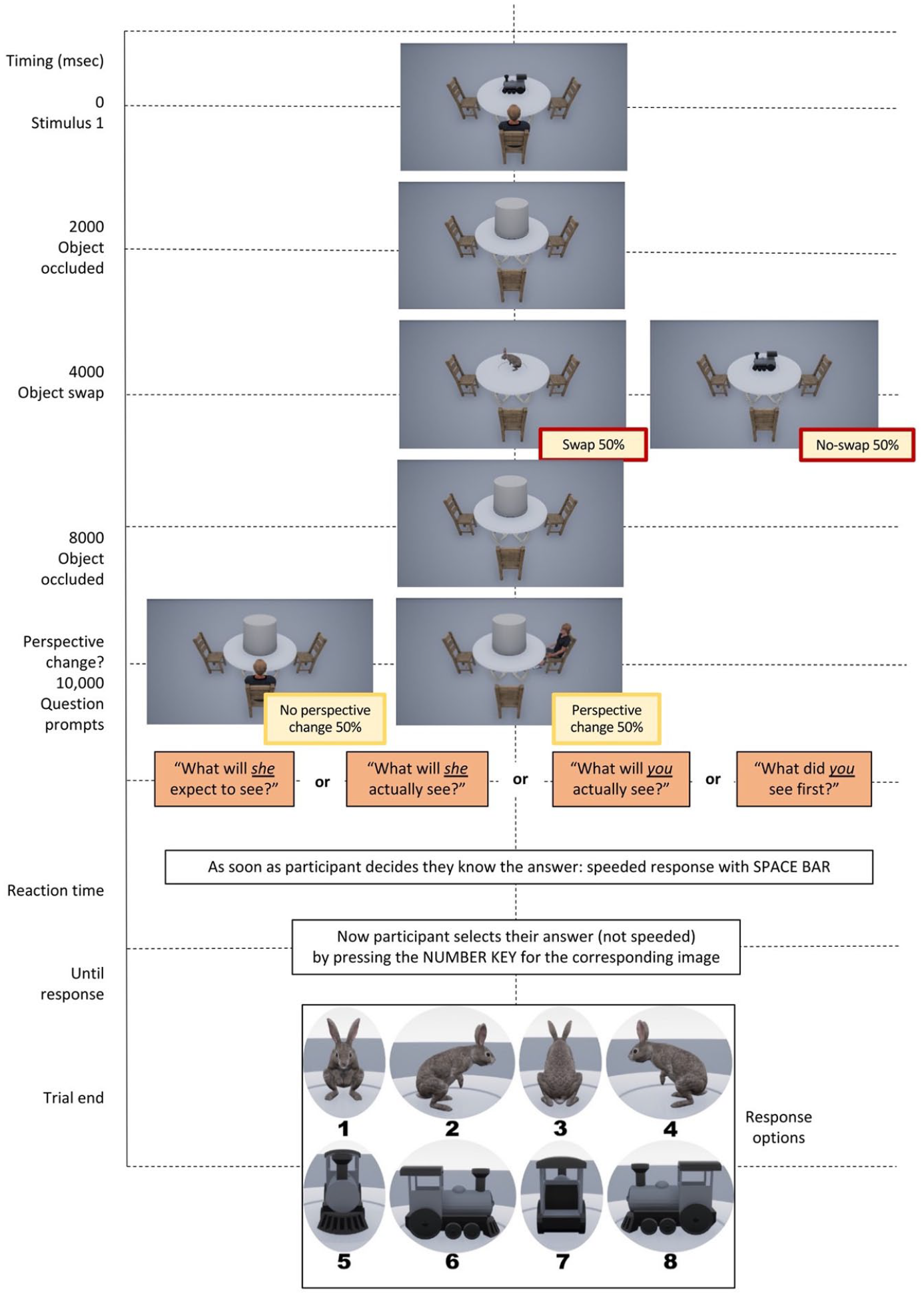
Trial schematic of the experimental task. Each trial starts with an image of an object (either a toy rabbit or train) on the table, and a character sitting in front of the participant (0° angular disparity with respect to the object on the table). Next, the character leaves and in her absence the object on the table is either swapped (50% of trials; e.g. train swapped for rabbit), resulting in a false belief (FB) or remains (50% of trials), resulting in a true belief (TB). A bucket then occludes the object. When the character returns, she sits either in her original seat (0⁰) or one positioned 90⁰ to its left or right. This results in either a 0⁰ or 90⁰ angular disparity, respectively, between the visual perspectives of character and participant. Participants are then asked one of two questions: ‘What will she [character] expect to see [when the bucket is lifted]?’, assessing their understanding of the character’s true (TB) or false (FB) belief, or ‘What will she actually see?’, assessing their understanding of the character’s visual experience from her current viewpoint, i.e. her perspective (VPT-2). Participants were also asked about their own current (Self-Current) or their initial (Self-Past) perspective of the scene. These additional questions helped to instigate a clearer self-other distinction and were related to Hypothesis 3 which is presented in Supplementary Materials (Section 3). There were two practice blocks, with twelve trials each, with a recap of the task instructions placed in between. This was followed by three blocks of 64 trials, each with self-paced breaks in between.
Green et al. (2023) reported that TB reasoning was associated consistently with increased response times (RTs) compared with VPT-2 judgements, despite their conceptual overlap and identical responses. This difference was consistently observed at 90⁰ disparity between Kim and the participant, where Kim’s perspective and belief could not be subsumed under the participant’s egocentric perspective and knowledge (at 0⁰). This led the authors to conclude that BR and VPT-2 might be resolved differently by the two distinct mentalizing systems proposed by Apperly and Butterfill (2009), with more complex representational processes assumed for BR and simpler processes for VPT-2 (Green et al., 2023).
The current investigation: hypotheses
Utilising the Seeing-Believing task (SB-task), we investigated whether more subtle differences exist between autistic and non-autistic adults between BR and VPT-2 that may provide more nuanced insights into the cognitive phenotype of autism compared to traditional deficit-based theories of autism (e.g. Gernsbacher & Yergeau, 2019; Pellicano & den Houting, 2022). All hypotheses were pre-registered on OSF (https://osf.io/3dgpy/). Hypothesis 1 concerned comparisons between TB reasoning and VPT-2, based upon the findings of our former study. We predicted that the non-autistic group would demonstrate greater RTs for BR judgements in the No-swap (TB) condition compared with VPT-2 judgements, and this difference would be greater at 90⁰ than 0⁰ angular disparity, since processing cannot be subsumed under the egocentric perspective.
Since it is unclear whether autism reflects specific differences in mentalizing or more general, non-social differences in processes common to both BR and VPT-2 (e.g. executive or verbal functioning, hereafter referred to as common non-social processes), we formulated two alternative hypotheses for the autistic group. Hypothesis 1a is based on the mentalizing hypothesis and predicts that the autistic group would produce greater RTs and/or errors for TB judgements compared to VPT-2 judgements, and this difference would be greater at 90⁰ relative to 0⁰ angular disparity. More importantly, these increases in RTs and/or errors for TB compared with VPT-2 judgements were predicted to be greater in the autistic compared with the non-autistic group, resulting in a Group-by-Judgement interaction (Hypothesis 1a). If, however, autism is associated with differences in common non-social processes, we predicted that TB and VPT-2 judgements would be equally more difficult for the autistic compared with the non-autistic group, particularly at high angular disparity. In other words, we hypothesised a Group-by-Angular Disparity interaction (Hypothesis 1b). The key distinction between Hypotheses 1a and 1b is whether a slowing in the autistic group is associated with complexity of mental representation (i.e. TB vs VPT-2), or increasing angular disparity (i.e. 0⁰ vs 90⁰).
Hypothesis 2 concerned the relationship between FB, TB, and VPT-2. Our previous findings in non-autistic individuals reported greater RTs and errors for FB judgements compared to both TB and VPT-2 judgements, which was most pronounced at 90⁰ angular disparity (Green et al., 2023). It was predicted that the non-autistic group would replicate this finding. Regardless of whether autism reflects specific difference in mentalizing or common non-social processes (see Rajendran & Mitchell, 2007 for review), we predicted that the autistic group might also exhibit greater RTs and/or errors for FB compared with TB and VPT-2 judgements, but that these costs might be larger compared to the non-autistic group (see Table 1 for details). (Note that further Hypotheses were described in the pre-registration and are reported in Supplementary Materials, Section 3.)
Summary of hypotheses.

Hypothesis numbers are consistent with the pre-registration (https://osf.io/3dgpy/); however, some additional hypotheses (e.g. Hypothesis 3) have been omitted here for conciseness but are included in Supplementary Materials (Section 3). TB stands for true belief judgements; FB stands for false belief judgements; VPT-2 stands for Level 2 visuospatial perspective judgements. Judgement types and angular disparities (0⁰, 90⁰) can be understood based on the detailed procedure shown in Figure 2.
Methods
Design
The hypotheses, study design and planned analyses were pre-registered. The experiment comprised a 2 (Group: autistic, non-autistic) × 2 (Object Swap: No-swap, Swap) × 2 (Angular Disparity: 0⁰, 90⁰) × 4 (Judgement Type: VPT-2, Belief Reasoning, Self-current, Self-past) full factorial mixed design.
Materials
All materials were administered online. The present study employed a version of the SB-task (Green et al., 2023, Experiment 2); see Figure 1 for details. We further administered the Raven’s Progressive Matrices (RPM; Raven & Court, 1938) to measure non-verbal reasoning, which was chosen over more common verbal measures of intelligence because RPM appears to be more appropriate for autistic individuals (further details in Supplementary Materials, Section 1). For example Dawson et al. (2007) reported that Wechsler Scales of Intelligence Three (WISC-III; Wechsler & Kodama, 1949) underestimate intelligence in autism by an average of 30 points. The Autism Spectrum Quotient (AQ; Baron-Cohen et al., 2001) was also administered to measure the degree to which an adult with typical intelligence has traits associated with autism (further details in Supplementary Materials, Section 1). Baron-Cohen et al. (2001) recommend a cut-off of 32 as ideal for discriminating between autistic and non-autistic groups. In the present study, this recommended cut-off was used for inclusion into the autistic group, while values of 26 (one standard deviation below the autistic group mean) or lower were used for inclusion into the non-autistic group.
Participants
Participants were recruited to the study via Prolific (https://www.prolific.co/). The SB-task and RPM were administered online through Pavlovia (Peirce, 2007), after which participants were asked to complete the AQ on Qualtrics and there was no time limit for completion for none of the tasks and instruments. Sample size calculations performed with G*Power (Faul et al., 2007) suggested that a sample of 112 participants (56 autistic, 56 non-autistic) was required to achieve a small-medium effect size (f = 0.15) with 95% power with a 2 × 2 × 4 mixed ANOVA (16 variables across 3 factors). Calculations were computed with correlations of r = .81 among repeated measures, based on our previous data (Green et al., 2023). Participants (see Table 2) were aged between 18 and 40 years and fluent in written and spoken English. Participants in the autistic group self-reported a formal diagnosis of autism and had an AQ score equal to or greater than 32. Participants in the non-autistic group reported to have never been diagnosed with autism and provided AQ scores of less than 26. As shown in Table 2, online recruitment via Prolific allowed us to balance sex in each group, which is uncommon in autism research. While our sample size was not powered to allow for the targeted analysis of sex differences, we propose that a balanced sex distribution allows for more generalisable findings (see Supplementary Materials, Section 4, for an exploratory analysis including sex). Participants were compensated with £12 via Prolific. Specific data on socioeconomic status and educational attainment levels were not recorded. Aston University’s Research Ethics Committee approved this experiment, and all participants provided informed consent before taking part. Autism community members were not involved in the development of the research question, study design, measures, implementation, or interpretation.
Statistical analysis
Custom MATLAB (r2019a) code (https://osf.io/xwjub/) was used to calculate condition averages and remove outliers, and JASP (Version 0.14.1) to perform inferential statistics. Outliers were defined as two SDs beyond each participant’s condition mean. Due to violations of normality, RTs were log-scaled and two participants were removed for scoring greater than two SDs above the overall mean RT for all participants over all conditions in at least 4/16 conditions, in addition to those removed due to low accuracy on the SB-task. Of those removed, one was in the autistic group and the other in the non-autistic group. All participants included in statistical analyses answered at least 3/12 trials of each type correctly in line with Green et al. (2023). This resulted in the sample described in Table 1. Incorrect trials were not included in mean RT calculations, and errors were analysed separately to RTs. Hypotheses were evaluated using within-subjects and mixed model analysis of variances (ANOVAs), and paired and independent samples t-tests for planned comparisons. The group comparison for Hypothesis 2 deviates from the pre-registration (https://osf.io/3dgpy/) using an ANOVA. (The pre-registered analysis is included in Supplementary Materials, Section 2.) For ANOVAs, where non-sphericity assumption was not met, Greenhouse–Geisser correction was applied.
Results
We used a two-tailed independent samples t-test to assess if the autistic and non-autistic group differed in their nonverbal reasoning, as assessed by RPM. On average, the autistic group revealed slightly higher scores than the non-autistic group (Table 2), but no significant difference was observed, t(119) = 1.771, p = .079, d = .323. RPM scores were not included as a covariate in subsequent statistical analyses (but see Supplementary Materials, Section 4.2, for exploratory analyses). Other variables were controlled a priori, limiting inter-group variability. We defined a specific age range of 18–40, we balanced sex in each group, and we defined the two groups as non-overlapping in terms of AQ. Despite these efforts and a seemingly comparable average age (Table 2), the groups actually differed significantly in age, t(119) = 2.696, p = .008, d = .491. We therefore included an exploratory ANOVA with age as a covariate in Supplementary Materials (Section 4.1) that shows that while age differs between the groups it does not interact with any of the design factors and specifically not in interaction with group (all p > .05).
Summary of sample demographic information after applying exclusion criteria.

M = mean, SD = standard deviation. Descriptive statistics were calculated after the removal of participants with low accuracy and excessive RTs on the Seeing-Believing Task.
Hypothesis 1
Between-groups comparison (Hypotheses 1a-group, 1b-group, 1c-group)
This analysis investigated if the relationship between TB and VPT-2 judgements differed between the autistic and non-autistic group (Hypotheses 1a,b), and/or whether angular disparity (0 vs 90°) would differentiate between the groups (Hypotheses 1b,c). A three-way mixed ANOVA included Group (autistic vs non-autistic), alongside Judgement Type (TB, VPT-2), and Angular Disparity (0°, 90°) as factors. Analysis of RTs revealed a significant interaction between Group and Angular Disparity, F(1, 119) = 4.906, p = .029,
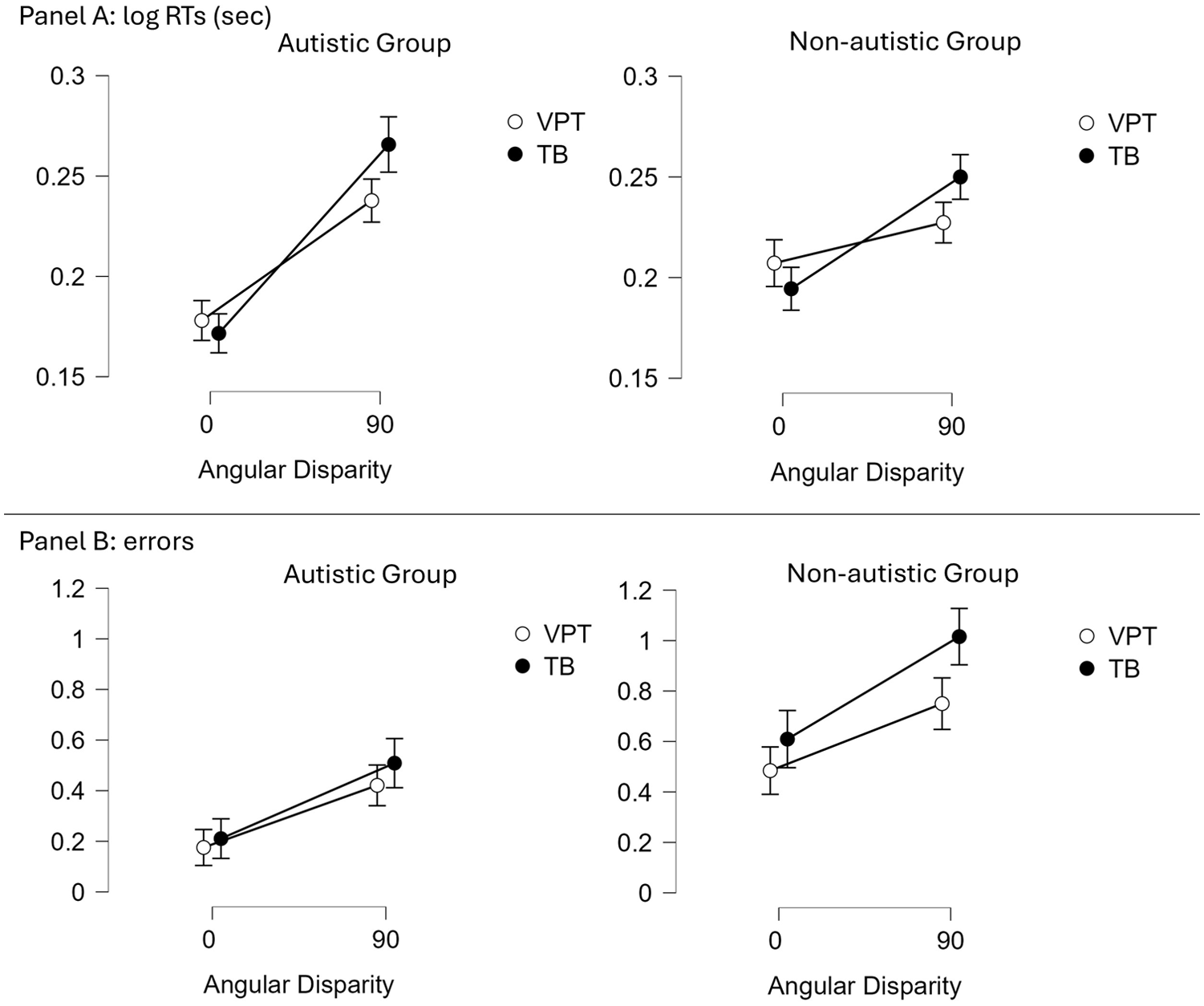
Results for Hypothesis 1 (analysis of No-swap trials (TB) only). Response times (logRTs, measured in seconds; correct responses only) are shown in Panel A and errors (average number of errors per condition with a maximum of 12) are shown in Panel B. Error bars are standard error of mean.
Post hoc tests revealed statistically significant differences between 0⁰ and 90⁰ angular disparity in the autistic, t(119) = 9.040, p < .001, d = .286, and the non-autistic group, t(119) = 6.303, p < .001, d = .188. Between-group comparisons at 0° and 90°, respectively, did not reach significance (both p > .1), although a larger increase in RTs on average from 0° to 90° in the autistic group (Figure 3) appears to drive the significant interaction between Group and Angular Disparity. So far, RT data appear to support Hypotheses 1b, since a larger angular disparity effect seems to differentiate between the two groups (Group × Angular Disparity interaction) rather than a difference between VPT-2 and TB processing.
The analysis of error data revealed no significant interaction between Group and Angular Disparity (p = .699), Group and Judgement Type (p = .304), nor Group, Judgement Type, and Angular Disparity (p = .684). However, there was a significant main effect of Group, F(1, 119) = 7.729, p = .006,
Non-autistic group (Hypothesis 1)
Based on Green et al. (2023), we expected greater RTs and/or errors for TB than VPT-2 and that this difference would be greater at 90° relative to 0° angular disparity. RT analysis indeed revealed a statistically significant interaction of Judgement Type × Angular Disparity interaction, F(1, 63) = 6.024, p = .017,
A planned comparison for the difference in RTs between TB and VPT-2 judgements at 90° angular disparity, performed with a two-tailed paired samples t-test, confirmed a statistically significant difference, t(63) = 1.789, p = .039, d = .224, where TB reasoning was associated with greater RTs than VPT-2. This difference was replicated in errors, t(63) = 2.009, p = .024, d = .251, with TB judgements producing more errors than VPT-2 judgments. In conclusion, findings for the non-autistic group support Hypothesis 1 (Table 1), replicating our previous work (Green et al., 2023; Figure 3).
Autistic group (Hypotheses 1a, b)
Hypothesis 1 (a, b) aimed to understand if there is a difference between TB reasoning and VPT-2 in autistic adults, especially at 90°, or if responses would only increase with angular disparity from 0° to 90°. Analysis of RT data did not reveal a statistically significant main effect of Judgement Type, F(1, 56) = 1.208, p = .276,
Hypothesis 2
On the basis of previous findings (Green et al., 2023), we predicted that FB judgements made at 90° angular disparity would be associated with greater RTs and/or errors than TB and VPT-2 judgments made at 90° angular disparity in the non-autistic group and that this pattern would be different in the autistic group. In concordance with Green et al. (2023) we focussed on 90° angular disparity only, because at 0° disparity TB and VPT-2 judgments were identical to the egocentric perspective and knowledge, while FB would also differ at 0°. Any differences observed at 90° would therefore be likely to reflect genuine differences in processing complexity rather than due to any overlap or discrepancy with the egocentric perspective. In contrast to our pre-registration, we employed ANOVAs to compare RTs and errors between and within groups (instead of a series of t-tests) and also included VPT-2, No-swap trials (full factorial design). The pre-registered analysis is provided in Supplementary Materials (Section 2).
Between-groups comparison (Hypotheses 2a-group, 2b-group)
The aim of this hypothesis was to assess whether the autistic group exhibits a larger difference between FB judgements and both TB and VPT-2 judgements at 90° angular disparity than the non-autistic group (Hypothesis 2a-group) or whether there would be a main effect of group with the autistic group revealing slower and /or more error-prone responses (Hypothesis 2b-group) across all conditions.
We employed two 2 × 2 × 2 mixed measures ANOVAs for RT and errors, separately, with the between-subjects factor Group (Autistic, Non-autistic) and the within-subjects factors Judgement Type (BR 90, VPT-2 90) and Object Swap (Swap 90, No-swap 90) at 90° angular disparity only.
Analysis of RTs (see Figure 4, Panel A) revealed main effects of Object Swap, F(1, 119) = 69.623, p < .001,
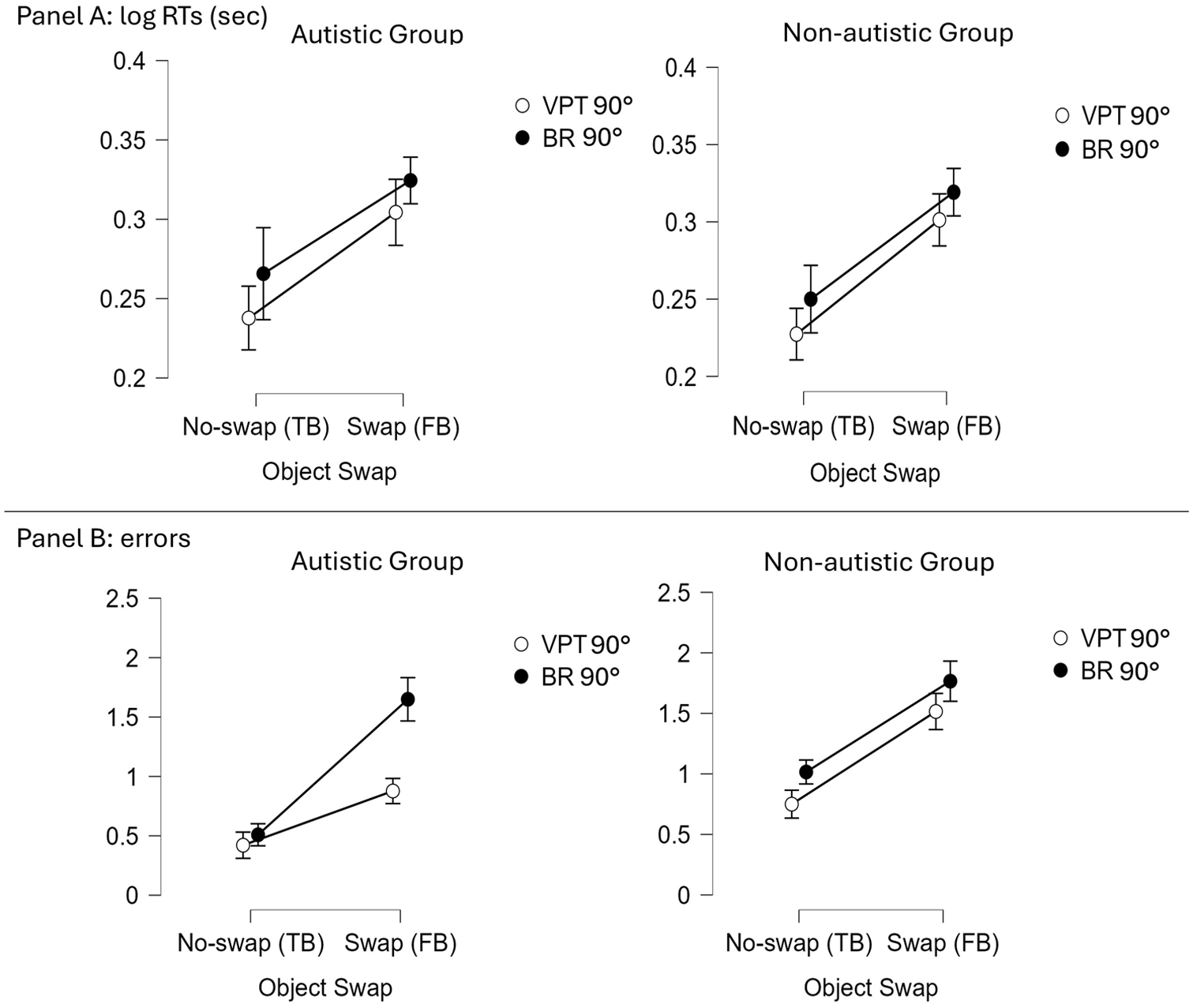
Results for Hypothesis 2 (analysis at 90° angular disparity only). Response times (logRTs, measured in seconds; correct responses only) are shown in Panel A (top) and errors (average number of errors per condition and with a maximum of 12) are shown in Panel B (bottom). Error bars are standard error of mean.
Analysis of errors (see Figure 4, Panel B) also revealed significant main effects of Object Swap, F(1, 119) = 71.248, p < .001,
Non-autistic group
RT analysis for the non-autistic group revealed significant main effects of Object Swap, F(1, 63) = 41.446, p < .001,
Autistic group (Hypotheses 2a and 2b)
For the autistic group, RTs revealed significant main effects of Object Swap, F(1, 56) = 29.136, p < .001,
Error analysis revealed significant main effects of Object Swap, F(1, 56) = 38.427, p < .001,
Discussion
This study utilised the SB-task (Green et al., 2023) to assess if autism reflected a specific difficulty in forming complex social representations, or difficulties in non-social processes common to both BR and VPT-2. To this end, we compared TB and VPT-2 performance in groups of autistic and non-autistic adults, recruited online via Prolific. The present findings for the non-autistic group replicate Green et al. (2023). They were slower to make TB compared with VPT-2 judgements at 90° angular disparity despite both types of judgement requiring the exact same responses. That is, asking these individuals about another’s TB of reality is identical in content to their visuospatial perspective, but different in the psychological processing of this content. We further replicated an additional RT cost for FB judgements relative to TB and VPT-2 judgements.
The Mentalizing Hypothesis (MH) of autism suggests that differences in social communication arise from a domain-specific difference in mentalizing ability (Rajendran & Mitchell, 2007). Alternatively, these differences may arise from differences in domain-general (not specifically social) processes common to both BR and VPT-2 (Denckla, 1996; Pellicano et al., 2006). Should the differences in social interaction characterising autism arise from differences in domain-general processes, we hypothesised the following: (1) BR and VPT-2 would be impaired equally in the autistic group; (2) any difference between TB and VPT-2 would be similar or smaller in the autistic compared to the non-autistic group; and (3) the autistic group would show greater overall increased processing difficulty (larger RTs and errors) compared with the non-autistic group. Conversely, if the social dimension of the autistic phenotype arises from social-specific variations in mentalizing ability, adults in the autistic group should exhibit a greater difficulty with TB reasoning than VPT-2 judgements when compared with adults in the non-autistic group.
Arguably, the current findings are conceptually closer to a domain-general processing explanation than to a mentalizing-specific explanation. The autistic group exhibited a significantly greater increase of RTs (irrespective of judgement type) from 0° to 90°, which could reflect a general increase in processing demands. However, in addition to somewhat slower RTs on average (but not statistically significant) at the higher angular disparity (90°) in the autistic compared to the non-autistic group (see Figure 3), the autistic group also revealed faster RTs on average (but not statistically significant) at 0° angular disparity (Figure 3). While group comparisons did not research significance, neither at 0° nor at 90°, a simple explanation in terms of increased effort in the autistic group is called into question.
One argument that could explain the greater cost associated with switching visual perspectives by autistic adults compared to non-autistic (Group-by-Angular Disparity interaction), comes from Schuwerk and Sodian (2023). They argued that autistic individuals have an egocentric bias that may result in interference and additional costs when switching to another’s perspective but that they are also less affected by altercentric interference than non-autistic individuals (see also Bradford et al., 2018; Doi et al., 2020). These two aspects of interference can be conceptualised as a difference in self-other control, i.e. the ability to hold in mind and manage neural representations of both the self and other (Schuwerk and Sodian, 2023; Sowden & Shah, 2014). This notion seems to provide a more suitable explanation for the reported Group × Angular Disparity interaction than assuming differences in (underspecified) domain-general processes (Hypothesis 1b).
In relation to Hypothesis 2, we observed significantly slower RTs and higher numbers of errors for FB compared to TB and VPT-2 judgements in both groups (Figure 4). Again, group comparisons did not reveal major differences, calling into question whether explicit BR is actually affected in autistic adults with typical scores of nonverbal reasoning (RPM, see Table 2). However, VPT-2 judgements (at 90°) after an object swap were less error-prone in autistic participants (Figure 4, Panel B). This suggests reduced altercentric intrusion from the character’s FB, further strengthening the case for different self-other control.
Studies investigating FB reasoning in autistic children have reported that they tend to score lower with these tasks in comparison to typically developing children (e.g. Baron-Cohen et al., 1985; Hamilton et al., 2009). Research investigating BR in autistic adults is less consistent. Previous studies using explicit paradigms typically report no differences in performance (Bowler, 1992; Peterson et al., 2007). It has been suggested that once individuals develop sufficient verbal abilities, they might develop compensatory strategies or rules to cope with such scenarios (Bradford et al., 2018; Schneider et al., 2013), alternatively there might not be a difference in explicit BR in adulthood, as this aspect of mentalizing may develop later in autism. Research in children has reported that autistic children pass first- and second-order FB tasks later than non-autistic children (Kaland et al., 2002; Tager-Flusberg et al., 2000), making it plausible that the development of explicit FB reasoning is delayed in autism. The results of our study support these notions, as autistic adults did not find explicit BR judgements any more difficult than their non-autistic counterparts. We only observed some evidence for different self-other control.
To the best of our knowledge, this is the first study to investigate VPT-2 using object-based representations in autistic adults. It is particularly interesting that we have observed greater RTs with increasing angularity in the autistic relative to the non-autistic group. Previous studies have compared performance on spatial perspective taking paradigms in autistic and non-autistic adults. These studies have not reported any differences, while differences were reported in other aspects of mentalizing (David et al., 2010; Zwickel et al., 2011). We suggest that such spatial tasks, e.g. judging laterality, might require lower-level cognitive processing and in some cases could be resolved by visual discrimination alone (e.g. Gardner et al., 2013; Kessler & Wang, 2012).
To infer another’s visuospatial perspective one typically performs a mental self-rotation into their viewpoint, but it is possible to obtain the same result through an allocentric rotation of the target stimuli towards the viewer (e.g. Kessler & Thomson, 2010, Kessler & Wang, 2012; Samuel et al., 2024; Surtees et al., 2013; Zacks et al., 2003). It is unclear whether autistic adults used embodied self-rotation or object-rotation to complete these tasks (for discussions see Kessler & Wang, 2012; Pearson et al., 2014; and most recently Samuel et al., 2024), but previous research observed that adults reporting high autistic traits struggle with embodied self-rotations (Brunyé et al., 2012; Kessler & Wang, 2012), yet not with object rotations (Hamilton et al., 2009). Therefore, it follows that autistic adults will find VPT-2 judgements at increasing angular disparities more difficult than at lower angular disparities. However, it is important to re-iterate our observation of somewhat (non-significant) faster RTs at 0° angular disparity, in addition to somewhat (non-significant) slower RTs at 90° angular disparity in the autistic compared to the non-autistic group (see Figure 3), resulting in a significantly steeper RT increase between 0° and 90°. Together with significantly reduced altercentric intrusion errors (VPT-2 swap trials) in the autistic group, our findings support the notion of differences in self-other control. This notion could also provide a link to differences reported in autistic participants during implicit Level 1 perspective tracking tasks (e.g. Doi et al., 2020, but see Pearson et al., 2013, for a critical review), such as the dot perspective task (Samson et al., 2010). While representationally and mechanistically less complex (e.g. Flavell et al., 1981; Kessler & Rutherford, 2010; Michelon & Zacks, 2006) these tasks also require self-other control to minimise ego- and altercentric interference.
Observing a difference at all in adults supports studies reporting differences in VPT-2 between non-autistic and autistic children (Hamilton et al., 2009; Ni et al., 2021; Yirmiya et al., 1994). Nevertheless, it is important to stress that our findings are not compatible with a deficit-based conceptualisation of autism, especially regarding mentalizing in adults (for reviews see (Gernsbacher & Yergeau, 2019; Pellicano & den Houting, 2022). The differences observed in RTs and errors suggests slight differences in processing preference rather than deficient processing and the overall advantage in performance accuracy for the autistic group further prohibits a deficiency-oriented interpretation, while supporting an interpretation within a neurodiversity paradigm (Pellicano & den Houting, 2022).
Unlike many other experiments investigating autism, the present sample of autistic adults were not recruited through clinical services. We recruited adults through Prolific. Unlike clinical services, Prolific does not diagnose individuals with autism or require them to provide evidence of a formal diagnosis. Participants simply self-reported whether they had previously been diagnosed with autism. We therefore also added inclusion criteria based on participant’s AQ scores. We acknowledge that participants could lie about their autism status and fake their AQ answers to gain access to our study and obtain a small monetary reward. Issues with online data collection in autism research have indeed been highlighted by Pellicano et al. (2024). However, we argue that this was less likely here, given the vast number of studies available to non-autistic participants on Prolific compared to the small amount to be gained from our study through pretence. All participants in the autism group scored at least 32 on the AQ – a criterion associated with maximal true-positives (73%) and minimal false-positives (2%; Baron-Cohen et al., 2001). Therefore, it is likely that this sample reflects at least part of the autism spectrum, though not all, since some autistic participants may not score as highly on the AQ as required for this study. Importantly, nonverbal reasoning scores (RPM, Table 1) were comparable between the autistic and the non-autistic group, corroborated by an exploratory analysis that showed an impact of RPM scores but no interaction with group (see Supplementary Materials, Section 4.2). Finally, online recruitment via Prolific also allowed us to balance the sex distribution in each experimental group. While our sample size was not sufficiently powered for a targeted analysis of sex differences, we conducted an exploratory ANOVA within the autistic group with sex as an additional factor. The analysis did not reveal a significant main effect of sex or any significant interactions with sex (all p > .1; see Supplementary Materials, Section 4.3). We propose that the balanced sex distribution in our sample allows for more generalisable findings. Our results are particularly robust because the study was pre-registered, gender-controlled, and we replicated our previous findings in the non-autistic group (Green et al., 2023).
In conclusion, the increased processing time associated with judgements made at greater angular disparities compared to very fast processing at 0° angular disparity as well as reduced altercentric intrusions in error rates by the autistic group could be explained by differences in self-other control compared to the non-autistic group (e.g. Schuwerk & Sodian, 2023). No disadvantage for the autistic group was observed in terms of explicit BR, converging with previous research that questions a deficit-based explanation of autism (e.g. Gernsbacher & Yergeau, 2019; Pellicano & den Houting, 2022). In the light of mentalizing difficulties reported by autistic individuals in daily life (Bylemans et al., 2023; Costa-Cordella et al., 2023; Spek et al., 2010) the search for a better scientific understanding of such differences continues. Future research should aim to characterise the involvement of self-other control in various aspects of mentalizing.
Supplemental Material
sj-docx-1-aut-10.1177_13623613241290880 – Supplemental material for Investigating visual perspective taking and belief reasoning in autistic adults: A pre-registered online study
Supplemental material, sj-docx-1-aut-10.1177_13623613241290880 for Investigating visual perspective taking and belief reasoning in autistic adults: A pre-registered online study by Rachel Lara Green, Sarah Joanne Carrington, Daniel Joel Shaw and Klaus Kessler in Autism
Footnotes

References
Supplementary Material
Please find the following supplemental material available below.
For Open Access articles published under a Creative Commons License, all supplemental material carries the same license as the article it is associated with.
For non-Open Access articles published, all supplemental material carries a non-exclusive license, and permission requests for re-use of supplemental material or any part of supplemental material shall be sent directly to the copyright owner as specified in the copyright notice associated with the article.
