




Abstract
There is limited literature on the association between parenting practices, parenting stress and externalising behaviours in autistic children. We investigated whether parenting practices mediate the association between parenting stress and externalising behaviours. Parents of school-aged autistic children (n = 138) completed an online survey on parenting practices, parenting stress and child externalising behaviours. Higher levels of parenting stress were associated with higher levels of externalising behaviours. In contrast to prior literature, parenting practices were not associated with child externalising behaviours and did not have mediating effects on the association between parenting stress and child externalising behaviours. However, higher levels of parenting stress were associated with lower levels of mindful parenting and higher levels of permissive and authoritarian parenting practices. Together, findings suggest that targeting parenting stress can impact parenting practices. Limitations of the study are acknowledged including the cross-sectional design, which limits causality-based inferences, given parent–child associations could occur over time. Implications for research and clinical practice in designing parent-informed programmes focused on reducing parenting stress via parenting practices are discussed.
Lay abstract
There is much research on parenting stress and child behaviours of autistic children. However, researchers have rarely explored whether how parents raise their children (called ‘parenting practices’) links to parenting stress and child behaviours. This is important, as if we know which parenting practices lead to better outcomes, parents can be supported to use parenting practices that are most helpful to them and/or their child. We asked parents of school-aged children to complete a survey on parenting stress, parenting practices and child behaviours. We found that parents who reported being more stressed (i.e. high levels of parenting stress) reported their children showed more observable behaviours that others find challenging such as aggression. Parents who were more stressed also reported lower mindful parenting (i.e. a style of parenting characterised by being present, non-judgementally in the moment) and were more permissive (e.g. giving in) in their parenting. However, these parenting practices did not impact the link between parenting stress and child behaviours. Results suggest we should focus on ways to reduce parents’ stress, which could include changing parenting practices which is consistent with strengths-based, neurodiversity-affirming approaches.
Parents of autistic children play an important role in their child’s wellbeing (Ventola et al., 2017); therefore, it is important to understand their experiences. Parenting stress is perceived stress by the parent resulting from parenting-related demands (Vernhet et al., 2019). Parents of autistic children report clinically significant and higher parenting stress than other parent groups, such as parents of neurotypical children (Costa et al., 2017), parents of children with other developmental conditions (Frantz et al., 2018), and parents of children with mood conditions, behavioural challenges and chronic conditions (see systematic review and meta-analysis by Barroso et al., 2018). Parenting stress may be higher in parents of autistic children due to specific characteristics of autism relative to other groups (e.g. sensory processing differences, social-communication differences) and increased needs associated with caregiving an autistic child in a world designed by, and for, neurotypical people, as shown in various samples with additional needs showing elevated parenting stress relative to neurotypical children, including children with medical needs or other neurodevelopmental conditions (Barroso et al., 2018; Costa et al., 2017; Frantz et al., 2018). Increased needs include additional challenges navigating health care systems, self/child advocacy, managing appointments, advocating for accommodations and balancing family life (Boshoff et al., 2021; Ruble et al., 2018). Moreover, increased levels of parenting stress may negatively impact children (see review, Karst & Van Hecke, 2012). Cross-sectional studies have found strong associations between parenting stress in parents of autistic children and high child externalising behaviours (Barroso et al., 2018; Kanne & Mazurek, 2011). Further, externalising behaviours are observed at a higher level in autistic than non-autistic children (Costa et al., 2017; Dieleman et al., 2017; Frantz et al., 2018), which may be a consequence of living in a predominantly neurotypical world (Evans et al., 2023). Externalising behaviours include behaviours that others may find challenging (e.g. aggression, non-compliance, tantrums, property damage) (Bader & Barry, 2014; Schiltz et al., 2018) and are conceptualised as observable behaviours that relate to the person’s external surroundings (McRae et al., 2019). Externalising behaviours are important to study due to strong associations with parenting stress across time, which may be associated with more negative family and child psychological outcomes (Lecavalier et al., 2006).
Parenting practices can serve as a protective (helpful) or risk (unhelpful) factor in the development and maintenance of child externalising behaviours (Maljaars et al., 2014), yet have received little research to date in parents of autistic children. Parenting practices is a broad and inclusive term that refers to a range of parenting styles (e.g. authoritative, authoritarian, permissive, warm, controlling, mindful), parenting behaviours (e.g. discipline, rules) and specific parenting strategies to support child behaviour (e.g. material rewarding, adapting the environment).
Permissive parents tend to place little/no control on their child and are warm and nurturing in their behaviours (high warmth and low control). Authoritarian parents tend to be very strict, exert high levels of control and display low warm and nurturing behaviours (low warmth and high control). Authoritative parents tend to balance discipline with appropriate control, warmth and nurturing behaviours (high warmth and high control) (Hutchison et al., 2016; Ueda et al., 2020; Ventola et al., 2017). O’Nions et al. (2018) also described other specific and observable parenting strategies. These include accommodating the child and modifying the environment for example (i.e. stimulating development and adapting the environment). These practices are goal and response oriented to child behaviours with an objective to reduce child behaviours or are responses to child behaviours. It includes parenting behaviours such as positive affect, acceptance and involvement (i.e. positive parenting), limit setting, monitoring (discipline/rule setting), psychological control (i.e. harsh punishment) (Maljaars et al., 2014). Mindful parenting is a non-Western parenting practice and only recently researched parenting practice in the Western literature (Bögels et al., 2010). In recent mindfulness research, mindful parenting has been introduced as an additional parenting practice informed by mindfulness-based theory (Bögels et al., 2010, 2014). It is based on Indian–Buddhist philosophy and defined as, paying attention to your child and your parenting in a particular way: intentionally, here and now and non-judgementally (Kabat-Zinn & Kabat-Zinn, 1997, p. 22).
Early parenting programmes in the autism field focused on predominantly behavioural approaches to modify child behaviours (Lichtle et al., 2020). Recent research, however, has identified this may not align with community priorities. For example, recent priority research has identified parent and family impact and stress as a top research priority, and behaviour support as lowest priority (Clark & Adams, 2020). Given parents of autistic children experience elevated levels of parenting stress (Enea & Rusu, 2020) understanding parenting stress and associations with parenting practices is important to inform future parenting programmes. Therefore, the purpose of this study was to investigate the relationships between parenting stress, parenting practices and child externalising behaviours. This is important as identifying helpful and unhelpful parenting practices for this population specifically, can inform the design of relevant supports.
Parenting stress and externalising behaviours
Longitudinal autism research has explored the relationship between parenting stress and child externalising behaviours (Rodriguez et al., 2019; Yorke et al., 2018). Recent review results suggest directional effects with stronger, more consistent effects of parenting stress predicting later child outcomes, with mixed findings for the reverse (Yorke et al., 2018). For example, Zaidman-Zait et al. (2014) reported longitudinally on 184 parents of autistic children (24–47 months old) and found that stress levels in parents predicted child externalising behaviours from earlier to later timepoints (T1-after 24 months, T2-child aged 6 years), however child externalising behaviour did not predict later parenting stress. Similarly, more recently, Rodriguez et al. (2019) found higher levels of parenting stress at an earlier timepoint (T1 and T2, 12 months apart) predicted higher externalising behaviours in autistic children (5–12 years) at a later timepoint (T2 and T3, 12 months apart). Likewise, Osborne et al. (2008) had found that parenting stress was associated with child externalising behaviours concurrently and over time, such that higher levels of parenting stress predicted higher levels of child externalising behaviours at the next time point. However, specific parenting practices (high levels of limit setting) were found to fully mediate the relationship between parenting stress and child externalising behaviours. Thus, these findings highlight the potential role of specific parenting practices in the relationship between parenting stress and child externalising behaviours.
Parenting practices and parenting stress
Parenting practices, parenting stress and child externalising behaviours have been widely researched within parents of non-autistic children, with parenting practices playing a mediating role on the association between parenting stress and child externalising behaviours (see Mak et al., 2020). This is consistent with Coercion Theory (Patterson, 1982), which suggests that caregivers may inadvertently reinforce the child’s behaviour by their response/s, such as withdrawing their expectations due to the escalation of child externalising behaviour/s (Boonen et al., 2015), and conversely maintain parenting stress.
Parenting stress may impact parenting practices (Abidin, 1992). High levels of parenting stress have been proposed to lead to changes in parenting practices (e.g. harsher reactions, over-reactions) for several reasons, including negative perceptions about one’s ability to manage stress and child behaviour (Mak et al., 2020) and altering perceptions of how challenging child behaviour is (Reed & Osborne, 2013). For instance, levels of stress have been shown to impact perceptions of child behaviours (Ueda et al., 2020). Parenting stress is associated with decreased use of coping strategies (Zaidman-Zait et al., 2017), thus high levels of parenting stress may lead to harsher reactions and/or over-reactions in response to children’s behaviour as demonstrated in parents of non-autistic (Mak et al., 2020; Schulz et al., 2019) and autistic children (Osborne & Reed, 2010).
Research on maternal parenting practices, stress and externalising behaviours in autistic children has found that parenting stress was associated with increased authoritarian (i.e. low warmth and high control) and permissive (i.e. high warmth and low control) parenting (Ueda et al., 2020). Further, Boonen et al. (2015) found significant positive associations between parenting stress and self-reported and observed parenting practices (material rewarding, punishment and negativity) of mothers of autistic children (n = 30) and neurotypical children (n = 39). In addition, for mothers of autistic children only, parenting practices of negative control (i.e. harsh punishment and discipline) contributed to child externalising behaviours. Taken together, parenting stress in parents of autistic children may impact the parenting practices used, which in turn may impact parental responses to children’s externalising behaviours.
Parenting practices and externalising behaviours
The use of specific parenting practices may be helpful in supporting children’s behaviours or may unintentionally maintain or exacerbate externalising behaviours. A recent systematic review (Suvarna et al., 2024) concluded that parenting practices associated with high control (i.e. negative control, psychological control) and authoritarian parenting styles (low warmth, high control), were significantly associated with increased child externalising behaviours while mindful parenting was found to be associated with reduced child externalising behaviours. Of note, only two studies were identified in the review that explored the relations between parenting stress, parenting practices and child externalising behaviours. Osborne et al. (2008) found significant mediating effects of the parental use of limit setting on the relationship between parenting stress and child externalising behaviours. Similarly, Shawler and Sullivan (2017) identified discipline and harsh/corrective parenting practices significantly mediated the relationship between parenting stress and externalising behaviours.Taken together parenting practices may impact the relationship between parenting stress and child externalising behaviours.
Parenting practices may serve as a protective factor, mediating the association between parenting stress and the maintenance of child externalising behaviours. Higher mindful parenting significantly correlates with lower parenting stress in parents of neurotypical children (e.g. Parent et al., 2016). Further, Chan and Lam (2017) found moderating effects of mindful parenting on the relationship between externalising behaviours in children with intellectual disabilities and parenting stress, suggesting that parents with higher levels of mindful parenting might experience lower levels of stress in relation to child externalising behaviours. Aydin (2022) found that the association between parental emotion regulation difficulties and externalising behaviours were partially mediated by mindful parenting in a sample of autistic children. Most recently, Griffith et al. (2023) found higher mindful parenting was significantly associated with lower child behaviours (internalising and externalising behaviours) and lower parenting stress in parents of children with neurodevelopmental disabilities (including 54.3% autistic children). However, this study found mindful parenting did not moderate the association between children’s behaviour and parenting stress. No other studies with parents of autistic children have investigated the mediating effects of helpful parenting practices (e.g. mindful parenting, authoritative style) on the association between parenting stress and child externalising behaviours.
Current study
There is limited research on the association between parenting practices, parenting stress and externalising behaviours in autistic children (for exceptions, see Boonen et al., 2015; O’Nions et al., 2020). Parenting stress is a key factor in determining parenting practices in neurotypical population (Abidin, 1992; Mak et al., 2020). Previous autism research has found parenting practices are significantly associated with child externalising behaviours (Suvarna et al., 2024). Longitudinal research indicates directionality whereby parenting stress is predictive of later increased externalising behaviours in autistic children but not vice versa (Rodriguez et al., 2019; Yorke et al., 2018). Paynter et al. (2024) did not find support for bidirectional effects between parenting stress and child behaviours across time, suggesting that it cannot be assumed that a child’s behaviour will cause parenting stress or parenting stress may lead to higher levels of externalising behaviours. However, the authors suggest the importance of considering other factors that may impact this relationship. Therefore, mediation analyses were conducted to understand this mechanism (i.e. how parenting practices may impact the association between parenting stress and child externalising behaviours). The role of parenting practices as a mediator is an important gap in the literature and essential to understanding the mechanisms behind associations and informing development of supports in future and is thus the focus of the present study. While we acknowledge the potential bidirectional effects of parenting stress and child behaviour (Barroso et al., 2018) and parenting stress and parenting practices (Abidin, 1992), we focus on understanding the impact of parenting stress on child behaviours with possible mediation of parenting practices. We have selected this focus based on research with parents of autistic children (Paynter et al., 2024; Rodriguez et al., 2019; Yorke et al., 2018) suggesting this directionality, along with drawing from the Coercion Theory (Patterson, 1982). Mediation using cross-sectional data was selected for an initial exploration of the potential mechanisms to inform and/or compare data with later intervention or longitudinal research via use of alternate models to better understand underlying mechanisms, acknowledging limitations of cross-sectional analysis in determining mechanisms over time (O’Laughlin et al., 2018; Shrout, 2011).
Hypotheses
It is hypothesised:
Parenting stress will have significant positive associations with child externalising behaviours (as per Barroso et al., 2018).
Parenting practices will mediate the relationship between parenting stress and child externalising behaviours (see Figure 1). Specifically,
a. Parenting stress will be positively associated with child externalising behaviours and parenting practices including rules, harsh punishment, discipline, material rewarding (as per Boonen et al., 2015; Osborne et al., 2008; Shawler & Sullivan, 2017), authoritarian parenting and permissive parenting practices (as per Ueda et al., 2020), which will mediate the relationship between parenting stress and child externalising behaviours.
b. Parenting stress will be positively associated with child externalising behaviours and negatively associated with parenting practices of parental warmth (positive parenting), authoritative parenting and autism-adapted behaviours (stimulating the development and adapting the environment) and mindful parenting, which will mediate the relationship between parenting stress and child externalising behaviours (as per Patterson, 1982).
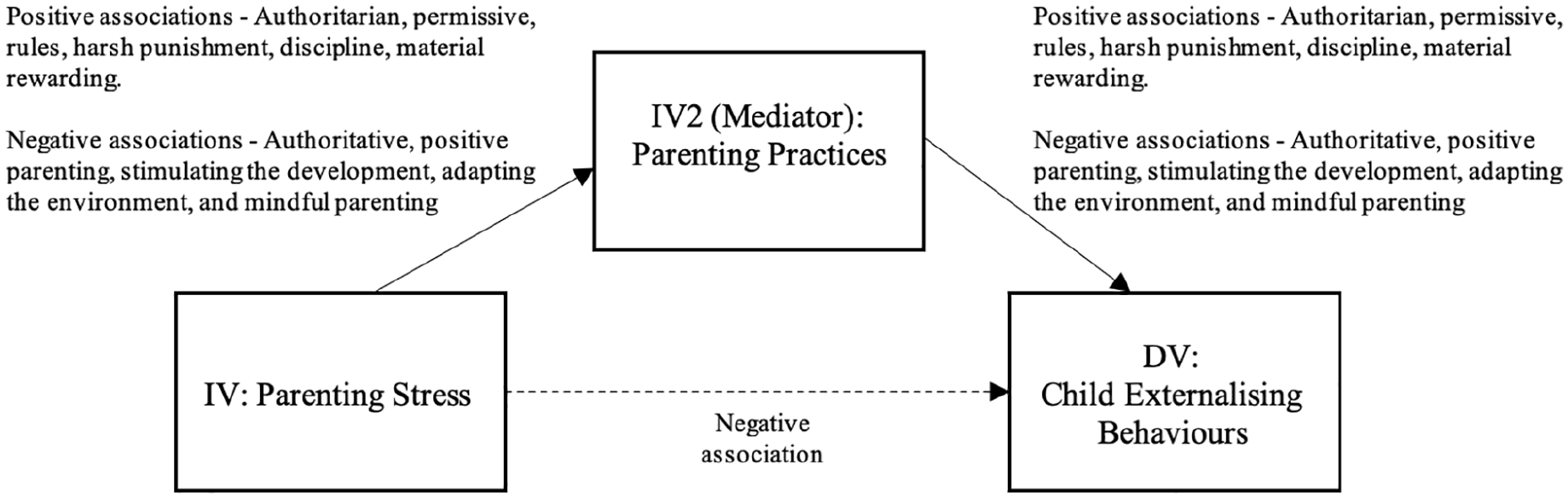
Hypothesised mediating effects of parenting practices.
Method
Design
This study used a cross-sectional design to explore associations between specific parenting factors in parents of autistic children and child behaviour. Variables included: Parenting stress (independent variable), child externalising behaviours (dependent variable) and parenting practices (authoritative, authoritarian, permissive, mindful parenting) and parenting behaviours (positive parenting, material rewarding, rules, harsh punishment, discipline, stimulating the development and adapting the environment) as possible mediators (see Figure 1).
Participants and procedure
This study received ethical approval from the Griffith University Research Ethics Committee (ref no: 2021/434). Gatekeeper approval was granted from autism associations (Autism Queensland and Autism Gold Coast) that advertised the project. Recruitment was conducted via Australian autism associations, author connections (e.g. Psychology clinics) and social media pages. The study was also advertised via the Griffith University Research Pool. Participants were recruited via snowball sampling between 15/05/2021 and 28/02/2023. Participants were provided with an information sheet and provided written digital consent before completing the questionnaire package. Two hundred and sixty-five participants opened the survey link, 107 did not meet criteria on the initial screener (child did not have a formal diagnosis of autism) for the study and were exited from the survey. Participation was voluntary for community members and university students could receive course credit (n = 39 participants). Community participants also went into a prize draw to win one of three $50 gift cards.
Inclusion criteria were: 1. Parents/Caregivers of school-aged autistic children, 2. Child formal autism diagnosis, further screened through scores on The Autism Spectrum Quotient Short Form Parent (Child and Adolescent) (Allison et al., 2012) consistent with other studies (Jones et al., 2020). Further, participants who did not complete the full survey set (n = 17) or appeared to be repeated responses from the same parent (n = 3) were also excluded. The sample size was set a priori to be at least 100 participants based on a power analysis of 80% power to achieve a medium effect size (d = 0.5), as determined by Monte Carlo power analysis simulation (Schoemann et al., 2017). The final sample size was further considered sufficient as per previous research using mediation analysis with this population (e.g. Osborne et al., 2008) and other clinical samples (Adams et al., 2018).
Participants were caregivers of 138 children (97 males, 34 females, three non-binary, four did not report). See Table 1 for demographics (with missing data for n = 6).Parents were predominantly in the age brackets of 41-50 years, with 37% reporting diagnoses of mental health disorders. The majority had completed high school (34.1%), approximately 47.1% worked full-time/part-time and had a varied range of family income. Children’s mean age was 9.59 (SD = 3.04).
Demographics for parents and children (Available for N = 132 of the Participants).

ADHD: attention-deficit/hyperactivity disorder.
Community involvement
All four authors work with neurodivergent individuals and their families and offered their experiences to co-design this study. There was no specific community involvement in the design of the study, besides Author 1’s family members (three neurodivergent individuals) stating their preferences for identity-first language. The research was also informed by the priorities of the community (i.e. parent and family impact and stress being rated as the most important research priority by parents of school-aged children; Clark & Adams, 2020).
Measures
Demographics
Demographic information was collected through a purpose-designed questionnaire which included questions on child gender and age, child medications, child co-occurring conditions, parent age group, parent mental health diagnoses, language spoken at home, race/ethnicity, country/state and family socio-economic status.
Autism characteristics
Autism Spectrum Quotient Short Form (AQ-10)
The AQ-10 Child and Adolescent (Allison et al., 2012) (items n = 10) was used to verify child autism characteristics, as per previous autism research (Jones et al., 2020). Parents completed the AQ-Child version for children (< 11.99 years) and the AQ-Adolescent version for adolescents (⩾ 12 years), which includes age-appropriate wording variations (Armstrong & Iarocci, 2013). Scale has demonstrated good convergent validity, including significant association between SRS and AQ (see Armstrong & Iarocci, 2013). The reliability for child and adolescent subsamples in this study were poor (α = .16 and α = .48, respectively) in contrast to the initial research (AQ-Child α = .90 and AQ-Adolescent α = .89; Allison et al., 2012). Data were checked for recoding and scoring accuracy and entry errors and no concerns were identified to explain the low internal consistency. As this criterion for inclusion was set a priori as inclusion criteria based on previous psychometric data, this was retained for verification, however it is acknowledged as a limitation for this sample.
IV: parenting stress
Parent Stress Index Short Form-Parent Distress Subscale (PSI-PD)
The PSI-PD (Abidin, 2012) (items n = 12) raw scores were used as a specific measure of parenting stress as per previous research (Bohadana et al., 2019; Manning et al., 2011; McStay et al., 2014). The Parental Distress subscale can be used as a measure of stress as it does not confound with measures of child characteristics such as externalising behaviours (Shawler & Sullivan, 2017). The subscale also had a relatively stable factor structure (Haskett et al., 2006). The subscale has demonstrated good validity and internal consistency (Whiteside-Mansell et al., 2007). Raw scores for PSI-PD items were summed to form a parenting stress score, with scores above 33 signifying clinical levels of stress. Cronbach’s alpha for the parenting stress score in this study sample was α = .87.
DV: child externalising behaviours
Developmental Behaviour Checklist Disruptive/Antisocial (Parent Form) (DBC-D/A)
The DBC-D/A (Einfeld & Tonge, 1995) (items n = 27) subscale was used as a specific measure of child externalising behaviours (e.g. throws, breaks, hits self) as per previous autism research (Adams et al., 2019; Chandler et al., 2016). The scale also had a relatively stable factor structure (Einfeld & Tonge, 1995). The subscale has high internal consistency (α = .91) (Adams et al., 2019). DBC-D/A subscale raw scores were added to form an externalising behaviour score. Cronbach’s alpha for externalising behaviour score in this study was α = .89.
Mediator: parenting practices
The Parenting Styles and Dimensions Questionnaire – Short Form (PSDQ-SF)
The PSDQ-SF (Robinson et al., 2001) (items n = 32) was used to measure parenting styles in parents of autistic children. It is a short form version of the full PSDQ (Robinson et al., 1995) (items n = 62) and has been used in previous autism research (Riany et al., 2017, 2018; Ueda et al., 2020; Van Steijn et al., 2013). The short version was chosen to focus on parenting styles of interest and to account for rater fatigue. The short version assesses three parenting styles, including authoritative, authoritarian and permissive styles (Martins et al., 2018). This scale has shown good psychometric properties in non-autism studies with adequate internal reliability for the three subscales (Authoritative, α = .82–.86; Authoritarian, α = .75–.80; and Permissive α = .56–.63) (Barrocas et al., 2017; Martins et al., 2018; Nunes & Mota, 2016). The scale also had a relatively stable factor structure with the three measures consistent with Baumrind’s authoritative, authoritarian and permissive parenting styles (Robinson et al., 1995). Means scores for each subscale were used to form three scores – Authoritative, Authoritarian and Permissive parenting styles.In the present sample, two scales showed good internal consistency (Authoritative, α = .91; Authoritarian, α = .85), whereas one showed acceptable consistency (Permissive α = .70).
The Parental Behaviour Scale-Autism (PBS-A)
The PBS-A (Van Leeuwen & Noens, 2013) (items n = 52) was used to measure parenting behaviours specifically in parents of autistic children, as per previous autism research (Boonen et al., 2015; Maljaars et al., 2014). The items measure everyday concrete parenting behaviours used by parents of autistic children to support their child (e.g. restricting distractions). The scale has shown satisfactory internal reliability and acceptable structural validity (Boonen et al., 2015; Maljaars et al., 2014). The scale also had a relatively stable factor structure (Lambrechts et al., 2011). Means scores for each subscale were used to form seven subscale scores. Cronbach’s alpha showed acceptable to good internal consistency for most scales in this sample (Positive parenting, α = .92; Rules. α = .80; Discipline, α = .70; Harsh punishment, α = .86; Stimulating the development, α = .89; Adapting the environment, α = .76), with one showing questionable consistency (Material rewarding, α = .63). Therefore, the Material rewarding subscale was deleted.
The Interpersonal Mindfulness in Parenting Long Form (IM-P)
The IM-P (Duncan, 2007) (items n = 31) scale was used to measure mindful parenting as seen in previous research (Ridderinkhof et al., 2018; Sherwood et al., 2023). The long form was used instead of the brief 10-item version to capture all five aspects of mindful parenting (i.e. listening with full attention, emotional awareness, self-regulation, non-judgemental acceptance and compassion for self and child (De Bruin et al., 2014). The scale also showed a relatively stable factor structure (Duncan, 2007). The IM-P demonstrates good psychometric properties, with high construct validity (Kim et al., 2018) and high internal consistency as seen across studies (α = .83 to .90) (Emerson et al., 2019; Ridderinkhof et al., 2018). Fourteen items were reverse scored and raw scores were added to form a mindful parenting score, with higher scores representing more mindful parenting (De Bruin et al., 2014). Cronbach’s alpha showed good internal consistency for the mindful parenting score in this sample (α = .88).
Data analysis
Internal consistency, that is, Cronbach’s alpha, was measured to determine the validity of selected measures in line with good practices for using reliability data (Helms et al., 2006). Data met assumptions for correlations and mediation including normality, linearity, independence of residuals, homoscedasticity and multicollinearity. No univariate outliers were found. Eleven participants’ data were identified as multivariate outliers and eight participants had leverage values > .20 but < .50 (maximum leverage value = .28). None were influential points and appeared genuine responses following checking including for non-patterned responses and were thus retained for analyses.
To explore relationships between parenting practices, parenting stress and child externalising behaviours, bivariate correlations were conducted. Next, using Process 4.3 (per Hayes & Little, 2018), mediated regression analyses were conducted to investigate the relationships with IV: Parenting stress, Mediator: Parenting practices (authoritarian, permissive and mindful parenting) and DV: Child externalising behaviours (see Figure 2). Mediation analyses were only conducted for the parenting practices that were correlated with parenting stress. Alpha was set to .01 to control for multiple comparisons. Results for mediation are presented in terms of whether the indirect effect is significant, followed by bootstrap analysis by using 10,000 samples and 99% bootstrapped confidence intervals for the mediated pathway, to assess if the indirect effect shows that it is significantly different from zero or not, with significant mediated pathways encompassing no zero. Due to poor internal consistency of the AQ-10 child and adolescent (α = -.26 and α = .01, respectively, AQ-10 scores below cut-off excluded), results were analysed with and without exclusion of participants (AQ-10 scores below cut-off). As results for the main analysis (mediation) were not substantively different, the full sample was retained given poor psychometrics of the AQ-10.
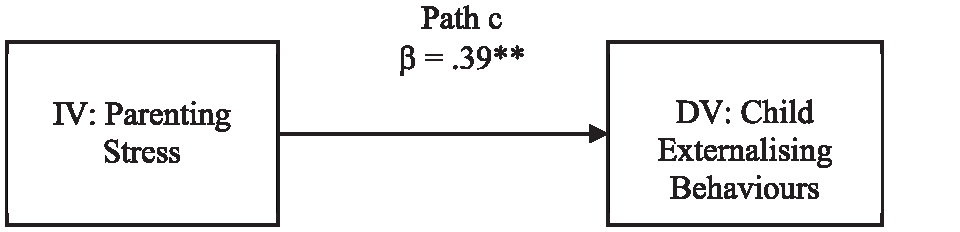
Direct pathway.
Results
Descriptive analyses
Descriptive statistics are presented in Table 2. On the PSI-PD, 71.74% (n = 99) of parents were in the clinical range for parenting stress.
Pearson correlations between predictor variables and child externalising behaviours (N = 138).

Note. DBC-D/A: Developmental Behaviour Checklist-Parent Disruptive/Antisocial Subscale; PSI-PD: Parenting Stress Index Parental Distress subscale; The Parenting Styles and Dimensions Questionnaire subscales – PSDQ-AUT: Authoritative; PSDQ-AT: Authoritarian; PSDQ-P: Permissive; Parental Behaviour Scale subscales – PBS-A POS: Positive parenting; PBS-A RUL: Rules; PBS-A HR: Harsh Punishment; PBS-A DIS: Discipline; PBS-A STI: Stimulating the Development; PBS-A AE: Adapting the Environment; IM-P: Interpersonal Mindfulness in Parenting.
p < .001; *p < .01.
Correlations between predictor and outcome variables
Only parenting stress had a statistically significant positive medium correlation with externalising behaviours, with more externalising behaviours associated with greater parenting stress, see Table 2. Parenting stress had significant small positive association with permissive parenting and significant medium negative associations with mindful parenting. Only permissive parenting had a small significant association with child externalising behaviours. No other parenting practices were associated child externalising behaviours.
Mediating effects of parenting practices
The direct pathway between parenting stress and child externalising behaviours (path c) β = .39, p < .001, was significant (Figure 2). Three mediators were analysed separately including parenting practices of authoritarian and permissive (PSDQ subscales) and mindful parenting (IM-P), as these were the parenting practices significantly correlating with parenting stress.
The pathway from parenting stress to parenting practices – permissive (path a), β = .23, p = .006 was significant, and parenting practices – permissive to externalising behaviours (path b) β = .15, p = .072 was not significant (Figure 3). After controlling for the mediator effect, a weak but significant indirect effect of parenting stress on child externalising behaviours (path c’) β = .32, p < .001 was found. Using 10,000 samples, 99% bootstrapped confidence intervals were produced for the mediated pathway, the indirect effect showed that it did not significantly differ from zero (99% CI = -.01–.11). As 95% CIs encompassed a zero, the mediated pathway was not significant.
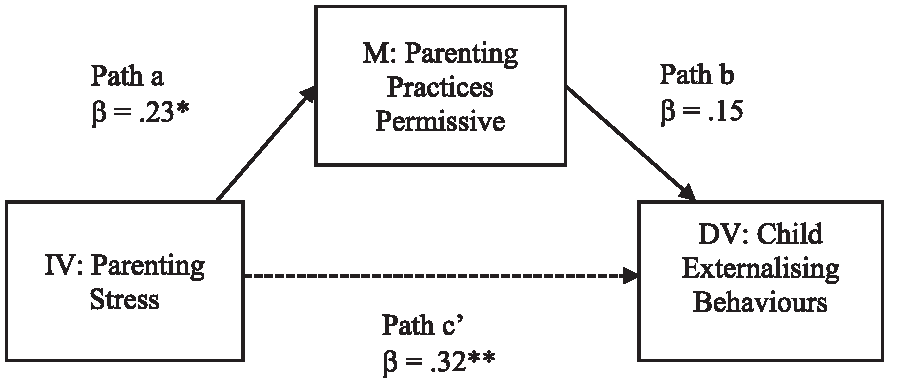
Mediating effects of permissive parenting practices.
The pathway from parenting stress to parenting practices – mindful parenting (path a), β = -.35, p < .001 was significant, whereas the pathway from parenting practices – mindful parenting to externalising behaviours (path b) β = .18, p = .039 was not significant (Figure 4). After controlling for the mediator effect, a weak but significant indirect effect of parenting stress on child externalising behaviours (path c’) β = .42, p < .001 was found. Using 10,000 samples, 99% bootstrapped confidence intervals were produced for the mediated pathway, the indirect effect showed that it did not significantly differ from zero (99% CIs = -.19–.02). As 99% CIs encompassed a zero, the mediated pathway was not significant.
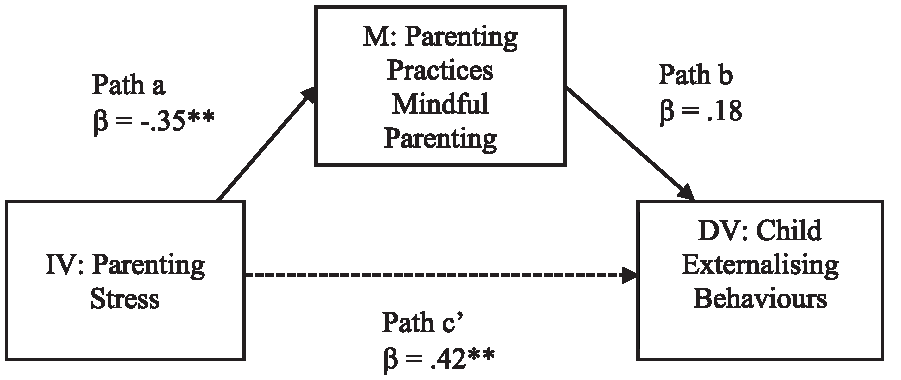
Mediating effects of mindful parenting.
Discussion
We investigated the potentially mediating effects of parenting practices on the association between parenting stress and child externalising behaviours. We found parenting stress had a significant positive association with child externalising behaviours. Further, parenting stress had significant positive associations with permissive parenting practices and significant negative associations with mindful parenting.Only permissive parenting had significant negative associations with child externalising behaviours. However, mediation analyses did not find mediating effects of parenting practices on the association between parenting stress and child externalising behaviours. Results are interpreted in the context of the previous research with limitations, future directions and implications discussed.
We found that a high proportion of parents of autistic children experienced clinical levels of parenting stress levels consistent with previous research (Costa et al., 2017; Dieleman et al., 2017; Frantz et al., 2018). Further, as predicted, higher levels of parenting stress were associated with higher levels of child externalising behaviours consistent with previous research (Barroso et al., 2018; Yorke et al., 2018). Parents’ may feel greater parenting stress in response to observing their child’s challenges and responding to these. Conversely, children’s behaviour may be influenced by observing or experiencing parent’s levels of stress. Higher parenting stress may also impact how parents view their children’s behaviour and reflect interpretation of behaviour rather than objective behaviours (e.g. as per Ueda et al., 2020). These explanations are not mutually exclusive; associations may be influenced both by actual behaviours and perceptions.
Associations between parenting stress and parenting practices were mixed and in contrast to some of our predictions and previous research. Higher levels of parenting stress were associated with lower levels of mindful parenting, and higher levels of authoritarian and permissive parenting practices, which was consistent with our predictions and previous research (Griffith et al., 2023; Parent et al., 2016; Ueda et al., 2020). However, higher levels of parenting stress were not significantly associated with the parenting practices of authoritative parenting (high warmth and high control), authoritarian (low warmth and high control), positive parenting (acceptance, positive affect, involvement), rules, discipline and autism adapted parenting (i.e. adapting the environment and stimulating the development), although these findings were consistent with Boonen et al. (2015). However, the non-significant association we found between parenting stress and harsh punishment subscale was in contrast to Boonen et al. (2015) who found a significant association. Differences in findings may reflect differences in measures used with Boonen et al. (2015) using the Nijmegen Parental Stress Index-Short (De Brock et al., 1992), which may measure different elements of parenting stress. It may be that specific types of parenting stress link to differing practices.
Only permissive parenting had a significant negative association with child externalising behaviours. None of the other parenting practices measures were significantly correlated with child externalising behaviours and parenting practices did not mediate the relationship between parenting stress and child externalising behaviours. This was in contrast to predictions. In the context of the previous literature, previous findings have been mixed. Results provide further support that parenting practices do not directly correlate with externalising behaviours in autistic samples as has been found in some of the previous literature (e.g. positive parenting and autism adapted parenting (Boonen et al., 2014; Maljaars et al., 2014) authoritative (Rahman & Jermadi, 2021; Ueda et al., 2020) authoritarian and permissive (see systematic review findings, Suvarna et al., 2024). Our findings, however, are in contrast to studies that have found that specific parenting practices do relate to externalising behaviours in this population (e.g. specific parenting practices, O’Nions et al., 2020; mindful parenting Griffith et al., 2023). It may be that specific parenting practices may be associated with child behaviours, but further research to identify exactly what these are is needed. Across studies however, differences in how child behaviours (e.g. including externalising and/or internalising behaviours) and parenting practices (e.g. specific measures vs general or total scores) were defined and operationalised (e.g. measures used) differed and may at least partially explain differences in findings. It may be, that parenting practices may be important to consider for parenting stress, but within this population they may not be directly related to child behaviour. It is also important to consider that parents of autistic children with high externalising behaviours may report higher levels of stress, irrespective of their parenting practice type due to other challenges arising for this parent population such as high costs of supports, stigma and additional needs of navigating and advocating for services for their autistic child (Boshoff et al., 2021; Ruble et al., 2018).
Non-significant mediation findings were inconsistent with Coercion theory, and previous findings in parents of autistic (Osborne et al., 2008; Shawler & Sullivan, 2017), and neurotypical children (Mak et al., 2020). Parenting practices may not mediate this relationship in families of autistic children, and other factors such as decreased parent coping strategies (Zaidman-Zait et al., 2017) may be more influential. Mixed results across studies however suggest some measures may be sensitive to specific practices and behaviours (see O’Nions et al., 2020). For example, Osborne et al. (2008) and Shawler and Sullivan (2017) found limit setting, discipline and harsh parenting had mediating effects on the relationship between parenting stress and child internalising and externalising behaviours. Parenting practices such as accommodation may also be linked more closely to internalising behaviours (e.g. anxiety related behaviours) (Frank et al., 2022). Future research could consider whether the type of child behaviour (e.g. internalising vs externalising) impacts mediation found or not found.
Relationships between parenting practices and child behaviours found for neurotypical children are likely more complex for autistic children and their caregivers with interaction effects from other autistic-specific variables. There are other known predictors of externalising behaviours in autistic children that are beyond parenting factors, such as neurocognitive factors, sensory processing differences, language/communication differences and specific health conditions that may have impacted findings (Carter Leno et al., 2019). Future research should consider a study design based on an autism-specific model to include the effects of these additional child variables.
Limitations and future research
This study provides further insights into the relations between parenting stress, parenting practices and externalising behaviours for autistic children and their parents; however, limitations are acknowledged. First, as per previous research (Jones et al., 2020), we used the AQ-10 to verify diagnosis; however, this showed poor internal consistency in this sample, consistent with more recent research (Wigham et al., 2019). In future research requesting diagnostic reports or using alternative measures (such as the Social Communication Questionnaire Rutter et al., 2003), may be of value. The Material Rewarding subscale of PBS-A also had poor internal consistency and was therefore deleted. Future research could consider developing a measure with adequate psychometrics to capture these specific parenting behaviours. Second, we used a cross-sectional design, which means we cannot infer causality or pathways which could be addressed in future longitudinal or parent support research. Further, longitudinal research including mediation of parenting practices is sparse (see only Osborne et al., 2008; Shawler & Sullivan, 2017) and understanding interconnections over time rather than at a static point is needed. Considering the limitations of mediation analysis with cross-sectional data (O’Laughlin et al., 2018; Shrout, 2011), future researchers could consider using alternate models (e.g. latent growth curve or latent difference score mediation models) (O’Laughlin et al., 2018). Further, we elected to only explore mediation analyses for significant relationships. Future research could further explore broader relations with larger samples such as via structural equation modelling. Third, with the exception of for the PBS-A autism subscales, the measures selected for this study were not specifically designed for parents of autistic children and were selected based on psychometrics for non-autistic groups given a scarcity of measures for this population. Measures may not have fully captured behaviours and practices common to parents of autistic children and development and use of autism-specific measures may yield differing findings in future research. Fourth, we relied on parent reports, which is subject to common method effects, which could inflate associations between parenting stress and child behaviour as stressed parents may perceive child externalising behaviours as more difficult (Pastor-Cerezuela et al., 2016). Future research could recruit multiple informants (e.g. child and teacher reports) and observational methods to counter common methods effects. Fifth, although, our sample was adequately powered for medium effects, larger samples may be needed to detect theoretically relevant small effects.
Finally, the sample was predominantly mothers and White and/or Australian (acknowledging that not all Australians may identify as White). Findings may not generalise to fathers or other communities such as culturally and linguistically diverse parents who may engage in different parenting practices and are more vulnerable to clinical stress. Further, stressors may differ between parents. Recruiting broader samples would be of value in future autism research to explore findings cross-culturally and to compare across parents.
Implications and conclusion
Parenting stress was significantly associated with child externalising behaviours consistent with the extensive research in this area. Specific parenting practices including mindful parenting, permissive and authoritarian parenting practices were significantly associated with parenting stress, but not children’s externalising behaviour and were not a mediator. As such, it may be important to focus on reducing parenting stress, which could include targeting parenting practices, with potential benefits via reductions in parenting stress to the child. This is in contrast to targeting parenting practices focused on changing child behaviours as these were not significantly linked. Building parent abilities to be non-judgemental, reduce reactivity and accept themselves and their child through targeting mindful parenting, is consistent with the research on neurodiversity-affirming programmes (Cherewick, 2023). Therefore, designing programmes that help parents understand and accept themselves and their child, could support both parents and their children to experience better outcomes.
Footnotes
Acknowledgements
The authors would like to express their gratitude to all participating parents that provided their time to this project.
Declaration of conflicting interests
The author(s) declared no potential conflicts of interest with respect to the research, authorship and/or publication of this article.
Funding
The author(s) disclosed receipt of the following financial support for the research, authorship and/or publication of this article: V.S. was supported by an Australian Government Research Training Program (RTP) Scholarship.
