




Abstract
Tabletop role-playing games (TTRPGs) are increasingly used in therapeutic and educational settings to improve the well-being of autistic people. This study investigated the potential of TTRPGs to provide a safe space where autistic adults could develop relationships with others while also engaging in character and world-building. Eight autistic adults were split into two groups and taken through a 6-week online Dungeons and Dragons campaign run by one of the researchers. Semi-structured interviews were then conducted to discuss how participants felt interacting in and out of the TTRPG. Several key themes were identified as important aspects of why autistic people could benefit from role-playing environments. The analysis showed that the participants felt a strong level of enjoyment from engaging in tabletop role-playing and, in many ways, experienced better social interactions during the TTRPG. The results suggested that TTRPGs can provide a safe space for autistic adults to engage in meaningful social interactions with like-minded individuals. Role-playing may also allow autistic participants to rewrite their own life stories through their characters’ adventures, leading to improved self-esteem.
Lay abstract
Tabletop role-playing games (TTRPGs) are popular hobbies that may offer specific social benefits for autistic people. This study investigated the ability of TTRPGs to provide a safe space where autistic adults could develop relationships with other autistic adults while engaging in character and world-building. A group of eight autistic adults were split into two groups and taken through a short-form online Dungeons and Dragons campaign over 6 weeks run by one of the researchers. The researcher then led a series of individual semi-structured interviews discussing how participants felt interacting in and out of the TTRPG. Several key themes were identified as important aspects of why autistic people could benefit from such an environment. Analysis showed that while real-life interactions could be challenging, in TTRPG play, they felt they experienced significantly fewer struggles. Results suggested that TTRPGs can provide a safe space environment where autistic adults can engage in productive social interactions with like-minded individuals. It also may allow autistic participants to experience ‘bleed’ or the ability to take on a new character that changes the way they feel about themselves outside of the game. Future directions for this work are discussed.
Introduction
Autism is a developmental condition and neurotype that is found across all ethnic and socioeconomic groups, and according to current estimations, approximately 1 in 100 children are diagnosed with autism worldwide (Zeidan et al., 2022). Inherent to the challenges of navigating a neurotypical world as a neurodivergent person, autistic people are more likely to experience loneliness and have smaller social networks both in childhood (Rowley et al., 2012) and adulthood (Atherton et al., 2021; Orsmond et al., 2013). However, social connection is just as important to autistic people as it is to neurotypical people (Jaswal & Akhtar, 2019), as evidenced, for instance, by the high levels of relationship satisfaction of autistic people in romantic partnerships (Sedgewick et al., 2019), and the social compensation that autistic people use to mask their traits in an attempt to better integrate into the neurotypical social world (Livingston et al., 2019).
While all people mask to some extent, research suggests autistic people employ more masking than most to hide their autistic traits (Miller et al., 2021). This places them at greater risk for poor mental health outcomes (Cook et al., 2021), including anxiety, depression (Cage, Troxell-Whitman, 2019) and even suicidality (Cassidy et al., 2020). An antidote to autistic masking may be found in developing genuine social connections, which can serve as a protective factor for mental health (Mournet et al., 2023). One potential area where autistic people may develop healthy, non-masked social relationships is in contexts where there are high chances of a ‘match’ with their peers, such as socialising with other autistic people (Bolis et al., 2020) or people who share common interests (Redcay & Schilbach, 2019). Such environments may reduce the need to mask, which, by extension, decreases the risk of autistic burnout and poor mental health (Cassidy et al., 2018).
Hobbies
Encouraging the development of shared hobbies (Bishop-Fitzpatrick et al., 2017), may be an important source of social support for autistic people across the lifespan (Pritchard-Rowe et al., 2023). A systematic review by Cameron et al. (2022) on leisure activity patterns in autistic adults suggests that compared to neurotypicals, autistic people spent more time in solitary activities, less time in organised groups and less time on activities they consider ‘important’. The data suggested that while autistic adults desired to be involved in regular groups or clubs, they often found it difficult to find such groups and so reverted back to solitary activities.
One emerging area of leisure that sees high participation by autistic people is online gaming, where autistic people are found to play various digital games with others rather than on their own (Cameron et al., 2022). The intersection between gaming and autism is an increasingly studied area, as it is consistently cited as being one of the most common leisure activities of autistic people (MacMullin et al., 2015; Mazurek et al., 2012; Stiller & Mößle, 2018). While video games have been shown to provide cognitive benefits (Martinez et al., 2023) and can be used to form useful interventions (Silva et al., 2021), they also pose a risk of encouraging maladaptive behaviours in players (Craig et al., 2021). For instance, Mazurek et al. (2015) found in a survey of adult autistic video gamers that while the hobby could be a source of social connection and immersion, it was often accompanied by feelings of addiction and time loss.
One alternative to video gaming is tabletop gaming, which shares many of the same game mechanics but may involve even more social interaction between players (Cheok et al., 2010). One recent study suggested that, across a sample of over 1500 tabletop gamers, autism rates were significantly higher than is typically seen in the general population (Cross et al., 2023). Interviews with autistic tabletop gamers also revealed that board games acted as a social lubricant for players, offering a clear system and rules around interactions (Cross et al., 2024). Atherton et al. (2024) found similar benefits of tabletop games over a year-long study with autistic adolescents and adults.
Role-playing games
Tabletop role-playing games (TTRPGs) are a specific genre of board games, and they are notable in that they largely remove the ‘board’ and require players to instead imagine interacting with one another in a fantastical world (Cover, 2014). Within this world, each player takes part as a fictional character that they design with a unique backstory and personality, which includes both strengths and weaknesses. Within the campaign (e.g. a set of adventures), which is run by a game master (GM), each player role-plays their character’s part in the story as it plays out. The game then develops and flows according to which actions the players choose, meaning that players directly influence the world and subsequent story. While the GM opens the rules towards a common goal and sets constraints on player actions, overall, the game is a collaborative effort between all participants (for a review, see Mizer, 2019).
TTRPGs first gained popularity in the 1970s with the game Dungeons and Dragons (D&D) (Gygax & Arneson, 1974). Since then, there has been a steady increase in new TTRPGs, and numerous gaming systems and mechanics have been created to offer new role-playing experiences for players (Dormans, 2006). This includes role-playing games that are focused heavily on mechanics and strategy, like Skirmisher games, and games more focused on dramatics and character development, such as Nordic Live Action Role-Play (LARP) (Mochocki, 2021). However, the classic TTRPG D&D arguably remains the most enduring, with its popularity reaching a peak during the COVID pandemic (Scriven, 2021) and subsequently forming the basis for a hit Hollywood movie and the 2023 video game of the year.
Benefits of TTRPGs
Researchers have identified several psychological benefits of playing TTRPGs (for a review, see Henrich & Worthington, 2023). This has led some researchers to investigate how TTRPGs can be used to help and understand special population groups (Arenas et al., 2022; Baker et al., 2022; Breland, 2022). Some of the benefits associated with TTRPGs are discussed below.
Imagination and bleed
At its heart, TTRPGs allow players to engage in make-believe. Through the pretence of fantasy, role-playing games provide a space where players, acting as their characters, can express pent-up emotions without hurting others (Fine, 1983) or experiencing judgement (Deterding, 2018). This freedom can, over time, allow players to experience the psychological phoenomenon ‘bleed’ or the blurring between the game and real life (Bowman & Lieberoth, 2018). Creane (2021) likens bleed to the TTRPG acting as a membrane with selectively permeable properties. Often, when players are within the membrane of the game, experiences are contained, and participants can quickly enter and leave the game with no lasting effects. However, the membrane can be ‘punctured’ by an emotional experience, resulting in either ‘bleeding-in’ or ‘bleeding-out’ or having in-game events become entangled with personal life histories. Bleed is, in many ways, inextricably tied to the level of immersion a person experiences with the TTRPG world and their character. When the game no longer feels like an illusion, a person may be persistently or even permanently affected by their TTRPG experience (Bowman, 2018).
While ‘bleeding’ in many ways involves a blurring or even losing one’s sense of self, research suggests that this can, in fact, have restorative effects on one’s identity. In an early case study where a TTRPG was used as a tool in therapy for a suicidal patient in hospital and outpatient settings, Blackmon (1994) found that bleeding in D&D allowed the patient to ‘explore their mental dungeons and slay their psychic dragons’ (p. 631), which allowed them in time to develop the confidence to confront the ‘demons’ in their real life. In another study, Baird (2021) investigated TTRPG’s effects on player gender expression and identification. They found that pre-transitional players who role-played as their preferred gender could explore and learn about their identity in a safe context, which often gave them the confidence to later transition to that gender in real life. Fein (2015) conducted ethnographic research at a LARP summer camp for autistic youths. Fein found that through LARP, players could create and interact within a world where their autistic identity neither stigmatised nor disabled them, allowing them to leave camp with increased self-efficacy.
Social connection
All games, even competitive ones, are, in a sense, cooperative in that they require players to mutually decide on a set of rules and agreed-upon actions within a shared system (Rogerson et al., 2018). TTRPGs like D&D are arguably an especially cooperative game type as they call upon players to act as a team (Daniau, 2016), to negotiate with one another on issues like justice and mercy (Wright et al., 2020) and to consider the well-being of the group when navigating sensitive topics (Sell, 2022). To progress through these complex situations, players must continuously communicate with the group to complete each player’s campaign goals (Ducheneaut & Moore, 2005). In this way, TTRPGs have the potential to, over time, improve the communicative abilities of players, all through the process of enjoying a game rather than intentionally practising skills.
Several studies have explored using TTRPGs to improve the social experiences of autistic players through skill building. Goldingay et al. (2015) ran a study in which five autistic adolescents created and acted out a story of their own invention. Results from parents and participants showed improvement in social competence ratings, indicating that character role-play enhanced the way participants communicated outside the game. Gjedde (2014) also found that LARPing programmes in schools bolstered neurodivergent students’ communication and problem-solving skills. Game to Grow is a group in the United States that has used several TTRPGs to help young autistic people (Kilmer et al., 2023). They concluded that exposure to imagined realities and engagement in pretence helped decrease sensory overload, improving communication. Some studies also suggest that TTRPG social interventions could be particularly helpful when played in all autistic groups. Breland (2022), for instance, found that autistic players often differed in their use of pretence in the TTRPG game-playing context, which could mean that all autistic TTRPG groups are a better ‘match’ for autistic players in terms of communication styles.
Community
Finally, TTRPGs often instil a sense of fellowship between players, which may help combat loneliness and social isolation (Abbott et al., 2022). Over the many sessions spent ‘world-building’ together as a team, friendships often develop organically between players. This may be linked to players interacting within the ‘magic circle’ (Huizinga, 1955), a term used in gameplay to denote the often fuzzy and indistinct boundaries that separate ‘play’ from real life (Salen Tekinbas & Zimmerman, 2003). In TTRPGs, the concept of the magic circle emphasises its exclusivity as a means to bond players; the players alone can access the circle and, in doing so, form social groups that underscore their differences from the common world (Copier, 2005).
Research on the social effects of TTRPGs consistently finds that players form important relationships with one another through shared access to and experiences within the ‘magic circle’. In Adams’ (2013) analysis of discussions between TTRPG players, friendship maintenance was identified as a significant theme. Although they were in a fantasy world, players nonetheless believed that their real-world needs had been met with symbolic in-game interactions. Based on interviews with autistic TTRPG players, Parks and Parks (2023) also concluded that engagement in role-playing games provided an open, understanding and supportive creative environment where autistic people developed social skills and friendships through shared in-game experiences. This is echoed in findings by Katō (2019), who found that autistic teens showed higher ratings of emotional well-being after 5 months of regular TTRPG sessions. In addition, Abbott et al. (2022) concluded that engaging in role-playing games led to additional friendships, increased confidence in setting boundaries and daring to make mistakes among adults with anxiety.
Rationale of study
Here, we have highlighted the potential of TTRPGs in stimulating imagination and ‘bleed’, supporting the development of social skills and fostering friendships between players. Given the benefits of TTRPGs, we were interested in understanding how TTRPGs may directly benefit autistic adults, particularly given the need for authentic, non-masked social outlets in this population. While research and anecdotal reports suggests that autistic people may be particularly drawn to the hobby due to its structure and inclusivity (Fein, 2015), understanding how TTRPGs could function as social support was of specific interest.
As such, this study aimed to investigate how autistic individuals experience TTRPGs in groups of all autistic players. In what way do TTRPG games function as a safe space for autistic people where they can interact comfortably and expand their social lives? In addition, recent research suggests a relative paucity of work focusing on neurodivergent-affirming approaches to improve well-being in autistic people, in contrast to interventions aimed at ‘improving’ autistic skills (Najeeb & Quadt, 2024). As a response, this work offers a case study of experiences of neurodiversity and well-being through the voices of autistic players after completing a D&D campaign with fellow autistic players.
Methods
Participants
Participants were recruited through social media advertisements on D&D and TTRPG Reddit and Discord communities. The advertisement made clear that the study was looking to find players who would be comfortable participating in the sessions and willing to discuss their role-playing experiences in forthcoming interviews. The participants who enrolled for the study confirmed they had an autism diagnosis given by a medical professional. Eight participants (4 males, 2 females, 1 nonbinary, 1 gender fluid) with ages ranging between 20 and 34 years (M = 23.25, SD = 4.46) and varying demographic backgrounds (4 British, 3 American, 1 Brazilian; 7 White, 1 Latinx) took part. Groups were split into four players and one GM, which is preferable as it allows for adequate discussion and appropriate turn lengths. Ethical approval was granted by Edge Hill University, and all participants provided full informed consent.
Materials and procedure
The participants participated in six sessions of the premade D&D narrative campaign Waterdeep: Dragon Heist (Perkins & Crawford, 2018). One of the researchers, with many years of D&D experience, acted as the GM and interviewer. Participants were split into two groups based on participants’ availability to attend sessions. The week before the campaign started, each group was organised for a ‘session zero’ where they met with the GM, introduced themselves and discussed their character ideas. After that, each player set up an online character sheet and used the online platforms Discord and Roll 20 to play the D&D sessions.
Quite broadly, the Waterdeep adventure involved all players forming an ‘adventuring party’ in which they worked together to accomplish the immediate and overarching goals of the game. In doing so, players role-played characters, took part in fights, negotiated politically and engaged in quests. Each session usually ran for 2–4 hours with several comfort breaks, and it lasted for 6 weeks in total. At the end of the sixth-week session, the GM reminded participants about the upcoming interviews, arranged individual meetings and answered any questions they had. The interview schedule was provided beforehand to allow the participants to prepare and reflect on their experiences before the interview (see Lambert, 2019).
The semi-structured interviews were conducted one-on-one with each participant over a voice call after the campaign concluded. Each interview lasted between 30 and 60 minutes and took place on Microsoft Teams. The interview questions were designed to investigate the players’ experiences both outside of and within the TTRPG setting, and the semi-structured design provided enough flexibility to allow the researcher to ask further questions while also allowing for questions that uncovered the reasoning behind the responses (see Miles & Gilbert, 2005). The interview schedule consisted of 11 open-ended questions that were split across various topics related to the research aim. Five questions focused on social interactions both inside and outside of a TTRPG, two discussed general opinions on tabletop games, and three focused on participant feelings about autism and how these feelings related to different areas, such as experiences with TTRPGs (please see the Appendix 1 for a full interview schedule).
Community involvement
Community involvement was solicited in several ways. First, before data collection began, two research team members visited autistic groups that played TTRPGS around the United Kingdom. During these visits, discussions were held about how to run a successful campaign for autistic adults, including the length of sessions, the number of sessions and whether to play in person or online. The recommendations provided by seasoned autistic TTRPG players and GMs were used to form the protocol. The research team is also primarily comprised of neurodivergent people (3/4), two of whom are on the spectrum and three of whom regularly play D&D with neurodivergent people, which also informed the project. After the project was completed, participant feedback was solicited, sometimes leading to language reformulation.
Analysis
Results were analysed using interpretative phenomenological analysis (IPA) (Smith & Osborn, 2008). IPA is an inductive and interrogative method for qualitative data analysis aimed at capturing rich and thick descriptions of lived experiences. It involves a phenomenological approach in which the researcher employs double hermeneutics: ‘The participant is trying to make sense of their personal and social world; the researcher is trying to make sense of the participant trying to make sense of their personal and social world’ (Smith, 2004, p. 40) (Table 1).
Frequency count of sub-themes within interview data.
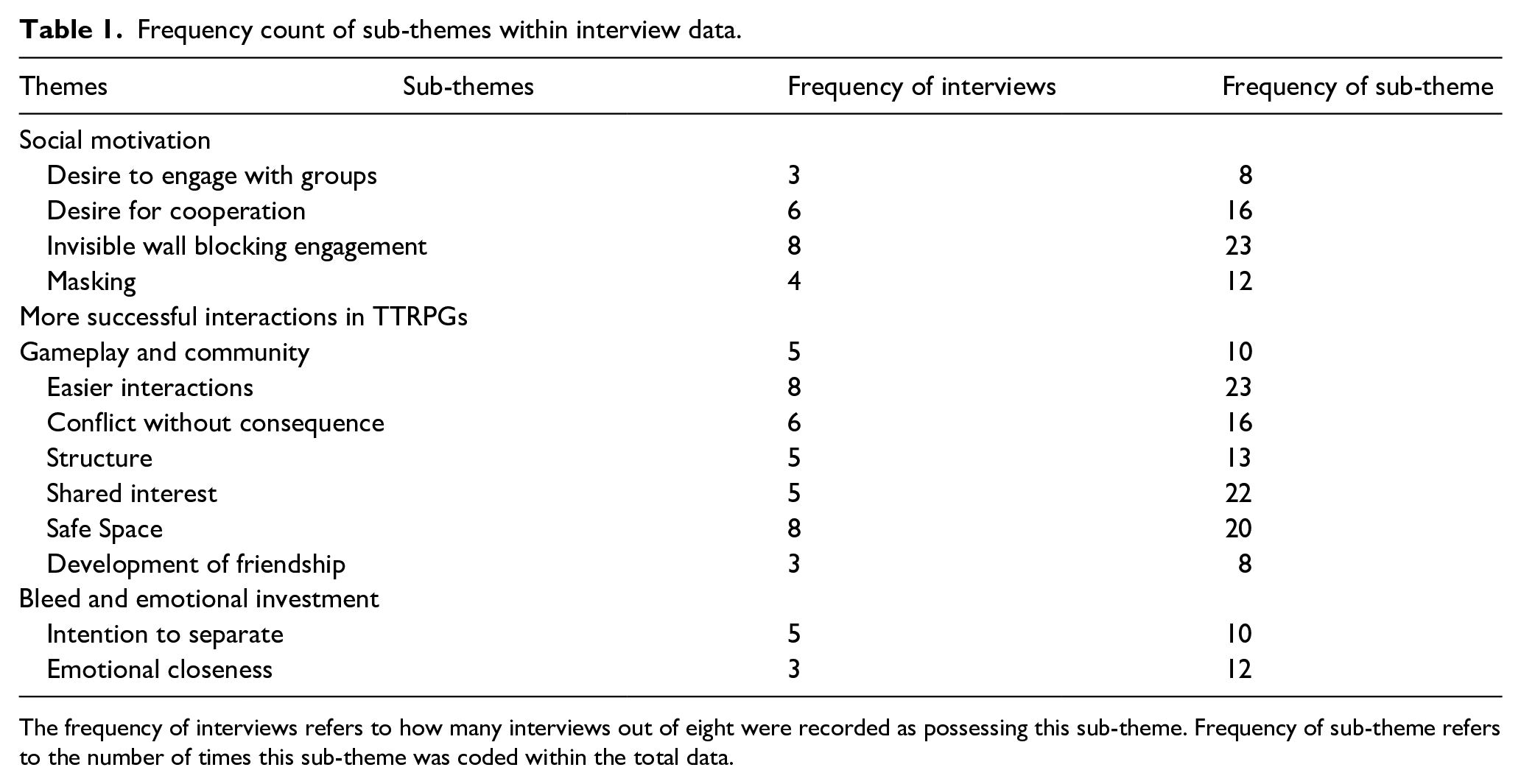
The frequency of interviews refers to how many interviews out of eight were recorded as possessing this sub-theme. Frequency of sub-theme refers to the number of times this sub-theme was coded within the total data.
IPA was used for the detailed case-by-case analysis of participant transcripts to better understand their worldview and understanding of the topics discussed. In line with Atherton et al. (2018), two researchers read through all transcripts multiple times, making annotations describing initial thoughts on sub-themes arising from participant statements. After this, master themes were collaboratively organised together under superordinate themes. This evolved through discussion between both coders to ensure themes had adequate textual support (Graneheim & Lundman, 2004) and applied to all participants as a whole group (Chapman & Smith, 2002).
Results
Three superordinate themes were identified from the IPA process described above. These themes were 1 – Social Motivation, 2 – More Successful Interactions in TTRPGs, and 3 – Bleed and Emotional Investment, and they will now be described in more detail below.
Social motivation
Participants spoke at length about the social challenges they often experienced in everyday life. These discussions led to reflections about ‘out-of-game’ social experiences and an overall lack of confidence in their communication with other people.
It can feel a bit unnatural at times. Like I’m always the one trying to start things. I feel like I’m not always directly connected to the conversation as much as other people I’m interacting with in the conversation. I’m still bringing up conversational topics after other people think they’ve gone past and things like that.
Insecurities about how other people would receive them often discouraged participants from joining a wide array of leisure activities. They created a negative narrative about their social lives that felt irreversible.
I think every autistic person has had multiple instances of social rejection and loss of relationships. You’ve done something wrong. You don’t know what it is. They don’t tell you, and you find out when you’ve been just, you know, left shunned in relationships, left out, and it’s, you know, it’s traumatic.
The social struggles that participants experienced did not stem from a self-reported lack of social motivation; it was quite the opposite. Participants regularly expressed a wish to get involved with others and their attempts at joining groups in their daily lives: ‘I do enjoy listening to other people talking to each other. I’ll feel some interest and some desire to interact with the conversations going on as well as sort of starting it’. Participants expressed a great interest in being part of groups, given the right conditions: I like going to theme parks and at the end of the night, they’ll play some happy, peppy music. Then they’ll have a parade and then the music plays and everybody parades out the gates together. And I’m just buzzing with it because there are so many people and they’re so happy and I’m happy and people are fun.
Even though they enjoyed people, they worried that many people did not in turn enjoy their company because they made social mistakes. Making social mistakes often came up in the context of social rules and how hard it is as an autistic person to understand nebulous and unspoken rules.
You’re supposed to just know. And if they don’t tell you, it just creates this problem. It’s like ‘I’ve upset you and I don’t know why’ and you’re acting like I should have known. Like I should have stopped doing something because I should have known what I was doing was upsetting you but you didn’t tell me you were upset.
For some, these experiences represented traumas, and these negative experiences left a lasting mark.
After that you know, I was depressed. It was, you know, like I said, triggering because you’ve got, you know, the serial trauma rejection.
Serial rejection and the pain that it caused led people to change their natural behaviour around others. Masking or hiding their autistic traits perhaps momentarily allowed them to blend in, but it also led to insincerity and a performative way of interacting in groups: The ‘Comic Relief’ barrier can aptly be described as masking. Through comic relief I feel, you know, less pressure to be constantly navigating these micro-transactions.
Another way that participants reported masking in everyday life was masking their feelings. In an effort to fit in and be accepted, participants discussed a strong desire for everyone to get along and that they would try to avoid social conflict at all costs.
I’m not very fond of conflicts and sometimes a discussion to decide on what to do or where to go can be seen as a conflict to me. As a conflict-avoidant person, I might just let the people who want to argue, argue, and then I’ll just accept the outcome.
To summarise the participants’ experiences of interacting with groups throughout daily life, the first finding concerns their desire to engage with others, including discovering those of a like-minded nature and sensing that one fits in. However, they felt that they had to struggle to be accepted by others and often made social mistakes that could lead to rejection. Fear of making these mistakes led to changed behaviours as they attempted to fit in through masking, avoiding conflict and taking a passive role in social situations. This finding highlights the strong desire to be accepted, as well as the impact of negative experiences which marked the participants in everyday life and led to unhealthy coping strategies like masking and compliance.
More successful interactions in TTRPGs
Expanding on the first theme, we observe that participants expressed a desire to engage with others. Yet, they often struggled to do so, which led to trauma, masking and compliance. It was, therefore, of particular interest to investigate if, and in which ways, socialising in TTRPGs was different from everyday life. Explicit questions about this comparison prompted the participants to highlight several key benefits generated by the game. One such aspect concerned the collaborative manner in which players interact: I seem to have better interactions with Dungeons and Dragons than any other activity. Maybe that’s why I do Dungeons and Dragons so well. Because it’s specifically a group game. There’s no real player-vs-player aspect and you know there’s no competitiveness. It’s a group activity.
TTRPGs thus allowed them to engage with other people more constructively, clear of the many ordinary hurdles they experienced. The participants moreover described D&D as a safe space that provided supportive social boundaries through the characters they enacted. Collaborative storytelling also allowed those whose characters had differing worldviews to come together without interpersonal conflict. Competition and conflict were described as a much less daunting challenge in a friendly game environment.
You all have a shared goal, right? So, because of that goal and because of having a very specific setting or scenario that you’re trying to solve with other people, it tends to be way easier for you to figure out what to say, how to contribute, than saying it in a random setting. A good example is whenever you meet new people outside of an RPG session it can be awkward to decide what to say or know how to interact, or how to move on within a conversation. In D&D not only do you have predetermined characters, but you’ve already kind of decided how your character is going to act.
Role-playing in D&D also highlighted that all the players shared a common interest. This allowed players to circumvent the type of small talk they often struggled with, making breaking down barriers much easier. They, for instance, described how they could talk about their interests at length with one another without worrying about stress. Such examples connect to the idea that the tabletop space can enhance friendship development, and participants indeed described how they had made friends this way: Some of my most dear and long-lasting friends have been people who played with me in these games, so I think it’s a very good idea to at least try it. Meeting them in a game setting places more focus on the game itself rather than the people, unlike if you’re meeting outside. So, I mainly meet people through tabletop games.
As an aid to more nebulous social interactions, D&D provides structure for communication. Participants described struggling with everyday conversation’s unorganised, free-form nature, which included difficulties estimating the right time to engage and their anxiety about talking over others.
Autistic people struggle with engagement and social interaction because there are an incredible number of unwritten rules. Because a big part of autism was just missing those things early on, so you develop differently. So, you’re working on a different set of rules. D&D offers a much more explained way of doing things. When you’re interacting with people over D&D, you’re more likely to understand what’s going on. That’s because the method you’ll use to interact is written out. You can see what you’re meant to do. There’s an actual sort of reference sheet for some social interactions.
Some also commented that innate kinship with other neurodivergent people was supportive. Understanding their common issues allowed them to relax without feeling pressure to act in a certain way: I prefer playing with other neurodivergent people, and I think it’s because we naturally communicate better and understand each other. If someone says ‘I’m overloaded’ I understand what that means, or if I say something similar they know what I mean. It’s just a more basic understanding of how my brain works and how I experience things with sensory disabilities. I feel like less of a burden on other autistic people.
This finding highlights the benefits which the TTRPG environment provides to group interaction. The autistic players concluded that interaction in this space felt easier than everyday life, and tabletop role-playing fulfilled their need to be included in group interaction. TTRPGs also added helpful elements onto social interactions often less available in general life, such as structure and shared focus and allowed participants to engage in a cooperative, fun and engaging social activity. Many of the hurdles they would typically face were absent when playing D&D. This in turn allowed for a more confident approach to socialising with others.
Bleed and emotional investment
This theme concerns the participants’ feelings of closeness to the character they role-played in the game. It also covers the idea of bleed, which concerns how characteristics of the player come through in their character or, conversely, how traits of the character become enmeshed with real life outside of the game (Montola, 2010).
Some participants talked about how they wanted to separate themselves from their D&D character to explore new sides of their personality or create a whole new persona.
You can interact with others without necessarily using your personality, if that makes sense. Whenever you are role-playing as a character, you can use that character’s traits or how you define that character to interact with other players. I can make a character quite different from how I interact with people in real life interactions . . . It helps you put yourself in the other person’s perspective because you are technically entering a persona that is your character. You can then try to see how it feels to be in that interaction or in that scenario through another lens.
They often likened this to playing a part in a story or taking on a character’s role, such as acting in a play or writing a book. This separation from the character allowed the participant to go beyond their ordinary selves and explore new ways of dealing with situations: Since it’s separating yourself from the character most of the time, you can explore behaving in ways you would not normally do. One big thing that sticks out to me is drama. While in person you may have massive drama or conflict with people, in D&D you can actually explore those. You can somewhat experience a level of conflict with people that has a social barrier.
The participants moreover discussed the pleasure involved in this possibility of separating from their ordinary selves. They described how this, in a sense, allowed them to be ‘more’ than themselves when embodying a D&D character with supernatural abilities: I want to play the character rather than just having myself walking around with added powers and strengths. I prefer to be a separate character who is influenced by me, rather than just be ‘me’ walking around with a different face and different strengths.
D&D was also portrayed as a fun way of engaging in perspective-taking and personal exploration by simulating another person: Playing ‘myself’ got boring. I wanted to do something else and I started down this path of always trying to separate myself. After a while, playing characters went from what I wish I could be to maybe something I wouldn’t want to be. I was finding enjoyment in something I wouldn’t really like and learning how to enjoy it from a different perspective, which is fun to do.
Owing to their emotional investment in the story, others described the difficulty of fully separating their real self and their character. This difficulty is synonymous with ‘bleed’ or allowing the TTRPG game to stay with you in the outside world, or vice versa. Journeying within the story and developing an emotional connection to the world and the characters who populate it seemed to prompt bleed: What makes it more different to me is the middle ground. When there is a significant difference between X character and me, that’s fine. But if there’s enough similarity for me to get confused about both of them, when I think ‘how would X character react to the scenario?’ and if there is enough there that is similar enough to me, I might end up reacting as myself instead of character.
Another participant explained why they chose not to to separate themselves from their character: ‘I would say overall I tend to strongly identify with my character. It’s a chance for me to kind of express myself or how I might not be able to be in society’. Along a similar line, some participants likened the bleed they experienced with their characters in D&D to being indicative of autism more broadly. They compared the D&D ‘hero’s journey’, reminiscent of the archetypes presented by Campbell (2008), to that of a person with differences fighting for broader acceptance and discovering their strengths.
I also think a lot of the themes of fantasy can be very compelling to people who are part of the minority group. If you have autism and you don’t feel like you fit in, then you know you’re obviously gonna relate to a hero’s journey story where someone doesn’t fit in and then they find out that ohh. . . they have magic powers. And you think ‘wouldn’t it be cool if what was different about me was actually, you know, really awesome’.
Emancipatory bleed (Femia, 2023), a term used to describe how people in TTRPGs can use the hero’s journey to rewrite their personal histories, was discussed multiple times.
I think part of the fantasy is also just about belonging. When I was in middle school I loved X-Men a lot. In middle school I was intensely bullied . . . I wanted, you know, to go to the boarding school for mutants or, you know, meet magic people or go through the wardrobe. All that stuff, it’s just finding somewhere where you belong, and being with other people. And I think that plays in with the themes of D&D too, because you’re in a party. You become like a family fighting together, so it’s, you know, basically like the friendship scenario.
This theme illustrates how the participants related to their characters and the fantasy world. For some, TTRPGs allowed them to take on different personas and experiment with divergent personalities in a way that broadened their worldviews. For others, the opposite strategy was adopted. Allowing their ordinary selves to bleed into their characters allowed them to learn more about themselves and, in a sense, to blend their own life story with the stories enacted in D&D. The participants’ emotions about themselves and their own struggles in life, as well as their strengths, moreover appeared to affect their perception and connection with their character. This demonstrates that the game has the potential to strengthen people’s self-concepts by either deepening their understanding of what it is like to be a different person or to experience what it feels like to reconceptualise themselves in a different reality.
Discussion
This study investigated autistic adults’ experiences in TTRPG group settings to better understand if and how this environment could be a safe space for autistic people to strengthen social connections. Our main findings showed that the autistic adults in this study were indeed motivated to experience social connection but felt that this often was difficult in everyday life. In contrast, participants used TTRPGs to interact safely within a group, which satisfied their desire for community. It also allowed them to reframe their lives as ones of heroism and friendship; experiences echoed in the game narrative and in their character’s journey.
Notably, games created a comfortable environment that broke down social walls and allowed the players to connect with others meaningfully. This alleviated the negative feelings participants had attached to social interaction and eradicated the need to mask as they were in the company of other autistic people who shared a common interest. These findings suggest that TTRPGs can provide a safe social space for autistic adults that is intrinsically rewarding and allows them to process previous adverse situations as notably different from the successes they experience in D&D. The success of the D&D group composed of autistic players only is particularly in line with research that suggests autistic people may have improved communication experiences when interacting with other autistic people (Crompton et al., 2020). The restorative effects of in-game social successes are perhaps particularly important for autistic people who are often faced with social stigmatization from others (Turnock et al., 2022), as it allows them to both experience and reflect upon the contexts in which their autistic traits are not deemed invaluable or in need of masking. Discovering exceptions to these types of internalised ‘rules,’ a form of cognitive reframing, can promote self-compassion and posttraumatic growth (Wong & Yeung, 2017) and has been found to be particularly beneficial for improving autistic people’s mental health (Han et al., 2022).
The insights into why TTRPGs are helpful for autistic adults as a hobby are important for several reasons. First, research suggests that as autistic adults age, they are more likely to develop conditions like social anxiety (Rødgaard et al., 2021). This may result from a lifetime of adverse social interactions with neurotypicals or even differences in social style (Espelöer et al., 2021). Parks and Parks (2023) echoed several of these themes in their research, discussing the growth players experienced socially through playing TTRPGs over multiple years. The community around games was shown to prompt initial engagement with the hobby and players could engage without fear of being judged for their autistic differences. Instead, they found enjoyment in sharing with others.
Adams (2013) also gives supporting evidence for the benefits of TTRPGs in the lives of autistic adults. Their research analysed conversations from a TTRPG group over 3 years to identify the social needs the game could fulfil. One area identified was democratic ideologies. Within D&D, collaborative agreement in particular was encouraged, and discussions were open and fair with every member having an equal say. The group made decisions together. Research suggests fairness and equality are often heightened in autistic people (Jaarsma et al., 2012). In this way, cooperating around a game and interacting within the ethical guidelines of the game may particularly appeal to autistic players.
In Pritchard-Rowe et al.’s study (2023), concepts around autistic play patterns were discussed, and what was long known as a deficit account was reframed as one of differences and considerable strengths. For instance, the authors discussed concepts such as parallel play or play where two people are playing separately yet in a shared space (which is often an autistic preference). While this is often pathologised in earlier literature on autism (see, for instance, Holmes & Willoughby, 2005), the authors instead argue that this is more a reflection of ableism than any deficit and contributes to masking and stigmatisation of autistic people. The discussions around play in our study often reflected the aspects of parallel play that are inherent to TTRPGs. Participants discussed the ways in which they were playing alongside others as well as cooperatively, thinking about their own goals and narratives while also working as a group. As discussed by Huang et al. (2013), TTRPGs allow for both team and parallel modes of play, where some players or at different points of the game all players will focus more on individual quests or goals rather than on team needs. In line with the neurodiversity paradigm, which argues that all forms of cognitive and social styles are both natural and valid (Silberman, 2015), the ability of the game to allow for both parallel and shared play is important in light of the need for neurodiversity-affirming leisure activities.
One of our study’s more intriguing findings was bleed, which is the emotional investment players put into their D&D characters that influenced their real-life self-schema. Many participants discussed how they experienced enmeshment with their character and identified with their characters in a way that spoke to their own experiences with autism and marginalisation. This finding aligns with the fieldwork conducted by Fein (2015) in a LARP summer camp for autistic youth. Their work revealed that players would create narratives in which their character was ‘the best version’ of themselves and where their disabilities or differences were no longer negative the way they often felt they were perceived in the outside world. In our study, participants discussed how they related to the themes of D&D regarding overcoming ‘evil’ and finding hidden powers, strengths and advantages even when they seemed weak or disadvantaged (a common trope in D&D narratives). In this way, through their characters, they could live out scenarios in which they rewrote their stories and experienced successes that perhaps mirrored the success they also experienced in real life, overcoming adversities in relation to autism. Campbell (2008) speaks on this topic about the importance of the ‘hero’ across time and culture within mythology. Integral to the hero characterisation, the protagonist faces challenges and successes and, in the process, uncovers not only the deeper meaning of life but who they are at their most basic, enduring level. Participants, in many ways, discussed how, through a D&D campaign, they were able to live out these moments within their campaigns and that experience led to reflection about their real-life journeys and the archetypes they may embody in real life.
There are some notable limitations to this work. First, this sample size was typical for qualitative research but notably small if it were to be empirically tested using quantitative measures. In addition, this research used participants who were active on social media groups for D&D /TTRPGs and who had some experience with TTRPGs in the past, about half of the participants had previously played full campaigns previously. This is one potential limitation of this work due to the sample’s self-selecting nature. Future work in this area should aim to increase our understanding of the benefits of TTRPGs for autistic players who have not tried the game before or those who have tried it and have not enjoyed it (and thus try to improve on accessibility). Longitudinal work may also wish to assess improvements in well-being, friendship development and transfer onto real-life outcomes like anxiety reduction and community integration following TTRPG campaigns and using a larger, randomly selected sample with quantitative as well as qualitative outcome measures. Comparing D&D as a leisure activity with a ‘business as usual’ control group on outcomes relating to well-being, self-identity, and friendship would be of particular interest.
Research suggests that autistic people are often marginalised in society on the premise that they must conform to neurotypical ways of being and try and mimic or understand ‘typical’ people, a largely one-sided endeavour (see Laurelut et al., 2016 for a review). The lack of reciprocity towards understanding autistic perspectives is commonly referred to as the ‘double empathy’ problem (Milton, 2012), and it calls for interventions in which autistic and neurotypical people must together improve communication bidirectionally with one another.
While this study showed the value of playing RPGs in groups comprising only autistic individuals, creating safe spaces for people with similar neurotypes, there is a potential for TTRPGs to be used to improve double empathy between groups, as D&D continues to be a popular hobby across ages, genders, cultures and neurotypes (Cragoe, 2016). Future research may want to investigate the use of RPGs with mixed neurotype groups, emphasising character embodiment, narrative co-production, and perhaps taking on characters with different neurotypes in an effort to explicitly experience double empathy.
It may be that through a gamified setting and through the embodiment of characters, neurotypical and neurodivergent people may be able to reduce barriers and, in turn, improve their double empathy towards each other, as they have a shared game language and the ability to present first as characters rather than themselves. Indeed, some research suggests that creativity is improved in groups with mixed neurotypes compared to single neurotypes (Axbey et al., 2023). Given that TTRPGs encourage a creative way to problem-solve in groups, investigating the strengths and challenges inherent to mixed-neurotype groups through games like D&D would be an interesting future area of research. Such work may help shed light on how games like D&D can serve as a microcosm to further investigate how various settings (educational, professional) can benefit from neurodiversity.
Researchers may also want to explore how a D&D campaign focused on neurodiversity, such as including characters with neurodiverse identities or stories with plot points surrounding neurodiversity and mental health, can improve the understanding of neurodiverse experiences in players. Our findings suggest that through bleed, neurodiverse players can take on personas that help illuminate their life experiences. Campaigns that focus on bleeding or help players achieve bleed through carefully crafted characters and stories may help improve double empathy. Collaboration between game developers, researchers, and people with neurodiverse backgrounds could help achieve these aims.
Footnotes
Appendix 1
Declaration of conflicting interests
The author(s) declared no potential conflicts of interest with respect to the research, authorship, and/or publication of this article.
Funding
The author(s) received no financial support for the research, authorship, and/or publication of this article.
