




Abstract
Little is known about the parenting experiences of autistic mothers, yet there is reason to believe that autistic mothers of non-autistic daughters have a unique set of experiences, especially during their daughters’ adolescence. Seven autistic mothers of adolescent (n = 5) and adult (n = 2) non-autistic daughters were interviewed about their experiences of raising their daughters during adolescence. Data were analyzed using an Interpretative Phenomenological Analysis (IPA) approach and four superordinate themes were identified: (1) Closeness in relationships (expressed affection, safety and support, understanding mothers’ autism), (2) Parenting strengths (problem-solving skills, positive strategies for managing conflict), (3) Identifying own social challenges (understanding social dynamics, friendships and social groups), and (4) Building daughters’ social skills (concern about daughters’ social development, creating opportunities for positive social interactions). This research highlights the strengths of autistic mothers and the loving relationships they have with their daughters. Mothers in this study also revealed specific challenges, such as interacting with other parents who often ignored or excluded them. This study, therefore, emphasizes the need for greater societal awareness, understanding, acceptance, and inclusion of the autistic community.
Lay Abstract
Little is known about the parenting experiences of autistic mothers, especially those who have daughters who are not on the autism spectrum. In this study, we interviewed seven autistic mothers who have raised or are currently raising non-autistic teenage daughters. Mothers were asked to describe what parenting was/is like during their daughters’ teenage years. We analyzed the transcripts of the interviews and found several common themes. Mothers described their relationships with their daughters to be loving, safe, and empathetic. Mothers described several strengths when it came to parenting, such as helping their daughters solve problems and using positive strategies to handle conflict with their daughters. Mothers also described challenges they faced when interacting with other non-autistic people and when trying to form relationships with them. Mothers tried to build their daughters’ social skills so that they would not experience the same challenges. This study shows that autistic mothers have close, loving relationships with their non-autistic teenage daughters but have trouble forming relationships with other non-autistic people. It is, therefore, important that non-autistic parents are more understanding and welcoming of autistic mothers.
Keywords
Introduction
Mother–daughter relationships are considered the closest among all parent–child relationships (Fisher & Miller-Day, 2006; Miller-Day et al., 2013; Russell & Saebel, 1997; Steinberg & Silk, 2002). Mothers and their daughters tend to spend more time together and communicate more frequently than other parent–child relationships, which often leads to greater closeness as well as higher conflict (Harrigan & Miller-Ott, 2013; Penington, 2004). Conflict in mother–daughter relationships often arises as daughters enter adolescence, when they begin to seek autonomy from their parents and adopt different views of parental authority (Laursen & Collins, 2009; Smetana, 2000). Adolescent and parental use of positive problem-solving strategies, such as seeking compromise, also usually increases across adolescence (Laursen & Collins, 2009; Smetana et al., 2003; Van Doorn et al., 2011). As adolescent daughters seek more autonomy, their mothers further begin to scaffold their growing social competence. Rather than directly telling their daughters what to do in social situations, mothers frequently encourage them to make their own decisions—for example, by telling them how they behaved in similar situations when they were teenagers (de Waal, 1993).
Autistic mothers of non-autistic daughters may encounter a unique set of experiences during their daughters’ adolescence. For example, differences in expressed empathy between autistic mothers and their non-autistic adolescent daughters may influence communication in their relationships. Prior studies have focused on the difficulties that autistic individuals experience with theory of mind, or the ability to understand the mental states of others (Baron-Cohen et al., 1995). However, more recent research has demonstrated that non-autistic individuals also have difficulty understanding the mental states of autistic people (Edey et al., 2016; Mitchell et al., 2021). According to the double-empathy theory of autism (Milton, 2012), autistic individuals experience and express empathy differently than non-autistic individuals—as a result, autistic and non-autistic people often have equal difficulty in understanding and empathizing with one another. Due to this double-empathy problem (Milton, 2012), the nature of the relationships between autistic mothers and their non-autistic adolescent daughters may differ from those of non-autistic mother–daughter dyads.
Differences in empathy between autistic and non-autistic individuals also affect the social communication skills of autistic women. Autistic women often have smaller social networks than non-autistic women (Sedgewick et al., 2019), tend to have greater difficulty with social skills (Baldwin & Costley, 2016; Kanfiszer et al., 2017; Milner et al., 2019), and are more likely to experience social anxiety (Tyson & Cruess, 2012). Autistic adults report being better able to understand the communication patterns of other autistic individuals, suggesting that the communication difficulties they experience when interacting with non-autistic people stem from mutual differences in empathy and understanding (Crompton et al., 2020; Milton, 2012). Nonetheless, autistic mothers may experience challenges in scaffolding their non-autistic daughters’ social development during adolescence. Non-autistic mothers with stronger social skills and larger social networks have been shown to have children with stronger social skills and more playmates in their social networks (Homel et al., 1987; Prinstein & La Greca, 1999; Rubin et al., 1989). Maternal social anxiety is further associated with social anxiety in children (Bögels et al., 2001). Therefore, the double-empathy problem in mother–daughter relationships may affect autistic mothers’ ability to promote their non-autistic daughters’ growing social competence during adolescence.
Despite the growing body of literature on the parenting experiences of autistic adults (e.g. Lau et al., 2016), few studies have specifically focused on autistic motherhood (Dugdale et al., 2021; Pohl et al., 2020; Winnard et al., 2022). Since autistic women are more likely than autistic men to receive a diagnosis during adulthood (Happé et al., 2016), and autism has genetic associations (Frazier et al., 2014; Hallmayer et al., 2011), many mothers of autistic children may be autistic but remain undiagnosed, or they may not receive a diagnosis until their child does (Pohl et al., 2020; Zener, 2019). Prior studies have identified numerous parenting strengths demonstrated by autistic mothers, such as displaying love and affection toward their children, prioritizing their children’s needs, and striving to become a better parent (Dugdale et al., 2021; Pohl et al., 2020). Autistic mothers have also reported specific parenting challenges, such as providing opportunities for their children to socialize (Pohl et al., 2020; Winnard et al., 2022). It is important to note that these studies focused on the relationships between autistic mothers and their autistic children, whose ages spanned from early childhood to adulthood. No known studies have tested the double-empathy theory by exploring the relationships between autistic mothers and their non-autistic children. Mutual differences in empathy may particularly impact mother–daughter relationships during adolescence as communication between mothers and daughters becomes more complex (Laursen & Collins, 2009; Smetana et al., 2003; Van Doorn et al., 2011).
The current descriptive pilot study aimed to understand the parenting experiences of autistic mothers who have raised or are currently raising non-autistic adolescent daughters. As the number of women who receive formal and self-diagnoses of autism continues to increase (Cumin et al., 2022; Russell et al., 2022), so does the importance of understanding their experiences with motherhood. Supports for autistic mothers are scarce (Dissanayake et al., 2020), and even fewer resources (if any) are tailored toward autistic mothers of non-autistic children. As previously discussed, differences in expressed empathy between autistic mothers and their non-autistic adolescent daughters may influence parent–child communication as well as daughters’ social development (Milton, 2012). This study aimed to identify aspects of these mother–daughter relationships that may be opportunities for support, as well as aspects that demonstrate the strengths of autistic motherhood. The following research questions guided this overarching aim:
Methods
Community involvement statement
The current pilot study employed a Community-Based Participatory Research (CBPR) approach, in which academic researchers and community partners shared equal power and ownership throughout the research process (Israel et al., 2003; Nicolaidis et al., 2019). Two autistic mothers who had extensive knowledge and experience in academic research served as co-investigators in this study. The other investigators were non-autistic researchers at an academic institution whose work focuses on autistic populations. Together, the research team developed the study topic and research questions, ensured that the study procedures prioritized the well-being of autistic mothers, and collaboratively decided how to present the research findings to minimize harm and prioritize the goals of the autistic community (Nicolaidis et al., 2019).
Methodological approach
The qualitative research design of the study used an Interpretative Phenomenological Analysis (IPA) approach. IPA aims to achieve a common understanding of participants’ lived experiences while also acknowledging individual and contextual differences (Larkin & Thompson, 2012; Montague et al., 2020; Smith et al., 2009). The study implemented a double hermeneutic process, in which participants reflected on their individual experiences while researchers interpreted shared meanings across the participants’ narratives (Montague et al., 2020; Pietkiewicz & Smith, 2014). In alignment with IPA, participants in this study were selected purposively (Alase, 2017; Pietkiewicz & Smith, 2014). While there was still heterogeneity in the sample, including differences in the demographic characteristics of mothers and their families, the IPA approach allowed for an examination of commonalities as well as differences across participants (Pietkiewicz & Smith, 2014; Smith et al., 2009).
Sampling and recruitment
Participants were recruited through a flyer that was distributed by several organizations and online communities for autistic adults, including those specifically designed for autistic women and parents. The recruitment flyer was also posted and circulated across social media sites. Eligibility criteria to participate in the study included (1) identifying as a mother with a formal or self-diagnosis of autism, (2) having a daughter aged 10 or older who did not have a formal or self-diagnosis of autism, and (3) having verbal fluency in English. Ethical approval for this study was obtained by the UCLA Institutional Review Board (IRB).
Participants
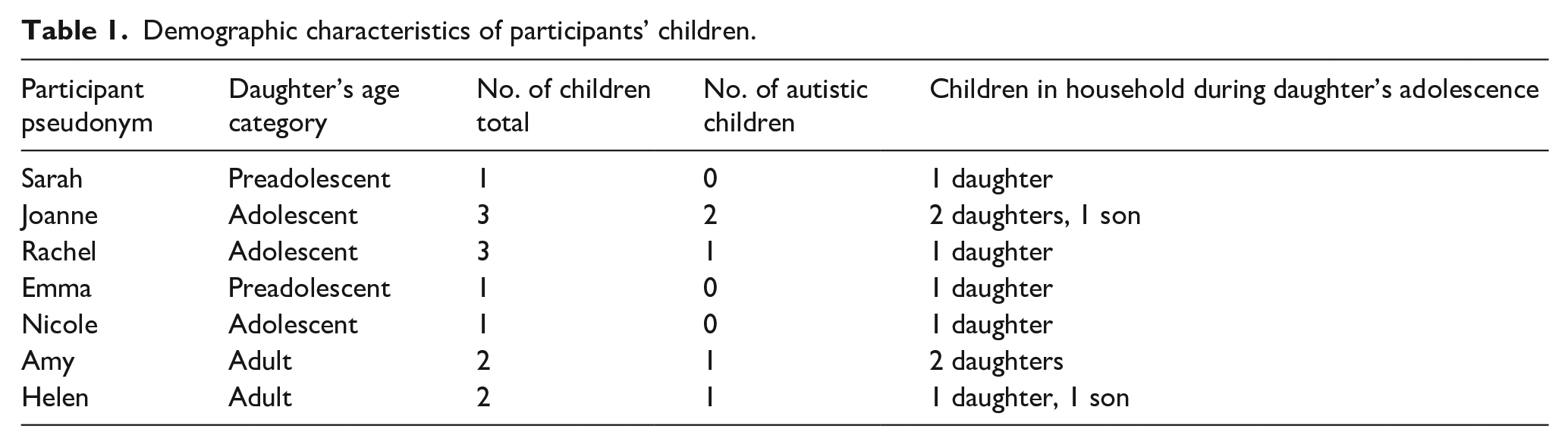
Seven autistic mothers between 40 and 64 years of age (M = 50, SD = 7.59) participated in this study. All mothers were diagnosed or began identifying as autistic between the ages of 35 and 52 (M = 40.67, SD = 5.34). Mothers’ education levels included high school graduate or equivalent (n = 1) and graduate degree (master’s or PhD; n = 6), and all mothers were employed, either full-time (n = 3), part-time (n = 2), or self-employed (n = 2). Mothers lived in the United States (n = 4), Canada (n = 1), and England (n = 2). All seven mothers were White, cisgender women, and the biological parents of their children. Furthermore, all mothers had experience raising an adolescent non-autistic daughter. Three mothers were married (two to their daughters’ fathers), three were divorced or separated, and one had never been married. Of the five mothers who were not married or were separated from their daughters’ fathers, three reported having co-parenting relationships, and two were raising their daughters on their own. Two daughters were preadolescents (10–12 years of age), three were adolescents (13–18 years of age), and two were adults (19 and older). Daughters’ ages ranged from 10 to 37 years (M = 18, SD = 9.08). Demographic characteristics of the participants’ children are depicted in Table 1. All names are pseudonyms to protect mothers’ confidentiality.
Demographic characteristics of participants’ children.
Measures
Semi-structured interview
A semi-structured interview guide was developed in collaboration with community partners and was based on the study’s aim and research questions. The development of the interview questions was further guided by prior studies that have used IPA approaches to explore the parenting experiences of autistic mothers (Dugdale et al., 2021; Winnard et al., 2022). The interview questions presented to mothers of preadolescent and adolescent daughters (below 19 years of age) and to mothers of adult daughters (19 and older) were framed slightly differently to reflect the ages of their daughters, but the contents of the interviews were the same (see Supplemental Materials). The interviewer adapted the questions and utilized prompts when necessary to elicit detailed accounts of participants’ lived experiences of raising an adolescent daughter. Interviews took place and were recorded on a secure video platform. Participants were asked to keep their cameras on to ensure authenticity of the interviews (Teitcher et al., 2015).
The autism spectrum quotient
Autistic behaviors in daughters were measured with the autism spectrum quotient (AQ), a 50-item questionnaire that examines the degree to which individuals identify with various traits associated with autism. The AQ was designed to be a descriptive measure, not a diagnostic measure, of autistic behaviors (Ruzich et al., 2015). Mothers completed the child version of the AQ (AQ-Child; Auyeung et al., 2008) if their daughters were below 12 years of age, and the adolescent version of the AQ (AQ-Adolescent; Baron-Cohen et al., 2006) if their daughters were between 12 and 15 years of age. Meanwhile, daughters completed the adult version of the AQ (AQ-Adult; Baron-Cohen et al., 2001) if they were 16 or older. Scores on the AQ-Adolescent and AQ-Adult range from 0 to 50 (Baron-Cohen et al., 2001, 2006), while scores on the AQ-Child range from 0 to 150 (Auyeung et al., 2008). For the purposes of this study, the AQ-Child was standardized to produce a score from 0 to 50. Daughters’ scores on the AQ ranged from 12 to 38 (M = 23.86, SD = 8.84) years. Two daughters scored 32 or above, which indicates high levels of autistic traits (Baron-Cohen et al., 2001, 2006). However, none of the daughters identified as autistic or had a formal diagnosis. One daughter with an elevated AQ score had received a diagnostic evaluation but did not meet criteria for a diagnosis.
Data coding and analysis
The interviews were transcribed verbatim and anonymized. The transcripts were then analyzed in four stages according to the IPA approach (Pietkiewicz & Smith, 2014). In the first stage, the first author read the transcripts closely and used an open coding method to note any thoughts, ideas, and observations that occurred while reading the text (Biggerstaff & Thompson, 2008). Descriptions of the concepts and language used in the transcripts were documented through detailed line-by-line annotations of the text. In the second stage, the first author reread each individual transcript and organized the annotations into preliminary themes (Biggerstaff & Thompson, 2008). A reflexivity journal was used throughout the first two stages to reflect on the influences of personal experiences and preconceptions on the analytic process (Biggerstaff & Thompson, 2008). In the third stage, community partners reviewed the preliminary themes, and the research team collaboratively identified conceptual similarities and overarching themes across the interviews. The research team also identified hierarchical relationships between overarching themes and created a conceptual map of superordinate themes and subthemes (Biggerstaff & Thompson, 2008). In the fourth and final stage, the research team reviewed the superordinate themes, subthemes, and the original transcripts to ensure that the final themes accurately reflected the raw data.
Results
Four superordinate themes, each comprised several subthemes, were identified: (1) Closeness in relationships, (2) Parenting strengths, (3) Identifying own social challenges, and (4) Building daughters’ social skills (see Figure 1). Themes 1 and 2 demonstrate the strengths of mother–daughter relationships, which were characterized by mutual empathy and understanding. Themes 3 and 4 demonstrate some of the challenges mothers experienced in their social interactions with other non-autistic individuals, which they were mindful of when scaffolding their daughters’ social development. Each theme is discussed in detail along with participant quotations that illustrate the themes.
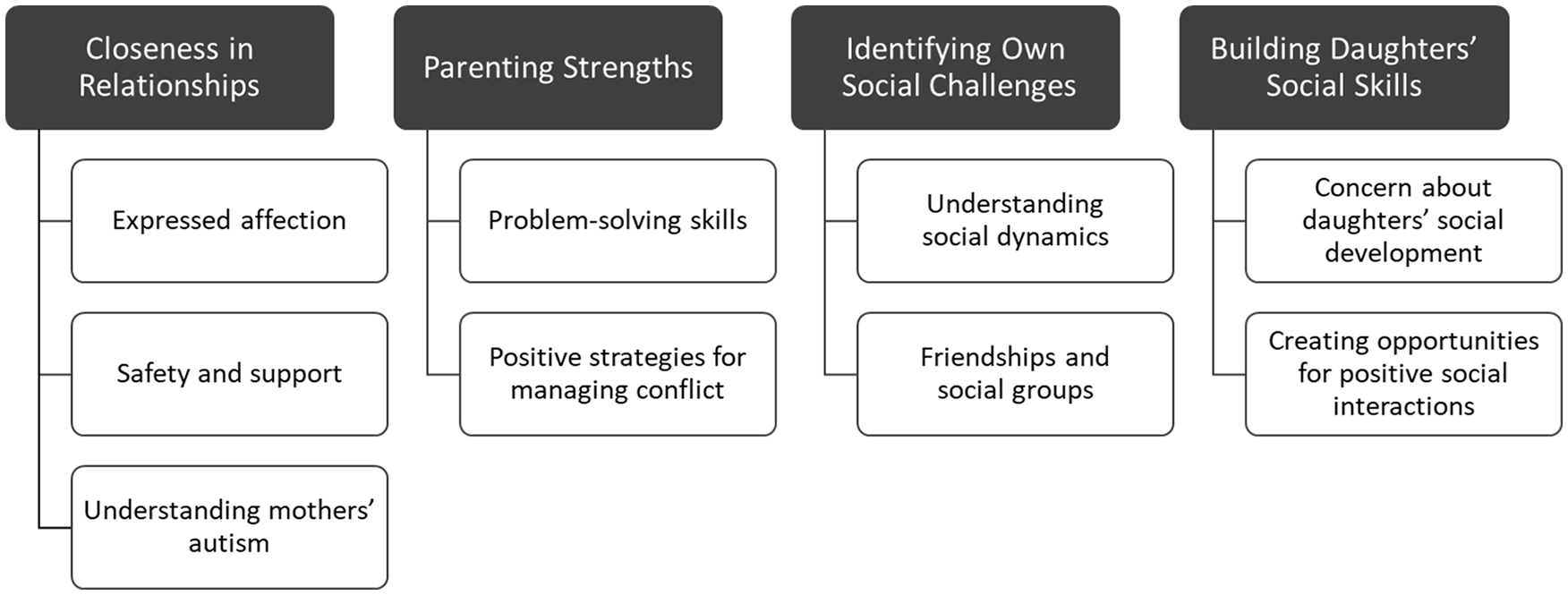
Structure of themes and subthemes.
Theme 1—closeness in relationships
This superordinate theme reflects the love and affection that mothers felt toward their daughters and the safety and security that characterized their relationships. Mothers’ disclosure of their autism to their daughters further brought them closer together.
Expressed affection
When talking about their daughters, several mothers expressed feelings of love and affection. Mothers described their daughters as “exuberant, funny, extremely silly, super bright, and so emotionally intelligent” (Sarah), “incredibly kind . . . and very, very thoughtful, smart, and determined,” (Rachel), and “a young, beautiful girl who is really quite larger than life in her personality” (Emma). Furthermore, mothers expressed that they “think she’s brilliant and wonderful no matter what” (Joanne) and they felt “blessed and lucky that this human being was given to me, and every day I do my best to do right by her” (Sarah). These feelings of affection continued after daughters began living on their own: Sometimes when I phone her, the way that she can say, “Hi Mom,” it just melts me. Like I know that there’s my 6-year-old and me, cuddled under the blanket, reading a book at night. (Rachel)
One mother also described how her daughter reciprocated these feelings of affection: She will also tell me what a wonderful mom I am and how much she loves me. (Emma)
Safety and support
The majority of mothers described how their relationships with their daughters were characterized by safety and support. Some mothers actively strove to create an emotionally safe home environment for their daughters. One mother, who had experienced domestic violence when living with her daughter’s father and left the relationship, explained, “I knew I didn’t want to bring up a child in that type of environment” (Emma). Other mothers had experienced emotional abuse from their own mothers, and when discussing their daughters’ upbringing, described how they “worked so hard to reroute it and do better” (Sarah) and wanted “to make sure my kids don’t feel like they have to walk on eggshells around me, because I did around my mom” (Joanne). One mother specified the parenting strategy she used so that her daughter felt safe with her: A lot of it revolves around emotion, and just letting her feel the emotion she feels, and not trying to come in and rescue it . . . if I keep acting as though this is a problem that needs to be fixed right away, she’s gonna internalize that she can’t show me her emotions. (Joanne)
While mothers mentioned that their daughters often relied on their friends for support (Amy, Nicole), they also explained that daughters felt comfortable coming to them (Sarah) and would tell them “the important things” (Amy, Joanne). Daughters were also honest with their mothers about prohibited activities, such as sneaking out of the house (Rachel) and drinking alcohol (Emma, Helen). Mothers were grateful that their daughters felt they could rely on them in those situations: She went to somebody’s house and there was a lot of booze there . . . she was a little uncomfortable, and she called me to pick her up in the middle of the night . . . so she knew that she could call me about anything. (Helen)
Understanding mothers’ autism
Six mothers in this study had received a formal diagnosis of autism, and one mother, who self-identified as autistic, had begun but did not complete a formal evaluation due to financial circumstances. Two mothers had conversations with their daughters about their diagnosis and explained how disclosing came “from the place of wanting to connect” (Rachel) and “opened up a whole aspect of our experience that really brought us closer together” (Sarah). Other daughters “picked it up more with me talking to other people about it” (Emma) and “had that information sort of through osmosis, I guess, rather than an explicit explanation” (Nicole). Meanwhile, some daughters learned about autism through siblings and other family members who were also autistic (Helen, Amy, Joanne), with one mother explaining that “the strongest identity in our family is really autism” (Joanne).
Some daughters experienced sensory sensitivities (Sarah, Joanne, Emma), and one mother explained that her daughter often wondered if “she would have the same criteria for diagnosis that I do because she and I are so similar” (Joanne). These shared experiences prompted daughters to ask their mothers about their autism: She was already so ready for it and curious and asking me questions . . . she just asked one day about sensory stuff, and she was already very primed to understand . . . and she wanted the information and she wanted to know how it applied to me. (Sarah)
When mothers explained to their daughters how their autism created certain challenges, their daughters responded with support and reassurance (Emma, Rachel). One mother, who had recently received her autism diagnosis, described her daughter’s response after explaining how her autism contributed to her preference for routines: And I’ve told her, you know, “I think this is part of why I get irritated when there’s this plan and then you change it. Then there’s this plan, and then you need this, you need that” . . . And she was so lovely, right. Cause I’m bawling on the phone. And she was like, “It’s okay, Mom.” (Rachel)
One mother also described how her daughter’s understanding of autism allowed her to appreciate her mother’s personality: She may be thinking . . . “Okay, Mom is a bit strange. Mom is a bit weird. And this is why—because she’s autistic” . . . that’s how she kind of probably appreciates and understands me. (Nicole)
Theme 2—parenting strengths
This superordinate theme reflects the parenting strengths that mothers described, including the skills they used to help their daughters with problem-solving and the strategies they used to manage conflict with their daughters.
Problem-solving skills
Mothers described different strategies they used when their daughters came to them for help with problem-solving. They described “going through a decision tree or algorithm” (Sarah) and helping “analyze a situation and lay out options around pros and cons” (Rachel). One mother attributed this strength to her autism: I despise the term “intellectualizing” because that was applied to me a lot as a kid. But the fact of the matter is as an autistic person, I tend to get at things through a big combo of the different routes of empathy. And part of it is critical thinking and analyzing. (Sarah)
While mothers’ reliance on their intellect was often perceived to be a strength, one mother reflected on how this strategy might have been perceived by her daughter: Because I rely on my intellect . . . I can’t show up in a way that other people would perceive as being present. Doesn’t mean I’m not there. It just doesn’t show up in a way that other people would think I was there. (Rachel)
When helping their daughters navigate personal problems, mothers often responded logically rather than emotionally. They reported the ability to “work it out really patiently, without freaking out or having a strong reaction” (Sarah) and explained that “my empathy is like cognitive empathy, it’s not like intuitive . . . and I think that’s also strength because I don’t get emotionally overwhelmed with stuff” (Nicole).
Positive strategies for managing conflict
Another parenting strength exhibited by mothers was the ability to use positive strategies to manage conflict with their daughters. Several mothers were able to manage conflict by recognizing and responding to their daughters’ needs—for example, by taking “an interest in the stuff that interests her” (Joanne), trying to be more encouraging rather than “solving her problems” (Rachel), using “a lot of the love and logic formats” (Amy), and explaining “things to her in a way that she can understand” (Emma). Mothers also explained that they “didn’t say anything” (Rachel) and would “hear it all out” (Emma) when their daughters were upset with them. Providing this space allowed daughters to calm down and talk through the issue: She does these things and acts out in these ways because I know that here at home is her space to do that . . . I’ve given her the confidence to always know that she can just come to me and just say, “I’m sorry, Mom,” and, “I didn’t mean those things.” (Emma)
Two mothers (Joanne, Helen) explained that the conflict they experienced with their daughters revolved around autistic siblings. Specifically, daughters felt that their mothers treated them differently or held them to higher standards compared with their autistic siblings. When this conflict arose, both mothers tried to reframe their daughters’ understanding of the problem: I’ve told her, I’m like, “Honey, you have no idea. Like you have this set of experiences that make you like the coolest, most good-humored mentor or leader in the world. And you don’t know it yet, but this will pay back some day.” (Joanne) She goes, “Well, it’s always about [Son].” And I said . . . “Everything we’ve done, we’ve done so he won’t be your responsibility” . . . and I think that that reframed her perspective . . . and I think she was able to see now that everything we did, we actually did for her. (Helen)
Theme 3—identifying own social challenges
This superordinate theme reflects the challenges that mothers experienced when engaging in group social interactions. Mothers were able to recognize their difficulties in understanding social dynamics and socializing with other parents, who often ignored and excluded them.
Understanding social dynamics
The majority of mothers reported difficulties in understanding social dynamics and processing social interactions. One mother described interacting with others as “speaking a third language without a translation guide . . . and sometimes the words change, and nobody tells you until you screw up” (Rachel). Another mother also reported the need to translate interactions in her head while they were occurring: My brain works in pictures . . . a lot of times I have to translate pictures into words to talk to people. And when I talk to people, I have to script things. So it’s like I have an ongoing mini teleprompter in my head most of the time. (Amy)
Mothers reported that social interactions required effort (Rachel, Sarah) and were “hard work” (Emma, Helen). One mother explained that she had to “download and analyze” interactions once they were over: I’ll pick things apart and realize, “Oh that’s what they were saying!’ . . . but I don’t really have the capacity to react in real time . . . I play the [mental] recording back at home, which is time-consuming and frustrating. (Sarah)
Another mother attributed her difficulty with social interactions to the cognitive demands that were required, explaining that “there’s just so much multitasking, auditory processing, trying to figure out the rhythm and the timing of the conversation” (Helen). However, mothers also explained that some social situations were easier to navigate than others. For example, mothers felt “much more adept and confident in my work environment” (Rachel) and preferred socializing with “other autistic people, neurotypical people that are leaders in the field, and researchers . . . because I don’t have to mask in any of those situations” (Helen).
Friendships and social groups
The majority of mothers reported having a few close friends but acknowledged that they did not have a large group of friends (Joanne, Rachel, Helen, Nicole, Emma). Mothers sometimes found it difficult to keep in touch with friends: I find it really hard to keep in touch with my friends. And I feel friendships are quite demanding . . . in this midst of everything that was always going on with [Daughter] through primary school . . . I just didn’t have any room for anything else. (Emma)
However, mothers explained that when they did contact their friends, they could “pick up where we left off in the conversation” (Joanne) and felt as though no time had passed (Emma, Helen).
Some mothers also had difficulty forming relationships with other parents. Mothers felt that the parents at their daughters’ schools “kind of seemed to have their own groups” (Amy), and mothers felt “a bit ignored at times or that I just don’t quite fit in” (Emma). One mother explained how she was intentionally excluded by other parents: [Daughter]’s friends’ moms and dads . . . they kind of became a group and they did things outside. And I was involved initially but slowly I kind of got excluded somehow . . . I had a bit of a, you know, a low time because I knew that they kept meeting up where I wasn’t invited any longer. (Nicole)
Theme 4—building daughters’ social skills
This superordinate theme reflects mothers’ concern about their daughters’ social development and their motivation to enhance their daughters’ social skills. Mothers were proactive in providing opportunities for their daughters to engage in positive social interactions.
Concerns about daughters’ social development
Several mothers expressed concern that their own social challenges may have impacted their daughters’ social development. Mothers felt guilty that they rarely hosted people in their homes (Emma, Joanne, Rachel) and “haven’t immersed her in like physical community as much as a much more social or non-autistic parent would” (Joanne). Mothers also reflected on how their introversion may have prevented their daughters from learning important social skills: She didn’t get a lot of opportunity to observe me in social situations . . . and so that’s where kids learn a lot about that kind of stuff . . . How do you be a really good friend? How do you listen? How do you do all those things? . . . I wasn’t a good model for her—not because I was bad at those things, but because she didn’t see a lot of it. (Rachel)
Another mother described how she felt unable to help her daughter navigate certain social situations: Sometimes she had some issues with friends and the social situations, and I have no idea. I don’t have a clue how to deal with that. I have no idea what you’re talking about. (Amy)
Creating opportunities for positive social interactions
While mothers expressed concern that their social challenges may have impacted their daughters’ social development, they were also proactive in ensuring that their daughters had opportunities for positive social interactions. When their daughters were young, mothers helped arrange playdates and sleepovers (Nicole, Emma, Sarah) and “made sure that she went to daycare . . . that she had social models besides me and other people to interact with” (Amy). Mothers whose daughters experienced sensory sensitivities were further able to help their daughters navigate social interactions in ways that met their sensory needs: I’ve given her the ability to identify what she likes and what she doesn’t like. And she doesn’t like as much social interaction as, like, a more traditionally extroverted kid . . . so she’s really been able to articulate, like, “This works, this person works, this situation doesn’t work, this person doesn’t work in this situation.” (Sarah) She gets easily annoyed by people when they are difficult in a sensory way . . . and I’m coming back at her going . . . “Don’t throw away otherwise decent people, who wish you well, just because their mode of expression is too intense” . . . And so we talk a lot about like, how do you advocate for your own sensory needs in a way that doesn’t hurt other people’s feelings? (Joanne)
Discussion
This study used an IPA framework to identify themes related to the parenting experiences of autistic mothers who have raised or are currently raising non-autistic adolescent daughters. Communication was a key strength in mother–daughter relationships, suggesting that autistic mothers did not experience the double-empathy problem in their relationships with their non-autistic daughters (Milton, 2012). The nature of mother–daughter relationships may foster mutual empathy and understanding, even when a mother is autistic and her daughter is non-autistic. Meanwhile, mothers seemed to experience the double-empathy problem when interacting with other non-autistic adults (Milton, 2012). Several mothers expressed concern that they were unable to teach their daughters certain social skills and help them navigate particular social situations—however, these difficulties motivated mothers to provide social opportunities for their daughters.
Contrary to prior findings (Pohl et al., 2020; Winnard et al., 2022), mothers in this study did not have trouble providing these social opportunities—they were proactive in arranging playdates and sleepovers, and in enrolling their daughters in other extracurriculars (e.g. Girl Scouts, martial arts). Studies have shown that parental involvement, in which parents actively support their children’s educational and social development (Fehrmann et al., 1987; Hill & Craft, 2003), is positively associated with maternal education (Suizzo & Stapleton, 2007). This may explain the high levels of parental involvement described by mothers in this study, who overall were highly educated. Five of the seven mothers in this study also had backgrounds in psychology- or education-related fields—therefore, parental knowledge of child/adolescent development may have further contributed to mothers’ motivation to provide social opportunities for their daughters.
This research has many strengths, such as being the first study to explore the narratives of autistic mothers who have experience raising non-autistic adolescent daughters. Few studies have explored the parenting experiences of autistic mothers, and these studies have only focused on maternal relationships with autistic children (Dugdale et al., 2021; Pohl et al., 2020). This study demonstrated that the relationships between autistic mothers and their non-autistic children are also often characterized by mutual love and understanding. Furthermore, this study benefited from the partnership with community members who were not only experts in academic research, but who could also personally relate to the phenomenon being investigated as autistic mothers (Bush et al., 2019). The CBPR approach used in this study allowed for a more holistic understanding of participants’ lived experiences.
Limitations
While this study has many strengths, there are also some limitations. First, the sample consisted of seven speaking, White mothers who had been diagnosed as adults, and most of the mothers had post-graduate degrees. The findings of this study, therefore, may not apply to autistic mothers with different behavioral and demographic characteristics. Studies have also found that individuals with higher levels of education are more likely to provide socially desirable responses (Ones et al., 1996; Tan et al., 2022). The high education levels among the study participants may, therefore, raise concerns of social desirability bias—however, several mothers explicitly revealed that they did not care about social desirability and valued honesty when expressing themselves.
Another limitation of this study was the substantial difference in age across both daughters (10–37) and mothers (40–64). Due to these age disparities, the study was unable to capture mother–daughter experiences that are specific to certain stages of development. Furthermore, this study did not explore how family dynamics influence mother–daughter relationships during adolescence (Bowen, 1966). Some of the mothers in this study were married to their daughters’ fathers, some had co-parenting relationships, and some were raising their daughters on their own. Mother–daughter relationships in this study were also influenced by other children/siblings in the home. The presence of fathers and other children in the home may not only influence the relationships between mothers and their adolescent daughters but may also shape daughters’ social development. Future studies should, therefore, use a Family System Theory approach (Bowen, 1966) to explore how the family unit impacts mother–daughter relationships and daughters’ social development during adolescence. To gain a more comprehensive understanding of the relationships between autistic mothers and their non-autistic daughters during adolescence, future studies should also explore how daughters describe their relationships and experiences with their mothers.
The IPA approach used in this study allowed for a relatively small, homogeneous sample (Pietkiewicz & Smith, 2014). The small sample sizes of IPA studies make it an appropriate framework for this demographic, as the number of autistic mothers, especially with non-autistic daughters, in the general population is limited. However, it is important to note that recruitment constraints limited our current sample to N = 7. We partnered with several large organizations and online communities during our recruitment efforts, which lasted approximately 6 months, yet few eligible participants enrolled in the study. Nonetheless, we felt that the data collected from the seven participants provided a comprehensive understanding of their lived experiences, thereby reaching saturation (Legard et al., 2003; Saunders et al., 2018).
Future directions
While mothers in this study prioritized their daughters’ social development, other autistic mothers may have difficulty providing opportunities for their children to socialize (Pohl et al., 2020; Winnard et al., 2022). In a study by Winnard et al. (2022), an autistic mother noticed how her reluctance to engage in social interactions may have impacted her children’s social skills: “. . . they didn’t really play with their friends that much outside of school. But then I suppose, whether they could pick up on the fact that I didn’t want to do it I don’t know” (p. 6). Autistic mothers may, therefore, benefit from resources designed to help them support their children’s social development, which is an area of future research. Furthermore, several mothers in this study reported being ignored and excluded by other parents, with one mother expressing guilt that this exclusion prevented her daughter from accessing certain social opportunities. Social exclusion is frequently reported by autistic adults (e.g. Sosnowy et al., 2019). These negative social experiences may not only increase mothers’ risk of depression and anxiety (Hedley et al., 2018; Mazurek, 2014), but may also limit the social opportunities available to their children, as demonstrated in this study. Therefore, this study highlights the need for interventions that focus on understanding, acceptance, and inclusion of autistic and neurodivergent populations. While prior interventions aimed at increasing autism acceptance have focused on school-aged children and adolescents (e.g. Ranson & Byrne, 2014), future school-based interventions that include children and their parents may be effective in promoting autism acceptance across all ages.
Conclusion
This study suggests that relationships between autistic mothers and their non-autistic daughters during adolescence are generally characterized by mutual feelings of affection, understanding, and support. While prior studies have conceptualized the parenting abilities of autistic mothers using a deficit framework, this research highlights the parenting strengths of autistic mothers and the loving relationships they have with their daughters. Mothers in this study did reveal specific challenges, such as modeling social skills for their daughters—however, they were also proactive in trying to ensure that their daughters did not experience the same challenges. Mothers described being accepted by their daughters and close friends, yet they felt ignored and excluded by other parents. This study, therefore, emphasizes the need for greater acceptance and inclusion of autistic mothers by non-autistic parents.
Supplemental Material
sj-docx-1-aut-10.1177_13623613241241577 – Supplemental material for “I do my best to do right by her”: Autistic motherhood and the experience of raising a non-autistic adolescent daughter
Supplemental material, sj-docx-1-aut-10.1177_13623613241241577 for “I do my best to do right by her”: Autistic motherhood and the experience of raising a non-autistic adolescent daughter by Natalie Libster, Robin Harwood, Karen Meacham and Connie Kasari in Autism
Footnotes
Declaration of conflicting interests
The author(s) declared no potential conflicts of interest with respect to the research, authorship, and/or publication of this article.
Funding
The author(s) disclosed receipt of the following financial support for the research, authorship, and/or publication of this article: This project was supported in part by the Health Resources and Services Administration (HRSA) of the U.S. Department of Health and Human Services (HHS) under cooperative agreement 5UT3MC39436, Autism Intervention Research Network on Behavioral Health (AIR-B). The information, content, and/or conclusions are those of the author and should not be construed as the official position or policy of, nor should any endorsements be inferred by HRSA, HHS, or the U.S. Government.
Ethical approval
Ethical approval for this study was obtained by the UCLA Institutional Review Board (IRB).

Supplemental material
Supplemental material for this article is available online.
References
Supplementary Material
Please find the following supplemental material available below.
For Open Access articles published under a Creative Commons License, all supplemental material carries the same license as the article it is associated with.
For non-Open Access articles published, all supplemental material carries a non-exclusive license, and permission requests for re-use of supplemental material or any part of supplemental material shall be sent directly to the copyright owner as specified in the copyright notice associated with the article.
