




Abstract
While overt social atypicalities remain a key component of the autistic phenotype, recent reframing of autistic social motivation suggests that these atypicalities do not overlap with their actual level of social engagement. Our study aimed to investigate autistic preschoolers’ visual attention toward social situations with unequal interactive load and determine the potential benefits of parallel competition, a form of lateral tutorship. The study observed 26 autistic preschoolers and 20 typically developing children. First, a gaze-contingent procedure measured visual attention toward videos of parallel competitive play, overtly cooperative play, and a non-social object. Then, a motor task and a cognitive task were conducted, both independently and with a parallel competitor to assess the effect of parallel engagement on children’s performance. Eye-tracking demonstrated autistic children displayed reduced attention toward competition than typically developing children. However, behavioral data revealed the presence of a parallel competitor significantly and similarly improved performance for autistics and typically developing children. These findings suggest a dissociation between social attention and social facilitation in young autistic children, indicating that atypical visual patterns toward social situations do not necessarily preclude them from benefiting from these situations. As such, activities parallel to the child activities, or lateral tutorship, may represent an addition to traditional joint-interactive activities in early education for autistic children.
Lay Abstract
Recent research suggests that we might have underestimated the social motivation of autistic individuals. Autistic children might be engaged in a social situation, even if they seem not to be attending to people in a typical way. Our study investigated how young autistic children behave in a “parallel” situation, which we call “parallel competition,” where people participate in friendly contests side-by-side but without direct interaction. First, we used eye-tracking technology to observe how much autistic children pay attention to two video scenarios: one depicting parallel competition, and the other where individuals play directly with each other. The results showed that autistic children looked less toward the parallel competition video than their typically developing peers. However, when autistic children took part in parallel competitions themselves, playing physical and cognitive games against a teacher, their performance improved relative to playing individually just as much as their typically developing peers. This suggests that even though autistic children pay attention to social events differently, they can still benefit from the presence of others. These findings suggest complementing traditional cooperative activities by incorporating parallel activities into educational programs for young autistic children. By doing so, we can create more inclusive learning environments for these children.
Autistic individuals have been historically viewed as lacking social motivation and accompanying skills necessary for success in social situations. As a result of this, mainstream education and intervention practices commonly adopt activities relying on typical interpersonal interactions, such as joint-interactive play and cooperative tasks. In response, researchers have put forward the need to reconceptualize autistic individuals’ distinct socialization patterns and their impact on the effectiveness of socially oriented strategies with varying interactive values in promoting the learning of autistic children (Gernsbacher et al., 2008; Jaswal & Akhtar, 2019; Mottron, 2017; Mottron et al., 2021; Ochs & Solomon, 2010).
Mainstream intervention strategies, such as the Early Start Denver Model (ESDM) and Joint Attention, Symbolic Play, Engagement, and Regulation (JASPER), typically involve intensive joint-interactive activities between clinical personnel and autistic learners with the aim of increasing social motivation and typical social behaviors (Dawson et al., 2010; Kasari et al., 2006). These “social-first” strategies are based on the observation that autistic children exhibit an overt disinterest in social stimuli during their early developmental stages (Jones & Klin, 2013; Klin et al., 2009; Swettenham et al., 1998). These alterations in social attention and the reduction of typical social behaviors in autistic individuals are addressed by social motivation theories. These theories emphasize the innate lack of attentional preference for social stimuli and propose that autistic children are less likely to be rewarded by social information than typically developing (TD) children during critical periods (Chevallier et al., 2012; Dawson et al., 2005). Moreover, “social-first” accounts suggest that deficits in social motivation disrupt the development of social cognitive skills, including joint attention, social play skills, understanding of others’ intentions, and speech development, thus impeding the maturation of social communication skills (Chevallier et al., 2012; Jones et al., 2014). Therefore, it is reasonable to prioritize the teaching of typical social behaviors to remediate the characteristic social challenges of young autistic children. Nevertheless, it is important to recognize that autistic learners may have distinct variations in socialization preferences which may inspire the adoption of strategies diverging from those employed in non-autistic joint-interactive activities to facilitate effective learning. In support of the need for reinterpretation, a recent meta-analysis reveals that the level of language reached by minimally verbal autistic children is not predicted by their joint attention as preschoolers (Kissine et al., 2023).
Recent proposals suggest that the social interests of autistic individuals may have been underestimated, thus challenging the reliance on non-autistic social norms to determine their intended social participation and motivation (Jaswal & Akhtar, 2019). For example, atypical eye-viewing patterns may not reliably reflect autistic people’s actual social engagement and interest. Autistic people may prefer unconventional ways of engaging with others, such as coordinated movement (Jaswal & Akhtar, 2019). The exclusive emphasis on promoting conventional non-autistic social behaviors that are characterized by overtly interactive and cooperative actions might deprive autistic children from other alternative social learning opportunities (Akhtar & Jaswal, 2019; Mottron, 2017; Mottron et al., 2021; Pellicano & Stears, 2011). To this end, lateral tutorship has been proposed as an alternative intervention principle to conventional face-to-face interactive approach for young autistic children (Mottron, 2017).
In lateral tutorship, the caregiver or clinician engages in parallel activities with the child, allowing for learning from a social partner without typical overt interactions (Mottron, 2017). A general form of lateral tutorship involves the adult manipulating educational materials (e.g., letters, numbers, or word copying) in front of the child, but without explicitly requiring the child to imitate or directly engage with the tasks. This approach provides the child with opportunities to observe and replicate behaviors or skills in their domain of interest at their own pace (Kissine et al., 2023; Ostrolenk et al., 2017). Another form of lateral tutorship is parallel competition, a competitive activity where participants operate independently without direct interactions or influences on each other’s actions. Compared with the non-competitive form of lateral tutorship, parallel competition prompts the child to work in a goal-oriented and structured manner while still maintaining their independence. Due to its lower demand for overt interaction, parallel competition might be more suitable for autistic children compared with conventional social activities that emphasize cooperation.
The absence, or marked reduction, of interactive cooperation is a key characteristic among autistic preschoolers and is represented as a diagnostic feature in the Autistic Diagnostic Observation Schedule (ADOS) diagnostic algorithm (Lord et al., 2012). During cooperative tasks that require collaboration between a child and an adult, autistic children aged 2–5 years old seldom make attempts to re-engage with their adult partners when the interaction had ceased. In contrast, developmentally delayed peers matched on nonverbal mental age sustained collaboration through various gaze, verbal, and gestural behaviors (Liebal et al., 2008). This finding may indicate that autistic children fail to establish shared goals with their partners (see also Kimhi & Bauminger-Zviely, 2012; Wang et al., 2020).
Considering that cooperation typically requires mutually supportive interactions and social face-to-face skills (Johnson & Johnson, 1989), diminished cooperation observed in autistic children could be linked to challenges in these skill areas. As such, it can be questioned whether decreasing the social interactive value of a task can enhance autistic children’s social performance. Downs and Smith (2004) conducted a study using a non-interactive task and provided counterevidence regarding cooperative deficits in autistic children aged 5–9 years old. In the study, the children played the prisoner’s dilemma game where they believed a peer was in an adjacent room. They were given the choice to allocate more tokens to themselves or to their peer, which reflected their orientation toward either competition or cooperation. The results revealed comparable levels of cooperative responses between the autistic children and their TD peers. Taken together, autistic children might not be inherently impaired across all social domains, rather, their abilities could be influenced by the way social interactive information is constructed and delivered through a particular activity.
Unlike face-to-face cooperative activities, parallel competition, a form of lateral tutorship, imposes only minimal social interaction demands on participants while allowing for a high degree of individual autonomy. This reduced interactive value permits a lower demand for monitoring social exchanges of parallel activities; conversely, highly interactive activities, such as cooperation, would impose a higher demand for monitoring. Indeed, existing eye-tracking research consistently indicates that autistic children tend to direct less attention to social stimuli when overt social interaction is present (Chevallier et al., 2015; Chita-Tegmark, 2016; Guillon et al., 2014; Hedger et al., 2020). For example, Chevallier et al. (2015) found that gaze patterns of autistic children only differed from those of TD children when viewing visual scenes rich in social content (e.g., two children engaging in joint-interactive play), but not when viewing static images or non-interactive social stimuli. Taken together, we predict that autistic children would allocate more attention to parallel competition over cooperation due to the lower interactive value of parallel competition.
Apart from eliciting social orientation, parallel competition may also offer unique advantages for scaffolding learning and performance in autistic children. To the best of our knowledge, only one autism study has incorporated a parallel competition task (Su et al., 2022). This study examined cortical activation patterns in autistic children aged 6–17 years old engaging in a Lincoln Log game 1 under cooperative (i.e., involving lead, follow, or turn-taking behaviors with an adult) and parallel competition conditions. The results revealed stronger activation in the inferior parietal lobule (IPL), a site putatively responsible for action planning and self-other distinction during leading and parallel competition conditions compared with following and turn-taking conditions. This observation would favor utilizing parallel competition and child-led settings to foster problem-solving abilities in autistic children (Su et al., 2022). However, the study was not able to determine whether parallel competition improved the problem-solving of autistic children, leaving its efficacy unanswered.
Motivated by the proposition regarding unconventional social orientation and behavior associated with autism, the current study focused on parallel competition, a form of lateral tutorship that can be implemented in empirical situations, and its impact on autistic preschoolers’ attention and action. First, we adopted a gaze-contingent paradigm to determine whether preschool-age autistic children were more attracted to parallel competitive play compared with cooperative play in terms of visual attention. The gaze-contingent paradigm consists of a human-computer interactive technique where the displayed content responds in real time to the viewer’s eye movements (Duchowski, 2017). This interactive feature can increase children’s sense of participation and provide a more engaging experience (Wang et al., 2012) while allowing objective quantification of visual attention preference. Based on the expected advantages of parallel competition, we hypothesized that autistic children may display an attentional preference for the competition game over the cooperation game suggesting an inclination toward parallel activities with lower social interactive value.
We then examined whether parallel competition could improve problem-solving performance by having the children participate in cognitive and motor tasks with and without a parallel-competing adult. We used an age-appropriate card-sorting task and ball-transporting task to examine whether the presence of a parallel competitive partner would improve problem-solving efficiency compared with working individually. Whether parallel competition has meaningful facilitative effects on autistic children would be directly manifested in the participatory tasks. We hypothesize a main effect of condition (individual vs parallel) on the behavioral performance. A performance improvement in the parallel competition condition, compared with the individual condition across both groups, would indicate that autistic children can demonstrate social learning in specific situations akin to their TD peers. This underscores the significance of incorporating lateral approaches in interventions and education.
Methods
Participants
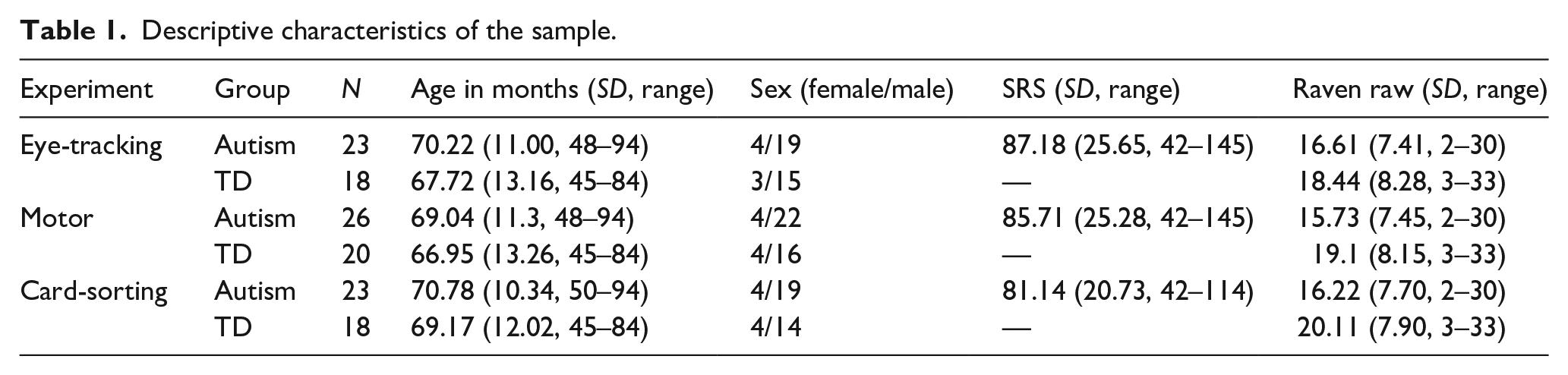
Forty-nine children (mean age = 68 months, range = 45–94 months) participated in the study, including 29 autistic children and 20 age-matched typically developing children. The autistic participants were recruited from special education institutes for autism in Guangzhou, China. The children in the TD group were recruited from local kindergartens. Eight out of the 49 participants were excluded from the analysis of eye-tracking data due to insufficient gaze samples (<50%), resulting in 23 children in the autistic group and 18 in the TD group. For the motor task, three autistic children were unable to complete the protocol resulting in 26 children in the autistic group and 20 in the TD group in the final analysis. For the card-sorting task, eight children were excluded from the analysis due to outlier values of time spent to complete the task (>±2SD), accuracy levels (<70%), or task incompletion. This resulted in 23 children in the autistic group and 18 in the TD group. The sample size recruited was guided by a power analysis, which indicated that an 80% chance of detecting a Group × Condition interaction with an effect size (Cohen’s f) of 0.25 would require a total sample size of 34, with 17 participants in each group. Sample sizes from previous studies on similar topics were considered (Downs & Smith, 2004; Geurts et al., 2008; Su et al., 2022).
All children in the autistic group received best-estimate diagnosis by licensed pediatricians specialized in Behavioral Developmental Pediatrics and child psychiatrists with more than 10 years of expertise in diagnosing autism spectrum disorder (ASD). The mean age of autism diagnosis was 3 years old (SD = 1.05 years) and confirmed by an independent pediatrician upon entering the special education institutes where participants were recruited. Social Responsiveness Scale (SRS; Cen et al., 2017; Constantino & Gruber, 2009) scores were available for 24 out of 26 autistic children included in the analysis, with a mean of 86 (SD = 25, range = 42–145). Three children scored below the suggested cutoff of 56.5 (Cen et al., 2017). The SRS has been validated in Chinese populations and exhibited satisfactory to good reliability and validity with the Social Communication Questionnaire (SCQ) and the Autism Behavior Checklist (ABC; Cen et al., 2017; Gau et al., 2013). Twenty autistic children had delayed onset of speech indicated by the age of the first meaningful word (>24 months). None of the children had any known or diagnosed genetic condition, additional psychiatric, or neurodevelopmental disorder, and were not medicated at the time of the study. The participants’ nonverbal reasoning estimates, as measured by the Raven’s Colored Progressive Matrices Test, were used as a proxy for their nonverbal IQ (NVIQ). The average score of the autistic group did not differ from that of the TD group (t(46) = –1.46, p = .152). Written informed consent was obtained from each child’s caregiver/guardian following a protocol approved by the local institutional review board. Detailed characteristics of the participants in each experimental task are summarized in Table 1.
Descriptive characteristics of the sample.
Procedures and materials
The experimental procedure included an eye-tracking task, a motor skill task, and a card-sorting task to assess cognitive problem-solving skills. The participants completed tasks in a fixed order.
Eye-tracking
The experiment adopted a 2 (group: autism, TD) × 3 (situation: competition, cooperation, object) factorial design. The visual stimuli consisted of three video clips depicting three types of situations (Figure 1): a competition game, a cooperation game, and a non-social object. The content of the competition and the cooperation games was adapted from Jin et al. (2017). In the competition video, two individuals had to catch a fish each using their own rod. Before each trial, a red box would appear around the target fish on the screen and flash three times. Each player’s score count was increased by one for each new fish caught. In the cooperation video, two players were fishing together using a jointly connected fishing rod with only one hook such that the two players must make coordinated movements to catch a fish. The score count increased by one whenever the players caught a fish together. The fishing game offers a simple non-hostile form of parallel competition that is easily understood by preschool-aged children (Jin et al., 2017). In the object condition, a video of a burning candle was used. This choice was based on its non-social and monotonous nature, as well as its minimal complexity and regularity. As a result, this object condition was intended to represent a less engaging situation compared with the competition and cooperation videos, thus allowing for a more effective assessment of the extent of the child’s preference or relative attentional increase toward the competition and cooperation videos.
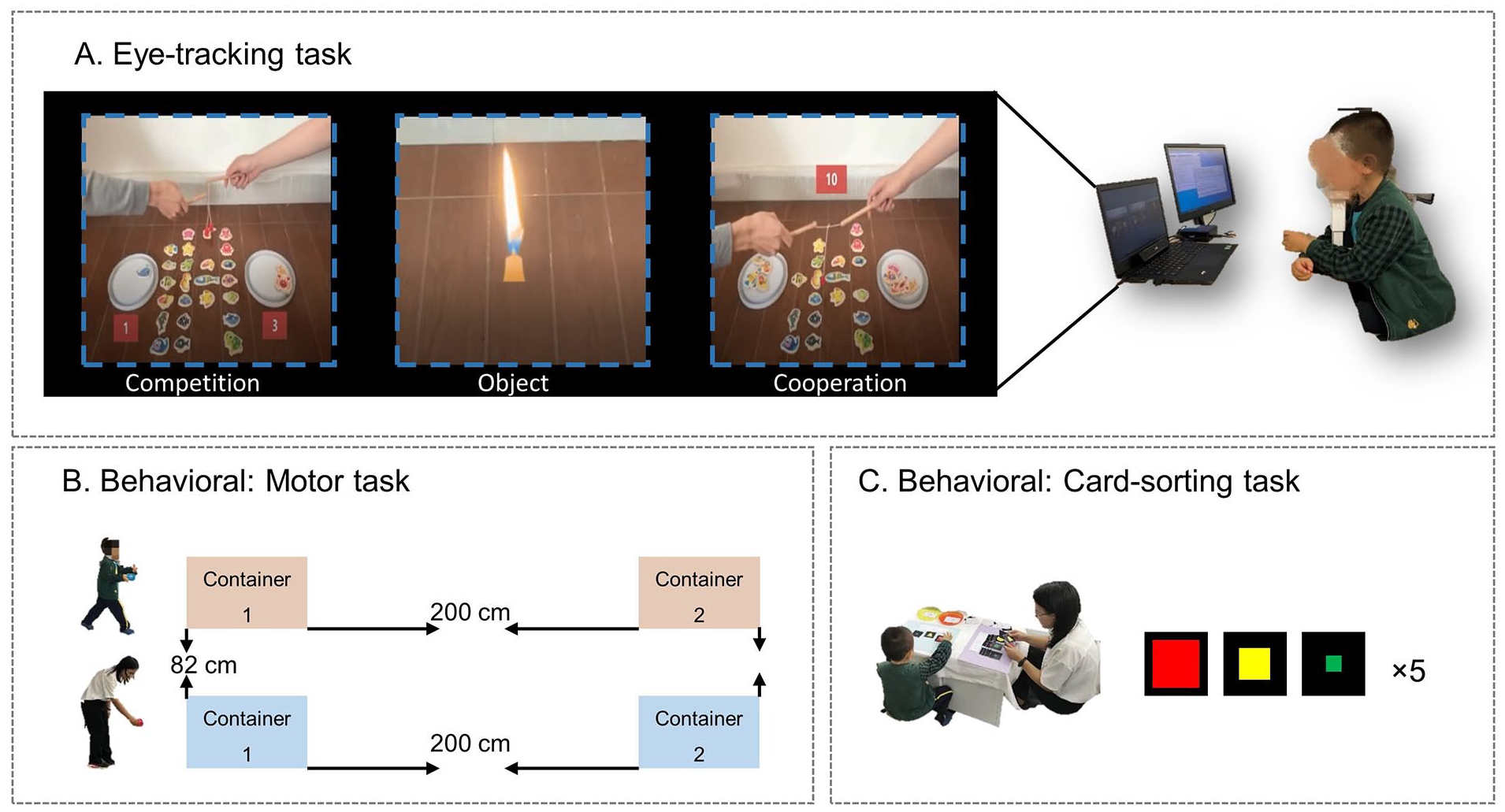
(A) Eye-tracking task and video displays (AOIs) of the competition and cooperation games, and the object condition. (B) Settings of the motor skill task. (C) Materials and settings of the card-sorting task.
The stimulus display and data recording were implemented via a Tobii X2-60 eye-tracker (60 Hz sampling rate) and a Dell Latitude 3400 laptop with a 14-inch monitor (60 Hz refresh rate, 1366×768 resolution). The gaze-contingent procedure was programmed and administered using MATLAB and Psychtoolbox (Kleiner et al., 2007). A five-point eye-tracker calibration was performed individually for each participant. The participant sat on a chair in front of the eye tracker on a table with a chin holder ensuring the distance between the participant’s eyes and the display monitor was 50 cm. The three videos were displayed simultaneously on the screen throughout the experiment (Figure 1A). The streaming of a specific video was controlled by the participant’s gaze in real time. That is, only the video being looked at by the participant would play, while the other two videos would pause. The video continued to play as long as the participant’s gaze remained on it, and it switched to another video if the participant shifted their gaze to one of the other videos. The participants were given minimal instructions consisting of: “Here are three videos. Whichever you look at will play.” The video placement/locations on the screen were counterbalanced across participants. During the testing, an experimenter monitored the eye-tracking data in real time through the recording software to ensure the eye-tracker’s contact with the child’s eyes. The recording lasted for 3 min unless the child became agitated or distracted.
Motor task
For the motor task, a 2 (group: autism, TD) × 2 (condition: individual, competition) factorial design was adopted. In the task, the participant was required to transport as many ping-pong balls as possible from one container to another in 40 s. The experimenter first familiarized the participant with the materials and rules and provided sufficient practice to ensure the participant’s understanding of the rules: (1) The child was not allowed to touch the balls in transit; and (2) if the balls were dropped on floor during transit, the child must return the balls to the beginning container and start over. The materials included two large containers where the balls were placed and a small plastic bowl with which the participant used to transport the balls. The distance between the two containers was two meters. In the individual condition, the participant was instructed to work alone and transport balls as fast as they can. In the competition condition, the participant was informed that a teacher would also be playing and that they would be competing against each other to see who could move more balls during the game. The competing teacher asked the participant, “How about we have a race? Let’s see who can move more balls?” Once the participant agreed, the experimenter asked both the participant and the competing teacher “Are you ready?” When everyone answered they were ready, the experimenter announced, “Get ready, start!,” ensuring that the child and the teacher started the game simultaneously. During the game, the competing teacher adjusted their speed to match that of the participant. This alignment aimed to maintain interpersonal competitiveness by ensuring similar performance levels.
Card-sorting task
The experiment design followed the motor task where the participant was required to complete the task individually and in the presence of a parallel competitor. The task was a simplified card-sorting game. The participant was asked to sort 15 picture cards according to their color (red, yellow, green) and shape (square, triangle, circle, rectangle, and trapezoid). In the competition condition, the child was instructed with “Let’s have a race. Let’s see who can sort faster.” The experimenter recorded the child’s accuracy and response times.
In both the motor and cognitive tasks, the order of individual and competition conditions was counterbalanced across participants within groups. The competing teacher was also present in the individual task conditions, ensuring that the participants were exposed to the same people throughout all tasks. After the competition trial, the experimenter announced and praised the winner. Both the competing partner and the child were rewarded for their participation.
Data analysis
The display areas of the competition, cooperation, and object videos were defined as areas of interest (AOIs). The eye movement data were recorded and processed by Tobii Studio software. A fixation was defined as the interval when the participant’s gaze points within 0.5° visual angle for at least 100 ms. A visit was counted when the fixation moved from the AOI to outside the AOI. The TD group and the autistic group did not differ on the percentage of valid gaze samples and total visit duration within AOIs (tsamples(39) = –0.862, p = 0.394, d = 0.27; tPVD(39) = –0.043, p = 0.932, d = 0.013).
The following gaze measures were obtained for statistical analysis. First, the information detection measures included: (1) Time to First Fixation (TFF) which is the duration of time from stimulus presentation to first fixation on the target AOI and (2) Fixations Before (FB) which is the number of fixations on screen prior to fixating on an AOI. The information detection measures focus on the beginning of viewing behavior and are typically used to indicate the sensitivity and efficiency of AOI discovery during visual search (i.e., how fast the viewer can detect the AOI). Information processing measures included: (1) Percentage of Total Fixation Duration (PFD) which is the ratio of the sum of duration of fixation points in an AOI to the total duration of all fixation points; (2) Percentage of Total Visit Duration (PVD) which is the ratio of the sum of duration of visits in an AOI to the total duration of all visits; (3) Percentage of Fixation Counts (PFC) which is the ratio of fixation points in an AOI to the total number of all fixation points; and (4) Percentage of Visit Counts (PVC) which is the ratio of the number of visits in an AOI to the total number of all visits. The information processing measures describe cumulative viewing behavior throughout the gaze-contingent procedure. In addition, in order to examine the participants’ increase in visual attention related to competition and cooperation, we calculated “Social Gain” scores (Chevallier et al., 2015). This was done by subtracting the PFD for the object AOI from the PFD for the social game AOIs.
The motor task performance was indexed by the number of ping-pong balls successfully transported within 40 s. For the card-sorting task, we obtained the response accuracy (i.e., percentage of cards correctly sorted) and response time in seconds averaged across shape and color subtasks. The response accuracy did not differ between the autistic group and the TD group (t(39) = –0.30, p = 0.765); therefore, it was appropriate to use the response time as an outcome measure to examine the effects of competition on task performance.
For the eye-tracking and behavioral measures, we performed mixed analysis of variance (ANOVA) analyses with group as a within-subject factor and AOI (or condition) as a between-subject factor. In each ANOVA model, sex, age, and AOI location (or task order) were controlled as covariates. Whenever the assumption of sphericity was violated in the ANOVA models, Wilks’ Lambda statistics were reported. Full results of the ANOVA analysis can be found in the Supplemental Material (Tables S1 to S3). Pearson correlational analysis was conducted to explore the relationships among the outcome measures and participants’ age and IQ. Two-tailed significance level at 0.05 was used for all the statistical analyses. Bonferroni correction was applied for post hoc multiple comparisons.
Community involvement statement
Four community providers including two agency leaders were involved in the development of research questions, study implementation, and interpretation and dissemination of the findings. One specializes in pediatrics and special education, and the other is a psychiatrist and psychologist. Both have over 20 years of experience with service provision for autistic individuals and their families. The other two providers were early intervention specialists.
Results
Eye-tracking data
Eye-tracking heat maps were generated from the average PFD via the iMAP4 toolbox (Lao et al., 2017). The heat maps and corresponding statistical results (see the “Information processing measures” section) indicated that participants in both the autistic and TD groups directed more attention toward the game AOIs as opposed to the object AOI. This observation supports the validity of the gaze-contingent procedure confirming that the children were able to focus on the meaningful AOIs effectively.
Information detection measures
The ANOVA results for the TFF metric, which measures the time taken before fixating on an AOI, displayed a significant main effect of AOI (Wilks’ Lambda = 0.82, F(2, 35) = 3.81, p = 0.032, η2p = 0.18). Planned comparisons indicated a trend toward a shorter TFF for the competition AOI compared with the object AOI (p = 0.06).
A similar result was observed for FB, which measures the number of searches taken before fixating on an AOI and the effect of AOI was significant (Wilks’ Lambda = 0.80, F(2, 35) = 4.52, p = 0.018,η2p = 0.21). Further comparisons showed a tendency for a smaller FB for the competition AOI in comparison with the object AOI (p = 0.072).
Information processing measures
The ANOVA analysis for the PFD metric, which measures the proportion of time spent on AOIs, revealed a significant effect of AOI (Wilks’ Lambda = .77, F(2, 35) = 5.38, p = 0.009, η2p = 0.24). In addition, the Group × Condition interaction approached significance (Wilks’ Lambda = 0.88, F(2, 35) = 2.51, p = 0.096, η2p = 0.13). Planned comparisons demonstrated that the game AOIs (competition and cooperation) produced substantially higher PFDs than the object AOI (ps < 0.001). The Group × Condition interaction was primarily driven by group differences in the competition AOI where the TD group exhibited a larger PFD than the autistic group (t(39) = –2.11, p = 0.041; Cohen’s d = 0.66; Figures 2 and S1 and Table 2).
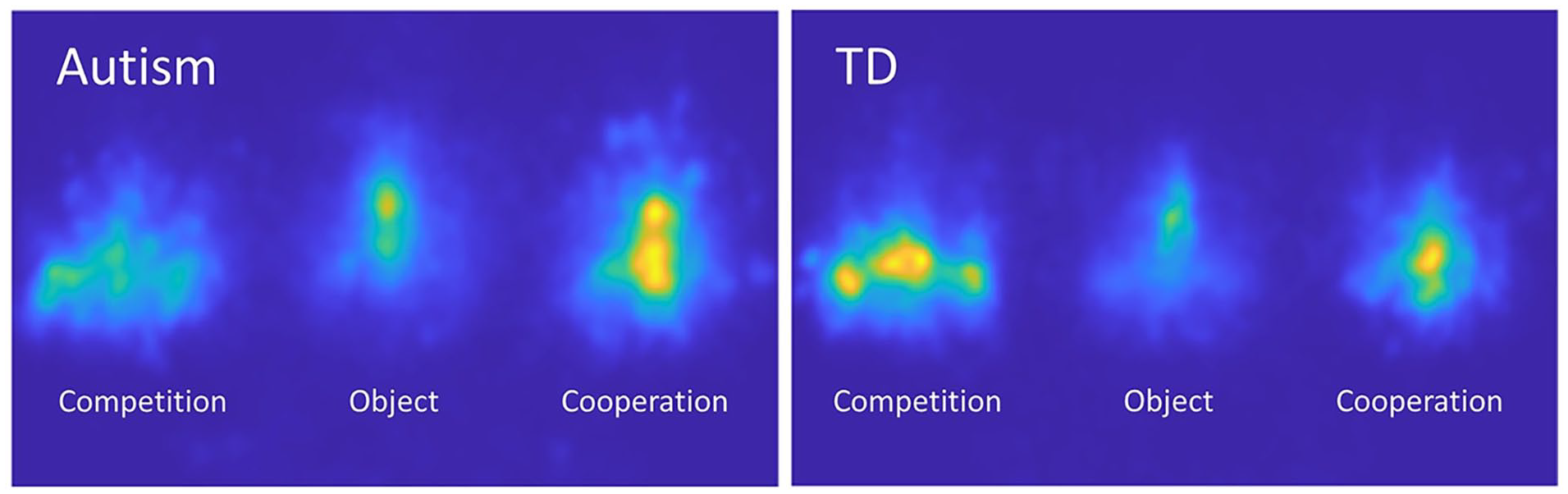
Heat maps of the percentages of fixation duration (PFD) in the AOIs.
Information detection measures and information processing measures in the eye-tracking task.
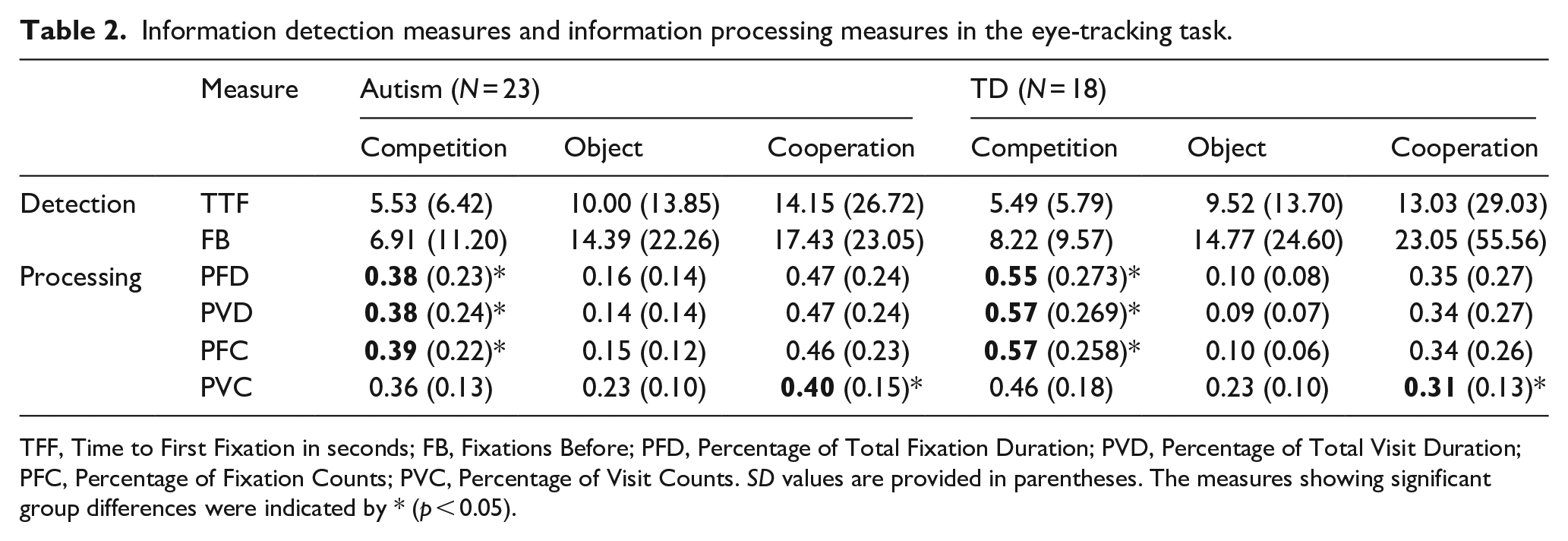
TFF, Time to First Fixation in seconds; FB, Fixations Before; PFD, Percentage of Total Fixation Duration; PVD, Percentage of Total Visit Duration; PFC, Percentage of Fixation Counts; PVC, Percentage of Visit Counts. SD values are provided in parentheses. The measures showing significant group differences were indicated by * (p < 0.05).
The analysis for the PVD metric revealed a significant effect of AOI (Wilks’ Lambda = 0.75, F(2, 35) = 5.72, p = 0.007, η2p = 0.25) and a marginally significant Group × Condition interaction (Wilks’ Lambda = 0.86, F(2, 35) = 2.97, p = 0.064, η2p = 0.15). Further comparisons showed that the participants spent more PVD on the game AOIs (competition and cooperation) than on the object AOI (ps < 0.001). The TD group allocated more proportional visits to the competition AOI compared with the autistic group (t(39) = –2.29, p = 0.028; Cohen’s d = 0.71; Figures 2 and S1 and Table 2). Moreover, a significant simple effect of AOI was observed only in the TD group with larger PVD in competition than in cooperation (Wilks’ Lambda = 0.60, F(2, 13) = 4.43, p = 0.034, η2p = 0.41), but not in the autistic group (Wilks’ Lambda = 0.79, F(2, 18) = 2.44, p = 0.115, η2p = 0.21).
For the PFC measure, which quantifies fixation points within an AOI, the ANOVA revealed significant effects of AOI (Wilks’ Lambda = 0.76, F(2, 35) = 5.65, p = 0.007, η2p = 0.24) and Group × Condition interaction (Wilks’ Lambda = 0.84, F(2, 35) = 3.41, p = 0.045, η2p = 0.16). Further analysis indicated that the participants looked more toward the game AOIs than toward the object AOI (ps < 0.001), thereby displaying patterns similar to the PVD and PFD measures. In addition, the TD group devoted more fixations than the autistic group for the competition AOI only (t(39) = –2.32, p = 0.025; Cohen’s d = 0.72; Figures 2 and S1 and Table 2). A significant simple effect of AOI was observed in the TD group with greater PFC in the competition compared with the cooperation (Wilks’ Lambda = 0.63, F(2, 13) = 3.88, p = 0.048, η2p = 0.37); conversely, the autistic group displayed a reversed pattern, with a smaller effect size (Wilks’ Lambda = .76, F(2, 15) = 2.79, p = 0.088, η2p = 0.24).
The PVC measure showed marginal effects of AOI and Group × Condition interaction that game AOIs produced higher PVC than object AOI, and the TD group visited the cooperation AOI less than the autistic group (see Supplemental Material).
Pearson correlation indicated age-related information processing differences in the TD, but not autistic group. Specifically, as age increased, TD children increasingly looked at competition (r = 0.48) and less at cooperation (r = –0.52 to –0.48) videos. For information detection measures, both groups demonstrated faster detection speed (r = –0.51 to –0.45) with age. See Supplemental Material for more details.
In sum, the information processing measures (PFD/PVD/PFC/PVC) collectively reflect a pattern of group differences: The TD group displayed a greater attention preference for the competition AOI, while the autistic group directed attention more evenly between the competition and cooperation AOIs (Table 2 and Figure S1).
Social gain scores
The Social Gain score measures visual attentional gains relative to the object condition. No group differences were observed when responses to competition and cooperation were pooled together (t(39) = –1.37, p = 0.179, Cohen’s d = 0.45) or when comparing cooperation against the object condition (t(39) = 0.68, p = 0.504, Cohen’s d = 0.213). However, a significant group difference emerged when comparing competition against the object, with the TD group showing greater gain associated with competition than the autistic group (t(39) = –2.29, p = 0.028, Cohen’s d = 0.72; Figure 3). Taken together, these results suggest that the competition video was given greater priority by the TD children compared with the autistic children, and this cannot be explained by a superior interest for the object by the autistic children.
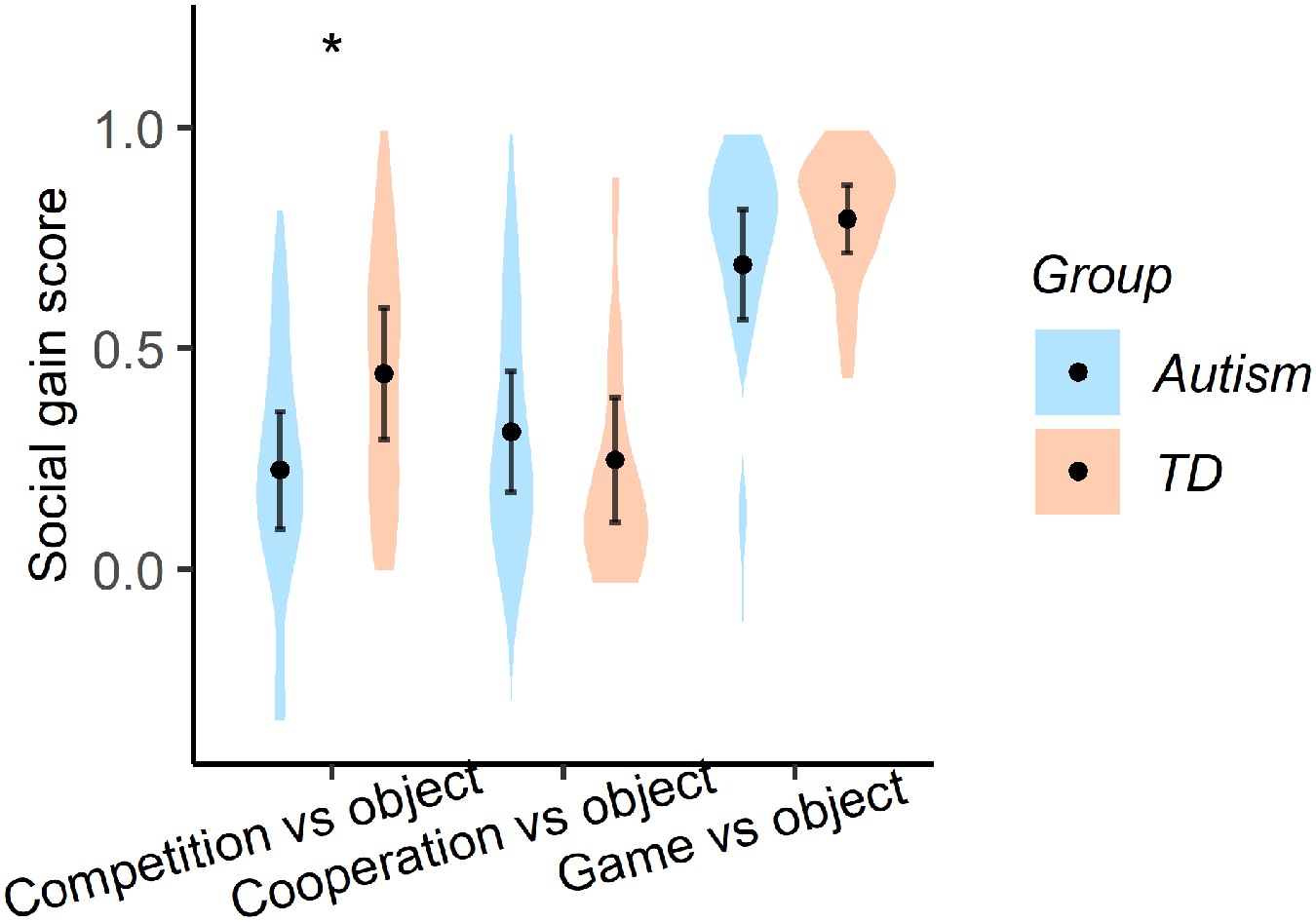
Comparisons of the Social Gains in PFD (Percentage of Total Fixation Duration) between groups. The horizontal axis labels represent the Social Gain associated with the competition video, the cooperation video, and a combination of competition and cooperation, arranged from left to right.
Motor task performance
The ANOVA revealed significant main effects of group (F(1, 41) = 9.45, p = 0.004, η2p = 0.19) and condition (F(1, 41) = 19.08, p < 0.001, η2p = 0.32). As depicted in Figure 4 and Table 3, the TD group outperformed the autistic group, and both groups performed better with the presence of a competitive partner than without. The results showed no significant Group × Condition interaction (F(1, 41) = 0.49, p = 0.489, η2p = 0.01), indicating that there was no difference between the groups in terms of performance improvement in the competition condition. The motor performance correlated with age in both groups showing motor skills improvement in older children (Figure S3).
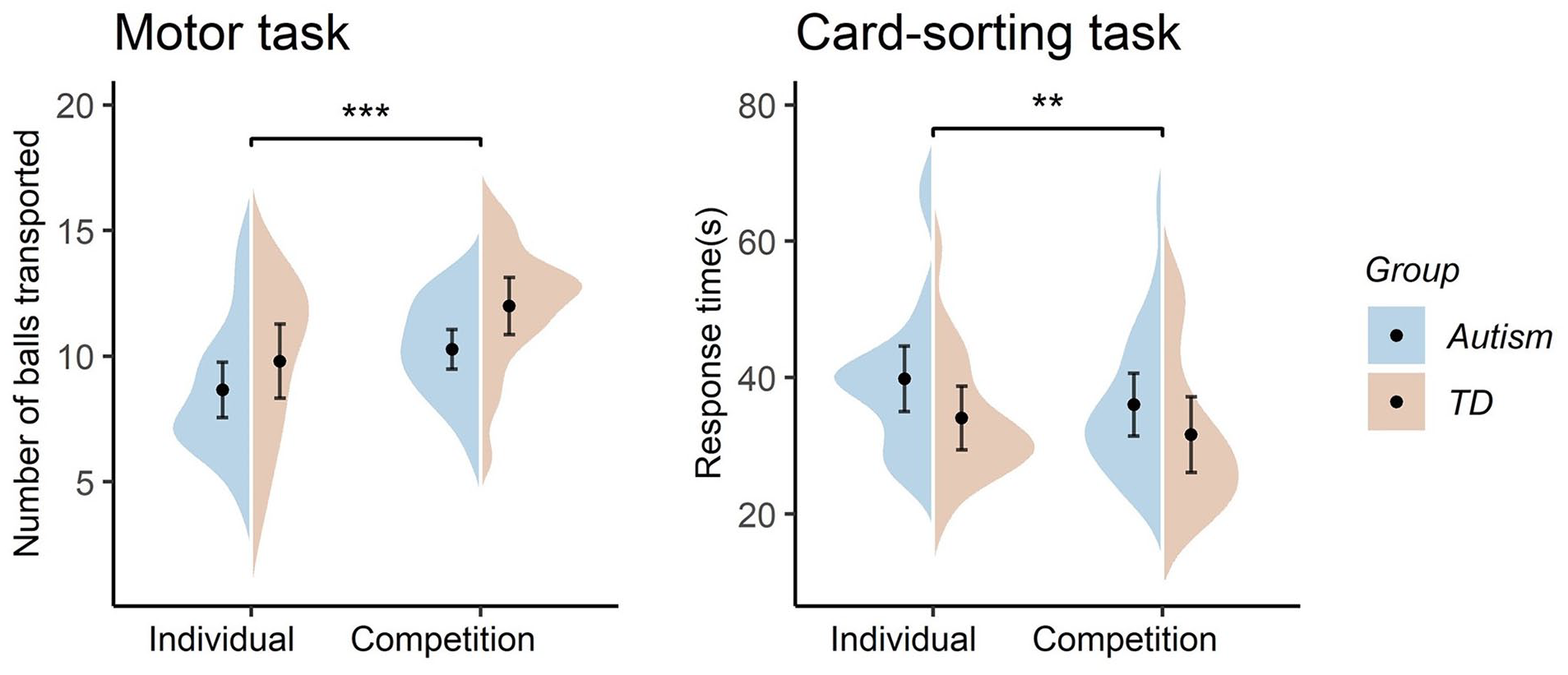
Condition effects on the motor task performance and the card-sorting performance.
Motor and cognitive performances with and without parallel competition.
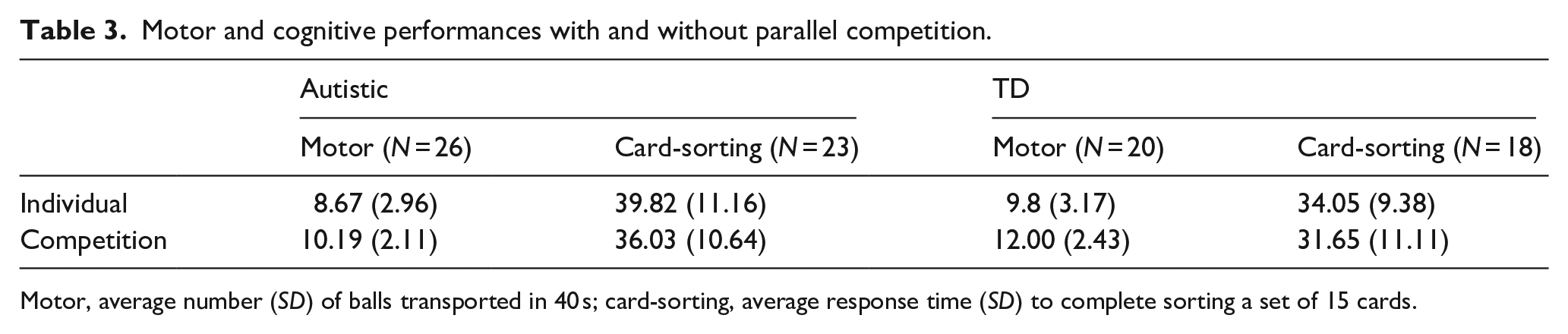
Motor, average number (SD) of balls transported in 40 s; card-sorting, average response time (SD) to complete sorting a set of 15 cards.
Card-sorting task performance
The ANOVA on response time showed significant effects of group (F(1, 36) = 5.18, p = 0.029, η2p = 0.13) and condition (F(1, 36) = 11.67, p = 0.002, η2p = 0.24), but no Group × Condition interaction (F(1, 36) = 0.34, p = 0.566, η2p = 0.01). Specifically, the autistic group took longer to complete the task compared with the TD group, and the performance improvement in the competition condition was similar across groups (Figure 4 and Table 3). In both groups, response time was negatively correlated with IQ suggesting faster completion with higher IQ (Figure S3).
To explore the potential relationship between visual processing of social and non-social situations and behavioral performance, we conducted Pearson correlational analyses between these two sets of measures. While bivariate results showed correlations between eye-tracking measures (PFD/PVD/PFC/PVC) and motor/cognitive performance in both groups, these correlations became non-significant after controlling for the effect of age. This suggests that there is no apparent link between the eye-tracking indices and the behavioral competence or effect of facilitation in the competition condition in these children.
Discussion
The present study employed a combination of eye-tracking techniques and behavioral tasks to investigate how young autistic children respond differently to two types of social interaction: parallel competition and cooperation. Results from the eye-tracking task, which utilized a gaze-contingent procedure, revealed that autistic children directed a similar amount of attention toward parallel competition and overt cooperation in contrast to their TD peers who demonstrated an apparent preference for competition over cooperation. Despite these differences in visual attention, subsequent behavioral tasks showed that the autistic children exhibited improvements in performance comparable with those seen in their TD peers from socially engaging in the parallel activity alongside a competing partner. These findings highlight the importance of integrating parallel activities into educational practices for autistic children.
Atypical visual attention for social situations in autism
Similar to the TD children, the young autistic children allocated more gaze toward the dynamic social situations compared with the monotonous non-social object. That is, the competition and cooperation videos as a whole provided a typical degree of social attentional gain for autistic children. However, differences emerged within the social domain between the groups. Contrary to our initial hypothesis that autistic children would prefer watching parallel activities over joint-interactive ones (i.e., cooperation) due to the overt interactive content of the latter, the eye-tracking data revealed no such preference in the autistic group. Instead, in comparison with the TD group, the autistic children directed less visual attention to the parallel competitive game and more to the cooperative game. Furthermore, the Social Gain score indicated a greater attention increase associated with competition in the TD group only, suggesting that competition is more meaningful and interesting for TD children compared with cooperation.
The lack of difference in Social Gain between competition and cooperation in the autistic group indicates that the autistic children distributed their attention more evenly between the two conditions. Attentional capture of social situations in autistic children may therefore not be contingent on their social interactive value, as we initially postulated. This interpretation is supported by a recent eye-tracking study in which autistic individuals allocated an equal amount of attention to activity regardless of the gaze directions of the actors. They did not modify their attention to activity based on the subtle differences in social interactive value (Kaliukhovich et al., 2020).
Interestingly, insensitivity to, or lower, competitiveness in autistic children has been outlined in Kanner’s (1943) original report, in which Case 5, an 8-year-old girl, was described as having “no competitive spirit” and remaining quiet even when she had superior knowledge on a topic (Kanner, 1943). Furthermore, a study by Finke et al. (2018) found that young autistic adults enjoyed overcoming personal challenges in video games, such as conquering levels or bosses, but did not emphasize competition with others as a key motivator for their gaming experiences, differing from TD adolescents. It is possible that inherent insensitivity toward interpersonal competition in autistic individuals leads to decreased focus on competitive actions in others. Alternatively, it could be the case that the autistic children did not differentiate between competitive and cooperative situations, or they may not have a specific preference for either scenario. Collectively, our results suggest that autistic children’s attention is less influenced by the social value of an interaction.
In addition to a social interpretation, or a top-down motivational explanation, it is important to consider bottom-up, or psychophysical factors, that potentially influence the social attention of autistic children. Research on social attention in autism has shown that the dynamic nature of human motion plays a key role in their diminished visual attention toward social scenes and interactions (Chevallier et al., 2015; Chita-Tegmark, 2016; Guillon et al., 2014; Kou et al., 2019; Speer et al., 2007). In the present design, the competition and cooperation videos were matched in terms of the number of people but differed in their physical structures including positioning and movement patterns of fishing hooks, and movement complexity of actors. Therefore, the reduced attention to the competitive video in autism may be attributable to its higher motion complexity and dynamicity. Specifically, the cooperative fishing game features a singular target action: the two actors must move simultaneously. In contrast, the competitive game portrays two actions executed by two independent actors which introduces more novel and asynchronous motions, thus rendering it more unpredictable. This increased complexity of human motion might at least partially explain the observed decreased social attentional gain from competition in autistic children. This interpretation is also consistent with Arora et al.’s (2022) findings, which demonstrated that autistic children spent more time looking at repetitive stimuli and less at changing, or unpredictable, stimuli when presented with complex materials.
Nonetheless, visual attention patterns captured via the gaze-contingent procedure may not serve as an unequivocal indicator of autistic children’s response to a social situation. In fact, the coexistence of atypical social attention and relatively intact social performance in autism is not surprising. This atypicality can be observed in the relationship between atypical gaze patterns toward faces and intact facial emotion recognition (Tang et al., 2019), as well as robustly reduced social attention and weakly reduced social seeking (Hedger et al., 2020). In the behavioral tasks evaluating motor and cognitive skills, we aimed to provide a more direct assessment of the extent to which parallel engagement provides immediate meaningful facilitation for autistic children.
Social facilitation in autism: enhanced performance in the presence of a parallel competitor
Our behavioral tasks demonstrated that the presence of a parallel partner significantly and similarly enhanced both TD and autistic children’s motor performance and cognitive problem-solving efficiency. Even though autistic children may display atypical decreases in visual orientation toward parallel competition, they still derived benefits from such settings. While it is challenging to assess the full extent of their comprehension of “competition” and its influence on their actions, the improvement in performance observed in these children under competitive conditions implies a certain level of understanding. However, we cannot determine whether this improvement is attributed to their understanding of verbal instructions or to their observation of the events. Nonetheless, the current findings indicate a clear and immediate social facilitation effect in autism, a phenomenon frequently reported as absent or diminished (Chevallier et al., 2014; Geurts et al., 2008; Izuma et al., 2011).
The observed typical social facilitation effect in preschool autistic children is in stark contrast with Geurts et al.’s (2008) study with school-aged autistic children. In their study, autistic boys, boys with attention-deficit/hyperactivity disorder (ADHD), and TD boys performed a cognitive control task while being informed that they were competing with peers from another school. The results revealed that although TD boys and boys with ADHD exhibited significant improvements when they believed they were competing with others compared with playing individually, autistic boys displayed no such performance gain. Importantly, both Geurts et al. (2008) and the present study employed parallel competition as a motivational context, but the two studies differed in terms of incorporating an actual human partner. The presence of a human partner and its immediate facilitation on task performance suggest that young autistic children are, in fact, influenced by their social environment. The observed differences in outcomes could also stem from the types of partners involved—whether a peer (even if virtual) or an adult, which presents an intriguing aspect for future investigation.
The preference for parallel play over joint-interactive play is often regarded as an indication of social impairment in autistic children (Bauminger et al., 2008; Chang et al., 2016; Sigman et al., 1999). As such, parallel play is considered less favorable when selecting intervention strategies (Robain et al., 2021) aimed at promoting non-autistic social reciprocity. Subsequently, it is discouraged for autistic children as it is considered dysfunctional, and a hindrance to the advancement of both social and non-social learning. However, the current data challenges these assumptions by demonstrating that parallel activity can lead to immediate performance gains, thereby reflecting automatic learning from the social environment. This observation also challenges the general assumption of “social-first” theories which posit that autistic children lack intrinsic motivation to engage in social interactions and inherently struggle to understand and process social information. Instead, the autistic preschoolers in the current study were able to participate in structured goal-directed interpersonal games just as their typical peers did.
Enriching one form of social reciprocity inadvertently depletes others. Autistic individuals’ unconventional sociality patterns warrant alternative explanations beyond mere deficiency-based interpretations. Several key elements of parallel activity could contribute to the success of autistic preschoolers in these settings. First, parallel play imposes minimal social demands on autistic children, allowing them to focus their efforts on task behavior. Second, actual social bonding occurs when autistic children are comfortable with the social structure of the environment. Lateral tutorship could serve as a counterpart to face-to-face interaction for autistic individuals where it could potentially facilitate the incidental learning of others’ behaviors (Mottron, 2017). Third, parallel activities allow autistic children to autonomously observe others to regulate their own behaviors. We herein propose that, instead of occupying young autistic children with intensive joint-interactive activities with which they inherently struggle with and/or resist, it may be more cost-effective to leverage their existing strengths to promote learning and social bonding—specifically, the natural and immediate lateral learning derived from a parallel social partner.
Limitations
Although the parallel competition was intentionally implemented as non-hostile, the concept of competition could be perceived as a hostile act. Potential adverse effects of competition have been reported in neurotypical individuals including an increased likelihood of committing unethical behavior and dishonesty (Kilduff et al., 2016; Schurr & Ritov, 2016). The possibility of competition exerting a similar influence on autistic individuals calls for cautionary considerations and further investigation.
In the present study, engagement with a competing partner served as a catalyst for social influence on autistic children; however, it remains an open question whether other non-competitive forms of lateral tutorship can yield the same immediate social facilitation effects. According to Mottron (2017), the learning effects of lateral tutorship might not be immediate; instead, a child might show delayed imitation of what was observed during lateral tutoring. Furthermore, it is important to explore whether the social facilitation effect is specific to certain conditions and influenced by factors such as gender, mental age, task complexity, and peer characteristics. A direct comparison of performance during parallel versus overt social interactions is also necessary to conclusively grasp the benefits of each type of activity. Future work should take greater advantage of the potential relationships between the eye-tracking paradigm and the behavioral tasks. In vivo monitoring of autistic children’s eye movements during real-world tasks is challenging but it is valuable for revealing the complex relationships between autistics’ social processing and social engagement.
Conclusion
Young autistic children may show atypical patterns of visual attention toward social situations. However, they can exhibit typical and immediate social facilitation effects when engaging in an implicit and lateral form of social interaction, as seen in the current scenario of parallel competition. These findings suggest that the unique social profile of autistic children may involve a divergence between social attention and social facilitation. It is important to recognize and leverage the potential benefits of parallel activities in early intervention and educational practices for autistic preschoolers.
Supplemental Material
sj-docx-1-aut-10.1177_13623613241239416 – Supplemental material for Autistic preschoolers display reduced attention orientation for competition but intact facilitation from a parallel competitor: Eye-tracking and behavioral data
Supplemental material, sj-docx-1-aut-10.1177_13623613241239416 for Autistic preschoolers display reduced attention orientation for competition but intact facilitation from a parallel competitor: Eye-tracking and behavioral data by Luodi Yu, Zhiren Wang, Yuebo Fan, Lizhi Ban and Laurent Mottron in Autism
Footnotes
Acknowledgements
We thank our participants and their families for their contribution to this research and Xiaofeng Jie, Xinjie He, and the involved staff and students for their assistance with data collection.
Authors’ note
The first author (L. Yu) was affiliated with South China Normal University in Guangzhou, China, during a portion of the study. L. Yu is now affiliated with Guangzhou University in Guangzhou, China.
Data availability statement

Declaration of conflicting interests
The author(s) declared no potential conflicts of interest with respect to the research, authorship, and/or publication of this article.
Funding
The author(s) disclosed receipt of the following financial support for the research, authorship, and/or publication of this article: This research was partially supported by the National Natural Science Foundation of China (31900775).
Supplemental material
Supplemental material for this article is available online.
Notes
References
Supplementary Material
Please find the following supplemental material available below.
For Open Access articles published under a Creative Commons License, all supplemental material carries the same license as the article it is associated with.
For non-Open Access articles published, all supplemental material carries a non-exclusive license, and permission requests for re-use of supplemental material or any part of supplemental material shall be sent directly to the copyright owner as specified in the copyright notice associated with the article.
