




Abstract
Some autistic people use strategies to hide autistic behaviour and appear more neurotypical. Previous research has linked this ‘social camouflaging’ with mental health difficulties. This review synthesised qualitative research to explore the relationship between camouflaging and mental health. Thirteen studies were systematically identified, appraised and synthesised using meta-ethnography. Four third-order concepts were developed, describing camouflaging as an attempt to cope with stressful social contexts which impact mental health. Many autistic people experienced unintended negative consequences of their camouflaging that increased stress. Potential mechanisms for the relationship between camouflaging and mental health related to the qualities of the strategies that were used. Camouflaging strategies that were superficially ‘successful’ involved high levels of self-monitoring, were highly cognitively demanding or highly habitual and appeared more linked to poor mental health. This should be investigated in future research and has potential implications for how clinicians support autistic people with mental health difficulties.
Lay Abstract
Some autistic people describe trying to hide autistic behaviour and seem more neurotypical. Researchers called this ‘social camouflaging’ and have linked it with mental health difficulties. We used a step-by-step approach to identify research where autistic people talk about social camouflaging to explore the relationship between camouflaging and poor mental health. Thirteen studies were combined. The results describe how society negatively impacts autistic people’s mental health, and camouflaging is a way to try and cope with this. Many autistic people find their camouflaging strategies have accidental negative consequences which also affect their mental health. Strategies which seemed ‘successful’ involved a lot of self-monitoring, were very mentally demanding or were very habitual and seemed to have more of an effect on mental health. This might be important for clinicians who support autistic people with mental health difficulties.
Introduction
Compared to the neurotypical majority, autistic people experience differences in social communication and understanding (American Psychiatric Association, 2013). When interviewed about their experiences of autism diagnosis, many autistic women speak of ‘wearing a mask’ to fit in in social situations (Bargiela et al., 2016). Subsequent research has investigated this experience further, referring to it as ‘masking’ (A. Cook et al., 2018) ‘compensatory strategies’ (Livingston et al., 2019) or ‘social camouflaging’ (Hull et al., 2017). There is no agreed definition of this concept (Ai et al., 2022), with some researchers suggesting a conceptual distinction between some terms, such as masking and compensation (Livingston et al., 2019). Camouflaging has also been considered to potentially overlap with impression management (Leary & Kowalski, 1990). However, it is recognised that the cognitive differences inherent to autism mean that there are unique features of camouflaging for autistic people in neurotypical contexts (Ai et al., 2022).
This article refers to social camouflaging or camouflaging as a set of strategies used in social situations to hide behaviours associated with autism and appear more socially neurotypical (Hull et al., 2017; Hull, Mandy, et al., 2019; Livingston et al., 2019). Camouflaging strategies include forcing eye contact, suppressing ‘autistic’ body movements and using conversational ‘scripts’ involving asking questions about others (J. Cook et al., 2022; Hull et al., 2017; Livingston et al., 2019). Social camouflaging has been identified in both autistic males and females, although there is suggestion that it is more prevalent in females (J. Cook, Hull, et al., 2021). These camouflaging strategies are suggested to come at a cost to mental wellbeing (Turnock et al., 2022).
The Camouflaging Autistic Traits Questionnaire (CAT-Q; Hull, Mandy, et al., 2019) has been used to research the association between self-reported engagement with camouflaging and a variety of factors, including gender (Hull, Lai, et al., 2019) and personality (Robinson et al., 2020). Using this tool, higher levels of camouflaging have been associated with generalised anxiety, social anxiety and depression in autistic adults (Hull et al., 2021). Further research has found an association between social camouflaging and psychological distress (Beck et al., 2020), and suicidal thoughts and behaviours (Cassidy et al., 2020). In autistic children and adolescents, camouflaging has been found to be a significant predictor of internalising symptoms such as anxiety and depression (Ross et al., 2023).
Although quantitative research has identified correlations between mental health, distress and camouflaging, it lacks a nuanced understanding of the mechanisms that may drive the relationship between them. The CAT-Q is the only existing quantitative measure of autistic camouflaging and was developed based on Hull et al.’s (2017) theoretical model of social camouflaging. Hull et al. (2017) specifically explore the experience of social camouflaging in formally diagnosed autistic adults. It is possible that qualitative studies that define camouflaging differently, and investigate it in different demographics, may provide alternative insights about the mechanisms linking camouflaging and poor mental health.
By synthesising multiple qualitative accounts, it may be possible to develop a deeper understanding of the mechanisms underlying the relationship between camouflaging and poor mental health. Multiple systematic reviews (Alaghband-rad et al., 2023; J. Cook, Hull, et al., 2021; Tubío-Fungueiriño et al., 2021) have aggregated and described the existing literature on social camouflaging. The existing systematic reviews suggest a relationship between camouflaging and anxiety and low mood, possibly relating to the cognitive effort involved (Alaghband-rad et al., 2023; Tubío-Fungueiriño et al., 2021). However, it is noted that this relationship is complex, and it may be an individual’s self-perceived need to camouflage that impacts mental health more so than ability to camouflage (J. Cook, Hull, et al., 2021). The existing systematic reviews have examined either quantitative studies alone (J. Cook, Hull, et al., 2021) or a combination of qualitative and quantitative literature (Alaghband-rad et al., 2023; Tubío-Fungueiriño et al., 2021). Although this has allowed a more comprehensive view of the evidence for the relationship between camouflaging and poor mental health, none of these reviews have added an additional interpretative layer in the way possible when synthesising qualitative data (Noblit & Hare, 1988; Walsh & Downe, 2005). By gaining a deeper understanding of this relationship, it may be possible to identify potential targets for mental health support using psychological therapies. Research into improving the mental health of autistic people, including the adaptation of psychological therapies, is a key priority for the autistic community (Benevides et al., 2020; Roche et al., 2021).
This review aimed to systematically identify and synthesise qualitative research about autistic people’s experiences of social camouflaging and their reflections on its impact. A meta-ethnography was planned as this methodology entails an interpretive rather than a merely aggregative approach (Noblit & Hare, 1988; Walsh & Downe, 2005). Unlike other methods of qualitative synthesis, meta-ethnography allows the reinterpretation of themes from the primary studies (second-order constructs) while taking into account the original participant quotes (first-order constructs) to create high-order themes (third-order constructs) (Sattar et al., 2021). A central feature of meta-ethnography is the presentation of the synthesis as a ‘line of argument’ composed of first-, second- and third-order constructs (Hannes & Macaitis, 2012). As a result, meta-ethnography is particularly suited for the generation of new theories (France et al., 2019; Sattar et al., 2021) and is therefore appropriate for exploring the relationship between social camouflaging and mental health. The present meta-ethnography explored the following questions:
Are there differences in the lived experience of social camouflaging for autistic people according to the type of strategy used?
Do autistic people’s descriptions of their experiences suggest mechanisms for a relationship between social camouflaging and mental health?
Question 1 was selected to investigate the current definitions of social camouflaging and related concepts across the literature and whether these meaningfully relate to differences in the experiences of autistic people. Question 2 was selected to gain a deeper understanding of the relationship between camouflaging and mental health in autistic people.
Methods
Systematic literature search
A search was conducted on 1 October 2021 using PsycINFO, Scopus, Web of Science, ASSIA (Applied Social Sciences Index and Abstracts) and OpenGrey. The search terms used are presented in Table 1. The reference lists of relevant studies were searched manually for additional papers. The search was rerun on 14 October 2022, with no additional studies meeting the inclusion criteria identified.
Search terms used.

Study selection
Studies needed to meet the following inclusion criteria: qualitative research on the topic of autistic people’s experiences of social camouflaging, or qualitative research on the topic of autistic people attempting to change their behaviour in social situations. Studies were excluded if it was not possible to separate qualitative and quantitative data; it was not possible to separate the experiences of non-autistic and autistic people; or they were written in a language other than English. There was no restriction on the date of publication.
Figure 1 shows a Preferred Reporting Items for Systematic Reviews and Meta-Analyses (PRISMA) diagram (Page et al., 2021) illustrating the study selection process. The systematic review was registered on international prospective register of systematic reviews (PROSPERO) under the registration number CRD42021271675. The first author (SLF) screened the titles and abstracts for relevant papers and then retrieved potentially relevant studies in full. SLF then applied the inclusion and exclusion criteria to the potentially relevant papers. A second rater (a clinical psychologist in training) independently screened 50% of the potentially relevant papers. Cohen’s kappa was 0.77, representing moderate agreement (McHugh, 2012). Any disagreements were resolved via discussion.
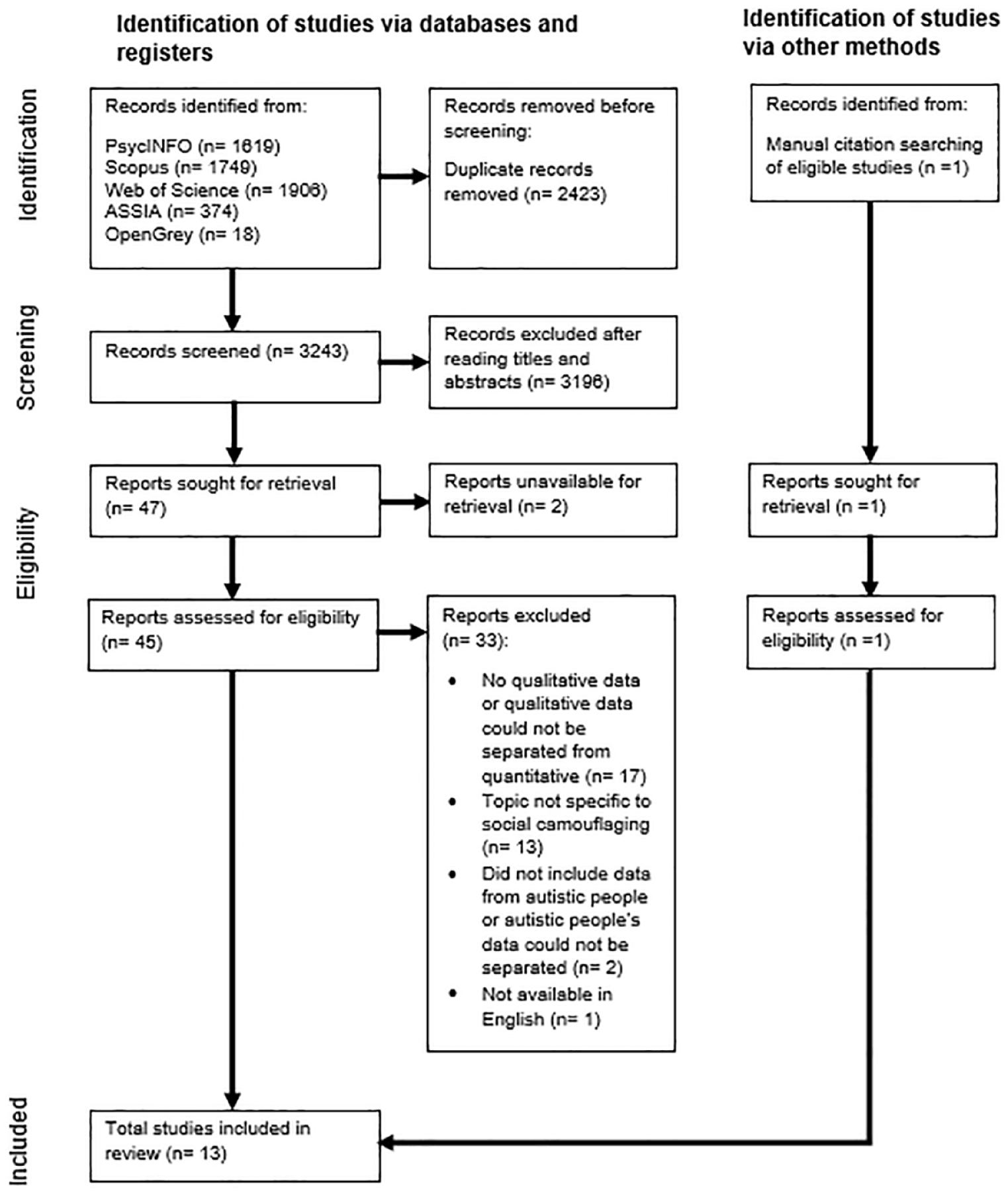
PRISMA diagram detailing search process and selection of studies.
At the full-text retrieval stage, 33 studies were excluded for not meeting the inclusion/exclusion criteria. Primary reasons for exclusion at this stage are given in Figure 1 with some studies excluded for multiple reasons. Of the excluded studies, 13 were primarily excluded for not being specific to the topic of social camouflaging. This meant that these studies were either unrelated or had a broader topic without a significant theme relating to camouflaging. Studies without a significant theme relating to camouflaging were deemed to have insufficient data to synthesise qualitative research (e.g. Cage et al., 2018) where there was a single subtheme relating to camouflaging with only four participant quotes given. Justifications for the exclusion of each paper at this stage can be found in the Supplemental Material.
Data extraction
SLF read the included studies in full and extracted the following information into a standardised table: authors, year, study aim and setting, method of data collection and analysis, sample characteristics and recruitment strategy (see Table 2).
Characteristics of included studies.
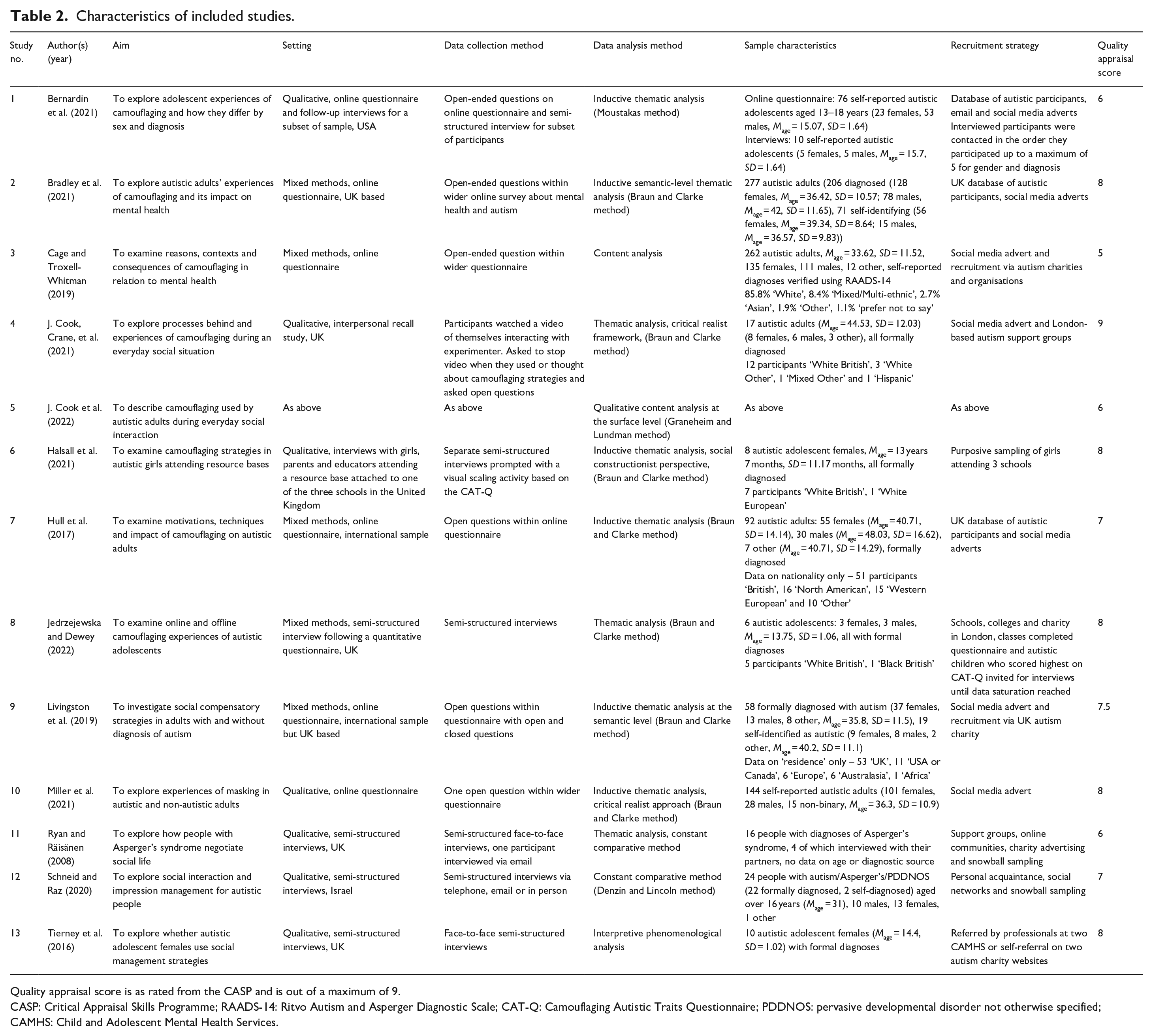
Quality appraisal score is as rated from the CASP and is out of a maximum of 9.
CASP: Critical Appraisal Skills Programme; RAADS-14: Ritvo Autism and Asperger Diagnostic Scale; CAT-Q: Camouflaging Autistic Traits Questionnaire; PDDNOS: pervasive developmental disorder not otherwise specified; CAMHS: Child and Adolescent Mental Health Services.
Critical appraisal
The quality of included studies was appraised using the Critical Appraisal Skills Programme (CASP, 2018). The CASP is a widely used tool for the evaluation of qualitative research (Dalton et al., 2017; Hannes & Macaitis, 2012) recommended by the Cochrane Qualitative and Implementation Methods Group (Noyes et al., 2019). The CASP can be used to evaluate qualitative research in terms of the validity, potential for bias and utility of the results. This study followed previous meta-ethnographies in assigning studies a point for each criterion with a half point for each criterion that was partially fulfilled or unclear (Graham et al., 2020). The CASP has a total of 9 scored criteria; therefore, each study could score a maximum of 9. The checklist was completed to aid interpretation during synthesis and was not used to exclude studies. The first author (SLF) completed the CASP for all included studies and a second reviewer (a clinical psychologist in training) independently appraised 50% of these. Where SLF and the second reviewer disagreed on a quality rating, this was discussed in detail. The purpose of this was to identify additional information about the quality of the studies that could have been overlooked by a single reviewer.
Data synthesis
A meta-ethnography was conducted to synthesise the studies. Meta-ethnography is one of the most used methods of qualitative synthesis, with improvements in the transparency of the search criteria and critical appraisal of studies in meta-ethnographies over time (Dixon-Woods et al., 2007; Hannes & Macaitis, 2012). The meta-ethnography used the seven steps outlined by Noblit and Hare (1988) as follows:
Getting started – identifying the research question.
Deciding what is relevant to the initial interest – defining inclusion and exclusion criteria and carrying out systematic searches.
Reading the studies – repeated reading of selected studies, noting interpretative metaphors.
Determining how the studies are related – determining relationships between studies by listing key concepts and comparing them. Concepts may be participants’ own interpretations of their experiences (first-order constructs) or study authors’ interpretations of participants’ experiences expressed as themes (second-order constructs). Studies are deemed directly comparable and capable of being reciprocally translated into each other, or representative of a line of argument that puts similarities and differences into a new interpretive context.
Translating the studies into one another – reciprocal translation identifies third-order constructs that are interpretations of the original authors’ interpretations. Refutational translation identifies differences in conflicting concepts.
Synthesising translations – comparing translations to identify overarching concepts and develop new interpretations from these (third-order constructs).
Expressing the synthesis via a written narrative and diagram.
The review was conducted from an inductive critical realist position, which presumes that knowledge is filtered through the lens of human experience and may be more or less close to reality (Fletcher, 2017). As a result, it was important to consider the background of the reviewers. The synthesis was primarily conducted by a non-autistic trainee clinical psychologist (SLF). SLF is the sibling of an autistic person and has worked with autistic people in a variety of contexts. The meta-ethnography was discussed by all four authors (SLF, MOW, CRGJ and JREF) at regular intervals during all seven stages of the synthesis to refine the concepts, improve the clarity of the results and ensure they addressed the research questions. This involved reviewing the first-, second- and third-order concepts; written narrative; and diagram. MOW is a non-autistic clinical psychologist with experience in the field of eating disorders and health psychology. Throughout his clinical work, MOW has interacted with a range of individuals who were autistic or thought they might be. CRGJ is a non-autistic researcher who leads an autism research group that includes neurodivergent and neurotypical researchers. JREF is a non-autistic clinical psychologist with experience working with people with eating disorders and complex mental health difficulties. JREF has significant experience of working with autistic people, especially within eating disorder services.
Community involvement
An autistic consultant reviewed the results of the meta-ethnography to ensure they reflected the perspectives of the autistic participants. The consultant was asked to comment on a draft of the results during stage 6 of the meta-ethnography, while the third-order constructs were being refined. The consultant was asked in lay terms to comment on whether the third-order constructs accurately reflected the perspectives of the autistic participants in the original studies. Previous qualitative research has also recruited autistic advisors to ensure themes accurately reflect the autistic voice (Babb et al., 2021). The consultant gave detailed reflections on how the third-order constructs related to the first-order constructs, and how the findings resonated with their own personal experiences. This guided the refinement of the third-order constructs and development of the visual diagram.
Results
Characteristics of the included studies
Thirteen studies were included in the review and their details are shown in Table 2. Each study was assigned a number which was used for reference throughout the review. Across the 13 studies, data were collected from 1009 autistic people. Two studies (4, 5) utilised data from the same sample of participants but applied different qualitative analysis methods. Where information about participants’ gender was given (n = 12 studies), 59.3% identified as female, 35.9% identified as male and 4.9% identified as ‘other’ or non-binary. Where reported (n = 12 studies), ages of participants ranged from 12 to 79 years. Where information was given about autism diagnoses (n = 9 studies), 88.3% had formal diagnoses and 11.7% self-identified as autistic.
Quality appraisal
The studies were assessed using the CASP (2018) checklist and scores (out of 9) are shown in Table 2. All but one (11) of the included studies gave a clear statement of their aims, and all the studies were appropriate in selecting a qualitative methodology. Most studies gave a clear statement of their findings with consideration of their credibility (1, 2, 3, 4, 5, 6, 7, 8, 9 and 10). A common weakness was a lack of explicit consideration of the researcher’s role and potential bias, with 7 of the 13 studies not sufficiently considering author positionality (1, 3, 5, 7, 8, 9 and 11). Some studies did not discuss their justification for aspects of their research design in detail (1, 3, 7 and 10).
Results of synthesis
First-order constructs from participant accounts of their experiences and second-order concepts from researchers’ interpretations of accounts were extracted and compared across studies using the method described by Noblit and Hare (1988). Reciprocal translation was used to identify similar concepts across the studies that could be grouped together under either an existing or new concept. Refutational synthesis was used to explore contradictory concepts. The meta-ethnographic process resulted in the development of four third-order concepts describing autistic people’s experiences using social camouflaging. These third-order concepts were generated from the synthesis and reorganisation of second- and first-order concepts. A line-of-argument synthesis was used to draw the third-order concepts together and determine how they relate to each other. The line-of-argument synthesis describes how autistic people use camouflaging to cope with the stressful social context, but that camouflaging itself has unintended negative consequences that make the context paradoxically more stressful. Four different qualities of camouflaging strategies appeared to affect mental health via their negative unintended consequences. Figure 2 shows a diagrammatic representation of the synthesis.
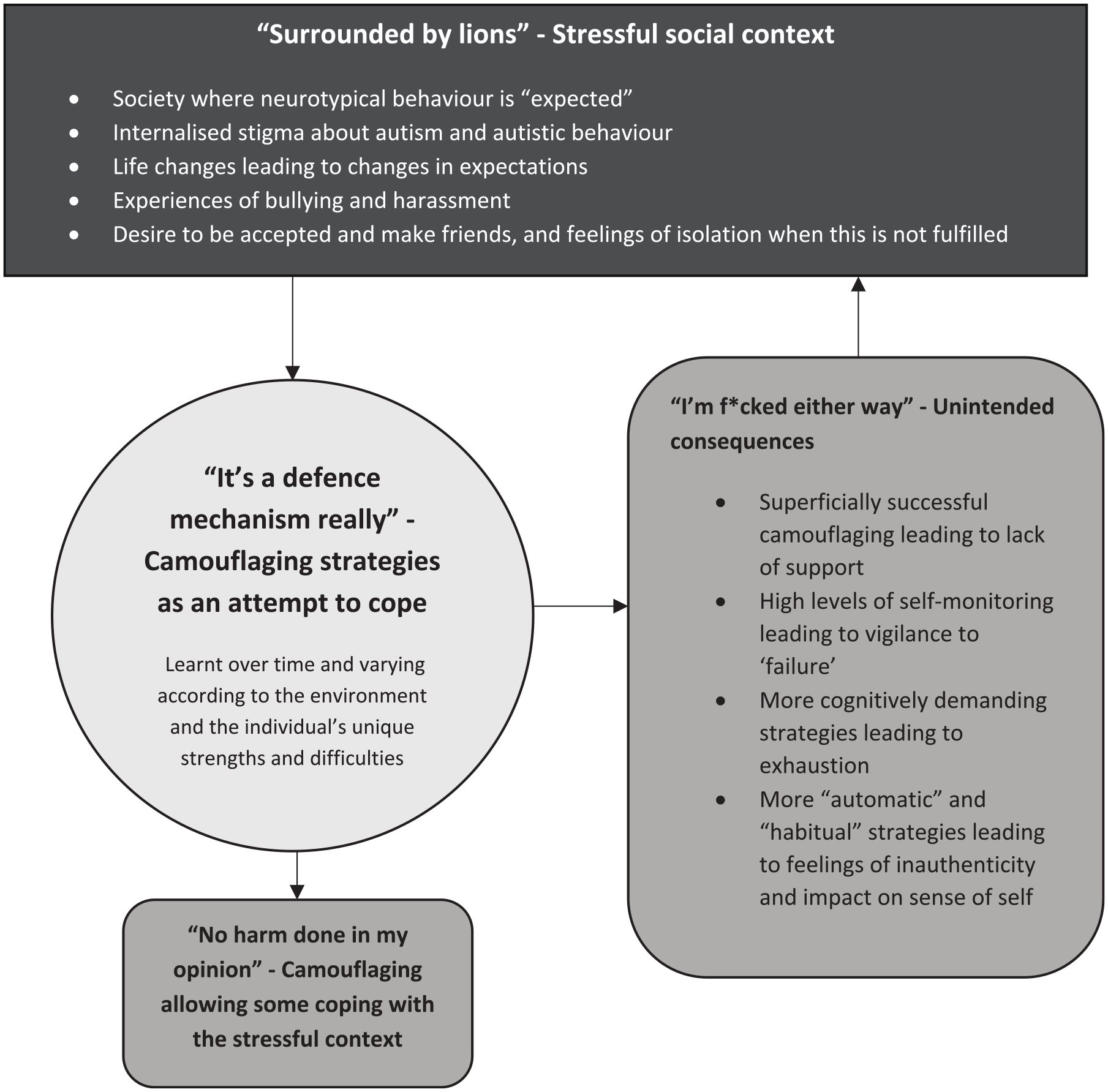
Diagrammatic representation of the four third-order concepts and line-of-argument synthesis (represented by arrows) from the meta-ethnography.
‘Surrounded by lions’ – stressful social context
Across the reviewed studies, autistic people described a constantly present stressful social and societal context. This was described as like being ‘surrounded by lions’ (Tierney et al., 2016). This context had the potential to impact autistic people’s mental health via internalised stigma about autism, and experiences of rejection and bullying.
Participants in several studies (2, 3, 4, 7, 9) described a social context where people ‘expect neurotypical behaviour’ (Bradley et al., 2021) and ‘connections have to be made initially on neurotypical terms’(Hull et al., 2017). Participants described a pressure to change autistic behaviour to be ‘more socially acceptable’ (J. Cook, Crane, et al., 2021). Schneid and Raz (2020) emphasised how this feels ‘coercive’ to autistic people. Autistic people felt ‘you have no choice but to change’ and ‘it’s not possible to be “out” … without incurring stigma and disapproval’ (Bradley et al., 2021). There was a sense that if autistic people did not conform to neurotypical norms, they would experience negative consequences, such as being perceived as ‘“rude,” “sick” or “shifty”’ (J. Cook, Crane, et al., 2021). Autistic people (1, 2, 4, 7, 8, 11 and 12) made references to being ‘abnormal’ or ‘weird’, suggesting that their awareness of how they are perceived in social contexts negatively affects how they perceive themselves. One participant in Schneid and Raz (2020) described the relationship between societal views and their view of themself: ‘all these years I have been judging myself because I was judged by others’. Cage and Troxell-Whitman (2019) referred to stigma becoming ‘internalised’ and autism being associated with ‘shame’.
Participants in the majority of studies (1, 2, 3, 6, 7, 9, 10 and 13) described experiences of bullying and harassment. Autistic people also described or displayed a desire for friendships and connection (1, 2, 4, 6, 7, 8, 9 and 13). Multiple studies (1, 2, 9, 11 and 13) discussed autistic people’s experiences of social rejection and isolation and the impact of this on mental health. One participant in Ryan and Räisänen (2008) discussed their experiences of isolation:
… sometimes it feels that it is just happening all over there somewhere and I am living in a bubble or living on the other side of a plate glass window to everybody else … it is kind of like really hard being alive sometimes.
Some studies (1, 7, 8 and 13) considered how gender influenced experiences of the social context. Bernardin et al. (2021) suggested that ‘social landscapes for adolescent females are more complex … which may make it more difficult for autistic females to fit in with peers’. Participants in Jedrzejewska and Dewey (2022) noted how their gender affected whether others perceived them as autistic: ‘girls are expected to be quiet, so when they’re quiet people don’t really recognise autism as much in them’. They felt their gender affected how they were ‘allowed’ to act, with ‘women being more like hysterical than boys … so like if they’re upset they wouldn’t be like a problem more’. Gender expectations may affect the neurotypical social expectations placed on autistic people. This is likely to vary depending on subtle aspects of the context, as highlighted by the fact that participants in Jedrzejewska and Dewey (2022) simultaneously felt girls are expected to be ‘quiet’ and ‘hysterical’. There was a lack of discussion in the literature of how other aspects of autistic people’s identities might affect their experience of the social environment, with only one mention of sexuality (13), and no discussion of race or disability.
Multiple studies (1, 6, 9, 12 and 13) noted changes in the social context lead to increased stress for autistic people. Some studies linked this to increased expectations being placed on autistic people, such as ‘major unspoken changes in social etiquette’ (Tierney et al., 2016) during adolescence and ‘applying for jobs and being in the real world’ (Livingston et al., 2019) during adulthood. These changes in expectations led to increased stress due to autistic people being expected to need less support, or because current coping or camouflaging strategies were no longer sufficient to meet neurotypical social norms.
‘It’s a defence mechanism really’ – camouflaging strategies as an attempt to cope
Across the reviewed studies, camouflaging was framed as a ‘defence mechanism’ (Hull et al., 2017) used to adapt to the stressful context. Autistic people (1, 2, 3, 6, 7 and 9) described camouflaging to ‘protect [themselves] from violence, intimidation, bullying and harassment’ (Cage & Troxell-Whitman, 2019). In addition, participants and researchers (2, 3, 6, 7, 8, 9, 10, 11, 12 and 13) described camouflaging being used to ‘fit in’ to the ‘neurotypical world’. For some autistic people (1, 2, 7, 9 and 13), camouflaging was used to attempt to access opportunities such as relationships and work. Although two studies (1 and 13) described autistic adolescents ‘develop[ing] strategies in order to establish friendships’ (Tierney et al., 2016), no studies described adolescents using camouflaging to obtain other opportunities such as to support success at school.
Some researchers (5, 7, 9 and 12) attempted to categorise camouflaging, with some suggesting particular methods might be related to different outcomes. However, none of the suggested categories appeared consistently and without conceptual overlap across all the studies. There did not appear to be any ‘types’ of camouflaging that existed categorically and had meaningfully distinct impacts on the experiences of autistic people. J. Cook, Crane, et al. (2021) and J. Cook et al. (2022) instead described camouflaging as a range of diverse ‘idiosyncratic solutions’ to an individual’s social differences and suggested camouflaging strategies may exist on a ‘continuum’. Some studies (5, 7, 10, 11 and 13) described autistic people using areas of strength, such as memory, to compensate for areas of difficulty. Autistic people in most studies (1, 2, 4, 6, 7, 8, 9, 11 and 12) reported camouflaging to different extents in different contexts. For example, some autistic people reported that ‘at home I can be myself’ (Halsall et al., 2021) (11). Other contexts where some autistic people reported camouflaging less include with close friends and family (7 and 8), when communicating online (8 and 11) and with other autistic people (2, 11 and 12). It appears that camouflaging strategies are adjusted to both the autistic individual’s unique strengths and challenges and the demands of their current context.
‘I’m f*cked either way’ – unintended consequences
Although camouflaging is an attempt to cope with a stressful context, many studies suggested it has unintended consequences. This is described as leaving autistic people ‘f*cked either way’ (Livingston et al., 2019) as they suffer either negative consequences from the social context or negative consequences from social camouflaging. These negative consequences did not appear to relate to particular ‘types’ of strategies (e.g. modifying eye gaze; using a social script) being used. Rather, they related to overarching qualities of the strategies being used, which included (1) the ‘success’ of the camouflaging; (2) the vigilance and monitoring needed; (3) the cognitive demand required; and (4) the automaticity of the camouflaging (see Figure 2). Many of these unintended consequences lead to the context becoming paradoxically increasingly stressful. These unintended consequences are potential mechanisms that help explain the negative impact of camouflaging on mental health for autistic people.
Participants (2, 7, 8, 9, 10 and 13) described not having their needs recognised because of using social camouflaging. Some participants linked camouflaging with a ‘delay in formal diagnosis’ (Bradley et al., 2021), which made it difficult to access support. Other participants discussed how camouflaging post-diagnosis led to others invalidating them or saying they were ‘faking being autistic’ (Miller et al., 2021). This appeared to be an unintended consequence of superficially successful camouflaging. J. Cook, Crane, et al. (2021) felt participants’ experiences suggested they ‘[continue] to experience social cognition difficulties while engaging in camouflaging’. Autistic people suggested that appearing to cope meant others ‘don’t think [they] need the help that [they] sometimes do’ (Bradley et al., 2021). The apparent ‘success’ of a strategy in making an autistic person appear to cope is one quality of camouflaging with a potential mechanistic impact on stress and mental health. As a result of superficially appearing to cope, the context can become increasingly unsupportive, inflexible and unresponsive to autistic people’s needs, causing additional stress.
Some autistic people felt ‘uncertain’ about their ability to camouflage (1, 4, 6 and 7). ‘Continuous’ monitoring of their behaviour and other’s social cues was part of the camouflaging process for some autistic people (4, 7 and 11). Autistic people appeared particularly aware of and anxious about camouflaging ‘failing’ (2, 4, 7, 9 and 11); for example, ‘I go over and over and over what they said and what I said. Did I understand them correctly, did I respond appropriately, did I make a gaffe? Have I offended anyone?’ (Hull et al., 2017). Ryan and Räisänen (2008) and J. Cook, Crane, et al. (2021) hypothesised that this ‘consciousness’ may paradoxically make it more difficult for autistic people to become fully involved in interaction. Therefore, although vigilant monitoring of the social cues and context may superficially lead to smoother interactions with neurotypical people, this may be at a cost to mental health and connectedness with others. The level of vigilance and self-monitoring needed as part of a camouflaging strategy, with consequential effects on social engagement and connectedness, is another potential mechanism whereby camouflaging impacts mental health. In addition, when camouflaging is perceived to be ‘failing’, this may result in increased anxiety and the context being perceived as increasingly stressful.
Autistic people in several studies (2, 4, 7, 9 and 11) described camouflaging as conscious and cognitively demanding ‘like trying to solve mathematical equations in your head all day long while carrying on as normal’ (Bradley et al., 2021). The consequence of this was ‘exhaustion’ and feeling ‘drained’ after camouflaging (1, 2, 4, 6, 7, 9, 10, 11 and 12). Autistic people described needing time to ‘recover’ after camouflaging (2, 7 and 9). Some studies (2 and 9) linked exhaustion to other unintended consequences such as feeling ‘burnt out’ and unable to do ‘simple’ things like eating and washing. The amount of cognitive demand involved in a strategy is a potential mechanism whereby camouflaging impacts mental health. Exhaustion from more cognitively demanding camouflaging may make autistic people less able to meet the demands of the context, leading to increased stress.
Contrastingly, autistic people in some studies (2, 3, 4, 7 and 10) reported that over time, their camouflaging strategies had become more ‘automatic’, ‘habitual’ and ‘involuntary’. However, camouflaging did not become more automatic for all autistic people. Notably, none of the studies of adolescents described camouflaging becoming more habitual over time. Some studies (4, 7, 9, 10, 11 and 12) described camouflaging being ‘refined’ over time. Miller et al. (2021) particularly emphasised that camouflaging may be learnt during childhood. Miller et al. (2021) noted that for some participants, the more ‘instinctual’ camouflaging became, the more difficult it became to ‘work out where they ended and the mask begun’ and the more autistic people felt confused about who they ‘really’ are. Additional studies (1, 2, 4, 7, 9, 10, 12 and 13) discussed feelings of ‘inauthenticity’ or changes in their sense of self due to camouflaging. Schneid and Raz (2020) note that camouflaging to ‘pass as normal’ appears to increase autistic people’s ‘sense of alienation’. How automatic and habitual an individual’s camouflaging is therefore another mechanism through which autistic people’s mental health can be affected. Where camouflaging becomes more automatic, this appears to be associated with feelings of inauthenticity and confusion about their ‘true’ identity. Over time, this cumulatively impacts autistic people’s sense of identity. This sense of alienation may contribute to shame and stigma about autism, making the context increasingly stressful.
‘No harm done in my opinion’ – camouflaging allowing some coping with the stressful context
Some autistic people reported that camouflaging was helpful overall, and for some, there was ‘no harm done’ (Bernardin et al., 2021). In Bernardin et al. (2021), some adolescent autistic boys did not feel there were any negative consequences to camouflaging, and reported feeling positive or neutral afterwards. For example, one participant reported ‘I feel I still have enough of my personality that I don’t feel like a different person, but just enough so … it’s proper for the situation’. None of the other studies and none of the studies of autistic adults described a complete absence of negative consequences.
In other studies (7 and 9), autistic people reported some negative consequences of camouflaging but felt these were not as severe as those of not camouflaging: ‘It cuts down the pain and makes me employable … To not compensate would make life more unhappy for me’ (Livingston et al., 2019). Livingston et al. (2019) linked positive outcomes to autistic people refining their strategies, choosing environments where strategies were more successful or balancing the time spent camouflaging with time where they are not. Both Hull et al. (2017) and Bernardin et al. (2021) noted that positive feelings about camouflaging appeared more common in autistic males than in females. Hull et al. (2017) hypothesised that camouflaging is more likely to have positive consequences for males due to ‘present gendered socio-cultural contexts’.
Discussion
The current review sought to investigate how autistic people experience social camouflaging and whether this varies according to the type of strategy used. The review also aimed to explore the mechanistic relationship between social camouflaging and mental health. Our meta-ethnographic approach produced four third-order concepts, ‘stressful social context’, ‘camouflaging strategies as an attempt to cope’, ‘unintended negative consequences’ and ‘camouflaging allowing some coping with the stressful context’. Crucially, these concepts highlighted how autistic people experienced bullying and harassment while simultaneously desiring and struggling to obtain friendships, suggesting a direct relationship between the social context and poor mental health. Social camouflaging was described as an attempt to cope with the stressful social context, with camouflaging varying depending on the context and strengths and differences of the individual. The mechanistic relationship between social camouflaging and mental health was found to be complex. Camouflaging enables autistic people to cope with aspects of the context that may otherwise negatively impact their mental health (e.g. avoiding harassment), while paradoxically having other negative impacts on mental health (e.g. self-monitoring and vigilance to signs of ‘failure’). Some autistic people felt the negative consequences of camouflaging were not as significant as those they would face if they did not camouflage.
The previous literature on social camouflaging has suggested there may be a distinction between different types of strategies such as masking and compensation (Ai et al., 2022; Livingston et al., 2019). This meta-ethnography did not find any types of strategies that occurred consistently and categorically across all studies or were linked with particular mental health outcomes. The meta-ethnography instead suggested that certain qualities of camouflaging strategies have a mechanistic impact on mental health via the unintended consequences they have for autistic people. Camouflaging that was more ‘successful’ and made the autistic person seem to cope appeared linked with receiving less support, with a consequential impact upon mental health. Camouflaging that required a high level of self-monitoring appeared linked with higher levels of vigilance and concern about camouflaging ‘failing’. Camouflaging that was highly cognitively demanding appeared to exhaust autistic people and contribute to feelings of ‘burnout’ and poor mental health. Finally, camouflaging that had become highly ‘automatic’ or habitual appeared to be linked with a greater sense of inauthenticity, with consequential negative effects on identity and mental health. We argue that these qualities of camouflaging are potential mechanisms that explain some of the negative impacts of camouflaging on mental health in autistic people. The results of this review also link with the wider literature about stigma and social anxiety.
Stigma
Autistic people in the current review described the social context as inherently stressful and impacting their mental health, particularly due to perceived stigma about being autistic. These reflections echo previous reports of the experience of stigma by autistic adults and adolescents (Bachmann et al., 2019; Botha et al., 2022; Brownlow et al., 2021; Mantzalas et al., 2021). Autism stigma has been theoretically linked with camouflaging (Turnock et al., 2022), and identified as a coping strategy for managing stigma by autistic people (Han et al., 2022). Botha and Frost (2018) suggested that autistic people can be viewed as an identity-based minority who are affected by minority stress. The Minority Stress Model (Meyer, 2003) suggests that as an identity-based minority, autistic people are vulnerable to social stigma, rejection and victimisation, which can impact their health (Botha and Frost, 2018). In keeping with this review, Botha and Frost (2018) found that minority stressors, such as experiences of discrimination, significantly predicted poor mental health in autistic adults.
Social identity theory (SIT) (Tajfel & Turner, 1979) has also been used to understand social camouflaging in autism (Pearson & Rose, 2021; Perry et al., 2022). SIT suggests members of a stigmatised group may attempt to gain a more positive identity by ‘passing’ in a group with higher status (Perry et al., 2022). Individuals might attempt to avoid stigma by monitoring how they appear to others (Pearson & Rose, 2021). This is similar to descriptions of social camouflaging in the reviewed studies, where camouflaging could be considered an attempt to avoid stigma by ‘passing’ as non-autistic. The current meta-ethnography suggests autistic people’s experiences of stigma within the social context directly impact their mental health. This impact is in addition to the negative unintended consequences experienced as part of camouflaging.
As the available evidence suggests camouflaging and the mental health of autistic people is influenced by stigma (Botha & Frost, 2018; Pearson & Rose, 2021; Perry et al., 2022), it is important to consider how this may differ for autistic people who experience stigma that is intersectionally related to other identities. This meta-ethnography suggests autistic women experience different social pressures that may influence their camouflaging and the impact it has on them. The reviewed studies did not discuss how stigma from other characteristics such as ethnicity and sexuality may affect autistic people, or how autism stigma may be moderated by other identities and cultural contexts (Turnock et al., 2022). Some researchers suggest an additive effect of belonging to multiple minorities on mental health, although this is not necessarily observed in the data (Hayes et al., 2011). It remains unclear how belonging to other stigmatised identities may affect autistic people’s mental health and use of camouflaging.
Social anxiety
Autistic people’s descriptions of social camouflaging in the current meta-ethnography bears similarities to cognitive behavioural models of social anxiety (e.g. Clark & Wells, 1995). Within this model, people with social anxiety have higher self-focussed attention and closely monitor how they imagine they may be perceived. Self-focussed attention is hypothesised to increase the salience of negative self-perceptions (Kashdan & Roberts, 2004), similar to how some autistic people in the reviewed studies appeared sensitised to signs of camouflaging ‘failing’. Furthermore, self-focussed attention is hypothesised to make it more difficult to engage with social situations, making it more likely for feared negative responses to occur (Clark & Wells, 1995; Hofmann, 2007). This bears similarities to the findings from the current meta-ethnography, which show autistic people may find it more difficult to engage in interactions if they use high levels of self-monitoring as part of their camouflaging. It is possible that when autistic people monitor their own behaviour, this sensitises them to potential signs of their camouflaging ‘failing’ and makes it difficult to engage with the social interactions. This maintains their perception of the social context as stressful and reinforces the need to camouflage, perpetuating the impact of both the social context and camouflaging on their mental health.
Although there are similarities between autistic people’s monitoring during social camouflaging and the type of self-monitoring theorised to sustain social anxiety, there are also important differences. Autistic people in the present research described closely monitoring the responses of others as well as their own behaviour. Contrastingly, traditional models of social anxiety (Clark & Wells, 1995) propose a lack of attention to others during interactions, meaning the person fails to learn that their social behaviours do not lead to rejection or other feared responses. Autistic people in the current meta-ethnography described using camouflaging because of their experiences of rejection, bullying and harassment. Autistic children and adolescents are significantly more likely to be bullied than typically developing children and children with learning disabilities, with between 46.3% and 94% of autistic children experiencing bullying (Humphrey & Hebron, 2015). Autistic adults are also more likely to experience bullying than non-autistic adults (Weiss & Fardella, 2018), suggesting that autistic people experience genuinely high levels of rejection. Thus, there may be different mechanisms at play for autistic people, with close monitoring of others’ reactions either making them more aware of genuine rejection or stressed in ambiguous situations that are challenging to interpret.
Clinical implications
This meta-ethnography suggests social camouflaging is a strategy that autistic people use to cope with a difficult and stressful social context. Some autistic people find camouflaging allows them to cope with the social context, or that the negative consequences of camouflaging are not as harmful as tolerating the context without camouflaging. For other autistic people, camouflaging has negative unintended consequences that make the context more stressful. This means that camouflaging has a complex mechanistic relationship with mental health, as it may reduce the impact of some factors that affect mental health (e.g. social rejection) while itself negatively impacting mental health via other routes (e.g. feelings of inauthenticity).
Our findings suggest one of the most effective ways to improve the mental health of autistic people would be to improve the societal context. This would involve creating a context where autistic behaviour is accepted and neurotypical social norms are not considered a superior way to make social connections. Some autistic people in the current meta-ethnography described particular contexts where they felt more accepted, such as with close friends or other autistic people. Conceptualising ways to decrease autism stigma, Turnock et al. (2022) argued that stigma may be best reduced by embracing neurodiversity. In this view, autism is perceived as a ‘difference’, part of the wide variation in neural difference in society, rather than a deficit. The social context can also be improved for autistic people by making social spaces more ‘autism friendly’, including both social (e.g. shared rules of engagement) and environmental (e.g. reduced noise levels) accommodations. These adaptations are hypothesised to reduce autism stigma not only by supporting better integration of autistic people but also by supporting autistic people to be their true selves (Turnock et al., 2022). Clinicians can contribute to these changes by recognising neurodiversity and considering adaptations to clinical environments that support the comfort of autistic people.
Clinicians should be aware of the relative costs and benefits of camouflaging for autistic people in the current societal context. Some autistic people may wish to avoid or reduce their camouflaging because of the unintended consequences they experience, whereas others may feel these are less significant than the impact of not camouflaging. Some autistic people may find it beneficial to reconsider the ways they camouflage, for example, trying to use strategies that involve a lower level of self-monitoring to attempt to reduce the anxiety they feel while camouflaging, or by reflecting on the impact of self-monitoring and attempting to reduce their level of vigilance. A nuanced approach is needed to avoid introducing additional issues, such as a reduction in vigilance leading to more automaticity, which we found could lead to feelings of inauthenticity. Clinicians should work sensitively with autistic people to formulate how camouflaging impacts them. This may allow autistic people to make informed decisions about when, where and how they camouflage.
Strengths and limitations
The present meta-ethnography represents a systematic search of the literature on autistic people’s experiences of social camouflaging. The meta-ethnography synthesised data from multiple studies involving adolescents and adults to generate a model to describe camouflaging and its impact on mental health. Meta-ethnography is a commonly used and well-established method of qualitative synthesis with multiple guidelines on maximising quality (Dixon-Woods et al., 2007; France et al., 2019; Hannes & Macaitis, 2012; Sattar et al., 2021).
It is important to note the diversity of participants in the reviewed studies. Many studies did not report the ethnicity of their participants, and when this was reported, the majority of participants were White. The majority of studies did not collect other demographics such as sexuality, education and employment. Several studies acknowledged that their participants were of average intelligence or above and did not represent autistic people with learning disabilities. As a result, the present meta-ethnography may not describe the experience of camouflaging for all autistic people. Future qualitative research should explore social camouflaging in autistic people with diverse backgrounds, particularly people with other stigmatised characteristics.
Conclusion
This meta-ethnography systematically identified and synthesised 13 qualitative studies on autistic people’s experiences of camouflaging. The findings framed social camouflaging as an attempt to cope with a stressful context where autistic behaviours are stigmatised. Camouflaging had negative unintended consequences for some autistic people, but others felt the negative consequences of camouflaging were not as severe as experiencing the stressful context without camouflaging. This means camouflaging has a complex relationship with mental health, where it may simultaneously reduce the negative impact of some aspects of the social context on mental health and increase the negative impact of other aspects. There were several mechanisms that lead to camouflaging unintentionally causing the context to become more stressful and lead to poor mental health. These mechanisms included superficially successful camouflaging leading to less support, high levels of self-monitoring leading to anxiety, highly cognitively demanding strategies leading to exhaustion and highly habitual camouflaging leading to feelings of inauthenticity. It is important for clinicians working with autistic people with mental health difficulties to consider the role of camouflaging. Clinicians should sensitively support autistic people to explore their personal costs and benefits of camouflaging in different contexts.
Supplemental Material
sj-docx-1-aut-10.1177_13623613231223036 – Supplemental material for A meta-ethnography of autistic people’s experiences of social camouflaging and its relationship with mental health
Supplemental material, sj-docx-1-aut-10.1177_13623613231223036 for A meta-ethnography of autistic people’s experiences of social camouflaging and its relationship with mental health by Sarah L Field, Marc O Williams, Catherine R G Jones and John R E Fox in Autism
Footnotes
Acknowledgements
The authors thank Steven Preece for consulting on the results of this meta-ethnography and his thoughtful reflections on how the results aligned with his experiences and those of other autistic people. The authors thank Cameron Ferguson for his role in screening and appraising the included papers.
Declaration of conflicting interests
The author(s) declared no potential conflicts of interest with respect to the research, authorship and/or publication of this article.
Funding
The author(s) received no financial support for the research, authorship and/or publication of this article.

Supplemental material
Supplemental material for this article is available online.
References
Supplementary Material
Please find the following supplemental material available below.
For Open Access articles published under a Creative Commons License, all supplemental material carries the same license as the article it is associated with.
For non-Open Access articles published, all supplemental material carries a non-exclusive license, and permission requests for re-use of supplemental material or any part of supplemental material shall be sent directly to the copyright owner as specified in the copyright notice associated with the article.
