




Abstract
School absenteeism is a major societal problem, with a range of potential adverse long-term consequences. This scoping review aimed to provide a comprehensive overview of the research on school absenteeism in autistic children and adolescents, expose important gaps in the literature, and explore possibilities for future systematic reviews. Five relevant databases were searched systematically from inception to June 2023, yielding a total of 46 eligible reports from 42 separate studies. All studies were conducted in high-income countries, and most were published in the last decade. Three major themes emerged: occurrence, contextual factors, and interventions. The results of large-scale population-based studies clearly suggested that autistic children and adolescents were absent from school more often than their non-autistic peers, which partly was attributable to co-occurring conditions. Bullying also emerged as a potential risk factor. Only a few preliminary studies were available on targeted interventions, emphasizing the need for more robust studies. More research is also needed on the mechanisms leading to and maintaining school absenteeism in this group of learners. Overall, the diversity of research questions, methods, and definitions used in this body of research suggests that systematic reviews with narrow focus on a few key questions may still be premature.
Lay abstract
Autistic children and teenagers are, on average, absent from school more than their peers. The aim of this review was to provide an overview of the research on absence from school in autistic learners in primary and secondary school, to help guide future research. We sifted through 4632 reports and found 42 studies with a focus on school absence and autism. We looked at how, when, and where the studies were conducted. We also summarized the results and outlined how absence was measured in the studies. Absence from school may lead to problems later in life, like incomplete education and unemployment. It is therefore important to know how common this problem is among autistic learners, what the reasons may be, and what type of support they need. The studies were from high-income countries and were mainly published in the last 10 years. Studies based on school registers from the United States and the United Kingdom clearly showed that children and teenagers with autism had higher risk of school absence than those without autism. Absence was often linked to problems with mental health or additional neurodevelopmental conditions. Several studies also showed that absence in autistic children and adolescents was related to problems in school, like bullying or lack of knowledge about autism. Support programs were only evaluated in a few studies with a small number of study participants. We conclude that more research is needed to better understand why autistic learners are absent and what they need to thrive in school.
Introduction
Education is a basic human right, preparing children and adolescents (hereafter called children) for their future life and active citizenship. Still, it has been estimated that one out of five children are out of school (UNESCO, 2020). While children growing up in some parts of the world may be deprived of education due to poverty, political conflict, war, and gender inequalities, school absenteeism and premature school dropout are major societal challenges even in countries where public education is available for all. In addition, school closures during the COVID-19 pandemic recently disrupted education for children throughout the world (UNESCO, 2022), possibly aggravating the situation.
Studies suggest that absenteeism interferes with everyday functioning in school, with peers, and within the family (Kearney, 2022). Frequent absence from school increases the risk of low academic achievement, risk behaviors, substance use, and mental health problems (Epstein et al., 2020; Gottfried, 2009; Kearney, 2008). In the longer term, a range of adverse adult outcomes may follow, such as ill-health, economic deprivation, marital problems, and unemployment (Kearney, 2008). Complex and multifaceted underlying causal mechanisms have been outlined in previous research, including mental and physical health problems, adverse childhood experiences, low parent-school involvement, and socioeconomic factors (Crouch et al., 2019; Finning et al., 2019; Gubbels et al., 2019; Hancock et al., 2021; John et al., 2022; Kearney, 2008; Sosu et al., 2021). School-related factors are also likely to play an important role, including teachers’ classroom management and bullying victimization (Havik et al., 2015; Olweus, 2013; Vidourek et al., 2016).
To add to the complexity, a range of different types of absence have been described in the literature (Heyne et al., 2019, 2020; Kearney et al., 2019a, 2019b). Distinctions have been made between authorized (e.g. due to illness and health appointment) and non-authorized (e.g. school refusal and truancy) absence (Kearney et al., 2019a). Other frequently used terms include school refusal (due to emotional difficulties), school withdrawal (parent-initiated), exclusion (school initiated), truancy (unauthorized), and school dropout (premature departure from school) (Kearney et al., 2019a). Several terms are also used to delimit more severe forms of absence, including chronic absenteeism (missing 15 days in 1 year) (U.S. Department of Education, 2019) and persistent absence (missing over 10% of sessions) (United Kingdom Department for Education, 2021). The lack of consensus related to definitions and categorizations have recently been raised as one of the key challenges in this research field (Heyne et al., 2019, 2020).
In addition, the evidence suggests that the effects of available intervention programs are modest. A recent meta-analysis included data from 22 controlled intervention studies (Eklund et al., 2022). The three main forms of intervention—behavioral interventions, family-school partnerships, and academic interventions—had small positive effects on school attendance. The authors discuss the heterogeneity and quality issues concerning many of the studies. A systematic review and meta-analysis of interventions for school absenteeism in children with anxiety—mainly cognitive-behavioral approaches—found a significant effect on school attendance, but not on anxiety (Maynard et al., 2018).
Students with disabilities and special education needs are particularly vulnerable (Gottfried et al., 2019; Stromberg et al., 2022). While this group of students can be expected to have elevated levels of both unauthorized and authorized absence related to their disability and co-occurring health conditions, the pattern might be quite specific for different disabilities. Autistic children constitute a distinct group of learners that often find the school environment particularly challenging due to insufficient accommodations (L. Anderson, 2020; Dargue et al., 2022; Leifler et al., 2021). Some of the factors leading to and maintaining school absenteeism might be specific to autistic children (Adams et al., 2022), which in turn may have implications for how targeted interventions should be designed. For instance, bullying victimization is more common in this population than among non-autistic peers (Maiano et al., 2016). The high prevalence of co-existing neurodevelopmental conditions, mental disorders, and somatic health conditions (Hossain et al., 2020; Pan et al., 2021; Thapar et al., 2017) are also likely to impact on school absenteeism.
Recent population-based studies on neurodevelopmental conditions suggest elevated levels of school absenteeism in autistic children compared with their peers in the United States and the United Kingdom (K. P. Anderson, 2021; John et al., 2022). Still, no comprehensive overview of the accumulated research on school absenteeism and autism is currently available to guide upcoming research initiatives. We deemed that a scoping review would be an appropriate first step, with an aim to provide a broad overview of all research published to date on all forms of absence (e.g. chronic absenteeism/persistent absence, authorized absence, exclusion, dropout, and withdrawal) from primary and secondary school in children on the autism spectrum. The objectives of this scoping review were to
Provide an overview of the accumulated research in this field,
Expose important gaps in the literature, and
Explore possibilities for future systematic reviews with narrower review questions.
Method
Design
The present scoping review is part of a project aiming to provide an overview of the overall literature on school absenteeism in children with neurodevelopmental conditions. The review has been reported in accordance with the PRISMA Extension for Scoping Reviews (Tricco et al., 2018). The review was not pre-registered, and the protocol has not been published. There was no community involvement.
Eligibility criteria
Population
The study population included children in primary and secondary school age with a diagnosis on the autism spectrum as defined by the current or previous editions of the Diagnostic and Statistical Manual of Mental Disorders (DSM) or the International Classification of Diseases (ICD). Conditions were identified by clinical assessment, validated instruments based on the above classifications, parental report, or retrieval from administrative registers. Studies focusing on diverse conditions and disabilities were excluded, unless data were reported separately for the autistic participants.
Concept
Any form of absence from school in childhood or adolescence, including, but not limited to, chronic absenteeism, school refusal, exclusion, dropout, and withdrawal.
Context
Any type of primary or secondary school.
Design
All research designs.
Publication type
Original research papers published in English in peer-reviewed journals. Dissertations, books, review papers, theoretical papers, and governmental reports were not included.
Search strategy
A literature search was performed in the following databases: Cochrane (Wiley), Medline (Ovid), PsychInfo (Ovid), Web of Science Core Collection, and ERIC (ProQuest). The search strategy was developed in Medline (Ovid) in collaboration with librarians at the Karolinska Institutet University Library. For each search concept, Medical Subject Headings (MeSH terms) and free text terms were identified. Two distinct blocks were combined: the population (terms related to neurodevelopmental conditions) and the concept (terms related to school absenteeism). The search was then translated into the other databases. The strategies were peer reviewed by another librarian prior to execution. No language restriction was applied. Databases were searched from inception, and the search was last updated on 9 June 2023. The update and de-duplication were done using established methods (Bramer & Bain, 2017; Bramer et al., 2016). The full search strategies for all databases are available in Supplemental Appendix A.
Study selection
All references were screened independently by two review authors using EndNote (for the initial stage) and Rayyan (for an updated search). Publications found to be of potential relevance by at least one of the review authors were obtained in full text and assessed for eligibility independently by both. Ultimately, 12.5% of the citations screened were obtained in full text. Disagreements at the full-text stage were solved by consensus during regular meetings. If necessary, a third review author was consulted. The two assessors disagreed on seven full-text reports, of which four were solved by consensus and three after discussion with a third assessor.
Data charting process
Guided by our objectives, a data extraction sheet was created in excel. In a pilot test, three members of the team extracted information from five reports and thereafter collaboratively revised the sheet for usability. Data were thereafter extracted from eligible studies by one review author. The data were double checked by a second review author. A third review author checked the integrity of key information during the synthesis. One item (funding) was added during the data extraction phase.
Data items
The extracted information pertained to study characteristics (year of publication, country, diagnosis, age span, gender distribution, type of sample, sample size, design, research questions/objectives, definitions and concepts related to absence, data sources, and funding) and quantitative and qualitative data related to absenteeism (e.g. prevalence or other estimates of occurrence, contextual factors associated with absenteeism, intervention outcome, type of interventions and their main components, and experiences related to absenteeism).
Synthesis
To identify major themes in the literature, the research questions/objectives of each individual study were extracted. We also familiarized ourselves with the studies by reading each report carefully, to identify additional questions of relevance that were addressed but not explicitly stated in the reports. One review author coded the topic(s) of each report, based on the research questions/objectives identified. More than one topic could be coded for each report/study. The coded topics may or may not be identical to the research questions as stated by the authors of the original studies. An inductive approach was then used to identify major themes among the topics addressed in the reports. The coded topics and themes were reviewed, refined, and named by three of the authors in an iterative process. To further enhance readability, the information subsumed under each theme was organized under subheadings based on study design and/or specific topics. For each individual study, information related to key results, samples, and design were briefly summarized in the text. Characteristics of the individual studies were presented in tables and summarized across studies.
The key findings related to each of the objectives of our scoping review were synthesis across the whole body of research and within the major themes. To summarize the overview of the research, general patterns of results were derived based on the number of studies published, the specific topics addressed, the direction of results, and the sample sizes of relevant studies. Gaps in the literature were inferred by considering neglected areas of research, identifying less represented demographics, and pinpointing topics addressed in few or preliminary studies. Preconditions for future systematic reviews were determined based on the number of eligible studies for major potential review questions, the sample sizes of these studies, and their heterogeneity in terms of definitions of concepts, exposures, designs, measures, statistical methods, populations, comparison groups, and interventions. The synthesis was drafted by one of the authors, and subsequently discussed and revised together with two additional review authors.
Results
Study selection
After removal of duplicates, 4632 records were screened. From these, 578 full-text documents were assessed for eligibility. A total of 46 reports based on 42 unique studies met the eligibility criteria. The remaining 532 full-text documents were excluded (see Supplemental Appendix B). Results from the following studies were presented in more than one report: an Australian study by Bitsika and colleagues (Bitsika et al., 2021; Bitsika, Heyne, & Sharpley, 2022; Bitsika, Sharpley, & Heyne, 2022); an Australian study by Adams and co-workers (Adams, 2022; Adams et al., 2022); and a Norwegian study by Munkhaugen and colleagues (Munkhaugen et al., 2017, 2019). The study selection is outlined in Figure 1.
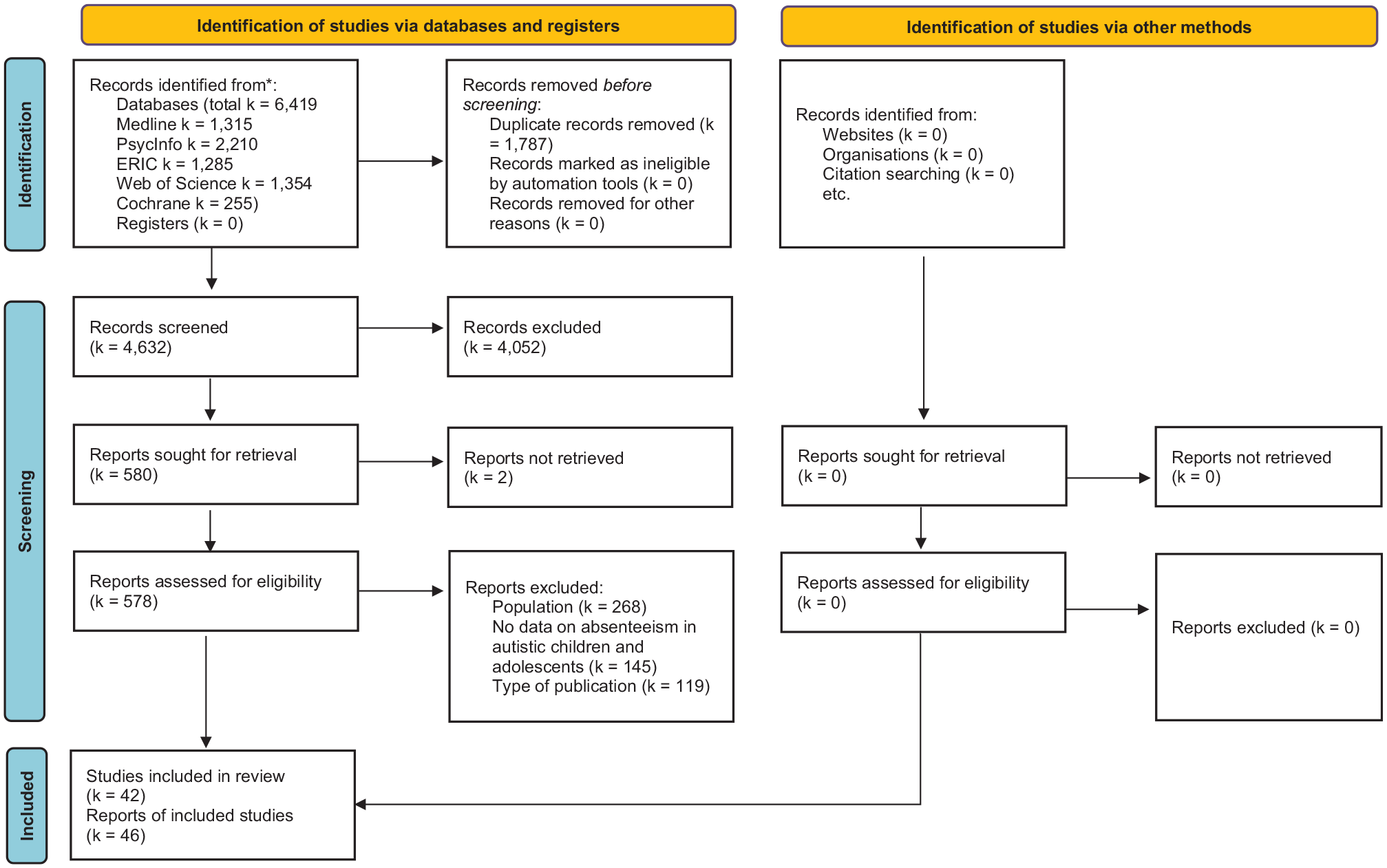
PRISMA 2020 flow diagram.
Study characteristics
The included studies were conducted in the United States (k = 14), the United Kingdom (k = 13), Japan (k = 7), Australia (k = 3), Sweden (k = 3), the Netherlands (k = 1), and Norway (k = 1). While the oldest publication was from 1991 (Kurita, 1991), most reports (k = 38) were published during the last 10 years. Eighteen of the studies were supported by external funding from foundations or research councils, while the remaining either did not receive external funding (k = 12) or did not include a statement about funding (k = 12). Participants were predominantly male, although the sex ratio was not always reported. The age span ranged from 2 to 21 years, with most of the studies focusing on ages 8–17. Information on school absenteeism was mainly based on parent reports or school attendance data. Only a few studies included information provided by the children themselves (Tables 1 to 3).
Characteristics of studies reporting on occurrence of school absenteeism.
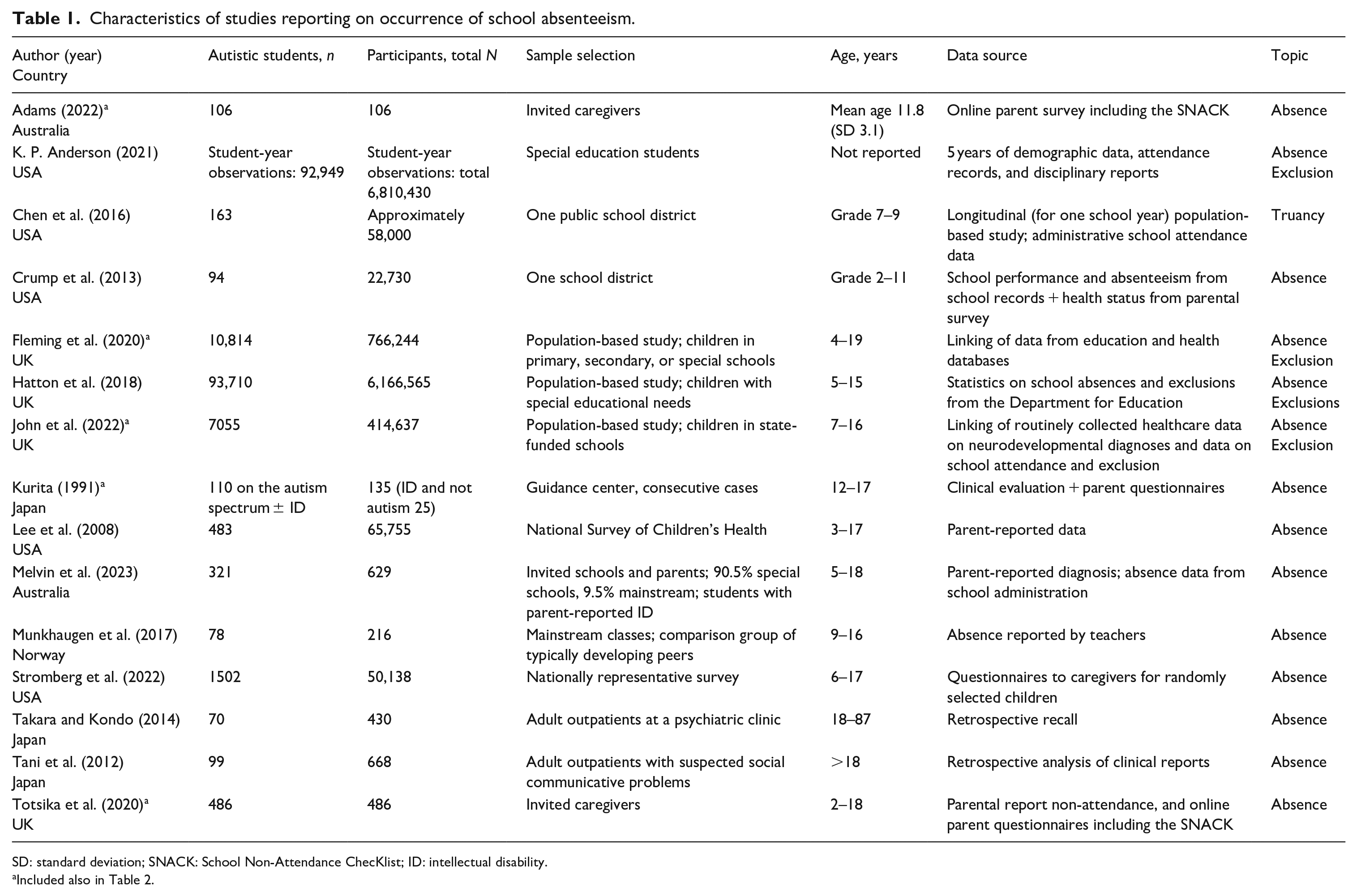
SD: standard deviation; SNACK: School Non-Attendance ChecKlist; ID: intellectual disability.
Included also in Table 2.
Characteristics of studies reporting on contextual factors related to school absenteeism.
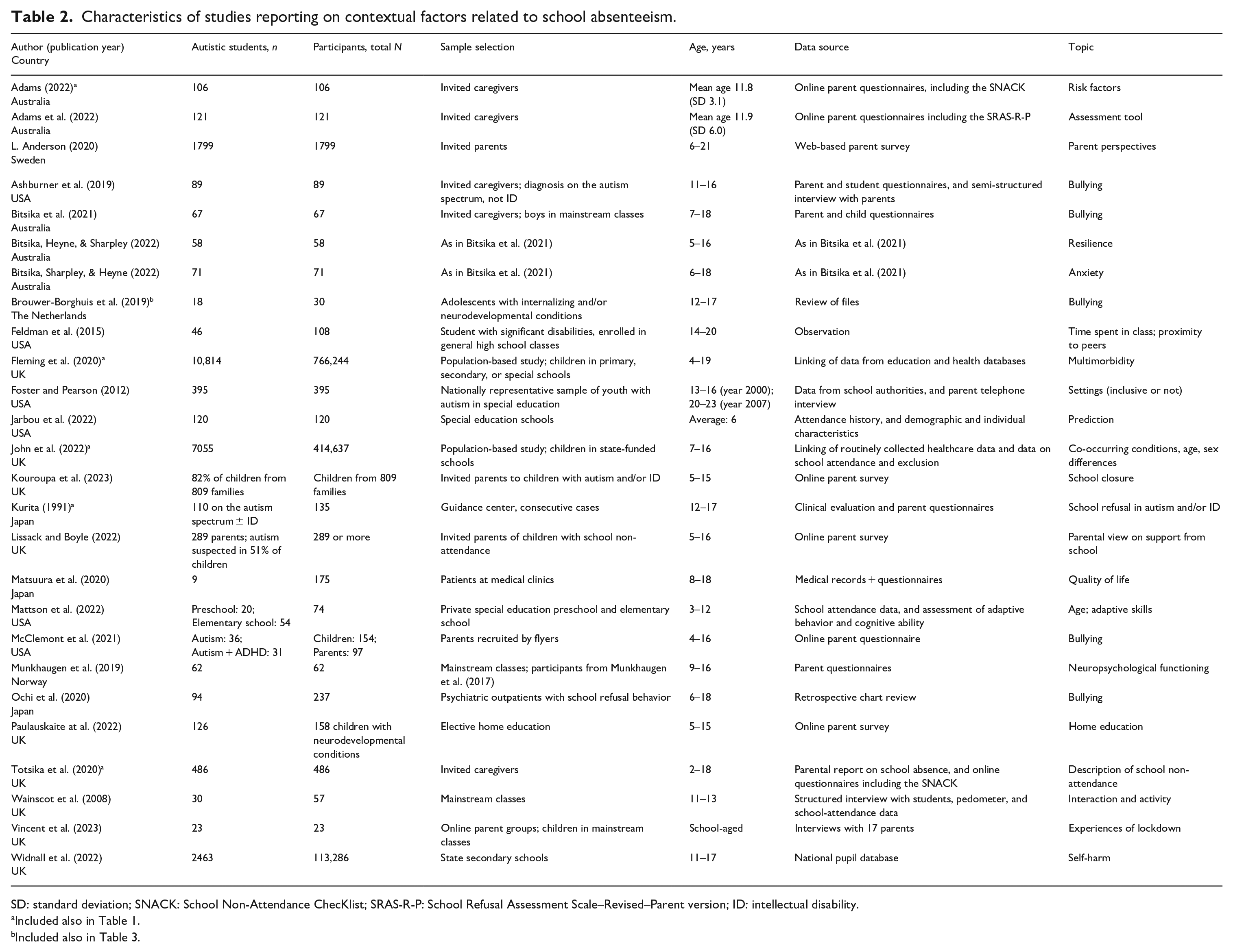
SD: standard deviation; SNACK: School Non-Attendance ChecKlist; SRAS-R-P: School Refusal Assessment Scale–Revised–Parent version; ID: intellectual disability.
Included also in Table 1.
Included also in Table 3.
Characteristics of studies focusing on interventions for school absenteeism.
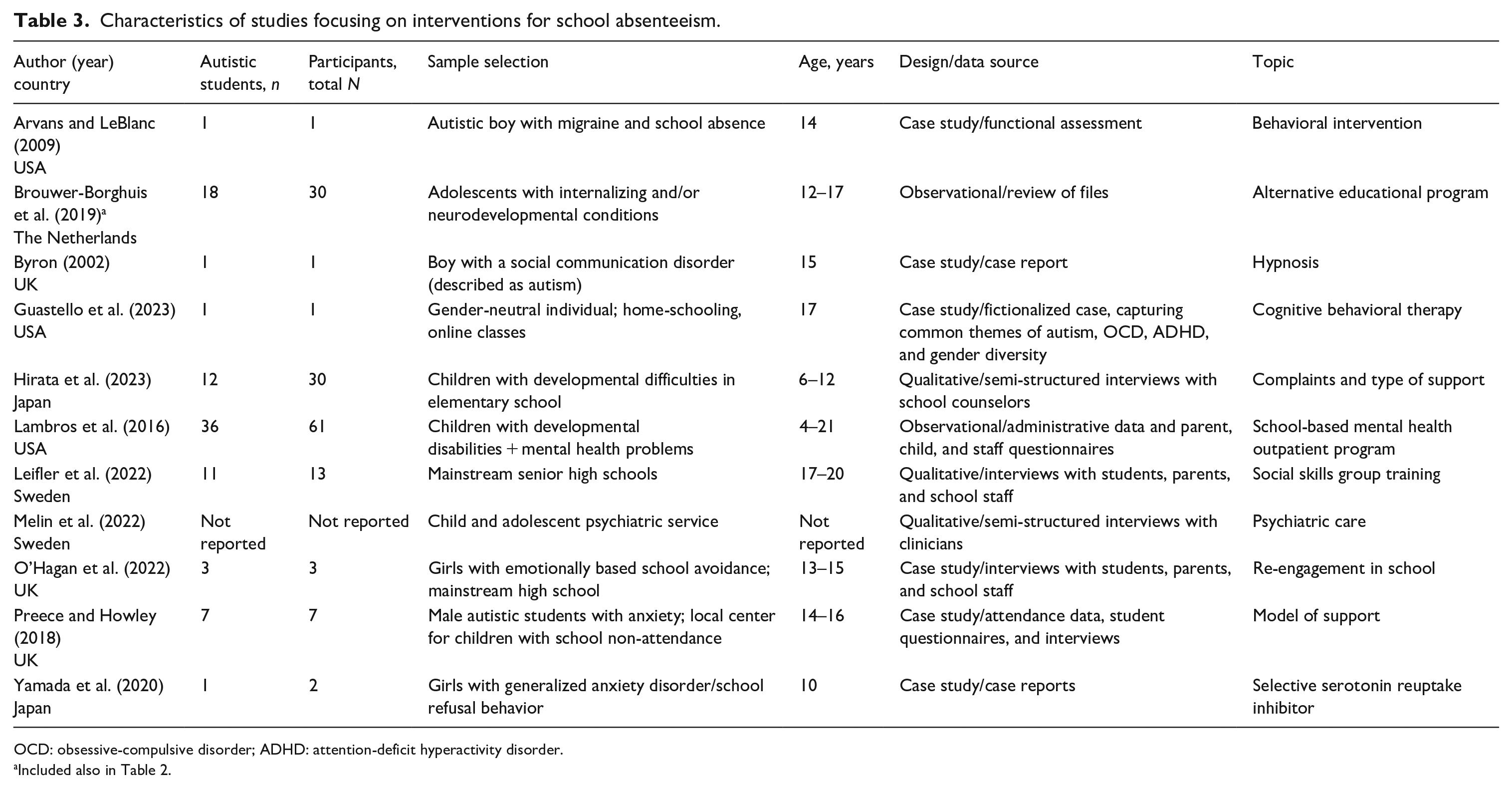
OCD: obsessive-compulsive disorder; ADHD: attention-deficit hyperactivity disorder.
Included also in Table 2.
A wide variety of terms were used to describe absenteeism, including school absenteeism, school absence, school non-attendance, and school refusal. Some studies used terms interchangeably. Studies generally used the terms in a broad sense, including both excused and unexcused absence. Three studies (Adams, 2022; Melvin et al., 2023; Totsika et al., 2020) differentiated between types of non-attendance using the School Non-Attendance ChecKlist (SNACK; Heyne et al., 2019). Most studies measured absence in school days missed during a specified period, often transformed into percentage of missed school time. Other studies gave no description of how absence was measured, or only a vague qualitative description. The terms used to denote problematic absence also varied (e.g. chronic, persistent, continuous, or frequent). The most common definition was 10% of school time, which was used in seven studies (K. P. Anderson, 2021; Hatton, 2018; Jarbou et al., 2022; John et al., 2022; Kouroupa et al., 2023; Mattson et al., 2022; Totsika et al., 2020). Other definitions included 30 days/year, 4 weeks/year, 3 days/20 days, more than 1 week, or 11 days. Several studies did not use a threshold, while some used several different categories (Supplemental Appendix C, Table S1 to S3).
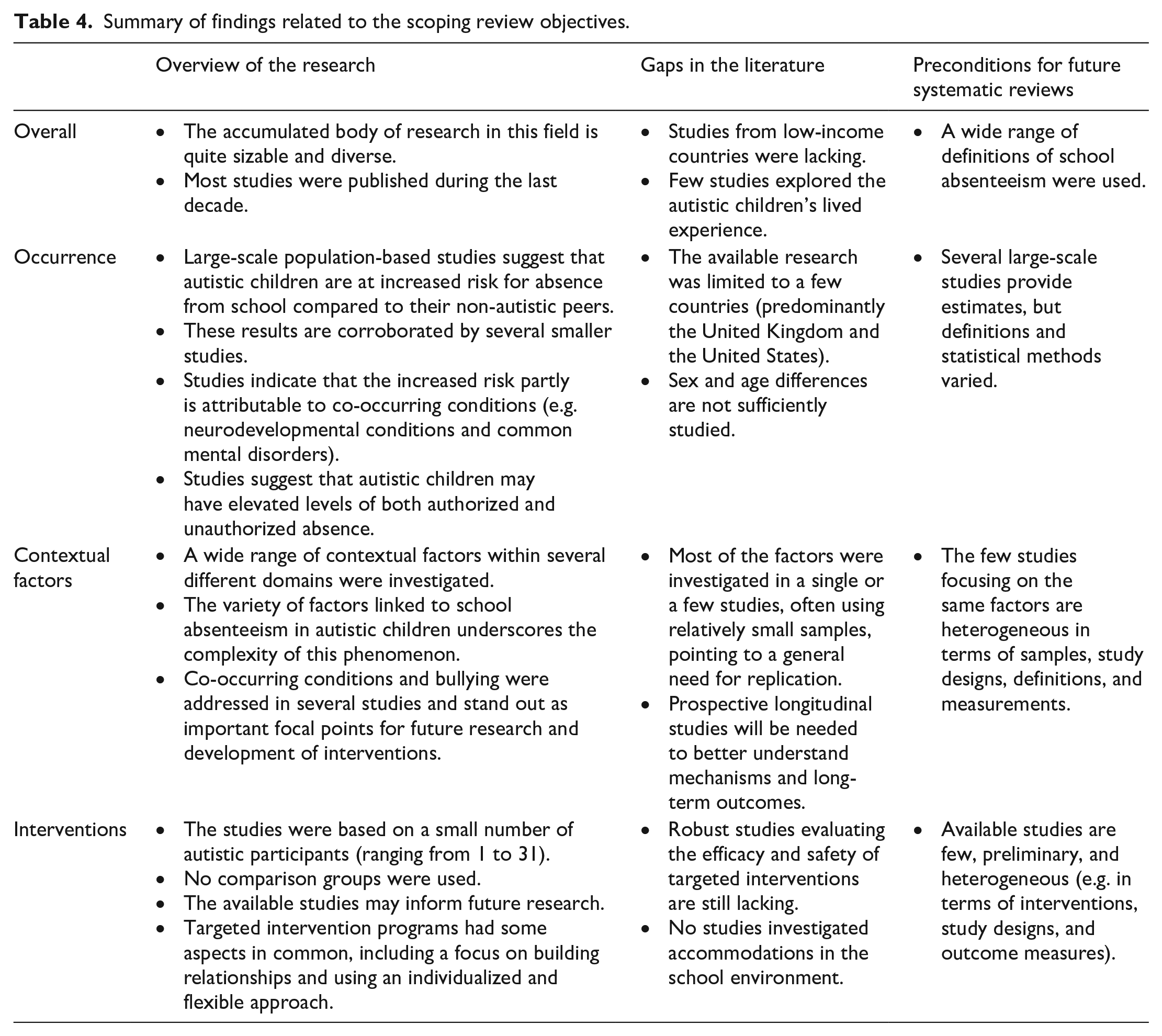
Three major themes emerged: occurrence; contextual factors; and interventions. The individual studies are briefly summarized under each theme, while key findings across studies are presented in Table 4.
Summary of findings related to the scoping review objectives.
Occurrence
Here, we include 15 studies presenting different types of estimates or related information on the occurrence of absenteeism. Eight studies used population-based samples, of which five utilized administrative data and school records and three relied on parent report. The remaining studies were based on diverse samples, including clinical samples and parents invited via advertisement (Table 1).
Summary of individual studies
Population-based studies
The association of school absenteeism and neurodevelopmental and mental disorders was analyzed in two large population-based studies from the United Kingdom (Fleming et al., 2020; John et al., 2022). A population-based cohort study from Wales linked health care data with data on school attendance and exclusion (John et al., 2022). In comparison to children with no registered disorder, children with a diagnosis on the autism spectrum were more likely to have chronic absenteeism (adjusted odds ratio (aOR) = 2.0; 1.9–2.1) and to be excluded from school (aOR = 2.6; 2.4–2.9). Sub-analyses suggested higher risk among those with co-occurring conditions (aOR = 2.5; 2.4–2.7 for chronic absenteeism; aOR = 3.5; 3.2–4.0 for exclusion).
A Scottish study similarly investigated the association of neurodevelopmental disorders with school absence or exclusion (Fleming et al., 2020). Having only an autism spectrum diagnosis was associated with elevated level of absenteeism and exclusion compared to children with no condition, with an adjusted incidence rate ratio (aIRR) of 1.10 (1.08–1.13) for absenteeism and 1.50 (1.30–1.73) for exclusion. The associations were stronger for those with co-occurring conditions, with an estimated aIRR of 2.36 (2.01–2.76) for absenteeism among those with autism and co-existing depression, and 6.04 (4.98–7.33) for exclusion among those with both autism and attention-deficit hyperactivity disorder (ADHD).
Another study from the United Kingdom analyzed reports from school authorities (Hatton, 2018). The level of authorized school absence was higher for children with special needs, including autistic children. Unauthorized absence was only slightly more common than in children without special needs.
A study from the United States analyzing school absence data for special education students (K. P. Anderson, 2021) reported that 19% of children on the autism spectrum were missing at least 10% of school days/year, compared to 14% of students in general education. Two additional studies using administrative and school data (Chen et al., 2016; Crump et al., 2013) included few autistic children in the samples, resulting in uncertain estimates.
The three population-based studies relying on parent report pointed in the same general direction. A report based on the US National Survey of Children’s Health found higher odds of chronic absenteeism in children with autism compared to children with typical development. After adjustment for co-occurring conditions, health status, and psychosocial factors, this association did not remain for the subgroup of younger autistic children with more support needs (Stromberg et al., 2022). Another study from the United States, with a primary focus on quality of life (Lee et al., 2008), reported that autistic children were more likely to miss school days due to illness or injury than children with ADHD and those without any of the conditions.
Other samples
Four studies included autistic samples and a comparison group. A Norwegian study (Munkhaugen et al., 2017) included students in mainstream classes with a diagnosis on the autism spectrum. During a 20-day period, school refusal behavior was present in 42.6% of the students with autism compared to 7.1% of randomly chosen non-autistic students. In older children, the pattern shifted to actual absenteeism and not only verbal/physical refusal. In a study of children attending a guidance center in Japan (Kurita, 1991), children on the autism spectrum (with or without concomitant intellectual disability) had higher rate of school refusal behavior compared to a group with intellectual disability without autism. In two retrospective case-control studies of adults visiting psychiatric outpatient clinics in Japan, patients with autism were more likely than other patients to have a history of school non-attendance (Takara & Kondo, 2014; Tani et al., 2012).
A study from the United Kingdom (Totsika et al., 2020) was the first to present a systematic classification of different types of non-attendance using the SNACK. Parents of children on the autism spectrum were invited to an online survey. Persistent absence (missing 10% or more of sessions) occurred among 43% of the students. The most frequent reason for non-attendance was school refusal, followed by non-problematic (authorized) absence which was more common in the group with intellectual disability. School exclusion and school withdrawal each accounted for 9% of days missed. Truancy was rare in this sample. An Australian study (Melvin et al., 2023) reported that the most common causes for non-attendance among children with intellectual disability were illness and health-related appointments. About 10% of autistic students with intellectual disability had at least one absence due to school withdrawal, and 6% due to school refusal. Truancy and exclusion were less common. The pattern was similar for non-autistic children with intellectual disability. Another Australian study (Adams, 2022) reported that children on the autism spectrum missed on average six full days of school each 4 weeks, with school refusal and medical/therapy appointments as the most frequent reasons.
Contextual factors
A total of 23 studies (26 reports) provided information about potential risk factors and other contextual factors (Table 2). The information was subcategorized into school factors, individual factors, family-related factors, and evaluation of tools for assessment of contextual factors.
Summary of individual studies
School factors
School placement was addressed in four studies. An online survey from the United Kingdom (Totsika et al., 2020) found an association between mainstream school placement and non-attendance. A study from the United States (Foster & Pearson, 2012) compared outcomes (e.g. not dropping out of high school) for autistic children having more or less of inclusive education. There were no significant differences, and the authors pointed to methodological problems, including finding comparable groups. Another study from the United States (Feldman et al., 2015) observed students with severe disabilities (autism or intellectual disability) in general education high school classes and highlighted that students with disabilities might arrive late and leave early and therefore miss time for instruction and time with peers. Finally, a study from the United Kingdom (Wainscot et al., 2008) found that autistic children in mainstream classes had significantly less physical activity, reported more time alone at breaks and less friends, and were more likely than matched controls to be bullied. However, no differences in school attendance were found.
The learning environment was discussed in five studies, all based on reports from invited parents. In a Swedish online survey (L. Anderson, 2020), parents reported on lack of autism competence among staff, insufficient adaptation of the learning environment, and lack of support. Similar problems were raised in recent studies from the United Kingdom tapping parents’ experiences during the pandemic. Many families experienced a continuation of a stressful situation (Vincent et al., 2023). For some families, however, the level of stress decreased as COVID-19 raised the awareness of the strains met by families where a child is absent from school (Lissack & Boyle, 2022). During the period with online education, children were reportedly feeling more connected to their peers. The parents stressed the importance of a partnership between home and school, to address the problem early, and to stop using the term school refusal. One study found that a reason for selecting elective home education was to avoid exclusion from school (Paulauskaite et al., 2022), while one study (Kouroupa et al., 2023) reported that school attendance problems increased during school closure in a group of children with autism and/or intellectual disability.
Several studies focused on bullying in relation to school absenteeism. An Australian study (Bitsika et al., 2021) found that being bullied was associated with emerging school refusal among autistic children. A study from the Netherlands (Brouwer-Borghuis et al., 2019) reported that at least one third of autistic adolescents in a school-based intervention for school refusal had experience of bullying, with a similar pattern among the other participants. A Japanese study (Ochi et al., 2020) reported significant association of bullying with school refusal in a retrospective chart review for autistic outpatients at a psychiatric hospital. A study in the United States of students diagnosed with autism without intellectual disability (Ashburner et al., 2019) found that those with co-occurring anxiety disorders and depression were more likely to report victimization, while parents reported that bullying had an impact on school attendance.
Individual factors
As mentioned above, some population-based studies (Fleming et al., 2020; John et al., 2022; Stromberg et al., 2022) indicated that co-occurring neurodevelopmental or mental conditions increased the risk substantially for school absenteeism in autistic children. A study from the United States (McClemont et al., 2021) noted that school refusal in children with co-occurring autism and ADHD was related to behavioral problems. A retrospective cohort study of students attending state secondary schools also found that poor attendance at school was associated with subsequent self-harm for children with and without autism (Widnall et al., 2022). The Australian study discussed above in relation to bullying found that autistic boys with emerging school refusal due to bullying experienced a significantly higher level of separation anxiety than their peers (Bitsika, Sharpley, & Heyne, 2022), and an inverse association between psychological resilience and emerging school refusal (Bitsika, Heyne, & Sharpley, 2022).
Individual characteristics of autistic children in mainstream classes were analyzed by parental questionnaires in a Norwegian report (Munkhaugen et al., 2019). In comparison to autistic children without school-attendance problems, those with school refusal behavior were significantly less socially motivated, displayed more deficits in initiating task or activities, were more withdrawn, and had more depressive symptoms. A Japanese study (Matsuura et al., 2020) found that children demonstrating school refusal behavior had significantly lower quality of life than a comparison group. However, this association could not be established for autistic children, possibly due to the low number of individuals with this diagnosis in the sample. A study from the United States, aiming to develop a machine learning algorithm to predict school absenteeism, failed to identify specific predictors. However, the authors suggest that attendance data for autistic children and signs of maladaptive behavior may be of help in early detection (Jarbou et al., 2022).
Co-existing intellectual disability was not consistently linked to school absenteeism; conversely, one study suggested that autistic children with school refusal behavior were cognitively more able than those without (Kurita, 1991). In a study of autistic children with co-occurring or suspected intellectual disability, a measure of adaptive skills was not significantly correlated with absence (Mattson et al., 2022).
Three studies reported that school absenteeism in autistic children became more common with age (Adams, 2022; John et al., 2022; Totsika et al., 2020). The population-based study by John et al. (2022) also reported that autistic girls were more likely to be absent than were boys, while the pattern was reversed for exclusion.
Family factors
Family factors were investigated as possible antecedents of school absenteeism in three studies, all mentioned above. The Australian online survey targeted to parents (Adams, 2022) found associations of parental unemployment and parental mental health with non-attendance. The online survey from the United Kingdom found that parental unemployment and not living in a two-parent household were associated with non-attendance (Totsika et al., 2020). Finally, an association between school refusal behavior and illness of family members was observed in the Norwegian study on autistic children in mainstream classes (Munkhaugen et al., 2019).
Evaluation of tools for assessment of contextual factors
An Australian study (Adams et al., 2022) evaluated an instrument originally developed for assessment of causes for school refusal in neurotypical pupils, the School Refusal Assessment Scale–Revised–Parent version (SRAS-R-P; Kearney, 2002). Feedback from parents suggested that items on autism-specific school-related factors were missing, including sensory environment, teacher–child relationships, and knowledge about autism among school staff.
Interventions
Eleven studies with focus on support or treatment were identified. In this section, we included not only studies evaluating intervention programs but also case studies and qualitative studies tapping the experiences of students, clinicians, and school staff related to support or treatment (Table 3).
Summary of individual studies
Targeted interventions
Four studies described detailed intervention programs. The Link program from the Netherlands aims to link adolescents with school refusal back into education (Brouwer-Borghuis et al., 2019). Data from 30 participants were reported, of whom 18 were diagnosed with autism. No adolescent was re-engaged with the original school, but participants were able to take part in other forms of education or training. A feasibility study of an intensive, school-based program in the United States included 61 participants with developmental disorders (59% with autism), many of whom had co-occurring medical disorders and mental health problems (Lambros et al., 2016). The authors found that the number of absences and school suspensions decreased compared to the year before. A study from the United Kingdom described a program for students with autism, anxiety, and severe non-attendance (Preece & Howley, 2018). The authors reported positive effects on attendance and well-being for the five students taking part in the program for 1 year.
The interventions had some aspects in common. The importance of building relationships was emphasized—to teachers and peers, between staff and family, and collaboration with professionals outside school. An individualized and flexible approach with adaptation of the learning situation was also stressed, including providing “a safe place” for the student. Psychoeducation and behavioral strategies were used, and an accepting and open climate at school was found to be important. Special consideration was also given to bullying.
In a Swedish study on social skills group training in mainstream upper secondary schools, students, teachers, and school leaders perceived positive effects of the intervention on school attendance and social school climate (Leifler et al., 2022). Four additional case studies were identified, focusing on cognitive-behavioral therapy in a fictionalized case with autism, obsessive-compulsive disorder (OCD), and gender diversity (Guastello et al., 2023), behavioral intervention for an autistic child with chronic migraine (Arvans & LeBlanc, 2009), hypnosis as anxiety management (Byron, 2002), and pharmacological treatment for an autistic child with generalized anxiety disorder (Yamada et al., 2020).
General support and treatment
A study from the United Kingdom included semi-structured interview with three autistic girls with emotionally based school avoidance, who were successfully re-engaged in mainstream school (O’Hagan et al., 2022). Developing a trusting student–key adult relationship was reported to be the first phase of re-engagement. In a Swedish study based on interviews (Melin et al., 2022), clinicians in child and adolescent psychiatric setting reported that many patients with severe attendance problems at school had difficulties related to autism. The importance of collaboration between the school and the parents was stressed, and a change of school was often necessary. In a qualitative study from Japan (Hirata & Ozawa, 2023), school counselors reported that school refusal was a common reason for giving support to children with developmental disorders, including autism. The authors highlighted the importance of early detection and intervention.
Discussion
This is the first scoping review on school absenteeism in autism. The major themes covered by the accumulated research were occurrence of different forms of school absenteeism, the relevance of contextual factors, and strategies to intervene. Large-scale population-based studies suggested that children on the autism spectrum have higher risk of school absenteeism compared to their non-autistic peers, with particularly high rates among those with co-occurring mental, behavioral, or neurodevelopmental conditions (Fleming et al., 2020; John et al., 2022; Stromberg et al., 2022). More severe disability and co-occurring health conditions were linked to authorized absence (Hatton, 2018; Lee et al., 2008; Totsika et al., 2020). Bullying also emerged as a possible risk factor, which may result in a downward spiral where children get fewer opportunities to practice social skills and become increasingly marginalized and anxious (Bitsika, Heyne, & Sharpley, 2022; Forrest et al., 2020; Wainscot et al., 2008). The few available studies on targeted interventions were based on few participants, and studies on early detection were scarce.
To better understand the need for further research in this field, it is important to consider school absenteeism in general and if there are aspects of this phenomenon that are specific to autism. Some of the large population-based studies included in our review examined a range of other conditions, allowing for comparison. The estimated risk among children with other neurodevelopmental conditions (e.g. ADHD and learning disabilities) were similar or somewhat higher than among autistic children, while the risk was substantially higher for children with common mental health conditions such as depression, bipolar disorder, and substance use disorders (Fleming et al., 2020; John et al., 2022). This aligns well with the adjusted estimates from the same studies, where the increased risk seen in autistic children at least partly was attributable to co-occurring conditions. Some factors causing and maintaining absenteeism may be quite generic (Leduc et al., 2022), while other factors may be related more directly to autism (e.g. high risk of bullying, insufficient accommodations, and a lack of knowledge about autism). Consequently, it is unclear if effect estimates for more generic interventions can be generalized to autistic children. Indeed, the quite modest and inconsistent intervention effects reported in recent meta-analyses (Eklund et al., 2022; Maynard et al., 2018) hint at the possibility that further adaptations may be necessary to the individual needs and preferences of individual students.
Research on school absenteeism in autistic children evidently has picked up speed in the last few years, but there are still some striking gaps. No studies from low- and middle-income countries were identified, despite widely reported difficulties for children with disabilities in primary and secondary school in these regions (World Bank Group, 2019). There is also a need for more research into the mechanisms leading to and maintaining school absenteeism in autistic children. The quite sizable number of studies on contextual factors point to the multifactorial nature of the phenomenon. Still, most factors were investigated in only one or a few studies. Importantly, few studies on sex differences were identified and study participants were predominantly male. Longitudinal studies were also lacking, precluding conclusions about temporality.
There is also a clear need for more robust studies on intervention effects. The overall complexity of school absenteeism in autistic children suggests that interventions may be needed at multiple levels, including school, individual, and family. A close collaboration with mental health services and social services seems crucial. The few available programs that were developed and preliminary evaluated will be a good starting point for future research, along with a recent practitioner review summarizing available treatment protocols (Heyne, 2022). In addition, the need for support and necessary accommodations in school should be further explored (L. Anderson, 2020).
Similarly, reliable tools for detection of early signs of school attendance problems are needed, as well as guidelines for determining when to intervene. Autism-specific information related to this is scant and proper adaptation of more generic tools seems crucial (Adams et al., 2022). For instance, a recently proposed framework based on functional impairment in important life domains (Kearney, 2022) could potentially be adapted to this specific population.
While the overall body of research focusing on school absenteeism and autism evidently is quite substantial, systematic reviews with a narrow focus on central review questions may still be premature. The varied and inconsistent use of terminology and definitions related to occurrence is a major challenge. On the positive side, though, ongoing initiatives to promote consensus on constructs and measurement methods in research (Heyne et al., 2020) have the potential to help facilitate future collection of data that will be comparable across different cultures and settings. A more detailed mapping of the contextual factors investigated, and the magnitude of the associations reported, could be a starting point for further disentanglement of mechanisms. However, further syntheses of the evidence may currently prove fruitless due to few studies focusing on each factor and heterogeneity across studies in terms of design, study population, and definitions. As for intervention effects, further synthesis will not be feasible due to the heterogeneous interventions, designs, and outcomes used in the few available studies.
Limitations
The overarching goal of this scoping review was to provide an overview of the field to guide future research, not to support decision-making and implementation in practice. No review questions related to the results were pre-registered, and there was no critical appraisal of the included sources of evidence. Furthermore, we did not review gray literature (e.g. reports from government agencies or interest organizations). There is also a risk that we failed to identify some reports with relevant information, even though we obtained almost 600 reports in full text. This risk may be heightened by the inconsistent use of terminology in this field. Furthermore, studies focusing on diverse conditions and disabilities were excluded, unless data were reported separately for the autistic participants. This may have resulted in the exclusion of some relevant information.
Conclusion
School absenteeism is a major challenge for autistic children and their families, often arising in a context of other developmental, health-related, and psychosocial problems. Further research is needed, especially on causal and maintaining factors, early detection, targeted intervention, and the situation in low- and middle-income countries. Pending further evidence, schools should make necessary accommodations to promote school attendance among children on the autism spectrum.
Supplemental Material
sj-docx-1-aut-10.1177_13623613231217409 – Supplemental material for School absenteeism in autistic children and adolescents: A scoping review
Supplemental material, sj-docx-1-aut-10.1177_13623613231217409 for School absenteeism in autistic children and adolescents: A scoping review by Viviann Nordin, Maud Palmgren, Anna Lindbladh, Sven Bölte and Ulf Jonsson in Autism
Supplemental Material
sj-docx-2-aut-10.1177_13623613231217409 – Supplemental material for School absenteeism in autistic children and adolescents: A scoping review
Supplemental material, sj-docx-2-aut-10.1177_13623613231217409 for School absenteeism in autistic children and adolescents: A scoping review by Viviann Nordin, Maud Palmgren, Anna Lindbladh, Sven Bölte and Ulf Jonsson in Autism
Supplemental Material
sj-docx-3-aut-10.1177_13623613231217409 – Supplemental material for School absenteeism in autistic children and adolescents: A scoping review
Supplemental material, sj-docx-3-aut-10.1177_13623613231217409 for School absenteeism in autistic children and adolescents: A scoping review by Viviann Nordin, Maud Palmgren, Anna Lindbladh, Sven Bölte and Ulf Jonsson in Autism
Supplemental Material
sj-docx-4-aut-10.1177_13623613231217409 – Supplemental material for School absenteeism in autistic children and adolescents: A scoping review
Supplemental material, sj-docx-4-aut-10.1177_13623613231217409 for School absenteeism in autistic children and adolescents: A scoping review by Viviann Nordin, Maud Palmgren, Anna Lindbladh, Sven Bölte and Ulf Jonsson in Autism
Footnotes
Acknowledgements
The authors thank Carl Gornitzki, Magdalena Svanberg, and Sabina Gillsund for assistance with the literature search. We also thank Nikolas Aho, Anna Borg, Miriam Montemartillo, Philip Ivers Ohlsson, Julia Stenbrink, and Ida Wiklander for assistance with the study selection and data extraction.
Data availability statement
The underlying research materials related to this study are available from the corresponding author upon request.
Declaration of conflicting interests
The author(s) declared the following potential conflicts of interest with respect to the research, authorship, and/or publication of this article: S.B. discloses that he has in the last 3 years acted as an author, consultant, or lecturer for Medice and Roche. He receives royalties for textbooks and diagnostic tools from Hogrefe and Liber. S.B. is partner in NeuroSupportSolutions International AB. The remaining authors declare no potential conflicts of interest with respect to the research, authorship and/or publication of this article.
Funding
The author(s) disclosed receipt of the following financial support for the research, authorship, and/or publication of this article: This work was supported by Region Stockholm.

Supplemental material
Supplemental material for this article is available online.
References
Supplementary Material
Please find the following supplemental material available below.
For Open Access articles published under a Creative Commons License, all supplemental material carries the same license as the article it is associated with.
For non-Open Access articles published, all supplemental material carries a non-exclusive license, and permission requests for re-use of supplemental material or any part of supplemental material shall be sent directly to the copyright owner as specified in the copyright notice associated with the article.
