




Abstract
Caregivers are increasingly recognised as significant in providing naturalistic interventions for children with autism spectrum disorder in high-income countries and low- and middle-income countries including Sri Lanka. It is imperative to assess the impact of programmes targeting desired parenting skills within cultural boundaries. A preliminary study evaluated the effectiveness of a play-based parent coaching programme by assessing caregiver interaction skills. A mixed-method approach included a prospective pre–post interventional study. A caregiver skills assessment checklist was designed by adapting a freely available tool to assess caregiver–child interactions following a 3-h parent coaching programme. Pre-/post-training 10-min video recordings were obtained for each child–caregiver dyad 2 weeks apart. Thirty mothers (25–55 years) participated. Mean scores improved significantly in all caregivers (p < 0.005) for special emotional (8.80–22.83), cognitive (4.63–14.13) and language (5.53–12.97) domains. Higher education level and older age of caregivers positively associated with the skill acquisition. Qualitative data revealed caregiver satisfaction of detailed workshops. Promising short-term outcomes demonstrated the potential role of parents as partners in autism spectrum disorder management in low- and middle-income countries. Longer-term outcomes on larger groups of children and caregivers need exploration.
Lay abstract
Most children with autism spectrum disorder live in low- and middle-income countries. Most of them do not have access to timely and culturally acceptable interventions. Research from high-income countries and low- and middle-income countries, such as Sri Lanka, show that parent-mediated intervention programmes improve functional outcomes, highlighting the importance of parents as partners. We undertook a preliminary study to evaluate how play-based parent coaching will enhance the parent interaction skills to promote social-emotional, cognitive and language skills in children with autism spectrum disorder aged 2–4 years. We evaluated how parents acquire interaction skills to engage with children using a caregiver skills assessment checklist adapted from freely accessible resources. Before and after training, all parent–child dyads participated in a 10-min video-recorded play session with a set of toys of their choice. Over the course of 2 weeks, all parents spent 2 h/day playing and interacting with the child to harness the desired skills. The results showed that the parental training had a positive effect on all 30 caregivers in gaining skills, with a significant improvement in all three domains with the highest impact on skills for social-emotional development. Overall, parents reported high levels of satisfaction on the training. The significant improvement in parent interaction skills was promising. However, further studies to look at the sustainability of the skills and the impact on children’s overall development need to be looked into using larger and more generalised studies.
Keywords
Autism spectrum disorder (ASD) is characterised by impairments in social communication and interactions and repetitive and/or restricted behaviours (American Psychiatric Association, 2013). Evidence from high-income countries (HICs) demonstrates better social communication and functional outcomes with early detection and intensive home-based intervention programmes (Green et al., 2017). A significant proportion of children with ASD are estimated to live in low- and middle-income countries (LMICs) with a reported prevalence of 1 in 97 in South Asia (Hossain et al., 2020). It is presumed that the majority lack access to timely, culturally tested and adapted interventions (Rahman et al., 2016). Lack of specialists in the identification and delivery of care is a major challenge for their functional progression resulting in major economic and social impacts on families and societies at large (Rahman et al., 2016; Solomon et al., 2007).
Over the last two decades, the role of parents in providing interventions for children in contrast to the specialists to overcome challenges in accessing services was explored (Vismara et al., 2018). Evidence from HICs as well as LMICs including Sri Lanka demonstrates promising results on social communication and behaviours through parent-mediated interventions (Green et al., 2017; Kasari et al., 2015; Perera et al., 2016; Rahman et al., 2016). Parents are likely to adopt this role well because they spend the longest time with children (Sharabi & Marom-Golan, 2018). Therefore, in limited resource settings, partnering with parents is a reasonable option.
Supporting and enhancing caregiver skills to enrich social communication are a key strategy in managing children with ASD, specially because intrusive parenting styles are often reported in these families (Conway et al., 2018). Therefore, parent coaching is often recognised to achieve the desired behaviours in the caregivers from HICs (Prata et al., 2018). While social communication and behaviour characteristics are universal among children with ASD, the approaches to intervention need to acknowledge cultural influences on parenting (Divan et al., 2021). Hence, it is imperative to pilot such parent coaching programmes within the cultural boundaries to evaluate the impact on desired parenting skills that are likely to generate preferred behaviours in children.
Parent-mediated intervention programmes are known to positively impact parent stress levels, child outcomes and parent–child dyadic interactions (Prata et al., 2018). Randomised clinical trials conducted in HICs from early infancy to school years have proven social communication interventions to be the most useful (Kasari et al., 2015). Evidence from LMICs also demonstrated that immediate parent–child social interactions improved through parent coaching (Rahman et al., 2016). The World Health Organization (WHO) mental health agenda identified autism as a priority area and caregiver skills training as a key need in LMICs, leading to positive outcomes in the South Asian regions (Salomone et al., 2019).
Video-based monitoring and feedback is identified as a reliable and a useful source with proven benefits even from the South Asian region (Rahman et al., 2016). Yet, there is minimal evidence from LMICs including Sri Lanka on caregivers respond to coaching. Therefore, it is essential to understand how parents acquire and master these skills by structured evaluation as a preliminary step towards establishing such interventions. This brief report aims to describe a preliminary study evaluating the effectiveness of a play-based parent coaching programme in Sri Lanka to enhance caregiver skills.
Method
A mixed-method study included a quantitative prospective pre–post interventional study conducted at a University multidisciplinary clinic over 6 weeks in the Gampaha District of Sri Lanka. Study protocol is shown in Figure 1.
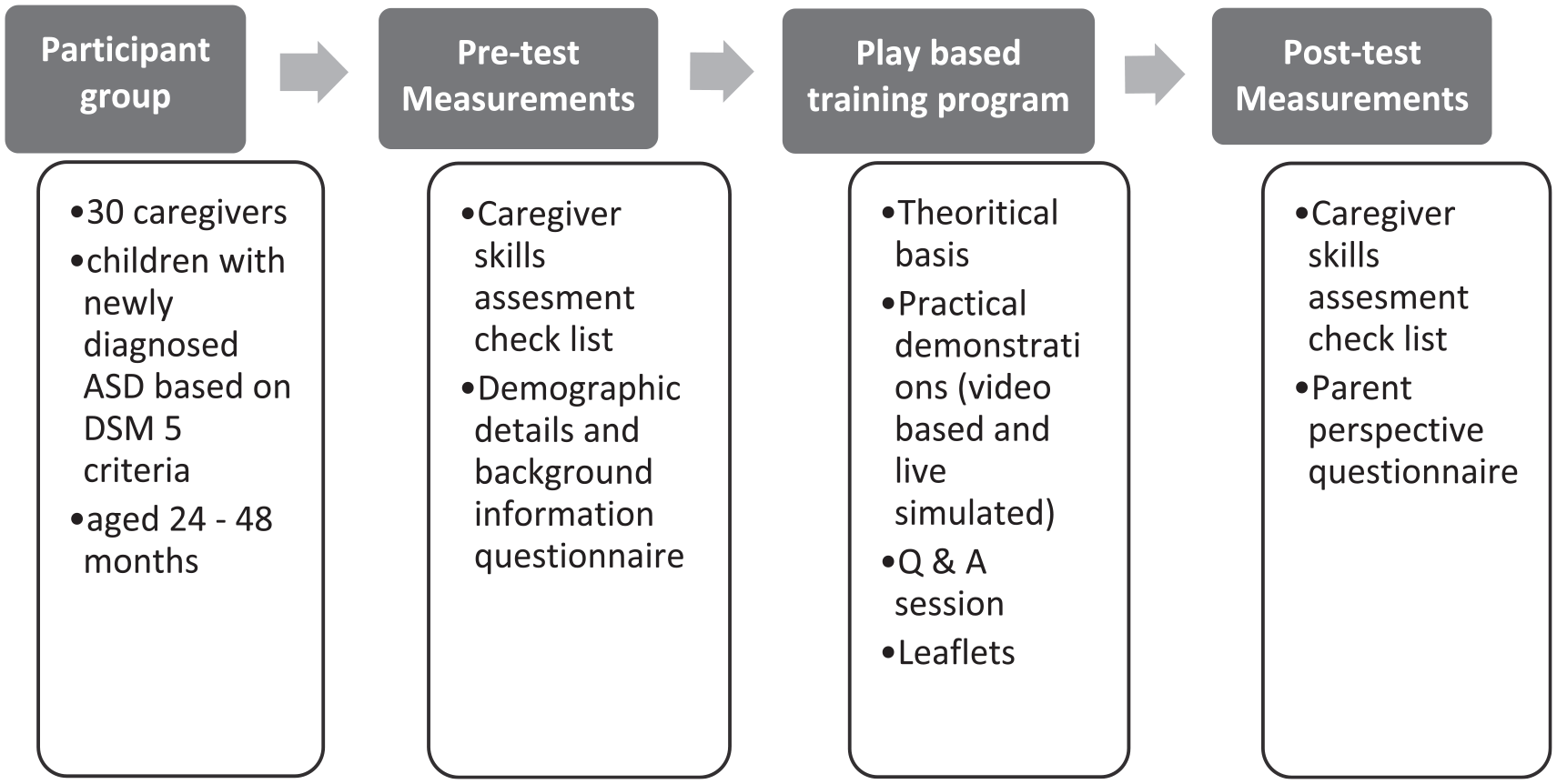
Study protocol.
Participants
Thirty caregivers of children with newly diagnosed ASD based on the Diagnostic and Statistical Manual of Mental Disorders (5th ed.; DSM-5 criteria; Maenner et al., 2014) aged 24–48 months were recruited with informed consent. At least one parent willing to spend time actively for a minimum of 2 h/day with the child was included. The qualitative component generated parental perceptions about this intervention.
Data collection
Socio-demographic and clinical data
A pre-tested interviewer administered questionnaire collected information on socio-demographic and clinical data.
Video assessment of caregiver skills
Each child–caregiver dyad underwent two 10-min pre- and post-caregiver coaching videos while at their preferred play/activity 2 weeks apart. Pre- and post-videos were scored.
Video scoring tool
The researchers designed a caregiver skills’ assessment checklist adapted from the quality of caregiver–child interactions for infants and toddlers tool, Q-CCIIT as shown in Supplementary Table 1 (Atkins-Burnett et al., 2015). The original tool was developed to measure the quality of child care settings – specifically, the quality of caregiver–child interaction for infants and toddlers in non-parental care and it contains multiple dimensions within four main domains. The Q-CCIIT observation tool measures caregiver support for social-emotional development, cognitive development, language and literacy development and areas of concern for caregiving. This tool was chosen as a guiding principle because it was freely accessible and was developed with high validity and reliability, although it was not originally designed for parents but for other caregivers. However, items contained within these tools are considered as essential for caregiver skills relevant for children with ASD in other parent skills assessment tools, but are not freely available (Roggman et al., 2013). Only three domains directly influencing children’s development, evaluating positive parenting strategies, were selected for the tool. The fourth domain on areas of concern in caregiving was not included because it looks mainly at negative caregiving practices. It is recommended that such information on caregiver behaviours should be obtained by prolonged observations within the natural environments. This study only included video-based assessments of child–caregiver interactions during specified activities; hence, the fourth domain was not included within the items. Several dimensions within each domain and relevant items were chosen by a panel of experts consisting of a clinical psychologist, speech and language therapist (SLT) and a developmental paediatrician as well as one of the parents. Inter-rater reliability of ⩾95% was obtained during the pilot phase. A binary scoring system scored the presence (1) or absence (0) of the desired behaviours in parents in the video recording during play.
Qualitative data
Each caregiver underwent a key informant interview using a post-course topic guide to generate perceptions about the coaching programme.
Intervention
Recruited families were invited to participate at a 3-h coaching session. The best current evidence on effective interventions for parent–child interactions for at risk toddlers and pre-schoolers for ASD underpinned the intervention design as in Supplementary Table 2 (Green et al., 2017). Principles on caregiver-mediated naturalistic play-based training using video-aided techniques to enhance parent–child interactions were also introduced (Rahman et al., 2016). The principal investigator (PI) with a team of qualified SLTs used video and live sessions to demonstrate each key domain in the caregiver skills checklist elaborating each item within the dimensions. Each caregiver was given the opportunity to practice play and video recording skills with a therapist simulating the child. Post-training, each caregiver was given a printed document with all necessary instructions. Following the parent coaching session, each caregiver was given the opportunity to reflect on their pre-training videos and discuss strategies to enhance the interaction skills individually.
Data analysis
Quantitative data
The progression of scores was compared between pre- and post-training. The factors influencing the scores were analysed against the socio-demographic and child characteristics. Statistical analyses were performed using SPSS (Statistical Package for Social Sciences) version 23. Non-parametric tests analysed quantitative data (Wilcoxon signed-rank test, Spearman’s rank correlation coefficient and Mann–Whitney U-test).
Qualitative data
Qualitative data were analysed using thematic analysis based on three objectives: perceptions about the training impact on the interactions and the advantages and disadvantages of the coaching.
Community involvement statement
This study primarily involved parents of children with ASD. They were active partners during the coaching workshops and the initial designing of the caregiver skills assessment checklist. At the end of the study, the results were presented to the families and further directions for future steps were discussed.
Results
A total of 30 caregivers who were also mothers of children with a confirmed diagnosis of ASD participated. All attended pre- and post-coaching assessments and workshops. The ages of the caregivers ranged from 25 to 55 years and of the children from 24 to 48 months. Table 1 details the socio-demographic and other details of participant families. 60% of the caregivers have never seen children with ASD before. 36% (n = 11) caregivers learnt about ASD management through social media and television.
Socio-demographic characteristics of study participants and their children.
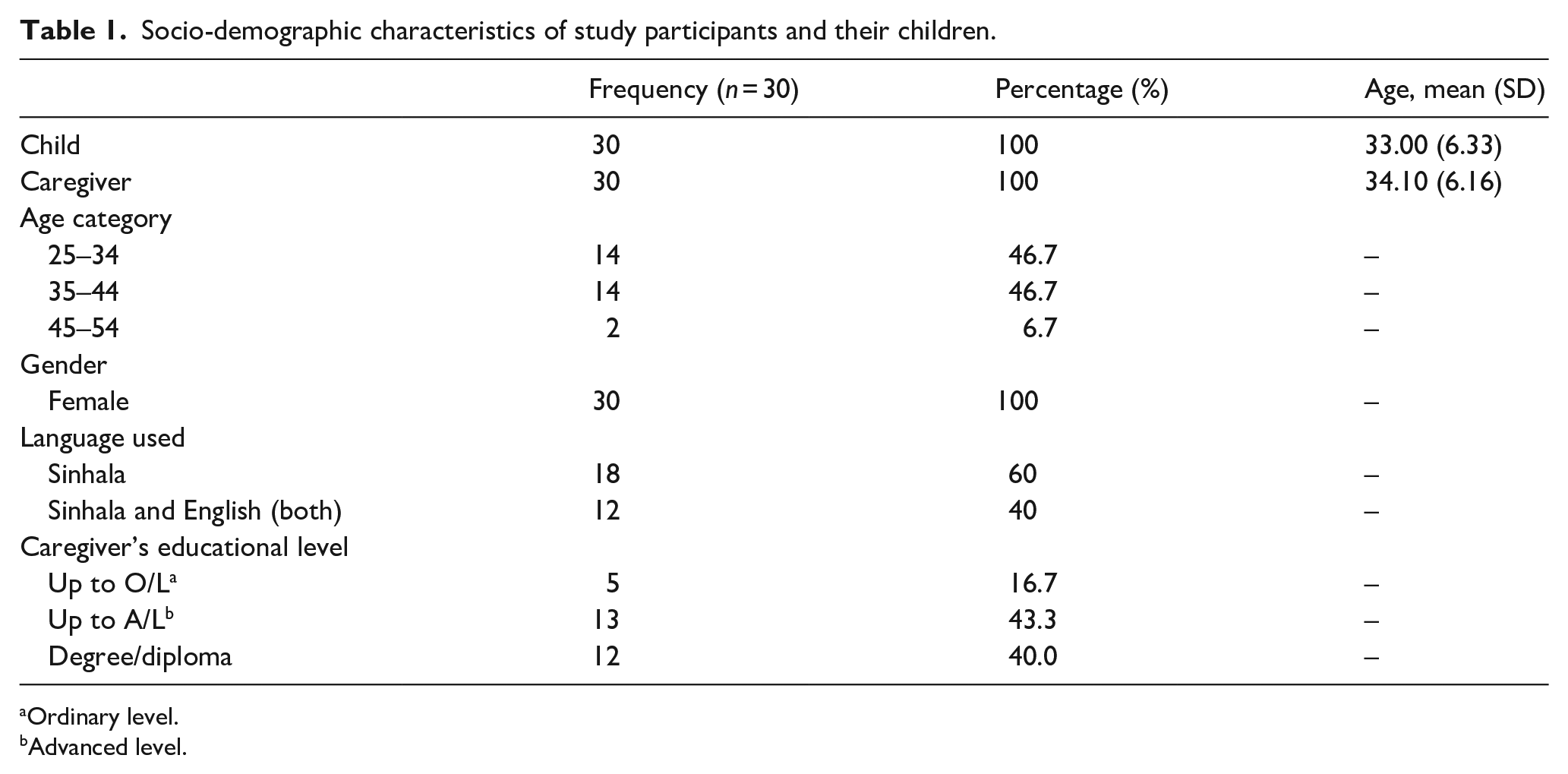
Ordinary level.
Advanced level.
Quantitative results
Caregiver acquisition of interaction skills to engage with children
Table 2 denotes the pre- and post-caregiver acquisition of interaction skills to engage with children with ASD during play to promote social-emotional, cognitive and language development in children. All three domains showed significant (p < 0.001) improvement in all dimensions and total scores. Mean scores for caregiver skills before coaching confirmed that less than 50% of dimensions were observed within each domain. The caregivers demonstrated the most progression in social-emotional domain and least in language domain. The majority performed poorly in teaching concepts within the cognitive domain (mean = 0.60 (SD = 0.77)) at the pre-intervention assessment. However, following training, the caregivers showed an increment of scores in all domains and dimensions assessed.
The pre- and post-interventions for interactive skills promoting social-emotional, cognitive and language development.
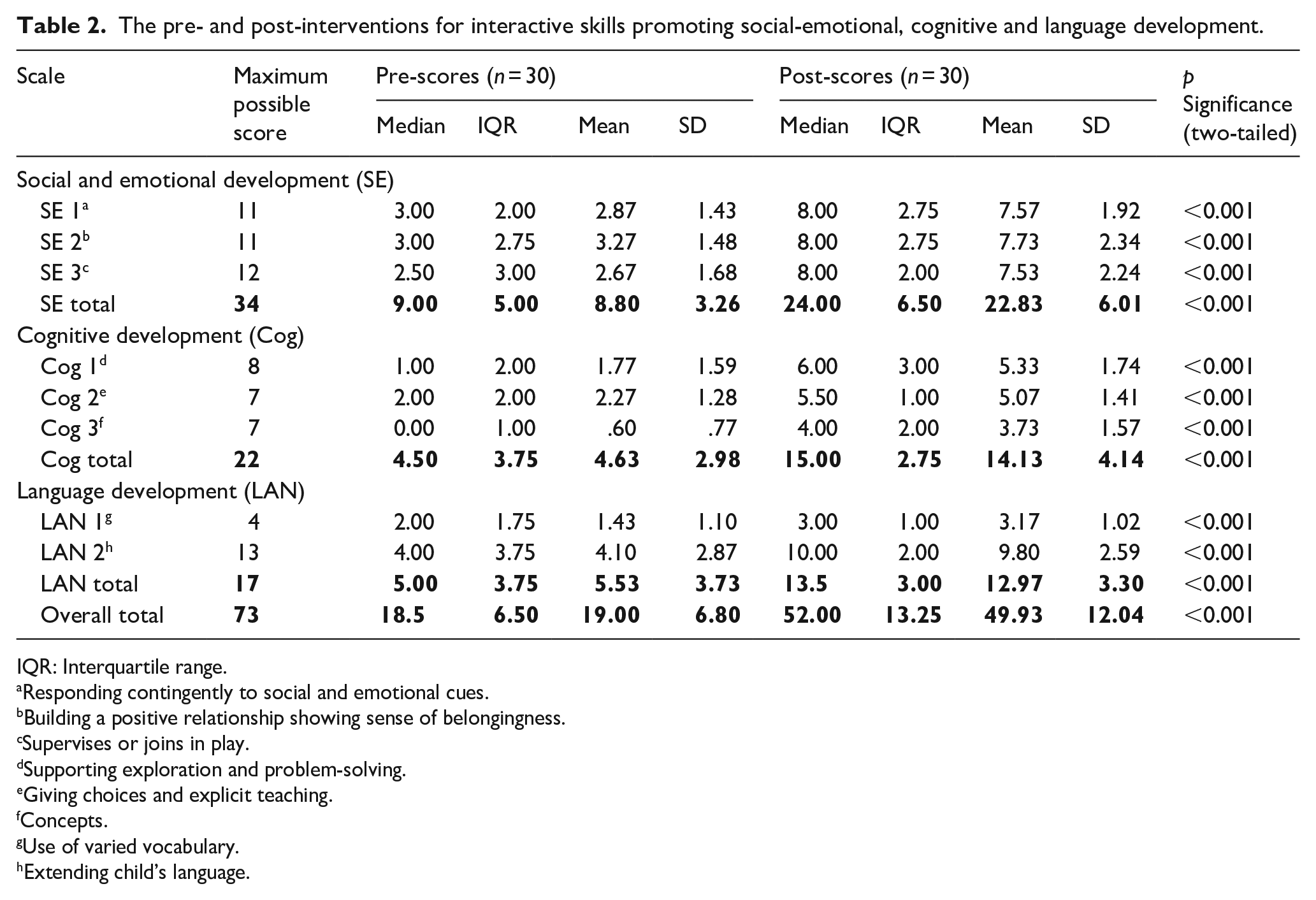
IQR: Interquartile range.
Responding contingently to social and emotional cues.
Building a positive relationship showing sense of belongingness.
Supervises or joins in play.
Supporting exploration and problem-solving.
Giving choices and explicit teaching.
Concepts.
Use of varied vocabulary.
Extending child’s language.
Associated socio-demographic factors
Advanced age and better educational level in mothers showed a significant (p < 0.05) association with the acquisition of interactive skills among caregivers.
Qualitative results
Supplementary Table 3 summarises the results generated through qualitative inquiry. Overall the caregivers held a positive opinion about the training and believed that their interaction skills enhanced. They reported that they spent quality time with children and that the coaching helped them to build positive perceptions about their children.
Discussion
This study examined how caregivers of children with ASD aged 24–48 months acquired skills through a play-based coaching programme to improve social, emotional, cognitive and language skills in their children using a locally adapted caregiver skills checklist. The parental coaching had a favourable effect on all 30 caregivers in gaining skills, with a significant improvement in all domains with the highest impact on social-emotional domain.
It is reported that rudimentary responsive parenting skills improve substantially within a short period of coaching in parents of children with ASD similar to the increment observed in this study (Green et al., 2017; Kasari et al., 2015). Kasari et al. (2015) confirmed parent education strategies for joint engagement resulted in better outcomes for toddlers with ASD than child–parent engagement strategies. This study from Sri Lanka combined both these strategies during caregiver coaching. Nevertheless, participants highlighted caregiver education as a positive experience in the qualitative enquiry.
Multiple interventional trials conducted in the HICs have demonstrated the impact of play-based caregiver interactions on joint attention which is the core deficit leading to social communication manifestations in ASD (Kasari et al., 2015). Our parent coaching programme included multiple and comprehensive strategies to address joint attention, the fundamental skill required to develop effective social communication which may have resulted in this positive observation as described previously (Kasari et al., 2015)
The language supporting skills of the caregivers, although improved, showed least increment relative to other domains. It is well recognised that parents of children with ASD have limited language and communication abilities leading to slower skill development even following coaching (Conway et al., 2018). Furthermore, the shorter duration of this study might have contributed to the slower gain in language scores.
This is one of the first studies reporting video-based assessments in ASD from Sri Lanka. The majority of research from HICs routinely use video-based pre- and post-assessments. The video-based assessments increase the fidelity of the assessment tools in child development and helps parents to reflect on their own interactions which possibly influenced better scores in all participants of the study (Rahman et al., 2016). The higher parental education levels associated with better parenting skills are similar to the previous parent coaching studies on ASD (Sharabi & Marom-Golan, 2018).
Limitations
This preliminary pilot study showed positive outcomes in caregiver skills; however, it is also associated with several intrinsic limitations. The sample size included only 30 participants, and only short-term outcomes were measured. Furthermore, the caregivers represented a relatively better educational background in comparison to the general population. Hence, the findings of this study cannot be generalised to the population. Therefore, it is recommended to recruit larger community-based sample representing a wider educational background and to look at longer-term outcomes for or future studies. The study included caregiver skills and interactions observed in clinic and home settings during free play which enabled observation of spontaneous caregiver skills rather than structured behaviours. Multiple home-based settings and routines such as feeding, washing, etc. may have captured more natural and accurate range of behaviours among caregivers and is therefore recommended for future studies. Furthermore, it is essential to recognise the mental health impacts on the caregivers of similar interventions and the longer-term outcomes on children in any further similar studies.
Conclusion
Caregiver coaching on play-based interventions for children with ASD demonstrated a significant short-term improvement in caregiver skills targeting three domains in child development over 2 weeks. The most significant and rapid transformation was in skills targeting social-emotional development in children. This preliminary study confirms the value of parents as partners in LMICs to support children with ASD with guidance from specialists. Furthermore, this study reiterates the value of video technology and objective assessment of caregiver skills to support and guide caregivers. Therefore, it is recommended that skilled professionals should partner with families to provide home-based interventions by conducting regular caregiver coaching sessions aiming specific skills in parents. However, longer-term larger studies should be conducted to assess the sustainability of such acquired skills and the impact on child and adult outcome measures.
Supplemental Material
sj-docx-1-aut-10.1177_13623613231211370 – Supplemental material for A short report on a preliminary interventional study to evaluate play-mediated interaction skills in caregivers of children with autism spectrum disorder from Sri Lanka
Supplemental material, sj-docx-1-aut-10.1177_13623613231211370 for A short report on a preliminary interventional study to evaluate play-mediated interaction skills in caregivers of children with autism spectrum disorder from Sri Lanka by Pamoda Madhubhashini Wanniachchi and Samanmali P Sumanasena in Autism
Supplemental Material
sj-docx-2-aut-10.1177_13623613231211370 – Supplemental material for A short report on a preliminary interventional study to evaluate play-mediated interaction skills in caregivers of children with autism spectrum disorder from Sri Lanka
Supplemental material, sj-docx-2-aut-10.1177_13623613231211370 for A short report on a preliminary interventional study to evaluate play-mediated interaction skills in caregivers of children with autism spectrum disorder from Sri Lanka by Pamoda Madhubhashini Wanniachchi and Samanmali P Sumanasena in Autism
Supplemental Material
sj-docx-3-aut-10.1177_13623613231211370 – Supplemental material for A short report on a preliminary interventional study to evaluate play-mediated interaction skills in caregivers of children with autism spectrum disorder from Sri Lanka
Supplemental material, sj-docx-3-aut-10.1177_13623613231211370 for A short report on a preliminary interventional study to evaluate play-mediated interaction skills in caregivers of children with autism spectrum disorder from Sri Lanka by Pamoda Madhubhashini Wanniachchi and Samanmali P Sumanasena in Autism
Footnotes
Acknowledgements
The authors acknowledge Dr Deepani Siriwardhana for supporting with data analysis and reviewing the manuscript.
Declaration of conflicting interests
The author(s) declared no potential conflicts of interest with respect to the research, authorship, and/or publication of this article.
Funding
The author(s) received no financial support for the research, authorship, and/or publication of this article.
Ethical approval
Ethical clearance was obtained from the Ethical Review Committee of the Faculty of Medicine, University of Kelaniya, Sri Lanka.

Supplemental material
Supplemental material for this article is available online.
References
Supplementary Material
Please find the following supplemental material available below.
For Open Access articles published under a Creative Commons License, all supplemental material carries the same license as the article it is associated with.
For non-Open Access articles published, all supplemental material carries a non-exclusive license, and permission requests for re-use of supplemental material or any part of supplemental material shall be sent directly to the copyright owner as specified in the copyright notice associated with the article.
