




Abstract
An autism spectrum condition is considered a lifelong condition. Affected individuals typically experience poorer psychosocial outcomes compared to non-autistic individuals. However, in Southeast Asian countries such as Malaysia, research about autism spectrum conditions beyond the early childhood context is scarce, and therefore, the prevalence and psychosocial outcomes of young adults with autism spectrum conditions remain largely unknown. This study aims to explore self-reported autistic traits among university students in Malaysia, and their relation to emotion regulation, stress, self-efficacy and quality of life. Data from 2732 students revealed that 0.3% of the students reported having an autism spectrum condition diagnosis, while 2.5% reported that they suspected having an autism spectrum condition, but did not obtain a formal diagnosis. This indicates that an estimated 2.8% of students might have a diagnosed or suspected autism spectrum condition. These two categories of students were found to have poorer self-efficacy, higher perceived stress and poorer quality of life, as compared to their peers. However, these students were not significantly different from their peers in emotion regulation. Overall, the findings pointed to negative psychosocial outcomes associated with autism spectrum condition and culture-specific associations between autistic traits and psychosocial outcomes.
Lay abstract
Most research on autism spectrum conditions is done on young children and not as much on young adults with autism spectrum conditions. Because of this, not much is known about how common autism spectrum conditions are in young adults and how they affect their mental and social health, especially in Southeast Asia. Based on self-reports, 2.8% of the 2732 university students we looked at in Malaysia might have been diagnosed or thought to have an autism spectrum condition. Students who said they had or thought they had autism spectrum conditions had lower self-efficacy, more stress and a lower quality of life than students who said they did not have autism spectrum conditions. The results showed that university students with autism spectrum condition are more likely to have bad psychological and social outcomes than their peers without autism spectrum condition. Also, the link between autistic traits and psychosocial outcomes could depend on the culture.
Prevalence and psychosocial outcomes of autism spectrum condition among university students in Malaysia
Autism spectrum condition (henceforth, ASC) is a neurodevelopmental condition associated with social communication impairments and repetitive, stereotypical behaviours (American Psychiatric Association, 2013). Based on epidemiological studies conducted over the past 50 years, the World Health Organization (2021) estimated that 1 in 160 individuals (0.6%) worldwide has an ASC. However, prevalence estimates of ASC vary across and within geographical areas, countries, years of study and sources of data (Chiarotti & Venerosi, 2020). Among the main sources to estimate the prevalence of ASC are administrative data, ad hoc studies and surveys (Chiarotti & Venerosi, 2020). More recently, data simulation techniques in a combined pool of unpublished surveillance data were used to estimate ASC prevalence among adults, showing that an estimated 2.21% of American adults aged 18 years and above have ASC (Dietz et al., 2020). This estimation is consistent with the latest prevalence estimation of 2.3% (1 in 44) in the United States (Maenner et al., 2021). However, the global prevalence of ASCs is not uniform with several countries reporting a lower frequency (see Salari et al., 2022 for a review).
Many individuals with ASC today, especially those who are already adults, may still be juggling their daily lives without a diagnosis. The reason that many adults with ASC do not have a diagnosis could be due to the fact that ASC was diagnosed infrequently until it was captured under the category of Pervasive Developmental Disorder in the Diagnostic and Statistical Manual of Mental Disorders (3rd ed., DSM-III) in 1980 (Rosen et al., 2021). Autistic people who were born before 1980 might not have been diagnosed at an early age but later in life (Brugha et al., 2011; Lai & Baron-Cohen, 2015; Robison, 2019). Lai and Baron-Cohen (2015) refer to autistic adults who were previously excluded from a diagnosis of classic autism as the ‘lost generation’. A systematic review indicated that late-diagnosed autistic adults tend to have limited intellectual issues and exhibit social interaction difficulties rather than restrictive/repetitive behaviours and interests (Huang et al., 2020). There are many possible reasons for late or lack of diagnoses, such as lack of prior knowledge of ASC (Robison, 2019), deliberately keeping ASC diagnosis out of one’s medical record (Robison, 2019), overlapping behaviour with other psychiatric diagnoses (Lai & Baron-Cohen, 2015) or the lack of ASC awareness training for healthcare professionals to accurately diagnosis ASC (Au-Yeung et al., 2019).
Globally, there is a stigma attached to ASC and therefore, ASC could be a basis for discrimination (Robison, 2019). Consequently, some autistic adults are aware of their condition but choose to fly under the radar due to perceived threats, such as denial of education and vocational opportunities associated with the diagnosis (Robison, 2019). However, amassing evidence showed that late diagnosis, suspected ASC and even abstaining from ASC disclosure are typically associated with poorer psychosocial outcomes (Bargiela et al., 2016), which are increasingly noted in the context of higher education (Cage & Howes, 2020).
University students with ASC reported facing certain challenges, which could be related to autistic traits and other related characteristics, such as perfectionist tendencies, procrastination, failure to identify strengths and weaknesses, or overreliance on parents for decision-making (Anderson, 2020). Diagnostic disclosure is a requirement to obtain disability support services in universities, but many students who might meet diagnostic criteria for an ASC do not seek out a diagnosis or limit their disclosure to support service personnel and faculty staff only (Thompson-Hodgetts et al., 2020). In some contexts, the reluctance to disclose could be due to the fear of discrimination and stigma (Thompson-Hodgetts et al., 2020); while in some limited-resource contexts, the reluctance to disclose may be due to family influence or the lack of facilities to obtain a formal diagnosis (Farsinejad et al., 2022).
ASC in higher education context
Reduced health support for adults with ASC beyond the childhood context is a global issue. Pertaining to this, the identification of ASC beyond the childhood context and the related psychosocial needs are important for identifying support needs, signposting appropriate treatments, providing access to services, reducing self-criticism and fostering a positive identity in those affected (Mandy et al., 2018). Young adults with ASC often experience a high number of job changes, reduced working hours and are overrepresented in low-paid positions (Harvery et al., 2021), with fewer than half of them maintaining a job (Solomon, 2020). Moreover, poor psychosocial outcomes including a higher rate of psychiatric disorders and unmet mental health needs are reported (Hossain et al., 2020; Lugo-Marin et al., 2019; Rosen et al., 2018). Young adults with ASC often reported feeling daunted by the added difficulties their autistic traits posed, which set them up for ongoing struggles (Sosnowy et al., 2018, 2019).
In the context of higher education, attending university may present many environmental challenges for young adults with ASC (Jansen et al., 2017), including navigating to and from university independently (Thompson et al., 2019) and studying in a lecture hall, which is comparatively much more sensory overwhelming than a school classroom with a more structured layout and schedule (Cai & Richdale, 2016). Students with ASC may experience over-sensitivity to changes, stereotypical, repetitive movements and problems with verbal and non-verbal communication, distinguishing gist from details, planning, organizing, global information processing, social interaction, handling stress, cognitive flexibility, directing and shifting attention, and applying learning strategies (Jansen et al., 2017). The severity of autistic symptoms, together with executive functioning skills, correlates with the academic progress of young adults with ASC in higher education (Dijkhuis et al., 2020) and later the transition to work (Gurbuz et al., 2019).
It is becoming more and more apparent that the struggles of individuals with ASC in higher education are real (Bakker et al., 2019; Cai & Richdale, 2016; Dijkhuis et al., 2020; Jansen et al., 2017; McLeod et al., 2019; Thompson et al., 2019). Without properly addressing these challenges, young adults with ASC might be exposed to an increased risk of negative social experiences, such as bullying and social isolation at the university, causing long-lasting deleterious effects (Maiano et al., 2016; McLeod et al., 2019). In some instances, such negative experiences are known to trigger episodes of depression and acute psychotic attacks (Park et al., 2019; Sampson et al., 2021).
Self-reported ASC traits and psychosocial outcomes
In recent years, self-report methods have increasingly been used to profile autistic traits among university students globally (Lundqvist & Lindner, 2017). For countries in Asia, such as Malaysia, researchers have used the self-report Autism-Spectrum Quotient (AQ) (Baron-Cohen et al., 2001) as a way to assess autistic traits in the general population (Chee & de Vries, 2022; de Vries et al., 2020; Freeth et al., 2013). The AQ (Baron-Cohen et al., 2001) is one of the most widely used self-assessment scales for the purpose of autistic traits screening and profiling to date (Lundqvist & Lindner, 2017). The AQ has high internal consistency and test–retest reliability, especially when the 4-point Likert-type scale scoring was applied (Stevenson & Hart, 2017) and the shorter forms are used (Lundqvist & Lindner, 2017; van Rentergem et al., 2019). The availability of self-reporting scales such as the AQ allows researchers to compare the unique characteristics of individuals who received early and late diagnoses of ASC to non-ASC counterparts (e.g. Oomen et al., 2021). Although ASC is a lifelong condition, different sets of life experiences and social expectations in adulthood could shape the manifestation of autistic behaviours. The AQ can give a profile of autistic behaviours in adulthood.
The original AQ (Baron-Cohen et al., 2001) has been abridged to the AQ-28 (Hoekstra et al., 2011). This scale consists of five factors: social skills, routine, switching, and imagination, and numbers and patterns, which resonate with difficulties experienced by autistic students. Although many young adults with ASC are highly motivated to interact with others, they may lack the social skills to create and maintain friendships (Fletcher-Watson et al., 2013; Jobe & White, 2007), leading to feelings of loneliness (Jobe & White, 2007). Many of them prefer routine and stability and they could experience a high level of emotional fluctuations when coping with changes (Lei & Russell, 2021). At the same time, autistic students in universities were found to exhibit poorer attention switching which could be related to poorer inhibitory control and attentional flexibility (Mostert-Kerckhoffs et al., 2015; Siebes et al., 2018). Individuals with ASC were also found to have a lower imagination score which was associated with obsessive-compulsive symptoms (Doi et al., 2021). In comparison with these four sub-scales, attention to detail, related to the factor numbers and patterns, has been less associated with negative psychosocial outcomes. Some studies linked attention to detail to cognitive advantages and savant skills in autistic individuals (Baron-Cohen et al., 2001; Hughes et al., 2018), and even a negative association with social-communicative difficulties among Asian autistic individuals (Ward et al., 2021). Furthermore, there is evidence that the sub-scale of factor numbers and patterns (i.e. attention to details) was not able to differentiate between non-autistic and autistic individuals (Kurita et al., 2005).
Most studies on university students with ASC are limited to Western countries, and studies involving university students with ASC in Asia are limited. It is important to investigate the types of experiences and issues faced by university students with ASC in higher education in different cultural contexts and countries, and the associations of autistic traits on psychosocial outcomes, including emotion regulation, stress, self-efficacy and quality of life (QoL). This is particularly important because autistic people with higher cognitive abilities may have higher anxiety and depression rates (Sterling et al., 2008). Therefore, the current study aims to answer the following research questions: (1) What is the self-reported ASC rate in university students? (2) What are the psychosocial outcomes of ASC students in comparison with non-ASC students? (3) Are autistic traits related to psychosocial outcomes?
Methodology
Procedure
An online survey was done to study autistic traits and psychosocial outcomes of students from two public and two private universities in Malaysia. Human ethical approval was obtained from all the participating institutions which abide by the Declaration of Helsinki research ethics guidelines (approval code of host institution: 21030283) for the survey. Between June and July 2021, online questionnaires (Qualtrics and Microsoft forms) were distributed through emails, social media and WhatsApp to undergraduate and postgraduate students. After the information sheet and consent form, participants filled in the questionnaires. On average, participation took 19 min. Participants who submitted the questionnaires were entitled for a lucky draw. Twelve cash vouchers were given away in the lucky draw.
Community involvement
The research was led by academicians and a representative from a local ASC support group. The community member in the team provided important feedback to ensure that the online questionnaire design is suitable for diverse-ability individuals.
Participants
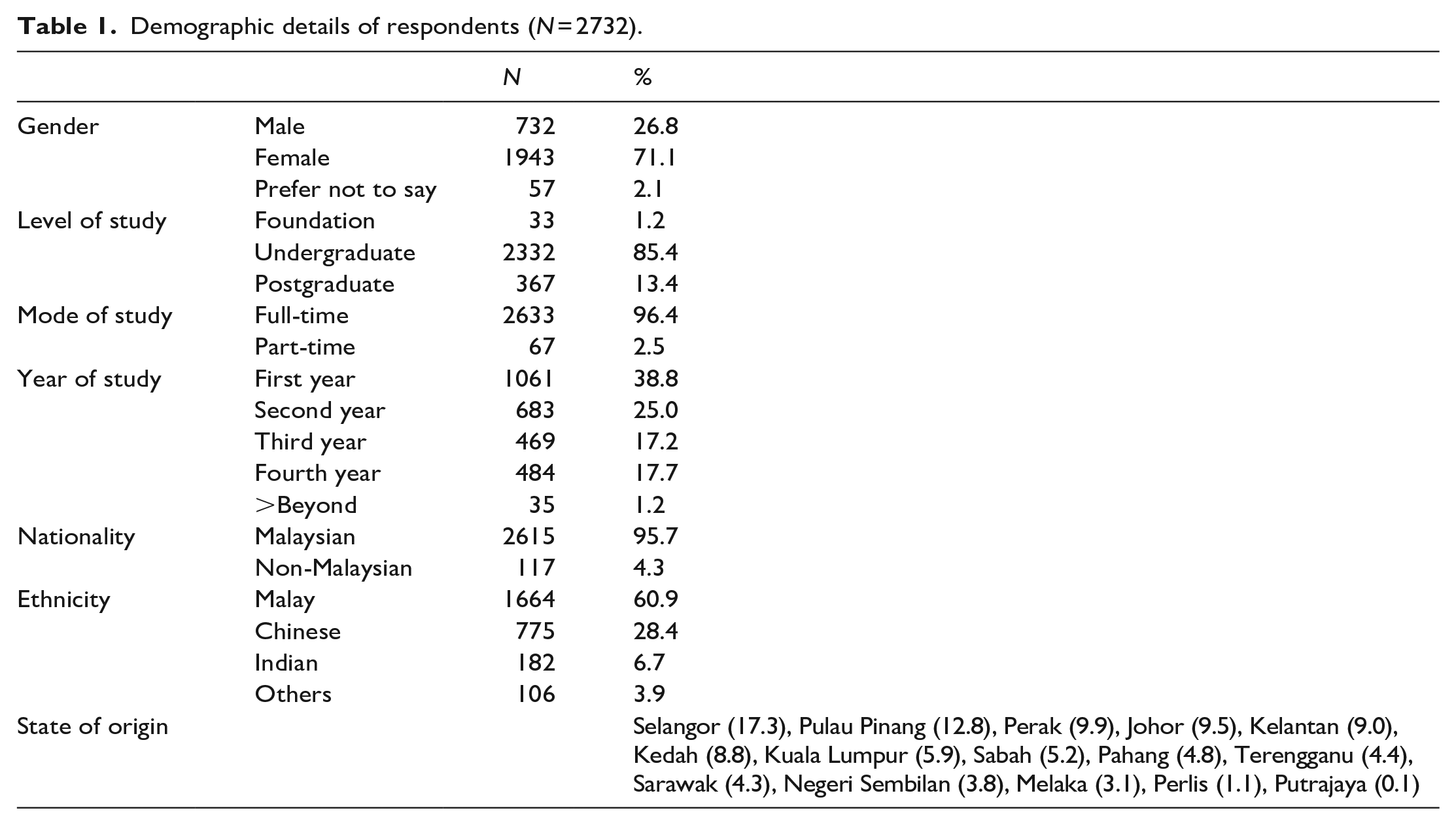
After removing duplicated data (n = 66) and data from non-university students (n = 6), a dataset from 2732 undergraduate and postgraduate students was included for data analysis. Their mean age is 22.98 years (SD = 3.853). See Table 1 for other demographic information.
Demographic details of respondents (N = 2732).
Research instruments
The online survey included demographic information (see Table 1), self-reported health information, and seven instruments as listed below. Two language versions (namely, Malay language and English) were made available so that the respondents could choose their preferred language. Although not all scales are thoroughly validated in autistic samples, we decided on the current scales because of their overall applicability to the research. Moreover, the majority of our sample was in fact non-autistic; hence, we aimed to look for questionnaires that were appropriate for general population samples, and as much as possible also for autistic samples.
AQ-28
The AQ-28 is a 28-item self-reported measure of autistic traits (Hoekstra et al., 2011) based on the original AQ-50 (Baron-Cohen et al., 2001). In AQ-28, autistic traits were classified as social traits (social skills, routine, switching and imagination) and non-social traits (factor numbers and patterns) (Hoekstra et al., 2011). We used a 4-point Likert-type-scale (from 1 = definitely agree to 4 = definitely disagree) as this improves the range of reliable measurement (Murray et al., 2016). The Malay (Chee & de Vries, 2022) and English (Hoekstra et al., 2011) versions of AQ-28 were administered. Adequate psychometric properties have been reported for both scales, Cronbach’s alpha = 0.87 (Chee & de Vries, 2022) and Cronbach’s alpha between 0.77 and 0.86 for the sub-scales (Hoekstra et al., 2011).
Emotion Regulation Questionnaire
The 10 items of the Emotion Regulation Questionnaire (Gross & John, 2003) measure the respondents’ tendency to regulate their emotions, using a 7-point Likert-type scale (from 1 = strongly disagree to 7 = strongly agree). This scale was found to have strong psychometric properties when used with 508 general community members from the United States, Cronbach’s alpha between 0.75 and 0.90 (Preece et al., 2020, 2021).
Perceived Stress Scale
The 10 items of the Perceived Stress Scale (Cohen et al., 1983) measure the experienced level of stress in one’s life, using a 5-point Likert-type scale (from 0 = never to 4 = very often). The Perceived Stress Scale shows adequate internal consistency across different populations, Cronbach’s alpha between 0.67 and 0.91 (Liu et al., 2020).
The General Self-Efficacy Scale
The General Self-Efficacy Scale (Jerusalem & Schwarzer, 1995) assesses a general sense of perceived self-efficacy with the aim to predict efficacy in coping with daily hassles and stressful life events, with 10 items using a 4-point Likert-type scale (from 1 = not true at all to 4 = exactly true). Internal consistency, Cronbach’s alpha between 0.84 and 0.90, was reported (Lazić et al., 2021).
The Satisfaction with Life Scale
QoL was measured with two questionnaires. The Satisfaction with Life Scale (Diener et al., 1985) measures global cognitive judgements of one’s life satisfaction, using five items scored on a 7-point Likert-type scale. This scale generated good internal consistency, Cronbach’s alpha between 0.88 and 0.94, in past studies (Bagherzadeh et al., 2018; Kjell & Diener, 2021).
The Autism-Specific QoL
The autism-specific QoL (McConachie et al., 2018) scale is the other QoL scale which measures the extent of challenging issues that adults with ASC may experience in their lives, with nine items scored on a 5-point Likert-type scale. The Cronbach’s alpha was recorded as 0.82 in the original study (McConachie et al., 2018).
Results
Data analysis
To answer the first research question, we grouped the data based on self-reported ASC (No, I do not have ASC; I do not know; I prefer not to say; I suspect that I might have ASC, but it has never been confirmed; Yes, I have an ASC diagnosis). The AQ data were normally distributed for each group, as assessed by Q–Q plot. Due to the vast difference in the sub-group sample sizes, Welch’s analyses of variance (ANOVAs) were conducted to examine the sub-group differences in self-reported medical and ASC conditions. Next, considering that Malaysia is a country with relatively many undiagnosed adults with ASC (as described in the introduction), the data were then divided into only two groups: ASC group refers to self-reported suspecting or having ASC, while non-ASC group refers to those who confirmed not having ASC. Again, due to the uneven sample sizes, Welch approximation T tests were conducted to evaluate between-group differences in AQ sub-scale scores. To answer the second research question, whether the ASC group has more adverse psychosocial outcomes, we did Welch approximation T tests to examine between-group emotion regulation, self-perceived stress, self-efficacy and QoL differences. Finally, regression analyses were conducted in the full sample to identify the dimensions of autistic traits that might predict self-perceived emotion regulation, stress, self-efficacy and QoL.
Self-reported ASC rate
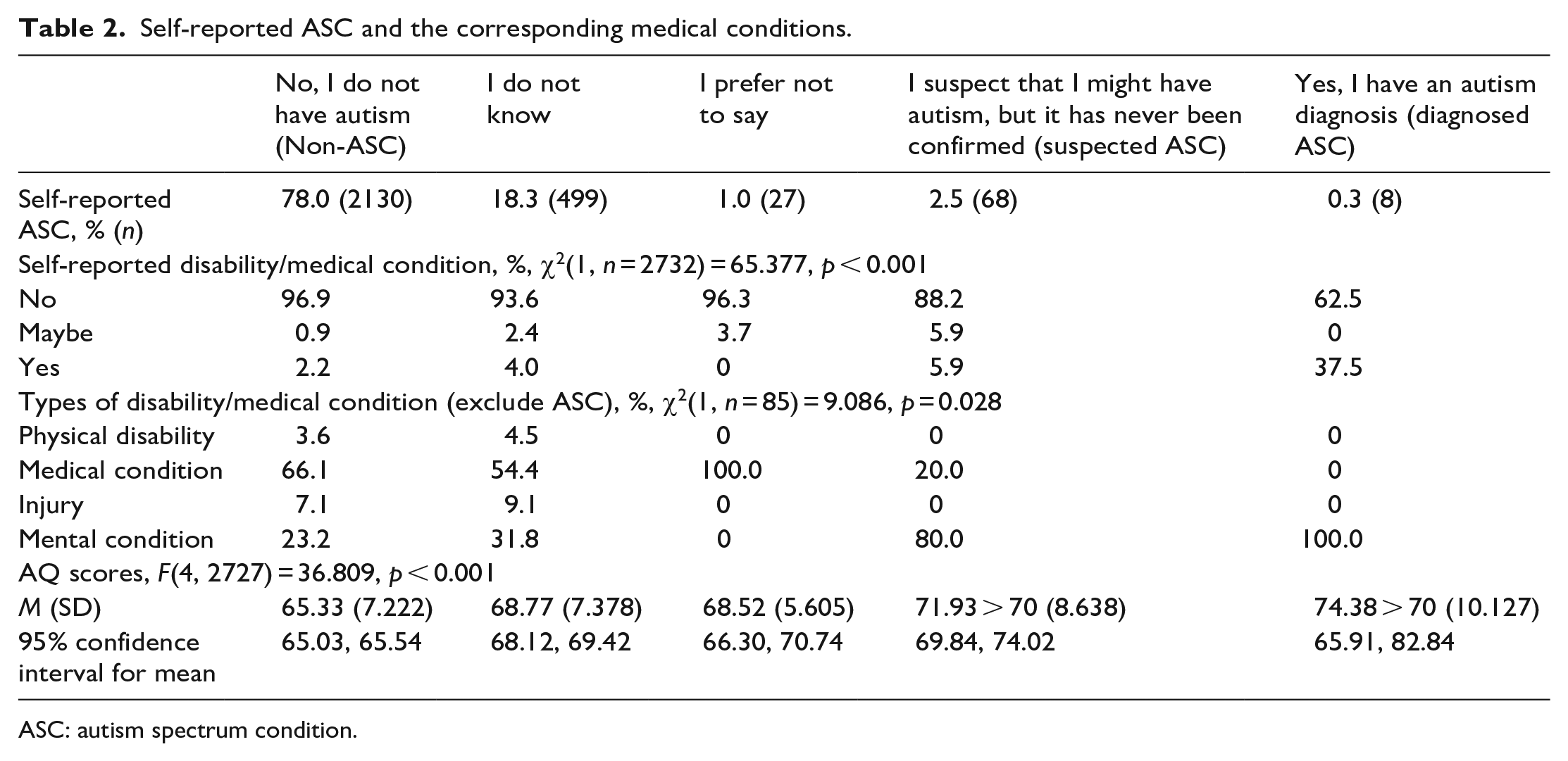
Table 2 shows that 2.5% of students reported that they suspected they might have ASC (suspected ASC) and 0.3% reported having a diagnosis of ASC (diagnosed ASC). However, 78% reported that they did not have ASC (non-ASC). Another 18.3% reported that they did not know and 1.0% preferred not to say. Suspected (5.9%) and diagnosed ASC students (37.5%) reported significantly higher rates of medical conditions than the other groups (0%–2.2%), χ2(1, n = 2732) = 65.377, p < 0.001. Among those who reported having had medical conditions, 80% and above those with suspected and diagnosed ASC reported having a mental-related medical condition; while the frequencies of mental-related medical condition in the other groups were only 0%–32.8%. The differences were statistically significant, χ2(1, n = 85) = 9.086, p = 0.028.
Self-reported ASC and the corresponding medical conditions.
ASC: autism spectrum condition.
Table 2 also shows the self-reported ASC responses and the AQ-28 mean scores (AQ scores) for each group. The suspected ASC (AQ score = 71.93) and diagnosed ASC groups (AQ score = 74.38) had AQ scores above the strict cut-off of 70 (Hoekstra et al., 2011), indicating a strong likelihood of having an ASC. High sensitivity of 0.94 and specificity of 0.91 were previously reported by Hoekstra et al. (2011) for this cut-off score. Welch’s ANOVA results indicated statistically significant differences in the AQ mean scores across the different self-reported ASC groups, F(4, 2727) = 36.809, p < 0.001, d = 0.05. Post hoc comparisons using Games-Howell test indicated that students in suspected ASC and diagnosed ASC groups are not statistically differentiable from one another (mean difference = 2.449, p = 0.961), suggesting the homogeneity of both groups.
Autistic traits
Given the similar AQ scores, and to increase statistical power for the subsequent analyses, the suspected (n = 68) and diagnosed ASC (n = 8) groups were unified as ‘ASC group’ while using non-ASC group as a control. The other two groups (‘do not know’ and ‘prefer not to say’ groups) were excluded from these analysis. Figure 1 summarizes the comparison of AQ scores between the ASC and non-ASC group. The ASC group reported significantly higher autistic traits in the domains of social skills (p < 0.001), routine (p = 0.037) and attention switching (p < 0.001) than the non-ASC group, with effect sizes of 0.003–0.032. However, the ASC group was not different from the non-ASC group in the domains of imagination and factor numbers and patterns, p > 0.05.
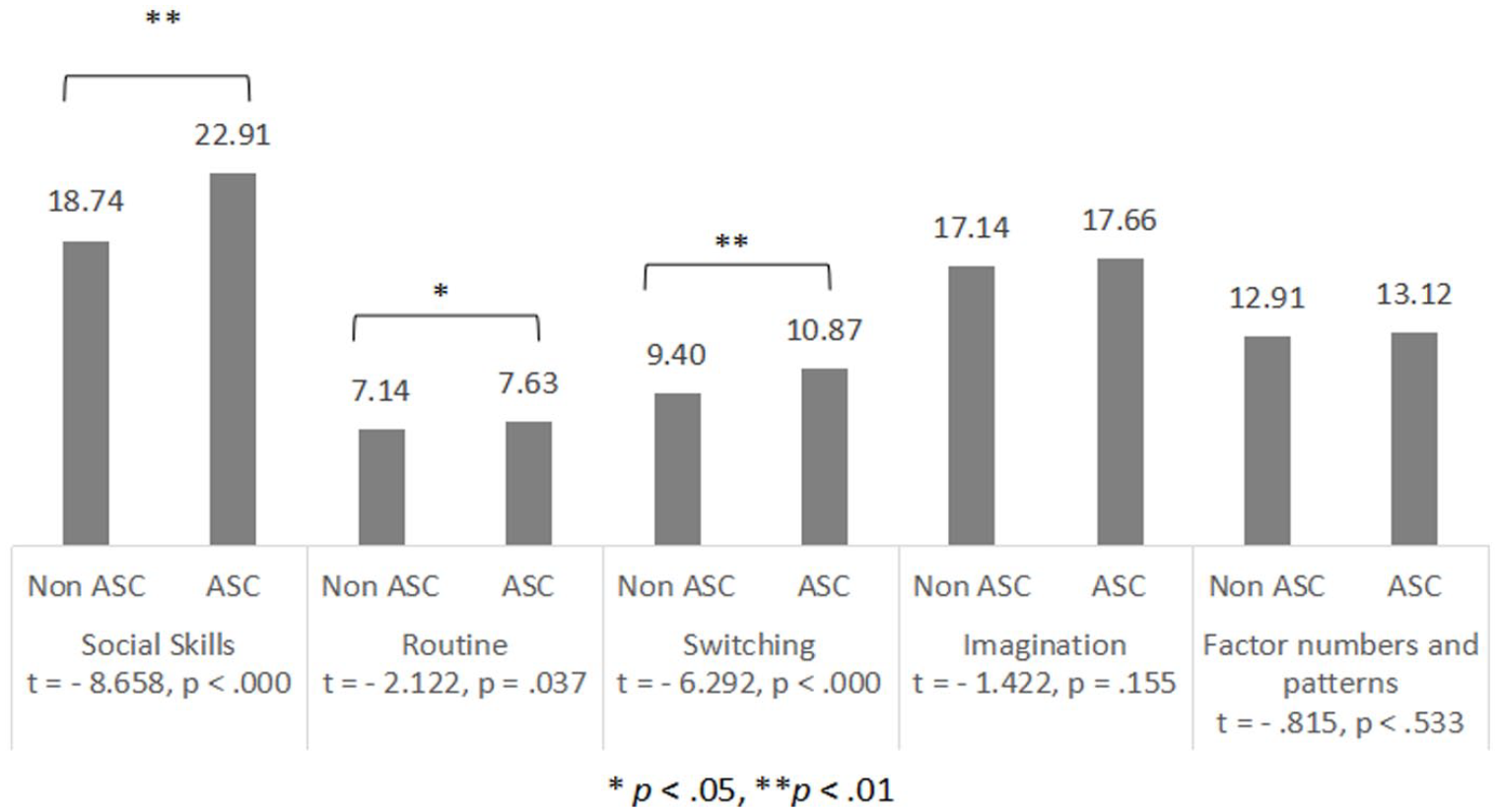
Comparison of AQ scores between ASC (n = 76) and non-ASC groups (n = 2130).
Comparison of emotion regulation, perceived stress, self-efficacy and QoL
Next, the psychosocial outcomes of ASC and non-ASC students were compared. Statistically significant differences in perceived stress (p < 0.001), self-efficacy (p < 0.001) and general QoL (p = 0.001), with effect sizes of d = 0.005–0.017, were less favourable outcomes which were reported for the ASC group. There were no differences in emotion regulation (p = 0.144) and ASC-specific QoL (p = 0.353) (Figure 2).
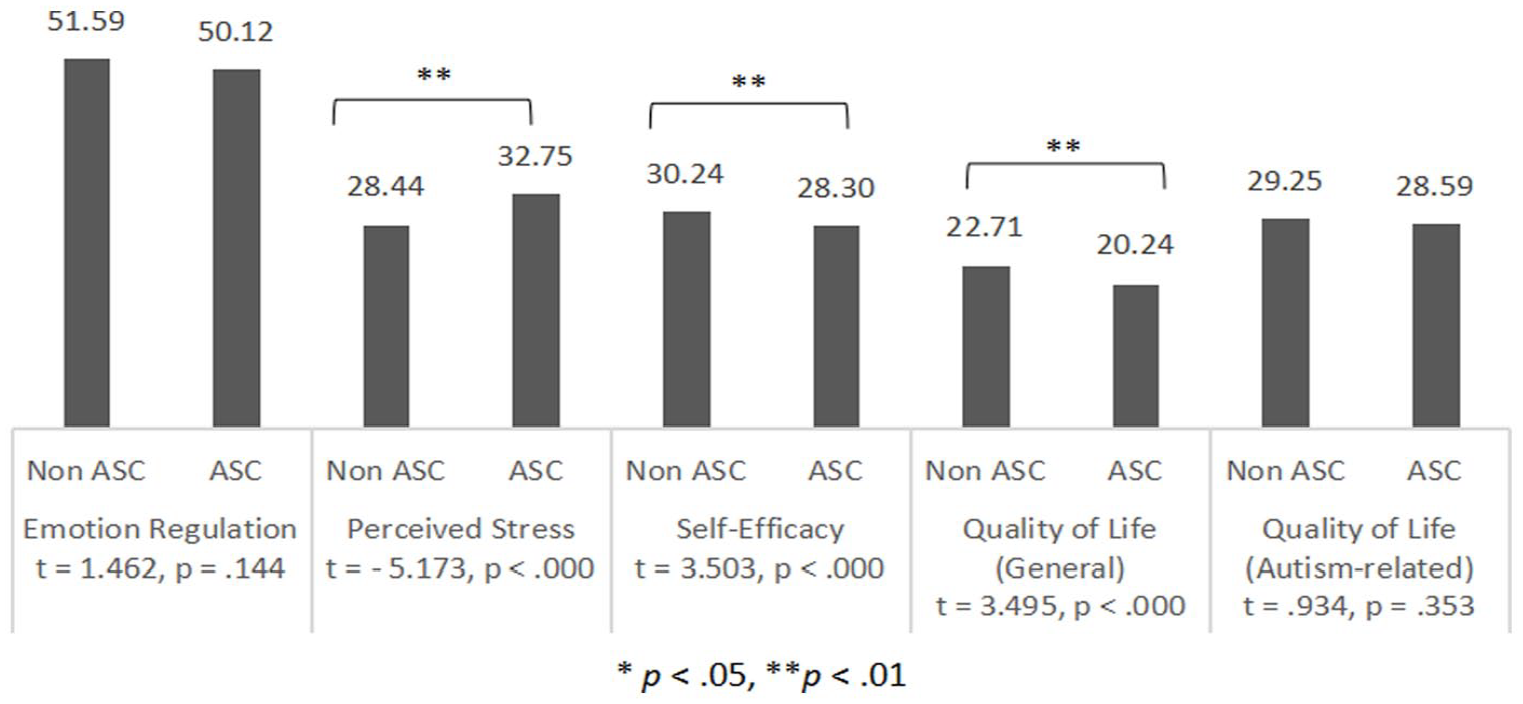
Comparison of emotion regulation, perceived stress, self-efficacy and satisfaction of life between ASC (n = 76) and non-ASC groups (n = 2130).
Predictors of psychosocial outcomes
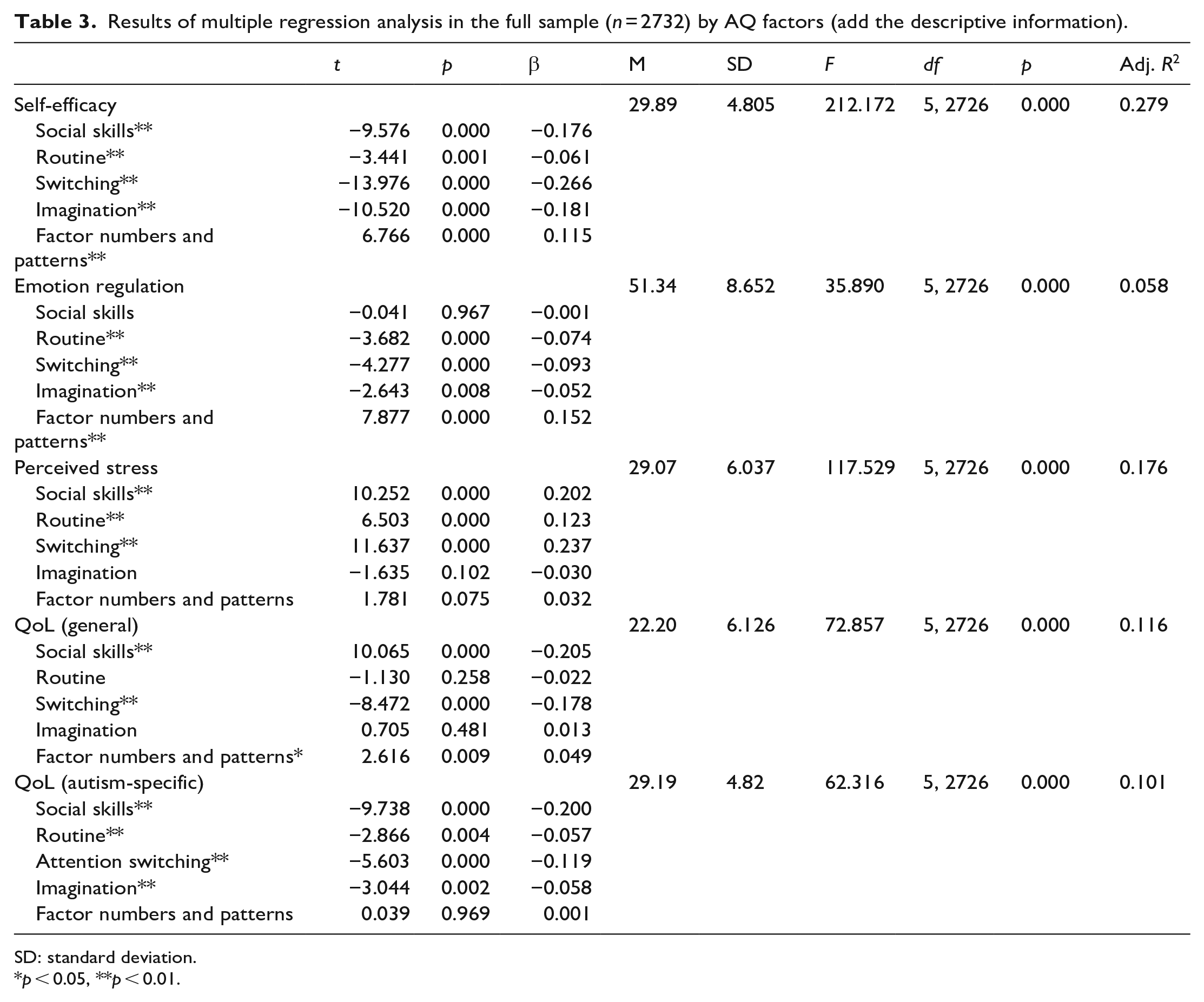
The last analyses were to identify autistic traits that could predict psychosocial outcomes in the whole sample of university students in this study (N = 2732). Table 3 shows the results of multiple linear regression. The results revealed variabilities in the ways autistic traits relate to psychosocial outcomes. Switching seems to be a critical aspect of autistic traits which relates to all psychosocial outcomes (p < 0.001). This is followed by social skills and routine which each related to four out of five psychosocial outcomes. Social skills did not affect emotion regulation (p = 0.967), while routine did not affect the general QoL (p = 0.258). Imagination was found to only weakly relate to emotion regulation (p = 0.008), self-efficacy (p < 0.001) and ASC-related QoL (p = 0.002). The factor numbers and patterns related to self-efficacy, emotion regulation and general QoL, though positively. It is also noted that autistic traits accounted for relatively less variance in emotion regulation than in other identified psychosocial outcomes (adjusted R2 value of 0.058).
Results of multiple regression analysis in the full sample (n = 2732) by AQ factors (add the descriptive information).
SD: standard deviation.
p < 0.05, **p < 0.01.
Discussion
This study aimed to explore self-reported autistic traits among university students, and their relation to emotion regulation, stress, self-efficacy and QoL. In our sample, out of every nine university students who suspected that they might have ASC, only one has a formal diagnosis. The collectivist culture in Southeast Asia might pose a barrier to obtaining a formal diagnosis of ASC (Ilias et al., 2018; Smith et al., 2021). Higher levels of stigma have been reported in Asia as compared to the United States (Yu et al., 2020). A better understanding of ASC and building of trust between professionals and community members are important efforts to minimize negative risks associated with a late or missed diagnosis of ASC, especially among ASC individuals with an average to high IQ.
Both the suspected and diagnosed ASC students scored above the stringent cut-off score of 70 on the AQ-28 (Hoekstra et al., 2011). The AQ scores obtained in this study are higher than the published norms of 53–60 (Hoekstra et al., 2011). This finding is consistent with the findings from past studies in Malaysia that AQ scores obtained in Malaysia seem to be higher than those collected in the United Kingdom (Chee & de Vries, 2022; Freeth et al., 2013). The current study showed that 2.8% of the students suspected having an ASC or had an ASC diagnosis. This is very close to the adult ASC estimation of 2.21% for American adults aged 18 years and older (Dietz et al., 2020) and 2.79% for American children aged 3–17 years reported by 2016 National Survey of Children’s Health in the United States (Xu et al., 2019). Although the global prevalence of ASC is commonly established at around 1% of the population, population study and cohort studies usually reported a higher estimated prevalence than administrative record studies, which indicates that many individuals with ASC are unrecognized by healthcare services (Underwood et al., 2022).
The (suspected and diagnosed) ASC group in the current study had more difficulties in social skills, routine and switching compared to the non-ASC group. These findings correspond with amassing evidence that social skill deficits are prominent among autistic adults (Lundqvist & Lindner, 2017; Sasson et al., 2013; Tonge et al., 2016). Besides that, the finding also resonates with past findings which disclosed a high extent of construct homogeneity among social skills, routine and switching (Hoekstra et al., 2011; Lundqvist & Lindner, 2017), in which these three sub-scales and also the sub-scale of imagination were considered as social traits in contrast to non-social traits (i.e. factor numbers and patterns) of ASC. However, the current ASC group did not show more difficulties in the imagination and number and pattern factors. The findings echoed Lundqvist and Lindner’s (2017) findings that the AQ sum score (social and non-social traits combined) did not perform better than social traits in AQ.
Furthermore, our findings provided evidence that university students with high autistic traits experienced negative psychosocial outcomes, which might have adverse effects on their psychosocial well-being. From the four studied psychosocial domains, reduced self-efficacy and increased perceived stress were clear psychosocial issues faced by the ASC group. Possibly, these domains are related to executive functioning difficulties experienced by autistic university students. The used stress scale (Cohen et al., 1983) reflects stressful conditions induced by reduced abilities in problem-solving, handling changes and lack of control of the situation, which could be related to poor executive functioning skills, which are of utmost importance for studying at the university.
Out of the five AQ factors (Hoekstra et al., 2011), social skills, routine and attention switching were stronger related to psychosocial outcomes than imagination and numbers and patterns. Moreover, all but the numbers and patterns factor were negatively related to psychosocial outcomes. This aligns with past research which described attention to detail as a cognitive advantage of individuals with ASC (Baron-Cohen et al., 2001; Hughes et al., 2018). In this study, the factor numbers and patterns was indeed positively associated with self-efficacy, emotion regulation and general QoL. From the findings, it seems that at least for the university students with ASC, a focus on numbers and patterns could enhance their functionality and participation, especially in the Asian cultural context which values attention to detail in academic performance (Ward et al., 2021), and focus on maths an numbers in general.
Difficulties in social skills were found to negatively predict all psychosocial outcomes, except for emotion regulation. This indicates that social skills are essential in university life and lacking social skills might lead to poorer psychosocial outcomes. The absence of association between high autistic traits in social skills and emotion regulation might be due to the fact that expressing emotions to others is not a common practice in the Asian culture. The emotion regulation scale used in this study might contain a cultural bias as 40% of the items were about expressing personal feelings to others. This is not common in an Asian collectivist contexts, where maintaining harmonious interdependence is important and where individuals are expected to control personal emotions to promote harmony (King & Chen, 2019). This may also explain why autistic traits accounted for relatively less variance in emotion regulation compared to other identified psychosocial outcomes in this study.
An unexpected finding was that close to 20% of the students reported did not know or preferred not to say whether they had ASC. This implies that one in five university students in the studied sample has a limited understanding and acceptance of ASC. It seems that indeed the knowledge about and acceptance of ASCs is lower in Malaysia than in the United Kingdom (de Vries et al., 2020). This finding also indicates that there is more stigma on ASC among Malaysian university students, which is in line with the reported disparity of ASC stigma in Asian and non-Asian cultures (Someki et al., 2018; Yu et al., 2020). For example, 38% of adult citizens in China show a stigma towards ASC, compared to 14% in the United States. (Yu et al., 2020). ASC stigma in a community is typically due to poor understanding and negative beliefs about ASC, which might cause individuals with high autistic traits to face prejudice and discrimination (Someki et al., 2018; Turnock et al., 2022), and hence discourage them from getting a proper diagnosis or disclose their diagnosis (Thompson-Hodgetts et al., 2020).
In sum, the findings illustrate that having high autistic traits can have deteriorating effects on the QoL of university students. Lacking optimal social skills and experiencing attention shifting difficulties significantly affect the QoL. Similar to previous findings (Baron-Cohen et al., 2001; Hughes et al., 2018), a focus on and excellence in factor numbers and patterns can be considered a strength to have a better QoL. However, having difficulties in social skills (such as making friends and meeting new people), routine (new routine, facing interruption), switching (keeping track of conversations, multi-tasking) and imagination (working out people’s intentions, making up cover stories) was found to be closely associated with reduced QoL. This conclusion should be limited to the Asian academic context only.
Although this study provides an important contribution to our understanding of the ASC and the assessment of autistic traits in university students with and without ASC, there are a number of limitations that warrant discussion. First, the survey was conducted during the Covid-19 pandemic, and findings of stress could be biased due to the effect of the pandemic. Research had suggested that during the tumultuous pandemic period, university students faced higher levels of stress (Debowska et al., 2022; Quintiliani et al., 2022). Second, the groups were not balanced for gender (71.1% women, 26.8% men). Future research should aim to address this issue, particularly because ASC is thought to be more prominent among males. Third, there is a marked imbalance group distribution as the ASC group is only 76, while the non-ASC group is 2130. However, to compensate for groups with unequal variances, a Welch U test was used for the between-group analysis (Fagerland & Sandvik, 2009). Fourth, the current study only involved university students from four higher education institutions in Malaysia; hence, this cannot be generalized to other populations. Finally, our findings cannot be generalized to autistic samples since the current analyses were largely based on students who suspected that they might have an ASC, but who did not have a formal diagnosis.
Future directions
It is important to study in depth why university students who suspect they might have an ASC did not obtain a formal diagnosis, university students who do not disclose their ASC identities or who do not have a formal diagnosis, will not be able to obtain ASC-specific support from the universities (Cage et al., 2020). Without the required support, they might be more prone to have limited or superficial friendships, experience loneliness and mental health issues, and have a poorer academic outcome to the point that some might eventually drop out of university (Cage et al., 2020). Moreover, because difficulties in social behaviour are associated with negative psychosocial outcomes, it is important to study how to improve these social challenges, for example with social skills training (Jobe & White, 2007). Providing a suitable social network and support has been known to be critical for the academic success and study completion for university students with high autistic traits (Accardo et al., 2019).
Conclusion
Data from 2732 students revealed that 0.3% of the students reported having an ASC diagnosis, while 2.5% reported that they suspected having an ASC, but did not obtain a formal diagnosis. This indicates that an estimated 2.8% of students might have a diagnosed or suspected ASC. These two categories of students were found to have poorer self-efficacy, higher perceived stress and poorer QoL, as compared to their peers. However, these students were not significantly different from their peers in emotion regulation. Overall, the findings pointed to negative psychosocial outcomes associated with ASC and culture-specific association between autistic traits and psychosocial outcomes.
