




Abstract
The prevalence of anxiety is higher in autistic young people, compared to neurotypical youths. However, the nature of worry in autistic young people is under-researched. Transition from secondary school is a time of change and can be challenging for autistic adolescents. This project explored the content and emotional impact of worries in neurotypical and autistic young people during transition. Twenty-two autistic people and 22 neurotypical people, aged 16–18, were recruited from mainstream schools. Participants completed a novel task to identify and explore the nature of their main worries. The participants’ worry frequency and distress levels in relation to their most salient concerns, and their anxiety levels, were measured. Content analysis highlighted similarities and differences between the two groups’ worries. Both groups worried about failure and their prospects of further education. Autistic people were more concerned about change and friendship, whereas more salient worries for neurotypical individuals were about work and money. Autistic people were more distressed by their worries than neurotypical individuals. Findings regarding the nature of autistic young people’s worries may help inform interventions. Moreover, asking autistic people about their worries as they leave school may help to address their concerns, ease their transition and reduce distress.
Lay abstract
Autistic young people experience higher levels of anxiety than neurotypical young people. Having worries is part of feeling anxious. This makes it surprising that very little research has looked at the kind of worries autistic young people have. Leaving school, in particular, can be a worrying time for young people. Twenty-two autistic young people and 22 neurotypical young people who were at mainstream secondary schools agreed to take part in the study. They were between 16 and 18 years of age. They were asked to sort through a series of pictures, showing the different types of worries that young people might experience. They were then asked to pick out their four main worries and say how much they thought about each worry and how upset the worry made them. They also completed a questionnaire about their level of anxiety. There were similarities and differences between the autistic and neurotypical young people’s worries. Both groups worried about failing and how they might get on in further education. The autistic young people were more worried about change and friendships. Work and money were particular concerns for the neurotypical young people. The autistic young people said that they found their worries more upsetting than the neurotypical young people. Having a better understanding of autistic young people’s worries at important points in their lives might mean that more timely help and support can be given to them. Simply knowing what to ask young autistic school leavers about may help them to express unspoken concerns.
Keywords
Introduction
Borkovec et al. (1983) describe worry as relatively uncontrollable thoughts and images regarding potential negative outcomes (Borkovec et al., 1983). ‘Normal’ amounts of worry are accepted as adaptive (Wells, 1995). Worries have been linked to problem-solving (Szabo & Lovibond, 2002), preparation for action, decision making and motivation (Floyd et al., 2005). However, chronic worry plays a major role in maintaining conditions recognised as anxiety disorders (Holaway et al., 2006).
Generalised Anxiety Disorder (GAD) – a common mental health condition estimated to affect between 3%−6% of adults and 5% of children and adolescents (Strawn et al., 2018) – is characterised by excessive and often irrational worry (American Psychiatric Association [APA], 2013). Likewise, Social Anxiety Disorder is estimated to affect 9.1% of US adolescents (Merikangas et al., 2010). Social anxiety is typified by marked concerns about exposure to social situations and being open to scrutiny by others (APA, 2013).
Worry content can vary with sociodemographic factors. For example, a UK survey found that people aged 55–74 worried less about relationships, housing and work, compared to those aged 16–24 (Lindesay et al., 2006). Emotional well-being can also be influenced by worry intensity and frequency. Worry intensity differentiates non-pathological worry from pathological worry (Cartwright-Hatton, 2006). Reasons why these links exist are speculative. One theory proposes that pathological worriers are unable to problem-solve their concerns and distress is experienced because there is no resolution (Szabo & Lovibond, 2004). Other research suggests that symptoms of anxiety are associated with metacognitive beliefs about worry (such as ‘my worrying is dangerous for me’) (Cook et al., 2015).
Research into worry in autistic young people is underexplored, with a limited number of studies investigating the content of concerns. A small focus group study gathering the views of four autistic children aged 10–12 found themes relating to change in routine, sensory triggers, social worries and bullying (Ozsivadjian et al., 2012). Another study interviewed autistic adolescents about their worries at school (1 girl and 11 boys). Themes relating to friendship, reputation and coping with unpredictability emerged (Cage et al., 2016). The findings from these two studies highlight the need for further exploration of the worries of autistic young people.
Anxiety-related difficulties are among the most common presenting problems for young autistic people attending school (Waddington & Reed, 2006), and such issues can have an impact on academic achievement and social functioning (Bellini, 2004; Sze & Wood, 2007). It is estimated that 40% of autistic children meet the diagnostic criteria for an anxiety disorder (van Steensel et al., 2011) and up to 84% suffer from sub-clinical anxiety symptoms (White et al., 2009). Prevalence rates of anxiety disorders in autistic children are considerably higher compared to children with intellectual disabilities (Gillott et al., 2001), and neurotypical children (Kerns & Kendall, 2012). Estimates show that the most common anxiety disorders among autistic children and adolescents are obsessive-compulsive disorder (OCD) (17%−37%), specific phobias (30%−44%), GAD (15%−35%), Separation Anxiety Disorder (9%−38%) and social phobia (17%−30%) (van Steensel et al., 2011; White et al., 2009).
Social skill difficulties and psychological hyperarousal leading to social anxiety is one explanation for higher rates of anxiety disorders (Bellini, 2006). Other theories suggest that the interaction between autism-specific difficulties and environmental challenges, such as bullying, contribute to elevated anxiety (van Steensel et al., 2014). The overlap in defining characteristics between autism and anxiety disorders may also play a part in explaining the higher prevalence rates of anxiety disorders in this group. For example, social anxiety could be misunderstood as social communication deficits, or repetitive behaviours may be misidentified as compulsions in OCD (Wood & Gadow, 2010). In addition, research indicates that genetic factors may mediate the effect of anxiety (Gadow et al., 2010) and that different observers and settings can influence how anxiety is expressed (Miller et al., 2014). It seems that a complex interaction of biological and environmental factors may contribute to higher rates of anxiety in this population.
Transition from high school is usually a time of increased independence, with a move to work or further education (Arnett, 2000). For autistic young people, transitioning can be particularly challenging. In the United Kingdom, only 16% of autistic people are in full-time, paid employment (National Autistic Society, 2016). Furthermore, post-secondary education attendance is lower than average (Newman et al., 2011). Isolation is common, as autistic young people often have reduced social contact post-school (Howlin et al., 2013). Transition planning is important for autistic young people (Wilczynski et al., 2013), but does not always lead to successful outcomes (Westbrook et al., 2015). Given the difficulties they face, it is surprising that there has not been a greater attempt to gain insight into their worries during this critical period of their lives. While autistic young people may suffer from higher rates of generalised anxiety, like any other young people they are also likely to worry about the real-life challenges they face, or their perceived ability to manage these challenges. Uncovering their particular worries could help to ensure that their concerns are addressed in a sensitive and timely manner. In turn, this may help autistic young people to reduce their levels of anxiety during this potentially stressful period.
The current study was an exploratory investigation of the worries of young autistic people as they reached the end of their school lives, compared to a group of neurotypical adolescents. It was hypothesised that:
(A) There will be differences between the autistic and neurotypical groups in terms of:
(1) The types of worries described.
(B) Compared to the neurotypical group, the autistic group will show higher:
(1) Frequency of worry;
(2) Distress levels about their worries;
(3) Anxiety.
(C) There will be positive correlations within groups in terms of:
(1) Anxiety and distress;
(2) Frequency of worry, and distress;
(3) Frequency of worry, and anxiety.
Methods
Participants
Twenty-two autistic young people and 22 neurotypical adolescents were recruited from mainstream secondary schools in the Scottish Highlands. All participants were aged between 16 and 18 years old, meaning adolescents were in their fourth, fifth or sixth year of their secondary schooling. Pupils in Scotland can choose to leave school in their fourth year if they have reached 16, or they can decide to continue for a fifth or sixth year. Participants were only included if they were English speaking and able to provide informed consent. Participants were excluded if they had an intellectual disability, or a significant sensory or physical impairment that would hinder their ability to complete the task.
Measures and interview
The measures and interview are described in the order they were administered.
A background information sheet gathered information regarding participant characteristics including gender and age. The Carstairs Index was used to determine socio-economic status. This ranks postcodes on a 7-point ‘DEPCAT’ scale from most affluent (1) to most deprived (7), based on recent census data (Carstairs & Morris, 1990).
To investigate the content and salience of participants’ worries, the ‘Worry Interview’ was administered. The approach was developed by Forte et al. (2011), in a study investigating and comparing the worries of college students with and without an intellectual disability (Forte et al., 2011) and has been used in a follow-up study with school pupils (Young et al., 2016). The semi-structured interview uses graphic representations of ‘worry topics’ to stimulate a dialogue about participants’ worries. Examples are shown in Figure 1. The worry topics for the current study were finalised after a pilot and development phase described below. Seventeen topics were included: family, friendship, school, further education, bullying, loneliness, relationships, money, work, appearance, home, decisions, failure, health, death, sensory and change. Participants were shown a photograph of each worry topic in turn and were asked ‘what is this a picture of?’, and ‘what does this picture make you think of?’ Participants were given time to discuss each image and were then asked to assign them to a card which either said ‘no, this is not a worry for me just now’ or ‘yes, this is a worry for me just now’. If the participant indicated that a subject was a worry, the researcher asked them to talk about it further. To be counted as a worry, the participant had to describe a relevant example. To eliminate order effects, worry topics were presented in a randomised order, using three permutations assigned across groups. After the participants had sorted each item, they were asked if they had any additional worries which had not been discussed. Topics assigned to the ‘no’ pile were discarded, and the participant was then asked follow-up questions. To gauge distress levels in relation to each worry, participants were prompted to rate their worry on a 3-point visual analogue scale in relation to how upset thinking about the worry made them feel (a little, quite a lot, a lot). Similarly, frequency of worry was measured in relation to each concern, by asking participants to rate how much they currently worried about the topic, again on a 3-point scale (sometimes, often, always). Finally, participants were shown four boxes of decreasing size and asked to select their four most salient worries from the yes pile and rank them from 1 to 4 (biggest to smallest).
Transcripts from the audio recordings of the interviews were content analysed (Strauss, 1987). Content analysis is a reflective process, aiming to methodically transform a large number of answers to a particular question into a succinct summary of main types of responses (Erlingsson & Brysiewicz, 2017). The first stage involved reading the interview transcripts in order to achieve an overall understanding of participant conversations. Responses for each worry topic were then gathered together. Next, the responses to each topic were grouped together into a smaller number of categories, capturing the different types of views expressed, while preserving the core meaning. This process yielded the specific types (categories) of worry content relating to the different worries, for each participant group. An independent rater was then asked to assign the views expressed about each worry to the typology (categories) that had been developed, and 100% agreement was obtained with the original groupings produced by the researcher.
The Glasgow Anxiety Scale for People with an Intellectual Disability (GAS-ID) was administered to measure participants’ anxiety levels. It comprises 27 questions regarding worries, fears and physiological symptoms experienced over the past week. For each item, participants were asked to respond if they had ‘never felt like this’, ‘sometimes felt like this’ or ‘always felt like this/felt like this a lot’. Responses were correspondingly tallied as 0, 1 or 2, yielding a final score from a maximum of 54. The questionnaire has good test–retest reliability (r = 0.95), internal consistency (a = 0.96) and is reasonably correlated with the Beck Anxiety Inventory (ρ = 0.75) (Mindham & Espie, 2003).
The two-subtest form of the Wechsler Abbreviated Scale of Intelligence – Second Edition (WASI-II; Wechsler, 2011) was used to provide a measure of intellectual functioning. The two-subtest version includes ‘Vocabulary’ and ‘Matrix Reasoning’ to yield an overall estimate of cognitive ability. Test–retest reliability correlations are adequate for children completing both the Vocabulary (r = 0.9) and Matrix Reasoning (r = 0.79) subtests.
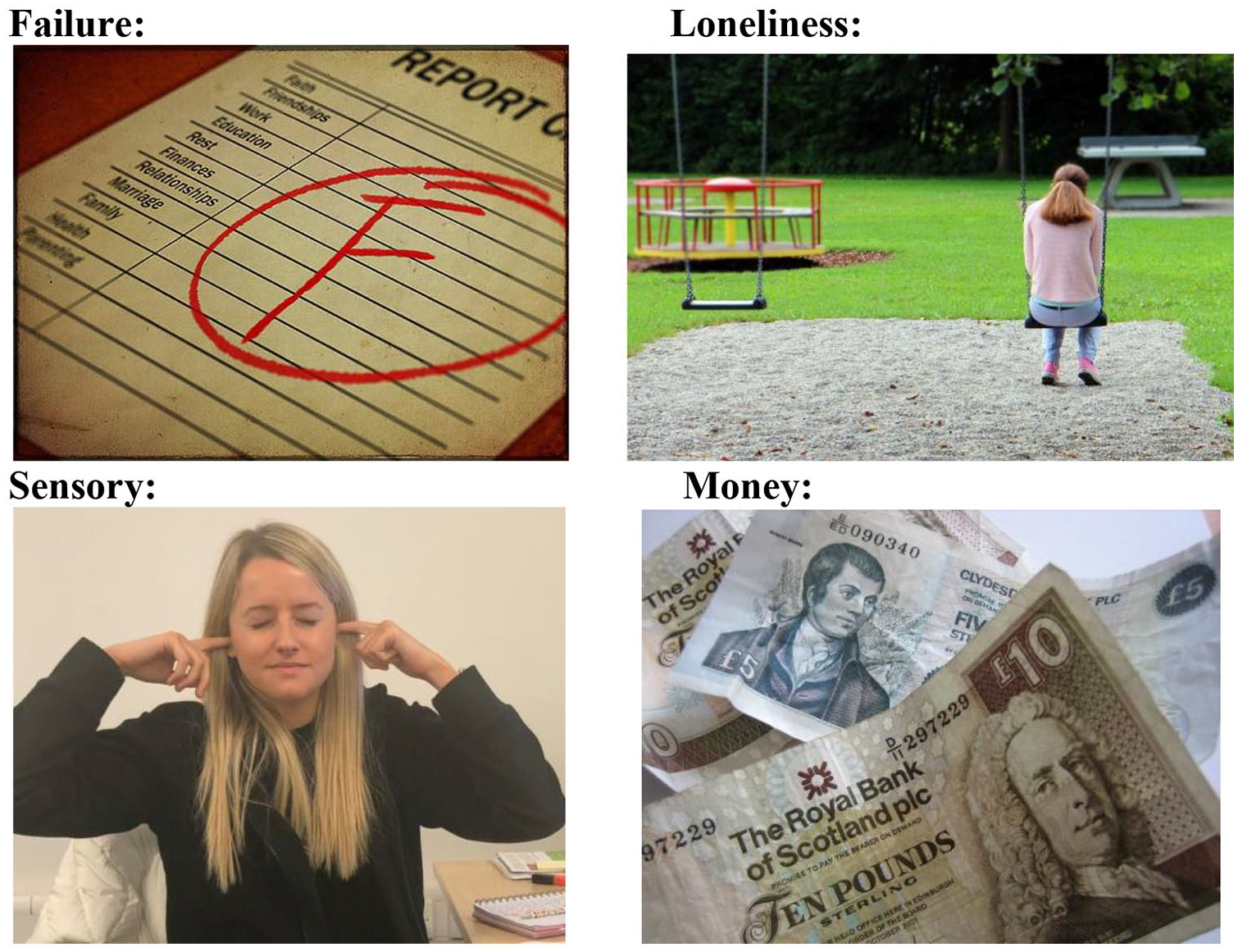
Examples of pictures conveying worry topics in the worry interview.
Procedure
Teachers at the schools who took part in the study handed out information packs to eligible pupils and consent was obtained from those who volunteered to take part. Data collection was carried out by the researcher on an individual, face-to-face basis. Sessions took place in a private room at the participant’s school and lasted around 50 min. The cognitive assessment includes right or wrong answers. Consequently, it was administered last, to avoid influencing the participants’ free responses on the Worry Interview. To enhance engagement, participants were offered breaks and had the option to meet for a second session, if required. The interviews were audio recorded and transcribed verbatim.
Development phase
The original Worry Interview consisted of 12 topics identified in the literature concerning young people’s worries by Forte et al. (2011). Three further common worries for adolescents leaving school, highlighted in the literature, were added to the Worry Interview by Young et al. (2016). The purpose of the development phase of this study was to establish whether any changes needed to be made to Worry Interview, to ensure the topics covered were relevant and meaningful to autistic young people.
Two relevant studies were found which investigated common worries of autistic young people (Cage et al., 2016; Ozsivadjian et al., 2012). These studies identified ‘change’ and ‘sensory issues’ as additional topics of concern, unique to autistic young people. These topics were added to the Worry Interview and the updated version was piloted with the first two autistic people recruited to the study. All topics in the updated Worry Interview were found to be relevant to the pilot participants. Hence, no further amendments were made to the Worry Interview and the data from the pilot participants were included in the main analyses.
Community involvement statement
Autistic young people were not directly involved in the development of the research questions or methods for this exploratory study.
Sample size justification
Forte et al. (2011) found a large effect size of 1.38 for the differences between distress scores of young people with and without intellectual disabilities. A medium to large effect size of 0.65 was found for the difference between their frequency of worry scores. A sample size calculation was carried out using this data. This showed that 30 participants per group would be needed to find a significant difference between frequency of worry scores, and 8 participants in each group required to find a difference in distress scores. Both calculations were based on a power of 0.8 at an alpha level of 0.05 (one-tailed).
Results
The participants’ sociodemographic characteristics are shown in Table 1. The two groups were fairly well matched in terms of age, socio-economic status, gender and IQ (intelligence quotient). Both groups had more males. Two of the female born autistic people did not identify with a particular gender. The mean age of the neurotypical group was 17.44, and the autism group was 17.00. The mean IQ score was slightly below average in the neurotypical group and slightly above average in the autistic group. One participant in the autistic group did not wish to complete the WASI-II. Thus, the average IQ score for the autistic group was calculated in the absence of this individual’s score. All participants lived in the Highlands of Scotland. The average deprivation category scores were comparable: 2.8 and 3.1 for the autism and neurotypical group, respectively, meaning participants tended to live in areas of average wealth. Around a quarter of participants resided in urban areas (such as Inverness), while most lived in rural areas with small populations. The majority of adolescents lived at home with their birth families.
Participant demographics.
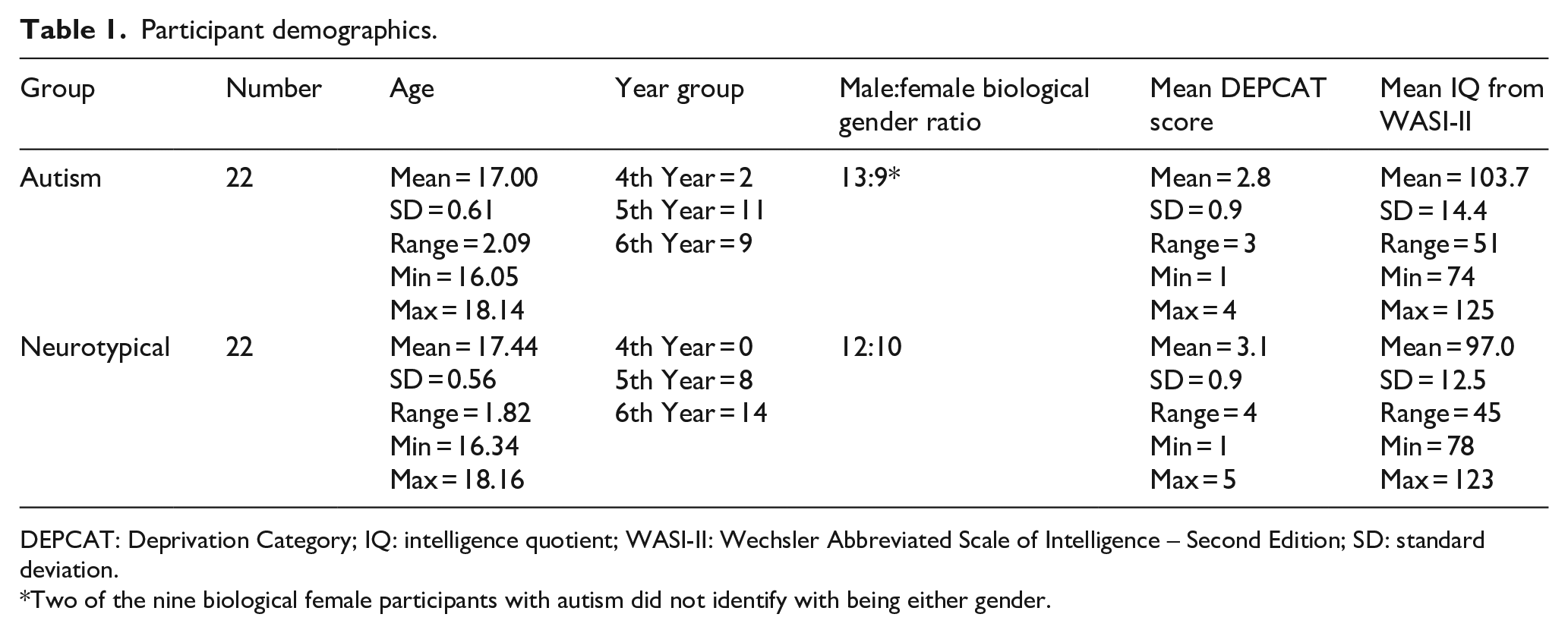
DEPCAT: Deprivation Category; IQ: intelligence quotient; WASI-II: Wechsler Abbreviated Scale of Intelligence – Second Edition; SD: standard deviation.
Two of the nine biological female participants with autism did not identify with being either gender.
Worry salience
After assessing all worry topics, participants selected their four ‘biggest’ worries. A score of 4 was assigned to the most salient worry; a score of 3 to the second most salient worry, and so forth. The most salient worries for each group were established by calculating the sums of scores and are illustrated in Figure 2.
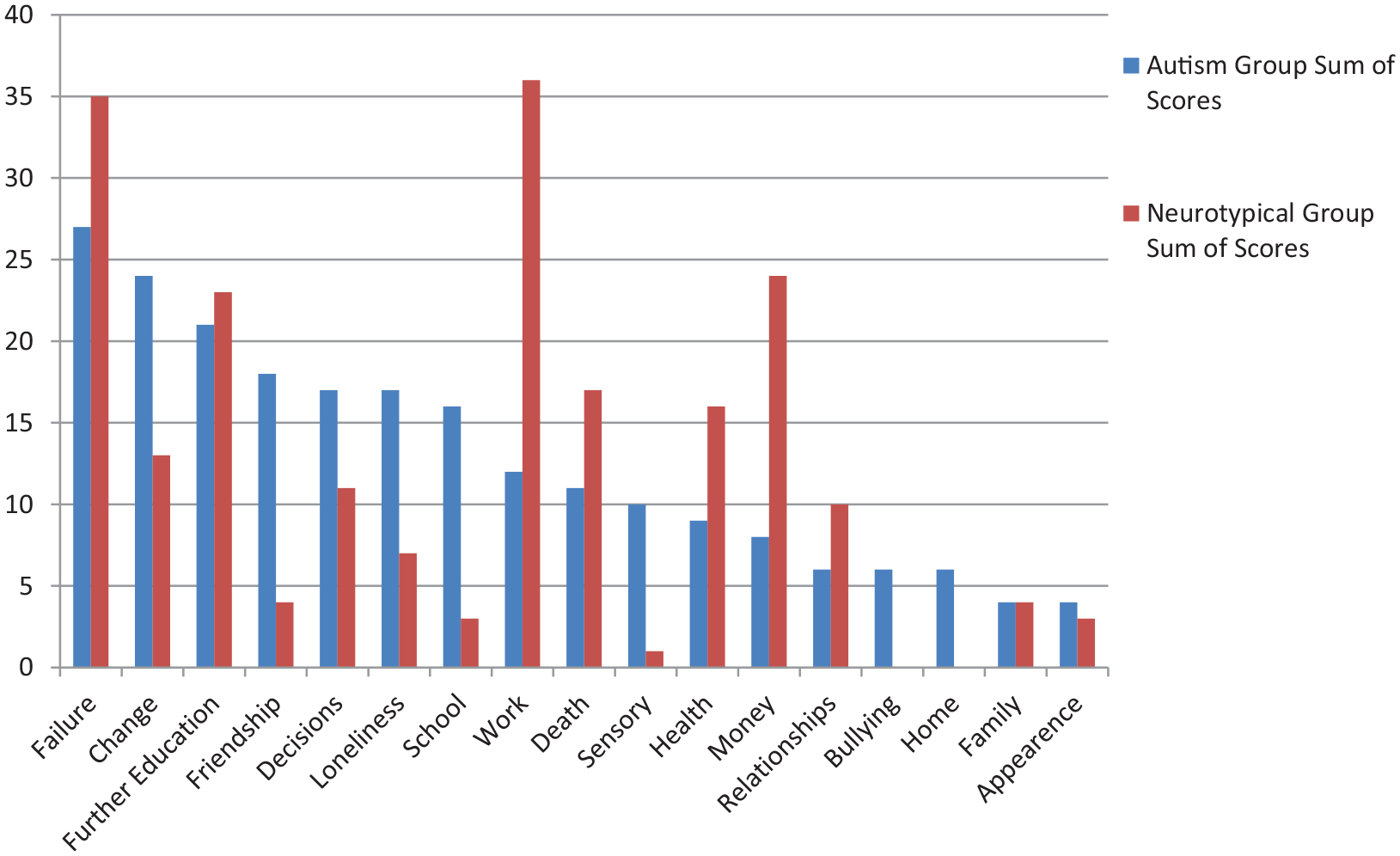
Salience of worries – sums of scores.
There were differences in the salience of certain worries for the two groups. Autistic people were markedly more worried about change, friendship, loneliness, school and sensory matters than their neurotypical peers. Conversely, the neurotypical group were notably more worried about failure, work, health and money. It is noteworthy that when the participants were asked if they had any additional worries that had not yet been discussed, they did not raise any worries that differed from topics presented on the cards.
Worry content
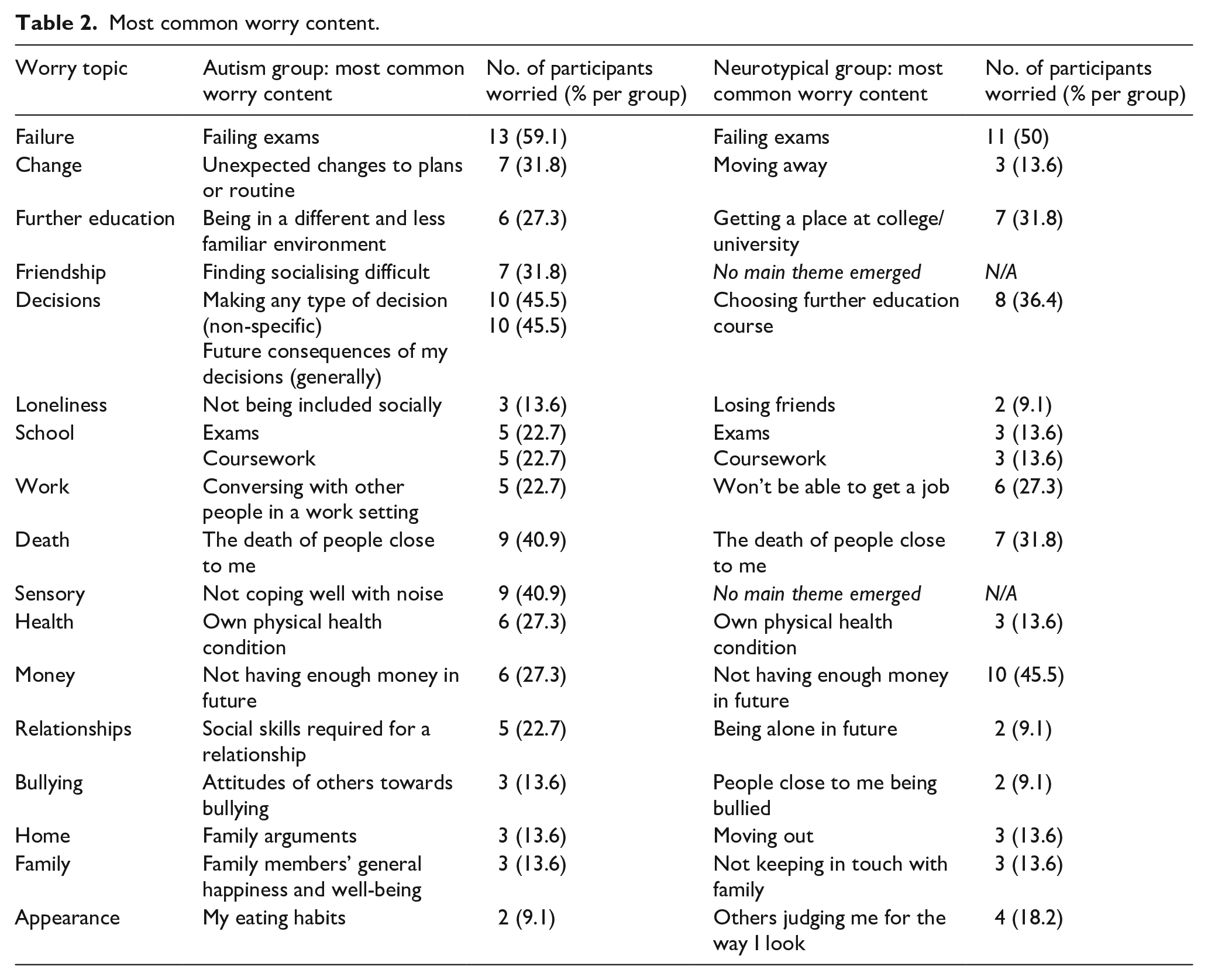
On the basis of the content analysis, the most common types of concerns the participants raised about the different worry topics were established for each participant group. The types of concerns are shown in Table 2. The quotes below are exemplars of the common concerns expressed by the participants and come from a representative mix of male and female participants.
Most common worry content.
Change
Most of the autistic people who worried about change mentioned disruption to their plans or routine:
Just like changes to any routines that I have. Like sometimes the buses change their timetables and stuff and I don’t like it. (Autistic man)
By contrast, those who mentioned change in the neurotypical group expressed a different concern about the prospect of moving away from home:
The leaving home thing, especially for people just moving out, it’s completely new. Never been away before so I guess that’s part of it; just like adapting I guess to the new parts of it. (Neurotypical woman)
Friendship
Autistic people were worried about having the social skills to make friends:
It’s like can I make friends? Or what happens if I have the wrong facial expression? Or my tone is wrong? Or eye contact? I have learned one thing that’s really good and that’s if you look just below the eyes or at people’s noses, it tricks them into thinking that you’re making eye contact. But for the most part I can’t make eye contact, so are they going to think that I’m not being sincere enough in a friendship if I don’t do that? (Autistic woman)
Only one neurotypical participant worried about friendship, and this person was mainly concerned about losing touch with friends:
Well, leaving school I’m going to lose contact with a lot of people. So it’s going to be harder to hold friends, and then of course there’s the issue of making new friends when you move to a new place. (Neurotypical man)
Loneliness
Autisic people were worried about being socially excluded:
When like you don’t know how to get involved in something. Sometimes people think I want to be alone but I don’t, but I don’t know how to explain that to them. (Autistic woman)
The neurotypical participants were anxious about losing friends:
Just the fact that anyone can turn on you and you could be in a close group of friends, and suddenly they put you out of it. (Neurotypical man)
Sensory
Autistic people described having difficulty coping with noise in particular:
That is one of the hardest things for me. At school and at home because I can’t cope if someone has the TV or radio on in the background. But then that’s not fair to them, they can do what they want. Also, it makes me worried to go to people’s houses. They might have noises that I can’t cope with and then I won’t be able to just tell them to stop it because I can’t do that. It makes me really anxious and I start crying and having like a meltdown thing. (Autistic woman)
Neurotypical participants had fewer and more diffuse sensory worries, including losing vision and headaches. One participant described being unable to study when others were talking:
I quite often find that if everybody’s talking it gets quite frustrating because you’re trying to study, you’re trying to do something and then everybody won’t shut up. (Neurotypical man)
Work
Autistic people were anxious about how they would manage the social demands of the workplace:
With the social thing, I can’t look people in the eye for long enough and I’m not very good at talking to people. So that probably hinders the whole ‘Oh you have to be really nice to people’ thing, and I can’t do that. I can’t fake being nice. If I don’t like you, I don’t like you, and I’ll just try to ignore you. But probably I’ll just try to force myself to do it because I’m getting paid for it at the end of the day. (Autistic woman)
By contrast, the most common fear for the neurotypical group was about being unable to get a job:
I don’t want to be unemployed my whole life. (Neurotypical man)
Health
Autistic people were worried about both their physical and mental health:
Definitely a worry because I get ill quite frequently. I have stomach issues that play up whenever I’m stressed which is not good. My mental and physical health both worry me. With exams everyone is stressed and my anxiety just seems to go up like that. Just rockets up. (Autistic man)
The neurotypical group were more focussed on their physical health:
My health conditions. I think it’s just not being at a constant stable level for me personally. (Neurotypical woman)
Between-group comparisons
To obtain a measure for distress, participant ratings for how upset thinking about the topic made them feel (1 = a little, 2 = quite a lot, 3 = a lot), in relation to what they judged to be their four main worries, were totalled to yield a score out of 12. To obtain a frequency of worry score, ratings provided relating to how much participants worried about the topic (1 = sometimes, 2 = often, 3 = always), for their four most salient worries, were summed, to produce a value out of 12. The study measured anxiety from the participant’s GAS-ID score (out of a possible 54).
Distributions of each group’s scores were explored via the Shapiro–Wilk test. Frequency of worry, distress and anxiety scores were normally distributed for the neurotypical group. However, only anxiety scores were normally distributed for the autistic group. Consequently, both parametric and non-parametric tests were employed.
A Mann–Whitney U test indicated that the distress scores were significantly higher in the autism group (Mdn = 10, n = 22) compared to the neurotypical group (Mdn = 7, n = 22), U = 145, z = −2.29, p < 0.05, with a medium effect size (r = 0.35). An independent t-test found that anxiety scores for the autistic group (M = 26.09, SD = 9.06, N = 22) were significantly higher than the scores for the neurotypical group (M = 17.91, SD = 7.75, N = 22), t (42) = 3.20, p < 0.05, with a medium to large effect size (r = 0.44). However, no significant difference was found between the frequency of worry scores of the autism group (Mdn = 9, n = 22) and the neurotypical group (Mdn = 7, n = 22), highlighted by a Mann–Whitney U test: U = 212, z = −0.71, p > 0.05. A small effect size was found (r = 0.11).
Within-group associations
The Spearman correlation coefficient was used to examine within-group associations between frequency of worry, distress and anxiety for the autistic group while the Pearson correlation coefficient was used to examine within-group associations for the neurotypical group.
For the autistic group, significant positive correlations were found between frequency of worry, and distress, r(20) = 0.84, p < 0.01; frequency of worry, and anxiety r(20) = 0.67, p < 0.05; and distress and anxiety, r(20) = 0.59, p < 0.05. Likewise in the neurotypical group, significant positive correlations were found between frequency of worry, and distress, r(20) = 0.85, p < 0.01; frequency of worry and anxiety, r(20) = 0.79, p < 0.01; and distress and anxiety, r(20) = 0.83, p < 0.01.
Discussion
Notable differences in the salience and content of worries experienced by autistic and neurotypical adolescents were found. The neurotypical adolescents’ most common worries of work, further education, money, failure and school echoed previous findings (Young et al., 2016). Likewise, prominent worries for autistic people including coping with unexpected change, and interacting in a range of contexts, found parallels with existing literature (Cage et al., 2016; Ozsivadjian et al., 2012).
Autistic people were significantly more distressed about their worries and had significantly higher levels of anxiety, consistent with research showing a higher prevalence of anxiety in autistic young people compared to neurotypical peers (van Steensel & Heeman, 2017; White et al., 2009). However, no significant differences in frequency of worry scores were found between the groups. Significant positive correlations were discovered between frequency of worry, distress and anxiety, bolstering evidence that these worry mechanisms are interconnected (Borkovec et al., 1998; Cook et al., 2015; Forte et al., 2011). Our findings support the notion that worry intensity is linked to the emotional well-being of autistic young people.
Previous qualitative research has provided insight into the social experiences of autistic young people. Some individuals have reported that they do not fit in or feel accepted by their peers (Humphrey & Lewis, 2008; Portway & Johnson, 2003). Others have reported that they wish to make friends but believe they lack the ability (Bauminger et al., 2003), and some have reported disguising their difficulties by pretending to know how social situations work (Carrington et al., 2003). The current findings echo the notion that although social experiences for autistic young people may be different, this should not be confused with a lack of interest in social contact and relationships. This in turn challenges the stereotypical view that autistic people are unsocial; an attitude which may fuel exclusion (Harnum et al., 2007).
Significant worries relating to socialising may have contributed to elevated anxiety levels in autistic people in the current study. There is the possibility that anxiety may be displayed differently in autistic people, and as such, certain anxiety disorders may present in a different manner (Kerns et al., 2014). For instance, a fear of being rejected, embarrassed or judged unfavourably by others would conventionally be associated with social anxiety in the general population. By contrast, autistic people may experience social anxiety due to complications experienced in navigating interactions, as opposed to being concerned with how others are evaluating them. However, the findings from this study suggest that this may be a rather crude distinction. While the socially related worries for individuals with autism revolved around the processes and techniques involved in interacting, they remained concerned that others would think they were getting it wrong.
Links between sensory modulation and emotional disturbances experienced by autistic people are well established (Pfeiffer et al., 2005). When predictions about the sensory environment fail to align with real sensory experiences, this can induce anxiety. Sensory prediction processes have been linked with sensory processing differences in autistic people (Pellicano & Burr, 2012; Sinha et al., 2014). As such, surroundings may be perceived as more uncertain by autistic people, contributing to more persistent states of anxiety (Green & Ben-Sasson, 2010). This may explain why sensory concerns, and associated distress, were comparatively higher in autistic people in the present study. However, in contrast to previous research (Ozsivadjian et al., 2012), sensory concerns were not among the autistic group’s most salient worries. This highlights the heterogeneous nature of autism and that not all autistic young people will experience the world in the same way, and not all will have the same concerns.
There were differences between the worries reported by the autistic and neurotypical young people. Change, particularly disruptions to plans or routines, was a significant concern for autistic people. Yet, it is important to note the similarities found between the content and salience of some of the main worries reported by the autistic and neurotypical young people. For instance, failure (specifically related to exams) and the prospect of further education were among the most salient worries for both groups. Likewise, the specific content of worries was comparable for both groups with regard to topics like ‘health’ and ‘school’. Thus, while there is a need to be aware of the specific difficulties that might contribute to autistic young people’s high levels of anxiety (van Steensel et al., 2014), it is important to recall that they face the same worries as other young people at this stage of their lives. An understandable concern with difference should not result in the similar life experiences of autistic young people being overlooked.
Limitations
Although the researcher spent time building a rapport to help facilitate dialogue, the teenage participants may have been reluctant to talk about more sensitive worries and did not talk about different topics to those presented on the cards. For instance, bullying has been highlighted as a concern for autistic young people (Ozsivadjian et al., 2012). However, bullying was not raised as a salient concern in the current study. Although autistic people appeared to engage well with the task used to elicit their worries, previous research has found that autistic young people can have difficulties expressing their emotions and initiating conversations (Preece & Jordan, 2010) and may also find it difficult to answer abstract or future-oriented questions (Beresford et al., 2004). Furthermore, the GAS-ID measure of anxiety has not been validated in an autistic population; thus, caution must be exercised when interpreting the findings from the measure.
The research was conducted when the participants were in their final years of school, thus many of their worries are likely to have been specific to this life stage. Likewise, data were collected from most of the participants in the lead up to important exams. This means that the participant reports were likely to have been linked to exam-related worries and a general increase in their anxiety levels. Our study did not explore the effects of age or gender on worry, nor did it take into account of individual background factors which may have influenced their worries and level of anxiety. Furthermore, although all pupils recruited were in the final stages of school and actively considering their future lives, we cannot be sure whether the participants in their fourth or fifth year were imminently planning to leave school or stay for a further year, as this was not asked during the interview.
Given the modest sample size of this small exploratory study, conclusions regarding group differences in worry types must be drawn tentatively. In addition, the insufficient sample size means that the study was not suitably powered to uncover a difference in frequency of worry scores between both groups. There remains a need for properly powered studies concerning young autistic people’s worries.
Further research
Carrying out longitudinal research into autistic young people’s experiences of worry would help uncover anxieties and perceived challenges at different life stages. Moreover, other factors, such as gender and ethnicity, should also be considered. The literature suggests that autistic characteristics can be expressed differently in men and women (Kreiser & White, 2014). Furthermore, the autistic young people in the current study reported that they were experiencing high levels of anxiety. It is estimated that 40% of autistic young people meet the diagnostic criteria for an anxiety disorder (van Steensel et al., 2011). It would seem important to investigate the long-term impact of being highly anxious and whether it makes individuals more vulnerable to developing mental health conditions.
Implications
Our study has shed light on the common worries of a group of autistic and neurotypical adolescents, at the stage of transition. If teachers or other professionals gained insight into autistic young people’s worries, it would allow them to have timely discussions about their students’ concerns. Resolving pupils’ worries or providing support with significant areas of concern could help to ease their transitions from school. In more general terms, given the high levels of anxiety shown by the autistic young people, it may be helpful for professionals to monitor pupils’ distress and embed tailored anxiety management interventions as part of the school curriculum.
Although screening tools are already emerging to help detect forms of anxiety in autistic people (Rodgers et al., 2016), standard clinical assessments for anxiety are often established on the basis of neurotypical presentations. Further work to explore the worries of autistic people may help to inform clinical tools and identify anxiety-related presentations in a population where co-occurring mental health conditions can be overlooked. In turn, a greater understanding of the nature of autistic people’s worries could even inform the content of targeted psychological interventions.
Interventions for autistic young people tend to be transdiagnostic in nature, with approaches applying to a variety of anxiety presentations (Zaboski & Storch, 2018). Cognitive behavioural therapy (CBT) addresses unhelpful thinking patterns and behaviours which heighten anxiety. Research indicates that CBT produces a moderate reduction in anxiety and improvement in well-being for autistic people (Lang et al., 2010). Other interventions include a programme for intolerance of uncertainty in autistic children, which focuses on changes in routine, through gradual exposure and role play, while practicing techniques to aid habituation (Rodgers et al., 2017). Whatever the intervention, there has to be an appropriate focus on the particular worries that are causing the individual distress. Outcomes from the current study or future studies adopting a similar approach could be used to ensure that the interventions are targeted to and appropriate for the typical worries experienced by autistic adolescents.
A core concern of the autistic young people taking part in the study was about socialising. High levels of anxiety might result in autistic youths avoiding social situations (White & Roberson-Nay, 2009), further limiting their opportunities for interaction. Social skills training in autistic young people, focusing on navigating friendships and resolving conflicts, has been shown to yield sustained improvements in their social skills and engagement with others (Laugeson et al., 2015). Our findings highlight the need for proactive interventions to help promote the social skills and opportunities for autistic adolescents to enhance their emotional well-being and quality of life.
Finally, the Worry Interview proved to be an effective way of promoting a discussion about worries with autistic young people. It may therefore have clinical utility, with autistic people who find it difficult to talk about their concerns.
Footnotes
Declaration of conflicting interests
The author(s) declared no potential conflicts of interest with respect to the research, authorship and/or publication of this article.
Ethical approval
Ethical approval was granted by the University of Glasgow College of Medical, Veterinary and Life Sciences (MVLS) Ethics Committee. Approval was also gained from the Highland Council to conduct the research in schools covered by the area.
Funding
The author(s) received no financial support for the research, authorship and/or publication of this article.
