




Abstract
Research regarding autistic children’s sibling relationship quality is mixed, although some literature suggests poorer quality compared to children with other disabilities or who are neurotypical. Little is known about how the clinical characteristics of autistic children relate to parent perceptions of sibling relationship quality. We drew data from a subsample of 119 children on the autism spectrum, ages 10–11 years, from an ongoing longitudinal study. Hierarchical multiple regressions tested the extent to which children’s autism symptoms, behavioral difficulties, and communication abilities related to four domains of parent-rated sibling relationship quality. We also examined communication ability as a moderator of the effect of behavioral difficulties on parent-rated sibling relationship quality. More severe autism symptoms were associated with lower levels of conflict and rivalry, whereas higher communication ability was related to more relative status/power, but also conflict. Communication ability moderated the effect of behavioral difficulties such that behavioral difficulties were more closely associated with less warmth/closeness when children had weaker communication skills; behavioral difficulties were not significantly associated with other domains of sibling relationship quality. Findings underscore the importance of considering clinical characteristics and multiple domains of relationship quality to better understand how parents view the relationships between autistic children and their siblings.
Lay abstract
Sibling relationship quality is important for the well-being of children on the autism spectrum and their siblings. Little is known, however, about how varied behavior and abilities of children on the autism spectrum may be associated with parent perceptions of domains of sibling relationship quality. We drew data from a subsample of 119 children on the autism spectrum (ages 10–11 years), participating in an ongoing longitudinal study. We looked at how three clinical characteristics (autism symptoms, behavioral difficulties, and communication ability) related to four areas of parent-reported sibling relationship quality (warmth/closeness, conflict, relative status/power, and rivalry). We also examined whether the strength of the association between behavioral difficulties and parent-reported sibling relationship quality was influenced by communication ability. We found that more severe autism symptoms were associated with less conflict and rivalry, and higher communication ability was associated with more relative status/power. We also found that children on the autism spectrum with more behavioral difficulties and weaker communication ability had less warmth/closeness in their sibling relationships. Our findings highlight that it is important to consider autism symptoms, behavioral difficulties, and communication ability, as well as multiple domains of relationship quality, to better understand how parents view the relationships between autistic children and their siblings. Clinically, methods for improving sibling relationships may include teaching conflict resolution strategies to children on the autism spectrum with stronger communication abilities and their siblings, and fostering sibling connection for those with lower communication abilities.
Keywords
Sibling relationships are integral for children’s socioemotional development and psychological well-being, and individual differences affect sibling relationship quality (McHale et al., 2012). Yet, findings are inconsistent regarding sibling relationship quality for children on the autism spectrum. Autistic children may experience poorer sibling relationship quality than children with intellectual and other (non-autism) developmental disabilities, Down syndrome, and neurotypical children (see Shivers et al., 2019, for a meta-analysis). Difficulties experienced by children on the autism spectrum may play a role in sibling relationships; for example, limited joint attention may contribute to interactions between children on the autism spectrum and their siblings being asynchronous, which may negatively impact their relationship quality (Wetherby et al., 2007). Nonetheless, the form and intensity of core and co-occurring difficulties experienced by youth on the autism spectrum vary considerably (e.g. Mundy et al., 2007), and this heterogeneity may differentially impact the quality of sibling relationships (Hastings & Petalas, 2014).
The link between autism symptoms and sibling relationship quality is unclear. One review suggests that autistic children’s sibling relationships show less conflict and less warmth, perhaps implying less engagement between siblings than has been found in the general population (McHale et al., 2016). Children with more severe autism symptoms have poorer friendships and parent–child relationship quality compared to children with fewer symptoms (Mazurek & Kanne, 2010; van Steijn et al., 2013), and siblings have indicated their autistic sibling’s social and communication challenges are frequently difficult for them (Watson et al., 2021). One study, however, found that autism symptom severity was not a predictor of mother-rated sibling relationship quality (Tudor et al., 2018). Perhaps in contrast to the above, non-autistic siblings report love, compassion, and affection for siblings on the autism spectrum (Guidotti et al., 2021; Leedham et al., 2020). Furthermore, a review highlights many possible benefits for siblings of children on the autism spectrum including being well-adjusted with a strong self-concept and demonstrating social competence (McHale et al., 2016). Siblings of children on the autism spectrum (and those with Down syndrome) have identified greater closeness and lesser conflict with their siblings than non-autistic sibling pairs (Kaminsky & Dewey, 2001). Siblings may also rate their sibling relationship quality more positively than parents, identifying more caring, loving, appreciation, and supportiveness and less criticism and arguing (Braconnier et al., 2018). Given these mixed findings, a nuanced examination of the factors associated with autistic children’s sibling relationship quality is warranted and could provide key insights regarding which families are thriving and which are in greater need of support.
Behavioral difficulties may or may not be tied to sibling relationship quality for children on the autism spectrum. Poorer parent- and sibling-rated sibling relationship quality has been identified for autistic children with more behavioral difficulties (Hastings & Petalas, 2014; E. A. Jones et al., 2019), a finding also apparent in children with other developmental disabilities (Begum & Blacher, 2011; Cebula et al., 2019). Findings highlight distress on behalf of siblings in response to autistic children’s behavioral difficulties, especially aggression (Braconnier et al., 2018; Leedham et al., 2020; McHale et al., 2016; Moss et al., 2019; Watson et al., 2021). Similarly, parents and siblings rated lesser warmth in the sibling relationship for children with greater autism symptom severity and poor adaptive skills, while they rated more conflict for children with fewer autism symptoms, better adaptive skills, but high behavioral difficulties (Rixon et al., 2021). On the contrary, higher levels of problem behavior have predicted better sibling relationship quality based on mothers’ perceptions (Tudor et al., 2018). Despite these findings, many studies of siblings have not reported upon co-occurring behavioral concerns for their samples of children on the autism spectrum (Watson et al., 2021). Further examination is needed to understand the link between behavioral difficulties and sibling relationships for autistic children.
In addition, children on the autism spectrum with poorer communication ability have been shown to be less connected with peers than those with greater ability (R. M. Jones et al., 2017), and social communication difficulties may challenge the sibling relationship (Shivers et al., 2019). One study, however, found that communication ability and sibling-identified relationship quality were unrelated among children with developmental delays (Smith et al., 2013). An outstanding question is the potential interaction of communication ability and behavioral difficulties, given that behavioral difficulties may be viewed differently by others when a child’s developmental difference is more salient and viewed as biological in origin (Mikami et al., 2019). This may be more the case for children on the autism spectrum with poorer communication abilities than those with greater communication skills.
Key demographic factors—birth order and gender—have also predicted variation in autistic children’s sibling relationship quality. For instance, when playing with siblings, children on the autism spectrum displayed more negative interactions when their siblings were older, suggesting poorer relationship quality when the children on the autism spectrum were the younger siblings (O’Brien et al., 2020). In another study, having older siblings was associated with lower rates of psychopathologies such as depression and behavior problems among children on the autism spectrum, which can suggest that types of interaction may differ depending on the birth order of the autistic child (Montes, 2018). The gender 1 of both siblings may also impact the likelihood of engaging in shared activities, with brothers of girls on the autism spectrum being least likely to engage and sisters of girls on the autism spectrum being most likely (Orsmond et al., 2009). A meta-analysis also suggested that the sibling gender combination moderates the effect size of the association between sibling relationship quality and non-autistic siblings’ mental wellness (Buist et al., 2013). In addition, sibling relationship quality varies across children’s development (Blacher & Begum, 2011). Middle childhood (ages 10–11) may be a key period, as sibling relationships in the general population become more egalitarian, time spent with siblings surpasses that spent with caretakers, and sibling relationship quality during this time may predict later psychological functioning (Buhrmester & Furman, 1990). In addition, better understanding and addressing conflicts earlier in life could serve a protective function for both siblings in the short and long term (Gass et al., 2007; Pollard et al., 2013).
Although they do not provide a comprehensive picture on their own, parents’ perceptions of autistic children’s sibling relationship quality are crucial information. A meta-analysis identified that informant type (child/sibling, parent, or teacher report, observation, or composite scores) did not moderate effect sizes of sibling relationship quality and behavioral difficulties (Buist et al., 2013). Yet, discrepancies between parent and sibling reports of autistic children’s sibling relationship quality have been identified (Braconnier et al., 2018), pointing to the importance of capturing parents’ perspectives. Parents may report more negative aspects of the sibling relationship (such as conflict) than siblings, which may be due to parents’ own stress or caregiver burden (Roper et al., 2014), but may also point to under-reporting of negatives from siblings (Braconnier et al., 2018). Relatedly, self- and parent reports may not correlate consistently with autism-related symptoms (E. A. Jones et al., 2019). Parents are likely to reflect upon the history of siblings’ relationship in their reports (Zucker et al., 2021), and the early parent–child relationship with the firstborn may itself impact later sibling relationship quality (Volling & Belsky, 1992). Parent perspectives of sibling relationships are essential for the development of caregiver-mediated interventions for siblings (Pickering & Sanders, 2017). Thus, capturing parent perspectives on autistic children’s sibling relationship quality may help to inform the assessment of overall family functioning.
Summary and aims of the current study
Blacher and Begum (2011) argued that a constellation of variables must be considered when studying sibling relationships. To better understand autistic children’s sibling relationship quality, we proposed that clinical characteristics, namely autism symptoms, behavioral difficulties, and communication ability, should be considered in concert.
The goals of this study were to examine how these factors were independently related to multiple domains of parent-rated sibling relationship quality among school-aged children on the autism spectrum. Given prior studies pointing to effects of birth order and assigned sex at birth, we controlled for these factors in our analyses. Two domains—warmth/closeness and conflict—have been previously examined in the literature. We examined two additional domains in exploratory analyses: relative status/power and rivalry. Relative status/power is the extent to which a sibling is “in charge” in the dyad or their position in the family structure, whereas rivalry is how much the children compete with one another for their caregiver(s)’ attention or their position in the family. Although less frequently studied in samples of children on the autism spectrum, the role of rivalry and relative status/power to sibling relationship quality and adjustment in the general population suggest these domains may warrant further attention (McHale et al., 2016).
Based on prior findings, we predicted that parent report of greater severity of autism symptoms and behavioral difficulties would be associated with less warmth/closeness and less conflict in the sibling relationship, and that communication ability would moderate the association between behavioral difficulties and relationship quality, such that children with more behavioral difficulties and stronger communication abilities would have less warmth/closeness and more conflict in the sibling relationship, as their developmental differences may be less salient to their siblings.
Method
Participants and procedure
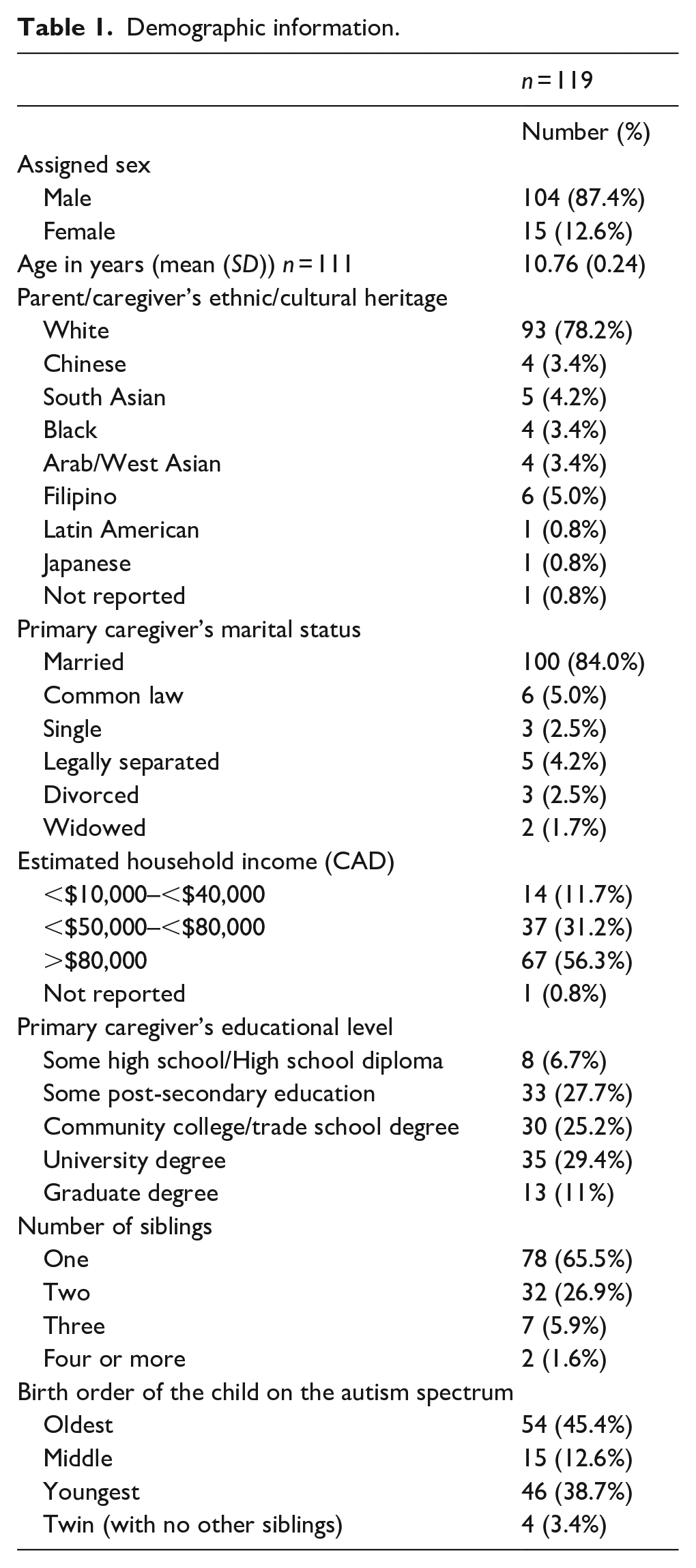
The current study used data drawn from the Pathways in ASD study across Canada. The study has been approved by Research Ethics Boards at all five participating sites, and all families gave informed consent for participation. All eligible families from five regional autism referral centers in Canada were invited to participate. Only one child (the one most recently diagnosed with Autism Spectrum Disorder within the eligible age range) in each family was recruited to ensure independence of observations (Mirenda et al., 2010). Inclusion criteria at the time of enrollment (Time 1) included being between the ages of 2 years and 4 years 11 months, meeting criteria for autism on the Autism Diagnostic Observation Scale (ADOS; Lord et al., 2000) and in the social and one other domain on the Autism Diagnostic Interview-Revised (ADI-R; Rutter et al., 2003), and meeting clinical criteria for autism spectrum disorder via Diagnostic and Statistical Manual of Mental Disorders (4th ed., text rev.; DSM-IV-TR; American Psychiatric Association, 2000) criteria. Qualified clinicians conducted the assessments and determined eligibility based on clinical judgment. Exclusion criteria included having a known genetic or chromosomal abnormality, a neuromotor disorder (e.g. cerebral palsy), and/or a severe hearing and/or vision impairment. Phase II consisted of annual assessments when the children were approximately ages 7–11 years. We primarily used data from Time 8 (T8; when autistic children in the study were ages 10–11 years), the last time point assessed in Phase II, to capture sibling relationship quality at the end of middle childhood, a key period of developmental transition (Buhrmester & Furman, 1990). Of the 240 families who participated in the Pathways study T8 assessment, 121 were excluded due to: (1) having at least one sibling, other than the Pathways proband, diagnosed with autism (n = 33) or (2) missing data on the selected measures (n = 88). This resulted in a final sample of 119 children with complete data. Demographic details are shown in Table 1. Participants did not differ by site regarding child’s assigned sex or birth order, parent/caregiver’s ethnicity/cultural heritage, household income, or marital status (ps > 0.05). Children’s age varied by site, F(4, 106) = 4.68, p = 0.002, with children at Montreal and Edmonton each being significantly older than children at Hamilton (ps < 0.05).
Demographic information.
Measures
Parents/caregivers completed a Family Background Information (FBI) questionnaire at most time points throughout the study. We drew demographic data from T8 (n = 110; 92.4%). If data were missing (n = 9; 7.6%), we drew from T7, followed by T6, and so on to T1, as necessary.
Parents/caregivers completed a Child in the Family Questionnaire at each time point to provide information about the years of birth, birth order, assigned sex at birth, relationships (i.e. biological or adopted sibling) with the child on the autism spectrum, living arrangements, and current diagnosis of autism or other developmental conditions for each child in their family. We drew this information from T8 (n = 109; 91.6%) unless it was missing (n = 10; 8.4%), in which case, we drew from T7, followed by T6. We grouped birth order of children on the autism spectrum into four categories: “Oldest,” “Middle” (at least one older and one younger sibling), “Youngest,” and “Twin” (twins with no other siblings; twins with other siblings were categorized as “youngest” or “oldest” depending upon the birth order of those other sibling(s)).
The ADOS is a semi-structured play-based assessment of social, communication, and restricted/repetitive behaviors consistent with autism (Lord et al., 2000). In addition to receiving this assessment upon entry into the study, the children were administered the ADOS at several time points. Research reliable administrators (i.e. >80% agreement) chose the appropriate module based on the child’s language ability (i.e. Module 1: pre-verbal/single words; Module 2: phrase speech; and Module 3: fluent speech) (Lord et al., 2000). We used the ADOS Calibrated Severity Score (CSS; Gotham et al., 2009), a standardized measure of autism symptom severity such that higher scores indicate more autism symptoms, from T8 in this study. The ADOS CSS takes chronological age and language ability into account, and therefore, it can be compared across modules.
The Child Behavior Checklist (CBCL) School-Age form for ages 6–18 years is a broadband parent report of emotional and behavioral concerns (Achenbach & Rescorla, 2001). It consists of 113 items that are scored on a 3-point Likert-type scale from 0 (not true), 1 (somewhat or sometimes true), or 2 (very true or often true). The sum of all the items comprises the Total Problems which we used to estimate child behavioral difficulties (CBCL-TP). We used raw scores; higher scores indicate more behavioral difficulties. Data were drawn from T8 (n = 103; 86.6%), T7, (n = 8; 6.7%) and T6 (n = 8; 6.7%). The CBCL-TP had high inter-item correlation in the current sample (Cronbach’s α = 0.95).
The Vineland Adaptive Behavior Scale, Second Edition (VABS; Sparrow et al., 2005) is a semi-structured parent interview that assesses domains of adaptive functioning including Socialization, Communication, and Daily Living Skills. Parents’ responses are rated using a 3-point Likert-type scale from 0 (never) to 2 (usually). We estimated communication ability with the Communication subscale raw score; higher scores represent stronger communication ability. Data were drawn from T8 (n = 113; 95%) and T6 (n = 6; 5%) (not collected at T7). The VABS Communication subscale had high inter-item correlation in this sample (Cronbach’s α = 0.96).
We used the revised, caregiver-reported Sibling Relationship Questionnaire (Furman & Buhrmester, 1985) to estimate sibling relationship quality. Parents reported upon one sibling dyad (i.e. the child on the autism spectrum enrolled in the study and one other sibling). In families with more than two children, parents chose the sibling but did not specify which sibling they selected to the research team. The 48-item SRQ assesses 16 dimensions that contribute to four subscales of sibling relationships: Warmth/Closeness (e.g. “How much do [child] and this sibling go places and do things together?”), Conflict (e.g. “How much [child] and this sibling disagree and quarrel with each other?”), Relative Status/Power, (e.g. “How much does this sibling make [child] do things?”), and Rivalry (e.g. “Who gets more attention from mother, [child] or this sibling?”). Warmth/Closeness, Relative Status/Power, and Conflict are calculated by summing the items within those domains, while the Rivalry subscale is calculated by averaging items from each parent’s partiality. It uses a 5-point Likert-type scale from 0 (hardly ever true) to 5 (extremely much). The SRQ has been used in research examining autistic children’s sibling relationships (Hastings & Petalas, 2014; E. A. Jones et al., 2019; Kaminsky & Dewey, 2002), with moderate-to-high inter-item correlation (Hastings & Petalas, 2014). In the present study, data were drawn from T8 (n = 103; 86.6%) and T6 (n = 16; 13.4%) (not collected at T7). Inter-item correlation was high for Warmth/Closeness (Cronbach’s α = 0.94) and Conflict (Cronbach’s α = 0.91) and moderate for Relative Status/Power (Cronbach’s α = 0.78) and Rivalry (Cronbach’s α = 0.69).
Analytic plan
We used SPSS Version 26.0 (IBM Corp., 2019) with the PROCESS macro (Hayes, 2017) for our statistical analyses. We screened the data for impossible values and outliers and tested all assumptions of the hierarchical multiple linear regressions (i.e. continuous dependent variables, two or more continuous independent variables, dependence of observations, linear relation between dependent and independent variables individually and collectively, equal error variances, an absence of multicollinearity, no significant outliers, high leverage points, or highly influential points, residuals approximately normally distributed; Laerd Statistics, 2015). All assumptions were met for all subscales except SRQ Rivalry. We identified one extreme value (5), which was not found to be a leverage point, an influential point, nor an error variable. Based on recommendations from Aguinis and colleagues (2013), we conducted sensitivity analysis. We ran four, three-step hierarchical multiple linear regressions to examine how clinical characteristics (Step 2; ADOS, CBCL, and VABS Communication) were associated with aspects of sibling relationship quality (Warmth/Closeness, Conflict, Relative Status/Power, and Rivalry), controlling for birth order, assigned sex at birth, and research site (Step 1). We also tested for an interaction effect (Step 3) between the CBCL and VABS Communication on the outcome variables. We used raw scores as they offer greater variability and may be more reliable than standard scores (Farmer et al., 2020; Medeiros et al., 2017). Due to a lack of identifying information for the siblings, we were unable to ascertain the sex or age of siblings in families with more than two children. Therefore, only assigned sex and birth order of the children on the autism spectrum, not the sex or age of their siblings, were controlled for in our main analyses.
Community involvement
The aims of the Pathways study were determined by a series of meetings of parents, advocates, practitioners, and researchers from 2000 to 2005 (www.asdpathways.ca).
Results
Preliminary analyses
Preliminary analyses showed that the SRQ Warmth/Closeness and ADOS differed significantly by site. As such, site was included as a control covariate in the subsequent analyses. Families excluded from analyses due to missing data showed several socio-demographic differences from those who were included. Specifically, participants’ missing data were more likely to have non-married parents (χ2 = 14.29, p = 0.006), parents with a high school or graduate degree relative to other levels of education (χ2 = 11.09, p = 0.026), and parents who made <$20,000 per year (χ2 = 22.90, p = 0.002). No differences were found regarding the primary caregiver’s race/ethnicity, the autistic child’s assigned sex, birth order, or number of siblings (last two only calculated for excluded children with at least one sibling). Descriptive statistics are shown in Table 2.
Descriptive statistics of the variables of interest.
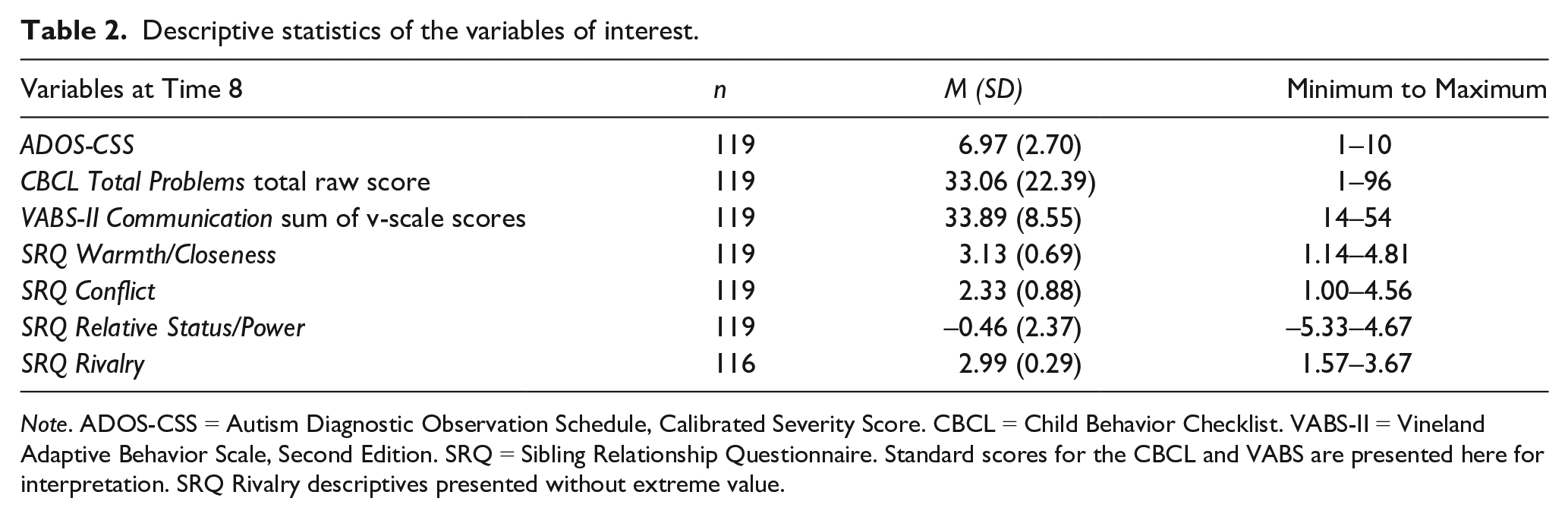
Note. ADOS-CSS = Autism Diagnostic Observation Schedule, Calibrated Severity Score. CBCL = Child Behavior Checklist. VABS-II = Vineland Adaptive Behavior Scale, Second Edition. SRQ = Sibling Relationship Questionnaire. Standard scores for the CBCL and VABS are presented here for interpretation. SRQ Rivalry descriptives presented without extreme value.
Sibling relationship quality: warmth/closeness
Regression results for all four models are shown in Table 3. Results indicated that the full model for sibling warmth/closeness was significant (p < 0.001). There was no significant effect of autism symptom severity. Behavioral difficulties were negatively, and communication ability was positively significantly associated with warmth/closeness, and these main effects were further qualified by a significant interaction effect between variables. The effect of behavioral difficulties (CBCL) on warmth/closeness (SRQ) was negative and larger at lower levels of communication (VABS) and smaller at higher levels of communication (β = 3.38, SE = 0.24; Figure 1). The model explained approximately 22% of the variance in warmth/closeness; the interaction explained an additional 3% variance.
Regressions testing sibling relationship quality.
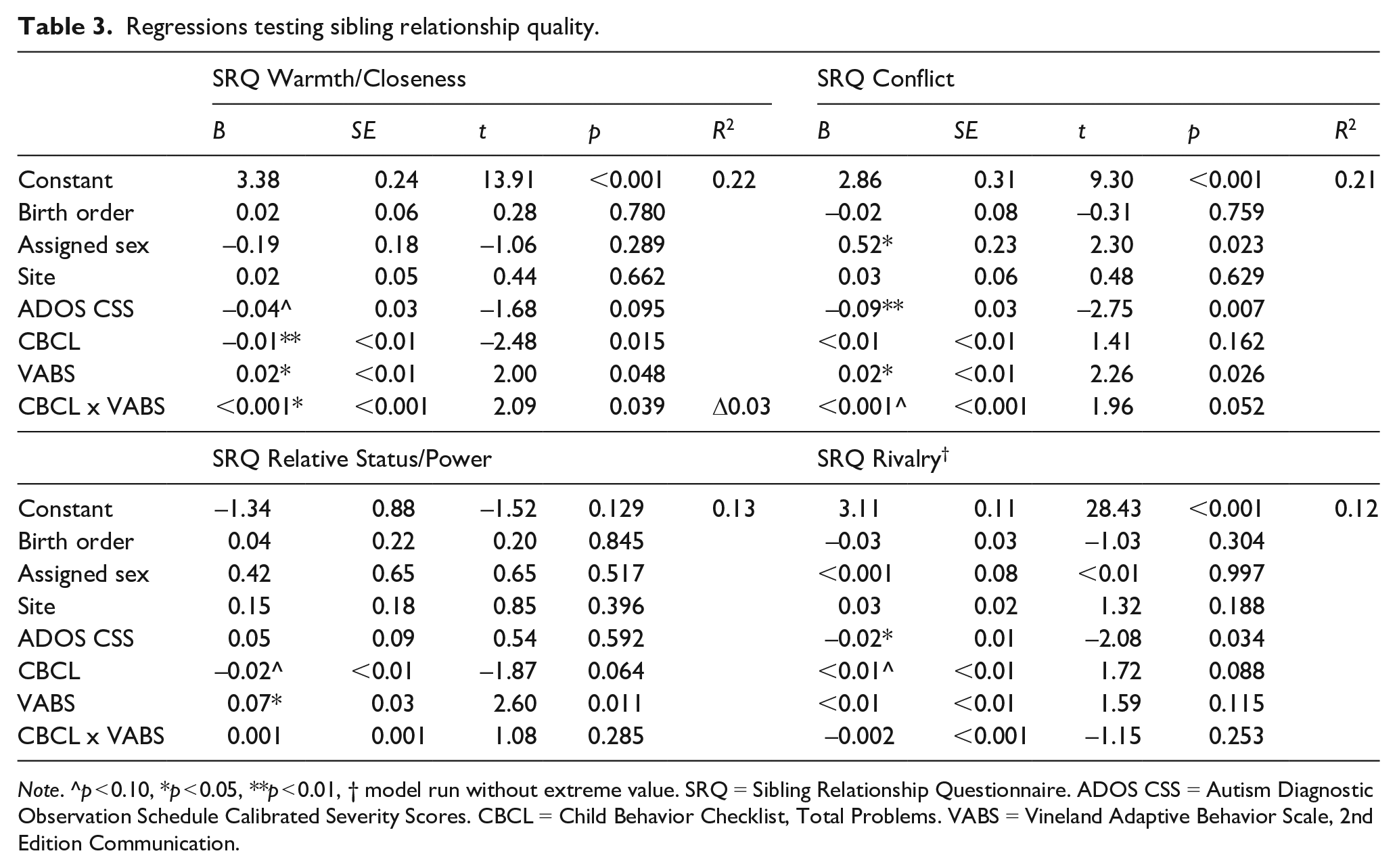
Note. ^p < 0.10, *p < 0.05, **p < 0.01, † model run without extreme value. SRQ = Sibling Relationship Questionnaire. ADOS CSS = Autism Diagnostic Observation Schedule Calibrated Severity Scores. CBCL = Child Behavior Checklist, Total Problems. VABS = Vineland Adaptive Behavior Scale, 2nd Edition Communication.
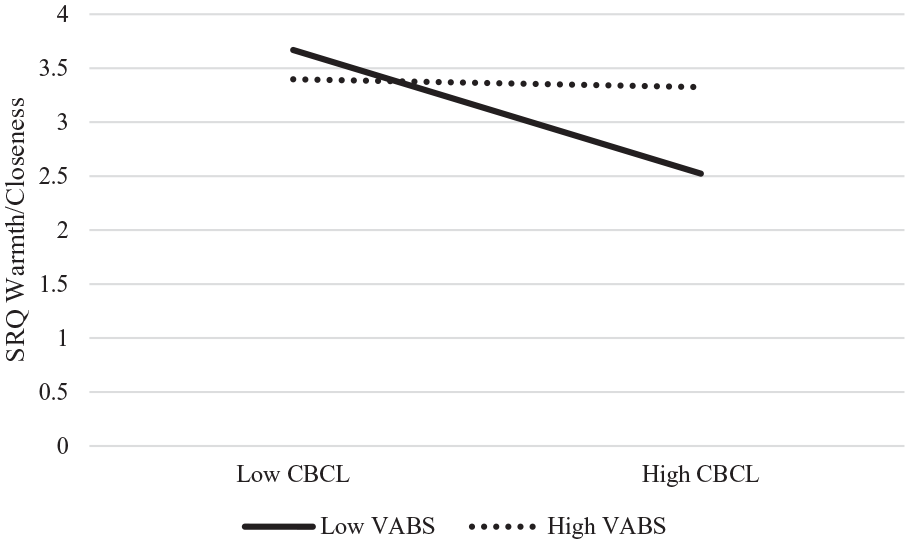
Behavioral difficulties and communication interact in their association with parent-rated warmth/closeness.
Sibling relationship quality: conflict
The full model for sibling conflict was significant (p = 0.001; Table 3). There were significant main effects of assigned sex of the child on the autism spectrum and autism symptoms, such that there was greater conflict for females than for males (β = 0.52, SE = 0.23), while more severe autism symptoms (ADOS) were associated with lesser conflict (SRQ) (β = –0.09, SE = 0.03). A significant main effect of communication was also identified, such that higher levels of communication ability were associated with more conflict (β = 0.02, SE ⩽ 0.01). An interaction between behavioral difficulties (CBCL) and communication ability (VABS) was observed but was not statistically significant (p = 0.052). The effect of behavioral difficulties (CBCL) on conflict (SRQ) was negative and smaller at lower levels of communication (VABS) and larger at higher levels of communication (β < 0.001, SE < 0.001; Figure 2). The model explained approximately 21% of the variance in conflict; the interaction explained an additional 3% variance.
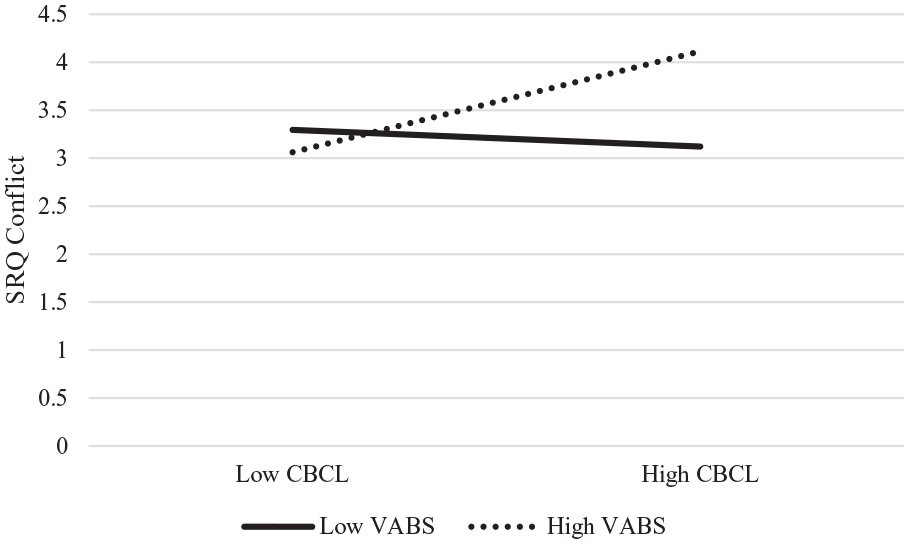
Behavioral difficulties and communication marginally interact (p = 0.052) in their association with parent-rated conflict.
Sibling relationship quality: relative status/power
The full model for sibling relative status/power was significant (p = 0.031; Table 3). There was no significant effect of autism symptom severity. There was a significant main effect of communication ability such that there were higher levels of relative status/power (SRQ) at higher levels of communication ability (VABS) (β = 0.07, SE = 0.03). The association between behavioral difficulties and status/power was not significant (p = 0.064), nor was there a significant interaction effect with communication. The model explained approximately 13% of the variance in relative status/power.
Sibling relationship quality: rivalry
As stated above, one extreme value was identified within the SRQ Rivalry subscale, and we conducted our analyses with and without this data point. When the data point was not included, results demonstrated that the full model for sibling rivalry was significant (p = 0.047; Table 3). A significant main effect of autism symptoms emerged, such that more severe autism symptoms (ADOS) were associated with lesser rivalry (SRQ) (β = –0.02, SE = 0.01). The association between behavioral difficulties and status/power was not significant (p = 0.088), nor was there a significant interaction effect with communication. The model explained approximately 12% of the variance in rivalry. When the extreme value was included, the full model was not significant (p = 0.160).
Supplemental analyses: two-child families
Because limitations in the dataset did not allow us to examine assigned sex or age of the siblings in all families, we re-ran analyses controlling for sibling assigned sex and age in a subsample of two-child families (n = 69) to evaluate the potential influence of sibling assigned sex and age on outcomes. In this subsample, siblings were 56.5% female (n = 39) with an average age of 11.32 years (SD = 4.27; minimum–maximum: 4–27). When these variables were entered into the models, only the conflict model maintained its significance; all three other models were non-significant (ps > 0.05). For SRQ Conflict, sibling assigned sex was significantly associated with conflict (β = –0.47, SE = 0.19, p = 0.019), whereas the autistic child’s assigned sex was not statistically significant. The ADOS was statistically significant (β = –0.08, SE = 0.36, p = 0.041), while the VABS was not (p = 0.126), and the CBCL × VABS interaction was statistically significant (β < 0.001, SE < 0.001, p = 0.040). These supplemental findings suggest that assigned sex of the sibling may affect relationship quality, such that there may be greater conflict when the siblings are male. Furthermore, when siblings’ assigned sex and age are covaried, the moderating effect of communication ability and behavioral difficulties on conflict (i.e. behavioral difficulties being negative and smaller at lower levels of communication ability and larger at higher levels) was strengthened.
Discussion
In this study, we examined how three clinical characteristics (autism symptoms, behavioral difficulties, and communication ability) were associated with domains of parent-reported sibling relationship quality and tested the moderating effect of communication ability on behavioral difficulties in a sample of children on the autism spectrum.
Autism symptoms and sibling relationships
Partially in line with our hypotheses, more severe autism symptoms were associated with lower levels of parent-reported conflict and rivalry. These findings align with the existing literature that children on the autism spectrum demonstrate less conflict in their sibling relationships than children not on the autism spectrum (McHale et al., 2016). Non-autistic siblings may be less engaged with or less likely to provoke their autistic siblings and therefore, less likely to demonstrate conflict with them (McHale et al., 2016). It is also possible that autistic children with more severe symptoms are less engaged with their siblings, resulting in lower conflict. Another possibility is that siblings demonstrate caring and love for siblings whose autism is more pronounced—and, therefore, are less likely to be in conflict with them—consistent with the notion that more salient differences elicit more understanding (Mikami et al., 2019). Consistent with our results, Rixon and colleagues (2021) noted higher levels of conflict in sibling relationships of children with fewer autism symptoms, better adaptive skills, and high behavioral difficulties. This pattern is consistent with what is observed in sibling relationships more broadly: Conflict is common, especially as perceived by younger siblings of their older siblings (Buhrmester & Furman, 1990). With regard to relative status/power and rivalry, few studies have examined these aspects of the sibling relationships for children on the autism spectrum, therefore, the association of autistic symptoms and reduced rivalry is quite novel. It may be that siblings of children with more severe autism symptoms are less likely to compete for their caregivers’ attention, perhaps by similar mechanisms as for conflict, that is, due to greater understanding of their sibling’s difficulties or less engagement of the child on the autism spectrum overall. Although prior research has suggested less warmth in the sibling relationships of children on the autism spectrum versus non-autistic children, we found that, among a sample of children on the autism spectrum alone, more severe autism symptoms were not significantly associated with reduced warmth. In addition, no effect of autism symptoms was observed for relative status/power.
Behavioral difficulties and communication ability and sibling relationships
Behavioral difficulties alone were not significantly linked with any domain of parent-reported sibling relationship quality, though results were approaching significance for relative status/power and rivalry, suggesting further research into these associations may be warranted. This differs from what has been found in the general population, wherein fewer behavioral difficulties have been associated with more warmth, less conflict, less relative status/power, and less rivalry (Buist et al., 2013). In a sample of children on the autism spectrum, conflict was most evident in sibling relationships when the children had milder autism symptoms, greater adaptive abilities, and more behavioral difficulties (Rixon et al., 2021). Regarding the moderating effect of communication ability on behavioral difficulties, results partially aligned with our predictions. Children on the autism spectrum with more behavioral difficulties showed less warmth/closeness in their sibling relationships when they also had weaker communication skills. Stronger communication skills were significantly associated with more conflict, and our results suggest this may be driven by enhanced conflict among children with a combination of behavioral difficulties and stronger communication skills; however, this interaction was not statistically significant, suggesting further inquiry is warranted. These findings further elucidate the link between greater behavioral difficulties and poorer sibling relationship quality (Hastings & Petalas, 2014; E. A. Jones et al., 2019; Orsmond et al., 2009), highlighting the key role of communication ability. Interestingly, this differs from a study of communication ability among children with and without a developmental disability, wherein communication ability did not affect domains of sibling relationships (Smith et al., 2013) and may point to the unique communication difficulties children on the autism spectrum experience. It may be that autistic children’s communication skills affect how behavioral difficulties are viewed by their siblings, such that better communication abilities beget more warmth/closeness. Perhaps, children on the autism spectrum with stronger communication abilities are better able to engage with their siblings, allowing for more warmth/closeness despite some conflict in their sibling relationships.
Communication ability alone was significantly related to relative status/power such that children on the autism spectrum with higher abilities had more power in the sibling relationship. It seems that children on the autism spectrum who are better able to articulate their wishes are likely to have more agency regarding their sibling relationships. Communication ability was not, however, found to moderate the effects of behavioral difficulties for relative status/power or rivalry, indicating that it likely neither bolsters nor hampers these domains of sibling relationships.
Limitations
There are several limitations in the current study. First, our findings, given that they are cross-sectional, cannot provide information on causal mechanisms or even temporality. Findings here cannot be generalized outside of the age range studied. Although our study of parent perceptions does not offer the full view of sibling relationship quality (i.e. self- or sibling report), parents provide key information about their children’s interactions, including from a historical perspective (Zucker et al., 2021). Parents are likely to be active members in family or sibling interventions and, as such, their insight is crucial to the development and success of such programs (Pickering & Sanders, 2017). Parents’ perceptions of siblings may reflect their own elevated stress or the higher demands of parents when sibling relationship quality is poorer (Roper et al., 2014). Either way, parents’ views warrant attention and may guide methods for improved family functioning overall. Due to existing constraints in the dataset, we were unable to identify which sibling parents reported upon in families with more than two children, and only assessed the relationship quality between the autistic child and one sibling. Unfortunately, this also limited our ability to report upon or control for sibling characteristics, such as age or assigned sex, in our complete sample. Nonetheless, exploratory analyses among two-child families found conflict was higher among male siblings and that covarying for sibling age and assigned sex strengthened the moderating effect of communication and behavioral difficulties on sibling conflict. Interestingly, siblings in this subsample were, on average, older, and this may help explain the overall findings of increased conflict as described above (Buhrmester & Furman, 1990). Research suggests there may be greater variability in the relationships of siblings within the same family than between siblings from different families (Orsmond & Fulford, 2018). As such, it will be important to examine multiple sibling relationships, including various gender pairings (Buhrmester & Furman, 1990; Buist et al., 2013), in future research. Next, we did not assess for psychiatric symptoms or subclinical levels of autistic symptoms in siblings (though families in which the sibling also had an autism diagnosis were excluded). Future studies which consider the clinical profiles of not only autistic children, but also their siblings, would likely add to the present findings given the bidirectional nature of sibling relationships (Watson et al., 2021). Because we only had IQ data available for a portion of our sample, we were unable to test for any potential distinct effects of cognitive ability relative to communication ability on sibling relationship quality, and this is recommended for future study. Our sample was relatively small (i.e. underpowered to detect interaction effects) and socio-demographically homogeneous; therefore, although our findings add to the literature on sibling relationships, replication with a larger and more diverse sample is needed. Of note, the inter-item correlation for Rivalry was somewhat low. This may have impacted our findings.
Future directions
Future work is needed to clarify the developmental trajectories of sibling relationship quality from the perspective of all family members. Sibling relationship quality has been shown to fluctuate throughout childhood and adolescence (McHale et al., 2012). Furthermore, in adolescence, non-autistic siblings of youth on the autism spectrum have demonstrated more negative affect (i.e. annoyance, shame, and embarrassment) than in childhood (Guidotti et al., 2021). Including measures of sibling relationship quality from the perspective of all children in the family, in addition to parent reports, is crucial to elucidating nuanced aspects of a dynamic system, such as a family. Having family members report upon multiple sibling relationships is also vital. Relatedly, capturing aspects of the family context such as parenting stress, parental warmth and harsh discipline, and the household context are all factors that likely play a critical role in the development and maintenance of siblings’ relationship quality (Chen, 2020; Dawson et al., 2015; Kretschmer & Pike, 2009). In addition, factors outside of the family also impact sibling relationship quality, such as educational level, proximity, and coping strategies among adult siblings where one was on the autism spectrum (Orsmond & Seltzer, 2007). Parent perspectives are nonetheless crucial in preparing to examine these broader questions of family, community, and societal effects on sibling relationship quality in the future.
Conclusion
Our findings underscore the importance of considering clinical characteristics of children on the autism spectrum and assessing multiple domains of relationship quality when examining sibling relationships. Core autism symptoms are not universally associated with poor sibling relationship quality. Furthermore, other clinical factors, including behavioral difficulties and communication ability, seem to be differentially associated with various domains of the sibling relationship. For instance, better communication ability was associated with more warmth for children on the autism spectrum with behavioral difficulties, and siblings showed less conflict and less rivalry for children with more severe autism symptoms. Qualitative studies highlight narratives of distress along with love and compassion from siblings of children on the autism spectrum (Leedham et al., 2020). Better understanding the factors associated with distress, as well as compassion, are crucial for promoting good outcomes for children on the autism spectrum and their siblings. Methods for improving autistic children’s sibling relationships, highlighted by McHale and colleagues (2016), may include teaching conflict resolution strategies to children on the autism spectrum with stronger communication abilities and their siblings, and fostering sibling connection for those with lower communication abilities. A support group that teaches non-autistic siblings autism knowledge and communication skills has also demonstrated positive outcomes on sibling relationship quality (Zucker et al., 2021). Sibling relationships are instrumental for socioemotional development and psychological well-being (McHale et al., 2012), and therefore, elucidating how clinical characteristics are linked with domains of autistic children’s sibling relationships is key.
Footnotes
Acknowledgements
The authors thank all the children and families who have participated in the Pathways in ASD study. The authors also acknowledge the Pathways in ASD Study Team (research staff members and trainees) who have contributed to this study. Prior iterations of this project were presented as posters at the 54th Annual Convention of the Association for Behavioural and Cognitive Therapies and the 20th Annual Meeting of the International Society of Autism Research.
Declaration of conflicting interests
The author(s) declared the following potential conflicts of interest with respect to the research, authorship, and/or publication of this article: Dr Szatmari has received royalties from Guilford Press for his book A Mind Apart: Understanding Children with Autism and Asperger Syndrome and from Simon & Schuster for Start Here. Dr Kerns has received royalties for an edited book on anxiety and autism published by Elsevier. Authors McVey, Liu, Bedford, Zaidman-Zait, Smith, Vaillancourt, Zwaigenbaum, Bennett, Duku, Elsabbagh, Bennett, and Georgiades declare that they have no conflict of interest.
Funding
The author(s) disclosed receipt of the following financial support for the research, authorship, and/or publication of this article: This study was supported by the Canadian Institutes of Health Research, Autism Speaks, Government of British Columbia, Alberta Innovates Health Solutions, Kids Brain Health Network (formerly NeuroDevNet), and the Sinneave Family Foundation.
