




Abstract
Autistic people contend with high levels of stigma in many cultures worldwide. There is a scarcity of literature on stigma in relation to autism in faith communities and virtually no research focussing on this topic in Jewish communities. In this study, we aimed to explore experiences of stigma towards autism and sought views on what steps have and can be taken to reduce such stigma. Using an interpretative phenomenological analysis approach, we conducted semi-structured interviews with 10 participants within the UK Jewish community, in both mainstream and specialist autistic schools. Interviews were conducted over 2 months in 2020. During analysis, 5 superordinate (central) themes and 13 subordinate themes were abstracted. Superordinate themes included ‘Stigma not specific to the Jewish community’; ‘Considerable strides made’; ‘More a lack of knowledge or denial than stigma’; ‘Fear of stigma is a real concern but not widely prevalent’; and ‘Potent factors that reduce stigma in the Jewish community’. We recommend workshops for greater awareness and training for teachers and parents on autism and autistic children’s experiences. We also recommend the formation of specialist autism schools in other communities and promotion of positive narratives concerning autistic people, as this successfully reduced stigma within the Jewish community.
Lay abstract
Autistic people contend with high levels of stigma in a wide array of cultures worldwide. There is a scarcity of literature on stigma in relation to autism in faith communities, with some limited research on this issue in Christian, Muslim and Hindu populations. There is virtually no research focussing on this topic in Jewish communities and to our knowledge, none at all within UK Jewish contexts. In this study, we aimed to explore experiences of stigma towards autism and sought views on what steps have and can be taken to reduce such stigma. Using an interpretative phenomenological analysis approach, we conducted semi-structured interviews with 10 participants within the UK Jewish community, including parents, rabbis, SENDCos, teachers, and headmasters of autistic children in both mainstream and specialist autistic schools. Interviews were conducted over 2 months in 2020. During analysis, 5 superordinate (central) themes and 13 subordinate themes were abstracted from the data. Superordinate themes included ‘Stigma not specific to the Jewish community’; ‘Considerable strides made’; ‘More a lack of knowledge or denial than stigma’; ‘Fear of stigma is a real concern but not widely prevalent’; and ‘Potent factors that reduce stigma in the Jewish community’. We recommend workshops for greater awareness and training for teachers and parents on autism and autistic children’s experiences. We also recommend the formation of specialist autism schools in other communities and promotion of positive narratives concerning autistic people, as this successfully reduced stigma within the Jewish community.
Autism is a lifelong neurodevelopmental condition that can affect socialising and communicating with others. It is often associated with a preference for sameness and routines, and can be characterised by deep absorption and interests (Elsabbagh et al., 2012). Autistic people also frequently experience sensory hypo- or hyper-sensitivities. Autism is common and there are approximately 700,000 autistic individuals in the United Kingdom alone (Brugha et al., 2012). Like people with other conditions (Ay et al., 2006), autistic people frequently contend with stigma. Such stigma often distends beyond the autistic person, to caregivers; this is referred to as affiliate or courtesy stigma (Goffman, 1964). Such stigma exists in many cultures (Alqahtani, 2012; Byrne et al., 2018; Gray, 2002; Liao et al., 2019; Manor-Binyamini & Shoshana, 2018; Patra & Kumar Patro, 2019; Tilahun et al., 2016). Within communities, stigma towards autistic people may be heightened by research which dehumanises autistic people (Botha et al., 2020) by arguing they constitute financial burdens (Ganz, 2006; Lavelle et al., 2014), are egotistical, self-interested (Frith, 2004), less domesticated (Benítez-Burraco et al., 2016), cannot have a sense of community or morality (Barnbaum, 2008), and that they feature integrity equal to animals (Russell, 2012). Eugenic arguments have been proffered (Barnbaum, 2008; Tantam, 2009). Autistic people have been compared to brain-damaged monkeys (Bainbridge, 2008), primates, robots (Pinker, 2002), and Great Apes (Tomasello et al., 2005). Problematic depictions of autistic people stretch back as far as Asperger (Sheffer, 2018) and stigma towards autistic children’s parents was generated by arguments presented in Leo Kanner’s research (Vicedo & Ilerbaig, 2021). Autistic people feel alienated by such problematic autism research (Botha et al., 2020; Luterman, 2019; Rose, 2020) and stigmatising terminology (Kenny et al., 2016; Sher, 2020).
Autistic children, adolescents, and university students face such stigma (Ay et al., 2006; Gillespie-Lynch et al., 2015; Kaushik et al., 2016) in diverse cultures (Gillespie-Lynch et al., 2019). Autistic stereotypes are primarily negative (Wood & Freeth, 2016), as are portrayals in English-language media (Holton et al., 2014; Huws & Jones, 2011; S. C. Jones & Harwood, 2009). Both autistic diagnoses and autistic behaviours are stigmatised; similarly, research has revealed that non-autistic people are less amenable to engage with autistic peers (Ohan et al., 2015; Sasson et al., 2017). Such stigma may make autistic people more likely to hide their diagnosis, which negatively affects their well-being (Cage et al., 2018).
Faith communities
Happé and Frith (2020) noted that the way in which cultures and different ethnicities closely affect those with autism has not yet been explored sufficiently. This study, which explores stigma and autism in Jewish communities, aims to make a contribution towards addressing this research gap. Certainly, autistic people’s experiences appear to be affected by membership of cultural groups and religion. For example, faith has been shown to play an important and highly beneficial role in autistic people’s lives (Liu et al., 2014; O’Hanlon, 2013; Turner et al., 2004). However, the benevolent approaches encouraged by many faiths do not always extend to all adherents of the religions. A study among church-going Christians in south-east England found both positive attitudes and deprecatory viewpoints concerning autistic people (Waldock & Forrester-Jones, 2020). Some Muslim parents may believe that black magic or evil ‘jinns’ are responsible for their child’s condition (Alqahtani, 2012; Diken, 2006; Endrawes et al., 2007), while others believe it is a curse (Furness & Gilligan, 2010) and are reticent to take their child out of their home (Bywaters et al., 2003; Gilligan, 2013). In India, some Hindu families may believe autism is the result of ‘bad karma’ or the evil eye (Sarrett, 2015). Such explanatory models may be used as they deflect from the familial stigma of genetic explanations (Sarrett, 2015). However, research in these different faith communities is at an early stage and one should not assume that the findings of this small body of literature can be extrapolated to all adherents within a particular faith, nor that faith itself encourages such interpretations.
UK Jewish contexts
Based on figures from the 2011 National Census, there are at least 269,568 Jews living in the United Kingdom today, although it is estimated that the actual figure is much higher (Vulkan, 2013). Some brief explanation of the denominational make-up of UK Jewry is necessary to provide context. Approximately 18% of UK Jews describe themselves as Reform Jews, 24% define themselves as secular or culturally Jewish. A slightly higher number (26%) describe themselves as traditional (or central Orthodox) and 16% view themselves as being Orthodox or ‘Haredi’ (strictly Orthodox; Graham et al., 2014). Haredi is a Hebrew term literally meaning ‘trembling’ and refers to fear of G-d. The term refers to Jews who punctiliously follow dictates of religious law and often eschew contact with material deemed contrary to a life of religious piety (Baumel, 2003). As such, Haredim may choose not to own a television, may not have internet access, and will not visit theatres or cinemas. Often, the term Haredi is used interchangeably with the designation ‘ultra-Orthodox’ or the appellation ‘strictly Orthodox’. In Britain, the strictly Orthodox sector is growing at a considerable rate and constituting an increasingly large proportion of the UK Jewish population (Vulkan, 2012). Nonetheless, the majority (53%) of British Jews who belong to a synagogue are members of the ‘central Orthodox’ or ‘traditional’ synagogue networks. Such Jews (who make up 26% of all Jews in the UK) are nominally under the UK Chief Rabbi’s spiritual jurisdiction and will often adhere to some central tenets of Jewish law, but will not follow religious dictates as fastidiously as strictly Orthodox Jews. Jews belonging to the ‘central Orthodox’ stream are often highly acculturated and embrace modernity and secular education (Freud-Kandel, 2012). Finally, the Reform and Liberal strands do not demand adherence to traditional Jewish law. Rejecting central tenets of Orthodox religious practice, these groupings are often more assimilated than their Orthodox counterparts and feature higher rates of intermarriage (Elton, 2014).
According to the most recent census data, there are over 30,900 children in Jewish schools in the United Kingdom and there are at least 88 UK Jewish primary schools, of which at least 55 are strictly Orthodox (Staetsky & Boyd, 2016). Several Jewish schools specialise in education for autistic children. Our study focussed on experiences within the central Orthodox and strictly Orthodox sectors.
Judaism and disabilities
Acceptance and respect accorded towards autistic children within the Jewish community has been ascribed to adherence to Judaic dicta and scriptures (M. Jones, 2004; Manor-Binyamini, 2012). Verses such as ‘thou shalt love thy neighbour as thyself, I am the L-RD’ (Leviticus 19:18), ‘Thou shalt not revile a deaf person, and thou shalt not put a stumbling-block before a blind one’ (Leviticus 19:14) ‘In the image of G-d He made man’ (Genesis 9:6), were interpreted by rabbinic exegetes as bestowing mercy, love, grace, and respect upon people with disabilities and adjuring Jews to treat people with disabilities with goodwill and respect. Judaic tradition indicates that a Jewish community’s piety and wholesomeness may be appraised by the manner in which it conducts itself towards members with disabilities (Manor-Binyamini, 2012).
Certainly, a cursory analysis of the Torah reveals that Judaism’s greatest religious leaders had disabilities. The patriarch Isaac was blind towards the end of his life. Jacob was injured in an enigmatic encounter with a stranger and limped for the remainder of his life. Moses, deemed to be the greatest Jewish leader, had a speech impediment. A central tenet of Judaism is that all human beings were fashioned in the Divine image of G-d and, therefore, all human beings are worthy of respect and dignity (Genesis 1:27). Rabbinic writings also caution against stigmatising another human. To take one example in Pirke Avot, (Dicta of the Fathers, 4:3), Ben Azzai declared ‘Despise no one and call nothing useless. For there is no person who does not have his hour – and no thing that does not have its’ place’. The Babylonian Talmud also makes clear that all Jews are responsible for each other’s welfare (Shevuot 39a). Jews are told to look beyond exterior manifestations of disability; ‘Do not look at the container, but what is in it’ (Pirkei Avot 4:27). Perhaps most revealingly, the Talmud rejects stigmatising others as, in fact, showing a flaw in the person who denigrates his fellow; ‘When a person insults someone else, it is his own defect that he is revealing’ (Kiddushin 70a).
There are very few articles focussing specifically on autism within the Jewish community. One qualitative study found that religious Jewish mothers opposed stigmatising, negative labels given by doctors such as ‘retarded’, and were resolute in not giving up hope for their autistic children to succeed (Shaked & Bilu, 2006). Some mothers cited Jewish religious writings to indicate that their autistic children were reincarnations of particularly virtuous souls. This quote was typical: ‘He is as clean as a baby in many ways; I can see it on his face too, he has that angelic and childish [expression] of one who has done no evil’ (Shaked & Bilu, 2006, p. 15). While in more secularised cultures, emphasising a saintly or spiritual quality might be problematised as lessening children’s ‘humanity’, in Orthodox Jewish communities, where attaining greater spirituality is deemed the raison d’être, such depictions of autistic children as being G-dly paint the children in a positive light (Shaked & Bilu, 2006). The reduction in communal stigma could be attributable to rabbis according immense respect to these children. A popular account relayed that when an autistic child entered a revered rabbi’s room, the minister would stand in honour of the child. The sage conveyed to his followers that he did so as these children were holy and had particularly pure souls. Mothers of autistic children drew upon these stories with pride (Shaked, 2005).
Strictly Orthodox Jewish marriages are often facilitated by a matchmaker, which necessitates circumstances of the potential bride and groom being considered prior to courtship. Conditions such as autism can constitute a familial stigma that hinders finding an appropriate match and may encourage families to conceal such conditions (Shaked & Bilu, 2006). However, increasing societal acceptance has ensured stigma and efforts to conceal the condition have decreased (Shaked & Bilu, 2006).
To the authors’ knowledge, there are no publications specifically focussing on stigma of autism in the context of Jewish communities. Similarly, while there are isolated articles on autism within Jewish communities, there is only one situated within a UK context (Sher et al., 2021). This focussed on experiences of linguistic decision-making and found that Jewish parents and practitioners were understanding of autistic children’s need to be integrated within the community and that forced monolingualism (a practice regarded as unjust and discriminatory) was rejected by the UK Jewish community (Sher et al., 2021). While that study was important in being the first to consider the experience of autistic people within the UK Jewish community, it did not focus on the issue of stigma in particular. This focus is the unique contribution of this study.
This study
Due to the lack of research evidence and the importance of reducing stigma of autism in all sectors, we crafted a study to explore this topic. We approached adults closest to the autistic children, who frequently engage with them and would be aware of any stigma faced and the children’s experience of this (if applicable). This study asks two main research questions:
What are the experiences of rabbis, parents, and educators of autistic Jewish children regarding stigma towards autism?
What steps have and can be taken to reduce stigma towards autism?
Method
Study design and methodological approach
This is an exploratory, interpretivist study that employs interpretative phenomenological analysis (IPA) as the methodological approach for data collection and analysis. This exploratory design is particularly appropriate due to the absence of research exploring this topic. IPA explores participants’ experiences and semi-structured interviews are viewed as the pre-eminent method of data-collection in the IPA approach (Smith et al., 2009).
In accord with methodological trends within IPA paradigms and recent autism research (Hebron et al., 2015; Larkin et al., 2019; Makin et al., 2017; Reid et al., 2005), this study sought to approach the research questions through exploration of the experiences of religious leaders, parents, and practitioners. The fact that participants were members (or leaders) of the Jewish community and had personal or professional experience of autism, including as parents of autistic children, helped facilitate community involvement.
Researcher reflexivity
We adopted a reflexive approach in our research. The first author completed a reflexive journal. The first author is an ordained rabbi, holds degrees in Jewish education, education and psychology, and has received qualitative research and IPA training from an original pioneer of IPA. The second researcher holds psychology and speech and language therapy qualifications, has completed qualitative research training and has personal and professional experience of neurodevelopmental difficulties. The third researcher has completed qualitative research training, holds a degree in psychology and works within several Jewish schools.
Participants
Recruitment
The study was conducted in the United Kingdom and is part of a wider project based at the University of Cambridge, which explores the experiences of Jewish autistic children and their caregivers in relation to religiosity, school choice, language learning, and other such experiences. This study explored the experiences of significant adults in the lives of autistic Jewish children. We, therefore, cast a broad recruitment net and sought rabbis, parents and educational practitioners, using the following inclusion criteria.
Rabbis:
Were ordained ministers of the Jewish religion;
Had Jewish autistic children as members of their congregation or organisation;
Self-identified as a member of the UK Jewish community.
Parents:
Cared for children with a formal autism diagnosis;
Self-identified as a member of the UK Jewish community.
Practitioners:
Were directly involved in educational provision for a child with a formal autism diagnosis;
Self-identified as a member of the UK Jewish community.
Please see Table 1 for demographic information, including age, gender, Jewish denomination and educational attainment levels.
Demographic information for participants.
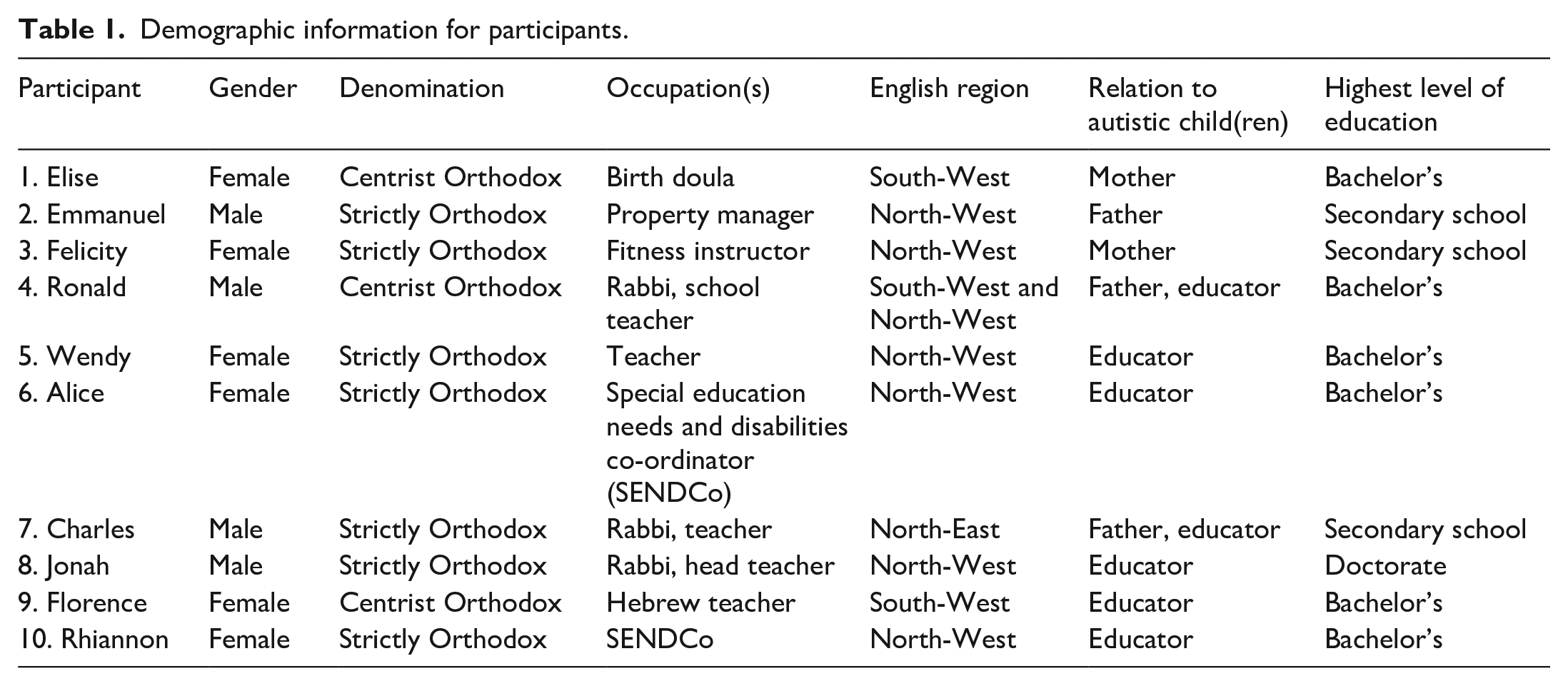
Based on previous autism research and recommended sample sizes for phenomenological research (Guest et al., 2006; Howard et al., 2019a; Morgan, 2002), we recruited 10 participants.
This study employed purposive sampling for participant recruitment for interviews. As Smith et al. (2009) outline, IPA studies should have relatively homogeneous samples, but there should be scope for comparison between the different participants. Thus, we sought a degree of variation between participants, so that experiences of participants caring for autistic children in differing settings would be represented. This was important in overcoming the research ‘parochialism’ of only reflecting the experiences of one particular setting or group. All participants were members of the Jewish community.
Procedure
The COVID-19 pandemic precluded face-to-face interviewing, and so participants were interviewed remotely, via teleconferencing software such as Skype or Zoom. Interviews featured questions relating to stigma and autism. Two key questions were asked of each participant; ‘From your experiences, do you think there is stigma towards autism within the community?’ and if applicable, ‘How do you think attitudes towards autism have changed over the years?’ These anchored the interview topic and allowed follow-up questions. Such questions included ‘Do you think parents are embarrassed to have autistic children?’ ‘In your experience, what factors have caused changes in stigma towards autism?’
Interviews were conducted in a semi-structured manner, as this afforded the researcher latitude to pursue certain points. Interview questions were open-ended and crafted to capture accounts of lived experience (Smith et al., 2009). All interviews were conducted in English. Interviews were conducted over 2 months in 2020.
Ethical approval
Ethical clearance was applied for and granted by the institutional Ethics Committee. Participants were recruited via faith leaders and school gatekeepers, who circulated pamphlets containing details of the study. Informed consent was given by all participants. Pseudonyms are used throughout this article.
Data analysis
Interviews were audio recorded and transcribed verbatim. Pauses and false starts were noted to contextualise the interviews. Transcripts were read several times and then annotated. This process was repeated until all themes had been noted (see Table 2).
Outline of stages of IPA analysis employed in this study.
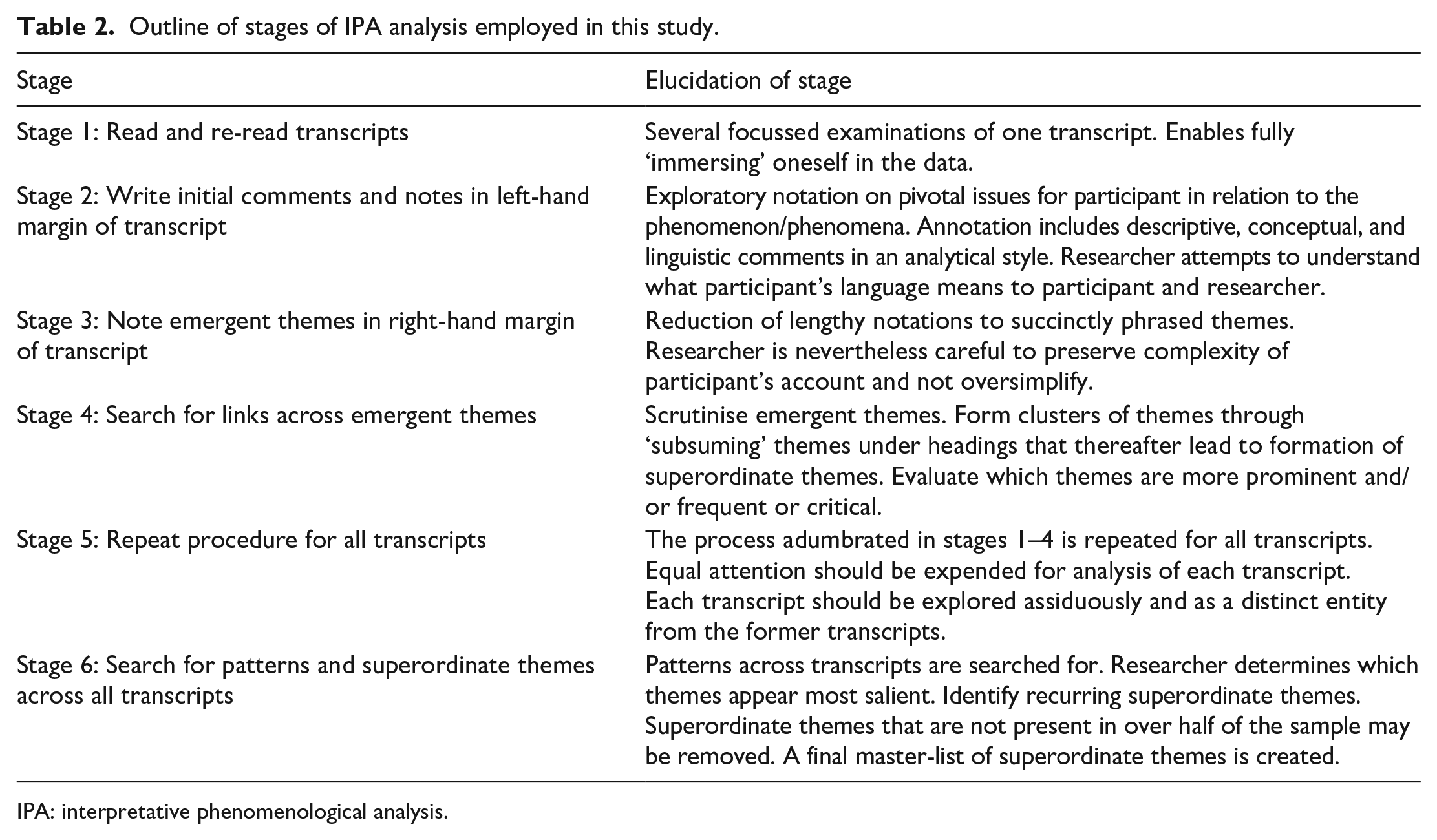
IPA: interpretative phenomenological analysis.
Following identification of themes, duplicate themes were deleted and a final master-list of superordinate and subordinate themes was created. Following this, two independent researchers perused the documentation, to ascertain if themes had been coherently abstracted.
Member-checking
The researchers utilised member-checking. Thus, participants received their transcript copy and were able to alter or elaborate on the accounts they provided.
Community involvement
This study was committed to research ‘with’ the autistic and Jewish communities rather than ‘on’ these sectors. Participants from both autistic and Jewish communities were consulted regarding recruitment, design, and implementation of the study and advised on how the study should be cognisant of parental preferences and concerns. The fact that two researchers were members of the Jewish community (one a rabbi) and that all participants were members (or leaders) of the Jewish community and had personal or professional experience of autism, including as parents of autistic children, helped facilitate community involvement. Following publication of this article, community members will be offered information about the study results through an email suitable for lay participants.
Results
This study featured 10 participants. Five superordinate and 13 subordinate themes were abstracted from the data (see Table 3).
Superordinate and subordinate themes.
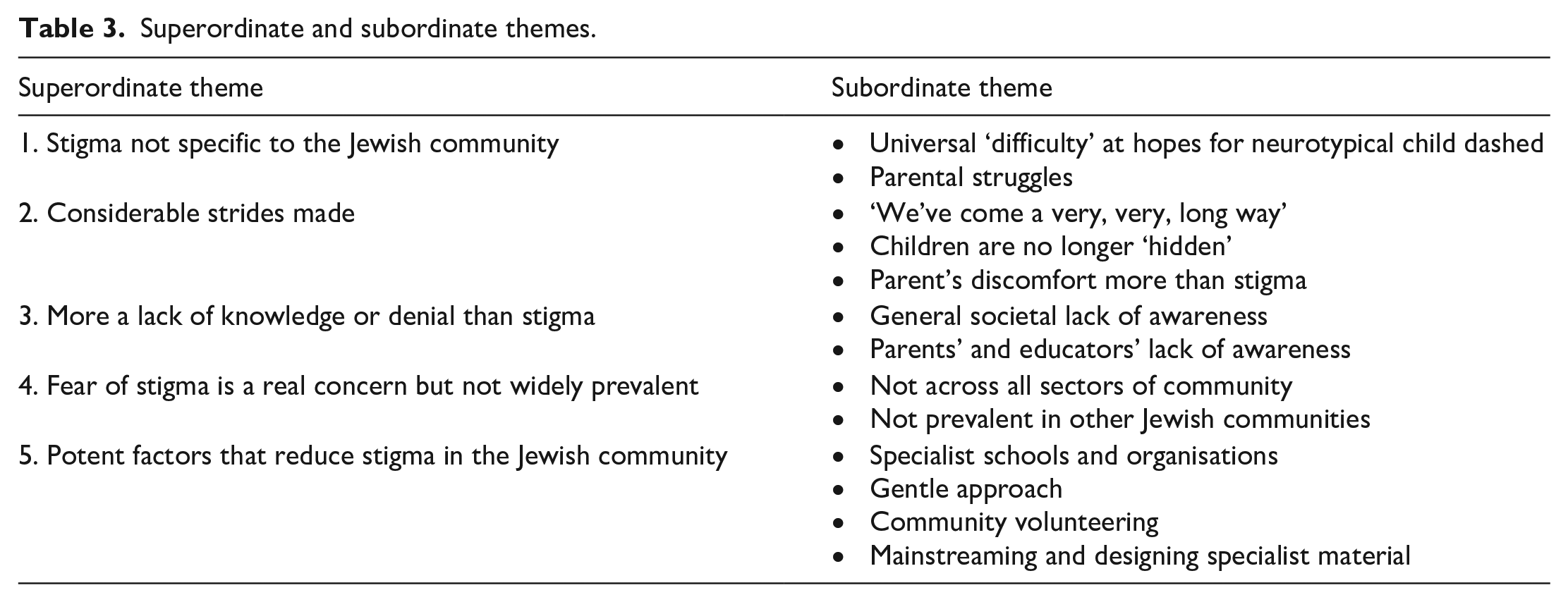
Superordinate and subordinate themes
Superordinate theme: stigma not specific to the Jewish community
Subordinate theme: universal ‘difficulty’ at hopes for neurotypical child dashed
Participants emphasised that stigma in relation to autism was not particular to the Jewish community; rather it was a worldwide concern. For example, Florence, a centrist Orthodox teacher in a specialist autistic, traditional Jewish school declared:
‘So I think . . . there’s still a global stigma so like we, as a whole, in society in general need to start shying away from [this stigma] . . .’ (Florence, 9)
Florence also provided a particularly rich account in which she explained how a worldwide stigma towards autism might develop:
‘We tend to forget . . . when you’re expecting a child, you’re not expecting to have a child with additional needs or with cognitive impairments, physical impairments . . . You picture this child as a beautiful, whole, healthy, neurotypical child that you’re going to bring into the world and . . . raise in the same kind of way that you were raised and they’re going to grow up to be fantastic human beings who make this wonderful change in the world. And then these parents have this child and their entire world comes crashing down because it’s not what they’ve expected . . . And I think it takes a long time for the family to come to grips with that and to acknowledge it and never mind just acknowledge it, but to accept it and make strides towards supporting the child . . . in the interim, between accepting, acknowledging, and supporting, there is sometimes embarrassment because of the way people look at them and how their child is behaving, or they might query or comment on their parenting skills and say your child is acting this way because you’re not doing XYZ’. (Florence, 9)
The vivid language used and the dramatic tone that Florence employed (‘crashing down’) seems to have been utilised to illustrate the considerable impact she believes parents face with an unexpected change in plans.
Other participants agreed:
‘This is generally . . . for any parent from any cultural background, it’s difficult to hear. Because you know, the illusion or hope that their child would be a normative, typical child . . . is shattered. And parents aren’t generally happy to hear such things’. (Rhiannon, 10)
Subordinate theme: parental struggles
Parents struggled with difficult choices. However, the emphasis on the stigma not being rooted within the community was underscored. For example, when asked if her embarrassment of her child making disruptive noise in synagogue would be specific to the Jewish community or would be applicable to all communities, Felicity replied:
‘If [in non-Jewish houses of worship] there would be religious practices that everyone would be deeply concentrating [in], then yes, I would feel bad if I brought my child who isn’t capable of doing that service anyway and would be making a racket and disturbing others’. (Felicity, 3)
Here, Felicity made clear that private scruples meant she made the personal, difficult, choice not to bring her child to synagogue and that she envisaged that the same would apply in any faith community where an autistic child might disturb the religious services. Other parental struggles referred to included the struggle to ensure that on the one hand, nothing should affect their child’s matchmaking prospects, while still balancing a need to provide support from outside sources in the public eye. This struggle was said to have receded in recent years (Alice, 6).
Superordinate theme: considerable strides made
Subordinate theme: ‘we’ve come a very, very, long way’
All participants believed that while further efforts were necessary, considerable strides had been made within the Jewish community to combat stigma. Some understood this to be related to a general societal shift to be more accepting of special education needs and disabilities (SEND);
‘There have been massive leaps and bounds in the way . . . special needs is viewed in society and the way we engage in people with additional needs and the way we [now] approach [this issue] is fantastic’. (Florence, 9)
Rhiannon, a SEND teacher working with autistic children, explained that the Jewish community had progressed in enhancing awareness, recognition, and support for autistic people:
‘So . . . I think that yes, there is a degree of stigma, but I think we’ve come a very, very, long way in recognising it and understanding it and supporting it . . . that people with autism . . . can achieve very great things in life and can develop specific talents and can excel in ways which other people can’t’. (Rhiannon, 10)
Rhiannon’s phrase ‘a very, very, long way’ seems to be used to indicate her appraisal of the significant extent of positive change. The view that matters had improved was reflected in this account from Emmanuel, who reflected on advances made within the strictly Orthodox community:
‘It’s becoming more accepted for people to understand it. It’s definitely something that is improving . . . in that aspect’. (Emmanuel, 2)
Jonah, a rabbi, and head teacher of a mainstream school indicated that such improvement within the Jewish community had led to more acceptance by parents of their child’s autistic diagnoses and less denial of the existence of the condition:
‘I think that the point is that as a school and as society, I think there’s more acceptance now. If we went back 30 years ago, even 15, 20 years back for sure, but over the last 10 years, I think parents have been much better’. (Jonah, 8)
As head teacher, he pointed to parenting workshops organised by the school as also important in reducing stigma. Participants acknowledged that despite improvements, a stigma still existed. Nevertheless, they related that schools were ‘moving away’ from a psychiatric emphasis on diagnostic labels which could be a source of stigma:
‘Um . . . definitely, definitely a stigma . . . that has been an issue . . . but . . . what we’re trying to do is to move away from that and move towards an understanding; ‘Let’s see how we can resolve and solve rather than label the child’. (Jonah, 8)
A very similar account was provided by Charles, a rabbi and teacher:
‘We have tried our very best to remove that stigma. There’s definitely some stigma still there, it’s virtually impossible to get rid of that stigma. We have made massive, massive steps in the last few years to remove that stigma’. (Charles, 7)
In repeating the ‘word’ massive, Charles conveys his view of his perception of the immense extent of constructive change.
Subordinate theme: children are no longer ‘hidden’
Emmanuel, a parent from a strictly Orthodox Jewish community, declared that parents’ openness and lack of shame when accompanying their children beyond the home was indicative that stigma within the Jewish community had appreciably decreased. Emmanuel explained:
‘You feel when you take care of these kids, nobody is embarrassed to take them shopping or to take them to shul [synagogue]’. (Emmanuel, 2)
Other participants concurred that a greater presence of autistic children now manifested itself within the community and this promoted respect and understanding towards autistic people.
Subordinate theme: parent’s discomfort more than stigma
Some parents were candid in their assertions that their reticence to bring their child to worship was attributable to their being uncomfortable in settings where their child could be disruptive; they underscored this did not stem from stigma:
‘His father [i.e. her husband, father of their autistic son] he might get a bit embarrassed if he makes a lot of noise. Which is probably why we don’t bring him to shul [synagogue] because he would disturb the davening [Yiddish for ‘praying’]. Anyway, but nobody else is being at all condescending, it’s coming from us, like we feel bad when we go . . . because he can’t be quiet and it disturbs other people. Nobody has made a comment to me, I just feel bad’. (Felicity, 3)
Felicity’s reiteration that she avoids taking her autistic son to synagogue due to her own conviction appears to express her belief that the community has not caused her embarrassment; rather, she simply does not want other worshippers’ prayers to be disrupted by her son.
Elise similarly related that from her experiences, she felt that within centrist and modern Orthodox sectors of the community, stigma was simply not extant. Interestingly, Elise’s father, a rabbi in an affluent provincial congregation, welcomed an autistic child who was most vocal during services. The community proved tolerant and were welcoming, despite the service being significantly disrupted, as they recognised the child was not intending to disturb.
Similarly, other participants felt that parents should not feel embarrassed to take their children to synagogue even if that might disrupt others, as others have awareness of autism:
‘What I experienced through my students . . . one example is we have a family who felt they couldn’t come to shul [synagogue] Saturday morning . . . Because their child was disrupting the service and it wouldn’t be fair to the other families . . . trying to pray . . . In my opinion, there’s a very big difference between a rowdy child who’s making bad choices, and a special needs child who . . . has high sensory needs and is quite vocal during a service because that’s what they need to kind of calm themselves down and regulate . . . And . . . I like to give people the benefit of the doubt and I like to think . . . people are quite aware of the differences in these two types of children um . . . I don’t think most people are that ignorant’. (Florence, 9)
Superordinate theme: more a lack of knowledge or denial than stigma
Subordinate theme: general societal lack of awareness
Participants reported that they perceived a greater issue of a lack of knowledge about autism rather than stigma, although the issue of lack of awareness was gradually improving. Participants declared that this was a societal problem and not specific to the Jewish community:
‘Mm . . . I think . . . generally there is not enough exposure and education . . . and I think it’s a massive spectrum and people are very, very, worried as soon as they hear the word autism, or ASD [autism spectrum disorder], or your child may . . . be displaying behaviours that suggest . . . that look like behaviours on the spectrum’. (Rhiannon, 10)
When asked if there was any stigma within the community, Emmanuel, a father of two autistic children, replied that there was some, but then explained:
‘And ignorance, there’s definitely . . . ignorance . . . but it’s becoming more accepted for people to understand it’. (Emmanuel, 2)
Subordinate theme: parents’ and educators’ lack of awareness
Alice, a Spanish-English bilingual special education needs and disabilities co-ordinator (SENDCo) highlighted that it was not stigma but lack of awareness:
‘One story I can tell you . . . I saw all the symptoms [of autism], I had all the evidence . . . all my assessments and everything and then when I sent [the autistic child] to her [the educational psychologist], I told her [concerning] these parents, “I cannot even say [to the parents of the autistic child] why I sent [the child] to you. I can tell you [i.e. the educational psychologist] that I can see the [autistic] symptoms . . . but I cannot even say [to the parents] . . . [and] cannot even really [make the parents] understand why they are going to you. So I ‘made it up’ that the child has some emotional difficulty [as a ruse to ensure they seek psychological counsel] but I can tell you [i.e. the educational psychologist] that I don’t know how to say this to the parents . . . [as they do not understand what autism is] so it’s not really a stigma, because they don’t know’. (Alice, 6)
Alice’s detailed account highlights that parents are sometimes not fully aware of autistic symptoms and that in her experience there is a lack of knowledge rather than a stigma.
Elise, a mother of an autistic child, emphasised that a lack of awareness was not unique to the Jewish community but was one facing human society and that this included parents of autistic children:
‘But I think there’s also such a lack of understanding of what autism actually is . . . Anyone who has exposure to autism and understands it more, probably is less worried about stigma’. (Elise, 1)
On the contrary, Alice declared regarding parents and teachers in her particular school:
‘My problem is the opposite. They don’t even know what is autism. And therefore they cannot identify if the child is autistic, they cannot go to [get] an assessment’. (Alice, 6)
Alice’s words ‘don’t even know’ seems to highlight her incredulity at this. However, she emphasised that this lack of knowledge might be specific to her school and did not apply to all parents, for some were very knowledgeable about autism. She relayed she had met several strictly Orthodox parents who were particularly informed and had adopted an ‘autism advocate’ role:
‘I met a few parents; they were very open and gave names and said if someone wants to speak to me, tell them to call me . . . I had a boy . . . in our school . . . The parents were very, very, open and okay [about their child’s autism]. But she was Israeli the mum, so a different type. But she was like everyone, tell everyone my name; I am happy to help! And she really has!’ (Alice, 6)
Superordinate theme: fear of stigma is a real concern but not widely prevalent
Subordinate theme: not across all sectors of community
All participants acknowledged that a stigma existed. Alice ascribed this to familial concerns about matchmaking
‘The shidduchim [matchmaking] and everything . . . yeah it’s normal. Parents are very embarrassed’. (Alice, 6)
Intriguingly, participants referred to parents’ fear of being stigmatised sometimes being stronger than the stigma itself. Parents indicated that this was not widespread across all Jewish sectors of the community. Elise, a mother of an autistic boy explained:
‘I guess it depends which parts of the community . . . I did an autism training course . . . it was put on by [London borough authority] and it was just parents of children with autism . . . it was really interesting and . . . taught me to be able to understand . . . how his brain processes . . . And then the people organising it said we’re actually going to put one on for religious Orthodox Jews in your community . . . Anyway, no one signed up. Not one person. And I promise you that there are children in [area of London] with autism but nobody wants to be seen in a place where people now know . . . I think that’s really sad . . . It gave me such a huge insight into parenting and understanding the fact that there is stigma and people don’t want people to know. They’re losing out and their kids are missing out and [they] can’t use approaches which are helpful and useful because there’s a lack of understanding’. (Elise, 1)
However, Elise emphasised that this was not a universal approach and there were parents within the Jewish community who were both proud and open about their autistic family members. When asked if fear of stigma was prevalent in other Jewish streams, she replied:
‘So from my experience no. For example, that Facebook group [an autistic Facebook group] is not just Jewish but there is a big Jewish section on it and those [Jewish] people will post stuff with their names and about their children and sometimes it’s really harrowing . . . and people really go through challenges and there’s none of that ‘please don’t tell anyone who knows me’ . . . people speak about it much more openly . . . I’ve met people who are like ‘I’ve got a child, this one has autism’. (Elise, 1)
Some parents explained how while they found that several strictly Orthodox schools were very supportive and understanding of SEND needs, within certain sectors of the strictly Orthodox Jewish community, fear of social stigma could influence parents’ decision-making on school-choice. For example, Ronald explained the dilemma facing him concerning his autistic daughter’s secondary school choice:
‘She could go to [the non-Jewish school] and they can work on her maths and English and all sorts of things, but maybe socially it’s better for her to go to [a religious] seminary . . . I think it’s a very difficult thing because if she goes to [the non-Jewish specialist school], I think there is a social stigma. And it’s very difficult as a parent to choose . . . she’s one of those kids who . . . can fit in, in inverted commas ‘normal society’ . . . But on the other hand, behind that, she’s very, very, vulnerable and very, very, uch it’s just very, very, difficult’. (Ronald, 4)
Ronald’s repetition of the word ‘very’ several times effectively portrays the painstaking decision he is currently facing.
Subordinate theme: fear of stigma not prevalent in other Jewish communities
Alice explained that she found that strictly Orthodox communities abroad had considerable awareness concerning autism,
‘So in Israel, yes. In America yes, but not in England. England is still very different’. (Alice, 6)
Alice opined that as SENDCo, she confronted this issue by educating staff,
‘And I came here and the local authority are like . . . the teachers don’t have the knowledge’. So my job as a SENDCo is to build a structured programme so that the teachers can learn more . . . they don’t have university [training] and somebody needs to help’. (Alice, 6).
She stated that strictly Orthodox communities in the United States of America and Israel had greater autism awareness than in the United Kingdom and ascribed this to compulsory SEND education in Israel.
‘So it was so different [in Israel] . . . I didn’t have a problem to explain to [Israeli] parents that your child has ASD . . . there was so much more knowledge there [than in the UK]. In the institute in Israel, we teach every regular teacher, even if it’s not a special needs course. Every single teacher in Israel learned [about] disabilities of learning or differences’. (Alice, 6)
The fact that communities in the United States of America and Israel have greater autism awareness was also similarly reflected in Elise’s account (Elise, 1).
Superordinate theme: potent factors that reduce stigma in the Jewish community
Subordinate theme: specialist schools and organisations
Over time, several Jewish schools specialising in education for autistic children have been established in the United Kingdom. Participants referred to this development as being especially important in combating lack of awareness and stigma:
‘There’s two ways that I see it changing in the community. One is the fact that we have now, the community is offering more than one school for these children. That’s number one. That is making a social awareness automatically, the fact that there is a presence, whereas years ago people would hide these children . . . They can now go to this school and one would say ‘Yes, my child is learning for example in [name of Jewish specialist autistic school]’, and people would start understanding straight away what that means’. (Emmanuel, 2)
(For Emmanuel’s second reason, see Subordinate Theme: Children are no longer ‘hidden’, above). Emmanuel’s account clearly indicates that in his experience, parents now openly relay their child’s condition and feel uninhibited in conveying to community members that their child attends a specialist autistic school.
Other participants indicated that the formation of schools and organisations focussing on autistic children within the Jewish community has been critically important in reducing stigma:
‘So yes . . . maybe there is some sort of embarrassment but . . . over the years it has become a lot better, it used to be a lot more of a stigma I think . . . With more organisations and more schools opening up geared towards these children and showing how these children can be helped and able to reach their true potential, I think . . . parents are becoming a lot more open minded and seeing that it is actually a normal thing and not every child is the same’. (Wendy, 5)
Subordinate theme: gentle approach
In a revealing vignette, Jonah, a rabbi and head teacher of a mainstream Jewish school indicated how parents manifested greater acceptance of their child’s condition and that a gentler, incremental approach used when revealing to parents that their children may be autistic was efficacious in preventing denial over autism:
‘As a school and as society, I think there’s more acceptance now . . . Over the last 10 years, I think parents have been much better. So we’ve not thrown it on them . . . [rather, we relay to parents in the following manner] ‘You know, this is a child, it’s a process and . . .we look at the issues . . . the difficulties, look at the challenges, let’s try work out why, get an assessment’. It works a lot better . . . ‘Why is my child not . . . ?’‘So let’s look at that and then bit by bit [the parents come to the realisation themselves].’ (Jonah, 8)
The detailed narrative and dialogic style between parents and educators appears to be employed by Jonah to illustrate the way in which parents gradually coming to the realisation of their child’s condition alongside a practitioner can be especially sensitive and help reduce shame.
Subordinate theme: community volunteering
Among other factors deemed to be important in reducing stigma, participants cited community members volunteering to assist autistic children or work in autistic school. Summer camps and clubs for autistic children had also been arranged within the Jewish community. Wendy, a teacher in a Jewish specialist SEND school, who also volunteers to assist autistic children, reflected:
‘. . . there’s a lot of volunteers like myself who work in these schools from the wider community who do try and help these children and other people can see that it’s not a stigma, it’s amazing that these children can reach their potential and people trying to help them’. (Wendy, 5)
From Wendy’s account, it seems apparent that with greater exposure to autistic children, greater acceptance and reduction of stigma ensues.
Subordinate theme: mainstreaming and designing specialist material
The head teacher of one specialist autistic school described the school’s innovative efforts to reduce stigma. Charles described how children in his school who were pleased to do so, joined a mainstream Jewish school for periods during the week:
‘We have made massive, massive steps in the last few years to remove that stigma . . . A key aspect in removing that stigma, is . . . social mainstreaming. So historically, parents . . . kept [autistic] children in mainstream schools . . .And that child becomes a drain and a drag . . . in the class [in the mainstream school]. Because the child is there all day. He gets a little bit of help but actually they really, really, really, struggle. Now if this child is in the class . . . the whole time, they’re going to be looked at negatively . . . .Whereas if you only have the child there for a very short space of time . . . and it’s more of a pleasure to have that child in that class . . . the class are proud to be associated with the other child. It creates far more positive views about . . . that child . . . They’re not acting out . . . because they’re only there for a little bit of a positive time whereby they can manage to be there’. (Charles, 7)
In explaining how he believed this reduced stigma, Charles explained:
‘It’s exposure. The amount of exposure is limited and putting this child in the best light. So let’s say we have a child learning [in our school] . . . specifically with autism and they . . . finished a Sedra [Bible portion] in Chumash [the Pentateuch], we will invite the mainstream class for a party, to a siyum [celebration to mark the completion of study of a section of scripture]. Where that child becomes the star. If that child was the pitied individual in the class and the class are sick and tired of the way this boy was misbehaving and disturbing . . . they wouldn’t have positive feelings for this child. So it’s having that positive interaction with their peers in a constructive way, it’s far more valuable than saying ‘No this child belongs in mainstream [schools]’ . . . We wanted our school to be an upbeat, positive, exciting, place to be, where people are proud to be there and we want them to have other people to look at it that way as well’. (Charles, 7)
This somewhat forthright but particularly revealing account candidly conveys the thinking behind this ‘social mainstreaming’ and efforts to ensure autistic children are portrayed positively and pejorative portrayals are avoided. Charles also relayed that the strictly Orthodox community had developed a specialised flashcard memory aid programme tailored for autistic children to enable them to read and comprehend Hebrew scriptures with greater ease. This allowed autistic children to participate in lessons and not face isolation or feelings of incompetence. Such support for autistic children was not limited to practice in specialist schools. Ronald relayed concerning his daughter’s mainstream school:
‘I think within the school that I teach in . . . it’s very caring . . . I have to say, my younger daughter gets support in all lessons, so they do want her to be involved.’ (Ronald, 4)
Discussion
This study is the first to consider experiences of significant adults in the lives of autistic Jewish children, including rabbis, parents, and educators, regarding stigma towards autism and steps undertaken by the Jewish community to reduce stigma.
The superordinate theme ‘Stigma not specific to the Jewish community’ reflected participants’ view that stigma in relation to autism is not an issue unique to the Jewish community and that this is an issue affecting humanity as a whole. Certainly, this appears to be in accord with existing literature, which found that stigma concerning autism exists in heterogeneous cultures and in many countries and settings (Alqahtani, 2012; Botha et al., 2020; Cage et al., 2018; Gillespie-Lynch et al., 2015, 2019; Holton et al., 2014; Huws & Jones, 2011; S. C. Jones & Harwood, 2009; Kaushik et al., 2016; Ohan et al., 2015; Sasson et al., 2017; Wood & Freeth, 2016; Yu et al., 2020). Participants stressed that all people, regardless of creed or culture, would likely feel distress upon discovering that their plans for their child were profoundly altered. This accords with literature indicating that Muslim parents struggled with accepting their child’s diagnosis but were comforted in the knowledge that this is G-d’s Will (Jegatheesan et al., 2010).
Interestingly, participants were consistent in never ascribing stigma as being generated from Judaism itself, which participants viewed as an asset in combating prejudice and stigma. Reports about ministers and several congregations being accepting of autistic children in synagogue, even when they disrupted services, were potent reminders of this. This resonates well with literature indicating Jewish scriptural injunctions on the need to treat people with conditions such as autism with dignity and respect, alongside rabbinic narratives on autistic people being holy and virtuous, which encouraged positive portrayals of autistic people within observant Jewish communities (M. Jones, 2004; Manor-Binyamini, 2012; Shaked, 2005; Shaked & Bilu, 2006). It might well be a consideration for other non-Jewish communities to draw upon positive narratives concerning autistic children.
Although parents may attribute not bringing their autistic children to synagogue to be a result of their own scruples and state congregants have never made insensitive comments, it seems prudent to suggest that rabbis should consider ways in which autistic children will be actively welcomed to join the congregation for worship where practicable, or for other communal events. This may encourage parents to overcome natural inhibitions in bringing their autistic children to worship as they perceive they might ‘disturb’ proceedings. Certainly, idiographic studies have shown that several synagogues have successfully ensured that autistic children are able to mark religious milestones publicly (Hyman, 2009; Muskat & Putterman, 2016).
As reflected in the superordinate theme ‘Considerable strides made’, importantly, this study found that all participants believed that significant, successful, advances had been made by the Jewish community in combating stigma of autism and that there was now far greater recognition and understanding of autism. There was also a decrease in the phenomenon of parents being unable to come to terms with their child’s autism. This was an especially salient theme, with participants using particularly expressive language to reflect the positive development. For participants, tangible results of such development were manifest in children no longer being kept at home and a greater openness pervading. This finding reflected research concerning autistic children in Israeli religious families (Shaked & Bilu, 2006).
While participants observed a lack of awareness about autism-related issues across the general population, this was also a phenomenon in some quarters of the Jewish community. As reflected in the superordinate theme ‘More a lack of knowledge or denial than stigma’, participants perceived that there was a more pressing issue of a lack of knowledge about autism rather than stigma. While this was not a concern reflected community-wide, there were serious concerns in one school that teachers and parents did not have sufficient knowledge. Insufficient knowledge among parents of autistic children is an international concern, existent in a heterogeneous range of cultures (Anwar et al., 2018; Harrison et al., 2016; Heys et al., 2017; Hussein et al., 2019; Wang et al., 2012). The implications of this are straightforward in that it seems imperative for all parents of autistic children and educators delivering academic provision for autistic children to undertake specialist SEND training to promote knowledge of autism. This complements existing research showing that internationally, in diverse communities, teachers have insufficient awareness of autism-related issues and are poorly prepared for inclusive classroom practice to involve autistic students (Emam & Farrell, 2009; McCabe, 2008; Morrier et al., 2011; Park et al., 2010; Ravet, 2018).
Alice’s comments concerning heightened knowledge of autism in Israel and the United States of America is certainly noteworthy. Interestingly, several studies (Cappon, 1953; Cappon & Andrews, 1957; Rimland, 1964; Sanua, 1983) have indicated the disproportionate prevalence of Jewish participants in American research studies concerning autistic children, which may be a reason for heightened awareness of autism in the United States of America. For example, in Kanner’s seminal 1943 study ‘Autistic disturbances of affective contact’, 27% of child participants were of Jewish lineage, a figure completely disproportionate to their overall population numbers in the United States of America (Kanner, 1943, 1954; Sanua, 1983). A possible explanation of this phenomenon is that Jewish communities have a sophisticated social agency configuration, which advances timelier autism diagnoses (Bender & Grugett, 1956; Sanua, 1983). Similar reasons have also been proferred to explain the disproportionate percentage of Jewish autism prevalence in Israel, as listed on the autism registry of the Israeli Ministry of Social Affairs (Gal et al., 2012), in north-western Israeli autism diagnostic centres and in Israeli national surveys (Mahajnah et al., 2015). Similarly, a greater predilection to seek medical advice and widespread awareness of autism has also been advanced as a reason explaining why the referral rate of Jewish children to an autism diagnostic clinic in southern Israel was almost six times greater than Bedouin-Arab referral rates (Levaot et al., 2019). This accords well with Alice’s assertion that there is considerable awareness of autism-related issues in Israel compared to other countries.
This is also relevant for the next superordinate theme, ‘Fear of stigma is a real concern but not widely prevalent’. Rabbis, parents and practitioners were candid in asserting that although much improved, a level of stigma still pervaded in the form of parents feeling apprehension of being associated with the shame of stigma itself. This has implications for practice and recommendations and demonstrates that further efforts are necessary to try further eliminate stigma and provide more rewarding experiences for autistic children. Recent research (Sher et al., 2021) has indicated that within the UK Jewish community, autistic children’s linguistic rights are championed and practitioners and parents show understanding of the importance of autistic children’s communal integration. Nevertheless, this literature did not focus specifically on the issue of stigma within the community. This is the uniqueness of this study and its contribution.
Importantly, however, it was discovered in this study that in participants’ experiences, the fear of stigma was not pronounced in many sectors of the Jewish community. It was stronger in certain strands of the strictly Orthodox community due to concerns about matchmaking. Nevertheless, this was not a uniform experience in strictly Orthodox communities, with participants relaying support and care in several strictly Orthodox schools. In addition, participants explained that American and Israeli strictly Orthodox communities had stronger awareness and understanding of autism. This accords well with findings that stigma has appreciably decreased in strictly Orthodox Israeli communities (Shaked & Bilu, 2006). It is also important to note that such fear of stigma was considered by participants to be virtually non-existent or perceptibly less salient in other denominational strands, including some strictly Orthodox and most modern and centrist Orthodox Jewish communities.
Overall, to address these concerns, greater awareness of autism may be promoted through workshops in which people from across the Jewish community participate. This accords with findings that appropriate, tailored, medical education can reduce stigma of neurodevelopmental disorders (Ay et al., 2006). In particular, cultural sensitivity may be enhanced by a programme that observes the strong tradition of Jewish scholarship and activism in pioneering autism categorisation and conceptualisation and raising awareness and knowledge of autism in broader contexts. The pioneering work of the Jewish researchers Grunya Efimovna Sukhareva (Manouilenko & Bejerot, 2015; Sher & Gibson, 2021; Simmonds & Sukhareva, 2020; Ssucharewa, 1927; Wolff, 1996), Leo Kanner (1943), Georg Frankl and Anni Weiss (Baron-Cohen et al., 2018; Muratori & Bizzari, 2019; Muratori et al., 2020; Robison, 2017, p. 869; Sheffer, 2018; Silberman, 2016), Simon Baron-Cohen (2002), and others might be referenced, to encourage communal pride and inspire greater knowledge and awareness of autism.
As explicated in the superordinate theme ‘Potent factors that reduce stigma in the Jewish community’, important factors which decrease stigma within the Jewish community included the formation of Jewish specialist autistic schools and organisations. Such institutions ensured that community members were immediately familiar with these schools when parents relay their children attend them. This was paralleled in the involvement of a wide range of figures within the Jewish community in volunteering in schools or special camps for autistic children. This reflects findings that disclosure of autism diagnoses in summer camps may improve peer engagement and reciprocal interactions, although findings only reflected one autistic child’s experience (Fan et al., 2021).
Arguably, other faith communities without similarly developed autistic infrastructure or volunteering initiatives might consider emulating this. Another factor which promoted parents’ acceptance of their child’s status was a ‘softer’, more gentle approach adopted by schools in gradually making parents cognisant that their children are autistic, instead of abruptly informing them of this. This helped avoid situations where parents were in denial over their child’s autistic status. The importance of a sensitive, gentler approach is reflected in recent findings that sensitivity towards parents of autistic children with differing levels of awareness is essential and that more nuanced approaches for engagement should be sought (Gentles et al., 2020).
The design of specialist flashcard memory aids to encourage Hebrew literacy was also a significant factor in ensuring children were able to participate and not feel inadequate. Such specialist memory aids may well prove useful in other contexts, for example, Arabic memory aids in Muslim schools or English ones for state schools. This suggestion is made more compelling by the finding that an interactive smartphone app initiative was trialled among Arabic-speaking Jordanian autistic children with promising results (Sweidan et al., 2019).
Considering children’s cultural needs as members of bilingual communities is also critical. As our study indicated, parents often face difficult decisions between sending their children to schools that accord with their cultural preference (which avoids stigma) and enrolling their children in autistic schools of a dominant societal culture. This finding is reflected in a study examining the experiences of parents of autistic children from Welsh cultural backgrounds (Howard et al., 2021). In addition, in our study, innovative arrangements, which empowered autistic children by ensuring integration in both mainstream and autistic schools helped ensure that antipathy and stigma towards autistic children did not develop in mainstream schools. Certainly, including autistic children in mainstream school environments has been successfully achieved (Morewood et al., 2011). Neurotypical peers marking autistic children’s milestones also encouraged Jewish neurotypical children to regard autistic children with respect and admiration and helped circumvent scenarios where autistic children were viewed piteously.
Strengths and limitations
This study benefitted from participation of representatives from several UK regions and from several stakeholder groups; this means findings are not limited to one specific stakeholder group or geographical region (Campbell et al., 2020; Patton, 1999). Another strength of this study was the method employed. IPA has been argued to be particularly fitting for autism research. This is because it employs a sensitive ‘double hermeneutic’ where reflexivity is enhanced by the researcher striving to make sense of an experience that the participant in turn, is trying to convey, and also because IPA aims to level power imbalances by viewing the interviewee as the expert on their own experiences (Howard et al., 2019b). The focus on community-based participatory research is also a strength of this study; such research has been argued to be more ethically appropriate and culturally sensitive (Grinker et al., 2012).
This study is arguably limited in only reflecting the experiences of participants who were Orthodox. Conversely, it is critical to note that these findings may still be reflective of the experiences of most UK Jews and the many Commonwealth countries with similar Jewish demographic compositions, for approximately 75% of the British Jewish community consider themselves Orthodox, although a majority are not fully observant (Casale Mashiah & Boyd, 2017). Further research might explore this topic in other understudied communities or within the Jewish community with a larger sample size. A narrative study on this topic might also be a worthwhile avenue for future research and a focus on the experiences of autistic children would be valuable. Although we are capturing a large degree of heterogeneity within Jewish communities in the United Kingdom in terms of participants, we consider this to be useful, given that there has been no previous research on stigma within the UK Jewish community.
Conclusion
This study has indicated participants’ experience that while some stigma remains, there have been considerable strides made in reducing stigma towards autism in UK Jewish communities. In particular, the formation of communal specialist autistic schools and organisations has raised awareness and helped reduce stigma. The fact that people from across the Jewish community have chosen to volunteer in such organisations and schools has helped ensure diffusion of awareness of autism issues and has been effective in combatting stigma. Similarly, the promotion of positive religious and rabbinic narratives concerning autistic people is a powerful resource employed by autistic people’s families and other advocates to promote respect and understanding. ‘Social mainstreaming’ and other innovative educational initiatives should be considered as ways in which nuanced, tailored approaches may be best used to promote knowledge of autism and portray autistic people positively. This research has revealed the need for greater awareness and training for teachers and parents on autism and autistic children’s experiences. More sophisticated knowledge has been deemed critical by participants to further reduce stigma within the community. However, this study’s findings are also relevant beyond the Jewish community, for other faiths and communities, who may employ culturally acceptable incarnations of these initiatives to combat the wider, unacceptable stigma that autistic people face in societies across the world.
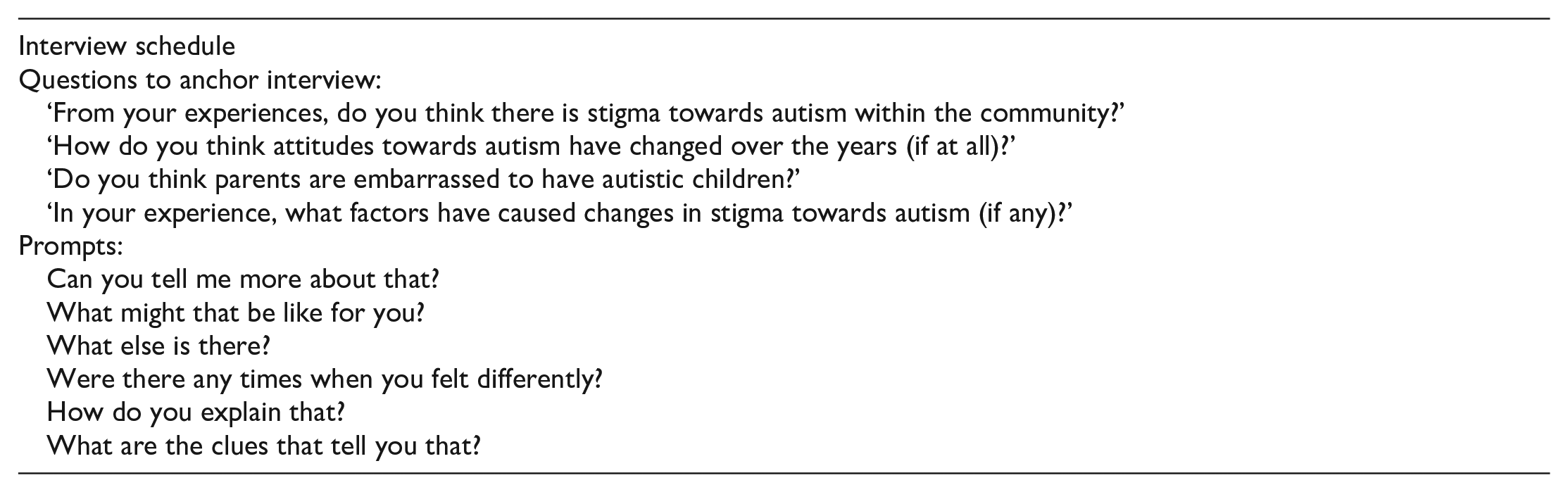
Interviews were conducted following the Interpretative Phenomenological Analysis (IPA) approach, as outlined by Smith et al. (2009). The approach also accorded with the second edition of this volume (Smith et al., 2022).
Footnotes
Acknowledgements
The authors acknowledge the assistance of Rabbi Dr J Yodaiken, for reading the manuscript and making helpful suggestions.
Declaration of conflicting interests
The author(s) declared no potential conflicts of interest with respect to the research, authorship and/or publication of this article.
Funding
The author(s) disclosed receipt of the following financial support for the research, authorship and/or publication of this article: We would like to thank Gonville & Caius College, University of Cambridge for contributing to the funding of this research.

Statement on research materials
Audio recordings were deleted as they contained identifiable information. Anonymised transcripts will be made available to researchers who contact the corresponding author with appropriate reasons for requesting access.