




Abstract
Peer interaction can be challenging in autism spectrum disorder, but naturalistic peer-observation scales for preschoolers are scarce. This study examined psychometric qualities of the newly developed Autism Peer Interaction Observation Scale. We tested the Autism Peer Interaction Observation Scale to (a) characterize peer interactions of preschoolers with autism spectrum disorder who were cognitively able versus typical age-mates, (b) explore each group’s hierarchical pattern of peer interaction behaviors, and (c) identify Autism Peer Interaction Observation Scale’s links with standard reports for assessing social-communication functioning (Vineland Behavior Scales, 2nd ed.), social impairment (Social Responsiveness Scale, 2nd ed.), autism severity (Autism Diagnostic Observation Schedule, 2nd ed.), and intelligence quotient (Mullen) in the cognitively able preschoolers with autism spectrum disorder group. Participants comprised 85 preschoolers (50 cognitively able preschoolers with autism spectrum disorder, intelligence quotient > 75; 35 typical). Groups were matched for age, intelligence quotient, and maternal education. Significant group differences emerged on all Autism Peer Interaction Observation Scale categories, in favor of typical. In cognitively able preschoolers with autism spectrum disorder, correlation analyses indicated that more typical peer relations on Autism Peer Interaction Observation Scale were linked with better adaptive and socialization skills (Vineland Behavior Scales, 2nd ed.) and fewer social atypicalities (Social Responsiveness Scale, 2nd ed.). Higher intelligence quotient scores were linked with better Autism Peer Interaction Observation Scale social-communication functioning. Only a few Autism Peer Interaction Observation Scale social-communication categories significantly correlated with the Autism Diagnostic Observation Schedule, 2nd ed. Findings highlight the Autism Peer Interaction Observation Scale as differentiating between groups and providing knowledge about peer interaction in natural settings. This new tool can help personalize social-communication programs and evaluations of early intervention outcomes.
Lay abstract
Peer interaction can be challenging in autism spectrum disorder, but naturalistic peer-observation scales for preschoolers are limited. This study examined the newly developed Autism Peer Interaction Observation Scale, with 17 subcategories, which evaluate naturalistic peer interaction processes in preschoolers with autism spectrum disorder and typical development. We tested the Autism Peer Interaction Observation Scale to (a) characterize peer interactions of preschoolers with autism spectrum disorder who were cognitively able versus typical age-mates, (b) explore each group’s hierarchical pattern of peer interaction behaviors, and (c) identify Autism Peer Interaction Observation Scale’s links with standard reports for assessing social-communication functioning (Vineland Behavior Scales, 2nd ed.), social impairment (Social Responsiveness Scale, 2nd ed.), autism severity (Autism Diagnostic Observation Schedule, 2nd ed.), and intelligence quotient (Mullen) in the cognitively able preschoolers with autism spectrum disorder group. Participants comprised 85 preschoolers (50 cognitively able preschoolers with autism spectrum disorder, intelligence quotient > 75; 35 typical). Groups were matched according to age, intelligence quotient, and maternal education. Significant group differences emerged on all Autism Peer Interaction Observation Scale categories, with the typical group showing better social-communication functioning as compared to the cognitively able preschoolers with autism spectrum disorder group. Also, in cognitively able preschoolers with autism spectrum disorder that observed as demonstrating more typical peer relations on the Autism Peer Interaction Observation Scale showed better adaptive and socialization skills on the Vineland (Vineland Behavior Scales, 2nd ed.) and fewer social atypicalities on the Social Responsiveness Scale, 2nd ed. Higher intelligence quotient scores were linked with better observed social-communication functioning (on Autism Peer Interaction Observation Scale). Few Autism Peer Interaction Observation Scale social-communicative categories significantly correlated with the Autism Diagnostic Observation Schedule, 2nd ed. Findings highlight the Autism Peer Interaction Observation Scale as differentiating the two preschooler groups and providing additional knowledge about socially communicative peer interaction in natural settings. This new tool can help personalize social-communication programs and evaluations of early intervention outcomes, thereby leading to a fuller picture of these young children’s functioning.
Keywords
The importance of peer relations for children’s growth and well-being is well documented (Hay et al., 2009; Vaughn et al., 2016). Peer interaction is defined as a reciprocal process in which children effectively initiate and respond to social stimuli presented by their peers in diverse social settings and situations (Shores, 1987). Longitudinal evidence shows that individual variations in behavior and in responding to peers’ behavior at early ages predict later social competence and mental health (Rose-Krasnor & Denham, 2009; Sette et al., 2017). Likewise, less effective peer engagement in early childhood has been linked with indicators of poorer social adaptation (Vaughn et al., 2016).
Autism spectrum disorder (ASD) is a neurodevelopmental disorder characterized by atypicalities in social interaction/communication and restricted and repetitive behaviors (Diagnostic and Statistical Manual of Mental Disorders (5th ed.; DSM-V; American Psychiatric Association, 2013). Although peer relations comprise a social-communication area often requiring substantial support in ASD (e.g. American Psychiatric Association, 2013), the field is in need of systematic naturalistic peer-observation scales to promote effective design of such support. This study aimed to close this research gap by evaluating the validity of the newly developed Autism Peer Interaction Observation Scale (APIOS).
Peer interaction in typical development and ASD
Although a unified theory is lacking for peer relations, there is wide consensus about the underlying verbal and nonverbal social-communication abilities that constitute effective interaction with peers during preschool, as well as about these abilities’ developmental trajectories (Rose-Krasnor & Denham, 2009). During preschool, eye contact to regulate the interaction, communicative gestures toward peers (e.g. descriptive gestures like waving arms up and down to demonstrate a bird; conventional gestures like yes, no, clapping, bye-bye), and the combination of eye contact and pointing to communicate intentions and needs and to socially learn from peers (e.g. joint attention) are all considered important components of nonverbal interactive communication (Mundy, 2018; Rice et al., 2016; Sekine, 2011; Siposova et al., 2018; Van Hecke et al., 2007). Other important components include regulation and expression of emotions during peer interaction, reflected in the variety and the situational appropriateness of children’s facial expressions directed at peers (e.g. Keltner & Cordaro, 2017; Rose-Krasnor & Denham, 2009). Gradually, preschoolers’ peer interactions become mutual and coordinated (Eisenberg, 1992; Hay et al., 2009; Rose-Krasnor & Denham, 2009), moving from merely basic functional interactive behaviors (e.g. maintaining close proximity to peers, requesting behaviors) to more complex socially interactive behaviors (e.g. using social problem-solving strategies to solve conflicts, suggesting joint activities, and sharing thoughts and feelings) and also to increasingly prosocial behaviors (e.g. acknowledgment of others’ stress, comfort, encouragement, sympathy, and empathy).
During the toddlerhood and preschool years, children’s social play and social pretend play also develop gradually. In social play, children initially engage in parallel play activities, which occur separately but in close proximity to peers. Next, simple social play emerges, involving direct social behavior with peers. Then, young children move on to interactive-complementary play skills, including role reversals in social games (e.g. run-and-chase and block building), where play becomes reciprocal and involves joint planning that integrates the pair’s actions (Howes & Matheson, 1992). Young children with higher levels of peer play show higher levels of later kindergarten competence (Eggum-Wilkens et al., 2014).
In social pretend play, children learn to share meanings of social acts and to negotiate and resolve conflicts by meta-communicating over roles, scripts, and themes (Howes, 1980; Howes et al., 1992). They move from simple unnamed scripts to engagement in complex social pretend play involving meta-communication like “Let’s play doctor; I will be the doctor and you will be the patient.” Social pretend play positively correlates with children’s social skills such as assertion and cooperation (Li et al., 2016). With regard to conversation skills, children as young as preschool ages are able to demonstrate fairly complex forms of peer talk while conversing over activities, personal experiences, or argumentative discourse or while discussing a topic from different viewpoints (Blum-Kulka et al., 2004; Harris, 2017). Taken altogether, during preschool, typically developing children’s interactions with peers become richer and more nuanced, sophisticated, and complex, based on their rapid advances in social, linguistic, social-cognitive, and cognitive skills (Coplan & Abreau, 2009).
The dynamic development of peer relations during the preschool years can be challenging for young children with ASD, who may struggle with some of the social-communication building blocks comprising effective peer interaction. Specific social-communication irregularities, such as vague and less communicative eye contact, communicative gestures mainly used for instrumental purposes, and low frequency of initiating and responding to joint attention, are considered as early signs of ASD (Adamson et al., 2019; Mundy, 2018). These early irregularities in nonverbal communication coincide with such children’s characteristically more limited variety of facial expressions, which may also be unusual in quality (e.g. mixed, situationally inappropriate; Chawarska et al., 2014; Costa et al., 2017).
Specifically, young children with ASD tend to have more infrequent and less complex peer interactions (Bauminger-Zviely, 2013). Mainly, they may produce fewer complex interactive prosocial behaviors such as sharing, providing help, cooperating, and comforting. Instead, children with ASD tend to produce more basic interactive behaviors such as mere close proximity, imitation of other children’s social acts, functional behaviors (e.g. giving and requesting information), and passive/observer and solitary behaviors. They tend to exhibit more substantial difficulties in initiating than in responding to peer interaction, and their response quality may be unusual (e.g. Bauminger-Zviely et al., 2014; Scheeren et al., 2020). Altogether, this set of characteristics often challenges the development and maintenance of fruitful or extended social interactions with peers (Hartley & Fisher, 2018; Kasari & Chang, 2014; Locke et al., 2016; Rice et al., 2016).
In particular, peer talk and coordinated co-regulated social play do not develop typically in young children with ASD. In peer interactions during spontaneous free-play situations, even cognitively able preschoolers with ASD (CAASD, having an intelligence quotient (IQ) of 75 or above) demonstrate less reciprocity and responsiveness to interlocutors, produce out-of-context utterances, and show unusual intonation and stereotypic speech. In most cases, the social play of young children with ASD reveals greater structure and learned routines, with fewer of the novel play acts indicating genuinely playful, engaging experiences (Jordan, 2003; Wolfberg, 2016).
Social-communication correlates with IQ, ASD severity, and adaptive and social functioning
Previous studies have identified several variables as correlates or predictors of positive social-communication outcomes in ASD. First, IQ was found to be positively linked with adults’ ratings of children’s adaptive social skills. Children with ASD who had higher IQ scores received higher ratings of adaptive social skills items on the MESSY-II (Matson Evaluation of Social Skills for Youngsters-II, Matson et al., 2011) compared to children with lower IQ scores, as reported by Tureck and Matson (2012). Furthermore, higher baseline IQ or language scores were associated with higher adaptive behavior scores on the VABS-II (Vineland Behavior Scales, 2nd ed., Sparrow et al., 2005) as reported by Hedvall et al. (2014). Likewise, higher baseline IQ or language scores were also associated with lower ASD severity scores on the ADOS (Autism Diagnostic Observation Schedule, Lord et al., 2012) as reported by Sacrey et al. (2019) and Szatmari et al. (2015).
In addition, the duration of the naturalistic peer interaction behaviors of school-age children with CAASD on the playground, as measured by the PIP (Peer Interaction Paradigm; Qualls & Corbett, 2017), was found to correlate negatively with the SRS-2 (Social Responsiveness Scale, 2nd ed., Constantino & Gruber, 2012), indicating that longer reciprocal peer exchanges were correlated with less social impairment. Furthermore, more solitary play as measured by the PIP correlated with greater social impairment on the SRS-2. These cumulative findings demonstrated that the SRS-2 ratings of social reciprocity and social communication correlated in the expected direction with the PIP social peer interaction variables. As a whole, research has demonstrated that higher IQ, lower ASD severity (ADOS), higher adaptive and socialized functioning (VABS-II), and lower social impairment (SRS-2) were linked with higher social-communication capabilities and peer interaction exchanges.
Assessment of peer interaction in ASD
In light of these unique characteristics of peer interaction in ASD, one would expect to find standardized all-inclusive naturalistic observational scales for its evaluation, especially during the preschool years that lay the foundation for later peer relations (Manning & Wainwright, 2010). However, surprisingly, this is not the case. Our literature search pinpointed common utilization of standardized questionnaires such as the VABS-II (Sparrow et al., 2005) and the SRS-2 (Constantino & Gruber, 2012) that can be completed by parents, teachers, or childcare providers to obtain information about a variety of social and communication behaviors (e.g. Chen et al., 2018; Farmer et al., 2018; Salomone et al., 2018; Schwichtenberg et al., 2019). However, scales for direct observation of peer interactions among preschoolers are scarce.
Our literature review yielded several naturalistic peer-observation scales for older school-age children (e.g. Dekker et al., 2016; Gibson et al., 2011; Hauck et al., 1995; Humphrey & Symes, 2011; Ingram et al., 2007; Locke et al., 2016; Murdock et al., 2007) but only a few for young children (ages 2-7 years) in preschool and kindergarten (e.g. Anderson et al., 2004; Boyd et al., 2011; Chang et al., 2016; Clifford et al., 2010). Furthermore, the research investigating these few tools developed for young children was limited in terms of sample characteristics and inclusivity of peer interaction behaviors, namely, regarding the samples, prior studies included small sample sizes (e.g. n = 10 in Anderson et al., 2004; n = 8 in Boyd et al., 2011); large variability in cognitive functioning or IQ (Anderson et al., 2004; Chang et al., 2016); and only ASD with intellectual disability (Clifford et al., 2010); or no IQ reported (Boyd et al., 2011). Regarding measured peer interaction observational profiles, prior studies were mainly limited to general evaluation of initiations and responses (Boyd et al., 2011), peer-engagement level (Chang et al., 2016), or play behaviors (Anderson et al., 2004), or else omitted play behaviors from the observation (Clifford et al., 2010).
This study
Clearly, the field requires additional manualized peer-observation scales to comprehensively and systematically assess preschoolers’ spontaneous peer interactions in naturalistic settings. To narrow this gap in the literature, this study examined the psychometric qualities (construct and convergent validity) of the newly developed APIOS. The APIOS (Shefer & Bauminger-Zviely, 2018) was carefully developed to span nine main categories and 17 subcategories reflecting the major building blocks of social-communication behaviors for adaptive peer interaction based on markers of neurotypical social-communication development. We tested the APIOS (a) to characterize the peer interactions of preschoolers with CAASD versus those of typically developing age-mates, (b) to explore the hierarchical pattern of peer interaction behaviors for each group (CAASD/typical), and (c) in the CAASD group only, to identify this scale’s links with available, reliable standard reports for assessing children with ASD regarding social-communication functioning (VABS-II; Sparrow et al., 2005), social impairment (SRS-2; Constantino & Gruber, 2012), autism severity (ADOS-2; Lord et al., 2012), and IQ (Mullen Scales of Early Learning; Mullen, 1995).
Based on the literature, we predicted that the APIOS observation tool would reveal a different hierarchical profile of social-communication behaviors during the peer interactions of children with CAASD, indicating strengths in functional social behaviors and major difficulties in complex social-communication behaviors compared to their typical peers. We also predicted that those children with CAASD who were observed on the APIOS as exhibiting more complex social-communication behaviors during peer interaction would be rated by teachers as showing higher social-communication functioning (on the VABS-II and SRS-2) and would also demonstrate higher full IQ and verbal IQ levels (on the Mullen) and a less severe ASD (on the ADOS-2).
Method
Participants
Participants were 85 preschoolers aged 3–6 years comprising: 50 children (nine girls) with CAASD (IQ > 75) and 35 children (eight girls) with typical development. All children with CAASD had been previously diagnosed with ASD and had been mainstreamed in regular preschools. Criteria for their inclusion in this study were (a) meeting ASD criteria on the ADOS-2 (Lord et al., 2012) and (b) an IQ of 75 or above on the Mullen Scales of Early Learning (Mullen, 1995). To enhance our ASD sample’s homogeneity and matching to the typically developing group, we selected preschoolers with CAASD (Mullen IQ beyond intellectual disability). This selection criterion based on the Mullen does not ignore recent discussion in the field striving to reach a more exhaustive definition that goes beyond cognitive abilities and includes other areas of functioning such as adaptive behaviors and the need for support (e.g. Alvares et al., 2020; American Psychiatric Association, 2013). As seen in Table 1, the typically developing group was matched to the CAASD group for child’s age, maternal education level, and child’s IQ score (full, verbal, and nonverbal). We based our selection of the typically developing children on their teacher’s report of no official known diagnosis.
Sample characteristics of preschoolers with CAASD and typical development.
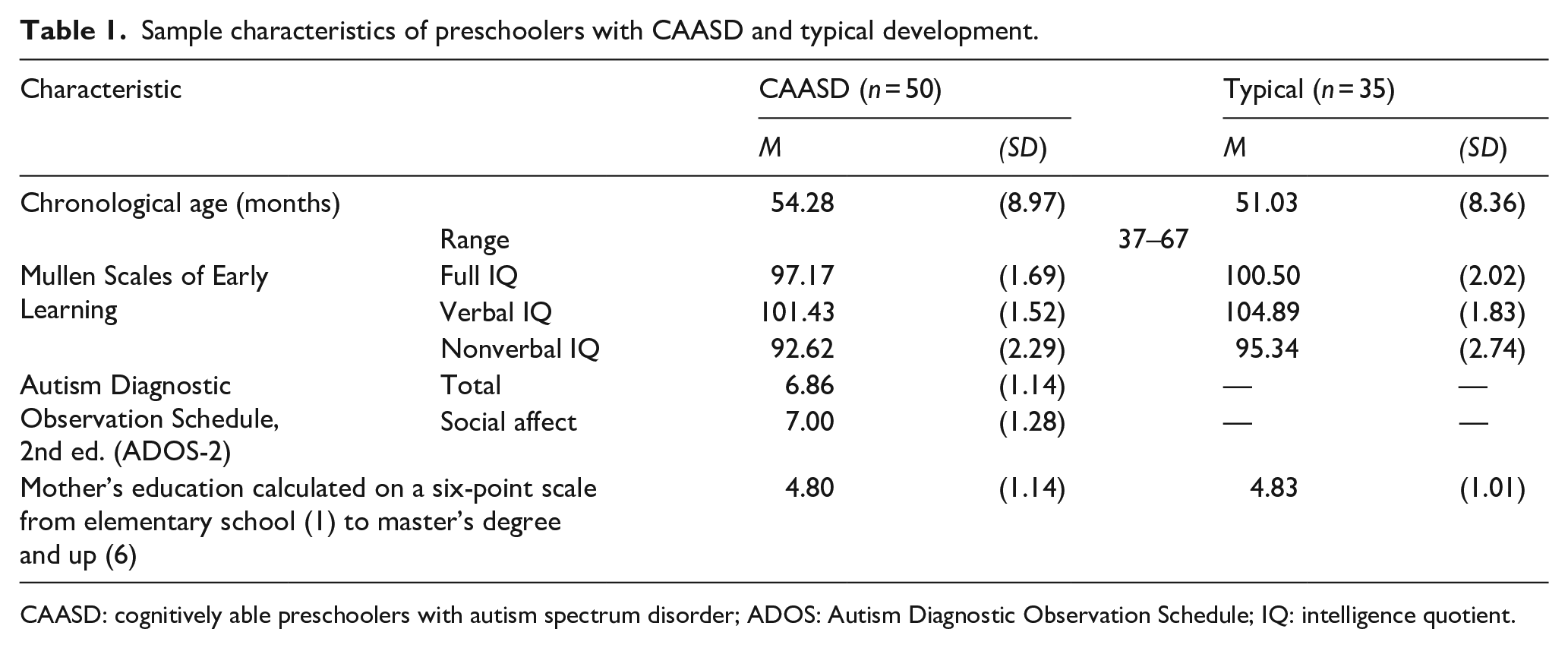
CAASD: cognitively able preschoolers with autism spectrum disorder; ADOS: Autism Diagnostic Observation Schedule; IQ: intelligence quotient.
Measures
APIOS for preschoolers
Children’s social-communication abilities during spontaneous peer interaction in the preschool were observed using the theoretically grounded APIOS, developed for the purpose of this study to examine peer-to-peer interaction behaviors along a continuum from typical to atypical development (Shefer & Bauminger-Zviely, 2018). The APIOS included nine main categories (nonverbal communication, basic/functional social behavior, complex social behavior, prosocial behavior, social play, social pretend play, conversation, variety of facial expressions, and situational appropriateness of facial expressions), with 17 subcategories (see Table 2), reflecting the major building blocks of social-communication behavior for adaptive peer interaction. The development of the APIOS was based on research and descriptive literature on typical social-communication peer interaction development during the preschool years and on the main social-communication characteristics of ASD (DSM-V; American Psychiatric Association, 2013). Internal consistency was calculated using Cronbach’s alpha for all main categories that included subcategories: nonverbal communication (α = 0.69), functional social behavior (α = 0.66), complex social behavior (α = 0.82), and conversation (α = 0.92).
Means, standard deviations, and statistical comparison of the two study groups’ APIOS categories and subcategories.
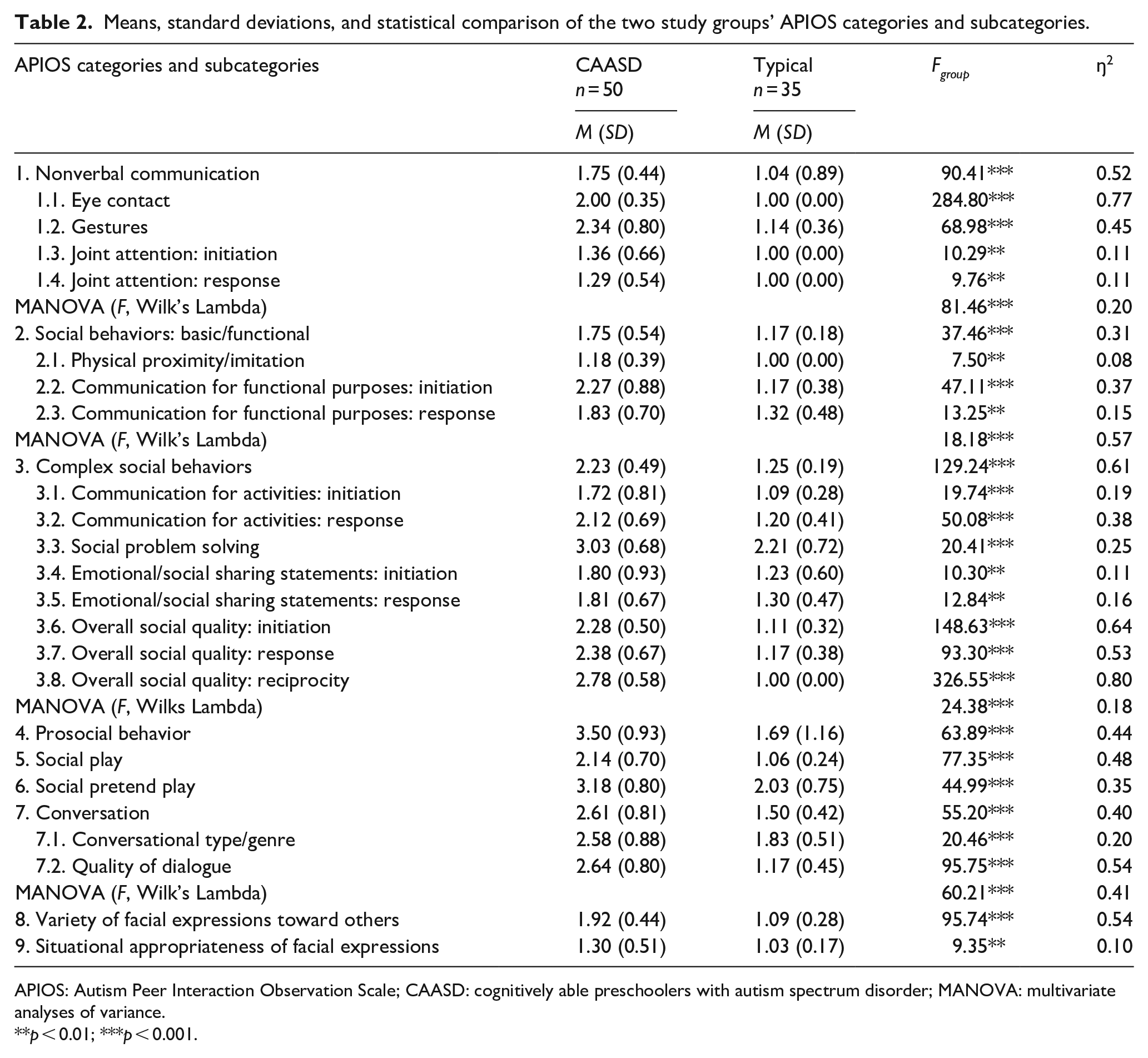
APIOS: Autism Peer Interaction Observation Scale; CAASD: cognitively able preschoolers with autism spectrum disorder; MANOVA: multivariate analyses of variance.
p < 0.01; ***p < 0.001.
APIOS observation procedure
The observations were conducted individually over 3 h on the same morning to assess each child’s social-communication behaviors while interacting with typically developing peers in the preschool, comprising 1.5 h observing various indoor activities (e.g. free time, corners, and mealtime) and 1.5 h observing outdoor (playground) activities. The APIOS observation time was determined based on the duration of prevalent ecological measures for evaluating dyadic interaction such as the Dyadic Relationships Q-Set assessing the quality of peer relations (e.g. Park & Waters, 1989) or the Waters Attachment Behavior Q-Sort assessing relationships with caregivers (e.g. Waters & Deane, 1985). If the weather prevented children from going outdoors, observers returned on a different day. The observer (second author), an expert in preschoolers’ development for children with and without ASD, sat close enough to the target child to hear peer interactions but did not engage with them. Children were told that the purpose of the observation was to learn what children do during their day in the preschool. No instructions were given to the children by the preschool teacher or the observer to maintain naturalistic interactions.
APIOS coding
During the observation, the observer (the second author) used a chart presenting the 17 subcategories, with space for field notes describing behaviors relevant to each subcategory. Each time the observed child exhibited a behavior that was relevant to the APIOS, the observer noted a written description of that behavior. Behaviors directed toward adults were not coded. At the end of the 3-h observation, the observer coded her field notes for the observed child’s social-communication behavior with peers, based on a very detailed coding scale for each of the 17 subcategories along a continuum ranging from typical behaviors based on markers for typical development (1) up to very atypical behaviors (4), where higher scores indicated greater irregularities. Appendix 1 presents sample coding rubrics for several categories. A mean score was calculated for each of the nine categories.
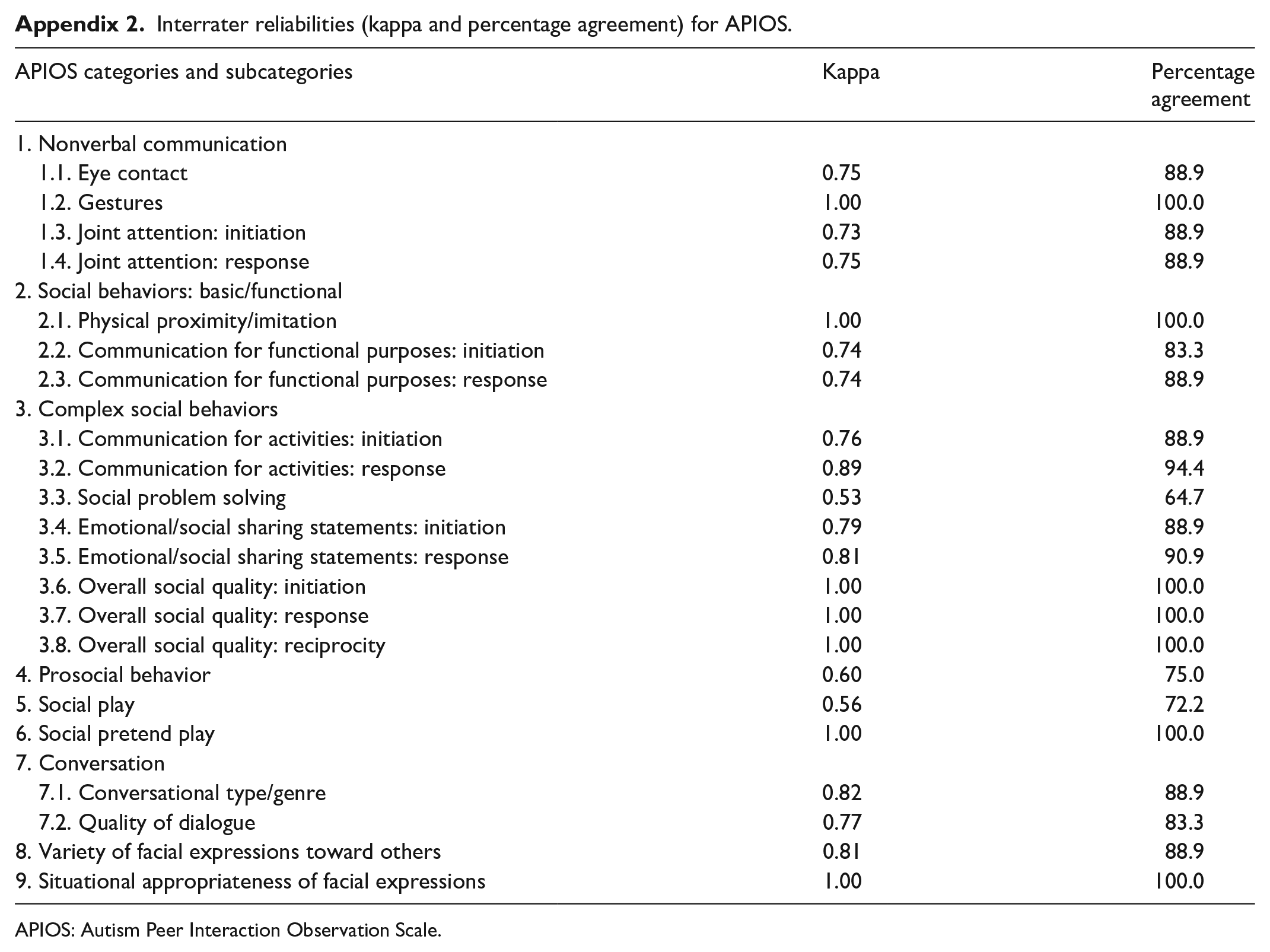
To establish reliability for the coding procedure, a second expert in special education (who had received training in use of the APIOS) joined the first observer for the first 18 children’s observations (20%). This additional rater used the same procedure of utilizing the detailed chart to write field notes and code the 17 APIOS subcategories. As seen in Appendix 2, for most APIOS items, interrater agreement between the two observers was high (kappa > 0.70). For the remaining 80% of the observations, the second author conducted the observations alone.
Teacher ratings of children’s social-communication functioning
The VABS-II (Sparrow et al., 2005) is a standardized semi-structured interview that was designed to measure adaptive behavior of individuals from birth to age of 90 years. It includes four domains—socialization, communication, daily living skills, and motor skills—and a total score, the adaptive behavior composite. Each domain and the composite yield a standard score (M = 100, SD = 15). The VABS-II has shown strong internal consistency, test–retest reliability, and validity (Cunningham, 2012; Perry et al., 2009; Yang et al., 2016) and is widely used in the ASD literature to assess social and adaptive skills (e.g. Frost et al., 2017). Due to the current focus on social-communication capabilities, we used the standard scores for the adaptive behavior composite and for two of the four domains: communication and socialization. Higher scores indicated more adaptive functioning.
Teacher ratings of children’s social impairment
The SRS-2 (Constantino & Gruber, 2012) is a 65-item questionnaire rated on a Likert-type-scale (1 = “not true” to 4 = “almost always true”) that identifies the extent of social impairment associated with ASD, from preschool through adulthood. The SRS-2 offers two new DSM-V-compatible (American Psychiatric Association, 2013) overall dimensions for ASD: the Social Communication & Interaction dimension (53 items) and the Restricted Interests/Repetitive Behavior dimension (12 items). This study used these two SRS-2 overall dimensions as well as the total score. Higher scores indicated greater social impairment.
Procedure
After receiving permission from the Chief Scientist of the Israeli Ministry of Education, letters were distributed to parents of children with ASD and children with typical development. All preschools in the study were in central Israel. SES was determined according to mothers’ education, which did not differ between the two groups. The 50 children with ASD attended 49 preschools (in one preschool and two children were observed). The 35 typically developing children attended 15 preschools: in nine preschools, only one child was observed; in six preschools, multiple children were observed. After obtaining parental consents, visits to preschools were coordinated with teachers. The child’s background measures (ADOS-2, Mullen) were administered individually in a first session at the preschool. The 3-h APIOS observation of the child’s peer interactions was conducted in a second visit. In addition, during one of these visits, the child’s preschool teacher completed the VABS-II and the SRS-2 (in counterbalanced sequence).
Community involvement statement
Please note that community members were not involved in the study.
Data analysis
Between-group differences (CAASD/typical) on the APIOS’s categories and subcategories were analyzed using a series of multivariate and univariate analyses of variance (MANOVAs and ANOVAs, respectively). Within-group differences on the nine APIOS categories were computed by repeated measure ANOVA for each group and follow-up post hoc pairwise comparisons, with Bonferroni correction. In addition, Pearson correlations examined the nine APIOS categories’ links with the VABS-II and with the SRS-2, as well as with the ADOS-2 and Mullen (IQ). We used partial correlation analyses while controlling for chronological age as a covariate due to possible developmental changes over the studied age span (37–67 months) and the large age variance. Preliminary analysis of group differences (CAASD/typical) on the VABS-II (standard scores for socialization, communication, and total composite) and on the SRS-2 (social communication & interaction dimension, restricted interests/repetitive behavior dimension, and total social deficit score) yielded significant group differences in favor of the typical group, substantiating the two groups’ dissimilarities. These differences are outside the scope of this article; therefore, results are not reported. Validity thresholds were r ⩽ 0.30 (denoting 10% shared variance) for convergent validity and high effect size (over 0.14; Cohen, 1988; Ellis, 2010) for discriminative validity.
Results
Between-group differences on the APIOS
As seen in Table 2, the ANOVA results revealed significant differences between the CAASD and typical groups for all the social-communication behaviors observed during spontaneous peer interactions in the preschool. The most dissimilar social-communication behaviors in the two groups were (a) the eye contact subcategory of the nonverbal communication category (ŋ2 = 0.77); (b) the complex social behavior category (ŋ2 = 0.61) and its three subcategories relating to overall social quality: initiations (ŋ2 = 0.64), responses (ŋ2 = 0.53), and reciprocity (ŋ2 = 0.80); and (c) the conversation category’s quality of dialogue subcategory (ŋ2 = 0.54). Overall, children with typical development scored very low on most of the APIOS categories and subcategories, demonstrating a more typical social-communication profile during peer interaction compared to the CAASD group.
Within-group differences on the hierarchical profile of APIOS behaviors
The results of the repeated measure ANOVA for each group (CAASD, typical) yielded significant within-group differences among the APIOS’s various social-communication categories: F(8,392) = 81.40, p < 0.001, ŋ2 = 0.62 for the CAASD group and F(8,272) = 17.19, p < 0.001, ŋ2 = 0.34 for the typical group. Figure 1 presents the results of post hoc pairwise comparisons with Bonferroni correction, indicating that along the continuum from typical to atypical peer interaction, both prosocial behavior and pretend play were the most atypical behaviors for the CAASD group (see data labeled e in the figure), followed by the conversation category (d). In the CAASD group, large-to-intermediate irregularities emerged for the complex social behavior and social play categories (c). Smaller irregularities emerged for expressions’ variety, nonverbal communication, and functional social behavior categories (b). Situational appropriateness of facial expressions was the most typical behavior in CAASD (a), which did not differ significantly from functional social behavior.
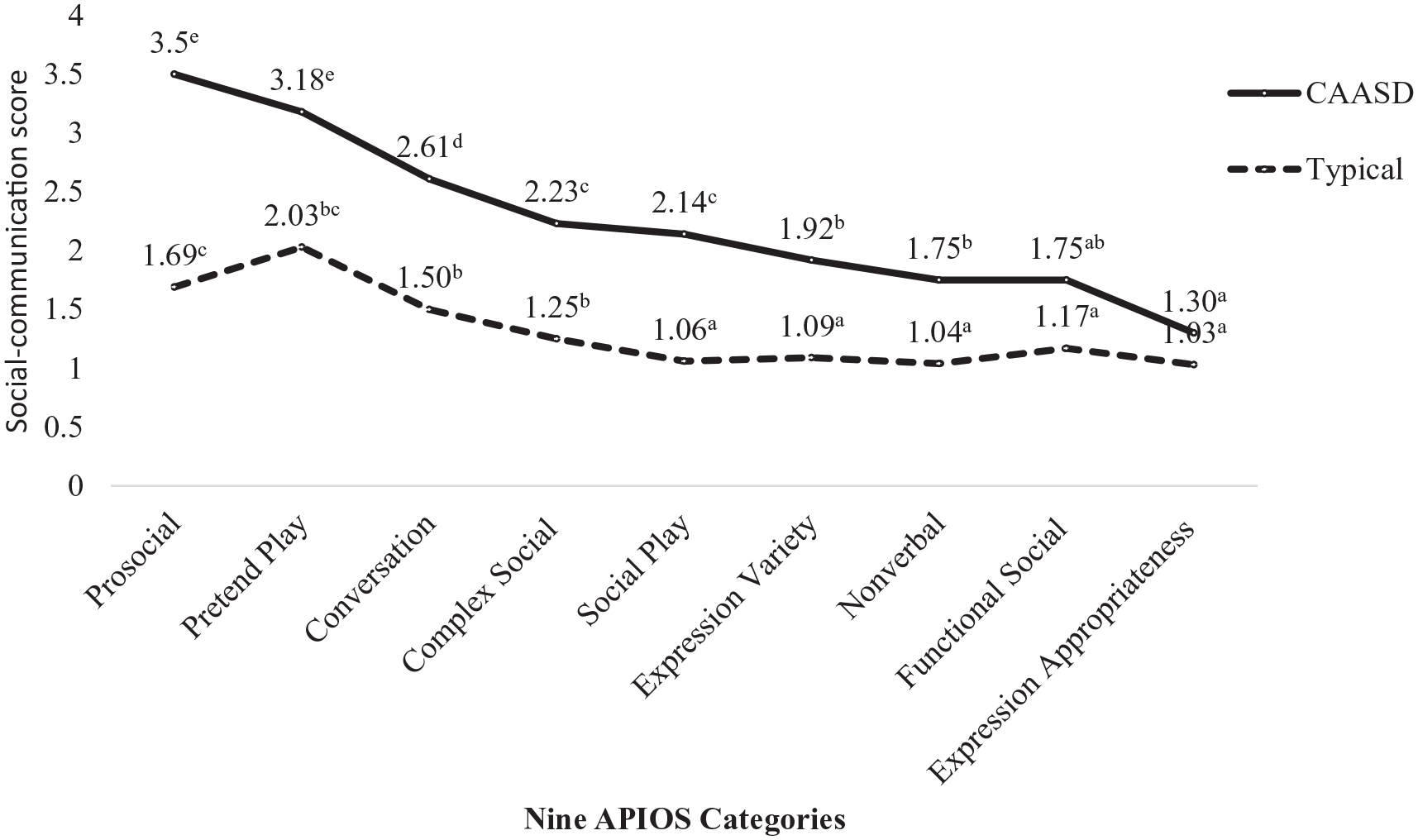
Social-communication profile in the CAASD and typical groups based on the major APIOS categories.
As seen in Figure 1, a similar profile emerged for the typical group, however, with notably less social-communication atypicality than in the CAASD group. In the typical group, prosocial behavior (c) and social pretend play (bc) were the most challenging behavioral categories, followed by conversation and complex social behaviors (b). All other categories of behaviors (a) scored very close to typical functioning (i.e. a score of 1).
Correlations of APIOS with teacher-rated social functioning for the CAASD group
Table 3 presents correlations for the nine APIOS categories with the teacher-rated VABS-II and SRS-2. In calculating correlations, we controlled for age (partial correlation), considering that variation across the 37–67 month age span for this target population (CAASD only) might be critical for understanding behavior.
Social-communication measures for preschoolers with CAASD: correlations among observations (APIOS) and teacher ratings (VABS-II and SRS-2).
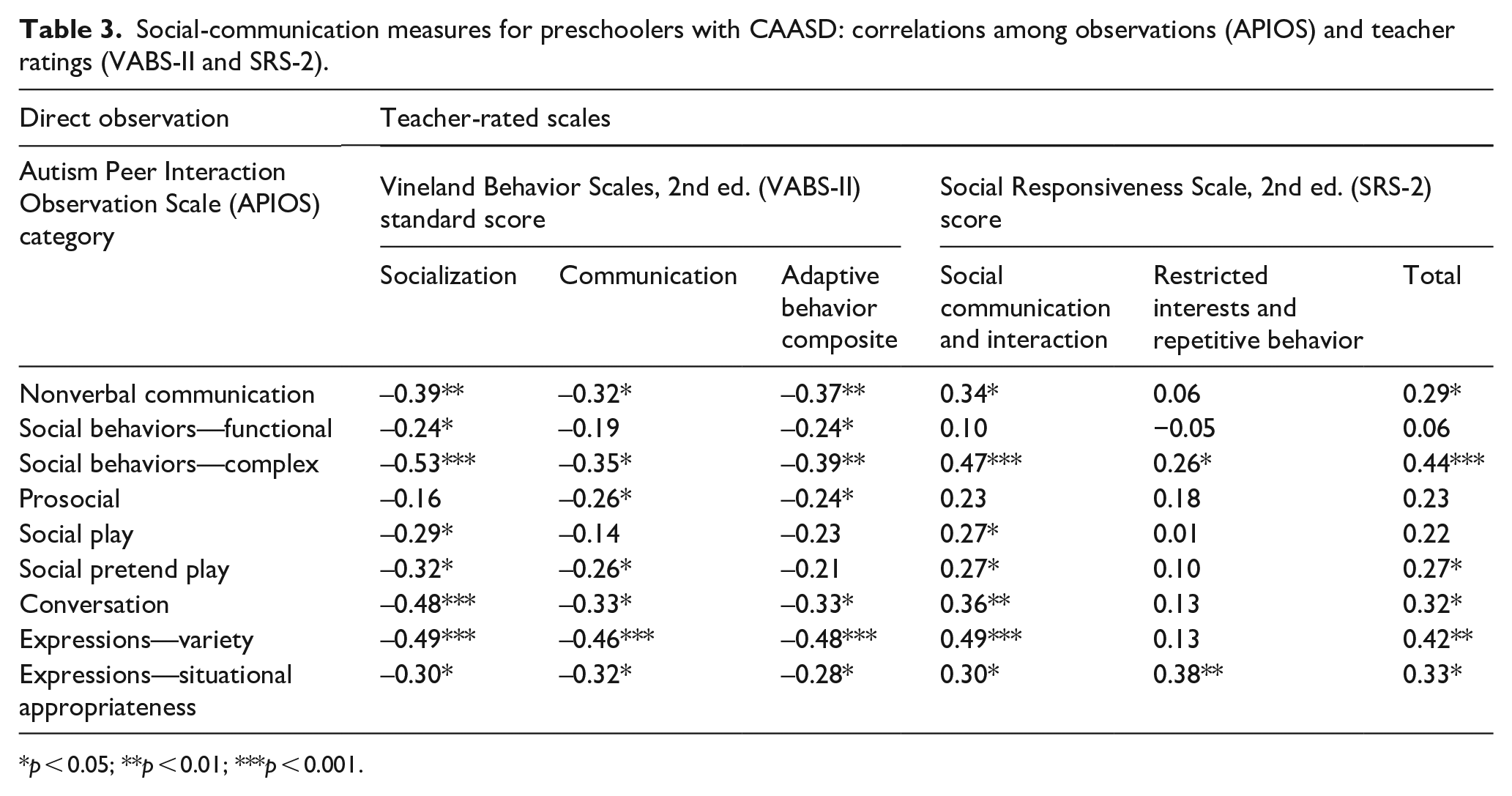
p < 0.05; **p < 0.01; ***p < 0.001.
As seen in Table 3, most of the observed APIOS social-communication categories were significantly negatively correlated with the VABS-II total composite and its socialization and communication domains. More specifically, all APIOS categories correlated significantly with the VABS-II except for APIOS prosocial behavior with the VABS-II socialization domain; APIOS functional social behavior and social play with the VABS-II communication domain; and APIOS social play and social pretend play with the VABS-II composite score. To be noted, even those behaviors that did not reach significance were in the expected direction. Altogether, less atypicality using the APIOS social-communication observation tool correlated with teachers’ ratings of better socialization, communication, and adaptive capabilities.
Similarly, as seen in Table 3, most of the APIOS categories revealed significant positive correlations with the SRS-2 total social impairment score and with the SRS-2 social communication & interaction dimension. A less typical profile observed using the APIOS social-communication tool correlated with teachers’ ratings of a higher total social impairment on the SRS-2 (except for the APIOS functional social behaviors, prosocial behaviors, and social play) and with teachers’ SRS-2 ratings of a higher social communication & interaction impairment (except for the APIOS functional social behaviors and prosocial behavior categories). Interestingly, only two APIOS social-communication behaviors (social complex behaviors and situationally appropriate expressions) significantly positively correlated with the SRS-2 restricted interests/repetitive behavior dimension, where higher teacher ratings on this dimension correlated with higher observed atypicality in these two APIOS behaviors.
Correlations of APIOS with IQ and autism Severity in the CAASD group
As seen in Table 4, in the CAASD group, most of the APIOS social-communication categories correlated negatively both with full IQ (except for functional social behaviors, social pretend play, and situationally appropriate expressions) and with verbal IQ (except for functional social behaviors and social play). Thus, as predicted, the children who showed less social atypicality on the APIOS had higher cognitive and verbal capabilities.
The APIOS’s correlations with IQ (Mullen) and autism severity scores (ADOS-2).
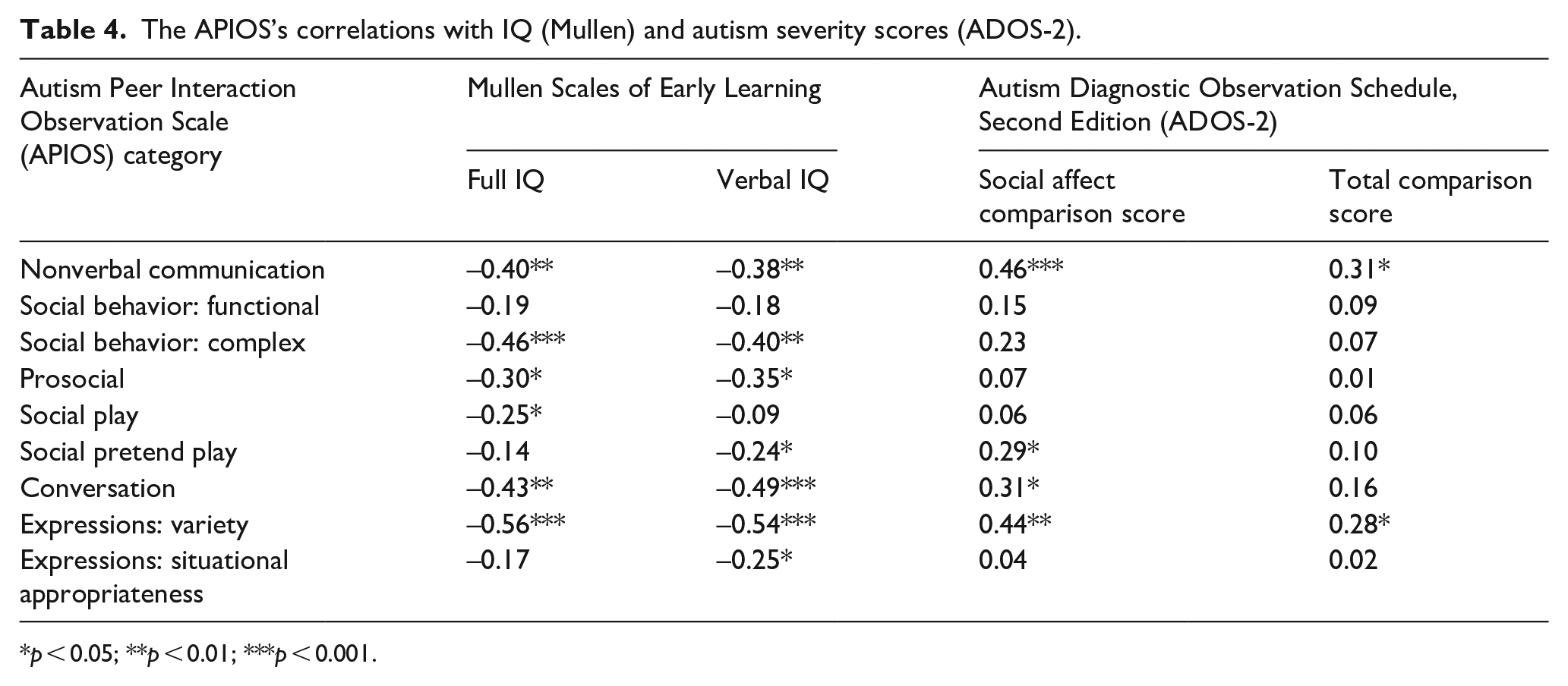
p < 0.05; **p < 0.01; ***p < 0.001.
As seen in Table 4, only a few APIOS social-communication categories significantly correlated with the ADOS-2 social affect comparison score (nonverbal, social pretend play, conversation, and expression variety), and even fewer APIOS categories significantly correlated with the total ADOS-2 comparison score (nonverbal and expression variety). These few positively significant correlations provided partial support to our prediction that children with more severe ASD based on the ADOS would be observed as demonstrating greater social atypicality on the APIOS.
Discussion
This study examined the qualities of a novel measure—the APIOS—in assessing the social-communication behaviors of preschoolers with ASD during spontaneous interactions with their age-mates. Overall, the APIOS differentiated well between the CAASD group’s less typical social-communication profile and the comparison group’s more typical profile. Moreover, the new instrument showed adequate correlations with standardized questionnaires tapping social communication (the VABS-II and SRS-2), thereby speaking to the APIOS’s construct and convergent validity. Moreover, intra-group hierarchical patterns for the APIOS interactive behaviors provided a fine-grain view of social-communication with peers among young children with and without CAASD.
Observed social communication in preschoolers with CAASD versus typical development
In line with our prediction, the non-ASD group showed more typical social-communication behaviors than the CAASD group on all the APIOS categories (effect sizes: 0.11–0.81). The social-communication profile of the typical preschoolers showed an overall mean score near 1, whereas most of the observed behaviors in the CAASD group scored between 2 and 3, reflecting moderate-to-strong atypicalities in peer interaction. A deeper look at the effect sizes, denoting the strength of group differences, provides informative clinical description regarding the most challenging social-communication behaviors for the preschoolers with CAASD. Namely, in the CAASD group, the observed behaviors nearest the atypical end of the interaction continuum were complex social behaviors like reciprocity, social quality of initiations and responses, conversational dialogue quality, and nonverbal communication like eye contact and gestures. These findings coincide with prior research where children with ASD demonstrated ineffective social-communication behaviors toward their peers, such as ignoring peers’ social initiations, poor timing, repetition, asking irrelevant questions, choosing not to participate, and ineffective problem solving (Bellini et al., 2014; Chawarska et al., 2014; Hartley & Fisher, 2018; Ziv et al., 2014). Also, children with ASD tend to use eye contact less often and have difficulty integrating gaze with additional nonverbal behaviors (Elsabbagh et al., 2012; Falck-Ytter et al., 2015; Franchini et al., 2017). These major gaps between the two groups of preschoolers regarding the building blocks of adaptive peer interaction, in congruence with prior literature, highlight the need to design specific interventions for young children with CAASD to elicit social-communication growth via peer interaction.
The hierarchy of social-communication behaviors observed in each group
The hierarchical profile of the APIOS’s social-communication behaviors in each group added important clinical information. Overall, the APIOS observations yielded a similar hierarchy of social-communication behaviors for preschoolers in the two groups, with the expected greater atypicality (higher scores) in the clinical CAASD group. In both groups, the two most challenging behaviors to achieve were prosocial behavior (M = 3.50 for CAASD and 1.69 for typical) and social pretend play (M = 3.13 for CAASD and 2.03 for typical), followed by conversation (M = 2.61 for CAASD and 1.50 for typical). Also, complex social behaviors and social play were a challenge for children with CAASD (M = 2.23 and 2.14, respectively).
These more complex and nuanced social-communication behaviors that were effortful for both preschooler groups can play important roles in the social milieu. For example, prosocial behavior has been linked to children’s peer status (Paulus, 2017). Likewise, children’s interactions during social pretend play are characterized by more positive affect, longer duration of play, greater compliance with other children’s directions, and increased reciprocity of social exchange, as compared to non-pretend social activities (Connolly et al., 1988; Sutherland & Friedman, 2013). Furthermore, conversation between peers can offer children opportunities for mutual learning of interactive cognitive and linguistic skills (Blum-Kulka et al., 2010; Li et al., 2016).
At the other end of the continuum, a group of social-communication behaviors was found to be less effortful for the CAASD group (scoring close to but below 2). These included nonverbal communication, functional behaviors, and expressions’ variety and situational appropriateness. A deeper look into the nonverbal behavior category indicates that eye contact was a considerable challenge for this group, but, interestingly, joint attention to initiations and responses was less difficult. This may be related to early intervention’s frequent focus on joint attention (Chang et al., 2016). Physical proximity behavior was almost typical, indicating the ASD group’s social motivation to interact with peers. Also, the situational appropriateness of children’s facial expressions was more typical than was the expressions’ variety. Thus, the APIOS also captured the potential strengths in the ASD group.
Overall, the APIOS enables in-depth understanding of the social-communication behavioral profile characterizing each group and allows tailoring of intervention programs to specific needs. The current findings suggest that early educational environments should facilitate social imaginary play and free discourse. It is also recommended that early interventionists devote resources to encourage and develop the awareness of peers toward each other, which includes offering help and/or support when needed.
Associations between the APIOS and standardized measures of social-communication
To test for the APIOS’s convergence validity (the degree to which two measures of theoretically related constructs are in fact related), we examined the APIOS’s correlations with the teacher-rated VABS-II and SRS-2. Indeed, the APIOS social-communication categories correlated nicely with the VABS-II social-communication domains and with social responsiveness as measured by the SRS-2. Children who were observed as demonstrating more typical peer relations in the preschool (APIOS) were rated by their teacher as showing better adaptive and socialization skills (VABS-II) and lower social impairment (SRS-2). These findings provide support for the APIOS’s psychometric qualities, as a valid measure for evaluating social-communication behaviors that contribute to adaptive peer interactions.
The APIOS’s associations with IQ and disorder severity
Children’s IQ (full and/or verbal) contributed significantly to more adaptive peer interaction functioning for all of the APIOS social-communication categories except functional behaviors. In general, these results support findings from other studies of children with ASD showing that early language and nonverbal skills are important predictors of social-communication functioning outcomes (e.g. Hedvall et al., 2014; Sacrey et al., 2019; Szatmari et al., 2015). This congruency between the APIOS and the Mullen provided support for the APIOS’s validity.
Likewise, some significant correlations emerged between some APIOS categories and the measure of ASD severity according to the ADOS, in the predicted direction. Namely, the APIOS nonverbal communication and expression variety scores correlated with the ADOS-2 total comparison score; and the APIOS nonverbal communication, social pretend play, conversation, and expression variety scores correlated with the ADOS-2 social affect comparison score. These findings whereby children with lower ASD disorder severity scores demonstrated some better peer social-communication skills on the APIOS appeared to corroborate prior research showing correlations between the ADOS-2 and verbal interaction in reciprocal social communication with peers in a natural playground setting (Qualls & Corbett, 2017).
However, unexpectedly, the present findings indicated weak overall coherence between the APIOS and the ADOS-2. Namely, seven of the nine APIOS social-communication categories did not correlate significantly with the ADOS-2 total comparison score and five of the nine APIOS categories did not correlate significantly with the ADOS-2 social affect comparison score. Similar incongruity between the ADOS-2 and an instrument measuring social skills with peers among children with ASD emerged in the Dekker et al. (2016) study, which reported weak coherence between the ADOS-2 and their social skill observation measure with peers in the classroom or in a natural unstructured context. These gaps appear to highlight the differences between social communication with an adult in a semi-structured social situation (ADOS-2) versus spontaneous peer interaction in a non-structured social situation (APIOS or social skill observation measure). Due to its reciprocal nature, peer engagement is a more challenging form of interaction than interaction with adults, who can scaffold the interaction. Interactive skills that are expressed with an adult do not naturally transfer into peer settings (e.g. Bauminger-Zviely, 2013; Clifford et al., 2010; Dekker et al., 2016; Ingram et al., 2007). Thus, the unexpected weak correlation between the APIOS and the ADOS-2 may possibly attest to the uniqueness of the APIOS in focusing on peer relations, which are presumably an independent form of social interaction. This implies that the APIOS may offer a complementary assessment tool to the well-accepted ASD diagnostic measures that rely on child-adult interaction.
Limitations, conclusions, and implications
Several study limitations should be considered. First, while observation in the natural environment is a significant method for assessing children’s social behaviors with peers, it is costly to perform and requires considerable resources. For the current purpose of validating the APIOS scale, we conducted a fairly lengthy 3-h observation procedure, in line with prior Q-sort techniques executed by a single observer (e.g. Park & Waters, 1989; Waters & Deane, 1985). This lengthy duration afforded a valuable, rich database of preschoolers’ indoor and outdoor inclusive social activities such as free play, painting and drawing, table games, construction games, dramatic play, mealtime, playground, and sandbox. This comprehensive research-based APIOS method enables observers to create a detailed personalization of assessment for each child, thereby maximizing their time and capitalizing on resources. Nonetheless, this long duration may be less feasible in some clinical or educational settings. Further research should explore whether a shorter observation (1–2 h) may be sufficient to assess each child’s social-communication profile, possibly as complemented by staff/parent interview (e.g. as used by Waters & Deane, 1985). In addition, despite its ample duration and comprehensiveness, the current observation procedure provided only a single measurement session per participant without variance partitioning between raters and sessions. Thus, future studies would do well to examine the APIOS’s qualities through implementation by several raters, possibly on different days and along various sessions.
Second, characterizing the challenges of naturalistic research in an authentic preschool environment, the child’s diagnosis (ASD or typical) was not masked from observers, which may have led to biased expectations from children’s behavior. The field notes during observations served as an anchor for coding and aimed to minimize bias, but group differences should be regarded with this limitation in mind. Third, the observations were not videotaped to avoid possible disruption to children’s natural behavior when facing a video-camera; however, this suggests that some information may have gone undocumented during observation. Fourth, indeed clear significant group differences were obtained based on the 35 typically developing children, and the group was very homogeneous, suggesting that the group size was adequate. However, future studies would do well to increase the number of non-autistic participants in order to eliminate the risk for both Type I and Type II errors. Finally, this study focused on cognitively able young children; hence, the APIOS’s generalization to the broad ASD population should be furthered explored.
This study is unique in its inclusion of a wide range of social-communication behaviors, directly observed in children interacting naturally and spontaneously with peers in inclusive preschools. Such naturalistic assessment of preschoolers with CAASD not only can provide knowledge about these young children’s patterns of social communication with peers but also can contribute to the design of effective personalized intervention programs by helping set more precise individualized peer interaction goals for each child. Based on the APIOS’s unique focus on peer interaction behaviors as well as its broad scope encompassing the major meaningful social-communication behaviors needed for children’s adaptive peer interaction, we also suggest that the APIOS can be useful to sensitively and comprehensively measure the outcomes of targeted early childhood intervention. Application of this unique ecological observational tool to assess the effectiveness of interventions targeting peer–peer interaction is also recommended considering that prior observational scales examining child–adult interaction demonstrated subtle pre–post differences that were not recognized by standardized measures such as the ADOS (e.g. Brian et al., 2016). Moreover, inasmuch as peer interaction is considered a challenging and effortful area in children with ASD, the knowledge gleaned from future widespread utilization of the APIOS may shed light on core issues and provide a broader, fuller picture of these young children’s functioning.
Footnotes
Appendix
Interrater reliabilities (kappa and percentage agreement) for APIOS.
| APIOS categories and subcategories | Kappa | Percentage agreement |
|---|---|---|
| 1. Nonverbal communication | ||
| 1.1. Eye contact | 0.75 | 88.9 |
| 1.2. Gestures | 1.00 | 100.0 |
| 1.3. Joint attention: initiation | 0.73 | 88.9 |
| 1.4. Joint attention: response | 0.75 | 88.9 |
| 2. Social behaviors: basic/functional | ||
| 2.1. Physical proximity/imitation | 1.00 | 100.0 |
| 2.2. Communication for functional purposes: initiation | 0.74 | 83.3 |
| 2.3. Communication for functional purposes: response | 0.74 | 88.9 |
| 3. Complex social behaviors | ||
| 3.1. Communication for activities: initiation | 0.76 | 88.9 |
| 3.2. Communication for activities: response | 0.89 | 94.4 |
| 3.3. Social problem solving | 0.53 | 64.7 |
| 3.4. Emotional/social sharing statements: initiation | 0.79 | 88.9 |
| 3.5. Emotional/social sharing statements: response | 0.81 | 90.9 |
| 3.6. Overall social quality: initiation | 1.00 | 100.0 |
| 3.7. Overall social quality: response | 1.00 | 100.0 |
| 3.8. Overall social quality: reciprocity | 1.00 | 100.0 |
| 4. Prosocial behavior | 0.60 | 75.0 |
| 5. Social play | 0.56 | 72.2 |
| 6. Social pretend play | 1.00 | 100.0 |
| 7. Conversation | ||
| 7.1. Conversational type/genre | 0.82 | 88.9 |
| 7.2. Quality of dialogue | 0.77 | 83.3 |
| 8. Variety of facial expressions toward others | 0.81 | 88.9 |
| 9. Situational appropriateness of facial expressions | 1.00 | 100.0 |
APIOS: Autism Peer Interaction Observation Scale.
Author’s note
This study was adapted from the second author’s doctoral dissertation with the first author as advisor.
Declaration of conflicting interests
The author(s) declared no potential conflicts of interest with respect to the research, authorship, and/or publication of this article.
Funding
The author(s) received no financial support for the research, authorship, and/or publication of this article.
