




Abstract
Autistic children have difficulties in adapting their language for particular listeners and contexts. We asked whether these difficulties are more prominent when children are required to be cognitively flexible, when changing how they have previously referred to a particular object. We compared autistic (N = 30) with neuro-typical 5- to 7-year-olds. Each child participated in two conditions. In the switch condition, the same animal had to be re-described across trials to be appropriately informative (e.g. a participant could appropriately describe a picture as ‘dog’ on one trial but later the participant needed to re-describe the same picture as ‘spotty dog’ to differentiate it from a co-present black dog). In the no-switch condition, no picture needed to be re-described. Nonetheless, the conditions were matched regarding the requirement to use both complex (e.g. spotty cat) versus simple expressions (e.g. horse). Autistic children were more over-informative than peers even prior to the requirement to re-describe an animal. Overall, we found a main effect of the switch condition and no interaction with group. Switching a description hinders the ability of children to be appropriately informative. As autistic children are generally less appropriately informative, the requirement to switch leads to particularly poor performance in autism.
Lay abstract
The way autistic individuals use language often gives the impression that they are not considering how much information listeners need in a given context. The same child can give too much information in one context (e.g. saying ‘the big cup’ with only one cup present) and too little information in another context (e.g. entering a room and announcing ‘the red one’ when the listener has no prior knowledge regarding what this refers to). We asked whether many autistic children particularly struggle to tailor their language appropriately in situations where this means changing how they have previously described something. That is, if a speaker has recently described an object as ‘the cup’, the need to switch to describing it as ‘the big cup’ could hinder the speaker’s ability to use language in a context-appropriate way. We found that switching descriptions indeed makes it more difficult for children to use language in a context-appropriate way, but that this effect did not play out differently for autistic versus neuro-typical children. Autistic children were, however, less likely to provide a context-appropriate amount of information overall than were neuro-typical peers. The combination of these effects meant that when object re-description was required, autistic children only produced an appropriate description half the time. In contrast, without a requirement to re-describe, autistic children could indeed take listener informational needs into account. Applied professionals should consider whether a requirement to change the way the child has previously said something may hinder a child’s ability to communicate effectively.
Keywords
Introduction
Two key diagnostic criteria for autism are, first, impairments in social communications and, second, difficulties with adapting behaviour to particular contexts. An autistic behaviour incorporating both these symptoms pertains to difficulties adapting one’s language for particular listeners and contexts (Arnold et al., 2009; Nadig et al., 2010). This can be most easily measured in relation to how individuals refer to objects. The same object can be described using a simple referring expression such as ‘the cup’ or a complex referring expression (e.g. ‘the big cup’). For the referring expression to be ‘appropriate’, the speaker must take into account what the listener knows and can see.
Even verbally fluent autistic children often demonstrate difficulties with using referring expressions in an appropriately informative manner (see e.g. Malkin et al., 2018, for a systematic review). Many have assumed that these difficulties are attributable to a diminished Theory of Mind (e.g. Happé, 2015). However, a key flaw in this proposal is that autistic individuals are not impaired relative to neuro-typical (NT) peers in taking context and a speaker’s perspective into account in order to interpret referring expressions (e.g. Santiesteban et al., 2015; Volden et al., 1997) – at least when working memory is not overly taxed (e.g. Schuh et al., 2016).
We explore whether a key factor underlying autistic difficulties in reference production might be cognitive flexibility (the ability to flexibly switch between different approaches to the same task). While autistic individuals have been shown to underperform NT peers in various aspects of executive functioning (EF), comparative difficulties with switching are consistently replicated, even when children with comorbid attention deficit hyperactivity disorder (ADHD) are removed from analyses (see e.g. Lai et al., 2016, for a meta-analysis; Granader et al., 2014, re every-day behaviours). In relation to referring expressions, relative to NT peers, autistic children show greater difficulties interpreting novel referring expressions when this involves a switch from a previously used referring expression for an object (Ostashchenko et al., 2019). Similarly, Nadig et al. (2015) found that while autistic adults did show an awareness of the need to tailor language for specific listeners, they were nonetheless less flexible than were NT adults in modifying an expression which they had already used. Even in NT children, those with greater cognitive flexibility are more able to provide new referring expressions when clarification is requested (Bacso & Nilsen, 2017). However, to date, no study has examined how cognitive flexibility might impact the production of referring expressions by autistic children. Indeed, no study has specifically focussed on how the requirement to switch referring terms impacts appropriate use of referring expressions by NT children or adults.
Therefore, we explored this question by creating the following experimental paradigm. For both conditions for each trial, children had to identify one animal (out of two) to an adult addressee, and in both conditions, this required an evaluation of the visual context (i.e. which animal the target was paired with) to be appropriately informative. In both conditions, for half the trials, the participant needed to use a simple referring expression (e.g. ‘the horse’) and for the other half, a complex referring expression (e.g. ‘the spotty frog’) to be appropriately informative. Importantly, usage of a complex referring expression was inappropriate (i.e. over-informative) when the target was paired with an animal of a different lexical type (e.g. frog with mouse).
We directly manipulated within-subjects the need to switch the expression a participant had previously used to refer to an animal. In the no-switch (control) condition, there was a different target animal for each trial, and thus no requirement to re-describe the same animal. In the switch condition, to be appropriately informative, the same target animal (a spotty dog) had to be re-described across different trials as a ‘spotty dog’, ‘big dog’, ‘black dog’ or merely as ‘dog’. We asked whether usage of appropriately informative referring expressions by autistic children – and indeed by NT children – would be detrimentally affected by the requirement to switch the referring term used for a particular animal.
Methods
Participants
Autistic (N = 30) and NT (N = 30) 5- to 7-year-olds were tested (see Table 1 for demographics). All were monolingual speakers of British English. None had hearing difficulties or comorbid ADHD. All autistic children had a diagnosis requiring multi-disciplinary consensus within the British National Health Service. All scored above the threshold for autism on the parent-completed Social Responsiveness Scale (SRS) (Constantino & Gruber, 2007). Of the autistic sample, 37% were recruited via an autism charity. The rest were recruited via their school. Of the NT sample, 87% were recruited via schools.
Mean values (SD in brackets) for participant characteristics.
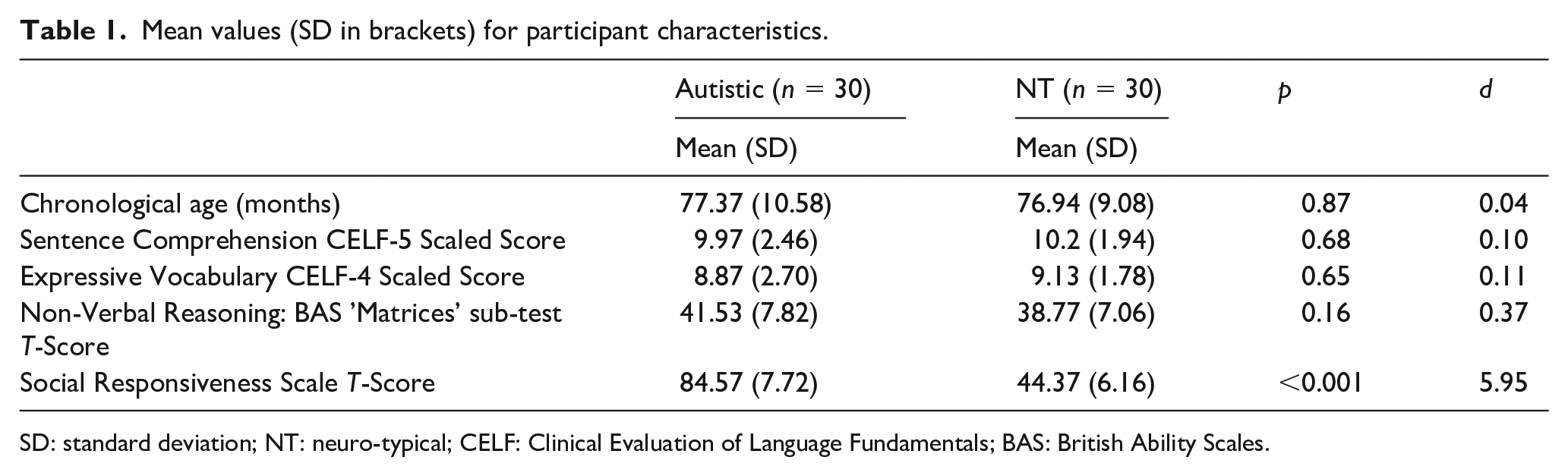
SD: standard deviation; NT: neuro-typical; CELF: Clinical Evaluation of Language Fundamentals; BAS: British Ability Scales.
Groups were matched on chronological age, gender, non-verbal reasoning (assessed by the ‘Matrices’ sub-test of the British Ability Scales (BAS, Elliot & Smith, 2011)) and core language (assessed by both the ‘Expressive Vocabulary’ sub-test of the Clinical Evaluation of Language Fundamentals (CELF-4; Semel et al., 2006)) and the ‘Sentence Structures’ sub-test of the CELF-5 (Wiig et al., 2013). Socioeconomic status 1 and race were not recorded. The adult autism community was not involved in this study.
Procedure
Ethical approval was obtained (University of (Kent)). Written consent was obtained from parents and verbal assent from the children. Four NT children and 11 autistic children were tested in the Kent Child Development Unit, and the remainder were tested in a quiet area of their school. Each child sat in front of a laptop next to one experimenter (E1). A second experimenter (the ‘judge’) sat opposite the child at a second laptop with the screen facing away from the child. E1 told the child that animals were participating in a pet show and the child had to tell the judge which animal was the winner of each round.
For each trial, each child saw two animals (target and distractor) move from the bottom to the centre of the screen, whereby the box around the ‘winning animal’ (target) changed to green (see Supplemental Figure S1 for illustration). Prior to the experiment, each child participated in three ‘demonstration’ trials. Here, they were shown that the ‘judge’ would see the same two animals in the centre of their screen but would not know which had won the prize because the judge would not see the box light up green. E1 modelled appropriately informative descriptions (namely, ‘fish’, ‘white mouse’ and ‘small cat’, respectively).
Each child participated in two conditions ‘No Switch’ (control) and ‘Switch’, the order of which was counterbalanced across participants in each group. Each condition consisted of 10 test trials and 10 ‘filler’ trials, which alternated with the test trials. The two conditions were presented 25 min apart. In both conditions, for half the test trials, the target animal would be ‘appropriately’ described by a simple referring expression – that is, a bare noun phrase (e.g. ‘the dog’). For the remaining test trials in each condition, the target could only be differentiated from the distractor if the participant produced a complex referring expression (e.g. including an adjective which discriminated the target from the distractor).
In both conditions, the order of the first test trial and first filler trial was fixed and both required a simple referring expression, whereas the order of the remaining test and filler trials was randomised. The target was on the left for half the trials. The filler trials always required a simple referring expression to be appropriately informative and always involved animals which were not targets in the test trials (see Supplemental Tables S2 and S3 for clarification regarding how the ordering might appear for a given participant).
No-switch condition
In the ‘No-Switch’ condition, to be appropriately informative participants had to use complex referring expressions – that is, including adjectives – on half the trials and simple referring expressions, that is, not including adjectives on remaining trials (see Supplemental Table S2 for items). However, a participant was never required to re-describe, that is to use different referring expressions for the same specific referent (e.g. the cat with yellow spots only appeared as the target once).
Switch condition
In the ‘Switch’ condition, to be appropriately informative participants had to use a different referring expression across trials for the same specific referent, namely, a black dog with white spots (see Supplemental Table S3 for items). This was because on half the trials, this black spotty dog was paired with an animal of a different lexical type (e.g. a snail); here, telling the judge to award the prize to ‘the spotty dog’ or ‘big dog’ would be over-informative (see Supplemental Table S4 second row for actual child descriptions and their corresponding coding). On the other half of the trials, the same black spotty dog was paired with another dog; sometimes this other dog differed in size (and thus, the participant had to re-describe by including ‘big’), sometimes the other dog differed in colour (requiring the inclusion of ‘black’) and sometimes the distractor dog was stripy (requiring the participant to re-describe as a ‘spotty dog’ or ‘dog with spots/dots’).
Transcription and coding
All verbal references during the experimental task were audio-recorded on Dictaphones and then transcribed and coded offline by two psychology graduates, blind to each child’s diagnostic status (see Supplemental Table S4 for further scoring criteria details). Inter-rater reliability with the first author was carried out on 20% of the data from each coder with strong agreement (Cohen’s k = 0.96) (see Supplemental Table S5 for further reliability calculation details).
Cognitive flexibility
Participants also completed a computer-based version of the Dimensional Change Card Sort (DCCS; Zelazo, 2006), during which children sorted either by object (flowers/boats) or colour (red/blue) (see Supplemental Table S6 for accuracy, reaction-time and switch-cost scores).
Results
The full anonymised csv data set is available on the Open Sciences Framework web pages here: https://osf.io/fnukh/?view_only=d3617a51632e4ecba4ad42ece2af6ff6 The mean values for appropriately informative referring expressions are shown in Table 2, by group and switching condition.
Mean percentage (bolded) appropriately informative, over-informative and under-informative descriptions, by group and condition (SDs in brackets).
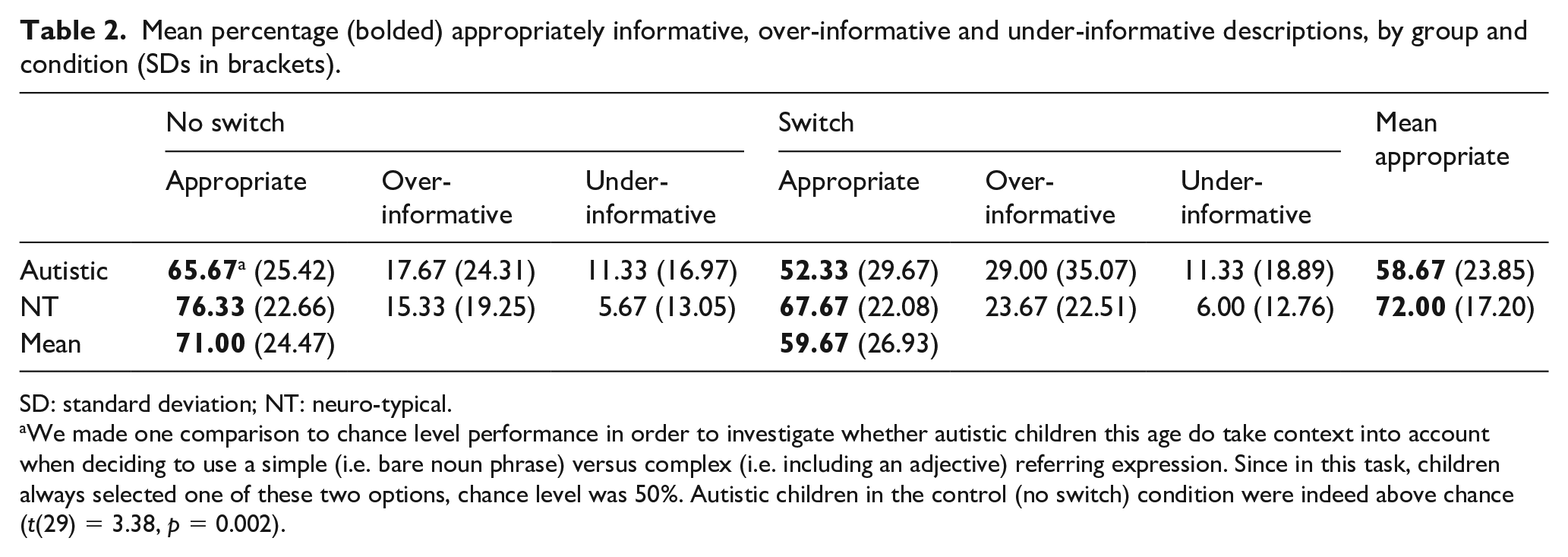
SD: standard deviation; NT: neuro-typical.
We made one comparison to chance level performance in order to investigate whether autistic children this age do take context into account when deciding to use a simple (i.e. bare noun phrase) versus complex (i.e. including an adjective) referring expression. Since in this task, children always selected one of these two options, chance level was 50%. Autistic children in the control (no switch) condition were indeed above chance (t(29) = 3.38, p = 0.002).
To determine which factors impacted appropriate informativity, we constructed a binomial mixed-effects model in R (e.g. Baayen et al., 2008). Switching and group were effect-coded factors and were fully crossed. Participants and items were random effects. We included by-participants random slopes for switching and by-items random slopes for group. p-values were computed by comparing models with likelihood-ratio tests.
There was a main effect for group (b = 0.76, standard error (SE) = 0.31, χ2 = 5.51, p = 0.02), indicating that autistic children were less likely (M = 59%) to produce an appropriately informative referring expression than were their NT peers (M = 72%). There was also a main effect for switching (b = 0.63, SE = 0.21, χ2 = 7.78, p = 0.005), indicating that participants produced more appropriately informative referring expression in the no-switch (control) condition (M = 71%) than in the switch (M = 60%). The interaction between switching and group was not significant (b = 0.14, SE = 0.40, χ2 = 0.12, p = 0.73). 2
For further assurance regarding the null effect for the interaction, we carried out a Bayesian analysis of variance (ANOVA) using default priors in JASP (see Wagenmakers et al., 2018). In line with our previous analyses, it was found that the best model included main effects for switching and group but no interaction. Crucially, the comparison between this ‘best model’ and the model that included the interaction term indicated a BF01 of 3.06, indicating that the best model is three times more likely to be true than the model, which included the interaction.
Secondary analyses
The very first trial in both conditions was fixed. No child was ever under-informative on the first trial because it merely required a simple referring expression to be appropriately informative. We summed the very first trial across conditions. Both parametric (t(58) = 2.17, p = 0.034) and non-parametric (p = 0.043) comparisons indicated that the autistic group was more frequently over-informative (M = 37%) on the first trials than were their NT peers (M = 19%).
Discussion
We are the first to experimentally manipulate how the requirement to re-describe or switch a previously used referring expression affects the ability of speakers to select an appropriately informative expression. We confirm that this does indeed have a detrimental effect in both NT and autistic children; we found a main effect for our experimental switching manipulation. There was also a main effect for group; the autistic group was less appropriately informative than NT peers. However, there was no interaction between diagnostic group and the switching manipulation, and the effect size for the interaction was very small. This ties in with our finding that on the very first trial (i.e. prior to the requirement to switch in either condition), the autistic group was more over-informative than NT peers.
Regarding autistic children, this study fits with numerous findings that autistic children underperform well-matched NT peers in the ability to select appropriately informative referring expressions (e.g. Arnold et al., 2009; Fukumura, 2016; Nadig et al., 2009). However, given the lack of an interaction this study suggests that it may not be difficulties with cognitive flexibility specifically (or solely) which cause them to underperform their peers in the selection of verbal reference. It is possible that autistic use of referring expressions is simultaneously impacted by difficulties in other aspects of EF, such as working memory (for which demands were light in our task). Indeed, some meta-analyses indicate broad difficulties with executive functions in autism (e.g. Demetriou et al., 2018). What is clear from this study is that when there is no requirement to re-describe, autistic 5- to 7-year-olds produce appropriate referring expressions at above-chance levels. Thus, they can in principle – and do under certain circumstances – take into account how much information listeners need in a given context.
Supplemental Material
sj-pdf-1-aut-10.1177_13623613211012860 – Supplemental material for How set switching affects the use of context-appropriate language by autistic and neuro-typical children
Supplemental material, sj-pdf-1-aut-10.1177_13623613211012860 for How set switching affects the use of context-appropriate language by autistic and neuro-typical children by Louise Malkin and Kirsten Abbot-Smith in Autism
Footnotes
Acknowledgements
The authors thank Frank Gasking for technical assistance. A special ‘thank you’ to the children, to the parents who brought their children into the Kent Child Development Unit and to the staff and caregivers of the various schools in Kent, UK, where we tested. The authors thank Hannah Doolan, Emily Farris, Lauren McGuinness, Aimee Murphy, Charlotte Nyman, Gabrielle Ragbir, Gemma Sayers, Laura Smith and Serena Welham for playing the role of Experimenter 2 and to Charlotte Nyman and Gemma Sayers for assistance with transcription and coding reliabilities. The authors also thank three anonymous reviewers as well as Danielle Matthews, Christina Kim and David Kelly for helpful comments on an earlier draft.
Declaration of conflicting interests
The author(s) declared no potential conflicts of interest with respect to the research, authorship, and/or publication of this article.
Funding
The author(s) received no financial support for the research, authorship and/or publication of this article: This study was funded by a PhD scholarship to L.M.

Supplemental material
Supplemental material for this article is available online.
Notes
References
Supplementary Material
Please find the following supplemental material available below.
For Open Access articles published under a Creative Commons License, all supplemental material carries the same license as the article it is associated with.
For non-Open Access articles published, all supplemental material carries a non-exclusive license, and permission requests for re-use of supplemental material or any part of supplemental material shall be sent directly to the copyright owner as specified in the copyright notice associated with the article.
