




Abstract
Empathy evokes support for the person in distress, and thus strengthening social cohesion. The question is to what extent empathic reactions can be observed in autistic adolescents and autistic girls in particular, since there is evidence that they have better social skills than boys, which might hinder their recognition as autistic. We examined 193 adolescents (autistic/non-autistic boys/girls) during an in vivo task in which the experimenter hurt herself. In line with our predictions, no group or gender differences appeared related to their attention for the event; yet autistic girls and boys showed less visible emotional arousal, indicative of less affective empathy. Autistic girls and boys reacted by comforting the experimenter equally often as their non-autistic peers, but autistic boys seemed to address the problem more often than any other group; while girls (autistic and non-autistic) more often addressed the emotion of the person in need. Our findings highlight that empathic behaviour – to some extent – seems similar between autistic and non-autistic boys and girls. However, differences exist, in terms of expressed emotional arousal and gender-specific comforting styles. Autistic girls’ higher levels of emotion-focused comforting could be explained by well-developed social skills, camouflaging, or emotional investment in relationships with others.
Lay abstract
Empathy is an important feature to feel for another person, evoking social support for the person in distress, and thus strengthening social cohesion. The question is to what extent empathic reactions can also be observed in autistic adolescents and autistic girls in particular, since their often mentioned good social skills might prevent their direct social environment from recognizing their autism. We examined 194 adolescents (autistic and non-autistic boys and girls) during an in vivo task in which the experimenter pretended to hurt herself while closing a binder. All responses by the participants were videotaped and coded by two independent coders. In line with our predictions, no group or gender differences appeared related to their attention for the event; yet autistic girls and boys showed less visible emotional arousal, which could indicate less affective empathy (feeling for someone), or which could indicate that autistic adolescents know less well how to show empathy. Autistic girls and boys reacted by comforting the experimenter equally often as their non-autistic peers, but autistic boys addressed the problem more often than any other group, while girls (autistic and non-autistic) more often addressed the emotion of the person in need. Our findings highlight that empathic behaviour is remarkably similar between autistic and non-autistic boys and girls. Indeed, only subtle differences exist, in terms of expressed emotional arousal and gender-specific comforting styles. Autistic girls’ higher levels of emotion-focused comforting could be explained by well-developed social skills, camouflaging, or emotional investment in relationships with others.
Introduction
Empathy refers to the ability to feel for other people’s emotional reactions, especially distress, evoking the urge to react supportively (Hoffman, 1987). It is an essential tool for social bonding and strengthening in-group behaviours. Given that social impairments are a crucial factor in the diagnosis of autism, one might expect empathy to be impaired in this population. However, the literature seems to show a diverse and unclear picture (Trimmer et al., 2017). Different factors might possibly account for these paradoxical findings. Gender differences might be one such factor.
Gender differences in autism have been long overlooked, as it was believed to be a male dominated condition. However, recent developments in the field are indicating that the female autism phenotype is different and distinct, and thus often difficult to recognize, both by professionals and those in their direct social environment. Many autistic women reach adulthood without receiving a diagnosis, often only getting diagnosed in their forties and fifties, after spending their young life confused and struggling to fit in (Lai & Baron-Cohen, 2015; Rivet & Matson, 2011; Sedgewick et al., 2018; Shattuck et al., 2009). One reason that autism in girls might go undetected is that girls in general show better social skills (Dworzynski et al., 2012; Head et al., 2014), a lack of which is a core feature of the autism diagnosis. One of those social skills, usually thought to be higher in girls, is empathy (Burr, 1998). As a result of these better social skills, autistic girls and women might often go misdiagnosed with depression, anxiety disorders, or eating disorders, which can also result in unnecessary medication intake and unhelpful treatments (Kopp & Gillberg, 1992; Rivet & Matson, 2011; Solomon et al., 2012). For obvious reasons, effective support for autistic people relies on a correct diagnosis. This requires more knowledge and a better understanding of the female autism phenotype (Allely, 2019) in order to prevent unnecessary suffering and inappropriate use of our health care system (García-Primo et al., 2014). Impairments in the social domain form an important pillar for the Diagnostic and Statistical Manual of Mental Disorders (5th ed.; DSM-5) diagnosis of autism, but the gender differences may be especially prominent in this area.
The aim of this study is to examine empathy in adolescence, which is an important aspect of social functioning and often mentioned to be impaired in autistic adolescent girls and boys compared to non-autistic girls and boys (Bons et al., 2013). We want to restrict the study and the literature overview to autistic people without intellectual disabilities, so we can more clearly attribute surfaced differences to dissimilarity between autistic and non-autistic adolescents, in particular those who could blend in with peers, unnoticed. In addition, we want to focus on adolescence in this study, since this is an important transition period in which peer relationships become increasingly important, and thus put a higher demand on the adolescents’ social skills (Laursen et al., 2012).
Empathy in autistic individuals
The ability for empathy can be subdivided into three different components: affective empathy, cognitive empathy and pro-social empathy (or intent to comfort; Overgaauw et al., 2017); each of which are considered important or even crucial features for bonding and evoking in-group behaviours, as a temporary priority for the other person’s concerns and needs over one’s own needs is formed. Affective empathy, also known as emotion contagion, occurs when one observes another’s emotional state and consequently also experiences emotional arousal, cognitive empathy is one’s ability to understand the other person’s emotion and pro-social empathy (comforting) is the act of responding verbally or non-verbally in an attempt to ease the emotional suffering of the other (Overgaauw et al., 2017).
One of the most widely used measures to examine empathy in autistic people is the ‘Empathy Quotient’ (EQ; Baron-Cohen & Wheelwright, 2004), which is a self-report scale primarily focused on the ‘understanding’ of others’ emotion, that is, cognitive empathy (e.g. ‘my child does not understand why some things upset other people so much’). Outcomes of studies using measures of cognitive empathy systematically show lower scores for autistic people compared to non-autistic young people (Bons et al., 2013). However, this particular aspect of empathy relies heavily on people’s ability to appreciate the subjective nature of other people’s mental states (such as their desires, beliefs and intentions), and acknowledge these mental states as the cause for their (emotional) behaviours, also called Theory of Mind (ToM) (Blair, 2005; Kaland et al., 2008). The ToM impairments in autistic individuals have been widely documented (Baron-Cohen, 2000; Blair, 2005). These impairments can already be observed in autistic toddlers and preschoolers (Broekhof et al., 2015), and continue into adulthood (Begeer et al., 2012). Thus, the difficulties in cognitive empathy that autistic people experience may therefore be related to these well-established ToM impairments and not a reflection of their empathy as a whole, thus on all components.
Interestingly, autistic individuals seem to show more emotion related and less cognition related activation on a neurological level than non-autistic people when observing images or videos of people in pain (Fan et al., 2014; Hadjikhani et al., 2014). This might be indicative for their affective empathy. Other studies on empathy that seem to have also addressed affective empathy, have used observational methods to observe how autistic and non-autistic participants reacted in an in vivo task, using a variety of emotional stimuli. Such studies provide us with an understanding of more real-life social responses in various contexts, when compared to the use of imaged or videos. Examples of stimuli include an adult hurting him/ herself or being in pain (Butean et al., 2014; Campbell et al., 2017; McDonald et al., 2017; McDonald & Messinger, 2012), receiving bad news (Scheeren et al., 2013), losing her watch/torn drawing (Newbigin et al., 2016), or a peer being excluded from an online ball game (Deschamps et al., 2014). By observing and scoring participant’s visible responses in the video recordings, these studies examine the level of attention to the event, the visible emotional arousal (i.e. facial, gestural and/ or vocal signs of emotion, concern or sympathy), which is considered to be indicative of the level of affective empathy and/ or the amount of pro-social empathic responding.
Findings have shown no difference between groups in terms of levels of attention to the event. Next, in terms of emotional arousal, there seems to be variability depending on the stimulus presented. Specifically, when an adult was in pain, autistic individuals usually showed less visible emotional arousal than their non-autistic peers (Butean et al., 2014; Campbell et al., 2017; McDonald & Messinger, 2012). The exception to this is a study by McDonald and colleagues (2017), where although the difference between groups was not significant, a trend in the same direction was present. When an experimenter expressed distress about losing his/ her watch however, autistic (pre-)adolescents showed as much visible emotional arousal as their non-autistic peers (Newbigin et al., 2016). When it comes to pro-social behavioural responses, the literature clearly indicates that autistic children and adolescents do not differ from their non-autistic counterparts, no matter what the stimulus is (Butean et al., 2014; Campbell et al., 2017; McDonald & Messinger, 2012; Newbigin et al., 2016; Sheeren et al., 2013).
Gender differences in empathy
Since girls are socially expected to be more interpersonally oriented and to express kindness and care when others are in need (Burr, 1998), we might expect higher levels of empathy in girls. Based on self-reports, non-autistic adolescent girls noted indeed higher levels of affective empathy and pro-social behaviours than their male peers (Garaigordobil, 2009; Lucas-Molina et al., 2016; Mestre et al., 2009; Stuijfzand et al., 2016; Tello et al., 2013). However, although higher levels of affective empathy in non-autistic girls were confirmed by parent reports (Dadds et al., 2008), when teachers or parents reported on their behaviours, results were mixed (Garaigordobil, 2009; McMahon et al., 2006). Observational studies in which someone hurts him/herself are currently limited in number, and to date, only involve toddlers or younger children. These studies have shown no differences between non-autistic boys and girls in terms of visible emotional arousal or pro-social empathic responding in response to someone in pain (Roth-Hanania et al., 2011; Spinrad & Stifter, 2006; Volbrecht et al., 2007), but it is not yet clear how this plays out in (pre-)adolescence, a time at which gender differences in the response to emotional stimuli become increasingly pronounced (Yang et al., 2018).
Debate is ongoing about whether this possible gender difference we observe in some studies but not all, has a biological basis or is an artefact of the socialization process (Burr, 1998). Possibly, it is socially expected for girls to express emotions, including empathic emotions, whereas boys may be seen as weak if they were to do so. In addition, it is possible that girls and boys experience similar levels of empathy, but differ in the way they express this, leading to differing reports from onlookers. In support of the socialization theory, quantity of physiological arousal, measured by heart rate or pupil dilation when observing negative emotions, is the same in males and females (Kuypers, 2017; Michalska et al., 2013). However, neurological differences appeared, whereby males activated more cognitive brain areas and females more emotion related areas (Schulte-Rüther et al., 2008). This difference in focus between boys and girls is also supported by a study that presented hypothetical situations to participants and observed that girls more often suggested offering emotional support (‘emotion-focused’ comforting), but boys more often suggested trying to solve the problem (‘problem-focused’ comforting; Banerjee et al., 2006). This gender-related difference indeed seems to support the statement by Crick and Dodge (1994) that girls are more interpersonally oriented, whereas boys are more instrumentally oriented and it could be argued that both are a genuine attempt to ease another person’s emotional distress.
When considering autism and gender differences together, autistic and non-autistic female preschoolers were seen to engage in more pro-social empathic behaviour than their male peers in the study by Bacon and colleagues (1998). Yet, the small number of girls with autism (six) in this study prohibits us from drawing firm conclusions about possible differences between autistic girls and boys in this respect. In addition, the other studies using in vivo tasks either did not involve any girls or included only a few autistic girls (Deschamps et al., 2014; Newbigin et al., 2016; Scheeren et al., 2013). In terms of how they comfort, we have no reason to believe that autistic boys will not respond in a similar manner to non-autistic boys (i.e. problem-focused comforting). Similarly, for autistic girls, we expect that the type of responses will be similar to their non-autistic female counterparts (i.e. emotion-focused comforting; Banerjee et al., 2006), especially considering their emotional investment in peer relationships (Sedgewick et al., 2019).
Present study
Empathy is an essential skill for social bonding, and often noted to be impaired in autistic people. Yet, by and large these studies either willingly or unwillingly neglect girls, focusing their outcomes on autistic boys. For example, in the study on empathy by Pouw and colleagues (2013), autistic girls were excluded from the sample because their sample size was so small that the analyses would hold no statistical power. Other studies included such small samples, which prohibits drawing any conclusions about this particular group (e.g. Bacon et al., 1998).
The present study used an in vivo empathy task adapted from previous studies (e.g. Butean et al., 2014), whereby the experimenter pretended to hurt her finger while closing a binder, to examine the extent to which autistic and non-autistic girls and boys (1) pay attention to the event, (2) show emotional arousal, and (3) show a (verbal or non-verbal) pro-social, empathic reaction. In addition, (4) we also examined group and gender differences in the use of (verbal) emotion-focused and problem-focused comforting styles.
In terms of (1) attending to the event, we expected that there would be no group or gender differences in the amount of attention paid to the event (e.g. Butean et al., 2014). With regard to (2) emotional arousal, which is considered indicative of affective empathy, in line with previous research also examining reactions to someone experiencing pain in an in vivo task; we expected that young autistic people would display less emotional arousal than their non-autistic peers (e.g. Butean et al., 2014). In addition, in line with findings regarding young children, we expected that there would be no gender difference in the amount of emotional arousal shown (McDonald et al., 2017; McDonald & Messinger, 2012).
In the light of a small number of studies examining gender differences in (3) pro-social empathic reactions, we predicted that girls would show equal amounts of pro-social empathic reactions to boys and that this would be true for both autistic and non-autistic groups (McDonald et al., 2017; McDonald & Messinger, 2012). In line with previous research (Butean et al., 2014; Deschamps et al., 2014; Newbigin et al., 2016; Scheeren et al., 2013) we did not anticipate any difference in the quantity of (verbal and non-verbal) pro-social empathic responding between autistic and non-autistic adolescents. But, (4) we did expect that boys (autistic or non-autistic) would express more verbal problem-focused comforting and girls (autistic or non-autistic) would express more verbal emotion-focused comforting (Banerjee et al., 2006).
Method
Participants
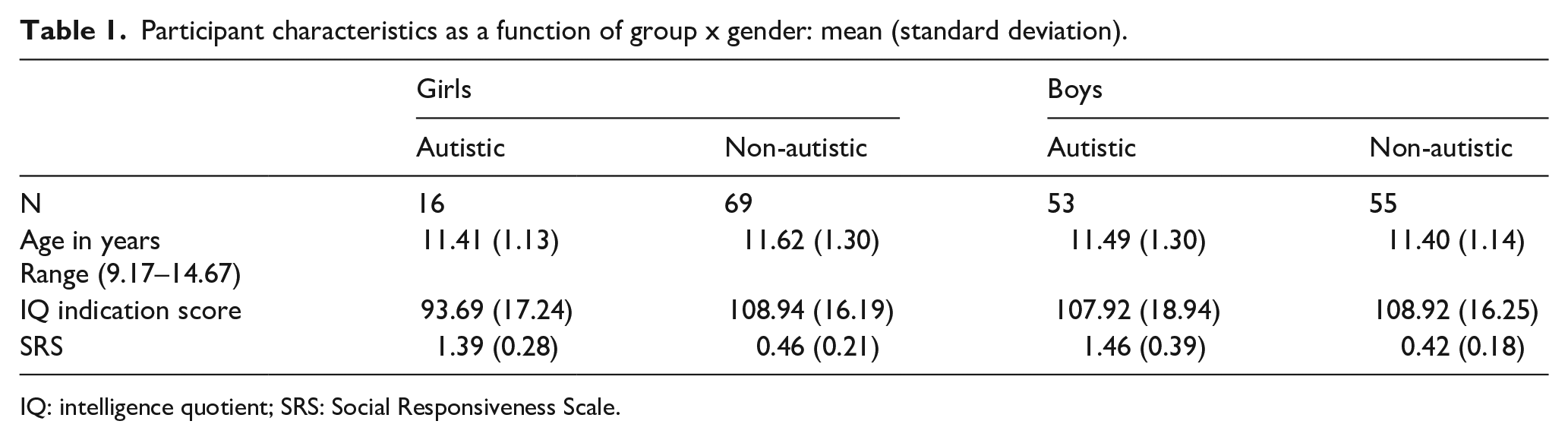
A total of 193 adolescents participated in this study (mean age = 11.51 years, standard deviation (SD) = 1.2, range: 9.16–14.67 years). Autistic (pre-)adolescents (16 girls/53 boys) were recruited from a mental health care facility specializing in autism (Centre for Autism, Leiden, the Netherlands) and schools for autistic children. Autism was clinically diagnosed based on extensive diagnostic assessment following the criteria in the Diagnostic and Statistical Manual of Mental Disorders (4th ed., text rev.; DSM-IV-TR; American Psychiatric Association, 1994), independent of this study. The control group consisted of non-autistic children and adolescents (69 girls/55 boys). The control group was recruited via regular Dutch primary schools and high schools. There were no differences in age between the groups (See Table 1 for group characteristics).
Participant characteristics as a function of group x gender: mean (standard deviation).
IQ: intelligence quotient; SRS: Social Responsiveness Scale.
Participants all had cognitive functioning in the normal range, above 70, and were capable of spontaneous verbal communication as indicated by parents or teachers. In the absence of a full IQ test, an indication score was calculated to estimate each participant’s cognitive level (i.e. to ensure IQ > 70, participants completed 2 subtests of the Wechsler Intelligence Scale (WISC): block design and picture arrangement; Kort et al., 2002; Wechsler, 1991). In order to compute an IQ indication score, raw scores for each subtest were converted to norm scores and the mean of these two scores was calculated. IQ indication scores ranged from 72 to 140. For 14 participants an IQ indication score was missing (4 of the autistic group, 10 of the non-autistic group). A 2 (Group: autistic / non-autistic) x 2 (Gender: girl / boy) mixed analyses of variance (ANOVAs) on IQ showed a main effect for Group (F(1, 176) = 7.642, p = 0.006) and Gender (F(1, 176) = 5.848, p = 0.017, which was qualified by an interaction of Group x Gender (F(1, 176) = 5.677, p = 0.016), indicating that autistic girls had a lower IQ indication scores than other sub-groups. See Supplementary Table 4 for further information on the relation between IQ scores and empathic responses.
The Social Responsiveness Scale (SRS) was used to quantify autistic traits. A 2 (Group: autistic/ non-autistic) x 2 (Gender: girl/ boy) mixed ANOVAs on SRS scores showed a main effect for Group (F(1, 179) = 458.98, p < 0.001), no effect for Gender and no interaction effect. This indicated that SRS scores were significantly higher for the autistic group. See Table 1 and Supplementary Tables 1 for SRS scores by group and gender. See Supplementary Tables 2 and 3 for further information on the relation between SRS scores and empathic responses.
Procedure
Permission for this study was granted by the ethics committee of Leiden University, department psychology. All parents of adolescents participating in this study signed a consent form before the start of the study. The measures described in this research paper are part of a larger research project, including additional measures and observation tasks that are not reported here, some results of which have been published elsewhere (e.g. Broekhof et al., 2018; Schmitz et al., 2015; Rieffe et al., 2014). Adolescents were tested in a quiet room at school or at home. Sessions took approximately 1 hour and were video recorded.
Materials
Empathy was measured through a widely used observation task in which an experimenter closed a binder and pretended to hurt her finger while closing it (Zahn-Waxler et al., 1992). The experimenter exclaimed in pain and put her finger to her mouth, saying ‘Oh, that hurts’. The experimenter then waited 10 s for the participant to react.
Prior to conducting the experiments, all experimenters were trained to perform all tasks necessary for the large research project. After completing the tasks with a small number of non-autistic participants, experimenters reviewed these video recordings with the trainer in order to ensure consistent administration of the tasks.
Scoring
Coders for the empathy task were first introduced to the task, shown videos of another sample, and instructed how to use the coding scheme. They first practised with the instructor on at least 10 participants from another sample to reach better interrater reliability. Next, two independent coders coded the reactions of each participant from the camera recordings based on the prescribed observation schema consisting of 5 items described below. Inter-rater variability was 85%. Cohen’s kappa for the items ranged from .48 to .94. Disagreements on the items were solved by discussion between the coders. Based on existing scoring schemes from other researchers in previous studies (Butean et al., 2014; Campbell et al., 2017; McDonald & Messinger, 2012), the following categories were used:
First, ‘Attention’ indicated to what extent participants paid attention to the situation (1 = participant does not look at the situation, i.e., the binder and/or experimenter, 2 = participant looks at the binder and/ or experimenter (for less than 2 s), and then turns away, 3 = participant looks continuously at the situation, i.e., the binder and/ or experimenter). Cohen’s kappa for this item was substantial (K = .62). This variable contained two missing values (2 autistic boys).
Second, ‘Emotional Arousal’ indicated to what extent participants showed affective empathy in response to the distress of the experimenter (1 = participant shows no sign of arousal, 2 = little arousal, i.e., a quick facial expression or body movement, 3 = clear arousal, defined as an obvious and appropriate emotional reaction, 4 = high arousal, defined as getting upset). Cohen’s kappa for this item was moderate (K = .48). This variable contained six missing values (5 non-autistic children and 1 autistic boy).
Third, ‘Pro-social empathic reaction’ indicated to what extent participants showed a pro-social empathic reaction (i.e. comforting) to the situation (1 = not at all, participant does not show any reaction, 2 = a bit, participant shows reaction (verbal and/or non-verbal) but this does not seem sincere (i.e. ‘Oh my mother also hurt her finger’) or participant shows no intent to communicate with experimenter, 3 = yes, participant reacts empathically to the situation and is affectively involved, verbal and/or non-verbal (‘Do you feel okay?’). Cohen’s kappa for this item was moderate (K = .56).
Extra to the scoring that is commonly used in the literature, we added an extra scoring to distinguish between emotion-focused and problem-focused verbal responses:
Fourth, ‘Emotion-focused’ indicated the number of participants who verbally referred to the emotion or feelings of the experimenter while comforting. For example, ‘Are you alright?’ or ‘Oh, that hurts’, for which participants received the score of 1. Participants received the score of 0 when there was no emotion-focused utterance. Cohen’s kappa for this item was high (K = .89). This value contains two missing values (both from the non-autistic group).
Fifth, ‘Problem-focused’ indicated the number of participants who verbally advised the experimenter to prevent future harm (‘You should be more careful’) or how to solve the situation (I can get you a bandage?’) while comforting. For these responses, participants received the score 1. In the absence of a problem-focused verbal reaction, participants received a score of 0. Cohen’s kappa for this item was high (K = .94).
Results
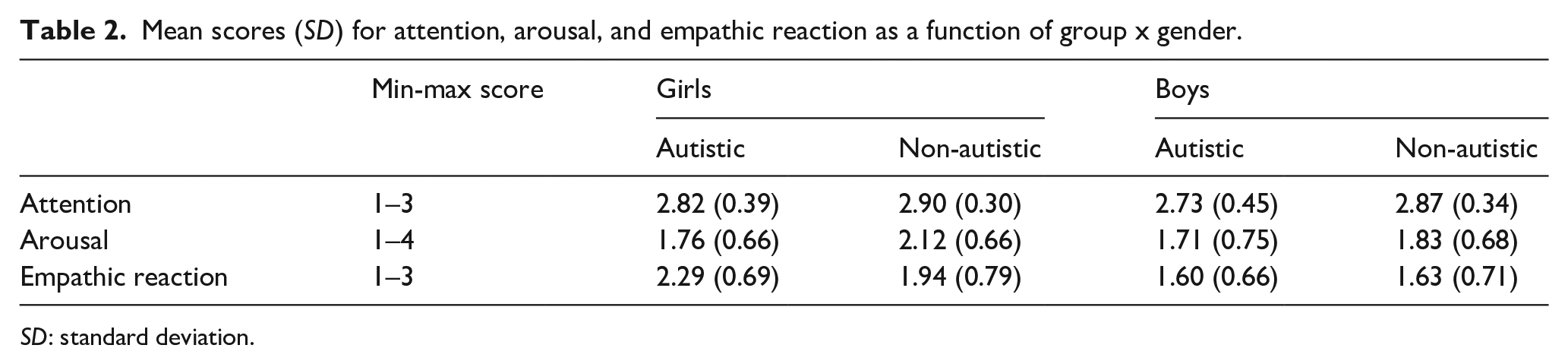
Mean scores and standard deviations of the items for Attention, Arousal, and Empathic reaction are shown in Table 2 for Group and Gender. Accounting for the ordinal data, several two way ANOVA for trimmed means (robust ANOVA) were estimated with R (Mair & Wilcox, 2020; R Core Team, 2019; Wilcox, 2012). A 2 (Group) x 2 (Gender) robust ANOVA for Attention showed no main effects for Group (F = 1.525, p = 0.227) or Gender (F = 1.525, p = 0.227), nor an interaction of Group x Gender, (F = 1.525, p = 0.227). Note that degrees of freedom are not reported, since an adjusted critical value is used for these analyses.
Mean scores (SD) for attention, arousal, and empathic reaction as a function of group x gender.
SD: standard deviation.
A 2 (Group) x 2 (Gender) robust ANOVA for Emotional Arousal showed a main effect for Group (F = 5.398, p = 0.028). There was no main effect for Gender (F = 2.985, p = 0.095), nor an interaction (F = 0.900, p = 0.351). Mean scores (Table 2) show that autistic (pre-)adolescents, boys and girls, showed less emotional arousal in response to the situation than non-autistic individuals.
A 2 (Group) x 2 (Gender) robust ANOVA for Pro-Social Empathic reaction showed a main effect for Gender (F = 18.979, p = 0.001), but not for Group (F = 2.605, p = 0.116) nor an interaction for Group x Gender (F = 2.29, p = 0.139). Mean scores (Table 2) revealed that autistic and non-autistic girls received higher scores for Pro-Social Empathic Reaction than autistic or non-autistic boys.
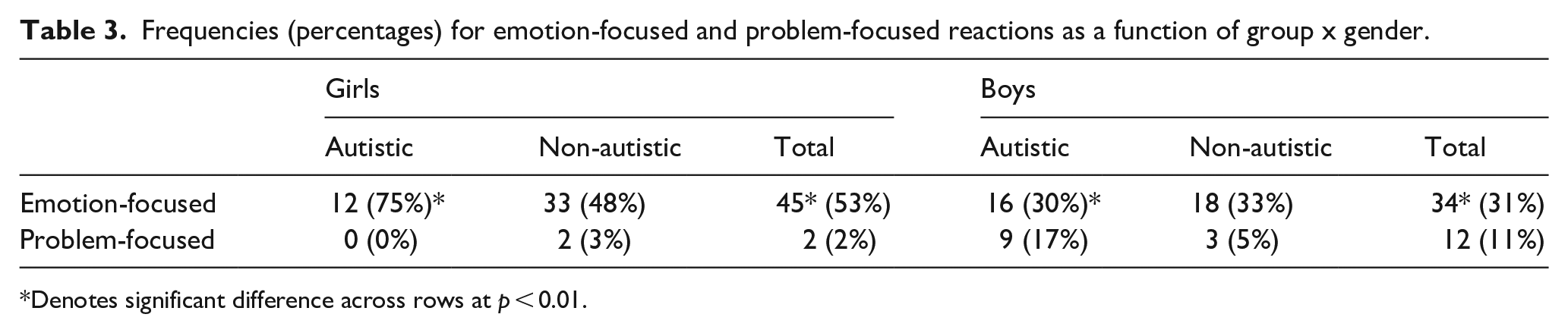
To analyse the content of the verbal Pro-Social Empathic reactions, Chi-square tests were conducted to compare participants by group and gender (see Table 3). Girls were more likely (53%) than boys (31%) to show an emotion focused reaction (χ2(1) = 8.194, p = 0.004). There was no difference between participants with autism spectrum disorder (ASD) (41%) and typically developing children (41%) in terms of an emotion focused reaction (χ2(1) > 0.001, p = 0.999). Bonferroni corrected Chi-square tests were conducted to explore Group x Gender differences. Autistic girls showed significantly more often an emotion focused response (75%) than autistic boys (30%; χ2(1) = 8.461, p = 0.015). No differences were found when comparing the frequency of the emotion-focused reaction of: girls with and without autism, boys with and without autism as well as typically developing boys and girls (all p > 0.369).
Frequencies (percentages) for emotion-focused and problem-focused reactions as a function of group x gender.
Denotes significant difference across rows at p < 0.01.
Regarding the problem-focused responding, no autistic girls showed this kind of response, while 17% of autistic boys did. For the non-autistic group, 5% of non-autistic boys responded in a problem-focused way, while 3% of non-autistic girls did. Due to low frequencies the problem-focused reaction Fisher-Yates tests were conducted. Boys (11%) were more likely than girls (2%) to react in a problem-focused manner (odds ratio (OR) = 0.19, p = 0.024). Autistic participants (13%) were more likely than non-autistic participants (4%) to show a problem-focused reaction (OR = 3.54, p = 0.039). No differences were found when comparing the frequency of the problem-focused reactions in sub-groups, that is, between boys and girls with autism; boys and girls without autism; girls with and without autism; nor boys with and without autism (all p > 0.071). Please see Supplementary materials for further analyses.
Discussion
Expressing emotional empathy is vital when building social relationships. However, it is not yet clear how this skill develops in autistic (pre-)adolescents and exceptionally little is known about how autistic girls behave in this area. The present study aimed to examine three aspects of empathic responding: the extent to which participants showed attention, showed emotional arousal (reflecting affective empathy), showed a pro-social empathic reaction (i.e. comforting), and what type of comforting styles were engaged in.
While almost all participants attended to the experimenter when she hurt her finger, visible arousal was slightly lower in autistic youngsters, as is consistent with other in vivo studies in which the experimenter also feigned pain (e.g. Butean et al., 2014). Yet, boys and girls appeared equally emotionally aroused, signifying that there was no gender difference in expressed affective empathy. In terms of pro-social action, the literature holds inconsistent findings, yet, in line with self-reports, (pre-)adolescent girls reacted more pro-socially than boys and this applied to both autistic and non-autistic girls. When it came to comforting styles, both autistic and non-autistic girls did show a preference for emotion-focused comforting, as predicted. Furthermore, autistic boys seemed to engage in more problem-focused comforting than the participants in the other groups, but this last outcome is only preliminary due to small sample sizes and low scores on this specific response pattern within the sub-groups.
Our finding that autistic youngsters showed less visible emotional arousal than non-autistic individuals is inconsistent with previous in vivo research observing the reactions of a similar group of participants when the experimenter discovered her watch was missing (e.g. Newbigin et al., 2016). However, it is in line with a previous in vivo study including younger children’s (6–10 years old) observed reaction to the experimenter’s pain (Butean et al., 2014). Therefore, these outcomes might be stimulus or emotion dependent, because the pain experiments depict accidents, whereas a ripped drawing reflects an intentional harmful act, possibly evoking also (empathic) anger and feelings of moral injustice.
These results indicate that autistic adolescents do not show affective empathy in response to pain to the same extent as their non-autistic peers. However, a lesser expression of emotional arousal does not necessarily imply that the participants with autism did not experience emotional arousal (and thus affective empathy). Previous research has shown a lack of concordance between physiological and expressed arousal in autistic children (Zantinge et al., 2017). Possibly, autistic individuals are less inclined to communicate their internal states, or do so in ways which are more difficult to interpret (Brewer et al., 2016; Milton, 2012; Sasson et al., 2017).
Autistic and non-autistic girls expressed more of a pro-social empathic reaction than autistic or non-autistic boys. In fact, autistic girls comforted to a similar extent as non-autistic girls, which may indicate that they did empathize with others’ emotions as the other girls did, as according to the empathy-altruism model (Batson, 1991), pro-social empathic responding is motivated by empathic concern for the other person. Not only this, but autistic girls were the highly likely to engage in emotion-focused comforting (75% of them did so). Taken together, these findings may indicate that autistic girls are in tune with the emotions of others and have a real desire to relieve the emotional distress experienced by other people.
Autistic girls might have learned more ‘neurotypical’ expressions of empathy through their environment and our findings may represent some overcompensating, i.e. excessively applying a learned social rule. Indeed, research has shown that girls are experts in camouflaging their difficulties, in part by ‘compensating’, which involves imitating behaviour they have observed in others (Hull et al., 2017). Nevertheless, recent research on the friendships of autistic girls have shown that they are just as emotionally invested in their friendships and are just as likely to engage in emotion-focussed talk and emotional sharing as non-autistic girls (Sedgewick et al., 2019), suggesting that their pro-social empathetic behaviours seen here are genuine.
Boys more often than girls offered problem-focussed solutions to the experimenter, and autistic participants did so more often than their non-autistic peers. Although these outcomes are preliminary, due to low frequencies within the sub-groups, especially autistic boys seemed to offer these solutions, because these kinds of responses did not occur at all in autistic girls. It can be assumed that this type of comforting, although well intended, may not have an actual comforting impact on an individual in pain or distress, but future studies could further look into the prevalence and effect of this kind of empathic response on the person in distress.
There are limitations to this work that must be taken into account when interpreting the findings. Indeed, observational studies such as this are relatively rare and provide us with objective measures of behaviour. However, the difficulties and subjectivities that arise when measuring behaviour in this way must also be acknowledged. While we endeavoured to map our coding scheme onto those of previous literature, direct comparisons should be interpreted with caution. Furthermore, we are restricted to drawing conclusions about behavioural responses, rather than the individuals’ internal experiences of empathy. Finally, caution should be applied to the conclusions drawn from this study due to the statistically small sample size of autistic girls.
The fact that it is difficult to include autistic girls, because they go often undiagnosed, also might give a bias to the current outcomes: possibly, girls with ‘obvious male’ characteristics have a higher chance of being recognized and diagnosed, as highlighted by other work (Gould & Ashton-Smith, 2011). It is important to note that the autistic girls in this study had a lower indicated IQ than the other groups, something which is unfortunately common in research as young girls with lower IQ are more likely to display challenging behaviours, increasing their chances of diagnosis (Dworzynski et al., 2012). This causes an issue when interpreting the findings of this study, as they may apply only to the specific sub-group of autistic females who show these ‘obvious male’ autistic traits, and thus receive a diagnosis early in life. Interestingly, despite this lower indicated IQ, however, autistic girls showed high levels of empathy, suggesting that the links between (indicated) IQ, social skills, and empathy are not linear, in line with work recently carried out with adult autistic women (Livingstone et al., 2019). It is promising that an increasing number of tools and instruments are now being developed to help identify autistic girls that are particularly good at camouflaging their difficulties (e.g. the Camouflaging Autistic Traits Questionnaire; Hull et al., 2019). These tools might further help us to understand the mechanisms underlying social and emotional behaviours, such as empathy, in autistic girls. Despite these limitations, we hope that this study can provide important initial indications of the empathy experiences and behaviours of this important, and thus far poorly understood sub-group of individuals.
This study dealt with an expression of pain by the experimenter. Yet, physical pain is easy to see and requires little insight into another’s personal experiences, compared to a friend’s broken heart, for example. How autistic girls would notice the more subtle signs of emotional pain, understand such pain, and subsequently respond to this pain, has not yet been explicitly studied. Therefore, empathic reactions to different stimuli, such as social pain (e.g. a friend’s sadness or embarrassment) should also be investigated, especially as previous research suggests people with autism have significant difficulty with these types of emotions (Krach et al., 2015). Furthermore, it must be stated that while the present study employs a real-life method for measuring empathy, our findings must be considered in the context of the wider literature on the topic, as we have endeavoured to achieve above. Also, further research is necessary to understand this complex issue more fully and should comprise a variety of approaches. For example, some useful approaches may be physiological measures, eye-tracking and interviewing autistic young people about their lived experiences. This will allow us to gradually build a clear picture of how empathy is both experienced and expressed by autistic young people.
The findings in this study suggest that empathic behaviours are generally similar between autistic and non-autistic adolescent boys and girls, with similar levels and styles of empathic responses. However, autistic adolescents showed less physical arousal in response to the experimenter, and there were differences in their verbal responses to the experimenter’s pain compared to the non-autistics participants. Girls, in particular autistic girls, focused on addressing the emotions of the experimenter. Autistic girls’ high levels of emotion-focused comforting could be explained by well-developed social skills, camouflaging, or emotional investment in relationships with others. On the other hand, boys, and autistic boys in particular, seemed to employ more problem-focused responses, but this outcome especially needs further investigation. We believe that empathy is an important topic for future research, as it is one of the most important features for social bonding (Hoffman, 1978). Answers to the questions and assumptions raised here could have significant implications for how autistic girls and boys need to be supported to develop and maintain friendships throughout the complex adolescent years.
Supplemental Material
Supplementary_Information – Supplemental material for Quantity and quality of empathic responding by autistic and non-autistic adolescent girls and boys
Supplemental material, Supplementary_Information for Quantity and quality of empathic responding by autistic and non-autistic adolescent girls and boys by Carolien Rieffe, Rachel O’Connor, Anne Bülow, Danique Willems, Laura Hull, Felicity Sedgewick, Lex Stockmann and Els Blijd-Hoogewys in Autism
Footnotes
Acknowledgements
The authors would like to thank the children, parents and schools who participated in this study. In addition, the authors want to thank Lucinda Pouw for her participation in this project and her leading role in the data collection.
Declaration of conflicting interests
The author(s) declared no potential conflicts of interest with respect to the research, authorship, and/or publication of this article.
Funding
The author(s) disclosed receipt of the following financial support for the research, authorship, and/or publication of this article: This research was supported by the Innovational Research Incentives Scheme (a VIDI grant) by The Netherlands Organization for Scientific Research (NWO), no. 452-07-004 to Carolien Rieffe.
ORCID iDs

Supplemental material
Supplemental material for this article is available online.
References
Supplementary Material
Please find the following supplemental material available below.
For Open Access articles published under a Creative Commons License, all supplemental material carries the same license as the article it is associated with.
For non-Open Access articles published, all supplemental material carries a non-exclusive license, and permission requests for re-use of supplemental material or any part of supplemental material shall be sent directly to the copyright owner as specified in the copyright notice associated with the article.
