




Abstract
Central coherence refers to an in-built propensity to form meaningful links over a wide range of stimuli and to generalize over as wide a range of contexts as possible. In children with autism this ability is diminished, and the impact of central coherence deficits in children with autism have previously been observed using static measures of learning, such as reading comprehension test performance. In this study, the relationship between central coherence and more dynamic indicators of learning are investigated. The responses of 52 children with autism (mean age 9:10 years) on a test of central coherence and a dynamic assessment task were analysed. All the children showed significant improvements in dynamic assessment test scores after mediation; however, among those with below average nonverbal intelligence scores, weak central coherence was significantly associated with smaller gains in performance after teaching. Implications for the validity of dynamic assessments for children with autism are discussed.
The weak central coherence hypothesis (Frith, 1989) is one of the major cognitive theories of autism. In normal cognition there is a propensity to form coherence over a wide range of stimuli, and to generalize over as wide range of contexts as possible. The normal operation of central coherence compels human beings to give priority to understanding meaning, to make ‘sense’ from perceiving connections and meaningful links, even from meaningless materials. Frith posited that in children with autism this capacity for coherence is diminished. Thus, their ability to process information is affected in that ideas and thoughts are ‘detached’ from context and lack meaningful connectedness with one another. This results in a unique cognitive profile of individuals with autism where they show a bias towards processing local, detailed information and a corresponding weakness in extracting global form or meaning. A review of over 50 empirical studies of central coherence indicated the robustness of these findings (Happe and Frith, 2006).
The concept of strong and weak central coherence was derived from the notion of ‘field-dependence/field-independence’ in cognition (Witkins et al., 1971). Field independence refers to a lack of influence of context both in visual perception and social interaction. In a field independent mode of perceiving, parts of the field are experienced as discrete from the organized ground. Consequently, individuals with strong field independence have a tendency to disregard context. In contrast, individuals with strong field dependence are dominated by the overall contextual organisation of the surrounding field, and consequently parts of the field and ground are experienced as ‘fused’ (i.e. inseparable).
The initial measures of central coherence were based on a test developed for assessing field-dependence/independence, namely the embedded figures test (Witkins et al., 1971). In the landmark study by Shah and Frith (1983), the Children’s Embedded Figure Test (CEFT) was used, which involves detecting a hidden figure (e.g. a house) among larger meaningful drawing (e.g. a rocking horse). Shah and Frith found that children with autism were significantly superior in the task, which requires field-independent perceptual skills. The strong field independence is seen to reflect a diminished central coherence. This is the key implication of the central coherence theory – that individuals with autism have a unique profile of perceptual and cognitive abilities in which superiority in processing local, detail-level information is contrasted with inferiority in processing global and contextual information.
Weak central coherence can account for a number of well-established deficits in autism, such as ‘hyperfocusing’, a tendency towards stimulus over-selectivity (Lovaas et al., 1979), or showing a poor grasp of the pragmatics of language, despite good expressive and receptive vocabulary (Schopler and Mesibov, 1985). However, weak central coherence can also confer a number of advantages. Children with autism perform above their mental age on the children’s version of the EFT (Shah and Frith, 1983), and adults with autism are faster on the adult version of the EFT (Jolliffe and Baron-Cohen, 1997).
The theory has been used to explain why children with autism do relatively well in block design tasks where patterned blocks are arranged to match designs on cards (Shah and Frith, 1993), but do not benefit from particular modifications which benefit other children, such as segmentation of the design to show the separate block faces of which it is comprised. The practical applications of these findings have been explored in a small number of studies which have focused on the relationship between weaknesses in central coherence and the adaptive skills of children with autism. For example, weaknesses in central coherence have been linked to the reading patterns of children with autism, where they are often seen to have poor text comprehension, despite having good reading accuracy (Lamb et al., 1990). Weakness in central coherence has also been used to explain why children with autism show good memory for details of a story, while failing to recall the overall storyline (Happe, 1997).
In many studies of central coherence in children with autism a small sub-sample is identified that does not show the marked impairment which characterises the majority of the sample (Shah and Frith, 1983). The children with autism who do not show deficits in central coherence tend to be those with high general intellectual ability. This pattern has also been reported by studies investigating other aspects of cognition in children with autism, such as theory of mind (Baron-Cohen et al., 2000).
However, to date, studies of the effects of central coherence on the learning patterns of children with autism have been focused on static measures of learning (e.g. reading comprehension test scores). One of the practical implications of the central coherence hypothesis is its impact on children’s ability to transfer learning across contexts. Hence children with autism show good discrimination and categorization abilities, and yet poor generalisation of learning (Ungerer and Sigran, 1987). It might be expected that measures of learning that focus on the aspect of transfer more directly, such as dynamic assessments, may prove more sensitive to the effects of weak central coherence.
Dynamic assessments (DA) emphasise the assessment of gains in performance on cognitive tasks after the strategies associated with successful completion of such tasks have been taught. A common approach in DA methodology is to measure children’s performance before and after ‘mediation’ (or teaching) is provided, and to use the difference in cognitive performance as a gauge of children’s cognitive modifiability. Several factors have been shown to affect children’s level of modifiability in DA tasks, including cognitive factors, such as memory and language (Lauchlan and Elliott, 1997; Resing, 2000); as well as ‘non-intellective’ factors, such as motivation and self-esteem (Tzuriel et al., 1988). For children with autism, weak central coherence is another aspect of cognitive processing that may have an impact on their ability to demonstrate gains in performance on DA tasks. Based on the theory of central coherence, we hypothesise that the tendency for children with autism to focus on the piecemeal, detailed information in a task would make it more difficult for them to see the connections between tasks used during mediation/teaching, and those used during post-teaching assessment (without mediation).
Proponents of DA have long claimed that it can provide a more valid assessment of learning potential for children with learning difficulties and social disadvantage than traditional static measures such as IQ tests. It has been argued that many of these children do poorly on standardised, static tests of ability because they do not have the pre-requisite cultural exposure and cognitive training needed to complete the tasks successfully (Feuerstein et al., 1979). Some studies have indicated that assessments of children with learning disabilities and social disadvantage based on dynamic assessment approaches can yield estimates of abilities that are higher than those based on the children’s performance on standardised/static IQ tests (Feuerstein et al., 1979; Haywood et al., 1990; Tzuriel, 1995; Hessels, 1997).
However, findings from children with learning difficulties or social disadvantage cannot be assumed to apply to children with the specific patterns of difficulty characteristic of autism. There may be cognitive factors specifically associated with the disorder that may affect the children’s responses to the tasks and mediation approaches used. For children with autism, weakness in central coherence is one such cognitive factor that could potentially undermine the validity and utility of information obtained from the use of dynamic assessments. While the utility of DA for children with learning difficulties and for those from disadvantaged backgrounds has been widely reported (Haywood et al., 1990; Hessels, 1997), empirical studies of DA methodologies in assessing the learning abilities of children with autism are lacking.
Empirical studies of DA methodologies in assessing the social-communicative behaviour of children with autism are also few. Donaldson and Olswang (2007) used DA to facilitate the production of requests for information by 5- to 7-year-old children with autism spectrum disorders and typically developing peers. The strategies that were successful in facilitating the performance of those children with autism spectrum disorders (ASD) who scored low on initial static assessment of requests for information were found to differ from those that were successful with typically developing peers. However children with ASD who scored high on initial static assessments were very similar to typically developing peers. These findings highlight a threshold effect within the ASD population which may also be relevant when investigating the use of DA in assessing learning abilities. Given the different effects of central coherence at different levels of general intellectual ability, as assessed by IQ (e.g. Shah and Frith, 1983), it would seem important to examine the relationships between central coherence and gains in learning, as assessed by DA, at different IQ levels.
The present study was designed to explore the links between central coherence and dynamic indicators of learning in children with autism. The aim was to investigate whether, as hypothesised, poor gains in learning are related to weaknesses in central coherence, and whether the relationship varies among children of average and below-average IQ levels. The present study also provided an opportunity to investigate the utility of DA for children with autism.
Method
Participants
Participants in the study were 52 children with autism (37 boys and 15 girls), all of whom had pre-existing diagnoses of autism given by qualified professionals. They were recruited from both mainstream and special schools in Singapore, through an open invitation letter sent out to the parents of about 100 students between 8 and 12 years old. The ages of the children for whom agreement for participation was obtained ranged from 96 months to 144 months (M = 119.1, sd = 16.9). Their Performance IQ ranged from 38 to 118 (M = 83.0, sd = 23.1). All 52 children came from homes where English was spoken, along with other languages such as Mandarin (88.5%), Tamil (5.8%), and Malay (5.8%). Overall, there were more children from middle (60%) to high (25%) socioeconomic status or SES (using father’s educational level as a proxy index), than from low SES (15%).
Measures
Central coherence
The Children’s Embedded Figures Test (CEFT; Witkins et al., 1971) was used as the measure of central coherence. It comprises 24 test items, in which a simple standard shape has to be detected that is embedded within a complex, meaningful, drawing (see Figure 1). The CEFT was presented following the standardized administration procedure, and children’s responses were scored in terms of accuracy in detecting the target shape. Previous studies have shown that tasks involving embedded figures, such as those used in the CEFT, produce larger differences between children with autism and their peers of the same age and ability levels than other measures of central coherence, such as the hierarchical letter task and configural processing tasks (Mottron et al., 2003). Although some issues have been raised about the consistency with which studies based on the EFT are able to distinguish children with and without autism, it has been suggested that the inconsistent findings are mostly likely due to methodological differences between studies, as well as heterogeneity in central coherence within the autism spectrum (White and Saldana, 2011).
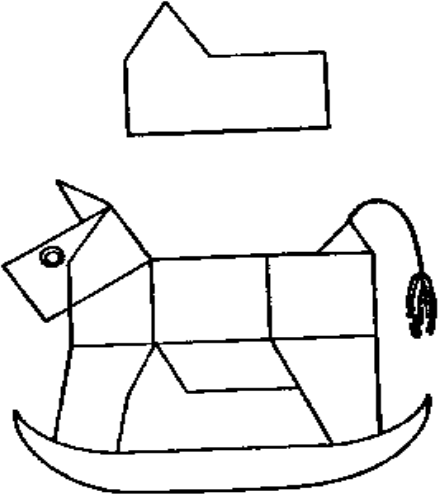
Sample item from Children’s Embedded Figures Test (CEFT) – ‘house’ embedded in ‘rocking horse’.
Dynamic assessment of gains in learning
Gains in learning were assessed through the children’s performance on the Analogies subtest of the Cognitive Modifiability Battery (CMB; Tzuriel, 1995). The test involves the use of three-dimensional coloured blocks arranged in a pattern, and set within wooden templates. For each item, the child is required to fill-in the missing piece of an incomplete three-dimensional pattern by studying the analogical transformation displayed. The transformations are based on changes in colour, height, position and number of blocks in the wooden templates. Twenty-three items were used, and responses were scored on each dimension – colour, height, and so on, with a maximum score of 92 (i.e. 23 × 4).
There are three phases: pre-teaching testing, teaching (with mediation), and post-teaching testing. A scripted protocol (without mediation) is used during the pre- and post-teaching phases. In the teaching phase, full mediation is given and this may involve use of a wide range of strategies, including: explicit teaching of pre-requisite concepts, such as colour, size, position and height discrimination; teaching concepts or vocabulary related to task-specific contexts, e.g. teaching use of terms top, bottom, left, right, same, different; explicit teaching of transformational rules of analogy; enhancement of reflective and analytic processes, e.g. focusing the child on the relation between his/her own thinking processes and the consequential cognitive performance; and feedback on success or failure in the learning process. Typically, following the general principles of mediation, when the child encounters a task or item that he or she cannot solve, the role of the tester/mediator is to prompt and guide the child, in discrete steps, towards the right answer, but without simply giving the child the answer. The judgment about the level and type of mediation given is left to the tester, and hence, the interaction between tester and testee in the teaching phase is individualised or customised to the needs of individual children. Reliability coefficients (Cronbach’s alpha) for the pre- and post-teaching phases of the Analogies subtest are reported in the test manual to be 0.84 and 0.77, respectively (Tzuriel, 1995).
Scores from the pre- and post-teaching phases of the CMB, where no mediation was provided, were used in the computation of gain in learning scores. Following Tzuriel (2000), the gains were based on residual gain scores derived from a regression analysis of post on pre-teaching scores, which reflect the child’s gains in performance after controlling for the initial pre-teaching scores. Using this scoring methodology, the residual gain scores on the CMB Analogies subtest have demonstrated high reliability and have been shown to be predictive of children’s reading comprehension skills (Tzuriel, 2001).
Intelligence
Standardised IQ scores based on the four core Performance subtests of the Wechsler Intelligence Scales for Children (Singapore Version) or WISC-III (S’pore) (Wechsler, 1996) were used as an indicator of the children’s global intellectual abilities. The subtests used were Picture Completion, Coding, Block Design and Picture Arrangement. Although there have been criticisms regarding the educational and instructional utility of IQ scores (Reschly, 1997; McGrew and Flanagan, 1993), support for their predictive validity in relation to school achievement has been provided for typically developing students (Mackintosh, 1998) and for students with autism (Eaves and Ho, 1997). The WISC-III (S’pore) was the only available standardised test of intelligence that had been normed on the Singapore population. It yields Verbal and Performance IQ indices, as well as a composite Full Scale IQ index. Many of the sub-tasks contributing to the Verbal IQ index involve the use of expressive language skills and social understanding, which are typically impaired in children with autism. As this may compromise the validity of the Verbal subtest scores, in the present study, only the Performance IQ index was used as an indicator of children’s intellectual abilities.
As we had predicted differences in findings at different IQ levels, the sample was divided into two sub-groups of children based on their Performance IQ. Children with scores more than 1 standard deviation below the mean, in the below average range (i.e. PIQ < 85) formed Sub-group 1 (n = 25), and those with scores in the average range or above (i.e. PIQ > 85) formed Sub-group 2 (n = 27).
Procedure
Approval for the study was obtained from the university research ethics committee and the study was carried out in accordance with the British Psychological Society’s ethical principles for conducting research with human participants. Following the recruitment of mainstream and special schools in which 8- to 12-year-old children with a diagnosis of ASD were being educated, invitations to participate were sent out to the parents. Upon receiving informed parental consent, arrangements were made to conduct individual testing of the children in their respective schools. All assessments were carried out individually by the first author, a trained educational psychologist experienced in working with children with autism. All the testing was carried out using standard Singapore English. The order of the tests (i.e. the CMB, CEFT and WISC-III) was counter-balanced across participants.
Results
Initial analysis
Children’s raw scores on the central coherence test (CEFT) showed a significant correlation with their age (r = 0.47, p < .01). Hence, for the present analyses, CEFT scores were adjusted for age differences by regressing children’s total raw score on their age in months. Preliminary analyses were conducted to establish whether the distributions of all variables met the assumptions of multivariate analysis. One case in Subgroup 2 was identified as a marginal outlier and, given the modest sample sizes involved, we decided to adopt the conservative approach of adjustment by substitution of a less extreme value: the lowest residual gain score, less one (Tabachnick and Fidell, 2001).
Table 1 shows the descriptive statistics for the test of central coherence (CEFT) and for the dynamic assessments before and after mediation/teaching (CMB pre-teaching and post-teaching scores, respectively) across the whole sample and for each subgroup. Analyses of the differences in mean scores showed that for the measure of gains in learning (CMB), children’s performance in the post-teaching phase showed a significant increase from pre-teaching across the whole sample (t(51) = 6.79, p < .001). Significant increases were also apparent for both the below average PIQ sub-group (t(24) = 4.96, p < .001) and the average/above average PIQ sub-group (t(26) = 4.62, p < .001).
Means and standard deviations for central coherence, assessed by the Children’s Embedded Figures Test (CEFT), and scores on the Cognitive Modifiability Battery (CMB) pre-teaching and post-teaching.
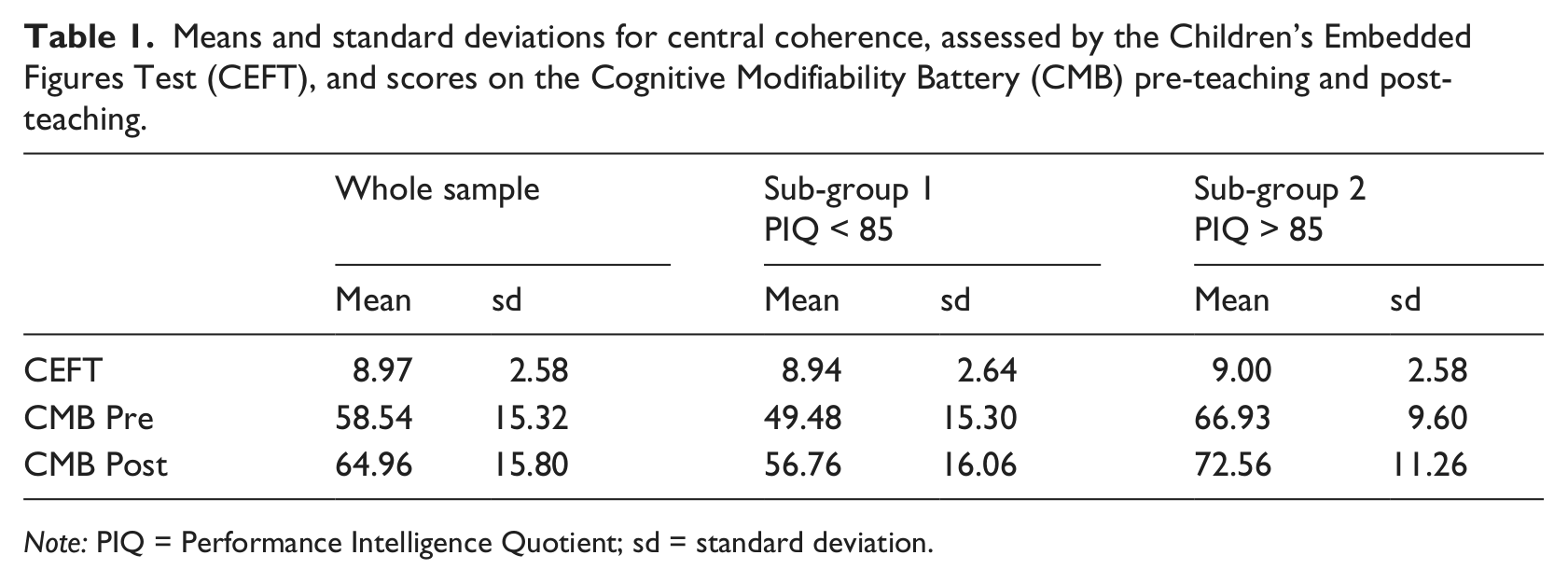
Note: PIQ = Performance Intelligence Quotient; sd = standard deviation.
Correlation between central coherence and gains in learning
To evaluate the hypothesis that children with weaker central coherence (i.e. those with higher CEFT scores) would show smaller gains in learning, correlational analysis was conducted based on children’s CEFT scores and their residual gain scores on the CMB – i.e. the difference between actual and predicted post-teaching scores. As we had predicted that the relationship may vary at different IQ levels, the analysis was conducted with the whole sample and, in addition, with two sub-groups of children based on their Performance IQ.
The correlation between scores on central coherence and gains in learning on the CMB across the whole sample was close to zero, r(52) = –.05, p = .75. However, the relationship between these variables differed for the performance IQ subgroups. It can be seen from Figure 2 that for children with below average nonverbal abilities (i.e. Sub-group 1) there was a significant negative relationship between scores on the test of central coherence (CEFT) and gains in learning (CMB), r(25) = –.44, p = .03. This indicates that within this sub-group, children with weaker central coherence (as indicated by higher scores on the CEFT) tended to show smaller gains on the CMB, as predicted. However, as can be seen from Figure 3, the same pattern was not observed among children in with high nonverbal abilities, where a positive relationship was observed between the children’s CEFT and CMB scores, r(27) = .43, p = .02. This indicates that for the sub-group with higher nonverbal abilities, children who showed larger gains in the CMB scores also performed relatively better in the CEFT. The Fisher transformed values of the correlation coefficients for the two sub-groups were found to differ significantly, z = 3.16, p = .002.
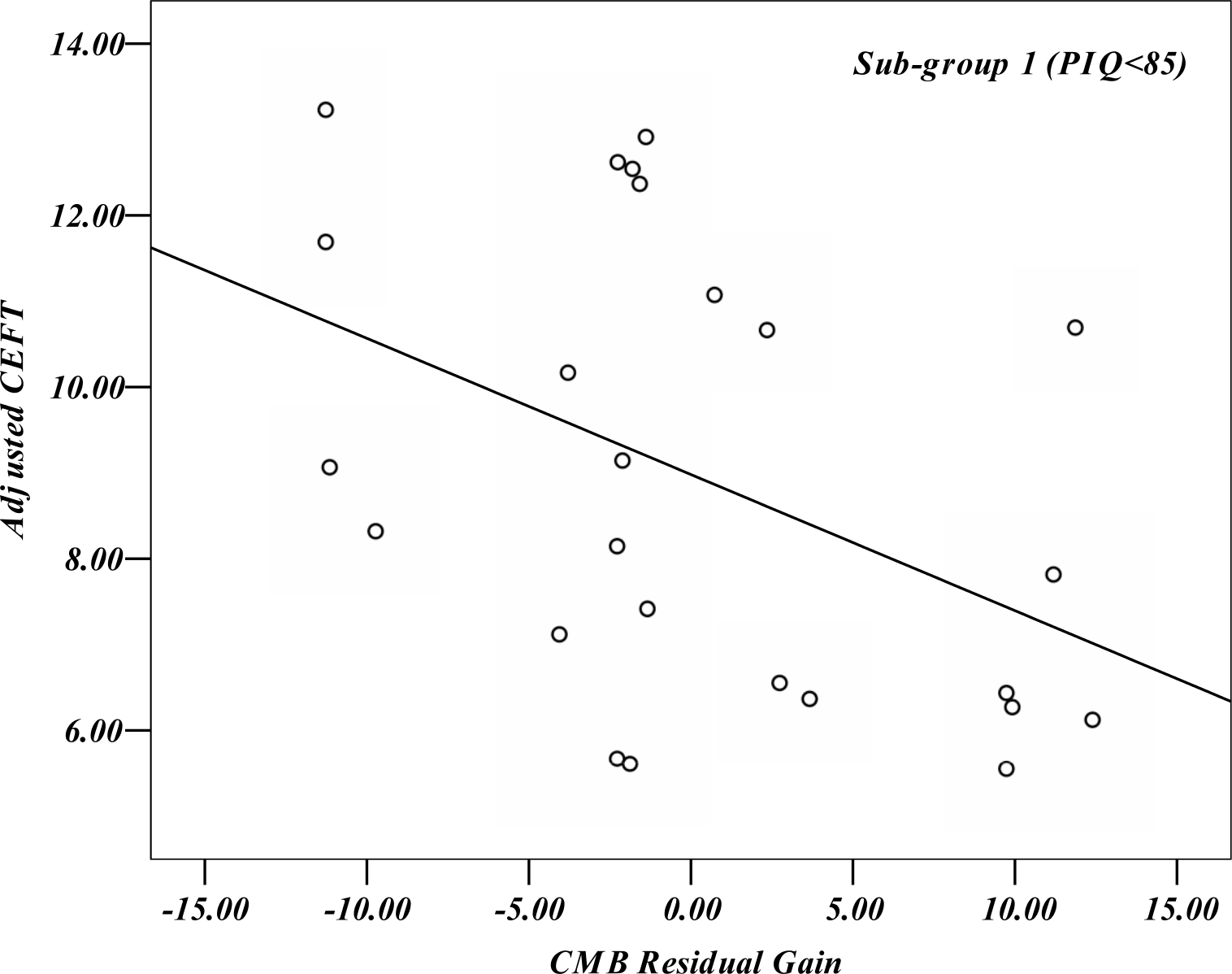
Relationship between Children’s Embedded Figures Test (CEFT) age adjusted scores and Cognitive Modifiability Battery (CMB) gain scores for children with Performance Intelligence Quotient (PIQ) scores less than 85.
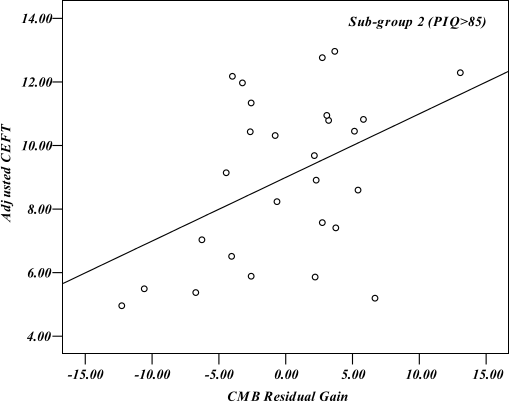
Relationship between Children’s Embedded Figures Test (CEFT) age adjusted scores and Cognitive Modifiability Battery (CMB) gain scores for children with Performance Intelligence Quotient (PIQ) scores greater than 85.
Discussion
Across the sample of children with autism a significant increase in scores was found following teaching. This is consistent with the results obtained from studies of children with other types of disabilities, such as Down syndrome and learning difficulties (Tzuriel and Klein, 1985). The gain scores for children with below average nonverbal abilities were negatively correlated with their scores on the test of central coherence. This negative relationship is consistent with the central coherence hypothesis; that is, children with diminished central coherence (who performed well in the embedded figures test) would show greater difficulties in transferring learning from one context to another (i.e. transferring learning from the teaching to post-teaching phases in the CMB).
However, among children with autism who had good nonverbal abilities, a diminished central coherence (as inferred from high scores on the CEFT) did not appear to inhibit their ability to demonstrate gains in learning after teaching. This is in line with the findings reported by Shah and Frith (1983), that the performance of some children with autism and higher abilities may not show the characteristics of weaknesses in central coherence. The positive correlation seen between the CEFT and CMB scores for these children could simply be reflecting their overall facility in processing visuo-spatial information. It could be argued that beyond a certain threshold of general intellectual ability, the effects of weak central coherence could be overcome or compensated, and hence no longer pose additional barriers to the transfer of learning. Similar arguments have been advanced in relation to the apparent absence of theory of mind deficits in some high-functioning children with autism. These children may be able to respond accurately to theory of mind tasks by using an alternative or compensatory strategy (e.g. by logical deductions), as opposed to normally developing children, who are able to perform the tasks by relying on their intuitive understanding of others’ perspectives or thoughts (Baron-Cohen et al., 2000).
To evaluate this possibility, it would be necessary to compare the performance of children, with and without autism, on dynamic assessments. Such a comparison would offer a number of benefits. Firstly, it would be useful to observe the strategies used by children with autism who do not show impairments in central coherence in order to identify the compensatory strategies that are used. These compensatory strategies could form a basis for the development of specific mediation strategies for children with autism. Secondly, for children who do experience impairments it would help to identify those that are autism-specific. Difficulties have also been observed in the CMB Analogies subtest for children who have moderate and severe learning difficulties but who do not have autism (Lauchlan and Elliott, 1997) and attributed, in part, to the complexity of the deductive reasoning required by the task and the children’s inherent difficulties with retention of information.
There may be other reasons why weaknesses in central coherence did not impede the performance of children with at least average nonverbal abilities. One possibility relates to the nature of the mediation approaches used. In the CMB Analogies subtest, the more difficult a child finds a task, the more likely they are to receive mediation that is focused on the achievement of very small steps, and which is consequently rather piecemeal and segmented. By contrast, children with good analogical (or nonverbal) abilities are unlikely to require prompts that are so highly structured and segmented and the mediation that they receive will tend to be at a more ‘global’ level (e.g. comprising reminders of the principle of transformation, or a transfer strategy). It can be argued that these global ‘higher-order’ mediation strategies, which are targeted at the principle of analogical transformation, place fewer demands on central coherence, and hence facilitate the children’s ability to show gains in learning after teaching. To explore this issue further, one would need to study experimentally any effect of the type of mediation received during the teaching phases on gains in learning for children of different central coherence and IQ levels.
Finally, we discuss a number of methodological issues and practical implications of using the CMB with children with autism. There are several other variables that may have affected the observed correlations, which were not accounted for in the present study. For example, following the principles of dynamic assessment, the inputs in the teaching phase of the CMB were individualised according to children’s needs. As such, differences in the duration, intensity and quality of the mediation could have caused variations in children’s gain scores. Variations in gain scores could also be due to non-intellective factors, such as motivation or confidence (Tzuriel et al., 1988). For example, it could be that the children in the study who were from mainstream schools may have had greater exposure to abstract analogical problems than those from special schools, and hence would be more at ease with the tasks in the CMB. Their prior experience and confidence may have contributed to better gains in learning. In the present study, variations in the quality of mediation and non-intellective factors were not evaluated, and the extent to which these could have affected the observed results is unknown.
Another possible limitation concerns the measure of central coherence. In the CEFT, each time a child accurately detects the target shape, he or she will get a point. This pass/fail criterion may not be adequately sensitive to differences in performance. Other measures, for example the time taken to detect the target shape, might have provided a more sensitive measure of variation in central coherence abilities. This would be especially relevant for children with average abilities, where differences in performance may be more apparent in terms of their speed in detecting the embedded figures, rather than accuracy per se (Jarrold et al., 2000). It should be acknowledged that the CEFT focuses on only one dimension of central coherence (i.e. in relation to visual processing). In future research, it would be important to include other dimensions such as language and literacy, to see if similar results can be observed when more comprehensive indices of central coherence are studied.
Use of the CMB with children with autism
The children’s improved scores in the post-teaching phase concur with the findings from other empirical studies that children with disabilities (e.g. learning difficulties, hearing impairments) tended to do better in the tasks with mediation (Tzuriel and Klein, 1985). There has been increasing interest in the use of DA with children who have ASD (Donaldson and Olswang, 2007; Flynn, 2005). From the present study, a number of implications of using the CMB with children with autism can be noted.
On the positive side, there are several aspects of the CMB that facilitated its use with children with autism. Firstly, the items in the CMB Analogies subtest are concrete and there are low demands on children’s language skills. This accommodated the needs of the children with autism, many of whom have severe impairments in communication (Schopler and Mesibov, 1995). Secondly, the items do not require high levels of prior content knowledge – they involve common aspects of colour and dimensions. For children with autism this is a positive feature, as they often have very circumscribed interests and may not have acquired age-appropriate levels of knowledge on topics outside their areas of special interests (Schopler and Mesibov, 1995).
At the same time, the present study highlights some of the challenges in mediating learning for children with autism. During the teaching phase of the CMB the aim of mediation is to provide as much assistance as required (in the form of cues, prompts and reminders) to help the child arrive at the answer. The aim is to do this without simply showing or telling him or her the solution. One way to achieve this is to give specific prompts that will cue the child towards the target response. For example, when the child makes an error in colour, the tester/mediator would focus the child’s attention on colour discrimination. On the other hand, if the child chooses the right colour but the wrong size, the focus of mediation would be on size discrimination and transformation.
It could be argued that for children with autism the approach typically used in mediation may impose greater demands on central coherence as increasing difficulty is experienced. It would seem that weak central coherence may undermine the gains that might be made in DA by children with autism and additional learning difficulties. The use of DA may therefore lead to an underestimate of the learning potential of these children unless specific mediation strategies can be developed that can accommodate the effects of weak central coherence. There has been very little work focused on the mediational strategies that are optimal for children with autism. This is therefore identified as an additional area for further research.