




Abstract
In the ultrasonic welding (UW) process, achieving reliable bonding under low ultrasonic energy input is crucial for minimising surface damage and improving long-term service stability of joints. In this research, three Cu interlayers with horizontal (H–TBs), inclined (I–TBs) and vertical twin boundaries (V–TBs) were designed to accelerate weld formation during UW. At a welding time of 0.3 s, lap shear tests indicated that the I–TBs joint exhibited 38.6% and 54.9% higher strength than the H–TBs and V–TBs joints, respectively. The moderate microhardness, elevated coefficient of friction and activation of soft-mode dislocation motion in the I–TBs joint generated localised plastic instability, accelerated the flattening process and improved metallurgical bonding under the low energy inputs.
This is a visual representation of the abstract.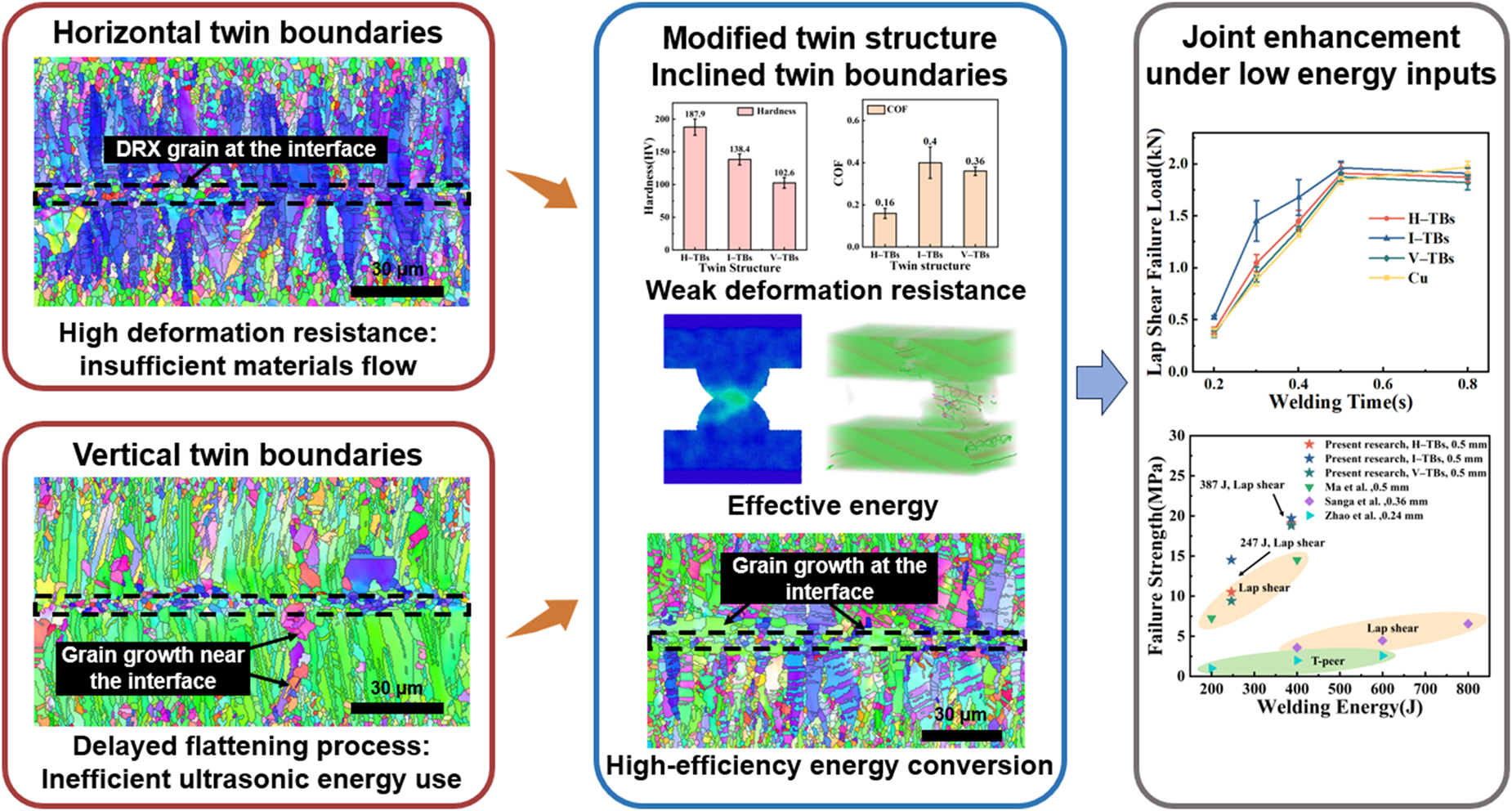
Keywords
Get full access to this article
View all access options for this article.
References
Supplementary Material
Please find the following supplemental material available below.
For Open Access articles published under a Creative Commons License, all supplemental material carries the same license as the article it is associated with.
For non-Open Access articles published, all supplemental material carries a non-exclusive license, and permission requests for re-use of supplemental material or any part of supplemental material shall be sent directly to the copyright owner as specified in the copyright notice associated with the article.
