



Abstract
The solder wettability is a key factor for assessing joint reliability. However, the extensive range of solder composition, substrate material and reflow temperature make it challenging to modulate wettability through experimental methods. This study utilizes the machine learning method to develop a surrogate model fitted to experimental wetting angle data, aiming to predict the solder wettability as a function of composition, substrate material, and reflow temperature. The model full-fit (five-fold cross validation) root-mean-square error was 4.27 (6.73 ± 1.42). The model performance was characterized by using the cross-plot method, and the input feature contribution was determined through SHapley Additive exPlanations analysis. The model extrapolation to unknown alloys, which were not shown in the training data set showed a good agreement with experimental data.
This is a visual representation of the abstract.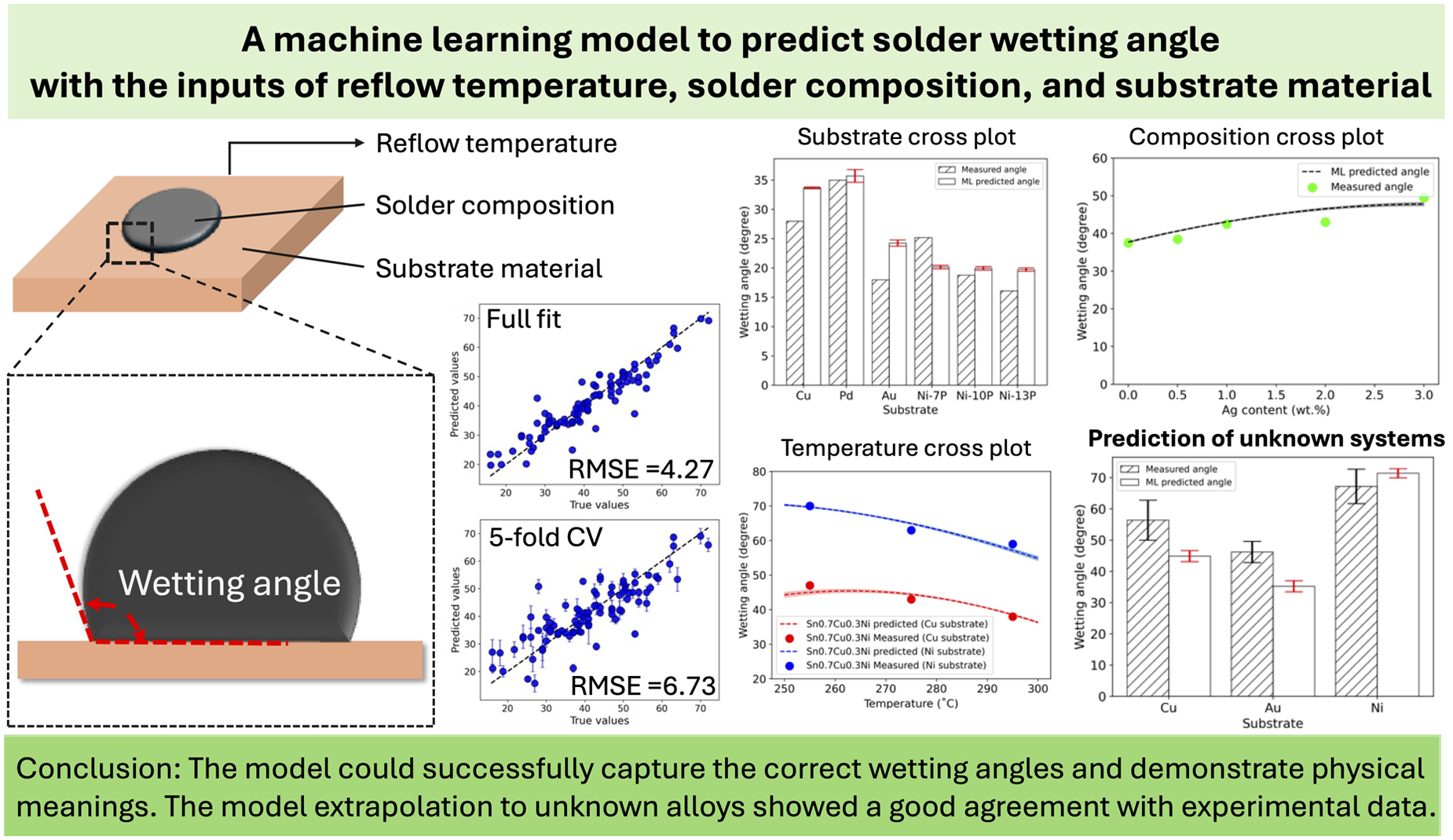
Get full access to this article
View all access options for this article.
References
Supplementary Material
Please find the following supplemental material available below.
For Open Access articles published under a Creative Commons License, all supplemental material carries the same license as the article it is associated with.
For non-Open Access articles published, all supplemental material carries a non-exclusive license, and permission requests for re-use of supplemental material or any part of supplemental material shall be sent directly to the copyright owner as specified in the copyright notice associated with the article.
