



Abstract
This study investigates whether a targeted grammar training session enhances English as a second language (ESL) learners’ sentence comprehension, focusing on garden-path sentences as a test of syntactic ambiguity resolution. Chinese ESL learners were assigned to a grammar training group or a control group before completing a self-paced sentence reading experiment. The training session followed a multiple-step progression from simple to complex sentence structures to raise the grammatical awareness in the learners for improving their syntactic parsing skills. Mixed-effects modeling of the data showed that ESL learners with grammar training outperformed those without training, as shown in both comprehension accuracy and reading speed measures. The finding supports the view that form-focused pretask training can direct second language (L2) learners' attention efficiently without overloading cognitive resources, and the notion of task-readiness could be extended from L2 production research to L2 sentence reading. This study shows that explicit grammar instruction brings cognitive benefits to ESL learners, and the experimental method links psycholinguistic research with language-teaching practice.
I Introduction
In recent years, much research in instructed second language acquisition (SLA) and task-based language teaching (TBLT) has sought to connect classroom-based practice with the general cognitive mechanisms that underlie language processing. An important question for teachers and researchers is how to help second language (L2) learners develop the skills to use their linguistic knowledge flexibly and efficiently when performing communicative tasks. One way to improve such abilities is by increasing the level of readiness for specific language tasks: at a higher readiness level, L2 learners will be able to integrate form and meaning more accurately and automatically. Empirical evidence for the role of task-readiness is ample in L2 production research, including oral speaking and writing, but less attention has been paid to receptive skills such as reading. From a psycholinguistic perspective, experiments such as sentence reading tasks offer a reliable way for measuring how learners allocate attention, parse sentence structure, and resolve structural ambiguity. In this paper, we explore how such tasks can be used as a pedagogical tool for assessing L2 reading skills, and how pretask grammar training may lead to positive effects for L2 learners in processing sentences with temporary structural ambiguity.
1 Instructed SLA and teaching grammar to L2 learners
For decades, researchers have wrestled with whether and how to teach grammar to L2 learners in the field of instructed SLA and language teaching pedagogy, and relatedly, researchers hold different opinions about how explicit or implicit these teaching activities should be. An early but influential meta-analysis by Norris and Ortega (2000) points out that explicit instruction of grammatical rules can be more effective than implicit exposure for L2 grammar development. Explicit grammar training thus takes the approach which Long (1991, 2015) called “focus on forms” rather than “focus on form”: the former refers to learners engaged in form-focused training, whereas the latter refers to meaning-focused activities where attention is only briefly drawn to grammatical rules. Such training could be helpful, as DeKeyser (2020) argues, because it provides students with declarative knowledge which can be proceduralized through practice. In classroom settings, research shows accumulated evidence that the best outcome is achieved when form-focused activities are integrated into communicative meaning-making contexts (Ellis, 2016). In other words, directing L2 learners’ attention directly to grammatical rules can encourage them to notice such linguistic features in context, and noticing serves as a precursor of knowledge internalization (Schmidt, 2001). Regarding cognitive processing, encouraging learners to notice novel or challenging linguistic features is necessary for deeper processing, and the development of interlanguage grammar should depend on the depth of processing during language learning (Leow, 2015; Leow & Mercer, 2015).
Empirical studies have also offered evidence to support the position of grammar teaching. Spada and Tomita (2010) did a systematic literature synthesis to compare the effectiveness of explicit grammar teaching across a wide range of studies focusing on different grammatical features. Their results showed that explicit grammar training almost always led to a significant learning effect, whereas implicit methods led to more mixed results. More specifically, explicit grammar training helped the acquisition of both simple linguistic features (e.g., tense marking, article use, and plural morpheme) and more complex grammatical constructions (e.g., interrogative clause formation, relative clauses, and pseudo-cleft sentences). In contrast, implicit teaching sometimes helped with complex features, but learners did not necessarily show improvements in simpler features. For example, Mochizuki and Ortega (2008) carried out a study to examine the role of grammar guidance in Japanese English as a second language (ESL) learners’ oral narrative. They compared the narratives from (1) learners who did the task without any pretask planning, (2) learners who had an unguided pretask planning, and (3) learners who had a guided pretask planning session with an English grammar handout on relative clause formation. Their results confirmed that guided grammar planning led to significantly more accurate relative clause usage in ESL learners' oral narratives when compared with the other two groups. Boston (2009) reported that exposure to target syntactic structures could lead to priming effects in learners’ production. Van de Guchte et al. (2017) found that when learners were instructed to focus on language features (rather than content) during video-watching, they produced more complex language in their oral production that followed. A more recent study by Li et al. (2019) examined English as a foreign language (EFL) oral performance with or without explicit grammar training in a dictogloss (story-retell) task. They found that students with explicit grammar training used the target structures more frequently than those who did not have training. Together, these findings demonstrate that grammar training has a robust facilitative effect on ESL learners’ control of grammatical structures across a range of task types and linguistic features. In other words, ESL learners often become more task-ready after targeted grammar training in language tasks that require the same set of grammatical knowledge.
Regarding the notion of task-readiness, an existing classification framework from Bui (2014) distinguishes several kinds of task-internal and external readiness variables. For instance, topic familiarity improves readiness typically in a language production task because it reduces the effort in conceptual search during language production (e.g., writing an essay on a familiar topic), and L2 learners could allocate more resources to language encoding and monitoring (Abdi Tabari & Wang, 2022; Abdi Tabari et al., 2024; Li & Yu, 2024). Related to this notion is schematic familiarity, which refers to learners’ knowledge of how real-life events unfold in predictable ways. On the other hand, task familiarity refers to L2 learners being familiar with a specific task type (e.g., narrative, retell, and grammar analysis) even when the topic changes (Nazemi & Rezvani, 2019; Seyyedrezaei et al., 2023). In addition, repeating the task without the awareness of future performance is also considered a kind of readiness from implicit planning; if L2 learners repeat the task with the awareness of future performance, it is termed as rehearsal, a kind of explicit planning (Abdi Tabari & Golparvar, 2024; Bui & Yu, 2022). In other explicit forms, strategic planning refers to time given before a task to plan content and language, typically in a writing task, whereas within-task planning refers to online preparation during task performance. At the core of the concept of readiness, it argues that L2 learners’ performance depends on whether and how they maneuver necessary cognitive and linguistic resources in advance.
It is worth noting that Bui’s (2014) framework is primarily concerned with production (primarily writing) but not receptive tasks such as listening or reading. In the present study, we explore how targeted grammar training can improve ESL learners’ task-readiness in a following sentence reading task focusing on receptive skills, especially sentence parsing strategies for ambiguity resolution (Bever, 2013; Christianson et al., 2024; Frazier & Rayner, 1982). Obviously, different cognitive processes are involved during reading and writing. While reading, the reader must recognize vocabulary, assign grammatical structures, and build a mental model of the text’s meaning; in contrast, writing requires conceptualizing content, formulating sentences, and monitoring output for correctness (Ingram, 2007; Warren, 2013). Accordingly, we argue that such differences are accompanied by what “readiness” could entail in each task type: for production, readiness often means having content ideas or language forms at hand to produce output; for reading, readiness could mean having the necessary linguistic knowledge or analytical skills to efficiently interpret language input. In our context, a pretask grammar training session should enhance task-readiness: as ESL learners become familiar with the reading task requirement through repetition or intentional rehearsal, they should become more efficient and strategic in allocating attention to syntactic analysis, thereby facilitating online parsing and ambiguity resolution during sentence reading.
2 English sentence processing and ambiguity resolution
As discussed previously, reading differs from writing or speaking skills because it looks at how people process language materials without asking participants to produce materials. When it comes to sentence processing, a central task is to perform structure parsing, where individual words are interpreted in a treelike hierarchy. During sentence parsing, constituency (e.g., which words form a constituent) and dependency (e.g., which constituent licenses or modifies another constituent) contribute to the ultimate semantic interpretation of the sentence's meaning. Such tasks could be challenging when the sentence involves temporary ambiguity, for instance, in garden-path sentences (Bever, 2013; Frazier & Rayner, 1982). A large body of psycholinguistic research has been dedicated to understanding how speakers (primarily first language [L1] speakers) construct syntactic structures on the fly, and how temporary structural ambiguity is resolved during reanalysis, a critical skill for reading. For instance, when reading the sentence “While Anna dressed the baby spit up on the bed,” readers often experience initial misinterpretation by taking “the baby” as the object of “dressed,” but upon encountering “spit up,” they realize “the baby” is actually the subject of a new clause. Therefore, competent readers are still capable of reanalyzing the structure even if temporary ambiguity exists. According to the two-stage garden-path model (Frazier & Fodor, 1978), readers initially build the simplest syntactic structure possible (guided by principles such as minimal attachment, which prefers fewer nodes, and late closure, which attaches new words to the current clause). Only when a later word (e.g., “spit up”) violates the chosen structure, the reader will backtrack and reanalyze the structure. Other researchers argue that reanalysis is not purely syntactic, but competent readers are able to utilize multiple sources of information (syntax, semantics, lexis, context) in parallel during sentence processing (MacDonald, 1994).
In a classic study, Christianson et al. (2001) investigated L1 English readers’ comprehension in garden-path sentences with different linguistic cues, e.g., the presence of a comma at the clausal boundary, or an explicit object in the first clause (see also Christianson et al., 2006, 2017, 2024). They observed that sentences such as “While Anna dressed, the baby spit up” or “While Anna dressed herself, the baby spit up” are much easier to analyze, as indicated by the accuracy in the comprehension question “Did Anna dress the baby?” (the answer: No). It is worth noting that the garden-path effect is gradient but not categorical. Specifically, certain verbs are more likely to cause reanalysis difficulties: optional transitive (OPT) verbs (e.g., “Anna hunted” cannot mean “Anna hunted herself”) are more difficult to process than reflexive absolute transitive (RAT) verbs (e.g., “Anna washed” could mean “Anna washed herself”). In other words, OPT verbs encourage the reader to analyze the following noun phrase as the object, creating a more challenging scenario for structural reanalysis. Finally, L1 readers show sensitivity to contextual semantic cues: the sentence “As the cowboy rode the horse sweated profusely” (plausible) is more difficult than “As the cowboy rode the horse slept peacefully” (implausible). These findings support the view that L1 readers make use of multiple sources of information during sentence reading, and native speakers were sensitive to a wide range of typographical, syntactical, lexical, and semantic cues. Despite that, garden-path sentences still pose a challenge for linguistic processing even for L1 speakers, and thus Christianson and colleagues argue that readers often rely on a "good-enough" interpretation of the sentence meaning and structure, and they often retain a lingering misunderstanding when structure reanalysis is not successful.
For L2 speakers, their reading skill for ambiguity resolution is further constrained by proficiency and cross-language interference. Juffs and Harrington (1996) provide an early report on Chinese ESL learners’ processing of garden-path sentences and found that the ESL learners made significantly more errors interpreting the meaning, and they also showed significantly longer response time as compared with English L1 speakers. More recently, Fujita and Cunnings (2021) and Cunnings and Fujita (2021) also reported that L2 learners struggle more with structure reanalysis compared with L1 readers. Jacob and Felser (2016) found that L2 readers showed weaker reanalysis effects at the syntactic disambiguation point and were more likely to misinterpret the garden-path sentences than the L1 group. These findings offer strong evidence for the shallow structure hypothesis (SSH) (Clahsen & Felser, 2006), which posits that adult L2 learners tend to rely more on lexical-semantic information and heuristics, constructing less detailed syntactic representations than natives. Despite this well-documented difference in processing mechanisms, an important question remains for applied psycholinguistics and instructed SLA: whether targeted grammar instruction helps L2 learners overcome these parsing difficulties. The last section examines this question by drawing on theories of cognitive resources and task design.
3 Task readiness and pretask grammar training for L2 sentence processing
The intersection of grammar instruction and sentence processing is an emerging area of interest in language teaching and applied psycholinguistics. In the present study, we are motivated by the research gap for investigating the effectiveness of pretask grammar training on L2 learners’ performance in reading complex sentences. Although garden-path sentences may represent only a small portion of authentic language input, the capacity to reanalyze sentence structures and resolve temporary ambiguity is a transferable skill for reading comprehension in general. We selected garden-path sentences because they specifically test a reader’s ability to parse and reanalyze sentences when initial interpretations go awry. Mastering such sentences demands an elevated level of grammatical awareness and cognitive flexibility, which our grammar training aimed to develop for ESL learners. By contrast, other complex structures such as cleft sentences or long multiclause sentences, are indeed difficult, but they may not involve the same kind of temporary ambiguity and immediate need for reanalysis. We also argue that psycholinguistic experiments such as garden-path sentence reading tasks could be deployed as language-teaching modules for developing L2 grammar awareness and improving reading skills. By extending the notion of “task-readiness” from L2 production (Abdi Tabari & Wang, 2022; Bui, 2014) to L2 reading, we investigate whether boosting their grammatical readiness could improve L2 learners’ real-time sentence processing, including comprehension accuracy and reading speed.
The specific predictions of the effectiveness of pretask grammar training can be discussed through the lens of two influential SLA theories: Skehan’s limited attention capacity model (Skehan, 1998; Skehan & Foster, 2001), and Robinson’s cognitive hypothesis (Robinson, 2001, 2003). First, the limited attention capacity model proposes that L2 learners have a fixed pool of attentional resources. If the task is very demanding, attention allocated to one aspect (say, grammatical accuracy) will detract from another (say, reading speed or fluency). Therefore, Skehan and colleagues argue that L2 performance is often a zero-sum game: improving in one dimension will cause declines in others if the cognitive load is high. In the context of sentence processing, learners may devote more attention to parsing sentences accurately (noticing multiple linguistic cues, carefully constructing structure) at the expense of processing speed. For instance, it is sometimes noted that pretask training can have detrimental effects on (production) accuracy and fluency (Li et al., 2019). From this point of view, the limited attention capacity model would predict a potential trade-off between reading accuracy and speed (indicated by reading time [RT]). In other words, explicit grammar training could be a double-edged sword (higher accuracy, but also longer RT).
In contrast, the cognition hypothesis (Robinson, 2001, 2003) argues that the cognitive complexity of a task can push learners to engage more deeply with task materials. In this framework, pretask grammar training can be seen as a resource-directing variable, which directs the learners' attention to more relevant aspects of language (syntax, lexical, semantics, context), rather than a resource-dispersing variable (which drains general processing capacity, e.g., performing multiple tasks at the same time). According to the cognition hypothesis, the goal of a pretask training session is to direct learners' effort toward the target linguistic form (e.g., structural ambiguity in garden-path sentences) without overloading them with extraneous difficulty that would disperse their resources. By this account, it is possible that pretask grammar training improves both accuracy and reading speed. To date, these two competing perspectives have been tested mostly in productive tasks (such as writing tasks where familiarity or planning was manipulated), and very few studies have directly examined them in receptive tasks such as reading. More specifically, the present study aims to answer the following research questions.
The first question is assessed by comparing accuracy and RT across conditions primarily defined by comma presence and overt object presence. The second question is assessed by the group effect and relevant interactions in the analysis for accuracy and RT differences. The third question is assessed by testing effects of sentence type (RAT, OPT-plausible, OPT-implausible) and its interaction with group on accuracy and RT measures.
II Method
1 Participants
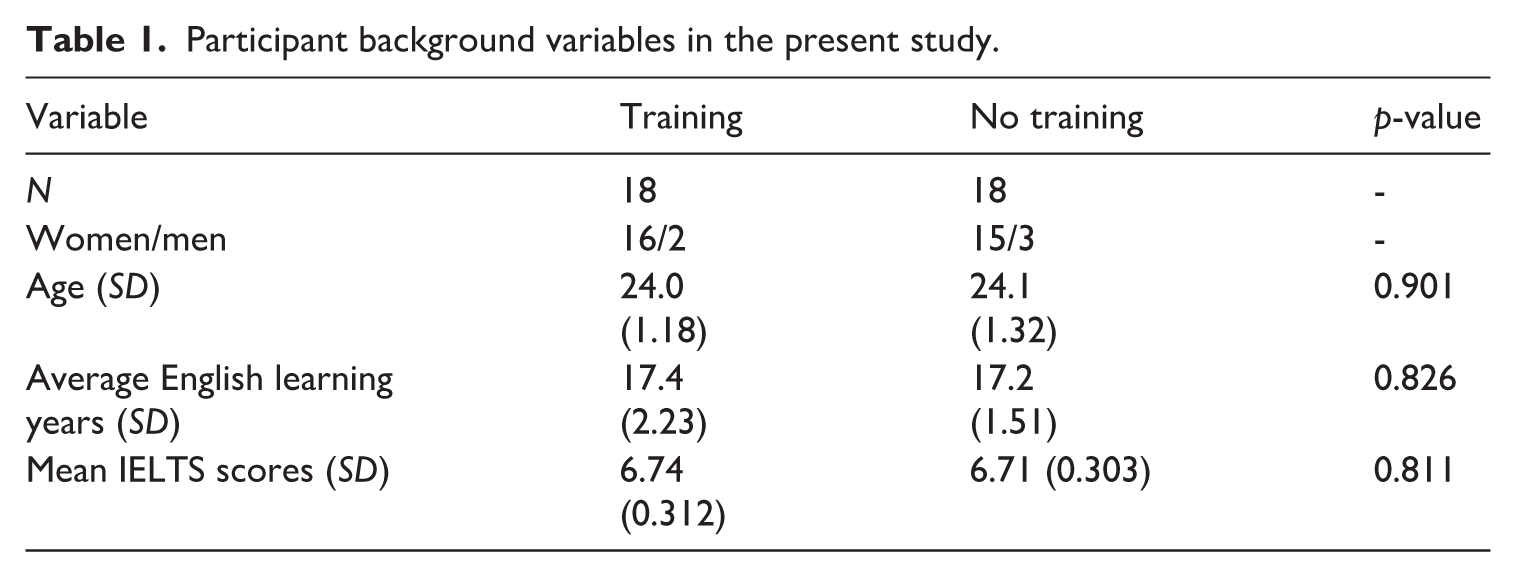
We initially recruited 38 advanced Chinese ESL learners (32 women and 6 men; mean age = 24.06 years; range = 22–27 years) at a public Australian university. The participants were randomly assigned to a no-training (control) group or an experimental group that received a short pretask grammar training session for 15 mins. Data from 2 participants were excluded: 1 participant did not finish the task, and another gave random responses and the final dataset included 36 participants. Paired t-tests verified no statistically significant differences between these two groups regarding language background (Table 1). All participants were informed about the study’s aims, procedures and instructions and gave written consent to participate. All were L1 Mandarin Chinese speakers, and they spoke English as an L2. All participants passed standardized language proficiency tests (e.g., International English Language Testing System [IELTS]). On average, the participants had 17.28 years (SD = 1.86) of experience learning English, and they had an average length of residence in Australia of 16.17 months (SD = 5.84).
Participant background variables in the present study.
2 Stimuli
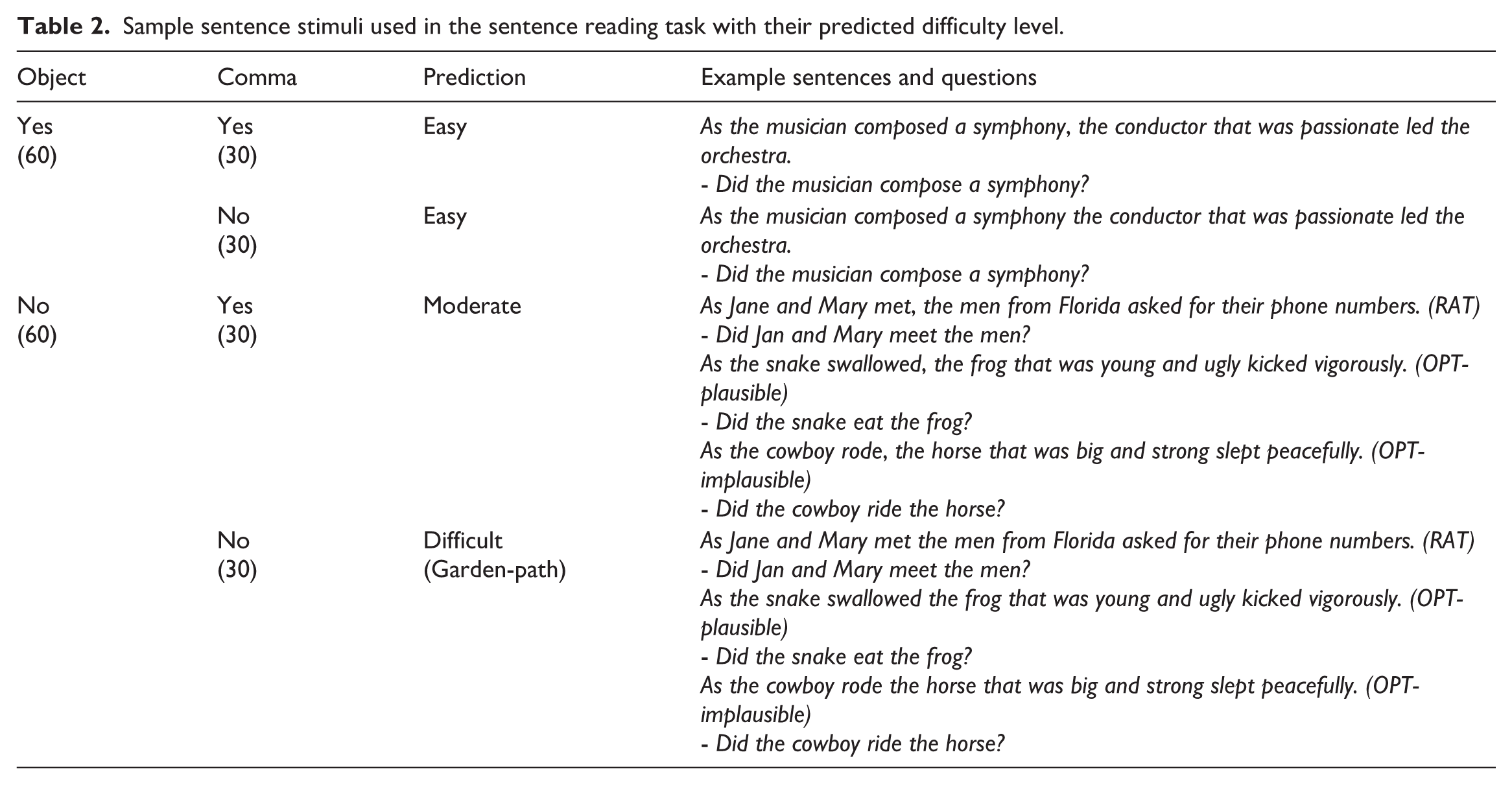
A total of 120 experimental stimuli were adapted from a series of previous studies by Christianson et al. (2001, 2006, 2017, 2024), and the predicted difficulty levels are determined based on native speakers’ data from previous studies. Table 2 illustrates examples used in the sentence reading task. A total of 10 RAT verbs and 20 OPT verbs were included. To avoid excessive fatigue effects and reduce the number of trials, we only included RAT-plausible, OPT-plausible, and OPT-implausible conditions, based on the idea that their pairwise comparisons were already sufficient to examine the effect of verb category and semantic plausibility, which were well-understood in previous studies. All sentences followed a subordinate-matrix clause order. Each verb was used to create two versions of a sentence, starting with “as” or “while” which share similar meanings. One version contained the disambiguating comma, whereas the other did not have the comma. In order to prevent participants from knowing the purpose of the study, 60 control items were created as fillers. The items followed the same subordinate-matrix sentence order as target items, by adding an extra object noun phrase in the subordinate clause. Sentences averaged 13–15 words to ensure consistent length. See the Appendix for a full list of the stimuli.
Sample sentence stimuli used in the sentence reading task with their predicted difficulty level.
3 Procedures
a Pretask grammar training
For half of the participants, we designed a short grammar training session for approximately 10–15 minutes. The aim of the grammar training was to encourage explicit syntactic parsing and facilitate the ESL learners' metalinguistic awareness for determining the grammatical functions of words and phrases in a complex sentence, including those with temporary ambiguity (i.e., garden-path sentences). There were 5 steps in the training session, with increasing task complexity levels and less scaffolding (Table 3). In Step 1, ESL learners were first prompted to analyze the grammatical functions of noun phrases and verb phrases in a simple (monoclausal) sentence, where they familiarized themselves with the linguistic terminologies and the analysis routines. In Step 2, they were prompted to analyze complex (multiclausal) sentences, and the clausal boundaries were clearly marked using commas, and key phrases were also displayed with visual aids (black boxes). In Step 3, the commas were removed, so participants were required to perform analysis without this disambiguation cue; in some cases, they had to perform reanalysis if a garden-path effect was triggered. In Step 4, we further removed the black boxes as visual aids, and then the participants were required to first identify the constituents and then perform syntactic analysis of the structure. This step was already similar to the requirement in the sentence reading experiment, and participants were instructed to focus on the sentence structure, not the content. Finally, in Step 5, participants were asked to create a new sentence beginning with "while” or “as,” and thus the sentence must be a multiclausal sentence.
Structure of the grammar training session.
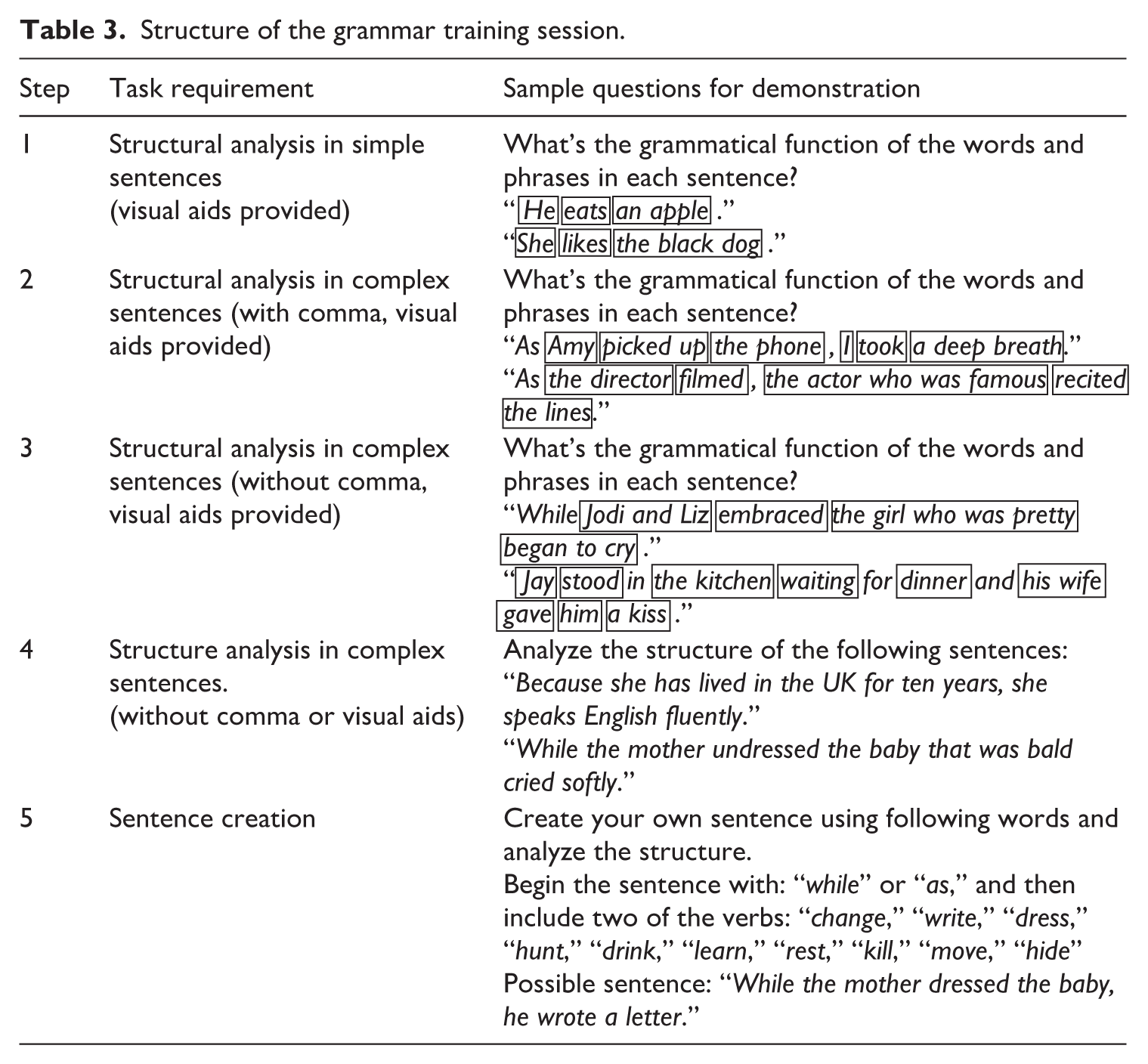
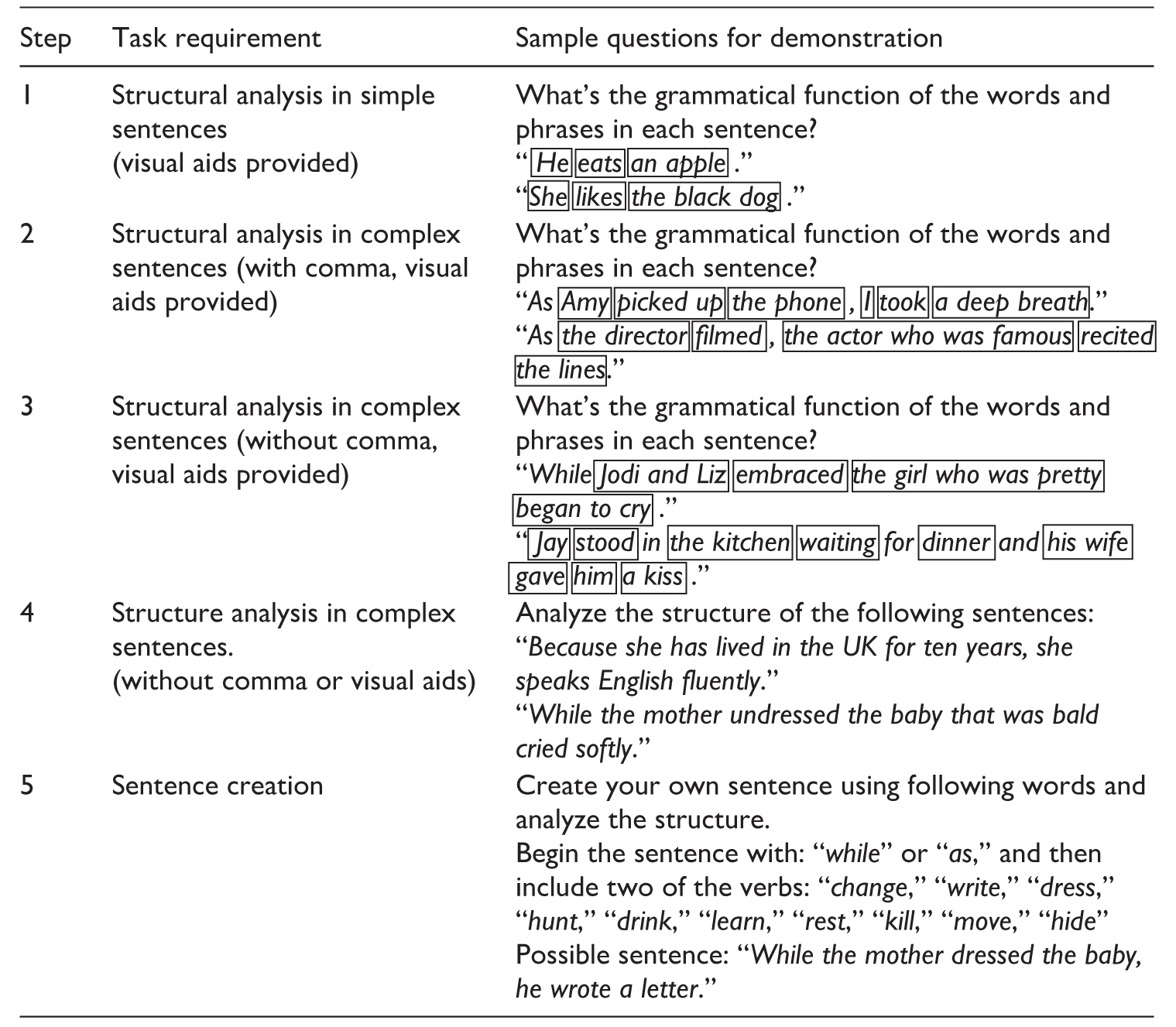
The design of the steps followed the principles of educational psychology (e.g., Bloom’s learning taxonomy) (Anderson & Krathwohl, 2001), as well as research in applied linguistics showing that increased cognitive task complexity will encourage deeper processing and better learning outcomes (e.g., Robinson’s cognition hypothesis) (Robinson, 2003). For instance, Step 1 targeted Remember and Understand by familiarizing learners with grammatical terminology and basic phrase structure. Steps 2 and 3 moved toward Apply and Analyze, requiring learners to use parsing routines to interpret multi-clausal sentences, detect ambiguity, and perform reanalysis when disambiguation cues were removed. Step 4 further strengthened Analyze by eliminating visual scaffolding, requiring independent identification of constituents in a format closely matching the experimental task. Finally, Step 5 engaged the Create level, as learners generated novel multiclausal sentences using subordinators. At the same time, this progression also followed task-based SLA research suggesting that increasing resource-directing task complexity promotes deeper linguistic processing (Robinson, 2003, 2011). However, in the current study, we did not aim to disentangle the effect of increased syntactic complexity and the effect of reducing scaffolding during the training session. The teaching materials were presented on a PowerPoint slides, and ESL learners received feedback on their performance while interacting with the researcher, but the training tasks were not scored.
b Sentence reading task and data collection
The sentence reading task was a two-alternative forced-choice experiment developed using Psytoolkit (Stoet, 2010, 2017), see Figure 1 for a schematic structure of the task. The participants completed the task immediately after the training session. On each trial, the reader first saw the sentence and was instructed to read silently and comprehend the content. Reading was self-paced, and they pressed the space key to finish the reading screen and enter the second window, which asked a yes–no question to test their comprehension. Once the key was lodged, there was a blank screen for 1 second before entering the next trial. No feedback was given in the experiment.
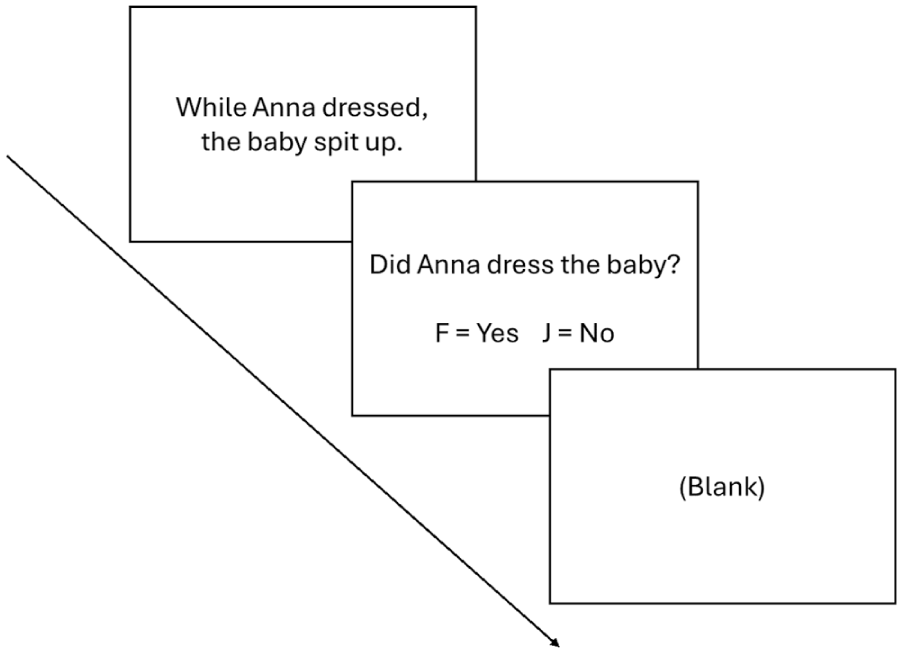
Structure of the reading task for testing ESL readers’ sentence comprehension.
4 Data analysis
We analyzed comprehension and RT data from the reading experiment. Response accuracies were coded as zeros and ones (for incorrect and correct responses) in the dataset, and they were modeled using generalized linear mixed-effect models (GLMMs). RTs with a correct response to the comprehension question were analyzed. RTs from incorrect responses are difficult to interpret because they do not reflect successful understanding of the sentence, and we followed the conventional methods in psycholinguistic research and removed these trials for RT analysis. These data were modeled using linear mixed-effect models (LMMs) after applying logarithmic transformations to counteract distribution skewness.
III Results
1 Garden-path versus unambiguous sentences
The mean accuracy (%) in the comprehension questions as well as the mean RT in correct responses are visualized in Figure 2, and the descriptive statistics are reported in Table 4. Clearly, the ESL readers in both groups achieved remarkably high accuracy rates when the sentences had a comma or an explicit object. In these two conditions, ESL readers in both groups had ceiling-level rates (~ 90%), indicating that these learners had no problem understanding the sentences when no ambiguity existed. However, regarding RT, the group that received grammar training showed higher reading speed (M = 8,014 and 7,006 ms) than the no training group (M = 9,494 and 8,511 ms), even when the accuracy levels were similar.
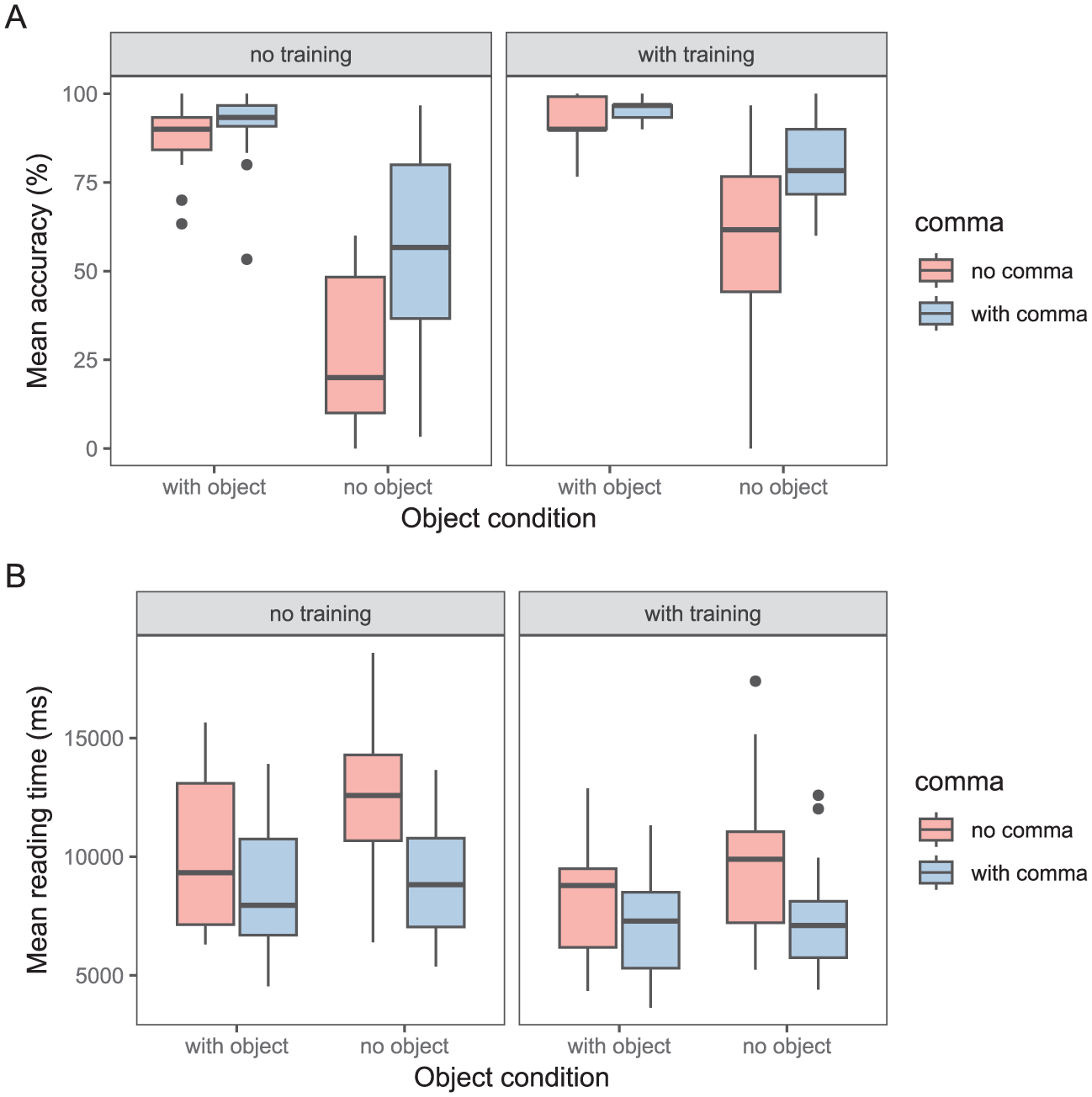
Boxplots of reading performance in ESL readers with and without grammar training, including accuracy (panel A) and mean RT data (panel B). Garden-path effect is expected when there is no comma or object noun phrase in the first clause.
Descriptive statistics of accuracy and RT (in correct trials) data in two ESL learner groups.
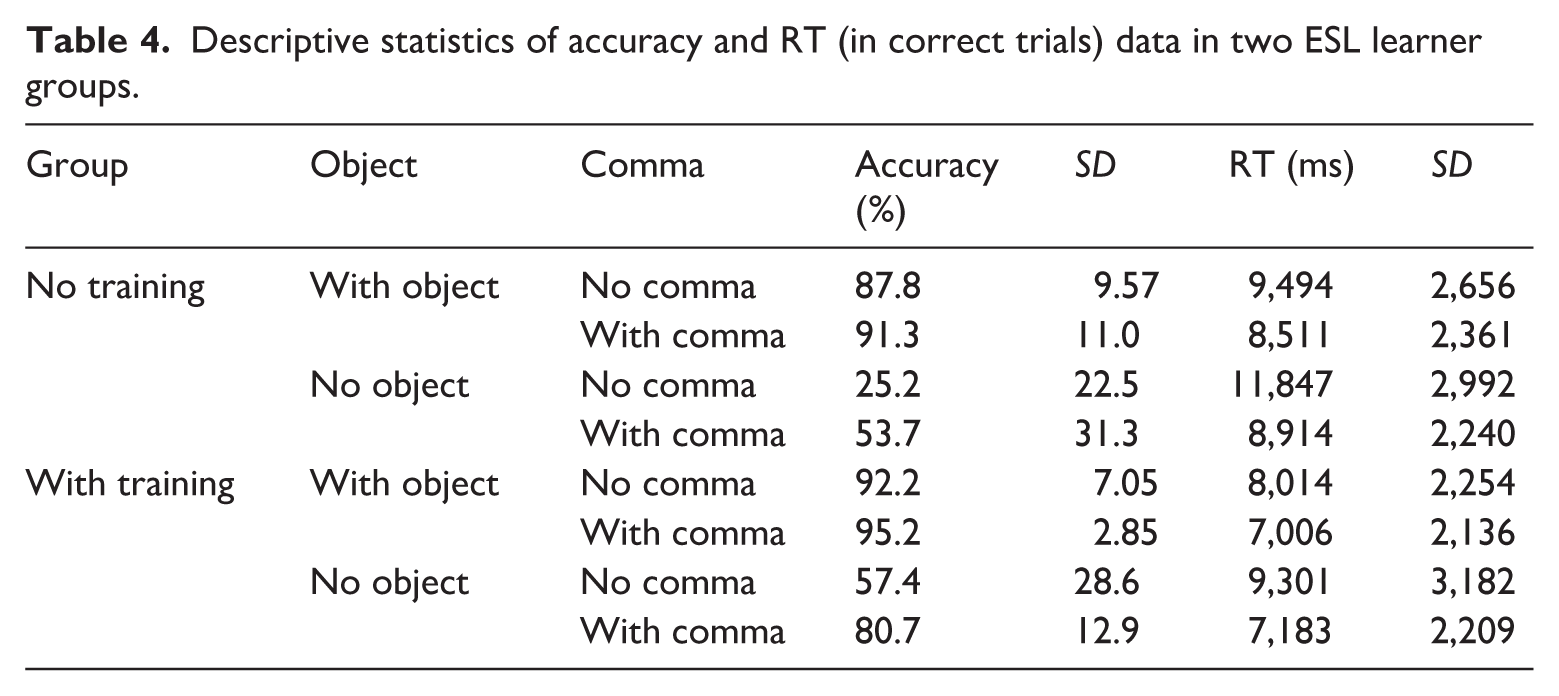
However, ESL readers’ comprehension performance was problematic when the sentence had no object or comma as linguistic cues for dependency. In the no training group, their comprehension accuracy was only 53.7% when there was no object but with a comma, and their performance dropped to 25.2% when the comma was further removed. For ESL readers with grammar training, the same pattern was observed but their descriptive means were higher at 80.7% and 57.4%, respectively. Regarding reading speed, again, the training group was faster (M = 9,301 and 7,183 ms) than the no training group (M = 11,847 and 8,914 ms).
For inferential statistics, we fitted a GLMM (binomial link, formula: Response ~ Object × Comma × Group + (1 + Object + Comma | Participant) + (1 | Item)) for the accuracy data, and a LMM for logarithmic RTs (formula: LogRT ~ Object × Comma × Group + (1 + Object + Comma | Participant) + (1 | Item)). These two models included both random intercepts and random slopes for participants in different conditions, and thus they controlled the variability of individuals' performance in mean value comparisons. To determine the significance level of the effects, we carried out Wald chi-squared tests based on the fitted models, and the results are reported in Table 5. In accuracy data, the model revealed a significant main effect of object presence [χ²(1) = 99.55, p < .0001], and comma presence [χ²(1) = 26.18, p < .0001], suggesting that all ESL readers were sensitive to these two parameters. The interaction between them was also significant [χ²(1) = 18.61, p < .0001]. More importantly, there was a significant effect of group [χ²(1) = 12.48, p = .0004], indicating that the grammar training group outperformed the no training group in general. Furthermore, there was a significant interaction effect between group and object presence [χ²(1) = 5.80, p = .0159], confirming that the training effect was more pronounced when the sentence did not have an explicit object. Post hoc tests confirmed that the accuracy values were comparable when the object was present (t = -1.435, p = .4776); but a significant effect was detected when the object was absent (t = -5.253, p < .0001). Similarly, the group effect was significant only when the object was present (t = -3.950, p = .0005), but not so when the object was absent (t = -2.032, p = .1762). Together, the GLMM model yielded a marginal R2 of .323 and a conditional R2 of .522, suggesting a large effect (i.e., the fixed effects explained 32.3% of the variance, whereas fixed plus random effects explained 52.2% of the variance).
Inferential statistics of accuracy and RT (in correct trials) data in two ESL learner groups.
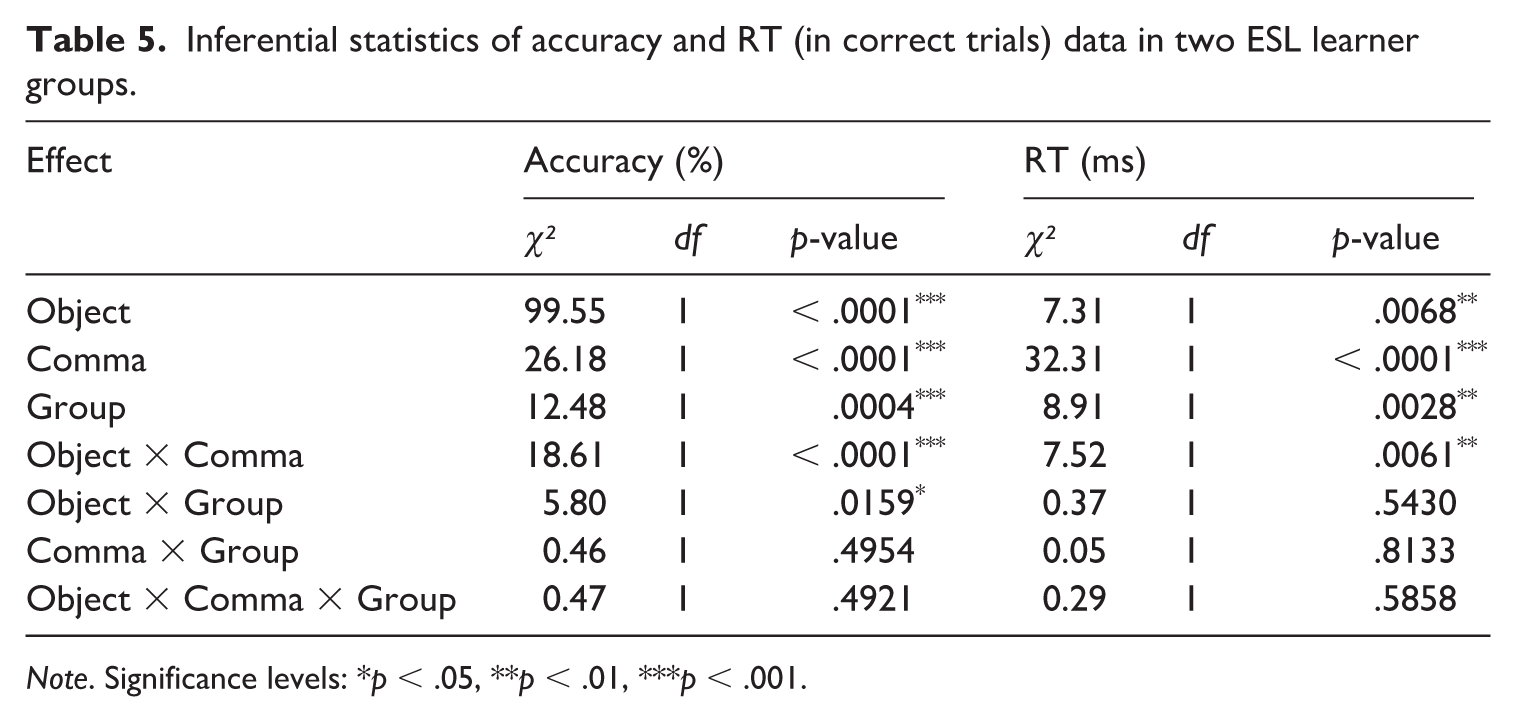
Note. Significance levels: *p < .05, **p < .01, ***p < .001.
For RT data in correct responses, a similar pattern emerged but the direction was reversed (i.e., higher accuracy and lower RT). We found a significant effect of object presence [χ²(1) = 7.31, p = .0068], a significant effect of comma presence [χ²(1) = 32.31, p < .0001], as well as their interaction [χ²(1) = 7.52, p = .0061]. Again, the effect of group was also significant [χ²(1) = 8.91, p = .0028], confirming that grammar training led to higher reading speed in ESL reading. Since there was a significant interaction effect, we carried out post hoc tests, which confirmed that the difference was significant when the object was absent (t = 4.123, p = .0002); the effect did not reach a significant level when the object was present (t = 2.557, p = .052). To summarize, the training group achieved higher accuracy, and they also showed higher reading speed compared to the ESL learners receiving no training when reading garden-path sentences. Together, the LMM model yielded a marginal R2 of .067 and a conditional R2 of .323, suggesting a moderate effect.
2 Lexical type and plausibility cues in garden-path sentences
In this section, we perform further exploratory analysis focusing on the garden-path sentences of different types of verbs and in different plausibility conditions. L1 English readers can have slightly higher accuracy in garden-path sentences with RAT verbs compared to OPT verbs, and they can have higher accuracy when the semantic context is implausible (thus encourages reanalysis) than when the semantic context is plausible (thus no need for reanalysis) (Christianson et al., 2001, 2006). However, it remains largely unknown whether ESL readers also have the sensitivity to these two more nuanced linguistic cues, and how grammar training affects accuracy and reading speed in different types of garden-path sentences.
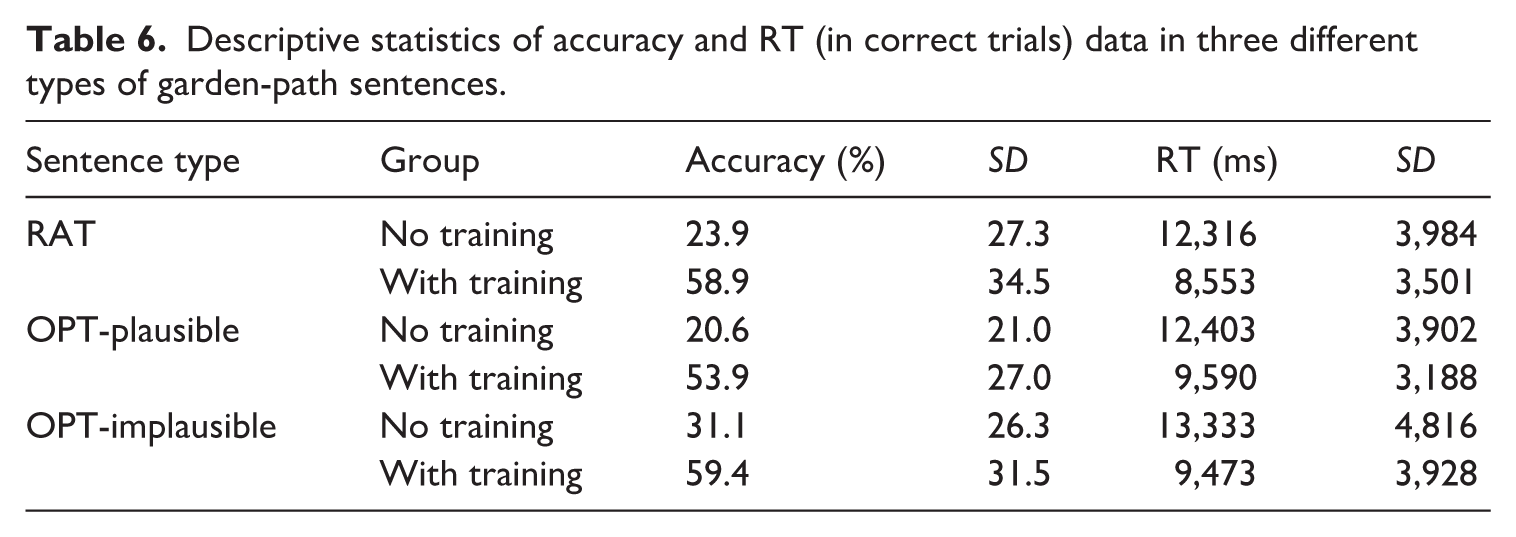
Similar to the overall performance data, we visualize the accuracy and RT data in Figure 3, and the descriptives are reported in Table 6. This time, the pattern was more stable across three types of garden-path sentences, but the group differences were more salient. In the no training group, comprehension accuracy was low in sentences with RAT verbs (also in plausible contexts, M = 23.9%), with OPT verbs in a plausible context (M = 20.6%), but slightly higher when OPT verbs were used in an implausible context (M = 31.1%). For the ESL readers who received grammar training, their accuracy rates were higher in each case (M = 58.9%, 53.9%, and 59.9%, respectively). We similarly fitted a GLMM and carried out a Wald chi-squared test to determine the significance value (Table 7): there was a significant effect of group [χ²(1) = 10.16, p = .0014], but the effect of sentence type was not significant, suggesting that ESL readers, unlike L1 native readers, showed minimal sensitivity to the verb differences and contextual plausibility. RT data showed the same result. In summary, grammar training led to more accurate and faster sentence comprehension and more successful ambiguity resolution, but ESL learners could not take into account the more nuanced cues (verb type, semantic plausibility) when processing garden-path sentences.
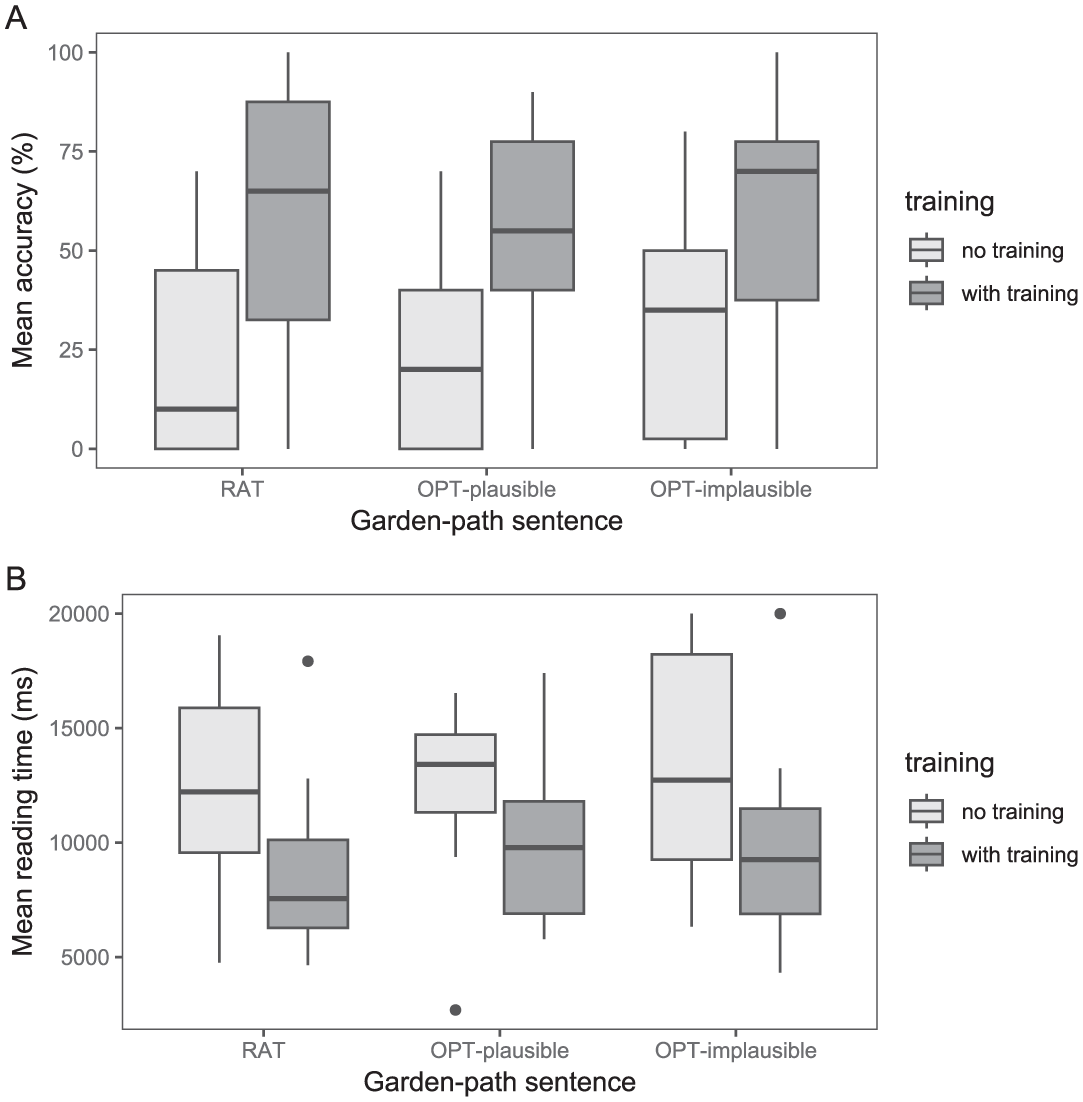
Boxplots of accuracy (panel A) and mean RT data (panel B) in garden-path sentences with different verb types and plausibility levels.
Descriptive statistics of accuracy and RT (in correct trials) data in three different types of garden-path sentences.
Inferential statistics of accuracy and RT (in correct trials) data in three different types of garden-path sentences.
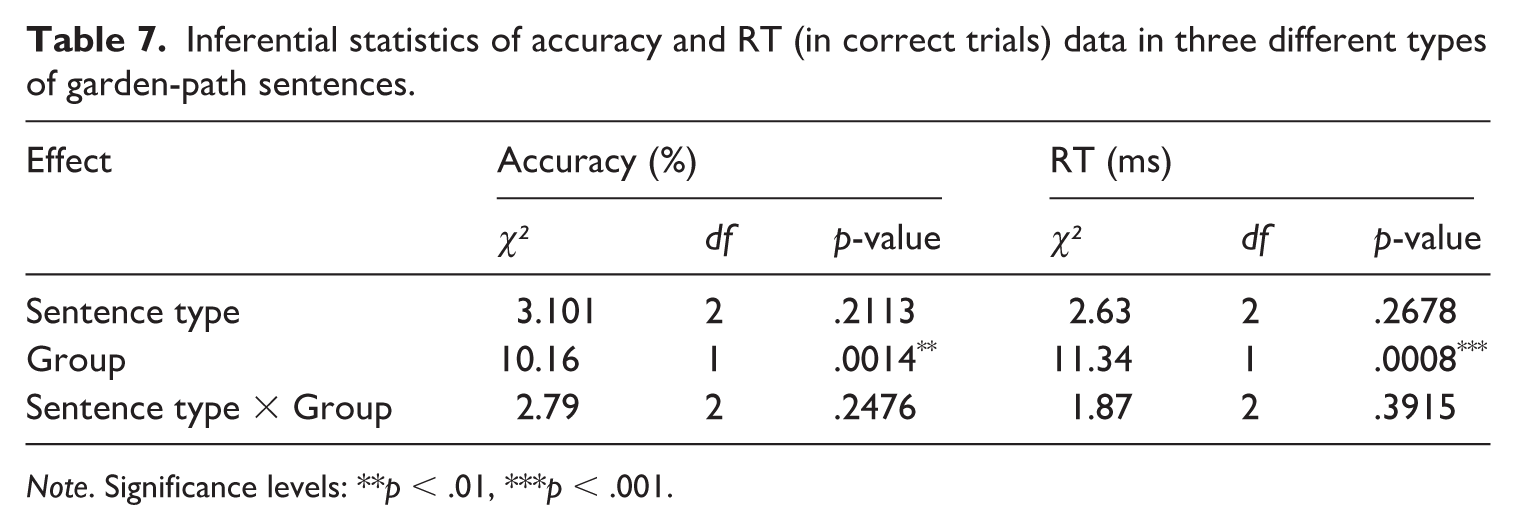
Note. Significance levels: **p < .01, ***p < .001.
IV Discussion
1 Grammar training helps ESL sentence reading
The results of the sentence reading experiment in the present study provide clear evidence that a short grammar training session with sentence structure analysis can substantially improve ESL learners’ sentence reading, especially when sentences have complex syntax and temporary ambiguity (i.e., in garden-path sentences). ESL learners who received grammar instruction before the experiment achieved higher accuracy and reading speed than those who did not receive any training. This suggests that grammar training effectively equipped learners with target strategies for syntactic parsing and ambiguity resolution. Together, these findings highlight the pedagogical value of incorporating targeted grammar lessons into L2/ESL reading curricula, especially for tasks that demand real-time structural analysis (e.g., sentence reading and reading comprehension in general).
Our finding thus aligns with Robinson’s cognition hypothesis (Robinson, 2001, 2003), which argues that increasing task complexity through form-focused learning activities by manipulating the resource-directing variables, such as pretask instruction, can actively promote deeper linguistic processing. In our case, the grammar training session has successfully directed learners’ attention to the syntactic configurations most relevant for accurate sentence interpretation (e.g., the boundary between clauses and the grammatical function of different noun phrases). As a result, ESL learners in the training group could parse the complex sentences more efficiently and more accurately. Conversely, our results do not support Skehan’s limited attention capacity model (Skehan, 1998; Skehan & Foster, 2001), which predicts a trade-off between accuracy and speed under high cognitive load. In this study, the ESL learners improved their accuracy without reducing their processing speed. Instead, both measures improved concurrently, suggesting that when the instructional design is well-calibrated, learners’ cognitive resources can be optimally engaged rather than overloaded or depleted. In our case, the difficulty level in the grammar training session progressed from simple to complex structures, and the stimuli in the reading task were comparable to those in the training sessions (e.g., in the last 2 training steps, ESL learners were asked to analyze and create multiclausal sentences with the same syntactic template). Another potential interpretation is that the training session has increased ESL learners’ familiarity level with the target syntactic structure, and thus their responses are more automatized or proceduralized in the experiment.
More generally, our findings also echo a long-standing body of SLA research that supports the benefits of explicit grammar instruction in classrooms. The results are consistent with the noticing hypothesis (Schmidt, 2001), which argues that conscious attention to linguistic form facilitates knowledge integration. It is also consistent with skill acquisition theory (DeKeyser, 2020), positing that declarative knowledge can become proceduralized through scaffolded practice. Our findings are also consistent with a wide range of experimental and classroom-based studies that demonstrate the effectiveness of explicit grammar teaching for enhancing learners’ linguistic accuracy and language awareness (e.g., Ellis, 2016; Li et al., 2019; Spada & Tomita, 2010).
Finally, this study extends Bui’s (2014) notion of task-readiness beyond its original focus on L2 writing to L2 sentence reading, demonstrating that several principles underlying writing-oriented readiness are also applicable to sentence reading comprehension. More specifically, the grammar training session implemented in the present study can be conceptualized as intentional rehearsal, as participants were explicitly aware that the sentence-parsing strategies introduced would be beneficial for a subsequent reading task. The progressively increasing complexity of the training steps provided effective scaffolding, while the session itself remained learner-oriented and self-paced. Such training enhances task-readiness by explicitly modeling how sentences should be analyzed, thereby establishing structural analysis as an expected task behavior. When encountering temporarily ambiguous sentences, learners were trained to treat ambiguity as a normal and resolvable aspect of comprehension rather than as a processing failure. From a cognitive perspective, this preparation reduced uncertainty about task demands and lowered executive control costs. For garden-path sentences in particular, the training led to earlier anomaly detection and more efficient reanalysis, as reflected in both accuracy and reaction-time data.
Importantly, task-readiness entails different constructs in writing and reading. In writing, readiness often involves having ideas and linguistic forms readily available for output, whereas in reading tasks, readiness should be understood as the ability to efficiently access linguistic knowledge and analyze sentence structure during comprehension. Drawing on Bui’s (2014) framework, we tentatively outline several interpretations and predictions of task-readiness variables as applied to L2 reading.
Topic familiarity: Familiar topics facilitate semantic integration and meaning construction during L2 sentence processing.
Schematic familiarity: Sentences conforming to familiar event schemas are processed more efficiently than those involving unfamiliar schemas.
Task familiarity: Readers who understand how to approach a specific reading task (e.g., ambiguity resolution) outperform those who are less familiar with task demands.
Task repetition and rehearsal: Repeated engagement with similar reading tasks promotes automatization and more efficient processing behaviors.
Strategic planning: Pretask support optimizes conscious allocation of attentional resources to critical linguistic cues for structural analysis and reanalysis.
Within-task planning: Readers who deploy more flexible parsing strategies during online processing achieve greater efficiency in sentence structure analysis.
In the present study, we did not examine the effects of topic or schematic familiarity. Nevertheless, our findings indicate that a brief grammar training session can function as effective pretask support for garden-path sentence reading, systematically altering how L2 readers allocate attentional resources and engage in online reanalysis when required. Because the training session shared structural similarities with the subsequent experimental task, learners also became more familiar with task demands through intentional rehearsal. Ultimately, the training group outperformed the control group in both accuracy and reading speed, providing converging evidence that targeted grammar training enhances L2 sentence-reading task-readiness.
2 Garden-path sentences and L2 reading skills
From a psycholinguistic perspective, this study provides some further information about the role of grammatical awareness in ambiguity resolution among L2 readers. Garden-path sentences represent one of the most cognitively demanding forms of sentence processing because they require readers to abandon an initially preferred syntactic interpretation and then perform structural reanalysis (Bever, 2013; Frazier & Fodor, 1978; Frazier & Rayner, 1982). Our findings show that ESL readers who received pretask grammar training were more successful at resolving these ambiguities than their peers in the control group, suggesting that explicit attention to grammar and heightened grammatical awareness could help L2 learners overcome garden-path effects. Garden-path effects were not exclusive to non-native speakers. Actually, much of the early research on this topic focused on L1 speakers, and even L1 speakers are prone to misinterpretations when they rely on heuristic cues such as surface-level semantic plausibility or thematic expectations rather than a full syntactic parse, and readers often stop at a “good-enough” interpretation (Christianson et al., 2001, 2006, 2017, 2024). At the same time, previous research has consistently shown that L2 readers experience greater difficulty with reanalysis and are more likely to maintain initial misinterpretations (Cunnings & Fujita, 2021; Fujita & Cunnings, 2021; Jacob & Felser, 2016; Juffs & Harrington, 1996). The current study suggests that raising grammatical awareness can mitigate this L2 vulnerability. Future studies could further compare the training effects between L1 and L2 reader groups.
At the same time, our data reveal an important limitation of ESL readers’ cue integration. While ESL readers, in both the training group and no training group, effectively exploited the overt syntactic cues such as the presence of commas and object noun phrases, they showed minimal sensitivity to more subtle contextual or lexical cues that native readers typically use (Christianson et al., 2001). Specially, they did not show the expected advantage for sentences containing RAT verbs (e.g., “dress”) over OPT verbs (e.g., “hunt”), nor did they demonstrate facilitation from implausible semantic contexts that usually prompt L1 speakers to reanalyze sentence structure. This finding indicates that ESL/L2 readers can deploy syntactic strategies when trained, but they tend to rely on a narrower range of information sources during sentence processing. This selective sensitivity echoes the SSH (Clahsen & Felser, 2006), which argues that L2 learners construct less detailed syntactic representations than L1 speakers. Future research could also investigate the long-term effectiveness of grammar training, e.g., through delayed tests or generalization tests. At the same time, we also acknowledge that the design of the training session of the present study has primarily focused on syntactic cues but not lexical types, so ESL learners might not notice such nuanced differences, even though the training materials included both verb types. Relatedly, future research is invited to investigate if training leads to immediate acquisition of different verb types in garden-path sentence processing.
V Conclusion
To summarize, this study investigated whether a brief, explicit grammar training session can enhance Chinese ESL learners’ processing of syntactically complex sentences, using garden-path materials as a way to measure ambiguity resolution skills. By combining the training session with a sentence reading experiment, we linked instructed-SLA principles with psycholinguistic measures of comprehension accuracy and reading speed. The major finding was that ESL learners who received pretask grammar training outperformed the no training group on both accuracy and RT, suggesting that targeted grammar teaching can facilitate deeper sentence processing without compromising reading speed. At the same time, ESL learners tended not to use verb type (OPT vs RAT) as a cue in garden-path sentence processing, different from native English readers as reported in previous research (e.g., Christianson et al., 2001, 2006).
We also acknowledge several limitations of the present study and encourage future research to further examine this topic. First, our participants were advanced ESL learners with an L1 Chinese background. While this homogeneity allowed for more controlled interpretation of the data, further research is needed to determine whether learners with different L1 backgrounds exhibit distinct sentence-processing patterns, particularly when the L1 differs from the target language in syntactic structure. In addition, the grammar training session was intentionally brief (10–15 minutes), as advanced learners were expected to improve task-readiness with limited exposure to the task structure. Nevertheless, it remains unclear whether longer training sessions or more systematic grammar instruction would yield greater benefits. This issue is especially relevant for studies concerned not only with the immediate effects of grammar training, but also with longer-term changes in L2 sentence-processing behavior.
For educators, our results support the view that it is effective to use targeted grammar training modules to develop sentence reading skills. Although garden-path sentences are a very special case of temporary ambiguity, we argue that the same skills for reanalysis and cue integration are generalizable and transferable to other sentence types that differ from basic and canonical clause structures (e.g., cleft-clauses, interrogatives, coordination, and subordination). While higher-level learners struggle with garden-path sentences even after training, lower-level learners might struggle with other, more basic sentence structures. An important pedagogical implication is the importance of raising grammatical awareness, e.g., introducing the basic metalinguistic concepts such as subject, verb, object, and subordinate clause. Once the grammatical knowledge can be applied to sentence reading, learners may have more flexibility during analysis and reanalysis, especially when the complex structure cannot be inferred from surface-level semantic information. Many errors during reading comprehension resulted from readers residing on a “good-enough” interpretation of the material, and at least at the sentence level, raising grammar awareness is a feasible way to counteract processing difficulties. Lastly, language teachers may want to develop targeted instructional modules focusing on different verb types (OPT and RAT) and their distinct linguistic behaviors, as our findings suggest that such fine-grained lexical cues are not always readily accessible during L2 sentence processing. Such modules could include direct comparisons of paired sentences containing different verb types, guiding learners to attend to how these differences affect sentence interpretation. While native speakers may acquire sensitivity to these cues implicitly through extensive exposure to authentic language use, ESL learners are more likely to benefit from explicit instruction that draws attention to these subtle but consequential distinctions.
Footnotes
Appendix. Sentences used in the experiment
Acknowledgements
We want to thank the ESL students who participated in the present study.
Data availability statement
The data of the present study will be available upon request.
Funding
The authors received no financial support for the research, authorship, and/or publication of this article.
Ethical approval
The project has been approved by the Human Ethics Team in the Faculty of Arts, University of Melbourne, Australia (no. 2025-21546-69872-5). All participants have given written consent to participate.
