



Abstract
This study explores the relationship between two facets of confidence in second language (L2) learning: linguistic self-confidence (LSC) and L2 communication confidence (L2 CC), and how they interplay with L2 speech fluency. The data were collected from 102 advanced L2 learners who performed a monologue task to capture their L2 speech fluency, measured in terms of breakdown fluency markers (mean length of silent pauses, frequency of filled and silent pauses), speed of speech (articulation rate), and composite indices (speech rate, phonation–time ratio, and mean length of run). The levels of L2 CC were established with the scale developed by Mystkowska-Wiertelak and Pawlak, while LSC levels were reported using a questionnaire designed for the purposes of the study. The results showed that LSC and L2 CC, while related, are distinct constructs. Regression analyses indicated that LSC accounted for 6% of the variance in speech rate and mean length of run, while L2 CC and LSC jointly predicted variation in frequency of filled pauses. Comparisons between groups with low and high levels of LSC revealed significant differences in temporal and breakdown L2 fluency indices; however, most of them lost statistical significance after applying corrections. The low and high L2 CC groups differed significantly in articulation rate. The outcomes of the study can serve as a basis for several implications for teaching and evaluating L2 speech.
Keywords
I Introduction
Second language acquisition (SLA) researchers have long been interested in identifying factors determining fluent speech in a second language (L2) or foreign language (FL) (see Lintunen et al., 2019; Riggenbach, 2000; Segalowitz, 2010; Suzuki, 2021; Tavakoli & Wright, 2020; Wood, 2010). L2 speech fluency has been widely researched from the perspective of L2 proficiency (e.g., Tavakoli et al., 2020), task type (e.g., Wright, 2021), and study abroad experience (e.g., Tavakoli, 2018), and target language (TL) development in instructed settings (e.g., Tavakoli, 2018). Empirical investigations have mostly focused on recognizing linguistic characteristics, such as L2 knowledge, and skills that shape appropriate and natural fluent communication. However, L2 speech fluency has been less frequently approached from the perspective of learner-based characteristics, in particular those determining confidence and eagerness to engage in L2 communication. This is unfortunate because individual difference (ID) variables of this kind have a considerable impact on capitalizing on opportunities for increased practice and, in consequence, influence automatization of speech production processes, manifested in utterance fluency (Segalowitz, 2010, 2016). For example, if learners lack ample confidence with respect to their mastery of TL subsystems and/or their ability to get their intended messages across, it stands to reason that they might be less inclined to engage in practice opportunities and more hesitant about what they say and how they say it in real time, which will have a negative impact on speech fluency.
Identification factors, such as linguistic and communication confidence in L2, have been reported to play a role in L2 communication frequency (e.g., Balouchi & Samad, 2021; Yashima, 2002). Moreover, there is evidence that L2 communication confidence (L2 CC) is among the strongest predictors of L2 willingness to communicate (WTC) (Peng & Woodrow, 2010; Shirvan et al., 2019), whose role in L2 speech fluency has recently been observed (e.g., Kim et al., 2022; Szyszka & Lintunen, 2025). However, the latest studies investigating the interplay between WTC and L2 speech fluency have produced somewhat inconsistent results (e.g., Kim et al., 2022; Nematizadeh, 2021; Nematizadeh & Wood, 2019; Wood, 2016), testifying to the complexity of this relationship. Therefore, further empirical investigations are of paramount importance in order to provide more comprehensive insights in this area.
One line of inquiry that has the potential to enhance our understanding of learner-based factors interacting with L2 speech fluency is to explore temporal fluency measures in conjunction with antecedents of L2 WTC, such as linguistic self-confidence (LSC) (Peng, 2022) and L2 CC (Mystkowska-Wiertelak & Pawlak, 2017; Yashima, 2002). Empirical research has provided evidence that those L2 learners who are confident about their linguistic and communicative abilities are more willing to use the L2 (Balouchi & Samad, 2021; Khajavy et al., 2016). Little is known, however, about whether high levels of both types of confidence translate into L2 speech fluency. The main aim of the current paper is, therefore, to fill this gap in existing research by investigating the relationship between LSC, L2 CC, and L2 speech fluency indices. The novelty of the study also lies in distinguishing LSC from L2 CC, despite the fact that both terms have often been used interchangeably in previous research, thus effectively being seen as representing a single concept (see Section II). Such a distinction seems warranted, however, in view of the fact that, while LSC can reasonably be seen as being mainly reflective of declarative, explicit knowledge of different elements of the TL that can be used to convey messages (e.g., grammar, pronunciation, vocabulary), L2 CC might be viewed as primarily representing procedural, implicit, or highly automatized knowledge that offers a basis for effective use of these elements in spontaneous communication under time pressure (DeKeyser, 2020; Ellis, 2009; Pawlak, 2021). Therefore, an additional goal is to provide insights regarding a theoretical differentiation of the two constructs underlying confidence in L2 use.
The current study has three main aims. First, it seeks to determine whether LSC and L2 CC should be investigated as two separate, although clearly related, constructs. Second, it sets out to examine the link between LSC and L2 CC, and L2 (English) speech fluency indices. Third, it addresses the issue of whether differences in LSC and L2 CC (i.e., high vs. low) are reflected in L2 speech fluency represented by utterance fluency measures. Specifically, the following three research questions were formulated.
RQ1: Do LSC and L2 CC represent independent constructs?
RQ2: To what extent are LSC and L2 CC predictors of different dimensions of L2 utterance fluency?
RQ3: Do speakers with high and low levels of LSC and L2 CC differ in L2 utterance fluency?
II LSC and communication confidence
An array of terms has been employed to refer to LSC and L2 CC, which have frequently been used interchangeably (Peng, 2022). For instance, some scholars investigating L2 WTC use such terms as perceived communicative competence (e.g., Shirvan et al., 2019) or self-perceived communication competence (e.g., Fushino, 2010), involving self-perceptions of only communicative abilities, whereas others opt for perceived competence (e.g., Balouchi & Samad, 2021) or perceived self-competence (Baran-Łucarz, 2015), thus emphasizing learners’ overall self-evaluation of their L2 skills. In the current study, we approach these constructs as distinct but related entities. LSC is defined in line with Peng’s (2022) conceptualization as individuals’ self-perceived capabilities regarding L2 linguistic skills. The second key construct of this study—L2 CC—is understood as “the overall belief in being able to communicate in the L2 in an adaptive and efficient manner” (MacIntyre et al., 1998, p. 551). L2 CC thus reflects the degree to which an individual feels confident in their ability to attain communicative goals in the L2, and is interrelated but distinct from LSC in the sense that L2 CC refers exclusively to the dimension of L2 communication, in whichever mode such communication may take place. By contrast, LSC entails more generalized subjective self-evaluations of L2 listening, speaking, reading, and writing skills but also different elements of the TL, such as grammar, pronunciation, and vocabulary. As pointed out above, understood in this way, L2 CC can be viewed in terms of learners’ perceptions concerning their ability to use the TL in spontaneous communication (i.e., implicit or automatized knowledge), whereas LSC can be regarded as more indicative of such perceptions in relation to the mastery of different components of the TL (i.e., explicit knowledge) (see DeKeyser, 2020, Ellis, 2009; Pawlak, 2021). Moreover, in some studies, L2 CC has been defined as an amalgam of L2 perceived competence and lack of communication anxiety (Yashima, 2002; Yashima et al., 2004). However, for the purposes of the current research, L2 CC is approached as a communication-focused construct. We also seek to empirically justify the distinction between these two concepts. Generally, both LSC and L2 CC are approached here as relatively stable antecedents of L2 WTC, which is understood as “readiness to enter into discourse at a particular time with a specific person or persons, using L2” (MacIntyre et al., 1998, p. 547).
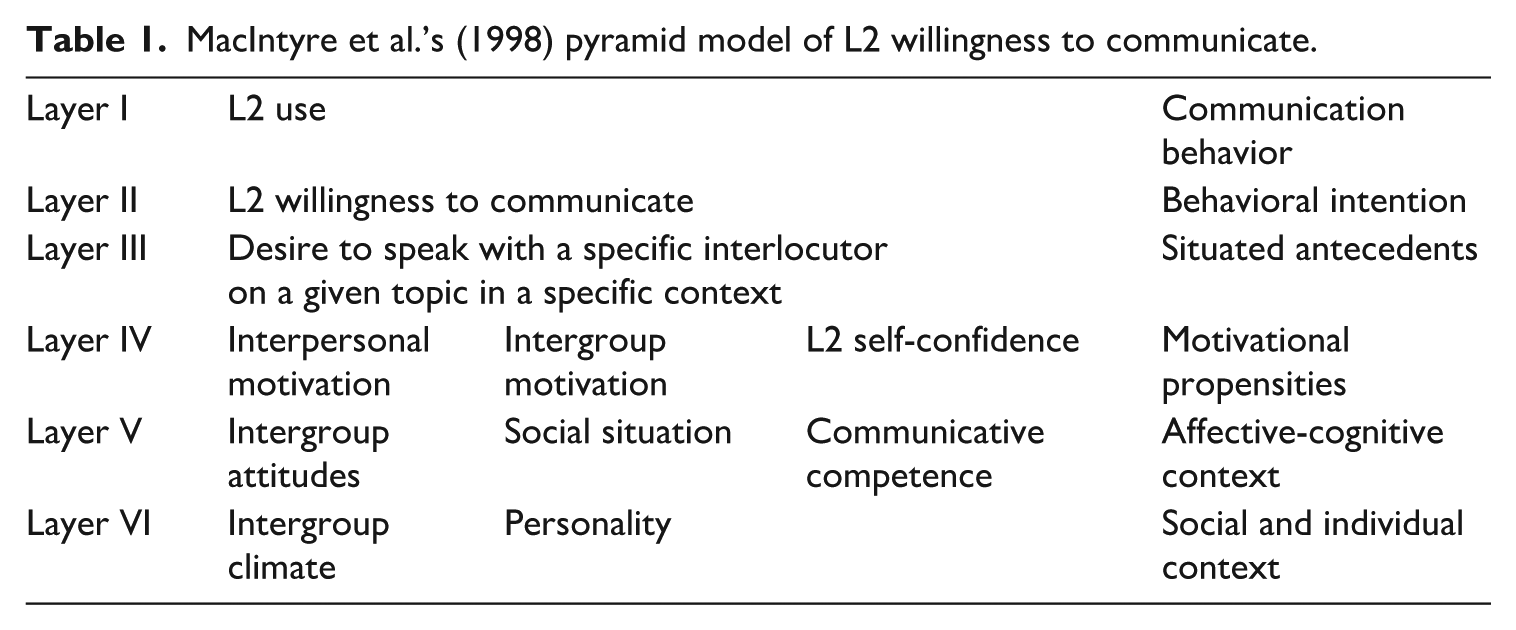
The potential contribution of LSC and L2 CC to speaking in an L2 is illustrated in the heuristic, multilayered pyramid model of L2 WTC proposed by MacIntyre et al. (1998). According to this model (Table 1), an L2 learner’s relatively stable appraisal of their linguistic abilities as well as beliefs in communicative capabilities represent socially defined motivational propensities, addressed under the umbrella term of L2 self-confidence and included in Layer IV. As such, they comprise more enduring antecedents of an L2 learner’s readiness to enter a communicative act when given an opportunity, which structure the bottom three layers. Other examples of more enduring factors are intergroup climate and personality, which form the most distal Layer VI, as well as intergroup attitudes, social situations, and communicative competence, labeled affective-cognitive contexts and belonging to Layer V. Situated individual and contextual precursors of L2 WTC are included in Layer III. They entail such aspects as a desire to initiate communication with a specific interlocutor, on a given topic, and in a concrete context. These factors directly underpin behavioral intention (Layer II), and, finally, communication behavior (Layer I). Importantly, although the model has recently been subject to reconceptualization (Henry & MacIntyre, 2023) to account for language use in multilingual contexts, the factors comprising different levels remain the same.
MacIntyre et al.’s (1998) pyramid model of L2 willingness to communicate.
Empirical research on L2 WTC provides evidence for a relatively strong relationship between confidence related to the use of L2 and L2 WTC (e.g., Baran-Łucarz, 2015; Shirvan et al., 2019). Self-perceived communication confidence, for example, was found to be a strong predictor of general L2 WTC (Peng & Woodrow, 2010; Yashima, 2002, Yashima et al., 2004) and L2 WTC in group work tasks (Fushino, 2010). It has also been reported to be a mediating factor in studies investigating the strength of the relationship between L2 WTC and motivation (e.g., Ghonsooly et al., 2012; Peng, 2014). Empirical research has confirmed that high LSC is associated with greater L2 WTC (e.g., Piechurska-Kuciel, 2018; Yashima et al., 2004). In the study undertaken by Baran-Łucarz (2015), LSC, operationalized as FL self-assessment, was shown to be positively related to L2 WTC. Interestingly, in that study, relatively strong correlations were found between self-assessment of L2 fluency and L2 WTC both in and outside the FL classroom (r = .64 and r = .44, respectively). However, it should be remembered that L2 WTC does not represent actual use of the TL but, rather, learners’ intention to engage in such use. Therefore, high levels of L2 WTC, substantiated by LSC and L2 CC, may only indirectly translate into increased practice in various contexts, which is fundamental for automatization processes determining L2 speech fluency development (Littlewood, 2006; Tavakoli & Wright, 2020). To the best of our knowledge, L2 speech fluency, as a crucial dimension of L2 use, has thus far not been investigated in conjunction with LSC and L2 CC, and certainly not with the help of more objective temporal indices. The current study aims to fill this gap in research by scrutinizing the interplay between selected L2 speech fluency measures and L2 learners’ levels of LSC and L2 CC.
III L2 speech fluency
Fluency in L2 has been perceived as a complex construct which, in line with Tavakoli and Hunter (2018), can be understood at different levels. In the broadest sense, fluency is frequently placed on a par with language proficiency, whereas at a narrower level it is limited to oral proficiency only. In SLA research, fluency is recurrently approached at a narrowest level as a “rapid, smooth, accurate, lucid, and efficient translation of thought or communicative intention under the temporal constraints of on-line processing” (Lennon, 2000, p. 26). This narrow understanding makes L2 speech fluency a more operational, objective, and tangible construct from an empirical perspective. Moreover, such operationalization acknowledges the interplay between cognitive and temporal dimensions of speech production, outlined in Segalowitz’s (2010) framework of L2 fluency. For these reasons, Lennon’s (2000) definition serves the purposes of this study most appropriately.
Segalowitz’s (2010) three-pillar L2 fluency framework identifies dimensions of fluency, which function independently but are interrelated: cognitive fluency, utterance fluency, and perceived fluency. The first pillar operates at a deep, cognitive level, where fluency refers to efficiency of the underlying cognitive processes involved in L2 speech production (De Boot, 1992; Kormos, 2006; Levelt, 1989). At this level, processing speed, processing stability, and automaticity of the cognitive processes play a critical role. In this case, communication frequency, understood as practice, contributes to transition from more controlled to more automatized speech production processes.
High efficiency of these processes may be reflected, to some extent, at the level of utterance fluency—the second pillar of the framework that guided the analyses in the present study—where observable speech performance can be objectively measured with utterance fluency indices. Skehan (2009) proposed a division of utterance fluency into speed fluency (reflecting continuity and fluidity of speech), breakdown fluency (indicating habits of pausing that break the fluidity of speech), and repair fluency (monitoring repair processes, such as false starts, reformulations, repetitions). These types of L2 fluency entail temporal, pausing, and repair characteristics of speech, respectively. Measures of speed of speech (e.g., articulation rate), pausing character (e.g., filled pauses), pausing frequency (e.g., silent pause frequency), and location (e.g., mid-clause pauses), along with repair behavior indices (e.g., false starts), have been widely used in L2 fluency studies in order to establish an objective perspective on utterance fluency (for an overview, see Tavakoli & Wright, 2020).
A more subjective listener’s perception of L2 speech fluency is referred to as perceived fluency, which is based, to a certain degree, on utterance fluency, and constitutes the last pillar of Segalowitz’s (2010) fluency framework. Hasselgreen (2005) defines perceived fluency as “the ability to contribute to what a listener, proficient in the language, would normally perceive as coherent speech, which can be understood without undue strain, and is carried out at a comfortable pace, not being disjointed or disrupted by excessive hesitation” (p. 134). This perspective has been adopted, for instance, in Zabihi et al.’s (2024) study, the aim of which was to investigate the extent to which L2 WTC predicts perceived fluency. The speech samples of 100 Iranian BA students of English were rated in terms of perceived fluency by 26 experienced teachers. The data regarding the participants’ L2 WTC were collected via an adopted L2 WTC questionnaire translated to Farsi (Khajavy et al., 2016). The results confirmed that L2 WTC level is a strong predictor of perceived L2 oral fluency. Therefore, it might also be assumed that the antecedents and strong predictors of L2 WTC are related to how fluent or disfluent L2 speech is, based on both subjective and objective measures. However, at present very little is known about how the two types of L2 confidence, that is, linguistic and communication, both of which are strong predictors of L2 WTC, are linked to L2 speech fluency measured with objective temporal indices (i.e., utterance fluency).
To reiterate, based on the literature review, the present study sought to address two research gaps in existing literature. First, given the lack of consensus and conflicting approaches embraced in the relevant studies, it attempted to determine whether LSC and L2 CC can be regarded as two distinct, albeit related, constructs. Second, it aimed to examine the extent to which the two constructs can be regarded as predictors of utterance fluency, which should be carefully distinguished from perceived fluency, typically considered in the assessment of speaking ability (Huhta et al., 2020). In doing so, we examine the interplay of two crucial ID variables that have been shown, often under different guises, to underpin L2 WTC (see Henry & MacIntyre, 2023; MacIntyre et al., 1998). L2 WTC, in turn, is an immediate precursor of L2 communicative behavior and L2 speech fluency, which, together with accuracy and complexity, represents an important index of L2 speaking ability (Michel, 2017).
IV Method
1 Participants
The participants were 102 university students, who were native speakers of Finnish and learners of L2 English. They all studied English as their major or minor subject, with most participants studying an additional FL, different from English. There were 66 females and 28 males. Four participants preferred not to disclose their gender, and another four marked their gender as “other.” The mean age of the students was 22.5, and they declared, on average, 10.3 years of pre-university exposure to English. To establish the homogeneity of the sample in this respect, their general L2 (English) proficiency level was measured with the Lexical Test for Advanced Learners of English (LexTALE). This is a validated indicator of general English proficiency that evaluates language proficiency levels based on vocabulary knowledge (Lemhöfer & Broersma, 2012). The students’ proficiency levels ranged between 62.5 and 98.8, which is the equivalent of B2–C2 CEFR levels. The mean value of L2 proficiency level reached 85.4 out of 100 (SD = 8.76), which, in line with Lemhöfer and Broersma (2012), can be interpreted as C1 CEFR level.
Speakers with low and high levels of LSC and L2 CC were selected for the purpose of the study on the basis of their scores on the linguistic self-confidence (mean = 19.5,7 SD = 2.83) and communication confidence (mean = 61.98, SD = 8.08) scales, described in Section IV 2. The data from the first and fourth quartiles were considered in determining low and high levels, respectively. The participants who scored lower than 18 on LSC were assigned to the low LSC group, whereas those who scored above 21 constituted the high LSC group. There were 23 low LSC and 25 high LSC participants in this study. Consequently, 26 individuals whose scores on L2 CC were below 57 (first quartile) formed the low L2 CC group, and 25 whose levels of L2 CC reached 70 or more (fourth quartile) constituted the high L2 CC group.
2 Instruments
Two instruments were used to collect requisite data in the present study: a questionnaire with Likert-scale items and a task for eliciting samples of L2 speech. They are described in the following subsections.
a Questionnaire
The Affective Questionnaire, a battery designed for the purposes of a larger research project, contained two instruments that elicited data regarding LSC and L2 CC (see the Appendix). First, the Linguistic Self-Confidence Scale (the LSCS), designed for the purposes of this study and inspired by Baran-Łucarz (2015), included five items, each referring to the participant’s self-appraisal of their ability in using one of the following L2 skills: listening, reading, writing, oral production, and oral interaction. The participants were instructed to mark the level of their confidence with respect to these L2 skills on a 5-point Likert scale: 1 = weak, 2 = moderate, 3 = good, 4 = very good, 5 = excellent. Given the straightforward nature of the instrument, there was no need to tap into its underlying structure by means of factor analysis. The reliability of this tool was at the Cronbach’s alpha level of .784, which, according to Larson-Hall (2010), is acceptable, particularly if the number of items in the scale is small, as in the LSCS. Second, the Communication Confidence Scale (CCS) (Mystkowska-Wiertelak & Pawlak, 2017) was used to measure the levels of L2 CC. This tool consisted of 12 items, such as I know I am able to speak without preparation in class (item 5) or I know I am able to self-correct when somebody draws my attention to my error (item 11). While responding, the participants were requested to choose the option that best described their experience on a 6-point Likert scale: 1 = Not at all true about me, 2 = Very slightly true of me, 3 = Slightly true of me, 4 = Moderately true of me, 5 = Very much true of me, and 6 = Extremely true of me. Also in this case, we decided against investigating the factor structure of the scale since it in itself constituted one of eight subscales identified in the original study with the help of exploratory factor analysis. Not having collected data for the other seven subscales and working with a limited number of participants, we concluded that such analyses would have gone beyond the scope of this investigation. The scale was characterized by high internal reliability consistency (Cronbach’s alpha .921). Both tools were translated and administered in Finnish with minor adaptations to the Finnish context to better reflect a more familiar exercise for Finnish participants. For instance, in the CCS item 2, I know I am able to take part in a role play in a group was changed to I know I am able to participate in a group discussion [Tiedän pystyväni osallistumaan ryhmäkeskusteluun] because Finnish participants may not have been very familiar with the role-play form of exercise. Back translation was applied to ensure quality.
b Speaking task
Samples of L2 speech were collected by means of a monologue task in which the participants were asked to narrate a story based on a set of six related cartoon frames. Similar narrative tasks are commonly used in L2 fluency studies to elicit monologic performance from more proficient L2 individuals (e.g., Kormos & Dénes, 2004; Peltonen, 2020). The story in the cartoon developed sequentially from the first frame to the last, and did not require any specialized prior knowledge. No linguistic prompts were included in the cartoon frames. The participants were not previously familiarized with the task. They were given two minutes of planning time to prepare before engaging in L2 performance and were allowed to view the cartoon prompts while speaking.
3 Fluency measures
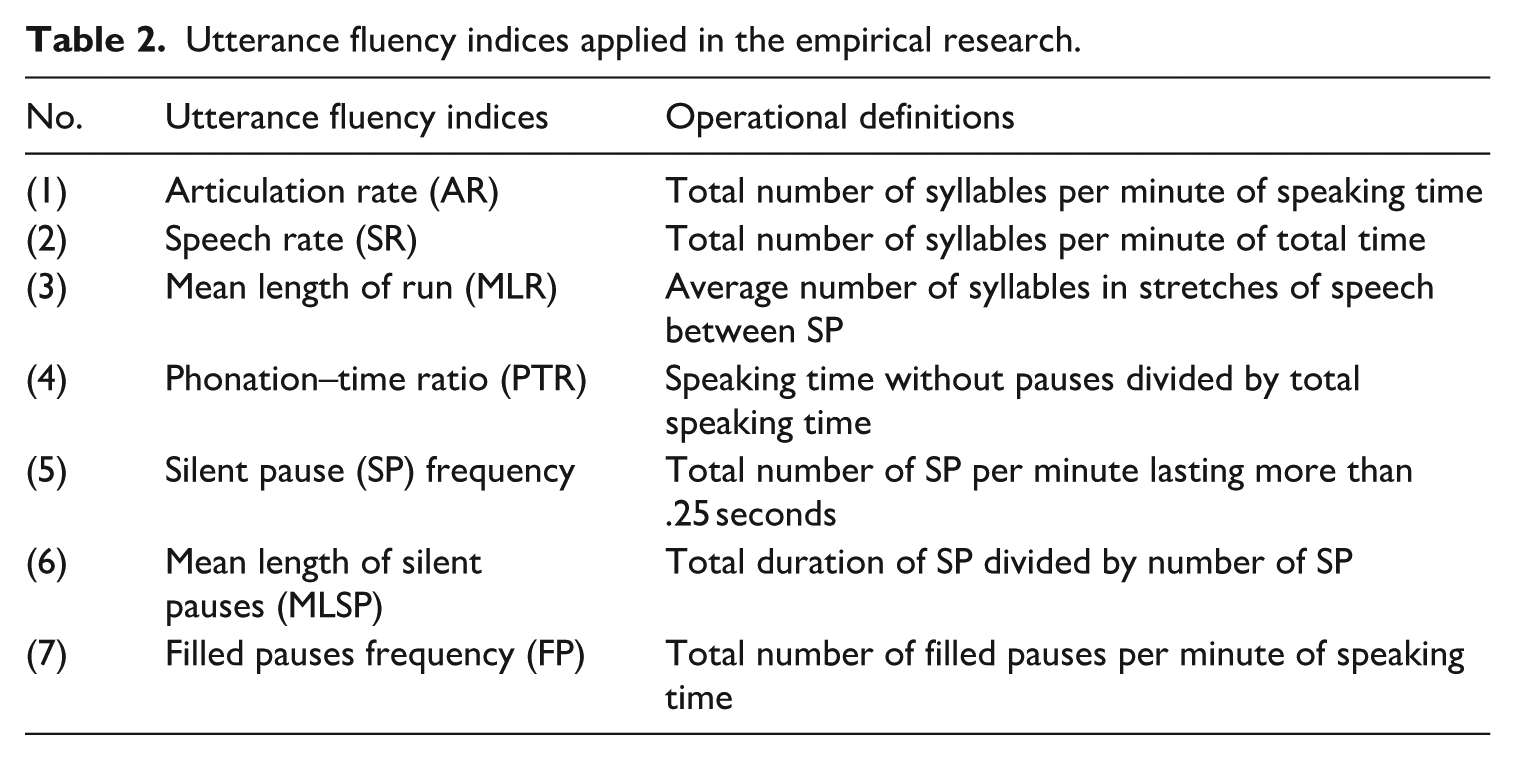
L2 speech fluency was tapped into by means of a number of utterance fluency indices reported as reliable in fluency research (see Tavakoli & Wright, 2020). Seven indices (Table 2), assigned to speed (measure 1), composite (measures 2–4), and breakdown (measures 5–7) categories (Skehan, 2009; Tavakoli & Skehan, 2005) were selected for the purposes of the study. The speed of speech was measured through (1) articulation rate (AR; operationalized as total number of syllables per minute of speaking time). The composite measures of speech fluency, identifying both speed and pausing characteristics of a speech sample, were represented by well-established measures of (2) speech rate (SR; total number of syllables per minute of total time), (3) mean length of run (MLR; the average number of syllables in stretches of speech between silent pauses), and (4) phonation–time ratio (PTR; speaking time without pauses divided by total speaking time). Breakdown fluency, focusing on characteristics of pausing, was calculated with the help of (5) silent pause (SP) frequency, defined as total number of SP lasting more than .25 seconds (De Jong et al., 2021) per minute of speaking time, (6) mean length of silent pauses (MLSP), understood as total duration of SP divided by number of SP, and (7) the frequency of filled pauses (FP), operationalized as total number of FP per minute of speaking time.
Utterance fluency indices applied in the empirical research.
The use of these multiple indices allowed a multifaceted picture of the participants’ L2 speech fluency. Measures from 1 to 4 have been reported to distinguish between more and less fluent L2 speakers (e.g., Kormos & Dénes, 2004). Additionally, MLR is considered to be related to the level of automaticity (Skehan, 2014), whereas PTR offers insights into “the amount of pausing in relation to speech” (Peltonen, 2020, p. 14). Pause frequency (measure 5) has been found to be a stronger marker of breakdown fluency than pause duration (Bosker et al., 2012). However, pause duration (measure 6) may signal that a speaker is taking time to think, formulate, or retrieve information while speaking (Tavakoli & Wright, 2020). FP (measure 7), in turn, can indicate hesitation or difficulties in recalling language (Götz, 2019).
4 Data collection and analysis
The data were collected in two separate sessions. Initially, in Session 1, the participants were familiarized with the general aim of the research project and signed informed consents. In Session 2, they performed the monologue task in the university language laboratory. Before the task, the students were provided with their individual codes and instructed to tell the story. Performance of the task was audio-recorded in the university laboratory, where the participants were assigned to individual recording devices with a headset and worked in parallel with others. Approximately 15 individuals were recorded simultaneously. The average recording lasted 63 seconds, ranging from 19 to 131 seconds. Similar ranges of the length of recordings have been used in other L2 fluency research (e.g., Szyszka et al., 2024). Immediately after speech sampling, the Affective Questionnaire, which included the tools eliciting biodata, the LexTALE, the LSCS, and the CCS, was completed online in a university IT room.
The speech samples were subsequently transcribed, annotated, and cross-checked manually. Basic calculations needed for further estimation of measures 1 to 6 were performed first. Total speaking time, syllable counts (syllable nuclei), frequencies, and durations of pauses were identified in Praat (Boersma & Weenink, 2007) with the help of the Praat script (De Jong & Wempe, 2009) and Lennes’s (2002) script. However, manual adjustments were needed for more precise analysis. FP (measure 7) were calculated manually. Fluency measures were standardized per minute of speaking time. Since the responses to the LSCS and L2 CC Scale were provided on different scales (a 5-point and a 6-point Likert scale, respectively), the data were converted to z-scores to avoid inconsistency in statistical processing.
The Shapiro–Wilk test was used to check normality of data distribution of all variables. As the data of a number of variables deviated from normal distribution, the analyses involved non-parametric Spearman’s rho correlation coefficients and Mann–Whitney tests. The parametric t-test was applied only after confirmation that a variable’s data distribution was close to normal, as in the case of LSC. Multiple regression was used to verify the predictive power of LSC and L2 CC on different dimensions of utterance fluency. The interpretation of the effect sizes followed Plonsky and Oswald’s (2014) recommendations: r = .25 small effect, r = .40 medium effect, and r = .60 large effect.
V Results
Correlational analysis was employed to address RQ1 regarding the link between LSC and L2 CC. The coefficient values, presented in Table 3, were all positive and significant at p < .01. The strongest positive correlation was found between L2 CC and overall LSC, whose value was a sum of subcomponents (rS = .655), indicating that the measures shared just over 42% (.6552) of the variance and that the effect size was large. Size effects verging on large (Plonsky & Oswald, 2014) were found for the relationships between L2 CC and LSC related to oral production (r = .589) and oral interaction (r = .594), with ca. 35% of the variance being accounted for. This indicates that the higher the advanced L2 learners scored on their L2 CC, the higher levels of LSC in oral production and interaction they self-reported. Positive correlations with medium effect sizes were also revealed between L2 CC and LSC related to writing (r = .420, 17.6% of the variance being explained) and listening (r = .465, 21.6% of the variance accounted for). These results show a mutually supportive role of confidence in L2 communication and confidence tied to these two skills. The relationship between L2 CC and LSC in reading (r = .298) was the only value with a small effect size. Nevertheless, the relationship was positive since the higher the levels of L2 CC the participants exhibited, the more confident they were in their reading.
Correlation coefficient values of the relationship between linguistic self-confidence (LSC) and L2 communication confidence (L2 CC).
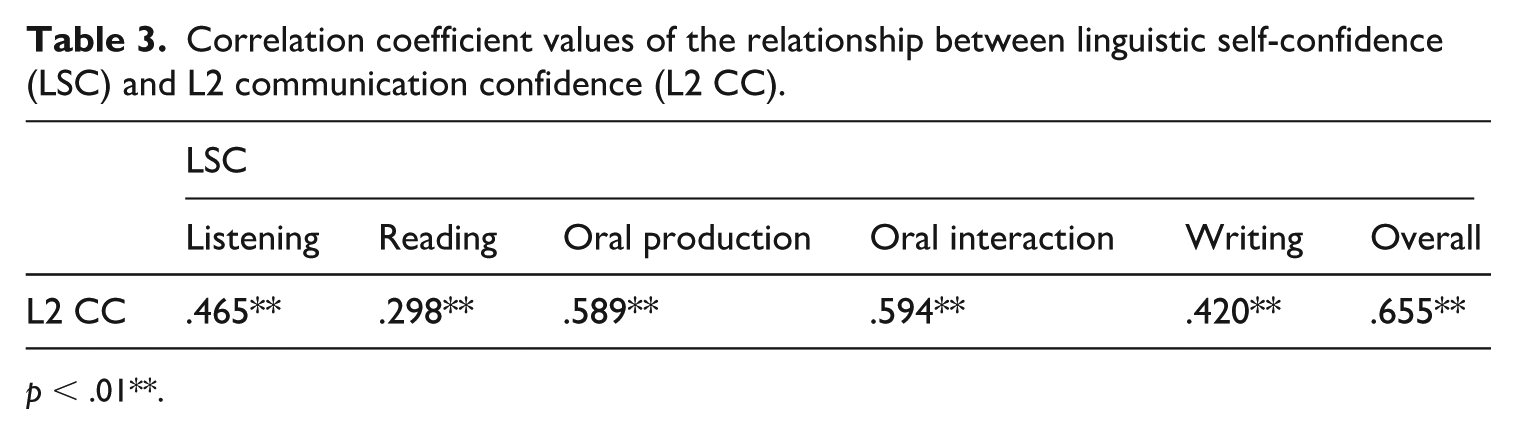
p < .01**.
Regarding RQ2, multiple linear regression analyses were conducted to determine how LSC and L2 CC predicted different facets of L2 utterance fluency. Before analyzing the multiple regression models, we first examined correlations between each L2 fluency measure and LSC and L2 CC (Table 4). Several significant correlations, although with small effect sizes (Plonsky & Oswald, 2014), were identified while inspecting the link between temporal aspects of L2 speech (dis)fluency and the levels of LSC and L2 CC. These relationships involved SR, MLR, frequency of FP, and AR. Overall LSC was positively correlated with two composite measures: SR (r = .216) and MLR (r = .231). Similarly, LSC in oral interaction was related to SR (r = .237) and MLR (r = .207). A positive link was also found between LSC in oral production and SR (r = .231). On the whole, SR was higher for participants who self-reported higher levels of confidence in speech production and interaction skills. Moreover, an increase in overall LSC and LSC related to spoken interaction was positively linked to a higher average number of syllables produced between pauses (MLR). Interestingly, LSC in reading was also related positively to MLR (r = .212). The strongest positive relationship, however, was uncovered between L2 CC and AR (r = .252), with the caveat that the effect size was also small in this case. This shows that the speed of speech of the participants who were more confident in their communication in L2 tended to be greater. L2 CC was also positively related to SR (r = .226). Two negative significant relationships were identified: between L2 CC and frequency of FP (r = –.236), as well as between LSC in oral interaction and frequency of FP (r = –.241). On the whole, the more confident the participants were in their general linguistic abilities, the longer stretches of speech they produced between pausing (MLR) at a higher SR and fewer FP. As for L2 CC, the more confident in their L2 communication the participants were, the faster they spoke (AR) and the fewer FP they inserted in their speech.
Correlations between overall linguistic self-confidence (overall LSC), its sub-components (listening, reading, oral production, oral interaction, and writing), L2 communication confidence (L2 CC), and L2 speech fluency measures.
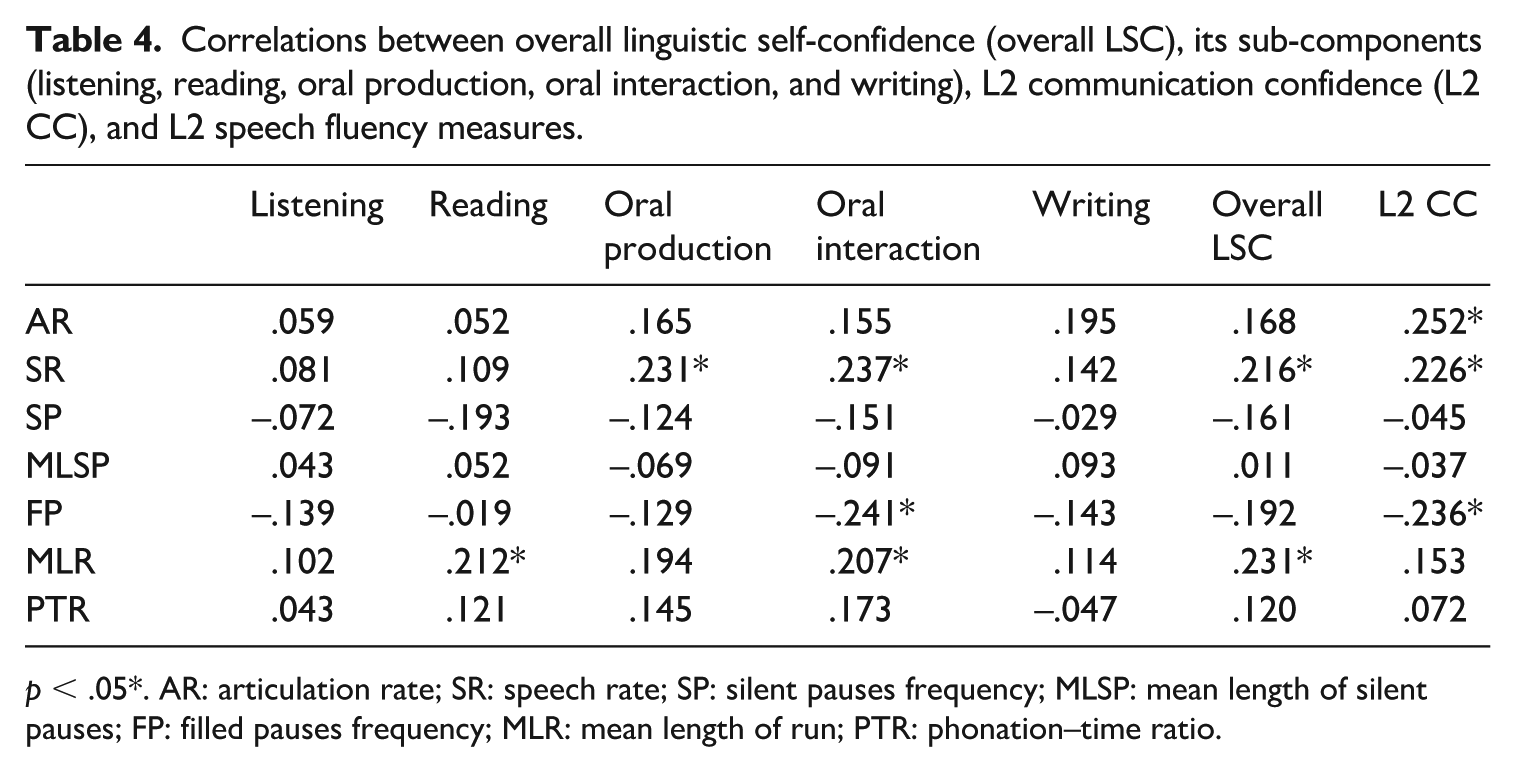
p < .05*. AR: articulation rate; SR: speech rate; SP: silent pauses frequency; MLSP: mean length of silent pauses; FP: filled pauses frequency; MLR: mean length of run; PTR: phonation–time ratio.
The outputs of the multiple regression were computed to identify how much of the variance in each L2 fluency index is accounted for by LSC and L2 CC. The models are summarized in Table 5. The results revealed that only three models significantly predicted variation in some L2 fluency indices. LSC accounted for R2 = 6% of the variance in SR and MLR. Jointly, LSC and L2 CC accounted for R2 = 6% of the variance in FP frequency, with L2 CC independently adding 3% (R2 change) of explanation for the variation.
Summary of regression models: linguistic self-confidence (LSC) and L2 communication confidence (L2 CC) as predictors of different facets of L2 utterance fluency.
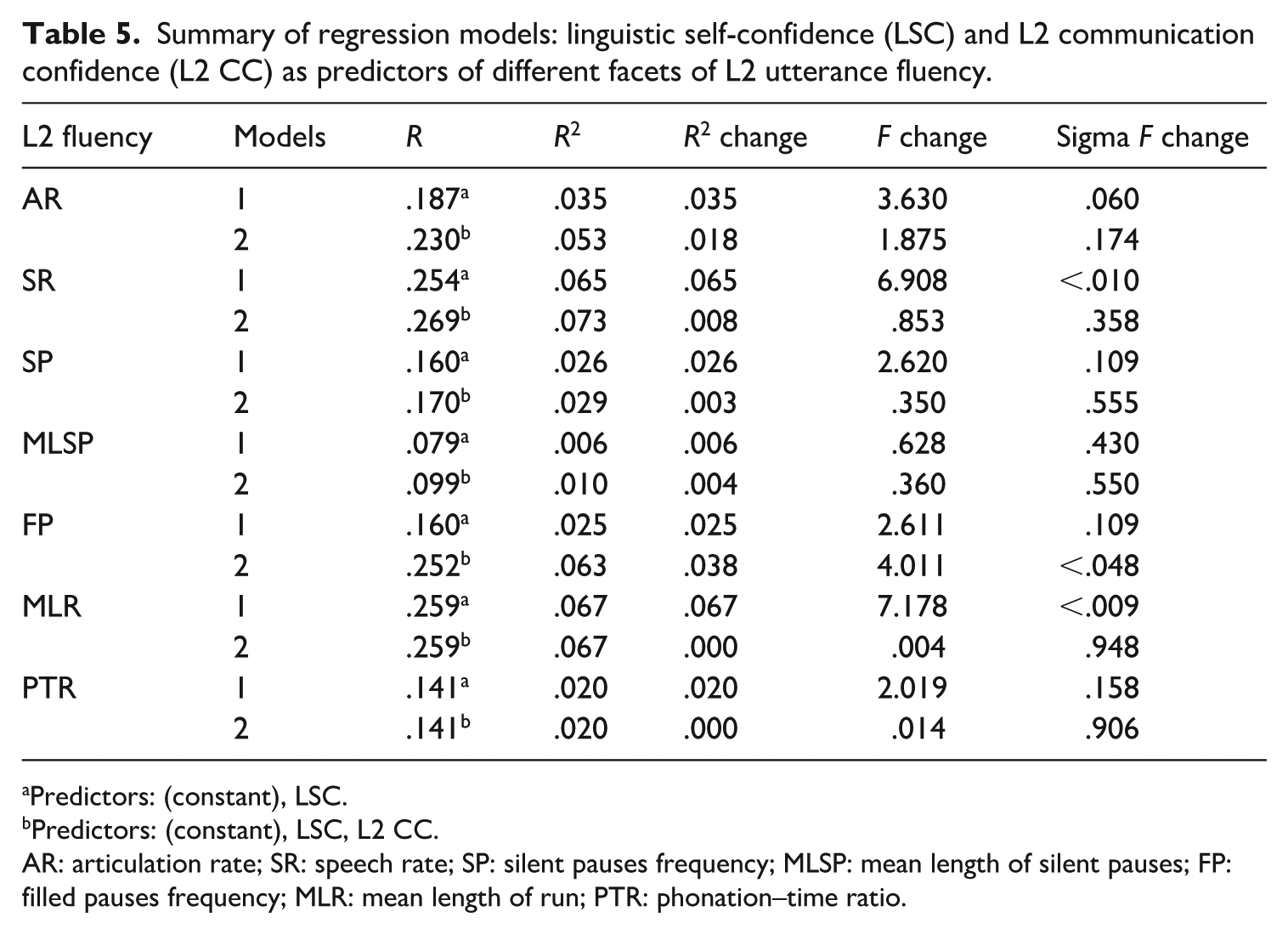
Predictors: (constant), LSC.
Predictors: (constant), LSC, L2 CC.
AR: articulation rate; SR: speech rate; SP: silent pauses frequency; MLSP: mean length of silent pauses; FP: filled pauses frequency; MLR: mean length of run; PTR: phonation–time ratio.
Proceeding to RQ3, the analysis for most fluency measures failed to provide evidence for the difference between low CC (quartile 1) and high CC (quartile 4) students with respect to their L2 speech fluency (Table 6). The only significant differences between the two groups were identified in the use of AR and SR. The participants with low levels of communication confidence in L2 spoke statistically significantly (AR: U = 168, p = .003; SR: U = 196, p = .015) slower on average (AR: MeanLowCC = 213.64, SR: MeanLowCC = 149.78) than those who were more confident (AR: MeanHighCC = 237.51, SR: MeanHighCC = 170.39). However, after applying Bonferroni adjustment to control for potential type I error (Larson-Hall, 2010, pp. 251–252), the p-value indicating this statistical difference (Bonferroni adjusted p = .007) was found false positive for SR. The differences between the two groups failed to reach significance in the case of the indices of breakdown (SP: U = 312, p = .806; MLSP: U = 310, p = .777, FP: U = 225.5, p = .061) and other composite measures (MLR: U = 248, p = .147; PTR: U = 297, p = .598) of L2 speech fluency in the analysis. On the whole, it can thus be concluded that in the present study the differences between the participants with low and high L2 CC were only revealed in the case of the pure measure of speed of speech AR.
Comparisons of L2 speech fluency indices in the groups of low (quartile 1 low CC) and high (quartile 4 high CC) levels of L2 communication confidence.
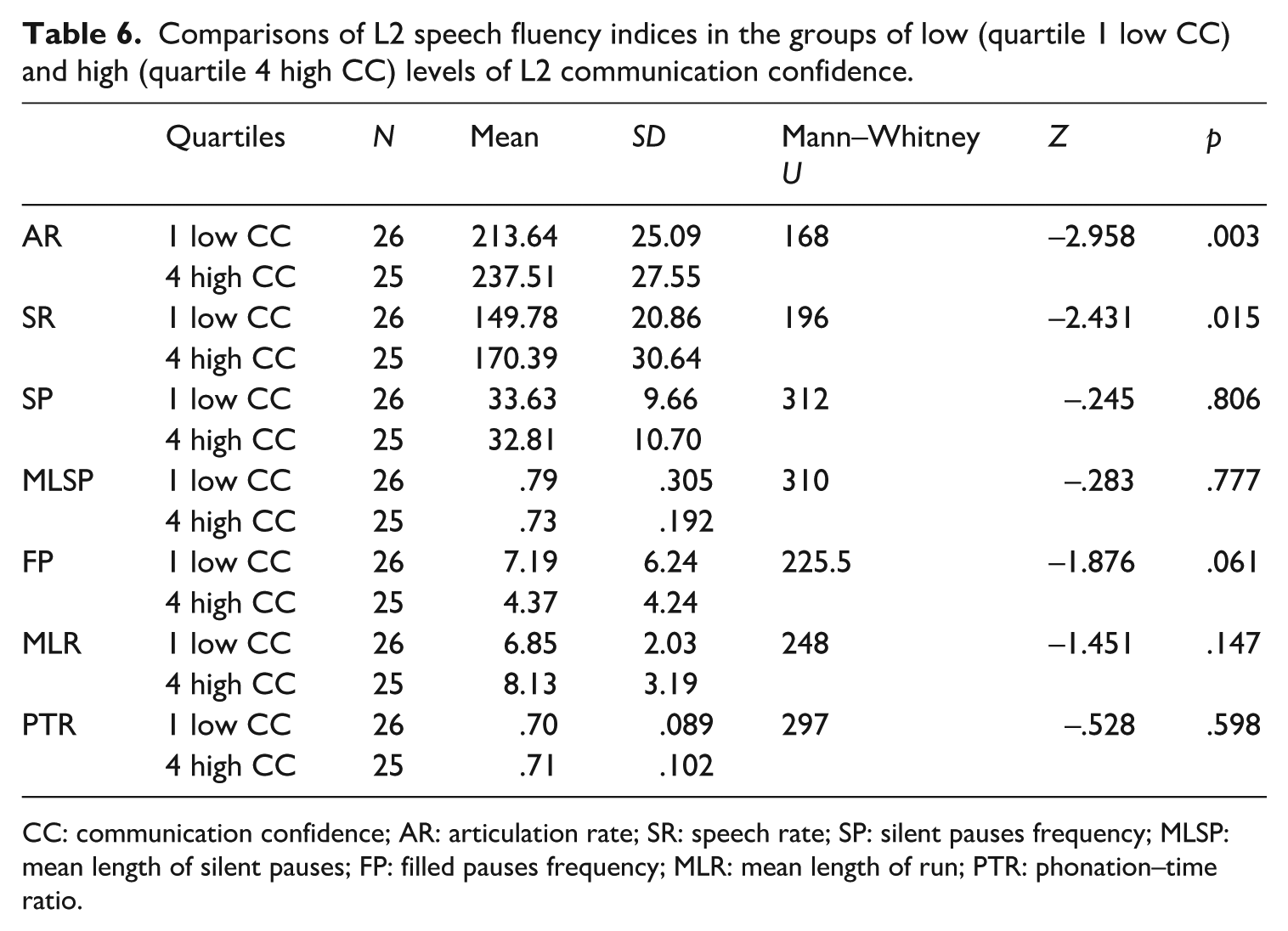
CC: communication confidence; AR: articulation rate; SR: speech rate; SP: silent pauses frequency; MLSP: mean length of silent pauses; FP: filled pauses frequency; MLR: mean length of run; PTR: phonation–time ratio.
More varied results were found while comparing groups with low (quartile 1) and high (quartile 4) levels of LSC (Table 7). The t-test outcomes confirmed significant differences in AR (t = –1664, p = .049), SR (t = –2.515, p = .008), SP frequency (t = 1.729, p = .045), FP frequency (t = 1.865, p = .034), and MLR (t = 2.475, p = .009). The participants with low levels of LSC spoke slower, as demonstrated by AR and SR, paused more frequently (SP), inserted FP more often, and produced fewer syllables in stretches of speech between SP (MLR) than their peers who were more linguistically confident. However, after applying the Bonferroni adjustment for the p-value (p = .007) in the seven t-tests conducted in the analysis, we found that only SR and MLR were close to reaching statistical significance.
Comparisons of L2 speech fluency indices in the groups of low (quartile 1 low LSC) and high (quartile 4 high LSC) levels of linguistic self-confidence.
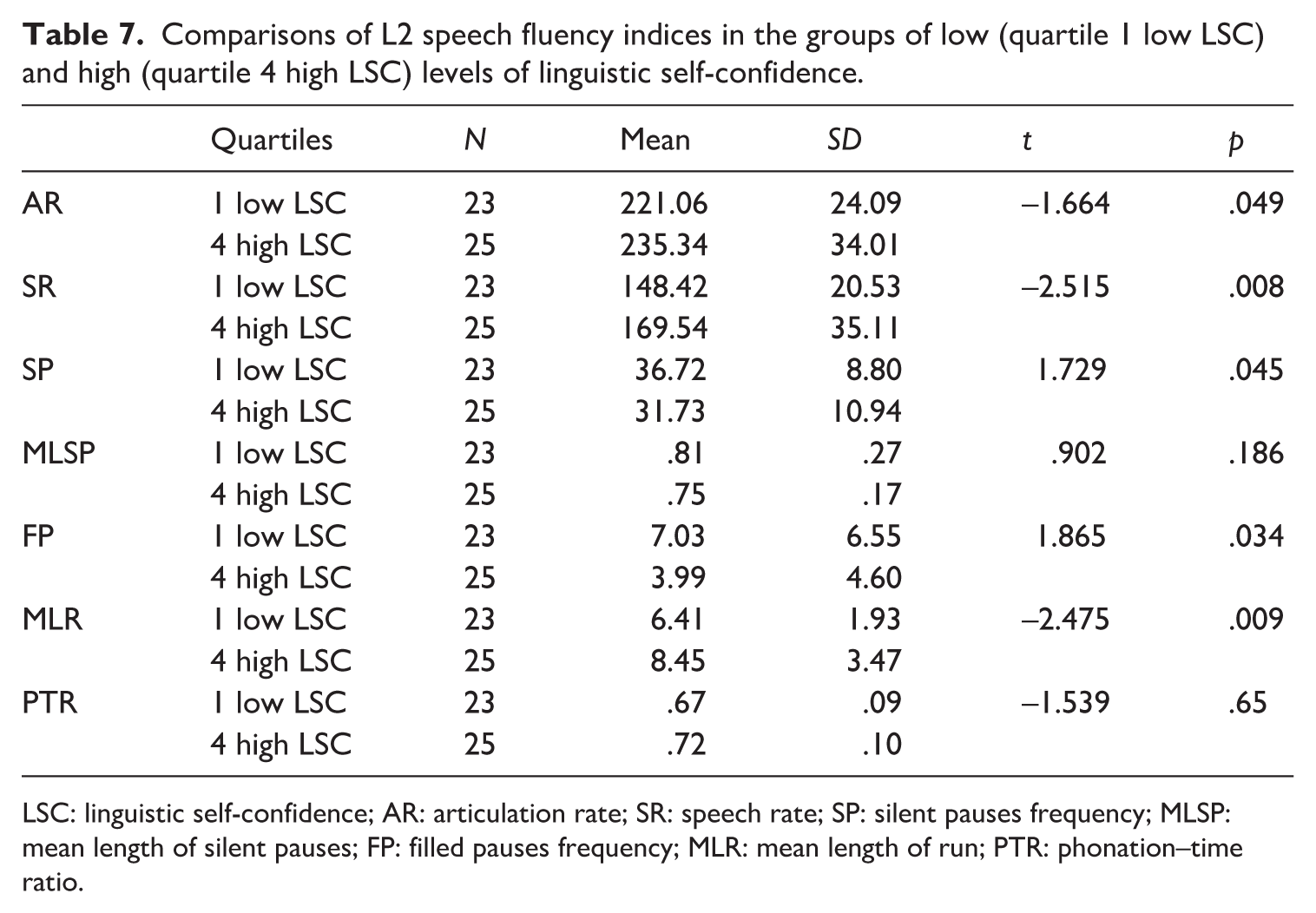
LSC: linguistic self-confidence; AR: articulation rate; SR: speech rate; SP: silent pauses frequency; MLSP: mean length of silent pauses; FP: filled pauses frequency; MLR: mean length of run; PTR: phonation–time ratio.
VI Discussion
The present study investigated three research questions, the first of which was related to the link between LSC and L2 CC, while the remaining two focused on the relationships between LSC and L2 CC on the one hand and different aspects of L2 speech fluency on the other. RQ1 was concerned with the extent to which LSC and L2 CC should be approached as two distinct but, to some degree, interrelated constructs. Correlational analysis revealed a significant positive relationship between L2 CC and overall LSC, with 42% of the variance being accounted for. This means that 42% of the variation in the scores on L2 CC can be explained by the variation in LSC, with 58% being explained by other factors. Such findings provide evidence in favor of approaching the two constructs independently (cf. Horwitz, 2017, p. 34). As expected, the strongest positive relationships were revealed between L2 CC and LSC in oral production and interaction. In other words, the participants who communicate in English with greater confidence also feel more confident in relation to their overall oral abilities in the TL.
What might be surprising, however, is that the correlation was not even stronger in this case. After all, it could reasonably be argued that when individuals are highly confident about their ability to produce language and engage in oral interactions, they should also be confident about their overall ability to communicate in the TL. This said, this degree of relationship might be explained at the theoretical level, considering the conceptualization of the two constructs. L2 CC entails individuals’ beliefs about their effectiveness in terms of L2 communication that is contextualized (MacIntyre et al., 1998, p. 551), whereas LSC involves self-perceptions or self-appraisals of linguistic knowledge and abilities that can be drawn upon in different situations. In other words, the former goes beyond the sheer confidence regarding the mastery of linguistic aspects needed for successful oral communication. Once again, an argument could be made that while L2 CC may reflect implicit or highly automatized knowledge allowing L2 use in real-time processing, LSC may be linked to explicit L2 knowledge that can only be accessed when sufficient time is available (see DeKeyser, 2020; Ellis, 2009; Pawlak, 2021). While the two types of L2 knowledge are distinct, skill-learning theory (DeKeyser, 2017, 2020) posits that the latter offers a basis for the development of the former through the process of proceduralization and then automatization, which is made possible through (communicative) practice. It is evident that more empirical evidence is needed to substantiate this assumption. Moreover, L2 CC also entails social, cultural, and individual components (Yashima, 2002). In effect, learners may feel confident in their L2 general abilities but may not necessarily be equally confident to engage in actual communication because, for example, of different cultural norms, interlocutor status, or various constellations of individual differences. In view of such reasoning, the two concepts can be said to differ despite the fact that they both refer to confidence in L2. This study thus produced evidence in favor of approaching LSC and L2 CC as two distinct yet closely related constructs.
While investigating the extent to which LSC and L2 CC predict different dimensions of utterance fluency (RQ2), first the relationships between these two types of confidence and different indices of L2 speech fluency were explored. L2 CC was weakly related to several of those indices. Both AR, which is a pure measure of speed of speech, and SR, which represents a composite measure of speech and breakdown, interplayed significantly with L2 CC. In other words, the participants who declared themselves to be more confident while communicating in L2 tended not only to speak faster but also inserted shorter SP than less confident speakers. However, the results of the multiple regression analysis did not reveal the predictive power of L2 CC in the variation of temporal indices of L2 fluency. Drawing on the previous research, L2 CC is a strong predictor of L2 WTC (Peng & Woodrow, 2010; Shirvan et al., 2019). Being willing to enter into communication in L2, in turn, increases opportunities for L2 oral practice (Balouchi & Samad, 2021), which plays a crucial role in L2 fluency development (Segalowitz, 2010, 2016). Our findings generally failed to confirm the predictive power of L2 CC on most L2 speech fluency indices. Perhaps the fact that the participants were advanced L2 learners, all with relatively high levels of L2 speaking fluency, might have affected the outcomes. Therefore, further studies, particularly involving participants at lower L2 proficiency levels, are needed to shed more light on this issue.
L2 CC, however, seems to play a role when it comes to the frequency of FP. In this study, more frequent use of FP per minute was related to lower levels of L2 CC, and jointly with LSC it explained 6% of the variance in the frequency of FP (RQ2). This is in line with research where a negative relationship was found between language anxiety, associated with confidence (e.g., Onwuegbuzie et al., 1999), and the frequency of FP among advanced L2 learners (Szyszka & Lintunen, 2025). De Jong et al. (2013) suggest that FP may result from speech planning processes and reflect to a certain extent individual characteristics of the speaker, such as speaking style. L2 CC and LSC might constitute the identifying factors that are associated with the use of FP. Additionally, more frequent use of FP was observed in the speech of the participants who were less confident about their linguistic capabilities regarding oral interaction. This is in line with De Jong et al.’s (2013) study, exploring the relationship between the frequency of the use of FP and measures of linguistic knowledge and skills, such as pronunciation quality, grammar knowledge, and vocabulary knowledge. Generally, this breakdown measure of L2 speech fluency emerges as an interesting indicator of L2 CC and LSC at higher levels of L2 proficiency. In a similar vein, Cossavella and Cevasco (2021) imply that FP “promote the coordination of speakers’ mental states” (p. 181), with those “states” also reflecting confidence in both L2 communication and linguistic abilities. Nevertheless, further empirical investigations are needed to substantiate this assumption.
Overall LSC, as well as the scores regarding confidence in oral production and interaction, correlated positively with SR and MLR. In other words, an advanced L2 learner whose confidence in linguistic abilities, particularly those associated with L2 production and interaction, is higher is more likely to produce speech at a slightly higher rate (SR), with longer stretches of L2 between pausing (MLR). Although multiple regression analysis further supported these findings, with LSC explaining 6% of the variance in both SR and MLR, the value is relatively low. This suggests that LSC interplays with SR and MLR only to a limited extent. Complex as it is, an explanation of these results may be rooted in the nature of the LSC construct. As stated earlier, LSC is a relatively stable identifying variable underpinning motivational propensities toward L2 WTC and then, ultimately, L2 use (MacIntyre et al., 1998). According to Tavakoli and Wright (2020), such identifying variables are mostly reflected in composite L2 speech fluency measures. However, the findings of this study corroborated this claim only partially, identifying SR and MLR, but not PTR, as composite measures related, albeit weakly, to LSC. Therefore, further research is needed to offer more definitive answers regarding the role of LSC and other identifiers in the outcomes of L2 speech fluency measures, including those of a composite character.
Interestingly, LSC related to reading was found to interact with MLR. More specifically, longer stretches of speech between pauses (MLR) were produced by those whose levels of LSC regarding reading were higher. One plausible explanation for this relationship could be that confidence in the L2 reading skill may reflect the amount of time spent reading in the L2, which contributes to greater mastery of vocabulary, including, possibly, gains in formulaic language. The use of formulaic expressions, or, multiword units, in turn, has long been associated with fluency (Wood, 2002). Therefore, MLR, which reflects skillful use of automatized chunks (Wood, 2010, p. 29) and relates to the degree of automaticity (Skehan, 2014), is the measure that best shows the interplay between L2 speech fluency and confidence in one’s L2 reading abilities.
Finally, with respect to RQ3, after applying Bonferroni adjustment, the groups with high (high L2 CC) and low (low L2 CC) levels of communication confidence differed only in the pure measure of speed of speech. Those who were more confident in their L2 communication produced their speech faster, which is supported by research linking confidence with greater L2 communication frequency (Balouchi & Samad, 2021). Increased practice results in the automatization of speech processes, and AR reflects these underlying cognitive processes (Segalowitz, 2010). However, there were no other significant differences in L2 speech fluency between the participants with high and low L2 CC. Nevertheless, an interesting observation is that the high L2 CC and low L2 CC students, as well as the individuals in the groups with high and low levels of LSC, manifested consistency in the mean values for all L2 speech fluency measures. As expected, the participants in the high L2 CC and high LSC groups produced speech with higher AR and SR, fewer and shorter SP, fewer FP, longer runs between pauses, and a slightly higher PTR than those who were in the low CC and low LSC groups. However, since the participants were overall very proficient learners of English, even those in the low CC and LSC groups exhibited relatively high L2 speech fluency, as reflected in the indices used in the present study, which might be the reason why the differences between the groups were marginal and thus mostly did not reach statistical significance.
The aforementioned exploratory trends, however, should be approached with a clear understanding of the limitations of the study. Firstly, the correlational nature of the study precludes any causal inferences; however, this type of research pioneers and sets the scene for further explorations. Secondly, the reported effect sizes are small, showing the directions and patterns worth exploring rather than indicating practical significance. Thirdly, despite the acceptable level of Cronbach’s alpha value, the newly developed LSC questionnaire, with a short scale, has not yet been extensively validated. Therefore, further research is needed to shed more light on its psychometric properties. Fourthly, the sample consisted of advanced L2 learners, whose linguistic processes are to a large extent automatized, which is reflected in utterance fluency indices. This high L2 proficiency may explain the lack of statistically significant differences in L2 speech fluency between the participants self-reporting different, but still relatively high, levels of L2 CC. For this reason, it would be interesting to explore the link between L2 speech fluency and L2 CC in groups of L2 learners at lower proficiency levels, where speech processes are less automatized and confidence in L2 communication might be lower. Furthermore, oral performance is very context dependent. As this study followed mainstream L2 fluency research by focusing on monologue performance, further studies are needed to include interactional settings and other task types. Finally, this study used objective utterance fluency measures, but as suggested by Segalowitz’ (2010) fluency dimensions, with different methodological approaches, more varied measures of L2 fluency, such as cognitive fluency variables or perceived fluency measures, can be considered.
There are several other weaknesses of the study that should be highlighted at this juncture as well. For one thing, the data distribution of L2 CC was negatively skewed, so perhaps low L2 CC was somewhat underrepresented. The participants’ L2 CC levels were relatively high, with a mean value of 61.98, exceeding the mean value on the scale (Mscale = 48) by almost 14 points. 1 Therefore, even the students assigned to the low L2 CC group might have been relatively confident in their L2 communicative abilities. Hence, with a larger sample, generating normal data distribution and exhibiting a wider range of L2 CC, the results might be different. Moreover, a different design of the study might have produced more nuanced evidence, addressing the imbalance of low and high L2 CC groups representing advanced proficiency level. For instance, extreme case sampling, involving a thorough analysis of the most extreme cases in a sample, could have been employed and is an issue that future research should consider (Dörnyei, 2010, p. 128). Interestingly, differences in SR and MLR between the low and high LSC groups approximated significance levels. Perhaps more than confidence in communication, confidence in overall linguistic ability is related to the automatization of linguistic processing, reflected in the number of syllables produced in total speaking time and the number of syllables that occur in stretches of speech between SP.
VII Conclusion, implications, and future research directions
The main aim of this exploratory contribution was to open up new research avenues regarding the interplay between two facets of confidence that individuals manifest in the course of their L2 learning, LSC and L2 CC, and their relationship with L2 speech fluency. For the participants in this study, L2 CC was found to be weakly related to AR, SR, and frequency of FP, whereas LSC was positively correlated with SR and MLR. Further positive and negative relationships were disclosed between the specific components of LSC concerning oral production and SR, as well as LSC in oral interaction and SR, frequency of FP, and MLR. However, the effect sizes were small in all cases (Plonsky & Oswald, 2014). Regression analysis indicated that LSC modestly predicted the variation in SR and MLR, while L2 CC and LSC jointly had a small effect on the frequency of FP. Generally, the participants with higher LSC exhibited a faster SR with more syllables between pauses, whereas those who were more confident in both LSC and L2 CC produced speech with fewer FP. However, low values of regression analysis inform that LSC and L2 CC alone cannot sufficiently explain fluency variations. Comparing low and high LSC groups showed significant differences in several temporal and breakdown indices of L2 fluency (i.e., AR, SR, SP frequency, FP frequency, and MLR), but most differences lost significance after applying statistical corrections. Those with low and high L2 CC, in turn, differed significantly only in AR. Importantly, the findings of the study provided tentative evidence that LSC and L2 CC should be viewed as related but nevertheless distinct constructs. This result is of pivotal importance at the theoretical level, and it is crucial for further research not only into L2 speech fluency but also into L2 WTC and L2 oral performance in general.
The outcomes of the study that followed mainly the correlational design can serve as a basis for several provisional implications for teaching and evaluating L2 speech. First, even at high levels of L2 proficiency, teachers can expect that their learners’ confidence in linguistic capabilities and in L2 communication may differ. Therefore, didactic approaches aimed at fostering LSC and L2 CC should be varied. For example, to promote LSC, teachers may engage learners in L2 self-evaluation against standardized criteria, such as CEFR’s proficiency level descriptors. Teachers can also guide learners on how to plan and set achievable goals for developing their L2 skills and how to monitor and reflect on their linguistic progress independently. These strategies, which foster learners’ self-regulation in L2 learning, may gradually build their linguistic confidence. Conversely, L2 CC can be boosted via positive and constructive feedback provided by the teacher in specific communicative classroom situations. Furthermore, learners become more confident in their L2 communication when they feel safe and motivated to speak in a language in which they are not fully competent. Therefore, creating a supportive classroom environment and selecting real-life communicative topics appropriate for the speakers’ proficiency levels could be an effective way to increase communication confidence. These positive, repetitive experiences may have a cumulative effect over time and solidify in the form of increased L2 CC. Second, the results related to the positive relationship between fluency indices and both types of confidence (i.e., LSC and L2 CC) suggest that teachers should introduce awareness-raising activities focusing on monitoring the use of FP and the amount of language produced between pausing. This is because enhancing self-perception of fluency aspects in speech may translate into higher levels of linguistic and communicative confidence in L2 learners (Lintunen et al., 2019). Third, L2 learners should be given ample time to practice L2 speaking not only to automatize processes that are reflected in utterance fluency but also to promote confidence-building strategies. Finally, there remains the question of approaching FP, particularly in evaluative situations. Their frequent use may not only imply a speaker’s problems with planning or retrieval (Cossavella & Cevasco, 2021) but also signal lack of confidence in L2 communication. These functions, however, are difficult, if not impossible, to discern from the perspective of a speech evaluator, who labels FP as signals of disfluent speech. Therefore, boosting L2 CC and adopting an awareness-raising approach to monitoring the use of FP may play a major role in diminishing negative evaluations of speech fluency.
This study sheds light on an important issue concerning two distinct types of confidence, that is, LSC and L2 CC, and L2 speech fluency as dimensions of oral performance. The findings provide preliminary insights and exploratory trends that need to be investigated further to gain a more complete picture of how individual differences, including LSC and L2 CC but also other socio-psychological and affective variables (e.g., strategy use, motivation, emotions), may relate to L2 speech fluency. In the present investigation, the constructs of LSC and L2 CC were viewed as relatively stable characteristics of L2 learners. However, contextual factors play an inevitable role in oral production and interaction. Therefore, in future studies confidence types may be approached from a dynamic perspective to investigate the extent to which the levels of LSC and L2 CC fluctuate while speaking in L2, depending on L2 proficiency, task type, interlocutor and setting, and how these changes relate to L2 speech fluency. In particular, it would be interesting to see how LSC and L2 CC would interact with fluency measures in cognitively more demanding tasks that require longer, more elaborate, and more nuanced speaking performance. Moreover, the outcomes based on the objective measures of utterance fluency used in this study could be verified in the future using the subjective perspective of perceived fluency. Further speech fluency research may also include elicitation tasks based on impromptu speech and dialogic situations. Finally, a quasi-experimental design involving interventions that increase either LSC or L2 CC, or both, while controlling for gains in L2 speech fluency, may help to provide evidence of a causal effect. Nevertheless, the findings of this study have demonstrated that L2 CC and LSC—two distinct yet related constructs—play a subtle role in the speech fluency of more advanced L2 users.
Footnotes
Appendix
Funding
The authors disclosed receipt of the following financial support for the research, authorship, and/or publication of this article: This work was a part of the Fluency and Disfluency Features in L2 Speech project, supported by the Research Council of Finland (decision number 331903).
Ethical approval
We have complied with the local ethical guidelines, according to which no IRB review was needed for our project.
Informed consent statements
All participants provided written informed consent prior to participating.

Data availability statement
The data supporting the results presented in the paper are stored at the University of Turku, Finland.