



Abstract
Theorizing teacher identity is an important component of effective language teacher education. The current study maps the professional identities of 20 practicing teachers of English as an additional language (EAL) from two distinct contexts: Sri Lanka (n = 10) and Australia (n = 10). Data tapping each participant’s professional identity was elicited with semi-structured interviews structured around three domains: personal experience, professional context and external political environment. From the resultant teacher discourse, thematic analysis was applied to identify nine themes that teachers from both contexts perceived as being influential in the development of their professional identities, with two of these themes being perceived by some teachers as being of limited or no influence. These themes are defined and elucidated with quotes. Key differences in the way themes were manifested among the Sri Lankan and Australian teachers are also described. Findings provide a reference for language teachers’ critical reflection on their professional identities, especially those at the beginning of their careers.
I Introduction
The identity of a language teacher significantly influences the pedagogical approaches enacted and the socio-cultural dynamics within culturally and linguistically diverse school communities. For this reason, the analysis of teacher identity holds strong value in deepening our understanding of language teachers’ professional practices (Mockler, 2011). As Varghese et al. (2005) point out, language teachers’ identities are a ‘critical component in the socio-cultural and socio-political landscape of the language classroom’ (p. 22). Due to these socio-cultural and political complexities, teacher identity, according to Olsen (2016), is seen as ‘the collection of influences and effects from immediate contexts’ (p. 139). Despite decades of study around teacher identity (Barkhuizen, 2016, 2010; Kayı-Aydar, 2019; Norton, 1997; Pavlenko, 2003), further research is needed specifically around English as an additional language (EAL) 1 teacher identity (Richards, 2023). In particular, transnational research that considers the identity of EAL teachers working in vastly different socio-cultural contexts is scant. Comparative analyses can provide a lens through which the language teaching community can more fully understand how language teacher identity is constructed across diverse socio-cultural contexts.
As language teacher identity is central to understanding the socio-cultural dynamics in the language teaching process, critical reflection upon one’s own, and others’ perceptions of teacher identity are a crucial aspect of teacher education. It is well understood that there is benefit in teachers reflecting on their own professional identity (Dewey, 1933; Farrell & Ives, 2015), its sources, and how it impacts their teaching and operation within the school environment (Richards, 2023). Kanno and Stuart (2011) ‘argue that the development of L2 teacher identity should be at the center of . . . L2 teacher education because it is the central project novice teachers engage in’ (p. 250). Providing accessible models for theorizing teacher identity, especially to early career teachers, holds strong value in initial teacher education and ‘can be used as a lever for teacher learning and development’ (Mockler, 2011, p. 522). This is further supported by Boylan and Woolsey (2015) who argue for the theorization of identity in teacher education as a mechanism to explore teachers’ relationships to social justice beliefs, practices and pedagogies. Among the various models for conceptualizing teacher professional identity (Day & Kingston, 2008; Farrell, 2011; Kelchtermans, 1993), Mockler’s (2011) three-part framework – which includes personal experience, professional context, and the external political environment – has strong utility in teacher education and will be central to the current research. Specifically, to develop an artefact of transnational relevance for initial EAL teacher education, we examine the identities of 20 experienced language teachers from two distinct socio-cultural contexts: Sri Lanka and Australia. In Sri Lanka, English serves as a significant additional language but is not the mother-tongue for most. Conversely, Australia, although linguistically diverse, is a context within which English is the predominant language spoken as a mother-tongue by a majority of the population. According to Kachru (1985), the English spoken in Sri Lanka and Australia exemplify Outer Circle and Inner Circle varieties respectively, with each holding a distinctly different socio-political value. Through the analysis of teacher narratives, we seek to compare and contrast the language teacher identities evident within each of these different contexts.
II Literature review
Given that teacher identity – or the ‘multiple presentations of self which are (re)constructed across social contexts’ (Kayı-Aydar, 2015, p. 138) – is evidently complex, conceptual frameworks that can be used to unpack various aspects of teacher identity are valuable in teacher education. Mockler (2011) proposes that teachers’ professional identities are influenced by factors within three interrelated domains: personal experience, professional context, and external political environment. Personal experience includes aspects of the teacher’s life relatively independent of the professional sphere, such as class, race, gender, family roles, personal interests, and formative life experiences, including the teacher’s own experiences as a student at school and university. Professional experience encompasses aspects specific to the teacher’s educational context, school, or institution, such as career trajectory, professional development, accreditation with professional associations and so on. The external political environment relates to factors such as geopolitical circumstances, prevailing or emerging political ideologies, policy enactment, and the general political landscape within which the teacher lives and works. Mockler suggests that the model has value in explorations of teachers’ professional identity, especially in studies of teachers working in vastly different contexts.
Previous research has examined the impact of various personal, professional, and political factors on the professional identity of EAL teachers in non-English dominant contexts such as China, Chile, Vietnam and Sri Lanka. Tsui (2007) investigated the identity formation of a Chinese EAL teacher, highlighting the significant role of personal factors like upbringing and emerging English language competence, alongside professional recognition and institutional power dynamics. Similarly, Liu and Xu (2011) explored the conflicts between personal beliefs and institutional expectations faced by another Chinese EAL teacher, emphasizing the ongoing tension between multiple factors and how this dynamic tension influences how teaching and teacher identity is manifested. Menard-Warwick (2011) in Chile and Tran-Thanh (2024) in Vietnam provided further insights into how personal experiences, professional contexts, and political environments shape EAL teacher identities. Menard-Warwick highlighted the influence of English language popular culture on teacher identity, while Tran-Thanh demonstrated how societal perceptions and policies could alternatively enhance or undermine the status and perceived authority of EAL teachers. In an autoethnographic self-reflection within the Sri Lankan context, Canagarajah (2012) explored the ways in which different teaching practices and professional cultures contribute to the development of a multifaceted professional identity. Herath (2023) highlights the importance of teachers reflecting on their identities to create more inclusive teaching practices that help understand learners’ experiences in the context of the post conflict reconciliation process of Sri Lanka.
In contexts where English is the main transactional language, studies have also cast light on how various factors can influence the development and formation of EAL teacher identity. It is noted, however, that to date there is scant literature that has specifically addressed the professional identity of English language teachers working within the Australian context. Kanno and Stuart (2011) followed two novice teachers in the United States, finding that classroom experiences and pedagogical competence were synergistic, with one fuelling the other as early career teachers formulated their professional identities. Farrell (2011) analysed the identities of three experienced EAL teachers in Canada, identifying roles as managers, professionals, and cultural liaisons. These roles encompassed managing classroom dynamics, advocating for English learning, engaging in lifelong learning, and helping students navigate cultural norms. Farrell called for more comparative research aimed at understanding the commonalities (and differences) of language teachers working within diverse contexts.
In conclusion, the complexity of teacher identity, shaped by personal experiences, professional contexts, and external political environments, is critical to understanding and improving teacher education. Conceptual frameworks, such as the one proposed by Mockler (2011), provide valuable tools for unpacking the multifaceted nature of teacher identity, particularly in diverse and non-English dominant contexts.
III The current study
As overviewed above, there is an existing foundation of relevant knowledge within the research literature that addresses the professional identities of EAL teachers (Kayı-Aydar, 2019). Despite being undertaken within a range of contexts, the studies reviewed above demonstrate that the domains of personal experience, professional context, and external political environment are likely to provide a useful categorization of factors that impart influence on the development of EAL teachers’ professional identity. Although informative, the existing body of knowledge around EAL teacher identity has been constituted from multiple studies drawn from a single research context. Further, there are currently few studies that investigate English language teacher identity in Australia and Sri Lanka. To our knowledge, no previously published research has conceptualized EAL teacher identity across two distinct socio-cultural contexts with a focus on the domains of personal experience, professional context, and external political environment. To begin filling this gap in the literature, we examine the identities of 20 experienced language teachers from Sri Lanka and Australia.
The following research questions will be addressed:
Research question 1: What factors do EAL teachers in Sri Lanka and Australia perceive as influencing their professional identities?
Research question 2: How do these factors influence the professional identities of EAL teachers in Sri Lanka and Australia, and in what ways do these influences differ between the two contexts?
IV Method
1 Participants
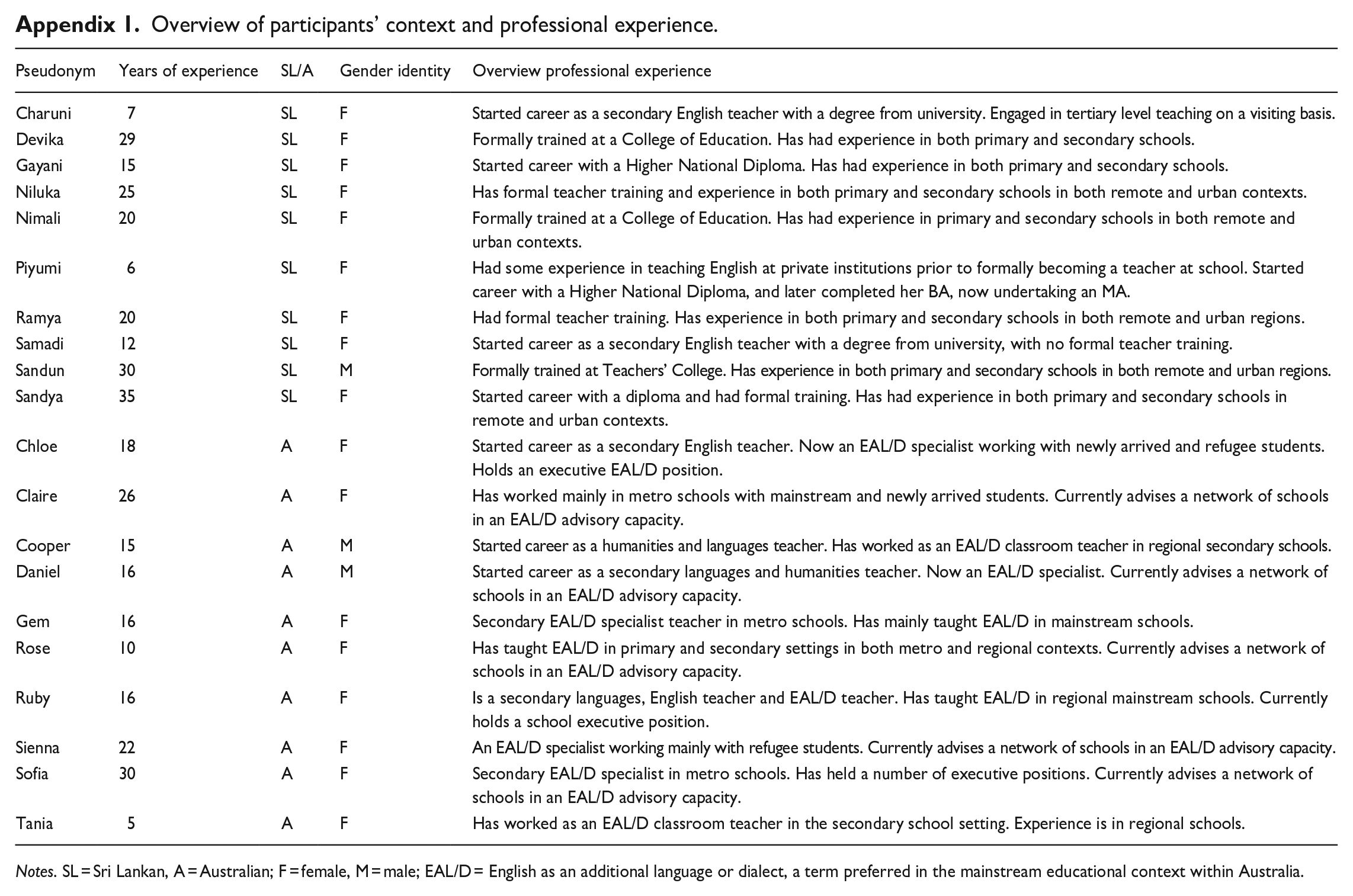
Purposeful sampling was used to recruit participants in both contexts, with all participants having at least five years of experience as an EAL teacher. To refine the scope of the participant group, those that had current experience in the secondary school sector were selected, although those who also had prior experience in other sectors (e.g. primary, tertiary, etc.) were not excluded. Participants were recruited through professional networks known to the researchers, with some subsequent snowball sampling until 10 participants from each context had been successfully recruited. Participants had a mean duration of teaching experience of 18.65 years (min. 5 and max. 35) and a variety of professional experiences (see Appendix 1). The gender distribution in our sample, comprising 17 female and 3 male teachers, aligns with broader trends in the teaching profession in both countries. In Australia, women represent approximately 76% of all teachers of EAL (Jobs and Skills Australia, 2023). In Sri Lanka, women constitute 76.2% of the teaching workforce in government schools (Department of Census and Statistics Sri Lanka, 2023). These figures support the predominance of female teachers in the profession and reflect the representativeness of our sample. Prior to commencing the research, ethical clearance from the authors’ institutional Human Research Ethics Committee (reference HE23-054) was received signaling compliance with the Australian National Statement on Ethical Conduct in Human Research. All participants received detailed information about the research in writing, provided their informed recorded consent to participate and were assigned pseudonyms.
2 Questionnaire instrument
A questionnaire was developed based on the three key domains of personal experience, professional context and external political environment (Mockler, 2011). The questionnaire comprised of 12 core questions (four from each domain), along with an initial question aimed at gathering basic information about professional experience as well as a final question that provided an opportunity for participants to add any additional ideas or thoughts (see supplemental material). Core questions elicited participants’ perspectives about the degree to which various factors had influenced their professional identity as an EAL teacher. See Figure 1.
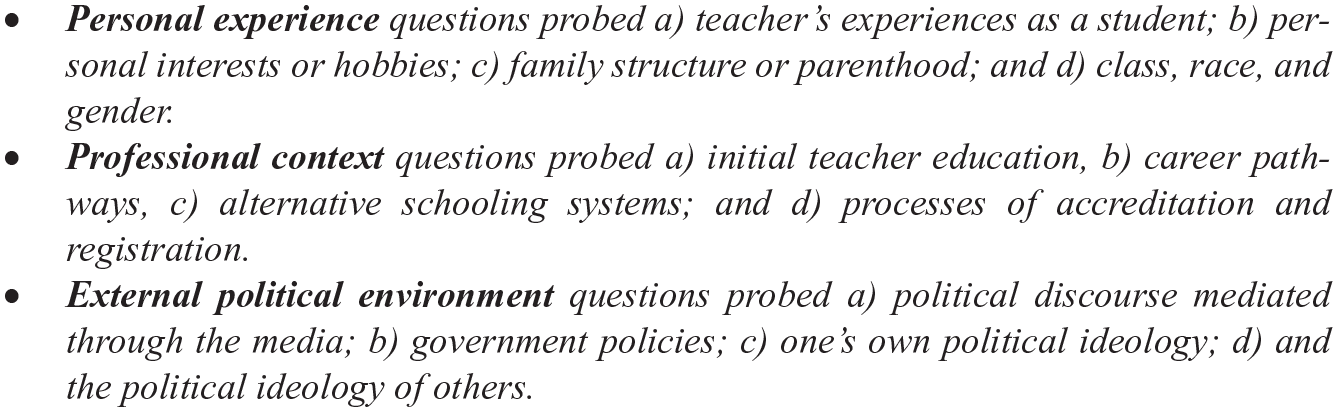
Overview of sub-questions from three key domains.
3 Procedures
All the interviews with Sri Lankan and Australian participants were conducted in English between one interviewer and one interviewee via videoconferencing (i.e. Zoom), which allowed the sessions to be recorded. Although Sri Lankan participants were given the option to undertake the interview in either Sinhala or English, all opted for English and thus no translation was needed during or after the interview. The duration of each interview was approximately one hour. All interviews were transcribed and the corpus of interview discourse was the primary data source for the current research. The transcribed files were loaded into the software package NVivo, enabling systematic qualitative analysis.
In this study, the researchers’ roles and backgrounds were integral to the data collection process. The interviews were conducted by the third and fourth authors of the current research: a Sri Lankan educator with extensive experience in EAL teaching and learning within Sri Lanka, and an Australian educator with comparable experience within Australia. Each researcher acted as a cultural insider, enabling them to conduct the semi-structured interviews in a culturally responsive manner suited to their respective participants. This cultural alignment helped establish rapport and facilitated a deeper exploration of the participants’ professional identities. To ensure reflexivity, the research team engaged in ongoing cross-cultural dialogue, discussing and accounting for potential biases, preconceptions, and culturally bound perspectives. As noted by Consoli (2021), high levels of researcher reflexivity can be established through systematic reflexive practice, resulting in enhanced rigor in qualitative analysis. These peer discussions and cross-checked interpretations served to enhance the comparability of teacher discourse elicited from the two contexts, promoting balanced and culturally nuanced insights into the data.
4 Analysis
Thematic analysis of this discourse was undertaken with reference to the recommendations of Braun and Clarke (2019) and Saldaña (2021). The first author of the current research was the primary coder of the data, with other members of the authorship team acting as ‘critical friends’ during the coding process. An inductive approach was applied with explicit meanings at the phrase, sentence, and group of sentences level categorized according to shared semantic attributes. The process of coding was iterative and included an initial process of repeated reading of the transcripts to develop a preliminary level of familiarity with the data. Once the researchers were orientated to the data, themes within the data were identified. Analysis not only identified themes that participants believed had influenced their professional identity, but also included themes that some participants did not perceive as being influential.
The theoretical position of the analysis was underscored by Mockler’s (2011) argument that teacher identity is a multifaceted construct shaped by ongoing interactions among personal experience, professional demands, and external societal (i.e. political) influences. These three categories provided an overarching a priori framework that structured the thematic analysis. Within this framework, Butler’s (1993) Theory of Identity Formation further informed the analysis. Butler conceptualizes identity as performative, emphasizing that it is continually ‘reconstituted’ through interactions with others and the self. The analysis also drew on sociological perspectives on identity formation (e.g. Bernstein, 1996; Wenger, 1998), which highlight the role of social interactions and community in shaping identity. These theoretical underpinnings provide a rationale for the use of teacher interviews as a data source for capturing the dynamic, relational and socially embedded nature of teacher identity.
V Findings
Table 1 presents the nine themes identified from participants’ discourse as influential in the development of EAL teacher professional identity. From the nine themes identified, two of these were determined by select teachers from each context as being of no or little influence on the development of their professional identity. Table 1 presents the degree to which the themes were distributed across the data set and shows the relative frequency of occurrence of themes across the files (i.e. the 20 text files containing participants’ transcribed interviews) and the number of references coded as each theme. Heat mapping shows the relative number of files with a given theme present within it and the frequency of occurrence of references that were coded as a given theme. For example, the theme of ‘principled teaching’ occurred in all 20 files and across the corpus, there were 121 instances of discourse (references) coded as this theme.
Number of files containing themes and total references coded to themes.
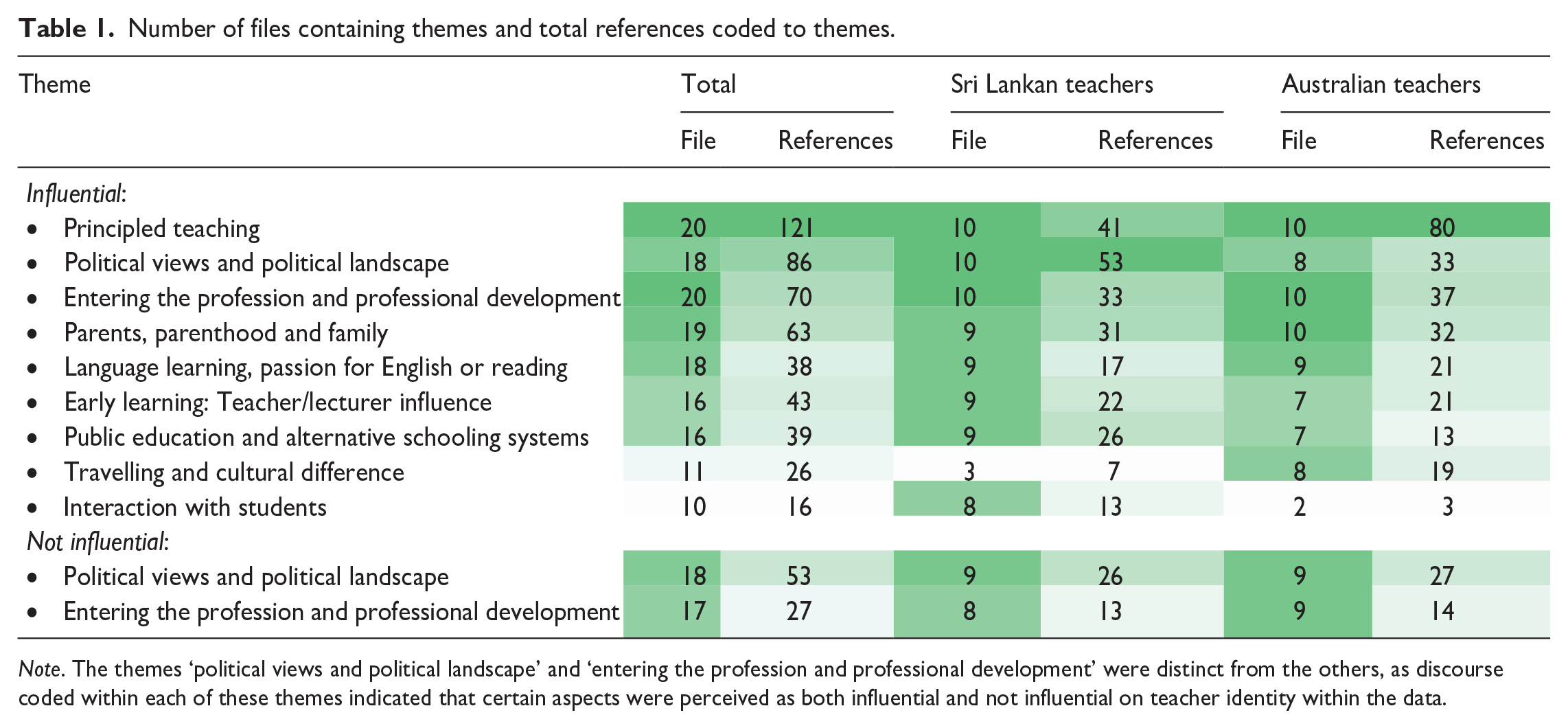
Note. The themes ‘political views and political landscape’ and ‘entering the profession and professional development’ were distinct from the others, as discourse coded within each of these themes indicated that certain aspects were perceived as both influential and not influential on teacher identity within the data.
What follows is an integrated response to research question 1 and research question 2 that entails a definition of the theme and the presentation of quotes from both Sri Lankan teachers (SLT) and Australian teachers (AT) that exemplifies how each theme has been manifested across and within the two contexts.
1 Principled teaching
This theme revolves around the commitment of educators to fostering equity, empowerment, and holistic development in their students. It emphasizes the role of teachers not just as educators, but as advocates and facilitators of social change, especially for marginalized communities (e.g. refugees, asylum seekers, those living in rural regions). References to equity were a recurring element of the quotes categorized within the theme of principled teaching for both Sri Lankan teachers (SLT) and Australian teachers (AT).
You believe that everybody should be treated fairly and equally and you believe that there should not be such a gap between teachers and children. (Sandya, SLT) It just comes back to that idea of equity. And yeah, that every person has a right to . . . the amount of support that they need and . . . that they deserve to be respected and yeah, just to access education. (Rose, AT)
Teacher’s own ideological positions were evident as factors that influenced their professional identity.
. . . from this ideology . . . education should be not just of quality, but it’s equitable, not equal per se, but equitable. (Claire, AT) When [a] child is hungry even Lord Buddha said, if your tummy is empty, you can’t learn anything . . . First, we have to cater their needs, hunger first, then the study. So . . . almost all the teachers I have [met] through schools were very nice, right. They . . . even give their lunch packets to the students. (Nimali, SLT)
The influence of principled teaching extended to crucial professional decisions such as where to teach.
I think as well, my own, my early teaching, I was teaching in a school in a low socioeconomic area. And I specifically chose that school because even when I started, to me, education was power and education was a way out for a lot of these students that I was teaching in my early years for them to go on to, you know, be able to get jobs and to take them out of some situations. (Chloe, AT)
Students who had come to Australia as refugees or asylum seekers were a recurring reference in Australian teachers’ discourse categorized within the theme of principled teaching.
Yeah, I think, working specifically with refugee students for the majority of my EAL/D teaching has influenced my professional identity because it’s made me more empathetic towards students of refugee status and . . . difficulties that they face with schooling. (Tania, AT) Seeing the plight of asylum seekers in this country has been also something that I’m pretty passionate about and feel like we need to look at the social justice side of it. So that’s influenced me and my identity as a language teacher. (Sofia, AT)
Refugees and asylum seekers did not feature in the Sri Lankan teachers’ discourse around principled teaching; however, the perceived disadvantage of learners from rural regions was salient.
So I wanted to make these students, even though they are in a rural area, [understand that] there is no rule that they should remain in the same place . . . that they can go out of that environment . . . they can get . . . the same fairy tale life of the students in [an] international school . . . if I push them . . . (Devika, SLT) But I’m really happy to work with those children. I think they need our support. Then we should help those types of children to improve because they are coming from rural families. (Samadi, SLT)
2 Political views and political landscape
This theme explores how the political environment and the political views of oneself and of others can influence teachers’ professional identities, teaching practices, and perceptions of their roles. It is important to note that this theme emerged as distinct from other themes (except one other: entering the profession and professional development), with discourse coded within it deemed alternately influential and non-influential on teacher identity. For example, some discourse categorized within this theme highlighted the impact of government policies, media portrayal, and broader political discourse on the education system and teachers’ morale.
Yeah, as a teacher, I think that [the] prevailing political situation of Sri Lanka is very bad. Politicians are not concerned much about the citizens of Sri Lanka. So, people cannot find their day-to-day necessaries because [of] the rising of cost of living. They are unable to find their food so they do not pay attention to the education of their children. Yeah, they are unable to fulfil the needs of their children. So, the prevailing situation has much influence on the education system in Sri Lanka. (Niluka, SLT) In terms of teaching English as an additional language, you know that, I think you can feel at times more valued or less valued depending on the political landscape . . . That all has an impact on how you see yourself and your role in shaping a society. (Gem, AT)
Political views conveyed through media were reported as having an impact on teacher identity.
I have seen that media . . . highlight . . . a teacher should be like this and like that . . . the typical role of the teacher. Basically, a teacher that is going against that particular [political] party is going against . . . ethics. (Devika, SLT) I know that particular announcements that have been made through the media like in the past about teachers and their roles definitely makes to kind of feel, like, you know, just like a little pawn . . . like kind of insignificant . . . I’ll just move you around and do whatever we want and you’ll find out about it later. (Rose, AT)
As presented above, discourse categorized under the theme of political views and political landscape highlighted the significant influence of factors such as policies and politicized portrayal of education in the media on teacher identity development. However, discourse categorized under this theme also made clear that several teachers also perceived political views and the prevailing political landscape as being of limited or no influence on their professional identities. Many teachers expressed a conscious effort to separate their teaching practice from political discourse.
I don’t think that influences my identity as a language teacher. I don’t think it plays a part in that really at all . . . I don’t feel like it’s . . . has any influence on me really in my day-to-day teaching or how I identify myself. (Chloe, AT) No, I don’t care what happens. The thing is, I don’t like the politics . . . I’m doing my teaching. That’s my way. These [policies], we can’t correct them, right? We tried our best, but we couldn’t do anything. So, no, I don’t care. (Charuni, SLT)
Some teachers acknowledged the presence of diverse political views among colleagues and in the broader society but maintained that these views did not significantly influence their own teaching identity.
. . . I’m always respectful of where people are at in terms of, you know, their beliefs, their values . . . But otherwise I would say not really maybe to some extent, but you know generally no. (Clair, AT)
Several Australian teachers felt that government policies and political ideologies did not play a significant role in shaping their identity as language teachers. They viewed these aspects as background factors rather than central influences.
When you’re talking about your identity and how you feel about your job and your purpose I don’t think the government policy really impacts . . . how I feel about it. (Rose, AT) No, I think it’s had an influence on me personally as a human being, but I actually just got to ignore that stuff and do what I need to do in the classroom. So that’s kind of external to my practice or who I think I am as a language teacher. (Gem, AT)
Several teachers indicated that the constructs of class, race and gender did not impart an influence on their professional identities: I can’t say it influenced me directly . . . (Sandun, SLT) No, I don’t believe class had anything to do with it. (Claire, AT) . . . gender and race, I do not think that [they] are very important to shape a language teacher. (Niluka, SLT) I try not to bring politics at any type into the classroom . . . my experience and my skills define me as a teacher, not things like class, race, and gender. (Cooper, AT)
However, in both the Sri Lankan and Australian contexts, it was apparent that constructs such as gender had been influential. For example, teachers reported gender as influencing how teachers were perceived and treated in the classroom, with female teachers often facing unique challenges in maintaining authority in the classroom, especially in mixed-gender or male-dominated settings.
So I had to do my prac at [a metropolitan school], which was pretty rough in those days and that was pretty overwhelming as a young female dealing with classes of these rough kids. So maybe that’s where gender influences . . . comes into it there. (Sofia, AT) But, disciplinary problems or things like that, especially when I was dealing with the boys. So I felt that it was better if I could be a male teacher because they just they come to their job and they do it very easily. That [matter] affected my career as we were at the very beginning . . . it shaped . . . my personality as a teacher as well. (Devika, SLT)
Multiple Australian teachers reflected on the interplay of class, race and gender in the dynamics of the classroom.
I think it has, being a white middle class female I’ve had a lot of privileges and, it’s made me realize that when teaching kids not of the same background that there’s a lot of, understanding gaps. (Tania, AT) I am quite conscious of being – particularly for our students – a white middle-class middle-aged woman telling them what they can and can’t do and I am quite conscious of that. (Chloe, AT)
3 Entering the profession and professional development
This theme encompasses the culmination of experiences that teachers accrue from the initial stages of their careers to their ongoing professional growth including formal education, practical training, mentorship, further studies, and continuous learning opportunities that shape their identities as educators. As with ‘political views and political landscape’, this theme emerged as distinct from the others, with discourse coded within it perceived as alternately influential and non-influential on teacher identity. For example, several teachers made clear that the modes of professional development that they had engaged with had strongly influenced the development of their professional identities. For example, teachers from both Sri Lanka and Australia made clear that their initial teacher training had been influential.
Both the theories and also the methodologies . . . it was very useful for teaching so that we learned these theories and, psychology, and even the methodology part. So I didn’t have a very clear idea about it. Once I learned these theories and knew, I started to think in a different way and started teaching in a different way. (Ramya, SLT)
Teachers, such as Ruby (AT), similarly asserted the value of initial teacher education on the development of their professional identity indicating that such training was a useful mechanism to focus existing relevant personal knowledge and experience into the language teaching professional domain.
. . . initial teacher education training, it’s sort of compliments, you know what you might already have going on in terms of . . . the personal kind of context stuff. So, you know, I’ve . . . had all the, you know, this cultural experiences, I’ve learned a language myself all that kind of stuff. And then to complement all of that you’ve got the initial teacher education training which is [the] mechanics of how do you do it like what is the pedagogy that kind of stuff. So, I would say definitely, initial teacher education has helped shape my identity. (Ruby, AT)
Sandun (SLT) made clear their position on the importance of initial teacher training in identity development: . . . [If] you are not trained properly, you don’t know how to teach in the classroom. We go there and start lecturing, not teaching. So, once you get the teacher training you become somewhat confident how to teach. That is the most important part. Because if you don’t know how to teach, there will be so many problems in the class.
Although not salient in the Sri Lankan teachers’ discourse, several of the Australian teachers referred to the role of higher degree study as being important to the development of their professional identity.
I think my further studies has had a massive impact on my identity as a language teacher. Definitely over the last, you know, 3 to 4 years. I did the TESOL qualification and then a . . . Masters in Applied Linguistics, but I think that has had the most impact actually on my identity, and reading current articles about teaching language . . . and looking at current theories about teaching language as well. (Chloe, AT)
As overviewed above, discourse categorized under the theme of entering the profession and professional development highlighted the significant influence of factors like initial teacher training on the development of professional identity. However, it was evident that factors categorized under this theme were also perceived by some teachers as being of limited or no influence on their professional identity as EAL teachers. Among the Australian teachers this was largely associated with dissatisfaction around the theoretical aspects of initial teacher training (with a preference for practical experience) and criticisms of what was perceived as an overly bureaucratic accreditation process.
Gem (AT) asserted that initial teacher education provided a useful foundation, but did not influence their professional identity per se.
Obviously my initial teacher education was really important in grounding me to where I am now. I think it gave me a baseline to figure out what my professional identity could be, but, I think I grew into my professional identity using that initial teacher education, I don’t think that that education itself actually formed the identity that I wanted to have. (Gem, AT)
Other teachers were more critical of the limited impact of aspects of their initial teacher training on their professional identity.
I remember just feeling like in university that none of the things that I learned at university actually applied to the classroom. You know, like practically. And that the lecturers had been in university for so long that they were kind of disconnected, almost like, you know, a principal when the principal comes in and says, oh, you know, you should be doing this, this and this. Well you think, okay, will you show me how it’s done? (Rose, AT)
A recurring sentiment among teachers was that the practical components (‘practicum’, colloquially referred to in the Australian context as ‘prac’) were far more impactful on the development of their professional identities than were the more theoretical aspects of initial teacher training.
I felt that learning on the ground was the only way to do it. So, I gained much more out of my pracs than I did, I think out of my I guess the more bookish learning that went into my teacher training. To be honest, I can’t really think of too many things that I learned in my teaching degree per se that I took into the classroom but I remember very clearly a lot of the lessons from my pracs. (Cooper, AT)
Among the Sri Lankan teachers it was noted that although some aspects of the initial teacher training strongly influenced their professional identity, aspects of recruitment were often viewed as of limited impact.
. . . the recruitment process in Sri Lanka is quite useless. I’m telling it directly because we had to do a general test . . . to become an English teacher . . . we had to face a test and sit for an examination. It was about some general knowledge questions and nothing related to English. I don’t know how . . . it was in Sinhala. (Devika, SLT) . . . the recruitment processes are not very fair. I think sometimes the graduated teachers are recruited to the education system . . . sometimes they don’t know how to teach. (Niluka, SRT)
Some Australian teachers were similarly critical of the ongoing accreditation processes that they needed to engage with and made clear that they thought these had a limited influence on their professional identities. Teachers in Australia must gain and maintain accreditation with their respective state teacher accreditation authority. Teacher accreditation is informed by the Australian Professional Standards for Teachers which describe what teaching practice looks like at different career stages (AITSL, 2022). Teachers are required to maintain their accreditation by completing an average of 20 hours of professional learning each year.
However, I don’t think the maintenance and accreditation process . . . does anything in that way, I think to be honest it’s more of just a bureaucratic box check. (Daniel, AT)
4 Parents, parenthood and family
Discourse categorized under this theme highlights the profound influence that family members, particularly parents, and the experience of parenthood has had on individuals’ professional identities and career choices as teachers. Within this theme, factors such as family values, parental professions, and childhood experiences shaped teachers’ teaching philosophies, career decisions, and educational practices. The theme also addresses how becoming a parent can impact one’s approach to teaching, in particular fostering empathy, patience, and a deeper understanding of students’ needs.
Among both the Sri Lankan and Australian teachers it became clear that many of the participants of the study had parents or other family members that were teachers themselves and that this was a strong influence on becoming a teacher and identity formation.
Yes, in our home my mother was a teacher and my father was also a principal. So that influence affected me a lot to become a teacher. (Gayani, SLT) My mother was an English teacher. And so I think that that has influenced me, to a certain extent as well. (Chloe, AT) . . . My, whole family. Right, grandmother, my mother . . . my father was the principal of the teacher training college. So, they all had that teaching in their blood. So that came to us also. (Nimali, SLT) Yes, so this may be subconscious, but . . . my mother was an English teacher and a science teacher, and I remember you know, going into her classroom because she would sometimes take me to her classrooms when I was little . . . (Claire, AT)
Parenthood was also noted as being an important factor that has shaped the professional identity of the teachers.
. . . having a family of my own has been quite a significant factor. I think having children of your own heightens your awareness of what they’re going to be exposed to in a classroom one day. (Gem, AT) . . . the experience I get from my students – when I combine everything – the family context and the parenthood . . . It affects a person to a larger extent than we think. (Devika, SRT)
5 Language learning, passion for English or reading
This theme encompasses the experiences, motivations, and personal interests that drove teachers to learn languages, engage in reading and develop a passion for the English language. Discourse categorized under this theme highlights the influence that intrinsic motivation to engage with languages and language learning had on English language teachers’ identities in both Sri Lanka and Australia. Many teachers recall early experiences with reading, which sparked their passion for English.
So, . . . I started reading books . . . especially the novels. So, it gave me a lot of opportunities to correct my mistakes as well as so many things about English. So it was the starting point . . . actually, we did not know so much English in those days, but it gave us a starting touch . . . (Sandun, SLT) I love learning about the world and I’m a very avid reader and you know, I love reading all sorts of literature. (Ruby, AT) I love to read. Yes, I love to read . . . I started reading like fairy tales most of the Sinhala fairy tales, the Sinhala books. I think by the time I moved on to reading English books . . . that’s how I entered the field of English literature. (Devika, SLT)
With immigrant parents of non-English speaking background, reading and language learning had particular relevance for Gem in relation to the development of their identity as an EAL teacher.
So to compensate for the fact that my parents couldn’t teach me English they purchased a lot of books for me to read. So I became a really avid reader as a child and I think that that has definitely . . . helped me to understand patterns in language and the way that sentences are structured and organized. (Gem, AT)
Teachers also made clear that the process of learning a language had been a valuable mode of personal development that has impacted on their professional identity and teaching practice. Among the Sri Lankan teachers this language learning related to their own development of English language proficiency, but in relation to most Australian teachers it related to a general interest in learning languages other than English.
The extracurricular activities that I have engaged in are very helpful to shape my teaching career as a language teacher. I strongly believe that listening to songs and listening to the news [in English] . . . were very supportive to me to improve my language skills. (Niluka, SLT) I like to watch English movies . . . I give these examples to my students even. You can improve your English by watching more English movies and listening to English songs. (Gayani, SLT) I am very interested in language in general. So I have learned a few different languages and I read, you know, really nerdy books about how language develops and things like that. And all the different parts of the English language, which are crazy. And so yes, I guess that’s an interest of mine and it has made me more invested in the theory and the pedagogy behind teaching language. (Rose, AT) I like writing in the sense, like, diary entries. I really loved writing diary entries because when I was 14 or 15 years old, I really wanted to keep a diary. But I couldn’t take it to the school or anywhere else, but it was my hobby. I wanted to write in my diary in a way that my mother couldn’t easily understand. So, I started to write it in English. (Devika, SLT) So . . . I was learning Spanish . . . and I was doing German . . . so I was always really aware of language and I loved English as well and just reading and writing and I think that love of language and understanding how it is, how you think differently in different languages and how you have to translate across and all of that has really . . . formed quite a part of my identity I think. (Sofia, AT)
6 Early learning: Teacher/lecturer influence
Discourse categorized under this theme related to how early educational experiences and interactions with influential teachers and lecturers shaped the identities of the language teachers. Teachers made clear that both positive and negative experiences with teachers and the educational system influenced teachers’ identities and their roles as educators. On the one hand, positive experiences often led to the adoption of practices teachers perceived as being supportive and pedagogically sound.
My experiences as a learner have definitely informed my practice as a teacher. I now practice my teaching in a way that never brings shame upon the learner. (Sienna, AT) They didn’t punish us. Whenever we spoke in English, they motivated us. I remember one teacher . . . She encouraged us to speak in English whenever possible. So, it was one of my experiences which I will not forget in my life. So, it was actually the foundation for me to start speaking English. (Sandun, SLT)
On the other hand, prior negative experiences appeared to have raised teachers’ awareness around less than optimal pedagogical approaches that they actively avoided.
As a language teacher, I have identified that there are many wrong things that our school teachers did at the school. As a teacher, I’m very careful when explaining things. I’m very careful to explain things to students and try to recognize their situations. In my school days, I was a very innocent and silent child. So, there was favouritism also. As a teacher, I’m very careful about those things. (Charuni, SLT) I had this one teacher who, just expected us to rote learn things. So, you know, we did a spelling test . . . and I couldn’t spell the word knife. I just didn’t understand . . . you know, silent k . . . I felt that she had never explained it explicitly to me . . . I just couldn’t pick that up and I remember her screaming at me one day . . . and I was crying . . . and I just remember thinking like I don’t understand how this can possibly be the best schooling system. (Gem, AT) It shaped in, both, you know, the good experiences and the bad experiences. So the [negative] things I experienced, I think I should never pass this experience to my students because sometimes it hurt me a lot. (Piyumi, SLT)
7 Public education and alternative schooling systems
This theme explores the diverse experiences and perceptions of teachers regarding public education and alternative schooling systems, such as private, religious, international, and government schools. It highlights the differences in educational philosophies, student demographics, resource availability, and teaching approaches across various systems. Among the Australian teachers, there was a noted link between the perceived ethos of public schooling and professional identity.
The public purpose of education, that moral imperative, especially of public education, is for me really tied up with being a languages teacher because it’s all about access that’s such an important goal and that’s definitely the foundation, I think of my identity, as a teacher and as a languages teacher for sure. (Ruby, AT)
For both Sri Lankan and Australian teachers, the nature of each schooling system was influential on identity development and how teaching was enacted.
I think . . . the need to move the kids through the IEC [intensive English centre
2
] so fast, I feel like that’s had influence on the development of my identity. Because it’s made me need to prioritize things very specifically and be a bit more organized and structured in what needs to be taught. (Tania, AT) Now [in government schools] we don’t have the freedom to teach the children as we want. When I teach in my private class, I think it’s more effective because I have much freedom but, in [government schools] schools, there are so many officers above us and they tell [us to] do this in this term – you have to cover this. You can’t do anything else. We don’t have the freedom to teach as we want . . . because the methodologies are different from one teacher to another, I think. (Samadi, SLT)
Among Sri Lankan teachers, the experience of teaching in remote schools and the stark difference between rural and metropolitan schools was noted as an important factor in the way teaching was enacted and understood.
First I taught in a remote school. There were no facilities at all. So, we had to take more effort to give the student what [they] needed . . . (Sandya, SLT) Definitely, for those [rural schools] . . . actually I had to create new methods. For example, if I am going to use my grammar lesson, I use my fingers to teach them. So likewise, they did not have books in the school library, especially English. So, I had to get [the students] to read. So, I created a new method. I put the stories in the form of a fan . . . and, asked them to read those books. Those books were very famous in that school those days. (Sandun, SLT) Yeah, when I was teaching in [a rural location], I had to find my place, and take a lot of visual aids, because they didn’t have that . . . So I had to take pictures of . . . [the] sea, robots and everything. (Nimali, SLT)
Among Sri Lankan teachers, it was also noted that working in remote schools did not have the same perceived professional development impact than did teaching in more well-resourced metropolitan schools.
When we were working in remote areas, it did not have much influence on our development as a language teacher. We have to work in a limited area because the students’ knowledge was not very good therefore, actually as teachers we also don’t need much knowledge to teach them, but now at present as we are working in these urban areas. Actually we have to update ourselves. (Ramya, SLT)
8 Travelling and cultural difference
This theme encompassed the influence of travel and exposure to different cultures on EAL teachers’ professional identities and teaching practices. Discourse categorized under this theme highlights that travelling and engaging with cultural difference broaden teachers’ worldviews, enriched their understanding of cultural nuances, and enhanced their ability to connect with and support diverse student populations.
And, you know, I think embracing other cultures. I would say, you know, one of another hobby would be travelling and going to other cultures and, really getting to know and appreciate other cultures and other ways of thinking and seeing and I think that has definitely had something to do with where I have ended up. (Chloe, AT) Because every year, most of the years, I got a chance to go to England and they visit here . . . I wrote many letters to them and they sent me letters because I wanted to express my feelings, my ideas to them and I wanted to study English. (Samadi, SLT) And then I lived overseas and that experience probably, made me more interested in just language and culture in general. So that’s why I then retrained to become an EAL/D teacher. (Rose, AT) I had a pen pal. She’s from Australia, we are still writing. And, that was the beginning of it. She is one of the influences who taught me English. (Sandun, SLT)
9 Interaction with students
This theme encompasses how educators interact with their students, focusing on the strategies, relationships, and dynamics that influence teaching and learning. It covers both positive and negative interactions and examines how these interactions shape teachers’ professional identities and practices.
When I picked up the EAL/D classes, they saw me as a surrogate mother to them . . . it kind of became like I was a proxy mother to them. (Gem, AT) They personally told me that ‘teacher we want to talk like you. Teacher we want to speak English like you’. So those things – they inspired me, they motivated me. (Devika, SLT) They want to be closer to us and I think it’s one way of teaching them in an influential way. We should not be tough for them. They like to learn in a very friendly environment. (Ramya, SLT) There is no gap between my students and myself. There is no big gap. (Sandya, SLT)
VI Discussion
The current study presents a snapshot of the commonalities (and differences) of the attributes of EAL teacher professional identity of teachers working in the Sri Lankan and Australian contexts. The nine themes that were identified within the discourse of both Sri Lankan and Australian teachers provide one perspective on how personal experiences, professional contexts, and external political environments influence EAL teacher identity. These findings build on previous work that describe the various influences of personal, professional and political domains on language teacher identity (Farrell & Ives, 2015; Herath, 2015; Liu & Xu, 2011; Varghese et al., 2005). The three domains provided a useful framework to elicit data valuable for cross-contextual comparison, which speaks to the utility of Mockler’s (2011) three-part framework in future related work.
The theme of principled teaching emerged as a core factor shaping teacher identities in both contexts. For Sri Lankan teachers, principled teaching was often linked to addressing the needs of students in rural or underprivileged areas, reflecting a commitment to equity and social justice (Boylan & Woolsey, 2015). Australian teachers also highlighted equity as a key aspect of their professional identity, but this was often framed within the contexts of supporting refugee students or the ethos of public schools. There was significant crossover between discourse categorized as principled teaching and discourse categorized as relating to political views and political landscape. In relation to the political domain and its impact on professional identity, there was a noted commonality between teachers from both contexts. On the one hand, there was an acknowledgement of the impact of political environments and policies on teacher identity. On the other hand, however, there was a conscious effort articulated by participants from both contexts to keep politics out of the classroom. While teachers acknowledge the intricate relationship between the socio-political context and their developing professional identities, their desire to put politics aside from the classroom may be indicative of a need to protect the perceived neutrality and focus of their role. We concur with Kayı-Aydar (2015) who points out that individuals’ multiple identities are (re)constructed across social and political contexts. By distancing themselves from overtly political topics, teachers may feel they are better able to fulfil what they see as their primary role: to enact language practice that caters for the needs of their students.
Entering the profession and professional development was another pivotal theme, with teachers from both contexts acknowledging the role that initial teacher education had had on the development of their professional identity. This concurs with the overall argument put forth by Olsen (2016) who argues that teacher identity is largely shaped by the conflation of experiences along with the socio-cultural influences that contribute to their profession and professional development. Although influential for some, it is noted that aspects of entering the profession were indicated by several teachers as being of little or no influence on their professional identities. Among the Australian teachers, criticism was leveled at the theoretical aspects of initial teacher education, with more influence reported in relation to practical teaching experiences in the early phases of their teaching career. Some Australian teachers were also critical of the ongoing accreditation processes that they needed to engage with, citing these as somewhat bureaucratic and of little influence on their professional identity. Among the Sri Lankan teachers, criticism was leveled at the mechanism of recruitment to the teaching profession, with some asserting that these mechanisms were inappropriate or unjust.
The theme of ‘parents, parenthood, and family’ highlights the profound influences of personal factors on teacher identity. Many teachers reported that their parents’ and close family members’ professions as teachers was a significant influence on their choice to become teachers and their identities as teachers. The experience of parenthood was also noted by participants from both contexts as enhancing empathy, patience and understanding of their students. Another important theme for teachers from both contexts was ‘language learning, passion for English or reading’. Many of the participants were avid readers and this was an important catalyst in the development of their teaching careers and subsequent professional identities. The lived experience of language learning was also an important factor. Among the Sri Lankan teachers, this revolved around the events in their lives that made learning the English language accessible and enjoyable. Among Australian teachers, the lived experience of learning a language other than English was key in understanding the mechanisms of language learning as well as a way to more clearly understand the implications of the cultural-linguistic challenges experienced by students (Ellis, 2013). Similarly, the theme of travelling and cultural difference made clear that exposure to different geographical regions through travel and interaction with ‘the cultural other’ influenced teachers’ professional identities and enhanced appreciation of approaches to language teaching that were viewed as pedagogically sound and culturally appropriate.
Early learning teacher/lecturer influence was another significant theme, with participants recalling both positive and negative experiences with their own teachers. Positive role models and supportive educational environments were influential, as were negative experiences, which often motivated teachers to adopt more empathetic teaching practices. The theme of public education and alternative schooling systems highlighted differences in educational philosophies and resource availability across various systems. Among Sri Lankan teachers there were salient references to the perceived lack of privilege among students in remote and rural government schools. Among Australian teachers there was a strong affinity to government schools in association with the public education ethos of equity and access to education. Finally, interaction with students was a theme that made clear that positive, but also challenging teacher–student interactions were of significance and had a noted impact on teachers’ professional identities.
While this study offers valuable insights into EAL teacher identity within the specific contexts of Sri Lanka and Australia, it is essential to acknowledge its limitations and consider broader implications. This is just one subjective cross-sectional interpretation of the factors that were common to the Sri Lankan and Australian participants involved in the current research. The comparative approach used here could be extended to other regions and continents where EAL plays a significant role in education and society. English’s status as a global lingua franca underscores the importance of understanding how EAL teacher professional identity is shaped by diverse socio-political, cultural, and educational contexts. Future research that explores these dynamics across a wider range of settings is encouraged, as such work holds potential to more fully map out the universal and context-specific factors that influence EAL teacher identity. Such studies could contribute to the development of more globally informed teacher education programs, ultimately supporting the diverse needs of EAL teachers in an increasingly interconnected world. Where possible, employing longitudinal research approaches that can track teacher professional identity development over time would be of strong benefit to the field of EAL initial teacher education (e.g. Barkhuizen, 2016; Farrell & Ives, 2015; Hahl & Mikulec, 2018). There is also benefit in future research exploring the professional identities of EAL teachers in tertiary education and other specialized contexts. The current study focused on secondary school teachers, but the increasing trend of pursuing higher education suggests that tertiary sector language teachers represent a growing demographic whose professional identities merit examination. These teachers often operate in environments where English is taught as a compulsory subject for academic purposes or as an elective for personal or professional development. Exploring their professional identities may uncover unique influences that differ from those experienced by school-level teachers.
Our study, and future studies like it, may also hold value for the management and leadership of EAL educational institutions. School and institute leaders who better understand the factors influencing EAL teacher identity may be better positioned to facilitate supportive environments. Such understanding could inform leadership approaches that provide tailored professional development opportunities and promote a workplace culture that values and nurtures teacher identity. By recognizing and addressing the factors that shape EAL teacher identity, leaders may enhance institutional effectiveness by fostering robust professional identities among EAL teachers, ultimately contributing to improved outcomes for EAL students.
VII Conclusions
This study contributes to the understanding of EAL teacher professional identity by providing an analysis of teachers operating in two vastly different contexts. The findings provide an example of how personal, professional, and political factors play a role in shaping language teacher identities. Key themes such as principled teaching, political influences, professional development, family influence and language learning, among others, were evident in the discourse of teachers from both contexts. Although these themes were sometimes manifested differently in the two contexts, the common themes provide a useful framework that is likely to have commonalities with language teachers from other contexts also. The current study’s comparative approach offers insights for language teacher education, particularly in initial teacher education where early career teachers are likely to benefit from reflection upon their own and others’ language teaching identity and the factors that have influenced that identity. By understanding the factors that influence the development of teacher identity, initial teacher education programs can better support teachers in their professional growth. For example, aspiring teachers and early career teachers may find benefit in asking themselves and one another the same questions that the current research asked 20 experienced EAL teachers (see supplemental). We hope that such activities, along with the insights that can be gleaned from the current research are useful to EAL teachers, especially those at the beginning of their careers.
Supplemental Material
sj-docx-1-ltr-10.1177_13621688251317247 – Supplemental material for Mapping professional identities of teachers of English as an additional language from Sri Lanka and Australia: Identifying commonalities across contexts
Supplemental material, sj-docx-1-ltr-10.1177_13621688251317247 for Mapping professional identities of teachers of English as an additional language from Sri Lanka and Australia: Identifying commonalities across contexts by Joshua Matthews, Leonardo Veliz, Ruwan Gunawardane and David Partridge in Language Teaching Research
Footnotes
Appendix
Overview of participants’ context and professional experience.
| Pseudonym | Years of experience | SL/A | Gender |
Overview professional experience |
|---|---|---|---|---|
| Charuni | 7 | SL | F | Started career as a secondary English teacher with a degree from university. Engaged in tertiary level teaching on a visiting basis. |
| Devika | 29 | SL | F | Formally trained at a College of Education. Has had experience in both primary and secondary schools. |
| Gayani | 15 | SL | F | Started career with a Higher National Diploma. Has had experience in both primary and secondary schools. |
| Niluka | 25 | SL | F | Has formal teacher training and experience in both primary and secondary schools in both remote and urban contexts. |
| Nimali | 20 | SL | F | Formally trained at a College of Education. Has had experience in primary and secondary schools in both remote and urban contexts. |
| Piyumi | 6 | SL | F | Had some experience in teaching English at private institutions prior to formally becoming a teacher at school. Started career with a Higher National Diploma, and later completed her BA, now undertaking an MA. |
| Ramya | 20 | SL | F | Had formal teacher training. Has experience in both primary and secondary schools in both remote and urban regions. |
| Samadi | 12 | SL | F | Started career as a secondary English teacher with a degree from university, with no formal teacher training. |
| Sandun | 30 | SL | M | Formally trained at Teachers’ College. Has experience in both primary and secondary schools in both remote and urban regions. |
| Sandya | 35 | SL | F | Started career with a diploma and had formal training. Has had experience in both primary and secondary schools in remote and urban contexts. |
| Chloe | 18 | A | F | Started career as a secondary English teacher. Now an EAL/D specialist working with newly arrived and refugee students. Holds an executive EAL/D position. |
| Claire | 26 | A | F | Has worked mainly in metro schools with mainstream and newly arrived students. Currently advises a network of schools in an EAL/D advisory capacity. |
| Cooper | 15 | A | M | Started career as a humanities and languages teacher. Has worked as an EAL/D classroom teacher in regional secondary schools. |
| Daniel | 16 | A | M | Started career as a secondary languages and humanities teacher. Now an EAL/D specialist. Currently advises a network of schools in an EAL/D advisory capacity. |
| Gem | 16 | A | F | Secondary EAL/D specialist teacher in metro schools. Has mainly taught EAL/D in mainstream schools. |
| Rose | 10 | A | F | Has taught EAL/D in primary and secondary settings in both metro and regional contexts. Currently advises a network of schools in an EAL/D advisory capacity. |
| Ruby | 16 | A | F | Is a secondary languages, English teacher and EAL/D teacher. Has taught EAL/D in regional mainstream schools. Currently holds a school executive position. |
| Sienna | 22 | A | F | An EAL/D specialist working mainly with refugee students. Currently advises a network of schools in an EAL/D advisory capacity. |
| Sofia | 30 | A | F | Secondary EAL/D specialist in metro schools. Has held a number of executive positions. Currently advises a network of schools in an EAL/D advisory capacity. |
| Tania | 5 | A | F | Has worked as an EAL/D classroom teacher in the secondary school setting. Experience is in regional schools. |
Notes. SL = Sri Lankan, A = Australian; F = female, M = male; EAL/D = English as an additional language or dialect, a term preferred in the mainstream educational context within Australia.
Funding
The author(s) disclosed receipt of the following financial support for the research, authorship, and/or publication of this article: This study was made possible by the generous support of Professor Sue Gregory and Professor Jennifer Charteris by way of the University of New England, School of Education, ‘Inspire: Excellence in research and teaching’ internal fund.

Supplemental material
Supplemental material for this article is available online.
Notes
References
Supplementary Material
Please find the following supplemental material available below.
For Open Access articles published under a Creative Commons License, all supplemental material carries the same license as the article it is associated with.
For non-Open Access articles published, all supplemental material carries a non-exclusive license, and permission requests for re-use of supplemental material or any part of supplemental material shall be sent directly to the copyright owner as specified in the copyright notice associated with the article.
