



Abstract
In the field of English language teaching, the deeply entrenched dichotomy between ‘native English-speaking teachers’ (NESTs) and ‘non-native English-speaking teachers’ (NNESTs) has forcibly positioned NNESTs as linguistically and pedagogically inferior to their native counterparts. The prevalence of native-speaker ideologies marginalizes NNESTs in professional settings and impedes their agency enactment in claiming identities as competent educators. Therefore, it is crucial to facilitate English teachers (especially NNESTs) to practice agency to (re)negotiate identities to move beyond native-speaker ideologies. Framed by positioning theory, this study investigates how 12 in-service English teachers worldwide exercised agency to (re)negotiate positions throughout an innovative identity-based intervention. The intervention, implemented in three online sessions across six weeks, instigated participants’ identity reflections based on three themes: theories, pedagogy and power. Each session comprised one online seminar and one self-reflective written task. Drawing on data from the intervention and pre- and post-intervention interviews, our findings yielded three distinct identity negotiation patterns, namely active, tentative and reluctant repositioning. Participants of each pattern presented unique combinations of repositioning acts, including resisting inferior positions, selectively engaging with empowering positions, shifting back to initial positions and maintaining existing positions. Agency and positioning were found to be reciprocally informed. While agency was practised to facilitate repositioning, the agentic positions teachers undertook influenced agency enactment as well. Participants’ choices of different repositioning acts were jointly mediated by their evaluation of native-speaker ideologies’ impact on their existing positions and their power to challenge native-speakerism in their own professional settings. At a theoretical level, this article provides a conceptual framework that illustrates the interconnectedness between the intervention, teacher identity and teacher agency. At a practical level, it demonstrates the effectiveness of implementing identity-based intervention in teacher education to foster NNESTs’ repositioning and agency enactment against the backdrop of native-speakerism.
Keywords
I Introduction
The rise in human mobility and globalization has turned English into an international language used by ever-growing numbers of speakers of different first languages (L1) (Wang & Fang, 2020), races, and ethnicities. This has resulted in approximately 80% of the 15 million English teachers worldwide being speakers of English as a second or foreign language, who are often labelled as ‘non-native English-speaking teachers’ (NNEST) (Selvi, 2019). However, in the field of English language teaching (ELT), NNESTs are usually placed in a binary and antagonistic relationship with ‘native English-speaking teachers’ (NESTs) (Dewaele, 2018; Selvi et al., 2024), in which the NNESTs’ linguistic, cultural and pedagogical abilities are inspected and defined vis-à-vis their native counterparts (Selvi, 2019). This has resulted in many NNESTs being positioned as linguistically and pedagogically less competent or ideal than the NEST ‘others’ (Archanjo et al., 2019; Ershadi et al., 2024). Such perceptions are referred to as native-speaker ideologies, the prevalence and common practice of which can result in the marginalization and self-marginalization of the so-called ‘NNESTs’ (Llurda, 2016), impeding their agency in (re)negotiating and claiming identities as legitimate and competent educators.
English language teachers’ identities (LTIs) are crucial in impacting teachers’ professional development and teaching practices. LTIs mediated by native-speaker ideologies may lead to teachers’ job insecurity, self-doubt and lack of self-confidence (Llurda, 2024; Rudolph et al., 2015), further influencing their pedagogical practices (Morgan, 2004) and learners’ identities. In other words, teachers’ (perceived) non-agentic positions may, in turn, result in a lack of agency (Kayi-Aydar, 2015). Since the acknowledgement of teachers’ worth and identities must be present to prompt learning and development (Rex & Schiller, 2009), teacher educators should help NNESTs develop confidence in their professional and linguistic strengths in ELT and recognize their identity constructions against the backdrop of native-speakerism. The recognition of NNESTs’ worth and identities may help them feel empowered in agentively defining and developing themselves rather than passively accepting the positions imposed onto them.
Given the significance of LTI and agency, this article reports on an identity-based intervention designed to empower teachers of English to agentively move beyond the confined label of NNEST. Drawing on positioning theory (Davies & Harré, 1999) and the poststructuralist viewpoint of agency pinpointed by Kayi-Aydar (2019), this study aims to understand how English teachers (re)negotiate positioning during an identity-based intervention, what roles agency plays in the repositioning processes, and what factors mediate teachers’ repositioning acts.
II Literature review
1 Deconstructing native-speaker ideologies through the lens of language teacher identities
ELT is deeply entrenched in the native speaker (NS) construct, which idealizes NSs and NESTs as users and teachers with exclusive ownership of and default expertise in the English language (Canagarajah, 1999; Rudolph et al., 2015; Selvi, 2019; Widdowson, 1994). As a result, non-native speakers (NNS) and NNESTs are considered as the ‘others’ to their native counterparts (Rose et al., 2020) and, therefore, often possess less power in claiming authority and competence in using and teaching the language. Such values have been conceptualized by a string of ‘native-speaker ideologies’, including the NS fallacy (Phillipson, 1992), the centre–periphery theory (Hilgendorf, 2018a, 2018b) and native-speakerism (Holliday, 2006; Llurda & Calvet-Terré, 2024). Phillipson (1992) proposed the concept of the NS fallacy to refer to the prevalent assumption that ‘the ideal teacher of English is a NS’ (p. 185), which resulted in the ‘unethical’ treatment of qualified NNESTs (Selvi, 2011, p. 187). The centre–periphery theory was developed by Hilgendorf (2018a) to demonstrate the authority and prestige attached to ‘the centre’ of English (i.e. the NS countries), reciprocally marginalizing the diverse English users of other communities to ‘the periphery’. Furthermore, the antithesis and hierarchy between the ‘centre’ and the ‘periphery’ of English has been expanded to interpret the tensions existing between the positions of NESTs and NNESTs (Hilgendorf, 2018b). Llurda and Calvet-Terré (2024) defined native-speakerism ‘as an ideology that presents NS as the ultimate models of language use and the ideal teachers of a language, thus invalidating, discriminating, and/or underestimating NNS’ (p. 231).
In light of the continuing persistence of native-speaker ideologies, scholars have been investigating English teachers’ LTIs to deconstruct native-speaker ideologies and tackle the issues associated with the marginalization and degradation of NNESTs. LTI can be seen as language teachers’ professional and linguistic self-perceptions through their ongoing ‘social interaction’ with teachers, language learners, teacher educators, and administrators, and ‘material interaction’ with educational materials in professional scenarios (Barkhuizen, 2017, p. 4; Block, 2015; Varghese et al., 2005). In particular, scholars have adopted a poststructuralist approach to (re)investigating and (re)conceptualizing NNESTs’ LTIs against the backdrop of native-speakerism, which considers identities as situated and constantly negotiated in particular dialogical and sociohistorical contexts and rejects universal or objective truths (Aneja, 2016).
The poststructuralist perspective considers identities as sociohistorically (re)constructed at the intersection of sociocultural and sociopolitical discourses, which are inscribed with power (Foucault, 1980; Rudolph et al., 2015). This view directed attention from the sole connection between native-speaker ideologies and linguistic features to the fluid and dynamic intersections of sociopolitical features, including citizenship and race. Researchers have inspected the political statuses of inner-circle countries and other countries and elaborated the historic-political rationale for the hierarchies between NESTs and NNESTs (e.g. Aneja, 2016; Canagarajah, 1999; Flores & Aneja, 2017; Holliday, 2006, 2013). The sociopolitical stance has also instigated the discussion of the pivotal roles English teachers’ ethnicities play in ELT and, as such, the image of ‘Whiteness’ or ‘Caucasianness’ has been widely addressed as an ‘icon’ of authoritative English teaching (e.g. Jenks & Lee, 2020; Ruecker & Ives, 2015; Widodo et al., 2020).
Furthermore, researchers have destabilized the common assumptions of the fixed marginalized positions of NNESTs and the prioritized positions of NESTs and demonstrated the fluidity and dynamics of LTI (Selvi et al., 2024; Yazan & Rudolph, 2018). Since identities are dynamically and constantly (re)constructed through dialogues (Bhabha, 1987; Davies, 2000; Weedon, 1997), teachers’ NNEST identities may shift constantly along discursive engagement. In this vein, some NNESTs may actively reject the incompetent and inferior labels attached to themselves (e.g. Park, 2012; Rodriguez & Cho, 2011). Additionally, NNESTs who are typically seen as inferior may paradoxically also enjoy the native-speaker privilege of speaking native-like English (e.g. Wang & Fang, 2020) or being Caucasian (Tezgiden Cakcak, 2019). Conversely, some NESTs have also experienced not only privileges but also marginalization when they teach English overseas, on account of, for example, being deemed as lacking teaching credentials or contextual knowledge and therefore not being identified as ‘legitimate’ teachers (e.g. Choi, 2022; Howard, 2019; Jeon, 2009; Lee & Jang, 2023; Ruecker & Ives, 2015). These research outputs demonstrate that essentializing NNESTs only as suffering from marginalization and NESTs only as enjoying absolute superiority can lead to LTI stagnation. The essentialization of English teachers’ identities based on whether they are native or not can impede or even strip away their agency (Rudolph et al., 2015). To avoid essentializing or silencing NNESTs against the backdrop of native-speaker ideologies, it is important to facilitate these teachers to agentively and confidently claim their identities as English language teaching professionals.
2 Making a case for identity-based intervention to promote identity negotiation and teacher agency
Facilitating identity reflection and negotiation represents one of the mainstays of language teacher education; as Singh and Richards (2006) articulated, ‘teacher-learning involves not only discovering more about the skills and knowledge of language teaching but also what it means to be a language teacher’ (p. 155). How teachers see themselves through their professional experiences can enable or constrain them to be engaged in certain teaching practices and to perform certain actions (Sanczyk, 2020) and is closely linked to the enactment of teacher agency. Teacher agency refers to teachers’ capacity ‘to act purposefully and reflectively on their world’ (Rogers & Wetzel, 2013, p. 63) and ‘to influence, to take stances, and to make choices concerning their own work and their professional identities’ (Eteläpelto et al., 2015, p. 662), and their ‘conscious efforts’ to ‘resist feelings of powerlessness and negativity experienced as a by-product of [the] conditions’ (Ollerhead, 2010, p. 609).
The relationship between identities and agency has been explored in existing studies. Many studies demonstrated the crucial role teacher identities play in influencing or even shaping teachers’ agentic acts and found that agency is often enacted within teachers’ positions (e.g. Bowen et al., 2021; Kayi-Aydar, 2015; Sanczyk, 2020; Tao & Gao, 2017). In return, some studies investigated how agency is enacted to negotiate identities (e.g. Choi, 2022; Lasky, 2005; Wu, 2023). A few studies did not explicitly address the relationship but deployed agency as a lens to inspect identities (e.g. Loo et al., 2017; Sloan, 2006). All these studies illustrate the intertwined relationship between teacher agency and teacher identities.
While teacher agency is significant for facilitating professional development (Toom et al., 2015), it ‘may be frail, especially among those with little power’ (Holland et al., 2001, p. 5). Although we do not want to assume the devalued and less empowered situations for all NNESTs, we should also not deny how the practice of native-speakerism in ELT can place many NNESTs in inferior and marginalized positions and deprive them of agency to actively claim identities as competent teachers and venture professional development. Given such concerns, we propose an identity-based intervention approach to promote teachers’ awareness of the relationship between their identities and the native-speaker ideologies, and potentially guide them to agentively review and negotiate LTIs to achieve more empowering positions against the backdrop of native-speakerism.
Identity-based intervention refers to ‘the purposeful involvement of educators with students’ identity-related processes or contents’ (Schachter & Rich, 2011, p. 222). Previously, such an interventionist approach has only been employed in several language education studies, which mainly focused on facilitating learners’ linguistic identity construction (e.g. Forbes et al., 2021, 2024) and promoting pre-service English teachers’ LTI construction (e.g. Kennedy, 2020; Renwick, 2023). While existing studies have substantially contributed to the NNEST movement (Braine, 2010) by exploring English teachers’ LTI construction, they rarely intervened to facilitate teachers to intentionally reflect on the connections between their LTIs and native-speakerism or to support them to agentively move beyond the confined NNEST label. Other teacher education studies have indeed implemented teacher education courses through the lenses of translingualism (e.g. Flores & Aneja, 2017) and Global Englishes (e.g. Prabjandee & Fang, 2022; Sifakis & Bayyurt, 2015; Solmaz, 2023). However, these studies primarily took the angle of cultivating teachers’ pedagogical skills and perceptions, with few focused on English teachers’ identity negotiation and agency. The scarcity of studies adopting the identity-based intervention approach opens an opportunity for us to explore how it can be used as a teacher education tool to facilitate English teachers’ identity negotiation and agency enactment within the NNEST movement.
3 Theoretical framework: Towards a poststructuralist approach to positioning and teacher agency
Coming from a poststructuralist perspective, this study adopts the lenses of positioning and teacher agency to understand LTI negotiation. Positioning theory understands ‘the social construction of identities and the world through discourse’ (Kayi-Aydar, 2015, p. 95). Accordingly, the term ‘positioning’ depicts the assignment of positions to oneself and/or others through discursive interactions (Davies & Harré, 1999; Kayi-Aydar, 2015; van Langenhove & Harré, 1999). Positioning has been categorized into multiple forms based on the subjects, logical sequences and intentions of positioning, including self/reflexive positioning and other/interactive positioning; first, second and third order positioning; tacit and intentional positioning; performative and accountive positioning (Dennen, 2007; van Langenhove & Harré, 1999). This study primarily focuses on the first and second order positionings of English teachers’ self- and other-positioning, as explained below.
Self-positioning refers to the spontaneous ‘reflexive positioning in which one positions oneself’ (Davies & Harré, 1999, p. 48), or the ‘forced’ reflexive positioning in which one is positioned by other speakers and which may or may not be endorsed by self (Choi, 2022, p. 6). Other-positioning refers to the ‘interactive positioning in which what one person says positions another’ (Davies & Harré, 1999, p. 48). Individuals’ interactive positions also indicate their own identities, for the positioning of others also implies a position of the person themselves (van Langenhove & Harré, 1999). When individuals position themselves or others in an initial status, they perform first order positioning, which is often ‘tacit and immanent’ (Howard, 2021, p. 659). In response, individuals can accept the initial positions, yet can also intentionally resist, refute and modify them. When first order positioning is questioned and has to be negotiated, second order positioning occurs (van Langenhove & Harré, 1999; Howard, 2021), which is referred to as ‘repositioning’ in the present study (Choi, 2022, p. 6; Dennen, 2007, p. 100).
Drawing on the notions of positioning triad (Dennen, 2007; van Langenhove & Harré, 1999) and subject positioning (Törrönen, 2001), positions in this study are seen as existing in triadic relationships with speech acts and storylines in conversations, which reads positioning beyond the borders of the here-and-now interactions wherein relations and power are only constructed between the interlocutors involved in the temporality of the conversations (Guilfoyle, 2016; Törrönen, 2001), but to further understand positioning in the speakers’ life course, wherein communities, power relations and social constructs situated in past experiences, present scenarios and future plans play crucial roles.
Furthermore, positioning theory opens up the understanding of identity negotiation from the angle of agency enactment (Søreide, 2006). According to Kayi-Aydar (2015), agency and positioning are in bidirectional relations, as ‘. . . certain positions may allow individuals to exercise agency in certain contexts or prevent them from doing so. Agentic individuals can also exercise agency as they assign certain positions to themselves or other individuals’ (p. 18). The positioning lens sees agency as exercised through discursive practices and mediated by power operated in conversations (Davies, 2000; Davies & Harré, 1990; McNay, 2004). Drawing on Kayi-Aydar (2015, 2019) and Davies and Harré (1990), agency, in this study, is defined as individuals’ discursive constitution of having presence and access to a position in which they have the right to speak or be heard, authorship to articulate their meanings and desires, and the ability to go beyond the given meaning and to forge new meanings.
Following the literature review on NNESTs’ LTIs and teacher identities within the context of prevailing native-speaker ideologies, this study aims to facilitate NNESTs’ agency enactment in LTI negotiation through an innovative identity-based intervention. Drawing on positioning theory and teacher agency, teacher participants in the present study were encouraged to (re)negotiate positions in the ELT professional milieu to move beyond native-speaker ideologies by deconstructing the knowledge, power relations and values inscribed with the ideological discourses. By implementing this research, we aim to answer the following research questions:
• Research question 1: How do English teachers (re)negotiate positionings during an identity-based intervention?
• Research question 2: What roles does agency play in the repositioning processes?
• Research question 3: What factors mediate teachers’ repositioning acts?
III Methodology
Given the fluid, multiple, shifting nature of identities from a poststructuralist perspective, we conducted a qualitative study to capture the complexity of NNESTs’ agency enactment and identity negotiation. The intervention was conducted online between October and November 2022, constituting the first cycle of a broader three-iteration design-based research study. This study has undergone the ethics clearance process of the Faculty of Education, University of Cambridge, and has received ethical approval.
It should be noted that scholars urged the dismantlement of the dichotomous labels of NEST and NNEST, for English teachers’ linguistic identities are more complex than the binary nomenclature can capture (Faez, 2011) and the simplified categories of ‘native’ or ‘non-native’ can essentialize LTIs (e.g. Dewaele, 2018; Rudolph et al., 2015; Selvi, 2019; Selvi et al., 2024). However, since the alternative terms proposed by researchers, such as ‘LX’ (Dewaele, 2018) and ‘plurilingual’ (Ellis, 2016) are not necessarily familiar to teachers, for practical reasons we therefore resorted to terms such as NNEST and NEST when recruiting participants and conducting the intervention. Moreover, these terms were used cautiously, only to reflect the social constructs and power relations that underpin the native-speaker ideologies and were not intended to assign priori positions to individuals.
1 Participants
Purposeful sampling (Cohen et al., 2018) was adopted; English teachers who are not from the inner circle countries and do not speak English as their L1 were sampled, as they are conventionally labelled as NNESTs in ELT contexts. Since this study endeavours to instigate intercultural discursive practices, maximum variation sampling was also deployed to select participants who represented a wide range of linguistic, sociocultural and political settings, such as different language learning and speaking backgrounds, institutional policies, learners’ L1s and cultures, and overall sociocultural circumstances. Participant recruitment advertisements were distributed through posts on multiple social media platforms, including Facebook, Twitter and Instagram. Among the three platforms, Facebook was the major venue, for there were numerous active and freely accessible English teacher groups.
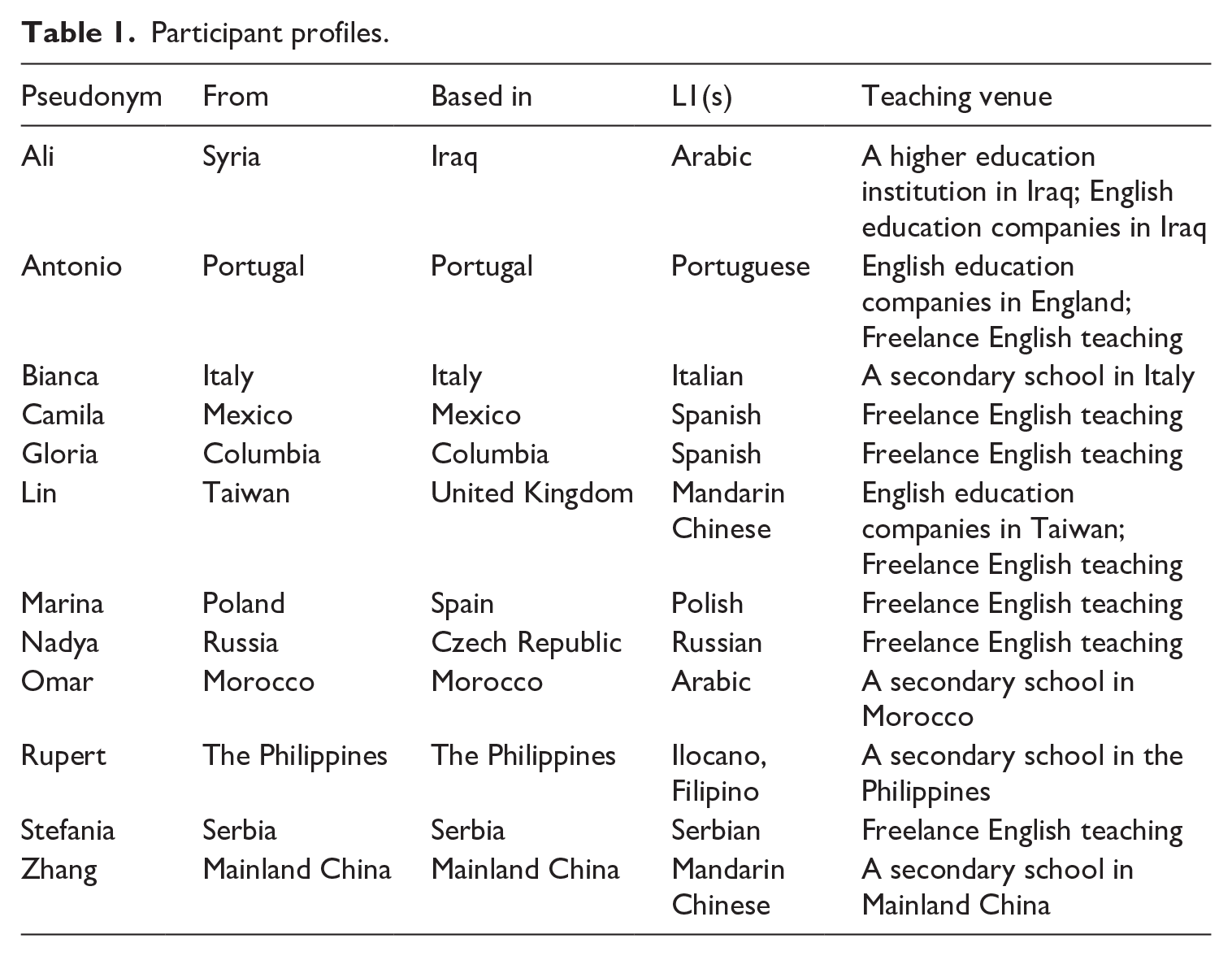
Thirty-seven in-service English teachers were initially recruited. All the recruited participants were asked to read and sign a participant information sheet and consent form and had the right to withdraw at any stage. However, the present study is based on the data provided by the 12 participants who participated in all intervention sessions. These 12 teachers came from 12 different non-Anglophone countries, providing insights from diverse sociolinguistic contexts. Participants’ profiles are provided in Table 1.
Participant profiles.
2 The intervention
Given the participants’ wide geographical spread, the intervention was conducted fully online. This identity-based intervention encouraged participants to reflect on how native-speaker ideologies might have influenced their identities (or not). It further prompted them to discuss the potential to challenge the ideologies by (re)positioning themselves and other ELT stakeholders. The six-week intervention consisted of three sessions designed and led by the first author, each dedicated to theories, pedagogies and power, which respectively fostered teachers’ critical awareness of the theories, equipping them with easy access to revised teaching resources and empowering them to act agentively in challenging native-speaker ideologies. These sessions, carried out bi-weekly, comprised a 60-minute seminar via Zoom, an online meeting platform familiar to English teachers, and a 30-minute post-seminar self-reflective written task, distributed via email for the easiness of communication. The researcher’s input in each seminar was complemented by group discussions, as identities are discursively constructed (Blackledge & Pavlenko, 2001). By encouraging them to probe into each other’s ideas (Cohen et al., 2018), participants from diverse contexts can complement each other’s viewpoints with their ELT experiences and perspectives. Each seminar was followed by a self-reflection written task. Since writing can open up spaces for ‘resisting, subverting, decomposing discourses’ (Kayi-Aydar, 2019, p.18), in the written tasks, participants were provided with enough space to contemplate further how their positioning had been informed by and could be negotiated based on the theories, perceptions and incidents we discussed in seminars. While Figure 1 illustrates the intervention procedures, a more detailed session plan can be found in Appendix A in supplemental material.
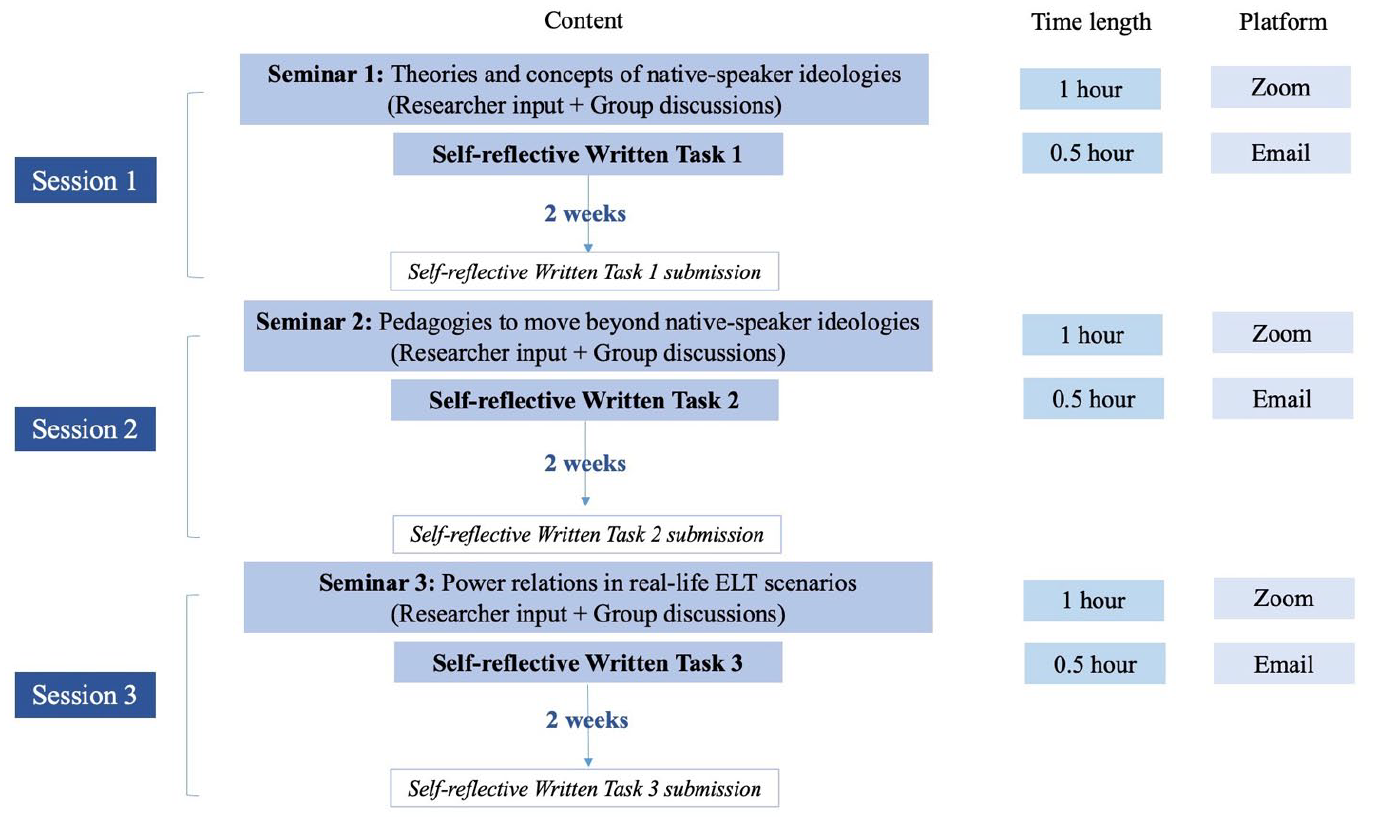
Procedures of the intervention.
It should be acknowledged that the core of the intervention is ‘reflection’. Self-reflection and evaluation are essential elements in professional identity construction, as they help teachers develop clear and critical understandings of their roles in their professions (Curran & Chern, 2017; De Weerdt et al., 2006). In addition, LTI negotiation is closely connected to teachers’ interpretation of previous professional experiences and imagination of aspired professional lives (Yazan & Lindahl, 2020). Therefore, reflection activities were carried out throughout the intervention in seminars or written tasks, to encourage participants’ reflections on their past teaching experiences and perspectives concerning native-speaker ideologies, and their aspiration for potential (re)negotiation of existing positions by moving beyond native-speaker ideologies.
3 Data collection
Data were collected through the intervention itself (i.e. seminars and self-reflective written tasks) and in-depth interviews (i.e. pre- and post-intervention interviews). The recorded group discussions in seminars provided data on participants’ collaborative and communicative sense-making practices (Given, 2008), while the collected written responses in participants’ self-reflective tasks informed us of participants’ independent and extensive thinking (Reja et al., 2003). Questions asked and discussed in the seminars and written tasks are listed in Appendix B in supplemental material. Two in-depth individual interviews, each lasting approximately 45 minutes, were conducted with each participant before and after the intervention. To evaluate the effectiveness of the intervention, the baseline questions asked in the interviews were identical, to compare how teachers’ positioning was negotiated after the intervention. Additionally, in Interview 2, participants were asked to reflect on whether and how the intervention had influenced their self-perceptions, teaching perspectives and teaching practice. The detailed interview agenda can be found in Appendix C in supplemental material.
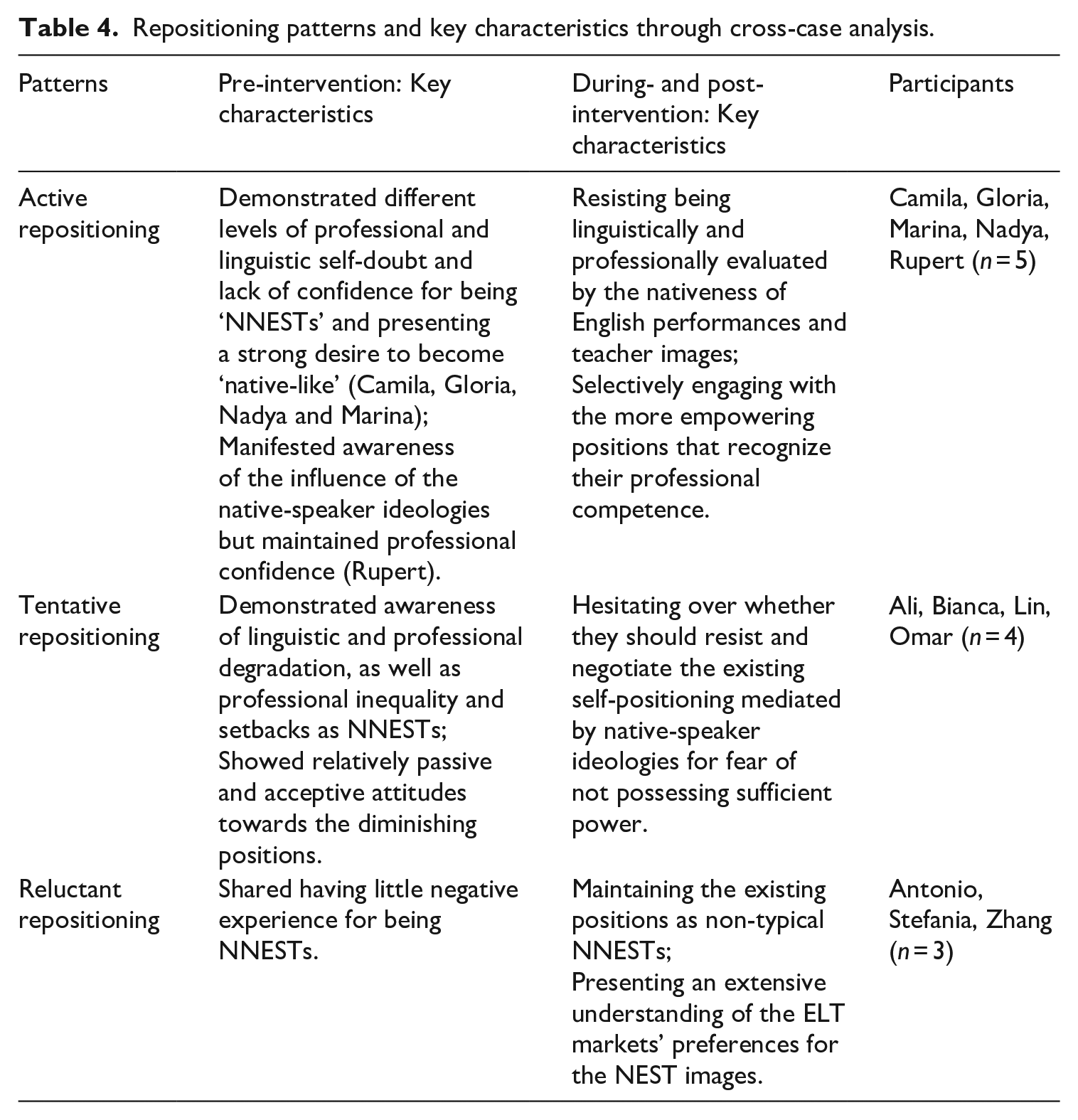
4 Data analysis
Inductive thematic analysis was conducted through the adaptation of Braun and Clarke’s (2006, 2012) six-phase thematic analysis. Given our intention to investigate the potential shifts and maintenance of each participant’s positions across the intervention and explore any connections or differences among participants’ agency acts, both within-case and cross-case analysis (Ayres et al., 2003) were embedded in the thematic analysis process. Table 2 illustrates the six phases of thematic analysis carried out in this study and the detailed analysis processes in each phase. Since the final phase of Braun and Clarke’s thematic analysis procedure requires demonstrating the validity of analysis in producing the report, the coding categories in within-case and cross-case analysis are demonstrated in detail in Tables 3 and 4. Moreover, it should be noted that the researchers endeavoured to ensure analysis quality through ongoing reflexive dialogues during the analytic process (Braun & Clarke, 2006), which urged our constant inspection and rectification of any bias made through coding and thematizing. Braun and Clarke’s (2006) 15-point checklist for quality thematic analysis was also followed to ensure the reliability of our data analysis.
Phases of thematic analysis.
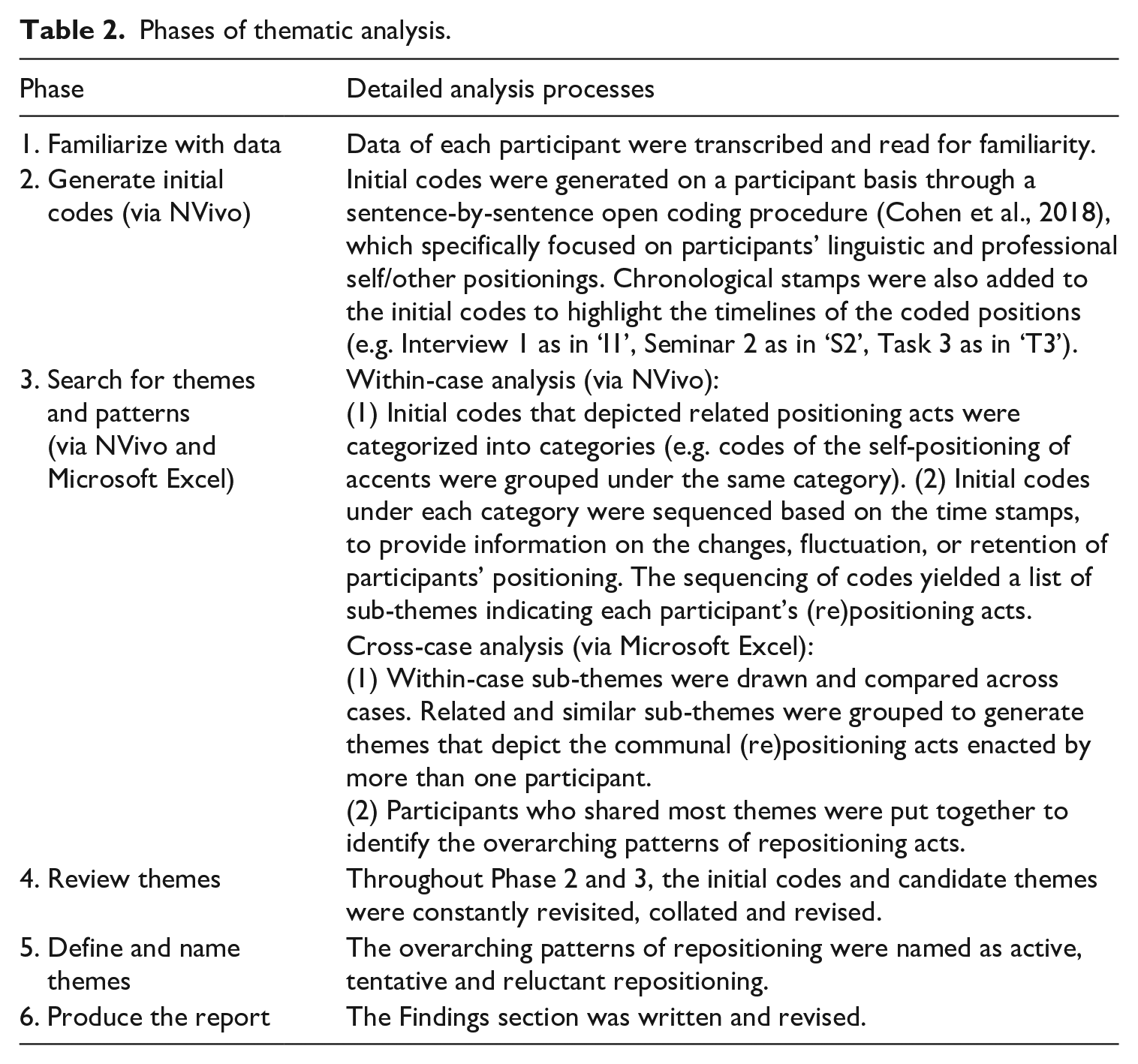
Sub-themes and overarching themes generated through within-cases analysis.
Repositioning patterns and key characteristics through cross-case analysis.
5 Researchers’ positionalities
This study emerged from the first author’s broader PhD research project and was carried out under the guidance of her supervisor, the second author. Through 20 years of learning English as a foreign language (EFL) and seven more years of EFL teaching, the first author’s linguistic self-perceptions gradually shifted from desiring to speak ‘native-like’ English to developing confidence in English communications. The transformation of her professional and linguistic positions motivated her interest in conducting the identity-based intervention with NNESTs to move beyond native-speakerism. Therefore, in collaboration with the second author, who has particular research interests in promoting multilingualism in ELT and multilingual identities, both researchers endeavoured to design the intervention to inclusively and sensitively address the marginalization and degradation issues that NNESTs face in ELT.
IV Findings
Following the presentation of the key characteristics of participants’ active, tentative and reluctant repositioning patterns above, we present results on how participants of these three patterns specifically (re)negotiated positions in light of the NNEST movement, and, where related, the roles that teacher agency played in these trajectories.
1 The pattern of active repositioning
Five participants (Camila, Gloria, Marina, Nadya and Rupert) demonstrated active repositioning. They presented relatively firm intentions and choices to negotiate the inferior linguistic and professional positions associated with the degradation of NNESTs’ English performance and proficiency.
a Resisting diminishing linguistic positions associated with non-native English accents
Across the intervention, three participants (Gloria, Marina and Nadya) demonstrated resistance against the (forced) self-positioning that evaluated the nativeness of their English performance and diminished their linguistic competence as NNESTs. Following the input content and discussions in the intervention, participants reflected on their existing positions as having linguistic deficiency due to non-native-like accents and having the need to imitate native speakers’ accents to ensure ELT qualities, which they considered to undermine their linguistic and professional self-confidence.
We may take Gloria’s problematization of forced self-positions as an example. Gloria recalled a deprecating linguistic position imposed by the principal of her school based on her pronunciation of the word ‘cat’ as ‘/kat/’ in a Spanish accent. She shared, ‘And she [the principal] just stopped me in front of some other parents and say, “Okay, can you pronounce it one more time?” ’ (Seminar 3). Gloria considered that being required to ameliorate her accent weakened her professional self-confidence and affected career benefits, as she continued, ‘It definitely affects your professional self-esteem one way or another and that is aligned or decides the salaries of course’ (Seminar 3). Gloria’s comments on the forced linguistic position indicated her awareness of how such a position reduced her agency to claim strengths in English and ELT competence. Following the intervention’s encouragement of refuting linguistic degradation as an agent, Gloria expressed intentions to cultivate her linguistic confidence as a resilient English teacher and reject being positioned as linguistically inferior: ‘Whatever people say, it’s not something that should affect me completely . . . Sometimes you have to stand on your feet and say: “Okay, I’m good at this!” ’ (Interview 2).
Apart from the three participants’ negotiation of reflexive positioning, two participants (Marina and Rupert) resisted the sense of inferiority associated with non-native-like English accents through interactive positionings of other NNESTs. For example, Rupert positioned some of his colleagues at school as ‘. . . English teachers desir[ing] to be native-like’ (Written Task 1). Rupert further pointed out how the pursuit of nativeness in English ‘inhibits ESL [English as a second language] teachers . . . to produce the language’ (Written Task 3). Likewise, Marina expressed her concern about the linguistically deficient positions of a participant she encountered in one of the seminars. She wrote, ‘Yesterday, during the last seminar my heart broke to hear one Italian lady say that she’d been convinced that once she’s possessed the British accent and rid of her Italian one, she’d become a good teacher’ (Written Task 3). It can be interpreted that both participants positioned some NNESTs as not having abundant agency to confidently address their language abilities when they were forcibly positioned under the native speakers’ English accent standards, which, the participants considered, may affect teachers’ self-esteem and limit professional and linguistic development.
Both participants further resisted such self-deprecating positions by expressing the will to help other teachers gain more linguistic and professional confidence. For example, Marina shared her aim to pursue a career in teacher education focusing on coaching NNESTs to be more confident. She wrote, ‘I see a lot of potential in focusing on coaching non-native English teachers and extracting from them the courage to be more confident and more proactive’ (Written Task 3). Rupert acted proactively during the intervention, where he exercised agency to communicate with his colleagues at school about rejecting native-like accents as a standard in teacher evaluation.
b Engaging with empowering positions by recognizing professional teaching abilities and claiming membership in the NNEST community
Alongside participants’ agentic acts involved with their linguistic positions, four teachers (Camila, Gloria, Nadya and Rupert) enacted agency by selectively engaging more with the professional positions that accentuated their teaching abilities than their English proficiency levels. First, teachers intentionally engaged themselves with the forced positions that acknowledged their teaching competence. For instance, Nadya, who focused mostly on her lack of English proficiency before the intervention, later paid more attention to her students’ appreciation of her ELT abilities in adequately understanding EFL learners’ learning difficulties and her multilingual abilities that helped establish effective communication with students. She shared, ‘I can relate to their experience . . . mostly people are happy that I’m not a native speaker because they need L1 instruction for them’ (Interview 2). Likewise, Gloria, who used to be bothered by the non-nativeness of her English before the intervention, was then more attentive to her students’ and supervisors’ positive feedback on her ELT practices, which she contended ‘makes me feel more secure and confident about my teaching performance’ (Interview 2).
Second, participants selectively engaged more with the potential for teaching ability improvement than their initial goals of improving linguistic performance. For example, in Interview 2, Camila expressed a stronger interest in acquiring teaching strategies for learners of different ages, while Gloria shared her objectives in developing multiple professional skills, including techniques for teaching in hybrid online and offline classrooms and open-mindedness for diverse ELT resources, which were not specifically mentioned before the intervention. These positions might prompt participants’ stronger sense of agency as they might feel more capable of navigating professional development by developing teaching skills than trying to imitate native speakers’ English accents.
Whether it be participants’ engagement with the positions that acknowledged their professional teaching competence or emphasized their potential in developing teaching abilities, we may deduce that the participants intentionally chose to reposition themselves under the positions that granted them more power to take control of professional development. While the participants may find themselves powerless in reconstructing their English accents to sound more native-like, recognizing and developing teaching abilities might have equipped teachers with a stronger sense of agency.
After communicating extensively with other teacher participants on professional experiences in different settings, four participants (Gloria, Marina, Nadya, Rupert) went beyond self-positions and developed awareness of how native-speakerism has put many other NNESTs in inferior positions. This facilitated them to be engaged in positions as members of the NNEST community. The participants found themselves more strongly connected to other NNESTs for sharing similar positioning experiences. For instance, Gloria shared, ‘Having and meeting colleagues from all over the world with similar experiences made me feel more confident and represented’ (Interview 2). Marina wrote, ‘We have so much to offer to the world as a community and yet we sell ourselves short’ (Task 3). The participants’ word choices such as ‘colleagues’, ‘represented’, ‘community’ and ‘we’ specifically demonstrated their sense of belonging to the NNEST group. Such positions in return empowered the participants to feel more confident in agentively claiming their professional competence in ELT as a group.
2 The pattern of tentative repositioning
Four participants (Ali, Bianca, Lin and Omar) presented tentative repositioning patterns. During the intervention, they vacillated between challenging and maintaining the linguistic and professional positions that degraded the NNESTs’ English abilities and images. Different from the active group who were firm about their agentic decisions of challenging the diminishing positions, participants of this group particularly hesitated over whether they were able to subvert the existing positions mediated by the prevalent native-speaker ideologies.
a Resisting degrading positions associated with non-native English accents and NNESTs’ nationalities and ethnicities
Throughout the intervention, two participants of this group (Bianca and Lin) resisted the inferior linguistic self-positions primarily associated with their non-native-like accents. Before the intervention, both participants positioned themselves as English teachers with major professional drawbacks in ELT due to their accents. However, the intervention’s emphasis on the equality of all English accents encouraged the participants to acknowledge the legitimacy of their own accents, which could be considered as a forced self-position provided by the intervention contents. For example, Bianca said, ‘. . . the seminar taught me . . . that everyone has got his own accent’ (Interview 2). Their communications with other teachers from diverse linguistic backgrounds contributed to their interactive positionings of other teachers’ various accents as being legitimate and appreciated. For example, Lin wrote, ‘I was quite happy to meet and know all the teachers with different accents’ (Task 3). Bianca and Lin further agentively repositioned themselves to feel less inferior and anxious about their non-native accents, indicating their resistance to being evaluated and diminished by accents. For example, Lin wrote, ‘The fact makes me feel that I’m less inferior to native English-speaking teachers’ (Written Task 3). Bianca said, ‘And so everyone must be respected. And so . . . I want to try to . . . feel less anxious about that’ (Interview 2). Such reflexive positions might have also endowed the participants with a stronger sense of agency in claiming professional competence.
In addition to Bianca’s and Lin’s resistance to the linguistic positions that degraded their professional competence, all four participants (Ali, Bianca, Lin and Omar) in this group demonstrated agency in their developed confidence and resolution to resist the forced inferior images attached to NNESTs’ ethnicities and nationalities that devalued their professional competence. For example, Omar, who used to be uncertain about whether it was his Moroccan identity that led to the obstacles in job searching, ascertained that he was forcibly positioned in disadvantaged situations due to his nationality. He shared, ‘. . . when they put this criterion of being “Native” . . . I always find this, you know, like, as a big hindrance for me, you know, to apply for a good job with good salary’ (Seminar 3). Omar considered such a position as depriving his agency in demonstrating his professional competence and requiring professional benefits on an equal basis with other candidates, which might have resulted in his later expressed intention to vocally challenge the degradation. He said: For example, when I’m treated . . . based on my . . . ethnicity, so I can definitely . . . talk more about it with more confidence. Like, ‘. . . this is a job skill. . . . We’re not here . . . to be American or to be British. So, it’s not fair to judge me based on that.’ (Interview 2)
By being vocal and confident about actively defending himself from being evaluated and devalued simply based on his nationality and ethnicity and arguing for teacher evaluation based on professional skills, Omar demonstrated his enactment of agency.
b Engaging with empowering positions by recognizing professional teaching abilities and claiming membership in the NNEST community
Resonating the four participants in the active group (Camila, Gloria, Nadya and Rupert) who focused more on their professional teaching competence than English proficiency levels, one participant of this group (Bianca) also selectively engaged herself with the positions associated with her teaching skills. Across the intervention, Bianca expressed her desire to acknowledge herself as a well-qualified and hardworking teacher for ELT through the intervention, which contrasted with her pre-intervention self-position as a linguistically disadvantaged teacher for being an English as a foreign language (EFL) speaker. She wrote, ‘Now, I want to try to accept myself because I studied a lot to prepare for this profession’ (Task 3). It can be deduced that the repositioning of her sufficient ELT qualifications led to a rise in her self-empathy and confidence in ELT. Moreover, Bianca repositioned herself as a teacher who put much effort into enhancing her ELT practices after the intervention. For instance, she shared how she had been endeavouring to better engage students in class and learning new teaching methodologies. Bianca’s intentional self-repositions demonstrated her enactment of agency to try to be associated more with her ELT professionality, such as being professionally confident and continually developing her ELT skills.
Aligning with the four participants (Gloria, Marina, Nadya, Rupert) in the active group, three participants (Ali, Bianca, and Omar) reflexively repositioned themselves and interactively positioned the wider NNEST community as closely connected and related, for they resonated with many other teachers’ experiences of being degraded and devalued. For example, Ali articulated, ‘It’s not only me, . . . not only Syrian, Arab . . . but I would say like this is prejudice against everyone’ (Interview 2). Ali’s resonance with other NNESTs’ experiences evoked a sense of belonging, as he wrote, ‘I feel that I belong to a community’ (Written Task 3). We may deduce that Ali’s reflexive positions as connected to the NNEST community facilitated the change in his initial passive acceptance of the forced self-positions and boosted his sense of agency to challenge the inferior images attached to NNESTs, as he may feel more support and courage from the NNEST group.
c Shifting back to the desire for ‘native-like’ English and ‘native-speaker’ ideals
While the four participants demonstrated agentic acts in negotiating the positions that downgraded their professional competence, they still hesitated, from time to time throughout the intervention, over whether they had sufficient power to challenge the prevalent prioritization of native speakers’ English, as well as some specific nationalities and ethnicities. This has resulted in participants shifting back to some of the initial positions wherein they desired native-like English and NEST ideals.
Bianca and Lin admitted they found it hard to eradicate their idealization of native speakers’ English, because they felt powerless in counteracting or ignoring ELT stakeholders’ (e.g. students, parents and institutions) evaluation of and expectations for the nativeness of their English accents and performance. These expectations had been forcibly positioned onto them. For example, Bianca shared that although the seminars made her want to be less defined by her accents, accent still remained one of the major standards by which English teachers’ professional competence is assessed. She said, ‘. . . it [i.e. accent] is important, for maybe the students or the family of the students . . . can judge you. They can say, “Oh, she has a good accent. She speaks a good English.” ’ (Interview 2) Therefore, Bianca found it difficult to firmly address her denial of being defined by accent but sometimes had to accept being positioned this way, as she said, ‘I tried . . . to prepare myself for these [i.e. the requirements for speaking in native-like accents]’ (Interview 2). Similar experiences were also encountered by Lin, who admitted after the intervention that, while she did not consider having a native-like accent crucial for her students, it was vital for her being an English teacher. When facing such forced positions, both participants manifested a lack of agency to resist the idealization of ‘native-like’ English by stakeholders but had to conform to their standards.
Furthermore, all four participants of this group found it daunting to subvert the ELT markets’ preference for the typical native-speaker ideals, which often comprise citizenships of major native-English-speaking countries (e.g. the United States, the United Kingdom, Canada, etc.) and the White/Caucasian ethnicity. Participants considered that representing the native-speaker images would provide easiness to their career development. For example, Lin expressed her envy of the native-speaker images by saying: I just thought . . . if I could, you know, pretend to be a British and maybe I could get a job . . . It doesn’t matter if I’m not really good at teaching . . . And those teachers [i.e. NESTs], they always get a job. (Interview 2)
In addition, by reflecting upon an incident of her Greek friend receiving a job offer for being White while herself being rejected by the same position for being Asian, Lin interactively positioned White English teachers as being privileged by the job market. Her interactive position resulted in a reflexive position of desiring the native speaker image. Lin said, ‘If . . . I’m white, and then [your professionality] doesn’t matter’ (Interview 2). Lin’s interactive and reflexive positionings indicated her sense of frustration for automatically receiving inferior forced positions for being Asian and her sense of incapability to subvert the discrimination. Therefore, Lin, as well as other participants in this group, presented lingering uncertainty in their agency to refute these positions; hence they tended to shift back to the original positions of admiring the priority attached to the native-speaker images, just as Ali shared: ‘It’s just something that you cannot change, right?’ (Interview 2).
3 The pattern of reluctant repositioning
The final pattern we address, reluctant repositioning, was evident among three teachers (Antonio, Stefania and Zhang). Compared to the participants from the previous two groups who negotiated existing positions to certain extents, these three participants did not explicitly reposition themselves or others to actively challenge native-speakerism.
a Maintaining positions as non-typical NNESTs
Distinct from other participants, the three participants in this group did not represent the typical NNEST figure in their positions, for they were either recognized as speaking native-like English or did not consider their identities to be significantly influenced by the native-speaker ideologies.
Two participants (Antonio and Stefania) had mostly been positioned as native-like English teachers. Such positions were maintained across the intervention. In contrast to the participants in the previous two groups who doubted their English proficiency, these participants were generally confident with their native-like English abilities. For example, Antonio used terms such as ‘[the] Queen’s English’ (Interview 1), ‘authentic’ (Interview 2) and ‘native English’ (Interview 2) to describe his English throughout the intervention. Stefania demonstrated her linguistic confidence by saying, ‘I don’t think they would ever be able to tell that I’m not a native speaker, you know, especially because of the speed’ (Interview 1). After the intervention, she further consolidated her confidence by comparing her skills with other English teachers, ‘And also, my strengths would be . . . Many people in my area . . . lack fluency. Yeah, pronunciation as well’ (Interview 2). Stefania’s positioning of other NNESTs as lacking English fluency indicated her self-position as being different from the general NNEST group. In this vein, she might not fully consider herself a typical NNEST, which was presumably also the case for Antonio.
Alongside the demonstration of how linguistically native-like they were, Antonio and Stefania were also positioned closer to the ‘NEST image’ for being ‘White’. Both teachers reflected on how they were asked to pretend to be NESTs to cater to students’ and parents’ needs. According to Antonio, ‘. . . it has been mentioned, you know, “don’t talk about being Portuguese or anything”, you know, “these parents paying for English speakers, not Portuguese speakers” ’ (Interview 2). Stefania also reflected on how her White ethnicity led to her superior career benefits, ‘I have even had higher salary than an American. However, she is black . . . So, I have been discriminated [against for being non-native], but also other people have been discriminated because of me [being white]’ (Seminar 3).
Although both teachers problematized how the near or pseudo-NEST positions had silenced their own national identities and imposed inequality on other non-White teachers, it cannot be denied such positions presumably endowed Antonio and Stefania with more privileges. It may be deduced that the relatively advantageous and privileged positions the participants received for being native-like have already supported them to have sufficient agency to effectively demonstrate their competent English teacher identities. Therefore, the participants were more likely to maintain the positions that brought them professional career benefits rather than actively modifying them.
Furthermore, Zhang considered herself to have had different experiences from many other NNESTs, since she had not been positioned in comparison to native English speakers due to the scarcity of NESTs in her school. She said, ‘There are fewer foreign teachers in China, much fewer than before. We don’t have foreign teachers at school now’ (Interview 2). Since Zhang did not resonate with the prejudiced positions that many NNESTs received, she did not find it necessary to reposition herself to challenge the ideologies.
All three participants’ evaluation of themselves as not being extensively negatively affected by the prioritization of NESTs may have resulted in their reluctance to negotiate their original positions, which were already non-inferior or even privileged. Moreover, they rejected the self-position options ‘forcibly’ offered by the researchers and other participants in the intervention and insisted on maintaining initial positions, which could also be seen as an agentic move.
b Maintaining tolerance towards NNESTs’ positions as less prioritized teachers
The three participants of this group interactively positioned the ELT markets’ preference for NESTs as understandable and tolerable. For example, Antonio considered it understandable to prioritize NESTs in ELT due to consumers’ demands. He said, ‘Just I understand . . . It’s that old school thinking of “We’re paying good money, [so] we want the best, and the best is native” ’ (Interview 2). Stefania took the visa policies of some countries’ governments, which had lower standards for NESTs but stricter requirements for other foreign NNESTs, as an example to explain that some institutions had no choice but to only or mainly recruit NESTs. Likewise, Helen considered the imbalance between NESTs’ and local teachers’ salary bands in non-native English-speaking countries as being more or less acceptable. She explained how the currency exchange rates and drastic income rates between the less developed countries (where some NESTs would be employed) and the developed countries (where many NESTs are originally from) resulted in institutions’ decisions to attract more NESTs with higher salaries, to meet the markets’ demands for those ‘foreign teachers’.
By reviewing how sociopolitical and socioeconomic factors have long been assigning teachers with the NEST status more priorities and privileges, the participants demonstrated their understanding of why they, when positioned as NNESTs, could not enjoy the privileges and preferences as other NESTs. Although they did not explicitly express their sense of lack of agency to challenge the prioritization of NESTs, we may deduce that their extensive understanding of why and how the native-speaker ideologies prevailed within the ELT markets might have caused them a sense of lack of agency where they felt incapable of and uninterested in subverting it.
V Discussion
This identity-based intervention study resulted in three major patterns of participants’ LTI (re)negotiation, namely active (n = 5), tentative (n = 4) and reluctant (n = 3) repositioning. In line with the research questions, this section discusses the repositioning acts demonstrated through the intervention, and the roles that agency played in participants’ repositioning and the mediating factors.
1 The repositioning acts during the identity-based intervention
Our analysis shows that participants (re)negotiated identities by resisting diminishing positions, selectively engaging with empowering positions, shifting back to initial positions, and maintaining existing positions. Participants of the active and tentative groups resisted being (forcibly) positioned as less competent teachers due to linguistic deficiency, especially associated with their non-native-like accents, which substantiates previous findings of participants’ rejection of being defined as deficient English speakers and incompetent language teachers (e.g. Park, 2012; Rodriguez & Cho, 2011; Sifakis & Bayyurt, 2015). Participants in the tentative repositioning group particularly resisted being professionally degraded by their nationalities and ethnicities, supplementing existing studies that primarily reported on NNESTs’ linguistic identities (e.g. Aoyama, 2023; Mahalingappa et al., 2022; Wang & Fang, 2020). Some participants in the active group also resisted other NNESTs’ degrading positions (e.g. Marina and Rupert). Their interactive positioning of other NNESTs in turn indicated their own reflexive positions (van Langenhove & Harré, 1999) as proactive promulgators who proactively disseminated the need to abandon accent imitations among NNESTs. Moreover, both the active and tentative groups selectively engaged themselves in more empowering professional and linguistic positions, particularly by recognizing their professional and linguistic strengths as multilingual NNESTs in accurately capturing students’ learning EFL/ESL difficulties (see also in Aoyama, 2023; Huang, 2019; Wang & Fang, 2020) and communicating efficiently with students’ L1s (see also in Higgins, 2016; Moate & Ruohotie-Lyhty, 2020). Moreover, the participants also engaged themselves in positions that acknowledged their sufficient ELT qualifications and preparations and provided them with resonance and support from the larger NNEST community. Participants’ selective engagement with empowering positions demonstrated that second-order positioning was more likely intentional than tacit (Howard, 2021).
In addition, repositioning acts were also seen in the tentative group’s intermittent shifts from the temporarily negotiated positions as confident NNESTs to original positions of desiring to sound like native speakers and admiring the facilitating roles native speakers’ nationalities and/or ethnicities play in ELT. However, negotiating initial positions was not specifically seen in the reluctant group as participants primarily maintained their positions as non-typical NNESTs who were not significantly affected by native-speakerism. Yet, despite this, they still repositioned the ‘forced’ positions of challenging native-speakerism imposed by the intervention.
2 The interconnectedness between repositioning, agency and agentic positions
Our findings demonstrate a symbiotic and complex relationship between repositioning, agency and agentic positions. Participants were found to exercise agency to reposition themselves and others to achieve agentic positions. In return, agentic positions could also potentially cultivate participants’ stronger sense of agency and facilitate agency enactment. Echoing Kayi-Aydar’s (2015) interpretation of agency enactment in positioning as revising existing positions and/or assigning new positions to themselves and others, participants of the active and tentative groups enacted agency to resist identity degradation and assign more empowering positions to themselves and other English teachers. However, agency was not only exercised through the modification of initial positions to refute native-speakerism; it was also practised through the reluctant group’s conscious refutation of the forced positions (Choi, 2022) discursively imposed through the intervention and insistence on existing positions, indicating their agentic interruption of discourses (Davies, 2000). The diverse agentic repositioning acts revealed the multifarious features of agency enactment through repositioning (Xu & Tao, 2023).
Aligning with existing scholars’ arguments of agency as a crucial component of LTI (Beijaard et al., 2004; Varghese et al., 2005), our findings demonstrate that agency enactment resulted in agentic positions. For instance, by making attempts to break the automatic connection between the NNEST roles and professional and linguistic incompetence in ELT, the active and tentative groups took on the agentic positions that acknowledged their ELT competence and teaching strengths and enhanced their sense of support from the NNEST community. By agentively rejecting the imposed positions of challenging native-speakerism, the reluctant group consolidated agentic positions as native-like English teachers or pseudo-NESTs (Tezgiden Cakcak, 2019) and NNESTs not extensively exposed to the native-speakerism discourses. While the participants did not explicitly address the agentic features of these positions, their responses indicated the existing positions did not deprive their rights or capabilities to claim identities as competent teachers.
Although our analysis cannot ascertain the causal relationship between participants’ agentic positions and agency enactment, it could still be deduced from the findings that participants’ agentic positions might have reciprocally facilitated participants to gain more capacity and willingness to take on active roles as agents (Kayi-Aydar, 2015; Rex & Schiller, 2009) and open up new possibilities (Rex & Schiller, 2009). For instance, the negotiated positions might have prompted the active and tentative groups to further enact agency to develop resilience in retaining and even developing ELT confidence under the systems that prioritize native speakers’ English and appearances, aligning with existing studies’ arguments on enacting agency to ‘resist’ (Kayi-Aydar, 2015, p. 96), ‘modify’ (Choi, 2022, p. 2), and ‘go beyond’ certain positions (Davies, 2000, p. 66). For instance, teacher agency was manifested in participants’ intentional cultivation of confidence in linguistic and professional competence (e.g. Bianca and Gloria), and their shifted professional development focus from speaking native-like English to advancing teaching methods (e.g. Bianca, Camila and Gloria). It was also seen through Omar’s intentions to agentively argue for fair career benefits and professional development opportunities by vocally fighting for the same opportunities as NESTs, as agency is represented through individuals’ having the right to speak or be heard and authorship to articulate meanings (Davies, 2000; Davies & Harré, 1990). Moreover, the negotiated positions might have also inspired some participants to express intentions, or even take actions, to help other NNESTs gain more agency when facing native-speakerism (e.g. Marina and Rupert). Through constructing communities where NNESTs support each other, the participants enacted agency to ‘imagine, take up and perform’ new positions (Duff, 2012, p.15). Although the reluctant group’s retained agentic positions might not lead to participants’ agency acts in challenging native-speakerism, their positions resulted in their agency enactment to vocally question and even deny the researchers’ suggestions of challenging native-speakerism.
The reciprocally informed relationships between teacher agency and agentic positions found in this study substantiated existing literature which demonstrated the interconnected relationship between teacher agency and identities (e.g. Ashton, 2022; Bowen et al., 2021; Choi, 2022; Moate & Ruohotie-Lyhty, 2020). It is also presumable that the negotiated agentic positions and enacted agency acts especially seen in the active and tentative groups were outcomes of teachers’ reflections and repositioning acts facilitated by the intervention, which supplemented a large body of studies that only explored teachers’ identities (e.g. Aoyama, 2023; Park, 2012; Rodriguez & Cho, 2011; Wang & Fang, 2020). While these existing studies found some participants actively addressing their competence and self-confidence against the backdrop of native-speakerism, which indicated their practice of agency, our findings demonstrated the potential to encourage more agentic positions and actions in NNESTs through identity-based teacher training. Since agency is usually found and enacted in personal experience of disjuncture (Moate & Ruohotie-Lyhty, 2020), the identity-based intervention not only adopted reflection as a tool to facilitate teachers to contemplate on previous disjuncture (Trent, 2013), but it has also acted as a disjuncture itself in the participants’ professional life which prompted active repositioning acts.
However, it should be noted that the intervention did not always lead to agency enactment or agentic positions. While agency may be fueled by empowering positions, some positions may prevent individuals from enacting agency (Kayi-Aydar, 2015). A lack of agency was particularly seen when the tentative group intermittently switched back to initial positions, which was intertwined with their non-agentic positions of lacking rights and capabilities to refute the forced positions imposed by native-speakerism in certain ELT settings. Likewise, the reluctant group, who elucidated the connection between NESTs’ privileges and the sociopolitical and socioeconomic factors, may also consider themselves lacking agency to subvert the deep-rooted structural causes, which might have resulted in their less agentic positions to proactively challenge the ELT systems’ prioritization of the NEST figures. The shifts between being powerful and powerless resulted in teachers’ conflicting identities, which was also seen in Kayi-Aydar’s (2015) research.
3 Factors mediating repositioning acts
Our results demonstrate that participants’ negotiation (or not) of positions to challenge native-speakerism were substantially informed by the conscious evaluation of their LTIs situated in past professional experiences and power relations, because how individuals ‘read’ the positioning ‘opens up’ or ‘closes down’ the possibility of agency enactment (Davies & Gannon, 2011, p. 313).
First, participants’ evaluation of how significantly their existing positions were impacted by the practice of native-speaker ideologies and who they can become after negotiating existing positions informed whether they should agentively reposition themselves against the degradation of NNESTs, supplementing Vähäsantanen’s (2015) perception of teachers’ professional identities being a crucial factor in teacher agency. For instance, teachers in the active and tentative groups mainly considered the professional identities and development of themselves and/or other NNEST colleagues diminished and impeded by the practice of native-speakerism in their own ELT settings. Therefore, enacting agency to reposition their identities could potentially lead to a developed sense of security and self-esteem, and even better professional development opportunities, in the future. In this way, these teachers were motivated to agentively reposition themselves. On the contrary, the reluctant group of participants did not primarily consider themselves closely associated with the prevalent inferior images that most NNESTs shared. Some participants (Antonio and Stefania) could have even enjoyed some benefits brought forward by native-speakerism, for the teachers were appreciated stakeholders for their native-like English production and/or ‘Whiteness’ (see also Aneja, 2016; Jenks & Lee, 2020; Mahalingappa et al., 2022; Ruecker & Ives, 2015; Selvi et al., 2024; Widodo et al., 2020). Since human beings cannot be forced to develop their understanding of information unless they have related experiences (Syaifudin & van Rensburg, 2018), and individuals exercise agency to be involved in worth-solving problems (Billett, 2006; Eteläpelto et al., 2013), the reluctant group may not find it necessary to reposition themselves against native-speakerism, as they may not see the direct benefits achieved from their existing positions being shifted. Participants’ evaluation of their existing positions situated in past experiences and potential benefits brought by negotiated positions in the future aligns with scholars’ perspectives that agency and identities are constructed at the intersection of the past, present and future experience of one’s life course (Eteläpelto et al., 2013; Guilfoyle, 2016; Ruohotie-Lyhty & Moate, 2016; Tao & Gao, 2017; Törrönen, 2001).
Second, participants’ evaluation of the power they possessed to refute native-speakerism informed whether could agentively reposition themselves, substantiating the perception of agency and positioning situated in complex webs of power relations (Kayi-Aydar, 2015; Törrönen, 2001). Compared to the active group’s confidence in subverting the positions that degraded their NNEST identities, participants of the tentative and reluctant groups were found to have positioned themselves under the imbalanced power relations with the ELT markets and policymakers. Since individuals often avoid participating in conditions where they feel that they haveg less power (Rex & Schiller, 2009), in this vein the two groups manifested powerlessness by rejecting the forced positions determined by the native-speakerism discourses. Participants’ different evaluation outcomes of their possessed power were possibly led by their professional contexts. While most participants in the active group (apart from Rupert) were freelance teachers, participants in the tentative and reluctant groups (apart from Stefania) primarily taught in educational institutions. Since native-speaker ideologies prevail in ELT hiring processes (e.g. Llurda, 2016; Ruecker & Ives, 2015; Widodo et al., 2020) and workplace settings (e.g. Charles, 2019; Howard, 2019; Widodo et al., 2020) among institutions, we may boldly deduce that the positions imposed by institutions (including institutional policies, supervisors, colleagues and customers) can be more pressing than the ones imposed by freelance teachers’ students (van Langenhove & Harré, 1999), resulting in the tentative and reluctant groups’ reduced agency in counteracting the forced positions.
To conclude the interrelated relationship between the intervention, positioning and agency, as well as the underlying factors influencing the agency enactment process, a conceptual framework is constructed and illustrated in Figure 2.
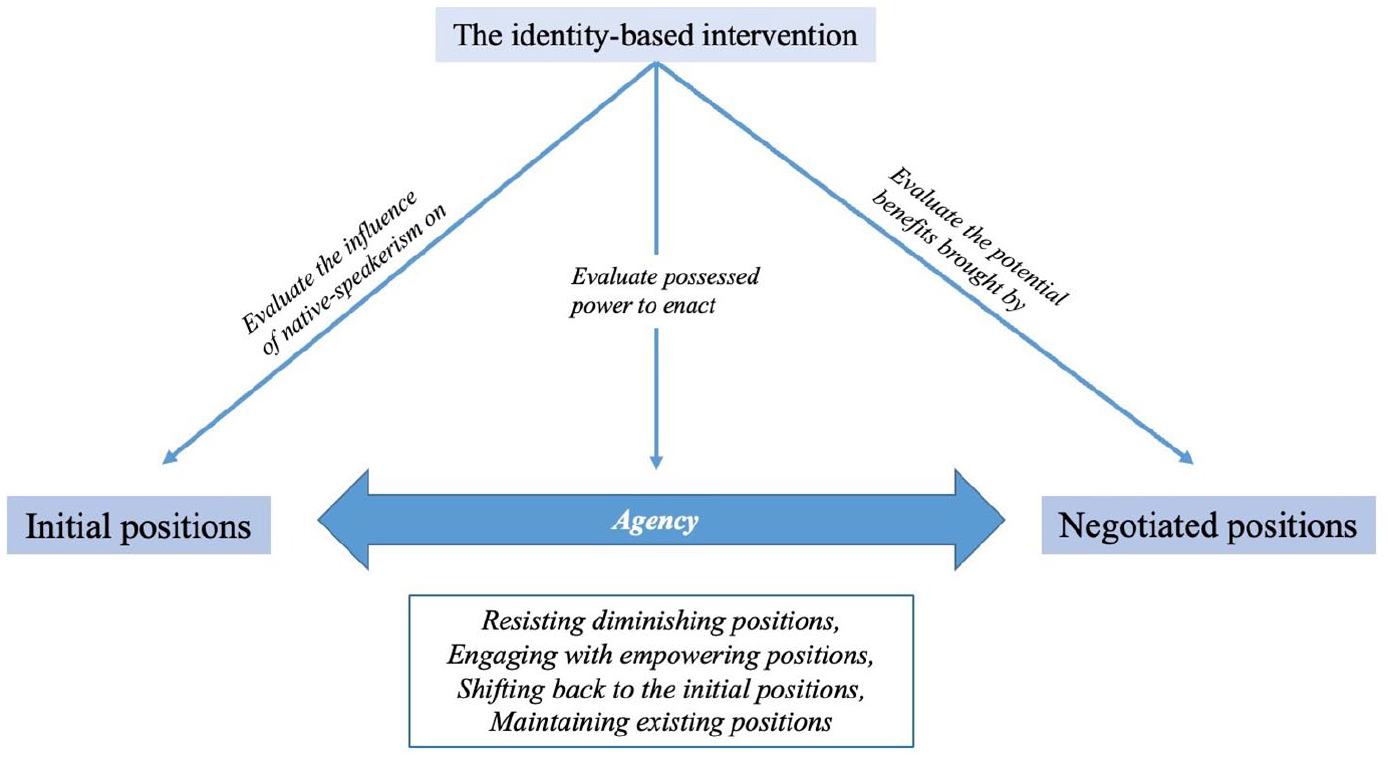
The interplay between the intervention, positioning and agency.
VI Conclusions
This article has demonstrated the potential for an identity-based intervention to facilitate English teachers’ agency in repositioning themselves. Twelve in-service NNESTs manifested different patterns of (re)negotiating positions, i.e. active, tentative and reluctant repositioning, the formation of which was dynamically interconnected within the diverse practice and combination of four different identity negotiation acts, namely, resisting existing diminishing positions, selectively engaging with more empowering positions, shifting back to initial positions, and maintaining existing positions. Agency and repositioning were shown to be interrelated. Agency was found to be enacted through repositioning to move beyond the native-speaker ideologies and to adopt more empowering positions. It was also exercised through some participants’ explicit or implicit refutation of the repositioning suggestions offered by the intervention and insistence on their current positions. A lack of agency was found in certain participants’ evaluation of personal incapability to subvert the discourses and positions determined by native-speakerism. In addition to the enactment of agency through repositioning, agency was found embedded in empowering positions which made the positions agentic and encouraged further enactment of agency. Furthermore, participants’ choices of repositioning and agency enactment were found to be mediated by teachers’ evaluation of the obstructiveness of their existing positions in life history and possessed power in challenging native-speaker ideologies in their own ELT settings.
Practical implications may be provided for teacher educators to facilitate English teachers to agentively negotiate LTIs to move beyond native-speaker ideologies. First, an identity-based intervention that focuses on teachers’ reflection on past professional experiences and existing positioning can be conducted to facilitate the teachers in evaluating their professional identities in-depth and to further develop agency in professional development. Second, abundant discursive practices among teachers should be involved in the training, for they can empower teachers to understand the substantial support they may receive from each other, as well as the wider NNEST community. Third, since teacher agency is enacted ‘in the light of their particular circumstances’ (Giddens, 1991, p. 175), participants’ different professional settings should be carefully considered in the training. Therefore, teacher educators should actively acknowledge the social force teachers may face when challenging native-speakerism and remind them of the power they possess. Moreover, since ‘what propels the change in humans is the reflexivity of which they are capable’ (Larsen-Freeman, 2019, p. 64), more subtle and implicit strategies to refute native-speakerism should be provided to facilitate agency development among teachers who are involved in imbalanced power relations. Fourth, teacher educators may consider inviting the less typical NNESTs to reflect on the experiences of other NNESTs and EFL/ESL learners who may be affected by native-speakerism, to kindle their interests in challenging the ideologies by negotiating interactive positions.
However, it cannot be denied that there are still limitations in the present study that can be resolved in future studies. First, participants in this study were English teachers worldwide with distinct sociolinguistic backgrounds and professional ELT experiences. While this allowed participants to gain diverse insights from each other, it could also be limited to a certain extent, as some participants may not easily resonate with each other in discussions. Future studies may be conducted with English teachers from the same professional context, granting them more opportunities to establish in-depth discussions on specific topics that all are familiar with. Second, since this study only lasted for approximately two months, with the post-intervention interview carried out immediately after the intervention, it is hard to draw a definite conclusion that the impact of the intervention will have long-lasting effects on participants’ identities. Future studies may consider conducting longitudinal studies to further explore whether the intervention will have a long-term impact on teachers’ identities.
Supplemental Material
sj-docx-1-ltr-10.1177_13621688241310403 – Supplemental material for Moving beyond native-speakerism through identity-based teacher education: The roles of positioning and agency
Supplemental material, sj-docx-1-ltr-10.1177_13621688241310403 for Moving beyond native-speakerism through identity-based teacher education: The roles of positioning and agency by Zehui Yang and Karen Forbes in Language Teaching Research
Footnotes

References
Supplementary Material
Please find the following supplemental material available below.
For Open Access articles published under a Creative Commons License, all supplemental material carries the same license as the article it is associated with.
For non-Open Access articles published, all supplemental material carries a non-exclusive license, and permission requests for re-use of supplemental material or any part of supplemental material shall be sent directly to the copyright owner as specified in the copyright notice associated with the article.
