



Abstract
Research into second or foreign language (L2) learning has demonstrated that L2 anxiety, perceived proficiency, and L2 willingness to communicate (L2WTC) profoundly impact language learning outcomes. However, the complex interplay between these variables has yet to be fully explored, as these factors are dynamic and context-specific and can vary across different learners and learning environments. The study, therefore, utilized a cross-sectional quantitative survey research design to scrutinize the causal relationships between L2 anxiety, English proficiency, and L2WTC of 609 Ethiopian preparatory school students. The model for the L2WTC, both inside and outside the classroom, has been expanded to include an additional sub-scale known as the L2WTC in a digital setting. Moreover, in contrast to the commonly recognized debilitative-focused L2 anxiety, the construct of L2 anxiety has been divided into facilitative and debilitative anxiety. This method allows us to measure not only the presence or absence of anxiety but also evaluate if anxiety helps or hinders the L2 learning experience. A self-assessment proficiency measure was also developed specifically for Ethiopian high school students. The study treated facilitative and debilitative anxiety as independent variables while considering English proficiency and L2WTC in the classroom, outside the classroom, and in digital settings as dependent variables. English proficiency was also used as an independent variable to predict L2WTC in these three settings. Our proposed model, including these variables, was tested using structural equation modelling (SEM). According to the descriptive analysis, the mean scores of L2WTC in the three settings were generally low, ranging from 2.30 to 2.84. Debilitative anxiety casts a shadow on the positive aspects of anxiety. The English proficiency was also too low. According to SEM, debilitative anxiety displayed a statistically significant negative impact on L2WTC inside and outside the classroom, in digital settings, and English proficiency. In contrast, facilitative anxiety was found to positively contribute to L2WTC outside the classroom, in digital settings, and in English proficiency. English proficiency made a statistically significant and positive contribution to L2WTC within and outside the classroom and in digital contexts. L2WTC inside the classroom positively contributed to L2WTC outside the classrooms and in digital contexts. We systematically compared the findings with existing studies in the discussion and elucidated the pedagogical implications, limitations, and potential future research avenues. The outcomes of our study have the potential to significantly contribute to the advancement of theoretical and empirical knowledge about improving English education, learning, and communication not only in Ethiopia but also in similar contexts of English as a foreign language (EFL).
I Introduction
Learning a second or foreign language (L2) is a multifaceted process that extends beyond the mere learning of linguistic structures. It encompasses a range of cognitive, metacognitive, and affective factors that influence the learner’s overall performance. Individual variables such as students’ L2 anxiety, proficiency and L2 willingness to communicate (L2WTC) in a new language have been extensively researched due to their significant impact on learning outcomes.
Researchers studied the relationships between psychological and L2 communication factors. Specifically, the relationship between L2WTC and anxiety was explored by Brauer et al. (2023), Khajavy et al. (2016), Lee and Chen Hsieh (2019), Peng (2015), Yashima (2002), and Zhou et al. (2020). Additionally, Brauer et al. (2023), Khajavy et al. (2016), and Peng and Woodrow (2010) examined the relationship between L2WTC and communication confidence, whereas Alrabai (2022a), Elahi Shirvan et al. (2019), and Welesilassie and Nikolov (2024) investigated how L2 WTC and motivation interacted.
Although several studies reported a negative relationship between L2WTC and anxiety, some gaps need to be addressed. Most research on L2WTC focused on the relationship between communication within and outside the classroom and various affective factors. However, with the emergence of digital tools, communication outside the classroom through digital devices and resources has not been adequately explored (Lee & Chen Hsieh, 2019; Lee & Lee, 2019). Specifically, in Ethiopia, where English is a foreign language, and the only source of English learning is within the classroom, it is unclear how willing Ethiopian students are to communicate by using digital technologies, given their anxiety and hesitancy to use English in classes and outside the classroom.
Furthermore, empirical research has not fully clarified the relationships between L2 anxiety and L2WTC in face-to-face and digital environments. Exploring the relationships between L2WTC and communication confidence, which includes perceived communication competency and reduced communication anxiety, may not adequately reflect the separate influence of anxiety and self-perceived proficiency on L2WTC.
In the realm of L2 anxiety research, it has been noted that inconsistencies may arise due to the use of narrow assessment tools which solely focus on debilitative anxiety and disregards positive emotions (Papi, 2010; Piniel & Csizér, 2013; Strack & Esteves, 2015). As Scovel (1978) and Strack and Esteves (2015) suggested, implementing diverse metrics tapping into facilitative and debilitative anxiety may help clarify how they are related to L2 proficiency and communication.
Finally, research has shown that relying on outcome measures of language proficiency that focus on a student’s intended effort can lead to over- or underestimation of their abilities (Al-Hoorie, 2018). Such measures may also lack direct relevance to a student’s perceived ability to use their current skills. Furthermore, actual course grades can be affected by various factors, including motivation, aptitude, learning strategies, and contextual elements (Dörnyei & Chan, 2013). Incorporating English proficiency alongside school grades as a criterion measure to overcome these challenges can help bridge the gap.
Therefore, this study aimed to address the research gaps in the field of L2 anxiety by developing measures that differentiated the construct as facilitative and debilitative anxiety. This step allows us to measure not only the presence or absence of anxiety but also evaluate if anxiety helps or hinders L2 learning and use. A self-assessment proficiency measure was also developed specifically for Ethiopian high school students to explore their predictive effects on L2WTC in various settings: in-class, out-of-class, and digital environments. This research can potentially advance theoretical and empirical knowledge on enhancing English education, learning, and communication in Ethiopia and other comparable contexts of English as a foreign language (EFL).
II Review of related literature
This section critically analyses significant theoretical and empirical studies on L2 anxiety, proficiency, and L2WTC inside and outside the classroom and in digital settings. In this section, a thorough presentation and discussion of the overview theories and empirical studies will be conducted. Gaps will be identified, and research questions and hypotheses on their relationships will be formulated.
1 L2 anxiety
Anxiety has been broadly defined as a subjective experience characterized by tension, apprehension, nervousness, and worry. This experience is intricately associated with the arousal of the autonomic nervous system (Horwitz et al., 1986; Spielberger, 1983). Psychologists have categorized anxiety into different types based on various criteria, such as its impact on performance (facilitative-debilitating anxiety), its chronicity (trait anxiety), its context-dependence (state anxiety), and its specificity to particular situations (situation-specific anxiety).
In 1960 Alpert and Haber introduced the concepts of facilitating and debilitating anxiety. Facilitative anxiety is essential to approaching a new learning task by motivating one to fight. Health and manageable types and levels characterize this form of anxiety and prepare learners emotionally for new tasks. Debilitative anxiety compels learners to avoid the new task by motivating them to flee. This kind of anxiety is so overwhelming that it can prevent any adaptive action (Dörnyei, 2005). Alpert and Haber (1960) proposed that these two types of anxiety do not represent opposite ends of a single continuum but are two distinct dimensions. This means that anxiety can either facilitate or debilitate performance, depending on how it is experienced. This distinction is essential, and its conceptual and methodological implications cannot be ignored, although it has been largely overlooked in research and practice (MacIntyre, 2017).
MacIntyre’s (2017) perspective on the facilitating/debilitating distinction is insightful and crucial. He argues that while the distinction is helpful, it can be misinterpreted and misapplied by language teachers and researchers. The crux of his argument lies in a potential misunderstanding of Alpert and Haber’s (1960) original position. Alpert and Haber suggested that debilitating and facilitating anxiety could be uncorrelated, meaning that an individual could possess both anxieties in large amounts, one but not the other, or none of either. They used two scales: one to gauge facilitating and another one to measure debilitating anxiety; the scales correlated significantly but not substantially. Therefore, MacIntyre (2017) emphasizes the importance of understanding facilitating and debilitating anxiety as two distinct yet interconnected dimensions of experience and measuring both constructs separately.
Spielberger (1983) presented a noteworthy differentiation between trait anxiety, which is regarded as a relatively persistent personal characteristic, and state anxiety, which is regarded as an emotional response to specific situations. The former pertains to an inherent tendency to experience anxiety consistently. In contrast, the latter is a fleeting emotion that may fluctuate in strength over time and is triggered by environmental factors.
The concept of foreign language classroom anxiety (FLCA) has been a pioneering construct in the realm of situation-specific L2 anxiety introduced in second language acquisition (SLA). Coined by Horwitz et al. (1986), FLCA encapsulates a multifaceted interplay of self-perceptions, beliefs, emotions, and behaviours associated with learning a language in a classroom. The authors identified three primary components of L2 anxiety: communication apprehension, test anxiety, and fear of negative evaluation. Communication apprehension is characterized by discomfort or nervousness during verbal interactions with others, whereas test anxiety is marked by the fear of performing poorly on language assessments. Lastly, fear of negative evaluation encompasses a wide array of situations that may trigger anxiety related to receiving critical feedback.
Although the FLCA scale is widely used, it has notable limitations when evaluating L2 anxiety. The unclear correlation between L2 anxiety and proficiency, which typically only displays moderate correlations (Teimouri et al., 2019), suggests that anxiety could both support and impede language learning (Piniel & Csizér, 2013). Additionally, the FLCA scale places excessive emphasis on assessing debilitating speaking anxiety, disregarding the dual aiding and inhibiting nature of anxiety in language learning. The absence of established cutoff scores adds complexity by restricting researchers from evaluating learners’ anxiety levels in L2 classrooms (Piniel & Csizér, 2013).
Scholars have extensively investigated the multifaceted phenomenon of L2 learning anxiety, researching its underlying causes, diverse manifestations, and far-reaching implications for language learning achievements. L2 anxiety is a multifaceted construct that is affected by various linguistic, learner-internal, and learner-external factors (Papi & Khajavy, 2023).
Regarding linguistic factors, L2 anxiety can arise from challenges in first language skills, perceived language proficiency, actual L2 proficiency, multilingualism, and frequent use of the L2 (Papi & Khajavy, 2023; Sparks & Ganschow, 1991). Furthermore, learner-internal factors may also play a significant role in L2 anxiety, encompassing sociobiological factors such as gender and age, as well as psychological factors like self-esteem, competitiveness, motivation, and personality traits like extroversion, neuroticism, emotional intelligence, perfectionism, and regulatory focus (Papi, 2010; Papi & Khajavy, 2023).
Learner-external factors also contribute to L2 anxiety, stemming from the classroom environment, teacher’s characteristics and instruction, attitudes towards L2 teachers, unfamiliar tasks, and the learner’s relative standing among classmates (Papi & Khajavy, 2023). It is evident that L2 anxiety is a complex construct, and identifying how it works is crucial in developing effective interventions to reduce anxiety and improve language learning outcomes (Horwitz et al., 1986).
L2 learning anxiety can manifest in diverse ways, as learners may encounter different physical, psychological, and behavioural symptoms when facing language learning tasks (Dörnyei, 2005; Horwitz, 2010; MacIntyre et al., 2003). Physical symptoms may include sweating, trembling, and an increased heart rate, while psychological symptoms may involve frustration, helplessness, or self-doubt (Horwitz, 2010). Furthermore, behavioural symptoms may manifest as avoidance of language learning situations or reluctance to participate in classroom activities (Dörnyei, 2005; MacIntyre et al., 2003).
Numerous studies have demonstrated that language learning anxiety has a significant impact on language learning outcomes. It can lead to low proficiency levels (Alrabai, 2022a, 2022b; Gerencheal, 2016; Horwitz et al., 1986; Papi, 2010; Piniel & Csizér, 2013; Teimouri et al., 2019), demotivation (Papi, 2010; Welesilassie & Nikolov, 2022), and low level of WTC (Arabia, 2022a; Brauer et al., 2023; Khajavy et al., 2018; Peng, 2015; Yashima, 2002), ultimately preventing L2 learning. These findings reveal the pressing need to address the issue of language learning anxiety and its impact on learners’ language learning journey.
2 L2 willingness to communicate
WTC was introduced by McCroskey and Baer (1985) as a model to understand why some individuals are more willing to initiate communication in their first language. The construct of WTC refers to the likelihood of engaging in communication when given the freedom to do so. The level of an individual’s WTC is influenced by several factors, such as self-perceived communication competence, communication apprehension, self-esteem, and introversion-extroversion (McCroskey & Baer, 1985).
Macintyre et al. (1998) suggested viewing WTC as a situational variable with enduring (e.g. personality traits) and transient (e.g. context-specific desires) influences. Accordingly, Macintyre et al. (1998) modified McCroskey and Baer’s (1985) WTC framework for L2 settings. They defined L2WTC as being prepared to engage in an L2 conversation at a specific moment with particular individuals. They also suggested extending WTC beyond speaking to include writing and spoken and written language comprehension.
In Macintyre et al. (1998) view, L2WTC is affected by various enduring factors, such as personality traits, motivation, and level of anxiety. These factors can facilitate or hinder one’s WTC in different contexts. For example, extroverts may be more willing to communicate in social settings than introverts. Similarly, a person with a high level of motivation to learn an L2 might be more inclined to communicate with others in that language. Transient factors, on the other hand, are context-specific and can change from one situation to another. These factors include things like the topic of conversation, the relationship between the speakers, and the interaction setting. For instance, people might be more willing to communicate with their friends about a topic they are interested in but less willing to communicate with strangers in a formal setting.
3 L2 willingness to communicate in the digital setting
An extensive body of early research on L2WTC indicated that various individual and situational factors impacted learners’ L2WTC. Studies explored how and why L2 learners become willing to communicate in a given context, considering personal traits and contextual factors, such as fluctuating communicative behaviours across time and context (Lee et al., 2019). With globalization and technological advancements, researchers investigated the impact of emotional variables on L2WTC in extramural digital settings (Lee & Chen Hsieh, 2019; Lee & Lee, 2019). Such settings refer to informal and unstructured contexts where individuals can independently regulate their learning using various digital resources and devices, such as social media platforms and smartphones (Lee et al., 2019). These allow learners to socialize with native speakers and other L2 learners online without teacher control.
Proactively engaging in digital environments is crucial for L2WTC in digital settings, influenced by contextual and individual factors like interlocutor type, teaching method, L2 anxiety, and self-confidence (Lee et al., 2019). These factors shape the situational and dynamic aspects of L2 communication, indicating that mere exposure to digital contexts may not enhance L2 communication. Moreover, digital environments can offer EFL learners advantages over traditional classrooms with various benefits. These platforms allow individuals to connect with English speakers worldwide autonomously, providing access to diverse online resources and authentic L2 experiences that can enhance their L2 proficiency. In addition, digital environments facilitate student-initiated L2 activities, allowing learners to interact in authentic situations such as virtual communities and social media.
The relaxed, evaluation-free environment and asynchronous nature of online communication can reduce anxiety and enhance the learning experience (Lee et al., 2019). Furthermore, digital communication offers flexibility by allowing learners to interact at their convenience and pace, which is particularly valuable for those with limited access to in-person conversations. These platforms also empower learners to control their learning process by selecting activities aligned with their interests and goals, promoting autonomy and independent learning skills (Lee & Lee, 2019). Learners can engage in meaningful collaboration through interactive features such as discussion forums and virtual classrooms, thus enhancing their WTC and L2 proficiency (Lee & Lee, 2019; Lee et al., 2019).
4 Study on the relationship between L2 anxiety, proficiency, and L2WTC
Many researchers used MacIntyre’s (1994) WTC Model, suggesting that a blend of perceived communicative competence and low communication anxiety may lead to L2WTC. Their research consolidated the relative absence of anxiety and perceived communication skills into what they termed as perceived communication confidence.
For example, Yashima (2002) found that in the Japanese EFL context, a low level of anxiety and perception of L2 communication competence resulted in a higher level of L2WTC. Similarly, Peng and Woodrow (2010) reported that students who evaluated themselves highly in L2 competence and experienced less anxiety were more willing to communicate in Chinese EFL classrooms. Khajavy et al. (2016) found similar results, noting that when Iranian EFL learners perceived themselves as competent in English and experienced low anxiety levels, they were willing to communicate in English language classes. Zhou et al. (2020) supported these findings the other way around by reporting that highly competent Chinese EFL users in Belgium became less willing to communicate in English due to high levels of language anxiety. Their participants reported high levels of L2WTC outside the classroom and low levels of FL anxiety.
These studies indicated that students who view themselves as proficient and self-assured in their L2 communication skills and experience low L2 anxiety are inclined to engage in communication in the target language. Nonetheless, Zhou et al.’s (2020) research indicated that excessive levels of language anxiety can impair even the abilities of highly skilled L2 learners.
While previous studies combined low anxiety and perceived communication competence as communication confidence, few examined their individual effects on L2WTC. For example, according to the meta-analysis by Elahi Shirvan et al. (2019), L2WTC was found to have a moderate, significant, and positive correlation with perceived communicative competence. However, it was also observed that L2WTC and language anxiety were negatively related. In the Iranian EFL context, Brauer et al. (2023) showed positive associations between perceived L2 competence and L2WTC and negative correlations between anxiety. Additionally, their descriptive statistics indicated low levels of anxiety and high levels of L2WTC and self-perceived proficiency. Teimouri et al.’s (2019) meta-analysis revealed a moderate negative association between anxiety and achievement. Alrabai (2022b) also identified L2 anxiety as the best predictor of learners’ L2 proficiency.
According to Peng’s (2015) research in China, despite high levels of L2WTC both in and out of the classroom, L2 anxiety was relatively low. The study found that L2 anxiety negatively influenced L2WTC in the classroom, while a statistically significant yet weak positive association was noted between L2WTC in and outside the classroom. In Khajavy et al.’s (2018) study in the Iranian context, students reported a moderate level of L2WTC and anxiety in the classroom and found that both anxiety and enjoyment were related to L2WTC; anxiety had a negative impact on L2WTC. Similarly, in the Saudi EFL context, Alrabai (2022a) reported that learners’ positive emotions (enjoyment and grit) and negative emotions (anxiety and boredom) significantly predicted L2WTC inside the classroom positively and negatively, respectively. Conversely, Papi (2010) reported that English anxiety contributed to anxious students’ intended effort, leading them to study more than those who experienced less anxiety.
According to these findings, the relationship between L2 anxiety and learning outcomes is not straightforward. Some studies reported adverse effects, some moderate negative effects, and others positive effects. A possible explanation for this is the unitary construct of anxiety, not distinguishing between facilitative and debilitative anxiety. This approach fails to indicate that anxiety can also be facilitative and thus can have positive effects on L2 learning outcomes (Papi, 2010; Scovel, 1978).
Regarding the correlation between L2WTC in digital settings and L2 anxiety, a study conducted in the Korean context by Lee and Lee (2019) reported that participants were more willing to communicate in English in out-of-class digital settings than in-classroom settings, and their L2 speaking anxiety was relatively low. The study demonstrated that L2 speaking anxiety had a stronger negative correlation with L2WTC inside the classroom than L2 WTC outside the classroom and in digital settings. Additionally, L2 speaking anxiety was a negative predictor of L2WTC in the classroom. According to Lee and Chen Hsieh’s (2019) study, Taiwanese EFL students exhibited high levels of anxiety and L2WTC in digital contexts and outside the classroom but low levels of L2WTC inside the classroom. Interestingly, all three contexts showed a positive correlation with self-confidence and a negative correlation with L2 anxiety. Notably, anxiety had a strong negative correlation with L2WTC in an in-class setting but moderately negative correlations in out-of-class and digital contexts. The authors suggested that digital environments may offer social support and psychological benefits, which helped reduce anxiety in EFL students and created a less stressful learning atmosphere.
Alpert and Haber’s (1960) pioneering study introduced an achievement–anxiety scale that gauges the impact of anxiety on test performance, both in terms of debilitative (hindering) and facilitative (helping). The findings revealed that both facilitating and debilitating anxiety can significantly predict academic performance, but in opposite directions. Over time, researchers modified the Alpert and Haber (1960) model of the Achievement Anxiety Test and researched how anxiety can help or hinder learning outcomes. For instance, Kleinmann (1977) found that debilitative anxiety made students avoid grammatical structures, while facilitative anxiety did not.
In the context of Hungary, Piniel and Csizér (2013) discovered that both kinds of anxiety impact motivated learning behaviour. They noted that higher levels of self-efficacy are positively associated with facilitating anxiety and negatively related to debilitating anxiety. Greater confidence in one’s abilities can lead to more beneficial anxiety and reduce harmful anxiety. The authors found positive stress motivates learners to participate in and persist in language learning activities more effectively than negative stress. In Ethiopia, Welesilassie and Nikolov (2022) revealed that participants reported a high level of debilitating anxiety, a low level of facilitative anxiety, and a weak yet statistically significant positive correlation between debilitating anxiety and motivation (ideal L2 self and L2 learning experience).
In the context of EFL in Ethiopia, research examined the impact of L2 anxiety on academic performance. Most studies used the FLCA scale to measure debilitative anxiety and students’ semester scores in English for achievements. These studies, like others conducted in different settings, found negative correlations between EFL anxiety and achievements. For instance, in Gerencheal’s (2016) study, Ethiopian university students experienced nervousness in English classes; Taye (2018) reported that first-year students at Addis Ababa University were anxious. However, the relationships between anxiety and achievements were curvilinear, indicating that a moderate level of anxiety could improve students’ performance, whereas excessive anxiety could impair it.
Other studies, for example, by Andualem Desta (2019) and Surur and Dengela (2019), found similar results. The latter study revealed that lack of writing practice, fear of tests and knowledge, and low self-confidence contributed to students’ anxiety. In contrast, Haile and Tilahun’s (2019) research on Ethiopian preparatory and secondary school students found that most students (77.1%) had medium-level anxiety and a negative correlation between EFL anxiety and achievement.
Although these Ethiopian studies shed light on the negative link between English anxiety and academic success, they relied heavily on the FLCA scale, which only gauges the negative impact of anxiety and did not consider any positive effects it may have. Another drawback of studies using classroom grades for measuring success was that they were probably impacted by other factors (e.g. motivation, aptitude, learning strategies, and contextual elements (Dörnyei & Chan, 2013) and found inconsistent results. Additionally, previous studies typically involved college students and left a gap in knowledge about school students’ experiences. Finally, the gap in research indicates that hardly any study attempted to model causal relationships between anxiety and individual factors in the multicultural and multilingual Ethiopian setting.
III The study
The main goal of this study was to examine the correlation between second language (L2) anxiety – particularly facilitative and debilitative anxiety – English proficiency and willingness to communicate in the L2 among preparatory high school students in Ethiopia. By investigating how different types of anxiety affect students’ confidence and tendency to engage in English communication in classroom, non-instructional, and digital environments, this research sought to offer valuable insights into the intricate interplay of emotional factors and language acquisition results.
Understanding the correlations between different types of anxiety is essential, as facilitative anxiety can boost students’ motivation and participation, whereas debilitative anxiety might impede their ability to express themselves effectively. Furthermore, by examining various communication contexts, the study aims to comprehensively understand how students manage their language learning experiences in an ever-evolving educational setting. This research adds to the current literature on language anxiety and communication. It provides practical insights for educators looking to cultivate a more supportive environment for language learners in Ethiopia.
1 Research questions
The study aimed to answer these four research questions:
• Research question 1: How did students appraise their L2 anxiety, English proficiency, and L2 willingness to communicate inside and outside the classroom and in digital settings?
• Research question 2: How were L2 anxiety, English proficiency, and L2 willingness to communicate inside and outside the classroom and in digital settings related?
• Research question 3: To what extent did students’ L2 anxiety influence their L2 willingness to communicate inside the classroom, outside the classroom and in digital settings?
• Research question 4: How did students’ English proficiency impact their L2 willingness to communicate inside, outside, and in digital settings?
2 The proposed model
The study used SEM to assess a theoretical model that integrates all factors in line with established theoretical frameworks. The hypothesis, as displayed in Figure 1, posits that participants’ L2WTC in three different contexts is significantly and negatively impacted by debilitative anxiety. This is in line with the findings of previous studies, including those conducted by, Elahi Shirvan et al. (2019), Khajavy et al. (2018), Lee and Chen Hsieh (2019), Lee and Lee (2019), Peng (2015), and Piniel and Csizér (2013).
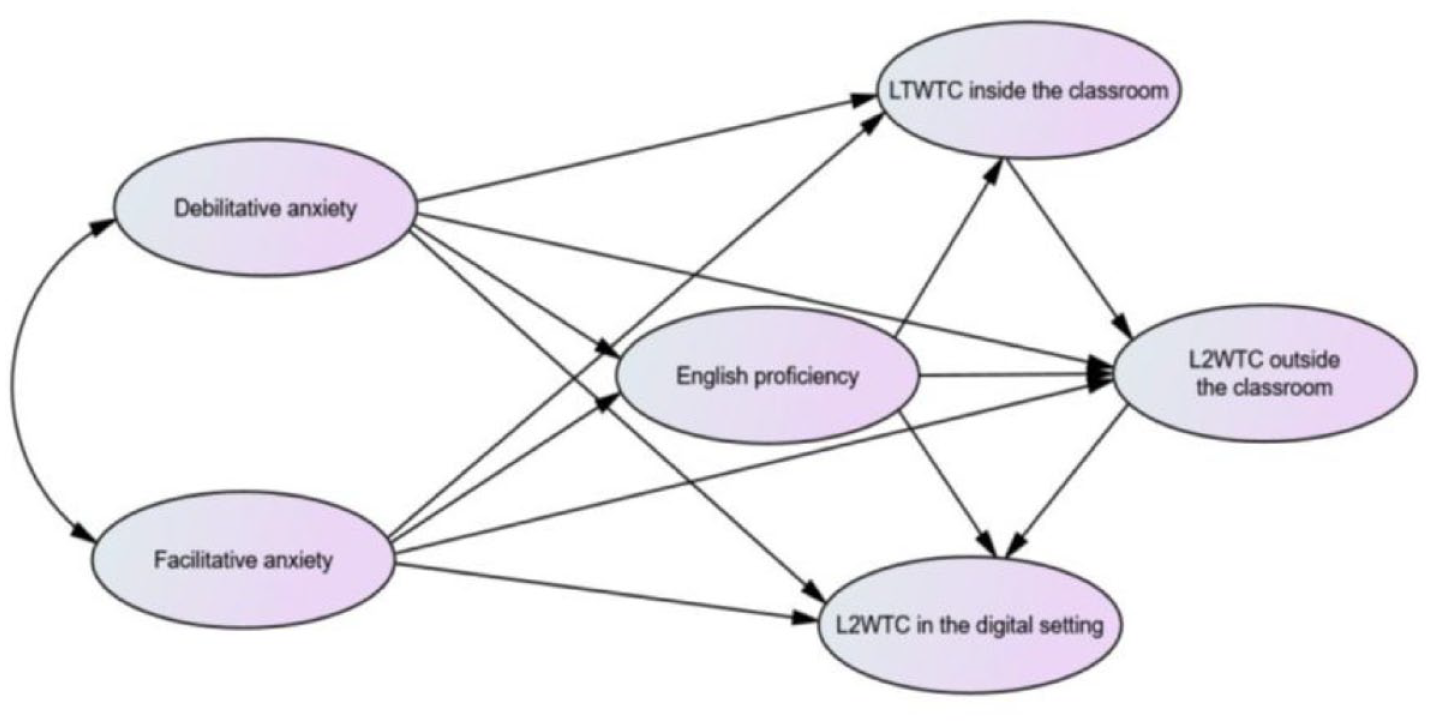
The hypothesized model.
The model also suggests that facilitative anxiety positively and significantly influences L2WTC in the three contexts. This idea aligns with the findings of studies conducted by Piniel and Csizér (2013) and Papi (2010), highlighting the positive impact of facilitative anxiety (positive stress) and anxiety on communication behaviour.
We expect English proficiency to be negatively and significantly impacted by debilitative anxiety, as was found in studies conducted by Alpert and Haber (1960), Alrabai (2022a), Gerencheal (2016), Horwitz et al. (1986), Kleinmann (1977), Piniel and Csizér (2013), and Teimouri et al. (2019). However, we assume that English proficiency is positively impacted by facilitative anxiety, as was documented by Alpert and Haber (1960), Kleinmann (1977), Papi (2010), and Piniel and Csizér (2013).
Finally, we expected that English proficiency confidence positively and directly impacted L2WTC both in and out of the classroom, supported by previous studies like Nagy (2007) and Yashima et al. (2004) and in the digital setting.
IV Method
1 Research design
The current study employed a cross-sectional quantitative survey research design (Creswell, 2012), a typical approach to collecting numerical data from a population at a specific time. The collected data was analysed using structural equation modelling (SEM) to test the relationships among variables and predict how they impacted one another.
2 Setting and participants
The study was conducted during the first semester of 2022–23. It involved 12th-grade students who were preparing to transition to university. This transition is critical because it provides insights into students’ needs, which can help tailor teaching approaches when they join higher education institutions. They learn English in 45-minute classes every weekday. The sample comprised 609 (352 men and 257 women) volunteers aged 18–23 years (M = 20.6, SD = .72) out of 652 students (314 females, 338 males).
3 Instruments
We used various methods recommended by Creswell (2012) and Dörnyei and Taguchi (2009) to develop and pilot the research instrument. The present study draws upon the literature and adapts two types of anxiety: facilitative anxiety (Alpert & Haber,1960; Piniel & Csizér, 2013; Welesilassie & Nikolov, 2022) and debilitative anxiety scales (Alpert & Haber, 1960; Horwitz et al., 1986; Papi, 2010; Piniel & Csizér, 2013). In addition, the study also draws upon the literature and adapted the L2WTC construct to three settings: inside the classroom (MacIntyre et al., 2001), outside the classroom (Nagy, 2007), and in the digital context (Lee & Chen Hsieh, 2019; Lee & Lee, 2019).
Finally, the study asked participants to self-assess their English proficiency. The tool for self-assessment was developed based on the Common European Framework of References. The categories were A1–A2 (Basic user), B1–B2 (Independent user), and C1–C2 (Proficient user) (Council of Europe, 2020).
The Ethiopian education system lacks comprehensive standardized English language proficiency measures. This fact creates a challenge in assessing language learning outcomes and comparing different language programs in Ethiopia. The only data available were English subject test scores and national examination results. However, a school test grade as an achievement measure can be unreliable, as it is influenced by many factors (Dörnyei & Chan, 2013). Furthermore, the English for Ethiopians National Examinations lacks reliable representation of language skills, as they emphasize grammar (60 items, 37.5%) and reading (43 items, 26.9%), while other skills are given less attention (Gashaye, 2020).
Accordingly, we developed a self-assessment scale for English proficiency using three criteria to fill this gap. First, we gathered specific objectives for each chapter from the preparatory textbooks to understand the core competencies that students developed. Second, we analysed the final and national exams to determine the competencies they measured. Finally, we related this information to the CEFR based on the first author’s 13 years of experience teaching English in various higher educational institutions in Ethiopia. After this process, we classified students as ‘basic users’ (A1 and A2) of English. Accordingly, on a 6-point Likert scale, we worded 11 ‘can do’ statements that students could use to rate their confidence in doing specific tasks.
The scale included items on reception (listening and reading comprehension), spoken and written interaction and production. We evaluated how the items worked in a pilot study conducted in September 2022 with four teachers and 12 students of comparable proficiency to the target group. The pilot study assessed the items’ suitability, user-friendliness, and efficacy. After the pilot study, we refined the items and translated the questionnaire into Amharic, Ethiopia’s official language. This approach was crucial in ensuring that our research instrument was linguistically and culturally relevant to the target population.
The final questionnaire consisted of seven items for each of the following factors: L2WTC inside the classroom (e.g. ‘I am willing to talk in group discussions in an English class’; α = .71), L2WTC outside the classroom (e.g. ‘I am willing to talk in English with an English-speaking waiter/waitress in a restaurant’; α = .83), L2WTC in digital settings (e.g. ‘I am willing to communicate with others in English through social media platforms such as Facebook, WhatsApp, and Skype’; α = .92), and English proficiency (α = .76), as well as four items for facilitative (e.g. ‘I am more productive when I feel anxious’; α = .83), and four for debilitative anxiety (e.g. ‘Even when I know the answers, I cannot remember them in English class’; α = .79).
4 The procedure of data collection and analysis
After obtaining approval from the Institutional Review Board of the Doctoral School of Education, University of Szeged, we informed potential participants about the study’s purposes, steps, benefits, and risks in November 2022. Students who had signed consent forms were invited to respond to the survey. Participants used pencil-and-paper questionnaires to rate their level of agreement or disagreement with statements on a 6-point Likert scale ranging from ‘strongly disagree’ to ‘strongly agree’. It took approximately 30 minutes to complete the questionnaire. To analyse the data, we used IBM SPSS 25 to report descriptive statistics and correlation analysis. AMOS 23 was used to evaluate the measurement models, structural models, and prediction effects (Byrne, 2013; Kline, 2016).
V Results
The first objective of this study was to examine the relationship between L2 anxiety, English proficiency, and L2WTC inside and outside the classroom, as well as in digital settings. Table 1 shows that students’ means on their debilitative anxiety were high (M = 3.93, SD = .92), whereas their means on facilitative anxiety and proficiency were lower (M = 2.58, SD = 1.01) and (M = 2.31, SD = .98), respectively. The mean scores of L2WTC were generally low, ranging from 2.30 to 2.84 across the three settings. The statistical analysis revealed that students’ L2WTC was higher outside the classroom (M = 2.84, SD = .94) and in the digital environment (M = 2.65, SD = .65) compared to their L2WTC inside the classroom (M = 2.13, SD = 1.00). A Shapiro–Wilk test was also conducted to verify the normal distribution of all variables. The test statistics ranged from W = 0.96 to W = 0.98, with corresponding p-values exceeding 0.05. These results support the appropriateness of parametric analyses, such as Pearson correlations, in the subsequent statistical examinations.
Descriptive and correlations of participants’ L2WTC (inside and outside the classroom and in digital settings), L2 anxiety (facilitative anxiety, debilitative anxiety, and English proficiency.
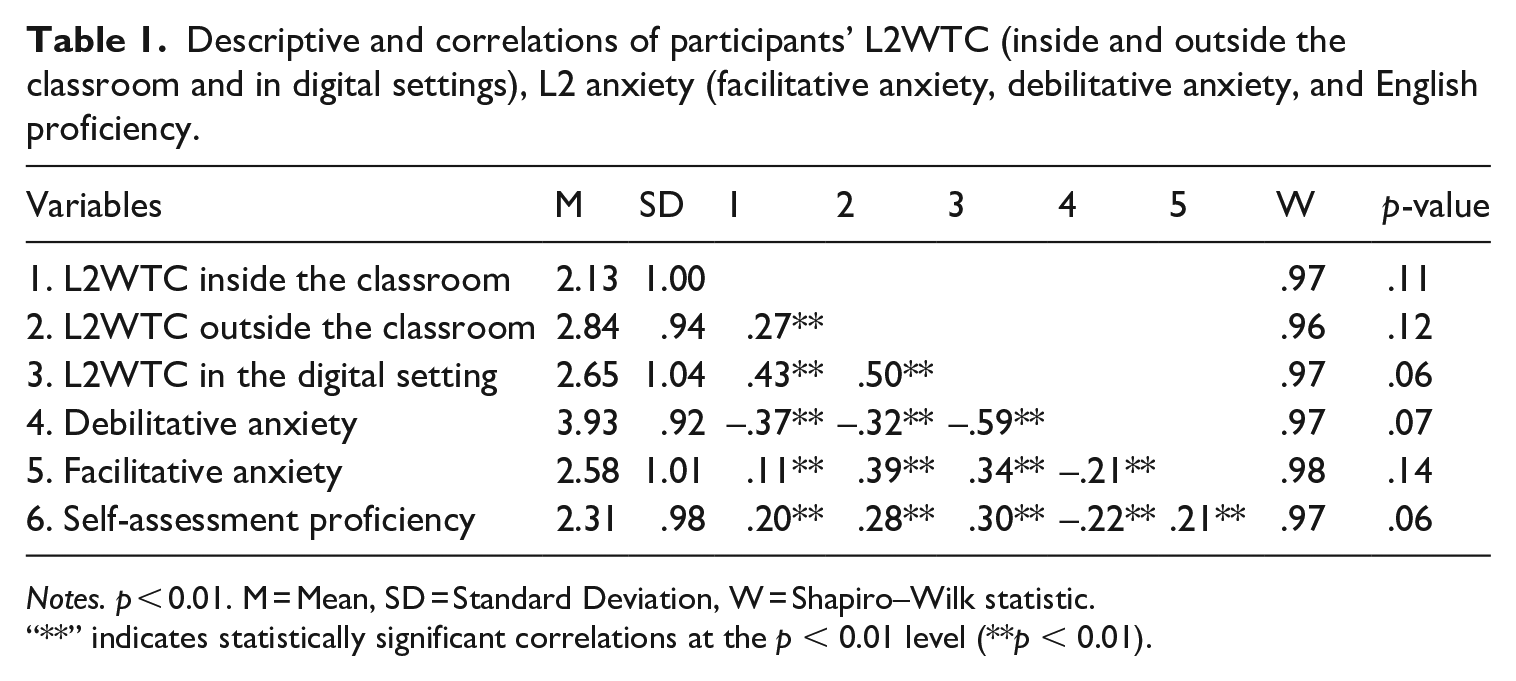
Notes. p < 0.01. M = Mean, SD = Standard Deviation, W = Shapiro–Wilk statistic.
“**” indicates statistically significant correlations at the p < 0.01 level (**p < 0.01).
The second aim was to examine the relationships between L2 anxiety and L2WTC and English proficiency. As illustrated in Table 1, the results indicate that debilitative anxiety showed a statistically significant negative correlation with L2WTC in various contexts, including inside (r = −.37, p < .01), outside (r = −.32, p < .01), and in digital settings (r = −.59, p < .01). Facilitative anxiety had a statistically significant positive relationship with L2WTC inside (r = .11, p < .01), outside EFL classes (r = .39, p < .01), and in digital settings (r = .34, p < .01). English proficiency had a statistically significant negative correlation with debilitative anxiety (r = −.22, p < .01), and a positive correlation with facilitative anxiety (r = .21, p < .01). Moreover, self-assessment proficiency had a statistically significant positive relationship with L2WTC inside the classroom (r = .20, p < .01), outside the classroom (r = .28, p < .01), and in the digital setting (r = 30, p < .01).
To address research question 3 on the causal relationships among the variables, we used AMOS version 23.0 for SEM. This approach divided the SEM model into two segments: a measurement model and a structural one. The measurement model used the maximum likelihood technique. Confirmatory factor analyses (CFAs) were conducted to evaluate the reliability and validity of the proposed model, guaranteeing that the latent variables precisely captured the intended constructs. The study relied on fit indices such as RMSEA, GFI, TLI, and CFI, as earlier studies such as Tseng et al. (2006) recommended. In order for a model to exhibit satisfactory goodness of fit, the GFI, TLI, and CFI should exceed .90, while the RMSEA should fall within the .05–.08 range (Taguchi et al., 2018; Tseng et al., 2006).
Certain items were excluded from the measurement models to comply with standards, as their factor loadings were below .50 (Tseng et al., 2006). For example, we excluded one item related to L2WTC outside the classroom: ‘I am willing to discuss with a small group of friends in English,’ and another item associated with L2WTC in the digital setting: ‘I am willing to chat with native speakers of English on Facebook.’ These items were deemed unsuitable for the analysis, as they overlapped with other variables. The results presented in Table 2 indicate that the model’s reliability and fit indices were within acceptable thresholds.
Fit indexes for the measurement models of the six variables.
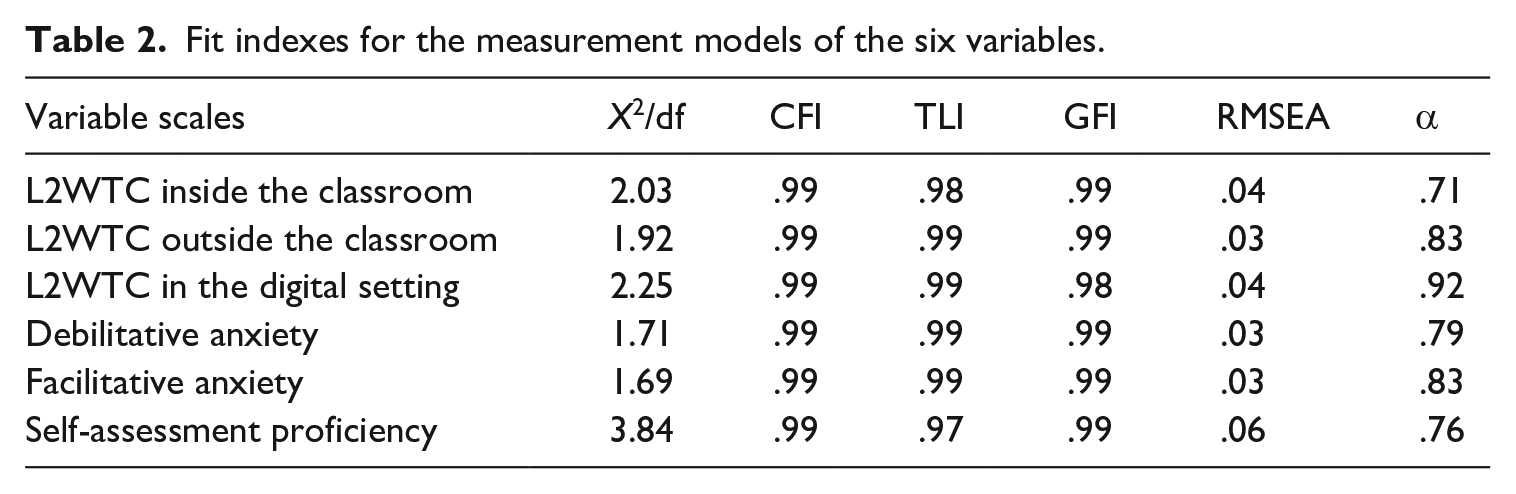
As part of the SEM process, we created a comprehensive structural model by incorporating measurement models. This approach was grounded in established L2WTC models we discussed in Section III.2. The initial analysis indicated that the proposed model adequately accounted for the observations. However, we found that the route from the facilitative anxiety to L2WTC in the classroom did not significantly impact the final model. We removed this pathway from the final model to improve its precision and alignment with the data. Ultimately, the model aligned well with the data (with x2 = 728.173; df = 238; x2 /df = 3.06; GFI = .91, TLI = .92, CFI = .93, and RMSEA = .05); see standardized path coefficients in Figure 2.
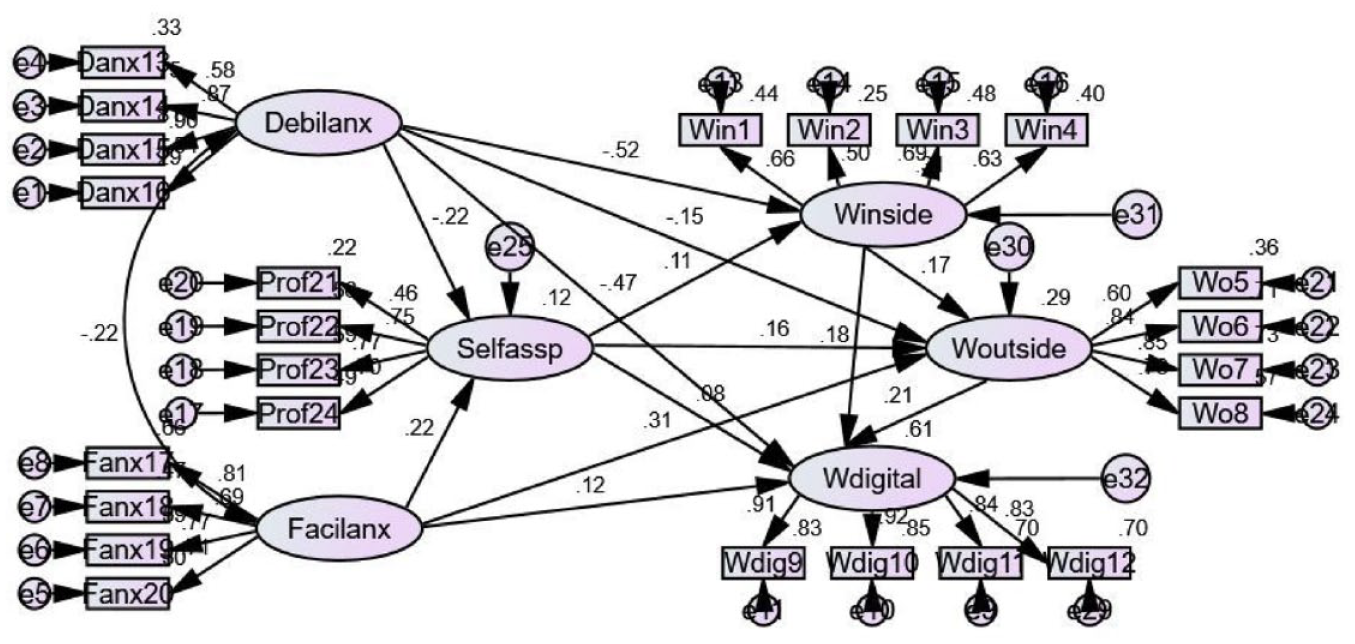
Full structural equation model.
Once we assessed the overall model, we evaluated the effect size and significance of the path coefficients. All direct effects among the variables in the model are shown in Figure 2. According to the model, debilitative anxiety displayed a statistically significant negative impact on L2WTC inside (β = −.52, t = −8.13, p = .000), outside (β = −.15, t = –2.69, p = .001) EFL classes, and in digital settings (β = −.47, t = −8.84, p = .000), and students’ level of English proficiency (β = −.22., t = −4.41, p = .000). Facilitative anxiety was found to positively contribute to L2WTC outside the classroom (β = .31, t = 6.31, p = .001), in digital settings (β = .12, t = 3.36, p = .000), and to English proficiency (β = .22, t = 4.42, p = .000). English proficiency positively and statistically significantly contributed to the L2WTC in (β = .11, t = 2.13, p = .000) and outside the classroom (β = .16, t = 3.21, p = .001). and in digital settings (β = .08, t = 2.20, p = .000). L2WTC inside the classroom was found to positively contribute to L2WTC beyond classrooms (β = .17, t = 2.87, p = .001) and in digital contexts (β = .18, t = 3.96, p = .000).
VI Discussion
The study investigated the relationship between L2 anxiety, English proficiency and L2WTC in classrooms, outside the classes, and digital environments. Additionally, it explored the impact of L2 anxiety on both English proficiency and L2 willingness to communicate. The study revealed a complex psychological landscape among these variables for Ethiopian students studying English as a foreign language. Ethiopian students reported experiencing high levels of debilitative anxiety while simultaneously documenting low levels of facilitative anxiety. Facilitative anxiety can be a constructive and controllable form of stress that can be beneficial to learners, as it encourages them to stay focused and engaged. In contrast, debilitative anxiety can be an unmanageable and harmful type of stress, as it may harm comprehension and communication.
The students who simultaneously experience different levels of facilitative and debilitative anxiety validate the assumptions put forth by Alpert and Haber (1960) and MacIntyre (2017). According to Alpert and Haber (1960) and MacIntyre (2017), the critical point is that these two types of anxiety can coexist independently. This emphasizes that individuals can encounter varying degrees of both facilitating and debilitating anxiety, sometimes at the same time. This underscores the importance of recognizing these anxieties as distinct yet interconnected aspects of the learning process.
For instance, a student may experience a degree of facilitating anxiety while preparing for an examination, which may serve to encourage diligent study and practice of their speaking skills. However, when faced with the actual speaking test, this same student may encounter debilitating anxiety, leading to struggles with self-doubt and performance pressure, ultimately impairing their ability to articulate thoughts clearly. This observation implies that anxiety is not a one-size-fits-all phenomenon; instead, it may manifest in varied ways based on the context and individual responses, thus uniquely influencing learners’ experiences.
These results were consistent with the findings of Andualem Desta (2019), Lee and Chen Hsieh (2019), Gerencheal (2016), and Surur and Dengela (2019), reporting high levels of anxiety that negatively affect language learning. However, the outcomes of the present study differed from the results of studies by Brauer et al. (2023), Lee and Lee (2019), Peng (2015), and Zhou et al. (2020), reporting lower levels of anxiety that negatively affect language.
The level of facilitative anxiety among preparatory school students was low, suggesting the lack of positive stress motivating them to work harder and do better. The students with high levels of debilitating anxiety and low levels of facilitative anxiety faced a significant challenge in learning English, as their negative aspects of anxiety (fear, self-doubt) were more prominent than the positive aspects, allowing them to show motivated behaviour and focus their attention on learning. Previous studies showed that the classroom environment, teaching methods, assessment practices, students’ low self-confidence and English proficiency can contribute to their debilitative anxiety (Surur & Dengela, 2019). If the learning environment is perceived as unsupportive, competitive, or judgmental, it can worsen anxiety (Dörnyei, 2005; Horwitz, 2010; MacIntyre et al., 2003; Papi, 2010; Papi & Khajavy, 2023).
The result showed that students’ L2WTC across diverse settings, including inside and beyond the classroom and in digital environments, was low. Participants were reluctant to communicate in English inside the classroom with familiar interlocutors such as their teachers and peers. They hesitated to ask questions, seek clarification, or participate in role-play activities. Various factors play a role in determining students’ WTC in EFL classes. The individuals they interact with, including peers and teachers, the topics they discuss and the tasks they do can considerably impact this aspect of student behaviour (Macintyre et al., 1998). In the Ethiopian context, it is plausible that pedagogical practices of teacher-led instruction and grammar-focused teaching, coupled with a rigidly prescribed curriculum, lack of practice opportunities, and low self-confidence (Haile & Tilahun, 2019; Surur & Dengela, 2019; Welesilassie & Nikolov, 2022) may adversely affect students’ willingness to communicate in the classroom.
Their low level of L2WTC in the EFL classes extends beyond the classroom setting to both face-to-face social interactions and online communication platforms. This reluctance to speak in the classroom significantly impacted their WTC in social gatherings, extracurricular activities, and interactions with friends and native and non-native speakers outside classrooms on digital platforms such as social media, which are increasingly essential for communication (Lee & Lee, 2019). This outcome is particularly concerning, as digital platforms have dramatically reshaped the language learning landscape, and students who are uncomfortable communicating in L2 online may be disadvantaged in the long run.
In Ethiopia, the limited exposure to extramural English makes EFL classes the primary source of language learning opportunities for these students. Limited classroom practice can cause reluctance to communicate in social settings, extracurricular activities, and online platforms. Our findings are aligned with previous studies that reported a low level of L2WTC in classrooms, such as Lee and Lee’s (2019) research in Korea and Lee and Chen Hsieh’s (2019) study in the Taiwanese context. However, the present study revealed a contrasting trend of low L2WTC in digital contexts and outside the classroom, not in line with findings in studies by Lee and Lee (2019), Lee and Chen Hsieh (2019) and Zhou et al. (2020). Lee and Lee (2019) and Lee and Chen Hsieh (2019) reported a high level of L2WTC in digital contexts, and Zhou et al. (2020) reported a high level of L2WTC outside the classroom.
Inconsistencies in research findings regarding the willingness and effectiveness of online language use among students from different countries may be attributed to the differences in digital literacy and infrastructure. Specifically, when comparing students from Ethiopia to those from Korea or Taiwan, we claim that Ethiopian students may lack the digital skills required for successful online L2 use. According to Demissie et al. (2022), the Ethiopian educational situation is characterized by limited exposure to digital technologies and a lack of formal digital education. These factors may contribute to participants’ reluctance to communicate in digital settings. Students’ limited access to digital infrastructure may also play a pivotal role. In Ethiopia, students have insufficient or inconsistent access to digital infrastructure, such as stable internet connection, computers and smartphones, and online learning platforms (Demissie et al., 2022). These factors may hinder students’ ability to participate in online communication regularly, impacting their ability to develop L2 skills through authentic and voluntary online language use.
Regarding the relationship, the study revealed that debilitative anxiety had the most significant negative impact on L2WTC in the classroom, followed by their willingness to interact in real-life and digital settings. The finding was consistent with the research conducted by Piniel and Csizér (2013), which indicates that debilitative anxiety, a form of negative stress, has a detrimental impact on learners’ ability to engage and persist in language learning activities actively.
Horwitz et al. (1986) linked debilitating anxiety to various factors, including feeling intimidated in formal classrooms, fear of making mistakes in front of peers, and the pressure to excel under the teacher’s guidance. This is particularly relevant in the Ethiopian cultural context, where errors are often regarded as a sign of incompetence (Gerencheal, 2016), thereby adding to the pressure on students to perform flawlessly in front of their peers and instructors. As a result, students may hesitate to participate in classroom discussions, ask questions, or engage in activities requiring them to speak in English. The findings of the present inquiry are consistent with previous studies by Alrabai (2022a), Khajavy et al. (2018), Lee and Chen Hsieh (2019), Lee and Lee (2019), and Peng (2015) documenting that anxiety negatively impacts L2WTC in classroom settings. Therefore, it can be inferred that debilitating L2 anxiety prevents students from using learning opportunities in their EFL classes.
Similarly, debilitative anxiety exerted a detrimental effect on students’ L2WTC in informal settings. Lee and Chen Hsieh (2019) reported that anxiety negatively impacted L2WTC outside classrooms, which is consistent with our findings. This suggests that the negative impacts of anxiety experienced during interactions with familiar interlocutors in classroom contexts tend to extend beyond the classroom to informal, authentic social situations, including interactions with familiar and unfamiliar acquaintances or encounters in public spaces.
The impact of debilitative anxiety also persisted in digital environments where students may interact on online forums, social media platforms, or in virtual classrooms. The present findings diverged from those of Lee and Lee (2019), who found a non-significant association between anxiety and L2WTC in digital settings. However, the current results align with Lee and Chen Hsieh (2019), who reported moderately negative correlations.
The possibility of encountering technical issues, like a weak internet connection or a lack of knowledge of digital tools (Demissie et al., 2022), could cause anxiety in individuals. This anxiety can negatively impact their learning experience and may lead to hesitance to engage in online classes, group chats, and authentic forums in English. Another critical factor to consider is that many Ethiopian students may feel that the mistakes they make in the digital environment are permanent and highly visible, leading to a fear of public humiliation. In face-to-face interactions, errors can be momentary and usually only affect those involved. However, errors may be recorded digitally, seen, and shared with a larger audience. Students may worry that their mistakes will negatively impact how their peers perceive them, making them hesitant to communicate in English online.
Facilitative anxiety, in contrast, has been found to positively influence L2WTC, particularly in extracurricular contexts and in digital environments. These research findings aligned with the results of Piniel and Csizér (2013) and Papi (2010), highlighting the positive impact of anxiety on communication behaviour. The studies emphasize the beneficial role of anxiety in communication behaviour and language acquisition. Piniel and Csizér (2013) demonstrate that facilitative anxiety, described as positive stress, effectively motivates learners to engage and persist in language learning activities, enhancing their involvement and drive. Similarly, Papi (2010) found that students who experienced anxiety related to their English studies were more motivated, channelling their apprehension into increased effort and dedication to the learning process. These findings collectively suggest that anxiety should not be viewed solely as unfavourable but as a potential motivator, contributing to a more dynamic and effective learning environment.
Debilitative anxiety and facilitative anxiety had the opposite impact on English proficiency. The presence of debilitative anxiety was discovered to have a negative impact on English proficiency, whereas facilitative anxiety was found to have a positive effect on English proficiency. The study’s findings were consistent with the research conducted by Piniel and Csizér (2013), which revealed that both types of anxiety impact motivated learning behaviour. The authors observed that increased levels of self-efficacy were positively correlated with facilitating anxiety and inversely related to debilitating anxiety.
Numerous studies have shown that anxiety can be a significant obstacle to effective language use and performance. Publications by Alrabai (2022a), Alrabai (2022b), Andualem Desta (2019), Gerencheal (2016), Haile and Tilahun (2019), Horwitz et al. (1986), Surur and Dengela (2019), and Teimouri et al. (2019) reported that anxiety can negatively impact language learning outcomes. Gardner and MacIntyre (1993) found negative correlations between student anxiety scores and their self-ratings of French competence rather than with their actual performance on the tests of French ability. However, some studies suggested that anxiety can also have a positive effect on learning. For example, Papi (2010) demonstrated that students facing English anxiety exhibited higher motivation to study and devoted more effort to their academic endeavours. Similarly, Taye (2018) discovered that anxiety and achievement have a curvilinear relationship, with moderate levels of anxiety improving performance while excessive anxiety impairing it.
Two reasons may account for the disparities. First, narrowly focused evaluation tools that only measure debilitating anxiety may not consider positive emotions. Anxiety as a psychological phenomenon is not a binary construct but rather a spectrum. The established view that anxiety is a condition with only two options, either present or absent, does not accurately represent the complexity of its manifestation. Instead, anxiety presents itself in a multitude of intensities and forms; therefore, researchers including Papi (2010), Piniel and Csizér (2013), and Scovel (1978) recommend the use of diverse metrics, including facilitative and debilitative types, to clarify their relationships with language proficiency, and this is what the present study did. Second, relying solely on course grades to gauge language proficiency may not be sufficient. According to Dörnyei and Chan (2013), while grades are a crucial indicator of academic achievement, they may be influenced by factors beyond anxiety, including the students’ motivated behaviour, use of strategies, and other contextual factors.
In the study, the relationship between facilitative anxiety and English proficiency was examined, and it was revealed that facilitative anxiety had a positive impact on English proficiency. This suggested that experiencing healthy and manageable levels of anxiety (facilitative anxiety) contributed to improved English proficiency. This outcome is consistent with previous research by Alpert and Haber (1960), Kleinmann (1977), and Piniel and Csizér (2013), as they also reported the positive impact of facilitative anxiety on L2 learning. In contrast to debilitating anxiety, which may hinder learning outcomes, facilitative anxiety can play a helpful role in improving English language skills.
The positive correlation between students’ self-perceived English proficiency and their inclination to communicate across diverse contexts underscores the profound impact of personal language competence perceptions on language usage. The findings are consistent with the research of Nagy (2007) and Yashima et al. (2004), who observed a significant link between perceived communication abilities and L2WTC, both within and outside the academic environment. They concluded that self-perceived communication competence was the most significant predictor of L2WTC inside and outside the classroom. Individuals with robust confidence in their language abilities demonstrate a heightened propensity to partake in English communication. This finding aligns with the widely acknowledged influence of linguistic confidence on foreign-language interaction. Notably, students who harbour unwavering faith in their English proficiency exhibit a proclivity for articulate and assured communication (Macintyre et al., 1998).
This augmented self-assurance catalyses increased motivation and enthusiasm to participate in language communication within educational settings and digital interfaces (Lee & Chen Hsieh, 2019; Lee & Lee, 2019). Individuals with proficiency in English are more inclined to engage in classroom dialogues actively, pose queries, and interact with peers and educators in English. This dynamic involvement fosters an environment conducive to language practice and cultivation. Moreover, their linguistic self-assurance propels them to actively embrace English communication opportunities beyond academic domains, encompassing social exchanges, community engagements, and real-life scenarios. This proactive approach to language utilization further augments their language fluency and proficiency.
The study’s findings revealed a compelling association between L2WTC within the classroom and its positive impact on language use outside and in digital contexts. The study’s findings align with research by Lee and Lee (2019) and Peng (2015), fortifying the argument that active involvement in classroom discourse is crucial for motivating students to employ English in genuine contexts. The findings underscore the pivotal role of classroom engagement in nurturing overall language proficiency among these students and the need to create more dynamic and interactive classroom environments. The research findings also emphasize the fundamental function of the classroom as a setting where students can bolster their confidence and hone their language abilities, subsequently applying them in real-life situations.
VII Conclusions and pedagogical implications
The present cross-sectional quantitative study investigated the relationships between anxiety and L2WTC in various settings (in-class, out-of-class, and digital) and English proficiency. It enriches the field by five significant findings. First, Ethiopian students’ willingness to communicate in in-class and out-of-class digital settings was low. An unwelcoming, competitive, or critical learning environment can deter students from participating in tasks and communicating in English. Therefore, teachers should establish a supportive and personalized learning atmosphere by using teaching strategies and assessments that provide constructive, specific, timely, and actionable feedback and non-threatening opportunities for students to practice their English.
In addition to this, policymakers should focus on developing a comprehensive set of English language education policies that enhance teachers’ and students’ digital literacy, their ability to use digital technology effectively and safely, and expand digital infrastructure, including reliable internet connection, access to computers or smartphones, and digital learning platforms.
Second, debilitative anxiety, the type riddled with fear, worry, and self-doubt, tends to overshadow the positive aspects of anxiety: motivation, focus and attention to tasks. The adverse effects of anxiety outweighed the beneficial ones in participants’ self-reports. Teachers should consider integrating anxiety reduction strategies into their teaching practices to address this issue. These techniques can include mindfulness exercises that help students stay focused and present, resilience training that teaches them how to overcome setbacks, relaxation techniques that allow them to manage stress effectively, and cognitive-behavioural interventions that help them identify and change negative thoughts and behaviour patterns contributing to their anxiety. Teachers should also use techniques such as surveys, observations, and interviews to identify the type and level of anxiety of their students and modify their teaching methods accordingly.
Third, the mean score for students’ English proficiency was low. Providing frequent and comprehensive feedback and motivating learning opportunities is essential to increase their English language proficiency. Feedback should diagnose weak areas in their L2 skills and suggest interventions to address these gaps.
Finally, we found evidence indicating a notable adverse effect of debilitative anxiety on the inclination to engage in communication within various settings, including both in-class and digital environments. Conversely, the influence of facilitative anxiety on communication in these contexts demonstrated a positive correlation.
In Ethiopia, these results have important implications. Many Ethiopian students experience overwhelming anxiety due to fear of making mistakes, lack of confidence in their language skills, and pressure to succeed in academic settings (Welesilassie & Nikolov, 2022, 2024). This anxiety frequently results in a decreased willingness to communicate, which obstructs language acquisition and fluency both in classroom and online interactions. Conversely, facilitative anxiety can drive learners to participate more actively in language practice through in-person interactions or digital platforms.
In order to tackle these challenges, educators in Ethiopia have the opportunity to introduce focused measures aimed at alleviating debilitating anxiety, such as establishing a supportive classroom environment that recognizes errors as integral to the learning journey. Furthermore, integrating activities designed to cultivate a sense of enthusiasm and stimulation, thus harnessing the constructive elements of conducive anxiety, holds the potential to foster increased student engagement. Through the cultivation of a learning milieu that is both nurturing and stimulating, educators can enrich interaction and effectively enhance language proficiency among Ethiopian EFL students.
VIII Limitations and future research
Although the study revealed critical causal relationships among variables in the Ethiopian preparatory high school context, it is essential to recognize its limitations for future research. While the study included a substantial sample of EFL students, caution should be exercised when generalizing the results to other contexts due to the focus on preparatory high school students in Ethiopia. We acknowledge the contextual specificity of this cohort and its implications for the generalizability of the findings. To allow researchers to expand the research design, integrating mixed-methods approaches could provide a more comprehensive understanding of the phenomena under investigation.
Furthermore, longitudinal studies would be essential to capture the dynamic nature of anxiety and its interaction with L2 learning outcomes over time. Exploring a broader array of learner variables, such as gender, age, social status, aptitude, motivation and other individual differences beyond those initially considered, is critical to uncovering a more extensive spectrum of factors influencing anxiety, learning outcomes in English, and other related factors. Finally, future studies should acknowledge the pivotal role of cultural influences shaping students’ encounters with anxiety and L2 learning for a nuanced analysis of these phenomena.
Footnotes
Funding
The author(s) received no financial support for the research, authorship, and/or publication of this article.
Ethics approval statement
The investigation was carried out under the guidelines established by the Institutional Review Board (IRB) at the Doctoral School of Education, University of Szeged, Hungary, with reference number 13/2022. The research received official approval, and written informed consent was obtained.
