



Abstract
Phrasal verbs are important for successful communication and yet are incredibly challenging for language learners. The current study compared two exercise formats for the learning of phrasal verbs. One format draws attention to the verb, while the other brings into focus the particle. In the verb-focused format, students were asked to guess the missing verb before receiving feedback. In the particle-focused format, they were told to guess the missing particle before feedback was presented. The results of a cued-recall test showed that the recall of phrasal verbs was enhanced more effectively in the particle-focused format than in the verb-focused format, although this advantage diminished after one week. A multiple-choice test revealed no significant difference between the two methods in terms of their impact on the recognition of phrasal verbs. The current study also aimed to test the prediction of the episodic recollection hypothesis, which specifies that memory of the initial guess plays a critical role in the subsequent recall of the correct answer. It was also found that asking students to recall their initial guess moderated their performance in the posttest. Overall, the findings of the current study suggest that the particle-focused format boosts the memory of phrasal verbs and that to minimize the adverse effects of proactive interference, it is vital for students to remember their errors. This means that teachers would be advised to focus on exercises that provide the verb and encourage guessing of the particle.
I Introduction
Phrasal verbs are widely recognized as crucial for learners of English as a second/foreign language for various compelling reasons. First, phrasal verbs are common in everyday spoken English (Gardner & Davies, 2007). Thus, students who understand and use phrasal verbs correctly can improve their comprehension of spoken English (Liu, 2011). Second, phrasal verbs can add nuance and specificity to language, allowing students to express themselves more clearly and accurately (Cornell, 1985). Third, knowing common phrasal verbs is an important part of achieving fluency in English (Liu & Myers, 2020). Thus, learning phrasal verbs is a crucial step for students on their path to fluency. Finally, learning phrasal verbs can also help students expand their vocabulary and improve their overall language skills.
Despite their importance, phrasal verbs pose numerous learning challenges. One obstacle is deciphering the meaning of phrasal verbs. These constructions often have meanings that differ from the words that comprise them, making them challenging to understand and use correctly. For example, the phrasal verb “turn off” can mean to stop something from functioning, whereas the verb “turn” on its own can mean to rotate or change direction. This can make it difficult for learners to grasp the meaning of phrasal verbs without explicit instruction or supportive context. Another complexity arises from the fact that phrasal verbs can vary in their meaning depending on the context in which they are used. For example, the phrasal verb “put off” can mean to delay or postpone something, but it can also mean to cause someone to dislike something. This added layer of complexity can further complicate the process of understanding and using phrasal verbs correctly.
In recognition of the difficulties students face in learning phrasal verbs, researchers have investigated how these constructions can be effectively presented to learners. In recent years, some researchers have examined the value of phrasal verb exercise formats in textbooks on English as a second language (ESL). Of particular interest have been the formats that bring into focus one of the component words of a phrasal verb. For example, one format draws attention to the verb by deleting and replacing it with an underlined space (e.g. I hang __ with my friends on the weekend). Another format highlights the particle instead of the verb in order to draw attention to the particle (e.g. I __ out with my friend on the weekend).
Having students take note of one component word over the other is assumed to enhance memory for that word. While highlighting the whole phrasal verb may seem more effective (Ferguson et al., 2021), some researchers have suggested that the particle deserves special attention because it causes the most confusion. This confusion can arise because particles often have multiple meanings and can drastically change the meaning of the verb with which they are paired. Therefore, it is assumed that the particle-focused format may be more effective than the verb-focused one. However, there is little research to support this assumption.
A concern raised in recent years is what happens when students fail to provide correct answers in these exercise formats. For example, instead of out, they give on as a response in the gapped sentence I hang __ with my friends on the weekend. Do the errors help or hinder learning the phrasal verb? This concern is warranted, considering that exercises are often implemented to promote learning through trial and error in textbooks.
In textbooks, students are asked more often to study a set of phrasal verbs after an exercise in the form of feedback than to study a set of phrasal verbs before an exercise (Strong & Boers, 2019a). Strong and Boers (2019a, 2019b) found the study-after-exercise implementation of a particle-focused format to be consistently less effective than the study-before-exercise implementation. It was also found that the errors students made in the exercise hindered their learning of the feedback. Yet, a growing body of evidence shows that incorrect guessing can improve memory for second-language vocabulary items compared to errorless learning (Potts & Shanks, 2014; Potts et al., 2019; Seabrooke et al., 2019).
It has recently been proposed that the benefit of incorrect guessing is related to whether students can recollect their initial guess at the time of the final test (Metcalfe & Huelser, 2020). It is assumed that if the error can be recalled, it will trigger the memory of the correct answer. If true, it may be the case that the students in the studies by Strong and Boers (2019a, 2019b) were unsuccessful in recalling most of the correct responses in the posttests because they could not recollect their initial guesses. This assumption is supported by a recent study by Strong and Leeming (2023) who demonstrated that episodic recollection of the original errors made in a particle-focused exercise format moderated performance on posttests.
In sum, the current study aims to examine the effectiveness of the particle-focused exercise format by comparing it to the verb-focused exercise format, given the arguments in favour of the former. It is predicted that the particle-focused exercise format will enhance the memory of phrasal verbs more effectively, as measured on a cued-recall test. However, both formats are expected to result in similar levels of learning when measured on a multiple-choice test. In addition, this study seeks to test the episodic recollection account. Unlike previous studies, participants will be asked to recall their initial guesses when studying feedback rather than at the time of the final test. The hypothesis is that the correctness of responses in the posttest will be moderated by whether students successfully recollect their initial errors at feedback.
II Literature review
1 Comparing exercise formats on the learning of multiword expressions
It has been argued that the least effective formats for learning multiword expressions are the ones that bring into focus one component word at the expense of the other. To examine this issue, researchers have compared different exercise formats on learning and retention. For example, Boers et al. (2014) compared three exercise formats for learning verb–noun collocations by university students learning English as a second language. One format consisted of inserting the correct collocations in gapped sentences, while the other formats involved reassembling collocations by underlining or inserting the correct verb in a sentence or connecting words to form a collocation. The results of several trials showed no difference between any of the exercise formats. However, the researchers noticed that when participants were presented with the collocations as intact wholes, the number of cross-associations in the posttest was less than when participants were required to assemble collocations from distinct parts. The researchers suspected that the absence of any significant difference between the exercise formats was likely due to methodological issues, such as the small number of participants in the study.
Due to the limitations of Boers et al. (2014) and the growing calls for research in this area, Boers et al. (2017) carried out a conceptual replication of the study. In addition to the select-the-phrase and select-the-verb formats of a matching exercise, a first-word-given format of the production exercise was examined. The main difference between the two multiple-choice and production formats was that in the production format, no lures were provided except the initial letter of the collocation, which functioned as a cue. The results of a posttest indicated that the select-the-phrase format was superior to the select-the-verb format. This finding confirmed Boers et al.’s (2014) suspicion that treating collocations as intact units leads to better memory of the collocations than when attention is focused solely on the verb.
To explore whether repetition plays a role in enhancing the knowledge students obtain from phrase-focused exercises, Ferguson et al. (2021) compared the same three formats examined by Boers et al. (2017) but had participants repeat the exercise once, twice, or three times. The results of the study showed that the best format was the one in which participants selected the phrase, supporting the findings of Boers et al. (2017). However, the least effective was the first-word-given format. Ferguson et al. (2021) attributed this unexpected finding to the fact that the participants in the study were high school students and may not have been motivated to learn the collocations and may not have been willing to expend the cognitive effort necessary for completing the first-word-given format, which involves generating a response rather than selecting one. As for repetition, the researchers showed that repetition positively affected the memory of verb–noun collocations in all three conditions.
Altogether, the findings of these studies clearly show that not all formats are equally effective for learning multiword expressions. More specifically, the least effective format is the one that requires students to reassemble collocations by choosing the missing verb. Whether these findings hold true for other types of multiword expressions, such as phrasal verbs, and other types of formats, remains to be seen.
2 The effects of incorrect guessing on learning
Textbooks often present a set of phrasal verbs after an exercise in the form of feedback. If students have no prior knowledge of the phrasal verbs, their responses in the exercise are likely to amount to a (wild) guess. Studies have shown that students’ guesses are almost always wrong when exercises are implemented to promote learning through trial and error (Strong & Boers, 2019a, 2019b). However, on posttests, some of their responses turn out to be correct. While the failure to remember the correct responses in a posttest after making an incorrect guess in an exercise is often attributed to proactive interference, it is unclear why incorrect guessing leads to enhanced memory for some phrasal verbs but not for others.
In the field of cognitive psychology, the mechanisms behind the benefit of incorrect guessing have been debated, and several hypotheses have been proposed. The ones relevant to the benefit of incorrect guessing on learning second language vocabulary items are the curiosity account by Potts and Shanks (2014), and the episodic recollection account by Metcalfe and Huelser (2020). According to the curiosity account, making errors fosters more curiosity or interest in learning the answer than simply studying a foreign word and its translation. In addition to this curiosity mechanism, Potts and Shanks (2014) suggested that feedback might induce surprise when it contradicts the initial guess.
The episodic recollection account suggests that the locus of the incorrect guessing benefit is the ability to remember the initial guess at the time of the final test. It is assumed that the recollection of the initial guess triggers the memory of the correct answer, and if the initial guess cannot be remembered, the correct answer is unlikely to be recalled. Metcalfe and Huelser (2020) tested this assumption by asking participants to learn word triplets (e.g. wrist–PALM–hand). First, a double-word cue (e.g. wrist–PALM–??) was shown, and participants were asked to guess the missing target item. After guessing, they were shown the word triplet as feedback. In the final test, in addition to recalling the target item when presented with the double-word cue again, the participants were asked to recall their initial guess. The results showed that when participants recollected their initial guess, they were also more likely to recall the correct target. By contrast, no benefit of incorrect guessing was observed when they could not recall their initial guess. While the episodic recollection hypothesis was not developed to account for the incorrect guessing benefit of learning L2 words, it proposes a mechanism that can account for the results observed in studies on the learning of L1–L1 word pairs as well as L2–L1 word pairs. To test the predictions of this hypothesis with regard to second language vocabulary acquisition, researchers need to conduct further investigations.
III The present study
The purpose of the current study is to compare the effects of a verb-focused and particle-focused exercise format for enhancing the memory of phrasal verbs. This study is motivated by the arguments supporting the view that the particle-focused format is more effective for learning phrasal verbs than the verb-focused format. We predict that the findings of the current study will lend support to this view. The current study is also interested in understanding whether the benefit of incorrect guessing reported in earlier studies is moderated by the ability of students to recollect their initial guess at the feedback stage rather than at the time of the final test, as was done in earlier studies. We predict that memory for the original error will also moderate recall of the correct responses in the posttest even when students are not asked to remember their initial errors at the final test. Our three research questions are presented below:
Research question 1: Which exercise format (verb-focused, particle-focused) is more effective for enhancing the recall of phrasal verbs as measured in a cued-recall test administered shortly after the treatments and one week later?
Research question 2: Which exercise format (verb-focused, particle-focused) is more effective for enhancing recognition of phrasal verbs as measured in a multiple-choice test as administered shortly after the treatments and one week later?
Research question 3: Does recollection of the initial guess at the feedback stage moderate successful retrieval of the correct phrasal verb in the immediate posttests?
IV Method
1 Participants
The participants were 67 first and second-year undergraduate students learning English as a foreign language at a private university in Osaka, Japan. They belonged to two intact classes taught by the second author. The participants completed a background questionnaire asking for their age (M = 19, SD = 0.694), their most recent scores on the TOEIC test (M = 671.30, SD = 117.151), and the number of years they had of formal English study (M = 8.15, SD = 2.772). They also indicated that they had little exposure to English outside the classroom. Participants were informed that their participation in the study was entirely voluntary and that they could withdraw at any stage without impacting their grades for the course. Although enrolled in a compulsory English language course, the participants were not English majors.
2 Materials
Twenty-four target items were selected from the pedagogical list of phrasal verbs (PHaVE), which contains the 150 most common phrasal verbs in English (Garnier & Schmitt, 2015). The list consists of several phrasal verbs that either share the same verb or the same particle. To avoid any potential interference from studying phrasal verbs with duplicate verbs or duplicate particles in one go, the target items were divided into blocks of six, and each block contained a phrasal verb with a unique verb and unique particle. The selection of these phrasal verbs was primarily based on their frequency, as indicated by the PHaVE list, as high frequency phrasal verbs would be of most immediate communicative use to the participants in the study. However, it is important to note that other factors, such as exact rank in frequency, degree of idiomaticity, or polysemy, were not explicitly considered in selecting and grouping these phrasal verbs. This was due to our study’s focus on frequency and the concern that the duplication of verbs and particles within the blocks could potentially influence the learning outcomes.
For each phrasal verb, a definitional paraphrase was created by referring to the supporting material in the PHaVE List. The frequency levels of all the individual words were checked using VocabProfile in Compleat Lexical Tutor (www.lextutor.ca). The results showed a word coverage of 95.2% at the 1,000 level, 99.2% at the 2,000 level and 100% at the 3,000 level. The participants’ proficiency level and the frequency of the individual words suggest they are familiar with all the items in this study.
To avoid a learning effect from pretesting, knowledge of the target items was assessed with a separate group of 20 participants in their third year at the same university and enrolled in an advanced-level English course. These participants were presented with the same cued-recall test that was used to measure the impact of the learning conditions (see below). None of the test responses were correct, indicating that the participants had no prior knowledge of the productive form of the phrasal verbs. Since the participants norming the target items are third-year students with a considerably higher proficiency level than the participants in the main study, it is safe to assume that the results of the cued-recall test can be attributed to the learning conditions. Such a norming procedure has been used in earlier studies (Boers et al., 2017; Ferguson et al., 2021; Strong & Boers, 2019a).
3 Research design
The experiment used a within-participants design. Participants learned half of the target items in one condition and the other half in the other condition. The order of the learning conditions and blocks was counterbalanced. The study consisted of two sessions. Session one comprised the learning conditions and immediate posttests. Separating the learning conditions and the immediate posttest was a distractor task that involved watching a 10-minute YouTube video in Japanese. The purpose of the distractor task was to flush the participants working memory of the phrasal verbs. Session two took place one week later and had the delayed posttests. To prevent participants from studying for the posttest, they were not notified about session two. The entire study was completed in Qualtrics (Qualtrics, Provo, UT), and participants used their smartphones to study the phrasal verbs and provide their responses. The program also controlled time on task. All data were collected electronically.
4 Learning conditions
The fill-in-the-verb condition displayed phrasal verbs in sentences. Next to the sentences were definitional paraphrases of the phrasal verbs. The verbs in the sentences were deleted and replaced by an underlined space. Below each sentence was a textbox. Participants were asked to guess the missing verbs and to type their responses in the textbox. After all guesses within a block were made, the verbs were returned to the sentences as feedback. Below each sentence was a textbox with instructions asking participants whether they could recollect their initial guess and, if so, to type it in the textbox. The fill-in-the-particle condition was exactly the same as the fill-in-the-verb condition, except that instead of the verb, the particle was deleted, and participants had to guess the missing particle. Again, after all guesses within a block were made, the correct particles were provided as feedback, and participants were asked to remember their initial guess.
5 Posttests
The effects of the learning conditions on the recall and recognition of phrasal verbs were assessed using a cued-recall and a multiple-choice test. The cued-recall test measured the ability to retrieve the phrasal verbs from memory in a controlled context. It displayed the same sentences and definitional paraphrases that made up the learning conditions. However, unlike the learning conditions, the verb and particle were deleted and replaced by underlined spaces. This test was used for half the target items.
The multiple-choice test measured the ability to recognize phrasal verbs in a given context. It also presented the same sentences and definitional paraphrases that comprised the learning conditions. The verb and the particle in each sentence were deleted and replaced by underlined spaces. Below each gapped sentence were three lures along with the target item. One lure consisted of the correct verb, but the particle was wrong. The other lure was made up of a wrong verb, but the particle was correct. The next lure consisted of a wrong verb and particle. This test was used for the other half of the target items.
Both tests were administered shortly after the treatments and one week later. This one-week delay was chosen to balance the need to measure retention over time with the practical constraints of our study, such as the availability of participants for follow-up testing. While a longer delay could potentially provide a better measure of long-term retention, it could also introduce more variability due to factors outside the control of our study, such as additional learning that may occur during the delay period. Therefore, we believe that the one-week delay provided a reasonable compromise for our study.
6 Procedure
Participants were sent a Qualtrics link to their smartphone by their English language instructor (the second author). When opened, the instructions for the learning conditions were presented. Participants were asked to read the instructions carefully before proceeding and to ask their instructor for help if they had questions. Participants had four minutes to learn each block. The time was regulated by Qualtrics, which displayed a countdown timer for participants to keep track of their time. However, it is important to note that while the overall time for each block was controlled, the time it took for each student to study the feedback and provide an answer was not recorded. Once the distractor task ended, participants were presented with immediate posttests. No feedback was provided following the tests. One week later, their English language instructor sent the participants another Qualtrics link to their smartphone. The link opened the posttests. After the posttests, the participants were thanked for their participation in the study.
7 Data analysis
Responses in the posttests were scored dichotomously (correct, incorrect). A response with an incorrect particle was marked incorrect because it would have been impossible to determine whether the response was a spelling mistake from a wrong word choice (e.g. in vs. on). For verbs, minor spelling mistakes were accepted as long as they did not hinder the recognition of the correct verb.
In this study, our primary interest was in the full understanding and correct usage of phrasal verbs, rather than partial learning. We aimed to assess whether learners could correctly identify and use both components of the phrasal verbs – the verb and the particle. Therefore, in our scoring of the multiple-choice test, we adopted a stringent approach. Responses that had a correct verb, but an incorrect particle were marked as wrong, as were responses that had an incorrect verb but a correct particle. This approach reflects our focus on the comprehensive understanding and usage of phrasal verbs. We believe that both the verb and the particle are integral to the meaning of phrasal verbs, and learners need to master both components to use these constructions correctly.
To answer research questions 1 and 2, the scores in the cued-recall tests and multiple-choice tests were analysed separately, while to answer research question 3 the immediate posttests of both test types were analysed together. The data were analysed using mixed-effects logistic regression models in Jamovi (version 2.0) with the GAMj module (Gallucci, 2019). The dependent variable in each model was the posttest or delayed posttest score. To answer research questions 1 and 2, the predictor variables were Learning Method (fill-in-the-verb, fill-in-the-particle) and Test Time (immediate, delayed). The predictor variables for research question 3 were Guess Recollection (successful, unsuccessful) and Test Type (cued-recall, multiple-choice). The fixed factors of participants’ TOEIC scores and class membership were initially included but then removed because they did not improve the fit of the models. The random effects in the models were the participants and the target items.
V Results
1 Performance in the exercise formats
In the fill-in-the-verb exercise, none of the responses were correct. However, in the fill-in-the-particle exercise, a small number of responses were correct (8%). This result is not surprising considering that there are a finite number of particles to choose from, and since the figure is below that of chance, it is most likely that the correct particle responses were lucky guesses. Because we were interested in the effects of incorrect guessing, the correct responses were removed from further analysis.
2 Performance in cued-recall posttests
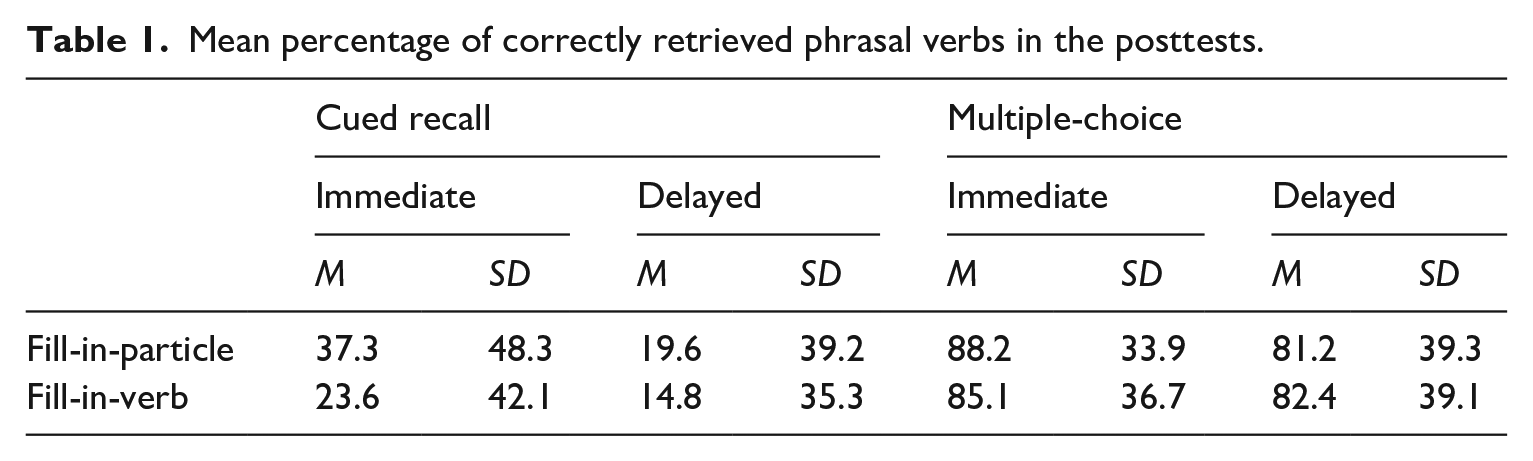
Research question 1 was interested in the impact of exercise format on recall of phrasal verbs. The mean percentage of correctly retrieved target items in the cued-recall posttests is presented in Table 1. The output of the mixed-effects model (see Table 2) revealed a main effect on Learning Condition and Test Time. Post-hoc analyses using Bonferroni’s correction for multiple comparisons found that, in the immediate posttest, the fill-in-the-particle condition outperformed the fill-in-the-verb condition (z = 3.022, p = 0.015, Cohen’s d = 0.45). No difference was found between the learning conditions in the delayed posttest. The drop in scores from the immediate to the delayed posttest was significant for the fill-in-the-verb condition (z = 2.978, p = 0.017, Cohen’s d = .43) and the fill-in-the-particle condition (z = 4.995, p < 0.001, Cohen’s d = .65). However, the attrition rate between the learning conditions was not statistically significant (p = 0.257).
Mean percentage of correctly retrieved phrasal verbs in the posttests.
Fixed effect parameter estimates for cued-recall posttests.
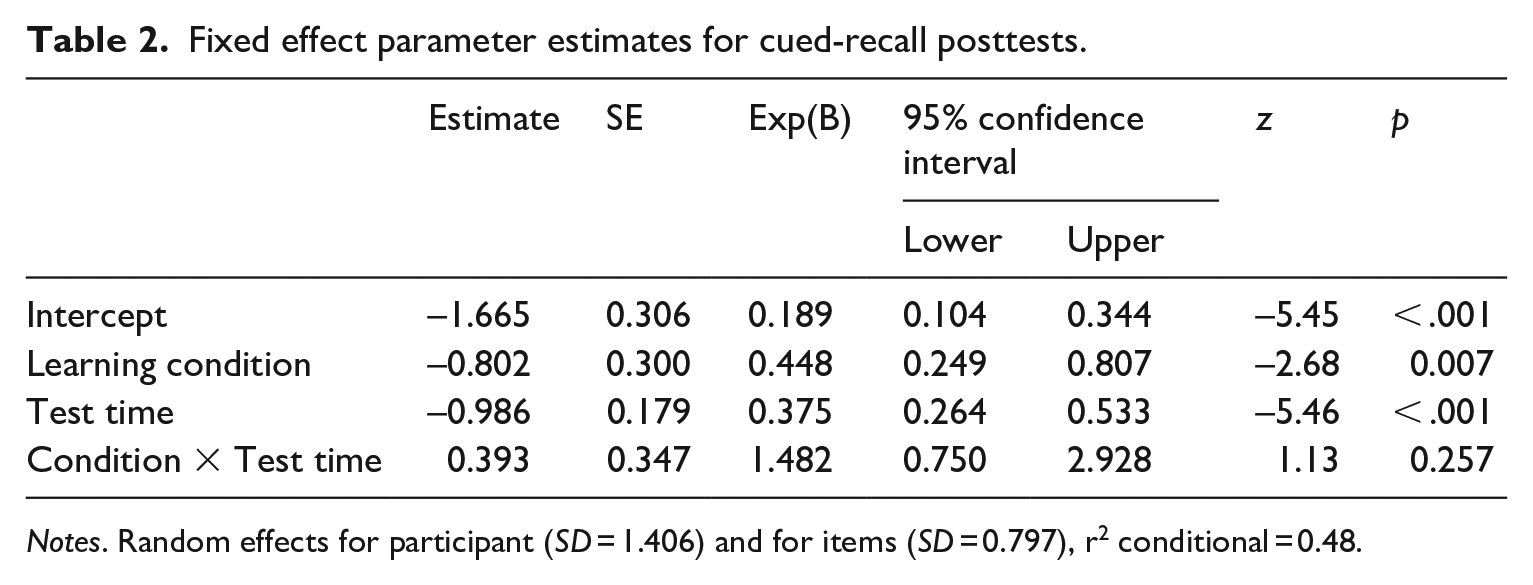
Notes. Random effects for participant (SD = 1.406) and for items (SD = 0.797), r2 conditional = 0.48.
3 Performance in multiple-choice posttests
Research question 2 concerned the impact of exercise format on enhancing recognition of phrasal verbs. Table 1 shows the mean percentage of correctly recognized target items in the multiple-choice posttests. According to the mixed-effects model (see Table 3), there was no main effect for Learning Condition (p = 0.804) and Test Time (p = 0.081).
Fixed effect parameter estimates for multiple-choice posttests.
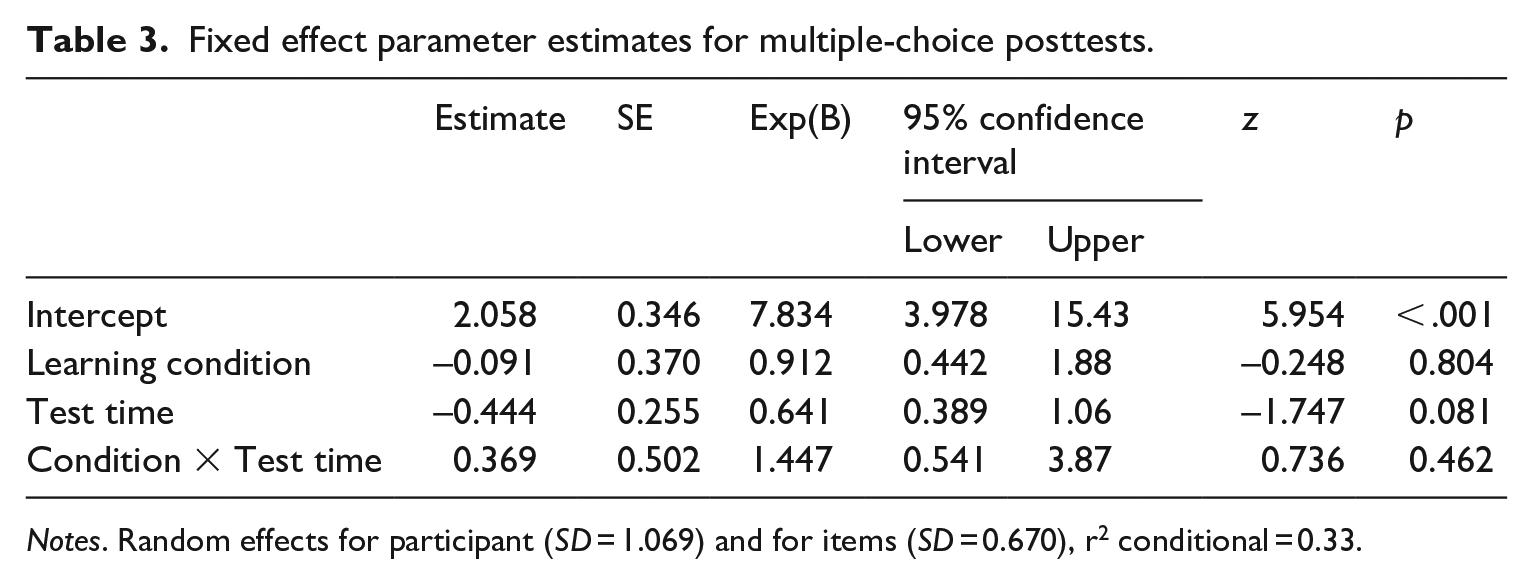
Notes. Random effects for participant (SD = 1.069) and for items (SD = 0.670), r2 conditional = 0.33.
4 Guess recollection
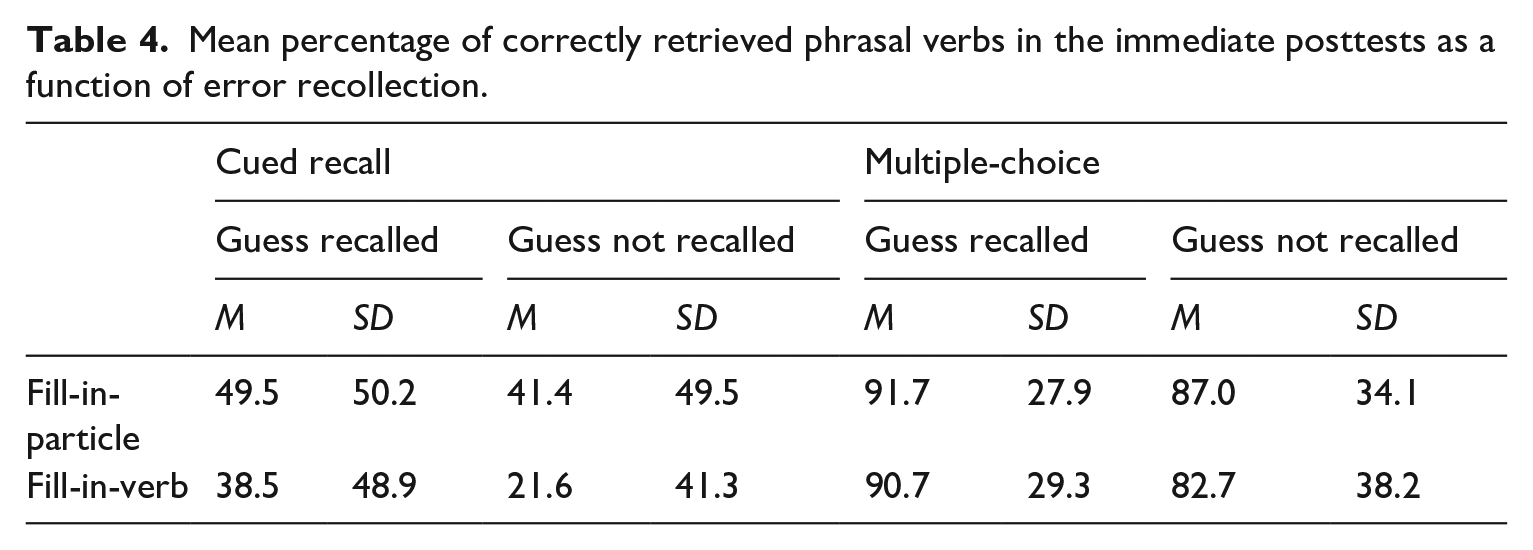
Research question 3 was interested in the influence of correct or incorrect retrieval of guesses on correct answers in the immediate posttests. The mean percentage of correct responses in the cued-recall and multiple-choice test, when participants recollected their initial guesses, is shown in Table 4. The output of the mixed-effects model (see Table 5) shows a main effect for Guess Recollection (Cohen’s d = 0.47) and that the interaction between Guess Recollection and Test Type was close to significant (p = 0.084).
Mean percentage of correctly retrieved phrasal verbs in the immediate posttests as a function of error recollection.
Fixed effects parameter estimates on immediate posttests as a function of error recollection.
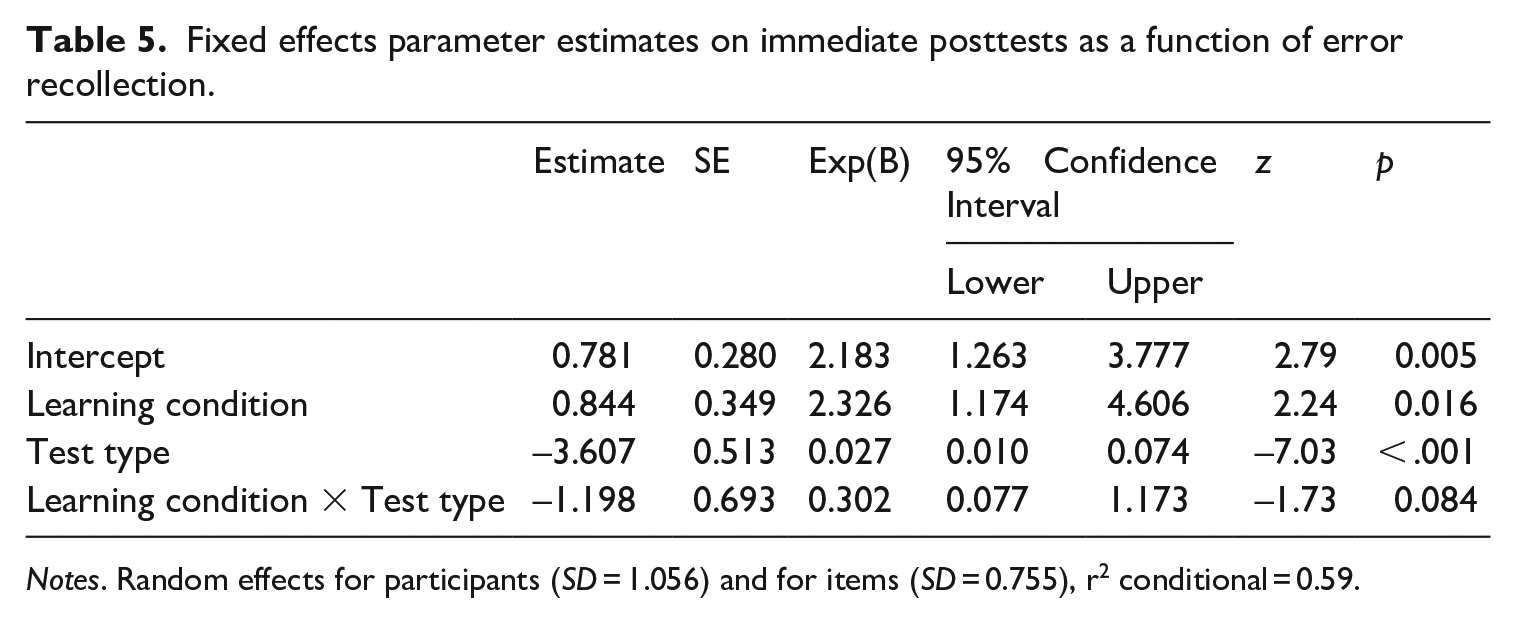
Notes. Random effects for participants (SD = 1.056) and for items (SD = 0.755), r2 conditional = 0.59.
VI Discussion
Research questions 1 and 2 were interested in the effects of two exercise formats on learning phrasal verbs. Research question 1 was concerned with recall of phrasal verbs. Results showed a significant advantage on the posttest for guessing the particle, which persisted one week later. These findings support our prediction and the view that drawing attention to the particle can help enhance the learning of phrasal verbs (Kovecses & Szabó, 1996; Yasuda, 2010).
The findings from the current study suggest that different reassembly formats of a gap-fill exercise have distinct effects on the learning of phrasal verbs. However, the fill-in-the-particle method led to superior retrieval rates in the immediate cued-recall test compared to the fill-in-the-verb method, with a striking 13-percentage point advantage. However, a significant decrease in retrieval rates was observed for both methods after one week. This suggests that while these training methods may enhance short-term retrieval, their effectiveness for long-term retention is less certain. This aligns with the notion that a single learning session may not suffice for long-term phrasal verb learning, and that repeated exposure and practice over time could be necessary for durable retention (Ferguson et al., 2021). Despite the decline in scores in the delayed posttest, the fill-in-the-particle method maintained a slight edge over the fill-in-the-verb method, although this difference was not statistically significant.
Research question 2 investigated the comparative effectiveness of the verb-focused and particle-focused exercise formats in enhancing the recognition of phrasal verbs. This was measured through a multiple-choice test administered both shortly after the treatments and one week later. Results from the immediate multiple-choice test revealed no statistically significant advantage for either method. This trend was consistent in the delayed test conducted a week later, with no discernible differences observed between the fill-in-the-particle and fill-in-the-verb methods.
There is an area of research on the learning of phrasal verbs that examines the utility of a cognitive linguistics approach (e.g. Boers, 2000; Condon, 2008; Condon & Kelly, 2002; Lee, 2016; Strong, 2013; White, 2012; Yasuda, 2010), whereby students are made aware of the metaphorical contribution of the particle to the meaning of the phrasal verb. Based on the results of the current study, bringing into focus the particle, whether students are able to appreciate the semantics of the particle or not, appears to be beneficial. However, more research is needed to determine whether highlighting the formal features of the particles in phrasal verbs or emphasizing their semantics leads to more effective learning of phrasal verbs.
Research question 3 was interested in whether incorrect guesses served as self-generated episodic mediators for accessing the phrasal verbs in the posttests. The finding that participants recalled a larger number of phrasal verbs when they remembered their initial guesses supports the view that memory for the initial guess plays an important role in the error correction process. For example, in the fill-in-the-particle condition, participants recalled around 8% more phrasal verbs in the cued recall test when they recalled their errors than when they did not. This facilitation effect was more pronounced in the fill-in-the-verb condition, as participants recalled 17% more phrasal verbs when they remembered their initial guess than when they did not. The same trend was observed in the multiple-choice test.
These findings raise the question of why memory for the original guess played a more significant role in the fill-in-the-particle method than in the fill-in-the-verb method. One possible explanation is that particles, being short words with vague meanings, are easily confused as they lack formal and semantic distinctiveness. As Strong and Boers (2019b) have argued, students can find it hard to grasp how the particle shown in the feedback made “better sense” than the one they provided in the exercise. However, asking students to bring to mind the erroneous particle they provided in the exercise can help them to distinguish their error from the correct answer. This reduces proactive interference while also boosting memory for the correct answer, as the error can now serve as an additional retrieval cue. Since few studies have investigated the impact of error recollection on learning phrasal verbs, the results and interpretation of the results require corroboration. Thus, we call for further research into this issue.
This study has a number of implications for textbook writers and teachers. Based on the results of the current study, it seems appropriate that ESL textbooks contain a larger number of fill-in-the-particle formats of exercises than fill-in-the-verb formats. However, there might be occasions when a focus on the verb makes better sense. For instance, some textbooks, such as McCarthy and O’Dell’s (2007) have units that group phrasal verbs by the same verb. Yet, it remains unclear whether such grouping is effective. The findings concerning errors also suggest that reminding students of their initial guesses in exercises when providing feedback is beneficial. Teachers may often have students erase their errors and write in the correct answer from fear that the student will become confused, but our study suggests that leaving the original error may be of benefit to the students.
VII Limitations
This study is not without limitations. First, the participants were L1 Japanese learners of English at an intermediate proficiency level. Given that Japanese does not have an equivalent to phrasal verbs, these constructions pose a particular challenge for these learners. Consequently, the results may not be generalizable to learners from other linguistic backgrounds or with different proficiency levels. Second, although we attempted to control for overall time on task, the study did not record the time each student took to study the feedback and provide an answer, which could have influenced the results due to varying time spent on each task among participants. Third, the study focused on a one-time learning technique, which may not be effective for enhancing the learning of phrasal verbs over the long term. Repeated exposure or practice over time might yield different results. Fourth, the study did not examine partial scores on the cued-recall and multiple-choice tests, which could provide additional insights into the learning process. Fifth, we did not analyse the types of errors made in the multiple-choice responses. This could have provided additional insights into the learning process and the effects of the verb-focused and particle-focused conditions. However, the overall accuracy on the multiple-choice task was quite high, limiting the amount of data available for an error analysis. Furthermore, our study’s primary goal was to compare the overall effectiveness of the verb-focused and particle-focused conditions, rather than to investigate the types of errors students make when learning phrasal verbs. Lastly, in many studies on learning phrasal verbs, the phrasal verbs are grouped by their particle. We chose to avoid this in our study to eliminate any potential learning effect that might result from this grouping. However, we acknowledge that this is a common practice in teaching phrasal verbs, and it reflects the reality that learners will often encounter phrasal verbs that share verbs or particles. Therefore, we believe that future research should definitely explore the impact of grouping phrasal verbs by their particles and even their verbs. This could provide valuable insights into the most effective strategies for teaching and learning phrasal verbs. These limitations suggest several avenues for future research to further explore the learning of phrasal verbs.
VIII Conclusions
Phrasal verbs play a crucial role in communication, yet our understanding of the most effective methods to teach and study them remains limited. The findings of this study shed light on this area, suggesting that the fill-in-the-particle format may be more effective in enhancing learners’ ability to use phrasal verbs compared to the fill-in-the-verb format. However, both formats appear to similarly improve learners’ understanding of phrasal verbs. Furthermore, the study lends support to the episodic recollection account, demonstrating that the advantage of recalling one’s initial guess is more pronounced in the fill-in-the-particle format. This is likely due to the unique semantic and formal characteristics of particles. While these findings provide valuable insights, they also underscore the need for further research to explore other aspects of phrasal verb learning, such as the impact of repeated exposure, the role of semantic understanding, and the potential benefits of different grouping strategies.
