



Abstract
Fluency is usually defined in relation to temporal features such as speed of delivery and pauses, and such features are generally the focus of research on fluency. The reasons why pauses occur, however, have received much less attention. This study first explores the distribution and location of pauses in short academic presentations given by students as part of an English for academic purposes (EAP) course at an Australian university. This data is then used to investigate the reasons for a sample of those pauses, using the researchers’ interpretations, followed by student explanations in stimulated recall interviews (SRIs). The main findings provide confirmation that the location and the reasons for those pauses which are likely to affect the fluency of the presentations are a result not only of linguistic and cognitive issues, but also of psychological factors. The results underline the importance of taking all of these factors into account in EAP programmes by encouraging student awareness of their pausing behaviour, its causes, the effect on their audience, and of strategies for dealing with psycholinguistic, as well as linguistic and cognitive issues. The results confirm the value of SRI as a technique in exploring assumptions about the reasons for pauses, and the limitation of focusing solely on statistical analyses of pausing phenomena.
I Introduction
In many subject areas, students at higher level education institutions will be required to deliver presentations on an academic topic to a class or seminar group. The effectiveness of such presentations will depend not only on the accuracy, relevance and interest of the content, but also on the quality of the delivery. Courses on English for academic purposes (EAP) preparing students for such presentations will be concerned with all of those aspects, but are likely to pay special attention to features which contribute to the quality, or fluency, of the delivery. Fluency is usually defined in relation to temporal features such as speed of delivery and pauses (N.H. de Jong et al., 2015; Kahng, 2014; Tavakoli & Wright, 2020), and this study explores pauses in monologues delivered in the form of short academic presentations as part of an EAP course at an Australian university, with an initial focus on their number, location, and duration. Without a clear understanding of the reason for pauses, however, it is difficult to identify how advice can be given about improving the fluency of a presentation. Therefore, having established the pattern of pauses within the data, the focus of the study then shifts to identifying the reasons for pauses, relying not just on the researchers’ interpretations, but also on student explanation during a stimulated recall interview (SRI). Raising awareness of the location and the reason for those pauses can help students to understand how pauses can be helpful to the speaker. It can also help them appreciate the effect which they can have on their audience, including when and where pauses can be used to emphasize or clarify points, or to help their listeners process the argument. There is no existing research which goes beyond a statistical analysis of second language (L2) learner pauses in academic presentations, and the aim of the current study is to fill that gap – to develop our understanding of why pauses occur, and to explore how that understanding might assist teachers in helping students improve the fluency of their presentations. The study set out to answer the following research questions:
• Research question 1: What is the location, type and frequency of pauses in an L2 English academic presentation?
• Research question 2: What are the reasons for the pauses?
II Literature review
1 Fluency
Fluency is generally viewed as a synthesis of several skills and has been defined in a number of different ways. A widely used definition is that of Segalowitz (2010), who distinguishes three interconnected forms of L2 fluency: cognitive, utterance and perceived. Cognitive fluency relates to the underlying mechanisms responsible for language production, including efficient and rapid access to lexical resources, the ability to focus on the most relevant linguistic information, and effective allocation of attentional resources in working memory. Utterance fluency is defined in terms of measurable aspects, including pauses, hesitation, and speed. Perceived fluency refers to listeners’ perceptions of a speaker’s fluency. In the L2 research context, fluency is commonly used in its narrow sense to refer exclusively to the temporal aspect of language proficiency, utterance fluency. This refers to the quantity of language produced within a given time, or to the speed and smoothness of speech output. Tavakoli and Wright (2020) define fluency as a measure of automaticity associated with easier access to linguistic knowledge (i.e. utterance fluency is linked to, or indicative of, cognitive fluency). Thus fluent speech would be characterized by an appropriate speed of delivery, with a limited number of pauses. Chang and Windeatt (2023) find that the speed of speech (as measured by the number of syllables per minute plus pause time) and the amount of speech between pauses (as measured by the mean number of syllables between two silent pauses) are strongly associated with levels of L2 fluency.
2 Pauses
Pauses belong to the temporal domain of speech, forming part of an individual’s overall oral language proficiency (Lennon, 1990). Pawley and Syder (2000) argue that in fluent speech, language is encoded a clause at a time, with the inference that pauses are most likely to occur at clausal level, though duration and frequency, as well as distribution, of pauses are held to be an indicator of level of L2 fluency in speech (N.H. de Jong, 2016; Kahng, 2014; Riazantseva, 2001; Tavakoli, 2011). In a comparative study of first language (L1) and second language (L2) Russian speakers of English (Riazantseva, 2001) both pause distribution and frequency were associated with proficiency level. The findings suggest that highly proficient speakers adhere more closely to native-like pause patterns, characterized by pauses at grammatical junctures, whereas less proficient speakers pause more often, and for longer, and are more likely to pause within clauses.
A distinction is generally made between silent pauses, ‘periods of non-articulation by the speaker’, and filled pauses, ‘periods of articulation of non-propositional content’ (Rose, 2017, p. 18), or ‘nonlexical fillers such as um, uh, er’ (Kang et al., 2010, p. 558). Iwashita et al. (2008) argue that fluent speech is characterized by speed, less pausing, and fewer unfilled pauses, and there is evidence that the number and length of mid-clause silent pauses in particular are linked to L2 fluency.
N.H. de Jong (2016) found that only silent pauses within speech units correlate with L2 proficiency level: the higher the L2 proficiency level, the shorter the pause, and within speech units, the fewer silent pauses. In Kahng’s (2014) study one of the biggest differences in utterance fluency between the L1 and L2 groups was found to be the number of silent pauses within a clause. There were significantly fewer silent pauses in the L1 group utterances., and within the L2 group the level of spoken performance was linked to both the number and length of silent pauses within a clause.
3 Why pauses occur
There is evidence that pauses are linked not only to proficiency (i.e. linguistic knowledge), but also to cognitive (topic-related) issues, and psycholinguistic research on L1 and L2 acquisition suggests that there is a more complex relationship between pauses and fluency. Pausing within clauses seems to reflect difficulties in planning or encoding speech (Kahng, 2018), and listeners are sensitive to pause location, apparently understanding that pauses within a clause tend to reflect reduced cognitive fluency. While silent pauses at grammatical boundaries are claimed to help listener comprehension by indicating the boundaries of speech to be analysed and by providing cognitive processing time (Griffiths, 1991), pauses within clauses are likely to be disruptive of that process.
a Processing difficulties
The strong correlation between pauses and their occurrence at the boundary between clauses may have a neurolinguistic basis (Pawley & Syder, 2000). Kircher et al. (2004) examined pauses and their neurological correlates using functional Magnetic Resonance Imaging (fMRI). The brain activity of six volunteers was scanned as they described seven Rorschach inkblots, creating a record of neurological activity linked with pauses. Activity during pauses was identified mainly in the left or right temporal lobes that form part of the cortex, which is responsible for the processing and administration of information. The left temporal cortex is associated with understanding language, learning, memorizing, forming speech and remembering verbal information (Queensland Health, 2021). Pauses at grammatical junctions were associated with the right hemisphere, in part of the right temporal lobe (Kircher et al., 2004, p. 87), which the authors (p. 88) suggest ‘might reflect memory retrieval and search processes, when [participants] think about what to say next between clauses (conceptual organisation).’ Pauses within clauses, however, were associated with an area of the left hemisphere which is ‘implicated in lexical retrieval . . . and error correction’ (p. 88). While urging caution due to the limited size of their sample, their data suggests that, in continuous speech, pauses within clauses involve more activity within the left temporal cortex than pauses between clauses and so may be indicative of speech planning and lexical difficulties.
b Emotional factors
Anxiety can also be a strong predictor for the association of certain temporal features with subjective ratings of fluency. Pérez Castillejo (2019) identifies the role of foreign language anxiety (FLA) in interfering with cognitive processing and investigates the effect of prior processing (defined as earlier L2 use in discussing a similar topic) in moderating contributions of foreign language classroom anxiety (FLCA) and proficiency to utterance fluency (Pérez Castillejo, 2023).
While prior processing did not result in statistically significant gains in fluency linked to lexical retrieval and syntactic encoding, it may nevertheless have the potential to reduce FLCA in L2 production by altering how attentional resources are allocated during subsequent performance. Pérez Castillejo found that prior processing was linked to a reduction in the resources speakers directed to formulation and encoding of speech, leaving more time for planning (‘when linguistic formulation required less attention, it became available for conceptual planning’; Pérez Castillejo, 2023, p. 540).
It is also worth noting that ‘prior processing’ defined as ‘immediately previous L2 production during a similar but not identical task’ (p. 541) may not be typical of tasks which involve more rehearsal and greater familiarity with the topic, such as academic presentations. Prior processing in the sense of rehearsal and topic familiarization which such tasks involve has the potential to reduce anxiety and the attentional resources required by working memory, with a positive effect on both cognitive and utterance fluency, and hence on automaticity (Tavakoli & Wright, 2020).
c Task type
The type of speaking task (e.g. read speech vs. spontaneous speech, casual conversation vs. academic presentation) has an effect on cognitive load and, as a result, on pauses. In read speech, punctuation within a written text provides a speaker with clues as to where a pause can be longer or shorter and since punctuation helps speakers see the boundaries in texts, less time is needed to organize their upcoming utterances (Goldman-Eisler, 1972). Familiarity with the type of oral task may also impact on the occurrence of pauses (Kendall, 2013). Among L1 English speakers, lack of familiarity with the topic at hand is likely to result in silent and/or filled pauses linked to difficulty in constructing explanations and selecting appropriate vocabulary (Fox Tree, 2002). Filled pauses in particular can be used when the speaker is looking for information or deciding how to proceed, and in their summary of research Cossavella and Cevasco (2021) conclude that filled pauses encourage listeners to focus on what is to come next in the speech. Given the demands imposed by both language and topic, however, the cognitive demands of the task may be such that even filled pauses are beyond the capacity of the speaker.
Planning time and its effect on aspects of performance including accuracy and fluency is another factor which has been widely investigated. The studies almost exclusively involve narrative, re-telling or dialogic tasks (Awwad & Alhamad, 2021; Foster & Skehan,1996; Li et al., 2015; Skehan & Foster, 1997, 1999; Tavakoli & Foster, 2008), with amounts of planning time up to a maximum of 10 minutes and inconclusive results regarding fluency (Dawadi, 2019). Most of the studies are concerned with tasks that are used in language tests, and none focus on tasks with the extended planning and rehearsal time which is typical of an academic presentation.
4 Academic presentations
Stapa et al. (2014) identify eight skills which contribute to effective presentations: (1) delivering the presentation at a suitable pace; (2) knowing how to use non-verbal communication; (3) not reading aloud from prepared notes/slides; (4) paying attention to intonation; (5) avoiding points that are unclear and lengthy; (6) knowing how to respond to questions; (7) giving examples; and (8) knowing how to organize content. The first three points can be explicitly related to the use of pauses; speaking too fast may hinder the audience from understanding the content of the presentation, whereas moving too slowly may result in distraction or difficulty in maintaining focus. Failure to deliver a presentation at an appropriate pace, including using pauses appropriately, perhaps due to lack of preparation, is likely to increase the cognitive burden for the listener and the psychological pressure on the presenter. Reading aloud from notes or slides may be helpful for the speaker, but may also discourage interaction with the audience, and encourage an inappropriate pace of delivery.
While the role of pauses as an important component in classroom interaction has been the focus of a range of studies (Ingram & Elliott, 2014; Maroni, 2011; Smith & King, 2017), no attention has been paid to the role of pauses in a monologic academic presentation, or to speech rate and pauses in an L2 academic presentation. As a genre, an academic presentation will have been prepared and probably rehearsed in advance, and so is likely to contain little spontaneous speech. The location, nature and frequency of pauses may therefore be indicative of particular linguistic, cognitive or psychological problems, or of other issues such as a failure to match the delivery to the purpose of such presentations.
5 Investigating the reasons for pauses
There is considerable agreement in the literature on the nature of pauses in spontaneous speech and most studies reach similar conclusions as to the link between the location, distribution, length and frequency of pauses and L2 fluency. Silent pauses are generally held to be indicative of greater difficulty on the part of the speaker than filled pauses, and to create more problems for the listener (Brennan & Williams, 2005). For the EAP teacher, such insights can inform a strategy for helping students practice and improve their academic presentations. At the same time associating this information with the reason or reasons for a particular pause for any individual student is more problematic. As an observer the teacher can attempt to categorize pauses and identify reasons for particular instances of dysfluency, but without further confirmation external observations are largely speculative. Input from the student, whilst not necessarily providing definitive confirmation, would at least add a useful extra dimension to any analysis and Tavakoli (2011) suggests the use of retrospective SRIs combined with observer data for a thorough investigation of why such pauses occur (p. 75). Kahng (2014) conducted stimulated recall interview sessions with 17 students who were asked to describe what they were thinking during pauses or hesitations in recordings of a spontaneous speech task they had completed. The aim was to explore differences in cognitive fluency between low and high proficiency students, with comments from lower proficiency learners in particular identifying vocabulary and grammar rules as causes of dysfluency.
This appears to be the only study which has incorporated contributions from learners into the overall interpretation of pauses. It does not, however, compare observer interpretation with student explanation, and from a teacher’s point of view it would be helpful to know how closely an observer’s interpretation of the reasons for pauses matches the student’s own explanation. The purpose of the present study is therefore to better understand the nature of pauses in L2 English speakers’ academic presentations in relation to pause duration, frequency and location and to compare observer interpretations of pauses with student explanations, using retrospective stimulated recall interviews.
III Methodology
1 Course and participants
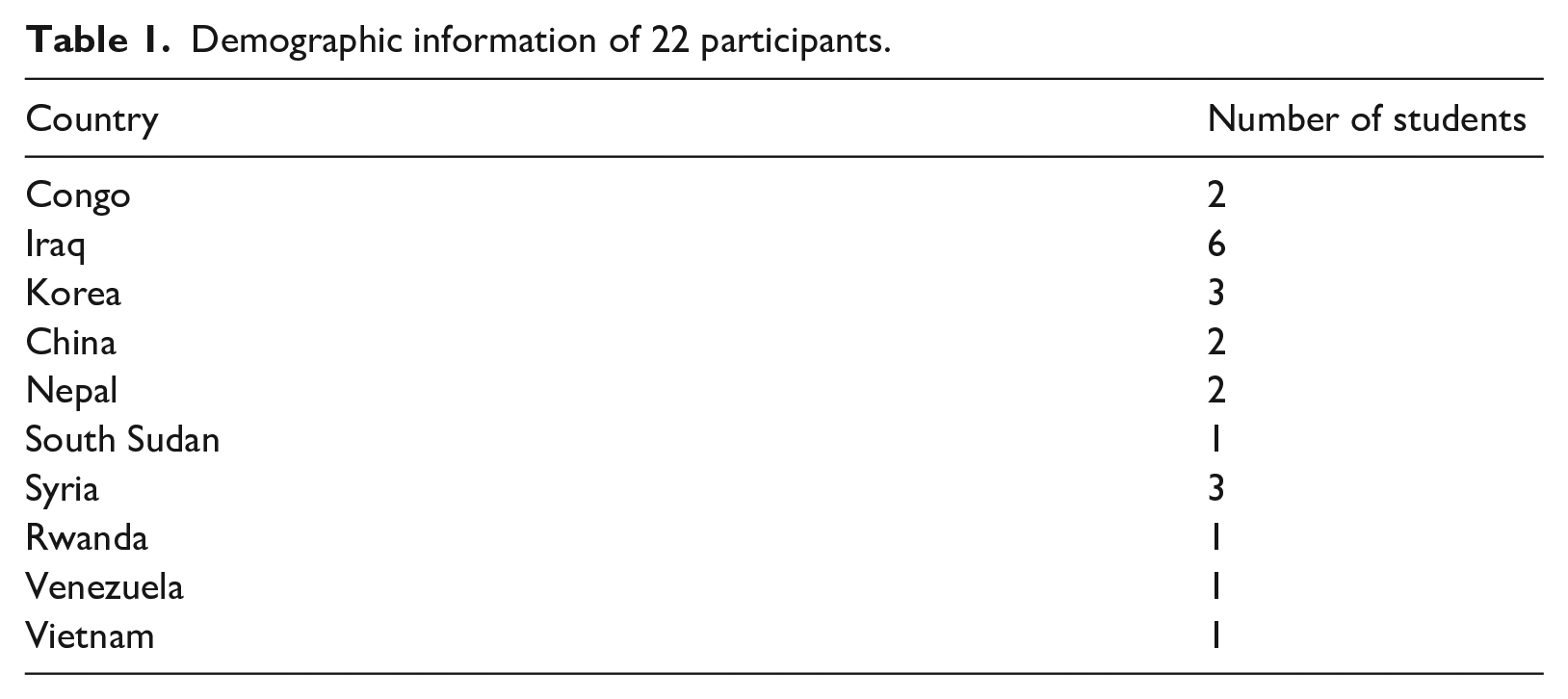
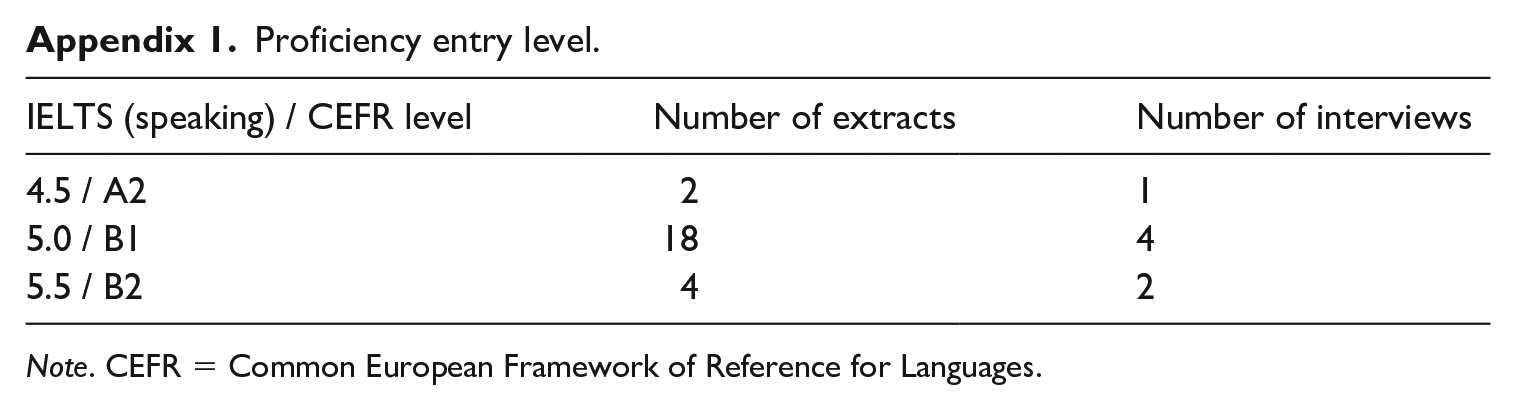
The purpose of this study was to investigate L2 English learners’ pausing patterns (i.e. pause duration, frequency, and distribution) in an academic presentation and to explore the link between the reasons for those pauses and their location. The participants were 22 EFL undergraduates from a variety of L1 backgrounds (see Table 1) at an Australian university, studying for 12 hours per week on an in-sessional English for academic purposes (EAP) programme, ‘Academic Speaking and Listening’. Their level of spoken English was between pre-intermediate and intermediate level (IELTS 5.0–5.5) (see Appendix 1).
Demographic information of 22 participants.
2 Data collection and analysis
Data were collected from an approximately 15-minute academic presentation given by the participants in Week 10 as their final assessment (see Section III.2.a), and from a stimulated recall interview (see Section III.2.b). To answer research question 1, acoustic analysis and transcription techniques were used to identify the duration, location, and frequency of the pauses. And for research question 2, a stimulated recall method was used to probe the students’ explanations of why the pauses occurred, and to compare those explanations with the researchers’ initial interpretation.
The data was analysed in three phases, the first involving identification of the duration, location, and frequency of the pauses. The second stage was to categorize the researchers’ interpretation of the reasons for the pauses. The final stage was exploring student explanations for the pauses from the SRI and comparing this with the initial researchers’ interpretation. The framework used for the analysis was adapted from categories used by Tavakoli (2011) whose study, although different from ours in a number of respects, was nevertheless similar in focusing on a monologic task involving some, though minimal, preparation. Our initial descriptive and interpretative analysis identified the pauses as falling into two categories: planned and unplanned. Our working assumption was that end of clause pauses were planned (or naturally occurring) pauses and mid-clause pauses were unplanned (or indicative of problems). The unplanned pauses were then allocated to one of four categories adapted from Tavakoli (2011): (1) repetition pauses; (2) correction pauses; (3) retrieving and planning pauses; and (4) unspecified pauses. However, while Tavakoli only considered pauses within mid-clause positions, our analysis was extended to include investigation of end of clause pauses. This decision was taken to avoid accepting assumptions about the reasons for pauses such as the expectation that, given the extra preparation carried out by the students for our task, end-of-clause pauses were likely to be planned (deliberate or natural), either just to provide breathing time for the speaker, or to allow the audience processing time before moving on to the next point.
a Acoustic analysis of speech (academic presentation) excerpts
In order to investigate pause patterns, video recordings of all 22 students’ academic presentations, each lasting 15-minutes including approximately 3–5 minutes of Q&A time, were analysed acoustically. The presentations were recorded in a hybrid mode. Most presentations and all interviews took place in a classroom equipped with a camera and a microphone for the presenter. A few presentations took place via Zoom, resulting in good quality audio and video recordings. Excerpts from all presentations were then transcribed using Otter (http://otter.ai), to provide an automatic transcription, and Praat (http://www.fon.hum.uva.nl/praat) to allow identification of segment durations (for more details, see Chang & Windeatt, 2023). Each excerpt was around one-minute in length and was taken approximately five minutes after the presentation began, by which point it was expected the presenters would have had time to settle down.
There was a need for manual correction of words transcribed incorrectly due to the software’s issues with student pronunciation (which varied from student to student). The length and number of silent pauses, total duration of speaking time, and total length of pause time and filled pauses were measured in milliseconds by listening to each speech sample and analysing the Praat waveform and spectrogram (Boersma & Weenink, 2012). Extraneous noises were excluded when reviewing the transcripts with the waveform and spectrogram. A note of the length of pauses was subsequently added to the transcript. Any silence equal to or longer than 250 milliseconds was identified as a silent pause and included in the analysis, as in N.H. de Jong et al. (2015) and de Jong et al. (2015). Filled pauses, using expressions of non-lexical status (e.g. uh, um, ah), were also included as these affect calculations of speed of delivery.
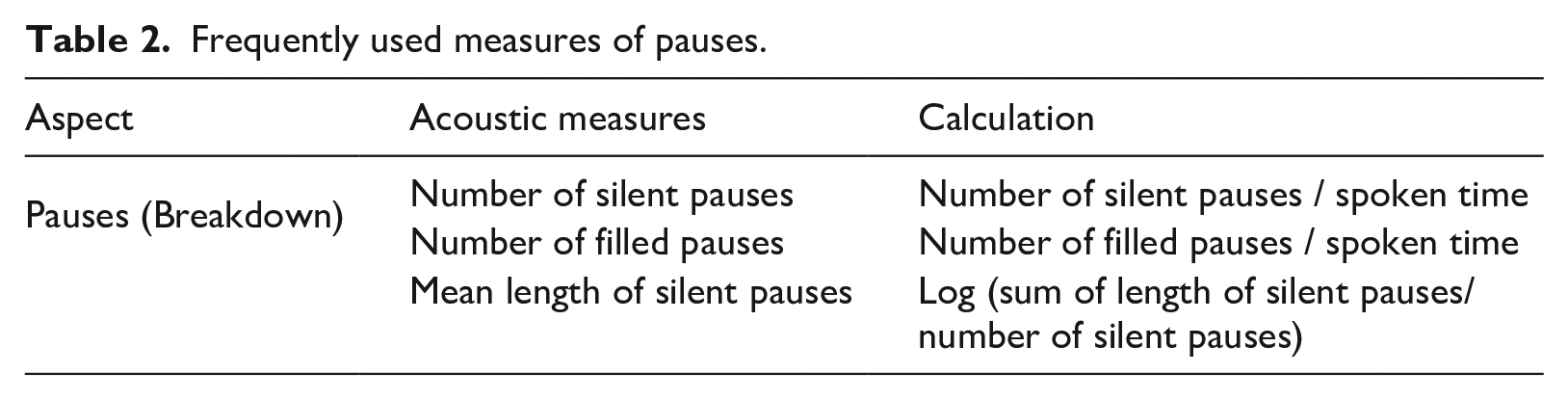
Measures adapted from N.H. de Jong et al. (2015, p. 240) were used to calculate the frequency and duration of silent pauses (see Table 2). Although mid-clause pauses are of particular concern as indicators of dysfluency, and end-of-clause pauses are generally considered as a legitimate characteristic of fluency, as we were interested in exploring the reasons for pauses, both mid-clause and end-of-clause pauses were included in our investigation. In each data set, the pauses were examined in the context of their occurrence. The aim was firstly to identify any patterns in the location and reasons for pauses, and secondly to gain insight into the linguistic or cognitive processes, and any other features, that may be associated with the pauses. By combining a detailed analysis of both the quantitative data, and of the qualitative data from stimulated recall interviews, it was hoped that a causal relationship might be established that could explicate instances of dysfluency in the participants’ performance.
Frequently used measures of pauses.
As the study was most concerned with exploring the reasons why pauses occur, statistical analysis was not at the heart of the research. However, in order to compare the pattern of pauses with other studies, and to identify a representative sample for further analysis, the number, location, and reason for those pauses were analysed in one-minute extracts from each of the 22 presentations, representing around 10% of the total of 220 minutes’ actual presentation time (excluding time allowed for Q&A). In addition, to confirm that the pattern of pauses in those one-minute sections was representative of the pattern found in longer sections, 5-minute extracts were analysed from the middle of three students’ presentations. A t-test was performed for each sample to compare the length of pauses per minute in the one-minute extracts with the length of pauses in the five-minute extracts. Both one-minute and five-minute extracts data were selected from the middle section of the presentations. The t-test results for these three samples showed that there were no statistically significant differences between the one-minute and five-minute extracts (p = .2713, p = .9241, p = .06429).
b Stimulated recall interview
Stimulated recall interview (SRI) is a research technique in which participants view a video sequence of their behaviours and are invited to reflect on their decision-making processes. This method can produce both insightful and useful data for examining the way participants experience a specific event. The technique of stimulated recall gives participants a chance to view themselves in action with the aim of helping them recall their thoughts during events as they occurred (Dempsey, 2010).
Collection of the interview data included videoing students’ academic presentations to provide objective data to scaffold the subsequent interview process and provide the necessary stimulus to memory. Reflections from the participants were then elicited through a structured stimulated recall interview on various aspects of their recorded pauses as they were watching their own presentation. This process was expected to facilitate detailed and context-sensitive processing of the video data and enable examination of the reasons for the pauses during their academic presentations. After being contacted by email seven students consented to participate in the interview. The question Why did you pause at that point? was asked at all pauses while watching their presentation. The data were analysed by themes to identify the reason why a participant paused at that point.
IV Results
1 Measuring pause patterns: Duration, frequency, and location
The total number of pauses from 22 participants was 332 including 210 filled pauses and 122 silent pauses. Filled pauses per second of speaking time (M = 0.0969) occurred more frequently than silent pauses (M = 0.0500). In order to identify any recurrent pausing patterns in the participants’ performance, transcripts of the data sets were carefully inspected. The researchers assumed that the participants would pause at the end of a clause to allow breathing space, or organize their presentation flow. These pauses may indicate the end of one thought, and preparation for the next, an assumption which required further investigation (see Section IV.2). Attempts were made to interpret pauses in the middle of a clause, however, a number of those proved difficult to explain. Table 3 shows the distributions of pauses according to two locations where they may occur: in the middle of a clause (MOC) (34.4%); and end of a clause (EOC) (65.6%). Students often employed silent pauses prior to and/or following a filler. Fillers, on average, took less time than pauses (Figure 1), and were sometimes used at the start or conclusion of a longer silent pause.
Distributions of pauses.

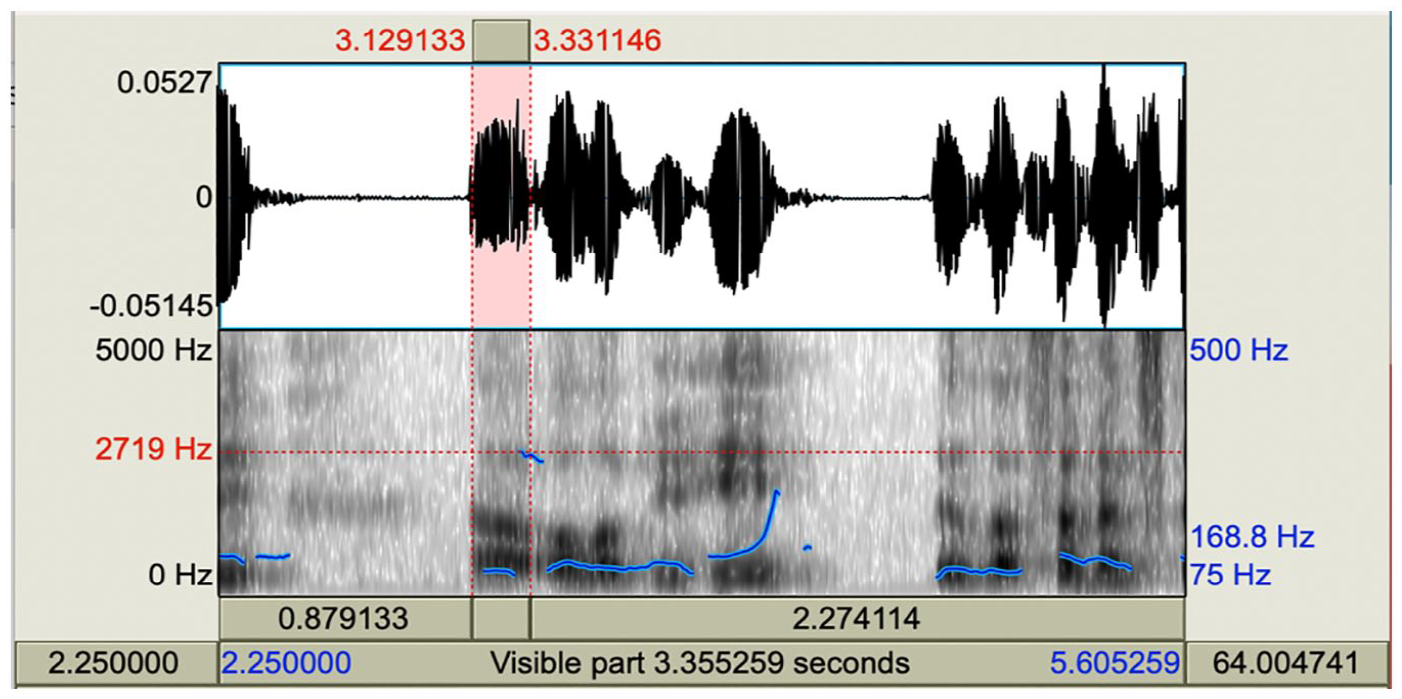
The duration of a filler.
2 Describing, interpreting and explaining pauses
Silent pauses were allocated to one of two categories areas: planned, and unplanned. These were then sub-divided into one (or more) of 6 sub-categories. See Table 4.
Summarizing the three categories and sub-categories.
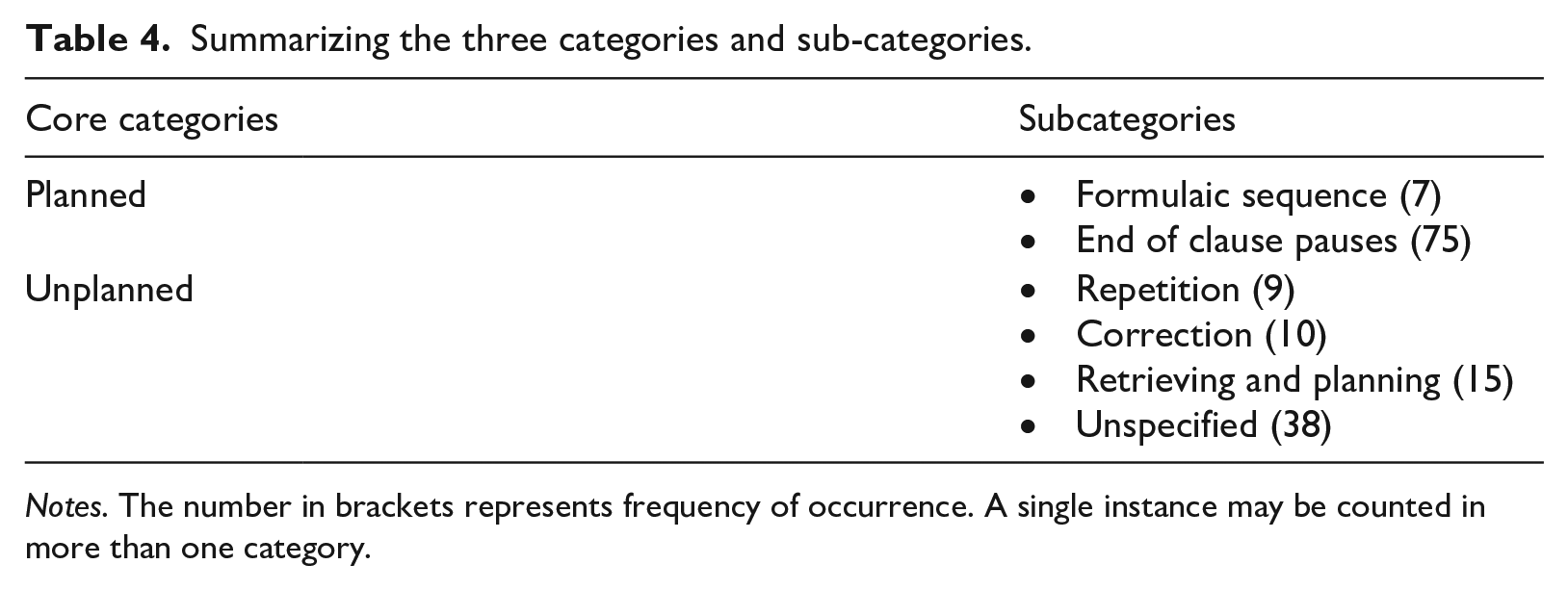
Notes. The number in brackets represents frequency of occurrence. A single instance may be counted in more than one category.
a Planned pauses
Pauses that we interpret as planned include those occurring at the end of clauses as well as, in our data, after certain formulaic sequences.
Formulaic sequence
Some pauses are associated with lexical units and especially those signalling a sequence of events or points, such as ‘in the beginning’, ‘first of all’ and ‘generally speaking’.
extract 1: and I’ve mentioned that in the beginning (1.357418) the authority extract 2: so uh (3.32618) first of all (2.358245) I can recommend extract 16: generally speaking (1.257579) the price of something will go
End of clause pauses
Pauses that we interpret as planned usually occurred at the end of a clause as shown in extracts 3, 4, and 17. The students may, for example, pause at grammatical boundaries to take a breath, or to allow the listeners to process the information they have provided. Each pause in the extracts below is placed at the end of a clause, with the effect of allowing the audience time to absorb and process the information.
extract 3: it’s about twice the size of Belgium Belgium is one of the European country (1.014985) so now I would like to give you 20 seconds to try to imagine how much carbon dioxide was emitted from uh that uh huge burn area and how many people and animals have suffered (2.859575) okay extract 4: it also shows strong relations with graph one (2.390809) showing that numbers of deaths also increase as the numbers of total cases increase (4.019270) extract 17: second one which is pay attention to nonverbal signals (2.283) the way you look listen or move and react to other person tells them more about how you are feeling and words alone ever come (3.572435) as I already mentioned
b Unplanned pauses
Pauses we interpret as unplanned usually occur mid-clause, and initial analysis of the data categorized them as: (1) repetition pauses; (2) correction pauses; (3) retrieving and planning or; (4) unspecified pauses.
Repetition
Some silent pauses in the data sets were accompanied by repetition of words or phrases, as in extracts 5, 6, and 7.
extract 5: the country will spend more money on (1.349139) on treating the people with HIV and AIDS extract 6: so ah first of all what is the hand hygiene (2.081725) hand hygiene um it’s a way of cleaning your hand (1.851658) extract 7: they are very popular mainly (3.8686) the very popular mainly because of their colour size and fragrance
Correction
Some pauses occurred to allow for the replacement or correction of an utterance. The pause in extract 8 is indicative of a process of self-monitoring and self-correction, repeating the phrase to correct the adjective – ‘Australian’ – and then completing the phrase. Similarly, in extract 9, the student pauses as she realizes there is a problem with the grammar in the preceding phrase, the pause allowing her time to reconstruct her phrase using the correct ‘There’s’ instead of ‘They’re’.
extract 8: according to the Australia Bureau (1.852982) according to the Australian Bureau of Statistics (1.506821) extract 9: um at first years in nineteen ninety eight, there is uh (1.263195) compared with last uh five years uh they’re just a little uh gap of (2.218946) uh there’s just a little gap but it still but the people who are waiting the (1.070) uh (2.070975)
Retrieving and planning
Pauses often occurred mid-clause while students appeared to be searching for and recalling information they needed to continue the presentation. These silent pauses were often accompanied by shorter filled pauses, such as um and uh. The student in extract 10 used silent pauses followed by and preceded by a filled pause, presumably allowing time to retrieve and/or plan what to say next.
extract 10: although this virus is extremely contagious and fatal (1.319) and may seem to be unstoppable science scientists found that (1.413) um (2.794649) these both viruses or originated in bats (3.028) and share eighty precents of its genome
Unspecified pauses
There are some mid-clause pauses which cannot easily be categorized by external observation, with no obvious reason as to why they occur or what causes them.
extract 11: we can see we can see that uh (1.824811) the donors uh uh (3.190687) uh we can we can see that the (2.556921) donors it’s much less small much less than the people who are waiting for the organ transplantation extract 12: it’s, it’s create developmental delays for children especially children ah um (1.017519) it’s like kids with autism extract 14: listening well means not just understanding the words that has been (1.279) sent by the speaker extract 15: we have to (1.001210) have a social hygiene and we have to have (1.139328) a social distance extract 19: according to the department of of Home Affairs more than 6 million Hectors (0.815382) of uh (0.704965) uh uh mo more than uh six six million Hectors (0.569068) have burn across Australia (2.019723) and and and that (0.802641)
The SRI data (see Section IV.2.c) helped in determining the nature of these pauses.
c Linguistic, cognitive and psychological reasons for pauses
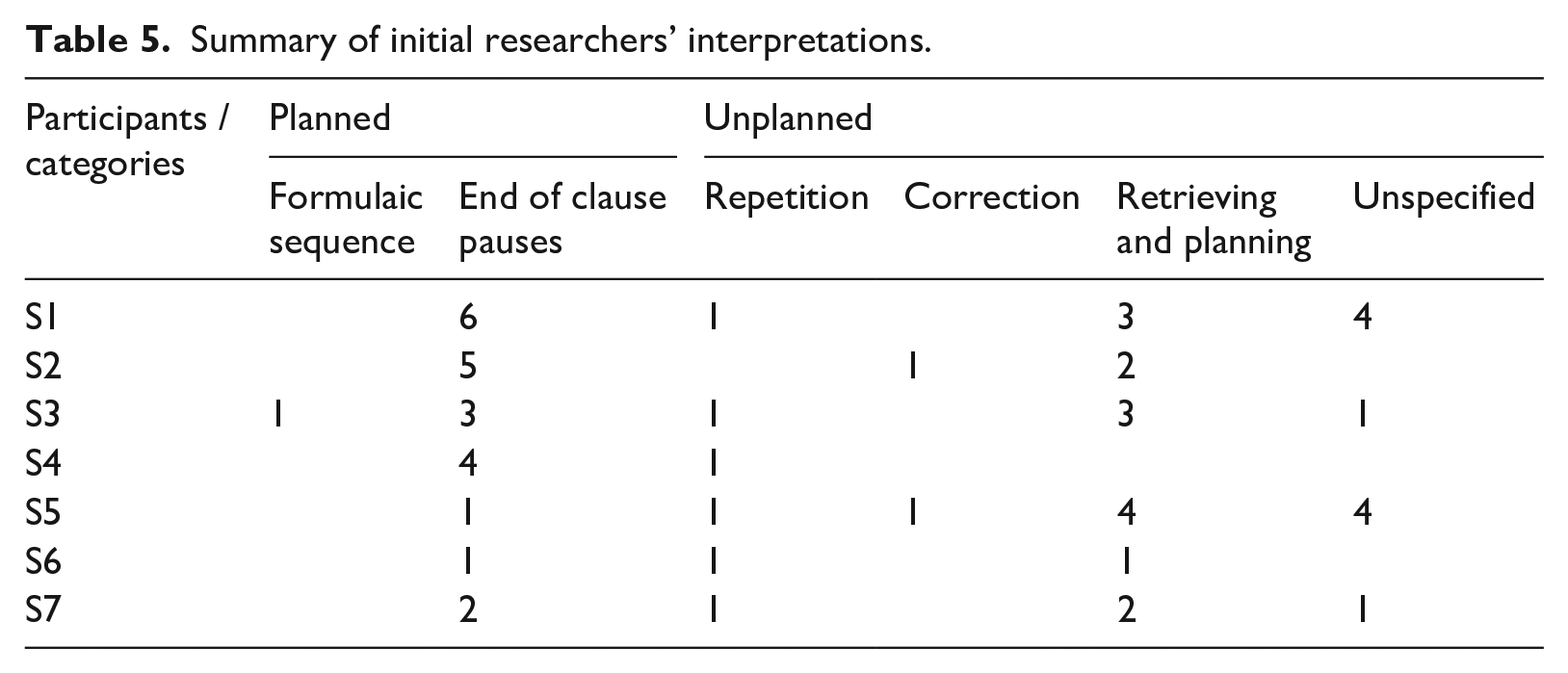
The total number of silent pauses from seven participants was 51. Table 5 shows the summary of researchers’ initial interpretation of pauses for each student, using categories and types discussed in Section IV.2.c. Note that the numbers in Table 5 represent frequency of occurrence. A single instance may be counted in more than one category. For example, the student in extract 6 repeated ‘hand hygiene’, which is counted in repetition. However, this is followed by ‘it’s a way of cleaning your hand’, an explanation what ‘hand hygiene’ means, i.e. the pause can also be categorized as an example of ‘retrieving and planning’.
Summary of initial researchers’ interpretations.
extract 6: so ah first of all what is the hand hygiene (2.081725) hand hygiene um it’s a way of cleaning your hand (1.851658)
When monitoring their speech in the SRI, students were sometimes surprised to find that there were lengthy pauses, as well as fillers, although they did recall pausing at various locations in their presentation. Answers to the question of why they paused at particular points in their presentation were analysed by theme, with three main categories emerging as explanations: 1) linguistic; 2) cognitive, and; 3) psychological. These categories and related subcategories are summarized in Table 6.
Summarizing the three core categories and sub-categories.
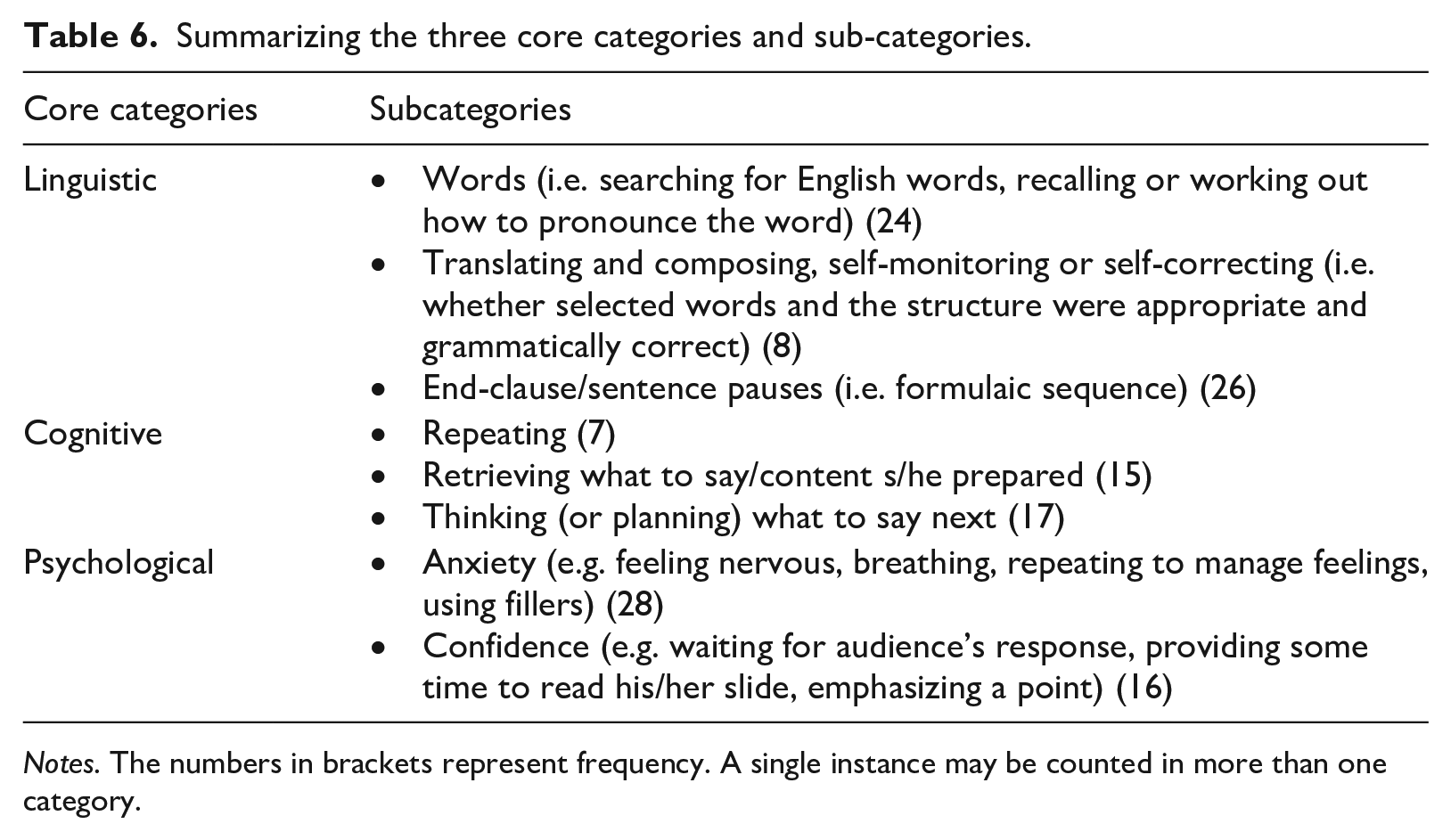
Notes. The numbers in brackets represent frequency. A single instance may be counted in more than one category.
Linguistic reasons
The students recalled pausing at various points in their presentation because of language problems. They used silent pauses and/or filled pauses, sometimes accompanied by repetition of the previous utterance (extracts 6, 11), to search for a word in English (e.g. donor, contribute) (extracts 19, 20), to work out how to pronounce a word, to correct mistakes (extract 11), or to compose what they were going to say next, which sometimes involved translating from their first language (extracts 10, 21, 23). In extract 10, the student stated that he used three pauses (1.413, 2.794649, and 3.028) to help organize the information he was going to present, with the final pause (3.028) also used to translate into English. In extract 20, the student explained that she had paused (1.119) while searching for the word which she knew began with the letter c. The word she was searching for was, in fact, ‘contribute’. However, she used the word ‘create’ at first, which she later realized was a mistake as she remembered the word she was looking for.
extract 10: and may seem to be unstoppable science scientists found that (1.413) um (2.794649) these both viruses or originated in bats (3.028) and share eighty precents of its genome extract 6: so ah first of all what is the hand hygiene (2.081725) hand hygiene um it’s a way of cleaning your hand (1.851658) extract 11: we can see we can see that uh(1.824811) the donors uh uh(3.190687) uh we can we can see that the (2.556921) donors extract 19: according to the department of of Home Affairs more than 6 million Hectors (0.815382) of uh (0.704965) uh uh mo more than uh six six million Hectors (0.569068) have burn across Australia (2.019723) and and and that (0.802641) extract 20: it’s um it’s sometime um (1.119) create it’s um contribute extract 21: the people (1.628857) in red line is much more uh it’s two times than the blue lines extract 23: it also shows strong relations with graph one (2.390809) showing that numbers of deaths also increase as the numbers of total cases increase (4.019270)
In extract 21, she seemed to be embarrassed about providing the reason for a pause (1.626657). Before providing a reason, she sighed and dropped her gaze for a while and explained, ‘I knew red in Chinese and English, but I don’t know why I forgot. I know it’s funny, and it is very easy word. But my classmates looked at me and then looking at my slide [of the PowerPoint], um, all of sudden I forgot.’ The linguistic problem may have been caused, or exacerbated by, psychological factors such as nervousness, anxiety, or feeling overwhelmed by the presentation itself.
Cognitive reasons
Academic presentations pose challenges to the presenters in understanding the topic they are presenting, and in accurately recalling and presenting the topic content. Allied to the difficulty of presenting this information in a second language, the cognitive processes involved resulted in the use of pauses and fillers for lexical retrieval, syntactic encoding, and articulation (extracts 7, 8, 13, 22, 24). In extract 13, initial descriptive analysis suggested the student might be using the pause (2.877608) to check the grammar and meaning of what she had just said, reformulating the phrase ‘the social workers’ as ‘how to become a social worker’. However, in the SRI, it emerged that the pause was to allow retrieval of what the social worker had said, and to plan how to report what had been said. A combination of difficulty in understanding content knowledge, delivering it in English, and understanding graphs or charts is a plausible explanation for the pauses in extracts 22 and 24. The researchers’ interpretation that pauses in extracts 22 and 24 were the result of ‘repetition’, ‘correction’ and/or ‘retrieving and planning’ was confirmed by the students’ explanation, and the specific details of what was causing the problem, ‘it was difficult to remember everything, specially, to explain the chart, graph, so difficulty’ (extract 24). No reference was made by the the students to the degree to which linguistic issues contributed to their difficulty.
extract 7: they are very popular mainly (3.8686) the very popular mainly because of their colour size and fragrance extract 8: according to the Australia Bureau (1.852982) according to the Australian Bureau of Statistics (1.506821) extract 13: and then we can have from the social workers (2.877608) how to become a social worker extract 22: please have a look in graph to the numbers of deaths due to Coronavirus grows exponentially (1.691) as time grows exponentially as time goes on (1.429) extract 24: um (2.862134) so and to be surprised um the blue line in the last year is uh still still uh (1.951441) still at lower uh still below the two thousands uh still below the figure of red line
Initial interpretation was that repetition was a technique the speakers adopted while recalling what they had planned to say, or perhaps while adapting their original plan. In the stimulated recall interview, the student in extract 7 did not realize that she had such a long pause (3.8686) and explained that this was for retrieving prepared information, i.e. ‘because of their colour, size, and fragrance’. She added that while she was trying to recall what she had planned to say next, she thought that repeating the phrase ‘very popular mainly’ sounded more natural, presumably than a prolonged silent pause. The student in extract 6, on the other hand, explained that the silent pause (2.081725) along with repetition of ‘hand hygiene’ gave him time to construct an explanation as he realized at this point that some of his classmates might not understand the meaning of that phrase.
extract 6: so ah first of all what is the hand hygiene (2.081725) hand hygiene um it’s a way of cleaning your hand (1.851658)
Psychological reasons
Anxiety and confidence can both have an impact on a student’s performance. Students who appeared confident based on their comments in the SRI (see examples in Table 6), or who had at least found a way of mastering their nervousness, were able to interact with their audience, using pauses, for example, to check the facial expressions of their listeners for clues as to how well they were following their presentations (extracts 4, 23). Planned pauses of this kind were also used to emphasize key points, as well as to give the audience time to process the information they were being presented with. Presentations by students who were nervous and anxious, on the other hand, were characterized by unplanned pauses and a lack of useful interaction with the audience, perhaps because of linguistic or cognitive difficulties (extracts 9, 19).
The student in extract 4 commented on the first pause that ‘after pointing the graph one in my slide, I needed to stop and looked at my classmates.’ The explanation for the second pause was that ‘it was a kind of a waiting time? for the next point to present. I thought my classmates might need to understand my presentation [. . .] Then provided more information about the similarity. . . and symptoms of Covid.’ His explanation for the rest of his pauses that ‘it was natural to stop, pause’ provides further evidence of his confidence. In extract 18, the reason for the first pause was that the student was trying to recall the word ‘phenomena’ and his explanation confirmed that anxiety, or relief at overcoming anxiety, was the reason for the second pause (2.181989): ‘when I remembered and pronounced correctly, I was so relieved. So I had a pause.’
extract 4: it also shows strong relations with graph one (2.390809) showing that numbers of deaths also increase as the numbers of total cases increase (4.019270) both us and Coronavirus has seemed uh uh share some similarities they appear to have similar symptoms such as cough fevers and shortness of breath (3.328458) although this virus is extremely contagious and fatal (1.319) and may seem to be unstoppable extract 23: it also shows strong relations with graph one (2.390809) showing that numbers of deaths also increase as the numbers of total cases increase (4.019270) extract 18: natural (0.560575) ah phenomena (2.181989) and
The student in extract 9 reported feeling nervous in situations such as presenting her work in front of an audience. Despite having practised and rehearsed her presentation, she added that the pressure of delivering an academic presentation sometimes caused her to forget what she was going to say. She also pointed out that another reason for pauses was difficulty in remembering the content of her presentation, despite having chosen a topic she was interested in, (‘organ transplantation’). In extract 19, the student identified nervousness as the reason for pauses in his presentation: ‘talking in front of my colleagues simply made me so nervous. I think I am not good at speaking in public.’ His nervousness manifested itself in the form of silent pauses, fillers and lexical repetition.
extract 9: um at first years in nineteen ninety eight, there is uh (1.263195) compared with last uh five years uh they’re just a little uh gap of (2.218946) uh there’s just a little gap but it still but the people who are waiting the (1.070) uh (2.070975) extract 19: according to the department of of Home Affairs more than 6 million Hectors (0.815382) of uh (0.704965) uh uh mo more than uh six six million Hectors (0.569068) have burn across Australia (2.019723) and and and that (0.802641)
V Discussion
The initial stage in analysing our data to establish details of the duration, frequency and location of pauses was straightforward and our data generally confirm the findings of earlier studies (e.g. N.H. de Jong, 2016; Kahng, 2014; Tavakoli, 2011). In terms of the pattern and location of pauses, most occur at the end of a clause position, but a significant proportion are located in mid-clause position. The second stage, distinguishing among pauses according to their purpose, proved more problematic, with the reason for many of the pauses (categorized as ‘repetition’ or ‘unspecified’) remaining unclear to the researchers. The third stage of analysis, the stimulated recall interviews with students, was intended to confirm or clarify the reasons for these ‘unplanned’ pauses, as well as allowing review of general assumptions about the ‘planned’ pauses. The student explanations did indeed reveal insights into what sometimes proved to be multiple causes for a single pause, as well as a variety of causes linked to a single category of pause. A clearer understanding of the underlying issues which these interviews provided was important in providing clues as to how the problems might be tackled.
1 What is the location, type and frequency of pauses in an L2 English academic presentation?
Studies of pause patterns generally involve dialogic or monologic tasks in which the speaker has to create an imagined narrative around a novel prompt, with limited pre-task preparation time (e.g. Kahng, 2014; Tavakoli, 2011). The academic presentations in our study, on the other hand, require a clear explanation of a topic that the presenter is expected to have mastered and rehearsed, and the nature of the task is a likely reason for differences between our categorization of data and Tavakoli’s.
The four categories to which Tavakoli (2011) allocated the pauses in her data each included an element linked to a task involving spontaneity and online planning, which was much less likely to be the case in our task, given the time allowed for pre-task preparation and rehearsal. Hence our choice of Repetition as a category, rather than Repetition and Replacement, as repetition in our data was likely to provide time to recall what had already been planned rather than to revise what had already been said. Similarly, while we found no instances of pauses to fit Tavakoli’s category of Reformulation, or working out how to express an idea, our data does suggest our students were monitoring, and where necessary correcting, language they had already prepared, hence our choice of Correction as our second category. Online Planning, Tavakoli’s third category, was linked to the need for spontaneous planning and production on the part of her participants, whereas similar pauses in our data were likely to allow recall of language, ideas and content that had already been prepared. Nevertheless, we did find pauses which appeared to indicate not only retrieval during the delivery, but also a degree of what might be classed as planning, hence our Retrieval and Planning category. Tavakoli found her learners ‘hardly ever paused in the middle of a formulaic sequence’ but we found no such examples in our data. so Tavakoli’s fourth category, Non-formulaic sequences, was discarded as irrelevant to our data. We did, however, require a fourth category – Unspecified – to allow for pauses which did not appear to fit into any obvious category.
Our alternative categorization of the pause data, and our assumptions about the reasons for the pauses, were explored in the SRIs.
2 What are the reasons for the pauses?
Perceptions of fluent speech are influenced by mastery of temporal aspects – pausing and speech rate – as well as by command of grammar, lexis and pragmatics (Mackay, 1987), and the duration, frequency, and distribution of pauses are an indicator of level of L2 fluency in speech (N.H. de Jong, 2016; Kahng, 2014; Riazantseva, 2001; Tavakoli, 2011), with fluent speech generally characterized by pauses at grammatical junctures (Riazantseva, 2001). There was evidence of such characteristics in our data, with speakers making what we have termed ‘planned’ pauses at the end of a clause, or mid-clause after formulaic sequences, especially those signalling a sequence of events or points. Mid-clause, or ‘unplanned’, pauses in our data appeared indicative of self-monitoring (Tavakoli, 2011) and correction and associated with linguistic problems (Williams & Korko, 2019). SRI data, however, identified both cognitive and psychological issues as contributory factors (N. de Jong & Perfetti, 2011; N.H. de Jong, 2016; Kahng, 2018; Pérez Castillejo, 2019; Williams & Korko, 2019).
a Planned pauses
Explanations offered by the students were that some of the end-of-clause pauses were to ‘allow time for breath’, or that they were ‘natural’, rather than ‘planned’ in the sense of conscious or deliberate. Pausing at certain points to give the audience time to process what had been said, as emerged in one interview, and to check whether further explanation was needed, is evidence that end-of-clause pauses may indeed be deliberate or ‘planned’ (Brennan & Williams, 2005; Zareva, 2009). The ability to deploy such pauses is indicative of mastery not just of the linguistic and cognitive aspects of a topic, but also of the psychological demands, allowing a more relaxed presentation which takes into account the needs of the speaker, and the perceived needs of the listener. This is more characteristic of presentations in the L1, where presenters take account of the perceived needs and reactions of the audience (Zareva, 2009). Our data therefore tend to confirm general assumptions about the reasons for end-of-clause pauses.
b Unplanned pauses
Student explanations for Repetition pauses were that they allowed retrieval of prepared information, or construction of an explanation (Fox Tree, 2002), but also that a repetition ‘sounded more natural’, suggesting an appreciation of the role of this type of filled pause in establishing causal connections, encouraging listeners to focus on what comes next in the speech (Cossavella & Cevasco, 2021; Cevasco & van den Broek, 2016).
Other pauses were associated with self-monitoring (Tavakoli, 2011) and correction, and students identified the reason for such pauses as difficulty with the content of the topic (Fox Tree, 2002), and nervousness (Pérez Castillejo, 2023). Other pauses were associated with searching for and recalling information (Goldman-Eisler, 1972), with student explanations identifying the pauses as providing time to plan how to organize the information to be presented. It is not clear from the SRI data whether this refers to a process of recalling a plan, or forming a new plan because one has been forgotten or needs to be revised. The SRI data was crucial, however, in helping to identify whether the reason for a pause was linguistic, cognitive, or psychological.
c Linguistic reasons
Explanations provided in the SRIs for unspecified silent pauses included organizing information, planning or composing what to say next, or trying to remember, or work out, the correct pronunciation of a word (Kahng, 2014; Kircher et al., 2004; Rose, 2017; Tavakoli, 2011). The most common explanation was that the student was searching for a word (N.H. de Jong, 2016; N.H. de Jong et al., 2015; Kircher et al., 2004; Pawley & Syder, 2000), but our interviews revealed that this encompassed a variety of very different strategies including: translating a word from the speaker’s L1; using the first letter of a word to trigger recall of the word itself – a tip-of-the-tongue situation; searching for what the student described as a simple word that she knew well but which anxiety had caused her to forget not only in the L2, but even in her L1.
It is clear from these examples that, even based on our limited sample, apparently similar pauses may have very different causes. The more specific explanations from the students can provide useful clues to the teacher – and to the students themselves, for that matter – as to the nature of the problem and what might be done to tackle it. Student reflections of this kind also raise other questions that the SRIs might have explored. What is the exact nature of the lexical issue? Is the lexical item that is sought not known at all, or not well enough known or understood? Is translation from the L1 a common strategy, and if so, how appropriate and effective is it? Does anxiety cause linguistic issues, or does inadequate linguistic knowledge cause anxiety, and if the former, what is the cause of the anxiety?
d Cognitive reasons
The initial interpretation of a number of pauses was that they were the result of language problems, with students monitoring their output, checking grammar, and reviewing and replacing phrases (N. de Jong & Perfetti, 2011; Foster & Skehan, 1996; Skehan & Foster, 1997; Kahng, 2014, 2018; Williams & Korko, 2019). According to the SRI data, however, many of the pauses were linked to cognitive, i.e. content-related, rather than linguistic issues. What the researcher interpreted as a pause to review and replace a phrase about a social worker was, according to the interview, an example of retrieval and planning. The student was trying to recall what the social worker had said and how to report it, not having originally planned to include that information in her presentation but deciding it might be helpful. Similarly, pauses for which there was no clear initial interpretation, or which appeared to have a linguistic basis, were caused by problems with the topic content. Students were struggling with their understanding of the content, or with specific types of content such as graphs and how to interpret and explain them. These problems manifested themselves in the form of long silent pauses, or repetition.
e Psychological reasons
Repetition, however, was not necessarily indicative of either linguistic or cognitive problems on the part of speaker. For one student repetition of a phrase while she retrieved information was a strategy to help her audience maintain focus (Brennan & Williams, 2005; Kang et al., 2010; Stapa et al., 2014; Zareva, 2009). A similar consideration led another student to repeat a phrase which he thought his audience might have problems with, while he constructed further explanation for it. In these cases the SRIs provided evidence, not of problems on the part of the speakers, but of the speakers’ understanding that the problems an audience might face need to be taken into account, and of the positive role that pauses might play in alleviating those problems (Stapa et al., 2014; Zareva, 2009). While this awareness of the needs of the audience is evidence of the speakers’ confidence in their ability to manage the pace and content of a presentation (Bankowski, 2010; Stapa et al., 2014), it is not clear whether this is the result of linguistic and cognitive competence, of confidence borne of sufficient preparation and rehearsal, or whether personality factors play a role (N.H. de Jong, 2016).
VI Conclusions
We set out to explore and identify the pausing patterns of students in academic presentations, with the aim of identifying where, and why, pauses, and especially silent pauses, occur. The broader aim was to use the results to reflect on how teachers might help students improve the fluency of their L2 academic presentations. The combination of content and linguistic concerns in such tasks increases the cognitive load, which in turn increases the psychological pressure on the presenter (Pérez Castillejo, 2019), who is faced with the need to understand the topic well enough to be able to explain it clearly and accurately in a second language, and in front of an audience (Radzuan & Kaur, 2011). This has implications for EAP courses for L2 learners in which a concentration on linguistic issues may be ignoring other important sources of difficulty for the presenter, and for the audience.
Among limitations of our study are the small size of our cohort, the narrow range of linguistic proficiency of our participants, and the lack of detailed information about the extent and type of planning and rehearsal that the participants carried out in preparing their presentations. In addition, although we took steps to confirm that the pattern of pauses in our sample of extracts was representative of that in the presentation as a whole, a larger sample would allow more detailed examination of that claim. The delay between conducting the SRIs and the delivery of the presentations is also a limitation since it will have had an effect on the accuracy of the student recollections.
Further studies to address these limitations could include selecting cohorts with a broader range of proficiency, which would allow the effect of different levels of linguistic proficiency on pause behaviour to be investigated. This would also allow consideration of questions such as the extent to which linguistic proficiency might compensate for a less confident grasp of the subject, and vice-versa. Sampling extracts from the whole presentation or, more practically, from different locations in the presentation, would allow closer examination of pause categories. This might reveal changes as the talk progresses due, for example, to initial nervousness and later fatigue, especially if this were combined with SRIs conducted immediately, or soon, after the presentation to maximize the accuracy of recall.
Taking into account the extra effort needed by L2 students to master both content and language, adequate practice and rehearsal prior to the presentation itself should play an important role, as well as strategies for coping with the extra cognitive workload during the presentation itself (Bankowski, 2010; N. de Jong & Perfetti, 2011; Fox Tree, 2002; Griffiths, 1991; Kim, 2006; Kang et al., 2010; Riazantseva, 2001; Stapa et al.,2014; Zareva, 2009). However, the fact that our data generally confirm the findings of earlier studies in terms of the pattern and location of pauses has implications for our understanding of how students can develop their presentation skills. Given that academic presentations require preparation and rehearsal, and that students are free to decide how much time to devote to that, we should expect to see fewer unplanned mid-clause pauses. Studies generally identify a positive link between planning time and perceptions of fluency (Skehan & Foster, 1997), though this varies according to task-type (Foster & Skehan, 1996), and to the length of time allowed for planning (Li et al., 2015). Most of these studies involve much shorter tasks, and much more limited planning time than our academic presentations, however. It may be that the presentations in our study received too little preparation, or there were problems with the form of preparation, or the effect of psychological factors outweighed the benefit of whatever preparation was undertaken. Procedures for gathering details of the amount and form of preparation and practice for the presentation would allow exploration of this issue.
In terms of implications for teachers involved in EAP courses, our results suggest a role for activities which raise students’ awareness of the effect on both speaker and listener of the pause location and type (Bankowski, 2010; Fox Tree, 2002). Such awareness-raising activities could usefully include SRIs (Kahng, 2014), given the ability of students in our study to analyse and explain the reasons for their pauses. Teachers, too, may benefit from encouraging such self-awareness among their students (Kim, 2006). While our study suggests that teacher interpretations of pauses in student presentations are reasonably accurate, the contribution of cognitive load, and especially of psychological pressures leading to anxiety and nervousness, as well as the fact that an individual pause may have more than one cause, can only be confidently identified by the students themselves. Raising awareness among teachers of the range of factors affecting pauses should improve their understanding of how to help students deliver academic presentations. And finally, claims for the benefit of strategies for dealing with linguistic, cognitive and psycholinguistic issues affecting academic presentations (Bankowski, 2010; N. de Jong & Perfetti, 2011; Kim, 2006; Riazantseva, 2001; Stapa et al., 2014; Zareva, 2009), including providing students with a digitally captured visual picture of pauses (Tavakoli, 2011), need to be validated by investigating the impact on both utterance and perceived fluency of their inclusion in EAP courses.
Footnotes
Appendix
Proficiency entry level.
| IELTS (speaking) / CEFR level | Number of extracts | Number of interviews |
|---|---|---|
| 4.5 / A2 | 2 | 1 |
| 5.0 / B1 | 18 | 4 |
| 5.5 / B2 | 4 | 2 |
Note. CEFR = Common European Framework of Reference for Languages.
Funding
The author(s) received no financial support for the research, authorship, and/or publication of this article.
