



Abstract
This study examined the professional becoming activities of three final-year Vietnamese preservice teachers (PSTs) of English across the past, present and (imagined) future in different contexts. The study used narrative data from narrative frames and individual interviews and drew on third-generation cultural-historical activity theory (CHAT) to explore the participants’ language teacher identity construction in relation to the tensions they experienced in these activities and the ways in which they responded to the tensions emotionally and agentively. The findings from activity system analysis and thematic analysis suggested that tensions, emotion, agency and identity existed in unity as tensions triggered emotions that motivated attempts to resolve tensions and construct language teacher identity. Identity, in turn, guided the participants’ efforts in addressing the tensions and emotions. We discuss theoretical implications including a model of language teachers’ professional becoming that is grounded in the relationships among tensions–emotion–agency–identity and pedagogical implications for mediating language teacher identity development.
I Introduction
Language teacher identity (LTI) has been variedly conceptualized and widely researched during the past two decades (Sang, 2020; Yazan & Lindahl, 2020). Conceptual divergences in LTI can be broadly summarized in the view that LTI is about how teachers understand and enact themselves as teachers in their teaching contexts (Nguyen, 2019; Sang, 2020). Many researchers demonstrate a general consensus that LTI development is fraught with tensions (Dang, 2013; Golombek & Klager, 2015; Lasky, 2005; Nguyen, 2017; Song, 2016; Yuan & Lee, 2015). Sometimes, tensions can inhibit professional growth (Nguyen, 2014, 2018). However, tensions are not necessarily negative and can actually drive LTI by triggering attempts to resolve them (Dang, 2013; Nguyen, 2017). Such LTI development, however, depends largely on teacher agency in negotiating tensions and emotional experiences (Kayi-Aydar, 2015). In fact, the literature has documented the role of emotion and agency in understanding and developing LTI. This literature has established that LTI necessarily involves emotional experiences (Nguyen, 2019; Yazan & Lindahl, 2020), while other authors reveal a co-constitutive relationship between agency and identity of language teachers (Kayi-Aydar, 2015, 2019b; Loo et al., 2017). Some researchers have also investigated the inter-related emotion–agency–identity triad (Lasky, 2005; Pappa et al., 2019; Song, 2016; Ursin et al., 2020). Notably, Kayi-Aydar (2019a) proposed an expanded conceptualization of language teacher agency using an identities–emotions–agency triangle for supporting research. She argued that identity development is contingent on the subject’s agency in response to their emotions. However, despite its theoretical novelty, the multidimensional relations between LTI, emotion, and agency remain an under-explored area in the literature (Kayi-Aydar, 2019a).
Motivated by the gaps in the literature cited above, this article examines LTI in its relationship with tensions, emotion and agency through narratives by Vietnamese preservice teachers (PSTs) of English as a foreign language (EFL). On the one hand, the process of negotiating tensions in constructing LTI, as Yazan and Lindahl (2020) argue, ‘is closely interconnected with their interpretation of past experiences and imagination of aspired professional life’ and ‘involves an ongoing engagement with narrative that revisits, reconstrues, and rewrites all their pertinent past experiences and re-envisions future practices and potentials’ (p. 2). On the other hand, LTI development is also context-bound and hence can only be understood in its social environment or space (Kayi-Aydar, 2015; Norton, 2013). Therefore, this study investigated LTI as situated across time (i.e. past, present and future) and space (i.e. different contexts of professional becoming activities). It is expected that the findings can provide practical implications for supporting language teachers, especially novice ones, in navigating their tensions, developing their agency, and regulating their emotion, not only for Vietnam but also similar EFL contexts. The study also contributes to the literature an innovative way of examining the complex inter-relationships between LTI, tensions, emotion, and agency through the use of narratives to reconstruct networked activity systems (Engeström, 2001) across time and space.
II Literature review
Following Kayi-Aydar’s (2019a) urge for more research that examines the relationship between LTI and emotion and agency, the present study traced the sources of identity–emotion–agency by examining the tensions in PSTs’ contexts of professional becoming activities and the ways the PSTs emotionally and agentively responded to these tensions in developing their LTI. In the following subsections, we briefly present current conceptualizations and research findings on these three concepts and discuss the inter-relationships between them.
1 Language teacher identity
The concept of LTI has been variedly interpreted using different theoretical lenses. For example, LTI is connected with how teachers (re)interpret their past, present and imagined experiences, such as tensions, struggles and emotions within their professional contexts (Yazan & Lindahl, 2020). This view is in line with an ecological perspective on identity (Norton, 2013). From a poststructural view, Kayi-Aydar (2015) considered identity as ‘multiple presentations of self which are (re)constructed across social contexts and demonstrated through actions and emotions’ (p. 138). It considers language teachers as intentional beings who negotiate tensions in their relationships with others and the various aspects of the context (Kayi-Aydar, 2015). Language teacher agency is, therefore, considered essential in how teachers respond to their tensions and emotion and re(construct) their LTI.
In this study, we adopt a sociocultural perspective on LTI as it is broad enough to account for the various dimensions of LTI central to the ecological and poststructural perspectives above (Golombek & Doran, 2014; Lasky, 2005). A sociocultural perspective (Nguyen, 2019) views LTI as originating from participation in sociocultural practices and contexts, and it involves teachers’ emotional responses and agency to navigate tensions in these settings. To this end, the sociocultural concept of identity-in-activity (Cross, 2006, 2020) presents an invaluable framework for understanding and developing LTI. Cross argued that LTI ‘resides in how teachers, as subjects of their activity systems . . ., have made sense of their role within their systems, and how they then choose to act within it’ (2006, pp. 63–64), and ‘identity-in-activity is an understanding of identity engaged in an ongoing, fluid process of development’ (2020, p. 40). Studies from this perspective (Dang, 2013; Golombek & Klager, 2015; Nguyen, 2017) have used activity system analysis to examine LTI in relation to tensions in the activity system. This analytical approach is powerful in that it allows for the analysis of tensions within the teacher’s activity, how the agentive teacher-subject interprets and responds to and negotiates these tensions to achieve their goals. It also allows for the examination of LTI in relation to time and space and a network of related activities. We elaborate on the sociocultural perspective on LTI development in Section IV.
2 Language teacher emotion
Teacher emotion was overlooked in the most parts of the teacher education history partly due to the perceptions that ‘emotions are complex and difficult to understand’, prejudiced against, and associated with feminism (Fried et al., 2015, p. 416). It has recently gained prominence in language teacher education research due to its close connection with teacher cognition and practice (Golombek & Doran, 2014; Nguyen, 2014, 2018; Yuan & Lee, 2015). A review of research on teacher emotions by Fried et al. (2015) found that teacher emotions can inform, regulate, motivate, give quality to experience, and influence cognition. From a sociocultural perspective on language teacher learning, Golombek and Doran (2014) noted that language teacher emotion is an indicator of the dissonance between the ideal and the experienced, and second language teacher education can better support teachers’ professional growth by recognizing teachers as both cognitive and emotional beings. Nguyen (2018) synthesized research which demonstrates that language teacher emotions originate from teachers’ engagement with members of their community such as learners, colleagues, and management, and such emotions are often associated with tensions between themselves and the community (see also Cowie, 2011; Nguyen, 2014; Trent, 2013; Yuan & Lee, 2015).
Emotion is seen as an influential element in the construction of LTI. Some language teachers succumb to situations when faced with tensions and intense negative emotions (Nguyen, 2014, 2018). On the other hand, many studies show that language teachers are agentive in responding to their emotions, such as establishing collaborative partnership (Dang, 2013), learning about how others deal with similar situations (Yuan & Lee, 2015), and improving practice (Song, 2016; Yuan & Lee, 2015). As a result of their agentive responses to tensions and emotions, language teachers develop their LTI (Dang, 2013; Golombek & Klager, 2015; Nguyen, 2017; Song, 2016; Yuan & Lee, 2015).
3 Language teacher agency
Like identity, agency has been defined using different theoretical underpinnings. For example, in social cognitive theory, agency is ‘to intentionally make things happen by one’s actions’ (Bandura, 2001, p. 2). Core elements of agency from this perspective include perceived efficacy, forethought, intentionality, self-reactiveness and self-reflectiveness (Bandura, 2001). This view also distinguishes between personal, proxy, and collective agency, which highlights the importance of the individual as well as the ‘broad network of sociocultural influences’ (Kayi-Aydar, 2019a, p. 12). From an ecological perspective, teacher agency is viewed as closely connected to the context in which it is achieved as opposed to a capacity the teacher possesses (Priestley et al., 2015). A poststructural perspective considers agency as discourse, or ‘one’s agentic moves in talk’ (Kayi-Aydar, 2019a, p. 13). From a sociocultural perspective, language teacher agency is purposeful, mediated, and situated within its context (Edwards, 2005; Lasky, 2005). This sociocultural view also recognizes agency as responses to the affordances and constraints in its context, and places agency within an activity system (Feryok, 2012). Adopting a cultural-historical activity theory (CHAT) perspective, language teacher agency can be considered to be ‘driven by recurring disturbances and troubles generated by historically accumulated inner contradictions in the activity system’ (Engeström & Sannino, 2021, p. 11).
Language teacher agency has also been linked with LTI. Yazan and Lindahl (2020) argued that ‘every act of agency and investment (or lack thereof) involves identity negotiation and enactment’ (p. 3). Similarly, Kayi-Aydar (2019a) considered language teacher agency as being shaped by teachers’ past experiences, present situations, future perspectives, and interaction with others across time and space, and it is ‘exercised through discourse, action, identities and emotions’ (Kayi-Aydar, 2019a, p. 17). Kayi-Aydar (2019a) further argued that language teacher emotion, despite its strong relationship with LTI and agency, has been missing from most studies on LTI and agency. To address this research gap, Kayi-Aydar (2019a) claimed that language teacher agency is best understood in its triadic relationship with emotion and identity through examination of discourse and action. A small number of studies have demonstrated such a triadic relationship (Kayi-Aydar, 2019b; Lasky, 2005; Loo et al., 2017; Pappa et al., 2019; Song, 2016; Ursin et al., 2020). However, the role of tensions as driving force in this relationship has been under-explored in this body of research.
III Research aims and questions
In this study, we brought together the scattered links between tensions, emotion, agency and LTI in the literature. We drew particularly on the sociocultural views on language teacher identity-in-activity (Cross, 2006, 2020) and on language teacher agency (Engeström & Sannino, 2021; Feryok, 2012; Lasky, 2005) to examine LTI in relation to tensions, emotions, and agency through the use of activity system analysis, which we elaborate on in the next section. Our research was guided by the following questions:
Research question 1: What major activities across the past, present and future shape Vietnamese EFL PSTs’ professional becoming?
Research question 2: What tensions do they experience in these activities and how do they respond to these tensions emotionally and agentively?
Research question 3: In what ways do their emotional and agentive responses to the tensions shape their LTI construction?
IV Theoretical framework
As indicated above, this research is underpinned by CHAT as an analytical tool to understand LTI in relation to tensions, emotions and agency in Vietnamese EFL PSTs’ activities within their sociocultural contexts. CHAT was initiated with Vygotsky’s (1978) concept of mediation and further developed by Leontʹev (1978, 1981) with the distinction between an individual action and a collective activity (Engeström, 2001, p. 134). Engeström (1987) illustrated this using a single activity system, with six interacting components, namely:
the subject (the actor/s in activity);
object (motive/goal of subject/activity);
mediational tools (resources mediating subject in obtaining object);
rules (norms regulating activity);
community (co-participants in activity); and
division of labour (responsibilities allocated to participants in activity).
A third generation of CHAT aims ‘to understand dialogue, multiple perspectives, and networks of interacting activity systems’ (Engeström, 2001, p. 135), and therefore it uses a joint activity system, including at least two interacting activities, as the unit of analysis. A fourth generation of CHAT deals with ‘the radical and fateful transformation in the objects of human activity’ and uses ‘a unit of analysis that can match the complexity and dynamics of an object’ (Engeström & Sannino, 2021, p. 14).
In this study, we adopted third generation CHAT because it allowed us to account for the various connected activities that the PSTs engaged in to become EFL teachers. It has the capacity to examine activities in relation to past, present and future across different spatial contexts (Engeström, 2001; Feryok, 2012), which is in line with our adopted sociocultural conceptualizations of agency (Feryok, 2012; Lasky, 2005) and identity-in-activity (Cross, 2006, 2020) in the language teacher education literature discussed above. One key principle of CHAT is ‘the central role of contradictions as sources of change and development’ (Engeström, 2001, p. 137). ‘Contradictions’ are defined as ‘historically accumulating structural tensions’ (Engeström, 2001, p. 137, emphasis added) or ‘historically evolving tensions’ (Engeström & Sannino, 2010, p. 4, emphasis added) that can be identified within and between activity systems. Much of the key activity theory literature refers to tensions as manifestations of contradictions in activity systems (Engeström, 2001; Engeström & Sannino, 2010; Yamagata-Lynch & Haudenschild, 2009). Following CHAT, we use ‘tensions’ in our data analysis to refer to the specific contradictions within and between the participants’ activity systems and tensions within/between components of the activity system (e.g. tensions between object and tools or between community and subject).
It should be noted that the term ‘identity tensions’ has been used in the teacher identity literature in a general sense, often referring to the dissonance between ideal identity and experienced identity (Pillen et al., 2013). As a reviewer of this article has rightly pointed out, identity tensions in this sense is not synonymous with tensions in CHAT. However, examining identity tensions may help to locate contradictions within the activity system. For example, a tension between a teacher’s experienced identity (located within the subject of the activity system) and aspired identity (located within the object) can be seen as the manifestation of a CHAT contradiction between the subject and object of the activity system.
From a CHAT perspective, change and development takes place because tensions create disturbances and conflicts (e.g. emotional experiences) that drive innovative efforts and action (i.e. agency) to resolve the tensions (Engeström, 2001; Engeström & Sannino, 2010). Drawing on this perspective, we were able to identify the tensions in our participants’ activities and account for how they responded to these tensions emotionally and agentively and how that process contributed to the construction of LTI.
V Methodology
The current qualitative case study used narratives to explore the tensions shaping the emotions, agency, and identity of Vietnamese EFL PSTs. Narratives have been argued to be a useful tool for LTI construction (Kayi-Aydar, 2019b; Yazan, 2019). Additionally, narrative research, with its collaborative nature, is considered a learning tool (Yazan, 2019) and can offer the participants the chance to reflect upon their LTI construction (Kayi-Aydar, 2015). Finally, the narratives co-constructed by the teachers and the researchers in this study will contribute to valorizing local knowledge (Golombek & Johnson, 2017) alongside existing narrative studies on teacher identities, emotions, and agency (Kayi-Aydar, 2015, 2019b; Loo et al., 2017; Nguyen & Parr, 2018).
1 Setting and participants
The study is situated in Vietnam, where major educational reforms have been implemented and resulted in significant changes in language teaching, learning, and assessment (Ngo, 2021). Due to its major ongoing reforms, the Vietnamese context presents a suitable setting for researching how current EFL PSTs experienced English learning in the past and language teacher education and teaching at the present, as well as how they imagine themselves to be teachers in the future.
Data were collected from three final-year PSTs, referred to as Anne, Beck and Carly, who enrolled in an initial TESOL program at Babel (pseudonyms), a large public university specializing in foreign language teacher and interpreter education in Northern Vietnam. In this program, PSTs complete foundational and language skills units in the first two years and professional learning units and a practicum in the last two years. The PSTs were selected, first, because of their enthusiastic responses to our recruitment notice, which meant they would be more willing to provide in-depth accounts required for our qualitative case study (Creswell & Poth, 2018). Moreover, our choice of participants was guided by the maximum variation sampling strategy, which ‘allow[s] for a greater range of application of the findings by consumers of the research’ (Merriam & Tisdell, 2016, p. 259). Specifically, given the importance of context in this study, we purposefully invited three participants with significantly different prior language learning experiences, current professional learning and future perspectives as elaborated below.
Anne was from a central district of Hanoi, Vietnam’s capital, and thus had early and extensive exposure to English. She started having English lessons from Grade 1 both at school and private language centres. Thanks to her advanced English level, Anne finished her schooling at a top-ranking foreign language specializing high school and afterwards entered Babel’s selective fast-track TESOL program. Having scored 8.0 on the IELTS test, Anne’s aspiration was to become an IELTS instructor after graduation. By contrast, Carly came from a small mountainous commune in North-Eastern Vietnam and was a member of an ethnic minority group. Her first contact with English was in Grade 6 at her junior secondary boarding school away from her hometown; nevertheless, Carly then found the language both ‘tough’ to learn and unnecessary for her future. In high school, she left her hometown for a government-funded boarding school in Hanoi, where English continued to be taught in the grammar-translation method. Only when she started the TESOL program at Babel did she have the chance to develop all the four language skills. Meanwhile, Beck was from a small river town in Northern Vietnam and did not start learning English until Grade 3. Unlike Anne and Carly, Beck went to mainstream local public schools throughout her K-12 education. She had an overall strong interest in English learning but expressed boredom of studying just grammar and vocabulary during her school days. Similar to Carly, Beck did not have a proper opportunity to develop her English skills until she attended Babel.
2 Data collection and analysis
Data collection happened during the 2018 academic year, when the participants were in their final year of the TESOL program. Narrative data were collected and informed the construction of the three participants’ activity systems involving English learning, teacher education, and teaching. These activity systems were analysed to reveal the tensions driving their emotions, agency and identity construction.
Initial data were gathered in English using narrative frames (Barkhuizen & Wette, 2008), which include incomplete sentences and blank spaces as a template to assist participants in writing their narratives. The narrative frame includes five sections, the first four of which correspond to the participants’ English language learning and learning to teach experiences at primary, junior secondary, senior secondary, and university levels. The final section focuses on the participant’s narratives about their journey of learning to teach English and teaching the language. Following is an extract from the narrative frame (Figure 1).

A narrative frame extract.
The narrative frame data were then examined further via individual in-depth semi-structured interviews, each lasting approximately 90 minutes. By examining the narrative frame data, the researchers devised interview questions that ask the participants to elaborate on and expand the information they provided in the narrative frame. Follow-up questions were also asked based on their interview answers. Overall, the interviews also focused on the five areas as in the narrative frames. The interviews were conducted mostly in Vietnamese in a vacant room at Babel so that the PSTs could express their ideas comfortably.
The interviews were first transcribed verbatim and then imported into an NVivo platform together with the narrative frames to prepare for analysis. Our analysis was guided by the third generation of CHAT (Engeström, 2001). Data for each of the PSTs were analysed separately. Only data excerpts used in the article were translated into English by the first author and cross-checked by the second author, who both speak Vietnamese and English competently. The analysis for each PST consisted of two phases. In the first phase, we coded data into the different components of the activity systems (i.e. subject, object, tools, rules, community, and division of labour) and identified tensions in each participant’s joint activity system. In the second phase, we performed thematic analysis to identify tensions within and between the participating activity systems and the PSTs’ emotional and agentive responses in resolving the tensions and their construction of LTI.
We identified a range of tensions within the activity systems. However, given the focus of this article on tensions, emotions, agency and LTI, only tensions that relate to all the three areas of concern (i.e. emotions, agency and identity) were included in Sections VI. Tensions which did not contribute to all the three areas are excluded from the article. For example, Anne had an object to develop assessment literacy, but the Language Assessment unit textbook (tools) and the lecturer’s teaching approach (community) were in tension with the object. Anne developed an emotion of disappointment at this tension but did not take any agentive action to reconstruct her identity regarding assessment literacy. This tension was therefore excluded from the findings. However, the majority of the tensions that were identified triggered emotion, agency and identity (re)construction. As a result, we arrived at six tensions across the three cases, which are presented in Section VI.2. In the interest of space, we only selected the quotes from data that best illustrate the types of tensions included.
VI Findings
In reporting the findings, we first start with the joint activity system that shaped each PST’s professional becoming (research question 1). The detailed analysis of the interactions within and between the activities, which revealed the inter-relations between the tensions, emotion, agency and LTI, will be presented in Section VI.2 (research questions 2 and 3).
1 The activities that shaped professional becoming
We identified three inter-related activities that shaped each PST’s professional becoming. The activities included (1) learning English, (2) learning to teach English, and (3) teaching English. The analysis did not consider, and did not find, these activities in a sequential developmental trajectory. Instead, they are a group of activities overlapping in their times and spaces. Figure 2 presents a broad joint activity system that illustrates the relationship between these activities:
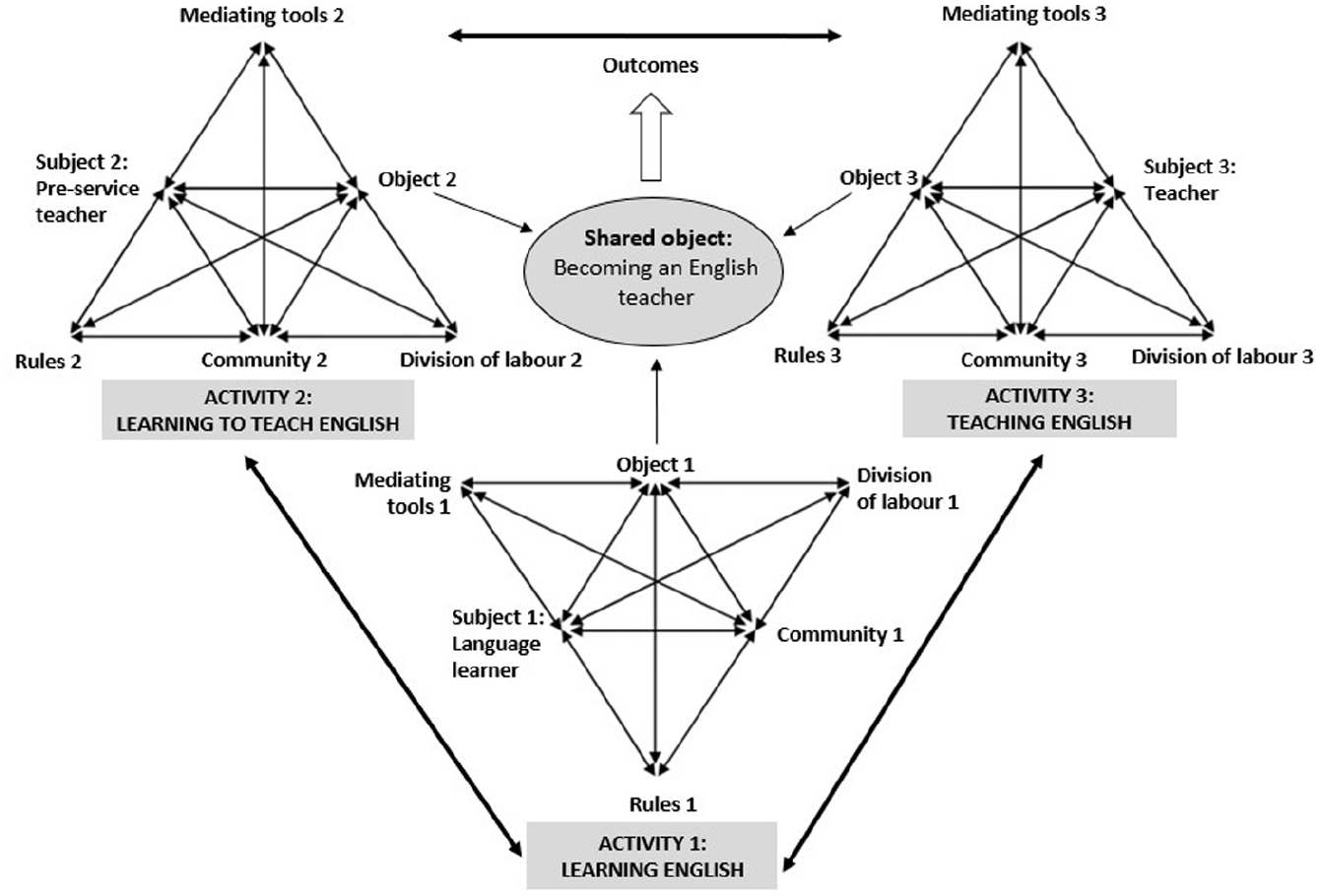
Activity systems shaping the preservice teachers’ (PSTs’) professional becoming.
In Figure 2, each participant was the subject in all three activities but played the different roles of a language learner, PST, and teacher at different times in different contexts. In Activity 1, all the participants learned English in formal schools and early years of teacher education, as well as in private language centres in the case of Anne. In Activity 2, they learned to teach English formally at Babel and also through their observation and reflection on their English learning activity. Activity 3 involves them teaching/assisting in private English classes and envisaging their future self as a teacher, drawing on their experiences in English learning, teacher education, and future perspectives.
The analysis showed that the three activities were inter-related, as demonstrated through the three two-headed arrows on the boundaries of Figure 2. The activities shared a common object of ‘becoming a language teacher’, although this object appeared later in Activity 1 for Carly than for Anne and Beck. The English learning activity was a stepping stone for the PSTs to transition to learning to teach as they first had to take the competitive English entrance exam to enter Babel. They had also all formed an object to become a teacher of English by the end of their schooling based on their English competence and awareness about the importance of English. The teaching activity, both current and imagined, were shaped by their English learning and learning to teach activities (e.g. all the PSTs reported the influences of their previous English teachers on their teaching). The PSTs’ perspectives on future teaching, in turn, informed the way they engaged with learning English, especially during their undergraduate studies, and learning to teach English during this period (e.g. developing communication skills to become a confident teacher, developing teaching strategies in line with how they would like to teach). This is consistent with previous claims that teachers’ aspirations and imaginations for the future influence their present activity (Kayi-Aydar, 2019a; Norton, 2013). As EFL speakers, the PSTs engaged in the activity of learning English and learning to teach English (even subconsciously through the apprenticeship of observation; Lortie, 1975) across times and spaces, resulting in Activity 1 and Activity 2 happening alongside and interplaying with Activity 3.
2 The construction of LTI in relation to tensions, emotions and agency
The data analysis revealed six tensions within the joint activity systems across the three cases. These tensions were included in the findings because they provided a context to examine the participants’ emotions, agency and LTI. Figure 3 indicates the locations of these tensions, which are analysed in detail in the subsections below. The initial letter of each participant’s name is used in the labels of their tensions (e.g. A1 and A2 are Anne’s tensions; B1 and B2 are Beck’s; and C1 and C2 are Carly’s).
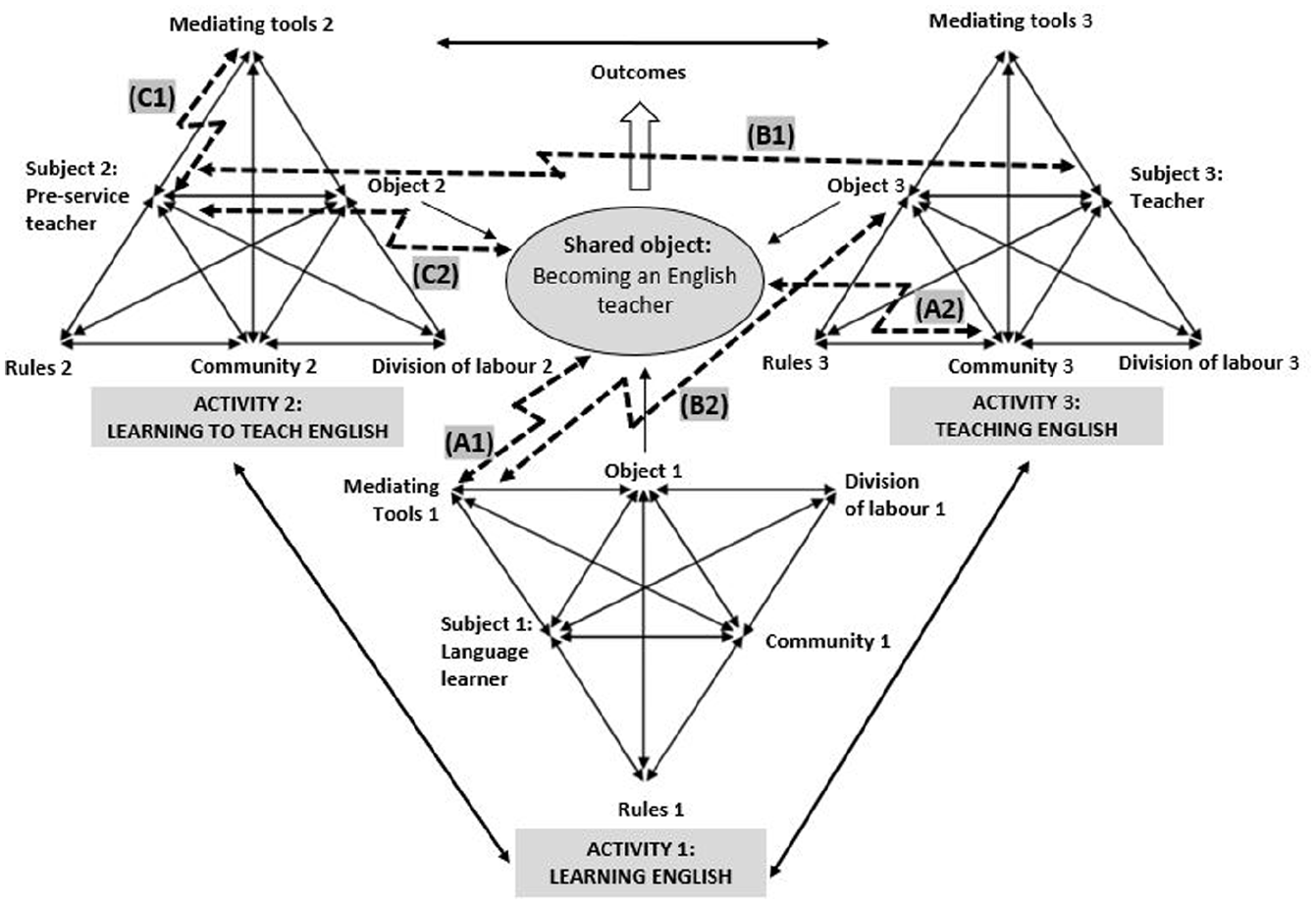
Tensions in the preservice teachers’ (PSTs’) activity systems.
a Anne
Tension A1: Shared Object vs. Tool 1
The analysis identified a tension between Anne’s shared object to become an English language teacher and the English learning resources and practices (Tool 1) used in her English learning activity. Specifically, she wanted to learn English to prepare for the university entrance exam to become a PST. This indicates her ‘aspired professional life’ (Yazan & Lindahl, 2020, p. 2) and investment (Norton, 2013) to construct her desired LTI. However, she faced a contextual constraint (Yazan & Lindahl, 2020, p. 3) where the English learning resources and practices in her Year 12 and extra classes were not facilitating the attainment of this object. She noted the tension in the interview: In Year 12, we started to prepare for the university entrance exam and used some practice test books, but we just did simple practice tests then the teacher corrected our work. The main activities were still focused on other things such as going on field trips . . . Sometimes, we had practice exams but the results were often low. We had to study by ourselves to succeed in the real entrance exam . . . At the time, there was no extra class that I felt was suitable for me because my knowledge level was already above the levels of extra classes, which were quite low, so I wouldn’t have learned new things.
This extract also reveals Anne’s emotion through concerns about her low performance in practice exams as a result of this tension. In response to these concerns, she agentively prepared for the exam by herself, which showed her ‘attempts to mediate and negotiate contradictory sources of identity’ (Yazan & Lindahl, 2020, p. 3) and the way she as subject of her activity system chose to act on the contradictory forces within it to form the LTI (Cross, 2006; Dang, 2013; Nguyen, 2017).
Tension A2: Shared Object vs. Community 3
Tension A2 (Figure 3) was between Anne’s shared object of becoming a teacher and the community of her teaching activity. More specifically, Anne had aspired to become an IELTS teacher, which demonstrates her imagined LTI. However, while observing a demonstration IELTS class in her induction to a part-time teaching job, she found ‘the class followed a “listen and copy” model where the teacher told the students to say this or write that in the tests.’ Her interpretation of this past experience (Yazan & Lindahl, 2020) was that ‘I was very bored.’ This statement reveals her emotional response when realizing that the demonstration teaching approach was contradictory to her imagined IELTS teaching style, which she learned from her past IELTS teacher. The boredom associated with this tension triggered her agency through self-reflectiveness on her past learning experience with her favourite IELTS teacher: I attended an IELTS class for 2–3 months to prepare for my tests. My teacher is Filipino . . . She taught me very useful tips for the tests rather than giving me the exact samples to follow during the tests . . . Her teaching style engaged me and made me feel comfortable in engaging . . . That was so different from the class I observed. So, I decided that I would follow her teaching approach rather than one that provides test samples and models.
Here, Anne demonstrated her aspired LTI (Yazan & Lindahl, 2020) and how she agentively made use of resources from her past activity (Kayi-Aydar, 2019a) (i.e. English learning) to resolve this tension and construct her desirable teaching approach as opposed to the ‘boring’ demonstrated approach. She further narrated on her agency in planning for how she would pursue her goal of becoming this type of teacher: I think it’s best if I follow the Filipino teacher’s approach. I want to teach students from different language backgrounds than me . . . So, I’m looking for opportunities to study overseas and if possible to teach there . . . or I can return home to teach IELTS after gaining some teaching experience overseas.
The extracts above reveal that the tension between Shared object and Community 3 led to Anne’s boredom, pushing her to make the agentive decision to model her teaching on the Filipino teacher’s engaging style. In other words, Anne started constructing her identity as an engaging IELTS teacher though her emotional and agentive responses to the tensions (Kayi-Aydar, 2019a). This LTI construction happened in the activity system which supports the concept of identity-in-activity (Cross, 2006, 2020).
b Beck
Tension B1: Subject 2 vs. Subject 3
This tension was between Beck’s current identity as a PST (Subject 2) lacking in confidence and competence and her imagined future LTI (Subject 3) as a confident and inspiring teacher who instils confidence in her students. This demonstrates the ways she made sense of herself in her activity system (Cross, 2006). The following data further reveals her LTI through aspirations (Yazan & Lindahl, 2020) and agency to overcome the deficit and develop her desired LTI.
Do you have any weaknesses that you want to overcome?
I have to become more confident . . .
How do you do that?
So, in this final year, I will apply for part-time jobs in different environments. I usually change my working environment quite frequently.
Why?
So that I can experience and learn from different places.
In this exchange, ‘have to’ indexes both Beck’s strong emotion and her agentive commitment which motivated her to enrich her working experiences to construct her desirable LTI. This illustrates the close relation between tension, emotion, agency and LTI (Kayi-Aydar, 2019a), which was all situated within the activity systems (Cross, 2006, 2020). As the interview unfolded, this self-perceived lack of confidence was found to originate from her prior language learning experience.
So, what do you think you will bring from your language learning experience into your teaching in the future?
I think I will not make my students learn too much about grammar . . . I will encourage them to be more confident, especially in speaking skills.
How are you going to encourage them? Are you telling them to speak more frequently?
Yes, speak freely and not worry about making mistakes, because I was always so afraid of making mistakes that I didn’t speak. I’ll tell them about my experience and tell them not to be shy, just speak up and they’ll be helped to speak better and will become confident in speaking. It’s better than not speaking at all.
In this extract, Beck’s agency can be seen through her ‘object-oriented, i.e. purposeful’ action (Edwards, 2005, p. 170) to not only connect her past English learning activity system with her future English teaching activity system but also reflect on and overcome her past problem/emotion (i.e. ‘afraid of making mistakes’). Her LTI transpired across time and space (Kayi-Aydar, 2019a) and was evidence in her growth trajectory from a shy learner and insecure PST into a confident and inspiring teacher.
Tension B2: Tool 1 vs. Object 3
This tension was between the tool that Beck’s English teacher used at school and Beck’s object to teach English communicatively. She wrote in her narratives about her boredom when her teacher taught mainly grammar and vocabulary: What I did not like was that the activities in English lessons were boring . . . The main elements I learnt were grammar and vocabulary.
This emotion of boredom became clear through her ‘interpretation of past experiences’, which is argued to interconnect with LTI (Yazan & Lindahl, 2020, p. 2). In narrative about her future teaching, Beck showed her LTI negotiation through her ‘imagination of aspired professional life’ (Yazan & Lindahl, 2020, p. 2) and agency in connecting her past learning experiences and future aspirations (Kayi-Aydar, 2019a): I think I’ll focus on grammar and vocabulary in my class because it plays an important role in learning basic language. I’ll also pay attention to listening and speaking skills because I’ve got some experience that most of the English teachers only taught grammar before, hence I hope that I can change this traditional teaching method in the future.
Here, Beck attributed importance to teaching grammar and vocabulary, despite her past ‘boring’ experience with grammar and vocabulary, because she considered these important in learning the language. What she was agentively trying to change was deliberately including a communication focus in her future teaching in addition to the language focus, which demonstrates that her aspired LTI mediated her agency (Kayi-Aydar, 2019a; Yazan & Lindahl, 2020). She explicitly pointed out that this change would overcome the potential negative influence of the traditional teaching approach that she experienced, which confirmed that her negotiations of LTI spanned across the past, present and future and involved negotiations of tensions, emotions and agency (Kayi-Aydar, 2019a). Later in the interview, she added that ‘I wanted to make this change in teaching contexts where communicative teaching is still new rather than in Hanoi.’ This revealed that she identified herself as a change agent, a sense of LTI and agency (Nguyen, 2019; Sang, 2020), in less advantaged contexts similar to her previous schools where such a change would be more meaningful than in such a big city as Hanoi, where language teaching methods would be more innovative.
c Carly
Tensions C1 and C2: Subject 2 vs. Tool 2 and Subject 2 vs. Shared Object
Carly presented a version of her LTI with the self-perceived inadequacy in her teaching skills and confidence (Subject 2) to complete a microteaching assignment (Tool 2) in her Activity 2 (Figure 3). This tension in the activity system (Engeström, 2001; Engeström & Sannino, 2010) caused her stress and anxiety, as illustrated below:
Can you elaborate a bit on the microteaching activity? Did you like it?
I . . . was stressed about that part (laugh) . . .
Why were you stressed about it?
Because, first, I felt that my teaching skills were not so good . . . Moreover, I was teaching my classmates, whose levels I had already known, so it was different from teaching lower level students who hadn’t learned what I taught before. I was also nervous because the lecturer was observing and assessing me.
The tension mentioned above and her emotional responses unveiled another tension (in CHAT sense), which was manifest in the form of an identity tension between her current LTI (Subject 2, lacking in teaching skills) and her aspired LTI (Shared object). Carly’s report on these two tensions showed how she made sense of herself in different activities (Cross, 2006). The two related tensions and Carly’s emotional responses to them triggered her agency to resolve the tensions and construct her aspired LTI:
I’m currently not confident in being in front of the class and delivering the content to the students . . . I speak very fast and I’m often shaky if I’m not well prepared. I speak fast, so I’m worried that my students will not understand (laugh).
And how do you plan to improve these areas?
First, about teaching skills I’ll have to practice more, maybe through part-time teaching or observing my peers and teachers . . . There are also professional development opportunities for teachers, so I will attend these programs. I can also learn from my fellow teachers in my school because they often know the teaching context well, including students’ characteristics. This will help with my lesson planning and teaching.
Here, Carly considered confidence in teaching as part of her aspired future LTI, so she was agentively committed to finding ways to continuously improve her confidence. In doing this, she made connections between her current activity (learning to teach English) and future activity (teaching English) (Kayi-Aydar, 2019a; Yazan & Lindahl, 2020). Specifically, the aspired LTI as a teacher competent in both English and teaching skills motivated Carly to overcome her emotions of stress and anxiety and to exercise her agency thorough her investment (Kayi-Aydar, 2015; Norton, 2013) in professional learning, including seeking part-time teaching and observing others’ teaching, to mediate her LTI in activity (Cross, 2006; Lasky, 2005).
VII Discussion, implications, and conclusions
This study examined LTI as situated in the professional becoming activities of three Vietnamese final-year PSTs of EFL with significantly different prior English learning experiences, current professional learning, and future perspectives. Specifically, based on data from narrative frames and interviews, with the support of the third generation CHAT as an analytical framework, we found that the PSTs shared a broad trajectory of becoming English teachers, which included three major inter-related activities: learning English, learning to teach English, and teaching English. Our analysis revealed systemic contradictions in the form of ‘historically evolving tensions’ (Engeström & Sannino, 2010, p. 4) within and between the participating activity systems, which drove teacher professional becoming. Starting with the identified tensions, we analysed the ways in which the PSTs responded to these tensions emotionally and agentively and how such processes shaped their LTI construction across temporal and spatial contexts. The findings of this research contribute to the current literature on LTI in two ways. First, the study offers empirical evidence to demonstrate the fundamental roles of tensions, emotions and agency and their relationships in shaping LTI construction. Second, in examining such identity-in-activity processes (Cross, 2006, 2020), we argue that the temporal and spatial dimensions of the activities provide contextualized understandings of EFL PSTs’ LTI construction and offer implications for teacher education in supporting their professional becoming.
1 The relationship between tensions, emotion, agency and LTI: An expanded unity
The present findings about Vietnamese EFL PSTs’ professional becoming have demonstrated that tensions in joint activity systems played a fundamental role in driving emotional and agentive responses that shaped the construction of LTI across time and space (Cross, 2006; Dang, 2013; Nguyen, 2017). These tensions included both identity tensions (e.g. between current and aspired LTI) and tensions within/between other components of the activity system (e.g. between the object of activity and the mediating tools). The study also provided evidence to demonstrate that tensions–emotion–agency–identity exist in unity, which brought together the scattered links between these four elements that have been documented in the literature (Kayi-Aydar, 2019a; Lasky, 2005; Pappa et al., 2019; Song, 2016; Ursin et al., 2020). In this study, for example, Anne’s desire to succeed in the university entrance exam and become a PST of English (i.e. aspired LTI) was met with the obstacle of not having access to a suitable English class to prepare for the exam (i.e. mediational tools). This tension triggered her concern (i.e. emotion) and subsequently investment (Kayi-Aydar, 2015; Norton, 2013) in self-study to achieve her aspiration (i.e. agency). Similarly, her aspired LTI as an IELTS teacher contradicted with the IELTS teaching approach she was exposed to in her induction, which caused her boredom (i.e. emotion) and also determination to follow her former teacher’s teaching approach that she perceived as more effective (i.e. agency).
The current research also extends the literature by demonstrating an innovative way of examining the inter-relationships between such expanded unity between tensions–emotion–agency–identity. Generation 3 CHAT (Engeström, 2001) was a powerful analytical lens that enabled the study to gain a nuanced and comprehensive understanding of such relationships. First, the use of the CHAT framework, coupled with the concept of identity-in-activity (Cross, 2006), allowed the study to examine EFL PSTs’ LTI in their temporal and spatial contexts. This supports and adds to current views on the importance of looking into these temporal and spatial dimensions in understanding language teacher learning through making connections between past, present, and future activities (Cross, 2020; Kayi-Aydar, 2015; Li, 2022; Norton, 2013). Second, the theoretical lens enabled the study to trace the sources of LTI through examining tensions, emotion, and agency in their contexts (Engeström, 2001). Therefore, activity system analysis would be a worthwhile approach in further research to explore LTI construction across time and space.
Based on the findings gained from such an analytical approach, we propose Figure 4 to illustrate the professional becoming of EFL teachers. Figure 4 has the potential to support research on EFL teachers’ professional becoming. The three embedded circles represent the three major activities shaping the professional becoming of EFL teachers, namely learning English, learning to teach English, and teaching English. The three overlapping ellipses in the middle represent the different roles that each teacher plays in the three activities (e.g. language learner, preservice teacher, and teacher). These roles are embodied in one person, sometimes inseparable, and sometimes in tension with each other, but the shared object is to emerge as a language teacher. It is recommended that language teacher education research in EFL contexts explore these activities and their inter-relationships in understanding LTI trajectories. In doing this, it is essential to consider the spatial and temporal contexts of the activities as well as the personal dimensions of language teachers’ professional becoming through an understanding of their tensions, emotions, agency and identity and how these interplay. Additionally, it is key to examine the systemic tensions inherent within and between the activities as these tensions are considered the driving force behind LTI construction (Dang, 2013; Nguyen, 2017). Finally, in order to further examine the relationship between the emotive and cognitive sides of language teacher professional learning, we recommend using Vygotsky’s concept of ‘perezhivanie’ (Vygotsky, 1994) to complement CHAT in future research on language teachers’ tensions–emotion–agency–identity. The concept of ‘perezhivanie’ has the potential to help such research to uncover how teachers interpret the tensions and, relatedly, experience these tensions emotionally.
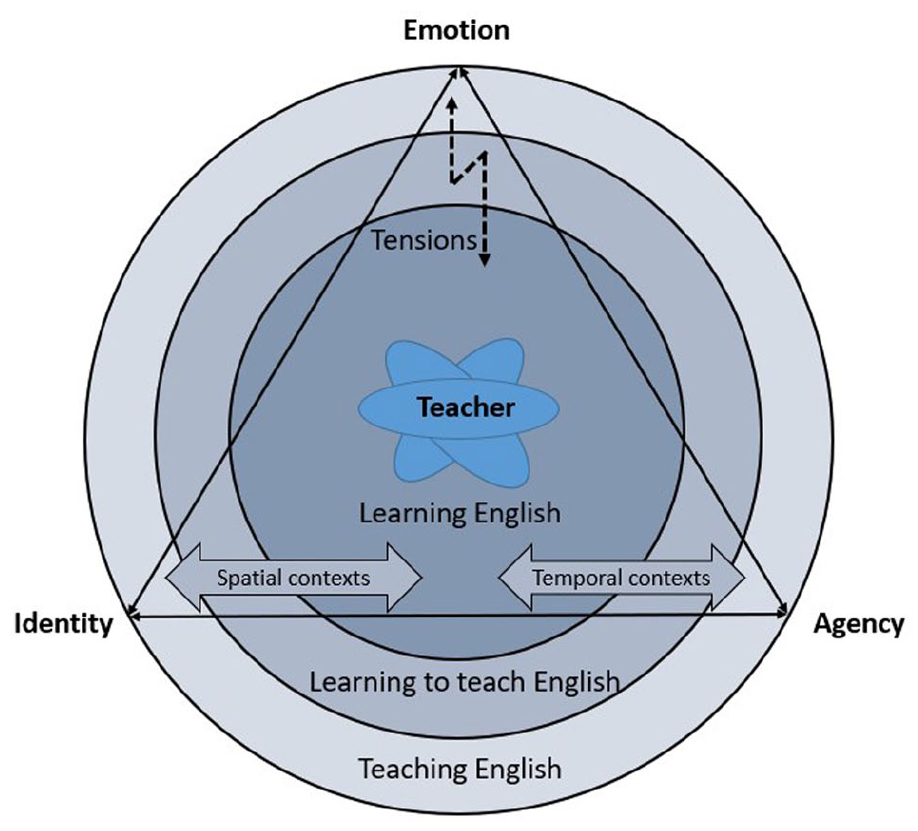
The professional becoming of English as a foreign language (EFL) teachers.
2 Supporting EFL PSTs’ professional learning through tension–emotion–agency–identity
The findings of this study provide nuanced and complex understandings of the LTI construction of EFL PSTs and offer implications for language teacher education in supporting their identity work. First, as the analysis revealed, PSTs in an EFL context often start learning the language at school and continue doing this during teacher education and well into future teaching. Learning the language over an extended period of time often involves experiencing changes in many contextual aspects such as language policy, curriculum, pedagogy, and resources, as well changes in personal circumstances. This, together with the experience in teacher education and teaching (i.e. across time and space), creates a site of uncertainty and tensions that necessitates emotional and agentive responses to emerge as teachers (Kayi-Aydar, 2015). As Cross (2020) suggested, ‘[t]he imperative is to prepare teachers who remain sure of their own capacity to navigate (and re-create) the systems within which they take up their roles as teacher-subject, despite such uncertainty’ (p. 45). It is fundamental that language teacher education account for this complexity of experiences by, for example, leveraging professional narrative and tensions in professional learning activities (Dang, 2013; Engeström, 2001; Nguyen, 2017) and by mediating tension resolution. It is also essential to promote strategies for handling emotions resulting from such tensions (Nguyen, 2018) and create mediational spaces (Golombek & Johnson, 2017) for language PSTs to develop agency and identity. Similarly, Cross (2020) highlighted the need to create opportunities for teachers to ‘re-negotiate alternative systems of activity’ (p. 43) in navigating their diverse professional learning situations.
Second, it is particularly important for language teacher education to provide contingent professional learning opportunities for PSTs from diverse English learning backgrounds. As in this study, Anne had a more advantageous English learning history while Beck and Carly experienced traditional teaching methods and a lack of resources. PSTs like these would benefit from teacher educators’ understanding of their language learning histories, strengths as well as areas they lack confidence in. Based on this, the curriculum could create differentiated opportunities for mediating their professional learning (Nguyen, 2019). This might include recognition of PSTs’ narratives of tensions and emotions and support for resolving these to become the type of teachers they aspire (Golombek & Doran, 2014). Engaging PSTs in professional reflexivity could be useful in addressing their sense of insecurity and developing agency (Li, 2022). This could be done through the use of reflective practice (Golombek & Johnson, 2017) with a focus on their background and the way it affects their practice (Farrell, 2015).
