



Abstract
This study, a follow-up to the research reported by Erlam, investigated K-12 content teachers’ ability to design tasks for content instruction in U.S. schools. Thirty-nine K-12 teachers who were enrolled in an English as a second language (ESL) teaching methods course participated in the study and each designed two language learning tasks. Two researchers rated the tasks following Ellis and Shintani’s four task criteria, as in Erlam. The study addressed the questions: (1) How successful are content teachers in designing tasks that satisfy Ellis and Shintani’s criteria? (2) Which of the criteria do teachers find easiest and most difficult to satisfy? and (3) Do the teachers improve in meeting the criteria in a second round of task designs? Ninety-two percent and 95% of the tasks satisfied three of the four criteria in task designs 1 and 2, respectively. The teachers excelled most at creating contexts for meaningful communication (92%) and including an information gap (92%) in their first tasks. Incorporating a clearly defined outcome was the most difficult criterion (66%) for teachers to achieve. There was no significant improvement from Task 1 to Task 2 in successfully incorporating the four criteria. The content teachers incorporated more of the task features than the foreign language teachers in Erlam. Over 90% met the majority of the criteria, compared to 82% in Erlam’s study. Another important difference was that participants in Erlam’s study found the easiest criteria to address was including an outcome, and they struggled most to allow learners to use their own linguistic resources and incorporate a gap. The content teachers in the follow-up study struggled most to include an outcome, but consistently incorporated communication gaps and grew in their ability to ensure that learners use their own linguistic resources. This suggests that language teachers may focus more readily on language forms, while content teachers focus more on meaningful content than on language, providing support for learners to focus on meaning.
Keywords
I Introduction
The past three decades have seen an abundance of research activity in task-based language teaching (TBLT), its effectiveness in promoting second language acquisition (e.g. Ellis, 2003; Long, 2015; Skehan, 1996) and as a researched language pedagogy (e.g. Samuda et al., 2018; Shintani, 2016). Task-based instruction promotes the use of authentic language to perform meaningful tasks with the aim of producing language that supports learners in their real-world communication. Although ‘task’ has been defined in many ways, researchers have agreed on four main components that a task must include to distinguish it from an exercise or language learning activity (Ellis, 2003; Lambert, 2018; Skehan, 1998). Ellis and Shintani (2013, p. 135) summarize these as follows:
The primary focus should be on ‘meaning’ (i.e. learners should not be focusing on linguistic form).
There should be a ‘gap’ (i.e. a need to convey information, to express an opinion or to infer meaning).
Learners should largely rely on their own resources (linguistic and non-linguistic) in order to complete the activity. That is, learners are not ‘taught’ the language they will need to perform the task.
There is a clearly defined outcome other than the use of language (i.e. the language serves as the means for achieving the outcome, not as an end in its own right).
While TBLT has been promoted with enthusiasm amongst the second language research community (e.g. Bryfonski & McKay, 2019; Ellis, 2020a; Long, 2015; Van den Branden, 2016) as an effective evidence-based form of language instruction, there is still a resistance to utilizing TBLT among language teachers. As Van den Branden and Van Gorp (2021) stated, ‘the inconvenient truth is that many teachers struggle with TBLT at different levels’ (p. 12). However, we argue that TBLT instruction is effective in promoting language learning outcomes. This is supported by a meta-analysis comparing TBLT curriculum with other forms of language instruction which showed TBLT’s strong positive effect on language learning outcomes and positive reception from teachers and learners (Bryfonski & McKay, 2019).
1 Challenges in implementing TBLT and the role of teachers
Researchers have documented several challenges that stand in the way of teachers and program coordinators implementing a task-based curriculum (e.g. Ellis, 2017, 2020b; Ogilvie & Dunn, 2010; Van den Branden, 2016; Van den Branden & Van Gorp, 2021; Vieira, 2017). Ellis (2017) summarized issues including teachers’ lack of confidence, lack of understanding of what a task is, and lack of ability to create tasks with a communication gap as problematic. Van den Branden and Van Gorp (2021) pointed to teachers’ lack of knowledge of how to access and develop TBLT materials and how to organize and execute tasks in lessons as problematic. Ellis (2020b) also highlighted challenges specific to introducing TBLT in new contexts such as students’ and teachers’ beliefs about language teaching and differing pedagogical knowledge that is needed to implement TBLT (e.g. using input-based tasks with learners with limited proficiency and distinguishing tasks from grammar exercises). Some of the contexts that have been reported as challenging for TBLT implementation include ‘large classrooms, mixed-ability classes, foreign language contexts with limited opportunities to use the language outside the classroom and/or high-stakes, form-focused examinations, with beginning language learners and, in particular, young learners’ (Van den Branden & Van Gorp, 2021, p. 14). These challenges need to be confronted in order to successfully introduce TBLT in contexts where teachers and students are not familiar with or resistant to this approach to language teaching and learning.
Both Ellis (2009) and Long (2016) agreed that a key issue in moving TBLT forward is to address in-service teacher preparation programs and pre-service teacher training designed to fully support innovation and TBLT. One such study was Ogilvie and Dunn (2010), who studied third-year education students at a Canadian university during their second language pedagogy course and practicum experience. The findings of the study revealed that before the course, the participants were against TBLT in favor of a more traditional presentation, practice, production (PPP) approach. At the end of the course, there was a significant difference in positive disposition scores toward TBLT. Participants’ written reflections also indicated a more open attitude toward implementing TBLT among some candidates. However, in interviews following the practicum, participants indicated they chose not to implement TBLT. They cited reasons including a lack of support for creating task-based materials and cultural norms such as mentor teachers expecting traditional grammatical exercises as significant barriers to implementing TBLT. Some participants also reported that it was very hard to fully implement TBLT with beginners because it was frustrating for their students to rely on their limited linguistic resources. The results of the study suggest that pre-service teacher education programs may increase teachers’ disposition toward TBLT, but Ogilvie and Dunn (2010) concluded that ‘only after greater attention is devoted to issues of implementation will the principles of TBLT regularly be put into practice’ (p. 176).
Vieira (2017) echoed the need for teacher education programs to better prepare student teachers to implement TBLT and to confront dominant teaching cultures, especially when preparing teachers who have no experience. She cited ‘workload, time spent on designing tests and assessing students from different learning levels, pressures to cover the syllabus and use the adopted coursebooks, and lack of collaboration from experienced teachers’ (p. 709) as barriers that the two student teachers in her study faced in implementing TBLT. However, she also pointed to the potential that new teachers can have ‘as agents of change’ (Vieira, 2017, p. 694). Van Den Branden (2016) also underscored that the role of teachers in TBLT has not received enough attention. In his study, he investigated the role of the teacher as a mediator of the students’ language development in using TBLT for second language teaching. Van Den Branden (2016) concluded that the role of teachers is pivotal since they ‘bring TBLT to life’ (p. 179) by providing the target language, modeling target language use, and selecting tasks that support interactions between learners.
Taken together, the studies reviewed above highlight many challenges that teachers face in implementing TBLT, particularly among pre-service teachers. Building on these findings, Ellis (2020b) proposed guidelines for effective teacher preparation programs, providing three types of factors that may impact the success of introducing TBLT to language teachers. The proposal highlights how teacher preparation program content and tools (e.g. providing existing TBLT tasks and syllabi; definitions and examples of tasks versus exercises), techniques and methods adopted (e.g. how to provide linguistic support while also allowing learners to use their own language; opportunities to design and implement tasks), and teacher support (e.g. opportunities for practice-based clinical experiences; receiving feedback on task-based lessons from coaches; mentoring from more experienced TBLT practitioners) will impact the success of training teachers in using TBLT.
One study that addressed the effectiveness of a TBLT-focused professional development (PD) program that included many of these features was Erlam (2016). She evaluated in-service teachers’ preparedness to implement TBLT and evaluated how well teachers in the program could design their own tasks and fully implement TBLT in their classes after the PD. Erlam explained that the inspiration for the study came when a teacher confessed at the end of her one-year program that she was still not sure what a task was. The study evaluated teachers who taught foreign languages to learners in grades 7–10 (ages 11–14 years) in New Zealand state schools. The 43 teachers enrolled in the program were all qualified and experienced teachers and were enrolled in a year-long ministry funded PD program for language teachers. In a pedagogy class, the teachers were introduced to TBLT and trained to identify, define and create tasks. The four criteria of tasks described by Ellis (2003) were highlighted throughout the course. The data for the study included written descriptions from the teachers of the tasks they designed for their classrooms as part of the PD program.
Erlam’s (2016) results showed that 47% of the teachers were able to design tasks that incorporated all four components of a task in their design. Thirty-five percent fulfilled three of the four criteria. Some components were reported to be more difficult to implement than others: The criterion that was most difficult for teachers to satisfy was allowing language learners to rely on their own linguistic resources, with 67% of tasks fulfilling this criterion. The second most difficult criterion was creating an information gap where learners had to communicate in order to figure out missing information in their tasks, with 79% of tasks meeting this criterion. Having a clear outcome for the task was the easiest component to incorporate, with 90% of the teachers successfully incorporating this component. As for designing tasks with a focus on meaning, 84% satisfied this criterion. Overall, the study showed that after PD, the majority of the teachers’ task designs (84%) tended toward the ‘focus on meaning’ end of Littlewood’s (2004) continuum rather than a focus on linguistic forms. This continuum ranges from a sole focus on forms (such as in a grammar exercise) on one extreme, to authentic communication where meaning is unpredictable at the other extreme, and reflects other TBLT researchers’ distinctions between tasks and exercises (e.g. Ellis & Shintani, 2013; Lambert, 2018). The fact that the teachers in Erlam’s (2016) study struggled most to design tasks that allowed learners to rely on their own linguistic resources highlights the persistence of some elements of instruction with a focus on forms. Erlam explained this may have been because most of the teachers designed output-promoting tasks, or that many of the tasks were designed as ‘one-off lessons’, rather than part of a learning sequence. Another explanation was that teachers may have been falling back into old habits of presenting new grammatical forms and asking the learners to use them in the same lesson, rather than integrating forms they had been exposed to previously. She also posited that the teachers struggled with allowing learners to rely on their own linguistic resources and with creating a language gap due to a misunderstanding of the wording of these criteria. It is possible the teachers thought the ‘gap’ should be in learners’ linguistic knowledge, rather than a gap in knowledge or opinion. Erlam suggested that teacher educators must ‘consider to what extent the criteria could be reworded so as to deal with any ambiguity, and, second, to consider how the technical knowledge of second language acquisition research may be made accessible to the practitioner’ (Ellis, 1997, p. 293).
2 Motivation for follow-up to Erlam, 2016)
The present study was conducted as part of a PD program that encouraged the implementation of TBLT by in-service teachers during an English as a second language (ESL) teaching methods class. While the previous study conducted by Erlam (2016) focused on the application of TBLT in the context of teaching foreign languages such as French, Japanese, Spanish, and Mandarin in New Zealand state schools, this study investigates how teachers of English learners (ELs) apply TBLT for different content area instruction in K-12 schools in the United States.
The motivation to conduct a follow-up to study Erlam (2016) was threefold. First, in spite of a robust body of research showing the link between TBLT and significant gains in second language learning, questions about teachers’ willingness and ability to implement TBLT remain, particularly in K-12 settings (Ogilvie & Dunn, 2010).
Second, to our knowledge, much of the research investigating teachers’ implementation of TBLT was conducted in foreign language settings (e.g. Shintani, 2016) and little to no research has been done in the K-12 context, particularly with teachers working with ELs in the United States. Of the studies included in Bryfonski and McKay (2019), the majority took place in foreign language contexts; only eight took place in a second language context. As a result, ‘setting (foreign vs. second language) could not be analysed as moderators due to the limited number of studies that were available. These variables would be exciting areas of investigation for future studies of TBLT programs’ (p. 624). Intriguingly, they reported that studies conducted in K-12 institutions had the strongest effect size (d = 1.23), but studies conducted in North America had small effect sizes (d = .45). The authors concluded that ‘TBLT is an effective pedagogy in a variety of contexts for learners at a variety of levels’ (p. 622). Their results also highlight a need for more studies to be conducted in ESL contexts, such as K-12 North American schools.
Finally, as ‘the quality of TBLT cannot exceed the quality of the teachers working with tasks . . . in research on task-based learning, teachers should receive much more attention’ (Van den Branden, 2016, p. 181). Similarly, Long (2016) and Ellis (2009, 2020b) have called for more efforts to research and implement teacher training for TBLT. In this section, we review the few studies that have highlighted the role of teachers in implementing task-based curricula. Han (2018) researched three Chinese-speaking teachers who were part of a semester-long course while studying for their Teaching Chinese to speakers of other languages (TCSOL) Certificate Program. The purpose of this study was to explore the extent to which learning about task-based learning could help the participants’ understanding of task-based teaching. Han collected three sets of 10 undergraduate writing samples from weekly journals to analyse teachers’ views on language and content learning in their descriptions of how they distinguished language and content. The results revealed that participants’ learning of content was dynamic and they showed a growth in their understanding of TBLT. Moreover, Han suggested that TBLT can result in both language and content learning simultaneously, which provides promising support for the use of TBLT and content-learning in K-12 settings.
Similar to Han’s (2018) work, Lai and Lin (2015) investigated a Chinese teacher who taught Anglo-American high-school students and was part of a training module that encouraged the use of TBLT. This Chinese online course adopted a Chinese e-textbook and developed a TBLT agenda for learning. The training module aimed at enhancing the participant’s familiarity with TBLT through a survey, weekly reflections, and recordings of virtual lessons. The results showed that students reported the training helped smooth the flow of task performance since they increased their understanding of language learning and resulted in positive attitudes towards TBLT.
East (2014) reported on a year-long initial teacher education program in New Zealand focused on TBLT in the context of modern foreign language teaching. Similarly, the goal of the study was to develop the participants’ understandings of TBLT and to uncover the challenges of its implementation. In a theory-focused methodology course, reflections on coursework were analysed and participants shared their developing knowledge and experience related to second language (L2) learning, PPP, and implementing tasks. The findings of the study showed improvement of the 20 teachers’ perceptions of TBLT from the beginning of the course to the end. They commented that their understanding of TBLT has greatly changed and they planned on implementing this approach in the future. The study paved the way for potentially introducing TBLT in school classrooms in New Zealand and for curriculum reform that was based on TBLT.
Ariatna and Ellis (2021) reported on a study of an Indonesian teacher who implemented TBLT in her English as a foreign language (EFL) classes for the first time. Her students showed gains in language learning and a positive disposition toward a task-based approach. The teacher developed a good understanding of TBLT and demonstrated the ability to integrate tasks into her lessons, even though she did struggle to let her students interact amongst themselves during tasks. Based on these observations, Ariatna and Ellis (2021) concluded that teachers who are new to TBLT need training in specific areas. These include demonstrating how to use the first language (L1) appropriately, how to design and use input-based tasks with learners at lower proficiency levels, how to facilitate meaningful teacher–student and student–student interactions, and how to use tasks with learners of mixed proficiency levels.
Taken together, the studies on the role of the teacher in TBLT feature language teachers working in university settings or in foreign language contexts. Lai and Lin (2015) and Ariatna and Ellis (2021) were conducted in high school settings; however, one was an online Chinese (foreign language) course and the other was specific to teaching English in Indonesia. Therefore, there is a necessity for further research that investigates TBLT that includes content teachers in K-12 ESL settings, which this study aims to do.
3 The present study
This current study followed similar research procedures adopted in Erlam’s (2016) study, with some alterations. The participants in this study worked in U.S. K-12 schools and were mainly content-area (e.g. math, science) teachers who had ELs in their classes, and not language teachers, as in Erlam’s study. Second, the current study expands the research questions as participants in this study were asked to implement a second round of task designs after receiving feedback from their instructor, whereas Erlam’s study only examined one round of tasks. The additional task addresses Ogilvie and Dunn’s (2010) call for research which features multiple rounds of implementation of TBLT. This second round of task designs gave the researchers the opportunity to compare results of task design 1 and task design 2 and report the results of task designs satisfying the four necessary criteria of a task (focus on meaning, information gap, rely on linguistic resources, clearly defined outcome), particularly after instructor feedback. In addition, Erlam suggested the four criteria could be reworded for clear interpretation by teacher participants. This was addressed in this study by providing examples. For instance, for the communication gap criterion, we explained that students should be ‘communicating information their partner may not already know’.
II Research questions
Given that the implementation of TBLT in K-12 ESL contexts represents an under-researched area, we address the following questions in this study:
Research question 1: How successful are K-12 teachers in designing language tasks that satisfy the four criteria proposed by Ellis and Shintani (2013)?
Research question 2: In designing language tasks for the classroom, which of the four Ellis and Shintani (2013) criteria do teachers find easiest and most difficult to satisfy?
Research question 3: Do the teachers improve in meeting the criteria in a second round of task designs?
III Methods
1 Participants
The participants in this study were all teachers enrolled in a comprehensive ESL PD program. The program was designed for K-12 educators in U.S. settings in order to earn an ESL endorsement. There were 39 participants, three of whom were male while the rest were female. Of the participants, two were Latina, one was African-American, one was of Middle Eastern descent, and the rest were Caucasian. Of the 39 participants, eight spoke another language aside from English.
In terms of the grade levels, 19 participants taught elementary students (K-5), nine taught middle school (grades 6–8), four taught high school (grades 9–12), and seven served as ESL specialists in their school or district and served students at multiple grade levels. Through this program, participants were exposed to instructional strategies and practicum experiences at multiple levels since the endorsement they were seeking was for the K-12 context. However, when designing their TBLT lesson, they designed it primarily for their current classroom contexts because they had to implement it with their own students. In terms of the ELs in their classroom, there was wide variation. Some participants had classrooms that were 95% ELs, while others had only a few in their classrooms. Regardless of the number of ELs in their classroom, they were instructed to design tasks that met all of Ellis and Shintani’s (2013) criteria.
2 Task-based teaching methods course
The PD program included courses on second language acquisition (SLA), linguistic principles, diversity in literacy, language assessment, and two language teaching methods courses. The first language teaching methods course focused on the Sheltered Instruction Observation Protocol (SIOP; Echevarría et al., 2017) for teaching ESL, and the second methods course built on this by introducing TBLT and integrating task-supported methods with SIOP lesson plans. Specifically, the teachers were evaluated on their ability to develop meaningful activities (SIOP feature 6), lessons that provided multiple opportunities for interaction (SIOP feature 16), and opportunities to apply content and linguistic knowledge in real-world activities (SIOP feature 21).
The introduction to TBLT was provided in the form of readings (e.g. Ellis & Shintani, 2013; Nunan, 2004), definitions of pedagogical and real-world tasks, presentation of the criteria that distinguish activities from tasks, and participation in sample tasks, such as a schedule information gap task, a role play, and a spot the difference task. After completing the sample tasks, the teachers evaluated each one using the four criteria presented in Ellis and Shintani (2013). Next, students read more about the development of pedagogical tasks that encourage learners to focus on form (e.g. Eckerth, 2009; Gass et al., 2005).
After evaluating a wide range of tasks in the task-based literature, the teachers designed two tasks for their own classrooms. They were instructed to design an output-based task that would promote interaction between at least two students, which could be modeled on the task types they had read about in the course. The tasks were evaluated along the four criteria presented above, and each teacher received feedback from their instructor on their tasks. They were then required to apply their tasks in their classrooms and write a short reflection about the successes and challenges of the implementation.
3 Data sources
Each teacher designed two tasks, two weeks apart. Similar to Erlam (2016), the focus of this study was on the ‘language task as a workplan’ (p. 287). That is, the researchers used the participants’ descriptions of their tasks as they meant to use them in their classrooms. The researchers did not take into account whether or not the tasks went as planned during implementation, nor whether the students achieved the defined task outcome.
4 Data analysis and coding
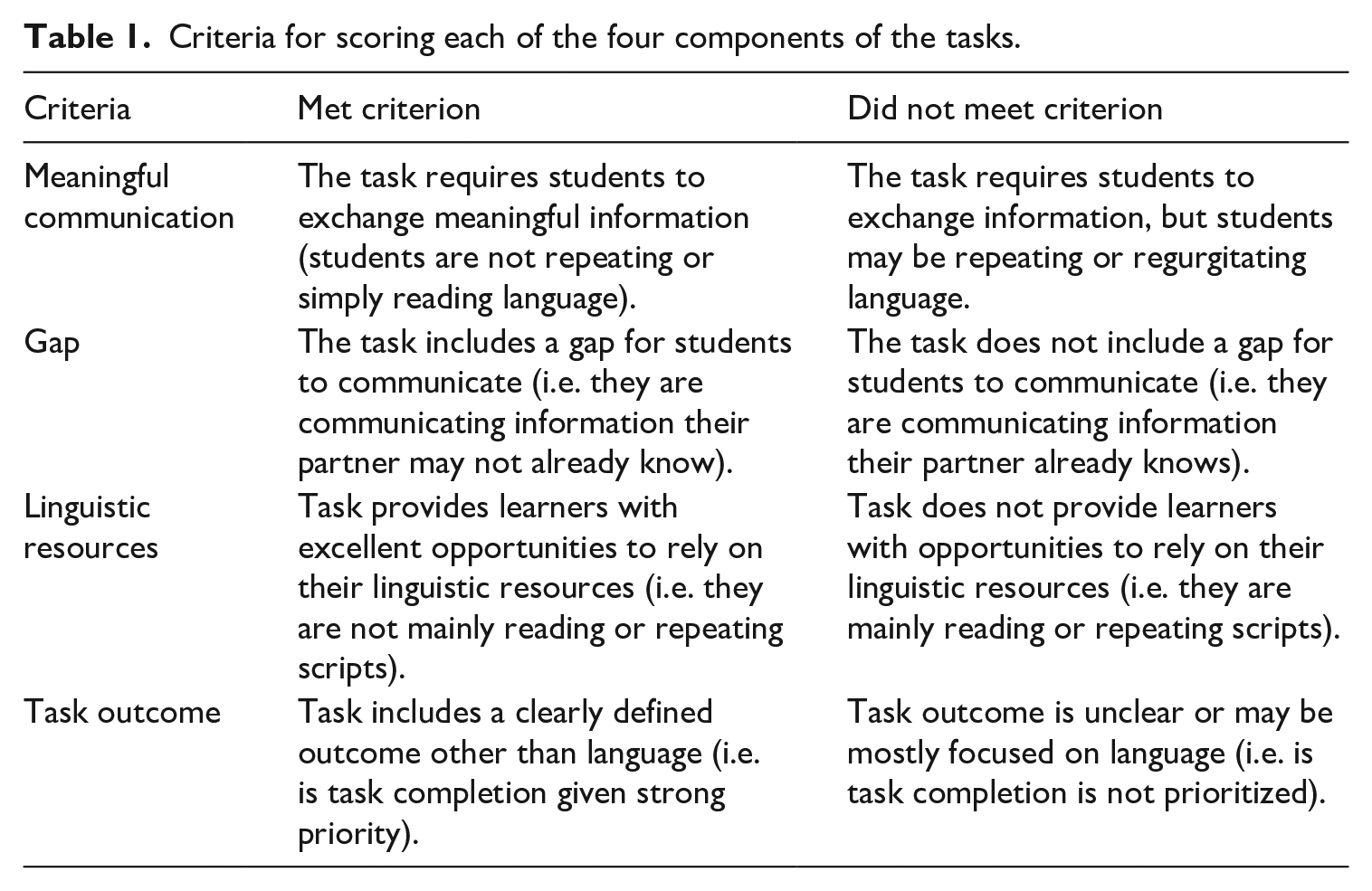
The tasks were scored categorically as successful or unsuccessful along the four criteria mentioned above, following Erlam’s (2016) study. The researchers created a rubric to score each task design (see Table 1), and the participants knew these were the criteria on which their tasks would be evaluated. In addition, a McNemar test was used to evaluate whether there was a statistically significant change in the proportion of the four criteria successfully included in the first task design compared to the second task design.
Criteria for scoring each of the four components of the tasks.
5 Reliability
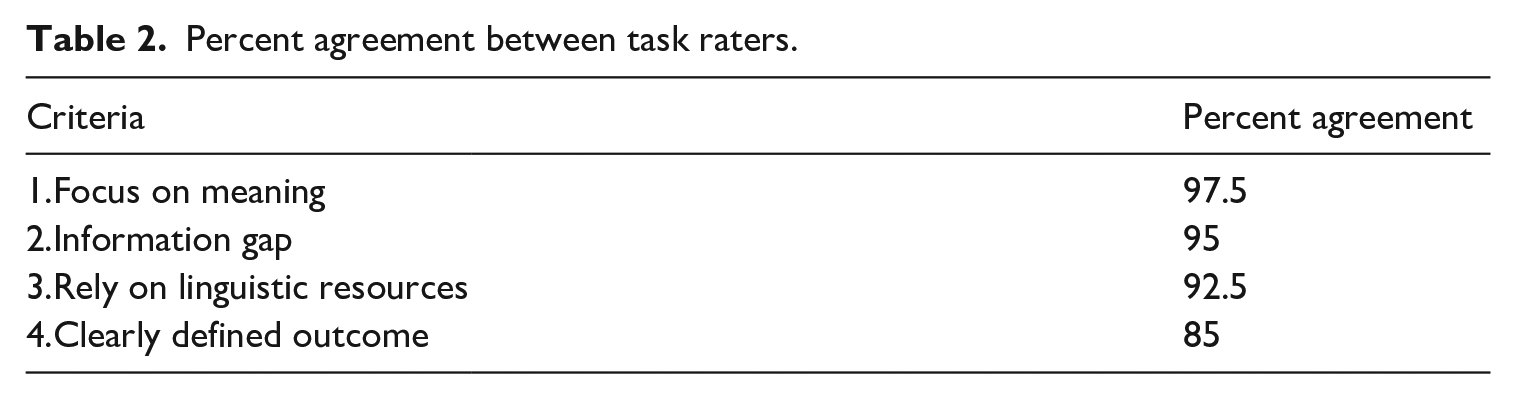
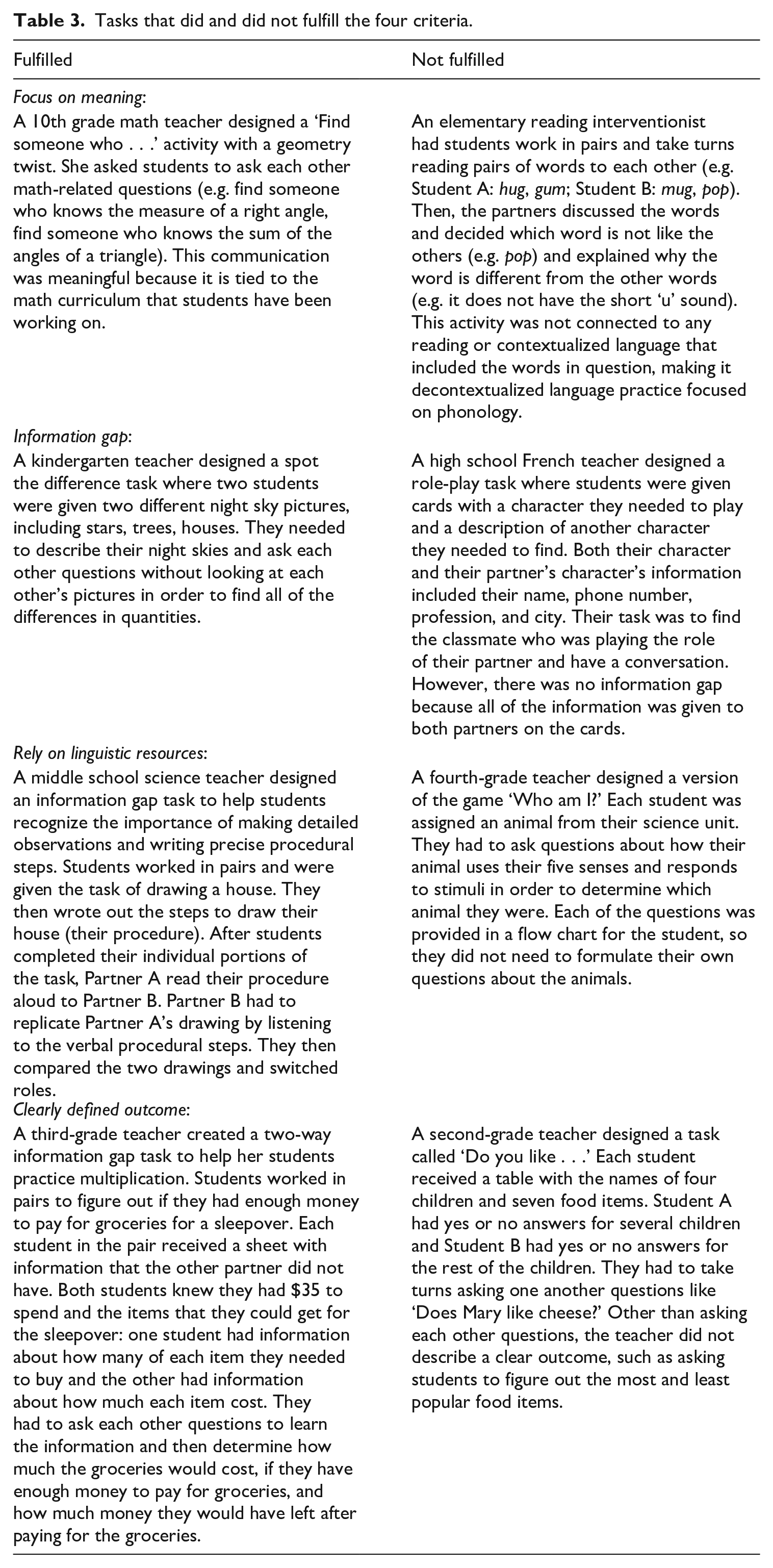
Following Erlam (2016), the first author rated all 76 tasks herself. She then met with the second author to discuss the rubric and train her to use it. First, they scored two of the 76 tasks together, then the second researcher scored 20 tasks on her own. The two researchers discussed any disagreements and came to a consensus about a final rating. The second researcher scored another 20 tasks, and again, the two researchers discussed any differences and came to an agreement. The overall percentage agreement was 93%. Percentage agreements for each criteria are listed in Table 2. The criterion with the lowest percentage agreement was clearly defined outcome. In Table 3, examples are provided of different tasks, and these are categorized on whether or not they met a specific criterion of TBLT.
Percent agreement between task raters.
Tasks that did and did not fulfill the four criteria.
IV Results
Research question 1 evaluated how successful K-12 teachers were in designing language tasks that satisfied the four criteria proposed by Ellis and Shintani (2013). We report the percentage of tasks the teachers designed that met Ellis and Shintani’s (2013) four criteria for a language task in Table 4. In the first task design, 20 tasks out of 38 (53%) satisfied all four criteria; an additional 15 tasks (39%) satisfied three criteria; two tasks met half of the criteria; one task met only one criterion. None of the tasks in the first design failed to meet any of the criteria.
Number and percentage of tasks that met the criteria (percentages in parentheses).

In the second task design, 23 of the 38 (61%) satisfied all four criteria; an additional 13 tasks (34%) included all three criteria, and two tasks included half of the criteria. In the second task design, 95% of the tasks included at least three of the criteria.
Research question 2 asked which of the four Ellis and Shintani (2013) criteria the teachers found easiest and most difficult to satisfy. The proportion of teachers who successfully incorporated each criteria for both task designs are presented in Table 5. Based on the percentages reported in Table 5, in the first task design the teachers excelled most at creating contexts for meaningful communication (92%) and including an information gap (92%) in their tasks. They struggled somewhat to provide learners the opportunity to rely on their own linguistic resources (87%), and it was most difficult for them to create a clear outcome (76%) for the tasks. Success rates were similar in the second task design, with the majority of the teachers successfully creating meaningful tasks (97%) that included a gap (95%) and that required learners to rely on their own linguistic resources (97%). The incorporation of a clearly defined outcome remained the most difficult criteria, with only 66% of teachers successfully incorporating this element.
Number and percentage of tasks that incorporated each of the criteria (percentages in parentheses).
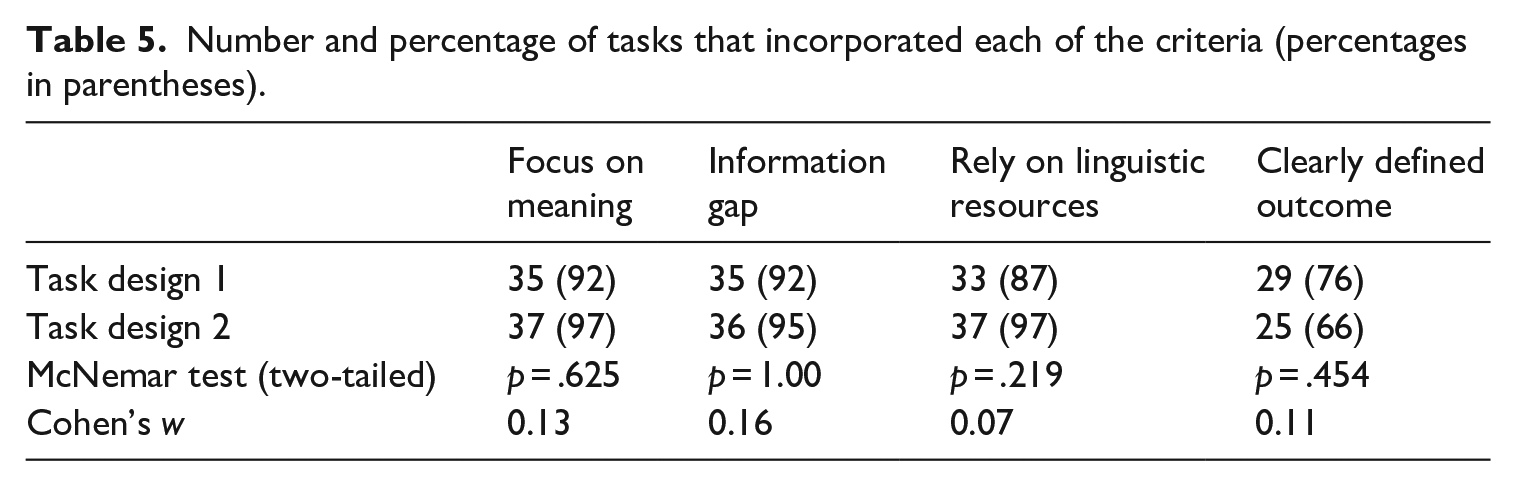
Research question 3 addressed whether the teachers’ task designs improved from Task 1 to Task 2. Descriptively, there was an increase in the number of tasks that were focused on meaning, that included a gap, and that allowed students to rely on their linguistic resources from Task 1 to Task 2. There was a decrease in the number of tasks that included an outcome on Task 2. A McNemar test showed that none of these changes were statistically significant and the effect sizes for all criteria were all close to 0.10, which Cohen (1988) described as small. Therefore, after a second round of task designs the teachers did not significantly improve their ability to incorporate the four task criteria.
V Discussion and implications
The results for research question 1 revealed that 53% and 60% of the participants were able to successfully include all four criteria outlined by Ellis and Shintani (2013) in Tasks 1 and 2, respectively. The percentage of successful implementation of all four criteria is slightly higher than Erlam’s (2016), who reported 47% of participants included all four criteria. Erlam (2016) found that more than 75% of the participants in her study fulfilled three of the four criteria and noted that ‘being able to fulfil three of the key components of task design is evidence of an activity that is placed further towards Littlewood’s (2004) “focus on meaning” end than the “focus on forms” end’ (p. 290). In this study, 92% and 94% of the participants included three out of the four criteria in Tasks 1 and 2, respectively, placing the content teachers’ designs squarely in the realm of tasks that focus on meaningful content.
The easiest criteria to implement for the participants in our study were creating contexts for meaningful communication and including an information gap for both task designs 1 and 2. The most difficult for the participants to implement in both tasks was creating a clear outcome for the task. Our results differed from Erlam’s (2016), who found exactly the opposite: the easiest criterion was creating a clear outcome for the task, and the more difficult ones were allowing learners to use their own linguistic resources and incorporating a gap. One important difference between the participants is that the teachers in Erlam’s study were foreign language teachers, while the participants in our study were content-area teachers in a second language setting. The tasks that our participants created were primarily content-based. Academic content such as social studies or math could potentially lend itself better to creating a gap in communication, whereas traditional foreign language teachers might place a heavier focus on language forms, making it more difficult to create a communication gap. Erlam stated that the participants in her study may have found it difficult for their learners to use their own linguistic resources because many were in the beginning levels of proficiency. While we do not have specific information about the levels of proficiency of our teachers’ students, we know that they receive more exposure to the target language than students in foreign language learning contexts due to the fact that all of their classes are in English and the language is spoken all around them. A second reason for why the participants in Erlam’s study struggled to create a communication gap could have been due to a misunderstanding of the term ‘gap’, as intended by Ellis (2003). Erlam explained that based on teachers’ reflections about the tasks they created the participants may have understood ‘gap’ to be a lack of language knowledge and not a gap in communication. The instructor of the participants in the current study emphasized that there should be a gap in communication. The language in the rubric also clearly stated that there should be ‘a gap for students to communicate’, and not simply a linguistic gap. Lambert (2018, p. 1) has also proposed descriptions such as ‘gap in the content on which the task operates’, and ‘communicative gap in opinion or personal experiences’. These wordings might be useful to include in teacher preparation programs to help clarify the meaning of ‘gap’.
The teachers in our study showed a strong ability to incorporate three of the four task criteria in both task designs. They received feedback from their instructor on their first round of task designs, and reached similar levels of success in creating tasks that would allow their students to exchange meaningful, content-focused information. One type of feedback that the teachers seemed to apply successfully was in the area of allowing learners to use their own linguistic resources. In the first round of task designs (87% of tasks met this criterion), we observed some tasks where teachers provided scripts or sentence frames. For example, in the ‘Who am I?’ animal task described in Table 3, the teacher provided all of the questions needed to guess which animals were on the task cards (e.g. ‘Can it see in the dark?’). In a ‘Find someone who . . .’ task designed in the second round, we observed another teacher write characteristics (e.g. ‘Find someone who . . . knows the quadratic equation’) in such a way that students were required to create their own questions (e.g. ‘Do you know the quadratic equation?’). We also observed a tendency to provide key vocabulary as a linguistic support in the second round of designs (97% of tasks met the linguistic resources criterion). Thornburn (2022) suggested that teachers should not provide sentence stems on the same page as the task itself, as this tended to result in learners reading the speaking prompts instead of interacting more spontaneously.
In spite of receiving instruction and feedback on how to create task outcomes, we observed that participants struggled in both rounds of task design to create a clear outcome (their success rate was similarly low in Task 1 and Task 2). One possible explanation for why they did not improve was that in the first task design, many of the teachers created a spot the difference task, which by design includes an outcome. Other teachers used games (e.g. multiplication battleship, find someone who . . .) for their first task, which either included an a priori outcome (e.g. locating all of the opponent’s ships by correctly multiplying numbers on a battleship grid), or could easily have an outcome added (e.g. determining which math concepts were the most difficult after classmates surveyed their peers). A middle school science teacher who created an information gap task for a unit on the Law of Superposition described that her design process for the first task involved modifying an existing activity. She explained, ‘I have done this activity in my classroom without the information gap piece.’ These examples of using familiar activities, games, and task formats to design tasks support calls for teachers in training to have ample access to TBLT materials (Ellis, 2020b; Van den Branden & Van Gorp, 2021). In the second task, the teachers were slightly more creative in their designs. For example, a high school science teacher created a jigsaw reading information gap activity on introduced species from scratch, choosing readings, writing her own directions, and creating handouts to organize the information that students should identify and share. However, beyond exchanging the information that each learner found in their reading to complete their handouts, she did not develop a strong outcome (e.g. determine as a group which introduced species is most/least harmful). This creative license may explain why some teachers had difficulty achieving a clear task outcome in the second designs.
VI Implications and future directions
The findings that the content teachers in this study struggled most to incorporate an outcome but consistently incorporated meaningful communication gaps and provided learners with opportunities to use their own linguistic resources have implications for teacher education programs. Erlam (2016) acknowledged that participants in her training program were not required to design their tasks to solely fit those criteria proposed by Ellis and Shintani (2013). The tasks in the current study were evaluated using the same rubric as the data were later scored on, and the participants each received feedback on which criteria of their designs were not met and what they did well. This may have contributed to the consistency in success rates that were observed. A first set of recommendations for PD programs is that teachers be given the opportunity to create tasks that fit a limited set of criteria when they are first learning about creating tasks. Given the large number of important contributions to the field of TBLT by numerous researchers (e.g. Ellis, 2005; Lambert & Oliver, 2020; Long, 2015; Nunan, 2004; Samuda et al., 2018; Shintani, 2016; Skehan, 2018), teachers may be overwhelmed by the number of considerations that could be made in designing classroom tasks, so selecting a focus to the design (e.g. real-world language use, input- or output-based tasks) may make learning to design tasks more feasible. Based on how successfully the teachers in this study were able to modify existing classroom activities, games (e.g. Battleship, Guess who?) and task formats (e.g. spot the difference, find someone who . . .), we highly recommend providing teachers participating in PD access to a repository of tasks and materials that lend themselves well to task-based interaction. This is also in line with recent proposals for TBLT teacher preparation program guidelines. Van den Branden and Van Gorp (2021) reported that ‘providing teachers with a rich collection of input-based, output-based, and integrated tasks which gradually increase in complexity’ (p. 11) was one of the improvements made to the TBLT training syllabus for primary educators in Belgium. Similarly, Lai (2015) underscored that teachers doing TBLT in Asia needed access to materials, and Ellis (2020b) included providing teachers ‘an actual task-based syllabus and the materials needed to teach it’ (p. 107) as a factor that impacts the success of introducing TBLT to language teachers. These observations and proposals suggest that TBLT teacher training programs should address how to access and select quality materials, how to modify existing exercises and activities to create tasks, and how to design tasks from scratch.
In addition, teachers would benefit from designing and implementing multiple tasks and receiving feedback on how their tasks may not fulfill the targeted criteria in order to get as much practice as possible. Previous research suggests that successfully implementing TBLT can be a very slow process that requires sustained effort and opportunities to practice implementing tasks and feedback and support from teacher educators, coaches, and materials developers (Ellis, 2020b; Erlam, 2015; Van den Branden, 2006; Van den Branden & Van Gorp, 2021). Our findings show that a single TBLT methods course with two opportunities to design and implement tasks did not result in significant improvement in teachers’ ability to incorporate all the task features, which suggests that teachers could benefit from even more practice and support.
Compared with Erlam’s (2016) findings, which showed that foreign language teachers may focus more readily on language forms, the content teachers in this study were able to design language tasks that focused more on meaningful content than on forms, which is an essential component for creating contexts for authentic communication. This finding suggests that tasks are ripe for use with young learners in K-12 content classrooms, in line with proposals from Butler (2011), Ellis (2020a), and Van den Branden (2006, 2016). In the current study, the content teachers needed some guidance in finding the balance between allowing their students to rely on their own linguistic resources while providing the appropriate amount of linguistic support. For example, those who provided scripts for their students to read in the first task design did not give their students freedom to use their own language resources. Others provided no linguistic support, which could leave some learners unable to complete tasks. In the second task design, the teachers succeeded in providing some linguistic support (e.g. key vocabulary) without dictating exactly what the learners should say to complete the tasks. For teacher education programs serving content teachers in areas such as math, science, social studies, and language arts, teachers will need guidance in learning how to effectively provide linguistic support for output-based tasks. This might include providing sentence stems in a pre-task phase and hiding them during the task itself as suggested by Thornburn (2022). In programs for language teachers, who may have a strong linguistic orientation, more support in designing meaningful contexts for authentic communication may be necessary. In programs that serve both content and language teachers, there is a great opportunity to pair both types of teachers together to design tasks that focus on meaningful content while also providing language learning opportunities for specific language forms.
This study considered one of many issues related to moving TBLT forward within the context of teacher preparation programs, namely teachers’ ability to learn to design language tasks. There are many related issues that remain ripe for exploration in teacher education programs designed to promote TBLT. Future research should address teachers’ ability to organize and execute tasks that they modify or design within lessons. This could include research that documents teacher support in implementing TBLT by way of opportunities for practice-based clinical experiences, receiving feedback on task implementation from coaches, and mentoring from more experienced TBLT practitioners (Ellis, 2020b). Following Ogilvie and Dunn’s (2010) line of inquiry, another fruitful avenue of research would be to evaluate how teachers’ beliefs about TBLT change after extensive training in learning to design and implement tasks, and after receiving support while implementing TBLT. Given outstanding questions about applicability of TBLT with younger learners at beginner levels of proficiency and mixed proficiency groups, future research on TBLT teacher education should also evaluate teachers’ implementation of tasks with these populations.
Footnotes
Funding
The author(s) disclosed receipt of the following financial support for the research, authorship, and/or publication of this article: This work was supported by the National Professional Development Grant of the Office of English Acquisition of the U.S. Department of Education (Grant number T365Z1700217).
