



Abstract
Gender contents, textual or visual, in instructional materials can be considered as a hidden curriculum, and may either hinder or advance equality. How teachers interpret and respond to this hidden curriculum in their classroom discourse, however, can play a crucial role in creating positive change. This research seeks to understand how teachers work with gender-sensitive contents in a newly-published English textbooks series for lower secondary education in Vietnam. To what extent are teachers aware of genderedness in textbooks, and how do they respond to it? Approaching gender as a social construct, using multi-dimensional methods, the study critically explores teachers’ experiences with the textbooks – their classroom practices and underlying perceptions – through 18 classroom observations and 12 follow-up interviews with 12 teachers in four lower secondary schools. Results indicate that neither the hidden curriculum of gender was recognized nor a critical mediation of it was practised. Gender content, whether ‘traditional’ or ‘progressive’, was largely absent from classroom discourse, as teachers prioritized transferring linguistic knowledge. Little space was allocated for promoting students’ critical thinking and self-reflections, including those about gender-related content. Teachers did not often pay full attention to different nuances and dimensions of gender issues, while sometimes their teaching design and interaction were found to be affected by their own bias – consciously and unconsciously. The study reveals that although teachers were later willing to reconstruct their perceptions and future practices, and were able to concretize their pedagogical intentions, enacting teacher agency in relation to critical pedagogy and gender equality in the contemporary English as a foreign language (EFL) classroom in Vietnam might remain a challenge. Based on the study’s findings, pedagogical implications that may enable teachers to be potential agents of change were suggested.
Keywords
I Introduction
In her recent book, Kramsch (2020) questioned why, even now, language education following a ‘code-centred, structuralist view’ still persists. Indeed, language is not simply an instrument to convey information, but a discourse with symbolic power, and teachers need to cultivate students’ transactional but also symbolic competence (Kramsch, 2020). Critical pedagogy (e.g. Crookes, 2021; Pessoa & de Urzêda Freitas, 2012), where teachers go beyond teaching language content to encourage students’ critical thinking, enables students to be engaged in challenging and subverting inequalities.
Although embracing social perspectives in gender and language education has been promoted in research, the focus has not been placed on real classrooms and teacher situated practices (Davis & Skilton-Sylvester, 2004). This study examines teacher practices in the English as a foreign language (EFL) classroom as a discourse of gender, nested in societal gendered discourses of ideologies (Sunderland, 2006). In particular, it investigates how teachers work with gender-sensitive textbook contents in the English classroom in Vietnam.
Research question 1: To what extent are teachers aware of gender contents in EFL textbooks?
Research question 2: How do they respond to these contents in the classroom discourse?
Research question 3: What underpins teachers’ pedagogical decisions?
Research on gender and textbooks has been well documented, focusing on materials analysis, textually and visually (Ariyanto, 2018; Carlson & Kanci, 2017; Lee, 2014, 2019; Lee & Mahmoudi-Gahrouei, 2020; Yang, 2016).
While text-based studies have taken a central role, little is known about how teachers actually interact with textbooks in general (Tomlinson & Masuhara, 2018), and with gender in textbooks in particular (Canale & Furtado, 2021; Mustapha, 2013; Sunderland, 2004; Sunderland et al., 2001). There has been a continuous call for more research on teachers’ behaviour and engagement when using gendered textbooks (Mustapha & Mills, 2015; Namatende-Sakwa, 2019; Sunderland et al., 2001) – to focus not only on bias ‘in the text’, but also on ‘teacher talk around the text’ (Sunderland et al., 2001). A small but growing body of research has investigated teacher roles in negotiating textbook gender content in the language classroom, including studies by Canale & Furtado, 2021; Namatende-Sakwa, 2019; Pakuła, Pawelczyk, & Sunderland, 2015; Pawelczyk & Pakuła, 2015; Sunderland et al., 2001; and Tainio & Karvonen, 2015.
In Vietnam, research on gender bias in textbooks and in classroom discourse is limited. Earlier studies (Brundrett & Mai, 2018; Mai & Brundrett, 2020) looked at gender equality in education via interviews with teachers, staff, and students. To date, no research investigating teachers’ gender-related classroom interactions, and their underlying mindset, seems to have taken place in the Vietnamese context.
This research contributes to this expanding area, aiming to provide a comprehensive understanding of the issue by an in-depth, multi-method examination drawing from rigorous data sources of textbooks, field observations, and interviews.
Adopting critical discourse analysis (Fairclough, 2003), the study analyses ‘text’ – understood in a broader sense as multi-modal language: written texts, visuals, interactions, interview data – in connection with different discourses and ideologies. Ideologies closely associate with power, because ideologies are assumptions embedded in conventions (norms), which in turn depend on power relations, and because ideologies are a vehicle of establishing, legitimizing, and changing social relations of power (Fairclough, 2001, 2003). Ideologies also closely associate with language, because using language is our everyday social behaviour which depends on ‘common-sense’ assumptions (Fairclough, 2001). Classroom teaching, as a social practice, articulates discourse (and language). The different elements of that practice – actions, interactions, social relations, and persons (with values, beliefs, attitudes, experiences), the physical classroom, and discourse – have a dialectical relationship; for example, ‘social relations are partly discoursal in nature, discourse is partly social relations’ (Fairclough, 2003, p. 25; italics in original).
In Vietnam, English language education has been described as being grammar-focused and examination-oriented (Le & Barnard, 2009). The classroom discourse is commonly teacher-led and textbook-based. Currently, English teaching starts at as early as grade 1, and communicative approaches are promoted, although large classes and textbook dependency remain (Khalifa, Nguyen & Walker, 2012).
The textbooks selected for this study are a newly-published series for lower secondary education (grades 6–9, students age 11–15 years) named Tieng Anh [English] (Hoang et al., 2017), within the ongoing National Foreign Languages Project, Vietnam Ministry of Education and Training (2008–2020, extended to 2025). The series was jointly produced by the Vietnam Education Publishing House and Pearson. One researcher of this study is a member of the writing team.
The current study is part of a larger project examining gender bias in English textbooks and classroom practices in Vietnam. The first component is a multi-modal textbook analysis, which found that although some efforts towards gender equality existed, the making of textbooks in today’s Vietnam is still largely affected by (patriarchal Confucian) norms and bias (Vu & Pham, 2021).
This second component explores teachers’ classroom practices and their underlying mindset regarding textbook gender-sensitive contents.
II Background
1 Gender and the hidden curriculum in education
The study adopts the perspective conceptualizing gender as being socially constructed. Moving away from the view seeing gender first as a biological construct, scholars who proposed gender as a social construct (e.g. Butler, 1990) argued that the way in which our characteristics and acts are acquired is significantly influenced by how they are understood by people around us. Butler (1990) discussed that we perform a gender according to our gendered norms and roles, and how we gradually become ‘feminine’ or ‘masculine’ is based on others’ reactions and expectations. Gender is thus continuously produced, and it can be used as a verb: we perform gender roles and we are gendered. Butler’s conceptualization of gender as performative not only aims to describe the production of gender, but also to discuss how the rules and power dynamics mandating gender identity can be challenged and subverted (Blencowe, 2013).
Using multiple official sources, Ortiz-Ospina & Roser (2018) observed that although gender inequalities have been decreasing over the last century worldwide, the gender pay gap still exists; women are still underrepresented in senior positions, while at home they often have less influence over family’s important decisions. Vietnam has established a sound legal framework for gender equality, including the Law on Gender Equality 2006 and the National Strategy on Gender Equality 2011–2020. However, an inclusive growth that provides women with equal opportunities remains an issue (UNFPA, 2020). There exists a gap between the espoused commitment and how policies are enacted in practice (Brundrett & Mai, 2018). Recent statistics (FWF, 2019) show that Vietnam still faces gender inequality in e.g. employment and education, and gender-based violence still prevails.
Gender inequality is often rooted in cultural forces and discourse, including power relations, norms and ideologies (Lips, 2014; Sunderland, 2006). Vietnam has its distinct history, culture, and traditions (e.g. Mai, 2006). However, Confucianism – a belief system originated in ancient China that emphasizes male domination – remains one of the main ideologies that influences Vietnam society at large, including education (e.g. FWF, 2019; Grosse, 2015; Mai & Brundrett, 2020; Schuler et al., 2006). The idea that being a male has more value than being a female has consequences. For example, a woman’s value may mainly be defined by her role as a wife, daughter-in-law, or mother; these may deny her alternative life pathways, for example, choosing to be single or prioritizing the pursuit of a career (Ritchie & Roser, 2019). The discriminatory attitude towards domestic work means women will have less time and resources, thus opportunities, for higher-paying jobs, health care, education, and leisure activities, which in turn negatively impacts their participation in society and their own quality of life (Chowdhury et al., 2018).
In reality, to detect, and question, these norms is not always easy, as societal power relations are constructed and embedded within everyday language use and interaction (Kramsch, 2020), and contents such as gender bias can largely go unnoticed or be seen as unproblematic without close examination (Jule, 2018). In education, gender bias in EFL textbooks is often an issue. Studies around the world have demonstrated that women are still portrayed as inferior to men, and these representations are influenced by discourses that disadvantage women (Ariyanto, 2018; Carlson & Kanci, 2017; Lee, 2014, 2019; Lee & Mahmoudi-Gahrouei, 2020; Li, 2016; Tainio & Karvonen, 2015; Yang, 2011, 2016). Indeed, curriculum is never neutral – it always reflects and generates, implicitly and explicitly, social ideologies, meanings, and values (e.g. Giroux, 1983). This agenda, known as the ‘hidden curriculum’, influences students’ learning but also their personalities and worldviews – which affects their future opportunities (Gullicks et al., 2005; Leask, 2015). The hidden curriculum in textbooks has been studied from different angles, for example immigrants, refugees and language (Auerbach & Burgess, 1985), gender (Lee, 2014), and ethnocentrism (Shinabe, 2018). In gender and education, if the messages from the hidden curriculum relay gendered biases, students may come to accept the assumptions, which influences their development and leads to social inequalities (Kereszty, 2009; Lee, 2014, 2019).
2 Teachers’ mediation of textbooks and critical pedagogy
The hidden curriculum is conveyed through instructional materials, but other components of formal (and informal) education – such as syllabus-based activities, extra-curricular activities, and the execution of actual teaching and learning – can all be sources of hidden curricula (Leask, 2015; Lee, 2014). The hidden curriculum may produce and reproduce certain cultural contents and sustain dominant social practices. However, that does not mean education is indoctrination. Sociologists of critical pedagogy (Freire, 1970/2005; Giroux, 1983) see education as a practice of freedom, and it must expand the capacities necessary for human agency towards a world of social justice and democracy. Human subjects do make history, and education must create room for ‘moments of self-creation, mediation, and resistance’ (Giroux, 1983, p. 259). Critical pedagogy thus concerns both ‘the practice of self-criticism about the values that inform teaching’ and ‘a critical self-consciousness regarding what it means to equip students with analytical skills to be self-reflective about the knowledge and values they confront in classrooms’ (Giroux, 2010, p. 717). Adopting a problem-posing education (Freire, 1970/2005), which encourages students’ critical thinking by presenting situations to them as a problem so that they can ‘perceive, reflect, and act on it’ (Crookes, 2021, p. 249), teachers can play a significant role in mediating the hidden curriculum. Teachers’ treatment of either ‘traditional’ or ‘progressive’ texts affects learners more than the ‘effect’ of the text itself (Sunderland et al., 2001).
In practice, whether textbooks are used as scripts or resources depends on various factors, including policy mandates, examinations, and teachers themselves. Tomlinson & Masuhara (2018), using a basis of international research, reported that while some teachers use textbooks as resources and act as ‘curriculum makers’ and ‘curriculum mediators’, more are ‘curriculum transmitters’ and ‘curriculum realizers’.
Regarding teacher interaction with gender issues, previous studies, though limited, have shown that teachers are often unaware of gender bias, because of their own ‘gender blindness’ (Sadker & Silber, 2007). Research by Pakuła, Pawelczyk and Sunderland (2015) and Pawelczyk and Pakuła (2015) revealed that EFL teachers in Polish schools seldom challenged the traditional portrayal of women and men in textbooks, nor actively created gender-relevant discussions. In Finland, teachers appeared not to take gender issues into consideration and, when they did, it was rare for them to talk about boys and girls in terms other than binary oppositions (Tainio & Karvonen, 2015). In the US, teachers seemed to lack gender awareness in textbooks and how it can be enacted in teaching (Namatende-Sakwa, 2019). Likewise, gender was not part of teacher’s teaching plan in the English lessons in Uruguay, and other priorities (e.g. grammar) seemed to take control (Canale & Furtado, 2021). However, there is evidence that teachers, when guided, are able to notice gender biases in instructional materials and reflect on gendered discourses (Namatende-Sakwa, 2019; Tainio & Karvonen, 2015). In Canale & Furtado’s (2021) study, the teacher actively helped create spaces for students when students initiated gender-related discussions, even if these were not part of the teacher’s plan.
The current study explores how teachers work with gender-related contents in EFL textbooks in Vietnam, and why. It draws on the interconnected concepts of stereotyping, invisibility and imbalance/selectivity, the analytic tools that help detect gender biases in teaching materials and classroom practices (Sadker & Zittleman, 2007). These concepts can largely be related to critical discourse analysis’s representation of social actors, where discourse practice is linked to the power dynamics between discourse participants, individual or collective (Fairclough, 2003; van Leeuwen, 1996). Stereotyping is the assigning of particular, often ‘traditional and rigid’, roles, character, and behaviour, to a group, which may create a limited impression of that group’s diversity, capabilities, and potential. Meanwhile, invisibility is present when certain groups are underrepresented or excluded from display, which implies they are of less value and importance. Similarly, imbalance/selectivity entails an unbalanced representation of groups, which may build an inaccurate image of that group while sending misleading implications about the other groups (Sadker & Zittleman, 2007).
III Materials, methods, and fieldwork
The study uses multiple methods with various sources of data. Classroom observation and interview are its main data sources, and textbook pre-examination is a supplementary source. The methods and data help answer the research questions, but they also complement each other (Table 1). The pre-examination of the textbooks’ units provides the necessary substance to answer Research question 1 (and Research question 2 and Research question 3) – to explore teachers’ awareness of gender-sensitive contents. Classroom observation serves Research question 1, and Research question 2 – to examine teachers’ practices. Interview serves Research question 3 – to understand teachers’ underlying mindset.
Study design.
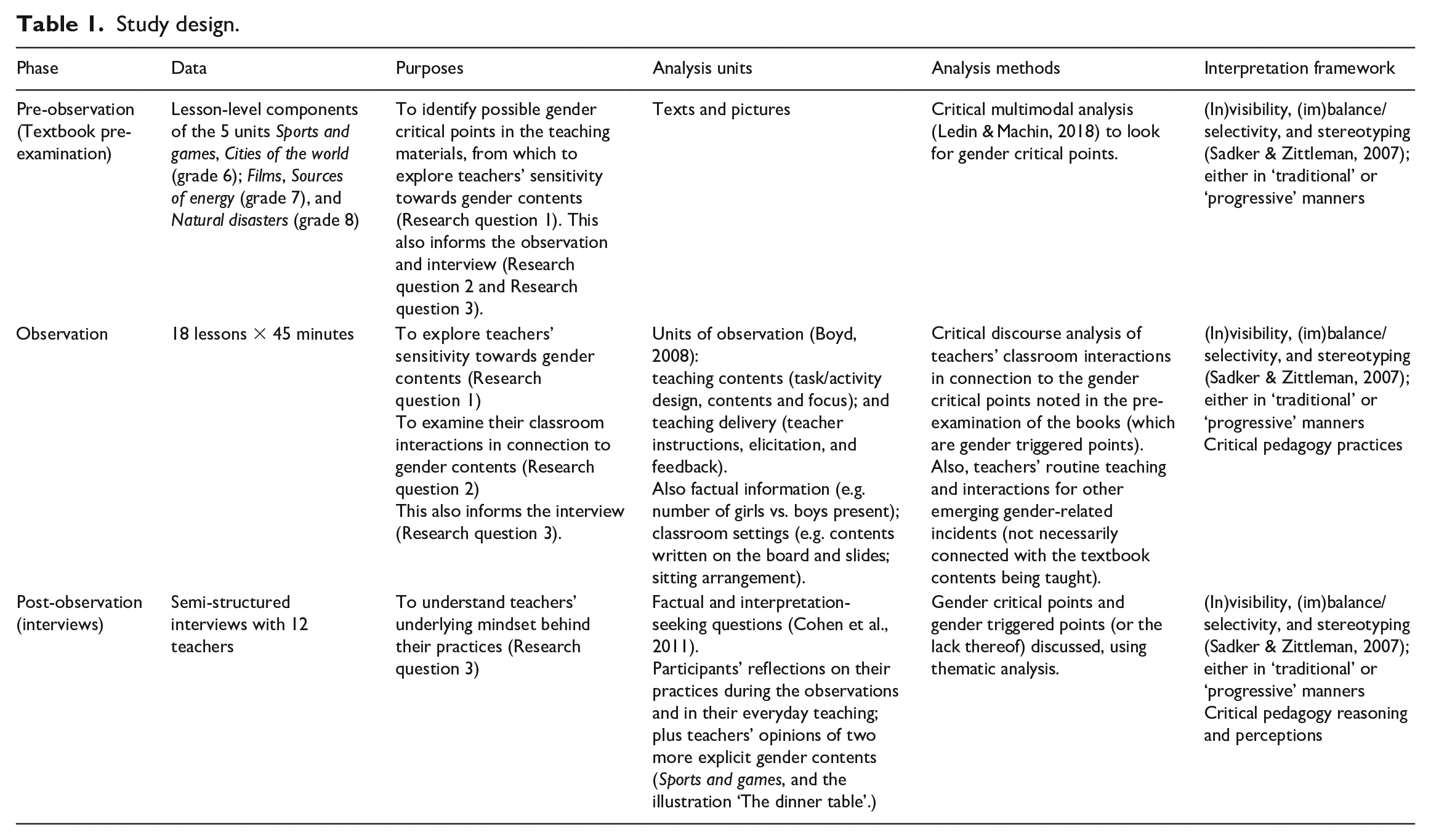
Multi-modal analysis (what is being communicated, and how) helps the investigator reveal the values and ideas embedded in the text (Ledin & Machin, 2018). Meanwhile, observation has a unique strength enabling the investigator to collect information in situ from naturally occurring situations, and use direct cognition as a research mode to generate data more authentic and valid (Cohen, Manion, & Morrison, 2011). Interview, on the other hand, allows the investigator to understand the respondent’s knowledge, values, attitudes, and beliefs, and – if combined with other research methods – can provide a deeper understanding of the respondent’s motivations (Cohen et al., 2011).
Critical discourse analysis, where teachers’ interactions were critically studied in connection to ideologies and discourses, or ‘interdiscursive analysis’ (texts within contexts; Fairclough, 2003), were employed as an overarching analytical lens. Within that lens, (in)visibility, (im)balance/selectivity, and stereotyping (Sadker & Zittleman, 2007) informed the interpretation, drawing on critical multimodal analysis methods (Ledin & Machin, 2018) and thematic content analysis methods (Braun & Clarke, 2020). Table 1 summarizes the study design.
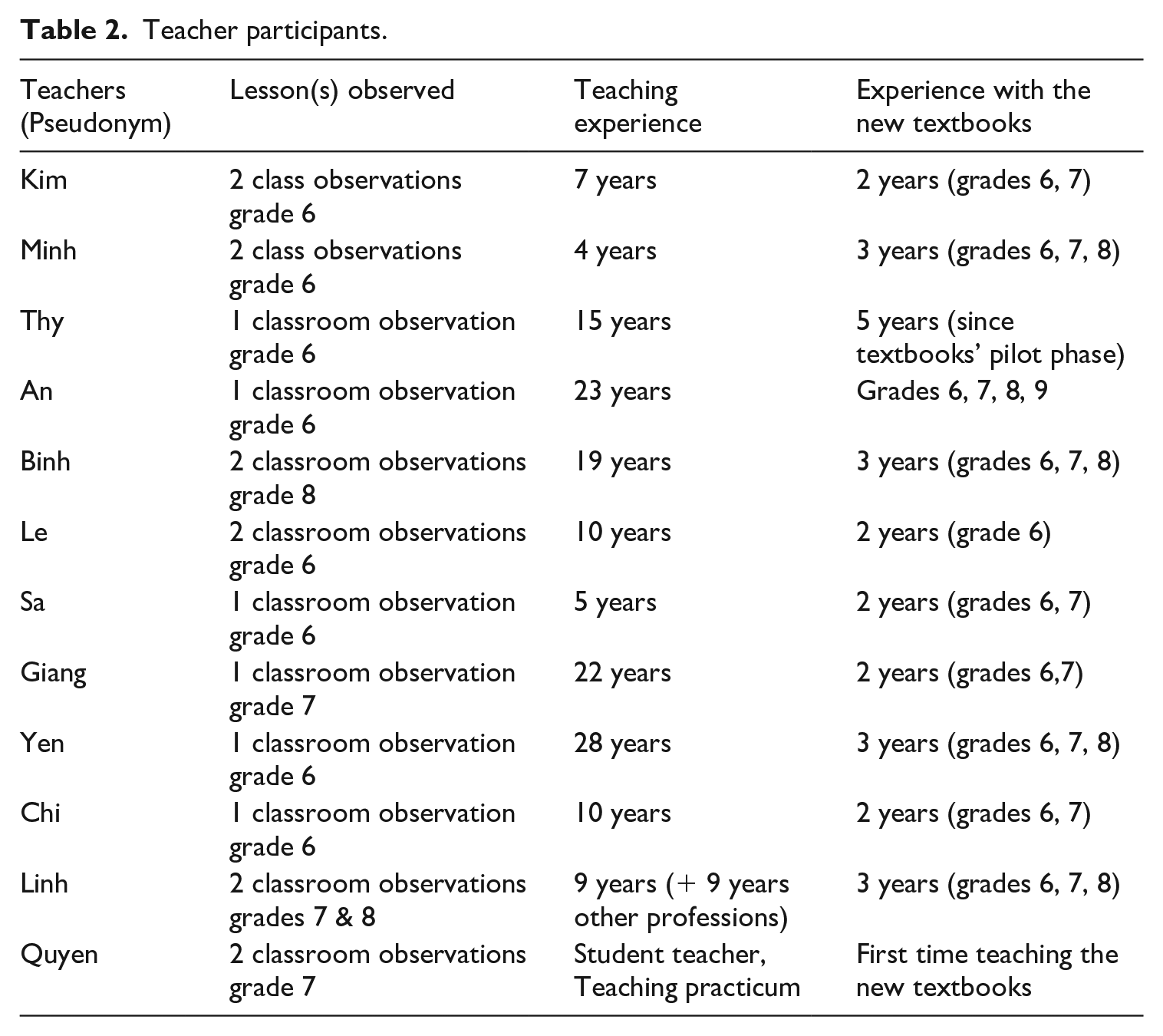
Eighteen classroom observations (45 minutes) and 12 follow-up interviews (30–40 minutes) with 12 EFL teachers in four lower secondary schools in Hanoi, Vietnam were conducted during five weeks. The 18 English lessons were with 13 classes of grades 6, 7, and 8 (no participants were teaching grade 9 at the time). All participants are female, in their mid-30s to 50s. The majority are experienced teachers, having been working with the new textbooks for 2–3 years (Table 2).
Teacher participants.
Participant rights of informed consent, anonymity and confidentiality were respected. The researchers also clarified to the teachers that one of the researchers is a co-author of the textbooks, and the study’s aim is to understand teachers’ experiences using the textbooks, in connection with gender.
The methods employed are non-interventionist, and non-intrusive, where observers/researchers do not seek to manipulate the situation or subjects (Cohen et al., 2011). This was achieved by the researchers (1) collecting naturally occurring data with a focus (Spada, 2019; Sunderland, 2006); and (2) following a design of three phases of pre-observation (textbook pre-examination), observation, and post-observation (interview).
The 18 lesson observations, as naturally occurring data, turned out to be from five units: Sports and games, Cities of the world (grade 6); Films, Sources of energy (grade 7), and Natural disasters (grade 8). These teachings followed the master schedule of the Department of Education. Each lesson covered one of the seven components in every unit. 1 The teachers were informed beforehand about the study’s focus (gender), but the researchers did not control what was to be taught in the lessons, and how.
After receiving information from the teachers about which unit was going to be taught, together the researchers briefly studied the unit before the observations, then took notes separately during the observations, and discussed the data with the teachers in the interviews. The pre-examination of the units served as the material for the observations and the interviews.
Two key analytical tools were used during these processes: gender critical points and gender triggered points. Gender critical points are where gender is evident or overt in the books, and gender triggered points are when the teacher uses the books as the substance in interacting with students for a richer learning experience (Pakuła et al., 2015; Sunderland et al., 2001). One example of gender critical points in our study is the Sports and Games unit, and while we observed these lessons, we looked for gender triggered points. How gender critical points was decided was based on the angles of (in)visibility, (im)balance/selectivity, and stereotyping, using multimodal analysis, whether they are ‘traditional’ or ‘progressive’. For example, in Films all action movie posters portray males, which denotes a selectivity bias and a stereotype bias. Meanwhile in Sources of energy, positive signs can be detected when the female and male interlocutors equally converse on a STEM topic – traditionally perceived as being a ‘male’ area. Classroom discourse was analysed in accordance with the gender critical points found, and thus they became gender triggered points, where the teachers might (or might not) respond to and/or use these contents in the classroom. We also looked for gender triggered points that were not directly connected to the textbook contents.
Each of the 12 teachers was observed in one or two lessons during the field trip, and altogether the 18 lessons provided naturally occurring data on a range of teaching activities. The five units that the observations happened to cover might not have been the ones that contain the most gender critical points of the entire textbook series, nor do they have an equal proportion of gender-sensitive content. Given this information, the interviews also sought teachers’ input on gender and their general practices when working with the series. This helped address the research questions: to understand teachers’ gender sensitivity, and their practices. The EFL classroom is treated as ‘an epistemological site of gendered discourse’, where teacher interaction with gendered textbook contents and with students provides ‘epistemologically fruitful’ data with ‘telling events’ (Sunderland, 2006, p. 73). In our research, we investigated these telling events to understand a situated phenomenon or practice (to be distinguished with ‘representative’ or ‘typical’ data – which are more about the generalizability of findings) (Sunderland, 2006).
Interview transcriptions were then examined using thematic analysis with reflexive approaches (Braun & Clarke, 2020), following the framework of (in)visibility, (im)balance/selectivity, and stereotyping. For instance, answers with codes – including ‘[boys] have stronger characters, play harder, are better at sports, and are more active’, and girls who like football as ‘having masculine traits’ – were interpreted as the sub-theme ‘stereotypes’ under the theme ‘Teachers’ possible bias’.
IV Results
This section presents the findings regarding teachers’ general classroom interactions in relation to gender, followed by a scrutinization of teachers’ practices surrounding gender critical points. Teachers’ interview accounts are incorporated along with the discussions to shed light on their practices.
1 General classroom discourse: Textbooks as scripts, instrumentalist teaching, and the absence of gender
Classroom observations show that teachers strictly adhered to the textbooks, leaving little space for gender discussions.
The lessons were typically structured into a warm-up, vocabulary presentation, main activity, and supporting activities. Only two lessons seemingly deviated: one on group projects (film-poster presentations), and one on grammar (verb tenses), but these two were also prescribed in the textbooks. In other lessons, the main activities were executed almost exactly after the books. Linguistic aspects dominated: a significant amount of lesson time was focus-on-form. Teachers provided explicit vocabulary teaching where they elicited words’ meanings as a list, and/or had them translated into Vietnamese, then asked students to chorus the words. Rules (grammar, pronunciation) were explained for students to copy down. For the main part of the lesson (e.g. reading, listening, speaking, writing), teachers asked students to complete exercises as provided in the books (e.g. matching, true/false, multiple choice, sentence completion, etc.), then gave corrective feedback – mostly in the form of fixed, short answer keys.
There did exist some instances where the teacher expanded the textbook content and asked for open answers (e.g. ‘What can we do so our class wins the school football cup next time?’ ‘How to be best prepared for natural disasters?’), but overall, open-ended elicitations between the teacher and the students were rare.
A fact-focused approach with lower-order thinking was used. Freer, more open-ended interactions such as warmer elicitation, reading comprehension questions, or speaking activities, might have been given more space, but they were marginal. Teachers did make an effort designing warm-up activities as interactive (games, short films, realia). However, these warmers were mainly form-focused (vocabulary, pronunciation) or fact-focused (cities names and adjectives, types of disasters, etc.) rather than personalized, contextualized, higher-order thinking interactions. For example, when showing the students the illustration of a reading text, Le asked: ‘I have this picture for you. How many people are there? Yes. What are they doing?’ While lower-order thinking questioning may be an effective tool to quickly check student understanding, this approach hardly ignites deeply-engaging interaction. Teachers may miss exploiting the topic in a meaningful way where students could have activated their high-order thinking skills. This affects the possibility for gender-related contents, among others, to be spotlighted, incorporated, and discussed.
Teacher talk took over classroom interaction. Among interaction patterns (Teacher–students, students–students), initiation–response–feedback (IRF) predominated. Teachers asked questions (presenting new words, or checking an exercise), then called on some student(s) to answer, and finally provided feedback. The following exchange pattern was the main interaction in all the lessons observed:
Number 1. (calling on one student)
B. (or reading out a word or a short sentence)
Yes, B. Number 2. (calling on another student)
D.
Yes, correct. D. Number 3. (calling on another student).
Within the R of the IRF, which is already a small talking space, boys seemed to enjoy more chances to speak than girls. The number of students of the 13 classes visited ranged between 42 and 54, and most classes (10/13) had largely equal girl–boy ratios. In 12 of the 18 lessons observed, including those in the classes with unequal girl–boy ratio, teachers called on both girls and boys. In the remaining six lessons, taught by three teachers, it was mostly boys who were asked to answer, even if that was a class with more girls than boys. In total, this means that across classes, generally, boys were given more opportunities to speak than girls.
a Teachers’ reasoning
Interviews provide insights into teachers’ practices. Gender was not planned into teaching and classroom interaction, while the focus was to ‘transfer’ language knowledge to students by completing as many exercises as possible.
All teachers thought the contents of the textbooks were interesting, but they most worried about covering the books. Kim talked about her teaching almost as a mechanical act: I don’t have any comments about the books’ content. I’m only concerned about their length – if it’s too long, I’ll cut it down. I don’t notice if the characters’ names are male or female, or if there are more males or females.
Any development from the textbook design or content seemed unfeasible. Sa wanted to create more activities from the book, but ‘[the textbook] has too many exercises and by the time we have them all done, the lesson has already finished.’
Teachers also believed that teaching English is all about language content. Quyen said what mattered most was to transfer language knowledge to students. While Quyen did not object to critical thinking, she seemed to be doubtful, because her teacher education programme ‘has always been focusing on how to teach the language’, and that ‘a teacher in Vietnam has always been expected to cover all the language contents in the book,’ Only one teacher, Linh, expressed a different view: ‘I believe a foreign language is a means of communication, so focusing on grammar is not the most important, but knowledge of cultures [is]. I teach not only English, but I also introduce new concepts’. However, in the observations it was not so clear how Linh exploited cross-curricular content. Her lessons seemingly aimed at getting students to complete exercises.
All teachers said they did not detect gender-sensitive contents in the books. There was no gender-based discrimination that caught their attention or stirred thoughts (Thy, Giang, and Binh). Minh explained, ‘I think gender is a new issue so it hasn’t been included in the textbooks.’ Meanwhile, Chi and Sa thought gender was unconnected to the topics in the books. Teachers seemed to see gender as a separate content area, rather than a set of embedded ideologies and values.
Regarding the distribution of students’ speaking turns, generally teachers were not aware of its implications. Teacher’s designation appeared to be a routine classroom management decision as part of the IRF to provide correction and move the lesson forward, without much attention to gender (Yen, Linh, Le, Kim). Kim, who appeared to called on boys more often than girls, even though girls outnumber boys in her class, said, ‘I don’t think about if it’s a boy or a girl. I call on students who like to talk, or who were not paying attention.’ Le tried to fairly distribute student speaking turns by telling them, ‘I’m going to call on one who doesn’t raise hand.’
To some teachers, however, this decision was also driven by bias (stereotypes). When asked about why they gave boys more attention, some (Chi, Quyen, Minh) said they saw boys as better (louder, more active) at English than girls, who tend to be shyer, more reserved, and do not raise their hands as often. ‘[Boys] have stronger characters, play harder, are better at sports, and are more active’ (Quyen). Girls, in contrast, are ‘quieter, and shyer, but more hard-working than boys and learn better’ (Quyen, Minh). Although the girls were not perceived by teachers as academically inferior, that the boys received some types of teacher attention that allows them to be more talkative in the classroom – known as ‘verbal male dominance’ (Sunderland, 2004) – may affect the girls’ learning: girls in this case become rather ‘invisible’. Who gets the chance to respond in IRF (i.e. interacting with the teacher in front of the whole class) is not seen by teachers as a high-stakes interaction that has implications for voicing and participation. If IRF is found to be the most dominant interaction pattern in the classroom, and if the teacher does not take notice of one particular group continuously receiving the chance to speak up, the other groups – whether they are boys or girls, quiet or loud, stronger or weaker – will remain deprived of participation.
2 Teachers’ (lack of) mediation of gender sensitive content in the classroom
Classroom discourse data suggest that teachers were largely neither aware of the gender critical points in the units they were teaching, nor initiated gender triggered points in class. All five textbook units contain gender critical points that can ignite discussions – some are more overt while some more subtle. These contents can either promote equality (positive), or hinder it (bias/negative). However, in the 18 lessons observed, it appeared that teachers seldom addressed gender content.
Of all the units observed, Sports and games (English 6, Volume 2, pp. 22, 23) yields more telling gender-related data, or gender critical points (Incident 1, which is discussed further in Section IV.3). Regarding the other four units (Cities of the world, Films, Sources of energy, and Natural disasters), observations show that gender was largely absent from classroom discourse – the (subtle) gender critical points detected were not recognized by teachers.
In Cities of the world’s cover-story conversation (English 6, Volume 2, pp. 26, 27, 29, 32), the boy character is represented as a world traveller, having an expert role (showing, explaining his photos taken in different cities) while the girl plays a subordinate role (asking questions, listening, and admiring the boy’s experiences). This content can be considered as a gender critical point (negative), as it reflects stereotypes (men are well travelled, having more life experiences, taking more space in society; women staying at home/having fewer life experiences) and invisibility bias (women becoming invisible). Later, the unit’s reading part was written as a postcard the girl sent from abroad to her grandparents in Vietnam, telling about her travelling experiences, which can be interpreted as a positive gender critical point, because females, taking the protagonist role, are portrayed as well travelled (and knowledgeable), and having opportunities. In another instance, regarding the content ‘famous British authors’, the illustrations feature Dickens and Shakespeare – both men, which can be a selectivity bias. However, in all nine lessons on this unit observed across the four schools with seven teachers, teachers did not attend to these contents: classroom activities were practising reading the conversation aloud, teaching new words mostly by translation, and completing tasks and exercises in the textbooks. No gender-related discussions/questions were included.
In Films (English 7, Volume 2, pp. 20–22), all action movie posters in the textbook portray males, which suggests selectivity bias (men selected as representing a field), invisibility bias (women becoming invisible in this field), and stereotypes (men associated with being physically strong and fast, with actions and movements, and with thrilled and strong emotions). Observational data (two lessons, two teachers, two schools) indicate that teachers did not notice nor question these gender critical points. In one lesson, students presented their own film poster (film Beauty and the Beast) with an illustration of women as being quite weak and needy (stereotype); however, the teacher did not pick up this content, but focused on the poster’s language and structure.
In Sources of energy (English 7, Volume 2, pp. 38–40), observed in two lessons given by one teacher, the cover-story conversation depicts equal roles between a girl and a boy; both show they are knowledgeable about a ‘serious’ topic (energy sources). This can be considered as a positive critical gender point, as it shows girls/women can take an interest in and perform well in STEM, and that girls/women have equal chances in education and future possibilities. In the classroom, nevertheless, this content seemed to go unnoticed, as the teacher concentrated on teaching-the-book: reading aloud, translating new words, and correcting tasks and exercises.
Finally, in Natural disasters (English 8, Volume 2, pp. 29, 30, 32), during the three lessons in two teachers’ classes, no gender-triggered points were observed. In the book, this unit was written as quite gender-neutral/gender-free (humans vs. natural disasters), but a subtle gender critical point might still be detected: all three of the names appearing in the two units are males’ names, which may denote a stereotype / selectivity bias that only men can discuss topics of social issues. However, again, the teaching went as prescribed in the textbook, with completion of exercises and activities, and vocabulary translation. Key findings of teachers’ practices in the classroom discourse are summarized in Table 3.
Summary of key gender critical points and teachers’ classroom interactions.
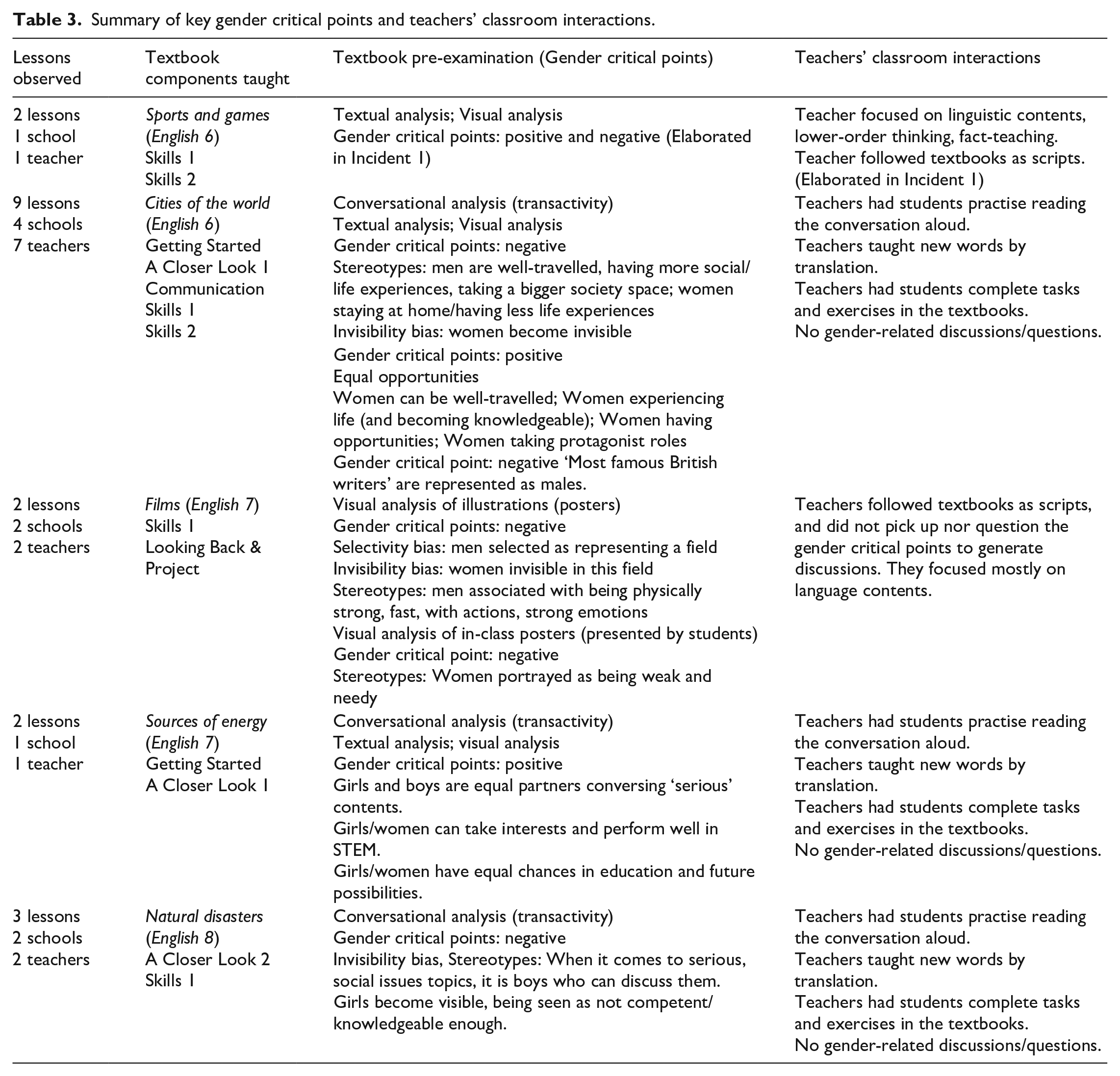
In post-observation interviews, when asked directly about the (subtle) gender critical points in these units, teachers said they had not noticed these contents while planning, nor intended to address them in classroom interactions.
3 Zooming in: The two incidents
To provide additional understanding of teacher awareness of gender, the following part focuses on two incidents which contain more explicit gender critical points compared to the others: Incident 1, unit Sports and games and Incident 2, The dinner table illustration.
Incident 1: Sports and games
The lessons from Sports and games observed were Skills 1 (reading – speaking) (English 6, Volume 2, p. 22) and Skills 2 (listening – writing) (English 6, Volume 2, p. 23). Skills 1 comprises a reading text on Brazilian footballer legend Pelé and a speaking activity about sport hobbies. Skills 2 includes a listening task about four children talking about their sports, and a writing task on one’s favourite sports. The speaking task has a list of sports (inclusive) and is a good prompt for gender discussions (positive). But the reading on Pelé may imply that football equates men, and men are best at it. The listening task contains stereotypes against women. Only one of the four speakers is a girl: Alice, who said she does not like doing sport much. Alice played chess, and watched ice-skating. Meanwhile, the three boys’ hobbies include volleyball, cycling, judo, computer games, guitar, football, and swimming. Girls are thus projected as the ‘weaker’ sex: they are not represented as much as boys in connection with sports and, when they do have a say, they are those who do not like sports. The sports mentioned are themselves gendered: ice-skating is for girls, while boys are associated with judo, football, guitar, and computer games. The photo illustrating the ice-skaters also features girls prominently (three girls in close-up and one blurring in the background).
Two lessons observed during the field trip covered this unit, and both were in teacher Kim’s class (grade 6). During the lessons, those gender critical points above, positive or negative, were not noticeably addressed. The listening task, similar to other parts, was executed according to the textbook: Students listened to the recording, then did the exercises, and finally the teacher called on some students to read out their answers. There was little elaborated exchange on the types of sports linked to each character in the recording: The content and language strictly followed the book. Similarly, the reading lesson about Pelé was centrally tied to the footballer’s story as introduced in the text; and with the teacher’s focus-on-facts eliciting, it did not allow much space for the content to be developed or questioned. Meanwhile, the teacher seemed to miss the chance to effectively use the inclusive speaking task as a gender triggered point, or simply a chance for students to recognize and celebrate differences. Again, this task was done mechanically as students ticked frequency adverbs, then some pairs were called on to read out the information they know about their partner.
At several moments, bias towards football and gender could possibly be detected. As the class moved on to a task about football, the slides showed four photos: three photos of the class football team, and one photo of the Vietnamese men’s U23 national football team. The teacher told the class ‘Let’s spend the last minutes to talk about the King of sports [football]. Girls, I want you to join in. Let’s work in groups of 6, boys and girls. When do you play it? How often do you play it? Do you play for a club? Boys, I want you to share the information. Girls, I want you to report the information. OK? Three minutes for you to share about the love for football’ (Kim). The teacher seemed to take it for granted that when it comes to football, it is men (while indeed the Vietnamese women’s national football team does exist). Girls were assumed from the beginning not to play football and were immediately assigned a supporting role (being invited to ‘join in’, ‘to report’ boy’s experiences rather than telling their own). In the interview, Kim explained she did not consider gender aspects then. But she also said, ‘I had wanted to focus on two sports, football and cheer-leading: one for boys and one for girls – there should be a balance.’ Kim did have intentions to incorporate gender, but they were somehow influenced by stereotypes. However, Kim also said if she taught this unit again, she would not limit the discussion only to football, but would make the topic more open and inclusive for both boys and girls.
Besides classroom observation, data about how teachers worked with Sports and games were also gathered through interviews. All teachers have taught this unit for at least two years. Like Kim, the majority of them said the content of Sports and games was ‘normal’ from a gender angle. Teachers took it for granted that boys like football, are knowledgeable about football, and play football, while they expected that ‘girls do not care about football as much as boys’ (Le). Sa said she would call on more boys to answer her questions on the topic of football because ‘they know a lot about football’. Meanwhile, Yen referred to one boy in her class who does not like football as ‘special’, and those few girls who like football as ‘having masculine traits’.
Minh and An, meanwhile, acknowledged possible influences of gendered cultural norms on how students interacted with the textbooks (answering questions about their favourite sports): I was not surprised by the students’ answers. They all play the sports suitable for their gender [girls: yoga, rope skipping, swimming; boys: football]. If a boy says he likes dancing, it will probably be quite strange. (Minh) Boys can’t say they like skipping rope, perhaps because they fear they might be ridiculed. (An)
Thy was the only teacher who spelled out gender aspects in this unit when interviewed. She commented on the unit’s cover-story conversation: I think in this lesson the boy has a more active part than the girl. Both go to the gym, but the boy is more comfortable, and he looks fitter. He does sports, plays Judo, and wins some other games. Then he encourages the girl to do karate to be fitter. So here the boy has a more dominating role than the girl.
About the other critical points, however, Thy said even if the textbook was changed and Alice was introduced as playing football, she would not notice it as a gender issue – she would simply think it is a cultural difference between Vietnam and ‘western cultures’.
The study’s findings regarding Sports and games suggest that teachers seemed to miss the gender critical points in this unit. Gendered biases were neither critically examined nor questioned, while more gender inclusive instances were passed by. Teachers appeared to have little awareness of these contents to plan them into their teaching, and thus missed turning them into gender triggered points, amid other priorities such as adhering to the curriculum and managing the class. Their reasoning, meanwhile, suggests gender-based stereotypes were seen as unproblematic and ‘normal’.
Incident 2: The dinner table illustration
English 6, Volume 1 (p.10) contains an illustration on a grammar item (‘My family are having dinner now’). On first glance, the scene of a family – Mum, Dad, son, and daughter, having dinner depicted seemed unproblematic. However, a gender-based analysis of the illustration reveals a number of biases. Mum is standing serving the family. There seems to be no seat for Mum. There is no bowl for Mum on the table. Meanwhile, Dad and the two children are seated and already started eating. All of them, including Mum, look happy. The scene can indeed be related to a custom in Vietnam, especially in the countryside. In family get-togethers, men sit and eat in the upper room (often in the main house built higher than the rest) while women sit and eat in a lower room (often with children), or even in the back kitchen. This arrangement is because women are expected to be serving men (and taking care of children). The custom is also rooted in the belief that women are intellectually inferior to men: they do not have the capability required to discuss important issues with men, and thus cannot be sitting on the same level. This dinner table illustration, therefore, is deemed to contain bias against women: it reflects male privilege and superiority.
To find out about the teachers’ views about the illustration, the following questions were asked: ‘What do you see in this picture? Is there anything that stirs your concerns?’ One third of the teachers (Giang, Yen, Thy, Le) did not see the illustration as problematic: it simply pictures a family eating dinner. The majority of teachers spotted that the mother is the only person who stands and serves the family, but all thought this is completely ‘normal’, ‘not unusual’, ‘it’s like that in every home’, a part of everyday life, according to the Vietnamese culture (Sa, Le, An).
However, a few other teachers, while also attributing to cultural factors, questioned the norm: ‘Why does the mother always have to serve? Family roles need to be changed. This is very traditional’ (Binh). Kim even asserted that the mother was serving her family in ‘a traditional way’, and ‘traditional means inequality’.
The next question we asked the teachers was, ‘What if the mother is replaced by the father in the illustration?’ Most teachers saw this scenario as being of a provocative nature. For example, Yen commented, ‘Dad cooking instead of Mum? Seeing Dad in an apron? In Vietnam, students will be surprised. They will probably ask the teacher “Oh Miss, why is Dad cooking the meal?” ’ Sa said, ‘Then I think the students will surely react, like “Oh, how comes Daddy has to stand serving dinner?” ’
Only three teachers (Giang, Le, Linh) did not think the image of the father cooking would be upsetting to students, because ‘Now in some families, if the father has time, he also helps the mother, so no problem’ (Giang), and ‘Their parents are young. Perhaps students already experience this at home: Dad helps Mum wash the dishes and cook. They have seen it so they are familiar with it’ (Linh).
Teachers’ answers show how awareness can be an obstacle to breaking gender stereotypes among students. Nevertheless, teachers also thought it could be possible if the illustration was changed even if students react, though most said this with hedging (‘I think it’s ok’, ‘possibly’, ‘possible’, ‘can be’, ‘could be’, ‘possibly necessary’). This was again explained from a cultural angle. Sa remarked on the extent to which ‘one family is open to western culture where the woman is respected’ will decide if this role change is seen as acceptable. Thy talked about this obstacle in strong language: ‘The viewpoint of Vietnamese people is deeply rooted. In our mind, the mother is still the one who takes care of the family. Mother cooks. Unless there is no mother, the mother is dead, then the father cooks.’
4 Teachers reconstructing gender: Ideas and aspirations
Even if participants were not completely certain about whether some stereotypes and norms can be broken immediately, all were supportive of introducing more gender in the classroom. After discussing some possible gender biases and their impact, all participants espoused the importance of gender education.
We should change the norms, because this will encourage boys to do the same. Boys often copy their father. If the father does housework, he’s a role model for the son. (Giang)
But teachers still have a cautious view about gender education. Many did not think challenging gender norms is easy, because the norms have become an ‘ideology’ (An), and a ‘long-standing culture’ (Binh), so the change does not entirely depend on the textbooks nor what happens in the classroom, but also on students’ experiences at home (Sa).
Teachers’ perspectives on gender education, however, seemed to change as some gender bias examples in textbooks and classroom practices were discussed. At first, most did not seem to see how gender connects with the English classroom. However, later, all teachers talked about gender equality with more nuances and dimensions, and with more assertive statements. This excerpt is from Thy’s interview.
We need to gradually erase our mindset of the past: that boys and girls must be in some certain ways. If students look at textbooks and if they see girls and boys are equal, then gradually their prejudice will be challenged. (Thy)
Teachers also openly reflected on their teaching and even their own bias, and how they had now been becoming more aware of the issue. Kim, who was teaching the sports and games lesson that day, said, Just like the teacher, students don’t notice gender issues. But if there is an Alice in the textbook who likes football, I would ask students: Do the girls in our class also like football? Have you ever tried playing football? If yes, how did it feel? If no, what position would you like to play? (Kim)
Teachers also envisioned how they would possibly do differently – both concrete pedagogical ideas and behaviour but also a change of perception were mentioned.
I didn’t think much about gender before. But now I do. I will make some changes when I teach the textbooks. For example, for the dinner picture, I will tell students: This is just an example of one family. But you can imagine pictures of other families [with] other members helping out. It could be Dad, it could be the children. (Chi) I think I will change. I will be more observant. Because when we don’t take interest in it [gender], we just teach the books automatically (as a habit). But once we are more aware, we will plan it into the lesson. (Linh)
These accounts, at the same time, show teachers have become more confident talking about textbook use. The textbooks did not appear to be as intimidating and controlling as described by participants at the beginning of the interviews. Sa, who earlier said teachers had little choice but to follow the textbooks, became quite affirmative about teacher’s capability to make changes. Teachers, to her, should be able to ‘spark’ students’ (critical) thinking: Even if textbooks explicitly challenge gender bias, students will not notice it immediately and change immediately. But the teacher has to be the person who sparks their thinking – they need to ask students what they think. Then the change is possible. (Sa)
Le and Binh also emphasized gender equality matters for both girls and boys, and that teachers need to voice their own opinions.
The teacher needs to construct gender from small details, to notice, and bring it to discussion. They also need to speak their opinions. All of these affect the way students’ opinions and thoughts are formed. (Le)
Teachers thus showed more awareness of their roles in actively mediating teaching, including using textbooks as resources, starting with the teacher ‘trying from the small things in each lesson’ (Yen). All teachers wished for teacher training workshops on gender and textbooks.
V Discussion
1 Gender in the classroom as situated practices: Understanding teachers’ practices and choice-making
Results show that the teachers in this study, regardless of teaching experiences, were not highly sensitive to gender contents – both ‘traditional’ and ‘progressive’ – and they did not plan gender into their teaching, nor create opportunities for incidental learning and discussions on gender. These results confirm other studies on gender in the language classroom (Canale & Furtado, 2021; Namatende-Sakwa, 2019; Pakuła, Pawelczyk, & Sunderland, 2015; Pawelczyk & Pakuła, 2015; Sunderland et al., 2001; Tainio & Karvonen, 2015), as well as research on other subjects, which has indicated that teachers tend to avoid controversial topics (Aivelo & Uitto, 2019).
Our study research, meanwhile, enriches this body of literature by providing a more comprehensive understanding of teachers’ classroom behaviour and mindset. The analysis of the varied data sources implies that this lack of teachers’ mediation of the gendered hidden curriculum, and their reasoning and choice-making can be understood from multi-layered perspectives. The study suggests how gender interaction in classroom is a complex, discursive practice – ‘explanation lies in social practices existing outside the classroom’ (Sunderland, 2004, p. 234; italic in original). Whether gender was avoided, consciously or unconsciously, or whether the gender discourse was shadowed by bias and stereotypes, again consciously or unconsciously, these create a hidden curriculum, and the messages are already sent out, without teachers being aware that they were sending them (Leask, 2015). Gender is performative (Butler, 1990): teachers’ perceptions and practices were sometimes influenced by norms, expectations and restrictions, which the teachers in the study referred to as ‘tradition’ and ‘culture’; but it could also be the gendered discourse globally (e.g. Tainio & Karvonen, 2015). Even if some teachers questioned this performativity (‘Tradition means inequality’), they were worried about students’ prejudices, perceived as rooted in cultural norms – a challenge for teachers when dealing with controversial and sensitive issues (Sætra, 2021; Tribukait, 2021).
The study meanwhile reveals that an instrumentalist view of language teaching as ‘decoding’ (Kramsch, 2020) remains rather popular, and that could be an obstacle to critical pedagogy. Most teachers did not initially consider cultural norms when working with textbooks; for example, teachers did not ‘talk around the textbook text’. The teacher-led classroom interaction patterns aiming mostly at lower order thinking skills observed in this study can be related to language teaching as structuralist, instrumentalist.
Teacher awareness and competence of critical pedagogy can be another issue. Teachers’ ability to challenge their own assumptions (bias) is important, as these assumptions can be taken for granted, as shown in the study, while in fact they affect teachers’ pedagogical decisions. Meanwhile, low sensitivity towards gender might restrain their seeing textbook content from plural angles: the teachers prioritized transactional functions (linguistic use), rather than enacting its potential of promoting students’ symbolic competence, including critical thinking and self-reflection.
Teachers’ interviews indicate that their choice-making was also decided by external factors, most notably the curriculum and syllabus, as well as resources (e.g. preparation time) – factors preventing teachers from taking an active role in working with textbooks (Tomlinson & Masuhara, 2018). Their teaching is frequently driven by the concern of getting the lesson done according to the curricular frame rather than pedagogical considerations such as activating learner participation (Rathert & Cabaroğlu, 2021).
2 Teachers as curriculum mediators: Gender, critical pedagogy and teacher agency
Even though teachers were initially not aware of gender issues, and did not mediate these contents in their practices, their interviews show that they were open to a critical pedagogy, supporting the findings by Canale and Furtado, 2021; Namatende-Sakwa, 2019; and Tainio and Karvonen, 2015. On self-reflecting on practices that may reinforce the hidden curriculum, the teachers in this study appeared to actively re-imagine gender in the classroom, and their relationship with textbooks, with more agency.
The study’s findings, at the same time, suggest that this agency-enacting is a process. Mediating gender contents in the classroom is a situated practice, and teachers, more often than not, struggle between the complexities between their work demands and available resources, and their ideals and aspirations. Enacting teacher agency in gender education, therefore, requires teacher autonomous actions, but it also relies on contextual possibilities and constraints. As teacher agency is influenced by teachers’ beliefs, values and attributes (Priestley et al., 2012), teachers can question gender issues ‘out there’, but also examine their own bias. Teachers may practise embodying gender equalities themselves; they can carefully observe how power functions, deepening their understanding of the workings of symbolic power (Kramsch, 2020; Pessoa & de Urzêda Freitas, 2012; Thompson, 2017).
EFL teachers, besides teaching linguistic contents, may be equipped with transformative pedagogical tools, including changing the ‘teach-to-the-book’ approach and creatively adapting textbooks as resources (Tomlinson & Masuhara, 2018). It may not always be possible to present gender in every lesson, but teachers may intentionally choose to introduce it as planned, explicit content (e.g. a reading text on inventions by female scientists), or to incorporate it into discussions (‘What are some assumptions about how people should look like, based on their gender?’). Anti-bias education can also be done by teachers making use of ‘teachable moments’ (Derman-Sparks, Edwards, & Goins, 2020) whenever gender-related contents may pop up (for example if the class is talking about football and it turns out that no one mentions women’s football at all) by raising the question. Teachers can even go beyond those ‘teachable moments’ with some planned teaching; for example, by introducing the concept ‘stereotype’, by asking students what they think about what girls and women can do, and what boys and men can do, then have students reflect on their own thinking (Derman-Sparks et al., 2020). Considering local cultural norms, an incremental approach may be used, with questions starting from being ‘neutral’ (e.g. ‘How may housework be divided between family members?’) to more ‘radical’ and thought-provoking (‘Should Dad cook dinner?’). Teachers can create more gender triggered points by expanding textbooks’ gender critical points (e.g. highlighting women’s roles and contributions), questioning these contents (e.g. discussing gender biases), or even challenging norms (e.g. posing hypotheses: what about roles changing between men and women?). Gender can be incorporated into designed-in scaffolding (Hammond & Gibbons, 2005); for example, when setting learning outcomes, designing and sequencing tasks, choosing organizational patterns (e.g. pairwork, groupwork), and selecting resources (e.g. language, images). And it can also be incorporated into interactional scaffolding (Hammond & Gibbons, 2005) during classroom interaction, by asking open questions and engaging students in more lengthy exchanges for higher-order thinking, and activating students’ prior knowledge and experiences. Viewing education as a dialogical process, problem-posing education in critical pedagogy can be applied by reposing the curriculum’s content as a problem. Facilitating discussions on controversial issues, relating teaching to local culture, re-imagining the roles of the teacher as the problem-poser and students as the decision-maker (Crookes, 2021; Sætra, 2021), can cultivate students’ critical thinking and help them approach an issue from multiple perspectives. Teachers then communicate gender contents to, and with, their students. Gender bias education and training for people at schools (principals and parents), and in the community, could be an important support, while more explicit gender guidance could be mainstreamed in textbooks, curricula, and other policies.
Thus, language teaching could be reconceptualized as not only ‘transferring’ (linguistic) knowledge, but also as having social influence (Butera et al., 2021), enabling learners to develop cross-curriculum knowledge and critical thinking, including reflections on gender issues.
VI Conclusions
Drawing from a rigorous data analysis using multiple methods, the research has presented an in-depth investigation on teacher awareness, engagement, behaviour, and perception regarding gender in teaching materials and interactions in the EFL classroom. Additional understanding of their pedagogical decisions and practices – in particular their (lack) of mediation of instructional materials with gender-sensitive contents – was discussed. The study also offers new observations into the complex, situated relationships between teacher agency, textbooks, gender, critical pedagogy, and the larger societal discourse in language education. The research thus provides critical insights into pedagogical practices, while informing curriculum and textbook development, and teacher education and training, which is relevant to Vietnam but also possibly to similar contexts. It also contributes to the ongoing effort to acknowledge language teaching as having a social impact, rather than being an instrumentalist operation.
The study explored teachers’ current practices and perspectives, and it did not aim to conduct post-interview classroom visits where changes in teacher’s behaviour towards gender equality can be observed. However, the research provides initial evidence on how awareness-raising could influence attitude-changing, as expressed by the teachers themselves, which would hopefully lead to behaviour change (UN Women, 2020). Still, more research, such as follow-up observations, is needed to gain more understanding about how teachers ‘travel the distance between the possibilities and practicalities of teaching English as we think about gender and social justice’ (Davis & Skilton-Sylvester, 2004, p. 397), especially considering the complexities of their everyday work.
Footnotes
Funding
The author(s) disclosed receipt of the following financial support for the research, authorship, and/or publication of this article: This project was supported by the National Geographic Society, Grant No HJ-127EE-17.
