




Abstract
This meta-analysis includes experimental and quasi-experimental studies of reading interventions for English learners (ELs) coupled with four specific instructional strategies. The purposes of this meta-analysis were two-fold: (1) to identify the effects of the four instructional strategies (i.e. scaffolding, graphic organizers, interactive read aloud, and leveled questions) on ELs’ reading comprehension; and (2) to evaluate the combined effect of these four strategies when used together on ELs’ reading comprehension. In addition to considering that different studies might have varying effect sizes on ELs’ reading comprehension, we also conducted moderator analyses to explore potential moderators that might affect the variation between selected studies. Our moderators were school level, intervention duration, language learning context, and sample size. After an extensive search of research literature, 23 studies were identified that met the inclusion criteria of this meta-analysis study with a total of 2,284 participants. Mean effect sizes among these studies ranged from –.05 to 2.23, depending on instructional strategies. These studies were associated with increased reading comprehension across varied school levels, methodological features, and settings. Our findings showed that each of the four instructional strategies is beneficial for ELs’ reading comprehension. We also found an additional potential benefit on ELs’ reading comprehension when these four instructional strategies are used together throughout a lesson. Our findings also revealed that intervention duration was the only significant moderator, suggesting that the longer the treatment is, the greater the impact will be on ELs’ comprehension.
I Introduction
Reading comprehension has been confirmed to be strongly correlated with English learners’ (ELs) language proficiency (Guo, 2018; Jiménez, García, & Pearson, 1996). In addition, reading comprehension has been reported to be the foundation for ELs’ learning performance in other subject areas such as math and science (Beal, Adams, Cohen, 2010; Maerten-Rivera et al., 2016; National Reading Panel, 2000). Reading comprehension involves having students actively engage in reading and understanding texts (Wigfield et al., 2008). Only by actively engaging in text reading will learners construct knowledge from text. To engage ELs in text reading, researchers (e.g. Fountas & Pinnell, 2006; Goldenberg, 1992, 2011; Lara-Alecio, Tong, Irby & Mathes, 2009; Tong, Irby, Lara-Alecio & Koch, 2014) suggested teachers to read with the ELs. These researchers also acknowledged the effectiveness of reading with ELs in improving their reading comprehension.
When reading with ELs, researchers suggested that teachers should use multiple effective instructional strategies because the application of multiple strategies yields a stronger effect on ELs’ reading comprehension (US Department of Education, 2008). Existing meta-analyses (e.g. Shanahan & Beck, 2006; Klingner et al., 2006; Hall et al., 2016) have focused on the effects of teachers’ instruction using multiple strategies (e.g. questioning, visualizing, interactive reading, and scaffolding) on ELs’ reading comprehension. A common finding of these existing meta-analysis studies is that the use of multiple strategies yielded a positive effect size (from small to medium); however, since these studies examined the strategies collectively, what is still unknown is the independent effect of each of these strategies. It has also been reported that during reading instruction, teachers of ELs have expressed a challenge in identifying specific instructional strategies that are effective in enhancing ELs’ reading comprehension and English language skills (e.g. Batt, 2008; Center for American Progress, 2015; Gándara, Maxwell-Jolly, & Driscoll, 2005). In addition, the above referenced meta-analysis studies did not address the instructional context where English is taught as a foreign language.
To help teachers of ELs identify what strategies are effective, Adesope, Lavin, Thompson, and Ungerleider (2011) reviewed and synthesized the effects of three pedagogical reading strategies (cooperative reading, systematic phonics instruction and guided reading, and multimedia-assisted reading) on ELs’ reading across Canada, the USA, and the United Kingdom. They called for continued research on ‘successful literacy practices in ways to better inform educators and policy makers’ (p. 630). In answering this and earlier calls on the need for another meta-analysis study, we conducted this meta-analysis with an attempt to gain a better understanding of the effects of specific instructional strategies on EL’s reading comprehension across English-speaking and non-English speaking countries when teachers guide ELs to ‘learn to read’ and ‘read to learn.’ By including studies conducted in non-English countries where there is a growing need and interest in teaching and learning English, we expect to identify a broader impact on how instructional strategies might impact reading comprehension for ELs across the globe.
In our study we included four instructional strategies: (1) scaffolding, (2) graphic organizers, (3) interactive read aloud, and (4) leveled questions. These four strategies are recommended by the Institute of Education Sciences as a practice guide for teachers working with ELs (Shanahan et al., 2010). These strategies have also been recommended for English Language Arts teachers to use when working with ELs to achieve Common Core State Standards (American Federation of Teachers, 2015). In addition, these four strategies have not been examined in a review of experimental studies on ELs’ reading comprehension.
1 Scaffolding (activation of prior knowledge)
Researchers have confirmed that prior knowledge is a significant predictor of text comprehension, and students with more prior knowledge of a given topic are better able to comprehend (Amadieu et al., 2009; Molinary & Tapiero, 2007; Ozuru, Dempsey & McNamara, 2009). Moreover, students who struggle with reading rarely link new content knowledge with their prior knowledge (Narkon & Wells, 2013). These findings suggested that with the activation of prior knowledge, students’ reading comprehension can be increased. According to Graves and Graves (2003), the activation of students’ prior knowledge is considered a pre-reading activity which can provide text-specific knowledge, pre-teaching vocabulary, or pre-questioning. In our study, any activity listed as pre-reading per Graves and Graves’ (2003) recommendation was considered a scaffolding activity. In short, any pre-reading activity which is designed to activate students’ prior knowledge can be considered a scaffolding strategy.
Many researchers (e.g. Alemi & Ebadi, 2010; Dabarera, Renandya, & Zhang, 2014; Proctor, Dalton, & Grisham, 2007) have also found that using a scaffolding activity to activate ELs’ prior knowledge can enhance their reading comprehension, encourage them to develop a broader knowledge base, and motivate them to learn more (Cho, Xu, & Rhodes, 2010). Further, Morgan, Moni, and Jobling (2009) and McKay and Vilela (2011) recommended that the use and activation of prior knowledge should be ongoing, because the absence of such ongoing prior knowledge engagement may lead to underutilization of preexisting knowledge and ultimately result in poor reading comprehension. We argue that using prior knowledge is much like preparing the soil before planting a seed. The richness of prior knowledge creates the most balanced environment for optimal and sustained growth.
2 Graphic organizers
Graphic organizers, a during-reading activity in our study, are defined as a strategy to help students learn new content knowledge. Graphic organizers are tools to visually organize information for students to link fragments of information together (Hyerle, 2008), as well as to assist with increasing students’ efficiency in learning new concepts (Bromley, Irwin-DeVitis, & Modlo, 1995; Irwin-DeVitis, Bromley, & Modlo, 1999). Graphic organizers are classified into four different types: conceptual (e.g. Venn diagrams and central question organizers), hierarchical (e.g. main idea pyramid and hierarchical organizers), sequential (e.g. cause-effect and problem-solving organizers), and cyclical (e.g. cycle diagrams) (Bromley et al., 1995).
Graphic organizers, not used as pre-reading activities, have been found to positively impact ELs’ reading comprehension (Heidarifard, 2014; Jiang, 2012; Liu, Chen, & Chang, 2010; Mohammadi, Moenikia, & Zahed-Babelan, 2010; Ozturk, 2012; Tang, 1992). Liu, Chen, and Chang (2010) and Tang (1992) indicated that graphic organizers can help ELs capture not only primary concepts but also secondary concepts within the text; moreover, graphic organizers can assist readers in processing the concepts in text. Jiang (2012) investigated how graphic organizers affected the English reading comprehension of university-level ELs whose major was not English. These students were divided into two groups; one group received graphic organizers and the other group received traditional instruction (e.g. lexico-grammatical analysis of the text). The students who received graphic organizers performed better on both an immediate post-test and a delayed test administered seven weeks later. The results indicated that graphic organizers provided visual and logical structures for ELs to organize conceptual knowledge of text, facilitate learning, and improve English reading comprehension.
3 Interactive read aloud
Interactive read aloud, a during-reading activity, is defined as a strategy to assist students with understanding new content knowledge. Two key aspects of interactive read aloud are that reading should be reciprocal and interactive (Lara-Alecio et al., 2009). Interaction with books allows for a more meaningful and intellectually-stimulating learning experience (Doyle & Bramwell, 2006). Moreover, using language, providing feedback, and having adult-child/student interactions through picture book reading will facilitate students’ language learning and develop their language skills (Zevenbergen & Whitehurst, 2003). If teachers would introduce interactive read aloud activities in the classroom as early as possible in the school year, ELs could acquire comprehension skills early on and then transfer those skills to a future advanced English learning stage (Chow, McBride-Chang, Cheung, & Chow, 2008; Tsybina & Eriks-Brophy, 2010). This is because the comprehension skills help ELs shorten the time for becoming an exceptional English user. In addition, by introducing interactive read aloud to young ELs they can learn to interact with text normally associated with higher language levels (Eng & Chandrasekaran, 2014).
4 Leveled questions
Leveled questions, a during-reading activity, are defined as a strategy to help students comprehend new content knowledge. According to the National Reading Panel, meaningful questions can improve students’ reading comprehension (National Institute of Child Health and Human Development, 2000). Moreover, using meaningful questions in class can lead students to a higher level of comprehension of the learning materials (Harvey & Goudvis, 2000). Researchers (Guastello & Lenz, 2005; Lara-Alecio et al., 2009; Miciano, 2002; Pham & Humid, 2013) studying the use of leveled questions to enhance ELs’ reading comprehension adopted Bloom’s Taxonomy as a guideline for developing six levels of questions: knowledge, comprehension, application, analysis, synthesis, and evaluation. Empirical studies (e.g. Farahian & Farshid, 2014; Khansir & Dashti, 2014; Taboada, Bianco, & Bowerman, 2012) have shown that different levels of questions can facilitate ELs in comprehending new concepts. In addition, leveled questions can help ELs negotiate for meaning, which allows them to receive more comprehensible input to later enhance their development of reading comprehension (Ayaduray & Jacobs, 1997).
Our review of these four instructional strategies revealed beneficial effects on ELs’ reading comprehension. However, the question must be asked whether these four strategies can be used together throughout a lesson and whether such combined effect can produce a sustainable growth in ELs’ reading comprehension. According to the National Reading Panel (2000) teachers are suggested to use multiple instructional strategies throughout a lesson. In addition, according to Lara-Alecio et al. (2009) and Tong et al. (2014), ELs’ reading comprehension was increased by using multiple instructional strategies. Therefore, the purpose of this meta-analysis was two-fold: (1) to identify the effects of four specific instructional strategies (i.e. scaffolding, graphic organizers, interactive read aloud, and leveled questions) on ELs’ reading comprehension; and (2) to evaluate the combined effect of these strategies when used together on ELs’ reading comprehension. In addition to considering that these instructional strategies might have varying impacts on ELs’ reading comprehension, we also set out to explore potential moderators of interest (school level, intervention duration, and language learning environment – ESL [English as a second language] or EFL [English as a foreign language]). The purpose of moderator analyses was to understand which potential variables might affect the variation between selected studies (Hall & Rosenthal, 1991). For instance, meta-analyses focusing on ELs’ reading comprehension reported that: (1) longer treatments yielded larger effect sizes (e.g. Adesope et al., 2011; Plonsky, 2011; for a discussion, see also Hattie, Biggs & Purdie, 1996); (2) students in ESL learning contexts had larger effect sizes than those in EFL learning contexts (e.g. Park, 2010; Taylor, Stevens, & Asher, 2006); and (3) higher school levels had larger effect sizes (e.g. Adesope et al., 2011; Parks, 2010). Our study is different from these meta-analyses because of three unique features in terms of moderator analyses: (1) our study focused on the impacts of four instructional strategies on ELs’ reading comprehension – scaffolding, graphic organizers, interactive read aloud, and level questions; (2) all studies included in our review administered pretest–posttest comparison group designs, which could help identify whether the treatment (four instructional strategies in our case) impacted the reading comprehension outcome; and (3) our study used a random-effect model which emphasizes that for a contribution of true effect sizes, studies with larger sample size are less likely to dominate the summary effect (Borenstein et al., 2009). Therefore, our study provides a perspective on the impacts of the four specific instructional strategies, and on how the effects of these four strategies on ELs’ reading comprehension may differ across school levels, intervention durations, and learning contexts.
Taken together, the potential contributions of our meta-analysis include: (1) to synthesize, in a cohesive manner for statistical evidence (pre-post comparison group designs), reporting from multiple studies focusing on using the four instructional strategies in the development of ELs’ reading comprehension; (2) to examine the impacts of each of the four strategies by using a random-effect model, a conservative approach to take when the sample size of each included study varies; (3) to calculate a weighted mean estimate of varying effect sizes, which may assist in the understanding of the impact of individual strategy across research settings; and (4) to guide pre-service or in-service teachers in their selective use of the four instructional strategies for enhancing ELs’ reading comprehension.
With these stated goals of this meta-analysis, the following research questions were addressed:
1a. What are the effects of each of the four instructional strategies (i.e. scaffolding, graphic organizers, interactive read aloud, and leveled questions) on ELs’ reading comprehension?
1b. What is the combined effect of the four instructional strategies on ELs’ reading comprehension?
2. Do the effects of the four instructional strategies vary across school levels,
intervention durations, ESL/EFL environments, and sample sizes as moderators?
II Method
In this meta-analysis study, experimental and quasi-experimental studies of reading instruction and instructional strategies for enhancing ELs’ reading comprehension were reviewed. We followed procedures for conducting and reporting meta-analyses proposed by Cooper (2010) and Borenstein, Hedges, Higgins, and Rothstein (2009). Specifically, we used Cooper’s suggested procedures to synthesize research studies and build our coding system. To calculate adjusted effect sizes, perform various tests of homogeneity (i.e. Q statistic) and measure calculation bias, we used the formulas per Borenstein et al.’s recommendation (2009).
We used the four following databases to search for studies: Google Scholar, Linguistics and Language Behavior Abstracts, Texas A&M University Library Search, and the Education Resources Information Center. The following search terms were used: English as a second language, English as a foreign language, English learner, guided reading, reading comprehension, interactive read aloud, storytelling, scaffolding, graphic organizer, reader response, and leveled question. Our initial search yielded 793 articles for further review.
1 Inclusion criteria
Guided by Adesope et al.’s (2011) article inclusion/exclusion framework, we determined seven inclusion criteria for this meta-analysis study:
Student participants in each study must be English learners.
The study had to include experimental and control groups.
The researchers had to define one of the four instructional strategies included in our study and use it with students in an experimental group, and the researchers had to include a traditional instructional method for the control group.
The study had to include the school level of all EL participants, from first grade to university.
The researchers had to clearly report reading comprehension as a measured outcome for both experimental and control groups.
To calculate an effect size, the study had to include scores for pre- and post-tests, the number of students in the experimental and control groups, mean scores for both groups, and standard deviation for both groups.
The study had to be accessible online either with or without subscribing to journals and be conducted after 1990, which corresponds to the year when Cohen (1990) suggested the use of d for calculating and reporting effect sizes. Furthermore, the American Psychological Association first suggested reporting effect sizes in 1994 in their 4th edition of the Publication manual.
2 Screening process
Using Adesope et al.’s (2011) screening process, two graduate research assistants served as raters in a two-step screening process to review the 793 articles. In the first step, one of the raters reviewed the title, abstract, and research question of each article. One hundred forty-one articles met the inclusion criteria; the remainder were excluded. To determine the reliability of this process, 50 of the articles were randomly selected and reviewed by the second graduate research assistant rater. The inter-rater reliability (Cohen’s kappa) was .90. In the second step, the two raters independently read the full text of the 141 articles. The raters excluded articles that did not meet the inclusion criteria. The inter-rater reliability (Cohen’s kappa) on excluded articles for this phase was .91.
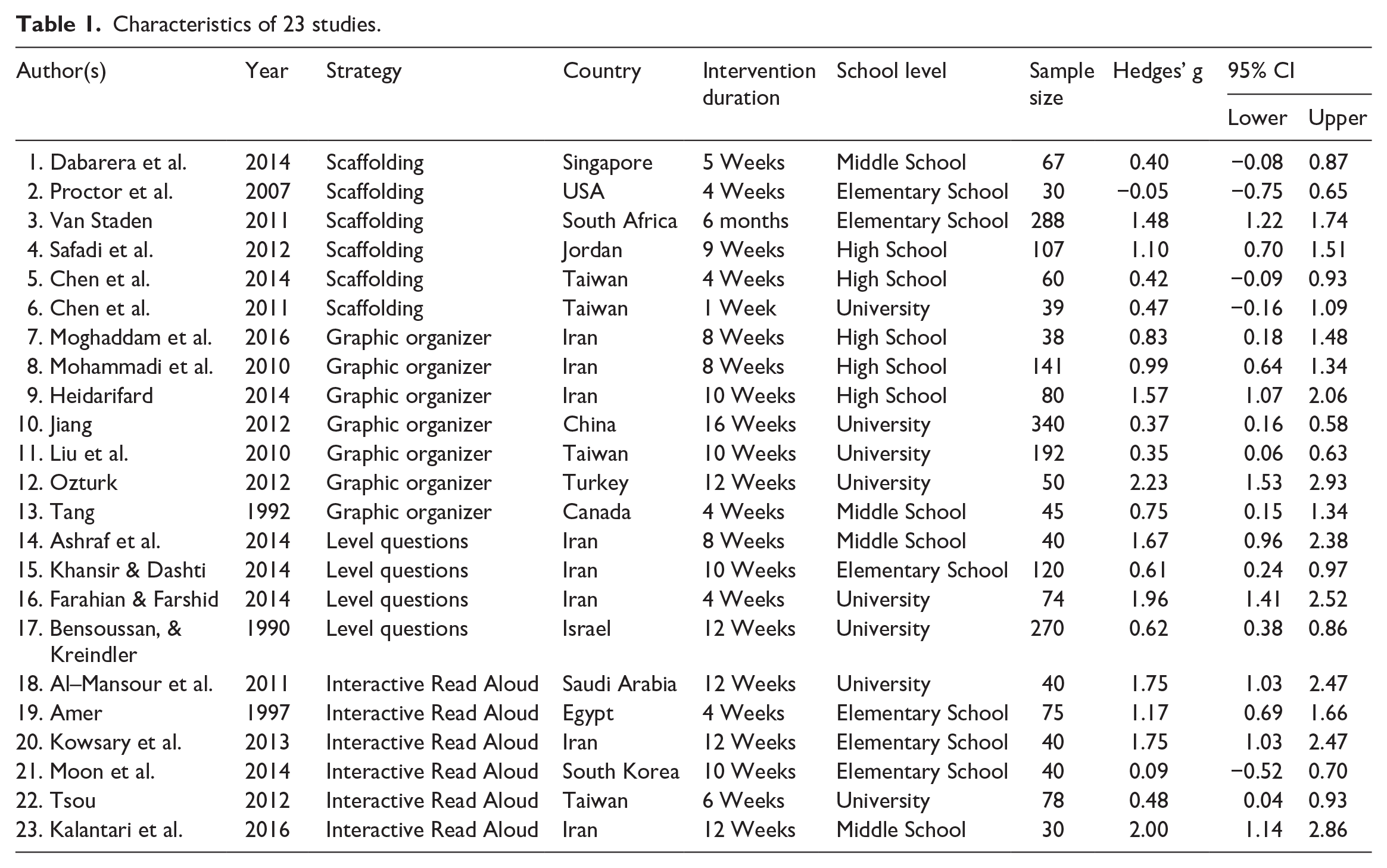
Following the two-step screening process, a total of 23 empirical studies with an overall sample of 2,284 participants met the inclusion criteria. Each study included seven characteristics (see Table 1): (1) the focused strategy; (2) the country where participants received the intervention; (3) the intervention duration; (4) the school level of participants; (5) the sample size; (6) the Hedges’ g (effect size); and (7) the 95% lower and upper confidence intervals on Hedges’ g.
Characteristics of 23 studies.
3 Effect size
Borenstein et al.’s formula (2009) was used to calculate weighted mean effect sizes in a random-effects model. A random-effects model was utilized because the studies did not share a common effect size due to the characteristics of each study (e.g. school level, sample size, etc.). A four-step procedure was used to calculate a weighted mean effect size: (1) retrieve the sample size, mean and standard deviation for two groups in each study; (2) calculate standardized mean difference d and g – a bias-corrected effect size – for each study; (3) calculate the W, WY, WY2, W2, and T2 for each study; and (4) calculate the weighted mean effect size. W refers to the mean weight given to the study based on its inverse variance; Y refers to Hedges’ g; T2 is the estimate of between-study variance (Borenstein et al., 2005). According to Cohen (1988), the value of less than .30 is considered as a small effect size, .30 to .50 as a medium effect size, and greater than .50 as a large effect size. When obtaining the weighted mean effect size, we should explore if there is a heterogeneity between studies in the random-effects model. To explore this heterogeneity, we should look at multiple indices, such as Q, I2, and T2 (Nikolakopoulou, 2017). Q is a chi-square statistic to understand if all studies evaluate the same effect (Higgins, 2003); I2 is the percentage of variation across studies (Borenstein et al., 2009); T2 is clarified above.
4 Outcome variable
We had one outcome variable: reading comprehension. The reading comprehension tasks focused on the students’ ability to understand passages they read. The reading comprehension tasks that were used in the retained studies were drawn from: TOEFL (e.g. Heidarifard, 2014); the Gates–MacGinitie Reading Test (e.g. Proctor et al., 2007); Practical English Language Test Junior (e.g. Moon & Maeng, 2014); International Competitions and Assessments for Schools (e.g. Dabarera et al., 2014); the Reading Diagnostic Test (e.g. Van Staden, 2011); or curriculum-based assessment (e.g. Tang, 1992).
5 Moderator variables
We examined five moderators that could explain variation between studies: instructional strategy, school level, intervention duration, ESL/EFL environment, and sample size.
a Instructional strategy
We had four strategies: scaffolding, graphic organizers, interactive read aloud, and level questions.
b School level
We had four school levels: elementary school, middle school, high school, and university. In consideration of the difference of school systems across countries (e.g. elementary school is 1st through 5th grades in the USA but 1st through 6th grades in South Korea), we coded school levels based on how countries define their school systems.
c Intervention duration
We had two subcategories: (1) a period of less than three months, and (2) a period of equal to/more than three months.
d ESL/EFL environment
We had two subcategories: (1) studies conducted in countries where English is an official language - ESL, and (2) studies conducted in countries where English is a non-official language – EFL.
e Sample size
We had two groups: (1) below/equal to 60 participants, and (2) above 60 participants. We used 60 as a cutoff number based on Suter’s (2012) and Wilson Van Voorhis and Morgan’s (2007) standard of measuring group differences (e.g. t-test), because they argued that a more reasonable sample size for each of the two test cells should be larger than 30.
III Results
Across the four instructional strategies (i.e. scaffolding, graphic organizers, interactive read aloud, and leveled questions) for reading with ELs (Guided Reading and Shared Reading), we detected a strong mean effect size, g = 0.96 (k = 23, N = 2,284), with a standard error of mean at 0.12 and a standard deviation of .02. This showed a stronger effect of using these four different instructional strategies on ELs’ reading comprehension than other instructional strategies or traditional methods. The lower and upper bounds of the 95% confidence intervals on the mean effect size were .73 and 1.20, respectively, showing that the mean effect size was statistically detectable. Heterogeneity was present for this mean effect size (Q = 27.59, df = 22, p > .05; I2 = 20.27; T2 = .27). According to Nikolakopoulou (2017), a nonsignificant p-value in this Q test ‘should not be interpreted as absence of heterogeneity’ (p. 3). The degree of freedom is the number of studies minus one. Zero in I2 is considered to be no heterogeneity (Higgins et al., 2003); zero in T2 could be interpreted as no heterogeneity (Borenstein, Hedges, & Rothstein, 2007). These statistics suggested that further examination of the study features was necessary and could help explain the variability among effect sizes. Hence, moderator analyses were conducted on the following factors: instructional strategy, school level, intervention duration, ESL/EFL environment, and sample size.
Research question 1: Effects of four different instructional strategies
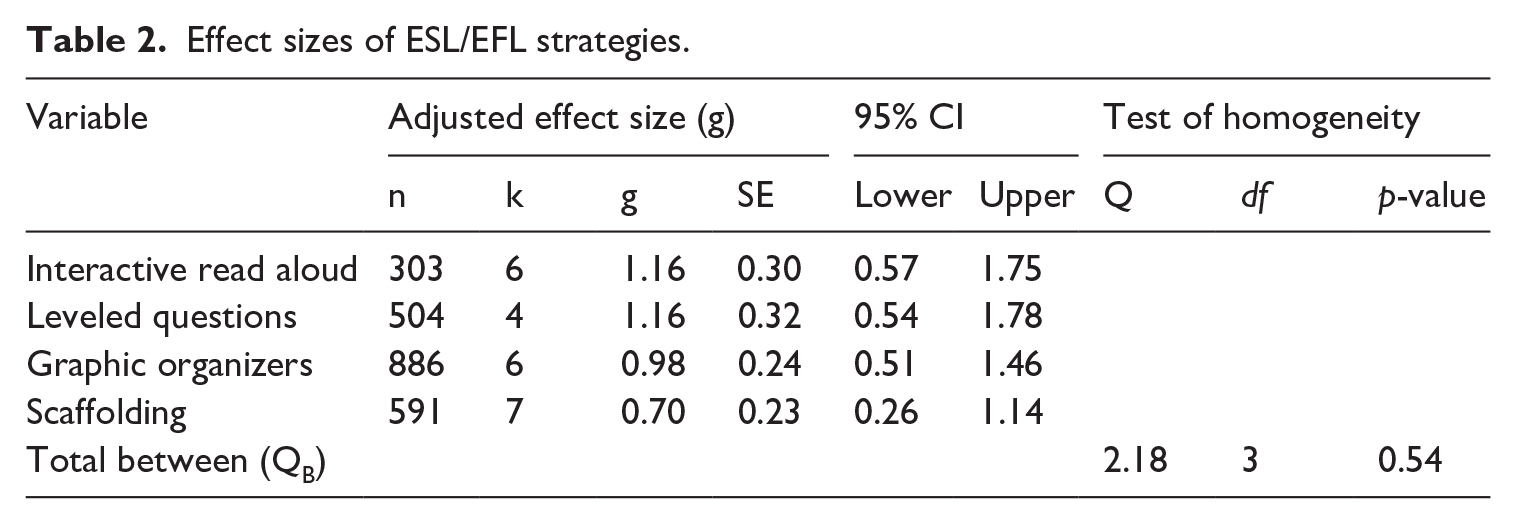
For Question 1a (what are the effects of each of the four instructional strategies on reading comprehension?), results showed that each of the four instructional strategies yielded statistically detectable mean effect sizes and that interactive read aloud and leveled questions each yielded the largest weighted mean effect size of 1.16 (see Table 2). Further, a statistically significant total between-studies variance was not observed (QB = 2.18, df = 3, p > .05). For Question 1b (what is the combined effect of these four instructional strategies on reading comprehension), the average adjusted effect size of the four strategies was .95.
Effect sizes of ESL/EFL strategies.
Research question 2: Effects of these four instructional strategies across school levels, intervention durations, ESL/EFL environments, and sample sizes as moderators
a School level
All four school levels (i.e. elementary school, middle school, high school, and university) yielded mean effect sizes that were statistically detectable (see Table 3). A statistically significant total between-studies variance was not observed (QB = .42, df = 3, p > .05).
Effect sizes of school level.
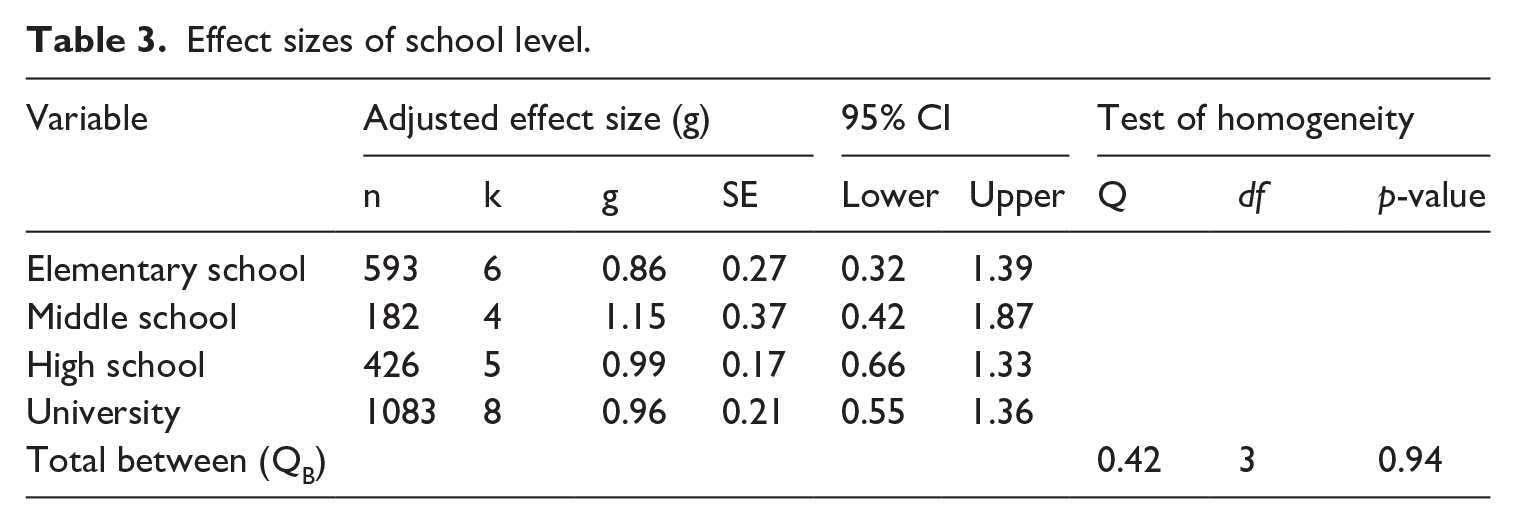
We further examined if effect sizes for the four different strategies were different within each school level. A statistical difference was detected between strategies on middle school (QB = 15.25, df = 3, p < .01): 2 for interactive read aloud; 1.67 for leveled questions; .75 for graphic organizer; and .40 for scaffolding. Post-hoc results showed that the effect sizes for interactive read aloud and leveled questions were significantly larger than graphic organizer and scaffolding (ps < .05).
b Intervention duration
Two subcategories of intervention duration (i.e. a period of less than three months and a period of more than/equal to three months) yielded large detectable mean effect sizes of .80 and 1.38, respectively (see Table 4). A significant difference was found between studies conducted during a period of less than three months and those conducted during a period of more than three months (QB = 3.85, p = .05).
Effect sizes of intervention duration.
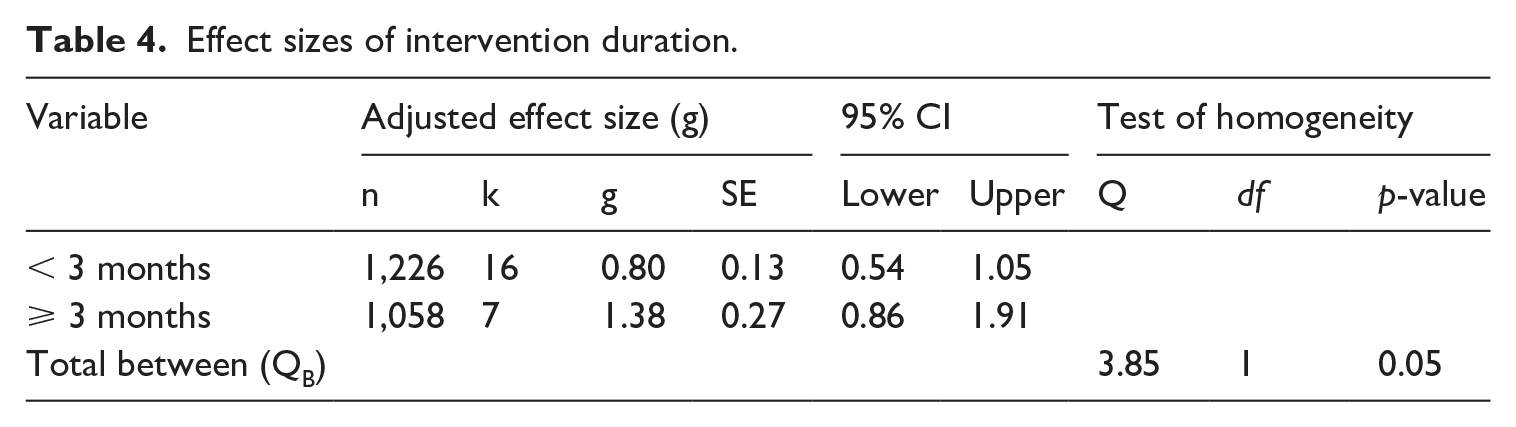
We further examined if effect sizes for the four different strategies were different within each intervention duration. A statistical difference was detected between strategies on the intervention duration over three months (QB = 33.21, df = 3, p < .01): 1.82 for interactive read aloud; 1.48 for scaffolding; 1.27 for graphic organizer; and .62 for leveled questions. Post-hoc results showed that effect sizes for interactive read aloud and scaffolding were significantly larger than leveled questions (ps < .01).
c ESL/EFL environment
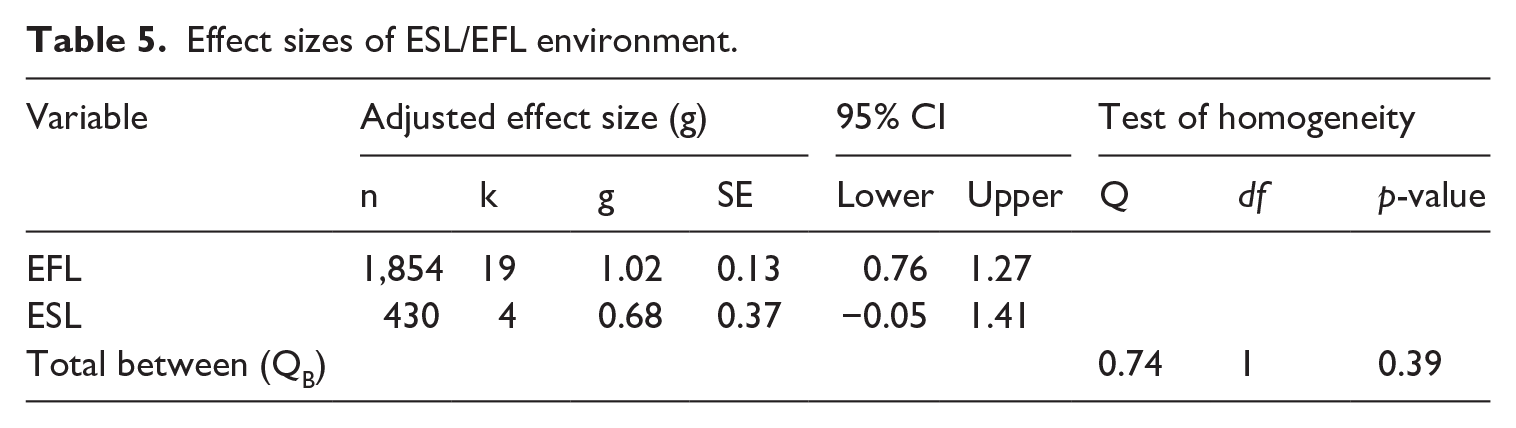
Two subcategories of ESL and EFL environments (i.e. studies conducted in countries where English is an official language and studies conducted in countries where English is a non-official language) yielded mean effect sizes that were statistically detectable. These two subcategories yielded large effect sizes with .68 and 1.02, respectively (see Table 5). However, there was no significant difference between ESL and EFL countries (QB = .74, p > .05). In addition, for each environment, no significant differences between strategies emerged.
Effect sizes of ESL/EFL environment.
d Sample size
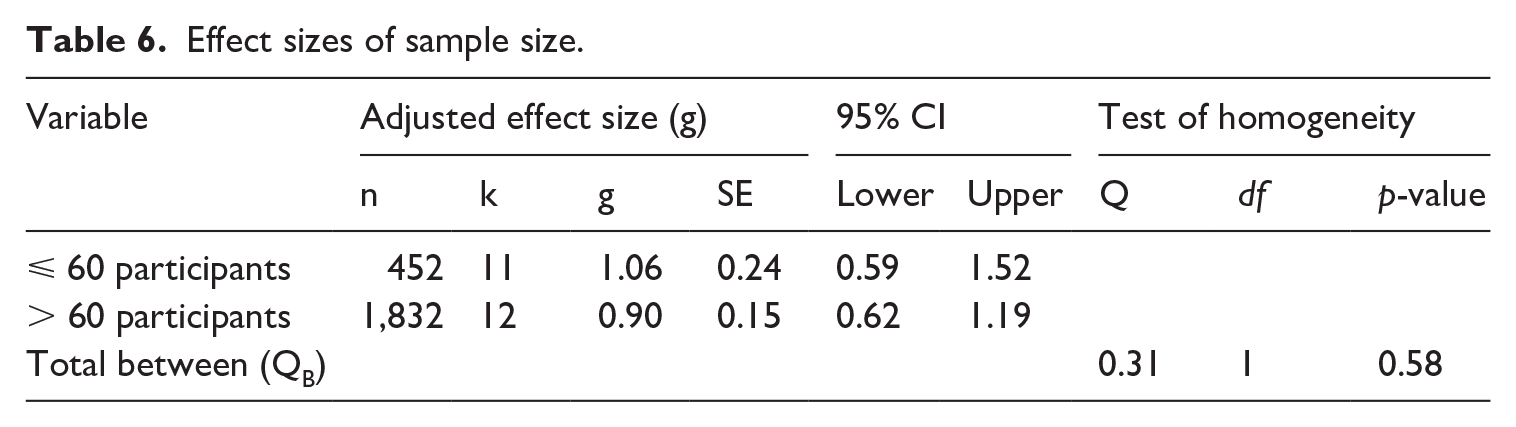
Two subcategories of sample size (i.e. studies with less than/equal to 60 participants and studies with more than 60 participants) yielded large detectable mean effect sizes of 1.06 and .9, respectively (see Table 6). However, there was no significant difference between studies with less than 60 participants and those with more than 60 participants (QB = 3.58, p > .05).
Effect sizes of sample size.
We further examined if effect sizes for the four different strategies were different within each sample size. A statistical difference was detected between strategies on sample size less than/equal to 60 (QB = 12.93, df = 3, p < .01): 1.67 for leveled questions; 1.48 for graphic organizers; 1.38 for interactive read aloud; and .43 for scaffolding. Post-hoc results showed that effect sizes for leveled questions was significantly larger than scaffolding (p < .01).
IV Discussion
The purposes of this meta-analysis were to: (1) identify the effects of the four specific instructional strategies (scaffolding, graphic organizers, interactive read aloud, and leveled questions) on reading interventions (i.e. reading with ELs) across school level, intervention duration, ESL/EFL environment, and sample size; and (2) to evaluate the combined effect of these four instructional strategies on ELs’ reading comprehension. The overall finding provides compelling evidence for the positive effects of the four instructional strategies on reading intervention for ELs. This finding supports the notion that when ELs receive reading intervention utilizing any one of these four instructional strategies, they should more easily understand text and will therefore boost their reading comprehension as well. Moreover, the combined effect of these instructional strategies was large, suggesting that teachers of ELs could use all four strategies together when reading with ELs. This finding supports previous research (e.g. National Reading Panel, 2000; Tong et al., 2014) that when reading intervention combines multiple instructional strategies, ELs’ reading comprehension can be enhanced.
Our findings have practical implications for pedagogical practices of the four instructional strategies. As to the strong and positive effect of scaffolding on ELs’ reading comprehension, we reasoned that prior knowledge associated with text concepts helps ELs find the relevant information which could facilitate their understanding of a new concept. ELs can use this strategy to comprehend what they read by linking their existing knowledge (similar vocabulary or relevant concept knowledge) to key ideas/information of text. Regarding graphic organizers, we reasoned that graphic organizers provides ELs with a visual representation which helps them tangibly and systematically understand text concepts and link fragments of information together. These graphic organizers may be used as a tool for ELs to help identify main and supporting ideas and ignore irrelevant information. Regarding leveled questions, when using this strategy, teachers lead ELs step-by-step into a thinking process of text concepts and help ELs identify important details. This strategy may be used as a tool for ELs to help predict what they will read and to pinpoint important pieces of information. Regarding interactive read aloud, ELs have a chance to verbally interact with text through teachers, which in turn helps them construct concept knowledge and develop their oral vocabulary and comprehension skills. Interactive read aloud can also be used as a reading strategy for ELs to internalize what they read and to remember key information.
The moderator analyses (i.e. school level, intervention duration, ESL and EFL environment, and sample size) highlight a number of additional details relevant to the overall findings. Regarding school level, these four instructional strategies produced statistically significant benefits for ELs in all school levels from elementary school to university. This implies that the progress of reading comprehension is irrespective of students’ school level; therefore, teachers of ELs in all grades can adopt these strategies when reading with their students. According to Lesnick, George, Smithgall, and Gwynne (2010), the level of students’ reading comprehension in the early grades was directly related to their high school and college enrollment. Therefore, elementary level teachers of ELs are strongly encouraged to use these four strategies to enhance students’ reading performance. According to National Center for Education Statistics (NCES, 2018), in 2017 only 36% of fourth graders in the nation read proficiently. Because of this, educators and researchers should adopt and adapt these four instructional strategies to improve reading performance of ELs and other students before they graduate from elementary school. Our results also indicated that each of the four strategies could promote ELs’ reading comprehension across school levels. Further, when enhancing middle school ELs’ reading comprehension, teachers are suggested to use interactive read aloud and leveled questions more because these two strategies produce larger effect sizes, indicating a greater impact on middle school ELs’ reading comprehension across language contexts and intervention durations.
Regarding intervention duration, our results indicated that the mean effect sizes of the studies conducted less than three months and those of the studies conducted more than three months were significant on ELs’ reading comprehension. This suggests that if teachers of ELs plan to implement a one-month reading intervention, the four instructional strategies can still be implemented. The finding also implies that if teachers of ELs plan to implement the reading intervention for a semester, the four strategies could be used to enhance ELs’ reading comprehension. Even though the effect size for each period of intervention time was significant, we did find a substantial difference between these two periods of intervention time. This finding indicates the sustained effects of these four instructional strategies over time for improving ELs’ reading comprehension. According to Tong et al. (2014), receiving and practicing multiple strategies for over a year produced a sustained learning effect on ELs’ reading comprehension, which later could positively reflect in their English language ability and academic performance in content areas. Our results also indicated that when implementing the four teaching strategies over three months, teachers may consider using interactive read aloud and scaffolding more frequently because these two strategies produce significantly larger effect sizes, suggesting that ELs’ reading comprehension might be strengthened through teachers’ use of interactive read aloud and scaffolding across school levels and language contexts.
Regarding ESL and EFL environment, the moderator analyses indicated that the mean effect sizes associated with ESL and EFL countries were statistically significant; however, no difference was detectable irrespective of whether the four strategies were used in ESL or EFL countries. This means the strategies are beneficial for, and applicable to ELs’ reading comprehension no matter where they learn English, regardless of their native language. The finding also suggests that teachers of ELs in EFL countries should be strongly encouraged to use these four strategies when implementing reading intervention. This is because the ELs in EFL countries benefited to a similar degree as did the ELs in ESL countries. The findings regarding the effects of instructional strategies across environment and school level reinforce the following cautionary note for teachers of ELs across ESL and EFL environments. When applying these four instructional strategies to increase ELs’ reading comprehension, teachers must understand that the level of strategy effect might differ psychologically and socially based on students’ school levels (Gürsoy, 2010).
Regarding sample size, the results showed that the mean effect sizes were significant for each group (i.e. less than/equal to 60 participants and above 60 participants). When comparing these two groups, a non-significant difference was detected. This indicates the four instructional strategies are still effective for improving reading comprehension for ELs in both small-scale and large-scale studies. Therefore, the number of participants would not influence the effect of the strategies. However, our results indicated that among the studies which had less than/equal to 60 participants, leveled questions is more effective than scaffolding on ELs’ reading comprehension across school levels and language contexts. This suggests that in a classroom with 30 ELs, they may benefit more when immersed in reading instruction with the use of leveled questions.
We further examined the sample size to provide a pedagogical implication. All 23 studies were divided into three different class sizes (20 or less students, 21 to 40 students, and above 40 students). This classification was based on average class size (≈ 20 students) for teachers in traditional public schools (NCES, 2017) and Maimonides’ Rule (an upper limit class size of 40 students) (Angrist & Lavy, 1999). We found that the group with above 40 students had the lowest mean effect size of 0.35 when compared with the other two groups (1.10 for class size with 20 or less students and 0.93 for class size with 21 to 40 students), and this difference was statistically significant. These findings indicate that to sustain a stronger effect of using the four strategies throughout a lesson, class size should not be larger than 40. This larger class size might cause greater difficulties for teachers in implementing instructional strategies or reading tasks.
V Publication bias
Following the procedure recommended by Borenstein et al. (2009) in meta-analysis, we also examined the publication bias among the 23 studies included in our analysis. All these studies were published in peer-reviewed journals. For each study, the forest plot displays an effect size with 95% confidence intervals on the x-axis and its corresponding study on the y-axis (see Figure 1). The forest plot shows that one study has a negative effect, and other studies have positive effects. The study with a negative effect contained a small sample size of less than 60; however, some studies with the positive effect were also found to have small sample sizes. According to Torgerson (2003), studies with larger sample sizes may have a higher quality in methodology. He also argued that larger sample sizes may produce more reliable results, whereas smaller sample sizes can ‘produce some surprisingly good or bad results, merely by chance’ (p. 65). To examine the potential publication bias of this meta-analysis, we calculated Rosenthal’s fail-safe N. The results indicated that 2,128 studies with a mean effect of zero would be required to invalidate the overall effect of this meta-analysis. This suggests that the results of this meta-analysis are robust, and the true effect is likely to be non-zero.
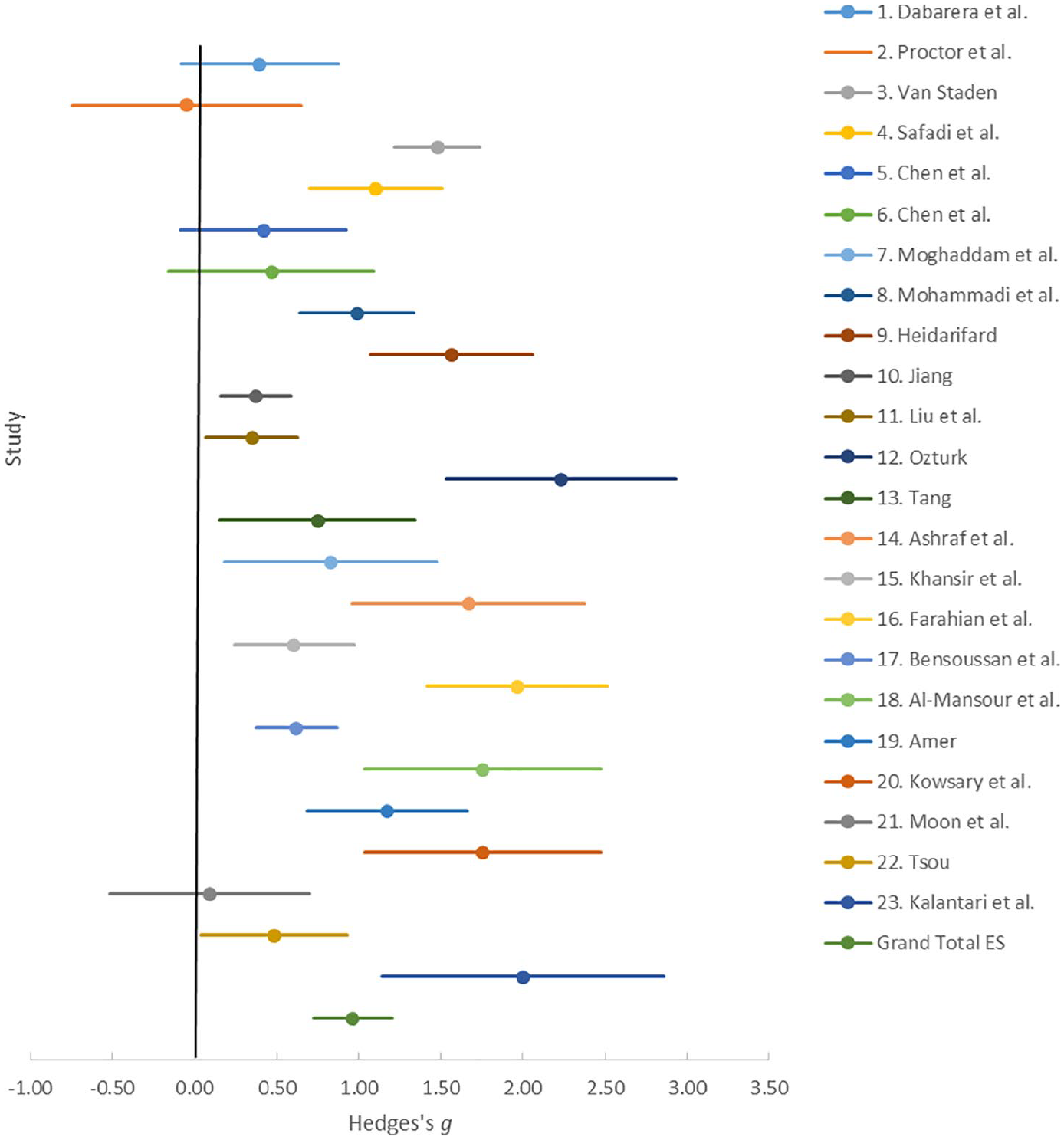
Forest plot of the 23 studies with an average effect size.
VI Limitations
This meta-analysis has three limitations. First, because we only focused on the effect of each of the four strategies in this study, all included studies needed to clearly define their experimental groups which used one of the four strategies. The control groups used regular teaching procedures without any of the four strategies, or they used other strategies such as summary (e.g. Bensoussan & Kreindler, 1990) and vocabulary (e.g. Liu et al., 2010). Even though we have taken the between-group standardized mean difference (pre- and post-test) into consideration, we should code if treatment and control groups within each study follow the same teaching procedures (e.g. stating learning goals, presenting strategies and materials are presented, and ending the lesson). In future work, we plan to include a dichotomous variable to code teaching procedures for each group. This way we can better understand if teaching procedures will be a critical factor on the impact of the four teaching strategies on ELs’ reading comprehension. Second, in the past 20 years, there were no empirical studies on the effects of the four instructional strategies on English reading comprehension among ELs at pre-kindergarten and kindergarten levels; therefore, our meta-analysis was limited to providing implications for ELs from first grade to university. In addition, few studies (e.g. Lara-Alecio et al., 2009; Tong et al., 2014) were focused on examining the effects of these four strategies on reading comprehension among ELs in early elementary levels. Early reading intervention is important, because it can enhance ELs’ reading comprehension and future academic achievement (Tong et al., 2014). Therefore, more studies with ELs from pre-kindergarten to grade 3 are needed to make broad statements about the generalizability of the results for these ELs. Third, there is some evidence to suggest that a relationship exists between duration of strategy use and progress in reading comprehension (Lara-Alecio et al., 2009; Tong et al., 2017); and between frequency of using instructional strategies and language proficiency (Hong-Nam & Leavell, 2006). All of the studies reviewed in this meta-analysis reported the duration of reading intervention; however, few studies (e.g. Amer, 1997; Dabarera, 2014; Jiang, 2012) provided information on how much time was spent on instruction, and none of these studies reported how often teachers used the instructional strategies. Therefore, it is difficult to draw conclusions about the strength and nature of this relationship. We recommend that in future studies researchers clearly specify the intensity of instruction and frequency of usage. There are studies showing Shared Reading or Guided Reading improves ELs’ reading comprehension; however, these studies did not include how frequently teachers incorporated instructional strategies into the reading lessons. Moreover, there is no study on how the frequency of using these instructional strategies moderates the relationship between reading with ELs and reading comprehension. Therefore, additional research on this topic is necessary.
VII Conclusions
This meta-analysis of 23 studies has shown the importance of teachers’ use of the four evidence-based explicit instructional strategies (graphic organizers, scaffolding, interactive read aloud, and leveled questions), and the beneficial impacts of using these four strategies on ELs’ reading comprehension across school levels, intervention durations, ESL and EFL learning contexts, and sample sizes. Given such importance, we suggest that when reading with ELs, teachers should use a selection of these four instructional strategies. To more effectively read with ELs, as well as to sustain a positive effect on their reading comprehension, teachers should be versed in using multiple instructional strategies and should use them throughout a lesson.
In addition, our findings further indicate that teachers’ use of the four instructional strategies in a classroom with less than 20 ELs may better support these ELs’ performance in reading comprehension, and that longer treatments (more than/equal to three months vs. less than three months) may better assist with their reading comprehension. We suggest that quasi-experimental or longitudinal research is needed to further the understanding (1) how ELs’ reading comprehension may change over time as a function of the length of treatments (using the four instructional strategies) across ESL and EFL contexts, as well as (2) how ELs’ developmental progression of reading comprehension is influenced by teachers’ frequency of using these strategies across ESL and EFL contexts. In consideration of the difference between these two learning contexts, findings from these future studies may offer insights on the use these four instructional strategies to enhance ESL or EFL students’ reading comprehension skills.
