



Abstract
This article intends to add to the rising discussion related to the employment of authentic plays and drama within a high school compulsory curriculum for enhancing learners’ foreign language (L2) oral skills. In particular, it examines the pedagogical use of authentic contemporary plays for developing learners’ L2 oral production in terms of (1) complexity – syntactic and mean length of AS-units (MLAS) and (2) accuracy – global and pronunciation accuracy. For this purpose, a class of 10 final year high school students with a lower-intermediate to upper-intermediate level of language in an Italian context was exposed longitudinally to a blended-drama approach – the use of literary play scripts, drama games and techniques, and a full-scale performance – conducted over two terms for a total of 40 hours in-class lessons. A control group was taught through a traditional approach over the same period. Quantitative data were collected through a pre-test/post-test design with three tasks under different conditions regarding status and interaction: oral proficiency interview (OPI), story-retelling and guided role-play (GRP). Findings revealed that drama significantly improved learners’ pronunciation accuracy, syntactic complexity and MLAS. There was no significant statistical result on global accuracy between the two groups. Pedagogical implications for teaching practice will be discussed.
Keywords
I Introduction
In recent years, research has shown that drama in language teaching forms a stepping-stone towards foreign language (henceforth L2) oral proficiency. When they start learning a new language, most foreign language learners hope to achieve a high level of speaking proficiency. Nonetheless, possession of a wide range of vocabulary and grammatical structures along with speaking accurately with a correct pronunciation is essential for achieving high communicative competence. To help learners achieve this goal an increasing number of scholars have focused their work on ways in which literature and drama can help L2 learning (e.g. Bora, 2020b; Colangelo & Ryan-Scheutz, 2010; Even, 2011; Korkut & Çelik, 2018; Marini-Maio, 2010; Moody, 2002; Nguyen et al., 2016; Ronke, 2015; Schenker, 2017; Schewe, 2013). According to Holden (1981, p. 1) drama is ‘any activity which asks the students to portray (a) himself/herself in an imaginary situation or (b) another person in an imaginary situation’. The term drama comes from Greek and means ‘action’. For the scope of the present article, drama includes a full-scale performance as well as role-plays, warm-up exercises, games and theatrical techniques as activities which include gestures, feelings and expressions of action.
Drama in foreign language learning is a growing field of practice and research (Stinson & Winston, 2011). Using various drama-based approaches, scholars propose to varying degrees that drama in its various forms is indispensable for a myriad of reasons. It is considered an ideal way of encouraging learners to use real, everyday authentic language (Maley & Duff, 1984) which they will need outside the classroom. A drama class offers opportunities for encountering contextualized exposure to the language in which the learners can ‘experience the signaling value of natural and more spontaneous communication’ (DiNapoli, 2009, p. 106). Brash and Warnecke (2009) claim that drama pedagogy uses authentic tasks which lessen the feeling of artificiality and may make learning more realistic and meaningful. Drama involves physical activity which can lead to improved retention of lexis and grammatical structures (O’Gara, 2008; Sambanis et al., 2013) since ‘the more sensory organs a student uses while learning, the greater the retention of the lesson’ (Ulas, 2008) whilst lowering anxiety (Piazzoli, 2011) and increasing motivation (Hulse & Owens, 2019) which may lead to a higher language achievement. Drama is not only useful for acquiring communicative competence, but it can also enhance intellectual, social and emotional skills. DiNapoli (2009, p. 101) upholds that drama promotes the development of emotional aptitude because in dramatic dialogue ‘meaning is dynamically exchanged between people in a context that includes subjective and emotional aspects’ which enhance empathy and learning. Drama also uses more cognitively demanding tasks as compared to the schematic dialogues found in the textbooks because dramatic dialogue prompts imagination and cognitive thinking to explore the inner life of the characters (DiNapoli. 2009). When analysing or even staging a play, learners can enhance their understanding of literature and another culture. This is an important dimension in language learning and a drama class will allow opportunities for learners to engage with intercultural language learning (Rothwell, 2011). That is because, language items are more relevant when they become a part of a wider message in human communication than learned as ‘stand alone entities’ (Gill, 2013, p. 38). As Nguyen (2016, p. 171) puts it: ‘literature has potential for communicative competence, aesthetic enjoyment, critical awareness, specific skills training and whole-person development.’ Drama facilitates language development through social interaction and through providing opportunities for co-constructing knowledge by expanding and deepening understanding of the topics explored (Vygotsky, 1978). For all these reasons, drama and theatre may be seen as complementary means for producing more accurate and complex speech because a blended-drama approach offers opportunities for both planned and thus more accurate and spontaneous production (Bora, 2020a; Bräuer, 2002).
There is by now an increasing number of studies which have examined the advantages of using dramatic activities or a theatre performance as an extra-curricular activity especially in a university context (Ronke, 2005; Ryan-Scheutz & Colangelo, 2004; Schenker, 2017). However, to date, there is very little research carried out within a secondary mandatory compulsory curriculum (Járfás, 2008; Lutzker, 2007; Moody, 2002). In addition, most of these studies were qualitative or lacking a control group and results were based on impressionistic self-reported levels of oral proficiency achieved by students. Omasta and Snyder-Young (2014) studied 428 international research articles published between 2002 and 2012 related to educational drama in order to discover which methodological design researchers had applied to conduct their research. They found that only 4% of the studies were quantitative. Galante & Thomson (2017, p. 2) note that studies have not been framed in terms of which particular dimension of oral communication might be most affected by drama approaches, but instead have only showed the impact of such instruction on global oral proficiency. Accordingly, they call for a more fine-grained analysis of how drama and theatre techniques promote the enhancement of specific dimensions of oral communication. Hence, there is a deficit this article attempts to redress by reporting on findings from an experimental study implemented longitudinally within a compulsory high school curriculum, in an Italian context, which explored the effectiveness of a blended-drama approach when compared to a traditional form of instruction. A blendeddrama approach involved the use of various extracts from authentic play scripts combined with dramatic activities followed by a theatre project (see Section III.2). The aim of the article is to assess the extent to which learners improve their oral skills on subdimensions of complexity and accuracy to better understand the impact of a blended-drama approach on foreign language learners’ oral abilities.
II Literature review
1 The positive impacts of a blended-drama approach
Hoecherl-Alden (2006) maintains that a literary text is an invaluable tool for teachers because it is one of the few vehicles of instruction that can support not only the development of oral skills, but every aspect of literacy development: it contributes greatly to oral and to written acquisition ‘since oral language provides the foundation for reading and writing’ (Hoecherl-Alden, 2006, p. 246). ‘Students are rarely allowed to view a text as anything but an abstract, flat piece of printed matter, isolated from and irrelevant to their lives’ (Heathcote, 1982, as cited in Wessels, 1987, p. 93) and even though text analysis and reading cannot be omitted from language teaching, the teacher ‘needs to breathe life into the words on the paper’ (Ronke, 2005, p. 132). The implementation of dramatic games and techniques, and enactment strategies encourages students to become more creative and ‘to apply their social, physical and intellectual selves to L2 literature analysis’ (Hoecherl-Alden, 2006, p. 244). A simple drama script extract and appropriate activities make drama work at the level of repeated reading, decoding knowledge and expanding vocabulary, developing syntactic knowledge as well as discourse and metacognitive knowledge (McMaster, 1998) which ultimately may lead to the improvement of learners’ oral skills. Creative interaction with a dramatic text results in communicating personal interpretation. Hence, by meaningfully combining dramatic learner-centred activities with analysis of authentic texts can help students to deepen their understanding not only of the target language but also of the culture. Similarly, teaching grammar in the context of a text and using drama activities can be an effective way of helping earners understand specific grammatical structures more easily (O’Gara, p. 2008). As Giebert (2014, p. 4) observes, dramatic activities ‘lend meaning to language structures by letting students experience the language in concrete situations’. Furthermore, students will more likely become emotionally involved: on one hand, there will be emotional personal responses to the text (Hoecherl-Alden, 2006, p. 260) whilst on the other hand, the dramatic games in which students take part will also engage their feelings and, in this way, language will become more memorable. Drama can additionally provide a low affective filter through the enjoyable atmosphere created which can increase motivation and in turn promote learning (Ronke, 2005) whilst catering to the wide range of students’ learning styles. As Krashen (1982) holds in his ‘Affective filter theory’ if motivation is low the affective filter is high, and the brain will not be receptive to language input. He also posits that students’ language learning acquisition emerges from their own experiences within the context of meaningful, useful and natural language input which a drama approach to literary texts can create.
Still, a dramatic text will ‘blossom into its full range of meaning only when put on a stage by actors in flesh and blood’ (Sosulski, 2008, p. 7) as only by performing one has the chance to see drama from the inside offering the students the possibility of interpreting the words and giving them meaning, not only through the words uttered by characters, but by using gestures and body movements which more evocatively reveal the relationship between the characters, their attitudes and intentions. Discussion of characters’ motivation and thoughts along with acting give learners opportunities to engage more fully with the language which may lead to an improvement of their oral skills. A full-scale performance places the students in a realistic, quasi-immersive language situation in which learners negotiate meaning and learn by doing. Throughout the numerous phases of production, like textual analysis and discussion, warm-up techniques, rehearsals and props preparation and performance, learners engage in an array of communicative approaches, through discussion and interaction in the target language. In these types of collaborative activities learners deal with language features in context rather than in isolation making learning more meaningful and effective (Almond, 2005; Gill, 2013). Ronke (2005) noticed how learning via rehearsals, in particular, generates a real need for intensive and longer-lasting interaction which leads to the improvement of pronunciation, accuracy and fluency. As Gill (2013) observes, group performance allows for extensive learner discourse, fosters balanced participation, and because it is student-centred, instils a sense of motivation in the students, thereby fitting the description of a successful speaking activity as defined by Ur (1996), which is conducive to oral skills development. Similarly, Kao and O’ Neill (1994) suggest that script-based drama forms and working on a performance towards an end product can be suitable for enhancing learners’ accuracy. Apart from possible language improvement, taking on a role and acting enhances self-confidence (Wessels, 1987, p. 13) because it is cooperative and mutually supportive (Senior, 2002), but above all is fun and full of enjoyment (Almond, 2005; Bora, 2020a). A full-scale performance has the unique ability to engage many different types of intelligences, as theorized by Gardner (1983), to enable rapport between students and inspire them. More importantly, Bora (2020a) has found that learners who learned through a blended-drama approach were more involved and more engaged with their learning as compared to those learning via a traditional approach.
2 Studies of background knowledge
Using authentic texts and various drama activities as well as engagement in a theatrical production of a literary text were found to be conducive to oral skills development. Miccoli (2003) explored the value of teaching English through drama to help university students in Brazil enhance their oral skills. Results gathered from students’ self-reports only revealed that they experienced an improvement in their oral skills, especially in pronunciation and vocabulary, and higher confidence in speaking. Ryan-Scheutz and Colangelo (2004) implemented a contemporary play as an extra-curricular project with 10 university students over the course of 27 rehearsals (each ranging from one hour and fifteen minutes to two hours) during a 10-week period. Results obtained from a version of American Council oral proficiency interviews showed notable improvements in learners’ oral skills. However, there is insufficient evidence that the instrument was carefully designed and evaluated before implementation and additionally, there was no comparison group in their study. In another study, Járfás (2008) researched the feasibility of implementing a full-scale production in an intact class within a compulsory curriculum over a two-term period using a questionnaire as a data collection instrument. The learners did not manage to stage the performance, however, the questionnaires revealed self-reported increased gains in accuracy and pronunciation. It appeared that the meaningful task gave students motivation and input to speak more in the target language in an interactive environment. Sirisrimangkorn & Suwanthep (2013) conducted a 16-week study with 80 undergraduate students learning English at a university in Taiwan to determine whether the pedagogical use of drama-based role-play and cooperative dramatic activities would have an effect on students’ L2 oral skills. The learners underwent memorization of a script, rehearsal and reflection aimed at achieving a common goal of staging a performance, as well as being involved in other cooperative dramatic activities. Findings from a pre-/post speaking test showed that blended drama role-play and dramatic activities had a significant effect on students’ speaking skills as compared to a control group not exposed to dramatic actives measured on a global scale of language proficiency. Finally, Schenker (2017) carried out an extra-curricular semester-long German theatre project at a small private college in the US with undergraduates which culminated in a performance. Students’ self-perception of learning knowledge was tested. Results showed that all students agreed that the play had improved their pronunciation skills. The majority perceived an increase in their vocabulary and some of them found the project beneficial for their grammar knowledge. More recently, Korkut and Çelik (2018) narrowed down their investigation and developed 18 hours of creative drama sessions with 12 Turkish volunteers learning English at university level directed towards developing learners’ pronunciation. A pre-/post-test read aloud task showed that the learners exposed to drama improved more at suprasegmental level as compared to the control group.
Thus, despite the heartening results offered by these previous studies, no study has to date endeavoured to quantify potential improvements attained by students involved in learning English through a blended-drama form of instruction, especially when designed as part of a compulsory high school curriculum. Moreover, no previous study has measured participants’ improvements in L2 speech production in terms of (1) complexity (syntactic complexity and mean length of AS-units; henceforth MLAS) and (2) accuracy (global accuracy and pronunciation accuracy). As such, the following research questions are posed in this reported study:
Research question 1: Does a blended drama approach promote the development of L2 oral complexity measured as syntactic complexity and MLAS?
Research question 2: Does a blended drama approach promote the development of L2 oral accuracy measured as global accuracy and pronunciation accuracy?
III Methodology
Vygotsky’s (1978) research on the importance of interaction and social context in language learning offers an effective lens through which to view the impact of a blended-drama approach on foreign language learners’ oral skills on sub-dimensions of complexity and accuracy. Drama brings into play the zone of proximal development (ZPD) as theorized by Vygotsky (1978) by offering possibilities for scaffolding through interaction and cooperative learning, so that a learner can perform linguistic functions at a much higher level than is possible individually. He defines ZPD as ‘the distance between the actual developmental level as determined by problem solving, and the level of potential development as determined through problem solving under adult guidance or in collaboration with more capable peers’ (Vygotsky, 1978, p. 86). Students learn better when they engage in meaningful communication with other people and the dramatic activities offer numerous opportunities for social interaction and peer feedback that are essential for internalizing new knowledge. When engaging in dramatic activities learners are encouraged to use and learn language within interactively situated social contexts which are sensitive to learners’ potential development.
1 Context of study and participants
The longitudinal study took place in a small private school in a small town in the northern part of Italy. An intact class of 10 final year high school students took part in the study for the experimental group (henceforth EXG) and the same number for the control group (henceforth CG). These two groups of learners, aged 18–20 years with a lower-intermediate to upper-intermediate level of language, were taught over 20 weeks during a spring and a summer term with a frequency of one lesson of 120 minutes per week. Prior to the intervention, both groups were taught by the same teacher and both of them had the same level of language proficiency as shown by their academic performance grades as well as similar language learning experience. Since this was a private school where students were paying fees, they were all motivated to do well in their studies. None of the learners had been exposed to drama-based approaches before.
The EXG was exposed to a blended-drama instruction delivered by the teacher/researcher, the author of the present article, who was in the school only for one academic year (including the pilot study that took place in the first term) with the aim of collecting data for research purposes. The EXG teacher/researcher was not a usual teacher at the school. The CG instead continued being instructed through a traditional teacher-centred approach by their usual schoolteacher who had a number of years of experience in this specific school. In the traditional approach the learners received no exposure to any form of drama and authentic literary texts. Coursebook texts written for the purposes of teaching language rather than authentic texts were used instead. The usual lesson would consist of teaching grammatical structures and vocabulary by using drills, gap-fill exercises and rote memorization of lists of vocabulary with an emphasis on grammatical accuracy which was generally the norm in the English classes. During such lessons, learners would mostly sit at their desks, unlike in the blended drama approach where they would get the chance to interact, move around and learn by doing.
2 Treatment: Blended-drama instruction
The blended-drama instruction comprised two phases. In the first phase, which stretched over 10 weeks, the learners were taught grammar and vocabulary in context through a variety of self-standing contemporary play extracts. The authentic texts selected intentionally took into consideration the institutional grammatical syllabus. Self-standing extracts from plays such as Little Brother, Little Sister and Us and Them by David Campton, Educating Rita and Blood Brothers by Willy Russell, Skirmishes by Catherin Hayes, The Patient by Agatha Christie and A Night Out by Harold Pinter were studied. They exemplified the grammatical structure to be learned on the day and formed the basis for classroom discussions and drama activities. 1 Grammar was taught mainly inductively. That is to say, under the teacher’s guidance, learners would deduce the grammar point from the play extract themselves which would be ultimately more enduring as compared to the passive transmission of knowledge by the teacher. The new grammar and vocabulary were then practiced through various activities and games. Role-plays, simulations, creative storytelling, characters’ presentations or various grammatical structure games were used as a means of scaffolding to reinforce the grammatical points and the lexis (see Appendix 2). These activities were mainly designed to encourage responses to the text, creativity and in-depth analyses of the text with a focus on character, plot, grammar and vocabulary, increasing the learners’ opportunities for speaking and creating a safe atmosphere in which learners could talk without reservations.
In the second phase, lasting a further 10 weeks, the learners worked together towards preparing a staging of Over the Wall (Saunders, 1977). This one-act play was selected since it was accessible in terms of language, length (approximately 17 minutes on the stage) and theme: a philosophical quest which was meant to be engaging for the students. It was also believed to be manageable in the ten English lessons available. Above all, the great advantage of this play was that any number could take part in the play, thus allowing learners to choose if they favoured being actors or taking on production roles such as stage managers, costume designers, etc. There was also a fair balance between actors in actors the quantity of lines to memorize. All learners decided to take on a role once the play had been studied through close reading, discussions and analyses of the characters. During the rehearsals, learners tried to memorize their lines, discussed the script in more depth and acted their parts for linguistic precision, pronunciation and accuracy. Warm-up drama activities and stretching routines with physical, vocal and linguistics objectives were performed at the beginning of the lessons. These activities aimed to establish a relaxed learning environment, energize and help the learners to focus. Some games combined linguistic goals such as exploring new vocabulary with performing objectives such as learning lines by heart whilst experimenting with different emotions and tone of voice (see Appendix 2). All these goal-oriented activities gave learners further language practice in order to develop their spoken skills in terms of vocabulary, fluency, pronunciation and accuracy. Although they did not manage to fully memorize all their lines due to time constraints and various levels of commitment, a presentation of the play, in which learners made use of rudimentary props, was held in the final English lesson.
The design of the study was dictated by the demands of a compulsory curriculum at this specific stage of learning English in that the grammatical syllabus had to be covered and grammar rules had to be taught systematically and gradually from a cognitively simple to a higher level of language difficulty. The theatre project, instead, was designed to consolidate the points of grammar taught in the previous stage, and further improve fluency, grammatical and pronunciation accuracy, and to expand learners’ vocabulary and thus language complexity.
3 Data collection procedure
Samples of speech to be analysed were collected through an oral pre-test and an immediate post-test administered at the beginning and end respectively of the whole period of instruction by implementing three tasks: a story-retelling from a written stimulus, an oral proficiency interview (OPI) and a guided role-play (GRP). Although the content of the task was different for the two testing phases, they had the same level of difficulty. The multiple tasks were used to allow for triangulation of data and to ensure some tasks did not favour others unfairly. Table 1 gives details of the tasks used in the oral test and summarizes their characteristics. The times given are based on the period spent by the learners speaking during their actual test in the main study.
Testing formats used for eliciting samples of oral speech in the pre- and post-test.
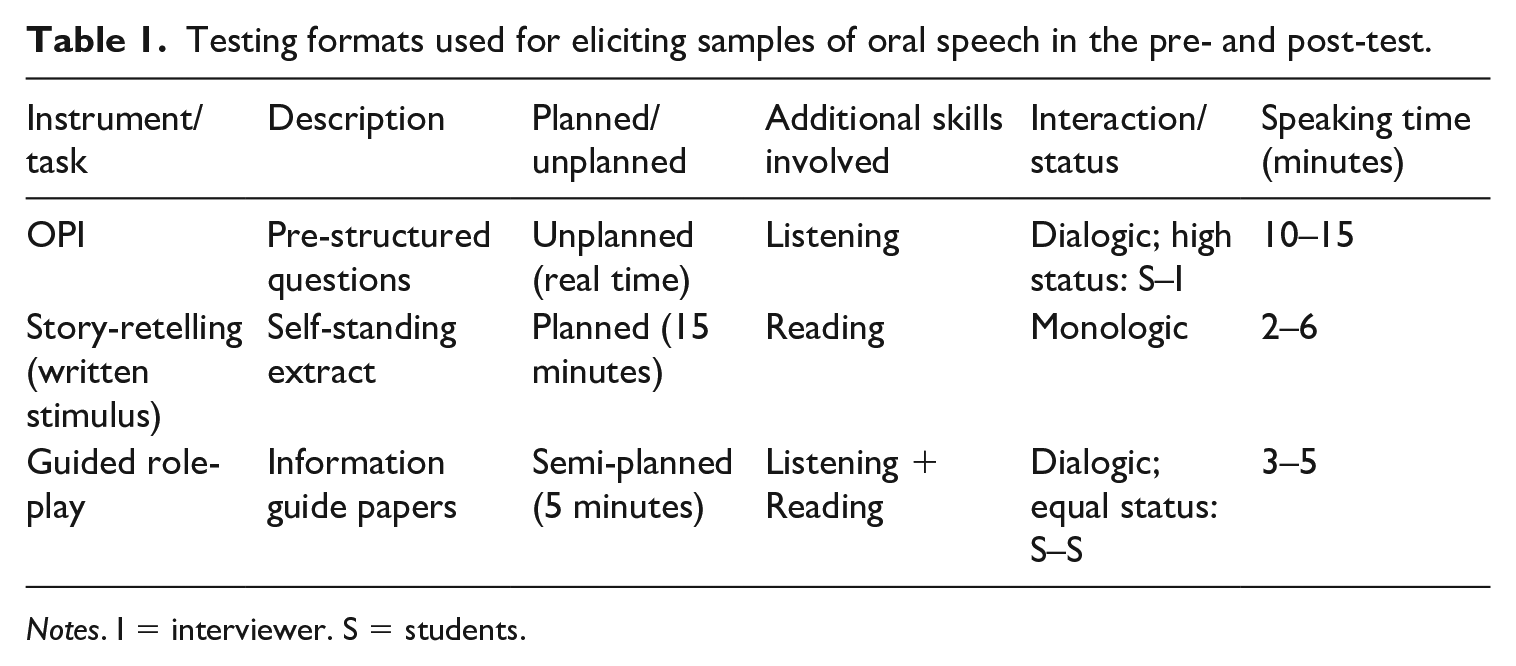
Notes. I = interviewer. S = students.
Based on previous results in second language acquisition (SLA) research, different testing task formats were chosen in the present study because there is some evidence that L2 complexity and accuracy depend on the type of tasks used for eliciting samples of oral speech. Planned tasks have been found to increase complexity, but not accuracy (Levkina & Gilabert, 2012; Ortega, 1999); narrative tasks appear to favour greater accuracy (Skehan & Foster, 1997) whilst a task in which there is greater scope for interaction seems to promote accuracy, but not complexity (Ferrari, 2012). Accordingly, different types of tasks were chosen to obtain a variety of speech samples (e.g. spontaneous and planned) and obtain a broad representation of learners’ oral abilities. The tasks featured different content and an equal level of difficulty in the two phases of testing. In order to make sure the tests had the same level of difficulty the two extracts used for the story-retelling were checked for readability. For this purpose the Flesch readability software in the Compleat Lexical Tutor website was run which displays the vocabulary profile of a text (Cobb, 2010).
IV Data analysis
1 Complexity
In this study, complexity is the extent to which the language produced in performing a task is elaborated and varied (Ellis, 2003) and which translates into a learner’s capacity to use more advanced language and richer vocabulary. Complexity can be measured on various dimensions which are used to quantify the elaboration of language. Syntactic complexity and Mean length of AS-units (MLAS) were chosen for the present study. The production unit used in this study for syntactic complexity is the AS-unit (‘analyses of speech unit’) which is specific to SLA research and used frequently since it was first proposed as an improved option for oral discourse segmentation by Foster et al. (2000). The AS-unit is ‘a single speaker utterance consisting of an independent clause, or sub-clausal unit, together with any subordinate clause(s) associated with either’ (Ellis, 2003, p. 365). ‘An independent sub-clausal unit’ is formed by ‘either one or more phrases which can be elaborated to full clause by means of recovery of ellipted elements from the context of the discourse situation’ (Ellis, 2003, p. 366). Such a unit, specifically designed for spoken production, is sensitive to genuine differences in performance, especially in highly interactional ones. The process of coding started with the manual transcription of the samples of speech in MS Word (2010) that were next segmented into independent, subordinate clauses, and sub-clausal units. Subsequently, AS-unit boundaries were created and calculated. Lastly, ratios of clauses per AS-unit were calculated.
MLAS measures the level of complexification occurring in units smaller than clauses, such as the noun phrase, and constitutes a more global metric for indexing overall syntactic complexity (Malicka, 2018; Mora & Valls-Ferrer, 2012; Norris & Ortega, 2009). In this study, MLAS was measured as mean number of words per AS-unit which was calculated by dividing the total number of words by the total number of AS-units in a speech file. If the results show that the students increased the number of words in an AS-unit, it means that they possess a larger repertoire of syntactic structures than previously attained and implicitly, a richer lexis. The number of words in a file transcription was shown automatically by MS Word.
2 Accuracy
Accuracy is dually defined as ‘the ability to produce error-free speech’ (Lennon, 1990, p. 390), and ‘the extent to which the language produced conforms to target language norms’ (Yuan & Ellis, 2003, p. 2). Accuracy was operationalized as global accuracy and pronunciation accuracy. A global measure of accuracy was adopted which has the advantage of being potentially the most comprehensive in that all errors are taken together (Iwashita et al., 2008, p. 31). The percentage of error-free clauses has often been used in research as a global measure (Foster & Skehan, 1996), however, this measure leads to possible bias as it ignores cases where there is more than one error in a clause. A further potential disadvantage of using the percentage of error-free clauses as a measure is that if a speaker uses many short correct utterances, the resulting score may be inflated (Skehan & Foster, 2012, p. 203). To analyse global accuracy, the ratio of errors per 100 words (t-unit) was counted and all errors related to syntax and lexical choice were taken into consideration: verb tenses, third person singular, articles, prepositions, plural markers (Nitta & Nakatsuhara, 2014), to which word-order and omissions were added because they constituted frequent mistakes found in learners’ testing samples. However, features of repairs were excluded from the analyses of global accuracy because learners show evidence of correct use of the target-like features when it is shown in their repaired utterance.
Pronunciation accuracy was assessed at word-level by making a distinction between ‘meaningful’ (intelligible) and ‘non-meaningful’ (unintelligible). A meaningful error comprised marginally target like word pronunciation (e.g. ‘The story talks /tɔlks/ about . . .’ instead of talk /tɔ:k/) and clearly non-target like word pronunciation (e.g. ‘The mother and her son /su:n/ . . .’, instead of son /sʌn/). All these pronunciation errors taken together were calculated and ratios of errors per 100-words (t-unit) were computed (adapted from Iwashita et al., 2008). Standard British English was considered the target language when coding the data.
3 Research method for complexity and accuracy analyses
To ensure reliability of measurements on (sub)dimensions of complexity and accuracy, intra-rater reliability was carried out. The intra-rater reliability is the consistency of a single marker with him/herself (Weir, 2005). Two months after originally coding the data for the main study, the researcher re-coded 10% of the data (a total of about 5,000 words) for global accuracy and pronunciation accuracy and respectively complexity in terms of AS-units and clauses. Samples to be recoded were chosen randomly from the pre-test and post-test and from the three types of tasks (one sample per task). Scholfield (1995, p. 206) states that a typical view regarding desirable levels of reliability ‘would suggest aiming for 0.6 in exploratory research, 0.75 for hypothesis testing research, and 0.9 for T purposes’, where T refers to teaching purposes within a pedagogical context and where individual cases are often being assessed (Scholfield, personal communication, September 2013). The results for the intra-coder agreement proved to be very high: .996 (99.6%) for AS-units and clauses, .94 (94%) for global accuracy and .983 (98.3%) for pronunciation accuracy which assured that the segmentation and measurement procedures were highly reliable.
Prior to performing the statistical analyses, Kolmogorov–Smirnov pre-test normality check tests were performed. The results showed data to be normally distributed and thus suitable for parametric analyses. Consequently, a two-way ANOVA design was used to check if there were any statistically significant differences of interest between pre-test and post-test in the CG and EXG and if so, whether the difference was greater in the EXG. Box’s test of equality of covariances and Levene’s test of equality of variances were used in order to see if the data met the assumptions for this type of analyses. The 0.05 level of confidence was used as the criterion level for determining a significant difference. Subsequently, post-hoc follow-up paired sample t-tests were performed in order to check the significance of the differences between pairs of occasions within the groups. In order to reduce type II errors the usual threshold significance value of p = 0.05 was divided by 2 giving p = .025 as the threshold for these post-hoc tests. A one-way ANOVA general linear model was performed separately for each group to calculate the effect size. For the present empirical study effect sizes are important because they show which approach had a greater effectiveness in developing L2 learners’ complexity and accuracy. For interpreting the magnitude of the effect sizes the subsequent benchmarks were considered: .10 to .29 (small effect size), .30 to .59 (medium effect size) and .60 to 1.0 (large effect size).
V Results
Table 2 gives the mean accuracy and complexity scores for EXG and CG on pre- and post-test.
Mean accuracy and complexity scores for experimental and control group on pre- and post-test.
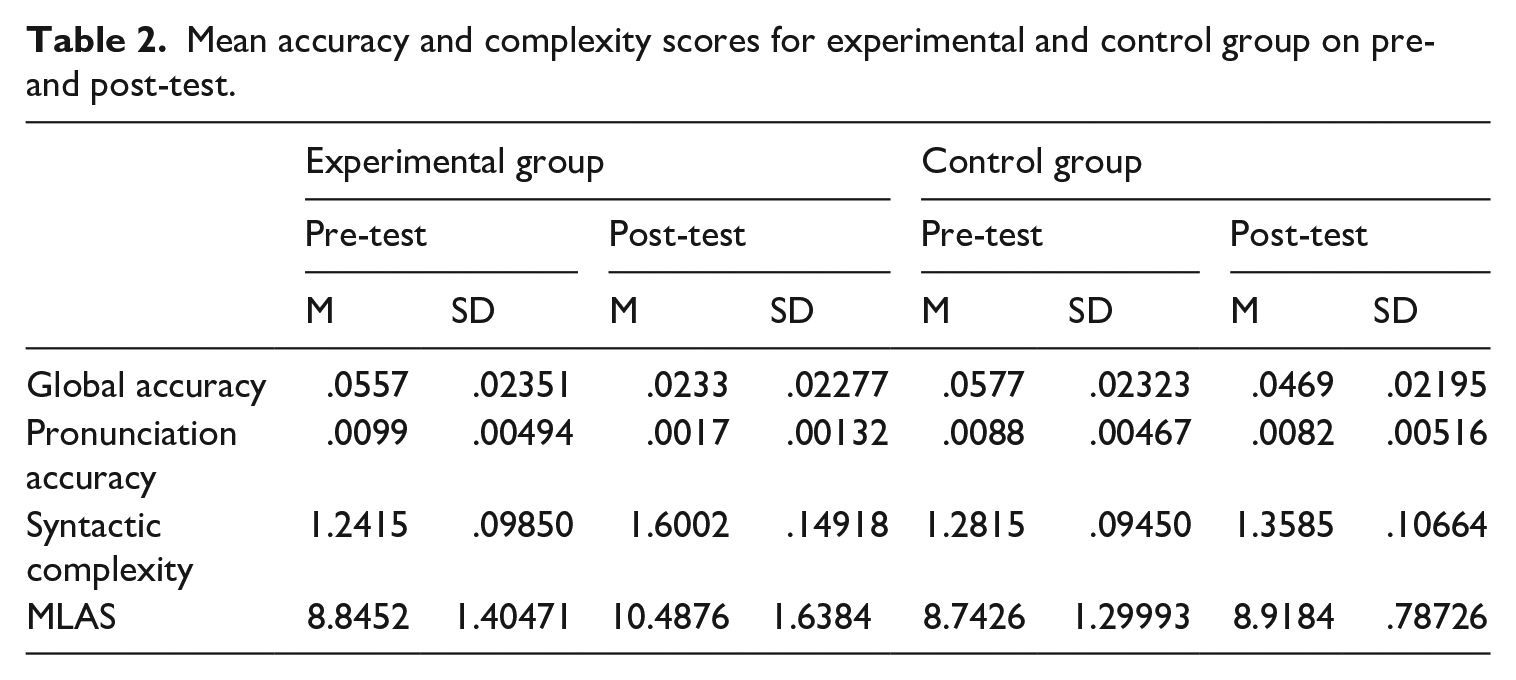
1 Syntactic complexity
The results of pre-/post comparison test of syntactic complexity for CG and EXG (Figure 1) disclosed a significant effect of time, F (2,18) = 25.783, p < .001, ηp2 = .589, a significant effect of group, F(2,18) = 13.820, p = .002, ηp2 = .434 and significant interaction effect, F (2,18) = 9.629, p = .006, ηp2 = .349 which shows that the groups performed differently. One-way RM-Anova with Bonferoni-Adjusted Pair-wise Comparisons indicated that the EXG improved significantly t (–4.798), p < .001 and a large effect size (.642) was obtained whereas the CG obtained a non-significant score t (–1.889), p = .092 with a small effect size (.235). In sum, this result shows that the blended drama approach was highly effective in developing learners’ syntactic complexity unlike the traditional approach. Figure 1 illustrates mean scores for syntactic complexity ratings across groups and time.
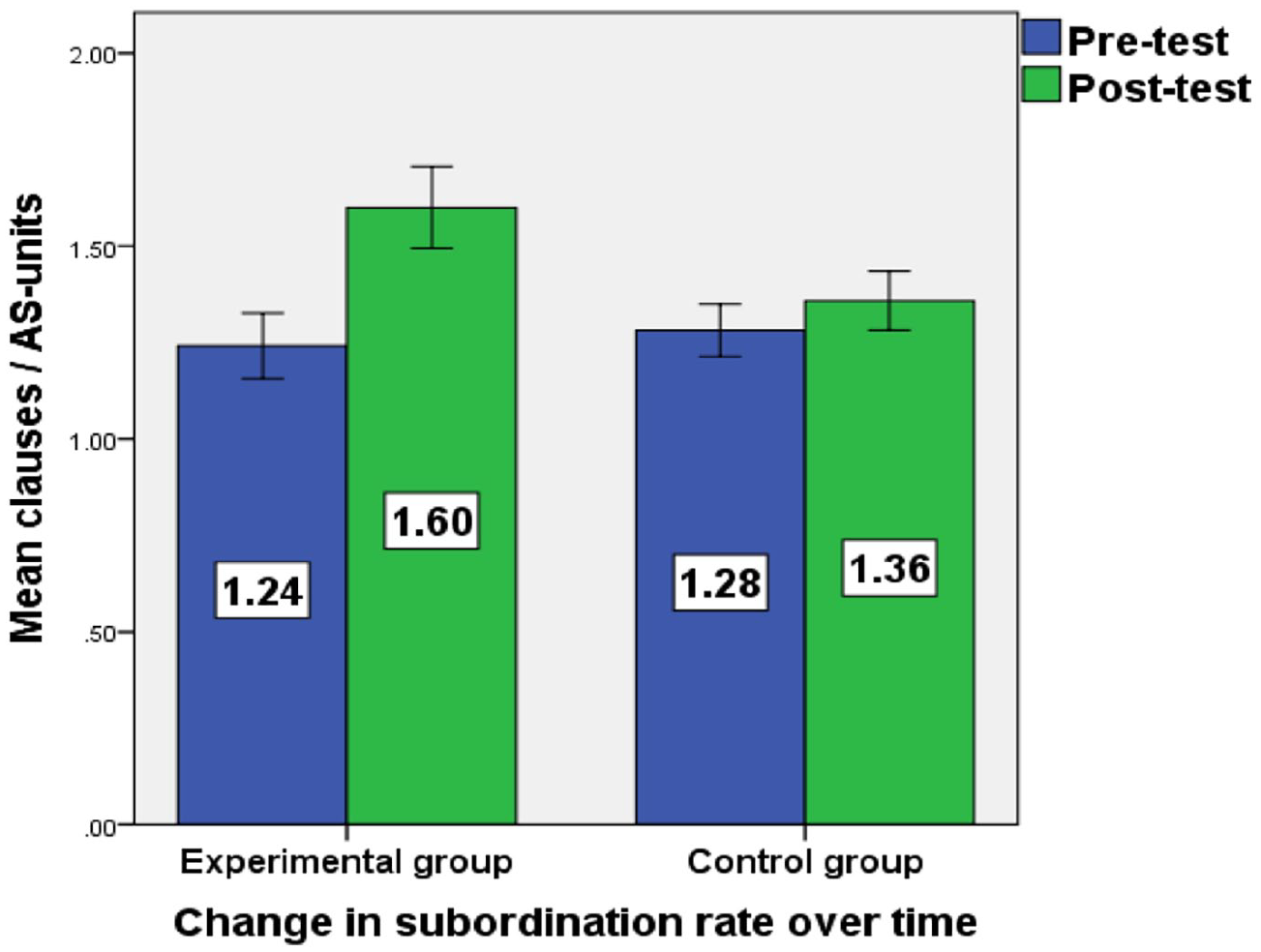
Syntactic complexity scores for experimental and control group.
2 Mean Length of AS-units (MLAS)
As for MLAS (Figure 2) significant improvement over time F (2,18) = 7.784, p = .012, ηp2 = .302 was detected. There was no significant main effect of group F(2,18) = 2.885, p = 107, ηp2 = .138, but the interaction effect of time by group was significant F(2,18) = 5.065, p = .037. ηp2 = .220. Similar to the syntactic complexity, only the EXG improved significantly t (–.3.490), p = .007 with a large effect size (.567) whilst the CG registered a slight, but not significant improvement t (–.390), p = .706 and a very small effect size (.089). These results suggest that drama blended approach was highly effective for developing learners’ MLAS as compared to a traditional approach. Figure 2 illustrates mean scores for MLAS ratings across groups and time.
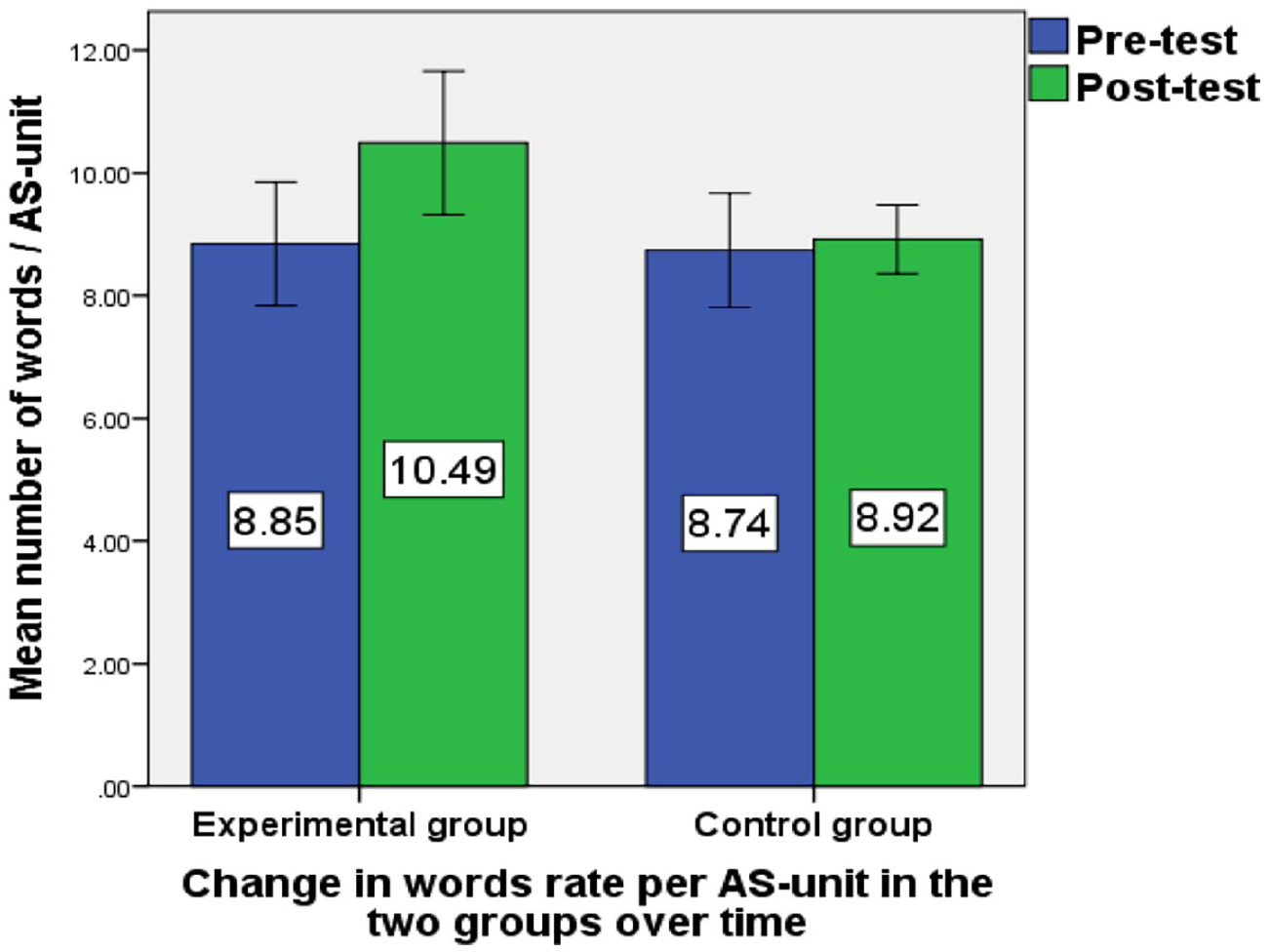
Mean length of AS-units (MLAS) scores for experimental and control group.
3 Global accuracy
The results of pre/post comparison of error rate for CG and EXG (Figure 3) revealed a significant effect of time, F(2,18) = 40.557, p < .001, ηp2 = .693, but no significant effect of group, F(2,18) = 2.252, p = .151, ηp2 = .111. The main effect of time shows the learners improved over time regardless of the group. However, a significant interaction effect of time by group, F(2,18) = 10.199, p = .005, ηp2 = .362 was registered. Post-hoc paired sample t-tests revealed that the EXG in fact did much better compared to the CG as they improved highly significantly (p < .001), whilst the result for the control group was just significant (p = .023). One-way ANOVA with Bonferoni-Adjusted Pair-wise Comparisons showed that both groups improved significantly: the EXG did significantly better t (5.883), p < .001 with a large effect size (.794) whilst the CG t (2.725), p = .023 registered a moderate effect size (.452). In sum, results for global accuracy show that this dimension of oral proficiency significantly improved for both groups, however, the blended drama-based instruction had a greater impact as compared to the traditional way of instruction. Figure 3 illustrates mean scores for global accuracy ratings across groups and time.
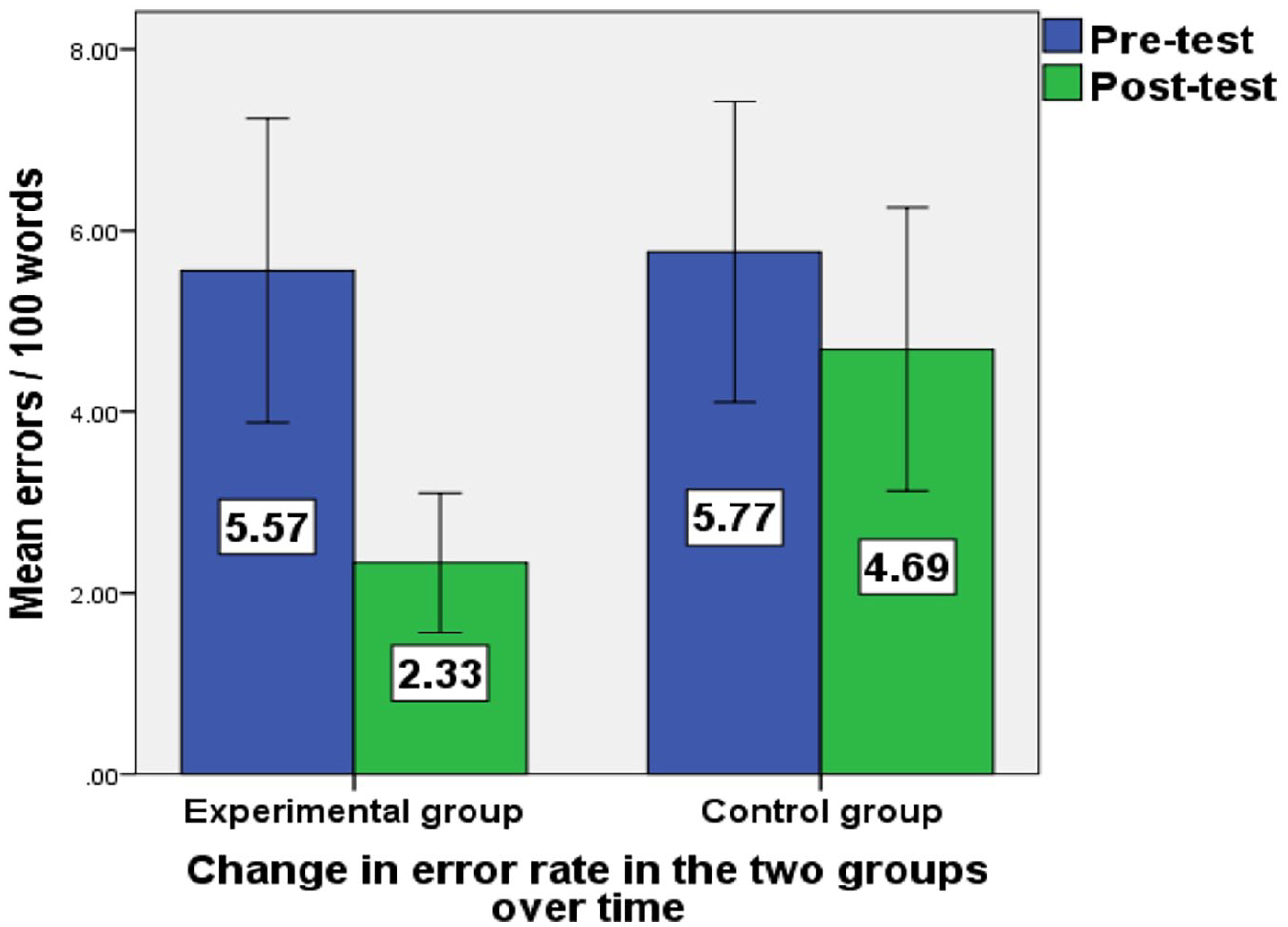
Global accuracy scores for experimental and control group.
4 Pronunciation accuracy
Regarding pronunciation accuracy (Figure 4), there was a significant effect of time F(2.18) = 15.536, p < .001, ηp2 = .436, which confirms that both groups improved over time, but no significant effect of group F(2.18) = 2.808, p = .111, ηp2 = .135 was found. The interaction effect was also significant F(2.18) = 11.689, p = .003, ηp2 = .394 disclosing that there was a difference in the improvement made in the two groups. The post-hoc t-tests, however, showed that in this instance only the EXG improved highly significantly t (5.468), p < .001 registering a high effect size (.769) as opposed to the CG which did not attain significance t (.353), p = .732 and the effect size was very small (.021). Hence, the blended drama approach was notably superior to the traditional teaching in improving learners’ pronunciation accuracy. Figure 4 illustrates mean scores for pronunciation ratings across groups and time.
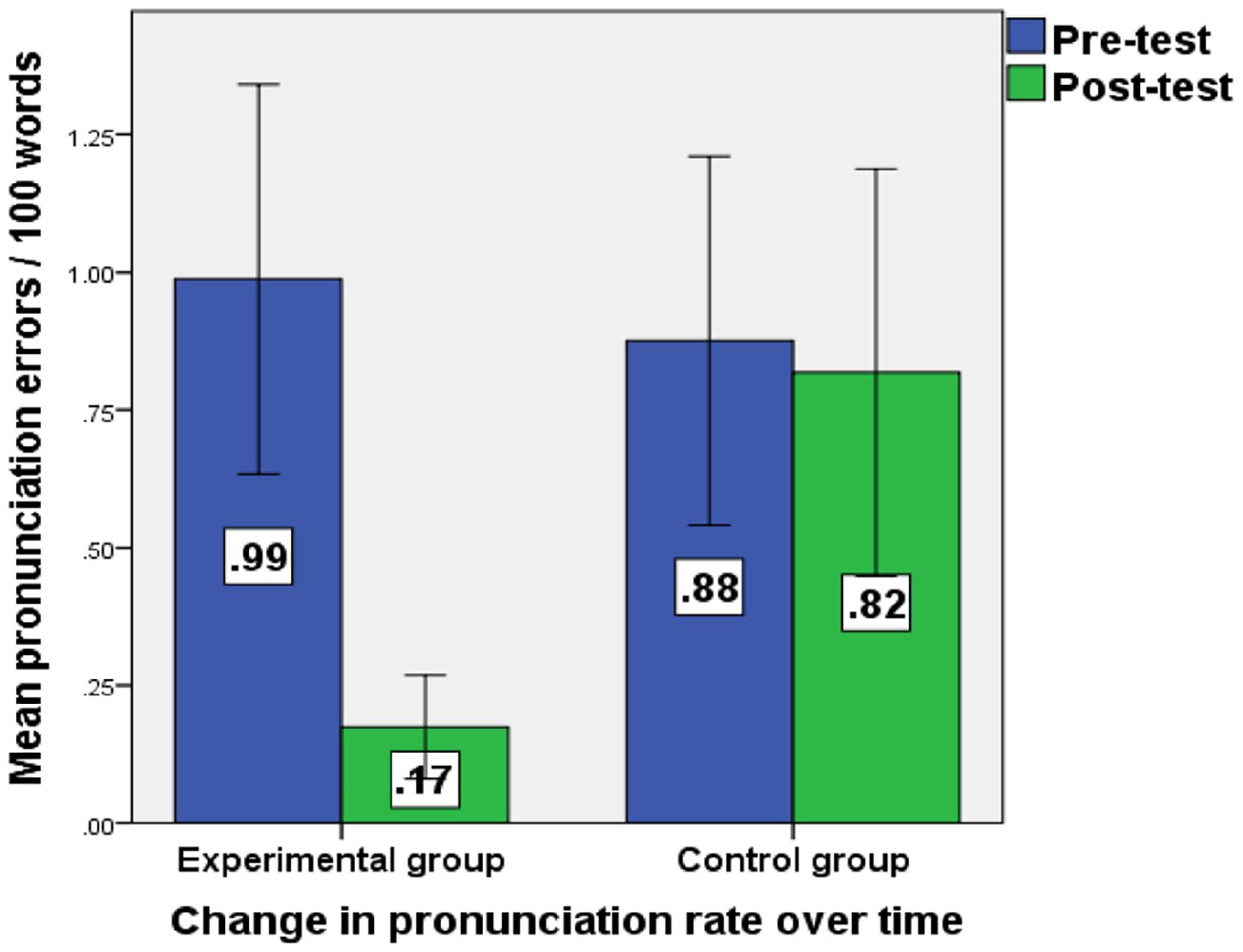
Pronunciation accuracy scores for experimental and control group.
VI Discussion
Over the twenty-week instruction period, both EXG and CG groups showed changes in the complexity and accuracy dimensions used in this study as would be expected after a certain period of instruction. However, the scores for the blended-drama approach when compared to the traditional approach proved to be significant on all measures of complexity and accuracy whereas the CG obtained a significant result only for global accuracy.
These results may be explained as follows. First, the blended-drama approach appears to offer advantages in terms of promoting a greater syntactic complexity over a traditional approach. The learners in the EXG obtained a significant result whilst the CG did not attain significance. This is important in language learning as it implies the development of a repertoire of syntactic structures that demonstrates a more advanced stage of language proficiency. A plausible explanation may be that by their nature, authentic pieces of literature generally contain more complex and varied language as compared to contrived texts. Constant exposure to a variety of styles and registers and to a greater richness of syntax and lexis may have helped learners to acquire more vocabulary. It is likely they learned to combine words whilst experimenting with more complex syntactic structures during continuous practice in the process of interaction both with the text and with their peers. The variety of dramatic games and activities implemented provided a means for scaffolding which may have led to greater uptake, and conseguently to the significant improvement reflected in participants’ scores. Furthermore, the debates and the numerous discussions when negotiating for meaning or interpreting the text along with the numerous phases of rehearsals and repetitions during the performance stage may all have contributed to a greater vocabulary retention and consequently to an increase in learners’ syntactic complexity. This is also reflected in the significant score obtained by the EXG group for the MLAS which disclosed that an AS-unit tended to be longer, whilst the CG did not obtain a significant score. This result is important as it supports the belief that a blended-drama approach in which learners engage with authentic pieces of literature and authentic tasks that offer opportunities for more production output could lead to significantly larger gains in oral syntactic complexity as compared to a traditional approach. Previous studies reported a positive impact of drama on vocabulary improvement (Demircioğlu, 2010; Miccoli, 2003; Schenker, 2017), but not on syntactic complexity measures. Overall, the novelty of the whole blended-drama experience increased learners’ enthusiasm (Bora, 2020a, 2020b) and this may have had an impact on the positive results obtained by the EXG.
Regarding global accuracy both the CG and the EXG group improved significantly after the post-test, however, the gains of the EXG were higher. This result might be explained in the following ways: first, the learners’ accuracy might have improved due to the repetition that occurred in the numerous phases of the rehearsals during the play production. This offered learners the opportunity to pay attention to different features of the discourse, amongst them the syntactical, morphological and lexical errors as the focus was on ‘getting it right’, so as to make themselves understood both by the audience formed by classmates during rehearsals and by the other actors in order to get the appropriate lines delivered back. Second, peer-correction may have encouraged awareness of mistakes by offering the necessary corrections. Learners had multiple chances to correct their erroneous grammar, as the more times a grammatical error is produced, the more opportunities there are for learners to notice it. Thirdly, putting on stage a performance creates a constant need for interaction between learners (Vygotsky, 1978) to help them achieve a common goal in a purposeful and meaningful context: learners practiced language together while undertaking cultural and linguistic analyses, or when working on production-related activities such as creating costumes, props, etc. In this sense, the Comprehensible Output Hypothesis (Swain, 1985) is also relevant. In the process of interaction when a learner has received some negative input, the learner is pushed to use alternative means to convey his or her message. Thus, the process of achieving Comprehensible Output leads to a more accurate production of the foreign language (Swain, 1985, p. 248). It seems that working on the performance gave students opportunities not only to internalize and produce correct structures, but also to communicate meaningfully. Although the learners did not manage to learn all their lines by heart, they actively participated in all the activities required for the preparation of the production. They memorized lines in class, performed repeatedly in front of their peers and discussed critically the characters’ motivation and thoughts which may have increased their level of attention to the accuracy of their linguistic output. During the formal intervention, the students in the CG were exposed to constant grammatical practice through fill-in the gap or multiple-choice exercises and consequently, their error rate decreased over time, however, with a different impact on the other dimensions of oral proficiency.
As for pronunciation accuracy the EXG achieved a highly statistically significant score after the drama-blended instruction was implemented. This result seems unsurprising since some of the activities, especially the warm-ups used, were theatre techniques which had a clear focus on pronunciation development. Based on previous literature, it may be that the rehearsal phase contributed greatly to this score since this stage unavoidably required and pushed learners to practice speaking and rehearse their pronunciation to a higher extent as well as experimenting with pitch, volume and intonation patterns. First, in order to memorize their dialogue, they had to repeat their allocated part of the script numerous times. Second, they had to be careful to speak with a correct pronunciation in order to make themselves understood both by the class audience and by the other peer-actors who needed to deliver the appropriate lines back in response. Peer correction, as theorized by Vygotsky (1978), might also have played an important role in fostering learners’ pronunciation as multiple repetitions also provide more chances for those involved in a play to make themselves aware of pronunciation errors and provide the required corrections. Since the learners were aware the focus was on the way they delivered the lines and ideally with the correct pronunciation, they may have been motivated to speak as accurately as possible. It may be that the performance offered a safe atmosphere in which the learners could take risks regardless of mispronunciation and, consequently, their pronunciation skills improved. Thus, the blended-drama approach provided a useful setting for learners to practise their pronunciation in an effective way because practicing pronunciation in the context of a drama-based blended approach facilitated greater uptake by learners. The improvement in pronunciation accuracy is in line with findings from previous studies (Bora, 2020a; Dodson, 2002; Korkut & Çelik, 2018; Miccoli, 2003; Ryan-Scheutz & Colangelo, 2004, 2008), confirming the effectiveness of a blended-drama approach with a performative component for developing L2 oral skills.
VII Conclusions
This study sought to establish the extent to which learners exposed to a blended drama-based approach improved their oral skills on the sub-components of complexity and accuracy: syntactic complexity, MLAS, global and pronunciation accuracy. The differences in pre-test and post-test scores for the EXG and the CG showed that learners who learned through a blended-drama form of instruction significantly improved their pronunciation accuracy, syntactic complexity and MLAS when compared to the CG whilst there was no significant statistical result for global accuracy between the two groups. However, the accuracy achieved by the EXG was greater than that of the CG with a greater effect size. That is to say, the blended-drama approach was more effective than the traditional approach in developing learners’ L2 spoken skills. The participants in the EXG, as a result of exposure to a drama-based form of instruction started speaking more accurately using a wider range of vocabulary in longer sentences. A noteworthy result of this study is that learners in the EXG improved their syntactic complexity, MLAS and pronunciation accuracy at nearly double the rate of the CG over the same period of time. It appears that authentic texts, dramatic activities and games spurred learners’ motivation and offered opportunities for learning grammar and lexicon in context. As posited by Vygotsky (1978), cooperative learning and meaningful interaction especially during the play production increased students’ confidence in manipulating language, as it seems that a more natural and spontaneous interaction was promoted by the authentic communicative situations created in a blended drama approach rather than in a traditional class setting. Performing in front of peers as well as using peer-correction (Vygotsky, 1978) may have made students more aware of their mistakes and they corrected each other without the risk of ‘losing face’ which resulted in higher global and pronunciation accuracy. Predominantly, learning lines, constantly using the target language and gaining confidence during the play production phase are all likely to have contributed to the students’ increased competence in the target language.
An important strength of this study is that the blended-drama lessons were entirely integrated into the students’ weekly English classroom routine within the compulsory foreign language syllabus. At the level of design, an additional strength was that the pre-/post-tests were used both as data collection instruments and for course assessment without using additional time for learners’ evaluation. However, it can be argued that students might have been more motivated to do better than otherwise expected all throughout their course by taking part in the activities and performing well because the testing was part of their required school assessment. Accordingly, they strove to achieve better marks and the overall significant results could well be influenced by this fact.
As with any study that endeavours to explore new and under-researched areas, the research reported here has limitations. The sample sizes of learners were small and the research was also limited to a small public school. Furthermore, the sample of students participating in the experimental study was not randomly selected, thus, generalizability cannot be extended to all contexts and settings. Further research would benefit from larger sample sizes in different school settings to corroborate the results of the present study. Another limitation may be that although a variety of tasks were used, they were conducted in a test environment which may have affected the scores. Learners were more prepared to do well given that the scores were part of their curricular assessment. Additionally, given the design of the study in which the participants’ level of language ranged from lower-intermediate to upper-intermediate, with most of them having a mid-intermediate level, the present findings may not be relevant to all stages of language proficiency.
Nevertheless, from a pedagogical perspective, this study constitutes another step towards more empirical and less anecdotal research in the field of drama in language teaching, and attempts to offer more insights regarding new ways, variations and possibilities in implementing drama-based approaches within a mandatory rather rigid compulsory curriculum. As for the implications, it is hoped that this study will persuade language instructors to use authentic literature and drama approaches in their classes so that drama could become a greater part of foreign language instruction in order to foster the development of L2 oral complexity and accuracy among other skills whilst cultivating learners’ positive attitudes towards foreign language learning.
Footnotes
Appendix 1
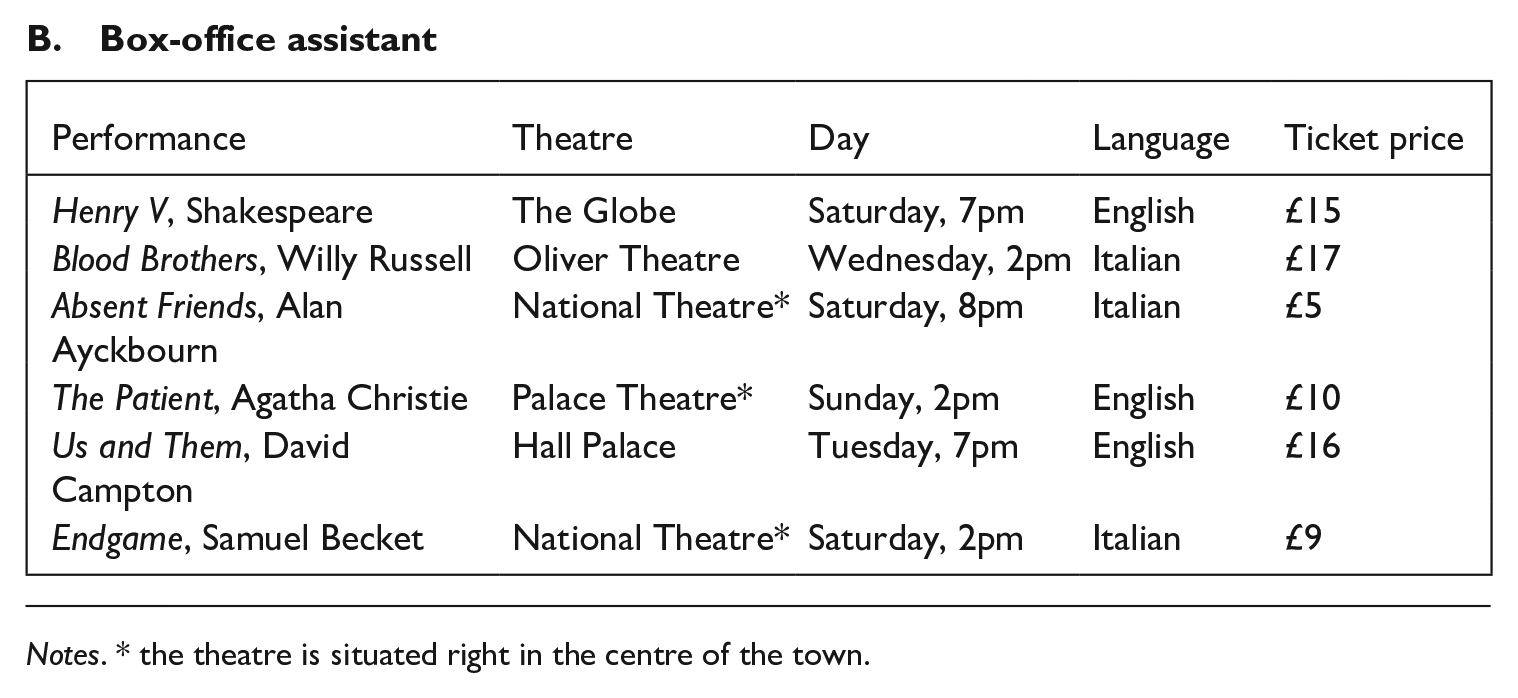
B. Box-office assistant
| Performance | Theatre | Day | Language | Ticket price |
|---|---|---|---|---|
| Henry V, Shakespeare | The Globe | Saturday, 7pm | English | £15 |
| Blood Brothers, Willy Russell | Oliver Theatre | Wednesday, 2pm | Italian | £17 |
| Absent Friends, Alan Ayckbourn | National Theatre* | Saturday, 8pm | Italian | £5 |
| The Patient, Agatha Christie | Palace Theatre* | Sunday, 2pm | English | £10 |
| Us and Them, David Campton | Hall Palace | Tuesday, 7pm | English | £16 |
| Endgame, Samuel Becket | National Theatre* | Saturday, 2pm | Italian | £9 |
Notes. * the theatre is situated right in the centre of the town.
Appendix 2
Examples of warm-up games, theatrical techniques and games
Funding
The author received no financial support for the research, authorship, and/or publication of this article.
