



Abstract
This study examined the extent to which textual enhancement incorporated into the post-task stage of task-based reading lessons can promote development in second language (L2) grammatical knowledge. The participants were 49 child language learners who participated in task-based reading lessons in their own classroom contexts. They were randomly assigned to two groups, one being exposed to textual enhancement and the other not. The experiment adopted a multiple-exposure design involving six treatment sessions over three weeks. The target construction was the third person singular -s morpheme. Pretest-posttest development was assessed with a grammaticality judgement test. The results revealed a small but positive effect for textual enhancement. We attributed the relative success of textual enhancement to a combination of factors: use of a multiple-exposure design, the incorporation of textual enhancement into the post-task rather than the during-task stage, age of participants, and prior knowledge.
Keywords
I Introduction
For the past two decades, research on task-based language teaching (TBLT) has provided increasing evidence that engaging in tasks, accompanied with timely focus on form (Long & Robinson, 1998), can provide a facilitative environment for second language (L2) development to unfold (Ellis et al., 2020). Much of the existing research on the role of focus on form in the context of TBLT, however, has focused on the acquisitional benefits of enacting focus on form during oral task performance (e.g. De la Fuente, 2006; Foster & Skehan, 2013; Kim, 2013). Although most definitions of task subsume all language skills, little is known about the extent to which task-based development can be fostered through incorporating focus-on-form interventions into task-based reading sequences. Given the documented benefits of reading and focus on form, this is a key gap in TBLT research.
One way to implement focus on form during L2 reading is through textual enhancement. Textual enhancement involves modifying texts to make certain L2 constructions more physically salient, for example, through
Another reason for the small impact observed for textual enhancement in previous research might be that, due to textual enhancement being administered in the during-task stage, the processing of texts posed extra processing demands on learners by prompting them to attend to form and meaning simultaneously (e.g. Han et al., 2008; Lee, 2007; VanPatten, 1990, 1996). Therefore, the question arises whether using textual enhancement might be more effective when it is implemented at a different stage of the reading lesson. Besides the during-task stage, focus on form can also be enacted in the pre-task and post-task stages of a task-based reading sequence, with the post-task stage probably providing the most optimal condition to draw learners’ attention to form without interrupting focus on meaning (R. Ellis, 2003). Nevertheless, only a handful of studies have examined the effects of post-task reading activities on L2 development (e.g. Yang et al., 2017), and none of these have been situated in a task-based context.
A further gap in previous research on textual enhancement as well as TBLT concerns a lack of attention to child foreign language learners. Although foreign language programs are increasingly introduced at elementary school level in various contexts, this population remains underrepresented in instructed second language acquisition (SLA) research in general (Collins & Muñoz, 2016). Research on classroom-based TBLT, involving child language learners (see, however, Shintani, 2016), is even more scarce.
In light of these considerations, in the current study we examined the extent to which textual enhancement incorporated into the post-task stage of task-based reading lessons can promote development in L2 grammatical knowledge. We hoped that enacting textual enhancement in the post-task stage would allow learners to allocate more attention to form since, compared to the during-task stage, there would be less burden on processing for meaning. To expand TBLT research on child language learners and classroom contexts, we worked with elementary school students in their real classroom environments. Finally, we repeated the task-based treatment over several sessions to allow ample time for any effects of textual enhancement to surface.
II Background
1 Input, attention, and child SLA
In the field of SLA, it is generally agreed that providing learners with ample exposure to input is essential for L2 acquisition to occur. However, in foreign language contexts the quality and quantity of input L2 learners receive are normally inadequate to achieve advanced levels of proficiency. A way to increase learners’ exposure to L2 input is to engage learners in reading in the target language. L2 reading has been reported to facilitate, besides the development of reading skills, the learning of various target language features including L2 vocabulary and grammar (e.g. Hafiz & Tudor, 1990; Hitosugi & Day, 2004; Kweon & Kim, 2008; Mermelstein, 2015). Researchers, however, have also observed that acquisition does not necessarily follow as a byproduct of comprehension (e.g. Long, 1996; VanPatten, 1996). That is, learners will not utilize all the input that they are exposed to in restructuring their interlanguage. This is particularly true for linguistic forms that have low communicative value and/or physical salience (N. Ellis, 2006; Goldschneider & DeKeyser, 2001; VanPatten, 1990, 1996). In such cases, there is a consensus that an external intervention is needed to capture learners’ attention, which is generally considered to be a prerequisite for L2 acquisition (Robinson, 2003; Schmidt, 2001). Several researchers have also proposed that this may be achieved via employing focus-on-form pedagogical techniques, which aim to direct learner attention to linguistic features in contexts where learners’ primary attention remains dedicated to meaning (Long & Robinson, 1998).
The use of focus-on-form techniques is also considered beneficial and oftentimes essential for sustainable and accurate child SLA (Oliver et al., 2017). This holds particularly true for children in foreign language classroom contexts where, due to limited access to L2 input, it is more challenging for children to reach high levels of L2 proficiency (Spada & Lightbown, 2008). Among the focus-on-form pedagogical techniques, the more implicit types, which draw learners’ attention to form unobtrusively in the context of meaning-based instruction, may be more suitable for children, as research suggests that children rely primarily on implicit learning mechanisms (e.g. Roehr-Brackin & Tellier, 2019).
2 Textual enhancement, focus on form, and task-based reading
Tasks, defined as activities that involve learners in using ‘language, with emphasis on meaning, to attain an objective’ (Bygate et al., 2001, p. 11), appear to provide an ideal platform for integrating focus on form into meaning-focused activities. Reading tasks, in particular, can expose learners to plentiful input while also providing a venue for facilitating learner attention to L2 constructions. Among the focus-on-form techniques that can be utilized in the context of reading, textual enhancement has probably received the most attention.
The theoretical rationale underlying textual enhancement stems from Sharwood Smith’s (1991, 1993) input enhancement hypothesis. According to this proposal, making linguistic features salient through techniques such as written (e.g. underlining) or oral (e.g. pausing) textual enhancement can raise the probability that learners allocate attention to and subsequently acquire the enhanced linguistic constructions (Robinson, 2003; Schmidt, 2001). Sharwood Smith (1991) also distinguished between internally- and externally-created salience, the former arising during natural learning processes and the latter resulting from deliberate modifications of the input (e.g. via textual enhancement). Notably, however, externally-created salience does not always coincide with internal salience, which Sharwood Smith regards as necessary for L2 development. In other words, textual enhancement is only expected to be effective when externally enhancing linguistic constructions help develop internal salience within learners.
Sharwood Smith’s distinction between internal and external salience chimes well with Chun, Golomb, and Turk-Browne’s (2011) conceptualization of attention as a multiple system, consisting of an internal and external system. Internal attention is concerned with selecting and modulating information that is internally-generated, whereas external or perceptual attention selects and modulates sensory information that can be created by external cues (e.g. underlining text). The internal and external systems are presumed to be distinct, but the two interact, with working memory serving as the interface (LaBrozzi & Villegas, 2020). For instance, internal attention subsumes cognitive control and executive functions, which, in turn, drive the selection of perceptual input that gets encoded and rehearsed in working memory. Similar to Sharwood Smith’s proposal, Chun et al.’s attentional account implies that while textual modifications may attract learners’ external attention (Issa & Morgan-Short, 2019), the enhanced constructions will only be encoded and maintained in working memory if they also capture learners’ internal attention.
In case internal attention becomes engaged and a memory trace gets created as a result of encoding in working memory, then the new trace needs to be strengthened through repeated retrieval for long-term retention to take place. An increasing number of L2 studies suggest that exposing learners to the targeted construction in a distributed fashion, in briefer sessions over multiple occasions, appears particularly beneficial (Rogers, 2015). That is, textual enhancement is unlikely to lead to development unless learners are exposed to the enhanced constructions multiple times over a longer period.
3 Previous empirical research on textual enhancement
Previous research findings on textual enhancement are aligned with these theoretical insights. As mentioned previously, Lee and Huang’s (2008) meta-analysis found that textual enhancement had a small positive impact on L2 grammatical development. The few studies that were conducted with children also reported some benefits of textual enhancement for grammar learning (e.g. Simard, 2009; White, 1998). Overall, however, existing results are fairly mixed for the effectiveness of textual enhancement (for reviews, see Han et al., 2008; Leow & Martin, 2017). Null findings have been accounted by a number of factors, including absence of sufficient prior knowledge of the targeted construction (Park, 2004; Winke, 2013), learners’ perception that enhancement is irrelevant to task completion (Indrarathne & Kormos, 2017), low level of motivation on the part of learners (Winke, 2013), number and choice of typographical cues (Simard, 2009), the application of non-conflated or simple enhancement (i.e. textual enhancement is the single technique used) as opposed to conflated or compound enhancement (i.e. using enhancement together with other pedagogical techniques) (Han et al., 2008; Leow, 2009), and lack of overlap between internally- and externally-created salience (Indrarathne & Kormos, 2017). In the present study, we intended to address two further factors that have been highlighted as providing potential explanations for the absence of effects for textual enhancement in previous studies: (1) employing short-term, often one-shot designs instead of multiple-exposure treatments and (2) creating conditions for simultaneous rather than sequential processing of the meaning and form associated with the target construction (Han et al., 2008). Now we turn to a discussion of these variables.
4 Need for more multiple-exposure research on textual enhancement
As discussed earlier, for textual enhancement to have a positive effect on L2 development, learners would probably need to encounter the enhanced linguistic construction on multiple occasions over an extended period. This is especially so given that textual enhancement, being an implicit focus-on-form technique, is anticipated to require a longer period to yield gains. More explicit instructional interventions are likely to have more immediate effects, albeit they are less probable to result in long-term retention (Long, 2007, 2015; Mackey & Goo, 2007). Despite these insights, the bulk of research on textual enhancement has adopted single-treatment designs. There are a small number of studies which included multiple treatments, but they typically had only a few sessions (e.g. Indrarathne & Kormos, 2017, 2018; Meguro, 2019). An exception is Doughty’s (1991) seminal work, where learners took part in ten treatment sessions involving compound enhancement. As expected, this study yielded benefits for the use of textual enhancement in developing knowledge of English relativization by university students. Further research, however, is needed to ascertain whether these findings can be transferred to different populations, contexts, and target constructions.
5 The post-task stage as a platform for focus on form
In the context of TBLT, another way to facilitate the effectiveness of textual enhancement might be to integrate textual enhancement in the post-task rather than the during-task stage. Han et al. (2008) argued that one of the reasons why many textual enhancement studies did not succeed in developing learners’ knowledge of the targeted forms might be that researchers attempted to direct participants’ attention to meaning and form simultaneously (e.g. instructing learners to read textually enhanced texts for meaning) instead of engaging them first in processing for meaning followed by providing them with opportunities to focus on form (e.g. reading an unenhanced text first for meaning, followed by exposure to an enhanced version to prompt attention to form). The researchers derived this argument from information processing accounts (Skehan, 1996, 2009; VanPatten, 1996), which propose that simultaneous processing of two types of information is only possible if the processing of one of them is automatized. Otherwise, trade-off effects are expected, with one or both types of information remaining insufficiently processed. Indeed, the few textual enhancement studies (e.g. Doughty, 1991; Izumi, 2002) that designed conditions for sequential instead of simultaneous processing generated more positive results.
Applying this idea to task-based reading lessons, it would appear that learners might benefit more from being exposed to textual enhancement in the post-task rather than the during-task stage. In the during-task stage, learners would be able to dedicate their full attention to the content of texts, thereby avoiding the possibility that a focus on meaning is compromised. Then, in the post-task stage, once they have had the opportunity to clarify the meaning of what they have read, they could be exposed to enhanced constructions in or from the text. In line with this, R. Ellis (2003) also suggested, as mentioned earlier, that the post-task stage is probably the ideal point to direct learners’ attention to form in the task-based lesson, as it increases the likelihood that learners’ primary focus on meaning remains uninterrupted in the during-task stage. To date, no empirical research has explored this possibility with respect to textual enhancement.
III Aims and research question
Against this background, we aimed to explore the extent to which textual enhancement in post-reading tasks can promote development in L2 grammatical knowledge by child language learners, an age group that has been neglected in TBLT research (Plonsky & Kim, 2016). Our target construction was the third person singular -s morpheme. We formulated the following research question: To what extent does textual enhancement in post-reading tasks affect the acquisition of third person singular -s among child language learners?
IV Method
1 Design
The study employed a pretest-posttest design, with six treatment sessions. As part of the treatment, participants took part in reading-focused English as a foreign language lessons in their real classroom context. We randomly assigned the participants to two groups. The groups differed as to the type of post-reading task they carried out, whether it involved textual enhancement (TE) of the target construction or not (+TE group versus −TE group). To establish participants’ proficiency, we administered the TOEFL Primary test. The pretest and posttest included a grammaticality judgement test (GJT). We also administered a post-study questionnaire to learners.
2 Participants and context
The participants were 49 fourth graders, with an average age of nine, from three intact classes at a local elementary school in Seoul, Republic of Korea. The participants in each class were randomly assigned to the +TE and −TE conditions.
All the participants had begun studying English as part of the school curriculum since third grade. At the time of the study, they learnt English through two hours of classroom instruction every week by their homeroom teacher. The school curriculum followed the state elementary English curriculum, which adopts a communicative approach to language teaching. The teachers strictly followed a textbook recommended by the Korean Ministry of Education, and focused largely on listening, speaking, and vocabulary. Also, the teachers used a mix of first language (L1) and L2 in class.
3 Target linguistic construction
The third person singular -s inflection was chosen as the target construction, as it was expected to cause difficulty for Korean learners of English on several grounds. First, in Korean subject-verb agreement does not exist, that is, Korean L2 learners of English lack prior knowledge of the concept associated with subject-verb agreement. Blom, Paradis and Sorenson Duncan (2012) found that children whose L1s do not have inflections have a disadvantage in acquiring third person -s. Second, the third person -s is a non-salient linguistic feature, being communicatively redundant and low in physical salience (Goldschneider & DeKeyser, 2001). These features make it a likely candidate for blocking (N. Ellis, 2006), which occurs when two linguistic cues jointly predict an outcome, and the more salient cue becomes more strongly associated with the outcome, leaving the less salient one being overshadowed. In the case of the third person -s, the subject of the verb and the inflection jointly signal the meaning of ‘person’ resulting in communicative redundancy, and the pronoun or noun used as the subject is physically more salient than the -s morpheme. Thus, the -s morpheme can become blocked from further processing. Third, the morpheme -s also denotes functions other than third person marking (plurality and possession), which poses a further challenge for learners when mapping forms to meanings (N. Ellis, 2006; Goldschneider & DeKeyser, 2001). Probably given these characteristics, the third person -s is a feature prone to fossilization in adulthood (Han, 2013). Hence, it is important to identify learning conditions that can facilitate its acquisition among child language learners.
The students in the study had not been taught the third person -s explicitly, and the teachers did not focus on this construction in their classes during the time of the study.
4 Reading materials
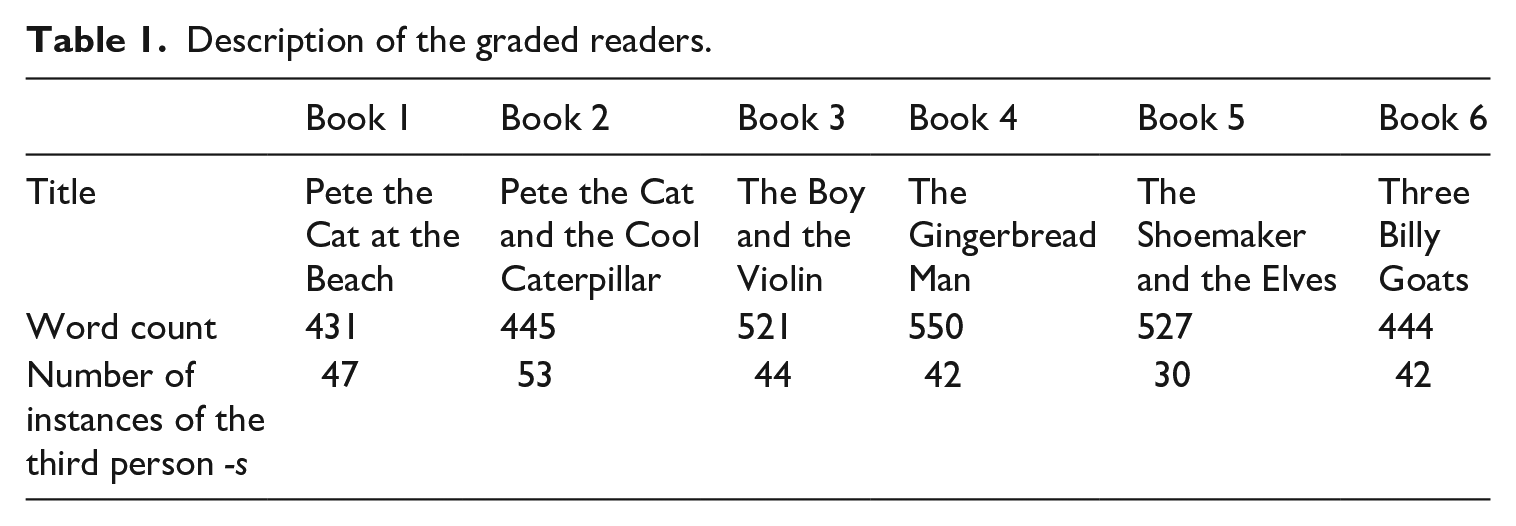
We used six graded readers as reading materials for the study (see Table 1). They were designed for beginner-level young learners of English as a foreign language (EFL) (band A1 according to the Common European Framework for Reference), so they were considered appropriate for our participants. Our selection was based on whether the books provided ample exposure to the target construction. The school library had a small selection of English children’s books and graded readers. The teachers confirmed, however, that the participants had not been exposed to graded readers in the past as part of their English lessons.
Description of the graded readers.
5 Treatment
In preparation for each treatment session, we extracted eight pictures from the book that students would read that day and divided these into two sets of four pictures (sets A and B) (see Appendix 1). As part of the pre-reading activity, half of the students received set A and the other half set B, and their task was to sequence the pictures, individually, in the order they thought the story would happen. Then, the first author, a former primary school teacher, read the book to the students, who either listened quietly or read along. Afterwards, the students were told to read the story again on their own. While reading, they were also asked to check whether they had guessed the order of the four pictures correctly. Immediately after reading, the students completed a true or false reading comprehension worksheet (see Appendix 2). We included this to be able to assess whether the post-task experimental manipulations would affect text comprehension in subsequent treatment sessions.
Next, the participants engaged, still individually, in the first part of a post-reading task. Each student received a worksheet, which contained eight sentences. These sentences were borrowed either straight from the book or modified so that they would have a simple subject-verb-object structure with no intervening clauses or phrases. In addition, we only used one-syllable verbs, and the subjects were always located in the same position. Using the set of four pictures from the pre-reading activity, the participants were asked to find the sentence that best described each picture, and then write it under the picture. In the +TE condition, the sentences in the worksheet had the verb printed in bold and the morpheme -s underlined. Under the –TE condition, the list of sentences did not include enhancement (see Appendix 3).
Once the students had finished writing, they moved onto the second part of the post-reading task, which involved pair work. Students were paired so that one student had previously worked with set A of the pictures and the other set B. They were asked to put all eight pictures in the correct order together. Then, their task was to write an ending for the story with their partner, with or without the support of a picture from the story (the focus of another study). The students were told that each person had to contribute at least one sentence to the end of the story. For both groups, the final outcome was a miniature book, which contained eight ordered pictures with descriptions and an extra page with the end of the story.
This sequence of activities meets the criteria for tasks as defined by Ellis and Shintani (2014, p. 135). For most of the activity, participants’ focus likely remained on meaning; there was an information gap as participants had different parts of the story to begin with; learners used their own linguistic repertoire to carry out the activity; and the sequence resulted in a miniature book, that is, a clear outcome besides the use of language.
6 Post-study questionnaire
After the study was over, we asked participants to answer three Likert scale items investigating their perceptions about the post-reading tasks. Of these, two items are relevant to the present study. These items asked whether the students thought that the post-reading tasks were (1) interesting and (2) useful for developing their English. The Likert scales included three options: Yes, Neutral, and No. When analysing the items, 2, 1, and 0 points were awarded to Yes, Neutral, and No responses respectively. The questionnaire was administered in Korean.
7 Assessments
a TOEFL primary test
We used the reading section of the TOEFL Primary Test Step 2 to determine participants’ reading proficiency. The test required students to read a paragraph or a short passage, and then answer three to four comprehension questions based on what they had read. Altogether, the test consisted of 37 multiple-choice questions. The time limit was 30 minutes. Following the TOEFL Primary scoring guidelines, we scored the learners’ responses dichotomously, giving one point for each correct answer. The internal consistency reliability of the test was found to be high (α = .90).
b Reading comprehension questions
To examine the participants’ understanding of the texts, the first author designed six true or false reading comprehension questions for each book (see Appendix 2). These questions were administered immediately after students had finished reading the text on their own. The participants were given five minutes to complete the questions, and no feedback was given on their responses. One point was given for each correct answer resulting in a maximum score of six. The internal consistency reliability for all comprehension questions combined (n = 36) was very good (α = .82).
c Grammaticality judgement test
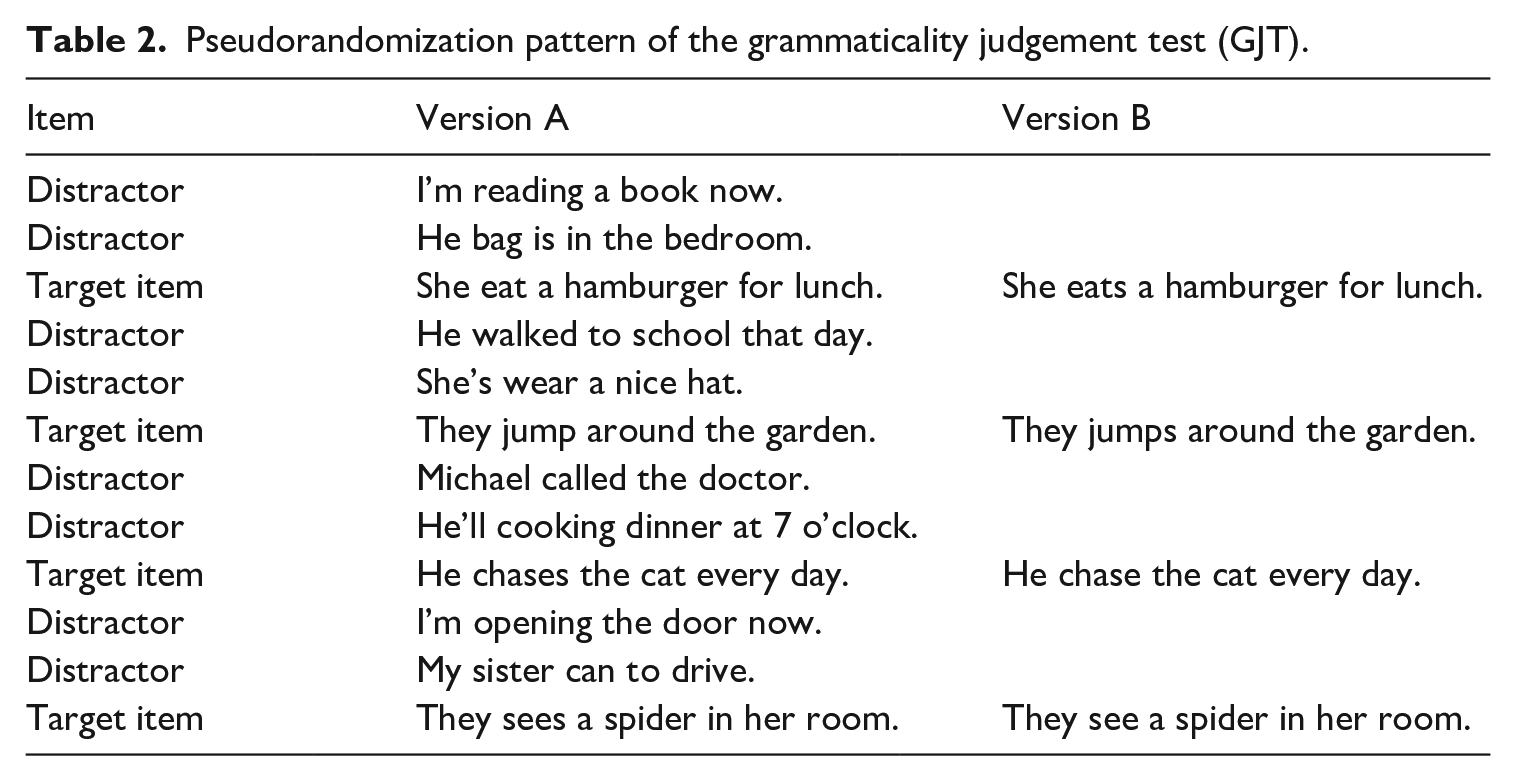
As a pre- and posttest, we administered an untimed GJT to measure potential changes in the participants’ knowledge of the third person -s as a result of the treatment. We developed the GJT following guidelines from Keating and Jegerski (2015). The test consisted of 48 items in total, with 16 target items and 32 distractors. Among the 16 target items, eight were grammatical and eight were ungrammatical. Among both grammatical and ungrammatical items, four items began with a plural subject and four with a singular subject. For the ungrammatical items, we either incorrectly omitted the morpheme -s or incorrectly added it to the base form of the verb, thus violating subject-verb agreement. To prevent participants from making guesses, we employed a 3-point scale with the options of correct, incorrect, and maybe.
We pseudorandomized the target items so that two verbs with the morpheme -s did not appear immediately after one another. In addition, we only used one-syllable verbs and personal pronouns as subjects, which were always located in the same position. We kept the length of the target sentences similar, ranging from six to seven syllables. To avoid item effects, we designed two versions for each item, which differed as to whether the item was grammatical or ungrammatical, resulting in versions A and B of the test (see Table 2). The distractors also had an equal number of grammatical and ungrammatical items. The length of the distractors was the same as that of the target items. They included the present progressive, past tense, and possessive as target constructions. Test versions A and B were counterbalanced across the groups and testing sessions. Before administering the GJT, participants completed a set of practice items. We provided all instructions for the test in Korean.
Pseudorandomization pattern of the grammaticality judgement test (GJT).
We awarded one point for each correct response and 0 points for maybe and incorrect responses. Hence, the maximum score was 16. We found the reliability of each version of the GJT acceptable (set A: α = .70, set B: α = .66).
8 Data collection procedure
Once the students and parents’ informed consent had been obtained, the first author collected the data over five weeks (see Figure 1). The study took place twice a week on Wednesdays and Thursdays during students’ regular English classes. On day one, students completed the TOEFL Primary Test. The participants were given 30 minutes to do the test. On day two, the GJT pretest was administered, which lasted 30 minutes. From day three to eight, the students took part in the treatment sessions, with the groups engaging in different types of post-reading tasks. The duration of the pre- and while-reading stage was approximately 20 minutes (individual work), whereas the post-reading task took roughly 20 minutes (pair work). On day nine, the participants completed the GJT posttest. On day ten, they answered the post-study questionnaire.
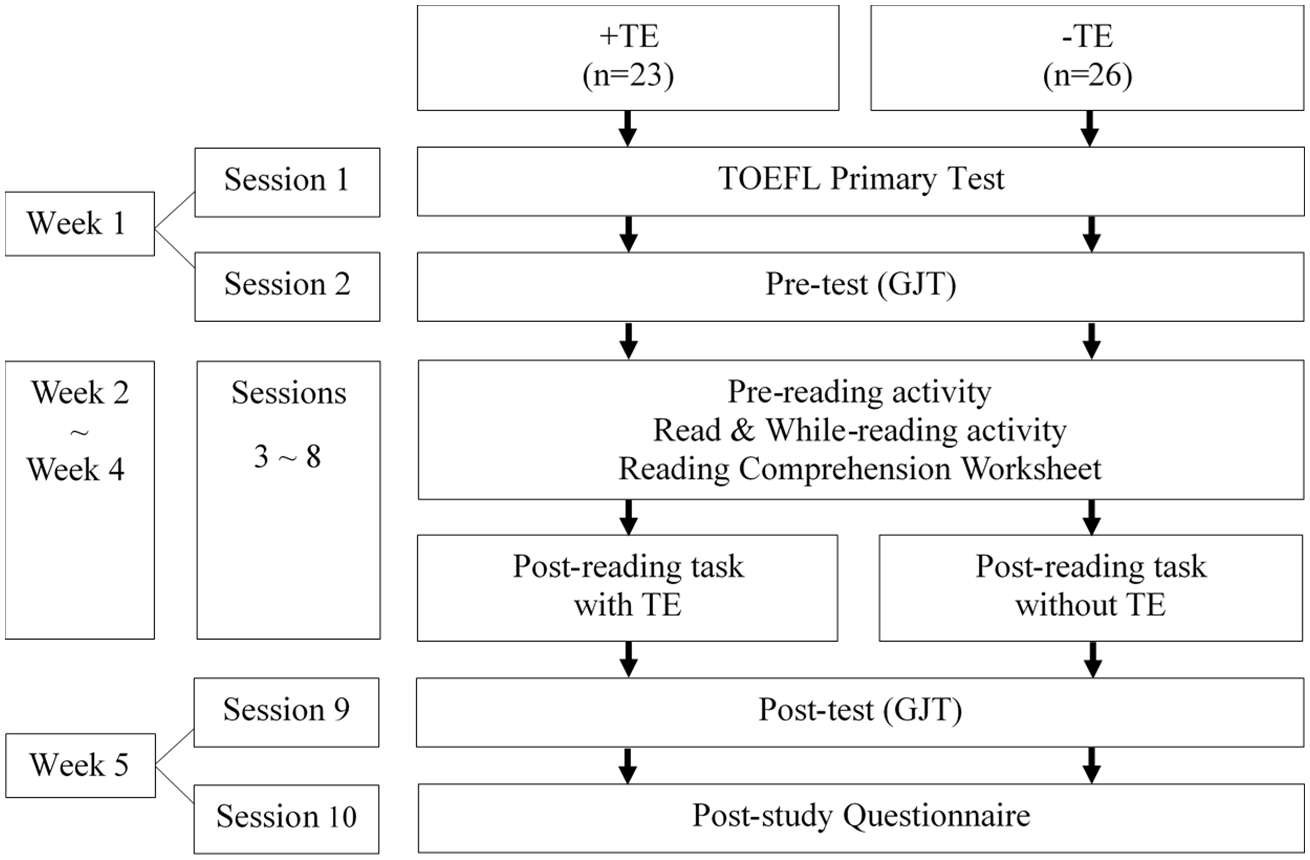
The experimental design.
9 Statistical analyses
As a preliminary step, we conducted independent samples t-tests to compare the participants’ performance under the +TE and −TE conditions on the reading component of the TOEFL Primary Test and the GJT pretest. To assess participants’ performance on the reading comprehension scores across the two conditions, we ran a Mann-Whitney test as the data did not meet the normality assumption. To address our research question, we carried out a mixed-model ANOVA analysis. An alpha level of .05 was set as the criterion for significance. To measure effect sizes, Cohen’s d values were computed for the independent-samples t-tests, r values for the Mann-Whitney test, and η2 values for the ANOVA. Following Plonsky and Oswald (2014), Cohen’s d values above .40, .70, and 1.00 and r values of .25, .40, and .60 were considered as small, medium, and large, respectively. We computed and interpreted η2 values following the guidelines outlined in Norouzian and Plonsky (2018). We ran standard diagnostic procedures to check whether the data met the assumptions for the analyses.
V Results
1 Preliminary analyses
a TOEFL primary test
The +TE and −TE groups achieved comparable scores (+TE: M = 17.22, SD = 7.90, 95% CI = [13.80, 20.63]; −TE: M = 18.15, SD = 7.74, 95% CI = [15.03, 21.28]) on the reading section of the TOEFL Primary Step 2. An independent-samples t-test confirmed that there was no significant difference between the two groups in terms of reading proficiency, t (47) = -.42, p = .68, d = .12.
b Reading comprehension scores
The descriptive statistics for the comprehension data appear in Table 3. As the overall comprehension scores indicate, participants displayed a very good understanding of the graded readers regardless of whether they received or did not receive textual enhancement in the post-reading tasks. A Mann-Whitney U test confirmed that there was indeed no significant difference between the +TE and −TE groups in terms of reading comprehension throughout the experiment, U = 205.00, z = -1.90, p = .06, r = .27. The effect size was in the small range. This means that whether learners were exposed to textual enhancement in the post-reading task had no significant impact on their overall reading comprehension scores.
Descriptive statistics for reading comprehension scores by condition.
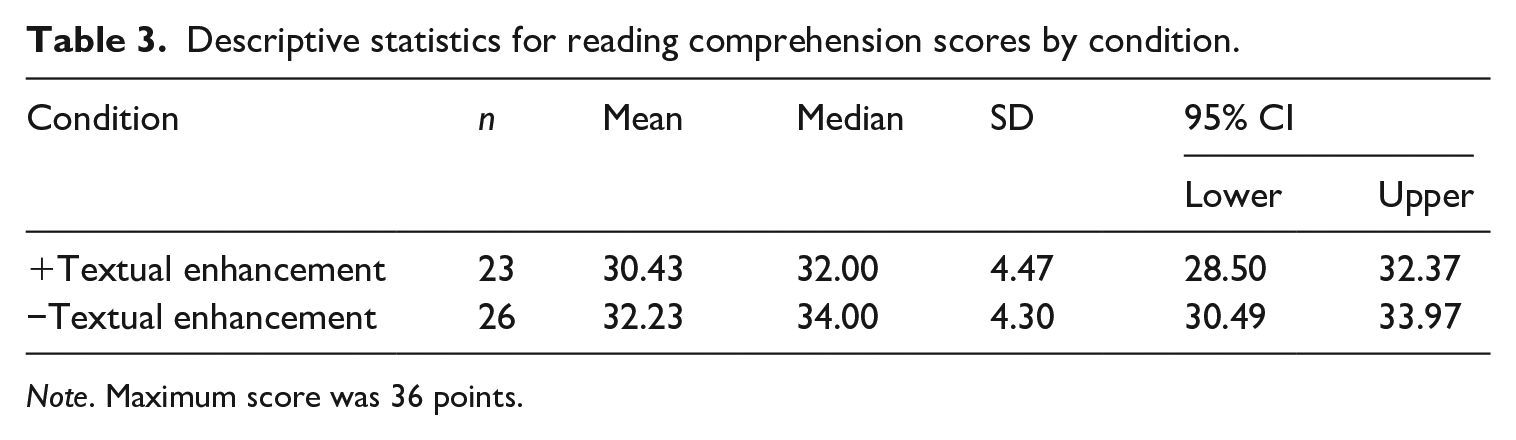
Note. Maximum score was 36 points.
c Grammaticality judgment pretest scores
Table 5 below gives the descriptive statistics for the GJT scores. The two groups appeared to have comparable scores on the GJT pretest. As for the reading comprehension scores, an independent samples t-test found no significant difference between the −TE and +TE groups on the grammaticality judgment pretest, t (47) = -1.34, p = .19, d = .38. That is, participants had comparable amounts of prior knowledge of the third person -s morpheme at the outset of the study as measured by the grammaticality judgement test.
d Post-study questionnaire
Participants’ responses to the post-study questionnaire items are summarized in Table 4. The two groups gave similar ratings as to whether they found the post-reading tasks interesting or useful. According to Mann-Whitney U tests, there was indeed no significant difference in the ratings of the students under the +TE and −TE conditions for either questionnaire item, Interest: U = 273.00, z = -.66, p = .51, r = .09, Usefulness: U = 289.00, z = -.237, p = .81, r = .03.
Descriptive statistics for post-study questionnaire responses.
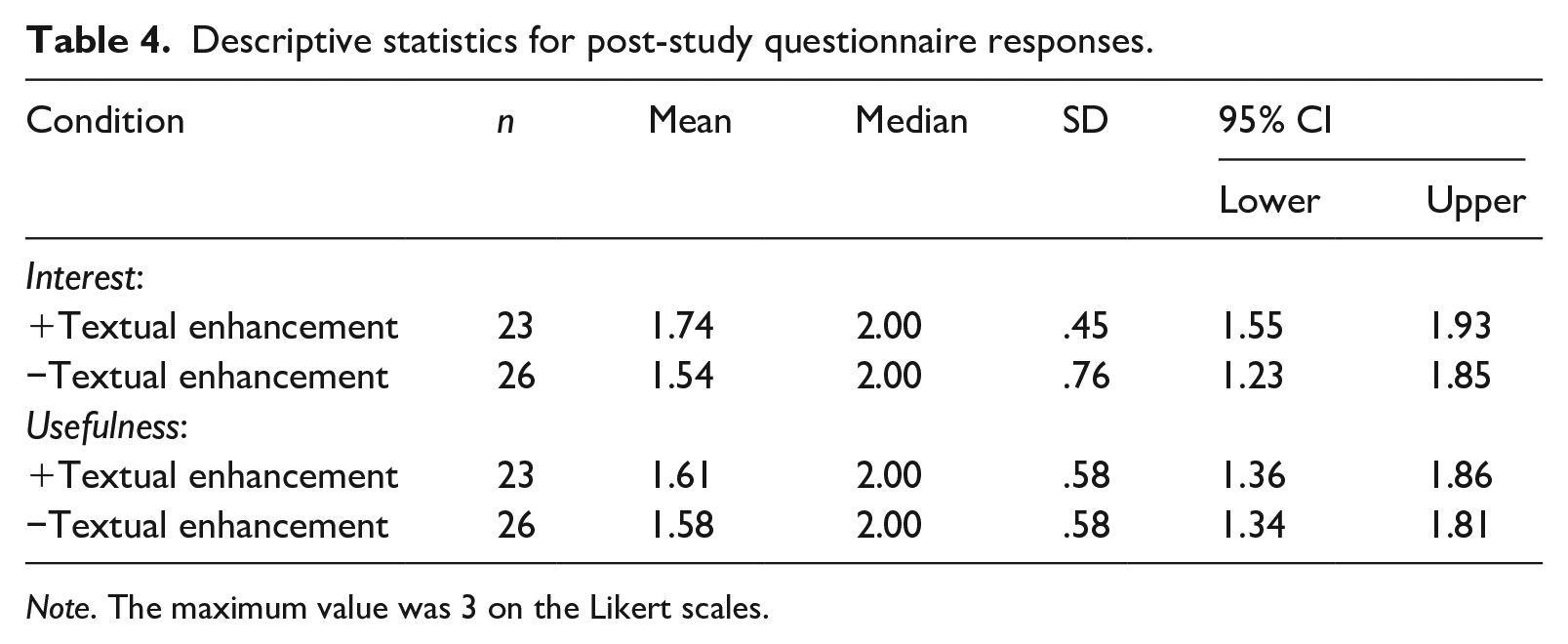
Note. The maximum value was 3 on the Likert scales.
2 Main analysis
As shown in Table 5 and Figure 2, the textual enhancement group achieved greater pretest-posttest gains on the GJT than the group who received no textual enhancement during the post-task stage. To test the significance of this difference and thereby address our research question, we conducted a mixed-model ANOVA analysis. Time served as a within-participant variable, and group was the between-participants factor. As Table 6 demonstrates, the analysis yielded a significant interaction between time and condition with a small effect size, accounting for two percent of the variation in scores (η2 = .02). This means that textual enhancement had a positive, but small impact on participant’s pretest-posttest gains, with the group exposed to textual enhancement showing somewhat greater development from the pretest to the posttest than the group who received no textual enhancement.
Descriptive statistics for grammaticality judgment scores.
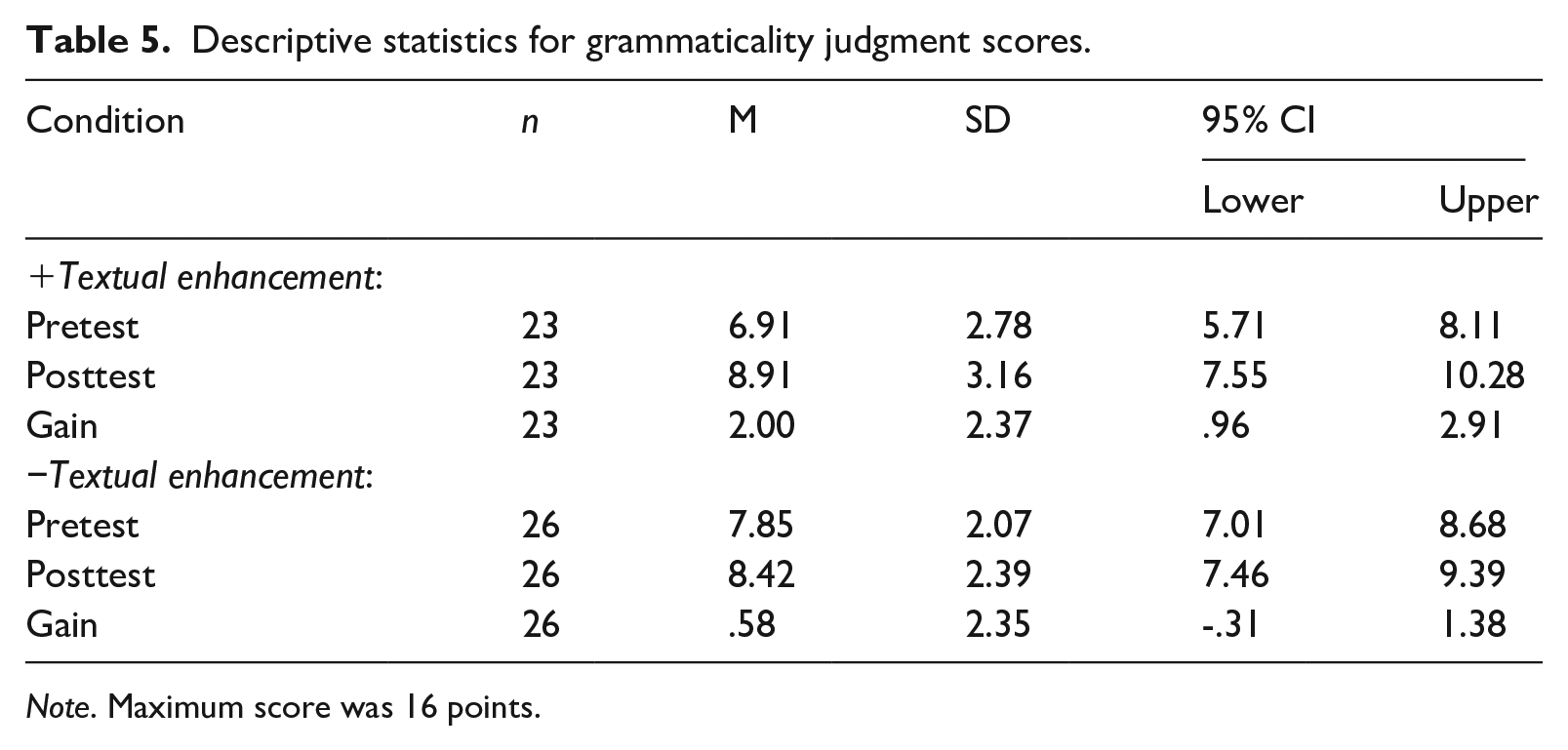
Note. Maximum score was 16 points.
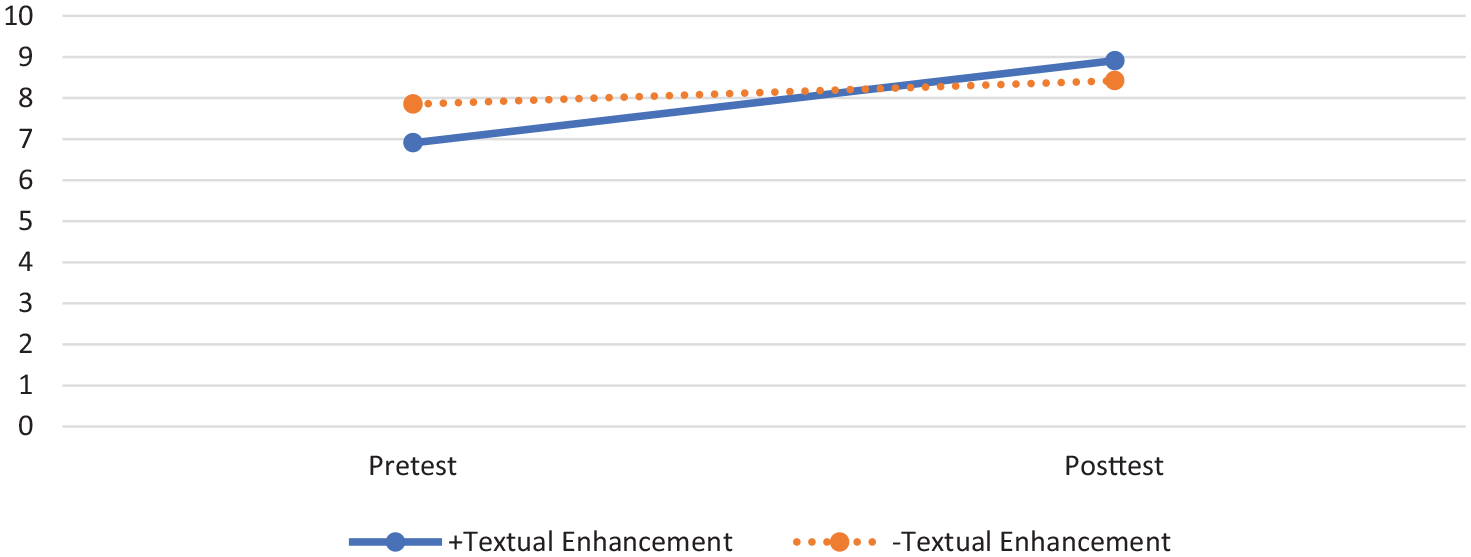
Pretest and posttest GJT scores for the +TE and −TE groups.
Results for mixed-model ANOVA comparing pretest-posttest gains by condition.

VI Discussion
In this study we examined the extent to which textual enhancement incorporated into post-reading tasks can improve child foreign language learners’ knowledge of the third person -s morpheme, as measured by a GJT. The results revealed that participants who were exposed to textual enhancement demonstrated significantly greater pretest-posttest gains with a small effect size, as compared to those who engaged in post-reading tasks without textual enhancement. Although this result is well aligned with the findings of Lee and Huang’s (2008) meta-analysis, it runs counter to a large number of previous studies which yielded null developmental effects for textual enhancement (e.g. Leow, 1997; Winke, 2013). As mentioned in the literature review, a variety of factors might influence the effectiveness of textual enhancement. Now we turn to a consideration of factors that might have contributed to the positive effects found here.
A key feature of the present study was the use of a multiple-exposure design. The participants in this study engaged in six treatment sessions over a three-week period. Despite calls for more multiple-exposure research investigating textual enhancement (e.g. Han et al., 2008), studies with several treatments remain scarce, with most existing research involving only a single treatment session with less than an hour of total exposure to the target construction. However, as discussed earlier, in case textual enhancement succeeds in drawing learners’ external attention to the target construction and thereby engaging their internal attention (Chun et al., 2011), the next step for learners, to achieve long-term gains, is to retrieve the resulting memory trace repeatedly. Such repeated exposure has been argued to be particularly important for implicit focus-on-form interventions such as textual enhancement. Although the effects of implicit techniques tend to be more durable, they typically take longer to generate gains (e.g. Long, 2015; Mackey & Goo, 2007). In light of this, it is likely that, in the present study, the longer treatment involving several sessions increased the likelihood that participants would develop their knowledge of the third person -s.
Another factor that might have facilitated the positive impact for textual enhancement in the current research is that textual enhancement was integrated into the post-task instead of the during-task stage of the reading lessons. Unlike here, the bulk of previous research included textual enhancement in the during-reading stage of the experiment. As highlighted by Han et al. (2008), this set-up required learners to simultaneously process for meaning and form, which probably led to information overload on the part of participants. For L2 learners, neither processing for meaning nor form tend to be automatized, thus trade-off effects are likely to occur when learners need to engage in both at the same time (Skehan, 1996, 2009; VanPatten, 1996). In the present study, given that textual enhancement was incorporated into the post-task stage, learners could probably allocate their full attention to meaning in the during-task stage. Thus, by the time of the post-task stage, they might have had enough attentional resources left to pay attention to the enhanced grammatical construction. From a task-based perspective, this design also had the advantage of making it less likely that learners’ primary focus gets diverted from meaning in the during-task stage (R. Ellis, 2003).
A further reason for the success of textual enhancement in this study might have been that the participants were child second language learners. It has been suggested that children are more adept at learning languages implicitly than adults, who show a gradual decline in their ability to engage in implicit learning processes, relying more and more on explicit mechanisms to learn second languages (e.g. DeKeyser, 2000). Thus, once textual enhancement had caught children’s attention in the present study, data-driven implicit learning processes may have more effectively operated on the memory traces that had been created than in the case of adult learners (N. Ellis, 2005). This difference might have had an especially pronounced influence in the current study, as participants did not only encounter enhanced versions of the target form in the post-task stage but were also exposed to non-enhanced exemplars in the during-task stage while reading the books. In other words, participants had opportunities to engage in implicit tallying of the construction not only in the post-task but also in the during-task stage.
This potential explanation relates to an additional factor that might have assisted in making textual enhancement work in the present research. Some researchers (Han et al., 2008; Leow, 2009; Leow & Martin, 2017) argued that textual enhancement is more likely to be effective when it is combined with another pedagogical technique, since such conflated or compound enhancement might help increase the salience of the target form. For the purposes of the current experiment, the treatment texts were selected in such a way that they contained a considerable number of the targeted feature, in other words, the texts were naturally flooded with the third person -s morpheme. This, together with textual enhancement, might have helped attract learners’ attention to the target construction.
Finally, prior knowledge is a variable worth highlighting. As reflected in participants’ pretest scores on the GJTs, the learners in the present experiment had some previous knowledge of the third person -s morpheme. Several researchers (e.g. Park, 2004; Winke, 2013) observed that textual enhancement is likely to be more beneficial when learners possess some existing knowledge of the enhanced construction. Given its subtle nature, textual enhancement is probably not explicit enough to trigger internal attention in the absence of some predisposition on the part of learners to process the targeted construction, even though it might capture learners’ external or perceptual attention due to visual cues (Chun et al., 2011; Winke, 2013).
A question that remains is why textual enhancement still had a relatively small impact on children’s gains despite all these facilitative factors working together. A possible explanation lies in the nature of the target construction. The third person -s is a construction notoriously difficult for L2 learners to acquire (N. Ellis, 2006). As discussed earlier, it is a non-salient feature with low communicative and physical salience, hence prone to blocking (N. Ellis, 2006) and fossilization (Han, 2013). Also, this is a construction that does not exist in the participants’ first language. Taking all these factors together, it would, in fact, have been surprising if learners had shown larger gains after a three-week treatment period. Linguistic constructions with such characteristics are expected to require even more prolonged treatment to yield substantial benefits. Hence, it is promising that, contrary to previous research findings (e.g. Leow et al., 2003; Shook, 1999; Wong, 2003), repeated exposure to textually enhanced forms was able to promote development, however small, in the acquisition of a non-salient feature in the present research.
VII Limitations and future directions
There are a number of limitations to this research, which need to be considered when interpreting its findings. First, the sample size was relatively small. It would be worthwhile to replicate the study with a larger group of students to increase the power of the design. Second, the first author of the study served as both the teacher and researcher in the experiment, which might have inadvertently introduced some bias. Ideally, in future studies these two roles would be separated. The absence of a delayed posttest is another weakness of this research. If a delayed posttest had been administered, we could have gained insights into whether the positive effects observed here could be retained in the longer term. To address this limitation, future studies should incorporate both immediate and delayed posttests. Further research would also benefit from employing an even longer treatment with more sessions to establish whether textual enhancement could yield more substantial benefits when applied for a more extended period across more treatment sessions than here. Finally, it would also be interesting to explore whether the effects found here would transfer to other linguistic constructions and different types of learner populations and contexts.
VIII Conclusions and implications
Our aim in the current study was to examine the extent to which textual enhancement implemented in the post-task stage of task-based reading lessons can facilitate development in L2 grammatical knowledge by child language learners. We found small but positive effects for textual enhancement in promoting knowledge of the third person singular -s morpheme, the target construction. Based on previous research, we argued that the success of textual enhancement could be attributed to the combination of several factors: the multiple-exposure nature of the design, the incorporation of textual enhancement into the post-task rather than the during-task stage of the lesson, the participants being child language learners, the use of textual enhancement together with input flood, and prior knowledge on the part of participants. We also proposed that the lack of more substantial gains may be accounted for by the non-salient nature of the target construction.
In sum, the results of the study suggest that textual enhancement, when applied under certain conditions, can be an effective focus-on-form intervention. We also found that integrating textual enhancement into the post-task phase can be an effective means of drawing learners’ attention to form, thereby ensuring that learners’ attention to meaning is not compromised in the during-task phase. More broadly speaking, while several concerns over implementing TBLT in Asian countries have been raised in the literature (e.g. Butler, 2011; see, however, Shintani, 2016), the present study demonstrates that TBLT can be successfully implemented with beginner level child EFL learners by using input-based, reading tasks.
