



Abstract
Willingness to communicate (WTC) reflects an intersection between instructed second language acquisition and learner psychology. WTC results from the coordinated interaction among complex processes that prepare second language (L2) learners to choose to use their L2 for authentic communication. Prior research has revealed considerable complexity in the influences on dynamic changes in WTC from moment-to-moment. The heuristic ‘pyramid model’ of WTC (MacIntyre et al., 1998) proposes interactions among approximately 30 different variables that may influence WTC. The present study uses the pyramid model to interpret data from three focal participants, all English as a second language (ESL) learners and international students in Canada, with varying degrees of experience in an English-speaking context. Using the idiodynamic method, all participants were recorded while describing a self-selected, personally meaningful photo. Second, participants rated their WTC in English using software that played a recording of their speech and collected continuous WTC ratings. Finally, participants were interviewed about their WTC ratings. Triangulating the data revealed how processes on multiple timescales interact during L2 communication about the photos. WTC changes as speakers’ motivations and emotions are influenced by the deep, personal relevance of the topics under discussion. Pedagogical implications for the results of this study and the use of the idiodynamic method in L2 classrooms are discussed.
Keywords
I Introduction
Second language (L2) communication, and specifically the process of forming the intention or willingness to communicate (WTC, MacIntyre et al., 1998), represents an ideal opportunity to study the intersection of learner psychology (LP) and the results of instructed second language acquisition (ISLA) (Başöz & Erten, 2018; Mystkowska-Wiertelak & Pawlak, 2017; Sato & Csizér, 2021). Languages are learned by people whose motivations, emotions, and relationships are integrated into every step of the learning and communicating process. The purpose of the present study is to offer an intensive examination of the dynamics taking place within one specific L2 activity, describing a meaningful photo. The study addresses two gaps in the literature. First, Freiermuth and Ito (2020) argue strongly for greater consideration of how learners’ specific ‘. . . past experiences – L2 and otherwise – may influence their present behaviors and attitudes’ (p. 71). Second, there has been little research showing how various interacting factors relevant to WTC integrate in real time to create a meaningful L2 communication experience (MacIntyre, 2020). We will draw together research traditions from LP and ISLA to highlight the internal psychological processes that create and change communicative behavioral intentions.
II Literature review
Conceptualized as a behavioral intention, WTC reflects the interaction among various internal psychological processes during authentic communication events, as language learners become language speakers (MacIntyre et al., 1998). A common observation is that the same instruction can sometimes produce very different outcomes in a group of learners. Larsen-Freeman (2018, pp. 59–60) addressed the unification of research into second language acquisition (SLA) processes and explanations for different levels of success among individual learners: I can foresee a time when the bifurcation between questions concerning the SLA process and those of differential success ends. Concomitant with this move, I predict that more research will examine the individual learner operating in a spatial-temporal context. Thus, rather than concentrating on one of the two areas, process or learners, researchers will undertake the study of the relationship between the process and the individual learner . . ., recognizing the unique developmental trajectory of each individual.
Consistent with Larsen-Freeman’s prediction for research, the present study adopts an individual-level approach to examine the multiple interacting influences on WTC with specific individuals asked to perform a meaningful communicative task.
WTC can be approached from multiple interacting angles; higher WTC can be seen as a result of successful language instruction, an integral part of the learning process and an emergent state reflecting learner psychology. The research literature shows that WTC can be increased among learners by adopting broad patterns of communicative language instruction, such as content-based or immersion approaches (MacIntyre et al., 2001), which tend to increase WTC and perceived communication competence among learners. Evidence suggests that study abroad experiences also increase participants’ WTC, observed in studies among Korean and Japanese learners travelling to English-speaking countries (Kang, 2005; Yashima et al., 2004), where higher levels of WTC before going abroad were associated with more favorable language and interpersonal experiences for learners. Within the confines of the typical classroom, a series of studies (Cao, 2011; Cao & Philip, 2006; Dewaele & Dewaele, 2018; Peng, 2012, 2019; Peng & Woodrow, 2010) suggests that the interplay among aspects of the learner, teacher, classroom instruction (including topics and tasks, interactional patterns among the pupils, support from the teacher), and other factors contribute to WTC. The arousal of positive and negative emotions, such as enjoyment and/or anxiety, has been shown to be strongly related to WTC (Dewaele, 2019; Dewaele & Pavelescu, 2021; Khajavy et al., 2018). Khajavy et al. (2016) found classroom factors such as teacher support, student cohesiveness, and task orientation were the strongest influences on learner WTC in the Iranian ESL (English as a second language) classrooms for included in their study.
Although specific language instruction techniques and classroom activities seem to affect WTC, recent research suggests that outcomes vary across participants, and that learner psychology plays a key role in shaping the trajectory of the effects of instruction for an individual learner. Adopting an individual-level, dynamic perspective to examine changes in WTC over the course of classroom activities, Zhong (2013) found that WTC was affected by beliefs about the value of collaborative learning, leading some to be willing to talk in group contexts when others do not. Yashima et al. (2016) reported specific ways in which WTC changed within a classroom over time, and how reactions of specific individuals changed either in similar or opposing directions to the general patterns. For example, a long period of silence reduced WTC for most students, but increased WTC for a student who saw it as an opportunity to break the ice and get the class back on track. Mystkowska-Wiertelak (2016) also reported a complex set of findings at the individual learner level, where both general patterns such as WTC increasing toward the middle of the lesson but decreasing with boredom and tiredness toward the end of the lesson, were reported. However, along with general trends in WTC, there were idiosyncratic patterns observed, making it ‘. . . difficult, if not impossible, to establish the impact of various factor parameters on the shifts in WTC levels’ (p. 673). Dewaele and Pavelescu (2021) examined the intricate connections between WTC and two seemingly incompatible emotions, anxiety and enjoyment, for two teenaged Romanian learners. The data showed that a strong influence from emotions, not only the feelings experienced at present but emotional experience from the past merged with anticipated future reactions, for both learners. The inescapable conclusion from these individual-level studies is that we must take into account how ISLA interacts with LP as the learning/communication situation unfolds. We turn now to a model of WTC that helps to account for both common and unique individual patterns and changes over time, both across learners and within individuals.
1 The pyramid model of WTC
MacIntyre et al. (1998) developed a heuristic model that captures a wide range of social psychological influences, all of which potentially influence the decision to communicate or not (see Figure 1). The model emphasizes that the moment of decision is constructed continuously, on a per-second basis, as time goes by; it conveys a sense of arriving at a point in time where a learner might choose to communication or not. Immediately afterward each moment, another moment arrives, and then another as communication unfolds. This dynamic and fluid concept of WTC is different from the original research that approached it as a trait-like concept developed with reference to native-language communication (MacIntyre & Charos, 1996; McCroskey & Richmond, 1991). The six layers of the model are organized into three lower layers that reflect distal, enduring, and widely applicable influences on L2 communication and three top layers that reflect immediate, transient, situation-specific influences on WTC at a given moment.
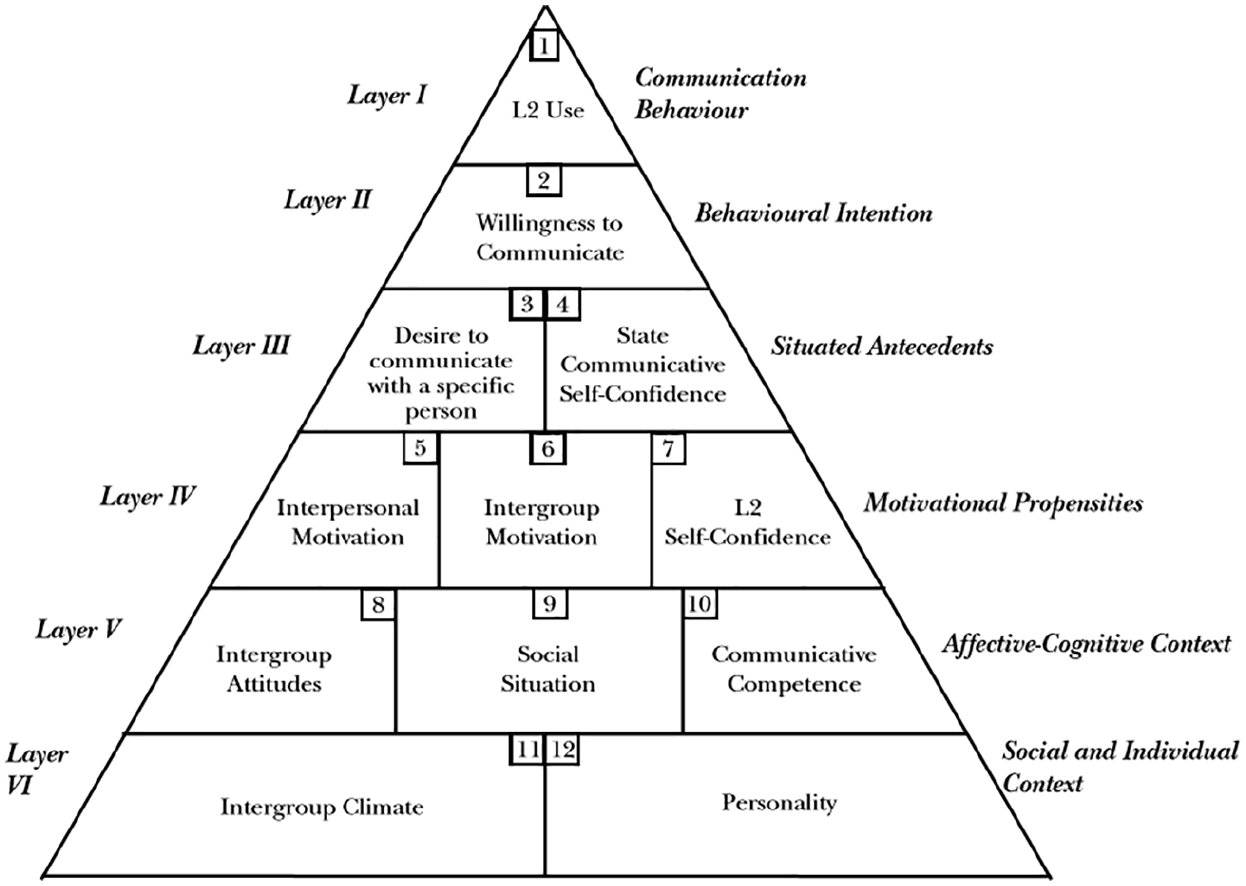
The pyramid model of WTC.
The base of the pyramid, Layer 6, reflects the social and individual context, representing the broadest influences on communication including intergroup climate and learner personality. Both learner personality traits and the relationships between language groups usually change very slowly, but are ubiquitous considerations across communication contexts, often operating at the background (MacIntyre, 2020). A series of studies on international posture shows that positive attitudes toward English as a way to communicate with people from other countries are consistently associated with higher levels of WTC (Yashima, 2002, 2009; Yashima et al. 2004). Personality, in particular extraversion and openness to new experience, have also been associated with WTC across several survey-based studies (Fatima et al., 2020; Piechurska-Kuciel, 2018; Oz, 2014).
Moving up the pyramid, variables at Layers 4 and 5 capture the bulk of WTC research. Research shows a long list of intra-personal, inter-personal, social and contextual factors associated with WTC. A recent meta-analysis identified the three LP variables that have been studied most often as predictors of WTC – anxiety, perceived language competence and motivation – identifying each as having a consistent, significant relationship with WTC (Shirvan et al., 2019). The motivation studies show that having positive attitudes toward the language and the people who speak it support both a motivation to learn and WTC (Ghonsooly et al., 2012). Studies show that WTC outside the classroom can differ from WTC inside the classroom; sometimes the protected space of the classroom leads to higher WTC but other times harsh teaching practices can reduce learners’ WTC inside the classroom (Başöz & Erten, 2018; MacIntyre et al., 2001). Classroom context, especially supportive relationships and positive interpersonal interaction among teacher and peers, can enhance WTC (Cao, 2011; Sheybani, 2019).
The top three layers of the pyramid model differ from most LP models by emphasizing that WTC emerges from the continuous interaction among multi-layered enduring and situational influences that can change rapidly, even on a per-second basis. Most ISLA theories are not designed to directly examine moment-to-moment fluctuations in key processes, for example, as a conversation activity unfolds (MacIntyre, 2020). Layer 3 of the model includes specifically desire to communicate with a specific person and state communicative self-confidence as the situated antecedents of talking to someone in the L2. Layer 2 has only one component, willingness to communicate, defined as ‘readiness to enter into a discourse at a particular time with a specific person or persons, using a L2’ (MacIntyre et al., 1998, p. 547), which is a behavioral intention. WTC is the final psychological step, the culmination of forces moving toward or away from volitional language use (MacIntyre, 2007).
2 Signature dynamics underlying WTC
The pyramid model of WTC pre-dates the rise of complex dynamic systems theory (CDST: Larsen-Freeman & Cameron, 2008) by a decade, but the two are highly compatible (MacIntyre, 2020). The conceptual toolbox of CDST potentially has much to offer at the interface of LP and ISLA. To provide an interpretive lens with which to view WTC in action, we draw on Dörnyei’s (2014) concept of signature dynamics, which refers to the main underlying dynamic patterns that produce the typical system outcomes. Complex dynamic systems are open and multiply determined; they are affected by interacting processes internal and external of the system that operate on multiple timescales (Larsen-Freeman & Cameron, 2008; MacIntyre, 2020). By identifying the most relevant influences on WTC, its signature dynamics, we can gain a more sophisticated understanding of the state space of communication and patterns of change in WTC as the conversation unfolds. More specifically, conceptualizing signature dynamics help to account for how salient components in the pyramid model interact with each other to create fluctuations in WTC, including communication outcomes that are learning opportunities. Because communication processes are so fluid, highly adaptive, and change rapidly, the most relevant factors and the signature dynamics underlying WTC also can change rapidly.
CDST has not yet ‘. . . produced much evidence-based pedagogy [whereas] other theories address important elements that can be manipulated in the L2 classroom to facilitate L2 learning’ (Sato & Loewen, 2019, p. 2). Dörnyei (2014) suggested that a system can be considered complex or dynamic if ‘it has at least two or more elements that are interlinked with each other, but which also change independently over time’ (p. 81). The pyramid model of WTC identified over 30 interrelated variables on different timescales that can interact with each other. Larsen-Freeman (2007) emphasizes the integral connection between learning and communication, arguing that the processes of language learning and use are ‘inseparable’ (p. 783); the dynamics underlying WTC are the dynamics of language learning.
However, researchers inevitably face problems when conducting empirical research within a CDST framework because the behavior of a system is neither wholly random or predictable (Larsen-Freeman & Cameron, 2008). With respect to L2 WTC, not all variables addressed in the pyramid model are activated or salient at a given time. Figuring out which one(s) is/are relevant to the signature dynamics at a given moment depends on individual characteristics of the learner and the communication contexts.
3 The present study
In the present study, we used the idiodynamic method (MacIntyre, 2012) to collect continuous WTC data from participants as they talked about a meaningful photo in the L2. This method provides an intensive, mixed-methods examination of a recorded sample of meaningful speech in which the speaker systematically rates WTC during a communication event and then immediately afterward, in an interview, identifies the rationale for increases and decreases in WTC. Our goal was to investigate ways in which the interplay of situational and enduring factors boosts or reduces WTC within an individual over time, using the pyramid model of WTC as an interpretive frame. The specific research goals were to:
Describe the influences on WTC and show their connection to the pyramid model of WTC.
Examine the role of fluctuating emotions with WTC and meaningful L2 use.
Understand why the same L2 performance task is approached differently by different learners and describe how the reasons for communicating affect WTC.
III Method
1 Participants
There were three focal participants in the study, selected from a sample of ten international students who ranged in age from 21 to 36 (M = 27.5, SD = 4.67), all of whom were taking courses in English (their L2) at a university in Canada. Participants showed different levels of English proficiency and varying degrees of experience in an English-speaking context.
The focal participants in this article were chosen because they experienced different signature dynamics underlying WTC. Participant 10 (‘Nyiti’), a 36-year-old male Nigerian, was chosen for analysis because his explanation for changes in WTC draws heavily on themes related to intention and motivation (i.e. the left side of the pyramid model). In contrast, Participant 9 (‘Hien’) was chosen because her comments were closely tied to L2 confidence and communicative competence (i.e. the right side of the pyramid model). Finally, Participant 6 (‘Lin’) was chosen because her comments referred to both sides of the model and provide similarities and differences with Nyiti and Hien.
2 Materials and procedure
To recruit participants, individual sign-up sheets including a brief explanation of the nature of the study were distributed on campus. Students were informed of the concept of WTC and the purpose of the research project. WTC was referred to as ‘the idea of how willing you are to communicate in your second language (in our case, English) with a specific person in a particular situation.’
The day prior to testing, participants were emailed a set of instructions. Participants were asked to bring with them a photograph they found enjoyable or with personal meaning for the purposes of discussing it in English for a few minutes. Upon arrival at the lab, each participant was given a consent form, a demographic form, and a video release form. The full procedure of the study was explained. All participants were given thorough instruction of how to use the Idiodynamic software (MacIntyre & Legatto, 2011) and practiced rating using a sample video.
a Photo narrative task
The photo narrative task was used by Steger Barenz, and Shin (2014) to help participants explore meaning in their lives and facilitate self-understanding. Boudreau et al. (2018) adapted this task to an idiodynamic approach by asking for discussion of the photo in the L2. The task allows for free-flowing discussion potentially tapping into the complex underlying processes linking enduring and situational factors that influence WTC. Participants discussed the meaningfulness of the photo for three to five minutes in English. If needed, a research assistant (RA) would give the participant a prompt, for example, what were you feeling when you take the photo or why did you choose this picture? All of the conversations were video-recorded. Participants’ descriptions of their photos were transcribed.
b Making dynamic WTC ratings
Immediately upon the completion of the photo narrative task, the video recording was saved on a memory card and loaded into the Idiodynamic software to collect participants’ self-ratings of moment-to-moment changes in their levels of WTC. This software allowed participants to watch the recording of the conversation and simultaneously rate their WTC on a per second basis by clicking the up or down button on the computer keyboard. The scale used by this software ranges from -10 to +10. If WTC remained stable over a short period, participants could hold the button indicating that there was no change in the ratings. Each individual’s idiodynamic graph shows the fluctuations in WTC as it unfolds in real time. Immediately after the ratings were completed, the software produced an Excel spreadsheet and printed a graph showing fluctuations in the participant’s own dynamic self-rated WTC ratings. The three phases – describing the photo, rating the video, and post-task interview – happen consecutively. The whole procedure for a participant took less than one hour to complete.
c Post-task interview
The post-task interview was divided into two parts. Part 1 involved a semi-structured interview in which the participant and research assistant (RA) discussed WTC changes. First, the RA marked points of interest where the graph showed a noticeable change in dynamic WTC. Then, the video of the task was played back for a second time; the video was stopped by either the participant or the RA at points of interest to explain increases, decreases or prolonged periods of stability, depending on the shape of the WTC ratings graph.
Part 2 of the interview was unstructured, in which the participant was asked to share his/her story as a L2 learner. The data collected in Part 2 of the interview were related to participants’ language-learning backgrounds; participants were encouraged to share their daily experiences of using English. Part 2 focused on stable, enduring influences on L2 communication situations.
IV Results and discussion
1 ‘Nyiti’
a Description
Nyiti is a 36-year-old male from Nigeria. Shortly after getting married, he left his wife at home to pursue higher education in Canada. He presented a photo of his wife taken at the airport just before his plane took off. He expressed mixed emotions when describing the photo, ‘happy’ that he had a chance to improve his education and future employment prospects but ‘sad’ to leave his family behind while he did so.
Throughout the session Nyiti spoke fluently and showed high idiodynamic WTC ratings (M = 7.17; SD = 1.77), as seen in Figure 2. The most relevant factor driving fluctuations of his WTC ratings were emotions. Generally, WTC increased when he was discussing positive emotions and decreased when he was describing negative emotions. After starting with high WTC ratings, a sharp drop occurred at the 48 second mark (see Figure 2, Section 2). When asked to explain the rapid drop in WTC, Nyiti stated: Because I was beginning to talk about this sad part like . . . it was sad for me to leave her, but same time I was trying to improve myself, my education. But at the end of the day, (I) was sad to leave her, so my willingness to disclose, it was lower that point in time.
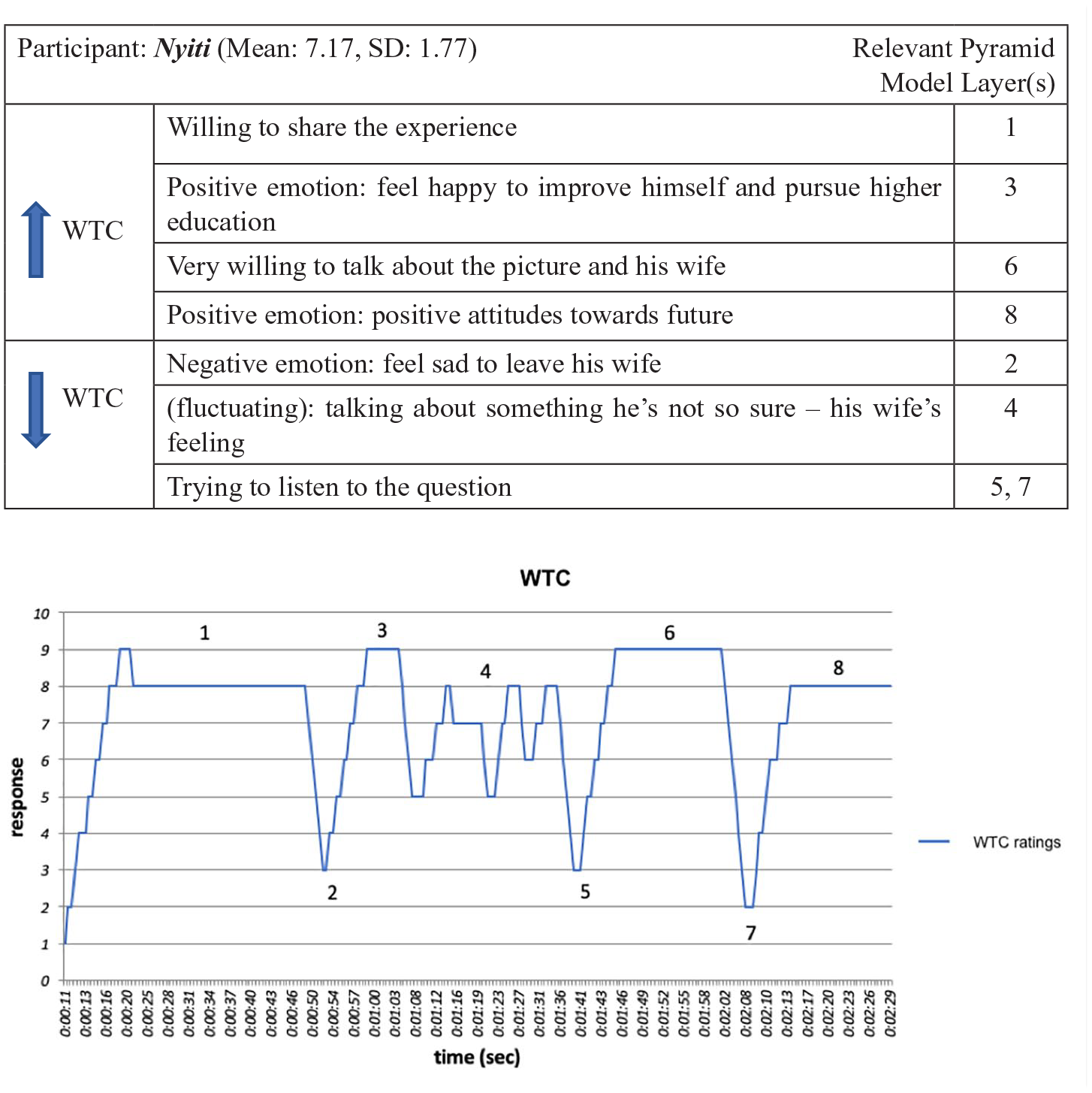
Nyiti’s WTC ratings and reasons for WTC changes.
The mixed emotions changed slightly to emphasize optimism and pride over sadness, which led to a quick recovery of WTC after 5 seconds of decline. In Figure 3, Section 3 there was a sharp spike in WTC ratings. He said: . . . as much as I was not happy to leave her, I was happy that I was going to improve myself for the sake of myself and her. So, that was why my willingness to discuss was improved, because I was happy to say that I’m trying to do something good for me.
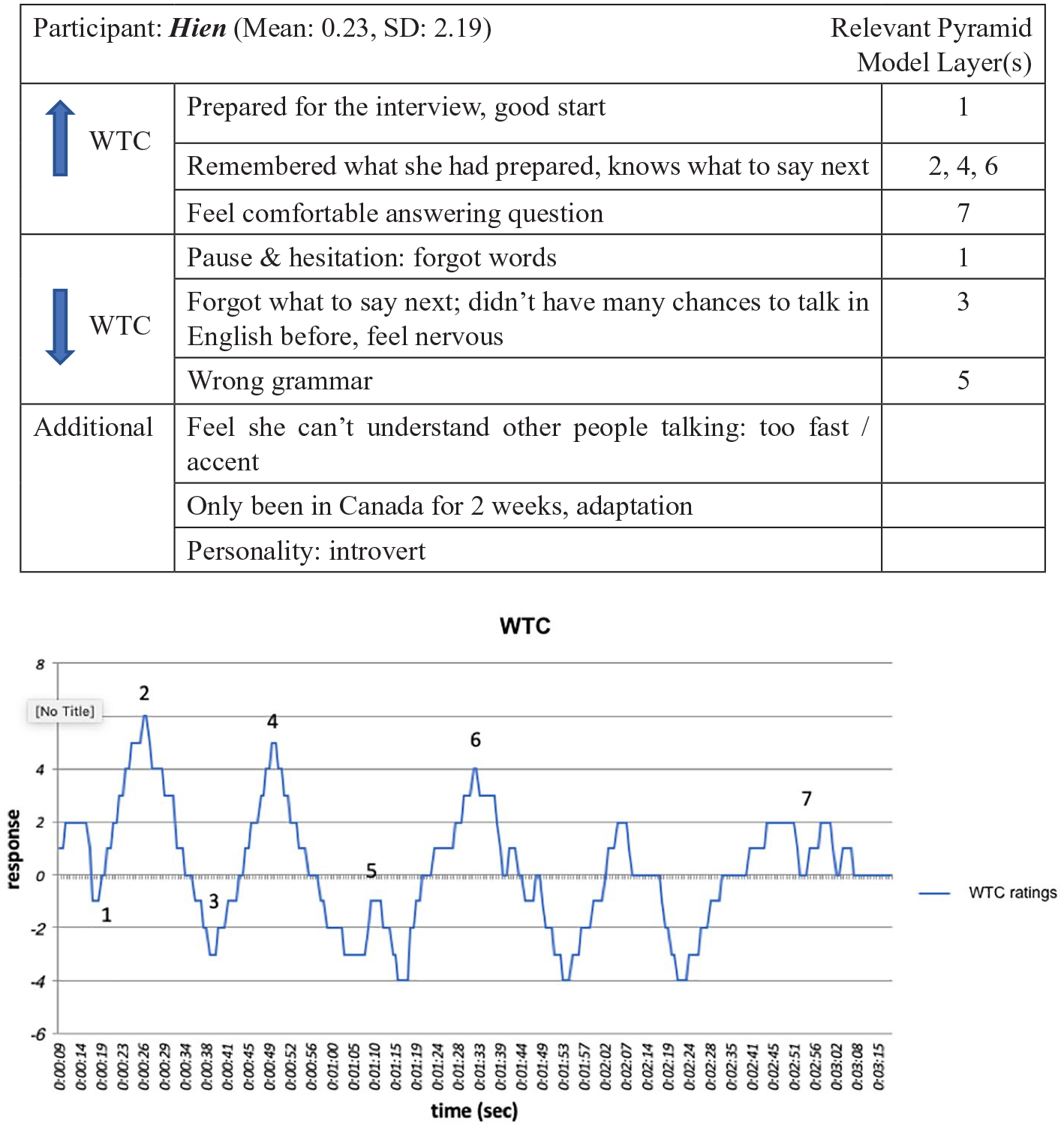
Hien’s WTC ratings and reasons for WTC changes.
In section 4 of Figure 2, Nyiti is discussing his wife’s reaction to his leaving home. His WTC fluctuated between ratings of 5 and 8 during this segment. In the interview, he said: I think that was the point where I was talking about her emotions . . . So that was why it was fluctuating at that point in time. Because I was not sure what she was actually feeling. Was she feeling like I’m feeling? . . . because I could not describe what she was feeling at that point in time.
At the end of Figure 2, Section 4 the RA is asking a question, WTC ratings decline. ‘So just one question for you, why do you think this picture is meaningful to you, like, why did you choose to share this picture with us today?’ The question itself takes 9 seconds to ask. As the RA says the first part of the question, Nyiti’s WTC drops precipitously but recovers as soon as the meaning of the question becomes clear. During that phase of the question, even as he is listening, he is preparing to respond and WTC builds rapidly, moving from a rating of 3 to 9 in just four seconds. His answer leads to 16 seconds of the highest WTC ratings he made during the study (Section 6). During this section, Nyiti explains: . . . while I have been here I miss her a lot, so this is one of the pictures I look at when I miss her so I am used to this picture very well and that’s why I can speak about this picture.
In Figure 2, Section 7, the previously high WTC ratings decline as the RA poses the final interview question, a pattern previously seen in Section 5. The final interview question was: ‘So this picture means a lot to you and every time you think about your wife you just . . .’ Nyiti interrupts the question to describe how he was feeling during the last few minutes before his flight took off. WTC remained high during this final section of the conversation (Section 8) as he went on to express his hope for the future. He said, ‘. . . because now I was feeling positive about leaving home for education, and I’m looking at the end goal when I finish and I go back to my wife. So, I’d be more willing to discuss that.’
b Analysis
There appear to be two signature dynamics underlying Nyiti’s WTC ratings. The main influences on WTC were interacting emotions: remembered emotions, those felt at present, and anticipated future emotions, similar to findings reported by Dewaele and Pavelescu (2021). The various positive and negative emotions emerged from the multiple meanings and beliefs about the photo, the specific memories it aroused, and the broader implications for Nyiti and his family’s future, a complex pattern of emotions also found in prior idiodynamic research (Boudreau et al., 2018) and retrodictive analysis (Dewaele & Pavelescu, 2021). Such results reinforce the need to consider emotion in language theory and practice (Prior, 2019).
The second, lesser signature dynamic was reacting to the conversational turns in which the RA posed the next question. Each RA question carries some uncertainty for Nyiti about what might be asked. However, when the meaning of the question becomes clear, state self-confidence quickly emerges and WTC increases rapidly. State self-confidence is built on lowering anxiety and increasing perceived competence, two strong predictors of WTC (Shirvan et al., 2019).
Nyiti’s motivational basis for communicating stemmed primarily from the social situation in which the conversation occurred. He expressed high levels of interpersonal motivation, positive attitudes, and a desire to communicate about his wife with the RA activating social-psychological influences from Layers 3 to 5 on the left side of the pyramid model (MacIntyre et al., 1998). In the post-narrative interview, when asked why his WTC rating was high in Section 1, Nyiti said ‘Because I was willing to share my experience about this picture, and I also wanted to talk about my wife.’ In Section 6, he went on to say: I wanted to really talk about, the picture, right? Because this is the picture I got when I miss my wife. So, when you asked me that question, I was willing to share it because of what I like about the picture.
Within the pyramid model, high state communicative self-confidence interacts with desire to communicate during the conversation. For Nyiti, the interpersonal motivation to talk about his wife and accompanying positive emotions both stated and those that can be inferred (e.g. pride, love) are strong enough to override the negative emotions (e.g. longing, sadness) aroused by talking about this photo (Boudreau et al., 2018; Dewaele & Pavelescu, 2021). This particular dynamic integration of intentions, motivation, and emotions is inherently unpredictable because the levels of those factors themselves fluctuate as communication unfolds (Larsen-Freeman, 2018; Mystkowska-Wiertelak, 2016). Individual-level analysis works especially well in this research context as WTC changes as the two persons continuously adapt to the ever-changing situation (MacIntyre, 2020).
2 ‘Hien’
a Description
Hien is a 30-year-old female from Vietnam; she had the lowest average idiodynamic WTC ratings in the sample (M = 0.23, SD = 2.19). Having been in Canada for only two weeks, Hien brought a photo taken by her husband of herself and daughter sitting on a hillside, surrounded by sheep, on a family trip in Vietnam. As she described the family trip in detail she indicated feeling homesick. When asked why she chose this photo, she said, ‘it’s meaningful for me because whenever I look at the picture, it brings back happy moments being with my family.’
The idiodynamic graph for Hien showed continuous fluctuations over the course of the task (see Figure 3). Hien said she felt nervous about performing the task and previously prepared phrases before visiting the lab. She began the task with a positive WTC rating, which quickly dropped into the unwilling to communicate range. In the post-task interview, she said, ‘. . . actually I did prepare for this conversation. So, I have already had the idea. So, I can start in fluent. But then there are some pause I think, because I was hesitated and maybe I, I forgot the words.’ In contrast to Nyiti, Hien lacked confidence in her ability to communicate the intended meanings effectively.
b Analysis
The signature dynamic for Hien can be described as self-conscious task performance. WTC increased when she remembered what she had prepared and knew what to say next. For example, in Figure 3, Section 2, her WTC spiked. In her words, ‘this is the moment I remember all the words and I know exactly what I have to say.’ Similarly, for the WTC spike in Section 4, she commented ‘. . . I have a clear vision of the sentence that I want to say.’ In contrast, WTC decreased when she forgot phrases or made grammar mistakes. WTC dropped in Section 3 ‘I think it’s because I am a little nervous. Yeah, so I forgot what I had to say, about the words.’
Hien’s signature dynamic differs substantially from Nyiti’s. Hien implicates items from the base of the pyramid model, personality and intergroup climate, and the rest of the factors involved are on the right side of Figure 1. In the post-task interview, she said ‘I’m . . . uh, introvert, you know? In my mother language, I am not . . . open to the stranger(s). So I, not so be more open, to talk with other people, especially in English.’ Prior research identified introversion and openness to experience as personality factors influencing WTC (Fatima et al., 2020; Oz, 2014). Moreover, she was new to Canada and was still adapting to the culture, which likely posed difficulties for her daily L2 use: . . . it is the first time I go to foreign country . . . I feel that I can converse in English in everyday life. But uh, sometime that when I communicate with them, I feel that I cannot understand the whole meaning, because they talk too fast. Yeah, and there’s accent . . .
Hien links communicative difficulties to recently moving to a ‘foreign’ country (Canada) suggesting some intergroup discomfort, but also expresses beliefs related to comprehensibility of speech (speed and accent) which are important processes in learning (Oxford, 2019).
In further contrast to Nyiti, Hien did not comment on the social situation in which this conversation occurred, express interpersonal motives (Layer 4), or mention a desire to communicate with an interlocuter about the photo. Rather, her explanations for WTC fluctuations focused on task performance. Hien said: I don’t have many chances to talk to foreigner in English. Yeah, so sometime I feel speaking with foreigner in English, I feel so anxious . . . not very confident. And I think in my mind, I have to choose the word and I have to make the sentence more grammatically. So sometimes still some pause and hesitation . . .
These beliefs implicate L2 competence, which combines anxiety with competence appraisals to form low levels of state communicative self-confidence during performing the current task (MacIntyre & Ayers-Glassey, 2020). The dip in WTC at Section 5 was explained by ‘. . . wrong grammar. So, when I think that I speak in a wrong grammar sentence, so my confidence become low.’ Hien had prepared for the task by memorizing phrases, but anxiety increased and WTC dropped when she forgot the words (see Gregersen et al., 2014 for a classroom-based example of a similar event). Further, Hien mentions talking to Canadians as ‘foreigners’, directly implicating intergroup attitudes most relevant at Layers 5 and 6 of the WTC pyramid model where the interlocutors are seen in terms of group membership rather than as individuals with whom to have a meaningful conversation. This factor appears to set a general context which is foreign and uncomfortable.
3 ‘Lin’
a Description
Lin is a 30-year-old female Chinese MBA student who was passionate about art and painting. She presented a photo of a sketch she copied from her favorite artist as practice. She was proud of her work on the reproduction and said that it helped her get a job at the campus art gallery. In the photo narrative task, Lin talked about her passion and her wish to learn more about art: I sketched many of his paintings, I’m big fan of his paintings. And I hope one day I could visit art gallery to see the original one . . . I’m MBA student, actually, I didn’t have a chance to learn art in professional art school . . . I used all my salary to find a (private) teacher to teach me how to sketch, and learn the art history from the teacher. . . . If I have opportunity, after I graduate from MBA, I would like to apply another art college to learn more.
As seen in Figure 4, Lin enjoyed talking about this photo in general and reported high idiodynamic WTC ratings (M = 7.45; SD = 2.04), but her WTC level exhibited frequent fluctuations. WTC increased when she was feeling proud or excited and decreased when talking about sad memories that upset her. The initial high WTC in Section 1 emerged ‘Because I’m so proud of myself . . .’ and in Section 3 because she was ‘excited . . . just imagining the future’. In Section 9 she described feeling pride and self-determination ‘. . . because I made my childhood dream come true. Yes, because it’s not depend on my family . . . I can earn money and I could use the money to do whatever I want. No one will challenge me or judge me.’
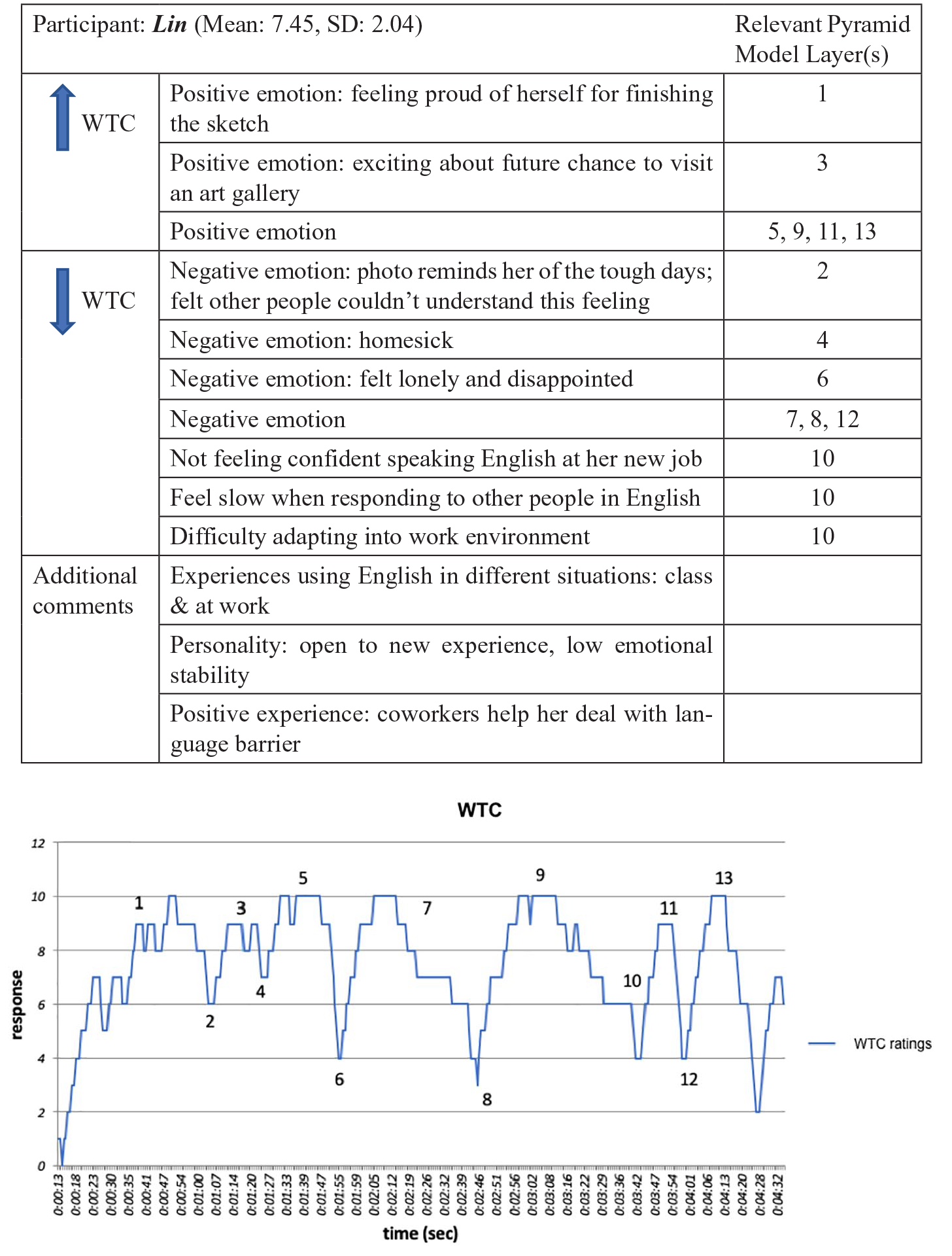
Lin’s WTC ratings and reasons for WTC changes.
Lin’s first decline of WTC at Section 2, from a rating of 10 to a rating of 6, happened because she felt less willing to talk about the struggle that she experienced while working on the sketch. As she stated in the interview, ‘when I think back, because I spent three days, so during these three days, it’s really tough for me, because I need to struggle by myself.’ At Section 4, her WTC decreased when she recalled times she felt homesick ‘because I lived in Beijing, it’s far from me. And I may be a little miss home. Because I come here over a year.’ At Section 6 she was talking about loneliness and frustration during a difficult job search. Although studying in an English-speaking country and willing to speak in English, Lin found herself getting few opportunities to use the language in her daily life. In the interview, she said, ‘Actually in MBA courses, (we are) all surrounded by all Chinese students, and only teacher speak English, and all students speak Chinese, it’s weird.’ She described a different context with her job at the art gallery: So all the art gallery’s work experience, work environment, all English, no Chinese. It’s a good experience. But I realized I still have a long way to go, to improve my English . . . (I’m) more relaxed (in speaking English now), because last week, I’m feel a little nervous because I feel sorry. Because about my English, I want to show them (my coworkers) more, but language barrier. But after I said (sorry) to them, they said they accept it and they would like to help me to improve my English.
b Analysis
Lin’s signature dynamics underlying changes in WTC were emotional, similar to Nyiti’s. Lin described her personality as open to experience, as she said: I think it (speaking English) is interesting. Because learn new things make me excited. . . . I don’t like a boring life, like go to work and go back, and do some housework. This is boring. But learn some new things is interesting.
MacIntyre et al. (1998) have long suggested that the role of individual differences (personality) is played out within a broader social climate between L1 and L2 communities, which provide the conditions that either favor or hinder the use of the L2. Lin felt support for language learning from her English-speaking co-workers, even as her L2 competence still has, as she said, ‘a long way to go.’ Lin described positive emotions interacting with self-assessment of language competence to produce relatively high WTC.
Lin’s post-task interview further demonstrates that CDST is relevant to explaining how each state of WTC transforms from immediately preceding experience (see Larsen-Freeman, 2018; MacIntyre, 2020). Lin acknowledged that her WTC was especially high during the photo narrative task that day. She said: . . . depending on my mood. Right now, maybe my mood is higher than before. Because before I come here, I have a good communication with my co-worker . . . Maybe another time when I come here to do this research, maybe I have all down (ratings), it (will be) different.
Lin’s comment reflects her intuitive awareness of the situated, dynamic nature of WTC, acknowledging that it emerges in part because she is coming to the study from a positive communicative encounter with her co-worker.
Finally, Lin’s interview revealed an interesting contrast to Hien. Both Lin and Hien described some difficulty with communicative competence (Layer 5) and L2 self-confidence (Layer 4), but they reacted in very different ways. In the interview, Lin said: I’m not confident about my language . . . when I take the art gallery’s summer job, I feel confuse about what I have learned. And when they talk to each other, maybe their accent, or maybe their culture, or maybe the words they use are different from (what I) learned . . . When they’re talking, 80% (of time) I can understand what they’re talking about. But sometimes I react not quickly, and if I response to teacher’s question, it’s a little hard for me. I was, like I need to translate into English.
However, in contrast to Hien, these factors were not debilitating to Lin’s state communicative self-confidence. During the photo narrative task, she spoke with frequent pauses, hesitations, and grammar mistakes, but these factors did not generate commentary during the interview. Instead, she focused on meaningfully communicating and interacting with the interlocutor. Unlike Hien, Lin was not focusing on difficulties in linguistic competence during task performance but was interested in sharing (communicating) her experiences related to the photo. Similar to Nyiti, Lin focused on interpersonal motives and desire to communicate with the interlocutor, which maintained high WTC.
4 General discussion
The research gap addressed by this study concerns the need to account for the interacting influences of learners’ past experience on WTC in a specific situation, in real time (Freiermuth & Ito, 2020; MacIntyre, 2020). The three focal individuals’ WTC ratings show that emotions and communicative intentions – the reasons why a person is talking – influence the trajectory of the signature dynamics within a specific instance of a communication event. The pyramid model of WTC suggests, and research results show, that the intention to talk is formed based on many potentially relevant psychological and contextual factors, both immediate (e.g. desire to communicate, confidence, emotional arousal) and distal (e.g. intergroup attitudes, learning experience, communicative competence). Emotions (past, present, and future) play a major role in shaping patterns of WTC fluctuations, but the original model was largely silent on the role of emotions (except for anxiety). In the present data, Nyiti’s signature dynamics featured strong emotions as the conversational turns took place, and he clearly was linking emotions such as love, loneliness, and pride based on past experience, present feelings, and an anticipated future (Dewaele & Pavelescu, 2021). In contrast, Hien showed weaker intentions for meaningful communication, less emotional investment, and lower levels of WTC. For Hein, the signature dynamics concerned self-conscious task performance in a lab setting. The final participant, Lin, exhibited high WTC in spite of language difficulties, linking her positive WTC to recent encouragement from her co-workers. There is a similarity between the signature dynamics of Lin and Nyiti who both were invested in describing the meaningful experiences with family, represented by the photos they were discussing. Nyiti spoke more easily than Lin, but both formed a strong communication intention to share their stories and showed ratings of WTC than did Hein, who was more self-conscious. These findings suggest that the reasons why a person is communicating are closely related to how the signature dynamics of emotions, perceived competencies, and WTC unfold over time. The implication for language teachers is that creating the conditions in which learners form a strong intention toward meaningful communication with emotional investment can overcome uncertainty in one’s language ability.
V Pedagogical implications
The above analyses point to the close connections between learner psychology and pedagogy. Perhaps the overarching implication is the value of understanding individual-level dynamics (Larsen-Freeman, 2018). Both learner psychology and language pedagogy theory tend to use methods that focus on groups. It would be inappropriate to assume that group averages and trends will be applicable to individuals. The richness of individual-level data generated by the idiodynamic method, used as a teaching tool, both encourages learners’ self-reflection and informs teachers of the many driving and restraining forces simultaneously faced by the learners and not a hypothetical abstraction of ‘the learner’ (MacIntyre, 2020). The idiodynamic method is systematic in rating a brief communication event in its entirety. Doing so provides a complete and possibly less biased account because it is so immediately connected to communication, with ratings made immediately after the communication event. Retrospective methods that aggregate or summarize more than one communication event are subject to a long list of biases (Gregersen & MacIntyre, 2017). Applied as a teaching tool, both the teacher and learner can rapidly gain an understanding of psychological factors that increase or reduce WTC for specific individuals, and therefore evaluate the efficacy of pedagogical interventions. Teachers can use video to record and analyse students’ performance in a variety of class activity types (e.g. a presentation, pair work, a structured conversation, etc.), or students could be assigned an idiodynamic self-assessment project. Comparing the results of an idiodynamic analysis across tasks, over time, and in different contexts can be especially informative about learner psychology.
The second implication concerns the importance of explicitly considering learner beliefs and emotions aroused by teaching techniques. Emotion theory suggests that negative emotions restrict attention and positive emotions broaden one’s thoughts and action repertoire (Fredrickson, 2013; MacIntyre & Gregersen, 2012). The above results reinforce how emotion processes facilitate and/or hinder WTC. In the interview, learners report on their emotions, which provides L2 instructors with a window into the learner’s key psychological processes. Teachers continuously design classroom experiences that generate specific emotions, and by working to promote positive emotions they can promote L2 communication. Emotion is core to LP and can no longer be seen as irrelevant to ISLA (Prior, 2019).
The third pedagogical implication emerges from the use of the photo narrative task. This task is meaningful for the respondents because they have chosen the photo for communication purposes. The task can test the limits of vocabulary, create fluctuations in WTC, and often generate conflicted emotions. In the above data, the learners who focused on authentically communicating meaning (Nyiti, Lin) were willing to talk despite arousal of restraining factors such as anxiety, memory lapses, and grammar issues. The learner who mostly focused on performance (Hien) showed much lower WTC and reported negative processes that reduced communication. Because WTC and learning are so intricately intertwined, teachers who can generate meaningful activities to encourage WTC are better able to take advantage of psychological factors promoting language learning.
VI Limitations and future direction
This research has a number of limitations to consider when interpreting its relevance to language pedagogy. The individual-level, qualitative analysis is not indicative of generalized processes but is recognized to be highly idiosyncratic. The specific signature dynamics that integrate prior learning, communication intentions, interpersonal motives, and felt emotions combine in unique ways for each individual on different occasions. The type of task chosen for analysis here likely places limitations on the LP processes that can be observed. If different speakers had been chosen for in-depth analysis, or different tasks used to generate data, different LP processes would be highlighted, because of the wide range of factors that potentially influence WTC. The meaningful photo narrative task tends to generate emotional reactions, and the data here show the influence of emotions on communication; other types of tasks may tap into different signature dynamics. The task-based emphasis on a particular type of LP process is not all that different from research on WTC that has used methods requiring the researcher to decide in advance which factors to study (e.g. adding scales of anxiety, perceived competence, or motivation to a questionnaire).
VII Conclusions
There is incredible complexity affecting the signature dynamics of WTC changes moment-to-moment. Interrogating the sources WTC in the context of CDST reveals a rich set of processes underlying the intention to speak (Freiermuth & Ito, 2020). However, as rich as this data is, there is more yet to be seen by applying these ideas to other tasks, in other situations, with other languages, and more learners. The idiodynamic method can be used by teachers as a tool in ISLA for revealing LP processes and its interaction with pedagogy. Teachers can use the idiodynamic method for complex task assessment, and learners can use it for self-reflection. The data show the importance of emotional engagement for learning within meaningful language activities.
Footnotes
Funding
The author(s) disclosed receipt of the following financial support for the research, authorship, and/or publication of this article: The author(s) received financial support from Cape Breton University and the Social Sciences and Humanities Research Council of Canada to facilitate publication of this article.