



Abstract
Research has shown that learning a known-and-unknown word combination leads to greater learning than learning an unknown word alone (Kasahara, 2010, 2011). These studies found that attaching a known adjective to an unknown noun can help learners remember the unknown noun. Kasahara (2015) found that a known verb can serve as an effective cue to remember an unknown noun in a known-and-unknown combination. To examine useful cues to learn unknown verbs, this study compared verb (unknown) + noun (known) combinations to verb (unknown) + adverb (known) combinations. Additionally, we explored how learners’ vocabulary size would affect the known-and-unknown two-word combination learning to deepen our understanding of the characteristics of students who benefit from combination learning. The participants in each group learned 18 two-word combinations consisting of the same unknown target verbs and different known cues (nouns or adverbs). The participants were provided with a five-minute learning phase and two immediate recall tests: a Single Word Test, to write down the L1 meanings of the targets, and a Combination Test, to write down the L1 meanings of the combinations. The same two tests were administered one week later. The results showed that known nouns were better cues for learning unknown verbs than known adverbs. It was also found that participants with a larger vocabulary size benefited more from two-word combination learning.
Keywords
I Introduction
The importance of acquiring multiword units (MWUs) has been widely understood among researchers and language teachers in the past few decades (Pellicer-Sánchez, 2020). It is assumed that learning MWUs is more demanding for second language (L2) learners than learning single words because of their idiomatic and complex nature (Laufer, 1997). Therefore, MWUs are argued to require more attentional resources of L2 learners (Peters, 2014). However, some studies have shown that MWUs can facilitate L2 vocabulary acquisition (Kasahara, 2010, 2011, 2015; Laufer & Girsai, 2008). A series of Kasahara’s studies (2010, 2011, 2015) found that learning a target word with a known word led to greater learning gains than learning the target word alone. Previous studies have exclusively focused on the learning of unknown noun words; thus, it is still not clear whether the effectiveness of combination learning can be generalizable to the learning of other parts of speech. In order to expand upon previous research, this study examines the effectiveness of combination learning on new verb learning while using known nouns or adverbs. Additionally, the relationship between learning and learners’ vocabulary size was investigated.
1 Paired-associate learning in L2 vocabulary acquisition
Incidental learning and deliberate learning are mutually complementary for successful L2 vocabulary acquisition (Schmitt, 2010). Unlike L1 vocabulary acquisition – where most lexical items are learned incidentally, L2 vocabulary acquisition cannot be accomplished solely by incidental learning (Cobb, 2007; Laufer, 2003). As Nation’s (2007) four strands suggest, deliberate learning plays a crucial role in L2 vocabulary acquisition as well as meaning-focused input, meaning-focused output, and fluency development. Deliberate vocabulary learning often takes the form of decontextualization, or paired-associate learning, where learners learn new words out of context by attaching L1 equivalents or L2 synonyms.
Paired-associate learning was severely criticized at one time because of the assumption that intentionally learned items cannot be transformed into items that can be used automatically in real communication (Krashen, 1982, 1985). However, Elgort (2011) found that L2 vocabulary knowledge gained through paired-associate learning can be turned into knowledge that can be used automatically like L1 words. Moreover, several studies have revealed that decontextualized learning and paired-associate learning are more effective methods for making form–meaning connections than contextualized learning (e.g. Laufer, 2003; Laufer & Shmueli, 1997; Mondria, 2003; Prince, 1996; Thorndike, 1908; S. Webb, 2007; W.B. Webb, 1962).
It is true that vocabulary learning is a long cumulative process that includes knowing various types of knowledge such as forms, meanings, and usages. Paired-associate learning can only cover a small part of L2 vocabulary acquisition, such as in form-and-meaning connections. However, paired-associate learning is still a crucial first step for successful L2 vocabulary acquisition. Nation (2013) claims that ‘most language learning necessarily involves some degree of decontextualization’ (p. 103). L2 learners must see lexical items consciously ‘as parts of the language systems rather than only as messages’ (p. 103) to learn them effectively. Before making use of the benefits of incidental learning such as extensive reading, students need to know the meanings of basic high-frequency words with decontextualization such as paired-associate learning (Schmitt, 2010). Therefore, this study focused on paired-associate learning, while acknowledging it only plays a limited role in vocabulary learning.
2 Combining known and unknown words for deliberate learning
Although word-by-word paired-associate learning is usually used to learn single L2 words, Kasahara (2010, 2011, 2015) suggests using known-and-unknown two-word combinations for lower-intermediate and intermediate L2 learners. If learners acquire the most frequent 1,000 or 2,000 English words, they can use these known words to learn unknown words (Kasahara, 2015). Making connections between known and unknown words can help learners to remember the unknown words (Barcroft, 2002; Pierson, 1989; Schmitt, 2010; Sökmen, 1997). Known words are already entrenched in the learner’s mental lexicon. If a learner attaches a known word to an unknown word, the link between them can serve as a hook for the unknown word to stay in his/her mental lexicon (Schmitt, 2010). Therefore, an unknown word attached to a known word can be more resistant to forgetting than a single unknown word.
Kasahara (2010, 2011) examined whether learning combinations of known-and-unknown words was more effective than learning a single unknown word. In Kasahara (2010), using a within-participants design, 39 high school students learned 10 single words and 10 known-and-unknown two-word combinations. Kasahara (2011) employed a between-participants design, where he employed two groups of university students with the same vocabulary size. One group learned 20 single words, while the other group learned the same target words in known-and-unknown combinations. Both studies showed that the combination learning led to significantly greater gains than single-word learning. For example, it was better to learn a known-and-unknown combination business acumen than to learn the unknown word, acumen (= ‘the ability to understand and decide things quickly’), itself.
Theoretically, the effectiveness of known-and-unknown combination learning can be explained by the following three concepts: elaborative rehearsal, complementary learning systems, and enhanced imageability. The first concept, elaborative rehearsal, refers to the act of forming connections between new and old information (as opposed to maintenance rehearsal, which means repeated rehearsal of an existing representation). Baddeley (1997) argues that elaborative rehearsal is likely to lead to substantial long-term learning, whereas maintenance rehearsal is useful for short-term retention. Human memory of one piece of information cannot exist independently but interacts with our memory of other bits of information. This interaction can leave a deeper trace in our mind, which is likely to lead to long-term retention (Baddeley, 2014).
Kasahara (2010) explains the mechanism of elaborative rehearsal in known-and-unknown two-word learning. Imagine a situation where you attach a familiar cue, school, to a new target word, janitor. In the encoding phase, the cue word school can activate the equivalent in a learners’ mental lexicon. This can make it easy for the learner to make the connection between school and janitor. This newly established connection can help the learner retain the target words. In the decoding phase, this connection can help the learner retrieve the meaning of the target. In sum, the cue can help learners fix the target word in their mental lexicon in the encoding phase, and it can also help them narrow the scope of meaning search of the target word in the decoding phase.
The second concept, complementary learning systems (Davis & Gaskell, 2009; Lindsay & Gaskell, 2010; McClelland, McNaughton & O’Reilly, 1995), may also explain the superiority of known-and-unknown combination learning (Kasahara, 2015). This theory speculates that new and old forms of information are dealt with in separate places in the brain. First, new information is brought into the hippocampus and its rapid learning system begins to process the new information. Then, the new information is gradually transferred to a slow learning network in the neocortex. Newly learned words are processed for a short time in the hippocampus, and then, by way of offline consolidation like sleep, they are gradually moved to a stable long-term memory in the neocortex (Kasahara, 2015). This transfer process can be facilitated with a connection between a known cue and a new target.
The third concept is enhanced imageability. Imageability denotes the degree to which a learner can clearly generate an image of a word when he or she hears or sees the word. Words with higher imageability can be retained better than words with lower imageability (de Groot & Keijzer, 2000; Lindstromberg & Boers, 2005). This could be explained by dual coding theory (Paivio & Desrochers, 1980), which claims that a word with a clear image can be processed through two different routes in the mental lexicon. One route is for literal information; the other route is for visual information. This double route processing can promote the retention of words. Usually, concrete words have higher imageability than abstract words (de Groot & Keijzer, 2000), and some studies have shown that concrete words are less susceptible to forgetting than abstract words (Ellis & Beaton, 1993; van Hell & Mahn, 1997).
Known-and-unknown combinations may have higher imageability than individual words. Adding a known word to a target word can make the image of the target word more specific. For example, imagine a situation where a learner tries to learn the word fiend (‘a person who is addicted to something’). If the learner already knows the word drug, he or she can make a known-and-unknown combination, drug fiend. Drug fiend has a clearer and more specific image than fiend itself. This enhanced imageability can help the learner retain and retrieve the target word.
Kasahara (2010, 2011) used nouns as target words and adjectives as known cues. This seems to be reasonable because nouns are so essential in language learning that they tend to be learned earlier than verbs (Tomasello, 2003), and ‘adjective + noun collocations are the foundation of L2 collocation knowledge’ (Barfield, 2009, p. 108). In order to confirm Kasahara’s findings, however, this known-and-unknown combination learning should be tested with other types of two-word combinations. Kasahara (2015) used verbs as known cues to target nouns. He investigated whether verb (known) + noun (unknown) combinations would be as effective as adjective (known) + noun (unknown) combinations, using the same target nouns. The study employed 20 pseudowords that replaced real English nouns as the targets, and 20 high-frequency verbs and 20 high-frequency adjectives that were combined with the targets. The participants were 62 university students, who were assigned to either of the two learning conditions. There was no significant difference in vocabulary size between the two groups. After the five-minute learning session, both groups took two immediate tests. Test 1 asked them to write down the L1 meanings of the 20 target words, and Test 2 required the L1 meanings of the known-and-unknown combinations. A week later, both groups took the same two recall tests without advance notice. The results showed that both types of combination word learning led to greater learning than the single word learning. The cue verbs worked as effectively as the cue adjectives to help the participants retain and retrieve the target meanings.
The next step to confirm the effectiveness of combination learning should be to use verbs as target words because a verb together with a noun is an essential component of a minimal English sentence. Novice and intermediate learners of English tend to focus on acquiring nouns and verbs in their vocabulary learning. McCrostie (2007) investigated words in vocabulary notebooks of 124 English major university students in Japan, and found that 28% of the words were verbs, and 43% were nouns. Therefore, it would be beneficial for students of English to know effective cues to learn new verbs.
Another crucial point for investigation is the relationship between the effectiveness of the known-and-unknown two-word learning and vocabulary sizes of learners, as emphasized in Kasahara (2010, 2011). In the case of incidental vocabulary learning through reading, learners with larger vocabulary sizes can acquire more vocabulary knowledge (Horst, Cobb & Meara, 1998). Webb and Chang (2015) examined how their 37-week reading sessions of graded readers affected incidental vocabulary learning of 200 target words. They found that participants with larger vocabulary sizes obtained larger vocabulary gains. Larger vocabulary sizes may provide learners with better reading skills including guessing the meanings of new words from context. We hypothesized that learners with larger vocabulary sizes benefit more from known-and-unknown two-word learning based on the assumption that they have denser vocabulary networks than learners with smaller vocabulary sizes. The links between known cues and other words may help to learn the meanings of target words.
II Aims of the present study
Expanding on the findings of previous studies (Kasahara, 2010, 2011, 2015) that learning new words with known words facilitates vocabulary learning, the present study examines whether the learning of unknown verbs can be enhanced by combining with known nouns or adverbs. Given that verbs often appear with adverbs, it may be useful to investigate whether known adverbs can work as effective cues to learn new verbs. The main purpose of the present study is to examine which cues, nouns or adverbs, can provide the most assistance for learning new verbs. Specifically, we compared the effectiveness of verb-noun combinations and verb-adverb combinations for intentional vocabulary learning. The second purpose of this study is to investigate whether learners’ vocabulary sizes affect known-and-unknown two-word combination learning.
The present study was guided by the following two questions:
What are the relative effects of the different parts of speech (noun vs. adverb) of known cue words on the learning of unknown verbs?
Does learners’ vocabulary size influence known-and-unknown two-word combination learning?
III Method
1 Participants
The original participants were 105 Japanese undergraduate university students (aged 18–22 years) of English as a foreign language (EFL) who took one of two English classes held once a week at the university: 51 belonged to Class A and 54 belonged to Class B. All of them had completed at least six years of English learning. Based on the instructors’ judgement, the participants’ L2 proficiency was speculated to be between level A2 and B1 on the Common European Framework of Reference (CEFR). Considering the ecological validity of the research, we adopted the intact-class allocation, and these classes were randomly assigned to either (1) Verb–Noun group or (2) Verb–Adverb group. To control the influence of the participants’ proficiency, their vocabulary size was measured for the 2,000- and 3,000-word levels by using the Vocabulary Levels Test (Nation, 1990, 2001, 2008) and was examined as a confounding factor. The reason for its adoption was its easy-to-use format and high reliability as a vocabulary size test (Schmitt, Schmitt & Clapham, 2001).
The experiment was carried out over three weeks as part of the students’ weekly regular English class. Eight participants who did not report vocabulary size test scores were excluded from the analyses, which left 97 participants in the final analysis (46 in the Verb�Noun group and 51 in the Verb�Adverb group).
2 Materials
Following Kasahara (2015), 20 pseudowords were used as the target verbs for all participants to learn. The present study prioritized removing the possibility that the participants had some knowledge of the target words, though using pseudowords could lower the ecological validity of the experiment (Nation & Webb, 2011). All the pseudowords were taken from the AKC Nonword Database, a website that automatically creates pseudowords, following the basic orthographical rules of English (Rastle, Harrington, & Coltheart, 2002). Each pseudoword replaced an English verb such as blunged for study, or doost for write. The length of each word was set between five to seven letters.
The known cue words that were able to collocate with the target verbs, 20 nouns and 20 adverbs, were selected from the 1,000 word-level or 2,000 word-level in JACET 8000 (JACET, 2003), which is one of the reliable vocabulary lists for Japanese learners of English because these high-frequency words were found to be already familiar to university students in Japan (Kasahara, 2005). The existence of the 20 verb-noun combinations and the 20 verb-adverb combinations were checked with the British National Corpus, Genius English–Japanese Dictionary (Konishi & Minamide, 2006) and The Wisdom English–Japanese Dictionary (Inoue & Akano, 2008). One native speaker of English also checked whether the combinations existed. As a result, two of the verb-adverb combinations were discarded, and accordingly, two of the verb-noun combinations with the same target verbs in them were excluded from the analyses later on. The final 18 target words, the 18 verb-noun combinations, and the 18 verb-adverb combinations are shown in Table 1.
The 18 target verbs and the two types of combinations.
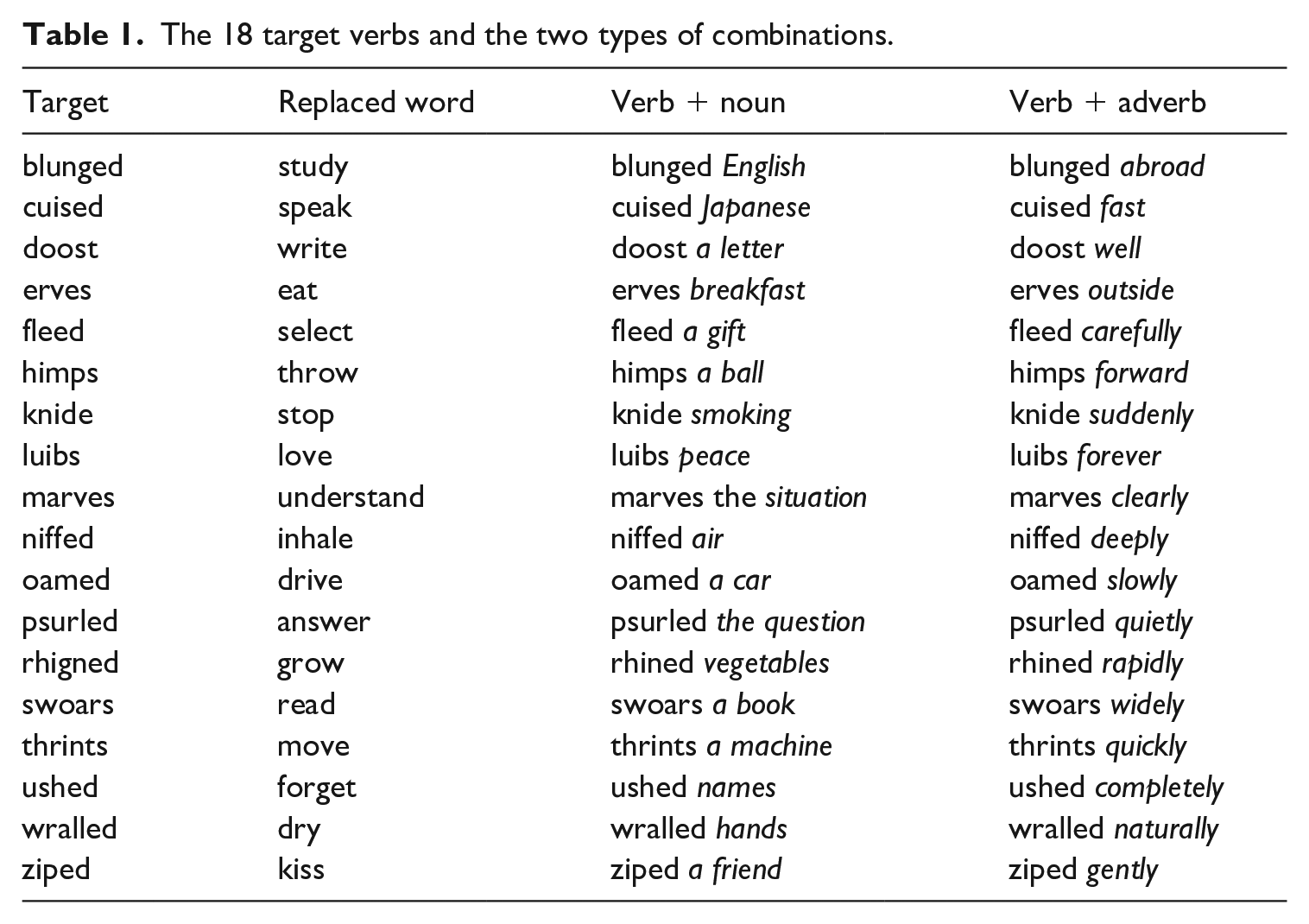
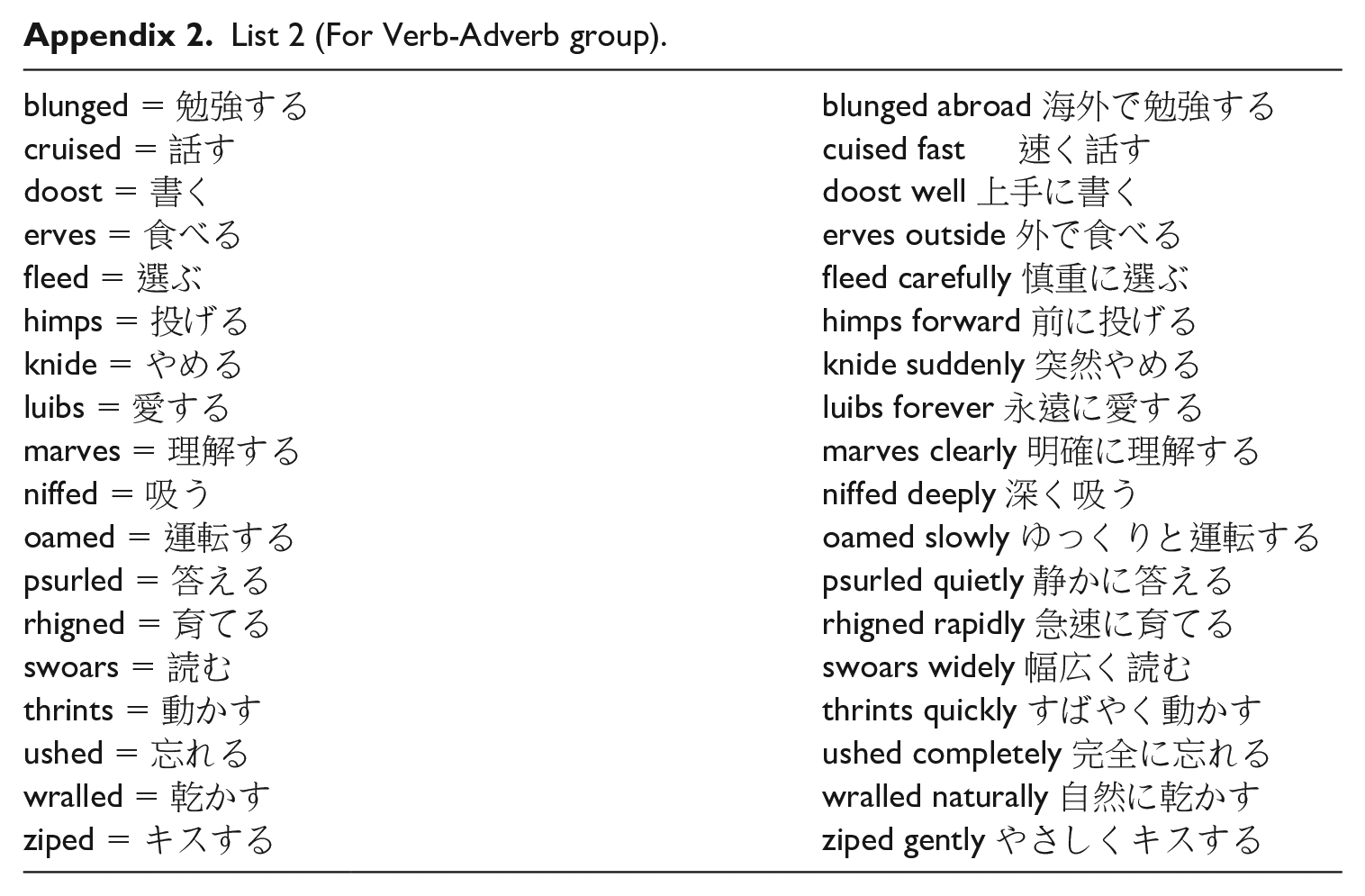
Next, we created two types of learning lists: List 1 for the Verb–Noun group and List 2 for the Verb–Adverb group. List 1 consisted of the 18 target words with their Japanese equivalents on the left and the 18 verb-noun combinations with their Japanese equivalents on the right. List 2 included the 18 target words with their Japanese equivalents on the left and the 18 verb-adverb combinations with their Japanese equivalents on the right. The target words were arranged in the same order between the two lists. For List 1, see Appendix 1; for List 2, see Appendix 2.
Following Kasahara (2015), two types of tests were adopted to measure learning. The Single Word Test asked all participants to write down the Japanese equivalents of the 18 target words. The Combination Test asked them to produce the Japanese equivalents of the combinations they had learned: the Verb–Noun group had to write down the meanings of the 18 verb-noun combinations, while the Verb–Adverb group wrote the meanings of the 18 verb-adverb combinations. The order of the target words and the combinations were randomized in order to avoid a learning order effect. Detailed information on each test is shown in Table 2. The allotted time for each test was the same as Kasahara (2015) as the same research design was used.
Means and SDs of the immediate and delayed posttests, separately for each learning condition and test format.
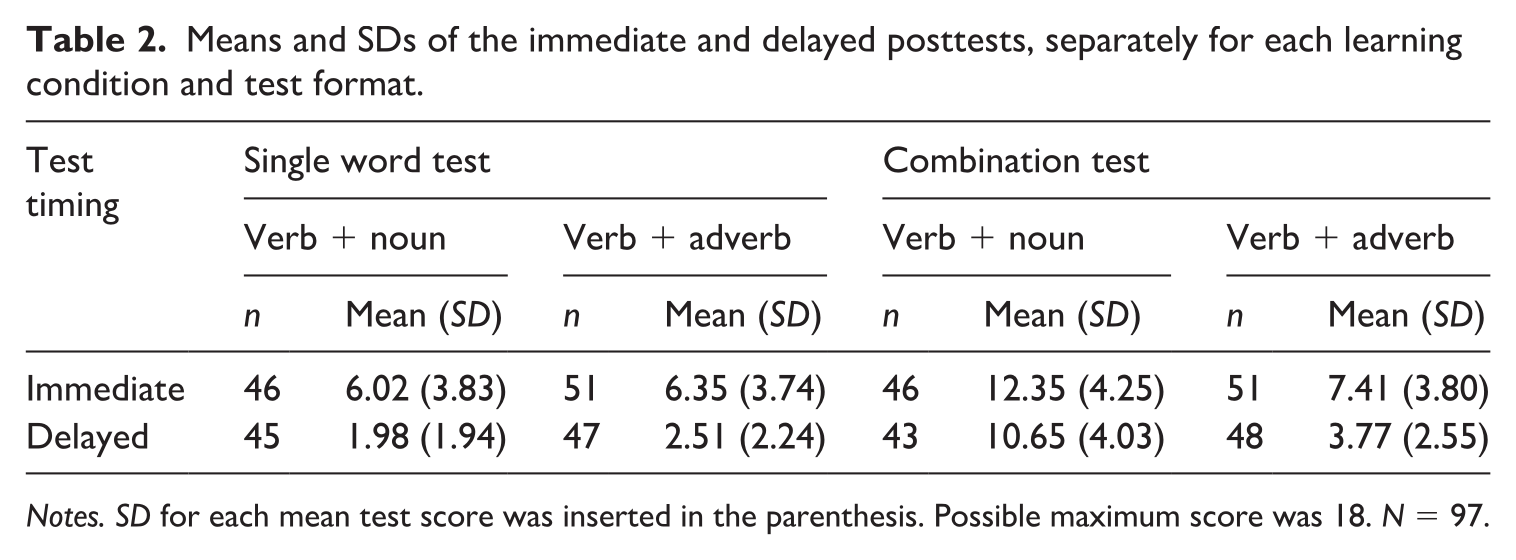
Notes. SD for each mean test score was inserted in the parenthesis. Possible maximum score was 18. N = 97.
3 Procedure
This study had three sessions held during weekly English lessons with the same procedure and time allotments as Kasahara (2015). In the first session, the participants in each group took the 2,000-word level and the 3,000-word level of the Vocabulary Levels Test. The second session included an encodings phase and immediate recall tests. Each participant in the Verb–Noun group was given List 1 (the verb + noun combinations), whereas each participant in the Verb–Adverb group was given List 2 (the verb-adverb combinations). Participants were instructed to learn the meanings of the target nouns and the combinations for five minutes. They were also told that they would have to write down the meanings of the targets during the Single Word Test and the meanings of the combinations during the Combination Test after the learning session. After the lists were collected, the participants took the Single Word Test for three minutes and then the Combination Test for four minutes. In the third session, a week later, they took the same recall tests again without any advance notice.
4 Scoring
In the Single Word Test, the participants got one point if they produced the exact Japanese equivalent to the target word in the list; otherwise, they got zero points. As for the Combination Test, only the target verbs were scored. The participants were given one point if they wrote down the correct translation for the target. They got zero points for a wrong translation for the target even if they produced the correct translation for the known cue.
5 Data analysis procedure
The participants’ responses on the immediate and delayed posttests were analysed by using a Generalized Linear Mixed-Effects Model (GLMM) (Cunnings, 2012). The GLMM has several advantages over ANOVA: (1) it does not require normal distribution of the variance, (2) it enhances the reliability of the results by accounting for the influence of random effects such as the influences related to participants, target words, known cue words, and (3) it produces more reliable results, especially when analysing the factors related to participants and target items at the same time (for this study, vocabulary size and part of speech of the known cue words) (see Cunnings, 2012 for a detailed discussion).
The analysis was conducted in the R statistical environment. The lme4 package (Bates et al., 2020) was used to carry out the GLMM. To examine the response accuracy on both the Single Word Test and the Combination Test, the participants’ responses were analysed as binary data by using the mixed logit model. Participants, target words, and cue words were specified as random effects to appropriately account for the effects of the participants and the learning items that are related to each test response. After confirming that the specifications of the random effects enhanced the model estimation by examining AIC values, we included the following predictor variables as fixed effects: Test format, Test timing, and Learning condition. Furthermore, vocabulary size was standardized as Z-scores and added to the model as another fixed effect variable to examine the influence of vocabulary size on learning. The emmeans package (Lenth et al., 2020) was used to conduct pairwise comparisons.
IV Results
Table 2 shows the descriptive statistics for the Single Word Test and the Combination Test, separately for test timing (immediate and delayed) and learning condition (Verb + noun vs. Verb + Adverb). To answer the first and second research questions, a total of 6,786 observations of the participants’ responses on the immediate and delayed posttests were analysed by using the GLMM. First, Participant, Target word, and Cue word were specified as random effects. Second, the fixed effect predictor variables – Test Format, Test Timing, Learning Condition, and a three-way interaction between Test Format, Test Timing, and Learning Condition – were added to the model. Lastly, to investigate the effect of vocabulary size on learning, a main effect and interactions related to vocabulary size, the following were further added to the model: Vocabulary Size, and interactions between Vocabulary Size and Learning condition, between Vocabulary Size and Test Format, and between Vocabulary Size and Test Timing. All predictor variables were dummy coded except for Vocabulary Size. The final model was diagnosed by using the DHARMA package (Hartig, 2020), and no abnormal residuals, dispersions, or outliners were found.
Table 3 shows the results of the final model, including all random effects and fixed effects predictors. The three-way interaction between Test Timing, Test Format, and Learning Condition was significant (p = .001), indicating that the relative effects of known cue words on learning differed based on the timing and format of the tests. Figure 1 shows the estimated accuracy rate of two learning conditions (Verb–Noun vs. Verb–Adverb), separately for different test timings and different test formats. To compare the effect of the part of speech of known cue words, the post hoc tests were administered separately for each Test Timing and each Test Format. The results showed that on the Single Word Test, there were no significant differences between Verb–Noun group and Verb–Adverb group (Odds Ratio [OR] = 0.87, z = −0.488, p = .626 on immediate and OR = 0.76, z = −0.865, p = .387 on delayed posttests). In contrast, on the Combination Test, the Verb–Noun group outperformed the Verb–Adverb group on both immediate (OR = 4.13, z = 4.955, p < .001) and delayed posttests (OR = 8.96, z = 7.481, p < .001). These results highlight the advantage of using known nouns, as opposed to adverbs, to learn new verbs; the participants were four times more accurate at recalling the meanings of the target words on immediate and nine times more accurate on the delayed posttests, although the effect was limited to the case in which participants were provided with the cue words when recalling. Additionally, for both learning conditions, the estimated accuracy rates were significantly higher on the immediate posttest compared to the delayed posttests at the level of p < .001. Similarly, the estimated accuracy rates were significantly higher when measured with the Combination Test compared to the Single Word Test (p < .001 for all Learning Conditions and Test Timings).
The results of Generalized Linear Mixed-Effects Model (GLMM) examining participants’ response on meaning recall tests.
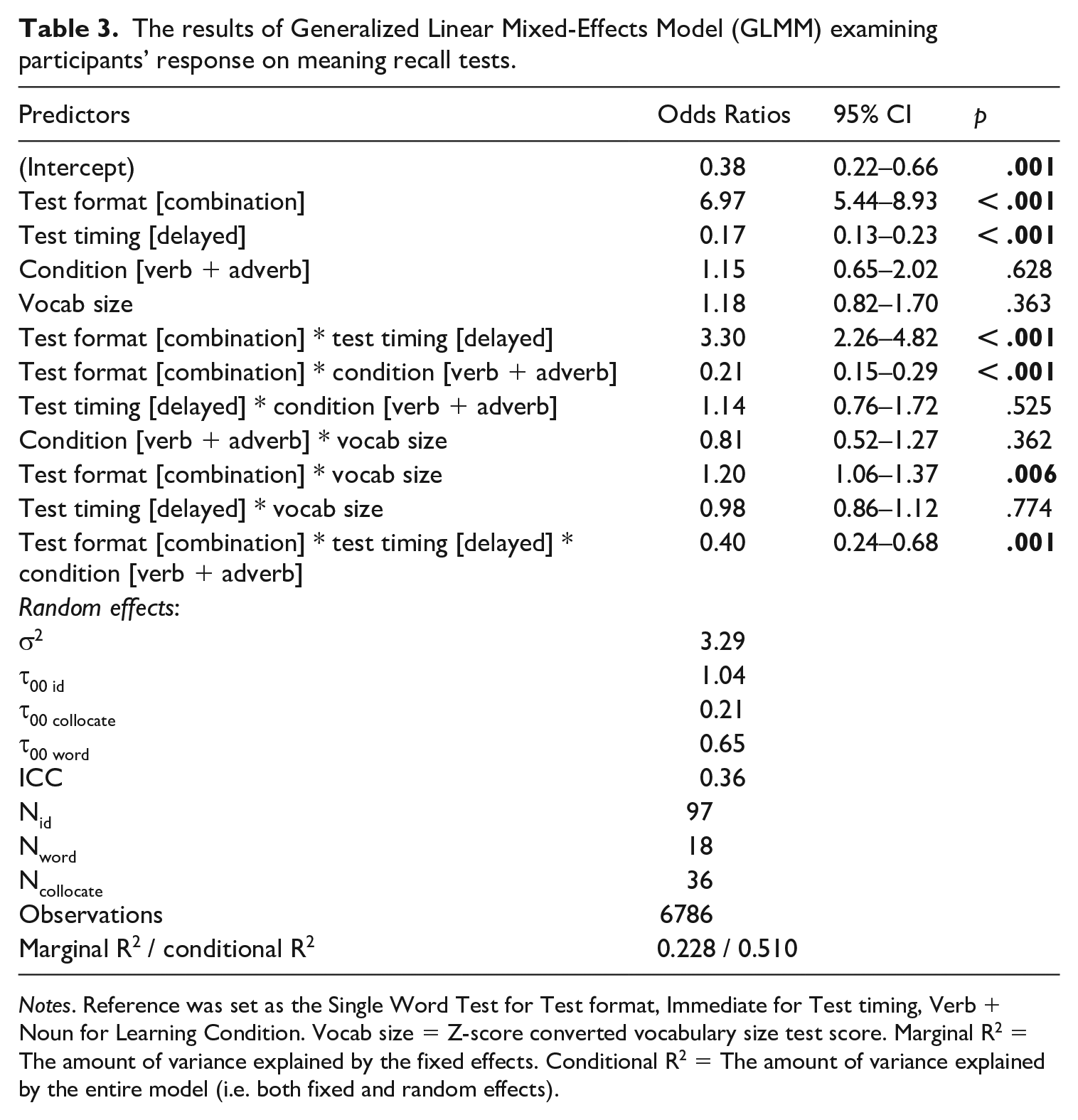
Notes. Reference was set as the Single Word Test for Test format, Immediate for Test timing, Verb + Noun for Learning Condition. Vocab size = Z-score converted vocabulary size test score. Marginal R2 = The amount of variance explained by the fixed effects. Conditional R2 = The amount of variance explained by the entire model (i.e. both fixed and random effects).
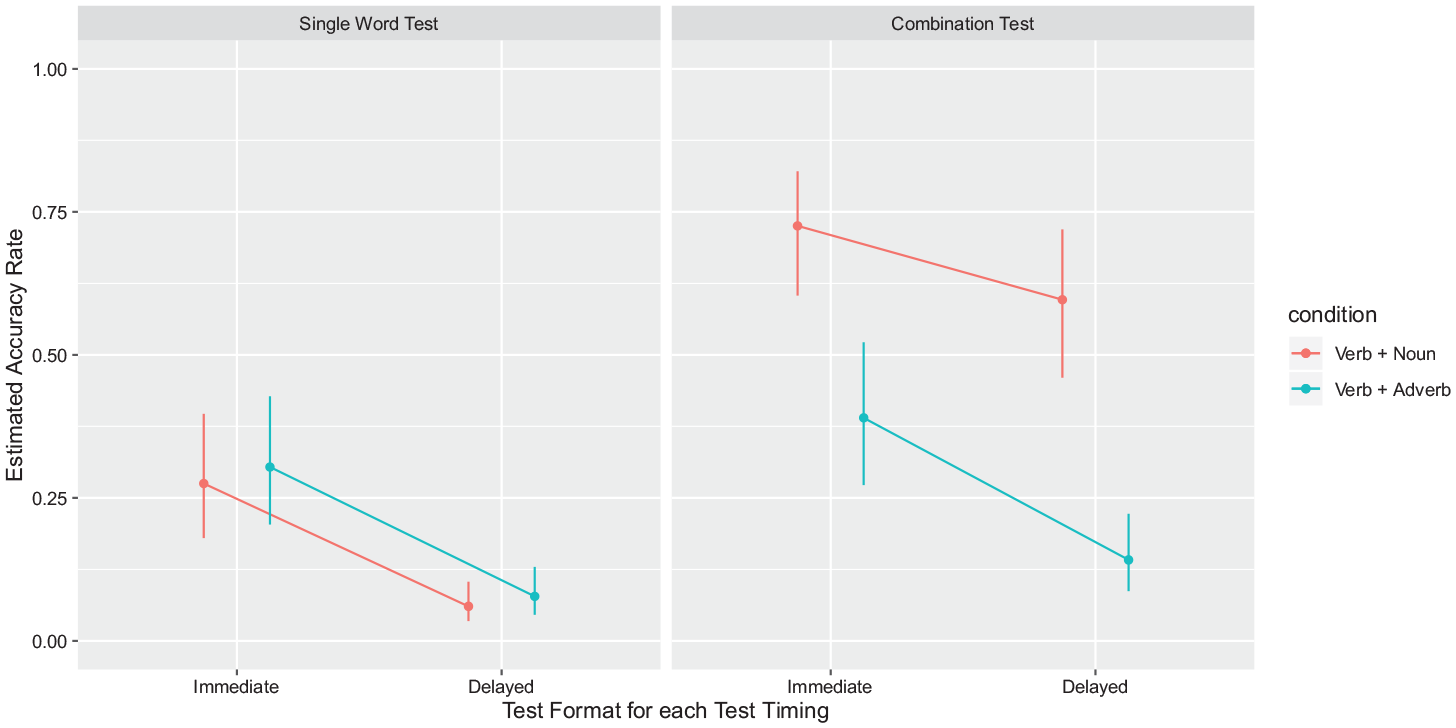
Estimated accuracy rates of different learning conditions, separately for each test timing and each test format.
Regarding the second research question investigating the influence of vocabulary size on learning, the interaction between Test Format and Vocabulary Size was significant (p = .006). In contrast, the main effect of Vocabulary Size, the interactions between Vocabulary Size and Learning Condition, and between Vocabulary Size and Test Timing were not significant (p = .363, p = .362, p = 774, respectively). The results of the non-significant main effect of Vocabulary Size and the significant interaction between Vocabulary Size and Test Format indicate that participants with a higher vocabulary size more accurately recalled the meaning of words when the cue words were provided as in the Combination Test. In contrast, such an effect of Vocabulary Size was not observed when cue words were not provided as in the Single Word Test (for the accurate response rate per Vocabulary Size, see Figure 2).
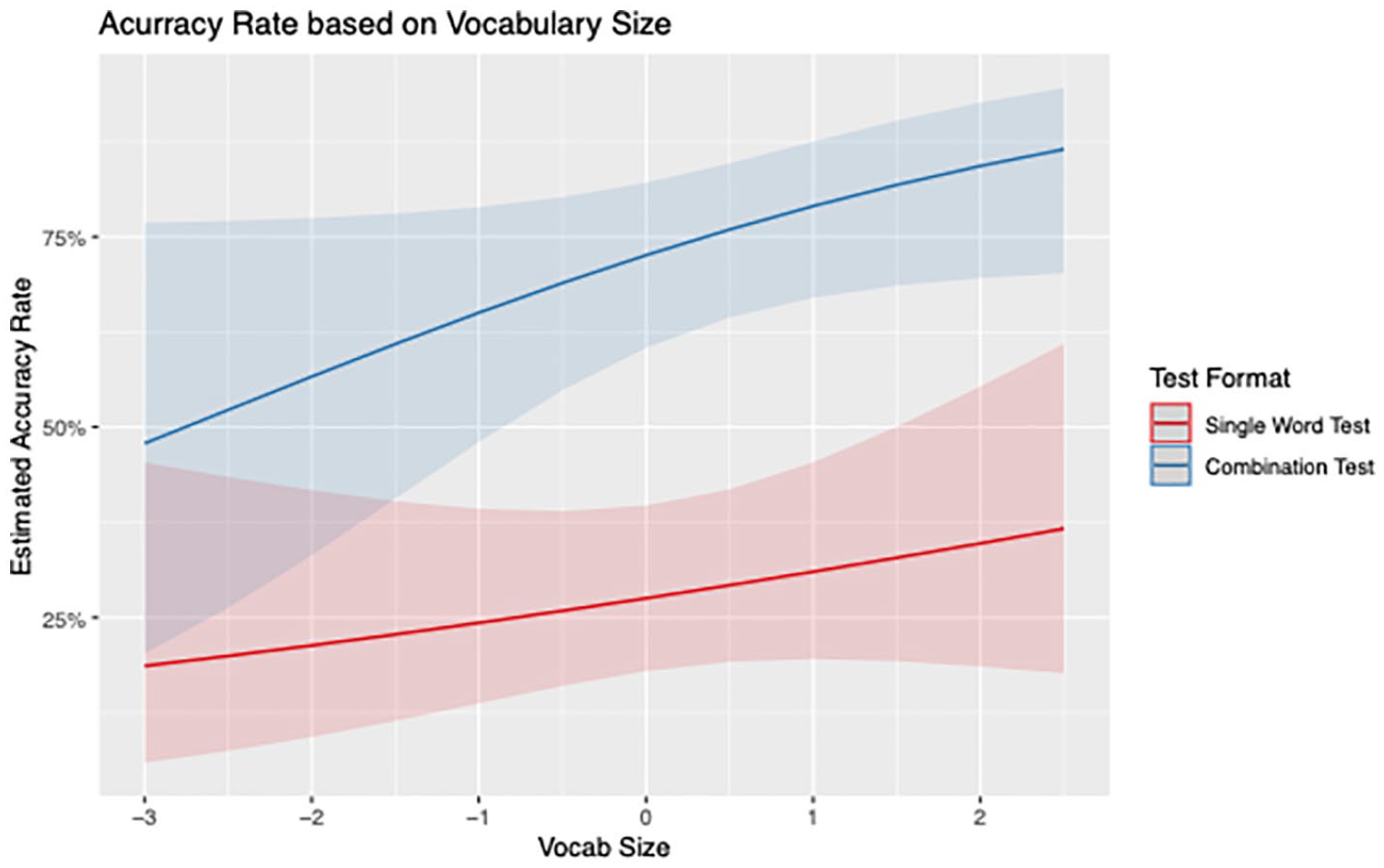
Estimated mean percentage of accuracy response per vocabulary size and test format.
V Discussion
The first research question investigated the relative effects of different parts of speech (noun vs. adverb) of known cue words on the learning of unknown verbs. The results of GLMM showed that nouns were more effective cues than adverbs to learn new verbs. The GLMM found that the Verb–Noun group outperformed the Verb–Adverb group both on the immediate and delayed Combination Tests, though there was no significant difference between the groups on the Single Word Test. This suggests that nouns serve as better cues to retrieve the meanings of target verbs than adverbs, if learners see the same known-and-unknown combinations both in the encoding and decoding phases. In addition, the Verb–Noun group produced four times more accurate recall of the target word meanings on the immediate Combination Test and nine times more on the delayed Combination Test compared to the Verb–Adverb group. The gap in recall accuracy between the groups became much larger on the delayed Combination Test. These results were confirmed by the fact that a three-way interaction was found between Test Format, Test Timing, and Learning Condition. This finding indicates that the forgetting rate for the Verb–Adverb group was greater than those for the Verb–Noun group when measured with Combination Tests. Overall, these findings suggest that verb-noun combinations may be more effective in meaning retention of target verbs than verb-adverb combinations.
There are two possible reasons why nouns are more effective cues than adverbs. In terms of retention of target verbs, verb-noun combinations may have higher imageability than verb-adverb combinations. Learners tend to retain words with higher imageability for longer than words with lower imageability (de Groot & Keijzer, 2000; Lindstromberg & Boers, 2005). This could be supported by the dual coding theory (Paivio & Desrochers, 1980), which claims a word with a clear image can be processed through both literal and visual routes in the mental lexicon. Clear visual images of concrete words can help learners retain their meanings. A significant gap in imageability can be seen in a comparison of a verb-noun combination, knide (= stop) smoking, and a verb-adverb combination, knide suddenly. The former can give learners a concrete image of someone smoking a cigar or a cigarette. On the other hand, the image that the latter creates is rather vague and abstract because learners have no idea of the subject or the object of the verb knide. This makes it hard for them to create a concrete image of the combination knide suddenly. The fact that verb-adverb combinations make it hard for learners to create their visual images may be the reason why using adverbs is less effective than using nouns in terms of retention of the target meanings.
Another potential reason for the advantage of nouns over adverbs may be that nouns are more powerful cues for limiting the scope of a meaning search than adverbs. A typical example lies in a comparison of doost (= write) a letter and doost well. Verbs that come before a letter are limited, such as read or write, whereas learners can think of a number of verbs that could come before well, not only read, write but also drive, speak, dance, etc. It can be said that nouns are powerful collocates with verbs to narrow down the meanings of the verbs, while adverbs are weak collocates in this respect. Therefore, this study found that the verb-noun combinations were more effective for retrieving the meanings of the target verbs than the verb-adverb combinations.
The second research question was about the relationship between learners’ vocabulary size and the known-and-unknown two-word combination learning. The present study found that participants with a larger vocabulary more accurately recalled the meanings of target words when the cue words were given in the testing phase. The results showed a significant two-way interaction between Vocabulary Size and Test Format and the non-significant main effect of Vocabulary Size, indicating that scores on the Combination Test increased as the vocabulary size of students increased. This finding overlaps the results of incidental vocabulary learning through reading (Peters, 2016; Horst et al., 1998; Webb & Chang, 2015), which demonstrated that students with larger vocabularies gained more words than students with smaller ones.
A possible reason why learners with larger vocabularies benefited significantly more from the known-and-unknown two-word combination learning might lie in their dense vocabulary network. The vocabulary network in the mental lexicon of a learner with a large vocabulary size is comparable to a fine-meshed net, as shown on the left side of Figure 3. This fine-mesh can catch a target word easily and retain it for a long time. Learners with large vocabularies have developed various kinds of connections between the words they have already acquired. These include semantic-related, syntactic-related, and phonological related connections. When they see a known-and-unknown two-word combination, the known cue word can activate its connections with other lexical items in their mental lexicon. Then a connection between the cue and the target can be gradually formed. This newly established connection could remain in their mental lexicon for a long time with the help of the old connections between the cue and other words. Then, in the decoding phase, the new connection between the cue and the target can help learners retrieve the target words’ meaning. Supporting evidence was provided by Nguyen and Webb (2017), who found that students’ collocational knowledge increased as their vocabulary sizes increased (for the relationship between vocabulary size and depth of vocabulary knowledge, see also, Schmitt, 2014).
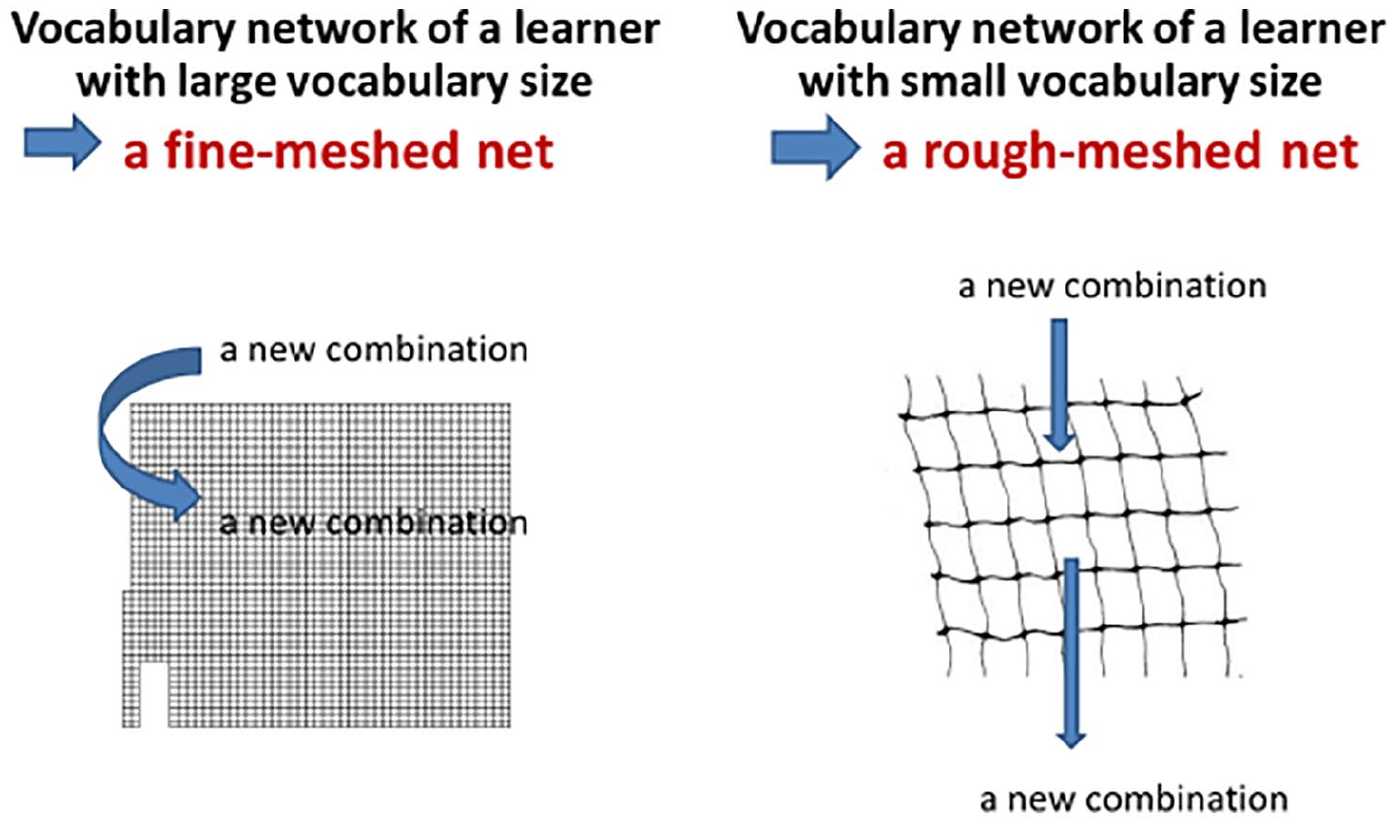
The vocabulary network of a learner with a large vocabulary size and the vocabulary network of a learner with a small vocabulary size.
In contrast, the vocabulary network in the mental lexicon of a learner with a small vocabulary size may be conceptualized as a rough-meshed net, as illustrated on the right side of Figure 3. His or her mental lexicon does not have a large number of lexical connections, and each cell of the net is quite large. Even if a learner knows a cue word in a two-word combination, the cue does not have numerous connections with other words. As a result, the cue word cannot substantially help retain the target word in the mental lexicon. The rough-meshed net of the lexical network has great difficulty in catching and especially retaining the target word. The target word can easily slip through the rough-meshed net, and it is difficult to build a connection between the cue and the target. Therefore, the cue word’s presence would not be of great help for the learner to retrieve the meaning of the target word. In conclusion, the larger the vocabulary size of the learner, the greater benefit he or she will obtain from the known-and-unknown two-word combination.
VI Limitations and future directions
Although the findings of the current study may be useful, this study has some limitations. First, this study only examined the parts of speech of cue words. It may be useful for future studies to examine the other characteristics of cue words (e.g. imageability, concreteness, word lengths, Ellis & Beaton, 1993; Peters, 2016) and combinations between cue and target words (e.g. frequency and mutual information scores; e.g. Nguyen & Webb, 2017).
Second, the present study used pseudowords as target words to control for the prior knowledge of participants. Although this is a commonly used approach in vocabulary research (e.g. Webb, 2007), it may be useful to replicate the study with real words in order to examine whether the results can be generalizable to the actual learning context (Nation & Webb, 2011).
Third, in this study, the target verbs in the verb-noun combination condition were all transitive verbs (e.g. speak Japanese) whereas those in the verb-adverb combination condition were intransitive verbs (e.g. speak slowly). The participants in this study may have remembered some of the target verbs replaced with the pseudowords as intransitive verbs (e.g. speak, stop, or answer) and other verbs as transitive verbs (e.g. study, write, or eat). Their knowledge of the original verbs might have interfered with learning if a verb remembered as an intransitive verb was used as a transitive verb in the experiment, or vice versa. These possible discrepancies might have affected the results although the target verbs were replaced with pseudowords.
Lastly, it is important to remember that intentional learning (including paired-associate learning) plays only a limited role in vocabulary learning. Vocabulary learning is an incremental process and students learn vocabulary by engaging in not only intentional but also incidental learning, where the words are repeatedly encountered in various contexts. The current study focused only on the form–meaning mapping of vocabulary knowledge from paired-associate learning. Knowledge of new words learned through intentional learning may be further enriched through incidental learning. Future research may benefit from exploring the long-term effect of combination learning in natural learning environments, where words are learned in both deliberate and incidental learning.
VII Conclusion
This study has presented the following two findings: (1) a known noun is a more effective cue word than a known adverb in order to learn a new verb in an known-unknown two-word combination; (2) learners with a larger vocabulary can benefit more from learning new words in combination learning. A pedagogical implication of these findings is that learners may better be supported to learn new verbs by combining them with known nouns. This two-word combination learning is more effective for learning target verbs than for learning the verbs alone. Another merit of known-and-unknown two-word learning is that learners can increase their knowledge of verb-and-noun collocations (Kasahara, 2015). This contributes greatly to improving their productive skills ‘because a verb-and-noun combination is a core part of an English sentence’ (p. 328). If learners already have a certain number of high frequency English nouns in their mental lexicons, they can be advised to use these nouns as cues in the unknown-and-known combinations to acquire new verbs.
Footnotes
Appendix
Appendix 2. List 2 (For Verb-Adverb group).
| blunged = 勉強する | blunged abroad 海外で勉強する |
| cruised = 話す | cuised fast 速く話す |
| doost = 書く | doost well 上手に書く |
| erves = 食べる | erves outside 外で食べる |
| fleed = 選ぶ | fleed carefully 慎重に選ぶ |
| himps = 投げる | himps forward 前に投げる |
| knide = やめる | knide suddenly 突然やめる |
| luibs = 愛する | luibs forever 永遠に愛する |
| marves = 理解する | marves clearly 明確に理解する |
| niffed = 吸う | niffed deeply 深く吸う |
| oamed = 運転する | oamed slowly ゆっくりと運転する |
| psurled = 答える | psurled quietly 静かに答える |
| rhigned = 育てる | rhigned rapidly 急速に育てる |
| swoars = 読む | swoars widely 幅広く読む |
| thrints = 動かす | thrints quickly すばやく動かす |
| ushed = 忘れる | ushed completely 完全に忘れる |
| wralled = 乾かす | wralled naturally 自然に乾かす |
| ziped = キスする | ziped gently やさしくキスする |
Acknowledgements
We would like to thank Martha Black, Kaitlyn Yanagisawa, Frank Boers, and the anonymous Language Teaching Research reviewers for their helpful feedback on earlier versions of the manuscript.
Funding
The author(s) disclosed receipt of the following financial support for the research, authorship, and/or publication of this article: This study was supported by JPS KAKENHI grant number 22520628.
